Egg Processing
Egg Processing Systems
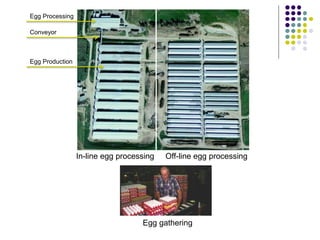
 In-Line Processing
 Egg processing occurs at the same location as
the egg production facility.
 This processing method is the most efficient egg
collection and processing of eggs available. Eggs
are delivered from the egg production facility to the
egg processing facility by an enclosed and
refrigerated conveyor system.
 Egg handling and processing is performed
with automated equipment.
Egg Processing Systems
 Off-Line Processing
 Egg processing occurs separate from the egg
production facility.
 This processing method utilizes satellite farms.
Satellite farms are egg production facilities that are
located at a different location from the egg
processing facility.
 Eggs produced at satellite farms must be gathered
and delivered to the egg processing facility.
 Egg handling and gathering is performed with
automated equipment.
In-line egg processing Off-line egg processing
Egg gathering
Egg Processing
Egg Production
Conveyor
Egg Processing Systems
 Care of eggs on the farm
 Regardless of on-line or off-line processing,
steps are taken to maintain egg quality on the
farm.
 These include, but are not limited to, egg collection
occurring several times daily, careful egg handling
procedures, egg cooling, egg cleaning, and use of
clean packaging materials.
Processing Functions
 Cleaning the Eggs
 All eggs in the United States are washed in warm water
with a mild detergent in order to remove any contaminants
(manure, grease, blood, yolk, etc.) before they are sold for
human consumption.
 Eggs are dried to remove an excess moisture prior to
packaging.
 Removal of contaminants prevents egg spoilage by
bacteria.
 Eggs that are not cleaned or contain defects are removed
from the processing line and are not packaged for human
consumption.
Processing Functions
 Grading
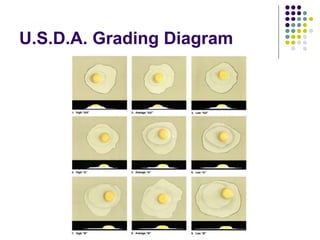
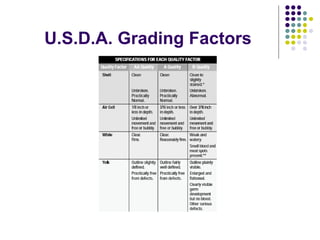
 Grading refers to the process of grouping eggs according
to similar characteristics, such as quality and weight.
 Egg grading is performed by trained professionals from the
United States Department of Agriculture (U.S.D.A.).
 The USDA has a stringent set of requirements for the
grading of fresh shell eggs.
 Egg grading is dependent upon examination of internal
quality factors (e.g., condition of the egg white and yolk, air
cell size).
U.S.D.A. Grading Diagram
Processing Functions
 Grading Continued
 Internal quality factors can also be determined
by candling.
 Candling involves holding the egg to a
concentrated light source for visual inspection
of internal defects, such as blood spots or
double yolks.
Processing Functions
 Grading Continued
 Egg grading is also dependent upon external quality
factors (e.g., shape, texture, cleanliness, and soundness
of the shell).
 An egg with a AA grade contains the most desirable
characteristics while an egg with a B grade contains the
least desirable characteristics.
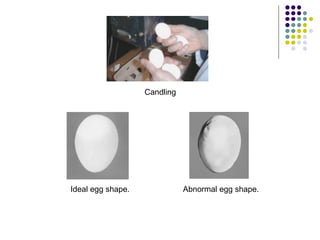
 External quality can be determined by candling for
illumination and detection of egg shell cracks.
Ideal egg shape. Abnormal egg shape.
Candling
U.S.D.A. Grading Factors
Processing Functions
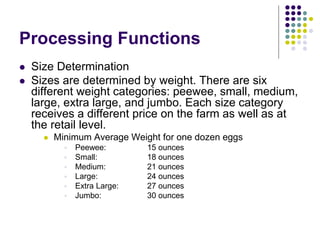
 Size Determination
 Sizes are determined by weight. There are six
different weight categories: peewee, small, medium,
large, extra large, and jumbo. Each size category
receives a different price on the farm as well as at
the retail level.
 Minimum Average Weight for one dozen eggs
 Peewee: 15 ounces
 Small: 18 ounces
 Medium: 21 ounces
 Large: 24 ounces
 Extra Large: 27 ounces
 Jumbo: 30 ounces
Processing Functions
 Packaging
 Eggs are packaged into a variety of containers
designed for safe shipment and enhanced
product appearance for the consumer.
 Loose packaging is a simple way of moving large
quantities of eggs in an efficient but also simple
fashion. Loose packaging usually refers to either
a thirty egg large or extra large flat, or a twenty
egg jumbo flat. Loose sales mostly consist of
sales to restaurants or other large quantity
consumers.
Processing Functions
 Packaging Continued
 In retail settings, eggs are often packaged in
cartons containing either one dozen or eighteen
eggs.
 This packaging method is designed to be handled
by the final consumer and is therefore usually
designed to be quite appealing.
 There are several different varieties of eggs
available to the consumer, called designer eggs by
the industry.
Care and Handling
 Refrigeration
 Eggs must be cooled to a core temperature of
45 ˚F.
 Eggs held prior to processing must also be
cooled.
 All eggs being transported must be hauled in a
refrigerated trailer so that the core temperature is
held constant at 45 ˚F.
Care and Handling
 Mechanical Handling
 Eggs are moved using conveyor systems
between the production facility and the processing
plant.
 The processing machinery is fully mechanical and
most of the equipment on commercial farms
works to wash, dry, sort by weight and quality,
and package the eggs into specified packaging.
 Once eggs are consolidated to pallets, fork lifts
are used to handle the product.
Labeling
 Sell by Date
 Every individual package of eggs processed must
contain a sell by date that is set from the date of
processing.
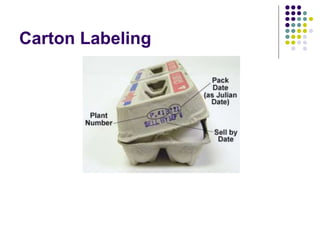
 Julian Date
 This is the three digit day number relative to the
day in the year the eggs were processed. This
date is calculated with January 1 as 001 and
December 31 as 365. This date is listed next to
the plant code.
Labeling
 Grade
 Both the size of the eggs and the level of quality
are printed on the carton. Most fresh shell eggs
are signified by an A or AA grade.
 Plant Code
 A code is printed on every carton produced in a
processing plant. Each plant has its own
individual code so that if there is a need to find
the origin of the finish product, it can be traced all
the way back to the processing plant.
Carton Labeling
Labeling
 Nutritional Facts
 Nutritional information is printed on every package
for retail sale. This information varies slightly
depending on the egg size and also the type of
egg (designer eggs).
 “Keep Refrigerated”
 All egg packages are labeled with a cautionary
“keep refrigerated” label. Refrigeration helps
reduce the growth of salmonella or other bacteria.
Labeling
 U.E.P. “Animal Care Certified”
 Nationwide many egg farmers have voluntarily
joined the United Egg Producers (U.E.P.), which
develops regulations to ensure the overall welfare
of chickens being used for egg production. When
a farm becomes “Animal Care Certified”, this label
informs the consumer that the product was
produced in accordance with accepted animal
welfare standards.

EggProcessing.ppt

  • 1.
  • 2.
    Egg Processing Systems In-Line Processing  Egg processing occurs at the same location as the egg production facility.  This processing method is the most efficient egg collection and processing of eggs available. Eggs are delivered from the egg production facility to the egg processing facility by an enclosed and refrigerated conveyor system.  Egg handling and processing is performed with automated equipment.
  • 3.
    Egg Processing Systems Off-Line Processing  Egg processing occurs separate from the egg production facility.  This processing method utilizes satellite farms. Satellite farms are egg production facilities that are located at a different location from the egg processing facility.  Eggs produced at satellite farms must be gathered and delivered to the egg processing facility.  Egg handling and gathering is performed with automated equipment.
  • 4.
    In-line egg processingOff-line egg processing Egg gathering Egg Processing Egg Production Conveyor
  • 5.
    Egg Processing Systems Care of eggs on the farm  Regardless of on-line or off-line processing, steps are taken to maintain egg quality on the farm.  These include, but are not limited to, egg collection occurring several times daily, careful egg handling procedures, egg cooling, egg cleaning, and use of clean packaging materials.
  • 6.
    Processing Functions  Cleaningthe Eggs  All eggs in the United States are washed in warm water with a mild detergent in order to remove any contaminants (manure, grease, blood, yolk, etc.) before they are sold for human consumption.  Eggs are dried to remove an excess moisture prior to packaging.  Removal of contaminants prevents egg spoilage by bacteria.  Eggs that are not cleaned or contain defects are removed from the processing line and are not packaged for human consumption.
  • 7.
    Processing Functions  Grading Grading refers to the process of grouping eggs according to similar characteristics, such as quality and weight.  Egg grading is performed by trained professionals from the United States Department of Agriculture (U.S.D.A.).  The USDA has a stringent set of requirements for the grading of fresh shell eggs.  Egg grading is dependent upon examination of internal quality factors (e.g., condition of the egg white and yolk, air cell size).
  • 8.
  • 9.
    Processing Functions  GradingContinued  Internal quality factors can also be determined by candling.  Candling involves holding the egg to a concentrated light source for visual inspection of internal defects, such as blood spots or double yolks.
  • 10.
    Processing Functions  GradingContinued  Egg grading is also dependent upon external quality factors (e.g., shape, texture, cleanliness, and soundness of the shell).  An egg with a AA grade contains the most desirable characteristics while an egg with a B grade contains the least desirable characteristics.  External quality can be determined by candling for illumination and detection of egg shell cracks.
  • 11.
    Ideal egg shape.Abnormal egg shape. Candling
  • 12.
  • 13.
    Processing Functions  SizeDetermination  Sizes are determined by weight. There are six different weight categories: peewee, small, medium, large, extra large, and jumbo. Each size category receives a different price on the farm as well as at the retail level.  Minimum Average Weight for one dozen eggs  Peewee: 15 ounces  Small: 18 ounces  Medium: 21 ounces  Large: 24 ounces  Extra Large: 27 ounces  Jumbo: 30 ounces
  • 14.
    Processing Functions  Packaging Eggs are packaged into a variety of containers designed for safe shipment and enhanced product appearance for the consumer.  Loose packaging is a simple way of moving large quantities of eggs in an efficient but also simple fashion. Loose packaging usually refers to either a thirty egg large or extra large flat, or a twenty egg jumbo flat. Loose sales mostly consist of sales to restaurants or other large quantity consumers.
  • 15.
    Processing Functions  PackagingContinued  In retail settings, eggs are often packaged in cartons containing either one dozen or eighteen eggs.  This packaging method is designed to be handled by the final consumer and is therefore usually designed to be quite appealing.  There are several different varieties of eggs available to the consumer, called designer eggs by the industry.
  • 16.
    Care and Handling Refrigeration  Eggs must be cooled to a core temperature of 45 ˚F.  Eggs held prior to processing must also be cooled.  All eggs being transported must be hauled in a refrigerated trailer so that the core temperature is held constant at 45 ˚F.
  • 17.
    Care and Handling Mechanical Handling  Eggs are moved using conveyor systems between the production facility and the processing plant.  The processing machinery is fully mechanical and most of the equipment on commercial farms works to wash, dry, sort by weight and quality, and package the eggs into specified packaging.  Once eggs are consolidated to pallets, fork lifts are used to handle the product.
  • 18.
    Labeling  Sell byDate  Every individual package of eggs processed must contain a sell by date that is set from the date of processing.  Julian Date  This is the three digit day number relative to the day in the year the eggs were processed. This date is calculated with January 1 as 001 and December 31 as 365. This date is listed next to the plant code.
  • 19.
    Labeling  Grade  Boththe size of the eggs and the level of quality are printed on the carton. Most fresh shell eggs are signified by an A or AA grade.  Plant Code  A code is printed on every carton produced in a processing plant. Each plant has its own individual code so that if there is a need to find the origin of the finish product, it can be traced all the way back to the processing plant.
  • 20.
  • 21.
    Labeling  Nutritional Facts Nutritional information is printed on every package for retail sale. This information varies slightly depending on the egg size and also the type of egg (designer eggs).  “Keep Refrigerated”  All egg packages are labeled with a cautionary “keep refrigerated” label. Refrigeration helps reduce the growth of salmonella or other bacteria.
  • 22.
    Labeling  U.E.P. “AnimalCare Certified”  Nationwide many egg farmers have voluntarily joined the United Egg Producers (U.E.P.), which develops regulations to ensure the overall welfare of chickens being used for egg production. When a farm becomes “Animal Care Certified”, this label informs the consumer that the product was produced in accordance with accepted animal welfare standards.