FOLDABLE BICYCLE WITH
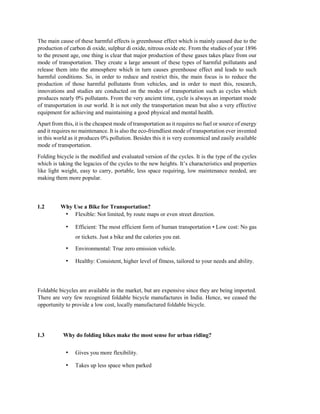
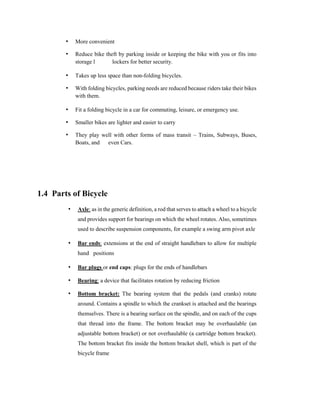
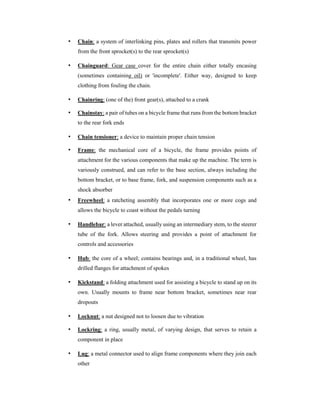
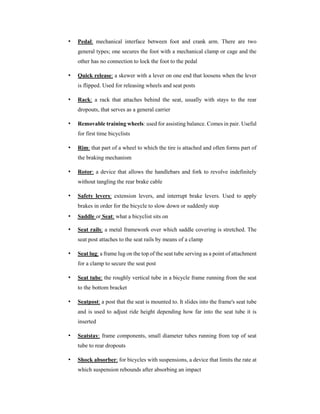
SPOKELESS WHEEL
A Minor Project
Submitted in partial fulfillment of the requirement for the award of
Degree of Bachelor of Technology in Mechanical Engineering
Submitted To
DEPARTMENT OF MECHANICAL ENGINEERING
SURESH GYAN VIHAR UNIVERSITY, JAIPUR, RAJASTHAN, INDIA
Submitted By: Guided by:
RAM THAPA (ME10401408081) Mr. AMIT TIWARI
BIBEK SHAKYA(ME10401408549) (Assistant Professor)
DARSHAN SONEJI (ME10401408454) SGVU, Jaipur
KHAGENDRA GAUTAM (ME10401408083)
6TH
SEMESTER
SESSION: 2016-17
SURESH GYAN VIHAR UNIVERSITY,
DEPARTMENT OF MECHANICAL ENGINEERING
CERTIFICATE
This is to certify that the work embodies in this minor project entitled “FOLDABLE BICYCLE WITH
SPOKELESS WHEEL ” being submitted by RAM THAPA (ME10401408081), BIBEK SHAKYA
(ME10401408549), KHAGENDRA GAUTAM (ME10401408083), DARSHAN SONEJI
(ME10401408454), for partial fulfillment of the requirement for the award of “Bachelor of Technology
in Mechanical Engineering” discipline to “Suresh Gyan Vihar University Jaipur (Rajasthan)” during the
academic year 2016-17 is a record of bonafide piece of work, carried out by them under my supervision
and guidance in the “Department of Mechanical Engineering”, Suresh Gyan Vihar University Jaipur
(Rajasthan
APPROVED & SUPERVISED BY:
Mr. AMIT TIWARI
(Lecturer, Mechanical Engineering Department)
FORWARDED BY
Mr. Amit Tiwari Dr.Neeraj Kumar
Mr. Vishal Sain Head of Department
Co-ordinator Minor Project Deptt. of Mech. Engg
Deptt. of Mech. Engg.
Department of Mechanical Engineering ,suresh gyan vihar university ,Jaipur
CERTIFICATE OF APPROVAL
The Minor Project entitled “FOLDABLE BICYCLE WITH SPOKELESS WHEEL” being submitted
by Ram Thapa (ME10401408081), Bibek Shakya (ME10401408549), Khagendra Gautam
(ME10401408083),Darshan Soneji (ME10401408454), has been examined by us and is hereby approved
for partial fulfillment of degree “Bachelor of Technology in Mechanical Engineering”, for which it has
been submitted. It is understood that by this approval the undersigned do not necessarily endorse or approve
any statement made, opinion expressed or conclusion drawn therein, but approve the minor project only
for the purpose for which it has been submitted.
(Internal Examiner) (External Examiner)
Date:________________ Date:________________
ACKNOWLEDGEMENT
We are deeply indebted to Suresh Gyan Vihar University Jaipur (Raj) for giving us an opportunity to work
on Minor Project “FOLDABLE BICYCLE WITH SPOKELESS WHEEL” and also for their invaluable
guidance and patience with us. We would like to thank Mr. Amit Tiwari for his support and cooperation
in preparing the minor project and guiding us. We thank him again for the valuable inputs and providing
us his valuable time for starting the project work.
We profusely thank Dr. Neeraj Kumar, Head of Department of Mechanical
Engineering, School of Engineering & Technology, Suresh Gyan Vihar University Jaipur Rajasthan for
providing us all the facilities and the very best technical and support infrastructure to carry on our project
work.
We would like to thank all the user and colleagues who extended help directly or indirectly during our
minor project work. We acknowledge the effort of those who have contributed significantly to our minor
project work and last but not the least we would like to thank all our B. Tech friends for their continuous
support and cooperation. We would like to take this opportunity to express our profound sense of gratitude
and respect to all those who helped us throughout.
Yours sincerely,
Ram Thapa (ME10401408081)
Bibek Shakya(ME10401408549)
Darshan Soneji (ME10401408454)
Khagendra Gautam(ME10401408083)
VI Semester,Batch 2016-17
B.Tech, Mechanical Engineering
ABSTRACT
In the present day lifestyle man is not able to dedicate specific time for his health,
importance is least given to exercise and body fitness due to time shortage and stressful
life. To cope with time deficit, we can utilize the time spent on commuting efficiently to
exercise by using bicycles, thereby also contributing to pollution control. But regular
bicycles occupy sufficient space to park, are not easy to carry around and are probable to
theft. Transport has been one of the most important issues to be dealt with in the present
day situation as commuting from place to place within the city has become a tedious and
an expensive task. It is very difficult to reach the nearest public transport facility and in
many cases the destination will be very far from the main roads where the public transport
might not be able to commute or it might be very expensive. To overcome a common
problem faced by the society, an idea is conceptualized to design and fabricate a foldable
bicycle. We already have seen many foldable bicycles in the global market but the main
idea of this project is to provide a foldable bicycle which is light & sleek yet rigid & safe,
easy to handle and easy to maintain. Unlike the conventional cycles, this bicycle will
occupy very less space and also is very easy to be carried around. The main objective is to
design and develop a foldable bicycle which is comfortable to ride and economical.
A spokeless bicycle system for providing a bicycle that does not have spokes within the
wheels. The inventive device includes a frame having a seat structure and handle bars, a
rear bracket having rear bearings within that rotatably engages a rear wheel, a front bracket
having front bearings within that rotatably engages a front wheel, and a drive train that
engages the rear wheel for driving the rear wheel. The rear rim of the rear wheel includes
a rear groove that receives the plurality of rear bearings. The rear rim of the rear wheel
includes a rear gear that is engaged by a drive sprocket from the drive train. The front rim
of the front wheel includes a front groove that receives the plurality of front bearings.
CONTENTS
Particulars Page No.
CERTIFICATE i
Certificate of Approval ii
ACKNOWLEDGEMENT iii
ABSTRACT 5
CONTENTS v 6
List of Figures and tablesCHAPTER 1: INTRODUCTION 1-6 Error!
Bookmark not defined.
1.1 General Introduction 1-2
1.2 Why Use a Bike for Transportation? 3
1.3 Why do folding bikes make the most sense for urban riding? 3
1.4 Parts of Bicycle 4-6
1.5 Other additional parts 6-8
1.5.1 Linch Pin 6-7
1.5.2 Hinge Joint 7-8
1.5.3 Internal Gear 8
CHAPTER 2: LITERATURE REVIEW 9-15
2.1 History of a Bicycle 9-11
2.2 Basic Principle of Bicycle 11
2.3 Components of folding bicycle 11-12
2.4 Background of the invention 13
2.5 Summary of the invention 14-15
CHAPTER 3: METHODOLOGY 16-
20
3.1 Methodology 16
3.2 Folding Mechanism 16
3.2.1 Half or mid fold 16
3.2.2 Clamp and Linch Pin 17
3.3 Centerless/hubless wheels 18
3.4 Power transmission Mechanism 19
3.5 Gear Arrangement 20
CHAPTER 4: DATA ANALYSIS AND IMPLEMENTATION 21-
23
4.1 Data Analysis 21
4.1.1 Cycle Specification 21
4.1.2 Calculation 22
4.2 Material Selection 23
CHAPTER 5: FUTURE SCOPE 24
CONCLUSION
REFRENCES
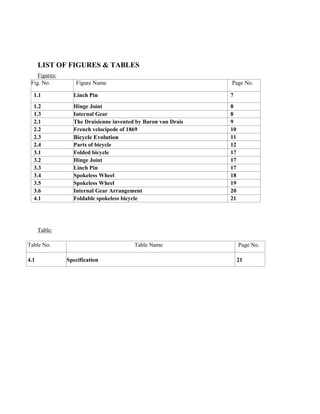
LIST OF FIGURES & TABLES
Figures:
Fig. No. Figure Name Page No.
1.1 Linch Pin 7
1.2 Hinge Joint 8
1.3 Internal Gear 8
2.1 The Draisienne invented by Baron van Drais 9
2.2 French velocipede of 1869 10
2.3 Bicycle Evolution 11
2.4 Parts of bicycle 12
3.1 Folded bicycle 17
3.2 Hinge Joint 17
3.3 Linch Pin 17
3.4 Spokeless Wheel 18
3.5 Spokeless Wheel 19
3.6 Internal Gear Arrangement 20
4.1 Foldable spokeless bicycle 21
Table:
Table No. Table Name Page No.
4.1 Specification 21
CHAPTER-1 INTRODUCTION
1.1 General Introduction
“The bicycle is the most efficient self-powered means of transportation in terms of energy a
person must expend to travel a given distance.”
S.S.Wilson
“BicycleTechnology”
Scientific American, March 1973
In the present-day lifestyle man is not able to dedicate specific time for his health, importance
is least given to exercise and body fitness due to time shortage and stressful life. Obesity is one
of the common issues seen in the society, which leads to many health hazards. Exercises are
advised for health promotion, and treatment for many diseases. Among the exercises aerobic
exercises are appropriate for these purposes. To do aerobic exercise many methods are available
for example: running, jogging, walking, cycling and others. Transport has been one of the
major issues in developing cities such as Bangalore since commuting from one place to another
has become tedious and expensive. With the petrol and diesel prices increasing day by day,
almost all the modes of transport are becoming expensive. It is difficult to reach the nearest
public transport facility and in many cases the destination will be far from the main roads where
the public transport might not be able to reach due to the small roads, to avoid which most people
use vehicles of their own, which in turn leads to issues with parking, traffic, etc. But not all can
opt for having own vehicles as it is expensive. With such issues in health, transport, space for
parking, etc. one solution that comes to mind is bicycle. Bicycles are being promoted in the
corporate and educational sectors. But how convenient is it to use a conventional bicycle? In
many cases, there is no special facility provided for locking the bicycles and even if one is
present, it is probable to theft, which is one of the fears that obstruct use of bicycle. Conventional
bicycles occupy sufficient space and hence providing one at work place or at home are quite
difficult. They are probable to be exposed to the weather outside and do require frequent
maintenance. With all such issues in the conventional bicycles, the next possible solution is the
usage of foldable bicycle. With foldable bicycles, there is no issue since the bicycle can be
folded and carried around to the work place or even it can be used to reach the nearest public
transport facility and then folded and carried along. Since the bicycle is being folded, it occupies
very less space and doesn’t require any special parking space. They are not exposed to the
weather since they can be carried inside buildings with ease and hence prone to less
maintenance. The usage of foldable bicycle helps combine the different modes of transport as
mentioned above, which helps in cutting down some cost involved in travelling.
Global warming is one of the most highlighted sectors over which the concentration and
dilemma of human beings have shifted in past recent years. It is only due to the harmful effects
of this global warming phenomenon which has caused disaster to our mother nature and to us.
Effects like global warming, depletion of ozone layer etc are very prominent nowadays.
The main cause of these harmful effects is greenhouse effect which is mainly caused due to the
production of carbon di oxide, sulphur di oxide, nitrous oxide etc. From the studies of year 1896
to the present age, one thing is clear that major production of these gases takes place from our
mode of transportation. They create a large amount of these types of harmful pollutants and
release them into the atmosphere which in turn causes greenhouse effect and leads to such
harmful conditions. So, in order to reduce and restrict this, the main focus is to reduce the
production of those harmful pollutants from vehicles, and in order to meet this, research,
innovations and studies are conducted on the modes of transportation such as cycles which
produces nearly 0% pollutants. From the very ancient time, cycle is always an important mode
of transportation in our world. It is not only the transportation mean but also a very effective
equipment for achieving and maintaining a good physical and mental health.
Apart from this, it is the cheapest mode of transportation as it requires no fuel or source of energy
and it requires no maintenance. It is also the eco-friendliest mode of transportation ever invented
in this world as it produces 0% pollution. Besides this it is very economical and easily available
mode of transportation.
Folding bicycle is the modified and evaluated version of the cycles. It is the type of the cycles
which is taking the legacies of the cycles to the new heights. It’s characteristics and properties
like light weight, easy to carry, portable, less space requiring, low maintenance needed, are
making them more popular.
1.2 Why Use a Bike for Transportation?
• Flexible: Not limited, by route maps or even street direction.
• Efficient: The most efficient form of human transportation • Low cost: No gas
or tickets. Just a bike and the calories you eat.
• Environmental: True zero emission vehicle.
• Healthy: Consistent, higher level of fitness, tailored to your needs and ability.
Foldable bicycles are available in the market, but are expensive since they are being imported.
There are very few recognized foldable bicycle manufactures in India. Hence, we ceased the
opportunity to provide a low cost, locally manufactured foldable bicycle.
1.3 Why do folding bikes make the most sense for urban riding?
• Gives you more flexibility.
• Takes up less space when parked
• More convenient
• Reduce bike theft by parking inside or keeping the bike with you or fits into
storage l lockers for better security.
• Takes up less space than non-folding bicycles.
• With folding bicycles, parking needs are reduced because riders take their bikes
with them.
• Fit a folding bicycle in a car for commuting, leisure, or emergency use.
• Smaller bikes are lighter and easier to carry
• They play well with other forms of mass transit – Trains, Subways, Buses,
Boats, and even Cars.
1.4 Parts of Bicycle
• Axle: as in the generic definition, a rod that serves to attach a wheel to a bicycle
and provides support for bearings on which the wheel rotates. Also, sometimes
used to describe suspension components, for example a swing arm pivot axle
• Bar ends: extensions at the end of straight handlebars to allow for multiple
hand positions
• Bar plugs or end caps: plugs for the ends of handlebars
• Bearing: a device that facilitates rotation by reducing friction
• Bottom bracket: The bearing system that the pedals (and cranks) rotate
around. Contains a spindle to which the crankset is attached and the bearings
themselves. There is a bearing surface on the spindle, and on each of the cups
that thread into the frame. The bottom bracket may be overhaulable (an
adjustable bottom bracket) or not overhaulable (a cartridge bottom bracket).
The bottom bracket fits inside the bottom bracket shell, which is part of the
bicycle frame
• Chain: a system of interlinking pins, plates and rollers that transmits power
from the front sprocket(s) to the rear sprocket(s)
• Chainguard: Gear case cover for the entire chain either totally encasing
(sometimes containing oil) or 'incomplete'. Either way, designed to keep
clothing from fouling the chain.
• Chainring: (one of the) front gear(s), attached to a crank
• Chainstay: a pair of tubes on a bicycle frame that runs from the bottom bracket
to the rear fork ends
• Chain tensioner: a device to maintain proper chain tension
• Frame: the mechanical core of a bicycle, the frame provides points of
attachment for the various components that make up the machine. The term is
variously construed, and can refer to the base section, always including the
bottom bracket, or to base frame, fork, and suspension components such as a
shock absorber
• Freewheel: a ratcheting assembly that incorporates one or more cogs and
allows the bicycle to coast without the pedals turning
• Handlebar: a lever attached, usually using an intermediary stem, to the steerer
tube of the fork. Allows steering and provides a point of attachment for
controls and accessories
• Hub: the core of a wheel; contains bearings and, in a traditional wheel, has
drilled flanges for attachment of spokes
• Kickstand: a folding attachment used for assisting a bicycle to stand up on its
own. Usually mounts to frame near bottom bracket, sometimes near rear
dropouts
• Locknut: a nut designed not to loosen due to vibration
• Lockring: a ring, usually metal, of varying design, that serves to retain a
component in place
• Lug: a metal connector used to align frame components where they join each
other
• Pedal: mechanical interface between foot and crank arm. There are two
general types; one secures the foot with a mechanical clamp or cage and the
other has no connection to lock the foot to the pedal
• Quick release: a skewer with a lever on one end that loosens when the lever
is flipped. Used for releasing wheels and seat posts
• Rack: a rack that attaches behind the seat, usually with stays to the rear
dropouts, that serves as a general carrier
• Removable training wheels: used for assisting balance. Comes in pair. Useful
for first time bicyclists
• Rim: that part of a wheel to which the tire is attached and often forms part of
the braking mechanism
• Rotor: a device that allows the handlebars and fork to revolve indefinitely
without tangling the rear brake cable
• Safety levers: extension levers, and interrupt brake levers. Used to apply
brakes in order for the bicycle to slow down or suddenly stop
• Saddle or Seat: what a bicyclist sits on
• Seat rails: a metal framework over which saddle covering is stretched. The
seat post attaches to the seat rails by means of a clamp
• Seat lug: a frame lug on the top of the seat tube serving as a point of attachment
for a clamp to secure the seat post
• Seat tube: the roughly vertical tube in a bicycle frame running from the seat
to the bottom bracket
• Seatpost: a post that the seat is mounted to. It slides into the frame's seat tube
and is used to adjust ride height depending how far into the seat tube it is
inserted
• Seatstay: frame components, small diameter tubes running from top of seat
tube to rear dropouts
• Shock absorber: for bicycles with suspensions, a device that limits the rate at
which suspension rebounds after absorbing an impact
• Spindle: an axle around which a pedal rotates; threaded at one end to screw
into crank arms
• Stem: a bracket used to attach handlebars to steerer tube of fork. Usually
secured by pinch bolts
• Wheel: as in common usage. Traditionally and most commonly spoked
• Wingnut: for attaching wheels before the development of the quick release
skewer
1.5 Other additional parts:
1.5.1 Linchpin
A linchpin, also spelled linch pin, lynchpin, or lynch pin, is a fastener used to prevent a wheel
or other part from sliding off the axle upon which it is riding. The word is first attested in the
late 14th century and derives from Middle English elements meaning "axletree pin".Securing
implements onto the three-point hitch of a tractor is an example of application. Linchpins may
also be used in place of an R-clip for securing hitch pins.
The word "linchpin" is also used figuratively to mean "something [or someone] that holds the
various elements of a complicated structure together.
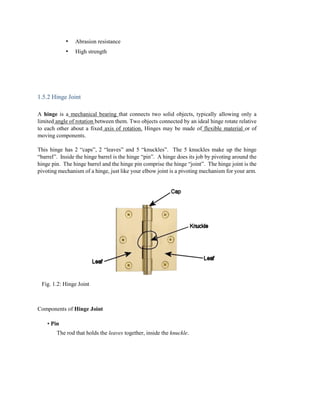
Fig 1.1: Linch pin
Linch pins have a ring loop attached to the head. This loop snaps down hard to hold the fastener
in place. The diameter of Linch Pins is between 30mm to 15mm. A linchpin, also spelled linch
pin, lynchpin, or lynch pin, is a fastener used to prevent a wheel or other part from sliding off
the axle upon which it is riding.
Features: -
• Sturdy design
• Abrasion resistance
• High strength
1.5.2 Hinge Joint
A hinge is a mechanical bearing that connects two solid objects, typically allowing only a
limited angle of rotation between them. Two objects connected by an ideal hinge rotate relative
to each other about a fixed axis of rotation. Hinges may be made of flexible material or of
moving components.
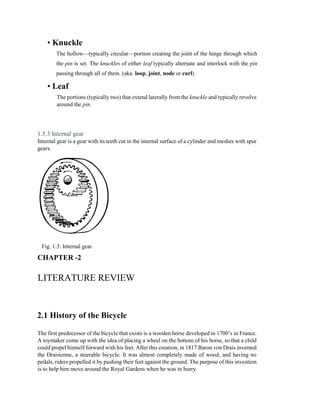
This hinge has 2 “caps”, 2 “leaves” and 5 “knuckles”. The 5 knuckles make up the hinge
“barrel”. Inside the hinge barrel is the hinge “pin”. A hinge does its job by pivoting around the
hinge pin. The hinge barrel and the hinge pin comprise the hinge “joint”. The hinge joint is the
pivoting mechanism of a hinge, just like your elbow joint is a pivoting mechanism for your arm.
Fig. 1.2: Hinge Joint
Components of Hinge Joint
• Pin
The rod that holds the leaves together, inside the knuckle.
• Knuckle
The hollow—typically circular—portion creating the joint of the hinge through which
the pin is set. The knuckles of either leaf typically alternate and interlock with the pin
passing through all of them. (aka. loop, joint, node or curl)
• Leaf
The portions (typically two) that extend laterally from the knuckle and typically revolve
around the pin.
1.5.3 Internal gear
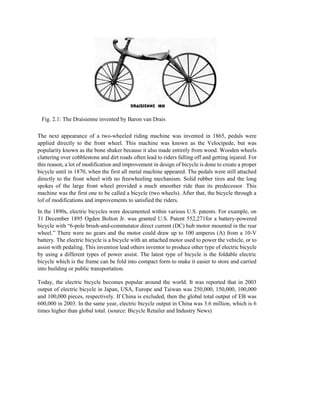
Internal gear is a gear with its teeth cut in the internal surface of a cylinder and meshes with spur
gears.
Fig. 1.3: Internal gear
CHAPTER -2
LITERATURE REVIEW
2.1 History of the Bicycle
The first predecessor of the bicycle that exists is a wooden horse developed in 1700’s in France.
A toymaker come up with the idea of placing a wheel on the bottom of his horse, so that a child
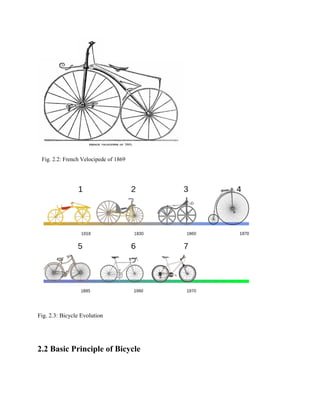
could propel himself forward with his feet. After this creation, in 1817 Baron von Drais invented
the Draisienne, a steerable bicycle. It was almost completely made of wood, and having no
pedals, riders propelled it by pushing their feet against the ground. The purpose of this invention
is to help him move around the Royal Gardens when he was in hurry.
Fig. 2.1: The Draisienne invented by Baron van Drais
The next appearance of a two-wheeled riding machine was invented in 1865, pedals were
applied directly to the front wheel. This machine was known as the Velocipede, but was
popularity known as the bone shaker because it also made entirely from wood. Wooden wheels
clattering over cobblestone and dirt roads often lead to riders falling off and getting injured. For
this reason, a lot of modification and improvement in design of bicycle is done to create a proper
bicycle until in 1870, when the first all metal machine appeared. The pedals were still attached
directly to the front wheel with no freewheeling mechanism. Solid rubber tires and the long
spokes of the large front wheel provided a much smoother ride than its predecessor. This
machine was the first one to be called a bicycle (two wheels). After that, the bicycle through a
lof of modifications and improvements to satisfied the riders.
In the 1890s, electric bicycles were documented within various U.S. patents. For example, on
31 December 1895 Ogden Bolton Jr. was granted U.S. Patent 552,271for a battery-powered
bicycle with “6-pole brush-and-commutator direct current (DC) hub motor mounted in the rear
wheel.” There were no gears and the motor could draw up to 100 amperes (A) from a 10-V
battery. The electric bicycle is a bicycle with an attached motor used to power the vehicle, or to
assist with pedaling. This invention lead others inventor to produce other type of electric bicycle
by using a different types of power assist. The latest type of bicycle is the foldable electric
bicycle which is the frame can be fold into compact form to make it easier to store and carried
into building or public transportation.
Today, the electric bicycle becomes popular around the world. It was reported that in 2003
output of electric bicycle in Japan, USA, Europe and Taiwan was 250,000, 150,000, 100,000
and 100,000 pieces, respectively. If China is excluded, then the global total output of EB was
600,000 in 2003. In the same year, electric bicycle output in China was 3.6 million, which is 6
times higher than global total. (source: Bicycle Retailer and Industry News)
Fig. 2.2: French Velocipede of 1869
Fig. 2.3: Bicycle Evolution
2.2 Basic Principle of Bicycle
A bicycle is a pedal-driven, human-powered vehicle with two wheels attached to a frame,
one behind the other. A person who rides a bicycle is called a cyclist or a bicyclist. The
coolest thing about a bicycle is that it lets you get where you are going a lot faster and using
a lot less energy than if you were walking or running. There are no covers or sheet metal
hiding any of the working parts that propel you down the road.
2.3 Components of folding bicycle
• Frame (1) - it is a main supporting part of the bicycle.
• Compact Joint (2) - it is a joint which provides on the frame so that front and rear portion
can be overlap.
• Handle (3) - it is the front portion of bicycle which use to control the direction of bicycle.
• Transmission mechanism (4): - it is the mechanism which transmits the power from
pedal to rear wheel.
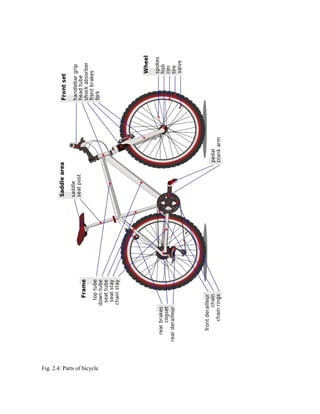
Bicycles are made of from just a few parts that we can immediately we can see and identify
as shown below:
Fig. 2.4: Parts of bicycle
2.4 Background of the invention
Field of the Invention
The present invention relates generally to bicycle devices and more specifically it relates to a
spokeless bicycle system for providing a bicycle that does not have spokes within the wheels.
Description of the Prior Art
Bicycles have been in use for years. Typically, a bicycle is comprised of a frame, handle bars, a
pair of wheels rotatably attached to the frame, and a chain connected between the rear wheel
and the drive system of the bicycle. The wheels of a conventional bicycle typically have a
plurality of spokes that extend from a central hub to the interior surface of the rim of the wheel.
Conventional bicycles with wheels that have spokes is that the user constantly has to maintain
the tension upon the spokes especially during rough riding conditions. If the user does not
maintain the tension upon the spokes the wheel will not provide the desired performance for the
user. Bicycles that utilize wheels with spokes are also dangerous in the respect that clothing and
feet often times are caught within the spokes sometimes leading to injury of the rider.
While these devices may be suitable for the particular purpose to which they address, they are
not as suitable for providing a bicycle that does not have spokes within the wheels. Conventional
bicycle devices require the utilization of wheels with a plurality of spokes which are undesirable.
In these respects, the spokeless bicycle system according to the present invention substantially
departs from the conventional concepts and designs of the prior art, and in so doing provides an
apparatus primarily developed for the purpose of providing a bicycle that does not have spokes
within the wheels.
2.5 Summary of the invention
In view of the foregoing disadvantages inherent in the known types of bicycle devices now
present in the prior art, the present invention provides a new spokeless bicycle system
construction wherein the same can be utilized for providing a bicycle that does not have spokes
within the wheels.
The general purpose of the present invention, which will be described subsequently in greater
detail, is to provide a new spokeless bicycle system that has many of the advantages of the
bicycle devices mentioned heretofore and many novel features that result in a new spokeless
bicycle system which is not anticipated, rendered obvious, suggested, or even implied by any of
the prior art bicycle devices, either alone or in any combination thereof.
To attain this, the present invention generally comprises a frame having a seat structure and
handle bars, a rear bracket having rear bearings within that rotatably engages a rear wheel, a
front bracket having front bearings within that rotatably engages a front wheel, and a drive train
that engages the rear wheel for driving the rear wheel. The rear rim of the rear wheel includes a
rear groove that receives the plurality of rear bearings. The rear rim of the rear wheel includes a
rear gear that is engaged by a drive sprocket from the drive train. The front rim of the front
wheel includes a front groove that receives the plurality of front bearings.
There has thus been outlined, rather broadly, the more important features of the invention in
order that the detailed description thereof may be better understood, and in order that the present
contribution to the art may be better appreciated. There are additional features of the invention
that will be described hereinafter and that will form the subject matter of the claims appended
hereto.
In this respect, before explaining at least one embodiment of the invention in detail, it is to be
understood that the invention is not limited in its application to the details of construction and
to the arrangements of the components set forth in the following description or illustrated in the
drawings. The invention is capable of other embodiments and of being practiced and carried out
in various ways. Also, it is to be understood that the phraseology and terminology employed
herein are for the purpose of the description and should not be regarded as limiting.
• A primary object of the present invention is to provide a spokeless bicycle system that
will overcome the shortcomings of the prior art devices.
• Another object is to provide a spokeless bicycle system that does not utilize wheels with
a plurality of spokes.
• An additional object is to provide a spokeless bicycle system that does not utilize a chain
drive system.
• A further object is to provide a spokeless bicycle system that utilizes a bearing tracking
system instead of traditional center pivoting bearing designs to rotatably support the
frame upon the wheels.
• Another object is to provide a spokeless bicycle system that reduces the chance of injury
to the rider.
• A further object is to provide a spokeless bicycle system that increases the appearance
of the bicycle.
• An additional object is to provide a spokeless bicycle system that is low maintenance
and has an increased useful life.
• Other objects and advantages of the present invention will become obvious to the reader
and it is intended that these objects and advantages are within the scope of the present
invention.
To the accomplishment of the above and related objects, this invention may be embodied in the
form illustrated in the accompanying drawings, attention being called to the fact, however, that
the drawings are illustrative only, and that changes may be made in the specific construction
illustrated and described within the scope of the appended claims.
CHAPTER -3
METHODOLOGY
3.1 Methodology
There is a diversity of bicycle models in the market, all of them have circular wire wheels. So
the question is, could a concept of a foldable bicycle with foldable centerless wheels be a good
idea? What is the best methodology to evaluate this new and unique bicycle from the engineering
point of view? Engineers are always taking new challenges and bringing their innovative ideas
on board and foldable bicycle with foldable wheels is one such innovative model that lets the
new bicycle traders take their bicycle to every corner of the world
3.2 Folding mechanism
Different type of folding patterns can be followed according to bicycle dimension, weight and
wheel size. For the larger diameter wheel, vertical or triangular folding is most effective whereas
for medium sized wheel mid-point folding is appropriate.
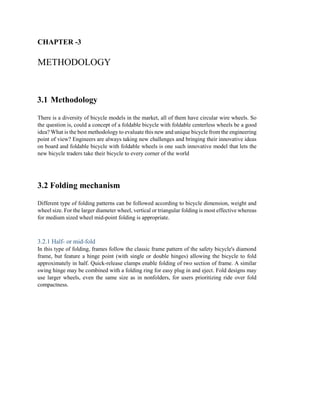
3.2.1 Half- or mid-fold
In this type of folding, frames follow the classic frame pattern of the safety bicycle's diamond
frame, but feature a hinge point (with single or double hinges) allowing the bicycle to fold
approximately in half. Quick-release clamps enable folding of two section of frame. A similar
swing hinge may be combined with a folding ring for easy plug in and eject. Fold designs may
use larger wheels, even the same size as in nonfolders, for users prioritizing ride over fold
compactness.
Fig. 3.1: Folded bicycle
3.2.2 Clamp and Linch pin
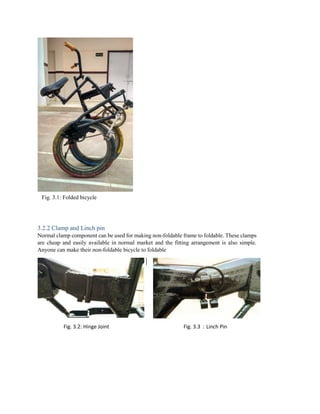
Normal clamp component can be used for making non-foldable frame to foldable. These clamps
are cheap and easily available in normal market and the fitting arrangement is also simple.
Anyone can make their non-foldable bicycle to foldable
Fig. 3.2: Hinge Joint Fig. 3.3 : Linch Pin
3.3 Centerless/hubless wheels:
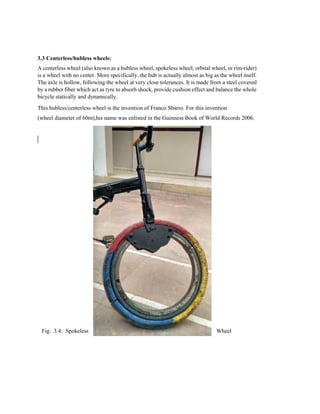
A centerless wheel (also known as a hubless wheel, spokeless wheel, orbital wheel, or rim-rider)
is a wheel with no center. More specifically, the hub is actually almost as big as the wheel itself.
The axle is hollow, following the wheel at very close tolerances. It is made from a steel covered
by a rubber fiber which act as tyre to absorb shock, provide cushion effect and balance the whole
bicycle statically and dynamically.
This hubless/centerless wheel is the invention of Franco Sbarro. For this invention
(wheel diameter of 60m),his name was enlisted in the Guinness Book of World Records 2006.
Fig. 3.4: Spokeless Wheel
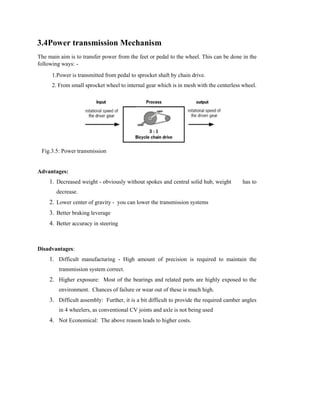
3.4Power transmission Mechanism
The main aim is to transfer power from the feet or pedal to the wheel. This can be done in the
following ways: -
1.Power is transmitted from pedal to sprocket shaft by chain drive.
2. From small sprocket wheel to internal gear which is in mesh with the centerless wheel.
Fig.3.5: Power transmission
Advantages:
1. Decreased weight - obviously without spokes and central solid hub, weight has to
decrease.
2. Lower center of gravity - you can lower the transmission systems
3. Better braking leverage
4. Better accuracy in steering
Disadvantages:
1. Difficult manufacturing - High amount of precision is required to maintain the
transmission system correct.
2. Higher exposure: Most of the bearings and related parts are highly exposed to the
environment. Chances of failure or wear out of these is much high.
3. Difficult assembly: Further, it is a bit difficult to provide the required camber angles
in 4 wheelers, as conventional CV joints and axle is not being used
4. Not Economical: The above reason leads to higher costs.
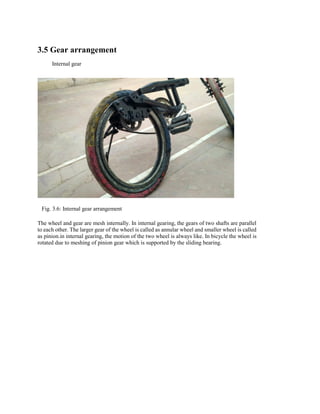
3.5 Gear arrangement
Internal gear
Fig. 3.6: Internal gear arrangement
The wheel and gear are mesh internally. In internal gearing, the gears of two shafts are parallel
to each other. The larger gear of the wheel is called as annular wheel and smaller wheel is called
as pinion.in internal gearing, the motion of the two wheel is always like. In bicycle the wheel is
rotated due to meshing of pinion gear which is supported by the sliding bearing.
CHAPTER -4
DATA ANALYSIS AND IMPLEMENTATION
4.1 Data analysis
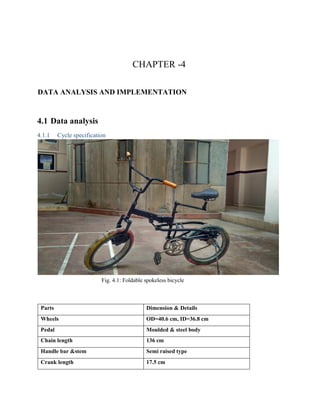
4.1.1 Cycle specification
Fig. 4.1: Foldable spokeless bicycle
Parts Dimension & Details
Wheels OD=40.6 cm, ID=36.8 cm
Pedal Moulded & steel body
Chain length 136 cm
Handle bar &stem Semi raised type
Crank length 17.5 cm
Pedal length 8.2 ×6.1 cm2
Handle to seat distance 25 cm
Hub height from base 24.5 cm
Elevation of seat 25 cm
Total height 80.9 cm
Table. 4.1: Specifications
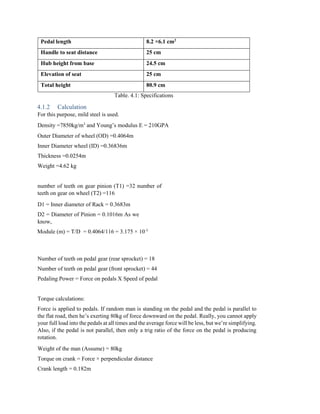
4.1.2 Calculation
For this purpose, mild steel is used.
Density =7850kg/m3
and Young’s modulus E = 210GPA
Outer Diameter of wheel (OD) =0.4064m
Inner Diameter wheel (ID) =0.36836m
Thickness =0.0254m
Weight =4.62 kg
number of teeth on gear pinion (T1) =32 number of
teeth on gear on wheel (T2) =116
D1 = Inner diameter of Rack = 0.3683m
D2 = Diameter of Pinion = 0.1016m As we
know,
Module (m) = T/D = 0.4064/116 = 3.175 × 10⁻³
Number of teeth on pedal gear (rear sprocket) = 18
Number of teeth on pedal gear (front sprocket) = 44
Pedaling Power = Force on pedals X Speed of pedal
Torque calculations:
Force is applied to pedals. If random man is standing on the pedal and the pedal is parallel to
the flat road, then he’s exerting 80kg of force downward on the pedal. Really, you cannot apply
your full load into the pedals at all times and the average force will be less, but we’re simplifying.
Also, if the pedal is not parallel, then only a trig ratio of the force on the pedal is producing
rotation.
Weight of the man (Assume) = 80kg
Torque on crank = Force × perpendicular distance
Crank length = 0.182m
Torque on crank = 80 × (0.182/2) = 7.3152 kg-m
Torque applied to rear gear is torque on front gear times
inverse ratio of front and rear gears. Torque on rear gear
= torque on force × (R/F)
= 7.3152 × (18/44)
= 3 kg-m
4.2 Material Selection
Most important factor selection of suitable material for the frame. It was important to make the
frame sturdy, yet light. Mild steel is mostly used in conventional bicycle. Mild steel is easily
available in the required diameter and length and is also not expensive. One main advantage
of using mild steel is that it is easy to fabricate with it as welding of mild steel is by arc welding
process which is cheap compared to other welding methods. Use of other materials like alloys
of aluminum were not selected as the availability is less and also the fabrication cost is high.
The hinge found in the market is also made of mild steel which eases the process of joining the
frame to the hinges. The following are the chemical composition and mechanical properties
of mild steel:
Chemical composition:
Carbon 0.16-0.18%
Silicon 0.40% max
Manganese 0.70-0.90%
Sulphur 0.040% Max
Phosphorus 0.040% Max
Mechanical properties:
Max Stress 400-560 N/mm2
Yield Stress 300-440 N/mm2
(Minimum)
0.2% Proof
Stress 280-420 N/mm2
Min
Elongation 10-14% Min
Young’s modulus 210 GPa.
CHAPTER - 5
FUTURE SCOPE
Future scope of folding bicycle
As for the future work, this study only deals with the evaluation of existing foldable bicycles in
the Indian market. Hence further, the proposed concepts are to be evaluated to find out the best
available concept using the typical concept selection methods like Pugh chart and weighted
matrix. The final concept design that has been selected by these methods would be considered
for embodiment design in which the materials and dimensions are selected. The embodiment
design stage is followed by analysis and optimization.
• Kinetic Energy Reservoir System
Kinetic energy of the cycle can be stored and later it can be utilized whenever the user
feel tired, exhausted or when he wants to use it. The kinetic energy can be store in any
reservoir type device such as batteries. Besides this flywheel attached to the rear wheel
is also an important mechanical device which can be used to store the kinetic energy for
the future use.
• Installation of Electronic Gadgets
Various types of electronic gadgets like mobile charger, music pods charger etc. can be
installed easily on the 4-fold foldable bicycle. They will draw energy for them through
the kinetic energy of the wheels of the bicycle and this will be conducted and initiated
with the help of the transducers. These Equipment will make the riding experience of
the user enjoyable and fun loving.
• Chainless Cycle Technology
This is the new technology developed in recent years in which the bicycles are not
installed with chains but instead of this the transfer of motion from paddling system to
the rear wheel takes place with the help of the strings. This reduces the loss of energy
and makes the bicycle very efficient in nature. Now the same concept of technology can
be implemented in the case of the 4 fold foldable bicycle which will increase its
efficiency.
CONCLUSION
The design of the foldable bicycle was based on the standard data available. Compared to the
foldable bicycles existing in the market, our bicycle is economical and occupies less space. A
further object is to provide a spokeless bicycle system that utilizes a bearing tracking system
instead of traditional center pivoting bearing designs to rotatable support the frame upon the
wheels. The spoke-less cycle was aimed at reducing weight of the cycle by replacing the
conventional hub and the spokes and providing more space for utilization. The weight of our
bicycle is light than bicycles available in the market, though the material used for fabrication is
mild steel. Overall design being sturdy, compact and simple with no braking system required as
the pedaling stops so does the cycle. This cycle being self-braking type can be used on slopes as
slipping can be avoided. Since it’s rim being mild steel is weigh bearing capacity is even higher
compared to conventional cycles. It can be used for both town sides and for villages. It is the
most efficient vehicle in the terms of fuel efficiency as the input fuel requirement is zero as it
works on the human power and because of this no pollution (air pollution) is caused by the
bicycle which makes it very environmental friendly.
Although hubless wheels are striking in appearance and advantageous compared to the
conventional wheel, their numerous practical disadvantages have impeded their widespread use
as an alternative to conventional wheels. They are difficult and expensive to manufacture and
require a great deal of precision while machining. And the design also leaves the bearings and
other mechanical parts exposed, the drive system is also very difficult to design and is
problematic hence conventional wheels are preferred to hubless ones though they are more
efficient.
REFERENCES
1. http://bikefitting.com/English/FSR/FSR.aspx: standard bicycle frame size
2. Prototype of a Folding Bicycle with a Slide Hinge; Goro IMURA, Tetsuya WATABE,
Yoshikazu ARAI, Nozomu MATSUSHIMA, Gen MATSUZAKI
3. A Typical Approach in Conceptual and Embodiment Design of Foldable Bicycle;
Arunachalam M, Arun Prakash R, Rajesh R
4. Foldable bicycle: evaluation of existing design and noveldesign proposals; Arunachalam
M., Arun Prakash R. and Rajesh R.
5. Hinge Clamp Plate for Brompton Folding Bike
6. Bicycle products News, an English monthly newspaper on Bicycle trade and industry
7. http://khkgears.net/product-category/internal-gears/
8. https://www.hardwaresource.com/hinge-resource-center/resource-center/what-isa-hinge-
joint/
9. https://cormsquare.com/Mechanical-components/Nails-and-Pins/59432/Linch-Pins
10. https://en.wikipedia.org/wiki/Centreless_wheel

project report on flodable bicycle

  • 1.
    FOLDABLE BICYCLE WITH SPOKELESSWHEEL A Minor Project Submitted in partial fulfillment of the requirement for the award of Degree of Bachelor of Technology in Mechanical Engineering Submitted To DEPARTMENT OF MECHANICAL ENGINEERING SURESH GYAN VIHAR UNIVERSITY, JAIPUR, RAJASTHAN, INDIA Submitted By: Guided by: RAM THAPA (ME10401408081) Mr. AMIT TIWARI BIBEK SHAKYA(ME10401408549) (Assistant Professor) DARSHAN SONEJI (ME10401408454) SGVU, Jaipur KHAGENDRA GAUTAM (ME10401408083) 6TH SEMESTER SESSION: 2016-17 SURESH GYAN VIHAR UNIVERSITY, DEPARTMENT OF MECHANICAL ENGINEERING
  • 2.
    CERTIFICATE This is tocertify that the work embodies in this minor project entitled “FOLDABLE BICYCLE WITH SPOKELESS WHEEL ” being submitted by RAM THAPA (ME10401408081), BIBEK SHAKYA (ME10401408549), KHAGENDRA GAUTAM (ME10401408083), DARSHAN SONEJI (ME10401408454), for partial fulfillment of the requirement for the award of “Bachelor of Technology in Mechanical Engineering” discipline to “Suresh Gyan Vihar University Jaipur (Rajasthan)” during the academic year 2016-17 is a record of bonafide piece of work, carried out by them under my supervision and guidance in the “Department of Mechanical Engineering”, Suresh Gyan Vihar University Jaipur (Rajasthan APPROVED & SUPERVISED BY: Mr. AMIT TIWARI (Lecturer, Mechanical Engineering Department) FORWARDED BY Mr. Amit Tiwari Dr.Neeraj Kumar Mr. Vishal Sain Head of Department Co-ordinator Minor Project Deptt. of Mech. Engg Deptt. of Mech. Engg. Department of Mechanical Engineering ,suresh gyan vihar university ,Jaipur
  • 3.
    CERTIFICATE OF APPROVAL TheMinor Project entitled “FOLDABLE BICYCLE WITH SPOKELESS WHEEL” being submitted by Ram Thapa (ME10401408081), Bibek Shakya (ME10401408549), Khagendra Gautam (ME10401408083),Darshan Soneji (ME10401408454), has been examined by us and is hereby approved for partial fulfillment of degree “Bachelor of Technology in Mechanical Engineering”, for which it has been submitted. It is understood that by this approval the undersigned do not necessarily endorse or approve any statement made, opinion expressed or conclusion drawn therein, but approve the minor project only for the purpose for which it has been submitted. (Internal Examiner) (External Examiner) Date:________________ Date:________________
  • 4.
    ACKNOWLEDGEMENT We are deeplyindebted to Suresh Gyan Vihar University Jaipur (Raj) for giving us an opportunity to work on Minor Project “FOLDABLE BICYCLE WITH SPOKELESS WHEEL” and also for their invaluable guidance and patience with us. We would like to thank Mr. Amit Tiwari for his support and cooperation in preparing the minor project and guiding us. We thank him again for the valuable inputs and providing us his valuable time for starting the project work. We profusely thank Dr. Neeraj Kumar, Head of Department of Mechanical Engineering, School of Engineering & Technology, Suresh Gyan Vihar University Jaipur Rajasthan for providing us all the facilities and the very best technical and support infrastructure to carry on our project work. We would like to thank all the user and colleagues who extended help directly or indirectly during our minor project work. We acknowledge the effort of those who have contributed significantly to our minor project work and last but not the least we would like to thank all our B. Tech friends for their continuous support and cooperation. We would like to take this opportunity to express our profound sense of gratitude and respect to all those who helped us throughout. Yours sincerely, Ram Thapa (ME10401408081) Bibek Shakya(ME10401408549) Darshan Soneji (ME10401408454) Khagendra Gautam(ME10401408083) VI Semester,Batch 2016-17 B.Tech, Mechanical Engineering
  • 5.
    ABSTRACT In the presentday lifestyle man is not able to dedicate specific time for his health, importance is least given to exercise and body fitness due to time shortage and stressful life. To cope with time deficit, we can utilize the time spent on commuting efficiently to exercise by using bicycles, thereby also contributing to pollution control. But regular bicycles occupy sufficient space to park, are not easy to carry around and are probable to theft. Transport has been one of the most important issues to be dealt with in the present day situation as commuting from place to place within the city has become a tedious and an expensive task. It is very difficult to reach the nearest public transport facility and in many cases the destination will be very far from the main roads where the public transport might not be able to commute or it might be very expensive. To overcome a common problem faced by the society, an idea is conceptualized to design and fabricate a foldable bicycle. We already have seen many foldable bicycles in the global market but the main idea of this project is to provide a foldable bicycle which is light & sleek yet rigid & safe, easy to handle and easy to maintain. Unlike the conventional cycles, this bicycle will occupy very less space and also is very easy to be carried around. The main objective is to design and develop a foldable bicycle which is comfortable to ride and economical. A spokeless bicycle system for providing a bicycle that does not have spokes within the wheels. The inventive device includes a frame having a seat structure and handle bars, a rear bracket having rear bearings within that rotatably engages a rear wheel, a front bracket having front bearings within that rotatably engages a front wheel, and a drive train that engages the rear wheel for driving the rear wheel. The rear rim of the rear wheel includes a rear groove that receives the plurality of rear bearings. The rear rim of the rear wheel includes a rear gear that is engaged by a drive sprocket from the drive train. The front rim of the front wheel includes a front groove that receives the plurality of front bearings.
  • 6.
    CONTENTS Particulars Page No. CERTIFICATEi Certificate of Approval ii ACKNOWLEDGEMENT iii ABSTRACT 5 CONTENTS v 6 List of Figures and tablesCHAPTER 1: INTRODUCTION 1-6 Error! Bookmark not defined. 1.1 General Introduction 1-2 1.2 Why Use a Bike for Transportation? 3 1.3 Why do folding bikes make the most sense for urban riding? 3 1.4 Parts of Bicycle 4-6 1.5 Other additional parts 6-8 1.5.1 Linch Pin 6-7 1.5.2 Hinge Joint 7-8 1.5.3 Internal Gear 8 CHAPTER 2: LITERATURE REVIEW 9-15 2.1 History of a Bicycle 9-11 2.2 Basic Principle of Bicycle 11 2.3 Components of folding bicycle 11-12 2.4 Background of the invention 13 2.5 Summary of the invention 14-15
  • 7.
    CHAPTER 3: METHODOLOGY16- 20 3.1 Methodology 16 3.2 Folding Mechanism 16 3.2.1 Half or mid fold 16 3.2.2 Clamp and Linch Pin 17 3.3 Centerless/hubless wheels 18 3.4 Power transmission Mechanism 19 3.5 Gear Arrangement 20 CHAPTER 4: DATA ANALYSIS AND IMPLEMENTATION 21- 23 4.1 Data Analysis 21 4.1.1 Cycle Specification 21 4.1.2 Calculation 22 4.2 Material Selection 23 CHAPTER 5: FUTURE SCOPE 24 CONCLUSION REFRENCES
  • 8.
    LIST OF FIGURES& TABLES Figures: Fig. No. Figure Name Page No. 1.1 Linch Pin 7 1.2 Hinge Joint 8 1.3 Internal Gear 8 2.1 The Draisienne invented by Baron van Drais 9 2.2 French velocipede of 1869 10 2.3 Bicycle Evolution 11 2.4 Parts of bicycle 12 3.1 Folded bicycle 17 3.2 Hinge Joint 17 3.3 Linch Pin 17 3.4 Spokeless Wheel 18 3.5 Spokeless Wheel 19 3.6 Internal Gear Arrangement 20 4.1 Foldable spokeless bicycle 21 Table: Table No. Table Name Page No. 4.1 Specification 21
  • 9.
    CHAPTER-1 INTRODUCTION 1.1 GeneralIntroduction “The bicycle is the most efficient self-powered means of transportation in terms of energy a person must expend to travel a given distance.” S.S.Wilson “BicycleTechnology” Scientific American, March 1973 In the present-day lifestyle man is not able to dedicate specific time for his health, importance is least given to exercise and body fitness due to time shortage and stressful life. Obesity is one of the common issues seen in the society, which leads to many health hazards. Exercises are advised for health promotion, and treatment for many diseases. Among the exercises aerobic exercises are appropriate for these purposes. To do aerobic exercise many methods are available for example: running, jogging, walking, cycling and others. Transport has been one of the major issues in developing cities such as Bangalore since commuting from one place to another has become tedious and expensive. With the petrol and diesel prices increasing day by day, almost all the modes of transport are becoming expensive. It is difficult to reach the nearest public transport facility and in many cases the destination will be far from the main roads where the public transport might not be able to reach due to the small roads, to avoid which most people use vehicles of their own, which in turn leads to issues with parking, traffic, etc. But not all can opt for having own vehicles as it is expensive. With such issues in health, transport, space for parking, etc. one solution that comes to mind is bicycle. Bicycles are being promoted in the corporate and educational sectors. But how convenient is it to use a conventional bicycle? In many cases, there is no special facility provided for locking the bicycles and even if one is present, it is probable to theft, which is one of the fears that obstruct use of bicycle. Conventional bicycles occupy sufficient space and hence providing one at work place or at home are quite difficult. They are probable to be exposed to the weather outside and do require frequent maintenance. With all such issues in the conventional bicycles, the next possible solution is the usage of foldable bicycle. With foldable bicycles, there is no issue since the bicycle can be folded and carried around to the work place or even it can be used to reach the nearest public transport facility and then folded and carried along. Since the bicycle is being folded, it occupies very less space and doesn’t require any special parking space. They are not exposed to the weather since they can be carried inside buildings with ease and hence prone to less maintenance. The usage of foldable bicycle helps combine the different modes of transport as mentioned above, which helps in cutting down some cost involved in travelling. Global warming is one of the most highlighted sectors over which the concentration and dilemma of human beings have shifted in past recent years. It is only due to the harmful effects of this global warming phenomenon which has caused disaster to our mother nature and to us. Effects like global warming, depletion of ozone layer etc are very prominent nowadays.
  • 10.
    The main causeof these harmful effects is greenhouse effect which is mainly caused due to the production of carbon di oxide, sulphur di oxide, nitrous oxide etc. From the studies of year 1896 to the present age, one thing is clear that major production of these gases takes place from our mode of transportation. They create a large amount of these types of harmful pollutants and release them into the atmosphere which in turn causes greenhouse effect and leads to such harmful conditions. So, in order to reduce and restrict this, the main focus is to reduce the production of those harmful pollutants from vehicles, and in order to meet this, research, innovations and studies are conducted on the modes of transportation such as cycles which produces nearly 0% pollutants. From the very ancient time, cycle is always an important mode of transportation in our world. It is not only the transportation mean but also a very effective equipment for achieving and maintaining a good physical and mental health. Apart from this, it is the cheapest mode of transportation as it requires no fuel or source of energy and it requires no maintenance. It is also the eco-friendliest mode of transportation ever invented in this world as it produces 0% pollution. Besides this it is very economical and easily available mode of transportation. Folding bicycle is the modified and evaluated version of the cycles. It is the type of the cycles which is taking the legacies of the cycles to the new heights. It’s characteristics and properties like light weight, easy to carry, portable, less space requiring, low maintenance needed, are making them more popular. 1.2 Why Use a Bike for Transportation? • Flexible: Not limited, by route maps or even street direction. • Efficient: The most efficient form of human transportation • Low cost: No gas or tickets. Just a bike and the calories you eat. • Environmental: True zero emission vehicle. • Healthy: Consistent, higher level of fitness, tailored to your needs and ability. Foldable bicycles are available in the market, but are expensive since they are being imported. There are very few recognized foldable bicycle manufactures in India. Hence, we ceased the opportunity to provide a low cost, locally manufactured foldable bicycle. 1.3 Why do folding bikes make the most sense for urban riding? • Gives you more flexibility. • Takes up less space when parked
  • 11.
    • More convenient •Reduce bike theft by parking inside or keeping the bike with you or fits into storage l lockers for better security. • Takes up less space than non-folding bicycles. • With folding bicycles, parking needs are reduced because riders take their bikes with them. • Fit a folding bicycle in a car for commuting, leisure, or emergency use. • Smaller bikes are lighter and easier to carry • They play well with other forms of mass transit – Trains, Subways, Buses, Boats, and even Cars. 1.4 Parts of Bicycle • Axle: as in the generic definition, a rod that serves to attach a wheel to a bicycle and provides support for bearings on which the wheel rotates. Also, sometimes used to describe suspension components, for example a swing arm pivot axle • Bar ends: extensions at the end of straight handlebars to allow for multiple hand positions • Bar plugs or end caps: plugs for the ends of handlebars • Bearing: a device that facilitates rotation by reducing friction • Bottom bracket: The bearing system that the pedals (and cranks) rotate around. Contains a spindle to which the crankset is attached and the bearings themselves. There is a bearing surface on the spindle, and on each of the cups that thread into the frame. The bottom bracket may be overhaulable (an adjustable bottom bracket) or not overhaulable (a cartridge bottom bracket). The bottom bracket fits inside the bottom bracket shell, which is part of the bicycle frame
  • 12.
    • Chain: asystem of interlinking pins, plates and rollers that transmits power from the front sprocket(s) to the rear sprocket(s) • Chainguard: Gear case cover for the entire chain either totally encasing (sometimes containing oil) or 'incomplete'. Either way, designed to keep clothing from fouling the chain. • Chainring: (one of the) front gear(s), attached to a crank • Chainstay: a pair of tubes on a bicycle frame that runs from the bottom bracket to the rear fork ends • Chain tensioner: a device to maintain proper chain tension • Frame: the mechanical core of a bicycle, the frame provides points of attachment for the various components that make up the machine. The term is variously construed, and can refer to the base section, always including the bottom bracket, or to base frame, fork, and suspension components such as a shock absorber • Freewheel: a ratcheting assembly that incorporates one or more cogs and allows the bicycle to coast without the pedals turning • Handlebar: a lever attached, usually using an intermediary stem, to the steerer tube of the fork. Allows steering and provides a point of attachment for controls and accessories • Hub: the core of a wheel; contains bearings and, in a traditional wheel, has drilled flanges for attachment of spokes • Kickstand: a folding attachment used for assisting a bicycle to stand up on its own. Usually mounts to frame near bottom bracket, sometimes near rear dropouts • Locknut: a nut designed not to loosen due to vibration • Lockring: a ring, usually metal, of varying design, that serves to retain a component in place • Lug: a metal connector used to align frame components where they join each other
  • 13.
    • Pedal: mechanicalinterface between foot and crank arm. There are two general types; one secures the foot with a mechanical clamp or cage and the other has no connection to lock the foot to the pedal • Quick release: a skewer with a lever on one end that loosens when the lever is flipped. Used for releasing wheels and seat posts • Rack: a rack that attaches behind the seat, usually with stays to the rear dropouts, that serves as a general carrier • Removable training wheels: used for assisting balance. Comes in pair. Useful for first time bicyclists • Rim: that part of a wheel to which the tire is attached and often forms part of the braking mechanism • Rotor: a device that allows the handlebars and fork to revolve indefinitely without tangling the rear brake cable • Safety levers: extension levers, and interrupt brake levers. Used to apply brakes in order for the bicycle to slow down or suddenly stop • Saddle or Seat: what a bicyclist sits on • Seat rails: a metal framework over which saddle covering is stretched. The seat post attaches to the seat rails by means of a clamp • Seat lug: a frame lug on the top of the seat tube serving as a point of attachment for a clamp to secure the seat post • Seat tube: the roughly vertical tube in a bicycle frame running from the seat to the bottom bracket • Seatpost: a post that the seat is mounted to. It slides into the frame's seat tube and is used to adjust ride height depending how far into the seat tube it is inserted • Seatstay: frame components, small diameter tubes running from top of seat tube to rear dropouts • Shock absorber: for bicycles with suspensions, a device that limits the rate at which suspension rebounds after absorbing an impact
  • 14.
    • Spindle: anaxle around which a pedal rotates; threaded at one end to screw into crank arms • Stem: a bracket used to attach handlebars to steerer tube of fork. Usually secured by pinch bolts • Wheel: as in common usage. Traditionally and most commonly spoked • Wingnut: for attaching wheels before the development of the quick release skewer 1.5 Other additional parts: 1.5.1 Linchpin A linchpin, also spelled linch pin, lynchpin, or lynch pin, is a fastener used to prevent a wheel or other part from sliding off the axle upon which it is riding. The word is first attested in the late 14th century and derives from Middle English elements meaning "axletree pin".Securing implements onto the three-point hitch of a tractor is an example of application. Linchpins may also be used in place of an R-clip for securing hitch pins. The word "linchpin" is also used figuratively to mean "something [or someone] that holds the various elements of a complicated structure together. Fig 1.1: Linch pin Linch pins have a ring loop attached to the head. This loop snaps down hard to hold the fastener in place. The diameter of Linch Pins is between 30mm to 15mm. A linchpin, also spelled linch pin, lynchpin, or lynch pin, is a fastener used to prevent a wheel or other part from sliding off the axle upon which it is riding. Features: - • Sturdy design
  • 15.
    • Abrasion resistance •High strength 1.5.2 Hinge Joint A hinge is a mechanical bearing that connects two solid objects, typically allowing only a limited angle of rotation between them. Two objects connected by an ideal hinge rotate relative to each other about a fixed axis of rotation. Hinges may be made of flexible material or of moving components. This hinge has 2 “caps”, 2 “leaves” and 5 “knuckles”. The 5 knuckles make up the hinge “barrel”. Inside the hinge barrel is the hinge “pin”. A hinge does its job by pivoting around the hinge pin. The hinge barrel and the hinge pin comprise the hinge “joint”. The hinge joint is the pivoting mechanism of a hinge, just like your elbow joint is a pivoting mechanism for your arm. Fig. 1.2: Hinge Joint Components of Hinge Joint • Pin The rod that holds the leaves together, inside the knuckle.
  • 16.
    • Knuckle The hollow—typicallycircular—portion creating the joint of the hinge through which the pin is set. The knuckles of either leaf typically alternate and interlock with the pin passing through all of them. (aka. loop, joint, node or curl) • Leaf The portions (typically two) that extend laterally from the knuckle and typically revolve around the pin. 1.5.3 Internal gear Internal gear is a gear with its teeth cut in the internal surface of a cylinder and meshes with spur gears. Fig. 1.3: Internal gear CHAPTER -2 LITERATURE REVIEW 2.1 History of the Bicycle The first predecessor of the bicycle that exists is a wooden horse developed in 1700’s in France. A toymaker come up with the idea of placing a wheel on the bottom of his horse, so that a child could propel himself forward with his feet. After this creation, in 1817 Baron von Drais invented the Draisienne, a steerable bicycle. It was almost completely made of wood, and having no pedals, riders propelled it by pushing their feet against the ground. The purpose of this invention is to help him move around the Royal Gardens when he was in hurry.
  • 17.
    Fig. 2.1: TheDraisienne invented by Baron van Drais The next appearance of a two-wheeled riding machine was invented in 1865, pedals were applied directly to the front wheel. This machine was known as the Velocipede, but was popularity known as the bone shaker because it also made entirely from wood. Wooden wheels clattering over cobblestone and dirt roads often lead to riders falling off and getting injured. For this reason, a lot of modification and improvement in design of bicycle is done to create a proper bicycle until in 1870, when the first all metal machine appeared. The pedals were still attached directly to the front wheel with no freewheeling mechanism. Solid rubber tires and the long spokes of the large front wheel provided a much smoother ride than its predecessor. This machine was the first one to be called a bicycle (two wheels). After that, the bicycle through a lof of modifications and improvements to satisfied the riders. In the 1890s, electric bicycles were documented within various U.S. patents. For example, on 31 December 1895 Ogden Bolton Jr. was granted U.S. Patent 552,271for a battery-powered bicycle with “6-pole brush-and-commutator direct current (DC) hub motor mounted in the rear wheel.” There were no gears and the motor could draw up to 100 amperes (A) from a 10-V battery. The electric bicycle is a bicycle with an attached motor used to power the vehicle, or to assist with pedaling. This invention lead others inventor to produce other type of electric bicycle by using a different types of power assist. The latest type of bicycle is the foldable electric bicycle which is the frame can be fold into compact form to make it easier to store and carried into building or public transportation. Today, the electric bicycle becomes popular around the world. It was reported that in 2003 output of electric bicycle in Japan, USA, Europe and Taiwan was 250,000, 150,000, 100,000 and 100,000 pieces, respectively. If China is excluded, then the global total output of EB was 600,000 in 2003. In the same year, electric bicycle output in China was 3.6 million, which is 6 times higher than global total. (source: Bicycle Retailer and Industry News)
  • 18.
    Fig. 2.2: FrenchVelocipede of 1869 Fig. 2.3: Bicycle Evolution 2.2 Basic Principle of Bicycle
  • 19.
    A bicycle isa pedal-driven, human-powered vehicle with two wheels attached to a frame, one behind the other. A person who rides a bicycle is called a cyclist or a bicyclist. The coolest thing about a bicycle is that it lets you get where you are going a lot faster and using a lot less energy than if you were walking or running. There are no covers or sheet metal hiding any of the working parts that propel you down the road. 2.3 Components of folding bicycle • Frame (1) - it is a main supporting part of the bicycle. • Compact Joint (2) - it is a joint which provides on the frame so that front and rear portion can be overlap. • Handle (3) - it is the front portion of bicycle which use to control the direction of bicycle. • Transmission mechanism (4): - it is the mechanism which transmits the power from pedal to rear wheel. Bicycles are made of from just a few parts that we can immediately we can see and identify as shown below:
  • 20.
    Fig. 2.4: Partsof bicycle
  • 21.
    2.4 Background ofthe invention Field of the Invention The present invention relates generally to bicycle devices and more specifically it relates to a spokeless bicycle system for providing a bicycle that does not have spokes within the wheels. Description of the Prior Art Bicycles have been in use for years. Typically, a bicycle is comprised of a frame, handle bars, a pair of wheels rotatably attached to the frame, and a chain connected between the rear wheel and the drive system of the bicycle. The wheels of a conventional bicycle typically have a plurality of spokes that extend from a central hub to the interior surface of the rim of the wheel. Conventional bicycles with wheels that have spokes is that the user constantly has to maintain the tension upon the spokes especially during rough riding conditions. If the user does not maintain the tension upon the spokes the wheel will not provide the desired performance for the user. Bicycles that utilize wheels with spokes are also dangerous in the respect that clothing and feet often times are caught within the spokes sometimes leading to injury of the rider. While these devices may be suitable for the particular purpose to which they address, they are not as suitable for providing a bicycle that does not have spokes within the wheels. Conventional bicycle devices require the utilization of wheels with a plurality of spokes which are undesirable. In these respects, the spokeless bicycle system according to the present invention substantially departs from the conventional concepts and designs of the prior art, and in so doing provides an apparatus primarily developed for the purpose of providing a bicycle that does not have spokes within the wheels.
  • 22.
    2.5 Summary ofthe invention In view of the foregoing disadvantages inherent in the known types of bicycle devices now present in the prior art, the present invention provides a new spokeless bicycle system construction wherein the same can be utilized for providing a bicycle that does not have spokes within the wheels. The general purpose of the present invention, which will be described subsequently in greater detail, is to provide a new spokeless bicycle system that has many of the advantages of the bicycle devices mentioned heretofore and many novel features that result in a new spokeless bicycle system which is not anticipated, rendered obvious, suggested, or even implied by any of the prior art bicycle devices, either alone or in any combination thereof. To attain this, the present invention generally comprises a frame having a seat structure and handle bars, a rear bracket having rear bearings within that rotatably engages a rear wheel, a front bracket having front bearings within that rotatably engages a front wheel, and a drive train that engages the rear wheel for driving the rear wheel. The rear rim of the rear wheel includes a rear groove that receives the plurality of rear bearings. The rear rim of the rear wheel includes a rear gear that is engaged by a drive sprocket from the drive train. The front rim of the front wheel includes a front groove that receives the plurality of front bearings. There has thus been outlined, rather broadly, the more important features of the invention in order that the detailed description thereof may be better understood, and in order that the present contribution to the art may be better appreciated. There are additional features of the invention that will be described hereinafter and that will form the subject matter of the claims appended hereto. In this respect, before explaining at least one embodiment of the invention in detail, it is to be understood that the invention is not limited in its application to the details of construction and to the arrangements of the components set forth in the following description or illustrated in the drawings. The invention is capable of other embodiments and of being practiced and carried out in various ways. Also, it is to be understood that the phraseology and terminology employed herein are for the purpose of the description and should not be regarded as limiting. • A primary object of the present invention is to provide a spokeless bicycle system that will overcome the shortcomings of the prior art devices. • Another object is to provide a spokeless bicycle system that does not utilize wheels with a plurality of spokes.
  • 23.
    • An additionalobject is to provide a spokeless bicycle system that does not utilize a chain drive system. • A further object is to provide a spokeless bicycle system that utilizes a bearing tracking system instead of traditional center pivoting bearing designs to rotatably support the frame upon the wheels. • Another object is to provide a spokeless bicycle system that reduces the chance of injury to the rider. • A further object is to provide a spokeless bicycle system that increases the appearance of the bicycle. • An additional object is to provide a spokeless bicycle system that is low maintenance and has an increased useful life. • Other objects and advantages of the present invention will become obvious to the reader and it is intended that these objects and advantages are within the scope of the present invention. To the accomplishment of the above and related objects, this invention may be embodied in the form illustrated in the accompanying drawings, attention being called to the fact, however, that the drawings are illustrative only, and that changes may be made in the specific construction illustrated and described within the scope of the appended claims.
  • 24.
    CHAPTER -3 METHODOLOGY 3.1 Methodology Thereis a diversity of bicycle models in the market, all of them have circular wire wheels. So the question is, could a concept of a foldable bicycle with foldable centerless wheels be a good idea? What is the best methodology to evaluate this new and unique bicycle from the engineering point of view? Engineers are always taking new challenges and bringing their innovative ideas on board and foldable bicycle with foldable wheels is one such innovative model that lets the new bicycle traders take their bicycle to every corner of the world 3.2 Folding mechanism Different type of folding patterns can be followed according to bicycle dimension, weight and wheel size. For the larger diameter wheel, vertical or triangular folding is most effective whereas for medium sized wheel mid-point folding is appropriate. 3.2.1 Half- or mid-fold In this type of folding, frames follow the classic frame pattern of the safety bicycle's diamond frame, but feature a hinge point (with single or double hinges) allowing the bicycle to fold approximately in half. Quick-release clamps enable folding of two section of frame. A similar swing hinge may be combined with a folding ring for easy plug in and eject. Fold designs may use larger wheels, even the same size as in nonfolders, for users prioritizing ride over fold compactness.
  • 25.
    Fig. 3.1: Foldedbicycle 3.2.2 Clamp and Linch pin Normal clamp component can be used for making non-foldable frame to foldable. These clamps are cheap and easily available in normal market and the fitting arrangement is also simple. Anyone can make their non-foldable bicycle to foldable Fig. 3.2: Hinge Joint Fig. 3.3 : Linch Pin
  • 26.
    3.3 Centerless/hubless wheels: Acenterless wheel (also known as a hubless wheel, spokeless wheel, orbital wheel, or rim-rider) is a wheel with no center. More specifically, the hub is actually almost as big as the wheel itself. The axle is hollow, following the wheel at very close tolerances. It is made from a steel covered by a rubber fiber which act as tyre to absorb shock, provide cushion effect and balance the whole bicycle statically and dynamically. This hubless/centerless wheel is the invention of Franco Sbarro. For this invention (wheel diameter of 60m),his name was enlisted in the Guinness Book of World Records 2006. Fig. 3.4: Spokeless Wheel
  • 27.
    3.4Power transmission Mechanism Themain aim is to transfer power from the feet or pedal to the wheel. This can be done in the following ways: - 1.Power is transmitted from pedal to sprocket shaft by chain drive. 2. From small sprocket wheel to internal gear which is in mesh with the centerless wheel. Fig.3.5: Power transmission Advantages: 1. Decreased weight - obviously without spokes and central solid hub, weight has to decrease. 2. Lower center of gravity - you can lower the transmission systems 3. Better braking leverage 4. Better accuracy in steering Disadvantages: 1. Difficult manufacturing - High amount of precision is required to maintain the transmission system correct. 2. Higher exposure: Most of the bearings and related parts are highly exposed to the environment. Chances of failure or wear out of these is much high. 3. Difficult assembly: Further, it is a bit difficult to provide the required camber angles in 4 wheelers, as conventional CV joints and axle is not being used 4. Not Economical: The above reason leads to higher costs.
  • 28.
    3.5 Gear arrangement Internalgear Fig. 3.6: Internal gear arrangement The wheel and gear are mesh internally. In internal gearing, the gears of two shafts are parallel to each other. The larger gear of the wheel is called as annular wheel and smaller wheel is called as pinion.in internal gearing, the motion of the two wheel is always like. In bicycle the wheel is rotated due to meshing of pinion gear which is supported by the sliding bearing.
  • 29.
    CHAPTER -4 DATA ANALYSISAND IMPLEMENTATION 4.1 Data analysis 4.1.1 Cycle specification Fig. 4.1: Foldable spokeless bicycle Parts Dimension & Details Wheels OD=40.6 cm, ID=36.8 cm Pedal Moulded & steel body Chain length 136 cm Handle bar &stem Semi raised type Crank length 17.5 cm
  • 30.
    Pedal length 8.2×6.1 cm2 Handle to seat distance 25 cm Hub height from base 24.5 cm Elevation of seat 25 cm Total height 80.9 cm Table. 4.1: Specifications 4.1.2 Calculation For this purpose, mild steel is used. Density =7850kg/m3 and Young’s modulus E = 210GPA Outer Diameter of wheel (OD) =0.4064m Inner Diameter wheel (ID) =0.36836m Thickness =0.0254m Weight =4.62 kg number of teeth on gear pinion (T1) =32 number of teeth on gear on wheel (T2) =116 D1 = Inner diameter of Rack = 0.3683m D2 = Diameter of Pinion = 0.1016m As we know, Module (m) = T/D = 0.4064/116 = 3.175 × 10⁻³ Number of teeth on pedal gear (rear sprocket) = 18 Number of teeth on pedal gear (front sprocket) = 44 Pedaling Power = Force on pedals X Speed of pedal Torque calculations: Force is applied to pedals. If random man is standing on the pedal and the pedal is parallel to the flat road, then he’s exerting 80kg of force downward on the pedal. Really, you cannot apply your full load into the pedals at all times and the average force will be less, but we’re simplifying. Also, if the pedal is not parallel, then only a trig ratio of the force on the pedal is producing rotation. Weight of the man (Assume) = 80kg Torque on crank = Force × perpendicular distance Crank length = 0.182m
  • 31.
    Torque on crank= 80 × (0.182/2) = 7.3152 kg-m Torque applied to rear gear is torque on front gear times inverse ratio of front and rear gears. Torque on rear gear = torque on force × (R/F) = 7.3152 × (18/44) = 3 kg-m 4.2 Material Selection Most important factor selection of suitable material for the frame. It was important to make the frame sturdy, yet light. Mild steel is mostly used in conventional bicycle. Mild steel is easily available in the required diameter and length and is also not expensive. One main advantage of using mild steel is that it is easy to fabricate with it as welding of mild steel is by arc welding process which is cheap compared to other welding methods. Use of other materials like alloys of aluminum were not selected as the availability is less and also the fabrication cost is high. The hinge found in the market is also made of mild steel which eases the process of joining the frame to the hinges. The following are the chemical composition and mechanical properties of mild steel: Chemical composition: Carbon 0.16-0.18% Silicon 0.40% max Manganese 0.70-0.90% Sulphur 0.040% Max Phosphorus 0.040% Max Mechanical properties: Max Stress 400-560 N/mm2 Yield Stress 300-440 N/mm2 (Minimum) 0.2% Proof Stress 280-420 N/mm2 Min Elongation 10-14% Min Young’s modulus 210 GPa.
  • 32.
    CHAPTER - 5 FUTURESCOPE Future scope of folding bicycle As for the future work, this study only deals with the evaluation of existing foldable bicycles in the Indian market. Hence further, the proposed concepts are to be evaluated to find out the best available concept using the typical concept selection methods like Pugh chart and weighted matrix. The final concept design that has been selected by these methods would be considered for embodiment design in which the materials and dimensions are selected. The embodiment design stage is followed by analysis and optimization. • Kinetic Energy Reservoir System Kinetic energy of the cycle can be stored and later it can be utilized whenever the user feel tired, exhausted or when he wants to use it. The kinetic energy can be store in any reservoir type device such as batteries. Besides this flywheel attached to the rear wheel is also an important mechanical device which can be used to store the kinetic energy for the future use. • Installation of Electronic Gadgets Various types of electronic gadgets like mobile charger, music pods charger etc. can be installed easily on the 4-fold foldable bicycle. They will draw energy for them through the kinetic energy of the wheels of the bicycle and this will be conducted and initiated with the help of the transducers. These Equipment will make the riding experience of the user enjoyable and fun loving. • Chainless Cycle Technology This is the new technology developed in recent years in which the bicycles are not installed with chains but instead of this the transfer of motion from paddling system to the rear wheel takes place with the help of the strings. This reduces the loss of energy and makes the bicycle very efficient in nature. Now the same concept of technology can be implemented in the case of the 4 fold foldable bicycle which will increase its efficiency.
  • 33.
    CONCLUSION The design ofthe foldable bicycle was based on the standard data available. Compared to the foldable bicycles existing in the market, our bicycle is economical and occupies less space. A further object is to provide a spokeless bicycle system that utilizes a bearing tracking system instead of traditional center pivoting bearing designs to rotatable support the frame upon the wheels. The spoke-less cycle was aimed at reducing weight of the cycle by replacing the conventional hub and the spokes and providing more space for utilization. The weight of our bicycle is light than bicycles available in the market, though the material used for fabrication is mild steel. Overall design being sturdy, compact and simple with no braking system required as the pedaling stops so does the cycle. This cycle being self-braking type can be used on slopes as slipping can be avoided. Since it’s rim being mild steel is weigh bearing capacity is even higher compared to conventional cycles. It can be used for both town sides and for villages. It is the most efficient vehicle in the terms of fuel efficiency as the input fuel requirement is zero as it works on the human power and because of this no pollution (air pollution) is caused by the bicycle which makes it very environmental friendly. Although hubless wheels are striking in appearance and advantageous compared to the conventional wheel, their numerous practical disadvantages have impeded their widespread use as an alternative to conventional wheels. They are difficult and expensive to manufacture and require a great deal of precision while machining. And the design also leaves the bearings and other mechanical parts exposed, the drive system is also very difficult to design and is problematic hence conventional wheels are preferred to hubless ones though they are more efficient.
  • 34.
    REFERENCES 1. http://bikefitting.com/English/FSR/FSR.aspx: standardbicycle frame size 2. Prototype of a Folding Bicycle with a Slide Hinge; Goro IMURA, Tetsuya WATABE, Yoshikazu ARAI, Nozomu MATSUSHIMA, Gen MATSUZAKI 3. A Typical Approach in Conceptual and Embodiment Design of Foldable Bicycle; Arunachalam M, Arun Prakash R, Rajesh R 4. Foldable bicycle: evaluation of existing design and noveldesign proposals; Arunachalam M., Arun Prakash R. and Rajesh R. 5. Hinge Clamp Plate for Brompton Folding Bike 6. Bicycle products News, an English monthly newspaper on Bicycle trade and industry 7. http://khkgears.net/product-category/internal-gears/ 8. https://www.hardwaresource.com/hinge-resource-center/resource-center/what-isa-hinge- joint/ 9. https://cormsquare.com/Mechanical-components/Nails-and-Pins/59432/Linch-Pins 10. https://en.wikipedia.org/wiki/Centreless_wheel