Fog Computing
Platform
徐正炘教授
洪華駿 蔡霈萱 ⿈主同 許翼麟 鄭安傑 陳冠維 莊若其
1
Motivation
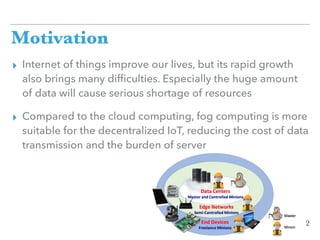
▸ Internet of things improve our lives, but its rapid growth
also brings many difficulties. Especially the huge amount
of data will cause serious shortage of resources
▸ Compared to the cloud computing, fog computing is more
suitable for the decentralized IoT, reducing the cost of data
transmission and the burden of server
2
Goal
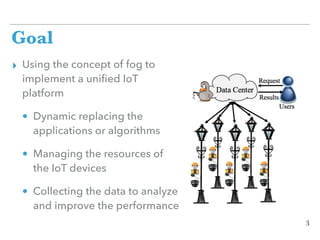
▸ Using the concept of fog to
implement a unified IoT
platform
• Dynamic replacing the
applications or algorithms
• Managing the resources of
the IoT devices
• Collecting the data to analyze
and improve the performance
3
Tasks
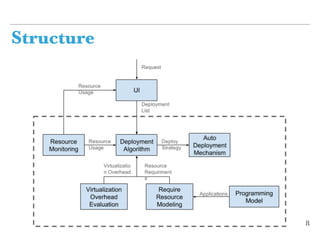
▸ Resource monitoring and container deployment
▸ Optimal location- and resource- aware optimal
deployment algorithm
▸ Network planning algorithm of fog devices
4
Task 1
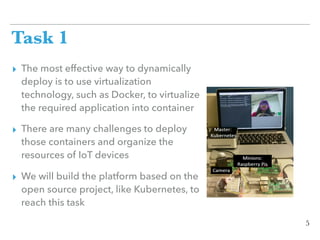
▸ The most effective way to dynamically
deploy is to use virtualization
technology, such as Docker, to virtualize
the required application into container
▸ There are many challenges to deploy
those containers and organize the
resources of IoT devices
▸ We will build the platform based on the
open source project, like Kubernetes, to
reach this task
5
Task 2
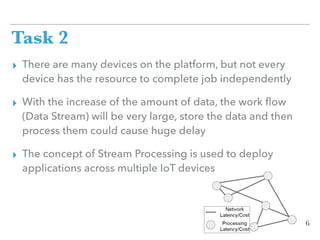
▸ There are many devices on the platform, but not every
device has the resource to complete job independently
▸ With the increase of the amount of data, the work flow
(Data Stream) will be very large, store the data and then
process them could cause huge delay
▸ The concept of Stream Processing is used to deploy
applications across multiple IoT devices
6
Task 3
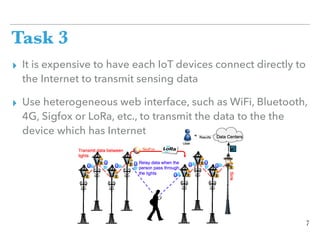
▸ It is expensive to have each IoT devices connect directly to
the Internet to transmit sensing data
▸ Use heterogeneous web interface, such as WiFi, Bluetooth,
4G, Sigfox or LoRa, etc., to transmit the data to the the
device which has Internet
7
Structure
8
⽂字 9
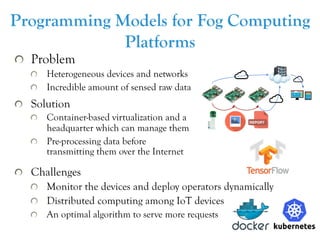
  Problem
  Heterogeneous devices and networks
  Incredible amount of sensed raw data
  Solution
  Container-based virtualization and a
headquarter which can manage them
  Pre-processing data before
transmitting them over the Internet
  Challenges
  Monitor the devices and deploy operators dynamically
  Distributed computing among IoT devices
  An optimal algorithm to serve more requests
Programming Models for Fog Computing
Platforms
⽂字 10
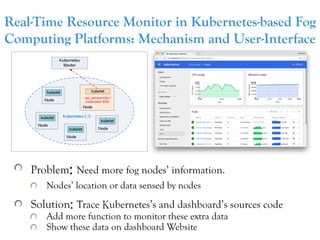
  Problem Need more fog nodes’ information.
  Nodes’ location or data sensed by nodes
  Solution Trace ubernetes’s and dashboard’s sources code
  Add more function to monitor these extra data
  Show these data on dashboard Website
Real-Time Resource Monitor in Kubernetes-based Fog
Computing Platforms: Mechanism and User-Interface
⽂字 11
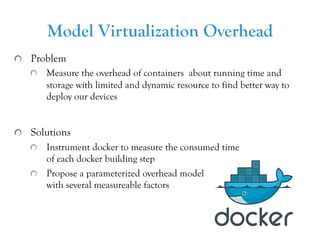
  Problem
  Measure the overhead of containers about running time and
storage with limited and dynamic resource to find better way to
deploy our devices
  Solutions
  Instrument docker to measure the consumed time
of each docker building step
  Propose a parameterized overhead model
with several measureable factors
Model Virtualization Overhead
⽂字 12
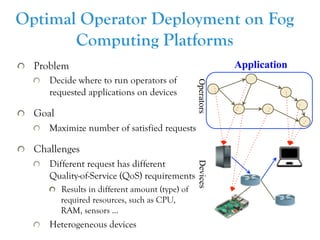
Optimal Operator Deployment on Fog
Computing Platforms
  Problem
  Decide where to run operators of
requested applications on devices
  Goal
  Maximize number of satisfied requests
  Challenges
  Different request has different
Quality-of-Service (QoS) requirements
  Results in different amount (type) of
required resources, such as CPU,
RAM, sensors …
  Heterogeneous devices
OperatorsDevices
Application
⽂字 13
  A mechanism to dynamically deploy container images on a fog
computing platform
  Problem
  In highly programmable IoT platforms, the auto-deployment of
containers need to consider the heterogeneities of hardware
  The GUI in the dashboards of container orchestration tools
usually don’t provide data mixing both container cluster
information and IoT device.
  Solutions
  Label the nodes and deploy images based on the deployment plan.
  Visualize detail informations of each node by modifying
Kubernetes UI Dashboard.
Dynamic Deployment
⽂字 14
  Motivation
  Optimize resource utilization in fog computing system
  Guaranteed QoS streaming
  Solutions
  Software-defined networking structure which can manage the
resource in a global network view
  Hierarchical Control system
  Challenges
  Optimal algorithm run on the controller
  Coordination between SDN controller
and fog controller
Enable OpenFlow in
Fog Computing System

Fog Computing Platform

  • 1.
    Fog Computing Platform 徐正炘教授 洪華駿 蔡霈萱⿈主同 許翼麟 鄭安傑 陳冠維 莊若其 1
  • 2.
    Motivation ▸ Internet ofthings improve our lives, but its rapid growth also brings many difficulties. Especially the huge amount of data will cause serious shortage of resources ▸ Compared to the cloud computing, fog computing is more suitable for the decentralized IoT, reducing the cost of data transmission and the burden of server 2
  • 3.
    Goal ▸ Using theconcept of fog to implement a unified IoT platform • Dynamic replacing the applications or algorithms • Managing the resources of the IoT devices • Collecting the data to analyze and improve the performance 3
  • 4.
    Tasks ▸ Resource monitoringand container deployment ▸ Optimal location- and resource- aware optimal deployment algorithm ▸ Network planning algorithm of fog devices 4
  • 5.
    Task 1 ▸ Themost effective way to dynamically deploy is to use virtualization technology, such as Docker, to virtualize the required application into container ▸ There are many challenges to deploy those containers and organize the resources of IoT devices ▸ We will build the platform based on the open source project, like Kubernetes, to reach this task 5
  • 6.
    Task 2 ▸ Thereare many devices on the platform, but not every device has the resource to complete job independently ▸ With the increase of the amount of data, the work flow (Data Stream) will be very large, store the data and then process them could cause huge delay ▸ The concept of Stream Processing is used to deploy applications across multiple IoT devices 6
  • 7.
    Task 3 ▸ Itis expensive to have each IoT devices connect directly to the Internet to transmit sensing data ▸ Use heterogeneous web interface, such as WiFi, Bluetooth, 4G, Sigfox or LoRa, etc., to transmit the data to the the device which has Internet 7
  • 8.
  • 9.
    ⽂字 9   Problem  Heterogeneous devices and networks   Incredible amount of sensed raw data   Solution   Container-based virtualization and a headquarter which can manage them   Pre-processing data before transmitting them over the Internet   Challenges   Monitor the devices and deploy operators dynamically   Distributed computing among IoT devices   An optimal algorithm to serve more requests Programming Models for Fog Computing Platforms
  • 10.
    ⽂字 10   ProblemNeed more fog nodes’ information.   Nodes’ location or data sensed by nodes   Solution Trace ubernetes’s and dashboard’s sources code   Add more function to monitor these extra data   Show these data on dashboard Website Real-Time Resource Monitor in Kubernetes-based Fog Computing Platforms: Mechanism and User-Interface
  • 11.
    ⽂字 11   Problem  Measure the overhead of containers about running time and storage with limited and dynamic resource to find better way to deploy our devices   Solutions   Instrument docker to measure the consumed time of each docker building step   Propose a parameterized overhead model with several measureable factors Model Virtualization Overhead
  • 12.
    ⽂字 12 Optimal OperatorDeployment on Fog Computing Platforms   Problem   Decide where to run operators of requested applications on devices   Goal   Maximize number of satisfied requests   Challenges   Different request has different Quality-of-Service (QoS) requirements   Results in different amount (type) of required resources, such as CPU, RAM, sensors …   Heterogeneous devices OperatorsDevices Application
  • 13.
    ⽂字 13   Amechanism to dynamically deploy container images on a fog computing platform   Problem   In highly programmable IoT platforms, the auto-deployment of containers need to consider the heterogeneities of hardware   The GUI in the dashboards of container orchestration tools usually don’t provide data mixing both container cluster information and IoT device.   Solutions   Label the nodes and deploy images based on the deployment plan.   Visualize detail informations of each node by modifying Kubernetes UI Dashboard. Dynamic Deployment
  • 14.
    ⽂字 14   Motivation  Optimize resource utilization in fog computing system   Guaranteed QoS streaming   Solutions   Software-defined networking structure which can manage the resource in a global network view   Hierarchical Control system   Challenges   Optimal algorithm run on the controller   Coordination between SDN controller and fog controller Enable OpenFlow in Fog Computing System