Metrics, Benchmarks and buckets of
              money

              Nicholas Lovell
               GAMESbrief

        Social Games Summit, Berlin
               23rd May, 2012
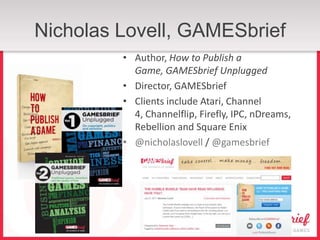
Nicholas Lovell, GAMESbrief
         • Author, How to Publish a
           Game, GAMESbrief Unplugged
         • Director, GAMESbrief
         • Clients include Atari, Channel
           4, Channelflip, Firefly, IPC, nDreams,
           Rebellion and Square Enix
         • @nicholaslovell / @gamesbrief
Subscribe to the blog
Buy How To Publish a Game
   50% off until Friday
    Use code: halfprice
Making F2P simple
REMEMBER: It’s about the fun
25 Add friction

• Game design is about taking
  friction out
• Freemium design is about
  adding friction
• GOOD fremium design is
  about finding a balance – just
  enough friction to encourage
  some players to pay, without
  ruining it for the rest of us.
Good F2P design
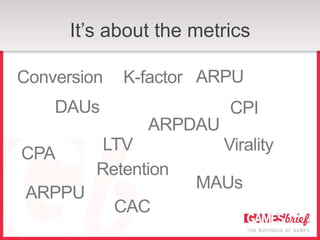
It’s about the metrics

Conversion   K-factor ARPU
    DAUs                 CPI
               ARPDAU
          LTV           Virality
CPA
         Retention
                     MAUs
ARPPU
             CAC
It’s about the metrics


       OMFG
It’s about the metrics


        WTF
What is the point of metrics?
• To connect game development and the
  finances of making games

• To teach you about your players and your
  game
• To help you make better decisions

            KEEP IT SIMPLE
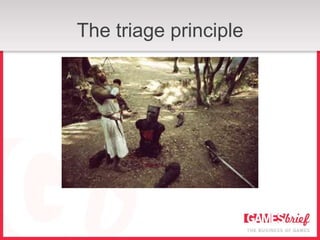
The triage principle
Beware vanity metrics
• A metric that can only go up is not useful
  – Registered users is a particular culprit
  – Yes, I’m looking at Bigpoint
• A metric that can’t be affected is not useful
  – Track percentages, not absolutes, for quick results
• Vanity metrics impress dumb VCs and the
  press
  – But they don’t help you run your business better
The Principles
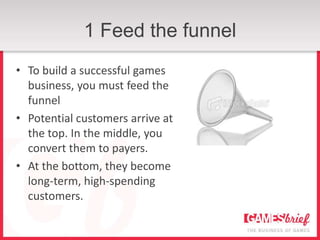
1 Feed the funnel
• To build a successful games
  business, you must feed the
  funnel
• Potential customers arrive at
  the top. In the middle, you
  convert them to payers.
• At the bottom, they become
  long-term, high-spending
  customers.
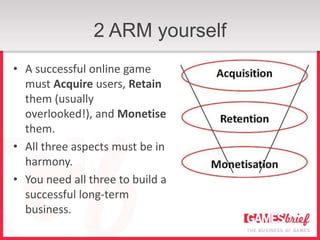
2 ARM yourself
• A successful online game
  must Acquire users, Retain
  them (usually
  overlooked!), and Monetise
  them.
• All three aspects must be in
  harmony.
• You need all three to build a
  successful long-term
  business.
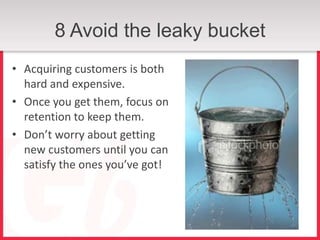
8 Avoid the leaky bucket
• Acquiring customers is both
  hard and expensive.
• Once you get them, focus on
  retention to keep them.
• Don’t worry about getting
  new customers until you can
  satisfy the ones you’ve got!
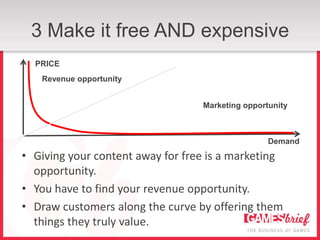
3 Make it free AND expensive
  PRICE
   Revenue opportunity


                                  Marketing opportunity


                                                  Demand
• Giving your content away for free is a marketing
  opportunity.
• You have to find your revenue opportunity.
• Draw customers along the curve by offering them
  things they truly value.
The GAMESbrief spreadsheet
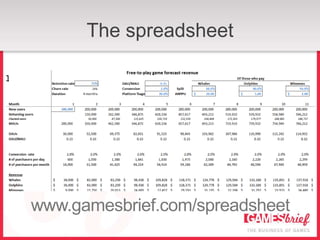
The spreadsheet


www.gamesbrief.com/spreadsheet
The data
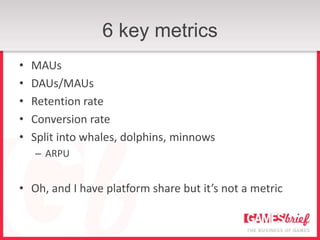
6 key metrics
•   MAUs
•   DAUs/MAUs
•   Retention rate
•   Conversion rate
•   Split into whales, dolphins, minnows
    – ARPU


• Oh, and I have platform share but it’s not a metric
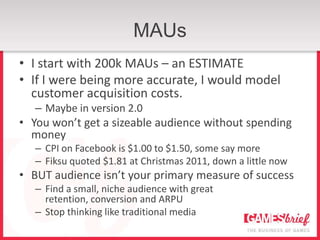
MAUs
• I start with 200k MAUs – an ESTIMATE
• If I were being more accurate, I would model
  customer acquisition costs.
   – Maybe in version 2.0
• You won’t get a sizeable audience without spending
  money
   – CPI on Facebook is $1.00 to $1.50, some say more
   – Fiksu quoted $1.81 at Christmas 2011, down a little now
• BUT audience isn’t your primary measure of success
   – Find a small, niche audience with great
     retention, conversion and ARPU
   – Stop thinking like traditional media
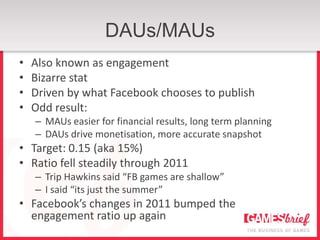
DAUs/MAUs
•   Also known as engagement
•   Bizarre stat
•   Driven by what Facebook chooses to publish
•   Odd result:
    – MAUs easier for financial results, long term planning
    – DAUs drive monetisation, more accurate snapshot
• Target: 0.15 (aka 15%)
• Ratio fell steadily through 2011
    – Trip Hawkins said “FB games are shallow”
    – I said “its just the summer”
• Facebook’s changes in 2011 bumped the
  engagement ratio up again
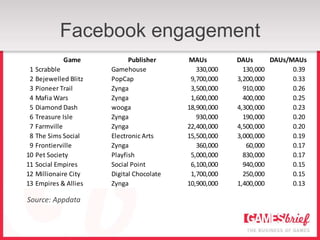
Facebook engagement
            Game            Publisher     MAUs         DAUs      DAUs/MAUs
 1 Scrabble           Gamehouse              330,000     130,000       0.39
 2 Bejewelled Blitz   PopCap               9,700,000   3,200,000       0.33
 3 Pioneer Trail      Zynga                3,500,000     910,000       0.26
 4 Mafia Wars         Zynga                1,600,000     400,000       0.25
 5 Diamond Dash       wooga               18,900,000   4,300,000       0.23
 6 Treasure Isle      Zynga                  930,000     190,000       0.20
 7 Farmville          Zynga               22,400,000   4,500,000       0.20
 8 The Sims Social    Electronic Arts     15,500,000   3,000,000       0.19
 9 Frontierville      Zynga                  360,000      60,000       0.17
10 Pet Society        Playfish             5,000,000     830,000       0.17
11 Social Empires     Social Point         6,100,000     940,000       0.15
12 Millionaire City   Digital Chocolate    1,700,000     250,000       0.15
13 Empires & Allies   Zynga               10,900,000   1,400,000       0.13

Source: Appdata
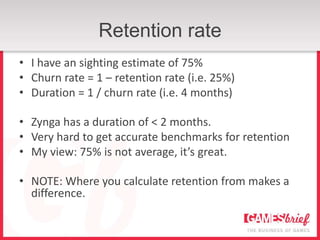
Retention rate
• I have an sighting estimate of 75%
• Churn rate = 1 – retention rate (i.e. 25%)
• Duration = 1 / churn rate (i.e. 4 months)

• Zynga has a duration of < 2 months.
• Very hard to get accurate benchmarks for retention
• My view: 75% is not average, it’s great.

• NOTE: Where you calculate retention from makes a
  difference.
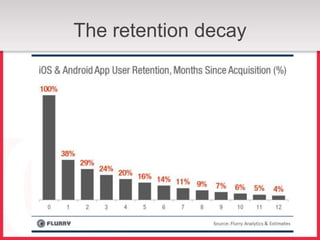
The retention decay
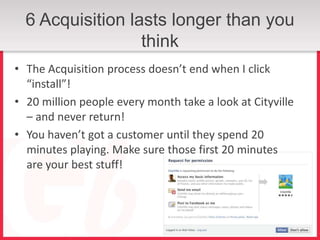
6 Acquisition lasts longer than you
                  think
• The Acquisition process doesn’t end when I click
  “install”!
• 20 million people every month take a look at Cityville
  – and never return!
• You haven’t got a customer until they spend 20
  minutes playing. Make sure those first 20 minutes
  are your best stuff!
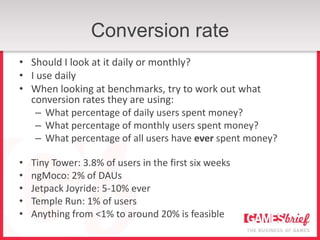
Conversion rate
• Should I look at it daily or monthly?
• I use daily
• When looking at benchmarks, try to work out what
  conversion rates they are using:
   – What percentage of daily users spent money?
   – What percentage of monthly users spent money?
   – What percentage of all users have ever spent money?

•   Tiny Tower: 3.8% of users in the first six weeks
•   ngMoco: 2% of DAUs
•   Jetpack Joyride: 5-10% ever
•   Temple Run: 1% of users
•   Anything from <1% to around 20% is feasible
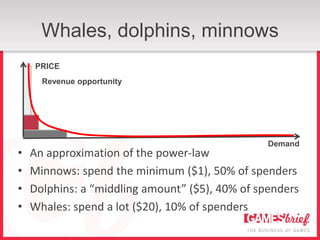
Whales, dolphins, minnows
     PRICE
      Revenue opportunity


                                                 Demand
•   An approximation of the power-law
•   Minnows: spend the minimum ($1), 50% of spenders
•   Dolphins: a “middling amount” ($5), 40% of spenders
•   Whales: spend a lot ($20), 10% of spenders
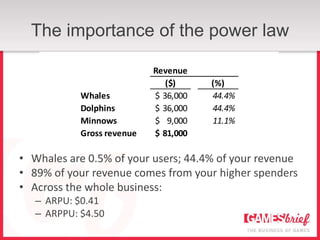
The importance of the power law

                            Revenue
                               ($)     (%)
            Whales          $ 36,000   44.4%
            Dolphins        $ 36,000   44.4%
            Minnows         $ 9,000    11.1%
            Gross revenue   $ 81,000

• Whales are 0.5% of your users; 44.4% of your revenue
• 89% of your revenue comes from your higher spenders
• Across the whole business:
   – ARPU: $0.41
   – ARPPU: $4.50
How to use the spreadsheet
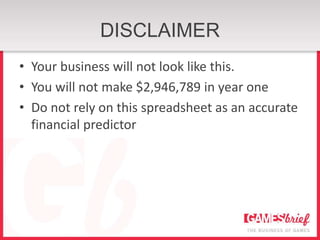
DISCLAIMER
• Your business will not look like this.
• You will not make $2,946,789 in year one
• Do not rely on this spreadsheet as an accurate
  financial predictor
The practical use
• All game developers have too many ideas to
  improve their game
• You need to prioritise
• Use the GAMESbrief spreadsheet to get a
  snapshot of the headline areas of
  Acquisition, Retention, Monetisation
• Identify which are below benchmark
• Work on those areas for the next sprint
• Move on
• Repeat
Conclusion
• You need metrics to make a successful F2P game
• They are useless unless you use them to make
  informed decisions
   – And then act on them
• It doesn’t even matter if my spreadsheet is right:
  look for the improvement over time, not the
  absolute number
• If the spreadsheet doesn’t fulfil your needs, change it
• (And if you want to, send it back to me, or tell me what you’ve
  changed)
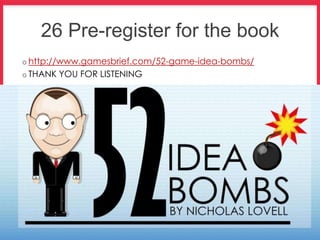
26 Pre-register for the book
o http://www.gamesbrief.com/52-game-idea-bombs/
o THANK YOU FOR LISTENING
Thank you
nicholas@gamesbrief.com

     Follow my blog
   www.gamesbrief.com

       Buy my books

www.gamesbrief.com/store
Code: halfprice (until Friday)

Benchmarks and metrics

  • 1.
    Metrics, Benchmarks andbuckets of money Nicholas Lovell GAMESbrief Social Games Summit, Berlin 23rd May, 2012
  • 2.
    Nicholas Lovell, GAMESbrief • Author, How to Publish a Game, GAMESbrief Unplugged • Director, GAMESbrief • Clients include Atari, Channel 4, Channelflip, Firefly, IPC, nDreams, Rebellion and Square Enix • @nicholaslovell / @gamesbrief
  • 3.
  • 4.
    Buy How ToPublish a Game 50% off until Friday Use code: halfprice
  • 5.
  • 6.
  • 7.
    25 Add friction •Game design is about taking friction out • Freemium design is about adding friction • GOOD fremium design is about finding a balance – just enough friction to encourage some players to pay, without ruining it for the rest of us.
  • 8.
  • 9.
    It’s about themetrics Conversion K-factor ARPU DAUs CPI ARPDAU LTV Virality CPA Retention MAUs ARPPU CAC
  • 10.
    It’s about themetrics OMFG
  • 11.
    It’s about themetrics WTF
  • 12.
    What is thepoint of metrics? • To connect game development and the finances of making games • To teach you about your players and your game • To help you make better decisions KEEP IT SIMPLE
  • 13.
  • 14.
    Beware vanity metrics •A metric that can only go up is not useful – Registered users is a particular culprit – Yes, I’m looking at Bigpoint • A metric that can’t be affected is not useful – Track percentages, not absolutes, for quick results • Vanity metrics impress dumb VCs and the press – But they don’t help you run your business better
  • 15.
  • 16.
    1 Feed thefunnel • To build a successful games business, you must feed the funnel • Potential customers arrive at the top. In the middle, you convert them to payers. • At the bottom, they become long-term, high-spending customers.
  • 17.
    2 ARM yourself •A successful online game must Acquire users, Retain them (usually overlooked!), and Monetise them. • All three aspects must be in harmony. • You need all three to build a successful long-term business.
  • 18.
    8 Avoid theleaky bucket • Acquiring customers is both hard and expensive. • Once you get them, focus on retention to keep them. • Don’t worry about getting new customers until you can satisfy the ones you’ve got!
  • 19.
    3 Make itfree AND expensive PRICE Revenue opportunity Marketing opportunity Demand • Giving your content away for free is a marketing opportunity. • You have to find your revenue opportunity. • Draw customers along the curve by offering them things they truly value.
  • 20.
  • 21.
  • 22.
  • 23.
    6 key metrics • MAUs • DAUs/MAUs • Retention rate • Conversion rate • Split into whales, dolphins, minnows – ARPU • Oh, and I have platform share but it’s not a metric
  • 24.
    MAUs • I startwith 200k MAUs – an ESTIMATE • If I were being more accurate, I would model customer acquisition costs. – Maybe in version 2.0 • You won’t get a sizeable audience without spending money – CPI on Facebook is $1.00 to $1.50, some say more – Fiksu quoted $1.81 at Christmas 2011, down a little now • BUT audience isn’t your primary measure of success – Find a small, niche audience with great retention, conversion and ARPU – Stop thinking like traditional media
  • 25.
    DAUs/MAUs • Also known as engagement • Bizarre stat • Driven by what Facebook chooses to publish • Odd result: – MAUs easier for financial results, long term planning – DAUs drive monetisation, more accurate snapshot • Target: 0.15 (aka 15%) • Ratio fell steadily through 2011 – Trip Hawkins said “FB games are shallow” – I said “its just the summer” • Facebook’s changes in 2011 bumped the engagement ratio up again
  • 26.
    Facebook engagement Game Publisher MAUs DAUs DAUs/MAUs 1 Scrabble Gamehouse 330,000 130,000 0.39 2 Bejewelled Blitz PopCap 9,700,000 3,200,000 0.33 3 Pioneer Trail Zynga 3,500,000 910,000 0.26 4 Mafia Wars Zynga 1,600,000 400,000 0.25 5 Diamond Dash wooga 18,900,000 4,300,000 0.23 6 Treasure Isle Zynga 930,000 190,000 0.20 7 Farmville Zynga 22,400,000 4,500,000 0.20 8 The Sims Social Electronic Arts 15,500,000 3,000,000 0.19 9 Frontierville Zynga 360,000 60,000 0.17 10 Pet Society Playfish 5,000,000 830,000 0.17 11 Social Empires Social Point 6,100,000 940,000 0.15 12 Millionaire City Digital Chocolate 1,700,000 250,000 0.15 13 Empires & Allies Zynga 10,900,000 1,400,000 0.13 Source: Appdata
  • 27.
    Retention rate • Ihave an sighting estimate of 75% • Churn rate = 1 – retention rate (i.e. 25%) • Duration = 1 / churn rate (i.e. 4 months) • Zynga has a duration of < 2 months. • Very hard to get accurate benchmarks for retention • My view: 75% is not average, it’s great. • NOTE: Where you calculate retention from makes a difference.
  • 28.
  • 29.
    6 Acquisition lastslonger than you think • The Acquisition process doesn’t end when I click “install”! • 20 million people every month take a look at Cityville – and never return! • You haven’t got a customer until they spend 20 minutes playing. Make sure those first 20 minutes are your best stuff!
  • 30.
    Conversion rate • ShouldI look at it daily or monthly? • I use daily • When looking at benchmarks, try to work out what conversion rates they are using: – What percentage of daily users spent money? – What percentage of monthly users spent money? – What percentage of all users have ever spent money? • Tiny Tower: 3.8% of users in the first six weeks • ngMoco: 2% of DAUs • Jetpack Joyride: 5-10% ever • Temple Run: 1% of users • Anything from <1% to around 20% is feasible
  • 31.
    Whales, dolphins, minnows PRICE Revenue opportunity Demand • An approximation of the power-law • Minnows: spend the minimum ($1), 50% of spenders • Dolphins: a “middling amount” ($5), 40% of spenders • Whales: spend a lot ($20), 10% of spenders
  • 32.
    The importance ofthe power law Revenue ($) (%) Whales $ 36,000 44.4% Dolphins $ 36,000 44.4% Minnows $ 9,000 11.1% Gross revenue $ 81,000 • Whales are 0.5% of your users; 44.4% of your revenue • 89% of your revenue comes from your higher spenders • Across the whole business: – ARPU: $0.41 – ARPPU: $4.50
  • 33.
    How to usethe spreadsheet
  • 34.
    DISCLAIMER • Your businesswill not look like this. • You will not make $2,946,789 in year one • Do not rely on this spreadsheet as an accurate financial predictor
  • 35.
    The practical use •All game developers have too many ideas to improve their game • You need to prioritise • Use the GAMESbrief spreadsheet to get a snapshot of the headline areas of Acquisition, Retention, Monetisation • Identify which are below benchmark • Work on those areas for the next sprint • Move on • Repeat
  • 36.
    Conclusion • You needmetrics to make a successful F2P game • They are useless unless you use them to make informed decisions – And then act on them • It doesn’t even matter if my spreadsheet is right: look for the improvement over time, not the absolute number • If the spreadsheet doesn’t fulfil your needs, change it • (And if you want to, send it back to me, or tell me what you’ve changed)
  • 37.
    26 Pre-register forthe book o http://www.gamesbrief.com/52-game-idea-bombs/ o THANK YOU FOR LISTENING
  • 38.
    Thank you nicholas@gamesbrief.com Follow my blog www.gamesbrief.com Buy my books www.gamesbrief.com/store Code: halfprice (until Friday)