NURSING PRIORITIZATION
MASLOW’S HEIRARCHY OF NEEDS
• Abraham Maslow noted that humans are
motivated to meet certain needs before they
can achieve a higher level of needs. In other
words, some conditions are foundational and
must be met before seeking to have
additional needs met.
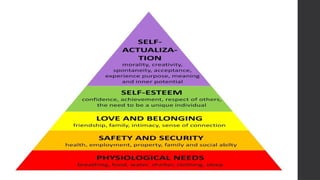
• Visualized as a pyramid. Needs at the bottom
of the pyramid are required as prerequisites
to meeting needs higher on the pyramid. The
categories of needs in Maslow’s theory are as
follows
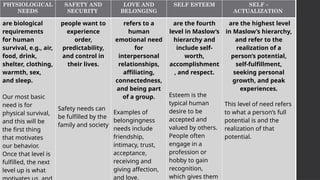
PHYSIOLOGICAL
NEEDS
SAFETY AND
SECURITY
LOVE AND
BELONGING
SELF ESTEEM SELF –
ACTUALIZATION
are biological
requirements
for human
survival, e.g., air,
food, drink,
shelter, clothing,
warmth, sex,
and sleep.
Our most basic
need is for
physical survival,
and this will be
the first thing
that motivates
our behavior.
Once that level is
fulfilled, the next
level up is what
people want to
experience
order,
predictability,
and control in
their lives.
Safety needs can
be fulfilled by the
family and society
refers to a
human
emotional need
for
interpersonal
relationships,
affiliating,
connectedness,
and being part
of a group.
Examples of
belongingness
needs include
friendship,
intimacy, trust,
acceptance,
receiving and
giving affection,
and love.
are the fourth
level in Maslow’s
hierarchy and
include self-
worth,
accomplishment
, and respect.
Esteem is the
typical human
desire to be
accepted and
valued by others.
People often
engage in a
profession or
hobby to gain
recognition,
which gives them
are the highest level
in Maslow’s hierarchy,
and refer to the
realization of a
person’s potential,
self-fulfillment,
seeking personal
growth, and peak
experiences.
This level of need refers
to what a person’s full
potential is and the
realization of that
potential.
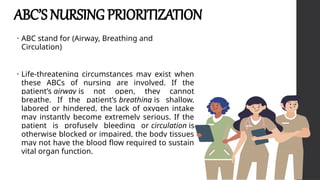
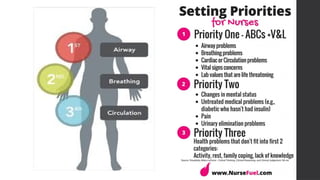
ABC’S NURSING PRIORITIZATION
• ABC stand for (Airway, Breathing and
Circulation)
• Life-threatening circumstances may exist when
these ABCs of nursing are involved. If the
patient’s airway is not open, they cannot
breathe. If the patient’s breathing is shallow,
labored or hindered, the lack of oxygen intake
may instantly become extremely serious. If the
patient is profusely bleeding or circulation is
otherwise blocked or impaired, the body tissues
may not have the blood flow required to sustain
vital organ function.
NURSING
PROCESS
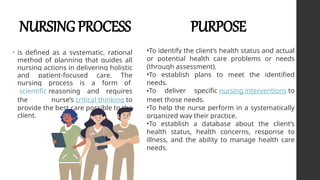
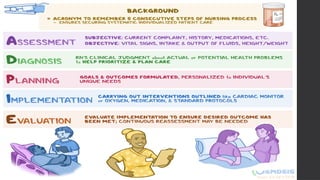
NURSING PROCESS PURPOSE
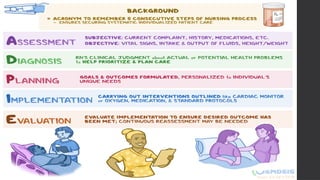
• is defined as a systematic, rational
method of planning that guides all
nursing actions in delivering holistic
and patient-focused care. The
nursing process is a form of
scientific reasoning and requires
the nurse’s critical thinking to
provide the best care possible to the
client.
•To identify the client’s health status and actual
or potential health care problems or needs
(through assessment).
•To establish plans to meet the identified
needs.
•To deliver specific nursing interventions to
meet those needs.
•To help the nurse perform in a systematically
organized way their practice.
•To establish a database about the client’s
health status, health concerns, response to
illness, and the ability to manage health care
needs.
CHARACTERISTICS OFTHENURSINGPROCESS
• Patient-centered. The unique approach of the nursing process requires
care respectful of and responsive to the individual patient’s needs,
preferences, and values.
• Interpersonal. The nursing process provides the basis for the therapeutic
process in which the nurse and patient respect each other as individuals,
both of them learning and growing due to the interaction.
• Collaborative. The nursing process functions effectively in nursing and
inter-professional teams, promoting open communication, mutual
respect, and shared decision-making to achieve quality patient care.
• Dynamic and cyclical. The nursing process is a dynamic, cyclical process
in which each phase interacts with and is influenced by the other phases.
• Requires critical thinking. The use of the nursing process requires
critical thinking which is a vital skill required for nurses in identifying
client problems and implementing interventions to promote effective care
outcomes.
FOCUS CHARTING
PREPARED BY: DAWN C. DEGAN, RN
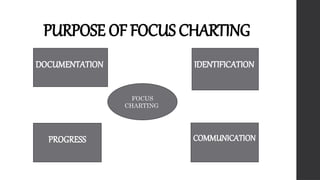
PURPOSE OF FOCUS CHARTING
IDENTIFICATION
COMMUNICATION
DOCUMENTATION
PROGRESS
FOCUS
CHARTING
FOCUS CHARTING
• is a method for organizing health
information in the individual's
record. It is a systematic
approach to documentation,
using nursing terminology to
describe individual's health status
and nursing action.
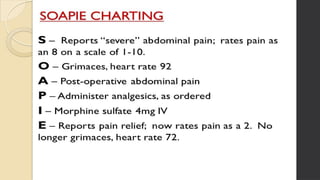
SOAPIE CHARTING
• is a mnemonic for a type of progress note that is
organized by six categories. SOAPIE progress
notes are written by nurses, as well as other
members of the health care team.
• categories:
Subjective, Objective, Assessment, Plan, Interventi
ons, and Evaluation.
FDAR
• The newest method that is being use in
charting in nurse’s note to evaluate
patient and guides further nursing
care plans and planning.
• It has 4 categories (Focus – Data –
Assessment – Response)
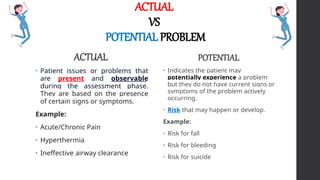
ACTUAL
VS
POTENTIAL PROBLEM
ACTUAL
• Patient issues or problems that
are present and observable
during the assessment phase.
They are based on the presence
of certain signs or symptoms.
Example:
• Acute/Chronic Pain
• Hyperthermia
• Ineffective airway clearance
POTENTIAL
• Indicates the patient may
potentially experience a problem
but they do not have current signs or
symptoms of the problem actively
occurring.
• Risk that may happen or develop.
Example:
• Risk for fall
• Risk for bleeding
• Risk for suicide
FOCUS
• a key word or diagnostic category from a
nursing diagnosis or collaborative
problem on the plan of care (action plan)
• a current individual concern or
behavior, i.e. nausea, chest pain, pre-op
teaching, hospital admission
• a sign or symptom of (possible
importance to the nursing and/or medical
diagnosis or treatment plan.
DATA
• Data is the information about the
patient's current status. This can include
the patient's vital signs or a noticeable
change in the patient's condition or
behavior.
TWOTYPES OF DATA
SUBJECTIVE
• a data that comes from feelings,
experiences, opinions, and thoughts
of a patient.
• For example:
“ masakit po yung tiyan ko”
“ nasusuka po ako”
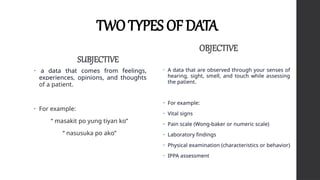
OBJECTIVE
• A data that are observed through your senses of
hearing, sight, smell, and touch while assessing
the patient.
• For example:
• Vital signs
• Pain scale (Wong-baker or numeric scale)
• Laboratory findings
• Physical examination (characteristics or behavior)
• IPPA assessment
ACTION
• This is the action the nurse takes in
response to the data. For example,
the nurse might replace a bandage if
they noticed it needed to be changed.
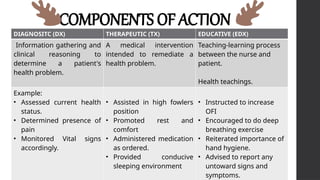
COMPONENTS OF ACTION
DIAGNOSITC (DX) THERAPEUTIC (TX) EDUCATIVE (EDX)
Information gathering and
clinical reasoning to
determine a patient's
health problem.
A medical intervention
intended to remediate a
health problem.
Teaching-learning process
between the nurse and
patient.
Health teachings.
Example:
• Assessed current health
status.
• Determined presence of
pain
• Monitored Vital signs
accordingly.
• Assisted in high fowlers
position
• Promoted rest and
comfort
• Administered medication
as ordered.
• Provided conducive
sleeping environment
• Instructed to increase
OFI
• Encouraged to do deep
breathing exercise
• Reiterated importance of
hand hygiene.
• Advised to report any
untoward signs and
symptoms.
RESPONSE
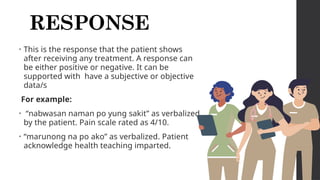
• This is the response that the patient shows
after receiving any treatment. A response can
be either positive or negative. It can be
supported with have a subjective or objective
data/s
For example:
• “nabwasan naman po yung sakit” as verbalized
by the patient. Pain scale rated as 4/10.
• “marunong na po ako” as verbalized. Patient
acknowledge health teaching imparted.
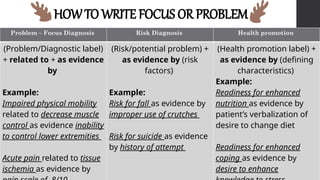
HOWTO WRITE FOCUS OR PROBLEM
Problem – Focus Diagnosis Risk Diagnosis Health promotion
(Problem/Diagnostic label)
+ related to + as evidence
by
Example:
Impaired physical mobility
related to decrease muscle
control as evidence inability
to control lower extremities
Acute pain related to tissue
ischemia as evidence by
(Risk/potential problem) +
as evidence by (risk
factors)
Example:
Risk for fall as evidence by
improper use of crutches
Risk for suicide as evidence
by history of attempt
(Health promotion label) +
as evidence by (defining
characteristics)
Example:
Readiness for enhanced
nutrition as evidence by
patient’s verbalization of
desire to change diet
Readiness for enhanced
coping as evidence by
desire to enhance
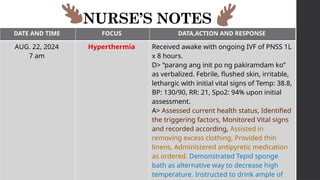
NURSE’S NOTES
DATE AND TIME FOCUS DATA,ACTION AND RESPONSE
AUG. 22, 2024
7 am
Hyperthermia Received awake with ongoing IVF of PNSS 1L
x 8 hours.
D> “parang ang init po ng pakiramdam ko”
as verbalized. Febrile, flushed skin, irritable,
lethargic with initial vital signs of Temp: 38.8,
BP: 130/90, RR: 21, Spo2: 94% upon initial
assessment.
A> Assessed current health status, Identified
the triggering factors, Monitored Vital signs
and recorded according, Assisted in
removing excess clothing, Provided thin
linens, Administered antipyretic medication
as ordered. Demonstrated Tepid sponge
bath as alternative way to decrease high
temperature. Instructed to drink ample of
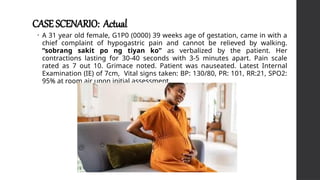
CASE SCENARIO: Actual
• A 31 year old female, G1P0 (0000) 39 weeks age of gestation, came in with a
chief complaint of hypogastric pain and cannot be relieved by walking.
“sobrang sakit po ng tiyan ko” as verbalized by the patient. Her
contractions lasting for 30-40 seconds with 3-5 minutes apart. Pain scale
rated as 7 out 10. Grimace noted. Patient was nauseated. Latest Internal
Examination (IE) of 7cm, Vital signs taken: BP: 130/80, PR: 101, RR:21, SPO2:
95% at room air upon initial assessment.
Case Scenario: Potential
• A 31 year old, female. G1P1(1001) was room in to OB Ward after delivering
her neonate via normal spontaneous delivery with right mediolateral
episiotomy. Patient has IV Therapy of PLRS 1L + 10 units oxytocin x 8
hours at level of 800cc. Pain rated as 4/10, with slightly boggy uterus,
Latest vital signs take: BP 100/70, RR: 21, T: 39.5 spo2: 95% PR; 110.
NURSING CARE PLAN
WHATIS NCP?
• A formal process that correctly identifies
existing needs and recognizes a client’s
potential needs or risks. Care plans
provide a way of communication among
nurses, their patients, and other
healthcare providers to achieve healthcare
outcomes. Without the nursing
care planning process, the quality and
consistency of patient care would be lost.
OBJECTIVES
• Promote evidence-based nursing care and
render pleasant and familiar conditions in
hospitals or health centers.
• Support holistic care, which involves the whole
person, including physical, psychological, social,
and spiritual, with the management and
prevention of the disease.
• Establish programs such as care pathways and
care bundles. Care pathways involve a team effort
to reach a consensus regarding standards of care
and expected outcomes. In contrast, care bundles
are related to best practices concerning care for a
specific disease.
• Identify and distinguish goals and expected
outcomes.
• Review communication and documentation of the
care plan.
• Measure nursing care.
PURPOSE
• Defines nurse’s role. Care plans help identify nurses’
unique and independent role in attending to clients’ overall
health and
• Provides direction for individualized care of the client. It
serves as a roadmap for the care that will be provided to the
patient and allows the nurse to think critically in developing
interventions directly tailored to the individual.
• Continuity of care. Nurses from different shifts or
departments can use the data to render the same quality
and type of interventions to care for clients
• Coordinate care. Ensures that all members of the
healthcare team are aware of the patient’s care needs
• Documentation. It should accurately outline which
observations to make, what nursing actions to carry out,
and what instructions the client or family members require.
• Serves as a guide for assigning a specific staff to a
specific client.
• Monitor progress. To help track the patient’s progress and
make necessary adjustments to the care plan
• Defines client’s goals. It benefits nurses and clients by
involving them in their treatment and care.
COMPONENTS OF NCP
DATA
• These are your gathered assessment
to your patient which include your:
Subjective data: verbalized by the
patient
Objectives: head to toe assessment,
physical examination and laboratories.
RN Diagnosis: with the use of NANDA
References: books or website. With
proper citations (APA)
PATHOPHYSIOLOGY
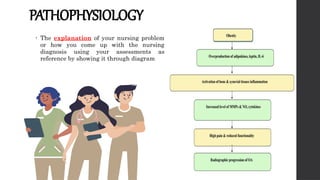
• The explanation of your nursing problem
or how you come up with the nursing
diagnosis using your assessments as
reference by showing it through diagram
GOALS
SHORT TERM GOALS
• This is your goal after a shift or 1-3
days of admission of your patient.
For example:
• After 6 hours of nursing intervention
patient’s fever decrease from 39.1 to
37.5 Degree Celsius.
• After 2 days, patient will be able to
ambulate with assist.
LONG TERM GOALS
• This is your goal to your patient
which can take a week , month/s or
year
For example:
• After 3 days, Patient displays
improvement in mood, coping.
• After 1 week, Patient demonstrates
the use of appropriate diversional
activities and relaxation skills.
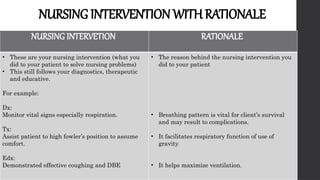
NURSING INTERVENTION WITH RATIONALE
NURSING INTERVETION RATIONALE
• These are your nursing intervention (what you
did to your patient to solve nursing problems)
• This still follows your diagnostics, therapeutic
and educative.
For example:
Dx:
Monitor vital signs especially respiration.
Tx:
Assist patient to high fowler’s position to assume
comfort.
Edx:
Demonstrated effective coughing and DBE
• The reason behind the nursing intervention you
did to your patient
• Breathing pattern is vital for client’s survival
and may result to complications.
• It facilitates respiratory function of use of
gravity
• It helps maximize ventilation.
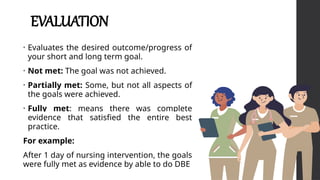
EVALUATION
• Evaluates the desired outcome/progress of
your short and long term goal.
• Not met: The goal was not achieved.
• Partially met: Some, but not all aspects of
the goals were achieved.
• Fully met: means there was complete
evidence that satisfied the entire best
practice.
For example:
After 1 day of nursing intervention, the goals
were fully met as evidence by able to do DBE
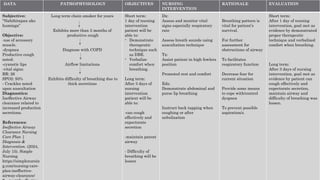
DATA PATHOPHYSIOLOGY OBJECTIVES NURSING
INTERVENTION
RATIONALE EVALUATION
Subjective:
“Nahihirapan ako
huminga”
Objective:
-use of accessory
muscle.
-dyspnea
Productive cough
noted.
-cyanotic lips
-vital signs:
RR: 26
SPO2: 93%
- Crackles noted
upon auscultation
Diagnostics:
Ineffective Airway
clearance related to
increased production
secretions.
References:
Ineffective Airway
Clearance Nursing
Care Plan |
Diagnosis &
Intervention. (2024,
July 15). Simple
Nursing.
https://simplenursin
g.com/nursing-care-
plan-ineffective-
airway-clearance/
Long term chain smoker for years
Exhibits more than 3 months of
productive cough
Diagnose with COPD
Airflow limitations
Exhibits difficulty of breathing due to
thick secretions
Short term:
1 day of nursing
intervention
patient will be
able to:
- Demonstrate
therapeutic
technique such
as DBE.
- Verbalize
comfort when
breathing.
Long term:
After 3 days of
nursing
intervention
patient will be
able to:
-can cough
effectively and
expectorate
secretion
-maintain patent
airway
- Difficulty of
breathing will be
lessen
Dx:
Assess and monitor vital
signs especially respiratory
rate
Assess breath sounds using
auscultation technique
Tx:
Assist patient in high fowlers
position
Promoted rest and comfort
Edx:
Demonstrate abdominal and
purse lip breathing
Instruct back tapping when
coughing or after
nebulization
Breathing pattern is
vital for patient’s
survival.
For further
assessment for
obstructions of airway
To facilitates
respiratory function
Decrease fear for
current situation
Provide some means
to cope with/control
dyspnea
To prevent possible
aspiration/s.
Short term:
After 1 day of nursing
intervention, goal met as
evidence by demonstrated
proper therapeutic
technique and verbalized
comfort when breathing.
Long term:
After 3 days of nursing
intervention, goal met as
evidence by patient can
cough effectively and
expectorate secretion,
maintain airway and
difficulty of breathing was
lessen.
THE END

FOCUS CHARTING and NURSING CARE PLAN.pptx

  • 1.
  • 2.
    MASLOW’S HEIRARCHY OFNEEDS • Abraham Maslow noted that humans are motivated to meet certain needs before they can achieve a higher level of needs. In other words, some conditions are foundational and must be met before seeking to have additional needs met. • Visualized as a pyramid. Needs at the bottom of the pyramid are required as prerequisites to meeting needs higher on the pyramid. The categories of needs in Maslow’s theory are as follows
  • 4.
    PHYSIOLOGICAL NEEDS SAFETY AND SECURITY LOVE AND BELONGING SELFESTEEM SELF – ACTUALIZATION are biological requirements for human survival, e.g., air, food, drink, shelter, clothing, warmth, sex, and sleep. Our most basic need is for physical survival, and this will be the first thing that motivates our behavior. Once that level is fulfilled, the next level up is what people want to experience order, predictability, and control in their lives. Safety needs can be fulfilled by the family and society refers to a human emotional need for interpersonal relationships, affiliating, connectedness, and being part of a group. Examples of belongingness needs include friendship, intimacy, trust, acceptance, receiving and giving affection, and love. are the fourth level in Maslow’s hierarchy and include self- worth, accomplishment , and respect. Esteem is the typical human desire to be accepted and valued by others. People often engage in a profession or hobby to gain recognition, which gives them are the highest level in Maslow’s hierarchy, and refer to the realization of a person’s potential, self-fulfillment, seeking personal growth, and peak experiences. This level of need refers to what a person’s full potential is and the realization of that potential.
  • 5.
    ABC’S NURSING PRIORITIZATION •ABC stand for (Airway, Breathing and Circulation) • Life-threatening circumstances may exist when these ABCs of nursing are involved. If the patient’s airway is not open, they cannot breathe. If the patient’s breathing is shallow, labored or hindered, the lack of oxygen intake may instantly become extremely serious. If the patient is profusely bleeding or circulation is otherwise blocked or impaired, the body tissues may not have the blood flow required to sustain vital organ function.
  • 7.
  • 8.
    NURSING PROCESS PURPOSE •is defined as a systematic, rational method of planning that guides all nursing actions in delivering holistic and patient-focused care. The nursing process is a form of scientific reasoning and requires the nurse’s critical thinking to provide the best care possible to the client. •To identify the client’s health status and actual or potential health care problems or needs (through assessment). •To establish plans to meet the identified needs. •To deliver specific nursing interventions to meet those needs. •To help the nurse perform in a systematically organized way their practice. •To establish a database about the client’s health status, health concerns, response to illness, and the ability to manage health care needs.
  • 9.
    CHARACTERISTICS OFTHENURSINGPROCESS • Patient-centered.The unique approach of the nursing process requires care respectful of and responsive to the individual patient’s needs, preferences, and values. • Interpersonal. The nursing process provides the basis for the therapeutic process in which the nurse and patient respect each other as individuals, both of them learning and growing due to the interaction. • Collaborative. The nursing process functions effectively in nursing and inter-professional teams, promoting open communication, mutual respect, and shared decision-making to achieve quality patient care. • Dynamic and cyclical. The nursing process is a dynamic, cyclical process in which each phase interacts with and is influenced by the other phases. • Requires critical thinking. The use of the nursing process requires critical thinking which is a vital skill required for nurses in identifying client problems and implementing interventions to promote effective care outcomes.
  • 11.
    FOCUS CHARTING PREPARED BY:DAWN C. DEGAN, RN
  • 12.
    PURPOSE OF FOCUSCHARTING IDENTIFICATION COMMUNICATION DOCUMENTATION PROGRESS FOCUS CHARTING
  • 13.
    FOCUS CHARTING • isa method for organizing health information in the individual's record. It is a systematic approach to documentation, using nursing terminology to describe individual's health status and nursing action.
  • 14.
    SOAPIE CHARTING • isa mnemonic for a type of progress note that is organized by six categories. SOAPIE progress notes are written by nurses, as well as other members of the health care team. • categories: Subjective, Objective, Assessment, Plan, Interventi ons, and Evaluation.
  • 17.
    FDAR • The newestmethod that is being use in charting in nurse’s note to evaluate patient and guides further nursing care plans and planning. • It has 4 categories (Focus – Data – Assessment – Response)
  • 18.
    ACTUAL VS POTENTIAL PROBLEM ACTUAL • Patientissues or problems that are present and observable during the assessment phase. They are based on the presence of certain signs or symptoms. Example: • Acute/Chronic Pain • Hyperthermia • Ineffective airway clearance POTENTIAL • Indicates the patient may potentially experience a problem but they do not have current signs or symptoms of the problem actively occurring. • Risk that may happen or develop. Example: • Risk for fall • Risk for bleeding • Risk for suicide
  • 19.
    FOCUS • a keyword or diagnostic category from a nursing diagnosis or collaborative problem on the plan of care (action plan) • a current individual concern or behavior, i.e. nausea, chest pain, pre-op teaching, hospital admission • a sign or symptom of (possible importance to the nursing and/or medical diagnosis or treatment plan.
  • 20.
    DATA • Data isthe information about the patient's current status. This can include the patient's vital signs or a noticeable change in the patient's condition or behavior.
  • 21.
    TWOTYPES OF DATA SUBJECTIVE •a data that comes from feelings, experiences, opinions, and thoughts of a patient. • For example: “ masakit po yung tiyan ko” “ nasusuka po ako” OBJECTIVE • A data that are observed through your senses of hearing, sight, smell, and touch while assessing the patient. • For example: • Vital signs • Pain scale (Wong-baker or numeric scale) • Laboratory findings • Physical examination (characteristics or behavior) • IPPA assessment
  • 22.
    ACTION • This isthe action the nurse takes in response to the data. For example, the nurse might replace a bandage if they noticed it needed to be changed.
  • 23.
    COMPONENTS OF ACTION DIAGNOSITC(DX) THERAPEUTIC (TX) EDUCATIVE (EDX) Information gathering and clinical reasoning to determine a patient's health problem. A medical intervention intended to remediate a health problem. Teaching-learning process between the nurse and patient. Health teachings. Example: • Assessed current health status. • Determined presence of pain • Monitored Vital signs accordingly. • Assisted in high fowlers position • Promoted rest and comfort • Administered medication as ordered. • Provided conducive sleeping environment • Instructed to increase OFI • Encouraged to do deep breathing exercise • Reiterated importance of hand hygiene. • Advised to report any untoward signs and symptoms.
  • 24.
    RESPONSE • This isthe response that the patient shows after receiving any treatment. A response can be either positive or negative. It can be supported with have a subjective or objective data/s For example: • “nabwasan naman po yung sakit” as verbalized by the patient. Pain scale rated as 4/10. • “marunong na po ako” as verbalized. Patient acknowledge health teaching imparted.
  • 25.
    HOWTO WRITE FOCUSOR PROBLEM Problem – Focus Diagnosis Risk Diagnosis Health promotion (Problem/Diagnostic label) + related to + as evidence by Example: Impaired physical mobility related to decrease muscle control as evidence inability to control lower extremities Acute pain related to tissue ischemia as evidence by (Risk/potential problem) + as evidence by (risk factors) Example: Risk for fall as evidence by improper use of crutches Risk for suicide as evidence by history of attempt (Health promotion label) + as evidence by (defining characteristics) Example: Readiness for enhanced nutrition as evidence by patient’s verbalization of desire to change diet Readiness for enhanced coping as evidence by desire to enhance
  • 26.
    NURSE’S NOTES DATE ANDTIME FOCUS DATA,ACTION AND RESPONSE AUG. 22, 2024 7 am Hyperthermia Received awake with ongoing IVF of PNSS 1L x 8 hours. D> “parang ang init po ng pakiramdam ko” as verbalized. Febrile, flushed skin, irritable, lethargic with initial vital signs of Temp: 38.8, BP: 130/90, RR: 21, Spo2: 94% upon initial assessment. A> Assessed current health status, Identified the triggering factors, Monitored Vital signs and recorded according, Assisted in removing excess clothing, Provided thin linens, Administered antipyretic medication as ordered. Demonstrated Tepid sponge bath as alternative way to decrease high temperature. Instructed to drink ample of
  • 27.
    CASE SCENARIO: Actual •A 31 year old female, G1P0 (0000) 39 weeks age of gestation, came in with a chief complaint of hypogastric pain and cannot be relieved by walking. “sobrang sakit po ng tiyan ko” as verbalized by the patient. Her contractions lasting for 30-40 seconds with 3-5 minutes apart. Pain scale rated as 7 out 10. Grimace noted. Patient was nauseated. Latest Internal Examination (IE) of 7cm, Vital signs taken: BP: 130/80, PR: 101, RR:21, SPO2: 95% at room air upon initial assessment.
  • 28.
    Case Scenario: Potential •A 31 year old, female. G1P1(1001) was room in to OB Ward after delivering her neonate via normal spontaneous delivery with right mediolateral episiotomy. Patient has IV Therapy of PLRS 1L + 10 units oxytocin x 8 hours at level of 800cc. Pain rated as 4/10, with slightly boggy uterus, Latest vital signs take: BP 100/70, RR: 21, T: 39.5 spo2: 95% PR; 110.
  • 29.
  • 30.
    WHATIS NCP? • Aformal process that correctly identifies existing needs and recognizes a client’s potential needs or risks. Care plans provide a way of communication among nurses, their patients, and other healthcare providers to achieve healthcare outcomes. Without the nursing care planning process, the quality and consistency of patient care would be lost.
  • 31.
    OBJECTIVES • Promote evidence-basednursing care and render pleasant and familiar conditions in hospitals or health centers. • Support holistic care, which involves the whole person, including physical, psychological, social, and spiritual, with the management and prevention of the disease. • Establish programs such as care pathways and care bundles. Care pathways involve a team effort to reach a consensus regarding standards of care and expected outcomes. In contrast, care bundles are related to best practices concerning care for a specific disease. • Identify and distinguish goals and expected outcomes. • Review communication and documentation of the care plan. • Measure nursing care. PURPOSE • Defines nurse’s role. Care plans help identify nurses’ unique and independent role in attending to clients’ overall health and • Provides direction for individualized care of the client. It serves as a roadmap for the care that will be provided to the patient and allows the nurse to think critically in developing interventions directly tailored to the individual. • Continuity of care. Nurses from different shifts or departments can use the data to render the same quality and type of interventions to care for clients • Coordinate care. Ensures that all members of the healthcare team are aware of the patient’s care needs • Documentation. It should accurately outline which observations to make, what nursing actions to carry out, and what instructions the client or family members require. • Serves as a guide for assigning a specific staff to a specific client. • Monitor progress. To help track the patient’s progress and make necessary adjustments to the care plan • Defines client’s goals. It benefits nurses and clients by involving them in their treatment and care.
  • 32.
  • 33.
    DATA • These areyour gathered assessment to your patient which include your: Subjective data: verbalized by the patient Objectives: head to toe assessment, physical examination and laboratories. RN Diagnosis: with the use of NANDA References: books or website. With proper citations (APA)
  • 34.
    PATHOPHYSIOLOGY • The explanationof your nursing problem or how you come up with the nursing diagnosis using your assessments as reference by showing it through diagram
  • 35.
    GOALS SHORT TERM GOALS •This is your goal after a shift or 1-3 days of admission of your patient. For example: • After 6 hours of nursing intervention patient’s fever decrease from 39.1 to 37.5 Degree Celsius. • After 2 days, patient will be able to ambulate with assist. LONG TERM GOALS • This is your goal to your patient which can take a week , month/s or year For example: • After 3 days, Patient displays improvement in mood, coping. • After 1 week, Patient demonstrates the use of appropriate diversional activities and relaxation skills.
  • 36.
    NURSING INTERVENTION WITHRATIONALE NURSING INTERVETION RATIONALE • These are your nursing intervention (what you did to your patient to solve nursing problems) • This still follows your diagnostics, therapeutic and educative. For example: Dx: Monitor vital signs especially respiration. Tx: Assist patient to high fowler’s position to assume comfort. Edx: Demonstrated effective coughing and DBE • The reason behind the nursing intervention you did to your patient • Breathing pattern is vital for client’s survival and may result to complications. • It facilitates respiratory function of use of gravity • It helps maximize ventilation.
  • 37.
    EVALUATION • Evaluates thedesired outcome/progress of your short and long term goal. • Not met: The goal was not achieved. • Partially met: Some, but not all aspects of the goals were achieved. • Fully met: means there was complete evidence that satisfied the entire best practice. For example: After 1 day of nursing intervention, the goals were fully met as evidence by able to do DBE
  • 38.
    DATA PATHOPHYSIOLOGY OBJECTIVESNURSING INTERVENTION RATIONALE EVALUATION Subjective: “Nahihirapan ako huminga” Objective: -use of accessory muscle. -dyspnea Productive cough noted. -cyanotic lips -vital signs: RR: 26 SPO2: 93% - Crackles noted upon auscultation Diagnostics: Ineffective Airway clearance related to increased production secretions. References: Ineffective Airway Clearance Nursing Care Plan | Diagnosis & Intervention. (2024, July 15). Simple Nursing. https://simplenursin g.com/nursing-care- plan-ineffective- airway-clearance/ Long term chain smoker for years Exhibits more than 3 months of productive cough Diagnose with COPD Airflow limitations Exhibits difficulty of breathing due to thick secretions Short term: 1 day of nursing intervention patient will be able to: - Demonstrate therapeutic technique such as DBE. - Verbalize comfort when breathing. Long term: After 3 days of nursing intervention patient will be able to: -can cough effectively and expectorate secretion -maintain patent airway - Difficulty of breathing will be lessen Dx: Assess and monitor vital signs especially respiratory rate Assess breath sounds using auscultation technique Tx: Assist patient in high fowlers position Promoted rest and comfort Edx: Demonstrate abdominal and purse lip breathing Instruct back tapping when coughing or after nebulization Breathing pattern is vital for patient’s survival. For further assessment for obstructions of airway To facilitates respiratory function Decrease fear for current situation Provide some means to cope with/control dyspnea To prevent possible aspiration/s. Short term: After 1 day of nursing intervention, goal met as evidence by demonstrated proper therapeutic technique and verbalized comfort when breathing. Long term: After 3 days of nursing intervention, goal met as evidence by patient can cough effectively and expectorate secretion, maintain airway and difficulty of breathing was lessen.
  • 40.

Editor's Notes

  • #1 Nursing prioritization Helps us nurses provide the most optimum and effecvtive nursing intervention to patients by simply prioritizing their highest needs .
  • #2 For example: relationship
  • #3 Basic needs – red Psychological needs – orange, yellow, green Self- fulfillment needs
  • #4 Physical -  body cannot function optimally if physiological needs are not satisfied. Safe – handrails, VAWC Lovw - This need is especially strong in childhood and can override the need for safety, as witnessed in children who cling to abusive parents
  • #9 1 - The nurse functions as a patient advocate by keeping the patient’s right to practice informed decision-making and maintaining patient-centered engagement in the health care setting. 2 - It involves the interaction between the nurse and the patient with a common goal
  • #12 Identification – chief complain of patient, problem or concerns Communication – sets as a communication of nurses and doctors regarding the patient Progress – monitoring of patient’s health severity or intensity of well being Documentation – patient’s outcome or feedback
  • #19  actual - skin integrity, coping, activity tolerance, self care deficit • Potential - ie. fever, constipation, hypertension, incontinence, lethargy • an acute change in an individual's condition, i.e. respiratory distress, seizure, fever, discomfort
  • #21 Inspection-palpation-percussion-auscultation
  • #25 Related to (related factors) Evidence (defining characteristics)
  • #31 Purpose- well-being without relying entirely on a physician’s orders or interventions. 3. , therefore allowing clients to receive the most benefit from treatment. 4. and the actions that need to be taken to meet those needs preventing gaps in care