FY 2011 NEW STARTS FINANCIAL ASSESSMENT

 PROJECT:                           Honolulu High Capacity Transit Corridor Project
 PROJECT LOCATION:                  Honolulu, Hawaii
 REVIEW DATE:                       September 2, 2009


                            FINANCIAL RATINGS SUMMARY

 Comparison ofFY 2009, FY 2010 and FY 2011 Ratings
 ( I = Low; 2 = Medium-Low; 3 = Medium; 4 = Medium-High; 5 = High)

               Overall Financial   Non-Section 5309       Project Capital      Project Operating
                   Rating          New Starts Share       Financial Plan        Financial Plan
                                       Rating                 Rating                Rating
 FY2009
 FY 2010
 FY2011                 3                  5                      3                   3
 Change                 -                  -                      -                   --


 Capital Finance Plan

                Capital        Commitment       Capital Financial Capacity!
               Condition        of Capital      Cost Estimates and Planning
                                  Fonds                Assumptions
FY 2009
FY2010
FY2011              3                  5                      1
Change                              -                        -


Operating Finance Plan

               Operating      Commitment       Operating Financial Capacity!
               Condition     ofO&MFonds         O&M Cost Estimates and
                                                       Assumptions

FY 2009
FY 2010
FY 2011            3                5                        2
Change             --              -                         -
Honolulu High Capacity Transit Corridor Project
  Honolulu, Hawaii


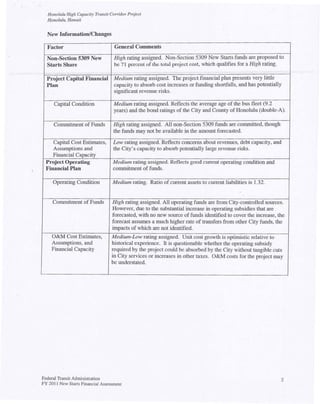
  New Information/Changes

  Factor                            General Comments

  Non-Section 5309 New              High rating assigned. Non-Section 5309 New Starts funds are proposed to
  Starts Share                      be 71 percent of the total project cost, which qualifies for a High rating.

  Project Capital Financial         Medium rating assigned. The project financial plan presents very little
  Plan                              capacity to absorb cost increases or funding shortfalls, and has potentially
                                    significant revenue risks.

      Capital Condition             Medium rating assigned. Reflects the average age of the bus fleet (9.2
                                    years) and the bond ratings of the City and County of Honolulu (double-A).

      Commitment of Funds          High rating assigned. All non-Section 5309 funds are committed, though
                                   the funds may not be available in the amount forecasted.

     Capital Cost Estimates,       Low rating assigned. Reflects concerns about revenues, debt capacity, and
     Assumptions and               the City's capacity to absorb potentially large revenue risks.
     Financial Capacity
  Project Operating                Medium rating assigned. Reflects good current operating condition and
  Financial Plan                   commitment of funds.

     Operating Condition           Medium rating. Ratio of current assets to current liabilities is 1.32.


     Commitment of Funds           High rating assigned. All operating funds are from City-controlled sources.
                                   However, due to the substantial increase in operating subsidies that are
                                   forecasted, with no new source of funds identified to cover the increase, the
                                   forecast assumes a much higher rate of transfers from other City funds, the
                                   impacts of which are not identified.
    O&M Cost Estimates,            Medium-Low rating assigned. Unit cost growth is optimistic relative to
    Assumptions, and               historical experience. It is questionable whether the operating subsidy
    Financial Capacity             required by the project could be absorbed by the City without tangible cuts
                                   in City services or increases in other taxes. O&M costs for the project may
                                   be understated.


Federal Transit Administration                                                                                 2
FY 20 It New Starts Financial Assessment
Honolulu High Capacity Transit Corridor Project
     Honolulu, Hawaii


                                                PROJECT SUMMARY


     PROJECT DESCRIPTION

     The Honolulu High Capacity Transit Corridor Project ("the Project") i's being undertaken by the City and
     County of Honolulu ("the City"). The corridor stretches across southern O'ahu, from Kapolei in the west
     to Ala Moana Center in the east. The locally preferred altemative (LPA) for the project, adopted in 2006,
     uses a 3'd-rail electrified rail technology throughout the corridor.

 The Project is a 20.2-mile light rail line extending from East Kapolei in the west to the Ala Moana Center
  in the east. The alignment would include 21 stations and will be a dual guideway with 19.5 miles
 elevated and 0.7 miles constructed at-grade. The Project is expected to be constructed in phases, each
 with similar construction activities. Phase I will be the portion between East Kapolei and Pearl
 Highlands, and will also include construction of the vehicle maintenance and storage facility. The
 remainder of the Project (phase II) would be built in three overlapping sub-phases continuing Koko Head
 from Pearl Highlands first to Aloha Stadium, then to Middle Street, and finally to Ala Moana Center.
 Individual construction phases would be opened as they are completed. The entire Project is scheduled to
 be in operation in FY2019. Conceptual design for ·the Project continues and work on the first
 construction phase is anticipated to begin in early calendar year 2010. Cost estimates for the Project
 presented in this Financial Plan assume that the Project is a steel wheel on steel rail technology operating
 on a combination of at-grade and elevated pOltions of guideway using high floor vehicles and a barrier-
 free fare collection system. While these assumptions could change as the project evolves, the. cost
 estimates that follow are based on these project characteristics.

 In the financial plan, the Project is assumed to open in March 2019. The City's fiscal year (FY) ends in
 June, thus the first full year of operation of the Project would be in FY 2020. The Project is estimated to
 cost $5,348 million in year-of-expenditure (YOE) dollars. The Project is forecasted to carry 97,000 daily
 trips in its opening year and 116,00Q trips in 2030.

 PROJECT DEVELOPMENT PHASE

 •      The City is requesting entry of the Project into Preliminary Engineering.
 •      The schedule presented in the August 2009 financial plan indicates:
                   Completion of NEPA in late 2009
                   FfA Record of Decision in 2009.
                   Execute full funding grant agreement in early 20 II.
                   Begin full-length Revenue Operation in 2019.


LOCAL PROJECT SPONSOR

The City and County of Honolulu, referred to as the City in the rest of this document.

AGENCY DESCRIPTION

The City is the project sponsor, through its Depaitment of Transportation Services (DTS).

Federal Transit Administration                                                                             3
FY 20 I J New StaJ.1S FinanciaJ Assessment
Honolulu High Capacity Trans;l Corridor Projecl
  Honolulu, Hawaii


  The City is a body politic and corporate, as provided in Section 1-101 of the Charter of the City and
  County of Honolulu 1973, as amended (RCH). The City's governmental structure consists of the
  Legislative Branch and the Executive Branch. The legislative power of the City is vested in and exercised
  by an elected nine-member City Council whose terms are staggered and limited to no more than two
  consecutive four-year terms. The executive power of the City is vested in and exercised by an elected
  Mayor, whose term is limited to no more than two consecutive full four-year terms. The City is
  authorized under Chapter 51 of the Hawai'i Revised Statutes to "acquire, condenm, purchase, lease,
  construct, extend, own, maintain, and operate mass transit systems, including, without being limited to,
  motor buses, street railroads, fixed rail facilities such as monorails or subways, whether surface,
  substu-face, or elevated, tax.is, and other forms of transportation for hire for passengers and their personal
  baggage." This authority may be carried out either directly, jointly, or under contract with private parties.
  The City is the designated recipient of FfA Urbanized Area Formula Funds apportioned to the Honolulu
  and Kailua-Kaneohe urbanized areas.

  The DTS is authorized under RCH Chapter 17 and consists of an appointed DTS Director who is the
  administrative head of the department, a transportation commission, and necessary staff. The DTS
  Director's powers, duties, and functions include planning, operating, and maintaining transportation
  systems, including transit. The DTS Director reports to the City Managing Director who is the principal
  administrative aide to the Mayor. Section 2-12.1 of the Revised Ordinances of Honolulu, as amended
  (ROH), assigns to the DTS Director the responsibility of planning, designing, operating, and maintaining
  the automated fixed guideway rapid transit system and for planning, administering, and coordinating
  those programs and projects that are proposed to be funded under the Federal Transit Act, as amended.

 The DTS' Rapid Transit Division will be responsible for planning, designing, implementing, and
 operating the Project. The Public Transit Division of DTS is responsible for the City's fixed route and
 paratransit services operated under contract by O'ahu Transit Services, Inc. The City's fixed route bus
 system is referred to as 'TheBus." TheBus serves the entire island of O'ahu with 91 bus routes, and
 carries more than 70 million unlinked passenger trips each ye:u. O'ahu Transit Services operates the
 City's paratransit services, referred to as the 'TheHandi-Van." TheHandi-Van serves over 13,000
 eligible customers, and caJ.Ties 750,000 unlinked passenger trips per year.

 The local funding source for the Project is a one-half percent (0.5 percent) surchaJ.·ge on the State of
 Hawai'i's General Excise Tax and Use (GET), first authorized in 2005, and adopted by the City in
 Ordinance No. 05-027, which established a 0.5 percent GET surcharge. The GET surchaJ.·ge commenced
 on January I, 2007, and will be levied through December 31, 2022. Business activities that are subject to
 the 4% GE tax. rate, such as retailing of goods and services, contracting, renting real property or tangible
 personal property, and interest income, are also subject to the GET surcharge. This source of revenue is
 to be exclusively used for operating and/or capital expenditures of a fixed guideway system. The
 Hawai'i State Department of Taxation collects the GET sW'charge and remits it to the City, net of a 10
 percent administrative charge.

PROJECT FINANCIAL SUMMARY

Total capital cost ($YOE)                                                                $ 5,347,681,000
                                                           (including $290,300,000 in financing charges)
      Section 5309 New Starts Share              $ 1,550,000,000         29.0%
      Non-Section 5309 New Starts Share          $ 3,797,681,000         71.0%
Annual project O&M costs (first full year of operation [FY 2020])                           $ 85,908,000
Total systemwide annual O&M costs (cunent year)                                            $ 189,513,000
Total systemwide annual O&M costs (first full year of New Starts Operation)                    $ 356,951,000

Federal Transit Administration                                                                               4
FY 20 II New Starts Financial Assessment
Honolulu High Capacity.Transit Corridor Project
  Honolulu, Hawaii


  REGIONAL ECONOMIC CONDITIONS AND FORECASTS
  Honolulu County, comprising the entire island of Oahu, has traditionally experienced steady population
  and employment gmwth.

  Honolulu County population increased at roughly 0.4 percent annually between 1990 and 2008,
  according to recent Census Bureau estimates. The annual growth rate since 2000 milTored this longer-
  term trend. A population forecast was not submitted with the financial plan. However, the Hawaii
  DepaJtment of Business, Economic Development & Tourism (DBEDT) forecasts 0.55 percent aJIllual
  population growth for Honolulu County thmugh 2030.

  Employment likewise experienced steady growth until recently. Between 1999 and 2008, employment
  (as reported by the Bureau of Labor Statistics) grew at 0.6 percent annually. Employment peaked in
  March 2008, at about 442,000, but declined to about 436,000 as of July 2009. The current
  unemployment rate - 6.1 percent - is one of the lowest metropolitan area unemployment rates in the
  country. At peak employment in March 2008, the unemployment rate was just 2.6 percent.

 The financial plan includes a forecast of the General Excise and Use Tax (referred to as the GET) that is
 the primary source of capital funding for the Project. After a period of sustained growth, GET revenues
 experienced year-over-year losses in four of the past five quarters. The GET fOrecast included in the
 financial plan is more bullish thaJl a recent forecast prepared by the Council on Revenues (COR), a group
 that advises the Governor of Hawaii. The GET forecast is analyzed in some detail in the Capital
 Financial Plan section of this report.

 IMPLEMENTATION ISSUES

      •   Other Planned Capital Projects in the Region. No other projects were identified as being
          dependent on or I inked to the Project.

      •   Legislation, Referenda, or Planning Approvals Needed. The City intends to request a letter of
          no prejudice (LONP) from FTA so that it can commence construction of Phase 1 of the Project
          prior to execution of the FFGA. The total cost of Phase 1 is $1,567 million, or approximately 29
          percent of total project cost. The City plans to award design-build contracts prior to the FFGA
          for guideway, maintenance and service facilities, and systems & vehicles,' as well as a design
          contract for stations.

     •    Innovative Financing Techniques Under Consideration. None are being considered for this
          project


Federal Transit Administration                                                                         5
FY 2011 New Starts Financial Assessment
Honolulu High Capacity Transit Corridor Project
 Honolulu, Hawaii


                                            FINANCIAL RATINGS

 Assessment of Local Financial Commitment                                                             High

 Proposed Non-Section 5309 New Starts Share of Project Capital Costs

        $ 3,797,681,000                                             71.0 %

 The proposed Non-Section 5309 share exceeds the threshold of 65 percent for a High rating.


                          ASSESSMENT OF CAPITAL FINANCE PLAN

 Current Capital Condition of Agency                                                              Medium
 The average age of the City's bus fleet is 9.2 years (New Starts Finance Template, dated 8/19/09). The
 average age of the demand-responsive fleet is 4.7 years (New Starts Finance Template, 8/19/09). The
 bus fleet age was the oldest recorded in the time period researched with NTD data (2003-2008). The
 demand-responsive fleet age was slightly higher than the average over that period (4.6 years).

 The latest City general obligation bond issue (May 2009) was rated AA by Standard & Poor's, Aa2 by
 Moody's, and AA by Fitch. No changes in.the City's ratings have been reported since.

 The capital condition rating based solely on fleet age would be Medium-Low, while the capital condition
 rating based solely on bond ratings would be Medium-High. Because this is more than a one-step
 difference, the rating is an average of the two, or Medium.


 Commitment of Capital Funds                                                                         High
Table I presents the sources of capital funds for the project. Ninety-five point three percent of the
funding sources are "committed." This exceeds the threshold of fifty percent for a High rating for a
project in preliminary engineering..

The non-New Starts funds consist of five sources, which in order of magnitude are: (i) GET surcharge
revenues, $2,442.4 million; (ii) general obligation bonds issued by the City that would be repaid from
GET surcharge revenues, $1,042.7 million; (iii) FTA Section 5307 Urbanized Area funds, $300.7
 million; (Iv) interest earned on cash balances, $7.9 million; and (v) American Reinvestment and
Recovery Act (ARRA) of 2009 funds, $4.0 million. The GET surcharge revenues (64.3 percent of non-
New Starts funds) are considered "committed"; these funds are under the direct control of the City and
County of Honolulu for the purposes of this Project. Since the GET surcharge revenues will be used to
pay Project-related debt service, and will be the sole basis for interest earnings, these latter two soW"ces
are also considered "committed." The FTA 5307 Urbanized Area funds are considered "committed"
t1uough the end of the current six-year progranuning period, ending in the City's fiscal year 2014.
During that period, the Section 5307 funds to be applied to the project total $127.5 million. The
remaining $173.2 million in Section 5307 funds are considered "planned."

The GET surcharge revenues derive from a 0.5 percent surcharge on the 4 percent general excise tax
levied by the State of Hawaii. The surcharge applies only to taxable activities in Honolulu County. The
tax conunenced in January 2007 and will sunset in December 2022. The revenues from the surcharge are
to be exclusively used for operating andlor capital expenditures of a fixed guideway system. The GET

Federal Transit Administration                                                                            6
FY 2011 New Starts Financial Assessment
Honolulu High Capacity Transit Corridor Project
  Honolulu, Hawaii


  surcharge revenues cited in Table 1 include the calTy-forward balance at the beginning of fiscal year (FY)
  2009 ($153 million) and the revenues forecasted to be collected in fiscal years 2009-2019, less $62
  million expended in FY 2009 prior to approval to enter preliminary engineering.

  The bonds to be issued for the project aTe contemplated to be general obligation (G.O.) bonds issued by
  the City. The amount of bonds shown in Table 1 ($1,042,740) is the outstanding principal when the
  project is completed in 2019. The City plans to issue another $811,973,000 in bonds that would be
  retired dUTing the construction period. The borrowing plan also includes $500 million in short-term debt.
  This debt is not shown as a source of funds because it will be retired or refunded before the end of the
  construction period.

  Debt service on the bonds would be paid from GET surcharge revenues. The bonds would be issued
  every year beginning in fiscal year 2013 (ending June) and terminating in FY 2019. The bonds are to be
  fully repaid in FY 2023. The GET surcharge terminates in December 2022. Due to a lag in collecting the
  revenue, cash income from the GET surcharge is anticipated to continue to flow to the project through
  the end of March 2023 (i.e., the third quarter of FY 2023).

 The amount of G.O. debt to be issued is within the City's "affordability guidelines" for self-supporting
 G.O. bonds. These guidelines limit G.O. debt service to 20 percent of the City's total operating budget.
 In the final year of construction (FY 2019), G.O. debt service, including the bonds issued for the Project,
 is forecasted to be 19.4 percent of the City operating budget.

 In prior ratings for the Project, the City's debt capacity was more constrained because a greater amount
 of debt was planned. The September 2008 financial plan, for example, included $2,244 million in bond
 proceeds, whereas the CUlTent financial plan (August 2009) includes $1,854 in bond proceeds. The
 amount of long-term debt to be issued was reduced, compared to the prior plan, by including $500
 million in shOtt-term debt (to which the above affordability guidelines do not apply) and by including
 FTA Section 5307 funds in the Project financing plan. These changes, along with an increase in New
 Stalts funding, offset the effects of a lower revenue forecast and an increase in Project cost, thereby
 reducing the need for long-term G.O. bonds, and thus reducing total G.O. debt service to a point below
 the affordability threshold.


 Capital Cost Estimates, Planning Assumptions, and Financial Capacity                                      Low
 The capital cost estimates and schedule, Federal funding assumptions, financing costs, and financial
 capacity analyses for the project are presented below.


Project cost and schedule
The Project Management Oversight Contractor (PMOC) - Jacobs Engineering - issued a spot report in
July 2009, presenting its assessment of the Project's cost and schedule risk. The PMOC recommended
an increase of $116.8 million in the capital cost of the project, bringing the total capital cost (at that time)
to $5,288 million. The PMOC noted that the revised total includes $1.219 billion (YOE) total
contingency or 31.8% of the adjusted baseline cost estimate (BCE). The net cost increase was said by the
PMOC to be primarily the result of line item adjustments to the BCE for vehicle quantity and escalation
rates used to estimate year-of-expenditure costs.
The City incorporated this increase in its financial plan, but also found it necessary to increase the
Project's financing costs by $59 million, bringing the total cost for the Project to the current $5,347
million.


Federal Transit Administration                                                                                7
FY 2011 New Starts Financial Assessment
Honolulu High Capacity Transit Corridor Project
  Honolulu, Hawaii


 The PMOC also recommended a project completion date of no earlier than August 2019. This
 recommendation has not been reflected in the financial plan, but would have an immaterial impact on this
 financial assessment.


  Federal funding assumptions
 The capital finance plan assumes receipt of Section 5309 New Starts funds of $1 ,550 million, as follows:
 $35 million in 2010; $80 million in 2011; $200 million in 2011; $250 million in both 2013 and 2014;
 $200 million annually, 2015-2017; and $135 million in 2018. This level of annual funding is well above
 that of New Starts projects in medium to large metropolitan areas, but has been accepted by FTA for
 planning purposes.
 The capital plan includes assumptions on two other sources of Federal funds - Section 5307 formula
 funds and Section 5309 bus funds. The 5307 formula funds are forecasted at a reasonable rate,
 approximately 2.9 percent annually. This is well below the 8.4 percent annual rate in funds app011ioned
 to Honolulu over the past four years. Section 5309 bus funds are assumed to be roughly 34 percent of
 on-going bus capital expenditures, averaging about $13.7 million annually in 2009 dollars, an estimate
 prepared by the reviewer using a 3 percent discilunt rate applied to the stream of YOE estimates. Over
 the past five years, actual earmarks have been about half that amount, or about $6.8 million annually.
 Thus, the section 5309 bus funding assumption is considered to be optimistic.


 Financing costs
 The project cost estimate includes $290.3 million in financing costs, which is approximately 5.4 percent
 of total project cost. The financing costs include $18 million in issuance cost, and $272 million in
 interest costs, calculated for the period 2013-2019. These financing costs are associated with $1,854
 million in bonds, and $500 million in short-term financing, that will be used to finance the construction
 cash flow.
Interest cost on the bonds is estimated at different rates, depending on the term of the bond. The bonds
are to be issued every year between 2013 and 2019. The average term of the bonds is eight years; the
term is relatively short because the bonds must be repaid by the time the GET surcharge revenues
terminate in FY 2023. The weighted average interest rate is 3.96 percent. This is slightly higher than the
current yield on an AA-rated general obligation bond (about 3 percent); however, current yields are at a
low and the City is prudent to plan on a higher rate. The issuance cost for the bonds is assumed to be 1
percent, which is a reasonable rule of thumb.
The $500 million in short-term financing is assumed to be in the form of tax-exempt commercial paper
(TECP). TECP issued for the Project would be $214 million in 2013, growing to $500 million the
following year, and would then be rolled over annually until 2017. The City currently has a $250 million
TECP program; the financial plan assumes that this program can be extended to support the additional
short-term debt needed for the Project. The interest rate for this debt is assumed to be 1.66 percent,
which is about 120 basis points (1.2 percent) above the current market yield for one-year, AA-rated notes
(0.44 percent). As with the bond interest rate noted above, this is a historically low rate and the City is
prudent to plan on a higher rate. One-year rates averaged 2.46 percent over the past five years, which
suggests that the City's assumption, while reasonable relative to the current market, is not conservative
relative to recent history. The issuance cost for TECP is assumed to be 0.25 percent of the TECP
proceeds.
The financing costs for the Project appear to be understated by about $24.7 million, or 8.5 percent.
Although the above rates are reasonable, the calculations for short-term interest cost and for issuance
costs are understated - short-term interest costs were calculated to be about 0.91 percent of outstanding
principal, rather than 1.66 percent; and issuance costs are apparently calculated only on the bonds. Also,

Federal Transit Administration                                                                           8
FY 20t 1 New Starts Financial Assessment
Honolulu High Capacity Transit Corridor Project
  Honolulu, Hawaii


  if the TECP issuance cost was included, it should be calculated on the annual issues, not just the total
  outstanding principal, since the debt will be rolled over (i.e. resold) armually.
  It should be noted that the financial plan excludes debt service costs associated with fleet replacement
  and acquisition, and bus facility projects. The plan anticipates $571 million in City capital funding for
  these projects, which is assumed to be in the form of general obligation bonds. There is not enough
  information in the financial plan to estimate the amount of debt service that would be associated with
  these bonds.


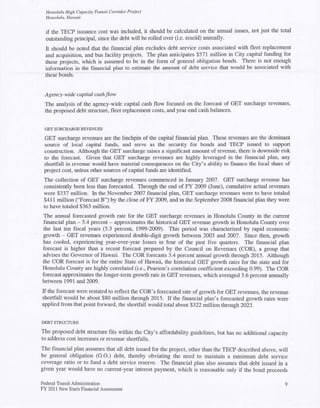
  Agency-wide capital cash flow
  The analysis of the agency-wide capital cash flow focused on the forecast of GET surcharge revenues,
  the proposed debt stmcture, fleet replacement costs, and year-end cash balances.


 GET SURCHARGE REVENUES
 GET surcharge revenues are the linchpin of the capital financial plan. These revenues are the dominant
 source of local capital funds, and serve as the security for bonds and TECP issued to support
 construction. Although the GET surcharge raises a significant amount of revenue, there is downside risk
 to the forecast. Given that GET surcharge revenues are highly leveraged in the financial plan, any
 shOitfall in revenue would have material consequences on the City's ability to finance the local share of
 project cost, unless other sources of capital funds are identified.
 The collection of GET surcharge revenues commenced in January 2007. GET surcharge revenue has
 consistently been less than forecasted. Through the end of FY 2009 (June), cumulative actual revenues
 were $337 million. In the November 2007 financial plan, GET surcharge revenues were to have totaled
 $411 million ("Forecast B") by the close of FY 2009, and in the September 2008 financial plan they were
 to have totaled $363 million.
The annual forecasted growth rate for the GET surcharge revenues in Honolulu County in the current
financial plan - 5.4 percent - approximates the historical GET revenue growth in Honolulu County over
the last ten fiscal years (5.3 percent, 1999-2009). This period was characterized by rapid economic
growth - GET revenues experienced double-digit growth between 2003 and 2007. Since then, growth
has cooled, experiencing year-over-year losses in four of the past five quarters. The financial plan
forecast is higher than a recent forecast prepared by the Council on Revenues (COR), a group that
advises the Governor of Hawaii. The COR forecasts 3.4 percent annual growth through 2015. Although
the COR forecast is for the entire State of Hawaii, the historical GET growth rates for the state and for
Honolulu County are highly correlated (i.e., Pearson's correlation coefficient exceeding 0.99). The COR
forecast approximates the longer-term growth rate in GET revenues, which averaged 3.6 percent atmually
between 1991 and 2009.
If the forecast were restated to reflect the COR'·s forecasted rate of growth for GET revenues, the revenue
shOltfall would be about $80 million through 2015. If the financial plan's forecasted growth rates were
applied from that point forward, the shortfall would total about $322 million through 2023.


DEBT STRUCTURE

The proposed debt structure fits within the City's affordability guidelines, but has no additional capacity
to address cost increases or revenue shortfalls.
The financial plan assumes that all debt issued for the project, other than the TECP described above, will
be general obligation (G.O.) debt, thereby obviating the need to maintain a minimum debt service
coverage ratio or to fund a debt service reserve. The financial plan also assumes that debt issued in a
given year would have no current-year interest payment, which is reasonable only if the bond proceeds

Federal Transit Administration                                                                           9
FY 2011 New Starts Financial Assessment
Honolulu High Capacity Transit Corridor Project
  Honolulu, Hawaii


  are needed late in the fiscal year. Collectively, these features maximize the amount of debt that could be
  suppOlted by GET surcharge revenues.
  The City's affordability guidelines restrict G.O. debt service to 20 percent of the City's operating budget,
  for all "direct" and "self-supporting" bonds. The City has confirmed that the debt issued for the Project
  will be considered "self-supporting" bonds, since the debt service will be paid with GET surcharge
  revenue. The City provided a forecast of the operating budget through 2023 (the final maturity of
  Project-related debt), and a forecast of G.O. debt service, including that associated with debt issued for
  the Project. The forecast of the City operating budget and other G.O. debt appeared reasonable, but was
  not vetted in detail. At its maximum point, total G.O. and self-supporting debt service would equal 19.6
  percent of the forecasted City operating budget at 2018. This translates to $12 million in additional
  capacity for debt service. This capacity could be interpreted as about $300 million in additional principal
  that could be financed at the financial plan's assumed interest rate (about 4 percent), or could be viewed
  as a contingency that would cover a 0.1 percent increase in the weighted average interest rate for all G.O.
  and self-supporting debt.
  The GET surcharge revenues that will be applied to Project-related debt service provide very slim
  coverage. The debt service coverage ratio is 1.0 - the absolute minimum - in fiscal years 2019 through
  2021. Although there is no coverage requirement per se associated with G.O. debt, the slim margin in
  debt capacity coupled with the slim coverage ratio effectively means there is no additional financial
  capacity to address funding shortfalls or cost increases.


 FLEET REPLACEMENT COSTS

 Fleet replacement costs are adequately funded in the financial plan, but rely on much higher Section 5309
 bus funding than was the case in prior financial plans. The Bus Fleet Plan indicates that the average fleet
 age will decline (improve) to 6.8 years in the horizon year of the forecast (FY 2030) from 9.3 years in FY
 2009. A fleet plan for the demand-responsive fleet was not available. However, the replacement
 requirements of the current fleet are comfOltably covered in the fleet cost estimates.


 YEAR-END CASH BALANCES

 The year-end cash balance at FY 2023, the last year of debt service and the last year that GET excise
 revenues are allocated to the project, is $29 million. During the heaviest years of construction (2012-
 2019), the ending casb balance is zero. The cash flow is at the margin of feasibility.


 Capital financial capacity
The capital financial capacity threshold for a Medium rating for a project in preliminary engineering is 25
percent of estimated project cost, or $1.34 billion. The threshold for a Medium-Low rating is 10 percent
of estimated project cost, or $535 million. One may consider three sources of funds to provide this
capacity: GET surcharge revenues, forecasted year-end cash balances, and additional financial support
from the City or other beneficiaries of the Project.
GET surcharge revenues are unlikely to provide any further capacity beyond what is already assumed in
the financial plan - the revenue forecast appears to be overstated based in comparison to long-term trends
and in comparison to the COR forecast; there is no net capacity in the baseline forecast after debt service
requirements are met; and there is scant debt capacity remaining within the City's affordability
guidelines.
Year-end cash balances show that relatively little remains after meeting the project's cw:rently-estimated
costs - just $29 million after the bonds are paid off in 2023.


Federal Transit Administration                                                                            10
FY 2011 New Starts Financial Assessment
Honolulu High Capacity Transit Corridor Project
   Honolulu, Hawaii


   The financial capacity of the City to provide additional support to the project is a complicated question
   that cannot be reasonably answered in the scope of this review. However, given the relative optimism of
   other assumptions affecting the amount of City funds that would be needed to support the Project and the
   other elements of the transit system (e.g., GET surcharge revenue forecast, section 5309 bus funds,
   funding of operating subsidy requirements), it seems reasonable to conclude, until and if supporting
   information is presented, that the City lacks the capacity to provide the additional funds necessary to
   SUppOit a Medium or Medium-Low rating.
   The financial plan references several other options that could conceivably be tapped to provide additional
   funds or to reduce Project cost - reducing the amount of GET surcharge revenues that are retained by the
   State (cUll-ently 10 percent); accessing Federal airport funding programs to support eligible Project costs;
   implementing various value capture mechanisms (e.g., assessment districts, tax increment financing); and
   acquiring military funding. However, none of these concepts have been developed to the point that
   would allow their reasonableness to be established.


  Rating
  The capital cost estimates/planning assumptions subfactor is rated Low. Tbe major factors contributing
  to this rating are: (i) material downside risks to the GET surcharge revenue forecast, and consequently the
  inability to cover all debt service cost; (ii) no net debt capacity; and (iii) lack of information to
  substantiate the City's capacity to absorb a material amount (up to $535 million) of cost risk. In addition
  to these concerns, bus capital funding - clearly needed as evidenced by the relatively old age of the bus
  fleet - depends on a much higher level of Federal funding than has previously been the case.


  Summary Capital Plan Rating                                                                       Medium
  The summary capital plan rating is Medium, reflecting: (i) a capital condition score of Medium, weighted
  at 25 percent; (ii) a capital funding commitment score of High, rated at 25 percent; and (iii) a capital
  cost/planning assumptions/capacity score of Low, weighted at 50 percent. Tbe weigbted score is 2.5,
  which is rounded to a score of 3.0, or Medium.


Federal Transit Administration
                                                                                                          II
FY 2011 New Starts Financial Assessment
Honolulu High Capacity Transit Corridor Project
  Honolulu, Hawaii


    Table 1
    Pl"oposed Sources of Capital Fwlds ($000 Vear ofE''1,enditme)


                                                                                                       PL'UUling and PE
                                                                        Level of      Mattuity of      Funds E:1o:P(,lUI~d
                                    -"',molUlt ($)   ~/o    ofTobl    COlluniiment* . SOUl'ces·"           to Date


    Fedeldl Section 5309              11,550,000           29,1/'/0       N/A            NlA

    Other Fedel"l:
     FTA Sec. 5307 (TIP podod)        1127,508             2.4%            C                  E
     FTA Sec, 5307 (aftel" 2014)      1173,210             3.2%            P                  E
     Other
    Subtotal Otlter Fe(Ieral         $300,718              5.6%

    Sbte:


   Subtotll SM.                            $0
   Local:
   Honolulu G. O. Bonds              11,042,735        19.5%               C              N
   GET Surcharge Revenues            12,442,350        45.70./0            C              E
   ARRA Funds                          14,000           0.1% .             P              N
   Inh2rest earnjn;;:s                 17,878           0.1%               C              N

      .
   Subtotal Local
                         ~   .
                                    $3,496,963        65.4%
                                                                                    ,                           '0((


                                           $0
                                                                                                           f-    ..

                                   $5,347,681         100.0%

                                     '" Commitment Codes                                      ..... Maturity Codes
                                  c omrnitte d       C                             Existing                     E
                                 Budgeted            B                             New                          N
                                 Planned             P                             Not Specified                NS
                                 Uncertain          U
                                 Not Soecified      NS

  Level of Corcuninnent of Capital FlUuls
                                   AmolUlt ($)             %
  Comr.nitted                       13,620,471        95.3%
  Budgeted                              10            0.0%
  Planned                            UTI,210          4.7'/0
  Uncertain                             10            0.00/0
  Not Specified                         10            0.0010
  Total                            $3,197,681        100.0%

  Matwity of Capit::tl FtU1dillg Sources
                                  Amount ($)            %
 Existing                          12,743,068        72.2"/0
 New                               11,054,613        27.8%
 Not Specified                         10             0.0010
 Total                            $3,797,681         100.0%


Federal Transit Administration                                                                                               12
FY 20 II New Starts Financial Assessment
Honolulu High Capacity Transit Corridor Project
   Honolulu, Hawaii


                          ASSESSMENT OF OPERATING FINANCE PIAN

   Current Operating Condition of Agency                                                           Medium
  Financial reponing for the operation of transit services by the City of Honolulu is provided in the City's
  Public Transponation System Fund. At the close of FY 2008 (June), that fund had current assets of
  $26.5 million and current liabilities of $20.1 million, yielding a current ratio of 1.32, indicating sound
  financial condition. The Public Transponation System Fund held cash and investments of $11.2 million,
  which is about 6.3 percent of annual operating cost.

  Two other funds which support public transit operations via interfold transfers - the General Fund and
  the Highway Fund - are governmental funds, for which the annual financial reports do not distinguish
  between current and long-term assets and liabilities. However, total assets in both funds substantially
  exceed total liabilities, and the funds collectively reponed an unreserved fund balance of $126.5 million.

  According to operating data reported through the National Transit Database (NTD), service levels (i.e.,
   vehicle reven'ue miles) were fairly steady between' 2002 and 2008 for both bus and demand-response
  services. Fares were increased in 2001 and 2003, pursuant to a City Council resolution that mandates a
  fare recovery ratio of between 27 percent and 33 percent. There have been no subsequent fare increases,
  although a fare increase is planned in FY 2010. The fare recovery ratio reported through NTD in 2008
  for the bus system was 27 percent. The observed price elasticity for the 2003 fare increase, estimated
  from NTD data, was -0.06, indicating a fairly low degree of price sensitivity. This estimate adjusts for
  the lower level of service operated in 2004, reflecting a one-month strike by transit workers.

 The operating condition rating is Medium. This is based on the current operating ratio of 1.32 and the
 absence of service cutbacks in recent years, both of which qualify the Medium rating.


 Commitment of Operating and Maintenance Funding                                                     High
 Transit operating funds for the opening year of the project (FY 2019) are presented in Table 2.
 The operating funds total approximately $357 million. These funds consist of: (i) Federal formula funds,
 $23.3 million (7 percent); (ii) operating revenues, composed almost entirely of passenger revenues, $108
 million (30 percent); and (iii) operating subsidies from the City's General Fund and Highway Fund, $225
 million (63 percent).
 All these funds are considered to be "committed", since they are under the direct control of the City.
 Thus, this subfactor is rated High.
However, as noted below in the operating financial capacity section, the forecasted subsidies would
require the City to transfer to the Public Transportation System Fund a higher share of the General Fund
and Highway Fund than has historically been the case.


Operating and Maintenance Cost Estimates, Planning Assumptions, and Financial
Capacity                                                                Medium-Low

The evaluation of this subfactor focused on the project's O&M costs, system-wide operating trends and
operating financial capacity.                                                                    '


Federal Transit Administration                                                                          13
FY 2011 New Starts Financial Assessment
Honolulu High Capacity Transit Corridor Project
  Honolulu, Hawaii


  Project O&M costs
  The Project is projected to cost $85.9 million in its first full year of operation (2020). Approximately 6.8
  million annual vehicle revenue miles will be operated, yielding a unit cost in 2020 of $12.56 per vehicle
  revenue mile. The rail operating cost estimate was reviewed by an FT A consultant in June 2009. The
  cost estimate was developed from an operating analysis of the Washington, DC, Metrorail system, from
  which a series of adjustments were made to make the model representative of conditions in Honolulu.
  The Metrorail system was not a first choice, nor the only choice, to use as a base for the operating cost
  model. In fact, the Honolulu rail line was said in the repOit to be analogous to rapid transit operations in
  Vancouver, BC and Kennedy International Airport (Air Train). The repOit noted the difficulty in using
  the Metrorail data to approximate the Honolulu operation, and questioned some of the cost adjustments.
  A comparison of the unit cost ($12.56, 2020$) to the unit cost of heavy rail and high-speed light rail
  operators indicates that the financial plan assumptions are optimistic. The 2020 unit cost was discounted
  to 2007 dollars, at a 2.5 percent annual discount rate, yielding a unit cost of $9.11. This was compared to
  2007 actual results for a collection of heavy rail systems - WMATA Metrorail ($10.39); Los Angeles
 MTA ($14.59); Baltimore ($10.68); and Miami ($9.65). The average of these systems was $11.33.
 BART was considered but excluded due to its very high operating speed (34.9 mph). The'Honolulu unit
 cost estimate was also compared to two high-speed light rail operations - Dallas ($15.28) and Los
 Angeles MTA ($16.63). The estimated unit cost for Honolulu ($9.11) is lower than any of these systems.
 It is 20 percent lower than the heavy rail average, and is 43 percent lower than the light rail average.
 Although more information is needed about the planned operation, these results suggest that the rail
 operating cost estimate has much more upside risk than downside risk. Also worth noting is the
 relativelY low rate of growth in rail unit costs - between 2019 and 2030, rail unit cost is forecast to grow
 at 1.5 percent annually, a full point below inflation.
 The Project will have a significant operating impact. Its net cost at 2020 ($85.9 million) is about 32
 percent of the cost of bus and Handi-Van services. The Project will add 6.8 million revenue vehicle
 miles, a 26 percent increase relative to bus and Handi-Vanservices.


 Operating trends
 The review of operating trends focused on inflation assumptions, unit costs, the firebox recovery ratio,
 and operating subsidies.
 The forecasted rate of inflation is 2.5 percent annually beginning in 2012 and continuing tln'ough the
 horizon year of the forecast (2030). The inflation rate for the period 2010-2012 was not cited. The
 Honolulu cpr-u, as reported by the Bureau of Labor Statistics, averaged 3.1 percent between 1999 and
 2008. In the first half of calendar year 2009, Honolulu inflation fell to just 0.8 percent (nationally, there
 was a 0.5 percent decline). The long-term inflation assumption may be slightly optimistic.

The financial plan assumes a steady increase in bus and demand-response services throughout the
forecast. Bus vehicle revenue miles are assumed to grow from about 19.4 million miles currently to 21.6
million miles at 2030, or a growth rate of about 0.5 percent annually. In contrast, bus service levels were
nearly constant between 2003 and 2008.

The operating costs of bus and demand-response services were based on a cost build-up model, calibrated
to current operations. The disaggregate unii costs were escalated at the assumed rates of growtb in the
cpr. The average unit costs that result from this procedure show a lower compound annual growth rate
than near-term history indicates. Bus operating cost per vehicle revenue mile is forecasted to grow at 2.8
percent between 2009 and 2030, whereas the actual rate of growth between 2004 and 2008 was 4.1
percent. Demand-response cost per vehicle revenue mile is forecasted to grow at 2.4 percent between
2009 and 2030, whereas the actual rate of growth between 2004 and 2008 was 10.7 percent. Thus, the
operating cost forecast for both bus and demand-response service is considered to be optimistic.

Federal Transit Administration                                                                             14
FY 201] New Starts Financial Assessment
Honolulu High Capacity Transit Corridor Project
   Honolulu, Hawaii


  The financial plan assumes that fares will increase in 2010 (per the budget), 2015 (following the opening
  of Phase 1), and 2023 (following the opening of Phase 2). Although the fare is planned to increase in
  steps, the changes in fares approximate inflationary growth throughout the forecast period, and are
  consistent with the demand modeling assumption. The resulting fare recovery ratio averages 34 percent
  (2010-2030), which is higher than the five-year historical average (26 percent). This is due to two
  factors: (i) the introduction of rail system, which is forecasted to have an average 52.9 percent fare
  recovery ratio; and (ii) relatively low unit cost growth for bus and Handi-Van services.

  Operating subsidies are forecast to grow at 4.3 percent, on average, for the forecast period, with near-
  term rates being higher (5.6 percent, 2009-2018) and the out-years being lower (1.7 percent, 2019-2030).
  This is a lower rate of growth than experienced over the past five years (8.5 percent), and is also less than
  the longer-term trend (6.3 percent annually, 1998 to 2008).

  Although the forecasted rates of growth in operating subsidies are below historical growth rates, the
  forecast requires increasing levels of transit subsidy relative to the funds from which the subsidies are
  transferred - the General Fund and the Highway Fund. Between 2000 and 2010, transit operating
  subsidies were, on average, 10 percent of combined General Fund-Highway Fund revenues. Between
  2010 and 2030, operating subsidies are forecast to average 14 percent of General Fund-Highway Fund
  revenues, reaching a maximum of 17 percent when the full line opens in 2019. Although there was one
  year when the historical percentage approached the forecasted average (e.g., 14.8 percent in 2001, when
  the resolution was passed to keep the firebox recovery ratio between 27 percent and 33 percent), it was an
  anomaly. An increase from 10 percent to 14 percent of General Fund-Highway Fund revenues is
  significant. If the forecasted rate (14 percent) were put into effect today, it would leave about $44
  million less revenue for General Fund and Highway Fund programs.

  Operating Financial Capacity
. The operating cash flow assumes a balanced budget, with no accrual of an operating surplus or reserve.
  Thus, the 2008 year-end cash and investments held in the Public Transportation System Fund ($11.2
  million) could be assumed to be constant. These funds represent 6.3 percent of operating costs in 2008,
  and would represent 3.2 percent of operating costs in 2019 when the Project fully opens. In 2030, these
 funds would represent 2.3 percent of operating cost.
 Rating
 The cost estimates/planning assumptions/financial capacity subfactor is rated Medium-Low. Several
 observations support this rating. First, it is questionable whether the City can afford the growth in
 subsidies presented in this financial plan, which require a higher portion of the General Fund and
 Highway Fund revenues than has histodcally been the case. Second, the subsidies could be yet higher
 due to optimistic assumptions regarding operating cost growth for all services. Third, the projected cash
 balances of the Public Transportation System Fund, inferred from current cash plus investments and the
 forecasted balanced budget, fall below the 1.5 month standard (12 percent of operating costs) that would
 be needed to support a higher rating. Finally, there is some prospect that the Project's O&M costs could
 be understated, based on a comparison to heavy rail and light rail operations in the U.S.


Summary Operatiug Plan Rating                                                                      Medium
The operating plan is rated Medium, based on: (i) a Medium rating for operating condition, weighted at
25 percent; (ii) a High rating for operating funding commitment, weighted at 25 percent; and (iii) a
Medium-Low rating for operating cost estimates/planning assumptions/capacity, weighted at 50 percent.
The weighted score is 3.0, or Medium.


Federal Transit Administration                                                                             15
FY 2011 New Starts Financial Assessment
Honolulu High Capacity Transit Corridor Project
     Honolulu, Hawaii


     Table 2
     Proposed Sources of Annual Operating Funds ($000)

                                                                             Level of        Maturity of
                                             Amount ($)     % of Total     Commitment*       Sources**

     Federal:
      5307 Formula                             $23,347        6.5%               C               E
      CMAO
      Other
     Subtotal Federal                          $23347         6.5%

     State:


     Subtotal State                               $0
     Local:
     Ooeratinl! Revenues                      $108,425       30.4%              C                E
     City/County of Honolulu                  $225,178       63.1%              C                E


 ,
     Subtotal Local                           $333603        93.5%


                                                 $0          0.0%

 ITotal                                       $356,951      100.0%                                          1
                                              *Level of Comm. Codes               ** Maturitv Codes
                                         Committed              C        Existing                 E
                                         Budgeted               B        New                      N
                                         Planned                P        Not Snecified           NS
                                         Uncertain              U
                                         Nnt Soecified         NS

 Commitment Status
                                            Amount ($)         %
Committed                                    $356,951       100.0%
Budgeted                                        $0           0.0%
Planned                                         $0           0.0%
Uncertain                                       $0           0.0%
Not Specified                                   $0           0.0%
Total                                        $356.951       100.0%

Maturity of Commitment of Capital Funds
                                           Amount ($1         %
Existing                                    $356,951       100.0%
New                                            $0           0.0%
Not Specified                                  $0           0.0%
Total                                       $356951        100.0%

Federal Transit Administration                                                                             16
FY 20J I New Starts Financial Assessment
Honolulu High Capacity Transit Corridor Project
     Honolulu, Hawaii


                                                       CONCLUSIONS

    •    The Honolulu metropolitan area has experienced an economic downturn after several years of robust
         growth, but appears to have been less effected by the national recess}on than other metropolitan
         areas.

    •    TheHonolulu High Capacity Transit Con-idor Project will introduce significant capital and operating
         funding requirements.
    •    The City's intention to obtain a Letter of No Prejudice (LONP) so that Phase 1 construction can
         commence prior to the FFGA is unusual, and is conspicuous in scope.
  •      The GET surcharge reveuue forecast has downside risks that could reasonably result in revenues that
         are inadequate to support debt service payments for the project. The forecast is higher than a recent
         forecast prepared by the Council on Revenues, and exceeds the long-term growth rate of the GET tax
         base in Honolulu County.
 •      The debt financing assumptions for the project maximize the leverage that could be gained from the
        GET surcharge revenue stream, leaving little if any upside to debt capacity. The Project-related debt
        will also push the City to its limit of affordability for general obligation debt.
 •      The operating plan has some optimistic features - operating cost estimates are understated relative to
        near-term trends (for City operations) and peers (for rail operations); the increase in operating
        subsidies would require a proportionately greater share of funds to be transferred from the City's
        General Fund and Highway Fund than has been the case.


                    RECOMMENDATIONS FOR IMPROVEMENT OF RATING

 •      The City should provide an independent forecast of GET surcharge revenues from a source that is
        familiar with the Hawaii economy.
 •      The City should substantiate its capacity to: (i) provide back-up funds for the Project should there be
        a cost increase or funding shortfall; and (ii) transfer a greater degree of revenue to the transit program
        without impacting other necessary City services.                                                           .

 •      The operating cost estimate for the Project should be refined and better substantiated.

•       The financing of bus and Handi-Van fleet replacements should beless reliant on FTA Section 5309
        bus funds.

•       The operating plan should be amended to reflect higher rates of unit cost growth for all services.


Federal Transit Administration                                                                                  17
FY 2011 New Starts Financial Assessment

FMOC Report

  • 1.
    FY 2011 NEWSTARTS FINANCIAL ASSESSMENT PROJECT: Honolulu High Capacity Transit Corridor Project PROJECT LOCATION: Honolulu, Hawaii REVIEW DATE: September 2, 2009 FINANCIAL RATINGS SUMMARY Comparison ofFY 2009, FY 2010 and FY 2011 Ratings ( I = Low; 2 = Medium-Low; 3 = Medium; 4 = Medium-High; 5 = High) Overall Financial Non-Section 5309 Project Capital Project Operating Rating New Starts Share Financial Plan Financial Plan Rating Rating Rating FY2009 FY 2010 FY2011 3 5 3 3 Change - - - -- Capital Finance Plan Capital Commitment Capital Financial Capacity! Condition of Capital Cost Estimates and Planning Fonds Assumptions FY 2009 FY2010 FY2011 3 5 1 Change - - Operating Finance Plan Operating Commitment Operating Financial Capacity! Condition ofO&MFonds O&M Cost Estimates and Assumptions FY 2009 FY 2010 FY 2011 3 5 2 Change -- - -
  • 2.
    Honolulu High CapacityTransit Corridor Project Honolulu, Hawaii New Information/Changes Factor General Comments Non-Section 5309 New High rating assigned. Non-Section 5309 New Starts funds are proposed to Starts Share be 71 percent of the total project cost, which qualifies for a High rating. Project Capital Financial Medium rating assigned. The project financial plan presents very little Plan capacity to absorb cost increases or funding shortfalls, and has potentially significant revenue risks. Capital Condition Medium rating assigned. Reflects the average age of the bus fleet (9.2 years) and the bond ratings of the City and County of Honolulu (double-A). Commitment of Funds High rating assigned. All non-Section 5309 funds are committed, though the funds may not be available in the amount forecasted. Capital Cost Estimates, Low rating assigned. Reflects concerns about revenues, debt capacity, and Assumptions and the City's capacity to absorb potentially large revenue risks. Financial Capacity Project Operating Medium rating assigned. Reflects good current operating condition and Financial Plan commitment of funds. Operating Condition Medium rating. Ratio of current assets to current liabilities is 1.32. Commitment of Funds High rating assigned. All operating funds are from City-controlled sources. However, due to the substantial increase in operating subsidies that are forecasted, with no new source of funds identified to cover the increase, the forecast assumes a much higher rate of transfers from other City funds, the impacts of which are not identified. O&M Cost Estimates, Medium-Low rating assigned. Unit cost growth is optimistic relative to Assumptions, and historical experience. It is questionable whether the operating subsidy Financial Capacity required by the project could be absorbed by the City without tangible cuts in City services or increases in other taxes. O&M costs for the project may be understated. Federal Transit Administration 2 FY 20 It New Starts Financial Assessment
  • 3.
    Honolulu High CapacityTransit Corridor Project Honolulu, Hawaii PROJECT SUMMARY PROJECT DESCRIPTION The Honolulu High Capacity Transit Corridor Project ("the Project") i's being undertaken by the City and County of Honolulu ("the City"). The corridor stretches across southern O'ahu, from Kapolei in the west to Ala Moana Center in the east. The locally preferred altemative (LPA) for the project, adopted in 2006, uses a 3'd-rail electrified rail technology throughout the corridor. The Project is a 20.2-mile light rail line extending from East Kapolei in the west to the Ala Moana Center in the east. The alignment would include 21 stations and will be a dual guideway with 19.5 miles elevated and 0.7 miles constructed at-grade. The Project is expected to be constructed in phases, each with similar construction activities. Phase I will be the portion between East Kapolei and Pearl Highlands, and will also include construction of the vehicle maintenance and storage facility. The remainder of the Project (phase II) would be built in three overlapping sub-phases continuing Koko Head from Pearl Highlands first to Aloha Stadium, then to Middle Street, and finally to Ala Moana Center. Individual construction phases would be opened as they are completed. The entire Project is scheduled to be in operation in FY2019. Conceptual design for ·the Project continues and work on the first construction phase is anticipated to begin in early calendar year 2010. Cost estimates for the Project presented in this Financial Plan assume that the Project is a steel wheel on steel rail technology operating on a combination of at-grade and elevated pOltions of guideway using high floor vehicles and a barrier- free fare collection system. While these assumptions could change as the project evolves, the. cost estimates that follow are based on these project characteristics. In the financial plan, the Project is assumed to open in March 2019. The City's fiscal year (FY) ends in June, thus the first full year of operation of the Project would be in FY 2020. The Project is estimated to cost $5,348 million in year-of-expenditure (YOE) dollars. The Project is forecasted to carry 97,000 daily trips in its opening year and 116,00Q trips in 2030. PROJECT DEVELOPMENT PHASE • The City is requesting entry of the Project into Preliminary Engineering. • The schedule presented in the August 2009 financial plan indicates: Completion of NEPA in late 2009 FfA Record of Decision in 2009. Execute full funding grant agreement in early 20 II. Begin full-length Revenue Operation in 2019. LOCAL PROJECT SPONSOR The City and County of Honolulu, referred to as the City in the rest of this document. AGENCY DESCRIPTION The City is the project sponsor, through its Depaitment of Transportation Services (DTS). Federal Transit Administration 3 FY 20 I J New StaJ.1S FinanciaJ Assessment
  • 4.
    Honolulu High CapacityTrans;l Corridor Projecl Honolulu, Hawaii The City is a body politic and corporate, as provided in Section 1-101 of the Charter of the City and County of Honolulu 1973, as amended (RCH). The City's governmental structure consists of the Legislative Branch and the Executive Branch. The legislative power of the City is vested in and exercised by an elected nine-member City Council whose terms are staggered and limited to no more than two consecutive four-year terms. The executive power of the City is vested in and exercised by an elected Mayor, whose term is limited to no more than two consecutive full four-year terms. The City is authorized under Chapter 51 of the Hawai'i Revised Statutes to "acquire, condenm, purchase, lease, construct, extend, own, maintain, and operate mass transit systems, including, without being limited to, motor buses, street railroads, fixed rail facilities such as monorails or subways, whether surface, substu-face, or elevated, tax.is, and other forms of transportation for hire for passengers and their personal baggage." This authority may be carried out either directly, jointly, or under contract with private parties. The City is the designated recipient of FfA Urbanized Area Formula Funds apportioned to the Honolulu and Kailua-Kaneohe urbanized areas. The DTS is authorized under RCH Chapter 17 and consists of an appointed DTS Director who is the administrative head of the department, a transportation commission, and necessary staff. The DTS Director's powers, duties, and functions include planning, operating, and maintaining transportation systems, including transit. The DTS Director reports to the City Managing Director who is the principal administrative aide to the Mayor. Section 2-12.1 of the Revised Ordinances of Honolulu, as amended (ROH), assigns to the DTS Director the responsibility of planning, designing, operating, and maintaining the automated fixed guideway rapid transit system and for planning, administering, and coordinating those programs and projects that are proposed to be funded under the Federal Transit Act, as amended. The DTS' Rapid Transit Division will be responsible for planning, designing, implementing, and operating the Project. The Public Transit Division of DTS is responsible for the City's fixed route and paratransit services operated under contract by O'ahu Transit Services, Inc. The City's fixed route bus system is referred to as 'TheBus." TheBus serves the entire island of O'ahu with 91 bus routes, and carries more than 70 million unlinked passenger trips each ye:u. O'ahu Transit Services operates the City's paratransit services, referred to as the 'TheHandi-Van." TheHandi-Van serves over 13,000 eligible customers, and caJ.Ties 750,000 unlinked passenger trips per year. The local funding source for the Project is a one-half percent (0.5 percent) surchaJ.·ge on the State of Hawai'i's General Excise Tax and Use (GET), first authorized in 2005, and adopted by the City in Ordinance No. 05-027, which established a 0.5 percent GET surcharge. The GET surchaJ.·ge commenced on January I, 2007, and will be levied through December 31, 2022. Business activities that are subject to the 4% GE tax. rate, such as retailing of goods and services, contracting, renting real property or tangible personal property, and interest income, are also subject to the GET surcharge. This source of revenue is to be exclusively used for operating and/or capital expenditures of a fixed guideway system. The Hawai'i State Department of Taxation collects the GET sW'charge and remits it to the City, net of a 10 percent administrative charge. PROJECT FINANCIAL SUMMARY Total capital cost ($YOE) $ 5,347,681,000 (including $290,300,000 in financing charges) Section 5309 New Starts Share $ 1,550,000,000 29.0% Non-Section 5309 New Starts Share $ 3,797,681,000 71.0% Annual project O&M costs (first full year of operation [FY 2020]) $ 85,908,000 Total systemwide annual O&M costs (cunent year) $ 189,513,000 Total systemwide annual O&M costs (first full year of New Starts Operation) $ 356,951,000 Federal Transit Administration 4 FY 20 II New Starts Financial Assessment
  • 5.
    Honolulu High Capacity.TransitCorridor Project Honolulu, Hawaii REGIONAL ECONOMIC CONDITIONS AND FORECASTS Honolulu County, comprising the entire island of Oahu, has traditionally experienced steady population and employment gmwth. Honolulu County population increased at roughly 0.4 percent annually between 1990 and 2008, according to recent Census Bureau estimates. The annual growth rate since 2000 milTored this longer- term trend. A population forecast was not submitted with the financial plan. However, the Hawaii DepaJtment of Business, Economic Development & Tourism (DBEDT) forecasts 0.55 percent aJIllual population growth for Honolulu County thmugh 2030. Employment likewise experienced steady growth until recently. Between 1999 and 2008, employment (as reported by the Bureau of Labor Statistics) grew at 0.6 percent annually. Employment peaked in March 2008, at about 442,000, but declined to about 436,000 as of July 2009. The current unemployment rate - 6.1 percent - is one of the lowest metropolitan area unemployment rates in the country. At peak employment in March 2008, the unemployment rate was just 2.6 percent. The financial plan includes a forecast of the General Excise and Use Tax (referred to as the GET) that is the primary source of capital funding for the Project. After a period of sustained growth, GET revenues experienced year-over-year losses in four of the past five quarters. The GET fOrecast included in the financial plan is more bullish thaJl a recent forecast prepared by the Council on Revenues (COR), a group that advises the Governor of Hawaii. The GET forecast is analyzed in some detail in the Capital Financial Plan section of this report. IMPLEMENTATION ISSUES • Other Planned Capital Projects in the Region. No other projects were identified as being dependent on or I inked to the Project. • Legislation, Referenda, or Planning Approvals Needed. The City intends to request a letter of no prejudice (LONP) from FTA so that it can commence construction of Phase 1 of the Project prior to execution of the FFGA. The total cost of Phase 1 is $1,567 million, or approximately 29 percent of total project cost. The City plans to award design-build contracts prior to the FFGA for guideway, maintenance and service facilities, and systems & vehicles,' as well as a design contract for stations. • Innovative Financing Techniques Under Consideration. None are being considered for this project Federal Transit Administration 5 FY 2011 New Starts Financial Assessment
  • 6.
    Honolulu High CapacityTransit Corridor Project Honolulu, Hawaii FINANCIAL RATINGS Assessment of Local Financial Commitment High Proposed Non-Section 5309 New Starts Share of Project Capital Costs $ 3,797,681,000 71.0 % The proposed Non-Section 5309 share exceeds the threshold of 65 percent for a High rating. ASSESSMENT OF CAPITAL FINANCE PLAN Current Capital Condition of Agency Medium The average age of the City's bus fleet is 9.2 years (New Starts Finance Template, dated 8/19/09). The average age of the demand-responsive fleet is 4.7 years (New Starts Finance Template, 8/19/09). The bus fleet age was the oldest recorded in the time period researched with NTD data (2003-2008). The demand-responsive fleet age was slightly higher than the average over that period (4.6 years). The latest City general obligation bond issue (May 2009) was rated AA by Standard & Poor's, Aa2 by Moody's, and AA by Fitch. No changes in.the City's ratings have been reported since. The capital condition rating based solely on fleet age would be Medium-Low, while the capital condition rating based solely on bond ratings would be Medium-High. Because this is more than a one-step difference, the rating is an average of the two, or Medium. Commitment of Capital Funds High Table I presents the sources of capital funds for the project. Ninety-five point three percent of the funding sources are "committed." This exceeds the threshold of fifty percent for a High rating for a project in preliminary engineering.. The non-New Starts funds consist of five sources, which in order of magnitude are: (i) GET surcharge revenues, $2,442.4 million; (ii) general obligation bonds issued by the City that would be repaid from GET surcharge revenues, $1,042.7 million; (iii) FTA Section 5307 Urbanized Area funds, $300.7 million; (Iv) interest earned on cash balances, $7.9 million; and (v) American Reinvestment and Recovery Act (ARRA) of 2009 funds, $4.0 million. The GET surcharge revenues (64.3 percent of non- New Starts funds) are considered "committed"; these funds are under the direct control of the City and County of Honolulu for the purposes of this Project. Since the GET surcharge revenues will be used to pay Project-related debt service, and will be the sole basis for interest earnings, these latter two soW"ces are also considered "committed." The FTA 5307 Urbanized Area funds are considered "committed" t1uough the end of the current six-year progranuning period, ending in the City's fiscal year 2014. During that period, the Section 5307 funds to be applied to the project total $127.5 million. The remaining $173.2 million in Section 5307 funds are considered "planned." The GET surcharge revenues derive from a 0.5 percent surcharge on the 4 percent general excise tax levied by the State of Hawaii. The surcharge applies only to taxable activities in Honolulu County. The tax conunenced in January 2007 and will sunset in December 2022. The revenues from the surcharge are to be exclusively used for operating andlor capital expenditures of a fixed guideway system. The GET Federal Transit Administration 6 FY 2011 New Starts Financial Assessment
  • 7.
    Honolulu High CapacityTransit Corridor Project Honolulu, Hawaii surcharge revenues cited in Table 1 include the calTy-forward balance at the beginning of fiscal year (FY) 2009 ($153 million) and the revenues forecasted to be collected in fiscal years 2009-2019, less $62 million expended in FY 2009 prior to approval to enter preliminary engineering. The bonds to be issued for the project aTe contemplated to be general obligation (G.O.) bonds issued by the City. The amount of bonds shown in Table 1 ($1,042,740) is the outstanding principal when the project is completed in 2019. The City plans to issue another $811,973,000 in bonds that would be retired dUTing the construction period. The borrowing plan also includes $500 million in short-term debt. This debt is not shown as a source of funds because it will be retired or refunded before the end of the construction period. Debt service on the bonds would be paid from GET surcharge revenues. The bonds would be issued every year beginning in fiscal year 2013 (ending June) and terminating in FY 2019. The bonds are to be fully repaid in FY 2023. The GET surcharge terminates in December 2022. Due to a lag in collecting the revenue, cash income from the GET surcharge is anticipated to continue to flow to the project through the end of March 2023 (i.e., the third quarter of FY 2023). The amount of G.O. debt to be issued is within the City's "affordability guidelines" for self-supporting G.O. bonds. These guidelines limit G.O. debt service to 20 percent of the City's total operating budget. In the final year of construction (FY 2019), G.O. debt service, including the bonds issued for the Project, is forecasted to be 19.4 percent of the City operating budget. In prior ratings for the Project, the City's debt capacity was more constrained because a greater amount of debt was planned. The September 2008 financial plan, for example, included $2,244 million in bond proceeds, whereas the CUlTent financial plan (August 2009) includes $1,854 in bond proceeds. The amount of long-term debt to be issued was reduced, compared to the prior plan, by including $500 million in shOtt-term debt (to which the above affordability guidelines do not apply) and by including FTA Section 5307 funds in the Project financing plan. These changes, along with an increase in New Stalts funding, offset the effects of a lower revenue forecast and an increase in Project cost, thereby reducing the need for long-term G.O. bonds, and thus reducing total G.O. debt service to a point below the affordability threshold. Capital Cost Estimates, Planning Assumptions, and Financial Capacity Low The capital cost estimates and schedule, Federal funding assumptions, financing costs, and financial capacity analyses for the project are presented below. Project cost and schedule The Project Management Oversight Contractor (PMOC) - Jacobs Engineering - issued a spot report in July 2009, presenting its assessment of the Project's cost and schedule risk. The PMOC recommended an increase of $116.8 million in the capital cost of the project, bringing the total capital cost (at that time) to $5,288 million. The PMOC noted that the revised total includes $1.219 billion (YOE) total contingency or 31.8% of the adjusted baseline cost estimate (BCE). The net cost increase was said by the PMOC to be primarily the result of line item adjustments to the BCE for vehicle quantity and escalation rates used to estimate year-of-expenditure costs. The City incorporated this increase in its financial plan, but also found it necessary to increase the Project's financing costs by $59 million, bringing the total cost for the Project to the current $5,347 million. Federal Transit Administration 7 FY 2011 New Starts Financial Assessment
  • 8.
    Honolulu High CapacityTransit Corridor Project Honolulu, Hawaii The PMOC also recommended a project completion date of no earlier than August 2019. This recommendation has not been reflected in the financial plan, but would have an immaterial impact on this financial assessment. Federal funding assumptions The capital finance plan assumes receipt of Section 5309 New Starts funds of $1 ,550 million, as follows: $35 million in 2010; $80 million in 2011; $200 million in 2011; $250 million in both 2013 and 2014; $200 million annually, 2015-2017; and $135 million in 2018. This level of annual funding is well above that of New Starts projects in medium to large metropolitan areas, but has been accepted by FTA for planning purposes. The capital plan includes assumptions on two other sources of Federal funds - Section 5307 formula funds and Section 5309 bus funds. The 5307 formula funds are forecasted at a reasonable rate, approximately 2.9 percent annually. This is well below the 8.4 percent annual rate in funds app011ioned to Honolulu over the past four years. Section 5309 bus funds are assumed to be roughly 34 percent of on-going bus capital expenditures, averaging about $13.7 million annually in 2009 dollars, an estimate prepared by the reviewer using a 3 percent discilunt rate applied to the stream of YOE estimates. Over the past five years, actual earmarks have been about half that amount, or about $6.8 million annually. Thus, the section 5309 bus funding assumption is considered to be optimistic. Financing costs The project cost estimate includes $290.3 million in financing costs, which is approximately 5.4 percent of total project cost. The financing costs include $18 million in issuance cost, and $272 million in interest costs, calculated for the period 2013-2019. These financing costs are associated with $1,854 million in bonds, and $500 million in short-term financing, that will be used to finance the construction cash flow. Interest cost on the bonds is estimated at different rates, depending on the term of the bond. The bonds are to be issued every year between 2013 and 2019. The average term of the bonds is eight years; the term is relatively short because the bonds must be repaid by the time the GET surcharge revenues terminate in FY 2023. The weighted average interest rate is 3.96 percent. This is slightly higher than the current yield on an AA-rated general obligation bond (about 3 percent); however, current yields are at a low and the City is prudent to plan on a higher rate. The issuance cost for the bonds is assumed to be 1 percent, which is a reasonable rule of thumb. The $500 million in short-term financing is assumed to be in the form of tax-exempt commercial paper (TECP). TECP issued for the Project would be $214 million in 2013, growing to $500 million the following year, and would then be rolled over annually until 2017. The City currently has a $250 million TECP program; the financial plan assumes that this program can be extended to support the additional short-term debt needed for the Project. The interest rate for this debt is assumed to be 1.66 percent, which is about 120 basis points (1.2 percent) above the current market yield for one-year, AA-rated notes (0.44 percent). As with the bond interest rate noted above, this is a historically low rate and the City is prudent to plan on a higher rate. One-year rates averaged 2.46 percent over the past five years, which suggests that the City's assumption, while reasonable relative to the current market, is not conservative relative to recent history. The issuance cost for TECP is assumed to be 0.25 percent of the TECP proceeds. The financing costs for the Project appear to be understated by about $24.7 million, or 8.5 percent. Although the above rates are reasonable, the calculations for short-term interest cost and for issuance costs are understated - short-term interest costs were calculated to be about 0.91 percent of outstanding principal, rather than 1.66 percent; and issuance costs are apparently calculated only on the bonds. Also, Federal Transit Administration 8 FY 20t 1 New Starts Financial Assessment
  • 9.
    Honolulu High CapacityTransit Corridor Project Honolulu, Hawaii if the TECP issuance cost was included, it should be calculated on the annual issues, not just the total outstanding principal, since the debt will be rolled over (i.e. resold) armually. It should be noted that the financial plan excludes debt service costs associated with fleet replacement and acquisition, and bus facility projects. The plan anticipates $571 million in City capital funding for these projects, which is assumed to be in the form of general obligation bonds. There is not enough information in the financial plan to estimate the amount of debt service that would be associated with these bonds. Agency-wide capital cash flow The analysis of the agency-wide capital cash flow focused on the forecast of GET surcharge revenues, the proposed debt stmcture, fleet replacement costs, and year-end cash balances. GET SURCHARGE REVENUES GET surcharge revenues are the linchpin of the capital financial plan. These revenues are the dominant source of local capital funds, and serve as the security for bonds and TECP issued to support construction. Although the GET surcharge raises a significant amount of revenue, there is downside risk to the forecast. Given that GET surcharge revenues are highly leveraged in the financial plan, any shOitfall in revenue would have material consequences on the City's ability to finance the local share of project cost, unless other sources of capital funds are identified. The collection of GET surcharge revenues commenced in January 2007. GET surcharge revenue has consistently been less than forecasted. Through the end of FY 2009 (June), cumulative actual revenues were $337 million. In the November 2007 financial plan, GET surcharge revenues were to have totaled $411 million ("Forecast B") by the close of FY 2009, and in the September 2008 financial plan they were to have totaled $363 million. The annual forecasted growth rate for the GET surcharge revenues in Honolulu County in the current financial plan - 5.4 percent - approximates the historical GET revenue growth in Honolulu County over the last ten fiscal years (5.3 percent, 1999-2009). This period was characterized by rapid economic growth - GET revenues experienced double-digit growth between 2003 and 2007. Since then, growth has cooled, experiencing year-over-year losses in four of the past five quarters. The financial plan forecast is higher than a recent forecast prepared by the Council on Revenues (COR), a group that advises the Governor of Hawaii. The COR forecasts 3.4 percent annual growth through 2015. Although the COR forecast is for the entire State of Hawaii, the historical GET growth rates for the state and for Honolulu County are highly correlated (i.e., Pearson's correlation coefficient exceeding 0.99). The COR forecast approximates the longer-term growth rate in GET revenues, which averaged 3.6 percent atmually between 1991 and 2009. If the forecast were restated to reflect the COR'·s forecasted rate of growth for GET revenues, the revenue shOltfall would be about $80 million through 2015. If the financial plan's forecasted growth rates were applied from that point forward, the shortfall would total about $322 million through 2023. DEBT STRUCTURE The proposed debt structure fits within the City's affordability guidelines, but has no additional capacity to address cost increases or revenue shortfalls. The financial plan assumes that all debt issued for the project, other than the TECP described above, will be general obligation (G.O.) debt, thereby obviating the need to maintain a minimum debt service coverage ratio or to fund a debt service reserve. The financial plan also assumes that debt issued in a given year would have no current-year interest payment, which is reasonable only if the bond proceeds Federal Transit Administration 9 FY 2011 New Starts Financial Assessment
  • 10.
    Honolulu High CapacityTransit Corridor Project Honolulu, Hawaii are needed late in the fiscal year. Collectively, these features maximize the amount of debt that could be suppOlted by GET surcharge revenues. The City's affordability guidelines restrict G.O. debt service to 20 percent of the City's operating budget, for all "direct" and "self-supporting" bonds. The City has confirmed that the debt issued for the Project will be considered "self-supporting" bonds, since the debt service will be paid with GET surcharge revenue. The City provided a forecast of the operating budget through 2023 (the final maturity of Project-related debt), and a forecast of G.O. debt service, including that associated with debt issued for the Project. The forecast of the City operating budget and other G.O. debt appeared reasonable, but was not vetted in detail. At its maximum point, total G.O. and self-supporting debt service would equal 19.6 percent of the forecasted City operating budget at 2018. This translates to $12 million in additional capacity for debt service. This capacity could be interpreted as about $300 million in additional principal that could be financed at the financial plan's assumed interest rate (about 4 percent), or could be viewed as a contingency that would cover a 0.1 percent increase in the weighted average interest rate for all G.O. and self-supporting debt. The GET surcharge revenues that will be applied to Project-related debt service provide very slim coverage. The debt service coverage ratio is 1.0 - the absolute minimum - in fiscal years 2019 through 2021. Although there is no coverage requirement per se associated with G.O. debt, the slim margin in debt capacity coupled with the slim coverage ratio effectively means there is no additional financial capacity to address funding shortfalls or cost increases. FLEET REPLACEMENT COSTS Fleet replacement costs are adequately funded in the financial plan, but rely on much higher Section 5309 bus funding than was the case in prior financial plans. The Bus Fleet Plan indicates that the average fleet age will decline (improve) to 6.8 years in the horizon year of the forecast (FY 2030) from 9.3 years in FY 2009. A fleet plan for the demand-responsive fleet was not available. However, the replacement requirements of the current fleet are comfOltably covered in the fleet cost estimates. YEAR-END CASH BALANCES The year-end cash balance at FY 2023, the last year of debt service and the last year that GET excise revenues are allocated to the project, is $29 million. During the heaviest years of construction (2012- 2019), the ending casb balance is zero. The cash flow is at the margin of feasibility. Capital financial capacity The capital financial capacity threshold for a Medium rating for a project in preliminary engineering is 25 percent of estimated project cost, or $1.34 billion. The threshold for a Medium-Low rating is 10 percent of estimated project cost, or $535 million. One may consider three sources of funds to provide this capacity: GET surcharge revenues, forecasted year-end cash balances, and additional financial support from the City or other beneficiaries of the Project. GET surcharge revenues are unlikely to provide any further capacity beyond what is already assumed in the financial plan - the revenue forecast appears to be overstated based in comparison to long-term trends and in comparison to the COR forecast; there is no net capacity in the baseline forecast after debt service requirements are met; and there is scant debt capacity remaining within the City's affordability guidelines. Year-end cash balances show that relatively little remains after meeting the project's cw:rently-estimated costs - just $29 million after the bonds are paid off in 2023. Federal Transit Administration 10 FY 2011 New Starts Financial Assessment
  • 11.
    Honolulu High CapacityTransit Corridor Project Honolulu, Hawaii The financial capacity of the City to provide additional support to the project is a complicated question that cannot be reasonably answered in the scope of this review. However, given the relative optimism of other assumptions affecting the amount of City funds that would be needed to support the Project and the other elements of the transit system (e.g., GET surcharge revenue forecast, section 5309 bus funds, funding of operating subsidy requirements), it seems reasonable to conclude, until and if supporting information is presented, that the City lacks the capacity to provide the additional funds necessary to SUppOit a Medium or Medium-Low rating. The financial plan references several other options that could conceivably be tapped to provide additional funds or to reduce Project cost - reducing the amount of GET surcharge revenues that are retained by the State (cUll-ently 10 percent); accessing Federal airport funding programs to support eligible Project costs; implementing various value capture mechanisms (e.g., assessment districts, tax increment financing); and acquiring military funding. However, none of these concepts have been developed to the point that would allow their reasonableness to be established. Rating The capital cost estimates/planning assumptions subfactor is rated Low. Tbe major factors contributing to this rating are: (i) material downside risks to the GET surcharge revenue forecast, and consequently the inability to cover all debt service cost; (ii) no net debt capacity; and (iii) lack of information to substantiate the City's capacity to absorb a material amount (up to $535 million) of cost risk. In addition to these concerns, bus capital funding - clearly needed as evidenced by the relatively old age of the bus fleet - depends on a much higher level of Federal funding than has previously been the case. Summary Capital Plan Rating Medium The summary capital plan rating is Medium, reflecting: (i) a capital condition score of Medium, weighted at 25 percent; (ii) a capital funding commitment score of High, rated at 25 percent; and (iii) a capital cost/planning assumptions/capacity score of Low, weighted at 50 percent. Tbe weigbted score is 2.5, which is rounded to a score of 3.0, or Medium. Federal Transit Administration II FY 2011 New Starts Financial Assessment
  • 12.
    Honolulu High CapacityTransit Corridor Project Honolulu, Hawaii Table 1 Pl"oposed Sources of Capital Fwlds ($000 Vear ofE''1,enditme) PL'UUling and PE Level of Mattuity of Funds E:1o:P(,lUI~d -"',molUlt ($) ~/o ofTobl COlluniiment* . SOUl'ces·" to Date Fedeldl Section 5309 11,550,000 29,1/'/0 N/A NlA Other Fedel"l: FTA Sec. 5307 (TIP podod) 1127,508 2.4% C E FTA Sec, 5307 (aftel" 2014) 1173,210 3.2% P E Other Subtotal Otlter Fe(Ieral $300,718 5.6% Sbte: Subtotll SM. $0 Local: Honolulu G. O. Bonds 11,042,735 19.5% C N GET Surcharge Revenues 12,442,350 45.70./0 C E ARRA Funds 14,000 0.1% . P N Inh2rest earnjn;;:s 17,878 0.1% C N . Subtotal Local ~ . $3,496,963 65.4% , '0(( $0 f- .. $5,347,681 100.0% '" Commitment Codes ..... Maturity Codes c omrnitte d C Existing E Budgeted B New N Planned P Not Specified NS Uncertain U Not Soecified NS Level of Corcuninnent of Capital FlUuls AmolUlt ($) % Comr.nitted 13,620,471 95.3% Budgeted 10 0.0% Planned UTI,210 4.7'/0 Uncertain 10 0.00/0 Not Specified 10 0.0010 Total $3,197,681 100.0% Matwity of Capit::tl FtU1dillg Sources Amount ($) % Existing 12,743,068 72.2"/0 New 11,054,613 27.8% Not Specified 10 0.0010 Total $3,797,681 100.0% Federal Transit Administration 12 FY 20 II New Starts Financial Assessment
  • 13.
    Honolulu High CapacityTransit Corridor Project Honolulu, Hawaii ASSESSMENT OF OPERATING FINANCE PIAN Current Operating Condition of Agency Medium Financial reponing for the operation of transit services by the City of Honolulu is provided in the City's Public Transponation System Fund. At the close of FY 2008 (June), that fund had current assets of $26.5 million and current liabilities of $20.1 million, yielding a current ratio of 1.32, indicating sound financial condition. The Public Transponation System Fund held cash and investments of $11.2 million, which is about 6.3 percent of annual operating cost. Two other funds which support public transit operations via interfold transfers - the General Fund and the Highway Fund - are governmental funds, for which the annual financial reports do not distinguish between current and long-term assets and liabilities. However, total assets in both funds substantially exceed total liabilities, and the funds collectively reponed an unreserved fund balance of $126.5 million. According to operating data reported through the National Transit Database (NTD), service levels (i.e., vehicle reven'ue miles) were fairly steady between' 2002 and 2008 for both bus and demand-response services. Fares were increased in 2001 and 2003, pursuant to a City Council resolution that mandates a fare recovery ratio of between 27 percent and 33 percent. There have been no subsequent fare increases, although a fare increase is planned in FY 2010. The fare recovery ratio reported through NTD in 2008 for the bus system was 27 percent. The observed price elasticity for the 2003 fare increase, estimated from NTD data, was -0.06, indicating a fairly low degree of price sensitivity. This estimate adjusts for the lower level of service operated in 2004, reflecting a one-month strike by transit workers. The operating condition rating is Medium. This is based on the current operating ratio of 1.32 and the absence of service cutbacks in recent years, both of which qualify the Medium rating. Commitment of Operating and Maintenance Funding High Transit operating funds for the opening year of the project (FY 2019) are presented in Table 2. The operating funds total approximately $357 million. These funds consist of: (i) Federal formula funds, $23.3 million (7 percent); (ii) operating revenues, composed almost entirely of passenger revenues, $108 million (30 percent); and (iii) operating subsidies from the City's General Fund and Highway Fund, $225 million (63 percent). All these funds are considered to be "committed", since they are under the direct control of the City. Thus, this subfactor is rated High. However, as noted below in the operating financial capacity section, the forecasted subsidies would require the City to transfer to the Public Transportation System Fund a higher share of the General Fund and Highway Fund than has historically been the case. Operating and Maintenance Cost Estimates, Planning Assumptions, and Financial Capacity Medium-Low The evaluation of this subfactor focused on the project's O&M costs, system-wide operating trends and operating financial capacity. ' Federal Transit Administration 13 FY 2011 New Starts Financial Assessment
  • 14.
    Honolulu High CapacityTransit Corridor Project Honolulu, Hawaii Project O&M costs The Project is projected to cost $85.9 million in its first full year of operation (2020). Approximately 6.8 million annual vehicle revenue miles will be operated, yielding a unit cost in 2020 of $12.56 per vehicle revenue mile. The rail operating cost estimate was reviewed by an FT A consultant in June 2009. The cost estimate was developed from an operating analysis of the Washington, DC, Metrorail system, from which a series of adjustments were made to make the model representative of conditions in Honolulu. The Metrorail system was not a first choice, nor the only choice, to use as a base for the operating cost model. In fact, the Honolulu rail line was said in the repOit to be analogous to rapid transit operations in Vancouver, BC and Kennedy International Airport (Air Train). The repOit noted the difficulty in using the Metrorail data to approximate the Honolulu operation, and questioned some of the cost adjustments. A comparison of the unit cost ($12.56, 2020$) to the unit cost of heavy rail and high-speed light rail operators indicates that the financial plan assumptions are optimistic. The 2020 unit cost was discounted to 2007 dollars, at a 2.5 percent annual discount rate, yielding a unit cost of $9.11. This was compared to 2007 actual results for a collection of heavy rail systems - WMATA Metrorail ($10.39); Los Angeles MTA ($14.59); Baltimore ($10.68); and Miami ($9.65). The average of these systems was $11.33. BART was considered but excluded due to its very high operating speed (34.9 mph). The'Honolulu unit cost estimate was also compared to two high-speed light rail operations - Dallas ($15.28) and Los Angeles MTA ($16.63). The estimated unit cost for Honolulu ($9.11) is lower than any of these systems. It is 20 percent lower than the heavy rail average, and is 43 percent lower than the light rail average. Although more information is needed about the planned operation, these results suggest that the rail operating cost estimate has much more upside risk than downside risk. Also worth noting is the relativelY low rate of growth in rail unit costs - between 2019 and 2030, rail unit cost is forecast to grow at 1.5 percent annually, a full point below inflation. The Project will have a significant operating impact. Its net cost at 2020 ($85.9 million) is about 32 percent of the cost of bus and Handi-Van services. The Project will add 6.8 million revenue vehicle miles, a 26 percent increase relative to bus and Handi-Vanservices. Operating trends The review of operating trends focused on inflation assumptions, unit costs, the firebox recovery ratio, and operating subsidies. The forecasted rate of inflation is 2.5 percent annually beginning in 2012 and continuing tln'ough the horizon year of the forecast (2030). The inflation rate for the period 2010-2012 was not cited. The Honolulu cpr-u, as reported by the Bureau of Labor Statistics, averaged 3.1 percent between 1999 and 2008. In the first half of calendar year 2009, Honolulu inflation fell to just 0.8 percent (nationally, there was a 0.5 percent decline). The long-term inflation assumption may be slightly optimistic. The financial plan assumes a steady increase in bus and demand-response services throughout the forecast. Bus vehicle revenue miles are assumed to grow from about 19.4 million miles currently to 21.6 million miles at 2030, or a growth rate of about 0.5 percent annually. In contrast, bus service levels were nearly constant between 2003 and 2008. The operating costs of bus and demand-response services were based on a cost build-up model, calibrated to current operations. The disaggregate unii costs were escalated at the assumed rates of growtb in the cpr. The average unit costs that result from this procedure show a lower compound annual growth rate than near-term history indicates. Bus operating cost per vehicle revenue mile is forecasted to grow at 2.8 percent between 2009 and 2030, whereas the actual rate of growth between 2004 and 2008 was 4.1 percent. Demand-response cost per vehicle revenue mile is forecasted to grow at 2.4 percent between 2009 and 2030, whereas the actual rate of growth between 2004 and 2008 was 10.7 percent. Thus, the operating cost forecast for both bus and demand-response service is considered to be optimistic. Federal Transit Administration 14 FY 201] New Starts Financial Assessment
  • 15.
    Honolulu High CapacityTransit Corridor Project Honolulu, Hawaii The financial plan assumes that fares will increase in 2010 (per the budget), 2015 (following the opening of Phase 1), and 2023 (following the opening of Phase 2). Although the fare is planned to increase in steps, the changes in fares approximate inflationary growth throughout the forecast period, and are consistent with the demand modeling assumption. The resulting fare recovery ratio averages 34 percent (2010-2030), which is higher than the five-year historical average (26 percent). This is due to two factors: (i) the introduction of rail system, which is forecasted to have an average 52.9 percent fare recovery ratio; and (ii) relatively low unit cost growth for bus and Handi-Van services. Operating subsidies are forecast to grow at 4.3 percent, on average, for the forecast period, with near- term rates being higher (5.6 percent, 2009-2018) and the out-years being lower (1.7 percent, 2019-2030). This is a lower rate of growth than experienced over the past five years (8.5 percent), and is also less than the longer-term trend (6.3 percent annually, 1998 to 2008). Although the forecasted rates of growth in operating subsidies are below historical growth rates, the forecast requires increasing levels of transit subsidy relative to the funds from which the subsidies are transferred - the General Fund and the Highway Fund. Between 2000 and 2010, transit operating subsidies were, on average, 10 percent of combined General Fund-Highway Fund revenues. Between 2010 and 2030, operating subsidies are forecast to average 14 percent of General Fund-Highway Fund revenues, reaching a maximum of 17 percent when the full line opens in 2019. Although there was one year when the historical percentage approached the forecasted average (e.g., 14.8 percent in 2001, when the resolution was passed to keep the firebox recovery ratio between 27 percent and 33 percent), it was an anomaly. An increase from 10 percent to 14 percent of General Fund-Highway Fund revenues is significant. If the forecasted rate (14 percent) were put into effect today, it would leave about $44 million less revenue for General Fund and Highway Fund programs. Operating Financial Capacity . The operating cash flow assumes a balanced budget, with no accrual of an operating surplus or reserve. Thus, the 2008 year-end cash and investments held in the Public Transportation System Fund ($11.2 million) could be assumed to be constant. These funds represent 6.3 percent of operating costs in 2008, and would represent 3.2 percent of operating costs in 2019 when the Project fully opens. In 2030, these funds would represent 2.3 percent of operating cost. Rating The cost estimates/planning assumptions/financial capacity subfactor is rated Medium-Low. Several observations support this rating. First, it is questionable whether the City can afford the growth in subsidies presented in this financial plan, which require a higher portion of the General Fund and Highway Fund revenues than has histodcally been the case. Second, the subsidies could be yet higher due to optimistic assumptions regarding operating cost growth for all services. Third, the projected cash balances of the Public Transportation System Fund, inferred from current cash plus investments and the forecasted balanced budget, fall below the 1.5 month standard (12 percent of operating costs) that would be needed to support a higher rating. Finally, there is some prospect that the Project's O&M costs could be understated, based on a comparison to heavy rail and light rail operations in the U.S. Summary Operatiug Plan Rating Medium The operating plan is rated Medium, based on: (i) a Medium rating for operating condition, weighted at 25 percent; (ii) a High rating for operating funding commitment, weighted at 25 percent; and (iii) a Medium-Low rating for operating cost estimates/planning assumptions/capacity, weighted at 50 percent. The weighted score is 3.0, or Medium. Federal Transit Administration 15 FY 2011 New Starts Financial Assessment
  • 16.
    Honolulu High CapacityTransit Corridor Project Honolulu, Hawaii Table 2 Proposed Sources of Annual Operating Funds ($000) Level of Maturity of Amount ($) % of Total Commitment* Sources** Federal: 5307 Formula $23,347 6.5% C E CMAO Other Subtotal Federal $23347 6.5% State: Subtotal State $0 Local: Ooeratinl! Revenues $108,425 30.4% C E City/County of Honolulu $225,178 63.1% C E , Subtotal Local $333603 93.5% $0 0.0% ITotal $356,951 100.0% 1 *Level of Comm. Codes ** Maturitv Codes Committed C Existing E Budgeted B New N Planned P Not Snecified NS Uncertain U Nnt Soecified NS Commitment Status Amount ($) % Committed $356,951 100.0% Budgeted $0 0.0% Planned $0 0.0% Uncertain $0 0.0% Not Specified $0 0.0% Total $356.951 100.0% Maturity of Commitment of Capital Funds Amount ($1 % Existing $356,951 100.0% New $0 0.0% Not Specified $0 0.0% Total $356951 100.0% Federal Transit Administration 16 FY 20J I New Starts Financial Assessment
  • 17.
    Honolulu High CapacityTransit Corridor Project Honolulu, Hawaii CONCLUSIONS • The Honolulu metropolitan area has experienced an economic downturn after several years of robust growth, but appears to have been less effected by the national recess}on than other metropolitan areas. • TheHonolulu High Capacity Transit Con-idor Project will introduce significant capital and operating funding requirements. • The City's intention to obtain a Letter of No Prejudice (LONP) so that Phase 1 construction can commence prior to the FFGA is unusual, and is conspicuous in scope. • The GET surcharge reveuue forecast has downside risks that could reasonably result in revenues that are inadequate to support debt service payments for the project. The forecast is higher than a recent forecast prepared by the Council on Revenues, and exceeds the long-term growth rate of the GET tax base in Honolulu County. • The debt financing assumptions for the project maximize the leverage that could be gained from the GET surcharge revenue stream, leaving little if any upside to debt capacity. The Project-related debt will also push the City to its limit of affordability for general obligation debt. • The operating plan has some optimistic features - operating cost estimates are understated relative to near-term trends (for City operations) and peers (for rail operations); the increase in operating subsidies would require a proportionately greater share of funds to be transferred from the City's General Fund and Highway Fund than has been the case. RECOMMENDATIONS FOR IMPROVEMENT OF RATING • The City should provide an independent forecast of GET surcharge revenues from a source that is familiar with the Hawaii economy. • The City should substantiate its capacity to: (i) provide back-up funds for the Project should there be a cost increase or funding shortfall; and (ii) transfer a greater degree of revenue to the transit program without impacting other necessary City services. . • The operating cost estimate for the Project should be refined and better substantiated. • The financing of bus and Handi-Van fleet replacements should beless reliant on FTA Section 5309 bus funds. • The operating plan should be amended to reflect higher rates of unit cost growth for all services. Federal Transit Administration 17 FY 2011 New Starts Financial Assessment