April 23, 2020
The Honorable David Y. Ige
Governor, State of Hawaii
State Capitol
Honolulu, HI 96813
Re: Importance of Timely Disaggregated Data
Aloha e Governor Ige:
The Office of Hawaiian Affairs (OHA) is mandated to better the conditions of Native Hawaiians
and to serve as the principal public agency in the state responsible for the performance,
development and coordination of programs and activities related to Native Hawaiians.
During these uncertain times of the COVID-19 pandemic, various state agencies including the
Departments of Health, Labor and Industrial Relations and Human Services are in a unique
position to collect, analyze and report racial and ethnic data on the impact of the pandemic on
communities’ health, economic conditions and well-being. The dissemination of disaggregated
data by race and ethnicity is vital for determining and addressing potential disparities of the
impacts of COVID-19.
Currently, population data indicates that Native Hawaiians are particularly vulnerable to the
health and socio-economic effects of this pandemic. For example, data suggests that Native
Hawaiians are at greater risk of serious illness resulting from COVID-19 as they experience
higher rates of coronary heart disease (3.4% of the Native Hawaiian population), diabetes (13.3%
of the Native Hawaiian population) and lung disease (26.0% of the Native Hawaiian population).
Additionally, Native Hawaiians are at greater risk of suffering from the results of economic
conditions, as Native Hawaiians have fewer financial resources to weather financial emergencies
due to their already lower per capita income ($25,590) in comparison to the total state population
($35,255); and their lower median household income ($75,708) compared to the total state
population ($80,212). To better understand the actual impact of this pandemic on our
Governor David Ige
April 23, 2020
Page 2
beneficiaries and to improve the performance, development and coordination of program and
activities, OHA requests disaggregated data on Native Hawaiians from all relevant state
agencies.
We respectfully request that the State prioritize the collection and reporting of Native Hawaiian-
specific data relating to the COVID-19 pandemic. Disaggregated data is critical in helping to
determine (1) the effects of COVID-19 on the Native Hawaiian population; and (2) how best our
state and OHA can most effectively direct limited resources to address these effects. OHA
requests information about data collection and to receive data from the following programs:
OHA requests the following data points disaggregated by Native Hawaiian status:
Department of Health
1. COVID-19 Data
a. Number of individuals tested
b. Number of positives cases
c. Number of hospitalizations
d. Number of deaths
2. Special Supplemental Nutrition Program for Women, Infants and Children (WIC)
applications and approvals
Department of Labor and Industrial Relations
1. Unemployment Insurance claims and approvals
Department of Human Services
1. General Financial Assistance applications and approvals
2. Supplemental Nutrition Assistance Program applications and approvals
3. Med-Quest applications and approvals
For the above listed programs, OHA specifically requests the following:
1. Information on how race data is currently being collected, including if individuals are
able to select multiple race categories and if those categories include Native Hawaiian/ Part
Hawaiian as a separate category from Other Pacific Islander;
2. If race data is not currently being collected as described above, that changes in data
collection methodology are implemented immediately to allow for disaggregation by Native
Hawaiian/ Part Hawaiian in reporting; and
3. To receive data tabulation that reports on the entire population of Native Hawaiian/ Part
Hawaiian (not aggregated by Native Hawaiian and Other Pacific Islander nor by Multiple
Races) or, alternatively, the raw datasets so OHA may conduct our own analysis. We request
such data tabulations or raw datasets from January 1, 2020 through the date of this letter and
Governor David Ige
April 23, 2020
Page 3
updates minimally on every first of the month until all federal, state and county emergency
and social distancing orders relating to COVID-19 expire.
We also request any other data collected and/or reported by the above state agencies that indicate
the impact of COVID-19 on our beneficiaries.
OHA is grateful for your attention to this important matter. We understand that this is a
significant request of your administration, especially with the increased pressure COVID-19 is
placing on these programs and their staff. However, we believe this data is absolutely critical for
OHA and the state to effectively address the needs of our beneficiaries, who are especially
vulnerable during these times. We are committed to working with you to improve conditions for
Native Hawaiians, and we welcome dialogue with you or your designated staff to discuss this
request. Should you have any additional questions, please do not hesitate to contact me via e-
mail at sylviah@oha.org or (808) 594-1973.
Sincerely,
Sylvia M. Hussey, Ed.D.
Ka Pouhana, Chief Executive Officer
Office of Hawaiian Affairs
Cc: Bruce S. Anderson, MPH, Ph.D., Director of Health
Department of Health
Scott T. Murakami, Director
Department of Labor and Industrial Relations
Pankaj Bhanot, Director
Department of Human Service

OHA Data Request

  • 1.
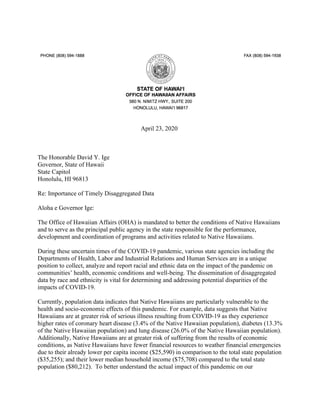
    April 23, 2020 TheHonorable David Y. Ige Governor, State of Hawaii State Capitol Honolulu, HI 96813 Re: Importance of Timely Disaggregated Data Aloha e Governor Ige: The Office of Hawaiian Affairs (OHA) is mandated to better the conditions of Native Hawaiians and to serve as the principal public agency in the state responsible for the performance, development and coordination of programs and activities related to Native Hawaiians. During these uncertain times of the COVID-19 pandemic, various state agencies including the Departments of Health, Labor and Industrial Relations and Human Services are in a unique position to collect, analyze and report racial and ethnic data on the impact of the pandemic on communities’ health, economic conditions and well-being. The dissemination of disaggregated data by race and ethnicity is vital for determining and addressing potential disparities of the impacts of COVID-19. Currently, population data indicates that Native Hawaiians are particularly vulnerable to the health and socio-economic effects of this pandemic. For example, data suggests that Native Hawaiians are at greater risk of serious illness resulting from COVID-19 as they experience higher rates of coronary heart disease (3.4% of the Native Hawaiian population), diabetes (13.3% of the Native Hawaiian population) and lung disease (26.0% of the Native Hawaiian population). Additionally, Native Hawaiians are at greater risk of suffering from the results of economic conditions, as Native Hawaiians have fewer financial resources to weather financial emergencies due to their already lower per capita income ($25,590) in comparison to the total state population ($35,255); and their lower median household income ($75,708) compared to the total state population ($80,212). To better understand the actual impact of this pandemic on our
  • 2.
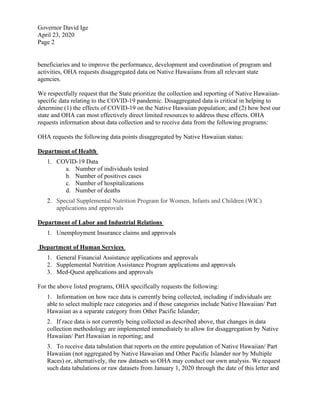
    Governor David Ige April23, 2020 Page 2 beneficiaries and to improve the performance, development and coordination of program and activities, OHA requests disaggregated data on Native Hawaiians from all relevant state agencies. We respectfully request that the State prioritize the collection and reporting of Native Hawaiian- specific data relating to the COVID-19 pandemic. Disaggregated data is critical in helping to determine (1) the effects of COVID-19 on the Native Hawaiian population; and (2) how best our state and OHA can most effectively direct limited resources to address these effects. OHA requests information about data collection and to receive data from the following programs: OHA requests the following data points disaggregated by Native Hawaiian status: Department of Health 1. COVID-19 Data a. Number of individuals tested b. Number of positives cases c. Number of hospitalizations d. Number of deaths 2. Special Supplemental Nutrition Program for Women, Infants and Children (WIC) applications and approvals Department of Labor and Industrial Relations 1. Unemployment Insurance claims and approvals Department of Human Services 1. General Financial Assistance applications and approvals 2. Supplemental Nutrition Assistance Program applications and approvals 3. Med-Quest applications and approvals For the above listed programs, OHA specifically requests the following: 1. Information on how race data is currently being collected, including if individuals are able to select multiple race categories and if those categories include Native Hawaiian/ Part Hawaiian as a separate category from Other Pacific Islander; 2. If race data is not currently being collected as described above, that changes in data collection methodology are implemented immediately to allow for disaggregation by Native Hawaiian/ Part Hawaiian in reporting; and 3. To receive data tabulation that reports on the entire population of Native Hawaiian/ Part Hawaiian (not aggregated by Native Hawaiian and Other Pacific Islander nor by Multiple Races) or, alternatively, the raw datasets so OHA may conduct our own analysis. We request such data tabulations or raw datasets from January 1, 2020 through the date of this letter and
  • 3.
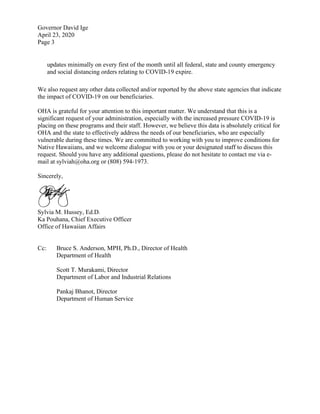
    Governor David Ige April23, 2020 Page 3 updates minimally on every first of the month until all federal, state and county emergency and social distancing orders relating to COVID-19 expire. We also request any other data collected and/or reported by the above state agencies that indicate the impact of COVID-19 on our beneficiaries. OHA is grateful for your attention to this important matter. We understand that this is a significant request of your administration, especially with the increased pressure COVID-19 is placing on these programs and their staff. However, we believe this data is absolutely critical for OHA and the state to effectively address the needs of our beneficiaries, who are especially vulnerable during these times. We are committed to working with you to improve conditions for Native Hawaiians, and we welcome dialogue with you or your designated staff to discuss this request. Should you have any additional questions, please do not hesitate to contact me via e- mail at sylviah@oha.org or (808) 594-1973. Sincerely, Sylvia M. Hussey, Ed.D. Ka Pouhana, Chief Executive Officer Office of Hawaiian Affairs Cc: Bruce S. Anderson, MPH, Ph.D., Director of Health Department of Health Scott T. Murakami, Director Department of Labor and Industrial Relations Pankaj Bhanot, Director Department of Human Service