RAIL CONSTRUCTION GOT A GO SIGN
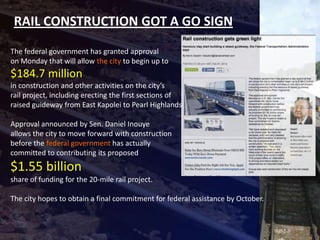
The federal government has granted approval
on Monday that will allow the city to begin up to
$184.7 million
in construction and other activities on the city’s
rail project, including erecting the first sections of
raised guideway from East Kapolei to Pearl Highlands

Approval announced by Sen. Daniel Inouye
allows the city to move forward with construction
before the federal government has actually
committed to contributing its proposed
$1.55 billion
share of funding for the 20-mile rail project.

The city hopes to obtain a final commitment for federal assistance by October.
RAIL CONSTRUCTION GOT A GO SIGN
WHO GAVE THE APPROVAL?
RAIL CONSTRUCTION GOT A GO SIGN
WHO GAVE THE APPROVAL?
THE FEDERAL TRANSIT ADMINISTRATION
RAIL CONSTRUCTION GOT A GO SIGN
WHO GAVE THE APPROVAL?
THE FEDERAL TRANSIT ADMINISTRATION
-An agency within the United States Department of Transportation (DOT)
 that provides financial and technical assistance to local public transit systems

-Public transportation includes buses, subways, light rail, commuter rail,
monorail, passenger ferry boats, trolleys, inclined railways, and people movers.

-The federal government, through the FTA, provides financial assistance
 to develop new transit systems and improve, maintain, and operate existing systems.

-The FTA oversees grants to state and local transit providers,
 primarily through its ten regional offices.

-These grantees are responsible for managing their programs
 in accordance with federal requirements,
 and the FTA is responsible for ensuring that grantees follow federal mandates
 along with statutory and administrative requirements.
RAIL CONSTRUCTION GOT A GO SIGN
REQUIREMENTS BY
THE FEDERAL TRANSIT ADMINISTRATION
RAIL CONSTRUCTION GOT A GO SIGN
REQUIREMENTS BY
THE FEDERAL TRANSIT ADMINISTRATION
RECORD OF DECISION
-issued Jan 18, 2011
-City and County of Honolulu met all of the laws
 and regulations of the environmental review
RAIL CONSTRUCTION GOT A GO SIGN
REQUIREMENTS BY
THE FEDERAL TRANSIT ADMINISTRATION
RECORD OF DECISION
-issued Jan 18, 2011
-City and County of Honolulu met all of the laws
 and regulations of the environmental review
PRE-AWARD AUTHORITY
-issued Dec 29, 2011
-phase where Honolulu can relocate utilities, procure vehicles
 and acquire real estate
-move into final design phase
-project sponsors and the public that the project are eligible
For reimbursement
RAIL CONSTRUCTION GOT A GO SIGN
REQUIREMENTS BY
THE FEDERAL TRANSIT ADMINISTRATION
RECORD OF DECISION
-issued Jan 18, 2011
-City and County of Honolulu met all of the laws
 and regulations of the environmental review
PRE-AWARD AUTHORITY
-issued Dec 29, 2011
-phase where Honolulu can relocate utilities, procure vehicles
 and acquire real estate
-move into final design phase
-project sponsors and the public that the project are eligible
For reimbursement
LETTER OF NO PREJUDICE
-the City has to explain the requirements of the project to the public
-City and County of Honolulu can start building pillars
RAIL CONSTRUCTION GOT A GO SIGN
However there are some limitations.
The city is only allowed to spend

$184.7 million
on this phase of the project.
RAIL CONSTRUCTION GOT A GO SIGN
However there are some limitations.
The city is only allowed to spend

$184.7 million
on this phase of the project.


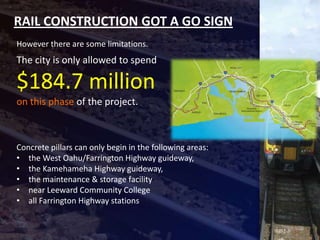
Concrete pillars can only begin in the following areas:
• the West Oahu/Farrington Highway guideway,
• the Kamehameha Highway guideway,
• the maintenance & storage facility
• near Leeward Community College
• all Farrington Highway stations
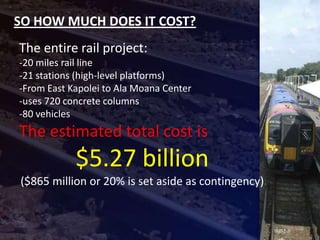
SO HOW MUCH DOES IT COST?
The entire rail project:
-20 miles rail line
-21 stations (high-level platforms)
-From East Kapolei to Ala Moana Center
-uses 720 concrete columns
-80 vehicles
SO HOW MUCH DOES IT COST?
The entire rail project:
-20 miles rail line
-21 stations (high-level platforms)
-From East Kapolei to Ala Moana Center
-uses 720 concrete columns
-80 vehicles
The estimated total cost is
            $5.27 billion
($865 million or 20% is set aside as contingency)
HOW ARE WE GOING TO GET THAT $
There is no assurance yet:
A full funding grant agreement
$1.55 billion
for the city to receive
(expected from federal funding)


HOW ARE WE GOING TO GET THAT $
There is no assurance yet:
A full funding grant agreement
$1.55 billion
for the city to receive
(expected from federal funding)
For planning and design, Congress appropriated

$65 billion
Obama Administration awarded another

$55 million
HOW ARE WE GOING TO GET THAT $
There is no assurance yet:
A full funding grant agreement
$1.55 billion
for the city to receive
(expected from federal funding)
For planning and design, Congress appropriated

$65 billion
Obama Administration awarded another

$55 million
HOW ARE WE GOING TO GET THAT $
Local Funding:
The ½ percent surcharge on the
General Excise and Use Tax (GET)
Paid by residents, business and tourists
$810.4 million
Total surcharge revenue collected to date,
25 percent of GET estimated revenue
(as of January 23, 2012, according to Honolulu.gov )
HOW ARE WE GOING TO GET THAT $
Local Funding:
The ½ percent surcharge on the
General Excise and Use Tax (GET)
Paid by residents, business and tourists
$810.4 million
Total surcharge revenue collected to date,
25 percent of GET estimated revenue
(as of January 23, 2012, according to Honolulu.gov )

The GET surcharge dedicated for the Honolulu
Rail system began in January 2007 and
set to expire on Dec. 31, 2022
ADDITIONAL COST FACTORS
The state financial study,
publicly released on December 2, 2010,
indicated that the project would likely
experience a $1.7 billion overrun above the
$5.3 billion projected cost,
and that collections
from the General Excise Tax would be
30% below forecasts
ADDITIONAL COST FACTORS
Project delay cost at least $15 million
(West Oahu/Farrington Highway Guideway)

A federal lawsuit including former
Gov. Ben Cayetano totaled more than
$1.87 million with seven law firms hired
for legal bills (as of Jan 26, 2012, according to Star-Advertiser)

State Supreme Court lawsuit to stop work until
archaeological survey along the entire road is
completed
ADDITIONAL COST FACTORS
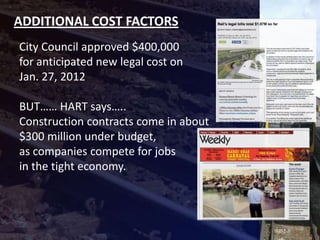
City Council approved $400,000
for anticipated new legal cost on
Jan. 27, 2012

BUT…… HART says…..
Construction contracts come in about
$300 million under budget,
as companies compete for jobs
in the tight economy.
DO WE REALLY NEED THIS?
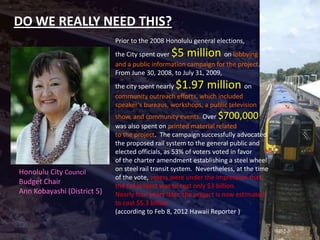
                             Prior to the 2008 Honolulu general elections,
                             the City spent over $5 million        on lobbying
                             and a public information campaign for the project.
                             From June 30, 2008, to July 31, 2009,
                             the city spent nearly$1.97 million           on
                             community outreach efforts, which included
                             speaker’s bureaus, workshops, a public television
                             show, and community events. Over $700,000
                             was also spent on printed material related
                             to the project. The campaign successfully advocated
                             the proposed rail system to the general public and
                             elected officials, as 53% of voters voted in favor
                             of the charter amendment establishing a steel wheel
Honolulu City Council        on steel rail transit system. Nevertheless, at the time
                             of the vote, voters were under the impression that
Budget Chair
                             the rail project was to cost only $3 billion.
Ann Kobayashi (District 5)   Nearly four years later, the project is now estimated
                             to cost $5.3 billion.
                             (according to Feb 8, 2012 Hawaii Reporter )
DO WE REALLY NEED THIS?
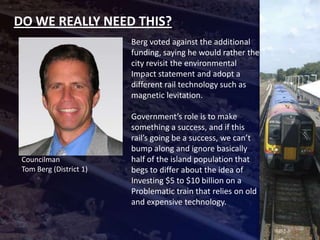
                         Berg voted against the additional
                         funding, saying he would rather the
                         city revisit the environmental
                         Impact statement and adopt a
                         different rail technology such as
                         magnetic levitation.

                         Government’s role is to make
                         something a success, and if this
                         rail’s going be a success, we can’t
                         bump along and ignore basically
 Councilman              half of the island population that
 Tom Berg (District 1)   begs to differ about the idea of
                         Investing $5 to $10 billion on a
                         Problematic train that relies on old
                         and expensive technology.
DO WE REALLY NEED THIS?
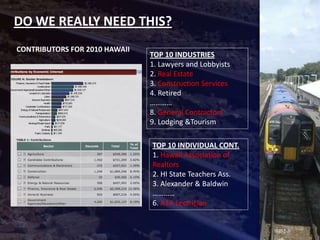
CONTRIBUTORS FOR 2010 HAWAII
                               TOP 10 INDUSTRIES
                               1. Lawyers and Lobbyists
                               2. Real Estate
                               3. Construction Services
                               4. Retired
                               …………
                               8. General Contractors
                               9. Lodging &Tourism

                               TOP 10 INDIVIDUAL CONT.
                               1. Hawaii Association of
                               Realtors
                               2. HI State Teachers Ass.
                               3. Alexander & Baldwin
                               …………
                               6. A1A Lectrician
Honolulu Rail Transit - Budget

Honolulu Rail Transit - Budget

  • 2.
    RAIL CONSTRUCTION GOTA GO SIGN The federal government has granted approval on Monday that will allow the city to begin up to $184.7 million in construction and other activities on the city’s rail project, including erecting the first sections of raised guideway from East Kapolei to Pearl Highlands Approval announced by Sen. Daniel Inouye allows the city to move forward with construction before the federal government has actually committed to contributing its proposed $1.55 billion share of funding for the 20-mile rail project. The city hopes to obtain a final commitment for federal assistance by October.
  • 3.
    RAIL CONSTRUCTION GOTA GO SIGN WHO GAVE THE APPROVAL?
  • 4.
    RAIL CONSTRUCTION GOTA GO SIGN WHO GAVE THE APPROVAL? THE FEDERAL TRANSIT ADMINISTRATION
  • 5.
    RAIL CONSTRUCTION GOTA GO SIGN WHO GAVE THE APPROVAL? THE FEDERAL TRANSIT ADMINISTRATION -An agency within the United States Department of Transportation (DOT) that provides financial and technical assistance to local public transit systems -Public transportation includes buses, subways, light rail, commuter rail, monorail, passenger ferry boats, trolleys, inclined railways, and people movers. -The federal government, through the FTA, provides financial assistance to develop new transit systems and improve, maintain, and operate existing systems. -The FTA oversees grants to state and local transit providers, primarily through its ten regional offices. -These grantees are responsible for managing their programs in accordance with federal requirements, and the FTA is responsible for ensuring that grantees follow federal mandates along with statutory and administrative requirements.
  • 6.
    RAIL CONSTRUCTION GOTA GO SIGN REQUIREMENTS BY THE FEDERAL TRANSIT ADMINISTRATION
  • 7.
    RAIL CONSTRUCTION GOTA GO SIGN REQUIREMENTS BY THE FEDERAL TRANSIT ADMINISTRATION RECORD OF DECISION -issued Jan 18, 2011 -City and County of Honolulu met all of the laws and regulations of the environmental review
  • 8.
    RAIL CONSTRUCTION GOTA GO SIGN REQUIREMENTS BY THE FEDERAL TRANSIT ADMINISTRATION RECORD OF DECISION -issued Jan 18, 2011 -City and County of Honolulu met all of the laws and regulations of the environmental review PRE-AWARD AUTHORITY -issued Dec 29, 2011 -phase where Honolulu can relocate utilities, procure vehicles and acquire real estate -move into final design phase -project sponsors and the public that the project are eligible For reimbursement
  • 9.
    RAIL CONSTRUCTION GOTA GO SIGN REQUIREMENTS BY THE FEDERAL TRANSIT ADMINISTRATION RECORD OF DECISION -issued Jan 18, 2011 -City and County of Honolulu met all of the laws and regulations of the environmental review PRE-AWARD AUTHORITY -issued Dec 29, 2011 -phase where Honolulu can relocate utilities, procure vehicles and acquire real estate -move into final design phase -project sponsors and the public that the project are eligible For reimbursement LETTER OF NO PREJUDICE -the City has to explain the requirements of the project to the public -City and County of Honolulu can start building pillars
  • 10.
    RAIL CONSTRUCTION GOTA GO SIGN However there are some limitations. The city is only allowed to spend $184.7 million on this phase of the project.
  • 11.
    RAIL CONSTRUCTION GOTA GO SIGN However there are some limitations. The city is only allowed to spend $184.7 million on this phase of the project. Concrete pillars can only begin in the following areas: • the West Oahu/Farrington Highway guideway, • the Kamehameha Highway guideway, • the maintenance & storage facility • near Leeward Community College • all Farrington Highway stations
  • 12.
    SO HOW MUCHDOES IT COST? The entire rail project: -20 miles rail line -21 stations (high-level platforms) -From East Kapolei to Ala Moana Center -uses 720 concrete columns -80 vehicles
  • 13.
    SO HOW MUCHDOES IT COST? The entire rail project: -20 miles rail line -21 stations (high-level platforms) -From East Kapolei to Ala Moana Center -uses 720 concrete columns -80 vehicles The estimated total cost is $5.27 billion ($865 million or 20% is set aside as contingency)
  • 14.
    HOW ARE WEGOING TO GET THAT $ There is no assurance yet: A full funding grant agreement $1.55 billion for the city to receive (expected from federal funding) 

  • 15.
    HOW ARE WEGOING TO GET THAT $ There is no assurance yet: A full funding grant agreement $1.55 billion for the city to receive (expected from federal funding) For planning and design, Congress appropriated $65 billion Obama Administration awarded another $55 million
  • 16.
    HOW ARE WEGOING TO GET THAT $ There is no assurance yet: A full funding grant agreement $1.55 billion for the city to receive (expected from federal funding) For planning and design, Congress appropriated $65 billion Obama Administration awarded another $55 million
  • 17.
    HOW ARE WEGOING TO GET THAT $ Local Funding: The ½ percent surcharge on the General Excise and Use Tax (GET) Paid by residents, business and tourists $810.4 million Total surcharge revenue collected to date, 25 percent of GET estimated revenue (as of January 23, 2012, according to Honolulu.gov )
  • 18.
    HOW ARE WEGOING TO GET THAT $ Local Funding: The ½ percent surcharge on the General Excise and Use Tax (GET) Paid by residents, business and tourists $810.4 million Total surcharge revenue collected to date, 25 percent of GET estimated revenue (as of January 23, 2012, according to Honolulu.gov ) The GET surcharge dedicated for the Honolulu Rail system began in January 2007 and set to expire on Dec. 31, 2022
  • 19.
    ADDITIONAL COST FACTORS Thestate financial study, publicly released on December 2, 2010, indicated that the project would likely experience a $1.7 billion overrun above the $5.3 billion projected cost, and that collections from the General Excise Tax would be 30% below forecasts
  • 20.
    ADDITIONAL COST FACTORS Projectdelay cost at least $15 million (West Oahu/Farrington Highway Guideway) A federal lawsuit including former Gov. Ben Cayetano totaled more than $1.87 million with seven law firms hired for legal bills (as of Jan 26, 2012, according to Star-Advertiser) State Supreme Court lawsuit to stop work until archaeological survey along the entire road is completed
  • 21.
    ADDITIONAL COST FACTORS CityCouncil approved $400,000 for anticipated new legal cost on Jan. 27, 2012 BUT…… HART says….. Construction contracts come in about $300 million under budget, as companies compete for jobs in the tight economy.
  • 22.
    DO WE REALLYNEED THIS?
  • 23.
    DO WE REALLYNEED THIS? Prior to the 2008 Honolulu general elections, the City spent over $5 million on lobbying and a public information campaign for the project. From June 30, 2008, to July 31, 2009, the city spent nearly$1.97 million on community outreach efforts, which included speaker’s bureaus, workshops, a public television show, and community events. Over $700,000 was also spent on printed material related to the project. The campaign successfully advocated the proposed rail system to the general public and elected officials, as 53% of voters voted in favor of the charter amendment establishing a steel wheel Honolulu City Council on steel rail transit system. Nevertheless, at the time of the vote, voters were under the impression that Budget Chair the rail project was to cost only $3 billion. Ann Kobayashi (District 5) Nearly four years later, the project is now estimated to cost $5.3 billion. (according to Feb 8, 2012 Hawaii Reporter )
  • 24.
    DO WE REALLYNEED THIS? Berg voted against the additional funding, saying he would rather the city revisit the environmental Impact statement and adopt a different rail technology such as magnetic levitation. Government’s role is to make something a success, and if this rail’s going be a success, we can’t bump along and ignore basically Councilman half of the island population that Tom Berg (District 1) begs to differ about the idea of Investing $5 to $10 billion on a Problematic train that relies on old and expensive technology.
  • 25.
    DO WE REALLYNEED THIS? CONTRIBUTORS FOR 2010 HAWAII TOP 10 INDUSTRIES 1. Lawyers and Lobbyists 2. Real Estate 3. Construction Services 4. Retired ………… 8. General Contractors 9. Lodging &Tourism TOP 10 INDIVIDUAL CONT. 1. Hawaii Association of Realtors 2. HI State Teachers Ass. 3. Alexander & Baldwin ………… 6. A1A Lectrician