What is FMEA ?
F AILURE
M ODE
E FFECT
A NALYSIS
Failure Modes and Effects
Analysis
 is a methodology that
documents the manners in
which an asset can fail, as
well as the consequences
of each failure with regard
to production and safety.
Use of FMEA
• is to Identify the Asset Criticality
Ranking
What is Asset Criticality
Ranking?
Numeric rank of an asset with
respect to its importance to safety
and production; based on the
likelihood of a failure mode to occur,
as well as on the effects of the failure
and costs to repair
SCOPE OF ASSET
CRITICALITY RANKING
 is to provide the means
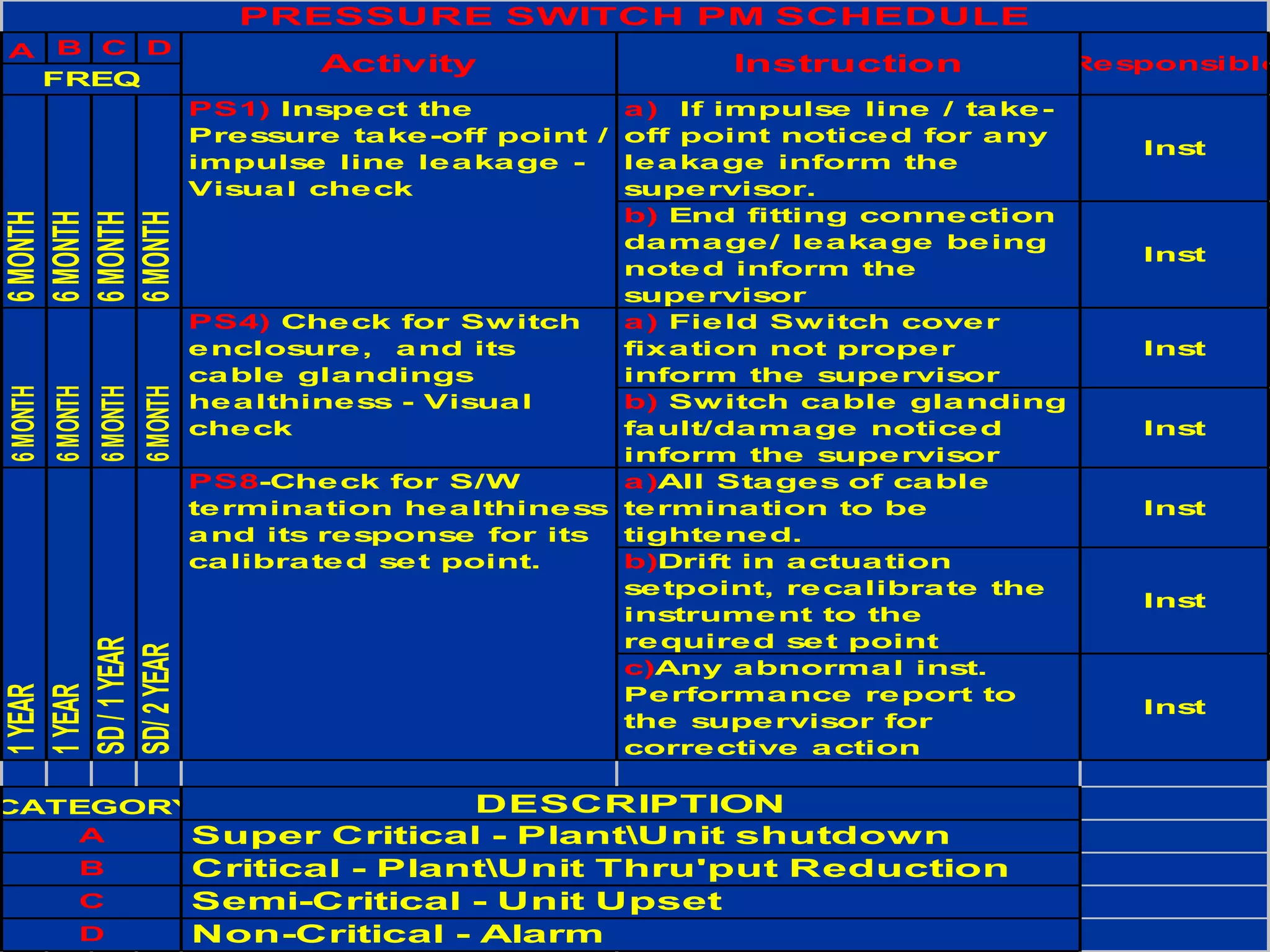
necessary to determine the
criticality of rotating equipment
and other assets with respect to the
asset’s importance to safety, the
environment and production
FMEA Methodology
1 All the possible failure modes for an
equipment is identified
2 Risk Priority Number is calculated for each
failure mode and equipment as a whole
3 All possible PM tasks for each failure mode
is identified with man-hour requirement
4 Failure Mode – PM Task matrix is
developed
5 PM tasks are selected to cover more than 70
% of risk assessed with optimum man-hour
requirement
FMEA - RPN
Calculation of Risk Priority
Number for the purpose of
criticality assessment.
Factors
 Likelihood of Failure
 Severity of the failure effects
 Cost to repair
FEMA RANKING CHART
A B C D E F G H I J K L
1
2 X Z T
3
4
N
SUM (A TO L) = Y
CRITICALITY RANKING
Sl.No. Failure mode LOF
Effect
CTR Ranking
T = X * Y * Z
CRITICALITY RANKING (N) = sum of T’s
Functional Failure
• Failure that results in the loss of an
asset’s ability to perform its intended
function at its desired level of
performance. A functional failure may
be a failure that results in a complete, or
partial, loss of asset performance.
Failure Mode
 Manner in which a functional
failure is realized; may or may
not be the root cause of the
functional failure. A functional
failure can possess one or more
failure modes.
 Failure modes should be based
on those that are plausible, or
most likely to occur, based on
the past history of the
component.
CONTROL VALVE
S.No Functional Failure Failure Mode
INST AIR LEAKAGE
INST AIR FAILURE
PRESSURE REGULATOR FAILURE
I/P CONVERTOR FAILURE
DIAPHRAGM FAILURE
CONTROL SYSTEM FAILURE
POSITIONER FAILURE
SOLENOID VALVE FAILURE
CONTROLLER PROBLEM
TUNNING PROBLEM
PROCESS PROBLEM
AIR REGULATOR FAULT
C/V ACCESSORIES FAULT
VALVE PASSING
ERROSION (PLUG / SEAT RING)
MECHANICAL FAULT
BLOCKAGE
MECHANICAL FAULT
DROPPING OF PLUG.
GONE TO FAIL SAFE CONDITION
VALVE HUNTING
MORE THAN REQUIRED FLOW
LESS FLOW
1
2
3
4
Likelihood of Failure
LIKELIHOOD CRITERIA
1
REMOTE: Failure is unlikely to occur
No evidence (i.e. work order) of prior occurrence; staff unaware of
it occurring on any similar piece of equipment.
2
LOW: Relatively few failures
Evidence (i.e. work order) of prior occurrence; staff aware of this
occurring on a similar piece of equipment, but not on the specific
equipment being analyzed, and the conditions resulting in the
previous failure do not exist in this case.
4
MODERATE: Occasional failures
Evidence (i.e. work order) of this failure mechanism with
occasional occurrence; staff aware that this failure mechanism
has occurred several times in the past.
8
HIGH: Repeated failures
Evidence (i.e. work order) of prior repeated occurrences; staff
aware that this failure mechanism has occurred many times in the
past.
10
VERY HIGH: Failure is almost inevitable
Evidence (i.e. work order) of continuous occurrence; staff aware
that this failure mechanism has occurred many times in the past.
Failure Effects
• The consequences of a
functional failure of an installed
asset. Failure effects are usually
described in terms of impact on
the asset, process, production,
and safety or environmental
issues.
Each failure mode may have more than one failure
effect. Identify all applicable failure effects for each
failure mode by inserting the proper weighting factor in
the appropriate column.
Failure Effects
FAILURE
CODE
DESCRIPTION
WEIGHTING
FACTOR
A FIRE / EXPLOSION 10
B TOTAL REFINERY SHUTDOWN 10
C HHC / FLAMMABLE SUBSTANCE RELEASE 10
D ENVIRONMENTAL EXCEEDANCE 10
E PLANT SHUTDOWN 8
F UNIT SHUTDOWN 7
G THRO'PUT REDUCTION (>5 %) 7
H THRO'PUT REDUCTION (<5 %) 5
I POWER IMPORT 5
J PLANT / UNIT UPSET 4
K LOSS OF REDUNDANCY 4
L ENERGY LOSS 4
Cost-to-Repair
• Preparer shall use best judgement or
component repair knowledge for this
estimate (Item L). Refer the Table
for the CTR value.
Cost to Repair
WEIGHTING FACTOR REPAIR COST
1 Minimal to moderate repair costs
3 Moderate to high repair costs
5 High to excessive repair costs
Determination of Critical Asset
Ranking
To determine the equipment criticality, list
out all the equipment's in the ascending form
depending upon their RPN value calculated
through failure mode criticality analysis
Prepare a bar chart using FEMA NO: in the
x axis and the risk priority no. in the y axis
Identify/classify the equipment's under three
categories viz. Most critical, critical and least
critical in the above chart.
EQUIPMENT CRITICALITY RANKING
0
100
200
300
400
500
600
700
800
900
H S V F T U E I P Z O Y A N X M B G C R K Q D L J W
FMEA No.
Criticality
Rank
Most Critical
Less Critical
Least Critical
Identification of applicable CD and
TD PM Task
1 List out the entire CD and TD preventive
maintenance task for the particular type of
equipment from the available sources.
2 Based on Equipment Criticality Ranking of
the equipment the required CD and TD PM tasks
shall be selected.
3 If one task eliminates more number of
failure modes that task shall also be included in
applicable CD and TD PM tasks.
1/2
4 If the risk priority number of a particular
failure mode is very high the task that
eliminates the failure mode shall also be
included in applicable CD and TD PM tasks.
5 Based on equipment history the task
performed frequently on a particular type of
equipment shall also be included in
applicable CD and TD PM tasks.
6 The task need to be performed on
particular type of equipment to meet statutory
requirement shall also be included in
applicable CD and TD PM tasks.
Identification of applicable CD and
TD PM Task
2/2
FMEA Benefits
‫٭‬ Improves the quality, reliability & safety of the
products, or service.
‫٭‬ Generate input data for use in system safety and
maintainability analysis
‫٭‬ Reduces product development time and costs.
‫٭‬ Systematic approach to classifying failures
‫٭‬ Identifies all possible failure modes and their
effects on objectives, personnel, system
‫٭‬ Helps error identification and prevention
‫٭‬ Helps establish the forum for defect prevention
‫٭‬ Helps define the corrective action
‫٭‬ Helps determine the redundancy of the system
A B C D E F G H I J K L
PRIMARY ELEMENT
1 Impulse line take -off leakage 4 4 1 16 16
2 Impulse line choked 1 4 1 4 4
3 Impulse line steam tracing failure
SECONDARY ELEMENT
4 Micro Switch unit failure 1 4 3 12 12
5 Switch Repeatability failure 2 4 5 40 40
6 Calibration Setting drift 4 4 1 16 16
7 Switch mechanism malfunction 1 4 5 20 20
8 Switch cable termination/block fault 2 4 1 8 8
Branch Cable
9
Cable fault due to improper cable
glanding 1 4 3 12 12
10 Cable fault due to physical damage 1 4 3 12 0
Multi-Core cable fault
11 Cable fault due to physical damage 1 4 5 20 0
12
Cable termination fault at Marshall
Rack 1 4 1 4 4
13
Cable termination fault at Barrier
Rack 2 4 1 8 8
14 Cable termination fault at PLC opto-
coupler side 1 4 1 4 4
Switch Power supply
15 Barrier failure 2 4 3 24 24
16 Fuse blown at Power distribution
Unit due to earthing fault 1 4 1 4 4
204 172
CTR Ranking
PRESSURE SWITCH (TRIP) ---- UNIT/PLANT UPSET
Coverage
Effect
Sl.No. Failure mode LOF
Failure mode
A B C D E F G H I J K L
PRIMARY ELEMENT
1
Impulse line take -off
leakage 4 7 1 28 28
2 Impulse line choked 1 7 1 7 7
3
Impulse line steam
tracing failure
SECONDARY
ELEMENT
4
Micro Switch unit
failure 1 7 3 21 21
5
Switch Repeatability
failure 2 7 5 70 70
6
Calibration Setting
drift 4 7 1 28 28
7
Switch mechanism
malfunction 1 7 5 35 35
8
Switch cable
termination/block fault 2 7 1 14 14
Branch Cable
9
Cable fault due to
improper cable
glanding 1 7 3 21 21
10
Cable fault due to
physical damage 1 7 3 21 0
Multi-Core cable fault
11
Cable fault due to
physical damage 1 7 5 35 0
12
Cable termination fault
at Marshall Rack 1 7 1 7 7
13
Cable termination fault
at Barrier Rack 2 7 1 14 14
14 Cable termination fault
at PLC opto-coupler
side 1 7 1 7 7
Switch Power supply
15 Barrier failure 2 7 3 42 42
16 Fuse blown at Power
distribution Unit due to
earthing fault 1 7 1 7 7
357 301
Coverage
PRESSURE SWITCH (TRIP) ---- THRU'PUT RDn.
Ranking
Sl.No. LOF
Effect
CTR
Sl.No.
Failure
mode
FEMA
VALUE
Inspect
the
Pressure
take-off
point
/
impulse
line
leakage
Check
for
any
remote
seal
puncher/any
scratch
mark
on
the
diaphragm
Check
for
any
physical
damage
happened
at
capillary
side
Check
for
Switch
enclosure,
and
its
cable
glanding
healthiness.
Check
Switch,
Jn.
Box
cable
glandings
and
its
Gasket
to
avoid
water
entry
Check
for
Inst.
Cable
tray
and
Jn.
Box
external
painting
condition
and
its
rain
hood
fixation
Check
for
loop
termination
tightness
from
field
S/W
to
FPR
Check
for
S/W
actuation
to
its
calibrated
set
point.
Shop
Service
/
calibrating
the
switch
/
S/d
Check
for
proper
Barrier
grounding
termination
&
its
power
supply
PRIMARY ELEMENT PS1 PS2 PS3 PS4 PS5 PS6 PS7 PS8 PS9 PS10
1 Impulse line take -off leakage 16 16
2 Impulse line choked 4 4
3
Impulse line steam tracing
failure
SECONDARY ELEMENT
4 Micro Switch contact failure 12 12 12 12 12
5 Switch Repeatability failure 40 40 40 40 40
6 Calibration Setting failure 16 16 16 16
7 Switch mechanism malfunction 20 20 20 20 20 20 20 20
8
Switch cable termination/block
fault 8 8 8 8 8 8
Branch Cable
9
Cable fault due to improper
cable glanding 12 12 12
10
Cable fault due to physical
damage 12 12
Multi-Core cable fault
11
Cable fault due to physical
damage 20
12
Cable termination fault at
Marshall Rack 4 4 4
13
Cable termination fault at
Barrier Rack 8 8 8
14 Cable termination fault at PLC
opto-coupler side 4 4 4
Switch Power supply
15 Barrier failure 24 24 24
16 Fuse blown at Power
distribution Unit due to earthing
fault 4 4 4
204 16 60 60 68 52 12 44 144 96 28
PRESSURE SWITCH (TRIP) --- UNIT/PLANT UPSET
Sl.
No.
Failure
mode FEMA
VALUE
Inspect
the
Pressure
take-
off
point
/
impulse
line
leakage
Check
for
any
remote
seal
purchase/any
scratch
mark
on
the
diaphragm
Check
for
any
physical
damage
happened
at
capillary
side
Check
for
Switch
enclosure,
and
its
cable
glanding
healthiness.
Check
Switch,
Jn.
Box
cable
glandings
and
its
Gasket
to
avoid
water
entry
Check
for
Inst.
Cable
tray
and
Jn.
Box
external
painting
condition
and
its
rain
hood
Check
for
loop
termination
tightness
from
field
S/W
to
FPR
Check
for
S/W
actuation
to
its
calibrated
set
point.
Shop
Service
/
calibrating
the
switch
/
S/d
Check
for
proper
Barrier
grounding
termination
&
its
power
supply
PS1 PS2 PS3 PS4 PS5 PS6 PS7 PS8PS9 PS10
1
Impuls
e line
take -
off
leakag
e 16 16
2
Impuls
e line
choke
d 4 4
Impuls
e line
steam
PRESSURE SWITCH (TRIP) --- UNIT/PLANT UPSET
PRIMARY ELEMENT
Sl.N
o.
Failure mode
FEMA
VALUE
Inspect
the
Pressure
take-
off
point
/
impulse
line
Check
for
any
remote
seal
purchase/any
scratch
mark
on
the
Check
for
any
physical
damage
happened
at
Check
for
Switch
enclosure,
and
its
cable
Check
Switch,
Jn.
Box
cable
glandings
and
its
Gasket
to
avoid
water
Check
for
Inst.
Cable
tray
and
Jn.
Box
external
painting
condition
and
its
Check
for
loop
termination
tightness
Check
for
S/W
actuation
to
its
calibrated
set
point.
PRIMARY ELEMENT PS1 PS2 PS3 PS4 PS5 PS6 PS7 PS8
1
Impulse line take
-off leakage 16 16
2
Impulse line
choked 4 4
3
Impulse line
steam tracing
failure
SECONDARY
ELEMENT
4
Micro Switch
contact failure 12 12 12 12
5
Switch
Repeatability
failure 40 40 40 40
6
Calibration
Setting failure 16 16 16
7
Switch
mechanism 20 20 20 20 20 20 20
8
Switch cable
termination/bloc
k fault 8 8 8 8 8
Branch Cable
9
Cable fault due
to improper
cable glanding 12 12 12
PRESSURE SWITCH (TRIP) --- UNIT/PLANT UPSET
8
Switch cable
termination/block
fault 8 8 8 8 8
Branch Cable
9
Cable fault due to
improper cable
glanding 12 12 12
10
Cable fault due to
physical damage 12 12
Multi-Core cable
fault
11
Cable fault due to
physical damage 20
12
Cable termination
fault at Marshall
Rack 4 4 4
13
Cable termination
fault at Barrier Rack 8 8 8
14 Cable termination
fault at PLC opto-
coupler side 4 4 4
Switch Power
supply
15 Barrier failure 24 24
16 Fuse blown at
Power distribution
Unit due to earthing
fault 4 4
204 16 60 60 68 52 12 44 144
A B C D
a) If impulse line / take-
off point noticed for any
leakage inform the
supervisor.
Inst
b) End fitting connection
damage/ leakage being
noted inform the
supervisor
Inst
a) Field Switch cover
fixation not proper
inform the supervisor
Inst
b) Switch cable glanding
fault/damage noticed
inform the supervisor
Inst
a)All Stages of cable
termination to be
tightened.
Inst
b)Drift in actuation
setpoint, recalibrate the
instrument to the
required set point
Inst
c)Any abnormal inst.
Performance report to
the supervisor for
corrective action
Inst
PS8-Check for S/W
termination healthiness
and its response for its
calibrated set point.
C
Critical - PlantUnit Thru'put Reduction
Semi-Critical - Unit Upset
Super Critical - PlantUnit shutdown
Non-Critical - Alarm
B
D
PRESSURE SWITCH PM SCHEDULE
PS1) Inspect the
Pressure take-off point /
impulse line leakage -
Visual check
6
MONTH
PS4) Check for Switch
enclosure, and its
cable glandings
healthiness - Visual
check
6
MONTH
Responsible
DESCRIPTION
6
MONTH
CATEGORY
A
6
MONTH
1
YEAR
1
YEAR
SD
/
1
YEAR
SD/
2
YEAR
Instruction
6
MONTH
6
MONTH
FREQ
6
MONTH
6
MONTH
Activity
Routines Activity Details Responsible
Daily Activity: Nil
Weekly Activity : Nil
Monthly Activity
a) Condition the
impulse line
Inst
b) Proper action to be
taken for end fitting
connections if any
damage being noted
Inst
a) Fix the Switch
cover properly
Inst
b) Close the Jn. Box
door with proper
fixing screws
Inst
a) Proper cable
glanding to the
Switch & Jn.Box to
be done if needed
Inst
b) Replace the Jn.
Box Gasket if
needed/damage
observed
Inst
PRESSURE SWITCH PM ACTIVITY
IP1) Observe for
Impluse line
condition and its
end fittings
IP2) Check for
Switch enclosure,
Jn. Box cover &
door fixed properly
IP3) Check Switch,
Jn. Box cable
glandings and its
Gasket to avoid
water entry
1/2
Routines Activity Details Responsible
IP4) Check for Inst.
Cable tray and Jn. Box
external painting
condition and its rain
hood fixation
a) Report any damage
noticed towards cable
tray / Junction Box Inst
IP6) Check for S/W
actuation to its
calibrated set point
a) Any drift from set point
corrective action to be
done
Inst
a) Any malfunction noted
service the switch
Inst
b) Repeatability problem
replace the switch
Inst
a) All Stages of Cable
terminations to be
tightened if any loose
connections noted
Inst
b) Barrier grounding
terminal connections and
its power supply to be
inspected, any
abnormality report to the
supervisor
Inst
PRESSURE SWITCH PM ACTIVITY
Yearly Activity
IP7) Shop Service /
calibrating the switch /
S/d
IP5) Check for loop
termination tightness
from field S/W to FPR
Half-Yearly Activity
S.NO
TAG NO
CATEGORY
Manhours/Yr
FMEA
FMEA
COVERED
FMEA
%
COVERAGE
1 76X
V411 C 1.17 256 224 87.5
2 76X
V412 C 1.17 256 224 87.5
3 76X
CV413 C 1.50 256 224 87.5
4 76X
CV414 C 1.50 256 224 87.5
5 76X
CV415 C 1.50 256 224 87.5
6 76X
Y411 C 0.17 240 196 81.67
7 76X
Y412 C 0.17 240 196 81.67
8 76ZSL411 C 0.17 276 244 88.41
9 76ZSL412 C 0.17 276 244 88.41
10 76ZSL413 C 0.17 276 244 88.41
11 76ZSL414 C 0.17 276 244 88.41
12 76ZSL415 C 0.17 276 244 88.41
13 76PT411 C 0.67 466 434 93.13
14 76PT403 A 4.67 784 728 92.86
15 LHH19276 A 8.67 448 392 87.5
16 THH19176 A 4.67 721 560 77.67
26.70 87.13
76 C 31 ADSORBER UNIT
Fmea

Fmea

  • 1.
    What is FMEA? F AILURE M ODE E FFECT A NALYSIS
  • 2.
    Failure Modes andEffects Analysis  is a methodology that documents the manners in which an asset can fail, as well as the consequences of each failure with regard to production and safety.
  • 3.
    Use of FMEA •is to Identify the Asset Criticality Ranking
  • 4.
    What is AssetCriticality Ranking? Numeric rank of an asset with respect to its importance to safety and production; based on the likelihood of a failure mode to occur, as well as on the effects of the failure and costs to repair
  • 5.
    SCOPE OF ASSET CRITICALITYRANKING  is to provide the means necessary to determine the criticality of rotating equipment and other assets with respect to the asset’s importance to safety, the environment and production
  • 6.
    FMEA Methodology 1 Allthe possible failure modes for an equipment is identified 2 Risk Priority Number is calculated for each failure mode and equipment as a whole 3 All possible PM tasks for each failure mode is identified with man-hour requirement 4 Failure Mode – PM Task matrix is developed 5 PM tasks are selected to cover more than 70 % of risk assessed with optimum man-hour requirement
  • 7.
    FMEA - RPN Calculationof Risk Priority Number for the purpose of criticality assessment. Factors  Likelihood of Failure  Severity of the failure effects  Cost to repair
  • 8.
    FEMA RANKING CHART AB C D E F G H I J K L 1 2 X Z T 3 4 N SUM (A TO L) = Y CRITICALITY RANKING Sl.No. Failure mode LOF Effect CTR Ranking T = X * Y * Z CRITICALITY RANKING (N) = sum of T’s
  • 9.
    Functional Failure • Failurethat results in the loss of an asset’s ability to perform its intended function at its desired level of performance. A functional failure may be a failure that results in a complete, or partial, loss of asset performance.
  • 10.
    Failure Mode  Mannerin which a functional failure is realized; may or may not be the root cause of the functional failure. A functional failure can possess one or more failure modes.  Failure modes should be based on those that are plausible, or most likely to occur, based on the past history of the component.
  • 11.
    CONTROL VALVE S.No FunctionalFailure Failure Mode INST AIR LEAKAGE INST AIR FAILURE PRESSURE REGULATOR FAILURE I/P CONVERTOR FAILURE DIAPHRAGM FAILURE CONTROL SYSTEM FAILURE POSITIONER FAILURE SOLENOID VALVE FAILURE CONTROLLER PROBLEM TUNNING PROBLEM PROCESS PROBLEM AIR REGULATOR FAULT C/V ACCESSORIES FAULT VALVE PASSING ERROSION (PLUG / SEAT RING) MECHANICAL FAULT BLOCKAGE MECHANICAL FAULT DROPPING OF PLUG. GONE TO FAIL SAFE CONDITION VALVE HUNTING MORE THAN REQUIRED FLOW LESS FLOW 1 2 3 4
  • 12.
    Likelihood of Failure LIKELIHOODCRITERIA 1 REMOTE: Failure is unlikely to occur No evidence (i.e. work order) of prior occurrence; staff unaware of it occurring on any similar piece of equipment. 2 LOW: Relatively few failures Evidence (i.e. work order) of prior occurrence; staff aware of this occurring on a similar piece of equipment, but not on the specific equipment being analyzed, and the conditions resulting in the previous failure do not exist in this case. 4 MODERATE: Occasional failures Evidence (i.e. work order) of this failure mechanism with occasional occurrence; staff aware that this failure mechanism has occurred several times in the past. 8 HIGH: Repeated failures Evidence (i.e. work order) of prior repeated occurrences; staff aware that this failure mechanism has occurred many times in the past. 10 VERY HIGH: Failure is almost inevitable Evidence (i.e. work order) of continuous occurrence; staff aware that this failure mechanism has occurred many times in the past.
  • 13.
    Failure Effects • Theconsequences of a functional failure of an installed asset. Failure effects are usually described in terms of impact on the asset, process, production, and safety or environmental issues. Each failure mode may have more than one failure effect. Identify all applicable failure effects for each failure mode by inserting the proper weighting factor in the appropriate column.
  • 14.
    Failure Effects FAILURE CODE DESCRIPTION WEIGHTING FACTOR A FIRE/ EXPLOSION 10 B TOTAL REFINERY SHUTDOWN 10 C HHC / FLAMMABLE SUBSTANCE RELEASE 10 D ENVIRONMENTAL EXCEEDANCE 10 E PLANT SHUTDOWN 8 F UNIT SHUTDOWN 7 G THRO'PUT REDUCTION (>5 %) 7 H THRO'PUT REDUCTION (<5 %) 5 I POWER IMPORT 5 J PLANT / UNIT UPSET 4 K LOSS OF REDUNDANCY 4 L ENERGY LOSS 4
  • 15.
    Cost-to-Repair • Preparer shalluse best judgement or component repair knowledge for this estimate (Item L). Refer the Table for the CTR value. Cost to Repair WEIGHTING FACTOR REPAIR COST 1 Minimal to moderate repair costs 3 Moderate to high repair costs 5 High to excessive repair costs
  • 16.
    Determination of CriticalAsset Ranking To determine the equipment criticality, list out all the equipment's in the ascending form depending upon their RPN value calculated through failure mode criticality analysis Prepare a bar chart using FEMA NO: in the x axis and the risk priority no. in the y axis Identify/classify the equipment's under three categories viz. Most critical, critical and least critical in the above chart.
  • 17.
    EQUIPMENT CRITICALITY RANKING 0 100 200 300 400 500 600 700 800 900 HS V F T U E I P Z O Y A N X M B G C R K Q D L J W FMEA No. Criticality Rank Most Critical Less Critical Least Critical
  • 18.
    Identification of applicableCD and TD PM Task 1 List out the entire CD and TD preventive maintenance task for the particular type of equipment from the available sources. 2 Based on Equipment Criticality Ranking of the equipment the required CD and TD PM tasks shall be selected. 3 If one task eliminates more number of failure modes that task shall also be included in applicable CD and TD PM tasks. 1/2
  • 19.
    4 If therisk priority number of a particular failure mode is very high the task that eliminates the failure mode shall also be included in applicable CD and TD PM tasks. 5 Based on equipment history the task performed frequently on a particular type of equipment shall also be included in applicable CD and TD PM tasks. 6 The task need to be performed on particular type of equipment to meet statutory requirement shall also be included in applicable CD and TD PM tasks. Identification of applicable CD and TD PM Task 2/2
  • 20.
    FMEA Benefits ‫٭‬ Improvesthe quality, reliability & safety of the products, or service. ‫٭‬ Generate input data for use in system safety and maintainability analysis ‫٭‬ Reduces product development time and costs. ‫٭‬ Systematic approach to classifying failures ‫٭‬ Identifies all possible failure modes and their effects on objectives, personnel, system ‫٭‬ Helps error identification and prevention ‫٭‬ Helps establish the forum for defect prevention ‫٭‬ Helps define the corrective action ‫٭‬ Helps determine the redundancy of the system
  • 21.
    A B CD E F G H I J K L PRIMARY ELEMENT 1 Impulse line take -off leakage 4 4 1 16 16 2 Impulse line choked 1 4 1 4 4 3 Impulse line steam tracing failure SECONDARY ELEMENT 4 Micro Switch unit failure 1 4 3 12 12 5 Switch Repeatability failure 2 4 5 40 40 6 Calibration Setting drift 4 4 1 16 16 7 Switch mechanism malfunction 1 4 5 20 20 8 Switch cable termination/block fault 2 4 1 8 8 Branch Cable 9 Cable fault due to improper cable glanding 1 4 3 12 12 10 Cable fault due to physical damage 1 4 3 12 0 Multi-Core cable fault 11 Cable fault due to physical damage 1 4 5 20 0 12 Cable termination fault at Marshall Rack 1 4 1 4 4 13 Cable termination fault at Barrier Rack 2 4 1 8 8 14 Cable termination fault at PLC opto- coupler side 1 4 1 4 4 Switch Power supply 15 Barrier failure 2 4 3 24 24 16 Fuse blown at Power distribution Unit due to earthing fault 1 4 1 4 4 204 172 CTR Ranking PRESSURE SWITCH (TRIP) ---- UNIT/PLANT UPSET Coverage Effect Sl.No. Failure mode LOF
  • 22.
    Failure mode A BC D E F G H I J K L PRIMARY ELEMENT 1 Impulse line take -off leakage 4 7 1 28 28 2 Impulse line choked 1 7 1 7 7 3 Impulse line steam tracing failure SECONDARY ELEMENT 4 Micro Switch unit failure 1 7 3 21 21 5 Switch Repeatability failure 2 7 5 70 70 6 Calibration Setting drift 4 7 1 28 28 7 Switch mechanism malfunction 1 7 5 35 35 8 Switch cable termination/block fault 2 7 1 14 14 Branch Cable 9 Cable fault due to improper cable glanding 1 7 3 21 21 10 Cable fault due to physical damage 1 7 3 21 0 Multi-Core cable fault 11 Cable fault due to physical damage 1 7 5 35 0 12 Cable termination fault at Marshall Rack 1 7 1 7 7 13 Cable termination fault at Barrier Rack 2 7 1 14 14 14 Cable termination fault at PLC opto-coupler side 1 7 1 7 7 Switch Power supply 15 Barrier failure 2 7 3 42 42 16 Fuse blown at Power distribution Unit due to earthing fault 1 7 1 7 7 357 301 Coverage PRESSURE SWITCH (TRIP) ---- THRU'PUT RDn. Ranking Sl.No. LOF Effect CTR
  • 23.
    Sl.No. Failure mode FEMA VALUE Inspect the Pressure take-off point / impulse line leakage Check for any remote seal puncher/any scratch mark on the diaphragm Check for any physical damage happened at capillary side Check for Switch enclosure, and its cable glanding healthiness. Check Switch, Jn. Box cable glandings and its Gasket to avoid water entry Check for Inst. Cable tray and Jn. Box external painting condition and its rain hood fixation Check for loop termination tightness from field S/W to FPR Check for S/W actuation to its calibrated set point. Shop Service / calibrating the switch / S/d Check for proper Barrier grounding termination & its power supply PRIMARY ELEMENT PS1PS2 PS3 PS4 PS5 PS6 PS7 PS8 PS9 PS10 1 Impulse line take -off leakage 16 16 2 Impulse line choked 4 4 3 Impulse line steam tracing failure SECONDARY ELEMENT 4 Micro Switch contact failure 12 12 12 12 12 5 Switch Repeatability failure 40 40 40 40 40 6 Calibration Setting failure 16 16 16 16 7 Switch mechanism malfunction 20 20 20 20 20 20 20 20 8 Switch cable termination/block fault 8 8 8 8 8 8 Branch Cable 9 Cable fault due to improper cable glanding 12 12 12 10 Cable fault due to physical damage 12 12 Multi-Core cable fault 11 Cable fault due to physical damage 20 12 Cable termination fault at Marshall Rack 4 4 4 13 Cable termination fault at Barrier Rack 8 8 8 14 Cable termination fault at PLC opto-coupler side 4 4 4 Switch Power supply 15 Barrier failure 24 24 24 16 Fuse blown at Power distribution Unit due to earthing fault 4 4 4 204 16 60 60 68 52 12 44 144 96 28 PRESSURE SWITCH (TRIP) --- UNIT/PLANT UPSET
  • 24.
    Sl. No. Failure mode FEMA VALUE Inspect the Pressure take- off point / impulse line leakage Check for any remote seal purchase/any scratch mark on the diaphragm Check for any physical damage happened at capillary side Check for Switch enclosure, and its cable glanding healthiness. Check Switch, Jn. Box cable glandings and its Gasket to avoid water entry Check for Inst. Cable tray and Jn. Box external painting condition and its rain hood Check for loop termination tightness from field S/W to FPR Check for S/W actuation to its calibrated set point. Shop Service / calibrating the switch / S/d Check for proper Barrier grounding termination & its power supply PS1 PS2PS3 PS4 PS5 PS6 PS7 PS8PS9 PS10 1 Impuls e line take - off leakag e 16 16 2 Impuls e line choke d 4 4 Impuls e line steam PRESSURE SWITCH (TRIP) --- UNIT/PLANT UPSET PRIMARY ELEMENT
  • 25.
    Sl.N o. Failure mode FEMA VALUE Inspect the Pressure take- off point / impulse line Check for any remote seal purchase/any scratch mark on the Check for any physical damage happened at Check for Switch enclosure, and its cable Check Switch, Jn. Box cable glandings and its Gasket to avoid water Check for Inst. Cable tray and Jn. Box external painting condition and its Check for loop termination tightness Check for S/W actuation to its calibrated set point. PRIMARY ELEMENTPS1 PS2 PS3 PS4 PS5 PS6 PS7 PS8 1 Impulse line take -off leakage 16 16 2 Impulse line choked 4 4 3 Impulse line steam tracing failure SECONDARY ELEMENT 4 Micro Switch contact failure 12 12 12 12 5 Switch Repeatability failure 40 40 40 40 6 Calibration Setting failure 16 16 16 7 Switch mechanism 20 20 20 20 20 20 20 8 Switch cable termination/bloc k fault 8 8 8 8 8 Branch Cable 9 Cable fault due to improper cable glanding 12 12 12 PRESSURE SWITCH (TRIP) --- UNIT/PLANT UPSET
  • 26.
    8 Switch cable termination/block fault 88 8 8 8 Branch Cable 9 Cable fault due to improper cable glanding 12 12 12 10 Cable fault due to physical damage 12 12 Multi-Core cable fault 11 Cable fault due to physical damage 20 12 Cable termination fault at Marshall Rack 4 4 4 13 Cable termination fault at Barrier Rack 8 8 8 14 Cable termination fault at PLC opto- coupler side 4 4 4 Switch Power supply 15 Barrier failure 24 24 16 Fuse blown at Power distribution Unit due to earthing fault 4 4 204 16 60 60 68 52 12 44 144
  • 27.
    A B CD a) If impulse line / take- off point noticed for any leakage inform the supervisor. Inst b) End fitting connection damage/ leakage being noted inform the supervisor Inst a) Field Switch cover fixation not proper inform the supervisor Inst b) Switch cable glanding fault/damage noticed inform the supervisor Inst a)All Stages of cable termination to be tightened. Inst b)Drift in actuation setpoint, recalibrate the instrument to the required set point Inst c)Any abnormal inst. Performance report to the supervisor for corrective action Inst PS8-Check for S/W termination healthiness and its response for its calibrated set point. C Critical - PlantUnit Thru'put Reduction Semi-Critical - Unit Upset Super Critical - PlantUnit shutdown Non-Critical - Alarm B D PRESSURE SWITCH PM SCHEDULE PS1) Inspect the Pressure take-off point / impulse line leakage - Visual check 6 MONTH PS4) Check for Switch enclosure, and its cable glandings healthiness - Visual check 6 MONTH Responsible DESCRIPTION 6 MONTH CATEGORY A 6 MONTH 1 YEAR 1 YEAR SD / 1 YEAR SD/ 2 YEAR Instruction 6 MONTH 6 MONTH FREQ 6 MONTH 6 MONTH Activity
  • 28.
    Routines Activity DetailsResponsible Daily Activity: Nil Weekly Activity : Nil Monthly Activity a) Condition the impulse line Inst b) Proper action to be taken for end fitting connections if any damage being noted Inst a) Fix the Switch cover properly Inst b) Close the Jn. Box door with proper fixing screws Inst a) Proper cable glanding to the Switch & Jn.Box to be done if needed Inst b) Replace the Jn. Box Gasket if needed/damage observed Inst PRESSURE SWITCH PM ACTIVITY IP1) Observe for Impluse line condition and its end fittings IP2) Check for Switch enclosure, Jn. Box cover & door fixed properly IP3) Check Switch, Jn. Box cable glandings and its Gasket to avoid water entry 1/2
  • 29.
    Routines Activity DetailsResponsible IP4) Check for Inst. Cable tray and Jn. Box external painting condition and its rain hood fixation a) Report any damage noticed towards cable tray / Junction Box Inst IP6) Check for S/W actuation to its calibrated set point a) Any drift from set point corrective action to be done Inst a) Any malfunction noted service the switch Inst b) Repeatability problem replace the switch Inst a) All Stages of Cable terminations to be tightened if any loose connections noted Inst b) Barrier grounding terminal connections and its power supply to be inspected, any abnormality report to the supervisor Inst PRESSURE SWITCH PM ACTIVITY Yearly Activity IP7) Shop Service / calibrating the switch / S/d IP5) Check for loop termination tightness from field S/W to FPR Half-Yearly Activity
  • 30.
    S.NO TAG NO CATEGORY Manhours/Yr FMEA FMEA COVERED FMEA % COVERAGE 1 76X V411C 1.17 256 224 87.5 2 76X V412 C 1.17 256 224 87.5 3 76X CV413 C 1.50 256 224 87.5 4 76X CV414 C 1.50 256 224 87.5 5 76X CV415 C 1.50 256 224 87.5 6 76X Y411 C 0.17 240 196 81.67 7 76X Y412 C 0.17 240 196 81.67 8 76ZSL411 C 0.17 276 244 88.41 9 76ZSL412 C 0.17 276 244 88.41 10 76ZSL413 C 0.17 276 244 88.41 11 76ZSL414 C 0.17 276 244 88.41 12 76ZSL415 C 0.17 276 244 88.41 13 76PT411 C 0.67 466 434 93.13 14 76PT403 A 4.67 784 728 92.86 15 LHH19276 A 8.67 448 392 87.5 16 THH19176 A 4.67 721 560 77.67 26.70 87.13 76 C 31 ADSORBER UNIT