

FM3 – FILM RESEARCH AND CREATIVE PROJECT


                                         SKILLS REQUIRED FOR THE UNIT

The two tasks which you are required to complete are a small scale research project and a piece of practical work
– either a film sequence or a screenplay.

Small scale research project – you will be required to carry out a small-scale research project. The project is
designed to develop your research skills. You project must be based on one focus film and make appropriate
reference to at least two other related films.

You are required to establish an area of investigation that relates your chosen film to one of the following
frameworks:

               Star / Performer
               Genre
               Auteur (in its broadest sense)

               Social, political and cultural studies
               Gender Issues
               Ethnicity

               Institution
               Technology

The research project is completed in two parts:

       An annotated catalogue (approx. 10 – 15 items) (15 marks)
       A presentation script (approx. 1,500 words) (25 Marks)

                                            Small-scale research project

Annotated catalogue of key items of the candidate's research – approximately 1000 words in total (15 marks)

The catalogue will contain approximately 10 to 15 items selected from the candidate’s primary and secondary
research. Each catalogue item should be appropriately referenced and be accompanied by a brief note (approx. 70
words), which explains how the particular item is relevant to the area of investigation and what it contributes to the
overall research.

The catalogue must conclude with a short paragraph which lists significant items (e.g. between 3 and 5) not
selected for inclusion in the catalogue offering brief reasons why (up to 200 words).

                               Presentation Script – approx. 1,500 words (25 marks)

The presentation script must take the form of notes for a presentation and could combine (for example)
subheadings, bullet points, short pieces of connected prose and reference to visual extracts to illustrate the
presentation. Candidates are encouraged to devise a presentation format appropriate to their needs and may, for
example, employ digital forms such as PowerPoint.

Reference to key items of research from the catalogue must be made explicitly in the presentation. Short credited
quotations may be used but care must be taken that the words of the presentation are the candidate’s own.
Credited quotations are excluded from the word count.

Before you begin your small-scale research project you must decide on a Critical Framework, or an area of
investigation that you wish to research.

Remember, pick an area of investigation that plays to your strengths!
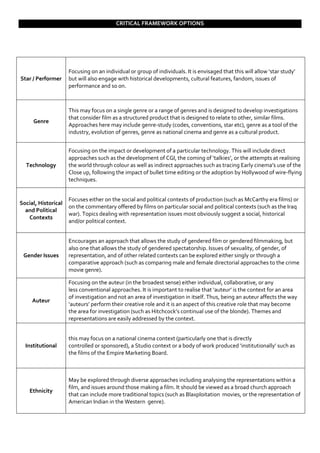
CRITICAL FRAMEWORK OPTIONS


                     Focusing on an individual or group of individuals. It is envisaged that this will allow ‘star study’
Star / Performer     but will also engage with historical developments, cultural features, fandom, issues of
                     performance and so on.


                     This may focus on a single genre or a range of genres and is designed to develop investigations
                     that consider film as a structured product that is designed to relate to other, similar films.
     Genre
                     Approaches here may include genre-study (codes, conventions, star etc), genre as a tool of the
                     industry, evolution of genres, genre as national cinema and genre as a cultural product.


                     Focusing on the impact or development of a particular technology. This will include direct
                     approaches such as the development of CGI, the coming of ‘talkies’, or the attempts at realising
  Technology         the world through colour as well as indirect approaches such as tracing Early cinema’s use of the
                     Close up, following the impact of bullet time editing or the adoption by Hollywood of wire-flying
                     techniques.


                     Focuses either on the social and political contexts of production (such as McCarthy era films) or
Social, Historical
                     on the commentary offered by films on particular social and political contexts (such as the Iraq
  and Political
                     war). Topics dealing with representation issues most obviously suggest a social, historical
   Contexts
                     and/or political context.


                     Encourages an approach that allows the study of gendered film or gendered filmmaking, but
                     also one that allows the study of gendered spectatorship. Issues of sexuality, of gender, of
 Gender Issues       representation, and of other related contexts can be explored either singly or through a
                     comparative approach (such as comparing male and female directorial approaches to the crime
                     movie genre).

                     Focusing on the auteur (in the broadest sense) either individual, collaborative, or any
                     less conventional approaches. It is important to realise that ‘auteur’ is the context for an area
                     of investigation and not an area of investigation in itself. Thus, being an auteur affects the way
     Auteur
                     ‘auteurs’ perform their creative role and it is an aspect of this creative role that may become
                     the area for investigation (such as Hitchcock’s continual use of the blonde). Themes and
                     representations are easily addressed by the context.


                     this may focus on a national cinema context (particularly one that is directly
  Institutional      controlled or sponsored), a Studio context or a body of work produced ‘institutionally’ such as
                     the films of the Empire Marketing Board.


                     May be explored through diverse approaches including analysing the representations within a
                     film, and issues around those making a film. It should be viewed as a broad church approach
    Ethnicity
                     that can include more traditional topics (such as Blaxploitation movies, or the representation of
                     American Indian in the Western genre).
The Area of Investigation

The range of areas of investigation is deliberately as wide as possible to encourage ownership of the project and
enables you to feel your interest and passions can lead to a project that will be lively, engaging, manageable and
successful.

Whatever the chosen area of investigation, the starting point of the research should be to identify what is specific
and distinctive about the focus film and about any other supporting film text as a group of films. (It is perfectly
acceptable to include films that offer an alternative to the chosen focus film in order to highlight the difference).
When placed against the contextualising issue, it should be clear how the distinctiveness of the focus film makes
meaning, and how it foregrounds the area of investigation. In doing this, you will ensure you are working from a film
text to broaden out the context, thereby giving your research a solid foundation.


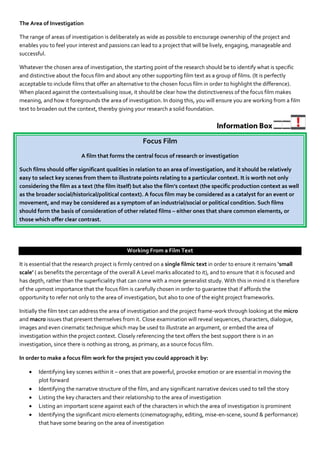
                                                    Focus Film
                          A film that forms the central focus of research or investigation

Such films should offer significant qualities in relation to an area of investigation, and it should be relatively
easy to select key scenes from them to illustrate points relating to a particular context. It is worth not only
considering the film as a text (the film itself) but also the film’s context (the specific production context as well
as the broader social/historical/political context). A focus film may be considered as a catalyst for an event or
movement, and may be considered as a symptom of an industrial/social or political condition. Such films
should form the basis of consideration of other related films – either ones that share common elements, or
those which offer clear contrast.


                                              Working From a Film Text

It is essential that the research project is firmly centred on a single filmic text in order to ensure it remains ‘small
scale’ ( as benefits the percentage of the overall A Level marks allocated to it), and to ensure that it is focused and
has depth, rather than the superficiality that can come with a more generalist study. With this in mind it is therefore
of the upmost importance that the focus film is carefully chosen in order to guarantee that if affords the
opportunity to refer not only to the area of investigation, but also to one of the eight project frameworks.

Initially the film text can address the area of investigation and the project frame-work through looking at the micro
and macro issues that present themselves from it. Close examination will reveal sequences, characters, dialogue,
images and even cinematic technique which may be used to illustrate an argument, or embed the area of
investigation within the project context. Closely referencing the text offers the best support there is in an
investigation, since there is nothing as strong, as primary, as a source focus film.

In order to make a focus film work for the project you could approach it by:

       Identifying key scenes within it – ones that are powerful, provoke emotion or are essential in moving the
        plot forward
       Identifying the narrative structure of the film, and any significant narrative devices used to tell the story
       Listing the key characters and their relationship to the area of investigation
       Listing an important scene against each of the characters in which the area of investigation is prominent
       Identifying the significant micro elements (cinematography, editing, mise-en-scene, sound & performance)
        that have some bearing on the area of investigation
   Listing any messages and values that are expressed in or by the film (you may want to identify where they
        appear)

In this way you build up useful in depth knowledge of the film with which to compare other related films, and
with which to illustrate any significant points arising from your research.

                                                     The Catalogue

The catalogue is simply a list of research material, which ideally contains a mix of both primary and secondary
research, and offers evidence of diversity in sourcing the material. It is important that each item is referenced
appropriately and that each is accompanied by a short commentary on why it was selected, what use is has and
what its relative value is.


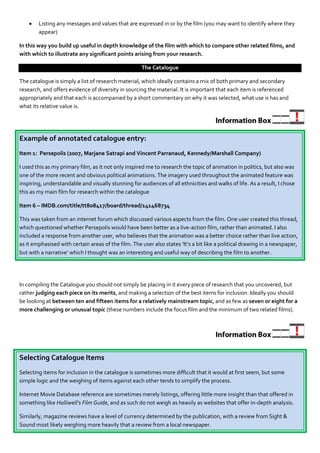
Example of annotated catalogue entry:
Item 1: Persepolis (2007, Marjane Satrapi and Vincent Parranaud, Kennedy/Marshall Company)

I used this as my primary film, as it not only inspired me to research the topic of animation in politics, but also was
one of the more recent and obvious political animations. The imagery used throughout the animated feature was
inspiring, understandable and visually stunning for audiences of all ethnicities and walks of life. As a result, I chose
this as my main film for research within the catalogue

Item 6 – IMDB.com/title/tt808417/board/thread/141468734

This was taken from an internet forum which discussed various aspects from the film. One user created this thread,
which questioned whether Persepolis would have been better as a live-action film, rather than animated. I also
included a response from another user, who believes that the animation was a better choice rather than live action,
as it emphasised with certain areas of the film. The user also states ‘It’s a bit like a political drawing in a newspaper,
but with a narrative’ which I thought was an interesting and useful way of describing the film to another.


In compiling the Catalogue you should not simply be placing in it every piece of research that you uncovered, but
rather judging each piece on its merits, and making a selection of the best items for inclusion. Ideally you should
be looking at between ten and fifteen items for a relatively mainstream topic, and as few as seven or eight for a
more challenging or unusual topic (these numbers include the focus film and the minimum of two related films).


Selecting Catalogue Items
Selecting items for inclusion in the catalogue is sometimes more difficult that it would at first seem, but some
simple logic and the weighing of items against each other tends to simplify the process.

Internet Movie Database reference are sometimes merely listings, offering little more insight than that offered in
something like Halliwell’s Film Guide, and as such do not weigh as heavily as websites that offer in-depth analysis.

Similarly, magazine reviews have a level of currency determined by the publication, with a review from Sight &
Sound most likely weighing more heavily that a review from a local newspaper.
Equally, with books, titles that relate specifically to the area of investigation should make it into the Catalogue
before more generalist texts (unless there is a specific chapter that is more relevant – in this case the chapter should
be identified in the Catalogue referencing).

Primary Research – interviews, phone conversations, e-mail responses, questionnaires – should almost always
appear in the Catalogue, though, where there is a significant amount of primary research material, some should
make way for secondary research to ensure you display a balanced representation of your research.

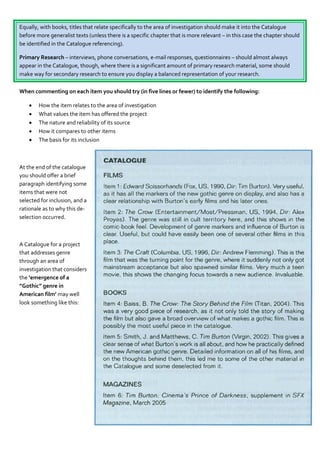
When commenting on each item you should try (in five lines or fewer) to identify the following:

       How the item relates to the area of investigation
       What values the item has offered the project
       The nature and reliability of its source
       How it compares to other items
       The basis for its inclusion


At the end of the catalogue
you should offer a brief
paragraph identifying some
items that were not
selected for inclusion, and a
rationale as to why this de-
selection occurred.


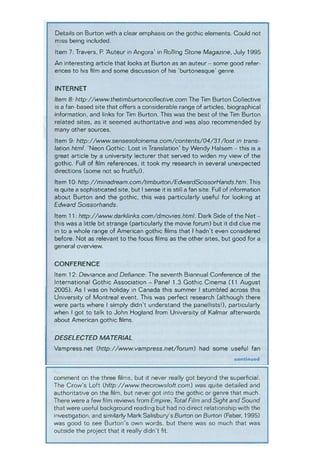
A Catalogue for a project
that addresses genre
through an area of
investigation that considers
the ‘emergence of a
“Gothic” genre in
American film’ may well
look something like this:
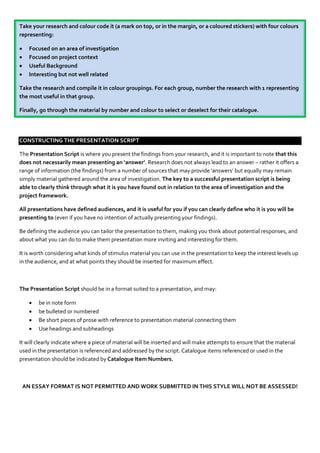
Take your research and colour code it (a mark on top, or in the margin, or a coloured stickers) with four colours
representing:

     Focused on an area of investigation
     Focused on project context
     Useful Background
     Interesting but not well related

Take the research and compile it in colour groupings. For each group, number the research with 1 representing
the most useful in that group.

Finally, go through the material by number and colour to select or deselect for their catalogue.


CONSTRUCTING THE PRESENTATION SCRIPT

The Presentation Script is where you present the findings from your research, and it is important to note that this
does not necessarily mean presenting an ‘answer’. Research does not always lead to an answer – rather it offers a
range of information (the findings) from a number of sources that may provide ‘answers’ but equally may remain
simply material gathered around the area of investigation. The key to a successful presentation script is being
able to clearly think through what it is you have found out in relation to the area of investigation and the
project framework.

All presentations have defined audiences, and it is useful for you if you can clearly define who it is you will be
presenting to (even if you have no intention of actually presenting your findings).

Be defining the audience you can tailor the presentation to them, making you think about potential responses, and
about what you can do to make them presentation more inviting and interesting for them.

It is worth considering what kinds of stimulus material you can use in the presentation to keep the interest levels up
in the audience, and at what points they should be inserted for maximum effect.


The Presentation Script should be in a format suited to a presentation, and may:

         be in note form
         be bulleted or numbered
         Be short pieces of prose with reference to presentation material connecting them
         Use headings and subheadings

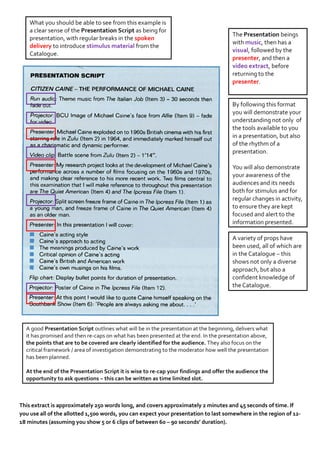
It will clearly indicate where a piece of material will be inserted and will make attempts to ensure that the material
used in the presentation is referenced and addressed by the script. Catalogue items referenced or used in the
presentation should be indicated by Catalogue Item Numbers.


    AN ESSAY FORMAT IS NOT PERMITTED AND WORK SUBMITTED IN THIS STYLE WILL NOT BE ASSESSED!
This extract is approximately 250 words long, and covers approximately 2 minutes and 45 seconds of time. If
you use all of the allotted 1,500 words, you can expect your presentation to last somewhere in the region of 12-
18 minutes (assuming you show 5 or 6 clips of between 60 – 90 seconds’ duration).
FM3 – Research Project – Check List


1. Clearly define the area of investigation from the start
2. Carefully choose your project framework
3. Choose an appropriate focus film
4. Don’t select more than three or four related films
5. Start working on the project sooner rather than later
6. Seek advice from Tutors
7. Prepare a project timetable and stick to it
8. Plan where you are going to research and how long for
9. Ensure you get a mix of sources and a variety of kinds of material
10. Know when to stop researching
11. Collate and order the material before Cataloguing
12. Only put your best material in the Catalogue
13. Have a good reason for each selection and write it in the commentary
14. Carefully choose which de-selected material to identify
15. Have a good reason for each de-selection – write it down
16. Make use the Presentation Script is lively and bust: not an essay
17. Choose audio-visual material carefully to illustrate your points
18. Allow space for an audience to ask questions
19. Reflect on process and product before evaluating
20. Identify what you have learned

FM3 research booklet

  • 2.
    FM3 – FILMRESEARCH AND CREATIVE PROJECT SKILLS REQUIRED FOR THE UNIT The two tasks which you are required to complete are a small scale research project and a piece of practical work – either a film sequence or a screenplay. Small scale research project – you will be required to carry out a small-scale research project. The project is designed to develop your research skills. You project must be based on one focus film and make appropriate reference to at least two other related films. You are required to establish an area of investigation that relates your chosen film to one of the following frameworks:  Star / Performer  Genre  Auteur (in its broadest sense)  Social, political and cultural studies  Gender Issues  Ethnicity  Institution  Technology The research project is completed in two parts:  An annotated catalogue (approx. 10 – 15 items) (15 marks)  A presentation script (approx. 1,500 words) (25 Marks) Small-scale research project Annotated catalogue of key items of the candidate's research – approximately 1000 words in total (15 marks) The catalogue will contain approximately 10 to 15 items selected from the candidate’s primary and secondary research. Each catalogue item should be appropriately referenced and be accompanied by a brief note (approx. 70 words), which explains how the particular item is relevant to the area of investigation and what it contributes to the overall research. The catalogue must conclude with a short paragraph which lists significant items (e.g. between 3 and 5) not selected for inclusion in the catalogue offering brief reasons why (up to 200 words). Presentation Script – approx. 1,500 words (25 marks) The presentation script must take the form of notes for a presentation and could combine (for example) subheadings, bullet points, short pieces of connected prose and reference to visual extracts to illustrate the presentation. Candidates are encouraged to devise a presentation format appropriate to their needs and may, for example, employ digital forms such as PowerPoint. Reference to key items of research from the catalogue must be made explicitly in the presentation. Short credited quotations may be used but care must be taken that the words of the presentation are the candidate’s own. Credited quotations are excluded from the word count. Before you begin your small-scale research project you must decide on a Critical Framework, or an area of investigation that you wish to research. Remember, pick an area of investigation that plays to your strengths!
  • 3.
    CRITICAL FRAMEWORK OPTIONS Focusing on an individual or group of individuals. It is envisaged that this will allow ‘star study’ Star / Performer but will also engage with historical developments, cultural features, fandom, issues of performance and so on. This may focus on a single genre or a range of genres and is designed to develop investigations that consider film as a structured product that is designed to relate to other, similar films. Genre Approaches here may include genre-study (codes, conventions, star etc), genre as a tool of the industry, evolution of genres, genre as national cinema and genre as a cultural product. Focusing on the impact or development of a particular technology. This will include direct approaches such as the development of CGI, the coming of ‘talkies’, or the attempts at realising Technology the world through colour as well as indirect approaches such as tracing Early cinema’s use of the Close up, following the impact of bullet time editing or the adoption by Hollywood of wire-flying techniques. Focuses either on the social and political contexts of production (such as McCarthy era films) or Social, Historical on the commentary offered by films on particular social and political contexts (such as the Iraq and Political war). Topics dealing with representation issues most obviously suggest a social, historical Contexts and/or political context. Encourages an approach that allows the study of gendered film or gendered filmmaking, but also one that allows the study of gendered spectatorship. Issues of sexuality, of gender, of Gender Issues representation, and of other related contexts can be explored either singly or through a comparative approach (such as comparing male and female directorial approaches to the crime movie genre). Focusing on the auteur (in the broadest sense) either individual, collaborative, or any less conventional approaches. It is important to realise that ‘auteur’ is the context for an area of investigation and not an area of investigation in itself. Thus, being an auteur affects the way Auteur ‘auteurs’ perform their creative role and it is an aspect of this creative role that may become the area for investigation (such as Hitchcock’s continual use of the blonde). Themes and representations are easily addressed by the context. this may focus on a national cinema context (particularly one that is directly Institutional controlled or sponsored), a Studio context or a body of work produced ‘institutionally’ such as the films of the Empire Marketing Board. May be explored through diverse approaches including analysing the representations within a film, and issues around those making a film. It should be viewed as a broad church approach Ethnicity that can include more traditional topics (such as Blaxploitation movies, or the representation of American Indian in the Western genre).
  • 4.
    The Area ofInvestigation The range of areas of investigation is deliberately as wide as possible to encourage ownership of the project and enables you to feel your interest and passions can lead to a project that will be lively, engaging, manageable and successful. Whatever the chosen area of investigation, the starting point of the research should be to identify what is specific and distinctive about the focus film and about any other supporting film text as a group of films. (It is perfectly acceptable to include films that offer an alternative to the chosen focus film in order to highlight the difference). When placed against the contextualising issue, it should be clear how the distinctiveness of the focus film makes meaning, and how it foregrounds the area of investigation. In doing this, you will ensure you are working from a film text to broaden out the context, thereby giving your research a solid foundation. Focus Film A film that forms the central focus of research or investigation Such films should offer significant qualities in relation to an area of investigation, and it should be relatively easy to select key scenes from them to illustrate points relating to a particular context. It is worth not only considering the film as a text (the film itself) but also the film’s context (the specific production context as well as the broader social/historical/political context). A focus film may be considered as a catalyst for an event or movement, and may be considered as a symptom of an industrial/social or political condition. Such films should form the basis of consideration of other related films – either ones that share common elements, or those which offer clear contrast. Working From a Film Text It is essential that the research project is firmly centred on a single filmic text in order to ensure it remains ‘small scale’ ( as benefits the percentage of the overall A Level marks allocated to it), and to ensure that it is focused and has depth, rather than the superficiality that can come with a more generalist study. With this in mind it is therefore of the upmost importance that the focus film is carefully chosen in order to guarantee that if affords the opportunity to refer not only to the area of investigation, but also to one of the eight project frameworks. Initially the film text can address the area of investigation and the project frame-work through looking at the micro and macro issues that present themselves from it. Close examination will reveal sequences, characters, dialogue, images and even cinematic technique which may be used to illustrate an argument, or embed the area of investigation within the project context. Closely referencing the text offers the best support there is in an investigation, since there is nothing as strong, as primary, as a source focus film. In order to make a focus film work for the project you could approach it by:  Identifying key scenes within it – ones that are powerful, provoke emotion or are essential in moving the plot forward  Identifying the narrative structure of the film, and any significant narrative devices used to tell the story  Listing the key characters and their relationship to the area of investigation  Listing an important scene against each of the characters in which the area of investigation is prominent  Identifying the significant micro elements (cinematography, editing, mise-en-scene, sound & performance) that have some bearing on the area of investigation
  • 5.
    Listing any messages and values that are expressed in or by the film (you may want to identify where they appear) In this way you build up useful in depth knowledge of the film with which to compare other related films, and with which to illustrate any significant points arising from your research. The Catalogue The catalogue is simply a list of research material, which ideally contains a mix of both primary and secondary research, and offers evidence of diversity in sourcing the material. It is important that each item is referenced appropriately and that each is accompanied by a short commentary on why it was selected, what use is has and what its relative value is. Example of annotated catalogue entry: Item 1: Persepolis (2007, Marjane Satrapi and Vincent Parranaud, Kennedy/Marshall Company) I used this as my primary film, as it not only inspired me to research the topic of animation in politics, but also was one of the more recent and obvious political animations. The imagery used throughout the animated feature was inspiring, understandable and visually stunning for audiences of all ethnicities and walks of life. As a result, I chose this as my main film for research within the catalogue Item 6 – IMDB.com/title/tt808417/board/thread/141468734 This was taken from an internet forum which discussed various aspects from the film. One user created this thread, which questioned whether Persepolis would have been better as a live-action film, rather than animated. I also included a response from another user, who believes that the animation was a better choice rather than live action, as it emphasised with certain areas of the film. The user also states ‘It’s a bit like a political drawing in a newspaper, but with a narrative’ which I thought was an interesting and useful way of describing the film to another. In compiling the Catalogue you should not simply be placing in it every piece of research that you uncovered, but rather judging each piece on its merits, and making a selection of the best items for inclusion. Ideally you should be looking at between ten and fifteen items for a relatively mainstream topic, and as few as seven or eight for a more challenging or unusual topic (these numbers include the focus film and the minimum of two related films). Selecting Catalogue Items Selecting items for inclusion in the catalogue is sometimes more difficult that it would at first seem, but some simple logic and the weighing of items against each other tends to simplify the process. Internet Movie Database reference are sometimes merely listings, offering little more insight than that offered in something like Halliwell’s Film Guide, and as such do not weigh as heavily as websites that offer in-depth analysis. Similarly, magazine reviews have a level of currency determined by the publication, with a review from Sight & Sound most likely weighing more heavily that a review from a local newspaper.
  • 6.
    Equally, with books,titles that relate specifically to the area of investigation should make it into the Catalogue before more generalist texts (unless there is a specific chapter that is more relevant – in this case the chapter should be identified in the Catalogue referencing). Primary Research – interviews, phone conversations, e-mail responses, questionnaires – should almost always appear in the Catalogue, though, where there is a significant amount of primary research material, some should make way for secondary research to ensure you display a balanced representation of your research. When commenting on each item you should try (in five lines or fewer) to identify the following:  How the item relates to the area of investigation  What values the item has offered the project  The nature and reliability of its source  How it compares to other items  The basis for its inclusion At the end of the catalogue you should offer a brief paragraph identifying some items that were not selected for inclusion, and a rationale as to why this de- selection occurred. A Catalogue for a project that addresses genre through an area of investigation that considers the ‘emergence of a “Gothic” genre in American film’ may well look something like this:
  • 8.
    Take your researchand colour code it (a mark on top, or in the margin, or a coloured stickers) with four colours representing:  Focused on an area of investigation  Focused on project context  Useful Background  Interesting but not well related Take the research and compile it in colour groupings. For each group, number the research with 1 representing the most useful in that group. Finally, go through the material by number and colour to select or deselect for their catalogue. CONSTRUCTING THE PRESENTATION SCRIPT The Presentation Script is where you present the findings from your research, and it is important to note that this does not necessarily mean presenting an ‘answer’. Research does not always lead to an answer – rather it offers a range of information (the findings) from a number of sources that may provide ‘answers’ but equally may remain simply material gathered around the area of investigation. The key to a successful presentation script is being able to clearly think through what it is you have found out in relation to the area of investigation and the project framework. All presentations have defined audiences, and it is useful for you if you can clearly define who it is you will be presenting to (even if you have no intention of actually presenting your findings). Be defining the audience you can tailor the presentation to them, making you think about potential responses, and about what you can do to make them presentation more inviting and interesting for them. It is worth considering what kinds of stimulus material you can use in the presentation to keep the interest levels up in the audience, and at what points they should be inserted for maximum effect. The Presentation Script should be in a format suited to a presentation, and may:  be in note form  be bulleted or numbered  Be short pieces of prose with reference to presentation material connecting them  Use headings and subheadings It will clearly indicate where a piece of material will be inserted and will make attempts to ensure that the material used in the presentation is referenced and addressed by the script. Catalogue items referenced or used in the presentation should be indicated by Catalogue Item Numbers. AN ESSAY FORMAT IS NOT PERMITTED AND WORK SUBMITTED IN THIS STYLE WILL NOT BE ASSESSED!
  • 9.
    This extract isapproximately 250 words long, and covers approximately 2 minutes and 45 seconds of time. If you use all of the allotted 1,500 words, you can expect your presentation to last somewhere in the region of 12- 18 minutes (assuming you show 5 or 6 clips of between 60 – 90 seconds’ duration).
  • 10.
    FM3 – ResearchProject – Check List 1. Clearly define the area of investigation from the start 2. Carefully choose your project framework 3. Choose an appropriate focus film 4. Don’t select more than three or four related films 5. Start working on the project sooner rather than later 6. Seek advice from Tutors 7. Prepare a project timetable and stick to it 8. Plan where you are going to research and how long for 9. Ensure you get a mix of sources and a variety of kinds of material 10. Know when to stop researching 11. Collate and order the material before Cataloguing 12. Only put your best material in the Catalogue 13. Have a good reason for each selection and write it in the commentary 14. Carefully choose which de-selected material to identify 15. Have a good reason for each de-selection – write it down 16. Make use the Presentation Script is lively and bust: not an essay 17. Choose audio-visual material carefully to illustrate your points 18. Allow space for an audience to ask questions 19. Reflect on process and product before evaluating 20. Identify what you have learned