Adeel Ahmed BSEE-13043
M. Jawad Ghafoor BSEE 13021
M.Jamal BSEE 13024
Courtesy of Google.com and
Slideshare.com
Contents
• Introduction
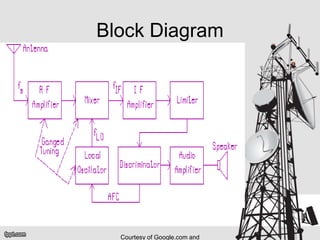
• Block Diagram
• History
• FM Receiver
• Apparatus
• Simulation
• Frequency Range
Courtesy of Google.com and
Slideshare.com
Introduction
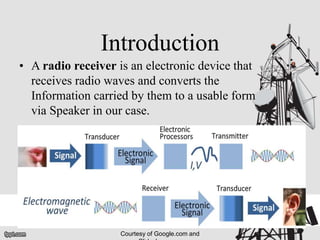
• A radio receiver is an electronic device that
receives radio waves and converts the
Information carried by them to a usable form
via Speaker in our case.
Courtesy of Google.com and
Block Diagram
Courtesy of Google.com and
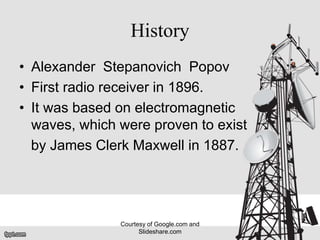
History
• Alexander Stepanovich Popov
• First radio receiver in 1896.
• It was based on electromagnetic
waves, which were proven to exist
by James Clerk Maxwell in 1887.
Courtesy of Google.com and
Slideshare.com
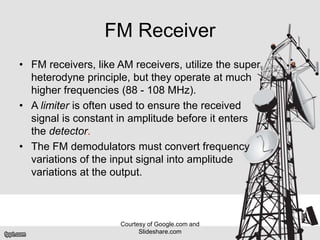
FM Receiver
• FM receivers, like AM receivers, utilize the super
heterodyne principle, but they operate at much
higher frequencies (88 - 108 MHz).
• A limiter is often used to ensure the received
signal is constant in amplitude before it enters
the detector.
• The FM demodulators must convert frequency
variations of the input signal into amplitude
variations at the output.
Courtesy of Google.com and
Slideshare.com
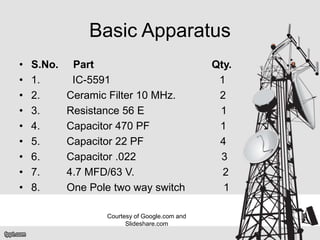
Basic Apparatus
• S.No. Part Qty.
• 1. IC-5591 1
• 2. Ceramic Filter 10 MHz. 2
• 3. Resistance 56 E 1
• 4. Capacitor 470 PF 1
• 5. Capacitor 22 PF 4
• 6. Capacitor .022 3
• 7. 4.7 MFD/63 V. 2
• 8. One Pole two way switch 1
Courtesy of Google.com and
Slideshare.com
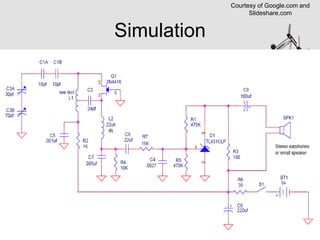
Simulation
Courtesy of Google.com and
Slideshare.com
Frequency range
• A radio receiver may be designed to tune to a
fixed frequency,
• MF AM broadcast band, 535 kHz - 1605 kHz
• General coverage MF/HF communications
receiver 100 kHz - 30 MHz
• VHF FM broadcast band, 88 - 108 MHz
• UHF TV broadcast band (analogue or digital)
470 - 860 MHz
• Scanning receiver 0.5 MHz - 1300 MHz
• GSM 900, GSM1800 or 3G mobile phone bands
• Wireless LAN band 2400 - 2483.5 MHz
Courtesy of Google.com and
Slideshare.com
Courtesy of Google.com and
Slideshare.com

Fm reciever mid

  • 1.
    Adeel Ahmed BSEE-13043 M.Jawad Ghafoor BSEE 13021 M.Jamal BSEE 13024 Courtesy of Google.com and Slideshare.com
  • 2.
    Contents • Introduction • BlockDiagram • History • FM Receiver • Apparatus • Simulation • Frequency Range Courtesy of Google.com and Slideshare.com
  • 3.
    Introduction • A radioreceiver is an electronic device that receives radio waves and converts the Information carried by them to a usable form via Speaker in our case. Courtesy of Google.com and
  • 4.
  • 5.
    History • Alexander StepanovichPopov • First radio receiver in 1896. • It was based on electromagnetic waves, which were proven to exist by James Clerk Maxwell in 1887. Courtesy of Google.com and Slideshare.com
  • 6.
    FM Receiver • FMreceivers, like AM receivers, utilize the super heterodyne principle, but they operate at much higher frequencies (88 - 108 MHz). • A limiter is often used to ensure the received signal is constant in amplitude before it enters the detector. • The FM demodulators must convert frequency variations of the input signal into amplitude variations at the output. Courtesy of Google.com and Slideshare.com
  • 7.
    Basic Apparatus • S.No.Part Qty. • 1. IC-5591 1 • 2. Ceramic Filter 10 MHz. 2 • 3. Resistance 56 E 1 • 4. Capacitor 470 PF 1 • 5. Capacitor 22 PF 4 • 6. Capacitor .022 3 • 7. 4.7 MFD/63 V. 2 • 8. One Pole two way switch 1 Courtesy of Google.com and Slideshare.com
  • 8.
  • 9.
    Frequency range • Aradio receiver may be designed to tune to a fixed frequency, • MF AM broadcast band, 535 kHz - 1605 kHz • General coverage MF/HF communications receiver 100 kHz - 30 MHz • VHF FM broadcast band, 88 - 108 MHz • UHF TV broadcast band (analogue or digital) 470 - 860 MHz • Scanning receiver 0.5 MHz - 1300 MHz • GSM 900, GSM1800 or 3G mobile phone bands • Wireless LAN band 2400 - 2483.5 MHz Courtesy of Google.com and Slideshare.com
  • 10.
    Courtesy of Google.comand Slideshare.com