Use code "JASPALLIVE" for instant maximum discount on Unacademy Plus subscriptions.
CHAPTER- 11 BOUNDARY LAYER
THEORY
• Boundary layer theory was given by “Prandtl” and it is valid for real fluid
flowing over infinitely large medium.
• When a real fluid flows past a solid surface, fluid particles adheres to the
boundary due to no –slip condition i.e. if boundary is stationary, fluid on it will be
stationary and if boundary is moving, fluid attached to it also moves.
• As distance from boundary increases, velocity gradually increases upto certain
distance (𝛿) and then becomes constant.
• This region “𝛿” is termed as “Boundary Layer Region”.
• There exist velocity gradient inside the boundary region and it varies from
maximum at boundary of solid surface to zero at “𝛿” from boundary of solid
surface.
• Hence, shear stress is also maximum at boundary of solid surface (τ = μ
du
dy
).
J
a
s
p
a
l
S
i
r
Use code "JASPALLIVE" for instant maximum discount on Unacademy Plus subscriptions.
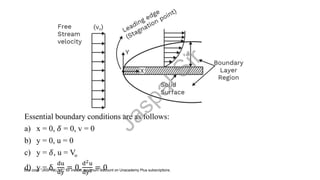
Essential boundary conditions are as follows:
a) x = 0, 𝛿 = 0, v = 0
b) y = 0, u = 0
c) y = 𝛿, u = Vo
d) y = δ,
du
dy
= 0,
d2u
dy2 = 0
J
a
s
p
a
l
S
i
r
Use code "JASPALLIVE" for instant maximum discount on Unacademy Plus subscriptions.
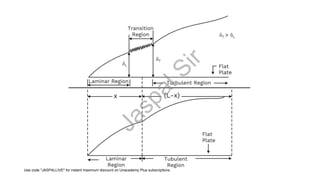
NOTE: When fluid flows pass a flat plate, the velocity at leading edge is zero and
retardation of fluid increases as the plate is exposed to flow. Hence, boundary layer
thickness increases as the distance from leading edge increases. This statement is
valid for both laminar and turbulent flow.
• Upto a certain distance from leading edge, flow in boundary layer is laminar
irrespective of approaching flow nature.
• As depth of laminar boundary layer increases, it cannot dissipate the effect of
instability in flow, hence transition of flow to turbulent takes place.
• Thereby, thickness of turbulent boundary layer is more.
• For calculation purpose, the presence of transition region is neglected.
J
a
s
p
a
l
S
i
r
Use code "JASPALLIVE" for instant maximum discount on Unacademy Plus subscriptions.
J
a
s
p
a
l
S
i
r
Use code "JASPALLIVE" for instant maximum discount on Unacademy Plus subscriptions.
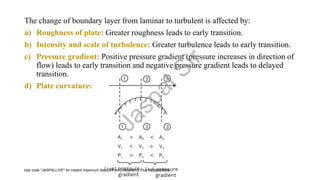
The change of boundary layer from laminar to turbulent is affected by:
a) Roughness of plate: Greater roughness leads to early transition.
b) Intensity and scale of turbulence: Greater turbulence leads to early transition.
c) Pressure gradient: Positive pressure gradient (pressure increases in direction of
flow) leads to early transition and negative pressure gradient leads to delayed
transition.
d) Plate curvature:
J
a
s
p
a
l
S
i
r
Use code "JASPALLIVE" for instant maximum discount on Unacademy Plus subscriptions.
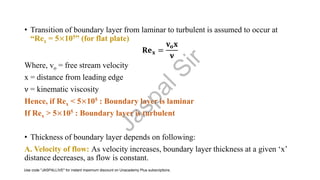
• Transition of boundary layer from laminar to turbulent is assumed to occur at
“Rex = 5×10⁵” (for flat plate)
𝐑𝐞𝐱 =
𝐯𝐨𝐱
𝛎
Where, vo = free stream velocity
x = distance from leading edge
ν = kinematic viscosity
Hence, if Rex < 5×10⁵ : Boundary layer is laminar
If Rex > 5×10⁵ : Boundary layer is turbulent
• Thickness of boundary layer depends on following:
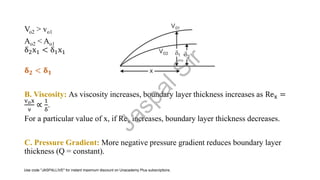
A. Velocity of flow: As velocity increases, boundary layer thickness at a given ‘x’
distance decreases, as flow is constant.
J
a
s
p
a
l
S
i
r
Use code "JASPALLIVE" for instant maximum discount on Unacademy Plus subscriptions.
Vo2 > vo1
Ao2 < Ao1
δ2x1 < δ1x1
𝛅𝟐 < 𝛅𝟏
B. Viscosity: As viscosity increases, boundary layer thickness increases as Rex =
vox
ν
∝
1
δ
.
For a particular value of x, if Rex increases, boundary layer thickness decreases.
C. Pressure Gradient: More negative pressure gradient reduces boundary layer
thickness (Q = constant).
J
a
s
p
a
l
S
i
r
Use code "JASPALLIVE" for instant maximum discount on Unacademy Plus subscriptions.
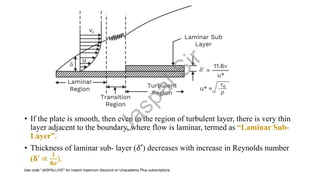
• If the plate is smooth, then even in the region of turbulent layer, there is very thin
layer adjacent to the boundary, where flow is laminar, termed as “Laminar Sub-
Layer”.
• Thickness of laminar sub- layer (𝛿′) decreases with increase in Reynolds number
(𝛅′ ∝
𝟏
𝐑𝐞
).
J
a
s
p
a
l
S
i
r
Use code "JASPALLIVE" for instant maximum discount on Unacademy Plus subscriptions.
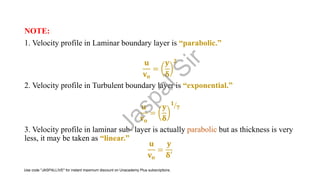
NOTE:
1. Velocity profile in Laminar boundary layer is “parabolic.”
𝐮
𝐯𝐨
=
𝐲
𝛅
𝟐
2. Velocity profile in Turbulent boundary layer is “exponential.”
𝐮
𝐯𝐨
=
𝐲
𝛅
ൗ
𝟏
𝟕
3. Velocity profile in laminar sub- layer is actually parabolic but as thickness is very
less, it may be taken as “linear.”
𝐮
𝐯𝐨
=
𝐲
𝛅′
J
a
s
p
a
l
S
i
r
Use code "JASPALLIVE" for instant maximum discount on Unacademy Plus subscriptions.
Q. Assertion (A): Boundary layer theory is applicable only in the vicinity of the
leading edge of the plate.
Reason (R): Boundary layer theory is based on the assumption that its thickness is
small when compared to other linear dimensions.
a) Assertion (A) and Reason (R) are individually true and Reason (R) is correct
explanation of Assertion (A)
b) Assertion (A) and Reason (R) are individually true but Reason (R) is not the
correct explanation of Assertion (A)
c) Assertion (A) is correct but Reason (R) is incorrect
d) Assertion (A) is incorrect but Reason (R) is correct.
[IES: 2006]
J
a
s
p
a
l
S
i
r
Use code "JASPALLIVE" for instant maximum discount on Unacademy Plus subscriptions.
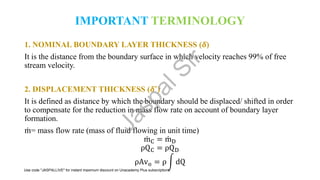
IMPORTANT TERMINOLOGY
1. NOMINAL BOUNDARY LAYER THICKNESS (𝜹)
It is the distance from the boundary surface in which velocity reaches 99% of free
stream velocity.
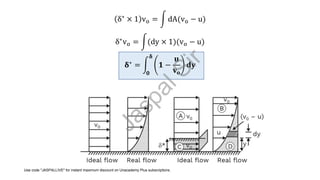
2. DISPLACEMENT THICKNESS (𝜹*)
It is defined as distance by which the boundary should be displaced/ shifted in order
to compensate for the reduction in mass flow rate on account of boundary layer
formation.
ሶ
m= mass flow rate (mass of fluid flowing in unit time)
ሶ
mC = ሶ
mD
ρQC = ρQD
ρAvo = ρ න dQ
J
a
s
p
a
l
S
i
r
Use code "JASPALLIVE" for instant maximum discount on Unacademy Plus subscriptions.
δ∗
× 1 vo = න dA(vo − u)
δ∗vo = න(dy × 1)(vo − u)
𝛅∗ = න
𝟎
𝛅
𝟏 −
𝐮
𝐯𝐨
𝐝𝐲
J
a
s
p
a
l
S
i
r
Use code "JASPALLIVE" for instant maximum discount on Unacademy Plus subscriptions.
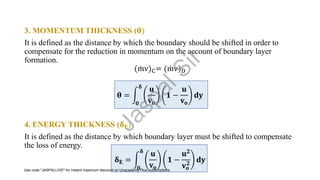
3. MOMENTUM THICKNESS (𝛉)
It is defined as the distance by which the boundary should be shifted in order to
compensate for the reduction in momentum on the account of boundary layer
formation.
( ሶ
mv)C= ( ሶ
mv)D
𝛉 = න
𝟎
𝛅
𝐮
𝐯𝐨
𝟏 −
𝐮
𝐯𝐨
𝐝𝐲
4. ENERGY THICKNESS (𝛅𝐄)
It is defined as the distance by which boundary layer must be shifted to compensate
the loss of energy.
𝛅𝐄 = න
𝟎
𝛅
𝐮
𝐯𝐨
𝟏 −
𝐮𝟐
𝐯𝐨
𝟐
𝐝𝐲
J
a
s
p
a
l
S
i
r
Use code "JASPALLIVE" for instant maximum discount on Unacademy Plus subscriptions.
Q. What is the momentum thickness for the boundary layer with velocity
distribution
u
U
=
y
δ
?
a) δ/6.
b) δ/2
c) 3 δ/2
d) 2 δ
[IES: 2008]
J
a
s
p
a
l
S
i
r
Use code "JASPALLIVE" for instant maximum discount on Unacademy Plus subscriptions.
Q. The displacement thickness of a boundary layer is
a) The distance to the point where (v/V) = 0.99
b) The distance where the velocity ‘v’ is equal to the shear velocity V*, that is,
where v = V*
c) The distance by which the main flow is to be shifted from the boundary to
maintain the continuity equation.
d) One- half the actual thickness of the boundary layer
[IES: 1997]
J
a
s
p
a
l
S
i
r
Use code "JASPALLIVE" for instant maximum discount on Unacademy Plus subscriptions.
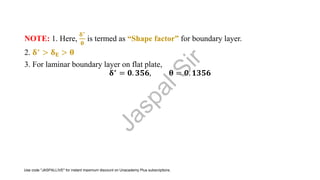
NOTE: 1. Here,
𝛅∗
𝛉
is termed as “Shape factor” for boundary layer.
2. 𝛅∗ > 𝛅𝐄 > 𝛉
3. For laminar boundary layer on flat plate,
𝛅∗
= 𝟎. 𝟑𝟓𝟔, 𝛉 = 𝟎. 𝟏𝟑𝟓𝟔
J
a
s
p
a
l
S
i
r
Use code "JASPALLIVE" for instant maximum discount on Unacademy Plus subscriptions.
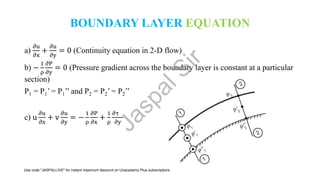
BOUNDARY LAYER EQUATION
a)
𝜕u
𝜕x
+
𝜕u
𝜕y
= 0 (Continuity equation in 2-D flow)
b) −
1
ρ
𝜕P
𝜕y
= 0 (Pressure gradient across the boundary layer is constant at a particular
section)
P1 = P1’ = P1’’ and P2 = P2’ = P2’’
c) u
𝜕u
𝜕x
+ v
𝜕u
𝜕y
= −
1
ρ
𝜕P
𝜕x
+
1
ρ
𝜕τ
𝜕y
J
a
s
p
a
l
S
i
r
Use code "JASPALLIVE" for instant maximum discount on Unacademy Plus subscriptions.
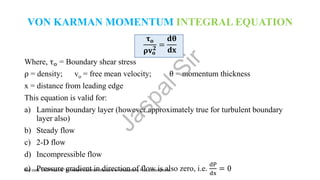
VON KARMAN MOMENTUM INTEGRAL EQUATION
𝛕𝐨
𝛒𝐯𝐨
𝟐
=
𝐝𝛉
𝐝𝐱
Where, τo = Boundary shear stress
ρ = density; vo = free mean velocity; θ = momentum thickness
x = distance from leading edge
This equation is valid for:
a) Laminar boundary layer (however approximately true for turbulent boundary
layer also)
b) Steady flow
c) 2-D flow
d) Incompressible flow
e) Pressure gradient in direction of flow is also zero, i.e.
dP
dx
= 0
J
a
s
p
a
l
S
i
r
Use code "JASPALLIVE" for instant maximum discount on Unacademy Plus subscriptions.
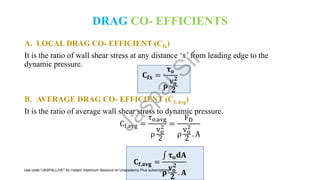
DRAG CO- EFFICIENTS
A. LOCAL DRAG CO- EFFICIENT (Cfx)
It is the ratio of wall shear stress at any distance ‘x’ from leading edge to the
dynamic pressure.
𝐂𝐟𝐱 =
𝛕𝐨
𝛒
𝐯𝐨
𝟐
𝟐
B. AVERAGE DRAG CO- EFFICIENT (Cf, avg)
It is the ratio of average wall shear stress to dynamic pressure.
Cf,avg =
τo,avg
ρ
vo
2
2
=
FD
ρ
vo
2
2
. A
𝐂𝐟,𝐚𝐯𝐠 =
‫׬‬ 𝛕𝐨𝐝𝐀
𝛒
𝐯𝐨
𝟐
𝟐
. 𝐀
J
a
s
p
a
l
S
i
r
Use code "JASPALLIVE" for instant maximum discount on Unacademy Plus subscriptions.
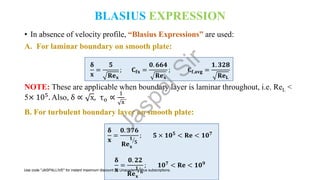
BLASIUS EXPRESSION
• In absence of velocity profile, “Blasius Expressions” are used:
A. For laminar boundary on smooth plate:
𝛅
𝐱
=
𝟓
𝐑𝐞𝐱
; 𝐂𝐟𝐱 =
𝟎. 𝟔𝟔𝟒
𝐑𝐞𝐱
; 𝐂𝐟,𝐚𝐯𝐠 =
𝟏. 𝟑𝟐𝟖
𝐑𝐞𝐋
NOTE: These are applicable when boundary layer is laminar throughout, i.e. ReL <
5× 10⁵. Also, δ ∝ x, τo ∝
1
x
.
B. For turbulent boundary layer on smooth plate:
𝛅
𝐱
=
𝟎. 𝟑𝟕𝟔
𝐑𝐞𝐱
ൗ
𝟏
𝟓
; 𝟓 × 𝟏𝟎𝟓
< 𝐑𝐞 < 𝟏𝟎𝟕
𝛅
𝐱
=
𝟎. 𝟐𝟐
𝐑𝐞𝐱
ൗ
𝟏
𝟔
; 𝟏𝟎𝟕 < 𝐑𝐞 < 𝟏𝟎𝟗
J
a
s
p
a
l
S
i
r
Use code "JASPALLIVE" for instant maximum discount on Unacademy Plus subscriptions.
NOTE: δ ∝ x Τ
4
5, hence boundary layer thickness increases more rapidly in
turbulent boundary layer than in laminar boundary layer.
Also,
𝐂𝐟𝐱 =
𝛕𝐨
𝛒𝐯𝐨
𝟐
𝟐
=
𝟎. 𝟎𝟓𝟗
𝐑𝐞𝐱
ൗ
𝟏
𝟓
; 𝟓 × 𝟏𝟎𝟓 < 𝐑𝐞 < 𝟏𝟎𝟕
𝐂𝐟𝐱 =
𝛕𝐨
𝛒𝐯𝐨
𝟐
𝟐
=
𝟎. 𝟑𝟕
[𝐥𝐨𝐠𝟏𝟎 𝐑𝐞𝐱 ]𝟐.𝟓𝟖
; 𝟏𝟎𝟕 < 𝐑𝐞 < 𝟏𝟎𝟗
NOTE: τo ∝
1
x ൗ
1
5
, hence boundary shear stress decreases less rapidly in turbulent
boundary layer than in laminar boundary layer.
J
a
s
p
a
l
S
i
r
Use code "JASPALLIVE" for instant maximum discount on Unacademy Plus subscriptions.
Also,
𝐂𝐟,𝐚𝐯𝐠 =
𝟎. 𝟎𝟕𝟗
𝐑𝐞𝐋
ൗ
𝟏
𝟓
; 𝟓 × 𝟏𝟎𝟓
< 𝐑𝐞 < 𝟏𝟎𝟕
𝐂𝐟,𝐚𝐯𝐠 =
𝟎. 𝟒𝟓𝟓
[𝐥𝐨𝐠𝟏𝟎 𝐑𝐞𝐋 ]𝟐.𝟓𝟖
; 𝟏𝟎𝟕 < 𝐑𝐞 < 𝟏𝟎𝟗
NOTE: All the above expressions are applicable only if turbulent boundary layer is
present throughout.
J
a
s
p
a
l
S
i
r
Use code "JASPALLIVE" for instant maximum discount on Unacademy Plus subscriptions.
Q. The ratio of the co- efficient of friction drag in laminar boundary layer compared
to that in turbulent boundary layer is proportional to
a) RL
1/2
b) RL
1/5
c) RL
3/10
d) RL
-3/10.
[IES: 1996]
J
a
s
p
a
l
S
i
r
Use code "JASPALLIVE" for instant maximum discount on Unacademy Plus subscriptions.
Q. If δ1 and δ2 are the laminar boundary layer thickness at a point M distant x from
the leading edge when the Reynolds number of the flow are 100 and 484,
respectively, then the ratio of
δ1
δ2
will be
a) 2.2.
b) 4.84
c) 23.43
d) 45.45
[IES: 2018]
J
a
s
p
a
l
S
i
r
Use code "JASPALLIVE" for instant maximum discount on Unacademy Plus subscriptions.
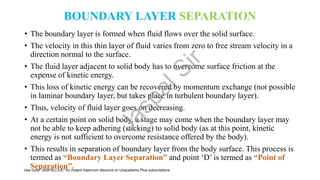
BOUNDARY LAYER SEPARATION
• The boundary layer is formed when fluid flows over the solid surface.
• The velocity in this thin layer of fluid varies from zero to free stream velocity in a
direction normal to the surface.
• The fluid layer adjacent to solid body has to overcome surface friction at the
expense of kinetic energy.
• This loss of kinetic energy can be recovered by momentum exchange (not possible
in laminar boundary layer, but takes place in turbulent boundary layer).
• Thus, velocity of fluid layer goes on decreasing.
• At a certain point on solid body, a stage may come when the boundary layer may
not be able to keep adhering (sticking) to solid body (as at this point, kinetic
energy is not sufficient to overcome resistance offered by the body).
• This results in separation of boundary layer from the body surface. This process is
termed as “Boundary Layer Separation” and point ‘D’ is termed as “Point of
Separation”.
J
a
s
p
a
l
S
i
r
Use code "JASPALLIVE" for instant maximum discount on Unacademy Plus subscriptions.
J
a
s
p
a
l
S
i
r
Use code "JASPALLIVE" for instant maximum discount on Unacademy Plus subscriptions.
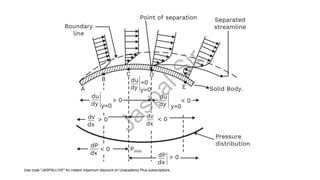
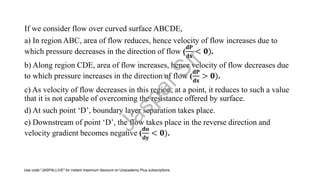
If we consider flow over curved surface ABCDE,
a) In region ABC, area of flow reduces, hence velocity of flow increases due to
which pressure decreases in the direction of flow (
𝐝𝐏
𝐝𝐱
< 𝟎).
b) Along region CDE, area of flow increases, hence velocity of flow decreases due
to which pressure increases in the direction of flow (
𝐝𝐏
𝐝𝐱
> 𝟎).
c) As velocity of flow decreases in this region, at a point, it reduces to such a value
that it is not capable of overcoming the resistance offered by surface.
d) At such point ‘D’, boundary layer separation takes place.
e) Downstream of point ‘D’, the flow takes place in the reverse direction and
velocity gradient becomes negative (
𝐝𝐮
𝐝𝐲
< 𝟎).
J
a
s
p
a
l
S
i
r
Use code "JASPALLIVE" for instant maximum discount on Unacademy Plus subscriptions.
• Boundary layer separation is observed in pumps, fans, diffusers, turbine blades,
aero-foils, open channel transitions, etc.
• Boundary layer separation leads to increase in pressure drag, magnitude of which
is more than frictional drag.
• Boundary layer separation can be controlled by:
a) By accelerating the fluid in boundary layer by injecting another/ same fluid.
b) By creating suction of fluid from boundary layer.
c) By streamlining the body.
J
a
s
p
a
l
S
i
r
Use code "JASPALLIVE" for instant maximum discount on Unacademy Plus subscriptions.
Q. Flow separation is likely to occur when the pressure gradient is
a) Positive.
b) Zero
c) Negative
d) Negative and only when equal to -0.332
[GATE: 1992]
J
a
s
p
a
l
S
i
r
Use code "JASPALLIVE" for instant maximum discount on Unacademy Plus subscriptions.
Q. Which of the following is responsible for the separation of boundary layer?
a) Positive pressure gradient.
b) High viscosity of fluid
c) Low viscosity of fluid
d) None of these
[SSC: 2017]
J
a
s
p
a
l
S
i
r
Use code "JASPALLIVE" for instant maximum discount on Unacademy Plus subscriptions.
Q. Separation of flow occurs when pressure gradient
a) Tends to approach zero.
b) Becomes negative
c) Changes abruptly
d) Reduces to a value when vapor formation starts
[SSC: 2016]
J
a
s
p
a
l
S
i
r
Use code "JASPALLIVE" for instant maximum discount on Unacademy Plus subscriptions.
Q. Assertion: At the point of boundary layer separation, the shear stress is zero.
Reason (R): The point of separation demarcates between zones of forward and
reverse flow close to the wall.
a) Assertion (A) and Reason (R) are individually true and Reason (R) is correct
explanation of Assertion (A).
b) Assertion (A) and Reason (R) are individually true but Reason (R) is not the
correct explanation of Assertion (A)
c) Assertion (A) is correct but Reason (R) is incorrect
d) Assertion (A) is incorrect but Reason (R) is correct
[IES: 2011]
J
a
s
p
a
l
S
i
r
Use code "JASPALLIVE" for instant maximum discount on Unacademy Plus subscriptions.
Q. Consider the following statements:
The critical value of Reynolds number at which the boundary layer changes from
laminar to turbulent depends upon
1. Turbulence in ambient flow
2. Surface roughness
Which of the above statements is/ are correct?
a) Neither 1 nor 2
b) 1 only
c) 2 only
d) Both 1 and 2.
[IES: 2008]
J
a
s
p
a
l
S
i
r
Use code "JASPALLIVE" for instant maximum discount on Unacademy Plus subscriptions.
Q. Which one of the following assumptions in deriving the boundary layer equation
of flow past a flat plate at zero incidence is not correct?
a) Uniform flow = 0
b) Outside boundary layer velocity is vo throughout
c) The boundary layer thickness 𝛿 is very small compared to distance x
d) Pressure remains constant throughout the flow both within and outside the
boundary layer.
[IES: 2006]
J
a
s
p
a
l
S
i
r
Use code "JASPALLIVE" for instant maximum discount on Unacademy Plus subscriptions.
Q. Match List-I with List- II and select the correct answer:
Codes: A B C D
a) 1 2 3 4
b) 2 1 3 4
c) 1 2 4 3
d) 2 1 4 3.
[IES: 2002]
List- I List- II
A.
𝜕u
𝜕y y=0
is zero 1. The flow is attached flow
B.
𝜕u
𝜕y y=0
is positive 2. The flow is on the verge of separation
C. Displacement thickness 3. ‫׬‬0
δ u
U
1 −
u
U
dy
D. Momentum thickness 4. ‫׬‬0
δ
1 −
u
U
dy
J
a
s
p
a
l
S
i
r
Use code "JASPALLIVE" for instant maximum discount on Unacademy Plus subscriptions.
Q. A flat plate is kept in an infinite fluid medium. The fluid has a uniform free
stream velocity parallel to the plate. For the laminar boundary layer formed on the
plate, pick the correct option matching List- I and List- II.
Codes: A B C
a) 1 2 3
b) 2 2 2
c) 1 1 2
d) 2 1 3.
[GATE: 2003]
List- I List- II
A. Boundary layer thickness 1. Decreases in the flow direction
B. Shear stress at the plate 2. Increases in the flow direction
C. Pressure gradient along the plate 3. Remains unchanged
J
a
s
p
a
l
S
i
r
Use code "JASPALLIVE" for instant maximum discount on Unacademy Plus subscriptions.

FM chapter- 11.pdf

  • 1.
    Use code "JASPALLIVE"for instant maximum discount on Unacademy Plus subscriptions.
  • 2.
    Use code "JASPALLIVE"for instant maximum discount on Unacademy Plus subscriptions.
  • 3.
    CHAPTER- 11 BOUNDARYLAYER THEORY • Boundary layer theory was given by “Prandtl” and it is valid for real fluid flowing over infinitely large medium. • When a real fluid flows past a solid surface, fluid particles adheres to the boundary due to no –slip condition i.e. if boundary is stationary, fluid on it will be stationary and if boundary is moving, fluid attached to it also moves. • As distance from boundary increases, velocity gradually increases upto certain distance (𝛿) and then becomes constant. • This region “𝛿” is termed as “Boundary Layer Region”. • There exist velocity gradient inside the boundary region and it varies from maximum at boundary of solid surface to zero at “𝛿” from boundary of solid surface. • Hence, shear stress is also maximum at boundary of solid surface (τ = μ du dy ). J a s p a l S i r Use code "JASPALLIVE" for instant maximum discount on Unacademy Plus subscriptions.
  • 4.
    Essential boundary conditionsare as follows: a) x = 0, 𝛿 = 0, v = 0 b) y = 0, u = 0 c) y = 𝛿, u = Vo d) y = δ, du dy = 0, d2u dy2 = 0 J a s p a l S i r Use code "JASPALLIVE" for instant maximum discount on Unacademy Plus subscriptions.
  • 5.
    NOTE: When fluidflows pass a flat plate, the velocity at leading edge is zero and retardation of fluid increases as the plate is exposed to flow. Hence, boundary layer thickness increases as the distance from leading edge increases. This statement is valid for both laminar and turbulent flow. • Upto a certain distance from leading edge, flow in boundary layer is laminar irrespective of approaching flow nature. • As depth of laminar boundary layer increases, it cannot dissipate the effect of instability in flow, hence transition of flow to turbulent takes place. • Thereby, thickness of turbulent boundary layer is more. • For calculation purpose, the presence of transition region is neglected. J a s p a l S i r Use code "JASPALLIVE" for instant maximum discount on Unacademy Plus subscriptions.
  • 6.
    J a s p a l S i r Use code "JASPALLIVE"for instant maximum discount on Unacademy Plus subscriptions.
  • 7.
    The change ofboundary layer from laminar to turbulent is affected by: a) Roughness of plate: Greater roughness leads to early transition. b) Intensity and scale of turbulence: Greater turbulence leads to early transition. c) Pressure gradient: Positive pressure gradient (pressure increases in direction of flow) leads to early transition and negative pressure gradient leads to delayed transition. d) Plate curvature: J a s p a l S i r Use code "JASPALLIVE" for instant maximum discount on Unacademy Plus subscriptions.
  • 8.
    • Transition ofboundary layer from laminar to turbulent is assumed to occur at “Rex = 5×10⁵” (for flat plate) 𝐑𝐞𝐱 = 𝐯𝐨𝐱 𝛎 Where, vo = free stream velocity x = distance from leading edge ν = kinematic viscosity Hence, if Rex < 5×10⁵ : Boundary layer is laminar If Rex > 5×10⁵ : Boundary layer is turbulent • Thickness of boundary layer depends on following: A. Velocity of flow: As velocity increases, boundary layer thickness at a given ‘x’ distance decreases, as flow is constant. J a s p a l S i r Use code "JASPALLIVE" for instant maximum discount on Unacademy Plus subscriptions.
  • 9.
    Vo2 > vo1 Ao2< Ao1 δ2x1 < δ1x1 𝛅𝟐 < 𝛅𝟏 B. Viscosity: As viscosity increases, boundary layer thickness increases as Rex = vox ν ∝ 1 δ . For a particular value of x, if Rex increases, boundary layer thickness decreases. C. Pressure Gradient: More negative pressure gradient reduces boundary layer thickness (Q = constant). J a s p a l S i r Use code "JASPALLIVE" for instant maximum discount on Unacademy Plus subscriptions.
  • 10.
    • If theplate is smooth, then even in the region of turbulent layer, there is very thin layer adjacent to the boundary, where flow is laminar, termed as “Laminar Sub- Layer”. • Thickness of laminar sub- layer (𝛿′) decreases with increase in Reynolds number (𝛅′ ∝ 𝟏 𝐑𝐞 ). J a s p a l S i r Use code "JASPALLIVE" for instant maximum discount on Unacademy Plus subscriptions.
  • 11.
    NOTE: 1. Velocity profilein Laminar boundary layer is “parabolic.” 𝐮 𝐯𝐨 = 𝐲 𝛅 𝟐 2. Velocity profile in Turbulent boundary layer is “exponential.” 𝐮 𝐯𝐨 = 𝐲 𝛅 ൗ 𝟏 𝟕 3. Velocity profile in laminar sub- layer is actually parabolic but as thickness is very less, it may be taken as “linear.” 𝐮 𝐯𝐨 = 𝐲 𝛅′ J a s p a l S i r Use code "JASPALLIVE" for instant maximum discount on Unacademy Plus subscriptions.
  • 12.
    Q. Assertion (A):Boundary layer theory is applicable only in the vicinity of the leading edge of the plate. Reason (R): Boundary layer theory is based on the assumption that its thickness is small when compared to other linear dimensions. a) Assertion (A) and Reason (R) are individually true and Reason (R) is correct explanation of Assertion (A) b) Assertion (A) and Reason (R) are individually true but Reason (R) is not the correct explanation of Assertion (A) c) Assertion (A) is correct but Reason (R) is incorrect d) Assertion (A) is incorrect but Reason (R) is correct. [IES: 2006] J a s p a l S i r Use code "JASPALLIVE" for instant maximum discount on Unacademy Plus subscriptions.
  • 13.
    IMPORTANT TERMINOLOGY 1. NOMINALBOUNDARY LAYER THICKNESS (𝜹) It is the distance from the boundary surface in which velocity reaches 99% of free stream velocity. 2. DISPLACEMENT THICKNESS (𝜹*) It is defined as distance by which the boundary should be displaced/ shifted in order to compensate for the reduction in mass flow rate on account of boundary layer formation. ሶ m= mass flow rate (mass of fluid flowing in unit time) ሶ mC = ሶ mD ρQC = ρQD ρAvo = ρ න dQ J a s p a l S i r Use code "JASPALLIVE" for instant maximum discount on Unacademy Plus subscriptions.
  • 14.
    δ∗ × 1 vo= න dA(vo − u) δ∗vo = න(dy × 1)(vo − u) 𝛅∗ = න 𝟎 𝛅 𝟏 − 𝐮 𝐯𝐨 𝐝𝐲 J a s p a l S i r Use code "JASPALLIVE" for instant maximum discount on Unacademy Plus subscriptions.
  • 15.
    3. MOMENTUM THICKNESS(𝛉) It is defined as the distance by which the boundary should be shifted in order to compensate for the reduction in momentum on the account of boundary layer formation. ( ሶ mv)C= ( ሶ mv)D 𝛉 = න 𝟎 𝛅 𝐮 𝐯𝐨 𝟏 − 𝐮 𝐯𝐨 𝐝𝐲 4. ENERGY THICKNESS (𝛅𝐄) It is defined as the distance by which boundary layer must be shifted to compensate the loss of energy. 𝛅𝐄 = න 𝟎 𝛅 𝐮 𝐯𝐨 𝟏 − 𝐮𝟐 𝐯𝐨 𝟐 𝐝𝐲 J a s p a l S i r Use code "JASPALLIVE" for instant maximum discount on Unacademy Plus subscriptions.
  • 16.
    Q. What isthe momentum thickness for the boundary layer with velocity distribution u U = y δ ? a) δ/6. b) δ/2 c) 3 δ/2 d) 2 δ [IES: 2008] J a s p a l S i r Use code "JASPALLIVE" for instant maximum discount on Unacademy Plus subscriptions.
  • 17.
    Q. The displacementthickness of a boundary layer is a) The distance to the point where (v/V) = 0.99 b) The distance where the velocity ‘v’ is equal to the shear velocity V*, that is, where v = V* c) The distance by which the main flow is to be shifted from the boundary to maintain the continuity equation. d) One- half the actual thickness of the boundary layer [IES: 1997] J a s p a l S i r Use code "JASPALLIVE" for instant maximum discount on Unacademy Plus subscriptions.
  • 18.
    NOTE: 1. Here, 𝛅∗ 𝛉 istermed as “Shape factor” for boundary layer. 2. 𝛅∗ > 𝛅𝐄 > 𝛉 3. For laminar boundary layer on flat plate, 𝛅∗ = 𝟎. 𝟑𝟓𝟔, 𝛉 = 𝟎. 𝟏𝟑𝟓𝟔 J a s p a l S i r Use code "JASPALLIVE" for instant maximum discount on Unacademy Plus subscriptions.
  • 19.
    BOUNDARY LAYER EQUATION a) 𝜕u 𝜕x + 𝜕u 𝜕y =0 (Continuity equation in 2-D flow) b) − 1 ρ 𝜕P 𝜕y = 0 (Pressure gradient across the boundary layer is constant at a particular section) P1 = P1’ = P1’’ and P2 = P2’ = P2’’ c) u 𝜕u 𝜕x + v 𝜕u 𝜕y = − 1 ρ 𝜕P 𝜕x + 1 ρ 𝜕τ 𝜕y J a s p a l S i r Use code "JASPALLIVE" for instant maximum discount on Unacademy Plus subscriptions.
  • 20.
    VON KARMAN MOMENTUMINTEGRAL EQUATION 𝛕𝐨 𝛒𝐯𝐨 𝟐 = 𝐝𝛉 𝐝𝐱 Where, τo = Boundary shear stress ρ = density; vo = free mean velocity; θ = momentum thickness x = distance from leading edge This equation is valid for: a) Laminar boundary layer (however approximately true for turbulent boundary layer also) b) Steady flow c) 2-D flow d) Incompressible flow e) Pressure gradient in direction of flow is also zero, i.e. dP dx = 0 J a s p a l S i r Use code "JASPALLIVE" for instant maximum discount on Unacademy Plus subscriptions.
  • 21.
    DRAG CO- EFFICIENTS A.LOCAL DRAG CO- EFFICIENT (Cfx) It is the ratio of wall shear stress at any distance ‘x’ from leading edge to the dynamic pressure. 𝐂𝐟𝐱 = 𝛕𝐨 𝛒 𝐯𝐨 𝟐 𝟐 B. AVERAGE DRAG CO- EFFICIENT (Cf, avg) It is the ratio of average wall shear stress to dynamic pressure. Cf,avg = τo,avg ρ vo 2 2 = FD ρ vo 2 2 . A 𝐂𝐟,𝐚𝐯𝐠 = ‫׬‬ 𝛕𝐨𝐝𝐀 𝛒 𝐯𝐨 𝟐 𝟐 . 𝐀 J a s p a l S i r Use code "JASPALLIVE" for instant maximum discount on Unacademy Plus subscriptions.
  • 22.
    BLASIUS EXPRESSION • Inabsence of velocity profile, “Blasius Expressions” are used: A. For laminar boundary on smooth plate: 𝛅 𝐱 = 𝟓 𝐑𝐞𝐱 ; 𝐂𝐟𝐱 = 𝟎. 𝟔𝟔𝟒 𝐑𝐞𝐱 ; 𝐂𝐟,𝐚𝐯𝐠 = 𝟏. 𝟑𝟐𝟖 𝐑𝐞𝐋 NOTE: These are applicable when boundary layer is laminar throughout, i.e. ReL < 5× 10⁵. Also, δ ∝ x, τo ∝ 1 x . B. For turbulent boundary layer on smooth plate: 𝛅 𝐱 = 𝟎. 𝟑𝟕𝟔 𝐑𝐞𝐱 ൗ 𝟏 𝟓 ; 𝟓 × 𝟏𝟎𝟓 < 𝐑𝐞 < 𝟏𝟎𝟕 𝛅 𝐱 = 𝟎. 𝟐𝟐 𝐑𝐞𝐱 ൗ 𝟏 𝟔 ; 𝟏𝟎𝟕 < 𝐑𝐞 < 𝟏𝟎𝟗 J a s p a l S i r Use code "JASPALLIVE" for instant maximum discount on Unacademy Plus subscriptions.
  • 23.
    NOTE: δ ∝x Τ 4 5, hence boundary layer thickness increases more rapidly in turbulent boundary layer than in laminar boundary layer. Also, 𝐂𝐟𝐱 = 𝛕𝐨 𝛒𝐯𝐨 𝟐 𝟐 = 𝟎. 𝟎𝟓𝟗 𝐑𝐞𝐱 ൗ 𝟏 𝟓 ; 𝟓 × 𝟏𝟎𝟓 < 𝐑𝐞 < 𝟏𝟎𝟕 𝐂𝐟𝐱 = 𝛕𝐨 𝛒𝐯𝐨 𝟐 𝟐 = 𝟎. 𝟑𝟕 [𝐥𝐨𝐠𝟏𝟎 𝐑𝐞𝐱 ]𝟐.𝟓𝟖 ; 𝟏𝟎𝟕 < 𝐑𝐞 < 𝟏𝟎𝟗 NOTE: τo ∝ 1 x ൗ 1 5 , hence boundary shear stress decreases less rapidly in turbulent boundary layer than in laminar boundary layer. J a s p a l S i r Use code "JASPALLIVE" for instant maximum discount on Unacademy Plus subscriptions.
  • 24.
    Also, 𝐂𝐟,𝐚𝐯𝐠 = 𝟎. 𝟎𝟕𝟗 𝐑𝐞𝐋 ൗ 𝟏 𝟓 ;𝟓 × 𝟏𝟎𝟓 < 𝐑𝐞 < 𝟏𝟎𝟕 𝐂𝐟,𝐚𝐯𝐠 = 𝟎. 𝟒𝟓𝟓 [𝐥𝐨𝐠𝟏𝟎 𝐑𝐞𝐋 ]𝟐.𝟓𝟖 ; 𝟏𝟎𝟕 < 𝐑𝐞 < 𝟏𝟎𝟗 NOTE: All the above expressions are applicable only if turbulent boundary layer is present throughout. J a s p a l S i r Use code "JASPALLIVE" for instant maximum discount on Unacademy Plus subscriptions.
  • 25.
    Q. The ratioof the co- efficient of friction drag in laminar boundary layer compared to that in turbulent boundary layer is proportional to a) RL 1/2 b) RL 1/5 c) RL 3/10 d) RL -3/10. [IES: 1996] J a s p a l S i r Use code "JASPALLIVE" for instant maximum discount on Unacademy Plus subscriptions.
  • 26.
    Q. If δ1and δ2 are the laminar boundary layer thickness at a point M distant x from the leading edge when the Reynolds number of the flow are 100 and 484, respectively, then the ratio of δ1 δ2 will be a) 2.2. b) 4.84 c) 23.43 d) 45.45 [IES: 2018] J a s p a l S i r Use code "JASPALLIVE" for instant maximum discount on Unacademy Plus subscriptions.
  • 27.
    BOUNDARY LAYER SEPARATION •The boundary layer is formed when fluid flows over the solid surface. • The velocity in this thin layer of fluid varies from zero to free stream velocity in a direction normal to the surface. • The fluid layer adjacent to solid body has to overcome surface friction at the expense of kinetic energy. • This loss of kinetic energy can be recovered by momentum exchange (not possible in laminar boundary layer, but takes place in turbulent boundary layer). • Thus, velocity of fluid layer goes on decreasing. • At a certain point on solid body, a stage may come when the boundary layer may not be able to keep adhering (sticking) to solid body (as at this point, kinetic energy is not sufficient to overcome resistance offered by the body). • This results in separation of boundary layer from the body surface. This process is termed as “Boundary Layer Separation” and point ‘D’ is termed as “Point of Separation”. J a s p a l S i r Use code "JASPALLIVE" for instant maximum discount on Unacademy Plus subscriptions.
  • 28.
    J a s p a l S i r Use code "JASPALLIVE"for instant maximum discount on Unacademy Plus subscriptions.
  • 29.
    If we considerflow over curved surface ABCDE, a) In region ABC, area of flow reduces, hence velocity of flow increases due to which pressure decreases in the direction of flow ( 𝐝𝐏 𝐝𝐱 < 𝟎). b) Along region CDE, area of flow increases, hence velocity of flow decreases due to which pressure increases in the direction of flow ( 𝐝𝐏 𝐝𝐱 > 𝟎). c) As velocity of flow decreases in this region, at a point, it reduces to such a value that it is not capable of overcoming the resistance offered by surface. d) At such point ‘D’, boundary layer separation takes place. e) Downstream of point ‘D’, the flow takes place in the reverse direction and velocity gradient becomes negative ( 𝐝𝐮 𝐝𝐲 < 𝟎). J a s p a l S i r Use code "JASPALLIVE" for instant maximum discount on Unacademy Plus subscriptions.
  • 30.
    • Boundary layerseparation is observed in pumps, fans, diffusers, turbine blades, aero-foils, open channel transitions, etc. • Boundary layer separation leads to increase in pressure drag, magnitude of which is more than frictional drag. • Boundary layer separation can be controlled by: a) By accelerating the fluid in boundary layer by injecting another/ same fluid. b) By creating suction of fluid from boundary layer. c) By streamlining the body. J a s p a l S i r Use code "JASPALLIVE" for instant maximum discount on Unacademy Plus subscriptions.
  • 31.
    Q. Flow separationis likely to occur when the pressure gradient is a) Positive. b) Zero c) Negative d) Negative and only when equal to -0.332 [GATE: 1992] J a s p a l S i r Use code "JASPALLIVE" for instant maximum discount on Unacademy Plus subscriptions.
  • 32.
    Q. Which ofthe following is responsible for the separation of boundary layer? a) Positive pressure gradient. b) High viscosity of fluid c) Low viscosity of fluid d) None of these [SSC: 2017] J a s p a l S i r Use code "JASPALLIVE" for instant maximum discount on Unacademy Plus subscriptions.
  • 33.
    Q. Separation offlow occurs when pressure gradient a) Tends to approach zero. b) Becomes negative c) Changes abruptly d) Reduces to a value when vapor formation starts [SSC: 2016] J a s p a l S i r Use code "JASPALLIVE" for instant maximum discount on Unacademy Plus subscriptions.
  • 34.
    Q. Assertion: Atthe point of boundary layer separation, the shear stress is zero. Reason (R): The point of separation demarcates between zones of forward and reverse flow close to the wall. a) Assertion (A) and Reason (R) are individually true and Reason (R) is correct explanation of Assertion (A). b) Assertion (A) and Reason (R) are individually true but Reason (R) is not the correct explanation of Assertion (A) c) Assertion (A) is correct but Reason (R) is incorrect d) Assertion (A) is incorrect but Reason (R) is correct [IES: 2011] J a s p a l S i r Use code "JASPALLIVE" for instant maximum discount on Unacademy Plus subscriptions.
  • 35.
    Q. Consider thefollowing statements: The critical value of Reynolds number at which the boundary layer changes from laminar to turbulent depends upon 1. Turbulence in ambient flow 2. Surface roughness Which of the above statements is/ are correct? a) Neither 1 nor 2 b) 1 only c) 2 only d) Both 1 and 2. [IES: 2008] J a s p a l S i r Use code "JASPALLIVE" for instant maximum discount on Unacademy Plus subscriptions.
  • 36.
    Q. Which oneof the following assumptions in deriving the boundary layer equation of flow past a flat plate at zero incidence is not correct? a) Uniform flow = 0 b) Outside boundary layer velocity is vo throughout c) The boundary layer thickness 𝛿 is very small compared to distance x d) Pressure remains constant throughout the flow both within and outside the boundary layer. [IES: 2006] J a s p a l S i r Use code "JASPALLIVE" for instant maximum discount on Unacademy Plus subscriptions.
  • 37.
    Q. Match List-Iwith List- II and select the correct answer: Codes: A B C D a) 1 2 3 4 b) 2 1 3 4 c) 1 2 4 3 d) 2 1 4 3. [IES: 2002] List- I List- II A. 𝜕u 𝜕y y=0 is zero 1. The flow is attached flow B. 𝜕u 𝜕y y=0 is positive 2. The flow is on the verge of separation C. Displacement thickness 3. ‫׬‬0 δ u U 1 − u U dy D. Momentum thickness 4. ‫׬‬0 δ 1 − u U dy J a s p a l S i r Use code "JASPALLIVE" for instant maximum discount on Unacademy Plus subscriptions.
  • 38.
    Q. A flatplate is kept in an infinite fluid medium. The fluid has a uniform free stream velocity parallel to the plate. For the laminar boundary layer formed on the plate, pick the correct option matching List- I and List- II. Codes: A B C a) 1 2 3 b) 2 2 2 c) 1 1 2 d) 2 1 3. [GATE: 2003] List- I List- II A. Boundary layer thickness 1. Decreases in the flow direction B. Shear stress at the plate 2. Increases in the flow direction C. Pressure gradient along the plate 3. Remains unchanged J a s p a l S i r Use code "JASPALLIVE" for instant maximum discount on Unacademy Plus subscriptions.