NETWORK
DESIGN & ANALYSIS
REQUIREMENTS ANALYSIS: PROCESS
Dr. Liyth Nissirat
Flow Analysis
• Preparation
• Background
• Flows
• Identifying and Developing Flows
• Data Sources and Sinks
• Flow Models
• Flow Prioritization
• The Flow Specification
• Example Application of Flow Analysis
Preparation
• client–server
• peer-to-peer
• distributed computing, and other models
• how applications and devices interact with one another
Flow Analysis
• Preparation
• Background
• Flows
• Identifying and Developing Flows
• Data Sources and Sinks
• Flow Models
• Flow Prioritization
• The Flow Specification
• Example Application of Flow Analysis
Background
• user, application, device, and network requirements developed, listed, and mapped
in the requirements specification,
• we further analyze these requirements based on their end-to-end characteristics.
• We use the concept of a flow, which, for an end-to-end connection, has constant
addressing and service requirements, to combine performance requirements in a
useful way.
• These characteristics are analyzed and combined, per flow, into a flow specification
or flowspec. This is used for capacity and service planning.
Flow Analysis
• Preparation
• Background
• Flows
• Identifying and Developing Flows
• Data Sources and Sinks
• Flow Models
• Flow Prioritization
• The Flow Specification
• Example Application of Flow Analysis
Flows
• Flows (also known as traffic flows or data flows) are sets of network traffic
(application, protocol, and control information) that have common
attributes, such as source/destination address, type of information,
directionality, or other end-to-end information.
Flows
Flows
Flows
Flows
• Individual and Composite Flows
• Critical Flows
Individual and Composite Flows
• An individual flow is the flow for a single session of an application.
• When an individual flow has guaranteed requirements, those requirements
are usually left with the individual flow and are not consolidated with other
requirements or flows into a composite flow (Figure 4.4).
Individual and Composite Flows
Critical Flows
• Some flows can be considered more important than others, in that they are
higher in performance or have strict requirements, while some flows may
serve more important users, their applications, and devices.
• Such flows are called critical flows
Flow Analysis
• Preparation
• Background
• Flows
• Identifying and Developing Flows
• Data Sources and Sinks
• Flow Models
• Flow Prioritization
• The Flow Specification
• Example Application of Flow Analysis
Identifying and Developing Flows
• Focusing on a Particular Application
• Developing a Profile
• Choosing the Top N Applications
Focusing on a Particular Application
Developing a Profile
Choosing the Top N Applications
Flow Analysis
• Preparation
• Background
• Flows
• Identifying and Developing Flows
• Data Sources and Sinks
• Flow Models
• Flow Prioritization
• The Flow Specification
• Example Application of Flow Analysis
Data Sources and Sinks
Flow Analysis
• Preparation
• Background
• Flows
• Identifying and Developing Flows
• Data Sources and Sinks
• Flow Models
• Flow Prioritization
• The Flow Specification
• Example Application of Flow Analysis
Flow Models
• Peer-to-Peer
• Client–Server
• Hierarchical Client–Server
• Distributed-Computing
Peer-to-Peer
Peer-to-Peer
Peer-to-Peer
Client–Server
Client–Server
Hierarchical Client–Server
Distributed-Computing
Flow Analysis
• Preparation
• Background
• Flows
• Identifying and Developing Flows
• Data Sources and Sinks
• Flow Models
• Flow Prioritization
• The Flow Specification
• Example Application of Flow Analysis
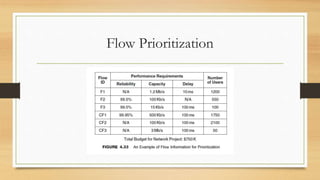
Flow Prioritization
Flow Prioritization
Flow Prioritization
Flow Analysis
• Preparation
• Background
• Flows
• Identifying and Developing Flows
• Data Sources and Sinks
• Flow Models
• Flow Prioritization
• The Flow Specification
• Example Application of Flow Analysis
The Flow Specification
• Flowspec Algorithm
• Capacity and Service Planning
Flowspec Algorithm
The flowspec algorithm applies the following rules:
1. Best-effort flows consist only of capacity requirements; therefore, only capacities
are used in best-effort calculations.
2. For flows with predictable requirements we use all available performance
requirements (capacity, delay, and RMA) in the calculations. Performance
requirements are combined for each characteristic so as to maximize the overall
performance of each flow.
3. For flows with guaranteed requirements we list each individual requirement (as an
individual flow), not combining them with other requirements.
Flowspec Algorithm
Flowspec Algorithm
Flowspec Algorithm
Capacity and Service Planning
• Capacity and service plans are written descriptions of the network
performance required for the flows described in the flowspec.
• A capacity plan describes network performance in terms of capacity only. It is
used in conjunction with a one-part flowspec.
• A service plan describes network performance in terms of sets of capacity,
delay, and RMA.
Flow Analysis
• Preparation
• Background
• Flows
• Identifying and Developing Flows
• Data Sources and Sinks
• Flow Models
• Flow Prioritization
• The Flow Specification
• Example Application of Flow Analysis
Example Application of Flow Analysis
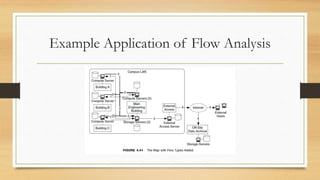
• We now bring the concepts of flow analysis together for an example
network, in this case a network to support computing and storage
management. For this network project the computing and storage devices
already exist in multiple buildings on a campus. The buildings and devices
that will be using this network for computing and storage management are
shown in Figure 4.40.
Example Application of Flow Analysis
From the requirements analysis process, we have been able to determine that
there are four types of flows for this network:
• Type 1: Flows between high-performance computing devices.
• Type 2: Data migration from computing to storage at Main Engineering.
• Type 3: Data migration to external server.
• Type 4: Data archival and Internet access.
• These flow types are added to our map, as shown in Figure 4.41.
Example Application of Flow Analysis
Performance Envelope from Requirements Analysis
• Characteristics of flow type 1.
• Characteristics of flow type 2.
Example Application of Flow Analysis
Performance Envelope from Requirements Analysis
Example Application of Flow Analysis
Performance Envelope from Requirements Analysis
Example Application of Flow Analysis
• Flow Models: For flow type 1 between compute servers and the Main Engineering storage servers, flows can
follow distributed-computing and hierarchical client–server computing flow models, as shown in Figure 4.43.
Example Application of Flow Analysis
Flow type 2 consists of data pushes from each compute server to the storage server in Main Engineering. Each
compute server is a data source, while the Main Engineering storage server is a data sink (Figure 4.44).
Example Application of Flow Analysis
For flow type 3, the storage servers in Main Engineering are data sources, andthe external access server is a data sink
(Figure 4.45).
Example Application of Flow Analysis
For flow type 4 a client–server flow model exists between external users of the data, including off-site archival, and the
external access server (Figure 4.46).
Example Application of Flow Analysis
• Flow Map: Figure 4.47 is an example of a flow map that describes flows
between buildings. Note that all devices have been removed from this map.
Example Application of Flow Analysis
Thank you

network design 5.pptx

  • 1.
    NETWORK DESIGN & ANALYSIS REQUIREMENTSANALYSIS: PROCESS Dr. Liyth Nissirat
  • 2.
    Flow Analysis • Preparation •Background • Flows • Identifying and Developing Flows • Data Sources and Sinks • Flow Models • Flow Prioritization • The Flow Specification • Example Application of Flow Analysis
  • 3.
    Preparation • client–server • peer-to-peer •distributed computing, and other models • how applications and devices interact with one another
  • 4.
    Flow Analysis • Preparation •Background • Flows • Identifying and Developing Flows • Data Sources and Sinks • Flow Models • Flow Prioritization • The Flow Specification • Example Application of Flow Analysis
  • 5.
    Background • user, application,device, and network requirements developed, listed, and mapped in the requirements specification, • we further analyze these requirements based on their end-to-end characteristics. • We use the concept of a flow, which, for an end-to-end connection, has constant addressing and service requirements, to combine performance requirements in a useful way. • These characteristics are analyzed and combined, per flow, into a flow specification or flowspec. This is used for capacity and service planning.
  • 6.
    Flow Analysis • Preparation •Background • Flows • Identifying and Developing Flows • Data Sources and Sinks • Flow Models • Flow Prioritization • The Flow Specification • Example Application of Flow Analysis
  • 7.
    Flows • Flows (alsoknown as traffic flows or data flows) are sets of network traffic (application, protocol, and control information) that have common attributes, such as source/destination address, type of information, directionality, or other end-to-end information.
  • 8.
  • 9.
  • 10.
  • 11.
    Flows • Individual andComposite Flows • Critical Flows
  • 12.
    Individual and CompositeFlows • An individual flow is the flow for a single session of an application. • When an individual flow has guaranteed requirements, those requirements are usually left with the individual flow and are not consolidated with other requirements or flows into a composite flow (Figure 4.4).
  • 13.
  • 14.
  • 15.
    Critical Flows • Someflows can be considered more important than others, in that they are higher in performance or have strict requirements, while some flows may serve more important users, their applications, and devices. • Such flows are called critical flows
  • 16.
    Flow Analysis • Preparation •Background • Flows • Identifying and Developing Flows • Data Sources and Sinks • Flow Models • Flow Prioritization • The Flow Specification • Example Application of Flow Analysis
  • 17.
  • 18.
    Identifying and DevelopingFlows • Focusing on a Particular Application • Developing a Profile • Choosing the Top N Applications
  • 19.
    Focusing on aParticular Application
  • 20.
    Focusing on aParticular Application
  • 21.
    Focusing on aParticular Application
  • 22.
    Focusing on aParticular Application
  • 23.
    Focusing on aParticular Application
  • 24.
  • 25.
    Choosing the TopN Applications
  • 26.
    Flow Analysis • Preparation •Background • Flows • Identifying and Developing Flows • Data Sources and Sinks • Flow Models • Flow Prioritization • The Flow Specification • Example Application of Flow Analysis
  • 27.
  • 28.
  • 29.
  • 30.
  • 31.
  • 32.
  • 33.
    Flow Analysis • Preparation •Background • Flows • Identifying and Developing Flows • Data Sources and Sinks • Flow Models • Flow Prioritization • The Flow Specification • Example Application of Flow Analysis
  • 34.
    Flow Models • Peer-to-Peer •Client–Server • Hierarchical Client–Server • Distributed-Computing
  • 35.
  • 36.
  • 37.
  • 38.
  • 39.
  • 40.
  • 41.
  • 42.
  • 43.
  • 44.
  • 45.
  • 46.
  • 47.
    Flow Analysis • Preparation •Background • Flows • Identifying and Developing Flows • Data Sources and Sinks • Flow Models • Flow Prioritization • The Flow Specification • Example Application of Flow Analysis
  • 48.
  • 49.
  • 50.
  • 51.
    Flow Analysis • Preparation •Background • Flows • Identifying and Developing Flows • Data Sources and Sinks • Flow Models • Flow Prioritization • The Flow Specification • Example Application of Flow Analysis
  • 52.
  • 53.
    The Flow Specification •Flowspec Algorithm • Capacity and Service Planning
  • 54.
    Flowspec Algorithm The flowspecalgorithm applies the following rules: 1. Best-effort flows consist only of capacity requirements; therefore, only capacities are used in best-effort calculations. 2. For flows with predictable requirements we use all available performance requirements (capacity, delay, and RMA) in the calculations. Performance requirements are combined for each characteristic so as to maximize the overall performance of each flow. 3. For flows with guaranteed requirements we list each individual requirement (as an individual flow), not combining them with other requirements.
  • 55.
  • 56.
  • 57.
  • 58.
    Capacity and ServicePlanning • Capacity and service plans are written descriptions of the network performance required for the flows described in the flowspec. • A capacity plan describes network performance in terms of capacity only. It is used in conjunction with a one-part flowspec. • A service plan describes network performance in terms of sets of capacity, delay, and RMA.
  • 59.
    Flow Analysis • Preparation •Background • Flows • Identifying and Developing Flows • Data Sources and Sinks • Flow Models • Flow Prioritization • The Flow Specification • Example Application of Flow Analysis
  • 60.
    Example Application ofFlow Analysis • We now bring the concepts of flow analysis together for an example network, in this case a network to support computing and storage management. For this network project the computing and storage devices already exist in multiple buildings on a campus. The buildings and devices that will be using this network for computing and storage management are shown in Figure 4.40.
  • 61.
  • 62.
    Example Application ofFlow Analysis From the requirements analysis process, we have been able to determine that there are four types of flows for this network: • Type 1: Flows between high-performance computing devices. • Type 2: Data migration from computing to storage at Main Engineering. • Type 3: Data migration to external server. • Type 4: Data archival and Internet access. • These flow types are added to our map, as shown in Figure 4.41.
  • 63.
  • 64.
    Example Application ofFlow Analysis Performance Envelope from Requirements Analysis • Characteristics of flow type 1. • Characteristics of flow type 2.
  • 65.
    Example Application ofFlow Analysis Performance Envelope from Requirements Analysis
  • 66.
    Example Application ofFlow Analysis Performance Envelope from Requirements Analysis
  • 67.
    Example Application ofFlow Analysis • Flow Models: For flow type 1 between compute servers and the Main Engineering storage servers, flows can follow distributed-computing and hierarchical client–server computing flow models, as shown in Figure 4.43.
  • 68.
    Example Application ofFlow Analysis Flow type 2 consists of data pushes from each compute server to the storage server in Main Engineering. Each compute server is a data source, while the Main Engineering storage server is a data sink (Figure 4.44).
  • 69.
    Example Application ofFlow Analysis For flow type 3, the storage servers in Main Engineering are data sources, andthe external access server is a data sink (Figure 4.45).
  • 70.
    Example Application ofFlow Analysis For flow type 4 a client–server flow model exists between external users of the data, including off-site archival, and the external access server (Figure 4.46).
  • 71.
    Example Application ofFlow Analysis • Flow Map: Figure 4.47 is an example of a flow map that describes flows between buildings. Note that all devices have been removed from this map.
  • 73.
  • 74.
  • 75.