
FLORENCE NIGHTINGALE:
ENVIRONMENTAL THEORY
By: ROMMEL LUIS C. ISRAEL III
BIOGRAPHY
By: ROMMEL LUIS C. ISRAEL III 2
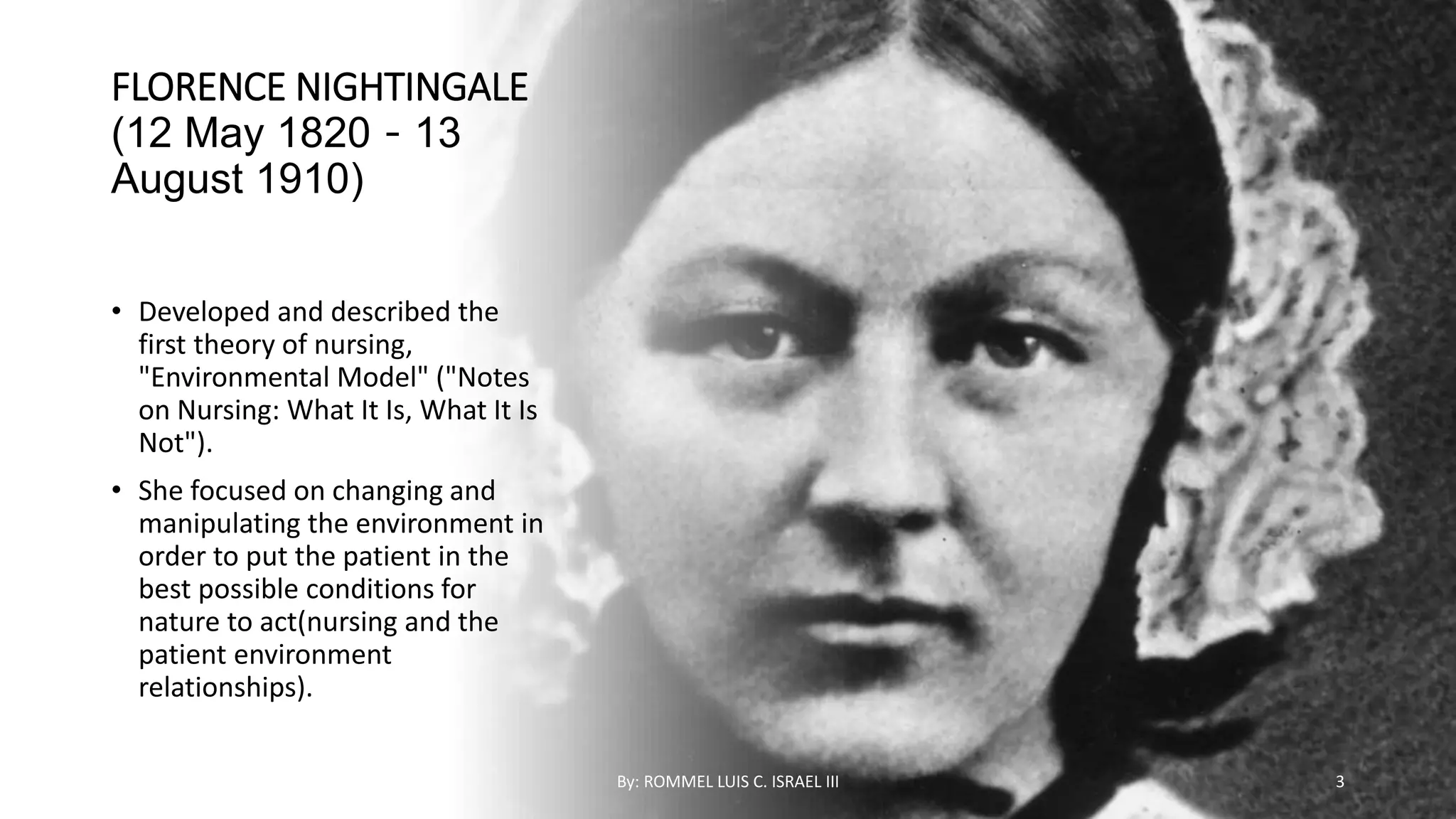
FLORENCE NIGHTINGALE
(12 May 1820 - 13
August 1910)
• Developed and described the
first theory of nursing,
"Environmental Model" ("Notes
on Nursing: What It Is, What It Is
Not").
• She focused on changing and
manipulating the environment in
order to put the patient in the
best possible conditions for
nature to act(nursing and the
patient environment
relationships).
By: ROMMEL LUIS C. ISRAEL III 3
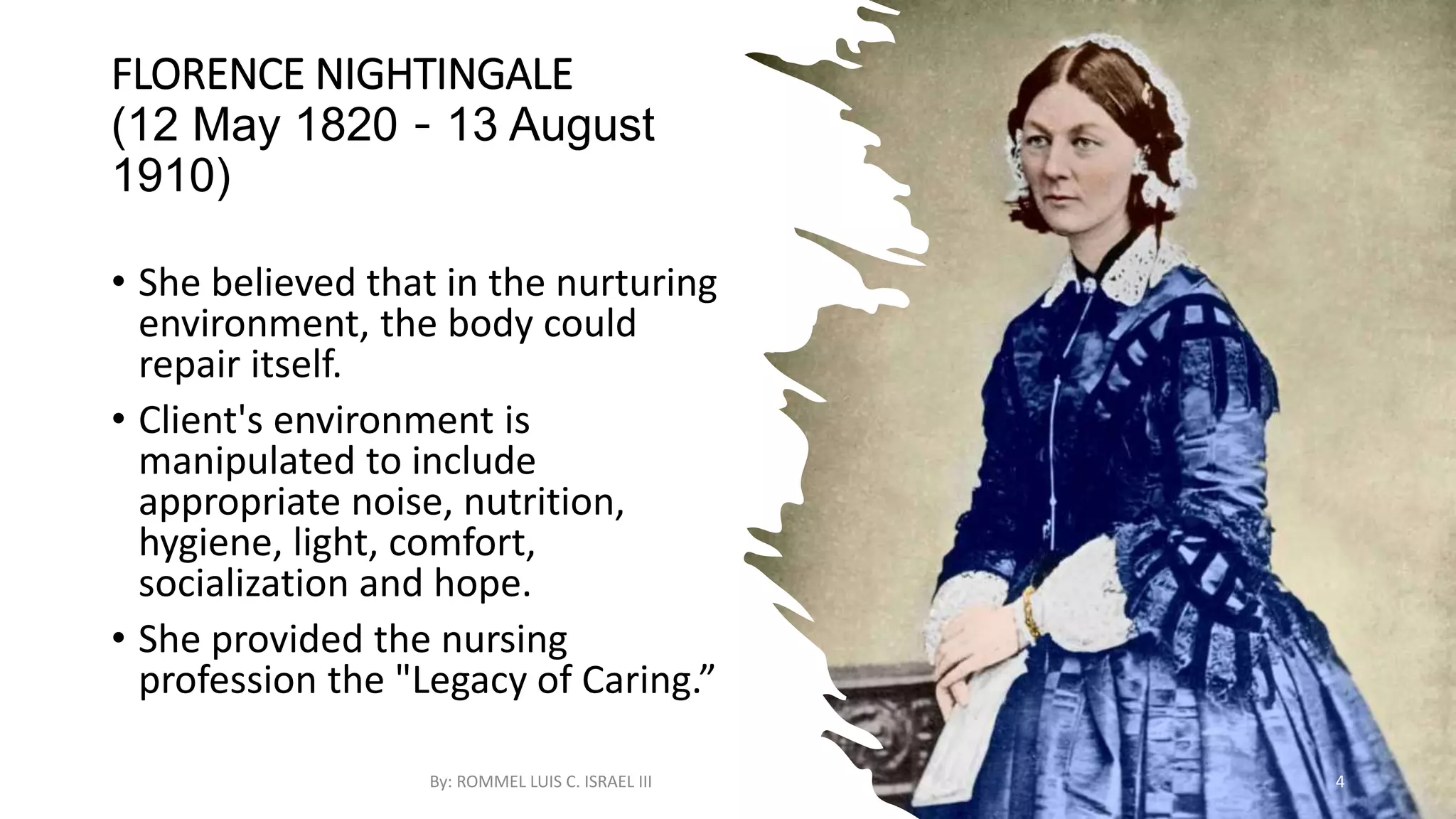
FLORENCE NIGHTINGALE
(12 May 1820 - 13 August
1910)
• She believed that in the nurturing
environment, the body could
repair itself.
• Client's environment is
manipulated to include
appropriate noise, nutrition,
hygiene, light, comfort,
socialization and hope.
• She provided the nursing
profession the "Legacy of Caring.”
By: ROMMEL LUIS C. ISRAEL III 4
FLORENCE NIGHTINGALE
(12 May 1820-13 August
1910)
• She was a nurse who
contributed to developing
and shaping the modern
nursing practice and has
set examples for nurses
who are standards for
today’s profession.
• Nightingale is the first nurse
theorist well known for
developing the
Environmental Theory that
revolutionized nursing
practices to create sanitary
conditions for patients to
get care.
By: ROMMEL LUIS C. ISRAEL III 5
FLORENCE
NIGHTINGALE
(12 May 1820-13 August
1910)
•She is recognized as the
founder of modern
nursing.
•During the Crimean War,
she tended to wounded
soldiers at night and was
known as THE LADY
WITH THE LAMP
By: ROMMEL LUIS C. ISRAEL III 6
EARLY LIFE
By: ROMMEL LUIS C. ISRAEL III 7
Florence Nightingale was born on May 12, 1820, in Nightingale,
Italy.
She was the younger of two children. Her British family belonged
to elite social circles.
Her father, William Shore Nightingale, a wealthy landowner who
had inherited two estates: one at Lea Hurst, Derbyshire, and the
other in Hampshire, Embley Park .
By: ROMMEL LUIS C. ISRAEL III 8
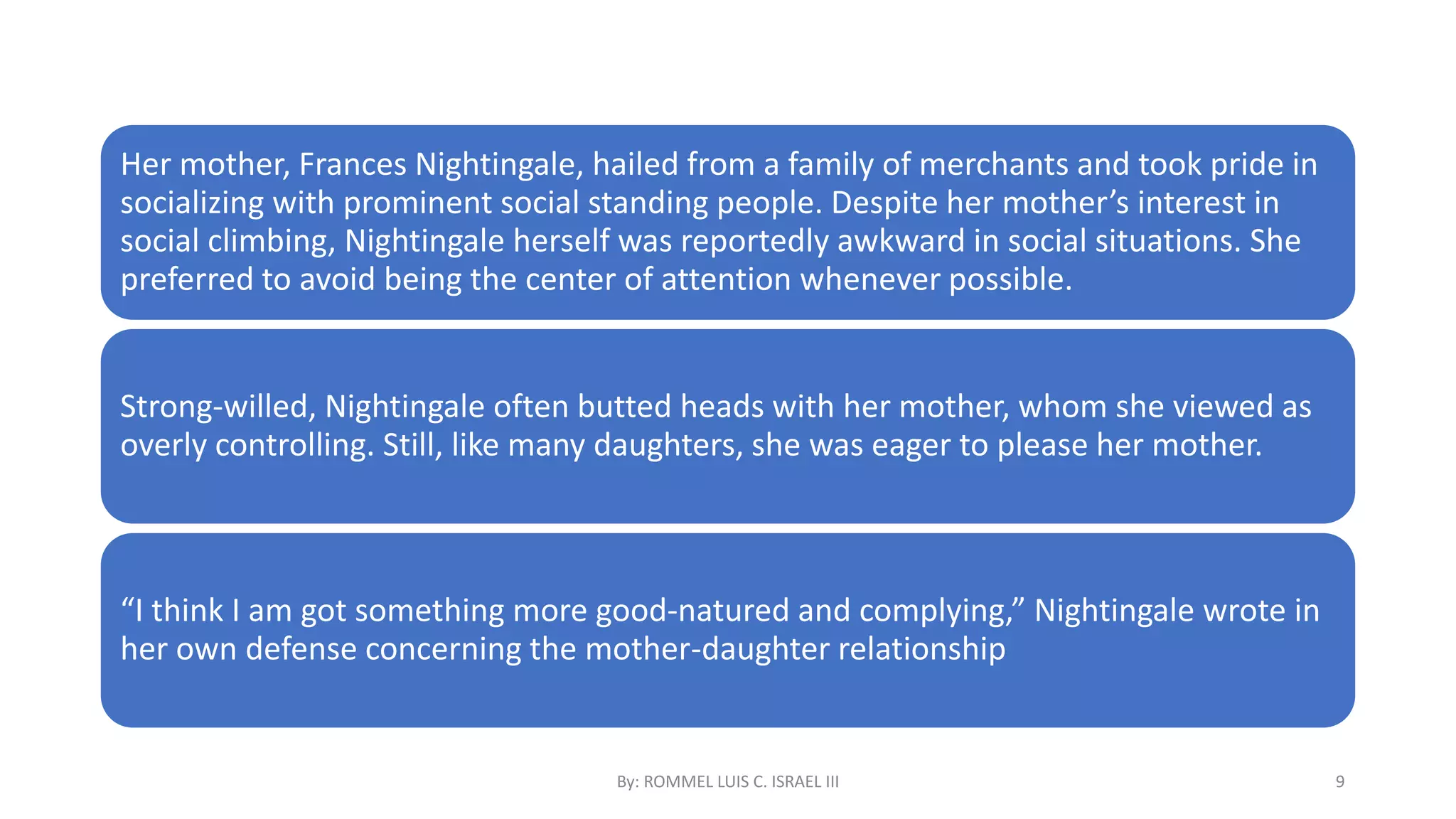
Her mother, Frances Nightingale, hailed from a family of merchants and took pride in
socializing with prominent social standing people. Despite her mother’s interest in
social climbing, Nightingale herself was reportedly awkward in social situations. She
preferred to avoid being the center of attention whenever possible.
Strong-willed, Nightingale often butted heads with her mother, whom she viewed as
overly controlling. Still, like many daughters, she was eager to please her mother.
“I think I am got something more good-natured and complying,” Nightingale wrote in
her own defense concerning the mother-daughter relationship
By: ROMMEL LUIS C. ISRAEL III 9
EDUCATION
By: ROMMEL LUIS C. ISRAEL III
10
PHOTOGRAPH OF FLORENCE NIGTHINGALE ,1880
Florence Nightingale was raised on the family estate at Lea Hurst,
where her father provided her with a classical education, including
German, French, and Italian studies.
As for being homeschooled by her parents and tutors, Nightingale
gained excellence in Mathematics. Nightingale was active in
philanthropy from a very young age, ministering to the ill and poor
people in the village neighboring her family’s estate.
By: ROMMEL LUIS C. ISRAEL III 11
At seventeen, she decided to
dedicate her life to medical
care for the sick resulting in a
lifetime commitment to speak
out, educate, overhaul and
sanitize the appalling health
care conditions in England.
Despite her parents’
objections, Nightingale
enrolled as a nursing student in
1844 at the Lutheran Hospital
of Pastor Fliedner in
Kaiserswerth, Germany.
By: ROMMEL LUIS C. ISRAEL III 12
PERSONAL LIFE
13
PHOTOGRAPH OF THE YOUNG
FLORENCE NIGHTINGALE
Only announcing her decision to enter the field in 1844,
following her desire to be a nurse, was not easy for
Florence Nightingale.
Her mother and sister were against her chosen career,
but Nightingale stood strong and worked hard to learn
more about her craft despite society’s expectation that
she become a wife and mother.
By: ROMMEL LUIS C. ISRAEL III 14
By: ROMMEL LUIS C. ISRAEL III 15
As a woman, Nightingale was beautiful and charming
that made every man like her. However, she rejected a
suitor, Richard Monckton Milnes, 1st Baron Houghton,
because she feared that entertaining men would
interfere with the process.
The income given to her by her father during this time
allowed her to pursue her career and still live
comfortably.
THE NIGHTINGALE’S
ENVIRONMENTAL MODEL
By: ROMMEL LUIS C. ISRAEL III 16
17
By: ROMMEL LUIS C. ISRAEL III
She
identified
theses
aspects as
major areas
of the
physical,
social, and
psychological
environment
that the
nurse could
control:
Health of houses
Ventilation and warming
Light
Noise
Variety
Bed and bedding
Cleanliness of rooms and walls
Personal Cleanliness
Nutrition and taking food
Chattering hopes and advices
Observation of the sick
Petty management
By: ROMMEL LUIS C. ISRAEL III 18
The social and psychological environment that affect the
physical environment are: Variety, chattering hopes and advices,
and petty management.
Nightingale believed that when one or more aspects of the
environment are outof balance, the client must use increased
energy to counter the environmental stress.
These stresses drain the client of energy needed for healing.
By: ROMMEL LUIS C. ISRAEL III 19
HEALTH AND
HOUSES
• Is closely related to the presence of
pure air, pure water, efficient
drainage, cleanliness, and light.
• According to Nightingale, "badly
constructed houses do for the healthy
what badly constructed hospitals do
for the sick. Once stagnant air is
stagnant,sickness is certain to follow"
(Nightingale, 1859, p.15).
• She also noted that the cleanliness
outside the house affected the inside
• Nightingale's advocacy is still applicable
in these modern times, because families
can be still affected by toxic wastes,
contaminated water and polluted air.
By: ROMMEL LUIS C. ISRAEL III 20
VENTILATION AND
WARMING
21
LIGHT
22
NOISE 23
VARIETY
24
BED AND BEDDING 25
CLEANLINESS OF ROOM
AND WALLS
• Nightingale emphasized that "the
greater part of nursing consists in
preserving cleanliness."
• She urges the removal of dust with the
use of damp cloth (rather than a feather
duster.
• Floors should be easily cleaned rather
than being covered with dust trapping
carpets. Furniture and walls should be
easily washed and not damaged by
coming in contact with moisture.
• In these modern times, the concept
that a clean room is a healthy room
continues to be relevant.
By: ROMMEL LUIS C. ISRAEL III 26
PERSONAL
CLEANLINESS
By: ROMMEL LUIS C. ISRAEL III
27
Nightingale viewed the function of the skin as important.
She believed that unwashed skin poisoned the patient and noted that
bathing and drying the skin provided great relief to the patient.
She strongly stated that "Just as it is necessary to renew the air around a
sick person frequently, to carry off morbid effluvia from the lungs and
skin, by maintaining free ventilation, so is it necessary to keep the pores
of the skin free from all obstructing excretions" (Nightingale, 1859, p.53)
She also advocated that personal cleanliness extended to the nurse and
that "every nurse ought to wash her hands very frequently during the
day" (p.53).
NUTRITION
AND TAKING
FOOD
By: ROMMEL LUIS C. ISRAEL III
28
Nightingale addressed the
importance of variety in
the food served to patients.
She has proven that the
attention given to the
patient affected how the
patient ate.
She has observed that
individuals desire different
foods at different times of
the day and that frequent
small servings may be more
beneficial to the patient
than a large breakfast or
dinner.
She urged that no business
be done with patient while
they are eating because
this was distraction. She
also urged that the right
food be brought at the
right time and "be taken
away, eaten or uneaten, at
the right time" (p.37)
CHATTERING
HOPES AND
ADVICES
By: ROMMEL LUIS C. ISRAEL III
29
Nightingale perceived that to falsely cheer the sick by
making light of their illness and its danger is not
helpful.
She considered it stressful for a patient to hear
opinions after only brief observations had been made.
False hope was depressing to patients, she felt, and
caused them to worry and become fatigued.
Nightingale encouraged the nurse to heed what is
being said by visitors, believing that sick persons
should hear good news that would assist them in
becoming healthier.
OBSERVATION
OF THE SICK
• According to Nightingale "the most important
practical lesson that can be given to nurses is to
teach them what to observe-----how to observe-
what symptoms indicate improvement-----what is
the reverse-----which are of importance-----which
are of none-----which are evidence of neglect-----
and what kind of neglect" (Nightingale, 1859 p.59).
• She felt strongly about the importance of obtaining
complete and accurate information about patients
that she said, "if you cannot get the habit of
observation one way or other, you had better give
up being a nurse, for it is not your calling, however
kind and anxious you maybe."
• She urges precise, specific, and individualized
questions and observations and warns against
failure to observe and the use of averages to
describe expectations of the individual.
• Finally, she urges that observation not be an end
unto itself but a means forassuring that appropriate
actions are taken
By: ROMMEL LUIS C. ISRAEL III 30
PETTY
MANAGEMENT
•Nightingale discussed
"petty management" or
ways to assure that
"what you do when you
are there, shall be done
when you are not
there"(p.20).
• She believed that the
house and the hospital
needed to be well-
managed-thatis
organized, clean, and
with appropriate supplies
By: ROMMEL LUIS C. ISRAEL III 31
CONCEPTS
By: ROMMEL LUIS C. ISRAEL III 32
ENVIRONMENT
33
PERSON
34
HEALTH
35
NURSING
36
NURSING
By: ROMMEL LUIS C. ISRAEL III
37
Nurses were to use common sense, observation,
and ingenuity to allow nature to effectively
repair the patient.
Nightingale believed,
"Observation may always be improved with
training---will seldom be present without
training; for otherwise the nurse does not know
what to look for."
NURSING
By: ROMMEL LUIS C. ISRAEL III
38
Using Nightingale's philosophy in practice today fits well with the use of the nursing
process. The nurse assesses the patient situation, identifies a need; implements a
plan of care, reevaluates the situation, and finally changes the plan to better serve
the patient.
She expected nurses to use their powers of observation in caring for patients.
She advocated for nurses to have educational background and knowledge that were
different from those of physicians.
She believed in and rallied for nursing education to be a combination of clinical
experience and classroom learning
NIGHTINGALE AND THE
NURSING PROCESS
By: ROMMEL LUIS C. ISRAEL III 39
ASSESSMENT
By: ROMMEL LUIS C. ISRAEL III 40
• Ask the client what is needed or
wanted
• Observation. She used precise and
specific observationsconcerning all
aspects of the client's physical
health andenvironment
Nightingale
recommended
two essential
behaviors by
the nurse in
the area of
assessment:
ASSESSMENT
1.Ask the client what is needed or
wanted.
Examples:
a. If the patient is in pain, ask
where the
pain is located.
b. If the patient is not eating, ask when
he By: ROMMEL LUIS C. ISRAEL III 41
ASSESSMENT
By: ROMMEL LUIS C. ISRAEL III 42
She recommended asking precise questions.
She warned against asking leading questions.
Correct: "How many hours of sleep did you have? At what hours of
the night?“
Wrong: "Did you have a good night sleep?
ASSESSMENT
2. Observation.
She used precise and specific observations concerning all
aspects
of the client's physical health and environment.
Examples:
a. How do light, noise, smells, and bedding affect the client?
b. How much food and drink had the client ingested at every
meal
or snack?
By: ROMMEL LUIS C. ISRAEL III 43
NURSING DIAGNOSES
By: ROMMEL LUIS C. ISRAEL III 44
Nightingale believed data should be used as the basis for
forming any conclusion.
The nursing diagnosis is the client's response to the
environment and not the environmental problem. It
reflects the importance of the environment to health and
well-being of the client
OUTCOMES AND PLANNING
By: ROMMEL LUIS C. ISRAEL III 45
Identifying the nursing actions needed to keep clients comfortable,
dry, and in the best state for nature to act on.
Planning is focused on modifying the environment to enhance the
client’s ability to respond to the disease process.
The desired outcomes are derived from the environmental model---
--for example, being comfortable, clean, dry, in the best state for
nature to work on.
IMPLEMENTATION
By: ROMMEL LUIS C. ISRAEL III 46
Takes place in the environment that affects the client and
involves taking action to modify that environment.
All factors of the environment should be considered, including
noise, air, odors, bedding, cleanliness, light, -----all the factors
that place clients in the best position for nature to work upon
them
EVALUATION
By: ROMMEL LUIS C. ISRAEL III 47
Is based on the effect of the changes in the
environment on the client’s ability to regain
his/her health at the least expense of energy.
Observation is the primary method of data
collection used to evaluate the client's response to
the intervention
References:
• Brain, J. (n.d.). Florence Nightingale. Historic UK.
https://www.historic-uk.com/HistoryUK/HistoryofBritain/Florence-
Nightingale/
• England, H. (2020, May 11). The Life and Legacy of Florence
Nightingale. The Historic England Blog.
https://heritagecalling.com/2020/05/11/the-life-and-legacy-of-
florence-nightingale/
By: ROMMEL LUIS C. ISRAEL III 48
References:
• Gonzalo, A. (2019, August 22). Florence Nightingale’s Biography and
Environmental Theory: Study Guide. Nurseslabs.
https://nurseslabs.com/florence-nightingales-environmental-
theory/#:~:text=The%20Environmental%20Theory%20by%20Floren
ce
• Conocimiento, V. al (2018). Florence Nightingale, the First Professional
Nurse. [online] OpenMind. Available at:
https://www.bbvaopenmind.com/en/science/leading-
figures/florence-nightingale-the-first-professional-
nurse/#:~:text=She%20faced%20down%20her%20family.
By: ROMMEL LUIS C. ISRAEL III 49
References:
• Haynes, S. (2020, May 12). How Florence Nightingale Paved the Way
for the Heroic Work of Nurses Today. Time.
https://time.com/5835150/florence-nightingale-legacy-nurses/
• Stake-Doucet, N. (2020, November 5). The Racist Lady with the
Lamp. Nursing Clio. https://nursingclio.org/2020/11/05/the-racist-
lady-with-the-lamp/
• Petiprin, A. (2020). Florence Nightingale - Nursing Theory. [online]
Nursing Theory. Available at: https://nursing-theory.org/nursing-
theorists/Florence-Nightingale.php.
By: ROMMEL LUIS C. ISRAEL III 50

FLORENCE NIGHTINGALE: ENVIRONMENTAL THEORY

  • 1.
  • 2.
  • 3.
    FLORENCE NIGHTINGALE (12 May1820 - 13 August 1910) • Developed and described the first theory of nursing, "Environmental Model" ("Notes on Nursing: What It Is, What It Is Not"). • She focused on changing and manipulating the environment in order to put the patient in the best possible conditions for nature to act(nursing and the patient environment relationships). By: ROMMEL LUIS C. ISRAEL III 3
  • 4.
    FLORENCE NIGHTINGALE (12 May1820 - 13 August 1910) • She believed that in the nurturing environment, the body could repair itself. • Client's environment is manipulated to include appropriate noise, nutrition, hygiene, light, comfort, socialization and hope. • She provided the nursing profession the "Legacy of Caring.” By: ROMMEL LUIS C. ISRAEL III 4
  • 5.
    FLORENCE NIGHTINGALE (12 May1820-13 August 1910) • She was a nurse who contributed to developing and shaping the modern nursing practice and has set examples for nurses who are standards for today’s profession. • Nightingale is the first nurse theorist well known for developing the Environmental Theory that revolutionized nursing practices to create sanitary conditions for patients to get care. By: ROMMEL LUIS C. ISRAEL III 5
  • 6.
    FLORENCE NIGHTINGALE (12 May 1820-13August 1910) •She is recognized as the founder of modern nursing. •During the Crimean War, she tended to wounded soldiers at night and was known as THE LADY WITH THE LAMP By: ROMMEL LUIS C. ISRAEL III 6
  • 7.
    EARLY LIFE By: ROMMELLUIS C. ISRAEL III 7
  • 8.
    Florence Nightingale wasborn on May 12, 1820, in Nightingale, Italy. She was the younger of two children. Her British family belonged to elite social circles. Her father, William Shore Nightingale, a wealthy landowner who had inherited two estates: one at Lea Hurst, Derbyshire, and the other in Hampshire, Embley Park . By: ROMMEL LUIS C. ISRAEL III 8
  • 9.
    Her mother, FrancesNightingale, hailed from a family of merchants and took pride in socializing with prominent social standing people. Despite her mother’s interest in social climbing, Nightingale herself was reportedly awkward in social situations. She preferred to avoid being the center of attention whenever possible. Strong-willed, Nightingale often butted heads with her mother, whom she viewed as overly controlling. Still, like many daughters, she was eager to please her mother. “I think I am got something more good-natured and complying,” Nightingale wrote in her own defense concerning the mother-daughter relationship By: ROMMEL LUIS C. ISRAEL III 9
  • 10.
    EDUCATION By: ROMMEL LUISC. ISRAEL III 10 PHOTOGRAPH OF FLORENCE NIGTHINGALE ,1880
  • 11.
    Florence Nightingale wasraised on the family estate at Lea Hurst, where her father provided her with a classical education, including German, French, and Italian studies. As for being homeschooled by her parents and tutors, Nightingale gained excellence in Mathematics. Nightingale was active in philanthropy from a very young age, ministering to the ill and poor people in the village neighboring her family’s estate. By: ROMMEL LUIS C. ISRAEL III 11
  • 12.
    At seventeen, shedecided to dedicate her life to medical care for the sick resulting in a lifetime commitment to speak out, educate, overhaul and sanitize the appalling health care conditions in England. Despite her parents’ objections, Nightingale enrolled as a nursing student in 1844 at the Lutheran Hospital of Pastor Fliedner in Kaiserswerth, Germany. By: ROMMEL LUIS C. ISRAEL III 12
  • 13.
    PERSONAL LIFE 13 PHOTOGRAPH OFTHE YOUNG FLORENCE NIGHTINGALE
  • 14.
    Only announcing herdecision to enter the field in 1844, following her desire to be a nurse, was not easy for Florence Nightingale. Her mother and sister were against her chosen career, but Nightingale stood strong and worked hard to learn more about her craft despite society’s expectation that she become a wife and mother. By: ROMMEL LUIS C. ISRAEL III 14
  • 15.
    By: ROMMEL LUISC. ISRAEL III 15 As a woman, Nightingale was beautiful and charming that made every man like her. However, she rejected a suitor, Richard Monckton Milnes, 1st Baron Houghton, because she feared that entertaining men would interfere with the process. The income given to her by her father during this time allowed her to pursue her career and still live comfortably.
  • 16.
    THE NIGHTINGALE’S ENVIRONMENTAL MODEL By:ROMMEL LUIS C. ISRAEL III 16
  • 17.
    17 By: ROMMEL LUISC. ISRAEL III
  • 18.
    She identified theses aspects as major areas ofthe physical, social, and psychological environment that the nurse could control: Health of houses Ventilation and warming Light Noise Variety Bed and bedding Cleanliness of rooms and walls Personal Cleanliness Nutrition and taking food Chattering hopes and advices Observation of the sick Petty management By: ROMMEL LUIS C. ISRAEL III 18
  • 19.
    The social andpsychological environment that affect the physical environment are: Variety, chattering hopes and advices, and petty management. Nightingale believed that when one or more aspects of the environment are outof balance, the client must use increased energy to counter the environmental stress. These stresses drain the client of energy needed for healing. By: ROMMEL LUIS C. ISRAEL III 19
  • 20.
    HEALTH AND HOUSES • Isclosely related to the presence of pure air, pure water, efficient drainage, cleanliness, and light. • According to Nightingale, "badly constructed houses do for the healthy what badly constructed hospitals do for the sick. Once stagnant air is stagnant,sickness is certain to follow" (Nightingale, 1859, p.15). • She also noted that the cleanliness outside the house affected the inside • Nightingale's advocacy is still applicable in these modern times, because families can be still affected by toxic wastes, contaminated water and polluted air. By: ROMMEL LUIS C. ISRAEL III 20
  • 21.
  • 22.
  • 23.
  • 24.
  • 25.
  • 26.
    CLEANLINESS OF ROOM ANDWALLS • Nightingale emphasized that "the greater part of nursing consists in preserving cleanliness." • She urges the removal of dust with the use of damp cloth (rather than a feather duster. • Floors should be easily cleaned rather than being covered with dust trapping carpets. Furniture and walls should be easily washed and not damaged by coming in contact with moisture. • In these modern times, the concept that a clean room is a healthy room continues to be relevant. By: ROMMEL LUIS C. ISRAEL III 26
  • 27.
    PERSONAL CLEANLINESS By: ROMMEL LUISC. ISRAEL III 27 Nightingale viewed the function of the skin as important. She believed that unwashed skin poisoned the patient and noted that bathing and drying the skin provided great relief to the patient. She strongly stated that "Just as it is necessary to renew the air around a sick person frequently, to carry off morbid effluvia from the lungs and skin, by maintaining free ventilation, so is it necessary to keep the pores of the skin free from all obstructing excretions" (Nightingale, 1859, p.53) She also advocated that personal cleanliness extended to the nurse and that "every nurse ought to wash her hands very frequently during the day" (p.53).
  • 28.
    NUTRITION AND TAKING FOOD By: ROMMELLUIS C. ISRAEL III 28 Nightingale addressed the importance of variety in the food served to patients. She has proven that the attention given to the patient affected how the patient ate. She has observed that individuals desire different foods at different times of the day and that frequent small servings may be more beneficial to the patient than a large breakfast or dinner. She urged that no business be done with patient while they are eating because this was distraction. She also urged that the right food be brought at the right time and "be taken away, eaten or uneaten, at the right time" (p.37)
  • 29.
    CHATTERING HOPES AND ADVICES By: ROMMELLUIS C. ISRAEL III 29 Nightingale perceived that to falsely cheer the sick by making light of their illness and its danger is not helpful. She considered it stressful for a patient to hear opinions after only brief observations had been made. False hope was depressing to patients, she felt, and caused them to worry and become fatigued. Nightingale encouraged the nurse to heed what is being said by visitors, believing that sick persons should hear good news that would assist them in becoming healthier.
  • 30.
    OBSERVATION OF THE SICK •According to Nightingale "the most important practical lesson that can be given to nurses is to teach them what to observe-----how to observe- what symptoms indicate improvement-----what is the reverse-----which are of importance-----which are of none-----which are evidence of neglect----- and what kind of neglect" (Nightingale, 1859 p.59). • She felt strongly about the importance of obtaining complete and accurate information about patients that she said, "if you cannot get the habit of observation one way or other, you had better give up being a nurse, for it is not your calling, however kind and anxious you maybe." • She urges precise, specific, and individualized questions and observations and warns against failure to observe and the use of averages to describe expectations of the individual. • Finally, she urges that observation not be an end unto itself but a means forassuring that appropriate actions are taken By: ROMMEL LUIS C. ISRAEL III 30
  • 31.
    PETTY MANAGEMENT •Nightingale discussed "petty management"or ways to assure that "what you do when you are there, shall be done when you are not there"(p.20). • She believed that the house and the hospital needed to be well- managed-thatis organized, clean, and with appropriate supplies By: ROMMEL LUIS C. ISRAEL III 31
  • 32.
    CONCEPTS By: ROMMEL LUISC. ISRAEL III 32
  • 33.
  • 34.
  • 35.
  • 36.
  • 37.
    NURSING By: ROMMEL LUISC. ISRAEL III 37 Nurses were to use common sense, observation, and ingenuity to allow nature to effectively repair the patient. Nightingale believed, "Observation may always be improved with training---will seldom be present without training; for otherwise the nurse does not know what to look for."
  • 38.
    NURSING By: ROMMEL LUISC. ISRAEL III 38 Using Nightingale's philosophy in practice today fits well with the use of the nursing process. The nurse assesses the patient situation, identifies a need; implements a plan of care, reevaluates the situation, and finally changes the plan to better serve the patient. She expected nurses to use their powers of observation in caring for patients. She advocated for nurses to have educational background and knowledge that were different from those of physicians. She believed in and rallied for nursing education to be a combination of clinical experience and classroom learning
  • 39.
    NIGHTINGALE AND THE NURSINGPROCESS By: ROMMEL LUIS C. ISRAEL III 39
  • 40.
    ASSESSMENT By: ROMMEL LUISC. ISRAEL III 40 • Ask the client what is needed or wanted • Observation. She used precise and specific observationsconcerning all aspects of the client's physical health andenvironment Nightingale recommended two essential behaviors by the nurse in the area of assessment:
  • 41.
    ASSESSMENT 1.Ask the clientwhat is needed or wanted. Examples: a. If the patient is in pain, ask where the pain is located. b. If the patient is not eating, ask when he By: ROMMEL LUIS C. ISRAEL III 41
  • 42.
    ASSESSMENT By: ROMMEL LUISC. ISRAEL III 42 She recommended asking precise questions. She warned against asking leading questions. Correct: "How many hours of sleep did you have? At what hours of the night?“ Wrong: "Did you have a good night sleep?
  • 43.
    ASSESSMENT 2. Observation. She usedprecise and specific observations concerning all aspects of the client's physical health and environment. Examples: a. How do light, noise, smells, and bedding affect the client? b. How much food and drink had the client ingested at every meal or snack? By: ROMMEL LUIS C. ISRAEL III 43
  • 44.
    NURSING DIAGNOSES By: ROMMELLUIS C. ISRAEL III 44 Nightingale believed data should be used as the basis for forming any conclusion. The nursing diagnosis is the client's response to the environment and not the environmental problem. It reflects the importance of the environment to health and well-being of the client
  • 45.
    OUTCOMES AND PLANNING By:ROMMEL LUIS C. ISRAEL III 45 Identifying the nursing actions needed to keep clients comfortable, dry, and in the best state for nature to act on. Planning is focused on modifying the environment to enhance the client’s ability to respond to the disease process. The desired outcomes are derived from the environmental model--- --for example, being comfortable, clean, dry, in the best state for nature to work on.
  • 46.
    IMPLEMENTATION By: ROMMEL LUISC. ISRAEL III 46 Takes place in the environment that affects the client and involves taking action to modify that environment. All factors of the environment should be considered, including noise, air, odors, bedding, cleanliness, light, -----all the factors that place clients in the best position for nature to work upon them
  • 47.
    EVALUATION By: ROMMEL LUISC. ISRAEL III 47 Is based on the effect of the changes in the environment on the client’s ability to regain his/her health at the least expense of energy. Observation is the primary method of data collection used to evaluate the client's response to the intervention
  • 48.
    References: • Brain, J.(n.d.). Florence Nightingale. Historic UK. https://www.historic-uk.com/HistoryUK/HistoryofBritain/Florence- Nightingale/ • England, H. (2020, May 11). The Life and Legacy of Florence Nightingale. The Historic England Blog. https://heritagecalling.com/2020/05/11/the-life-and-legacy-of- florence-nightingale/ By: ROMMEL LUIS C. ISRAEL III 48
  • 49.
    References: • Gonzalo, A.(2019, August 22). Florence Nightingale’s Biography and Environmental Theory: Study Guide. Nurseslabs. https://nurseslabs.com/florence-nightingales-environmental- theory/#:~:text=The%20Environmental%20Theory%20by%20Floren ce • Conocimiento, V. al (2018). Florence Nightingale, the First Professional Nurse. [online] OpenMind. Available at: https://www.bbvaopenmind.com/en/science/leading- figures/florence-nightingale-the-first-professional- nurse/#:~:text=She%20faced%20down%20her%20family. By: ROMMEL LUIS C. ISRAEL III 49
  • 50.
    References: • Haynes, S.(2020, May 12). How Florence Nightingale Paved the Way for the Heroic Work of Nurses Today. Time. https://time.com/5835150/florence-nightingale-legacy-nurses/ • Stake-Doucet, N. (2020, November 5). The Racist Lady with the Lamp. Nursing Clio. https://nursingclio.org/2020/11/05/the-racist- lady-with-the-lamp/ • Petiprin, A. (2020). Florence Nightingale - Nursing Theory. [online] Nursing Theory. Available at: https://nursing-theory.org/nursing- theorists/Florence-Nightingale.php. By: ROMMEL LUIS C. ISRAEL III 50