Florence Nightingale
Page 1 of 5 1/18/2015
 Introduction
was a celebrated English social reformer and statistician, and the
founder of modern nursing. She came to prominence while serving as a
manager of nurses trained by her during the Crimean War, where she
organised the tending to wounded soldiers.
She gave nursing a highly favourable reputation and became an
icon of Victorian culture, especially in the persona of "The Lady with
the Lamp" making rounds of wounded soldiers at night.
Some recent commentators have asserted Nightingale's
achievements in the Crimean War were exaggerated by the media at
the time, to satisfy the public's need for a hero. Nevertheless critics
agree on the decisive importance of her followup achievements in
professionalizing nursing roles for women. In 1860, Nightingale laid the
foundation of professional nursing with the establishment of
her nursing school at St Thomas' Hospital in London. It was the first
secular nursing school in the world, now part of King's College London.
The Nightingale Pledge taken by new nurses was named in her honour,
and the annual International Nurses Day is celebrated around the
world on her birthday. Her social reforms include improving
healthcare for all sections of British society, improving healthcare and
advocating better hunger relief in India, helping to abolish laws
regulating prostitution that were over-harsh to women, and expanding
the acceptable forms of female participation in the workforce.
Nightingale was a prodigious and versatile writer. In her lifetime
much of her published work was concerned with spreading medical
knowledge. Some of her tracts were written in simple English so that
they could easily be understood by those with poor literary skills. She
also helped popularise the graphical presentation of statistical data.
Much of her writing, including her extensive work on religion and
mysticism, has only been published posthumously.
 Early Life
Florence Nightingale was born on 12 May 1820 into a rich, upper-
class, well-connected British family at the Villa Colombaia, in Florence,
Florence Nightingale
Page 2 of 5 1/18/2015
Italy, and was named after the city of her birth. Florence's older
sister Frances Parthenope had similarly been named after her place of
birth, Parthenopolis, a Greek settlement now part of the city of Naples.
When Florence was 1, the family moved back to England in 1821,
with Nightingale being brought up in the family's homes
at Embley and Lea Hurst.
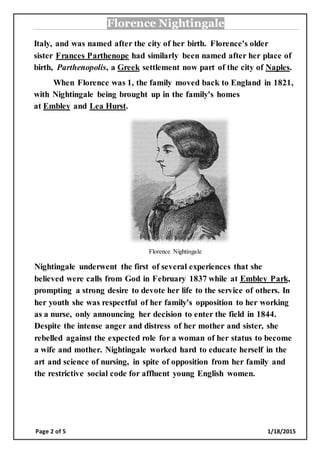
Florence Nightingale
underwent the first of several experiences that sheNightingale
,Embley Parkbelieved were calls from God in February 1837 while at
others. Inprompting a strong desire to devote her life to the service of
her youth she was respectful of her family's opposition to her working
as a nurse, only announcing her decision to enter the field in 1844.
Despite the intense anger and distress of her mother and sister, she
for a woman of her status to becomerebelled against the expected role
a wife and mother. Nightingale worked hard to educate herself in the
art and science of nursing, in spite of opposition from her family and
the restrictive social code for affluent young English women.
Florence Nightingale
Page 3 of 5 1/18/2015
 The Lady with the Lamp
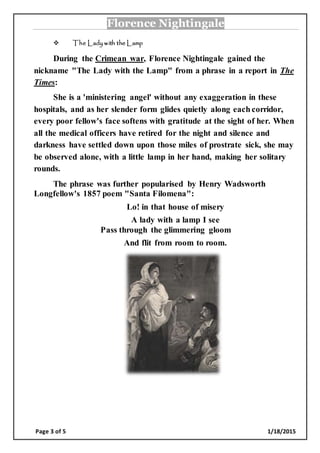
During the Crimean war, Florence Nightingale gained the
nickname "The Lady with the Lamp" from a phrase in a report in The
Times:
She is a 'ministering angel' without any exaggeration in these
hospitals, and as her slender form glides quietly along each corridor,
every poor fellow's face softens with gratitude at the sight of her. When
all the medical officers have retired for the night and silence and
darkness have settled down upon those miles of prostrate sick, she may
be observed alone, with a little lamp in her hand, making her solitary
rounds.
The phrase was further popularised by Henry Wadsworth
Longfellow's 1857 poem "Santa Filomena":
Lo! in that house of misery
A lady with a lamp I see
Pass through the glimmering gloom
And flit from room to room.
Florence Nightingale
Page 4 of 5 1/18/2015
 Relationships
Although much of Nightingale's work improved the lot of women
everywhere, Nightingale was of the opinion that women
craved sympathy and were not as capable as men. She criticised early
women's rights activists for decrying an alleged lack of careers for
women at the same time that lucrative medical positions, under the
supervision of Nightingale and others, went perpetually unfilled. She
preferred the friendship of powerful men, insisting they had done more
than women to help her attain her goals, writing,
"I have never found one woman who has altered her life by one
iota for me or my opinions." She often referred to herself in the
masculine, as for example "a man of action" and "a man of business".
She did, however, have several important and long-lasting
friendships with women. Later in life she kept up a prolonged
correspondence with Irish nun Sister Mary Clare Moore, with whom
she had worked in Crimea. Her most beloved confidante was Mary
Clarke, an Englishwoman she met in 1837 and kept in touch with
throughout her life.
Some scholars of Nightingale's life believe that she remained
chaste for her entire life; perhaps because she felt a religious calling to
her career.
Florence Nightingale
Page 5 of 5 1/18/2015
 Death
0, at the age of 90, she died peacefully in herOn 13 August 191
The offer of, London.Mayfairsleep in her room at 10 South Street,
was declined by her relatives and she isWestminster Abbeyburial in
,East Wellowburied in the graveyard at St. Margaret Church in
She left a large body of work, including several hundredHampshire.
notes which were previously unpublished.

Florence nightingale

  • 1.
    Florence Nightingale Page 1of 5 1/18/2015  Introduction was a celebrated English social reformer and statistician, and the founder of modern nursing. She came to prominence while serving as a manager of nurses trained by her during the Crimean War, where she organised the tending to wounded soldiers. She gave nursing a highly favourable reputation and became an icon of Victorian culture, especially in the persona of "The Lady with the Lamp" making rounds of wounded soldiers at night. Some recent commentators have asserted Nightingale's achievements in the Crimean War were exaggerated by the media at the time, to satisfy the public's need for a hero. Nevertheless critics agree on the decisive importance of her followup achievements in professionalizing nursing roles for women. In 1860, Nightingale laid the foundation of professional nursing with the establishment of her nursing school at St Thomas' Hospital in London. It was the first secular nursing school in the world, now part of King's College London. The Nightingale Pledge taken by new nurses was named in her honour, and the annual International Nurses Day is celebrated around the world on her birthday. Her social reforms include improving healthcare for all sections of British society, improving healthcare and advocating better hunger relief in India, helping to abolish laws regulating prostitution that were over-harsh to women, and expanding the acceptable forms of female participation in the workforce. Nightingale was a prodigious and versatile writer. In her lifetime much of her published work was concerned with spreading medical knowledge. Some of her tracts were written in simple English so that they could easily be understood by those with poor literary skills. She also helped popularise the graphical presentation of statistical data. Much of her writing, including her extensive work on religion and mysticism, has only been published posthumously.  Early Life Florence Nightingale was born on 12 May 1820 into a rich, upper- class, well-connected British family at the Villa Colombaia, in Florence,
  • 2.
    Florence Nightingale Page 2of 5 1/18/2015 Italy, and was named after the city of her birth. Florence's older sister Frances Parthenope had similarly been named after her place of birth, Parthenopolis, a Greek settlement now part of the city of Naples. When Florence was 1, the family moved back to England in 1821, with Nightingale being brought up in the family's homes at Embley and Lea Hurst. Florence Nightingale underwent the first of several experiences that sheNightingale ,Embley Parkbelieved were calls from God in February 1837 while at others. Inprompting a strong desire to devote her life to the service of her youth she was respectful of her family's opposition to her working as a nurse, only announcing her decision to enter the field in 1844. Despite the intense anger and distress of her mother and sister, she for a woman of her status to becomerebelled against the expected role a wife and mother. Nightingale worked hard to educate herself in the art and science of nursing, in spite of opposition from her family and the restrictive social code for affluent young English women.
  • 3.
    Florence Nightingale Page 3of 5 1/18/2015  The Lady with the Lamp During the Crimean war, Florence Nightingale gained the nickname "The Lady with the Lamp" from a phrase in a report in The Times: She is a 'ministering angel' without any exaggeration in these hospitals, and as her slender form glides quietly along each corridor, every poor fellow's face softens with gratitude at the sight of her. When all the medical officers have retired for the night and silence and darkness have settled down upon those miles of prostrate sick, she may be observed alone, with a little lamp in her hand, making her solitary rounds. The phrase was further popularised by Henry Wadsworth Longfellow's 1857 poem "Santa Filomena": Lo! in that house of misery A lady with a lamp I see Pass through the glimmering gloom And flit from room to room.
  • 4.
    Florence Nightingale Page 4of 5 1/18/2015  Relationships Although much of Nightingale's work improved the lot of women everywhere, Nightingale was of the opinion that women craved sympathy and were not as capable as men. She criticised early women's rights activists for decrying an alleged lack of careers for women at the same time that lucrative medical positions, under the supervision of Nightingale and others, went perpetually unfilled. She preferred the friendship of powerful men, insisting they had done more than women to help her attain her goals, writing, "I have never found one woman who has altered her life by one iota for me or my opinions." She often referred to herself in the masculine, as for example "a man of action" and "a man of business". She did, however, have several important and long-lasting friendships with women. Later in life she kept up a prolonged correspondence with Irish nun Sister Mary Clare Moore, with whom she had worked in Crimea. Her most beloved confidante was Mary Clarke, an Englishwoman she met in 1837 and kept in touch with throughout her life. Some scholars of Nightingale's life believe that she remained chaste for her entire life; perhaps because she felt a religious calling to her career.
  • 5.
    Florence Nightingale Page 5of 5 1/18/2015  Death 0, at the age of 90, she died peacefully in herOn 13 August 191 The offer of, London.Mayfairsleep in her room at 10 South Street, was declined by her relatives and she isWestminster Abbeyburial in ,East Wellowburied in the graveyard at St. Margaret Church in She left a large body of work, including several hundredHampshire. notes which were previously unpublished.