Summer 1 – Lesson 1
English focus
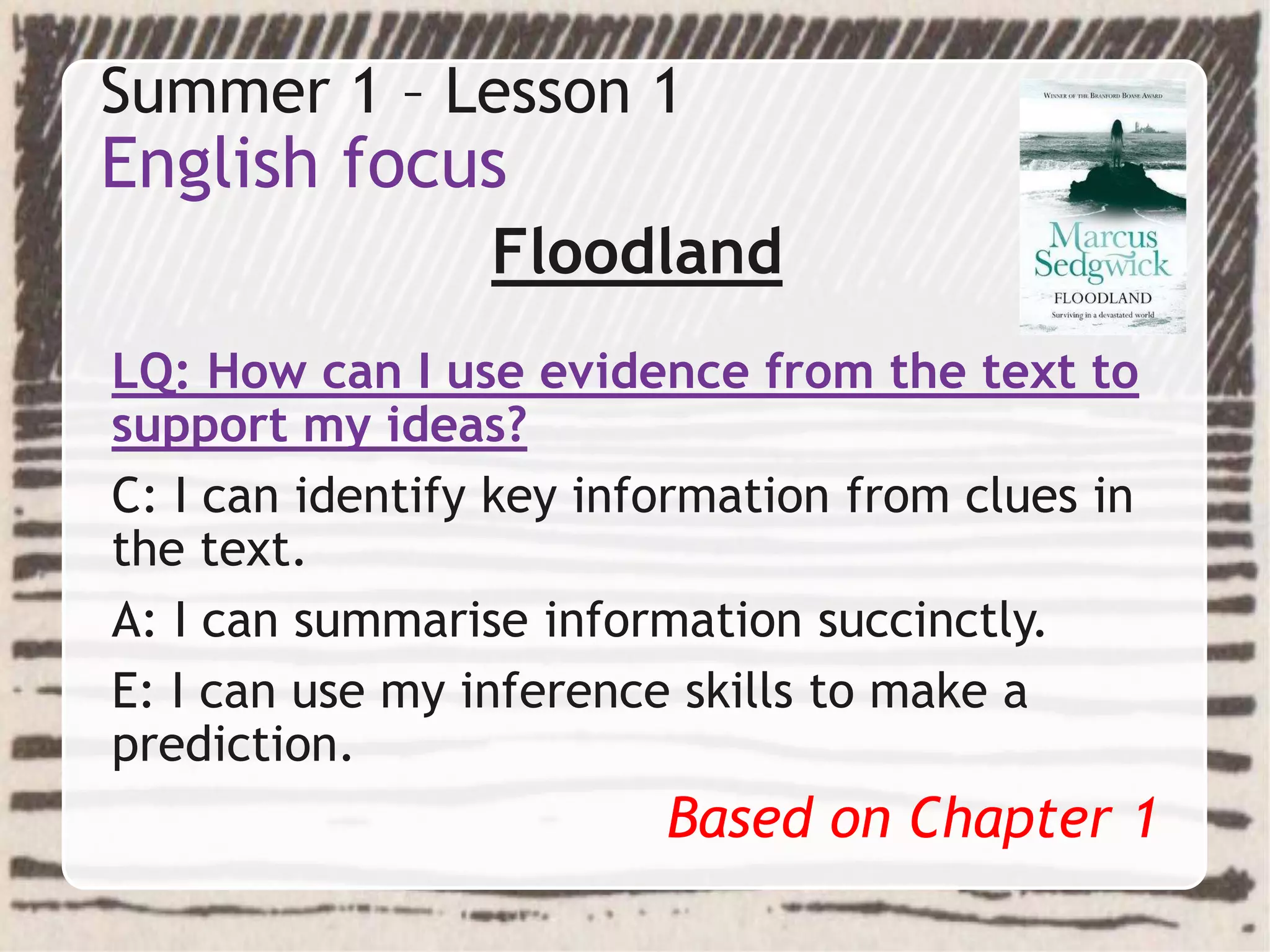
Floodland
LQ: How can I use evidence from the text to
support my ideas?
C: I can identify key information from clues in
the text.
A: I can summarise information succinctly.
E: I can use my inference skills to make a
prediction.
Based on Chapter 1
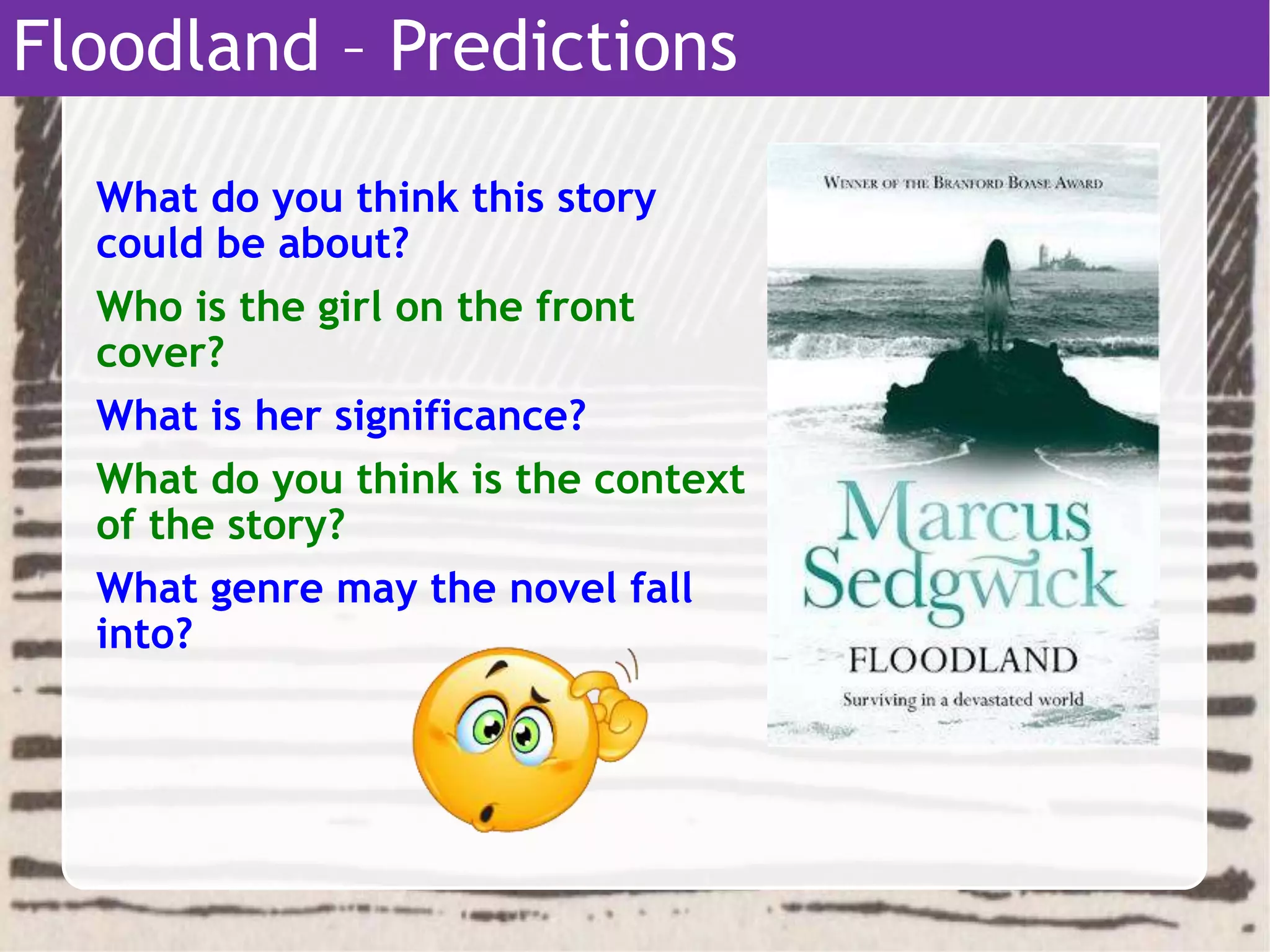
What do you think this story
could be about?
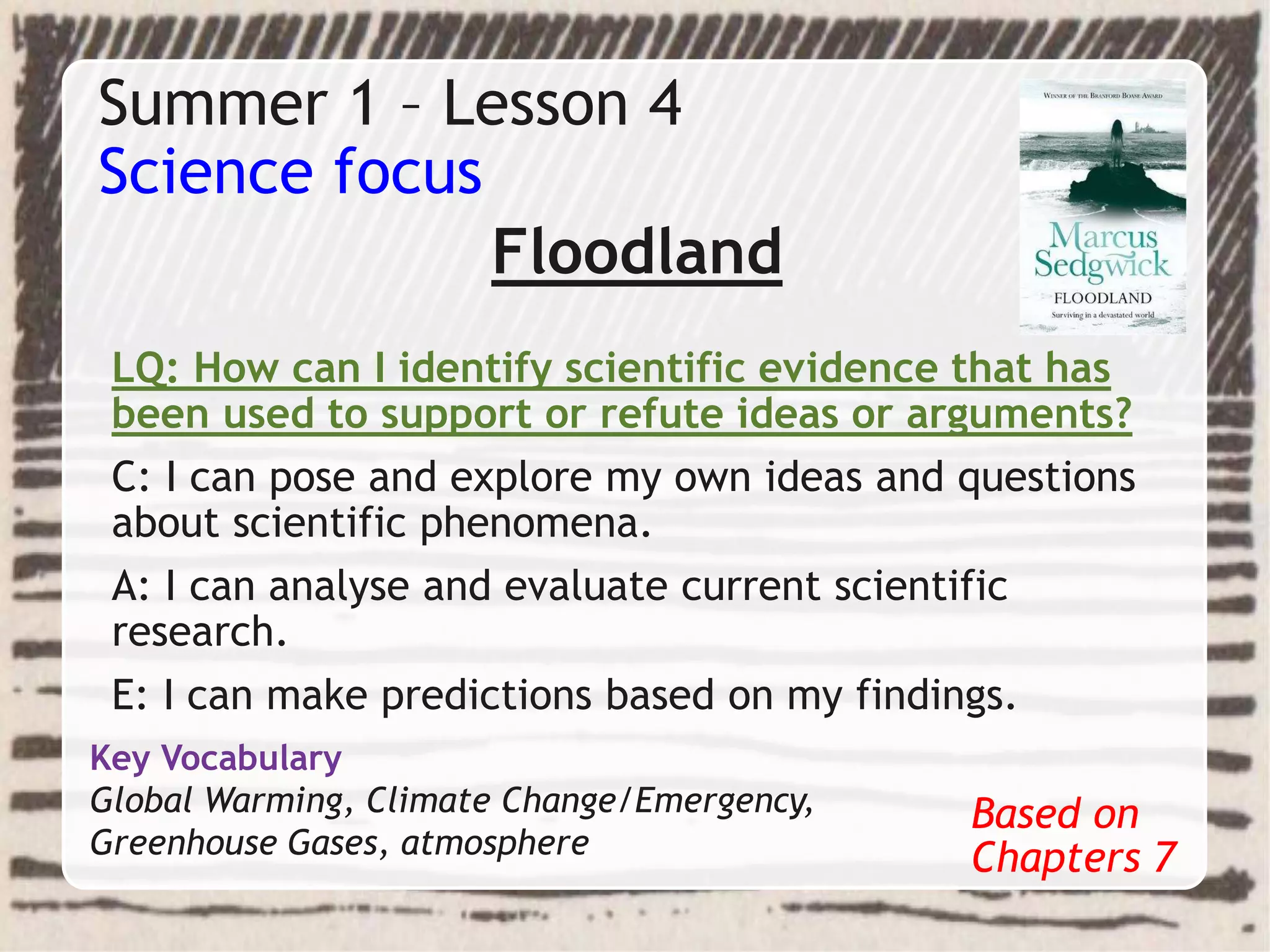
Who is the girl on the front
cover?
What is her significance?
What do you think is the context
of the story?
What genre may the novel fall
into?
Floodland – Predictions
derelict
Norwich
mob
sprawling
ruts
keel
sodden
Task 1: Vocabulary – Research it!
allotments
oars
hunched
compass
methodical
stupor
Zoe ran. Harder than she had ever run in her life.
Her feet pounded through the deserted streets of
derelict buildings. Somewhere, not far behind, she
could hear the gang coming after her. It felt as if her
heart would burst, but she didn’t slow down. She’d
been planning to leave the island for a long time, but
had been putting it off. It was a big decision to set
out to sea in a tiny rowing boat. Now she had no
choice.
What do we know so far about the story, setting and
characters? What do you think will happen next?
Floodland – Chapter 1 (‘Before’)
Before, no one had bothered her. Zoe was a loner.
Most of the people left on Norwich hung around
together in groups, but she preferred to be on her
own. It was safer that way, because you never knew
whom you could trust.
Somehow, someone had found out about the boat
she’d been hiding. A boat was an escape route, a way
to get away from Norwich, which got smaller and
smaller every year, as the sea kept on rising. It didn’t
matter that there could only be room for two people
at most in her boat. Others had joined in the chase,
and now a mob of fifteen people was hot on her
heels. There was only one way out; to get to her boat
before they got to her. So she ran on, while her body
screamed for her to stop.
Floodland – Chapter 1 (‘Before’)
“Get back here!” someone yelled angrily at her,
though they couldn’t see her.
It wasn’t far to the little shed where she’d hidden
Lyca, her boat. A couple more streets of derelict
shops to where what was left of the city fell away
into the sea. If the sea hadn’t come, she might have
been shopping here herself, with her parents
perhaps. From much practice, she squashed the
thought of her parents as soon as it started, and kept
on running.
Just before she rounded a corner, she heard more
shouts from behind. They had seen her.
“There!”
“Come on!” shouted another voice. “Get her!”
Floodland – Chapter 1 (‘Before’)
derelict
Norwich
mob
sprawling
ruts
keel
sodden
Vocabulary – Listen carefully to the rest of the chapter…
allotments
oars
hunched
compass
methodical
stupor
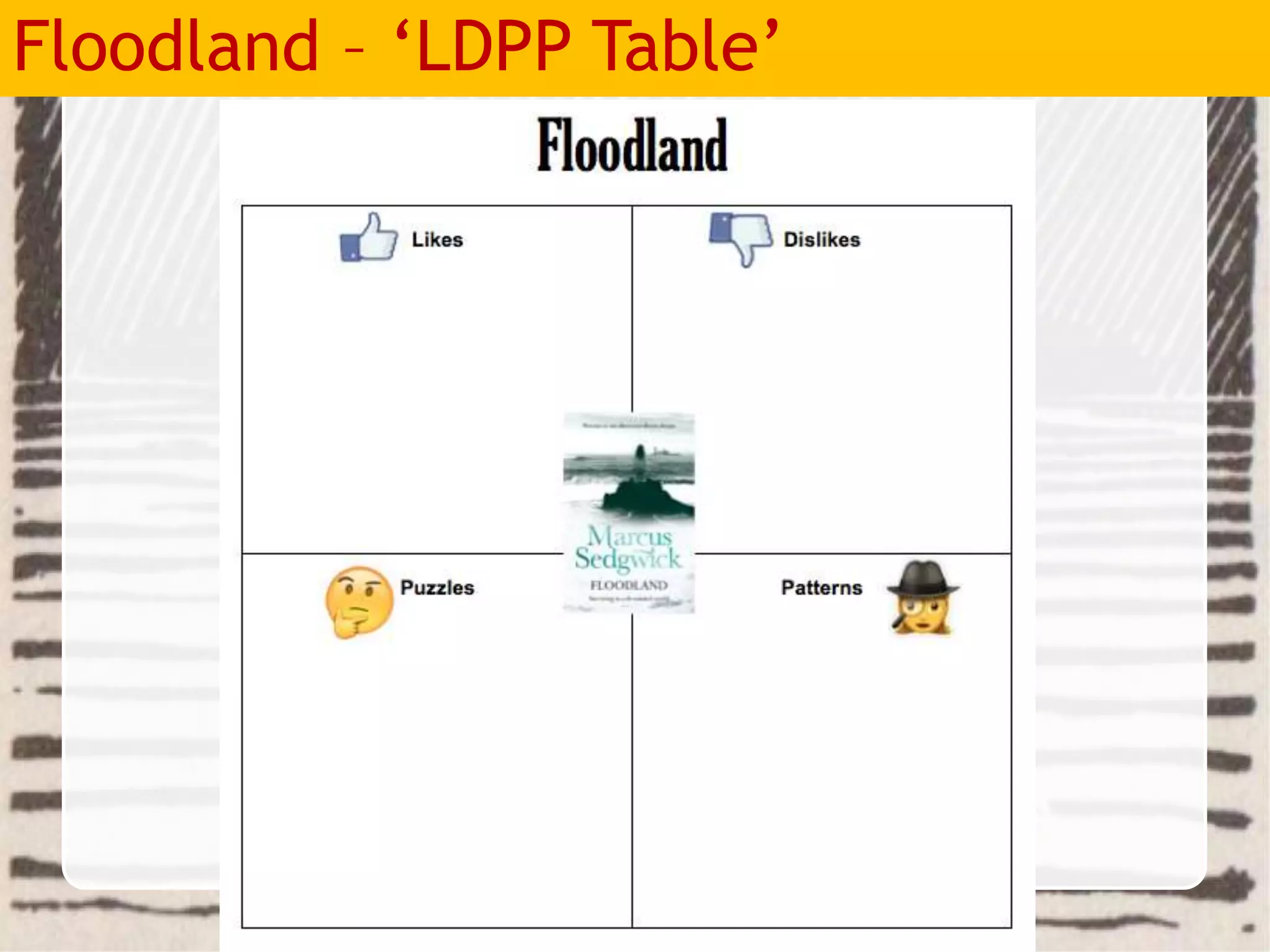
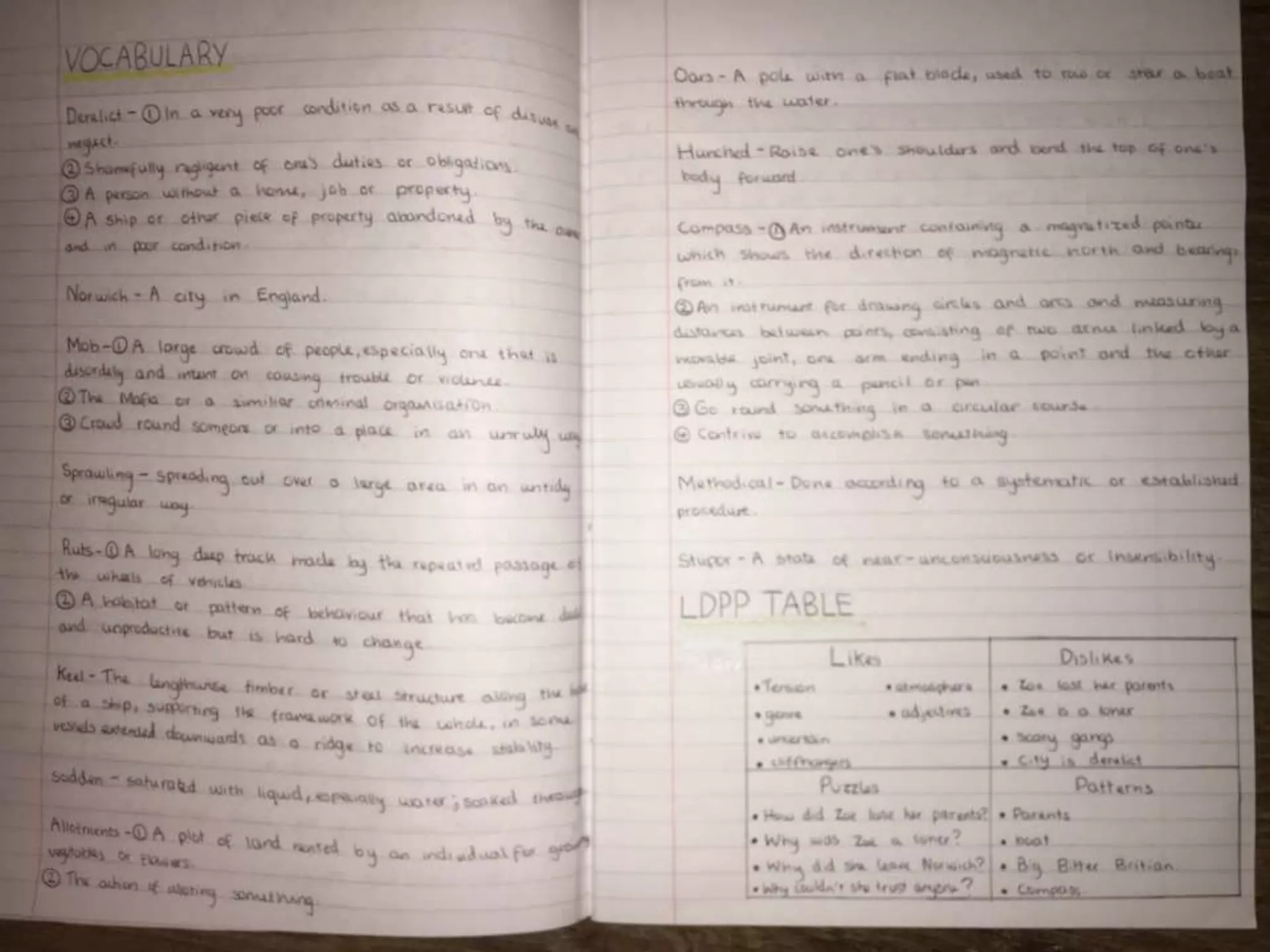
Floodland – ‘LDPP Table’
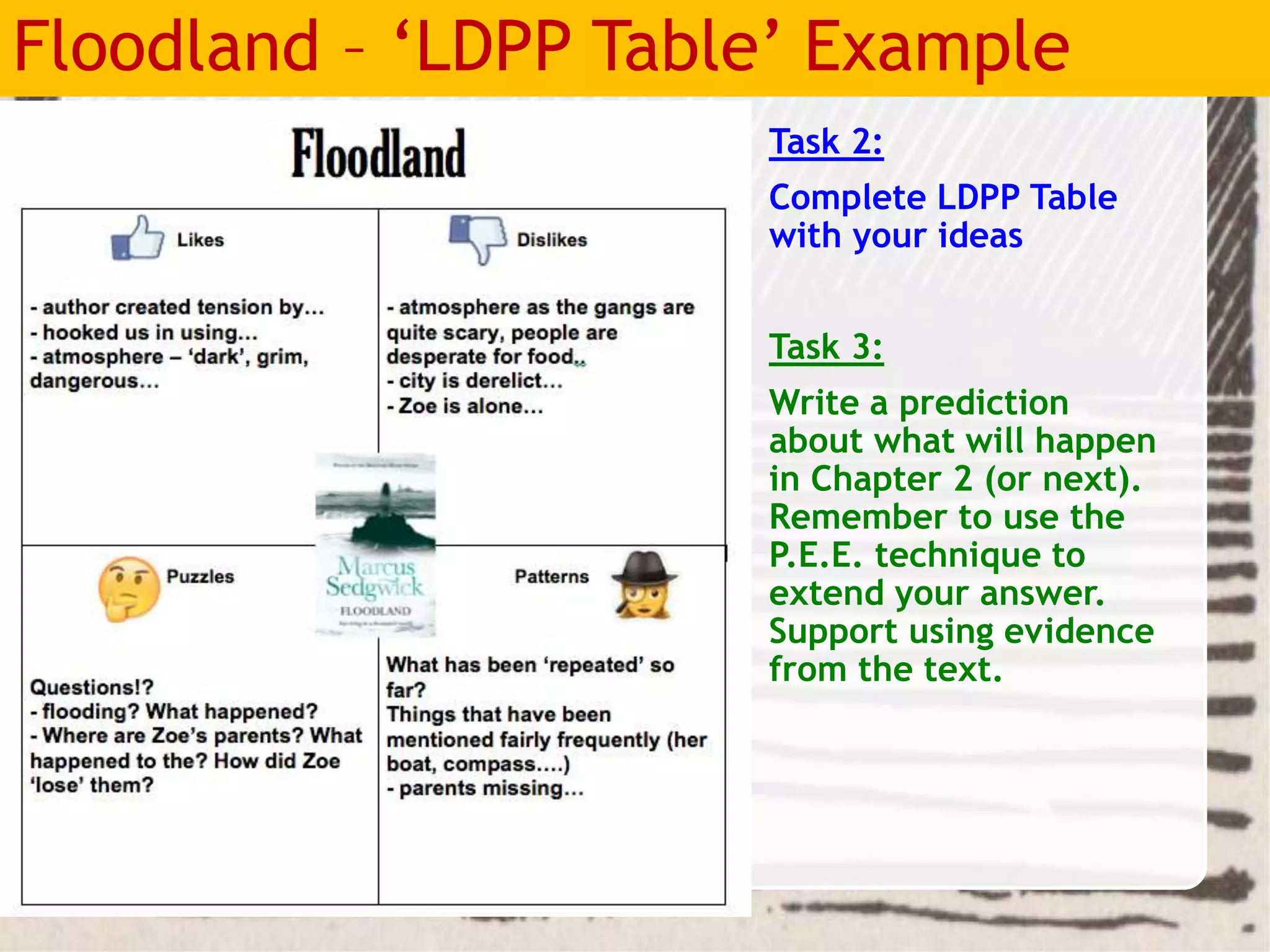
Floodland – ‘LDPP Table’ Example
Task 2:
Complete LDPP Table
with your ideas
Task 3:
Write a prediction
about what will happen
in Chapter 2 (or next).
Remember to use the
P.E.E. technique to
extend your answer.
Support using evidence
from the text.
Summer 1 – Lesson 2
English focus
Floodland
LQ: How can I write descriptively?
C: I can research definitions of key vocabulary.
A: I can use vocabulary to maintain the readers
interest.
E: I can vary my sentence structure.
Based on Chapter 2
derelict
Norwich
mob
sprawling
ruts
keel
sodden
Vocabulary – Review (Before: Chapter 1)
allotments
oars
hunched
compass
methodical
stupor
Vocabulary – Review (Before: Chapter 1)
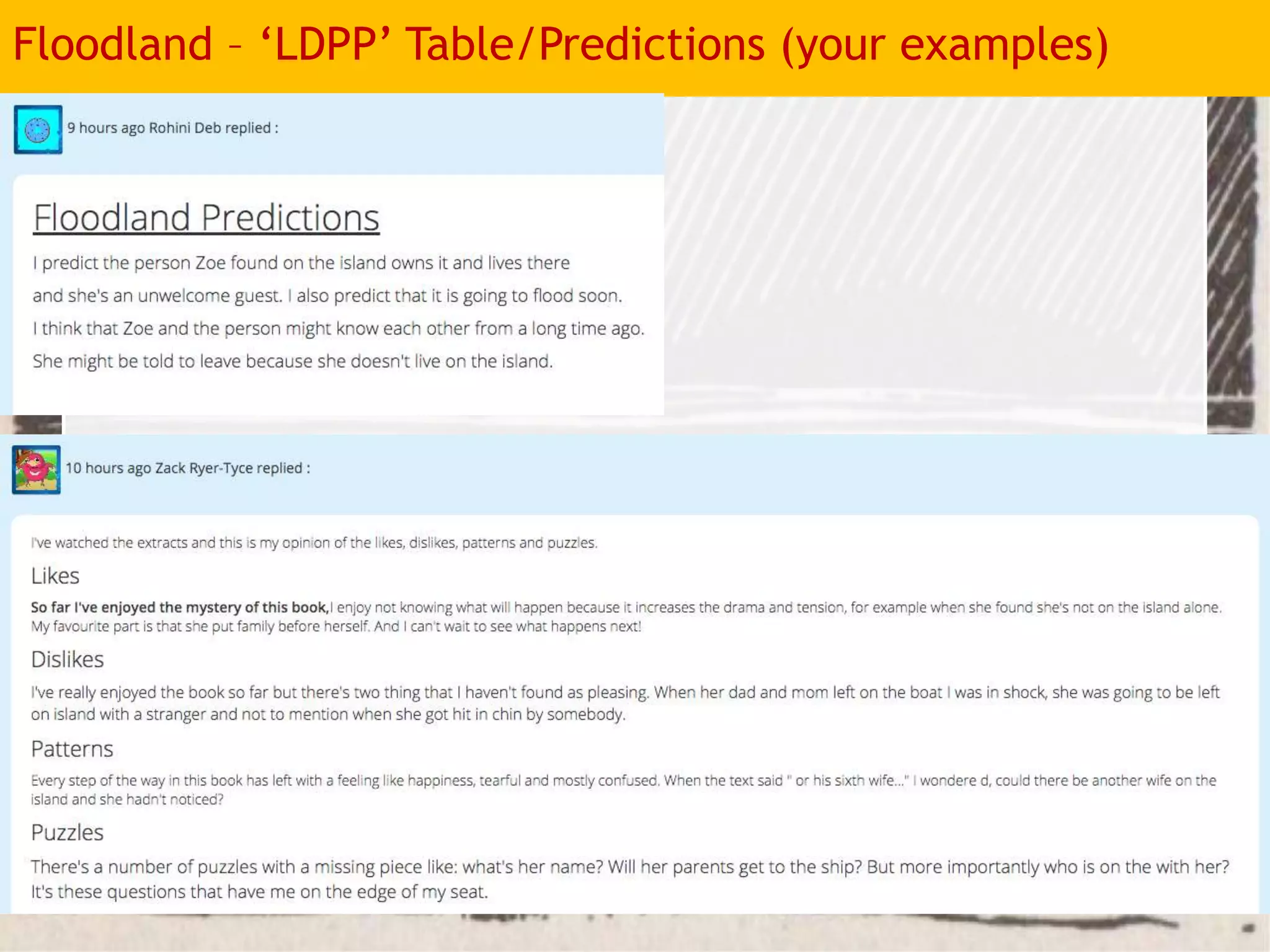
Floodland – ‘LDPP’ Table/Predictions (your examples)
Bella Adams
Floodland – ‘LDPP’ Table/Predictions (your examples)
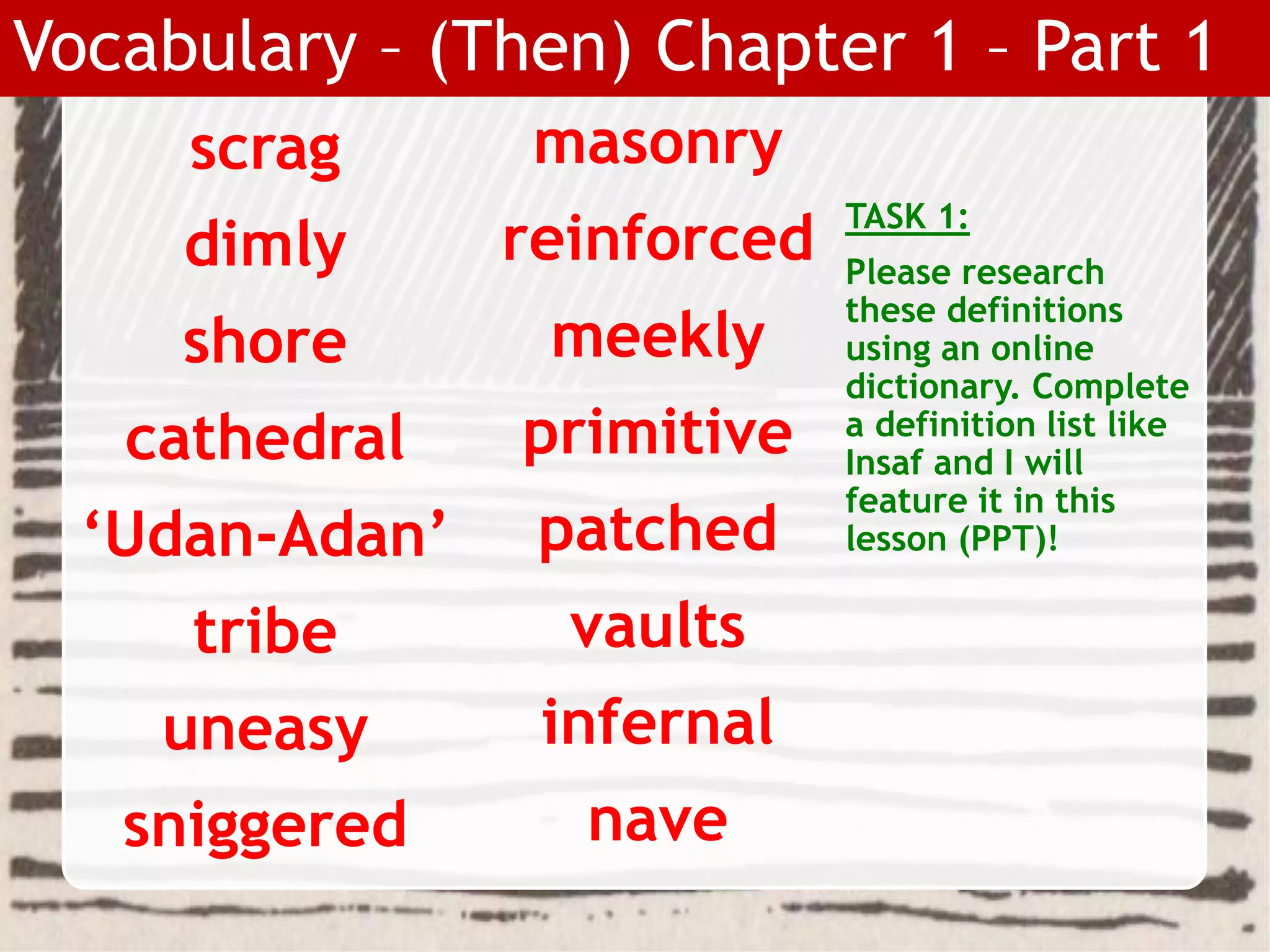
scrag
dimly
shore
cathedral
‘Udan-Adan’
tribe
uneasy
sniggered
TASK 1:
Please research
these definitions
using an online
dictionary. Complete
a definition list like
Insaf and I will
feature it in this
lesson (PPT)!
Vocabulary – (Then) Chapter 1 – Part 1
masonry
reinforced
meekly
primitive
patched
vaults
infernal
nave
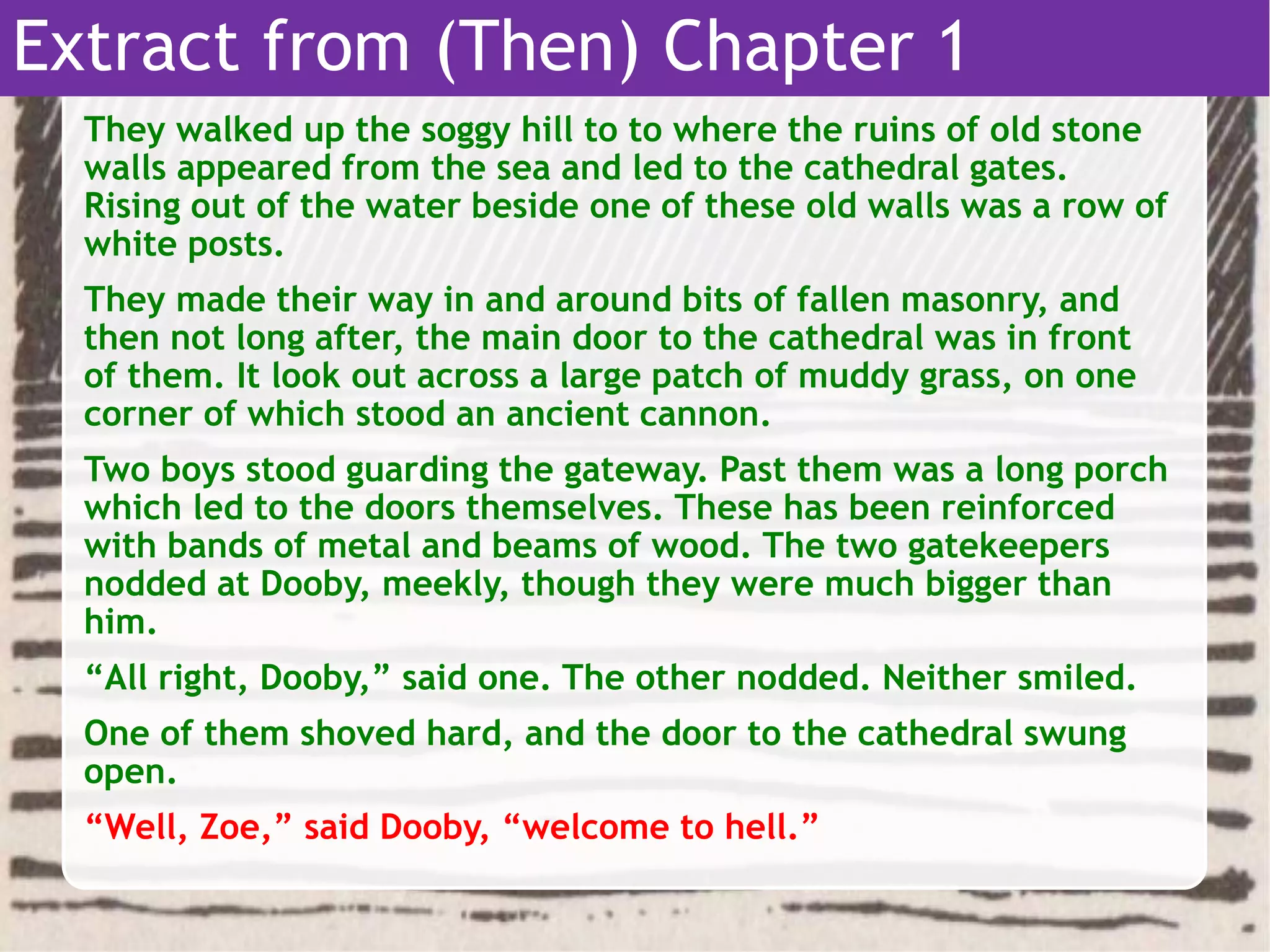
They walked up the soggy hill to to where the ruins of old stone
walls appeared from the sea and led to the cathedral gates.
Rising out of the water beside one of these old walls was a row of
white posts.
They made their way in and around bits of fallen masonry, and
then not long after, the main door to the cathedral was in front
of them. It look out across a large patch of muddy grass, on one
corner of which stood an ancient cannon.
Two boys stood guarding the gateway. Past them was a long porch
which led to the doors themselves. These has been reinforced
with bands of metal and beams of wood. The two gatekeepers
nodded at Dooby, meekly, though they were much bigger than
him.
“All right, Dooby,” said one. The other nodded. Neither smiled.
One of them shoved hard, and the door to the cathedral swung
open.
“Well, Zoe,” said Dooby, “welcome to hell.”
Extract from (Then) Chapter 1
“Well, Zoe,” said Dooby, “welcome to hell.”
Your challenge is to describe the scene that faces Zoe,
which Dooby has likened to ‘hell’.
- What makes it look or feel like ‘hell’?
- Think carefully about the lighting (or lack of), the possible
inhabitants (people present), and what might remain of the
cathedral.
- What sort of conditions would people be surviving in?
- How might the inhabitants be clothed? What is the atmosphere?
The smell…? I doubt there would be many bathroom facilities in a
cathedral!
Use the same techniques we discussed from the lesson where we
wrote setting descriptions after Emily Grazebrook came to visit
(Victorian Ghost Story!).
Task 2: Descriptive Writing
Want to hear Part 2?
Upload your examples to ‘Gallery: Your Work’ and I will add it below.
Part 2 of this particular chapter will not be released until I have seen
enough evidence of your writing!
Use this document to help you
(Descriptosaurus!):
Descriptive Writing – Your examples!
https://www.routledge.com/rsc/downloa
ds/temp_file_Descriptosaurus_Genre_Writ
ing_Toolkit1.pdf
Summer 1 – Lesson 3
English focus
Floodland
LQ: How can I use evidence from the text to
support my ideas?
C: I can identify key information from clues in
the text.
A: I can summarise information succinctly.
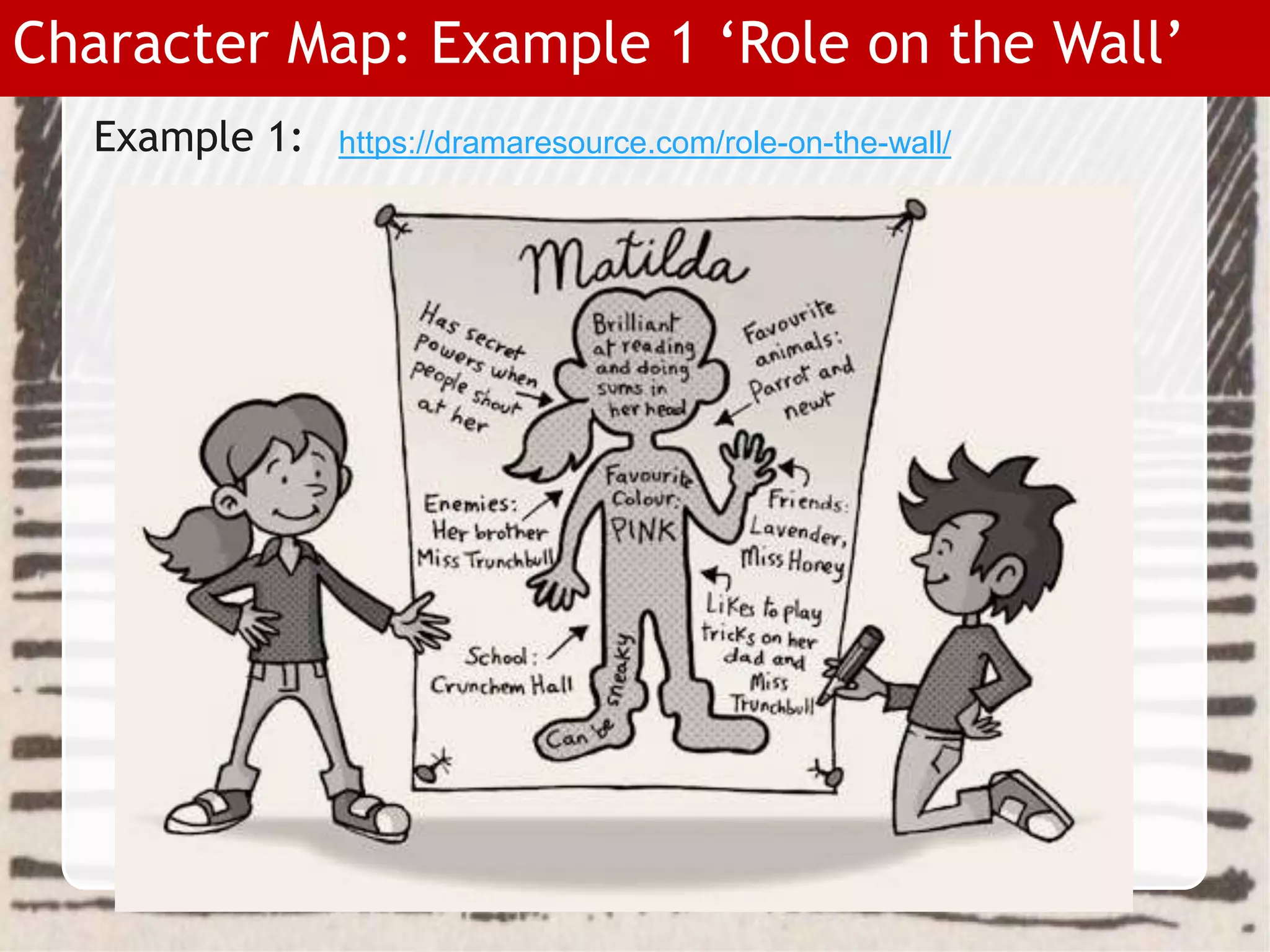
E: I can create character maps.
Based on ALL chapters
Watch this particular vlog (link above) for an
explanation as to how you could do the character
maps – don’t worry, you only need to watch the first 3
minutes!
Summary: Using evidence from the text (recordings)
do far, create character maps for the main characters
of Zoe, Dooby and William. I suggest you complete one
Munchkin and Spat too. Molly and Sarah are optional
and could be combined if needed.
https://www.youtube.com/watch?v
=fJziPMatxt0&feature=emb_title
Task: Character Maps
Example 1: https://dramaresource.com/role-on-the-wall/
Character Map: Example 1 ‘Role on the Wall’
Character Map: Example 1 ‘Word Cloud’
Summer 1 – Lesson 3
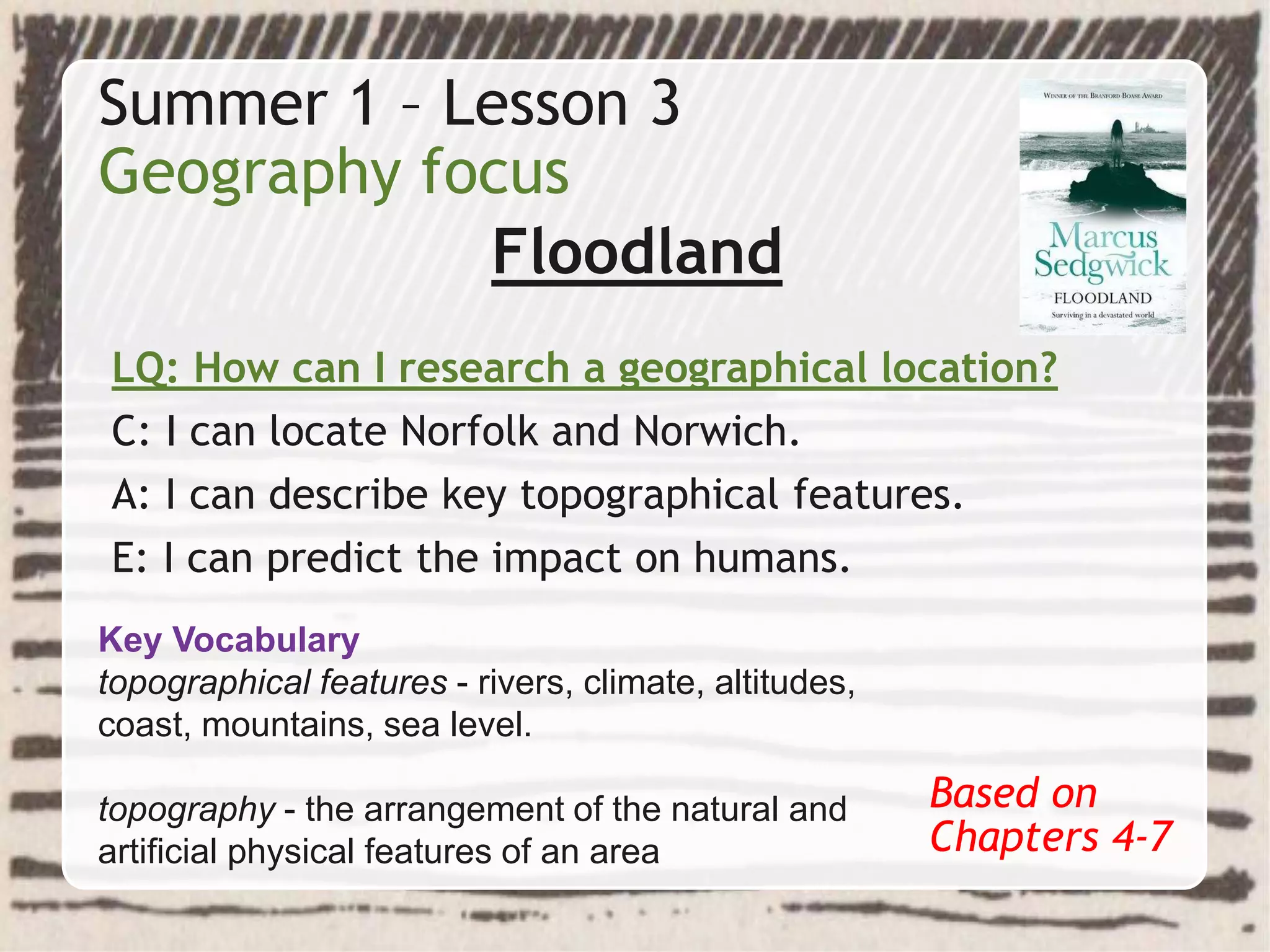
Geography focus
Floodland
LQ: How can I research a geographical location?
C: I can locate Norfolk and Norwich.
A: I can describe key topographical features.
E: I can predict the impact on humans.
Based on
Chapters 4-7
Key Vocabulary
topographical features - rivers, climate, altitudes,
coast, mountains, sea level.
topography - the arrangement of the natural and
artificial physical features of an area
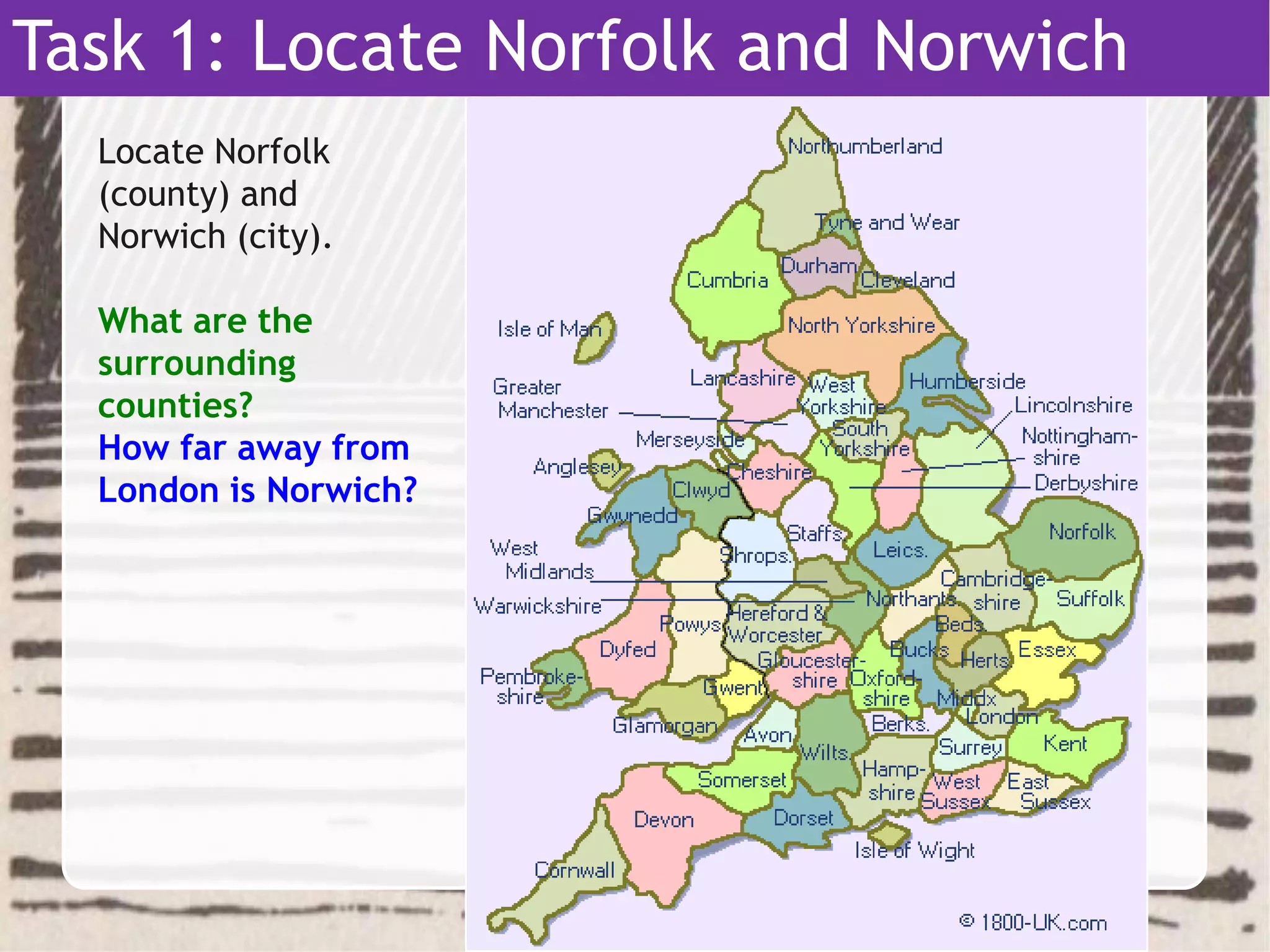
Task 1: Locate Norfolk and Norwich
Locate Norfolk
(county) and
Norwich (city).
What are the
surrounding
counties?
How far away from
London is Norwich?
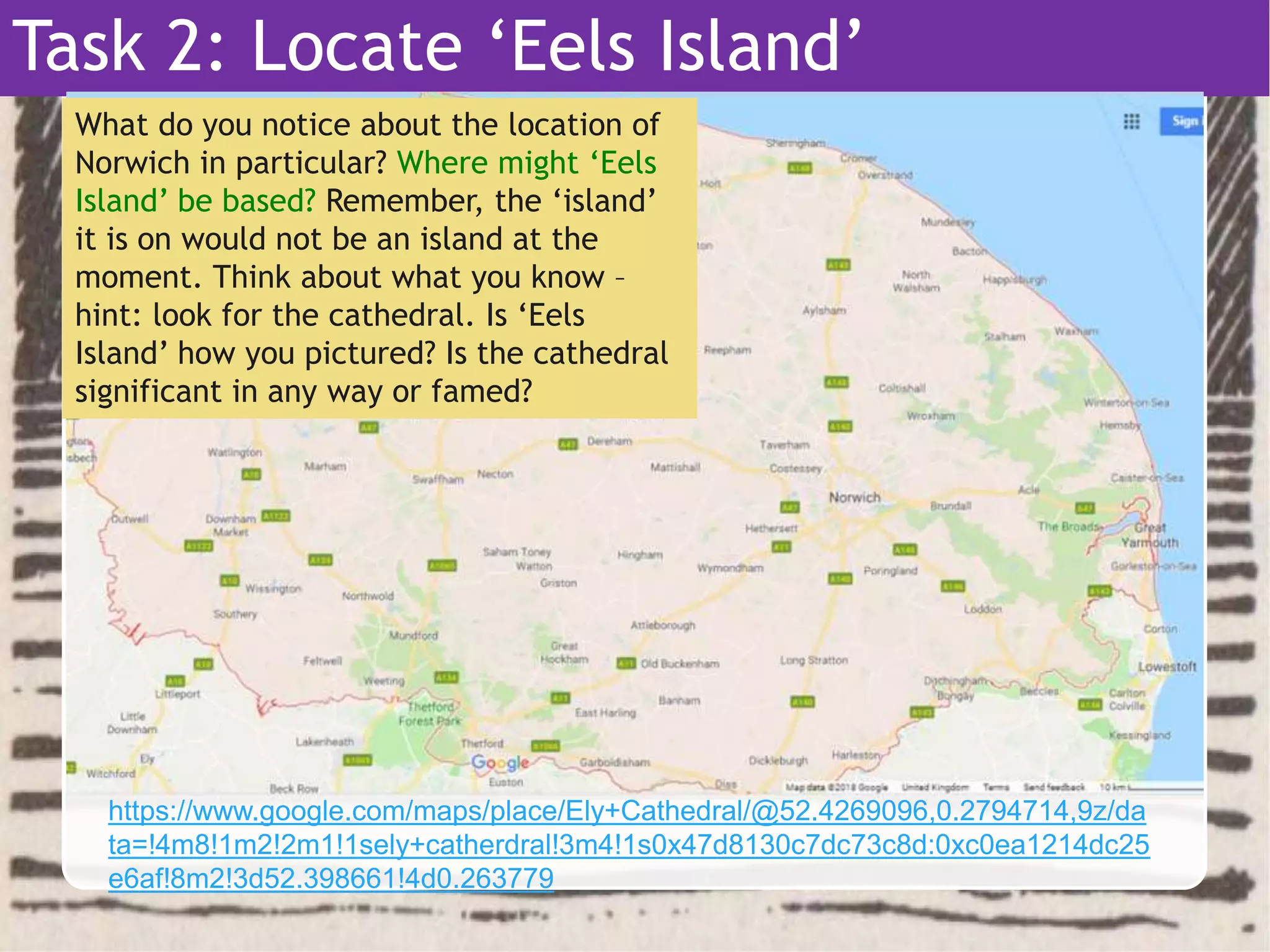
Task 2: Locate ‘Eels Island’
What do you notice about the location of
Norwich in particular? Where might ‘Eels
Island’ be based? Remember, the ‘island’
it is on would not be an island at the
moment. Think about what you know –
hint: look for the cathedral. Is ‘Eels
Island’ how you pictured? Is the cathedral
significant in any way or famed?
https://www.google.com/maps/place/Ely+Cathedral/@52.4269096,0.2794714,9z/da
ta=!4m8!1m2!2m1!1sely+catherdral!3m4!1s0x47d8130c7dc73c8d:0xc0ea1214dc25
e6af!8m2!3d52.398661!4d0.263779
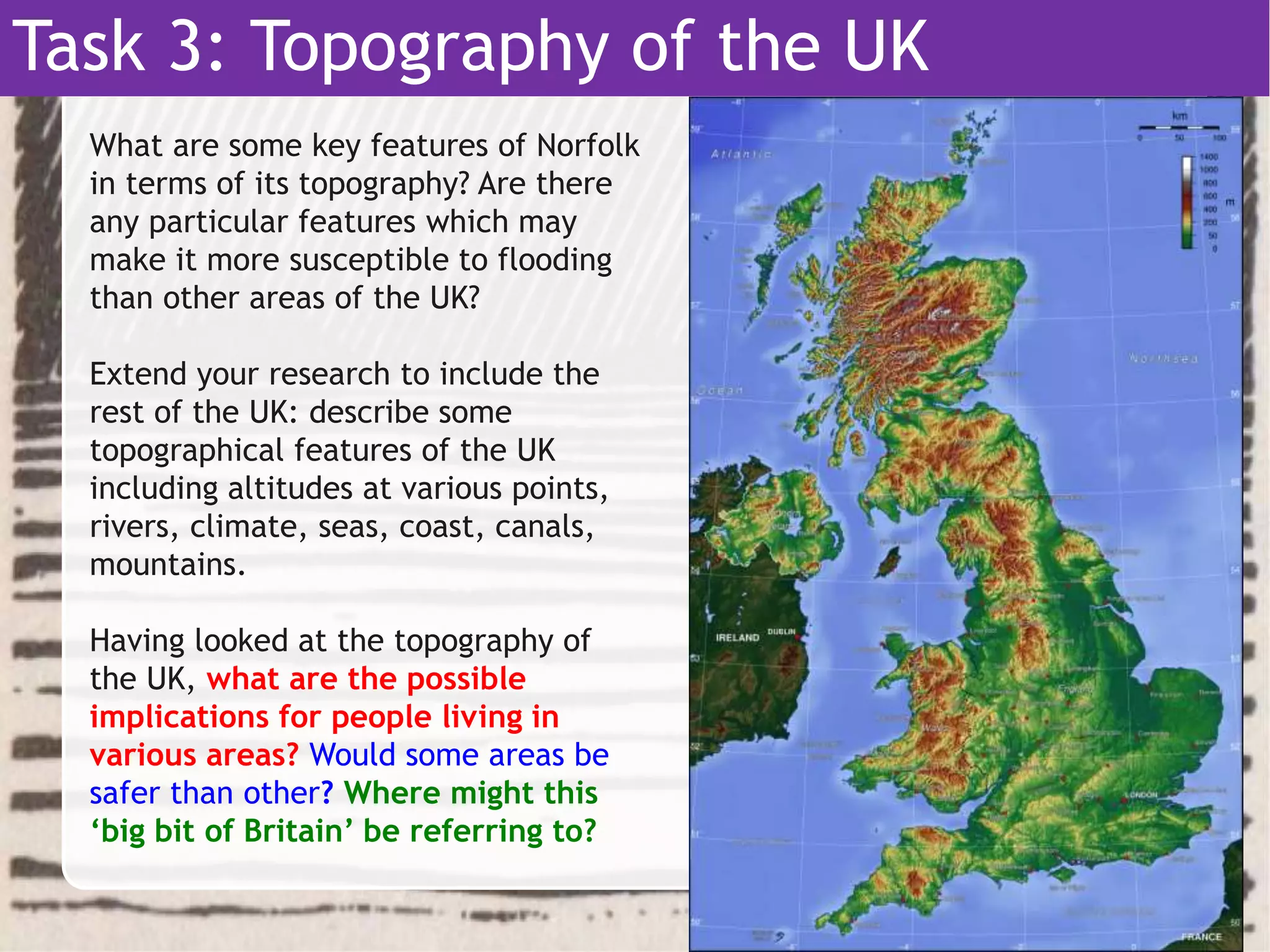
Task 3: Topography of the UK
What are some key features of Norfolk
in terms of its topography? Are there
any particular features which may
make it more susceptible to flooding
than other areas of the UK?
Extend your research to include the
rest of the UK: describe some
topographical features of the UK
including altitudes at various points,
rivers, climate, seas, coast, canals,
mountains.
Having looked at the topography of
the UK, what are the possible
implications for people living in
various areas? Would some areas be
safer than other? Where might this
‘big bit of Britain’ be referring to?
Gather as much information about Norwich and its
surrounding areas as much as possible. Your upcoming
task will be to write a report (ideally news related)
about floods either in this area and/or your local area!
This will be your next challenge – more to follow….
Use some of the documents on the Floodland page to
help with your research.
Looking ahead…
Gather as much information about Norwich and its
surrounding areas as much as possible. Your upcoming
task will be to write a report (ideally news related)
about floods either in this area and/or your local area!
This will be your next challenge – more to follow….
Use some of the documents on the Floodland page to
help with your research.
Looking ahead…
Summer 1 – Lesson 4
Science focus
Floodland
LQ: How can I identify scientific evidence that has
been used to support or refute ideas or arguments?
C: I can pose and explore my own ideas and questions
about scientific phenomena.
A: I can analyse and evaluate current scientific
research.
E: I can make predictions based on my findings.
Based on
Chapters 7
Key Vocabulary
Global Warming, Climate Change/Emergency,
Greenhouse Gases, atmosphere
• Climate Change refers to changes in
the world’s atmosphere.
• It includes a rise in average global
temperature and changes in rainfall,
and other weather patterns.
What is Climate Change?
What is causing
Climate Change?
• At the heart of Climate Change is
the GREENHOUSE EFFECT.
The Greenhouse Effect
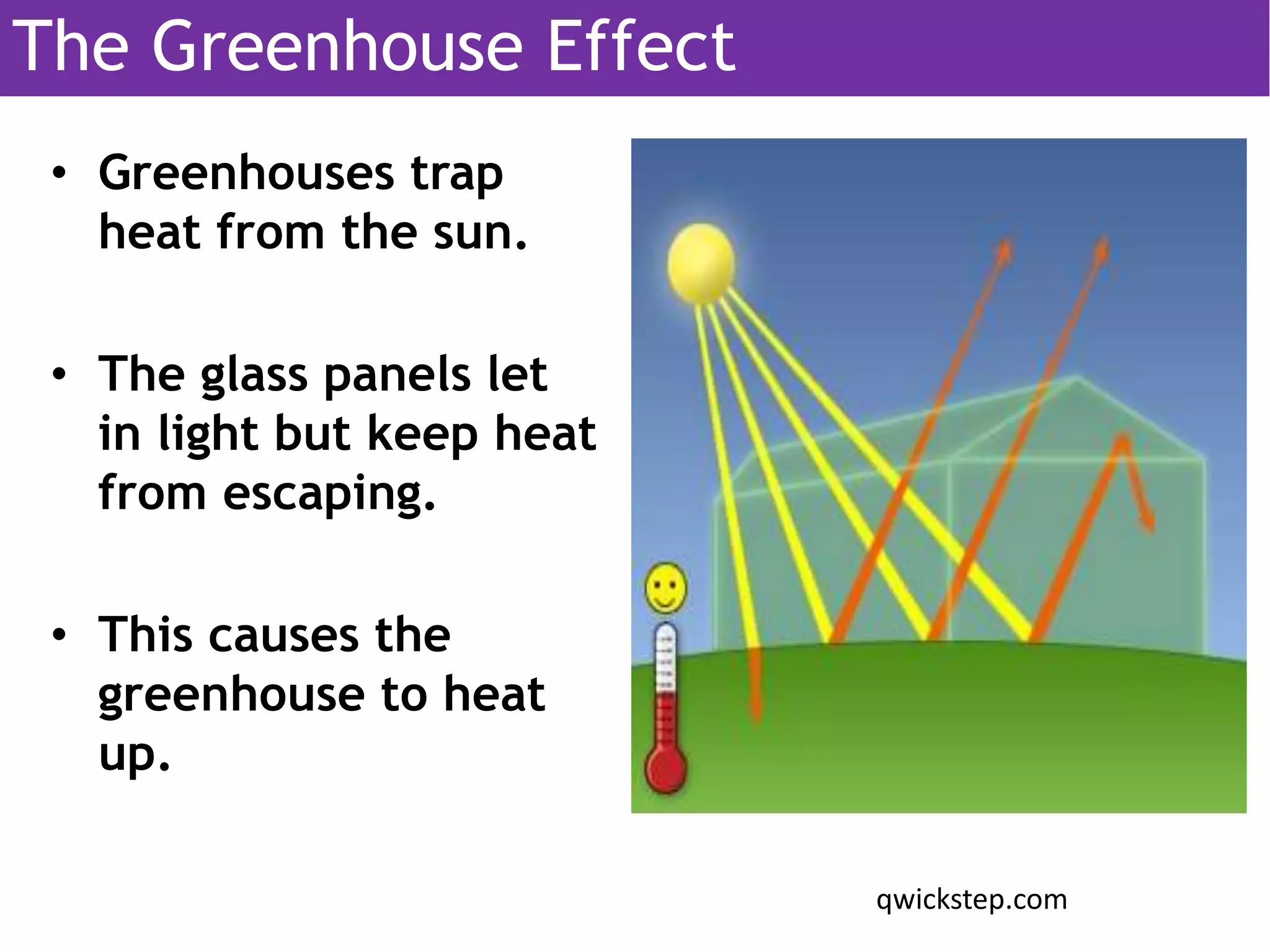
• Greenhouses trap
heat from the sun.
• The glass panels let
in light but keep heat
from escaping.
• This causes the
greenhouse to heat
up.
qwickstep.com
The Greenhouse Effect
• The same thing happens when a car is left in
direct sunlight.
The Greenhouse Effect
0n Earth, the
atmospheric
gases allow
sunshine to pass
through but it
also absorbs heat
that is radiated
(bounced) back
from the warmed
surface of the
Earth. kirklees.gov.uk
The Greenhouse Effect
solcomhouse.com
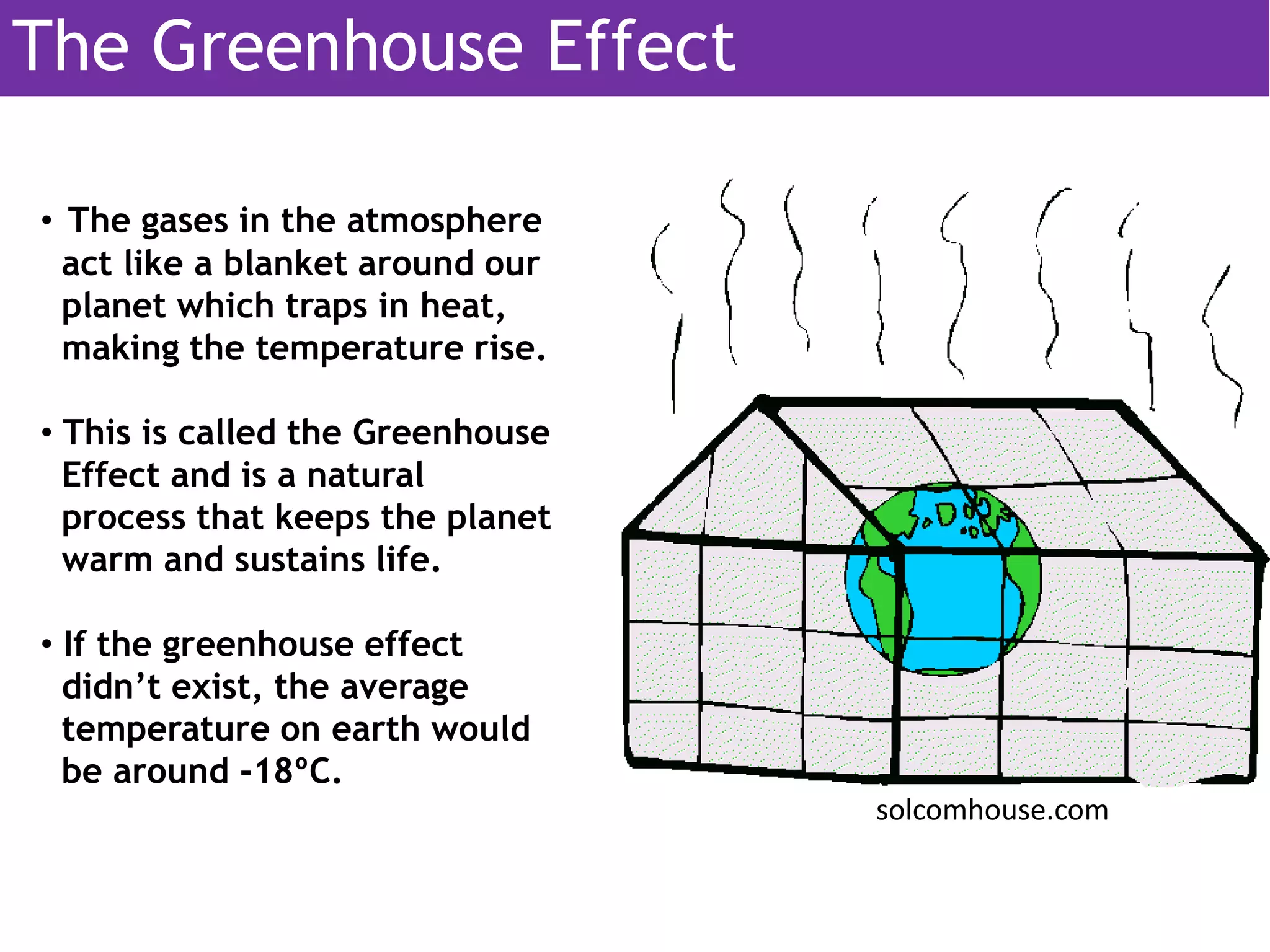
• The gases in the atmosphere
act like a blanket around our
planet which traps in heat,
making the temperature rise.
• This is called the Greenhouse
Effect and is a natural
process that keeps the planet
warm and sustains life.
• If the greenhouse effect
didn’t exist, the average
temperature on earth would
be around -18ºC.
The Greenhouse Effect
Without
greenhouse gases,
heat would
escape back into
space and Earth’s
average
temperature
would be about
16ºC colder...
The Greenhouse Effect
...and the
Earth would
not be warm
enough for
humans to
live!
The Greenhouse Effect
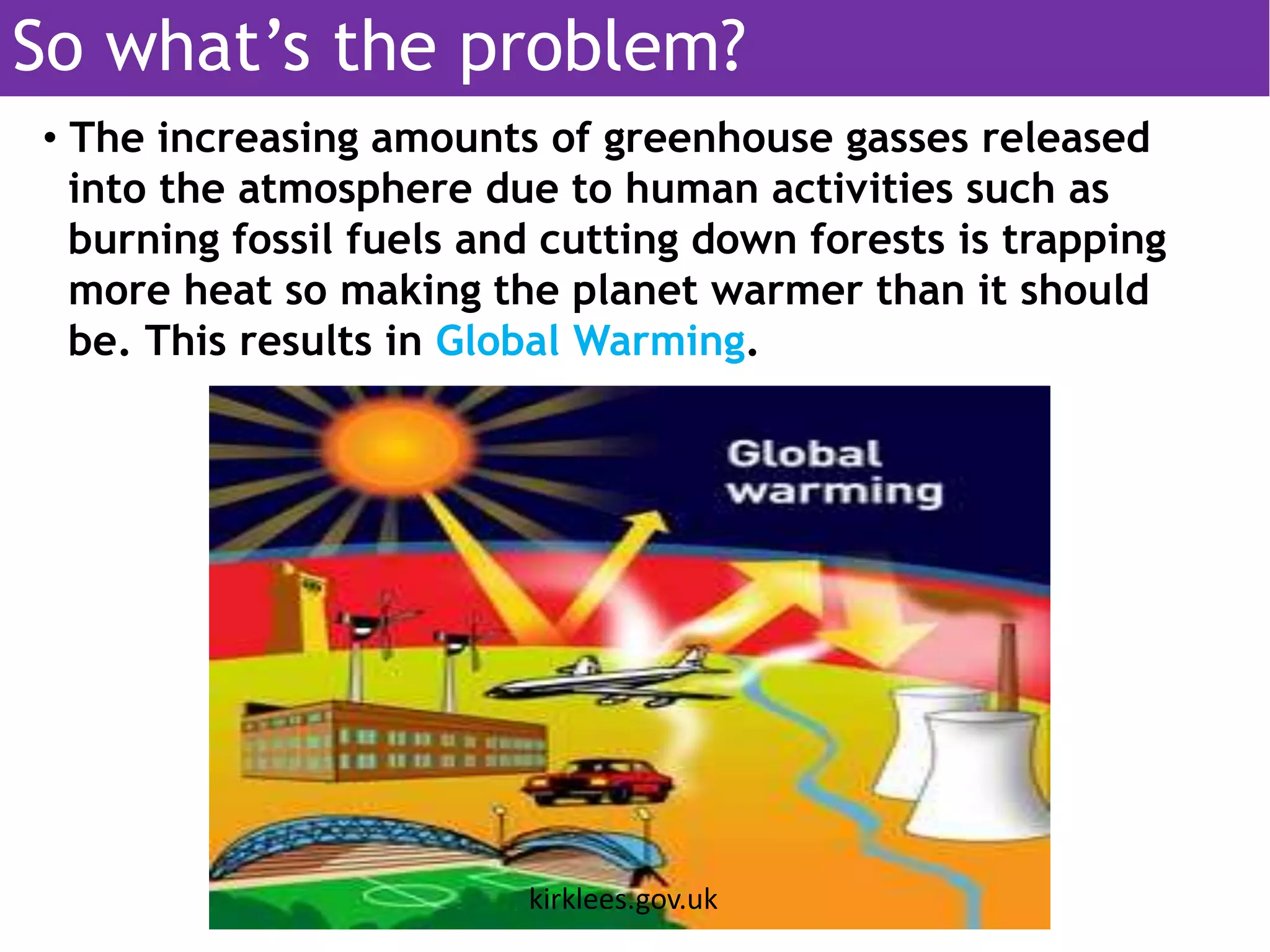
• The increasing amounts of greenhouse gasses released
into the atmosphere due to human activities such as
burning fossil fuels and cutting down forests is trapping
more heat so making the planet warmer than it should
be. This results in Global Warming.
kirklees.gov.uk
So what’s the problem?
newscientist.com
Global Warming
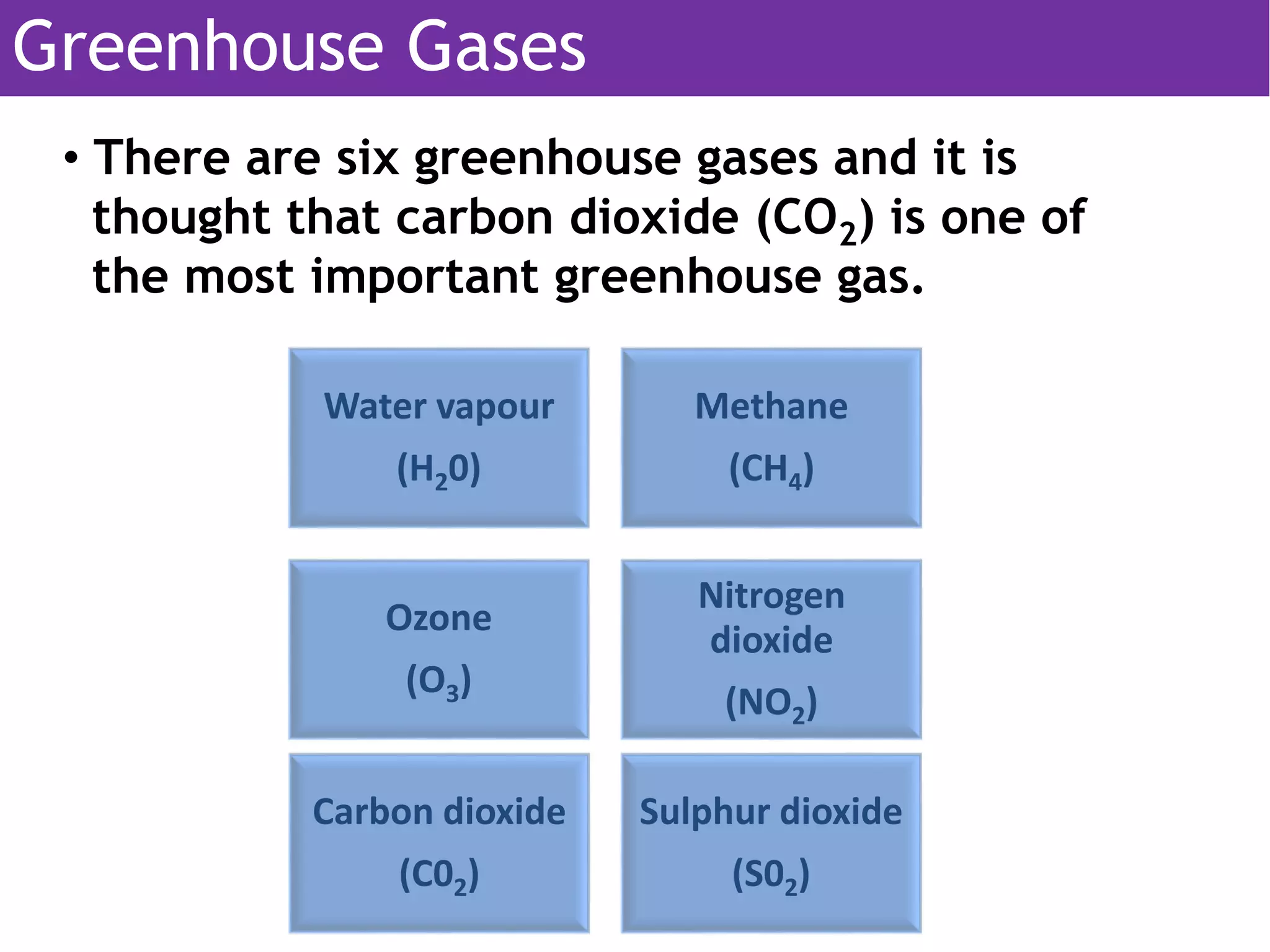
• There are six greenhouse gases and it is
thought that carbon dioxide (CO2) is one of
the most important greenhouse gas.
Water vapour
(H20)
Methane
(CH4)
Ozone
(O3)
Nitrogen
dioxide
(NO2)
Carbon dioxide
(C02)
Sulphur dioxide
(S02)
Greenhouse Gases
Greenhouse gases can come
from;
1. Natural sources
2. Man-Made sources
Greenhouse Gases
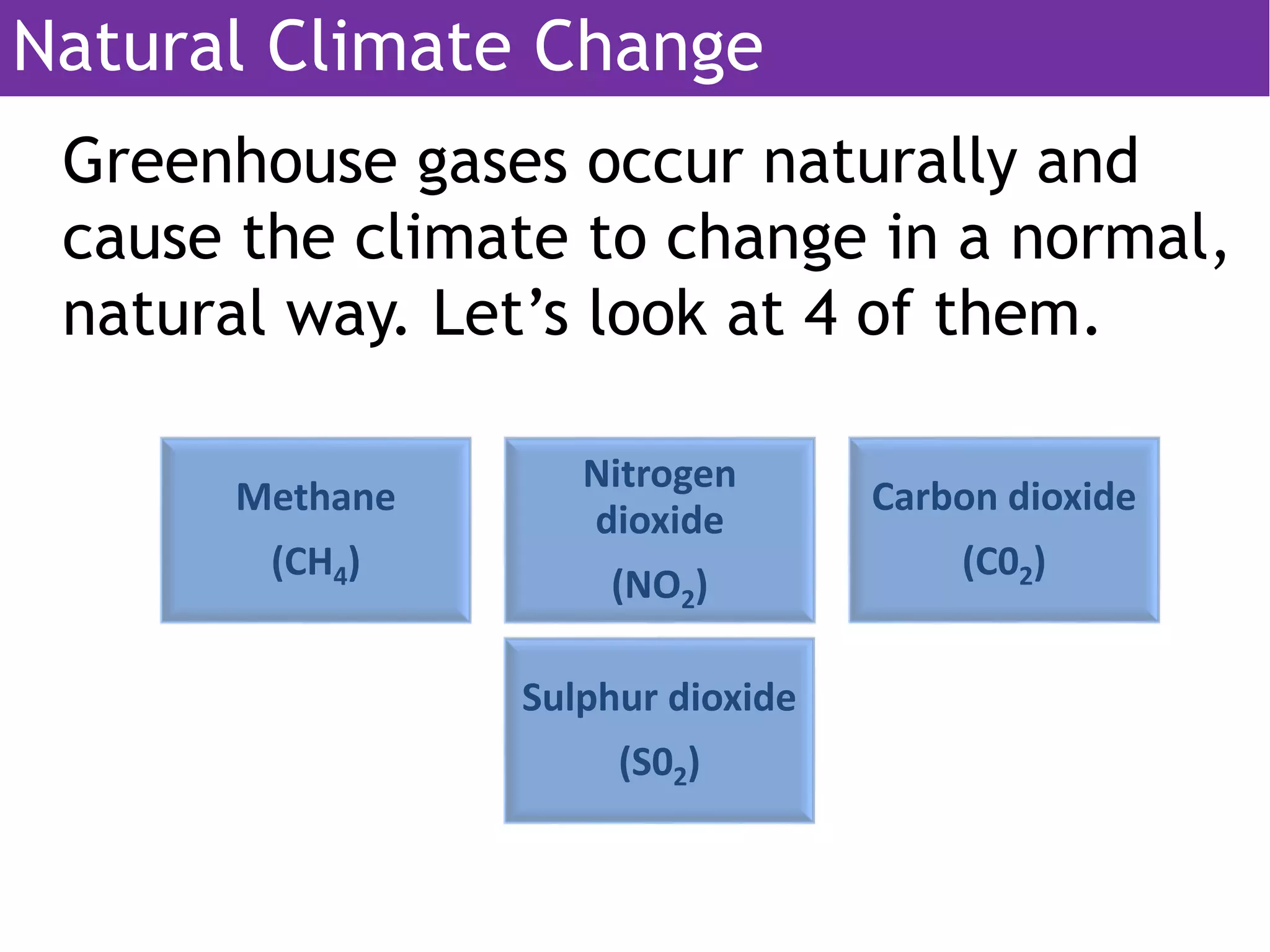
Greenhouse gases occur naturally and
cause the climate to change in a normal,
natural way. Let’s look at 4 of them.
Methane
(CH4)
Nitrogen
dioxide
(NO2)
Carbon dioxide
(C02)
Sulphur dioxide
(S02)
Natural Climate Change
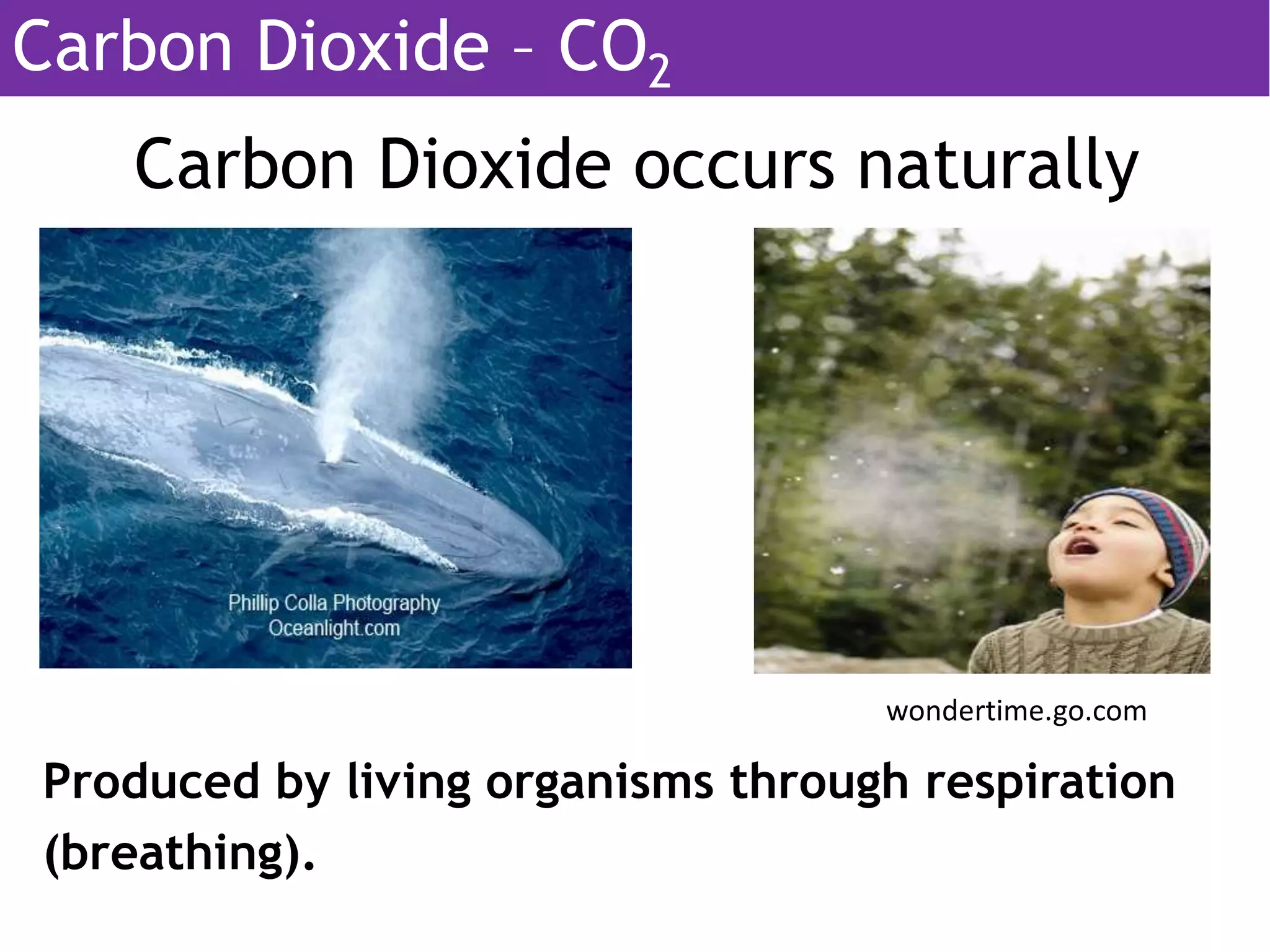
Carbon Dioxide occurs naturally
Produced by living organisms through respiration
(breathing).
wondertime.go.com
Carbon Dioxide – CO2
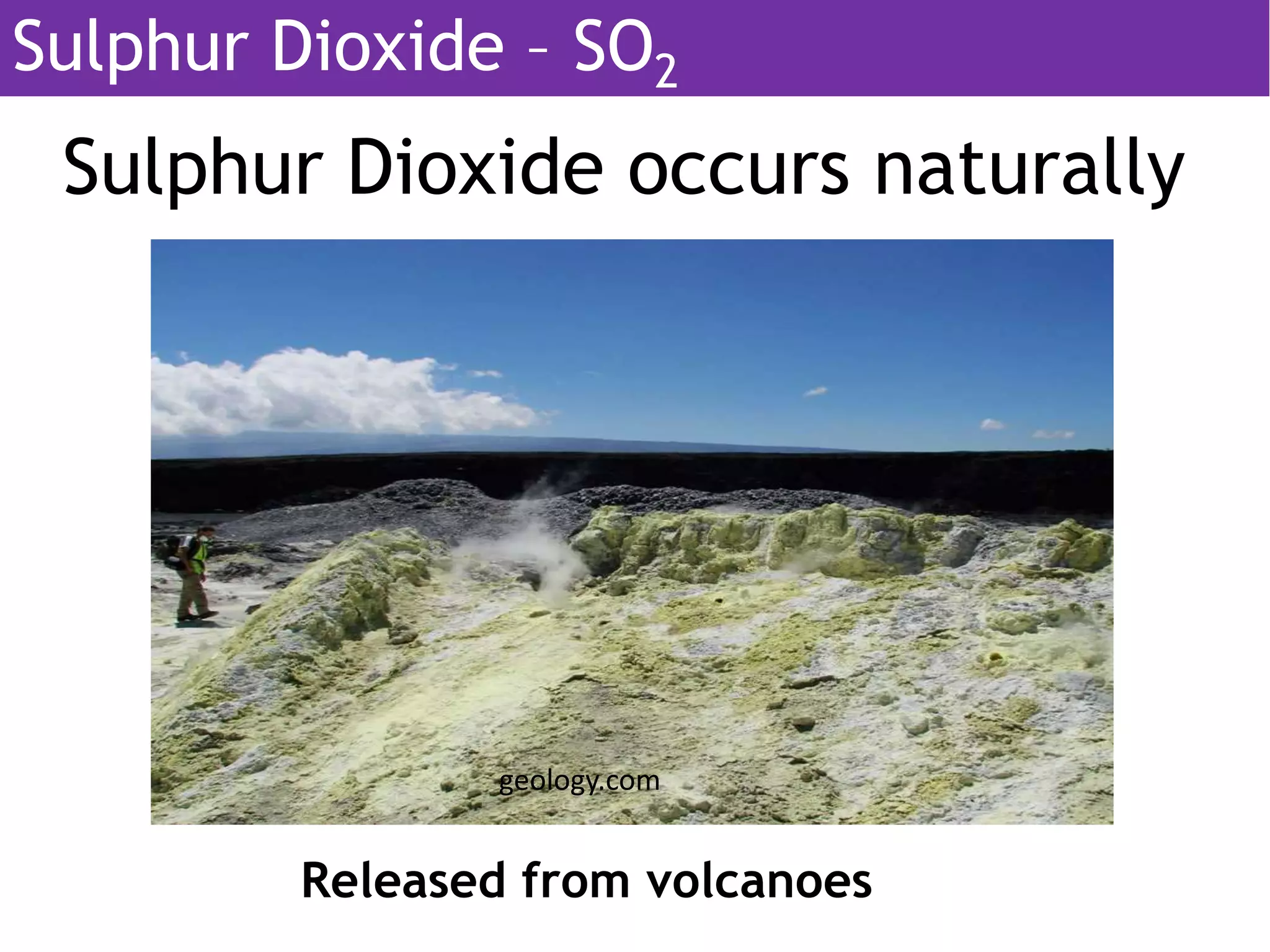
Sulphur Dioxide occurs naturally
Released from volcanoes
geology.com
Sulphur Dioxide – SO2
Methane occurs naturally
Decomposition of organic matter (especially in wetlands).
michellehenry.fr
Methane – CH4
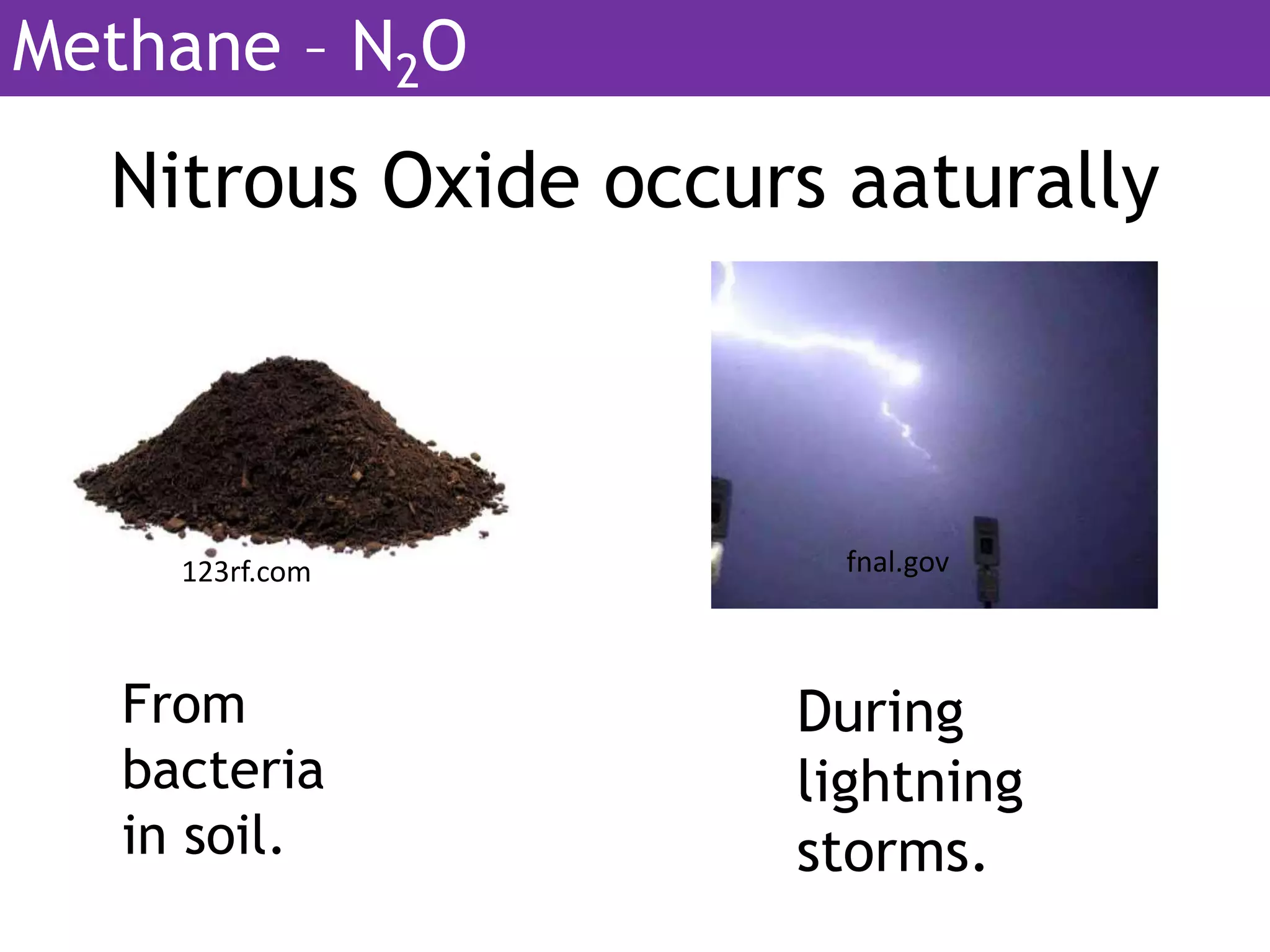
Nitrous Oxide occurs aaturally
From
bacteria
in soil.
During
lightning
storms.
fnal.gov123rf.com
Methane – N2O
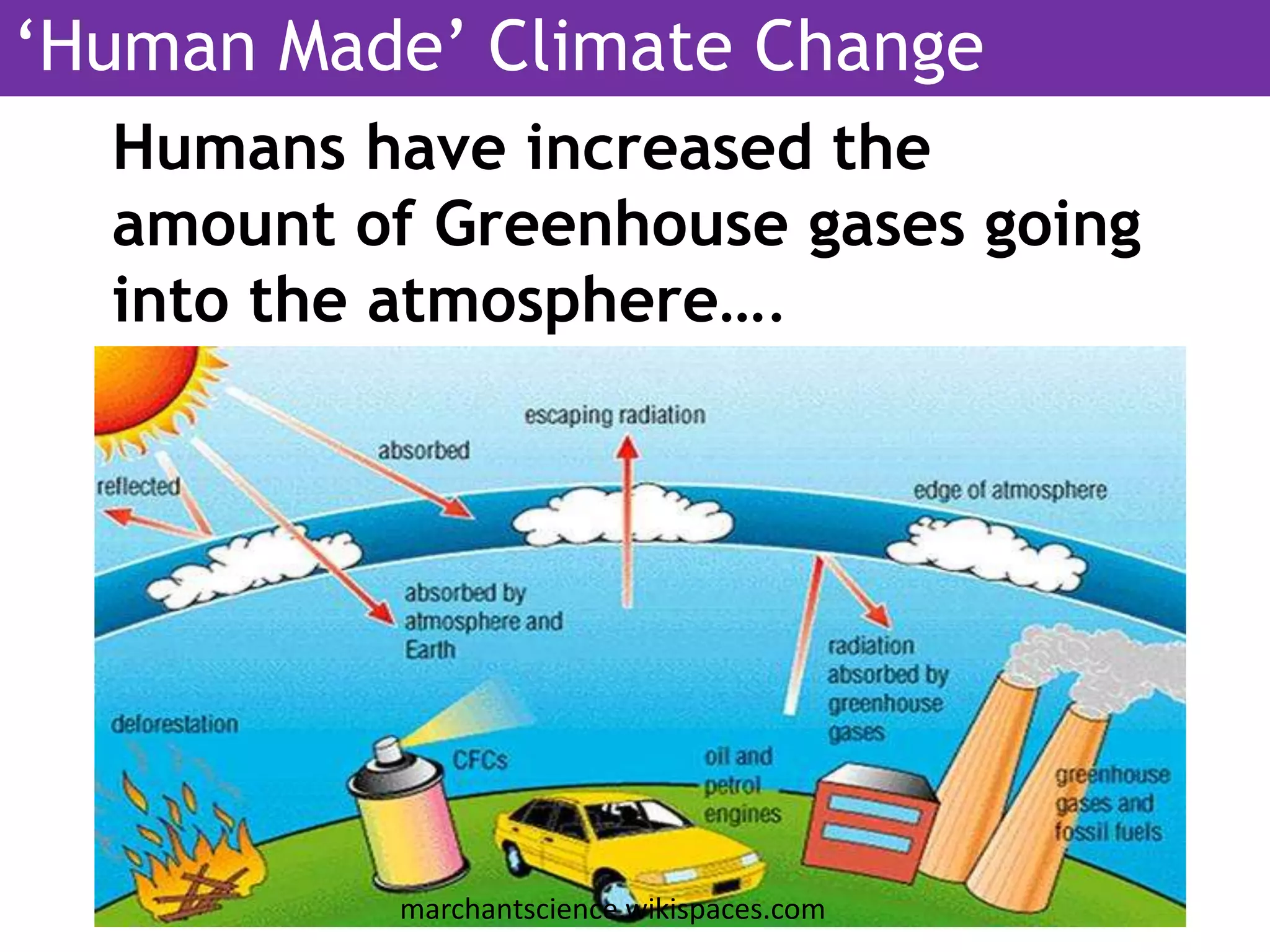
Humans have increased the
amount of Greenhouse gases going
into the atmosphere….
marchantscience.wikispaces.com
‘Human Made’ Climate Change
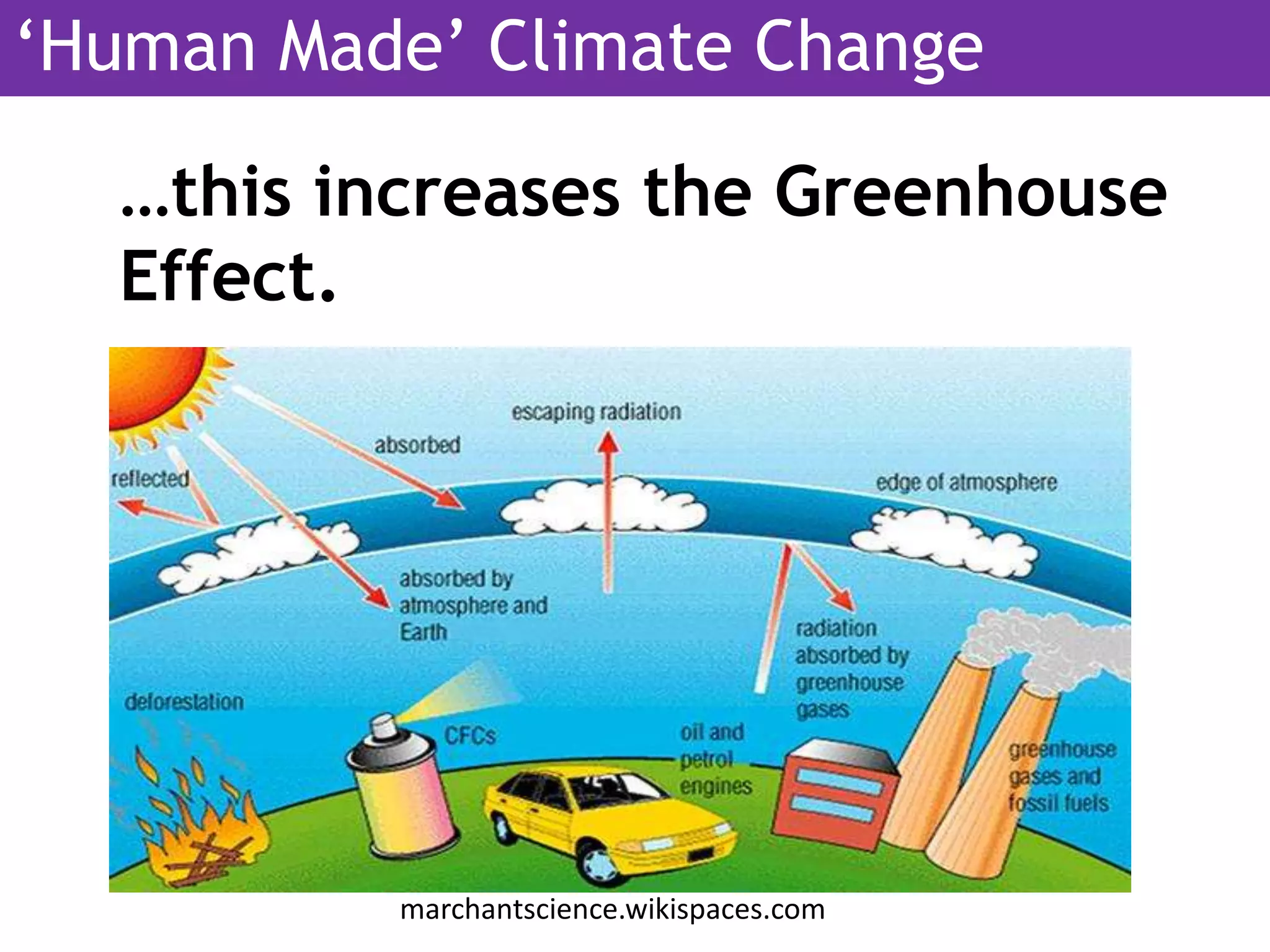
…this increases the Greenhouse
Effect.
marchantscience.wikispaces.com
‘Human Made’ Climate Change
squidoo.com
‘Human Made’ sources of Greenhouse Gases
Burning of solid waste, wood, and fossil fuels (oil,
natural gas, and coal).
globalwarmingimages.net
‘Human Made’ sources of CO2
Carbon dioxide concentrations have been on
the rise since the industrial revolution
grida.no
A lump of coal might look
like it only contains
carbon, but there is an
impurity hidden in within
it.
Sulphur is found in most
fossil fuels and is a
problem when it burns it
forms sulphur dioxide.
hertenberger.co.za
‘Human Made’ sources of SO2
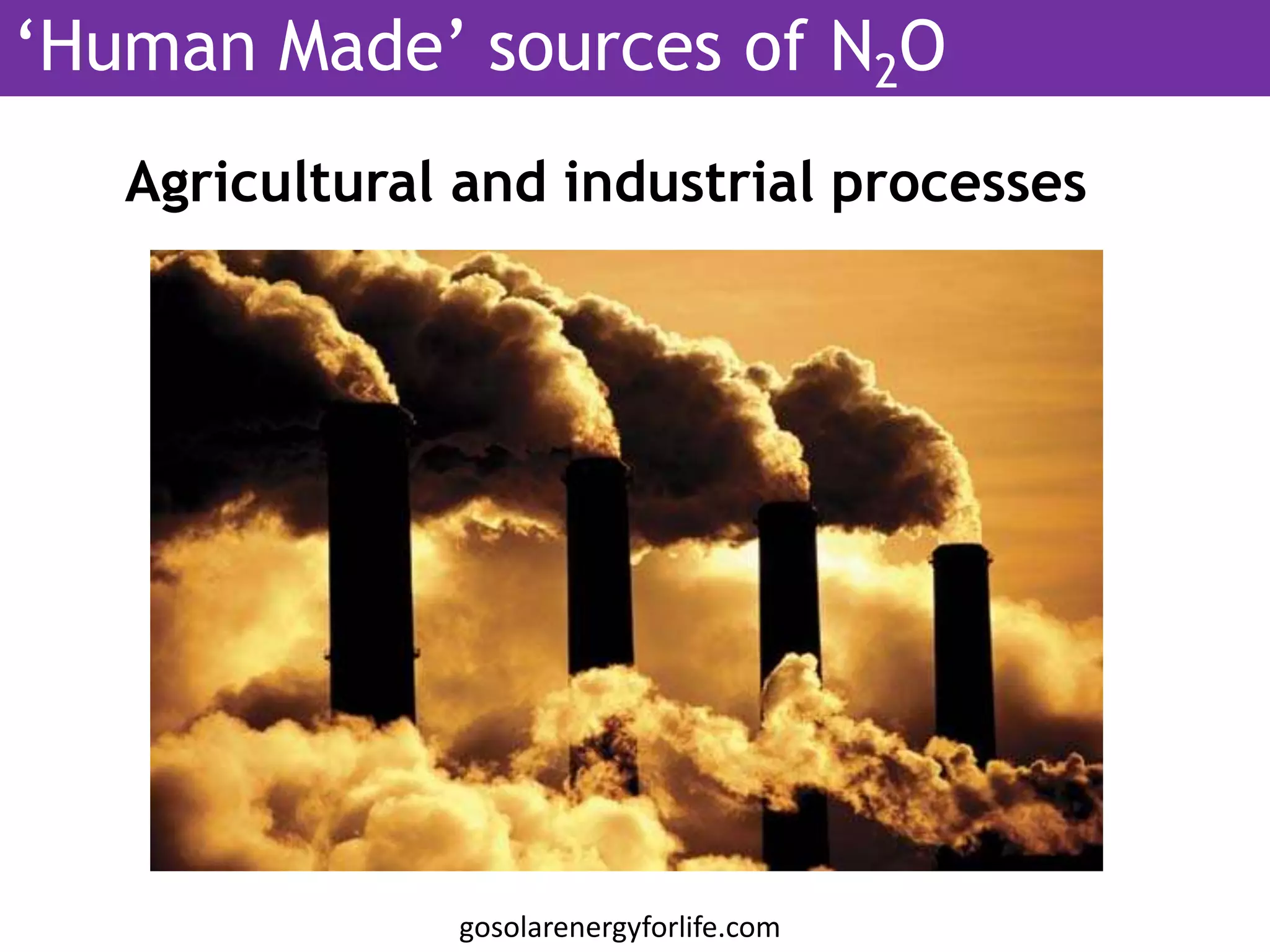
Agricultural and industrial processes
gosolarenergyforlife.com
‘Human Made’ sources of N2O
Car Engines
The spark plug in the car engine
causes the nitrogen and oxygen in the
air to react together.
‘Human Made’ sources of N2O
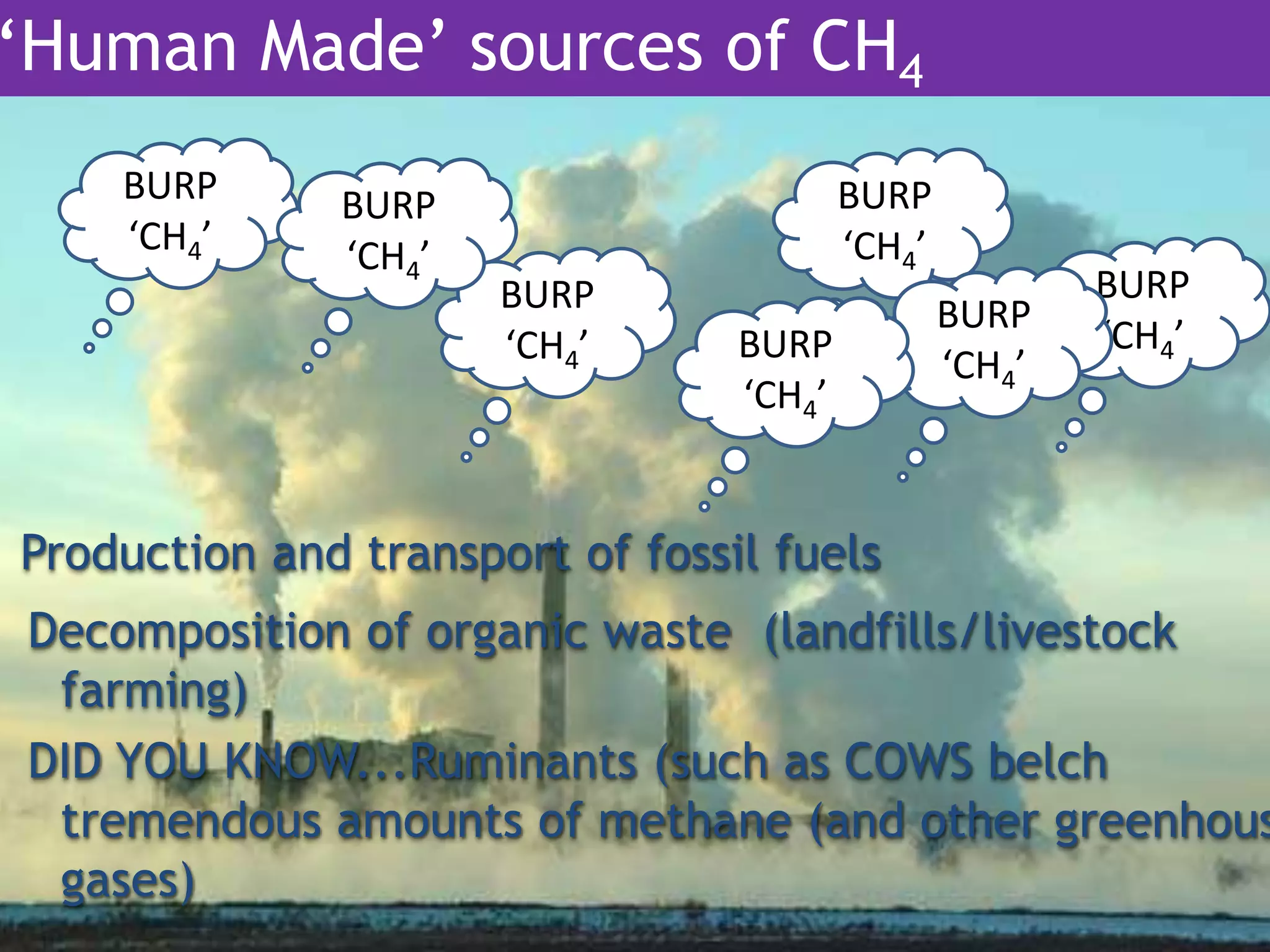
Production and transport of fossil fuels
Decomposition of organic waste (landfills/livestock
farming)
DID YOU KNOW...Ruminants (such as COWS belch
tremendous amounts of methane (and other greenhous
gases)
BURP
‘CH4’
BURP
‘CH4’
BURP
‘CH4’
BURP
‘CH4’BURP
‘CH4’
BURP
‘CH4’
BURP
‘CH4’
‘Human Made’ sources of CH4
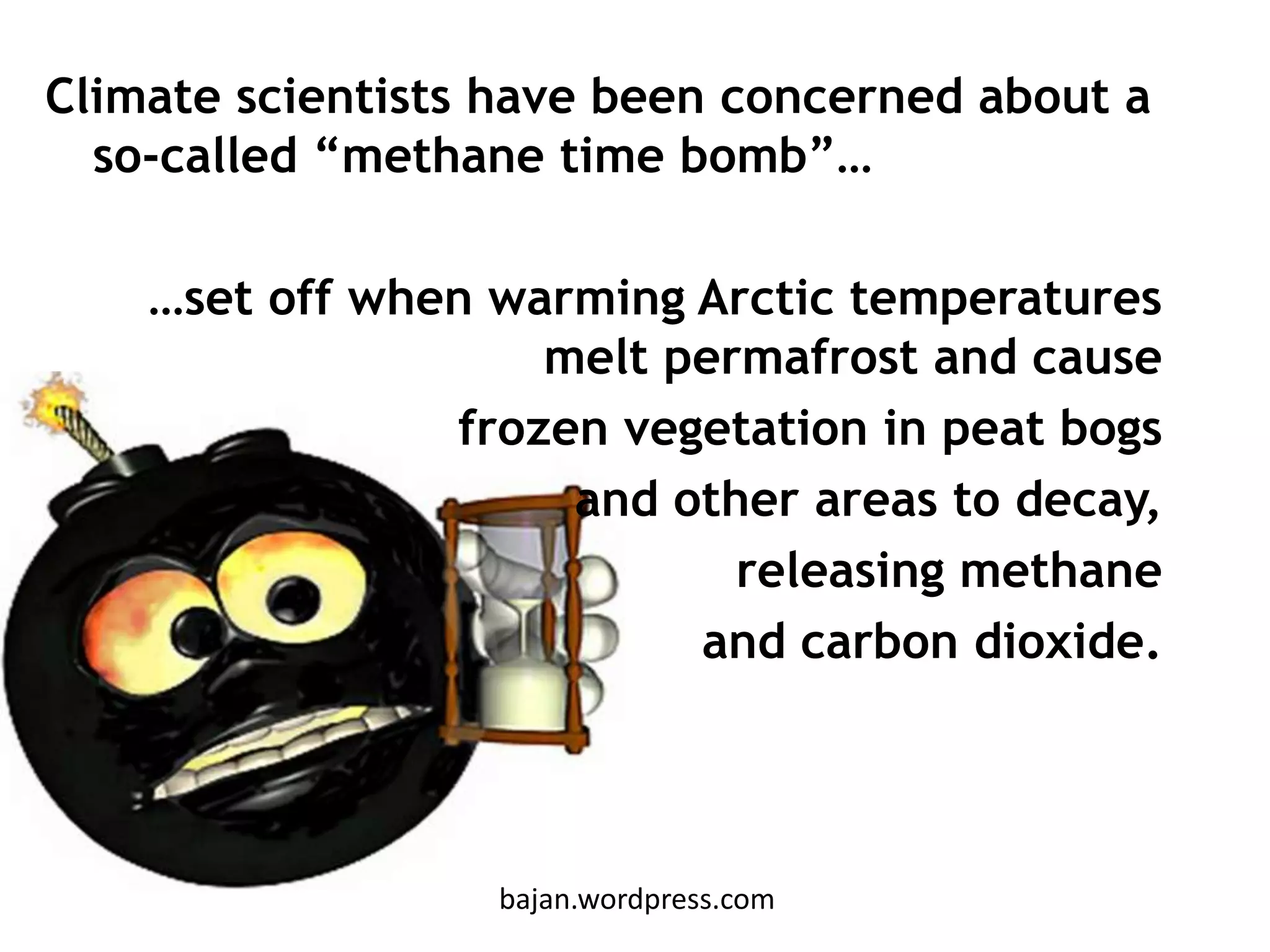
Climate scientists have been concerned about a
so-called “methane time bomb”…
…set off when warming Arctic temperatures
melt permafrost and cause
frozen vegetation in peat bogs
and other areas to decay,
releasing methane
and carbon dioxide.
bajan.wordpress.com
bajan.wordpress.com
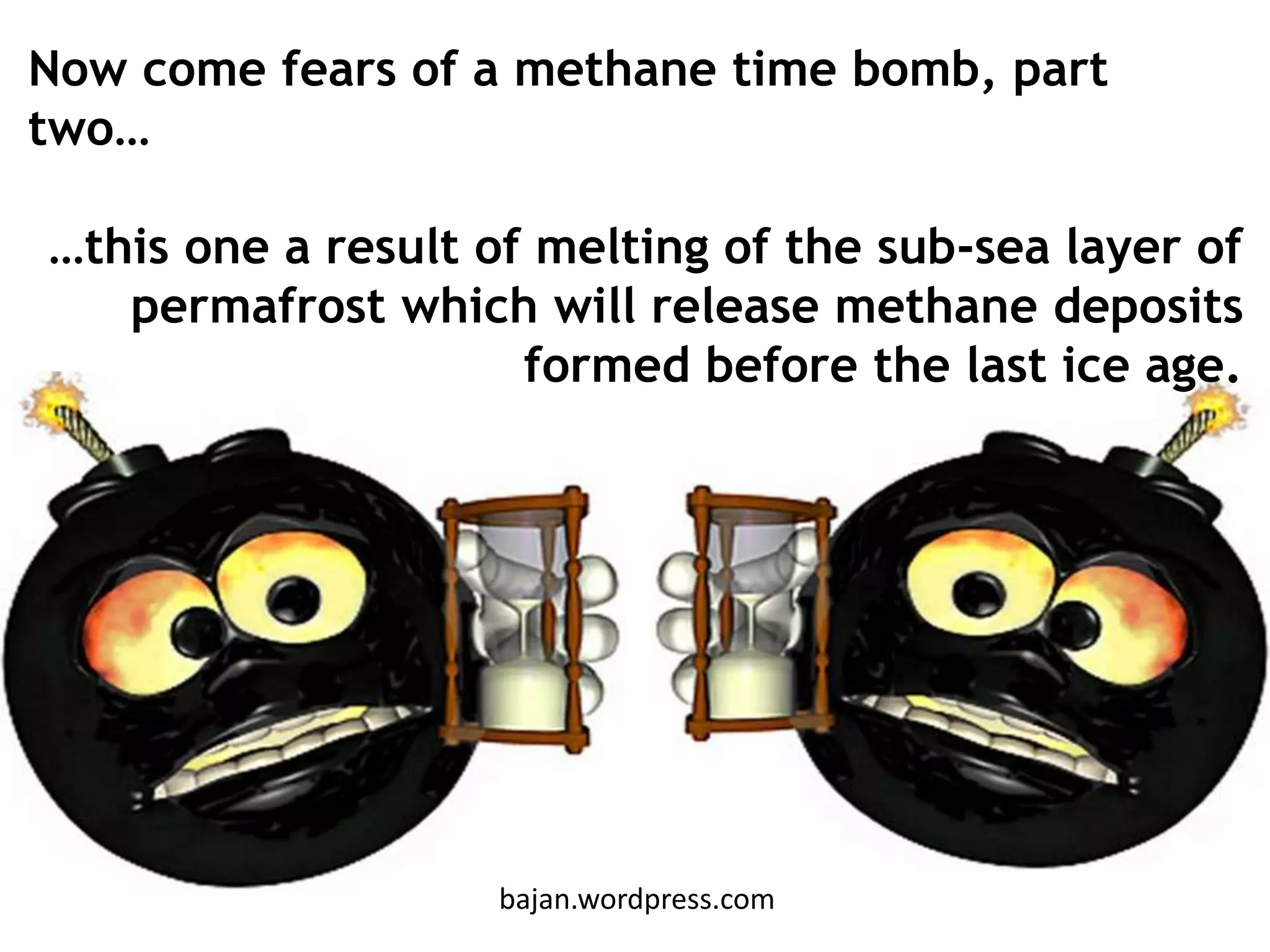
Now come fears of a methane time bomb, part
two…
…this one a result of melting of the sub-sea layer of
permafrost which will release methane deposits
formed before the last ice age.
bajan.wordpress.com
CH4
Scientists fear that its
release could
accelerate global
warming in a giant
positive feedback.
More
atmospheric
methane
Causes higher
temperatures
Leading to
further
permafrost
melting
And the
release of
yet more
methane
And it
keeps
going,
and
going…
Tipping Point
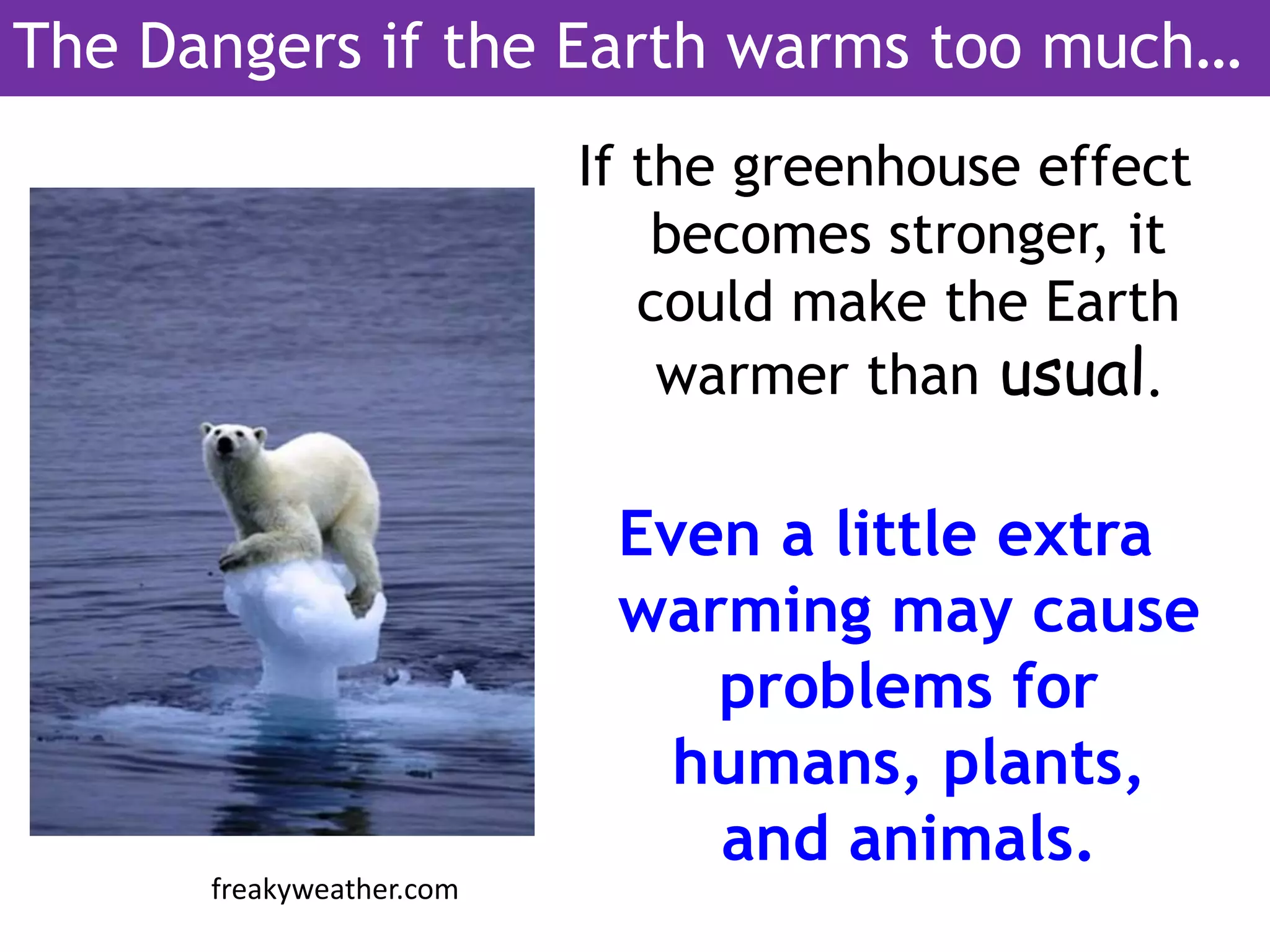
If the greenhouse effect
becomes stronger, it
could make the Earth
warmer than usual.
Even a little extra
warming may cause
problems for
humans, plants,
and animals.
freakyweather.com
The Dangers if the Earth warms too much…
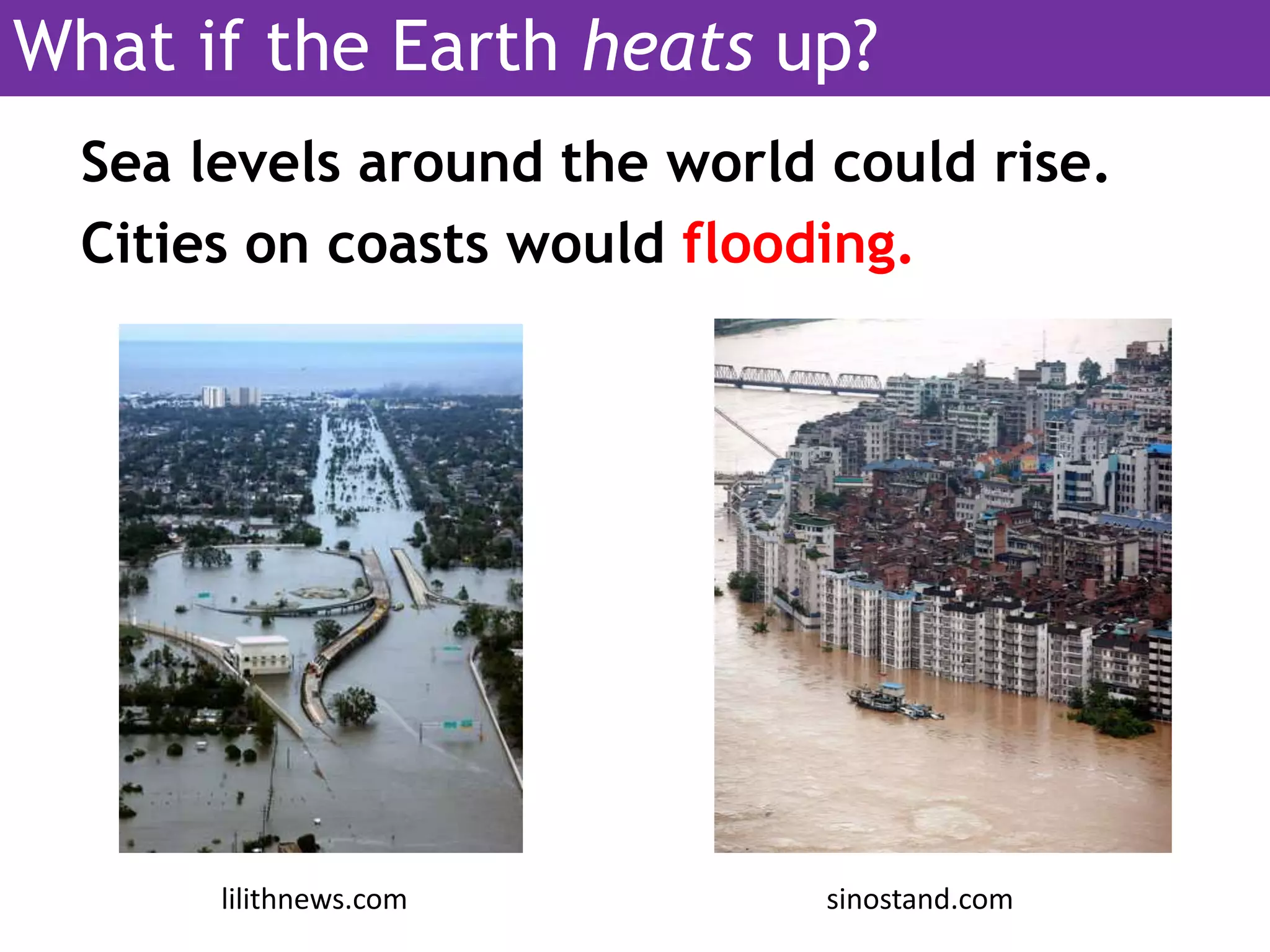
Sea levels around the world could rise.
Cities on coasts would flooding.
lilithnews.com sinostand.com
What if the Earth heats up?
Temperate places that now receive frequent
rain and snowfall might become hotter and
drier, leading to more drought.
serc.carleton.edu
What if the Earth heats up?
Frequent periods of drought would make
it hard to raise crops for food, leading to
famine.
photoshelter.com jamblichus.wordpress.com
What if the Earth heats up?
Forest fires could occur more frequently.
blogs.canoe.ca
What if the Earth heats up?
Plants and animals unable to take the heat
may go extinct, and be replaced by heat
tolerant species.
saddleridgeva.comneutralexistence.com
What if the Earth heats up?
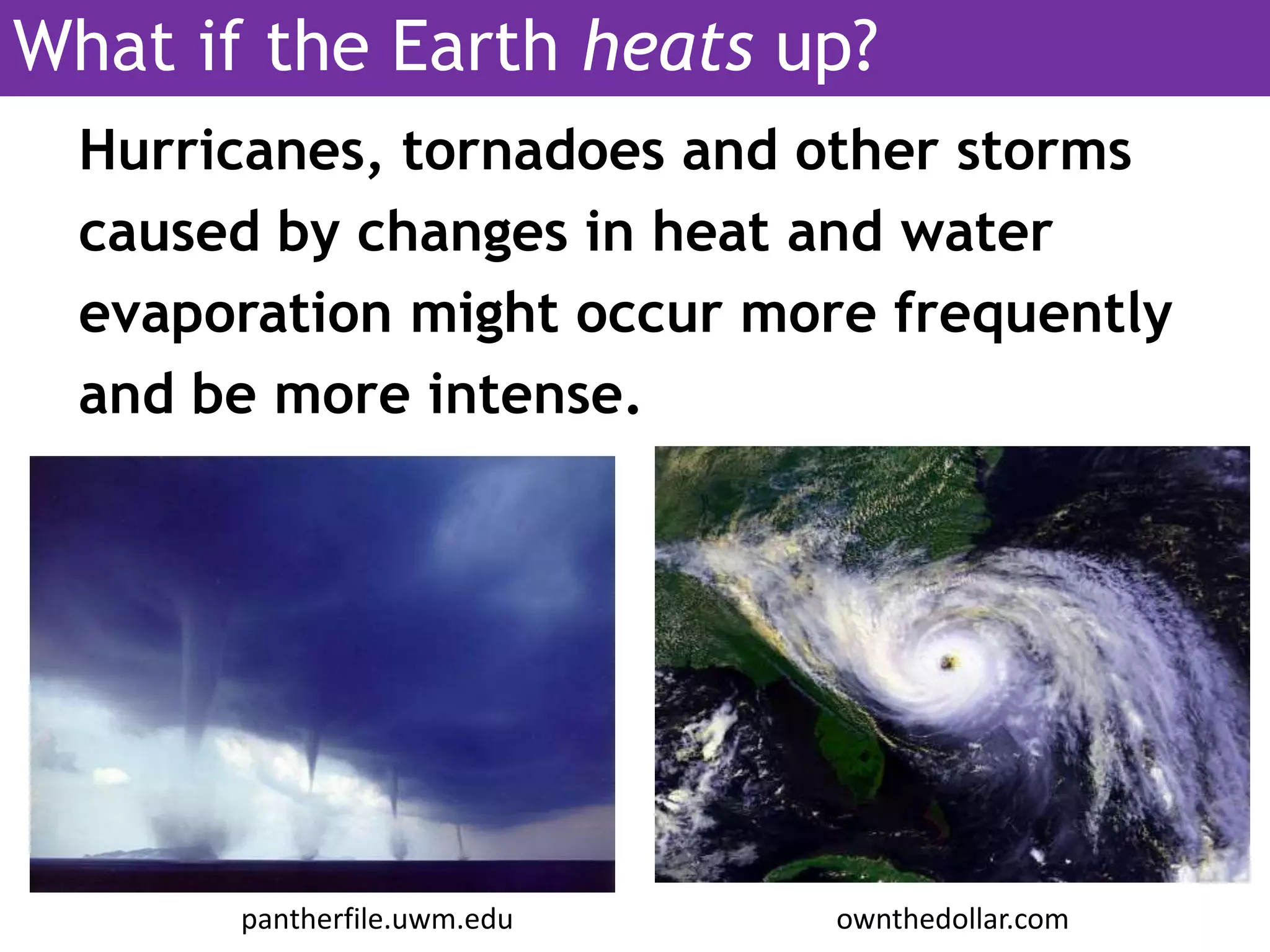
Hurricanes, tornadoes and other storms
caused by changes in heat and water
evaporation might occur more frequently
and be more intense.
pantherfile.uwm.edu ownthedollar.com
What if the Earth heats up?
In the UK, we expect that because of climate
change:
• Temperatures will increase.
• Winter rainfall will get heavier, increasing
the risk of flooding.
kirklees.gov.uk
The consequences in the UK…
• Summer rainfall in the UK may reduce considerably,
creating pressure on water resources.
• Sea levels will rise due to melting ice caps, leading
to further coastal erosion and flood risk.
kirklees.gov.uk
The consequences in the UK…
Scientists worry that climate change is
progressing so rapidly that, within decades,
humans may be helpless to slow or reverse
the trend.
There is a threshold where a slight rise in
the Earth's temperature can cause a
dramatic change in the environment that
itself triggers a far greater increase in
global temperatures.
This is the ‘tipping point’ beyond which
really dangerous climate change is likely
to be unstoppable.
What is happening in
the Arctic is a
"tipping point”
This is all a LOT of information!
CHALLENGE: Can you write a summary to explain all
that you have learnt to some of the younger children?
You COULD conduct some of your own research too
(see next slide), and even present your information
in a PPT presentation or a ‘fact file’, or just a simple
poster (or series of posters).
You could just write a blog post discussing some of
the facts presented, or research around the
questions on the next slide. Blogging (or vlogging!) is
a tool that can be very powerful in its simplicity.
What now?
Some of the information in the PPT may well be
slightly out of date…
• Have you noticed already some of the impact of Global
Warming and the effect of the Greenhouse Gases?
• What has been happening in the news to support these
scientific predictions?
• What changes is OUR government currently proposing to
mitigate (decrease) or slow down the impact of Climate
Change (Emergency)?
• How does this compare to other nations globally?
• How do YOU think what is happening (COVID-19) will have an
impact on these policies? Will they continue to be prioritised?
• Is there anything interesting that is happening in terms of
pollution levels since the initiation of ‘lock downs’ globally?
What could we learn from this?
Further investigation…(optional)
All of your research from this lesson and from your
geography research will be used to write a news
report in the next session. This report could be based
in Noriwch or in YOUR local area. Therefore, make
sure you make notes of any ‘sources’ you use or
quotes/opinions from experts to ensure your report
will be informative and accurate (No ‘FAKE NEWS’ -
aside from the fact your report will indeed be
fictional!). And, these are useful journalistic skills to
have!
Looking ahead…
Questions about Chapters 4-7
1. What do YOU think Zoe should do about her dilemma with
Dooby? Should she help him to escape? Or should she try and take
William instead? What does Dooby's intentions say about his
character? NONE of you guessed he would be this calculating,
manipulative and selfish!
2. Why do you think William is the way he is? Why does he reject
Zoe's offer to help him escape the island? Is he really 'mad' or does
he know a lot more than the others realise or appreciate? Is he
really called 'William Blake'? If not, why do you think he has
adopted this name?
3. What will be the fate of the unfortunate 'cat'? Why did he come
to the island? What is the 'light' that Zoe sees and what connection
has she made?
I have lots more, BUT, I want to hear YOUR questions as well. Share
to the 'Gallery: Your Work' forum...
Summer 1 – Lesson 5
English focus
Floodland
LQ: How can I write an effective news report?
C: I can use a range of vocabulary to create effect.
A: I can use a range of punctuation to ensure clarity.
E: I can manipulate the grammar to determine the
level of formality.
Based on
Chapters 5-7
REMEMBER: You can write this as if it were a
printed report or a broadcast – to be filmed or
read out as a podcast!
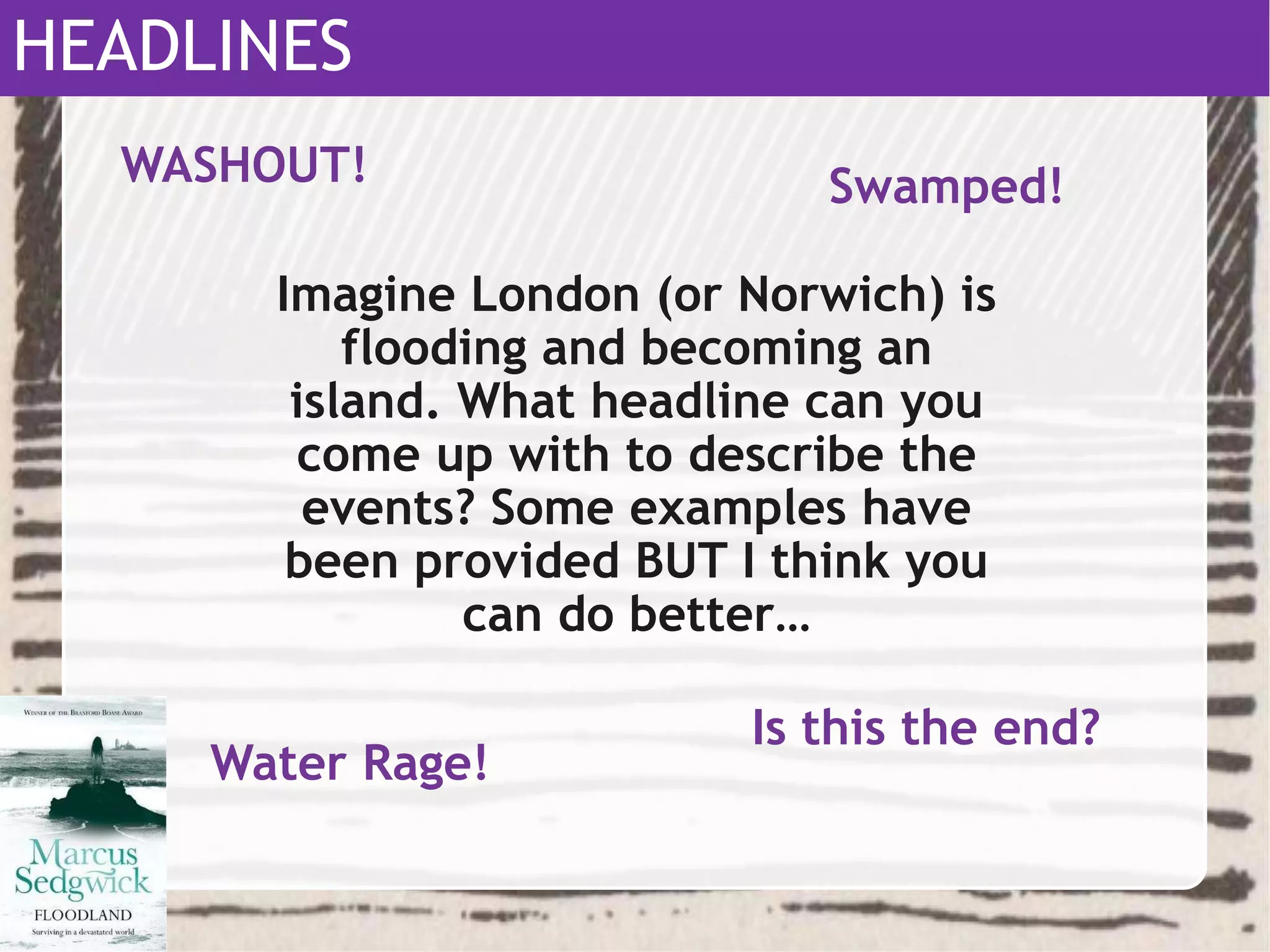
Imagine London (or Norwich) is
flooding and becoming an
island. What headline can you
come up with to describe the
events? Some examples have
been provided BUT I think you
can do better…
WASHOUT!
HEADLINES
Swamped!
Water Rage!
Is this the end?
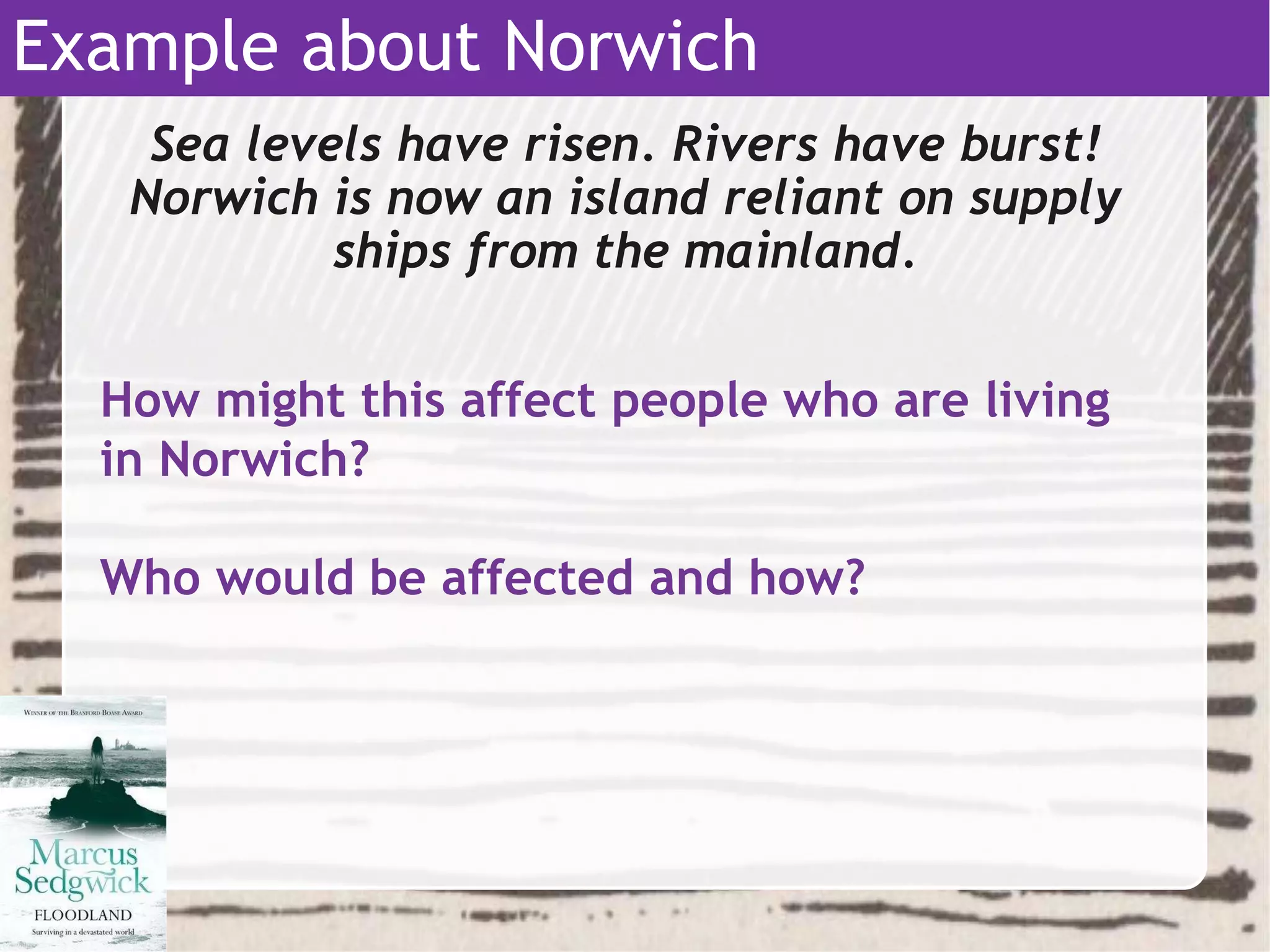
Sea levels have risen. Rivers have burst!
Norwich is now an island reliant on supply
ships from the mainland.
Example about Norwich
How might this affect people who are living
in Norwich?
Who would be affected and how?
You are now the reporter. Think carefully
about the questions you would like to ask
the inhabitants of Norwich.
Role Play - Reporter
Look at the examples of their statements –
could you use any of the quotes for your
own report?
https://thornhill-islington.secure-
dbprimary.com/islington/primary/thornhill/ar
enas/year6/web?backto=%2fislington%2fpr
imary%2fthornhill%2farenas%2fyear6%2fw
eb%3fsubfolder%3dfolder-
767026577#794366513
Plan your newspaper report. Use the boxing-
up plan to help structure your report or
outline your own. Remember to include all of
the facts and details you might want to use
when writing up your report later.
Boxing- Up Plan
https://thornhill-islington.secure-
dbprimary.com/islington/primary/thornhill/ar
enas/year6/web?backto=%2fislington%2fpr
imary%2fthornhill%2farenas%2fyear6%2fw
eb%3fsubfolder%3dfolder-
767026577#794366508
Once you have your completed plan, you are ready
to write. I have provided an example of a ‘model
text’ for you to refer to. You may want to use some
phrases from the model text in your own report –
just remember to add it to your plan to help you
structure it. If want some feedback first (as we
would in school), please share your plans to the
‘Gallery: Your Work’ forum.
Ready to write?
https://thornhill-islington.secure-
dbprimary.com/islington/primary/thornhill/arenas/year6/web?backto
=%2fislington%2fprimary%2fthornhill%2farenas%2fyear6%2fweb%
3fsubfolder%3dfolder-767026577#794366507
https://edition.cnn.com/2018/01/09/us/sout
hern-california-evacuations-rain-
flooding/index.html (original article)
Summer 1 – Lesson 6
English focus
Floodland
LQ: How can I write a narrative?
C: I can use accurate punctuation.
A: I can use dialogue and narration to advance the plot.
E: I can convey characters' emotions.
Based on
Chapters 11-12
pikestaff
·Cats attack earlier than expected
·William walks into the heart of the battle
field - dies?
·Horses attack- pre-planned attacks
·Dooby forces Zoe to leave on the boat
·Fight between Dooby and Spat
·Munchkin swims out to join Zoe on the boat…
Key events…
Zoe: independent, level-headed, intelligent, loner,
Dooby: violent, sadistic, leader, controlling
Munchkin: docile, dependent, naive
Spat: sadistic, easily-led, subordinate, cruel
Character Traits
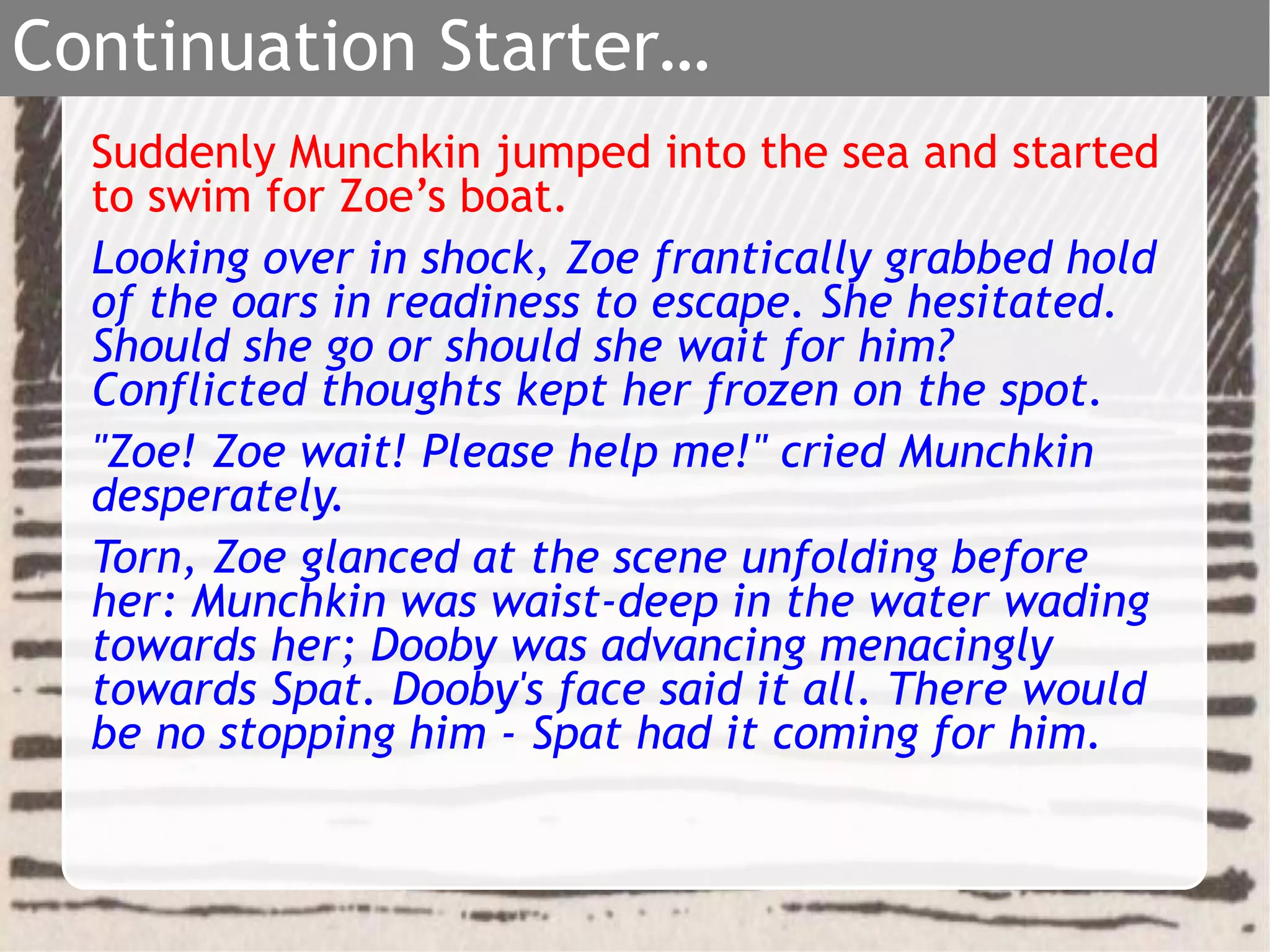
Suddenly Munchkin jumped into the sea and started
to swim for Zoe’s boat.
Looking over in shock, Zoe frantically grabbed hold
of the oars in readiness to escape. She hesitated.
Should she go or should she wait for him?
Conflicted thoughts kept her frozen on the spot.
"Zoe! Zoe wait! Please help me!" cried Munchkin
desperately.
Torn, Zoe glanced at the scene unfolding before
her: Munchkin was waist-deep in the water wading
towards her; Dooby was advancing menacingly
towards Spat. Dooby's face said it all. There would
be no stopping him - Spat had it coming for him.
Continuation Starter…
Write in role as Zoe during the turning point in the story.
CHALLENGE: Can you choose another character's
perspective to write from? How would this change the
events that might unfold?
Steps for Success
• More action needed - balance between dialogue
and narration
• Emotions need to be shown through description of
action
• Subordinate clause openers- vary sentence starters
• Phrases to show passing of time
Challenge: Continue Chapter 12
Sentence Starters: https://thornhill-islington.secure-
dbprimary.com/islington/primary/thornhill/arenas/year6/web?subfolder
=folder-767026577#794822583

Floodland - ALL LESSONS

  • 1.
    Summer 1 –Lesson 1 English focus Floodland LQ: How can I use evidence from the text to support my ideas? C: I can identify key information from clues in the text. A: I can summarise information succinctly. E: I can use my inference skills to make a prediction. Based on Chapter 1
  • 2.
    What do youthink this story could be about? Who is the girl on the front cover? What is her significance? What do you think is the context of the story? What genre may the novel fall into? Floodland – Predictions
  • 3.
    derelict Norwich mob sprawling ruts keel sodden Task 1: Vocabulary– Research it! allotments oars hunched compass methodical stupor
  • 4.
    Zoe ran. Harderthan she had ever run in her life. Her feet pounded through the deserted streets of derelict buildings. Somewhere, not far behind, she could hear the gang coming after her. It felt as if her heart would burst, but she didn’t slow down. She’d been planning to leave the island for a long time, but had been putting it off. It was a big decision to set out to sea in a tiny rowing boat. Now she had no choice. What do we know so far about the story, setting and characters? What do you think will happen next? Floodland – Chapter 1 (‘Before’)
  • 5.
    Before, no onehad bothered her. Zoe was a loner. Most of the people left on Norwich hung around together in groups, but she preferred to be on her own. It was safer that way, because you never knew whom you could trust. Somehow, someone had found out about the boat she’d been hiding. A boat was an escape route, a way to get away from Norwich, which got smaller and smaller every year, as the sea kept on rising. It didn’t matter that there could only be room for two people at most in her boat. Others had joined in the chase, and now a mob of fifteen people was hot on her heels. There was only one way out; to get to her boat before they got to her. So she ran on, while her body screamed for her to stop. Floodland – Chapter 1 (‘Before’)
  • 6.
    “Get back here!”someone yelled angrily at her, though they couldn’t see her. It wasn’t far to the little shed where she’d hidden Lyca, her boat. A couple more streets of derelict shops to where what was left of the city fell away into the sea. If the sea hadn’t come, she might have been shopping here herself, with her parents perhaps. From much practice, she squashed the thought of her parents as soon as it started, and kept on running. Just before she rounded a corner, she heard more shouts from behind. They had seen her. “There!” “Come on!” shouted another voice. “Get her!” Floodland – Chapter 1 (‘Before’)
  • 7.
    derelict Norwich mob sprawling ruts keel sodden Vocabulary – Listencarefully to the rest of the chapter… allotments oars hunched compass methodical stupor
  • 8.
  • 9.
    Floodland – ‘LDPPTable’ Example Task 2: Complete LDPP Table with your ideas Task 3: Write a prediction about what will happen in Chapter 2 (or next). Remember to use the P.E.E. technique to extend your answer. Support using evidence from the text.
  • 10.
    Summer 1 –Lesson 2 English focus Floodland LQ: How can I write descriptively? C: I can research definitions of key vocabulary. A: I can use vocabulary to maintain the readers interest. E: I can vary my sentence structure. Based on Chapter 2
  • 11.
    derelict Norwich mob sprawling ruts keel sodden Vocabulary – Review(Before: Chapter 1) allotments oars hunched compass methodical stupor
  • 12.
    Vocabulary – Review(Before: Chapter 1)
  • 13.
    Floodland – ‘LDPP’Table/Predictions (your examples) Bella Adams
  • 14.
    Floodland – ‘LDPP’Table/Predictions (your examples)
  • 15.
    scrag dimly shore cathedral ‘Udan-Adan’ tribe uneasy sniggered TASK 1: Please research thesedefinitions using an online dictionary. Complete a definition list like Insaf and I will feature it in this lesson (PPT)! Vocabulary – (Then) Chapter 1 – Part 1 masonry reinforced meekly primitive patched vaults infernal nave
  • 16.
    They walked upthe soggy hill to to where the ruins of old stone walls appeared from the sea and led to the cathedral gates. Rising out of the water beside one of these old walls was a row of white posts. They made their way in and around bits of fallen masonry, and then not long after, the main door to the cathedral was in front of them. It look out across a large patch of muddy grass, on one corner of which stood an ancient cannon. Two boys stood guarding the gateway. Past them was a long porch which led to the doors themselves. These has been reinforced with bands of metal and beams of wood. The two gatekeepers nodded at Dooby, meekly, though they were much bigger than him. “All right, Dooby,” said one. The other nodded. Neither smiled. One of them shoved hard, and the door to the cathedral swung open. “Well, Zoe,” said Dooby, “welcome to hell.” Extract from (Then) Chapter 1
  • 17.
    “Well, Zoe,” saidDooby, “welcome to hell.” Your challenge is to describe the scene that faces Zoe, which Dooby has likened to ‘hell’. - What makes it look or feel like ‘hell’? - Think carefully about the lighting (or lack of), the possible inhabitants (people present), and what might remain of the cathedral. - What sort of conditions would people be surviving in? - How might the inhabitants be clothed? What is the atmosphere? The smell…? I doubt there would be many bathroom facilities in a cathedral! Use the same techniques we discussed from the lesson where we wrote setting descriptions after Emily Grazebrook came to visit (Victorian Ghost Story!). Task 2: Descriptive Writing
  • 18.
    Want to hearPart 2? Upload your examples to ‘Gallery: Your Work’ and I will add it below. Part 2 of this particular chapter will not be released until I have seen enough evidence of your writing! Use this document to help you (Descriptosaurus!): Descriptive Writing – Your examples! https://www.routledge.com/rsc/downloa ds/temp_file_Descriptosaurus_Genre_Writ ing_Toolkit1.pdf
  • 19.
    Summer 1 –Lesson 3 English focus Floodland LQ: How can I use evidence from the text to support my ideas? C: I can identify key information from clues in the text. A: I can summarise information succinctly. E: I can create character maps. Based on ALL chapters
  • 20.
    Watch this particularvlog (link above) for an explanation as to how you could do the character maps – don’t worry, you only need to watch the first 3 minutes! Summary: Using evidence from the text (recordings) do far, create character maps for the main characters of Zoe, Dooby and William. I suggest you complete one Munchkin and Spat too. Molly and Sarah are optional and could be combined if needed. https://www.youtube.com/watch?v =fJziPMatxt0&feature=emb_title Task: Character Maps
  • 21.
  • 22.
    Character Map: Example1 ‘Word Cloud’
  • 23.
    Summer 1 –Lesson 3 Geography focus Floodland LQ: How can I research a geographical location? C: I can locate Norfolk and Norwich. A: I can describe key topographical features. E: I can predict the impact on humans. Based on Chapters 4-7 Key Vocabulary topographical features - rivers, climate, altitudes, coast, mountains, sea level. topography - the arrangement of the natural and artificial physical features of an area
  • 24.
    Task 1: LocateNorfolk and Norwich Locate Norfolk (county) and Norwich (city). What are the surrounding counties? How far away from London is Norwich?
  • 25.
    Task 2: Locate‘Eels Island’ What do you notice about the location of Norwich in particular? Where might ‘Eels Island’ be based? Remember, the ‘island’ it is on would not be an island at the moment. Think about what you know – hint: look for the cathedral. Is ‘Eels Island’ how you pictured? Is the cathedral significant in any way or famed? https://www.google.com/maps/place/Ely+Cathedral/@52.4269096,0.2794714,9z/da ta=!4m8!1m2!2m1!1sely+catherdral!3m4!1s0x47d8130c7dc73c8d:0xc0ea1214dc25 e6af!8m2!3d52.398661!4d0.263779
  • 26.
    Task 3: Topographyof the UK What are some key features of Norfolk in terms of its topography? Are there any particular features which may make it more susceptible to flooding than other areas of the UK? Extend your research to include the rest of the UK: describe some topographical features of the UK including altitudes at various points, rivers, climate, seas, coast, canals, mountains. Having looked at the topography of the UK, what are the possible implications for people living in various areas? Would some areas be safer than other? Where might this ‘big bit of Britain’ be referring to?
  • 27.
    Gather as muchinformation about Norwich and its surrounding areas as much as possible. Your upcoming task will be to write a report (ideally news related) about floods either in this area and/or your local area! This will be your next challenge – more to follow…. Use some of the documents on the Floodland page to help with your research. Looking ahead…
  • 28.
    Gather as muchinformation about Norwich and its surrounding areas as much as possible. Your upcoming task will be to write a report (ideally news related) about floods either in this area and/or your local area! This will be your next challenge – more to follow…. Use some of the documents on the Floodland page to help with your research. Looking ahead…
  • 29.
    Summer 1 –Lesson 4 Science focus Floodland LQ: How can I identify scientific evidence that has been used to support or refute ideas or arguments? C: I can pose and explore my own ideas and questions about scientific phenomena. A: I can analyse and evaluate current scientific research. E: I can make predictions based on my findings. Based on Chapters 7 Key Vocabulary Global Warming, Climate Change/Emergency, Greenhouse Gases, atmosphere
  • 30.
    • Climate Changerefers to changes in the world’s atmosphere. • It includes a rise in average global temperature and changes in rainfall, and other weather patterns. What is Climate Change? What is causing Climate Change?
  • 31.
    • At theheart of Climate Change is the GREENHOUSE EFFECT. The Greenhouse Effect
  • 32.
    • Greenhouses trap heatfrom the sun. • The glass panels let in light but keep heat from escaping. • This causes the greenhouse to heat up. qwickstep.com The Greenhouse Effect
  • 33.
    • The samething happens when a car is left in direct sunlight. The Greenhouse Effect
  • 34.
    0n Earth, the atmospheric gasesallow sunshine to pass through but it also absorbs heat that is radiated (bounced) back from the warmed surface of the Earth. kirklees.gov.uk The Greenhouse Effect
  • 35.
    solcomhouse.com • The gasesin the atmosphere act like a blanket around our planet which traps in heat, making the temperature rise. • This is called the Greenhouse Effect and is a natural process that keeps the planet warm and sustains life. • If the greenhouse effect didn’t exist, the average temperature on earth would be around -18ºC. The Greenhouse Effect
  • 36.
    Without greenhouse gases, heat would escapeback into space and Earth’s average temperature would be about 16ºC colder... The Greenhouse Effect
  • 37.
    ...and the Earth would notbe warm enough for humans to live! The Greenhouse Effect
  • 38.
    • The increasingamounts of greenhouse gasses released into the atmosphere due to human activities such as burning fossil fuels and cutting down forests is trapping more heat so making the planet warmer than it should be. This results in Global Warming. kirklees.gov.uk So what’s the problem?
  • 39.
  • 40.
    • There aresix greenhouse gases and it is thought that carbon dioxide (CO2) is one of the most important greenhouse gas. Water vapour (H20) Methane (CH4) Ozone (O3) Nitrogen dioxide (NO2) Carbon dioxide (C02) Sulphur dioxide (S02) Greenhouse Gases
  • 42.
    Greenhouse gases cancome from; 1. Natural sources 2. Man-Made sources Greenhouse Gases
  • 43.
    Greenhouse gases occurnaturally and cause the climate to change in a normal, natural way. Let’s look at 4 of them. Methane (CH4) Nitrogen dioxide (NO2) Carbon dioxide (C02) Sulphur dioxide (S02) Natural Climate Change
  • 44.
    Carbon Dioxide occursnaturally Produced by living organisms through respiration (breathing). wondertime.go.com Carbon Dioxide – CO2
  • 45.
    Sulphur Dioxide occursnaturally Released from volcanoes geology.com Sulphur Dioxide – SO2
  • 46.
    Methane occurs naturally Decompositionof organic matter (especially in wetlands). michellehenry.fr Methane – CH4
  • 47.
    Nitrous Oxide occursaaturally From bacteria in soil. During lightning storms. fnal.gov123rf.com Methane – N2O
  • 48.
    Humans have increasedthe amount of Greenhouse gases going into the atmosphere…. marchantscience.wikispaces.com ‘Human Made’ Climate Change
  • 49.
    …this increases theGreenhouse Effect. marchantscience.wikispaces.com ‘Human Made’ Climate Change
  • 50.
  • 51.
    Burning of solidwaste, wood, and fossil fuels (oil, natural gas, and coal). globalwarmingimages.net ‘Human Made’ sources of CO2
  • 52.
    Carbon dioxide concentrationshave been on the rise since the industrial revolution grida.no
  • 53.
    A lump ofcoal might look like it only contains carbon, but there is an impurity hidden in within it. Sulphur is found in most fossil fuels and is a problem when it burns it forms sulphur dioxide. hertenberger.co.za ‘Human Made’ sources of SO2
  • 54.
    Agricultural and industrialprocesses gosolarenergyforlife.com ‘Human Made’ sources of N2O
  • 55.
    Car Engines The sparkplug in the car engine causes the nitrogen and oxygen in the air to react together. ‘Human Made’ sources of N2O
  • 56.
    Production and transportof fossil fuels Decomposition of organic waste (landfills/livestock farming) DID YOU KNOW...Ruminants (such as COWS belch tremendous amounts of methane (and other greenhous gases) BURP ‘CH4’ BURP ‘CH4’ BURP ‘CH4’ BURP ‘CH4’BURP ‘CH4’ BURP ‘CH4’ BURP ‘CH4’ ‘Human Made’ sources of CH4
  • 57.
    Climate scientists havebeen concerned about a so-called “methane time bomb”… …set off when warming Arctic temperatures melt permafrost and cause frozen vegetation in peat bogs and other areas to decay, releasing methane and carbon dioxide. bajan.wordpress.com
  • 58.
    bajan.wordpress.com Now come fearsof a methane time bomb, part two… …this one a result of melting of the sub-sea layer of permafrost which will release methane deposits formed before the last ice age. bajan.wordpress.com
  • 59.
    CH4 Scientists fear thatits release could accelerate global warming in a giant positive feedback. More atmospheric methane Causes higher temperatures Leading to further permafrost melting And the release of yet more methane And it keeps going, and going… Tipping Point
  • 60.
    If the greenhouseeffect becomes stronger, it could make the Earth warmer than usual. Even a little extra warming may cause problems for humans, plants, and animals. freakyweather.com The Dangers if the Earth warms too much…
  • 61.
    Sea levels aroundthe world could rise. Cities on coasts would flooding. lilithnews.com sinostand.com What if the Earth heats up?
  • 62.
    Temperate places thatnow receive frequent rain and snowfall might become hotter and drier, leading to more drought. serc.carleton.edu What if the Earth heats up?
  • 63.
    Frequent periods ofdrought would make it hard to raise crops for food, leading to famine. photoshelter.com jamblichus.wordpress.com What if the Earth heats up?
  • 64.
    Forest fires couldoccur more frequently. blogs.canoe.ca What if the Earth heats up?
  • 65.
    Plants and animalsunable to take the heat may go extinct, and be replaced by heat tolerant species. saddleridgeva.comneutralexistence.com What if the Earth heats up?
  • 66.
    Hurricanes, tornadoes andother storms caused by changes in heat and water evaporation might occur more frequently and be more intense. pantherfile.uwm.edu ownthedollar.com What if the Earth heats up?
  • 67.
    In the UK,we expect that because of climate change: • Temperatures will increase. • Winter rainfall will get heavier, increasing the risk of flooding. kirklees.gov.uk The consequences in the UK…
  • 68.
    • Summer rainfallin the UK may reduce considerably, creating pressure on water resources. • Sea levels will rise due to melting ice caps, leading to further coastal erosion and flood risk. kirklees.gov.uk The consequences in the UK…
  • 69.
    Scientists worry thatclimate change is progressing so rapidly that, within decades, humans may be helpless to slow or reverse the trend. There is a threshold where a slight rise in the Earth's temperature can cause a dramatic change in the environment that itself triggers a far greater increase in global temperatures.
  • 70.
    This is the‘tipping point’ beyond which really dangerous climate change is likely to be unstoppable. What is happening in the Arctic is a "tipping point”
  • 71.
    This is alla LOT of information! CHALLENGE: Can you write a summary to explain all that you have learnt to some of the younger children? You COULD conduct some of your own research too (see next slide), and even present your information in a PPT presentation or a ‘fact file’, or just a simple poster (or series of posters). You could just write a blog post discussing some of the facts presented, or research around the questions on the next slide. Blogging (or vlogging!) is a tool that can be very powerful in its simplicity. What now?
  • 72.
    Some of theinformation in the PPT may well be slightly out of date… • Have you noticed already some of the impact of Global Warming and the effect of the Greenhouse Gases? • What has been happening in the news to support these scientific predictions? • What changes is OUR government currently proposing to mitigate (decrease) or slow down the impact of Climate Change (Emergency)? • How does this compare to other nations globally? • How do YOU think what is happening (COVID-19) will have an impact on these policies? Will they continue to be prioritised? • Is there anything interesting that is happening in terms of pollution levels since the initiation of ‘lock downs’ globally? What could we learn from this? Further investigation…(optional)
  • 73.
    All of yourresearch from this lesson and from your geography research will be used to write a news report in the next session. This report could be based in Noriwch or in YOUR local area. Therefore, make sure you make notes of any ‘sources’ you use or quotes/opinions from experts to ensure your report will be informative and accurate (No ‘FAKE NEWS’ - aside from the fact your report will indeed be fictional!). And, these are useful journalistic skills to have! Looking ahead…
  • 74.
    Questions about Chapters4-7 1. What do YOU think Zoe should do about her dilemma with Dooby? Should she help him to escape? Or should she try and take William instead? What does Dooby's intentions say about his character? NONE of you guessed he would be this calculating, manipulative and selfish! 2. Why do you think William is the way he is? Why does he reject Zoe's offer to help him escape the island? Is he really 'mad' or does he know a lot more than the others realise or appreciate? Is he really called 'William Blake'? If not, why do you think he has adopted this name? 3. What will be the fate of the unfortunate 'cat'? Why did he come to the island? What is the 'light' that Zoe sees and what connection has she made? I have lots more, BUT, I want to hear YOUR questions as well. Share to the 'Gallery: Your Work' forum...
  • 75.
    Summer 1 –Lesson 5 English focus Floodland LQ: How can I write an effective news report? C: I can use a range of vocabulary to create effect. A: I can use a range of punctuation to ensure clarity. E: I can manipulate the grammar to determine the level of formality. Based on Chapters 5-7 REMEMBER: You can write this as if it were a printed report or a broadcast – to be filmed or read out as a podcast!
  • 76.
    Imagine London (orNorwich) is flooding and becoming an island. What headline can you come up with to describe the events? Some examples have been provided BUT I think you can do better… WASHOUT! HEADLINES Swamped! Water Rage! Is this the end?
  • 77.
    Sea levels haverisen. Rivers have burst! Norwich is now an island reliant on supply ships from the mainland. Example about Norwich How might this affect people who are living in Norwich? Who would be affected and how?
  • 78.
    You are nowthe reporter. Think carefully about the questions you would like to ask the inhabitants of Norwich. Role Play - Reporter Look at the examples of their statements – could you use any of the quotes for your own report? https://thornhill-islington.secure- dbprimary.com/islington/primary/thornhill/ar enas/year6/web?backto=%2fislington%2fpr imary%2fthornhill%2farenas%2fyear6%2fw eb%3fsubfolder%3dfolder- 767026577#794366513
  • 79.
    Plan your newspaperreport. Use the boxing- up plan to help structure your report or outline your own. Remember to include all of the facts and details you might want to use when writing up your report later. Boxing- Up Plan https://thornhill-islington.secure- dbprimary.com/islington/primary/thornhill/ar enas/year6/web?backto=%2fislington%2fpr imary%2fthornhill%2farenas%2fyear6%2fw eb%3fsubfolder%3dfolder- 767026577#794366508
  • 80.
    Once you haveyour completed plan, you are ready to write. I have provided an example of a ‘model text’ for you to refer to. You may want to use some phrases from the model text in your own report – just remember to add it to your plan to help you structure it. If want some feedback first (as we would in school), please share your plans to the ‘Gallery: Your Work’ forum. Ready to write? https://thornhill-islington.secure- dbprimary.com/islington/primary/thornhill/arenas/year6/web?backto =%2fislington%2fprimary%2fthornhill%2farenas%2fyear6%2fweb% 3fsubfolder%3dfolder-767026577#794366507 https://edition.cnn.com/2018/01/09/us/sout hern-california-evacuations-rain- flooding/index.html (original article)
  • 81.
    Summer 1 –Lesson 6 English focus Floodland LQ: How can I write a narrative? C: I can use accurate punctuation. A: I can use dialogue and narration to advance the plot. E: I can convey characters' emotions. Based on Chapters 11-12 pikestaff
  • 82.
    ·Cats attack earlierthan expected ·William walks into the heart of the battle field - dies? ·Horses attack- pre-planned attacks ·Dooby forces Zoe to leave on the boat ·Fight between Dooby and Spat ·Munchkin swims out to join Zoe on the boat… Key events…
  • 83.
    Zoe: independent, level-headed,intelligent, loner, Dooby: violent, sadistic, leader, controlling Munchkin: docile, dependent, naive Spat: sadistic, easily-led, subordinate, cruel Character Traits
  • 84.
    Suddenly Munchkin jumpedinto the sea and started to swim for Zoe’s boat. Looking over in shock, Zoe frantically grabbed hold of the oars in readiness to escape. She hesitated. Should she go or should she wait for him? Conflicted thoughts kept her frozen on the spot. "Zoe! Zoe wait! Please help me!" cried Munchkin desperately. Torn, Zoe glanced at the scene unfolding before her: Munchkin was waist-deep in the water wading towards her; Dooby was advancing menacingly towards Spat. Dooby's face said it all. There would be no stopping him - Spat had it coming for him. Continuation Starter…
  • 85.
    Write in roleas Zoe during the turning point in the story. CHALLENGE: Can you choose another character's perspective to write from? How would this change the events that might unfold? Steps for Success • More action needed - balance between dialogue and narration • Emotions need to be shown through description of action • Subordinate clause openers- vary sentence starters • Phrases to show passing of time Challenge: Continue Chapter 12 Sentence Starters: https://thornhill-islington.secure- dbprimary.com/islington/primary/thornhill/arenas/year6/web?subfolder =folder-767026577#794822583