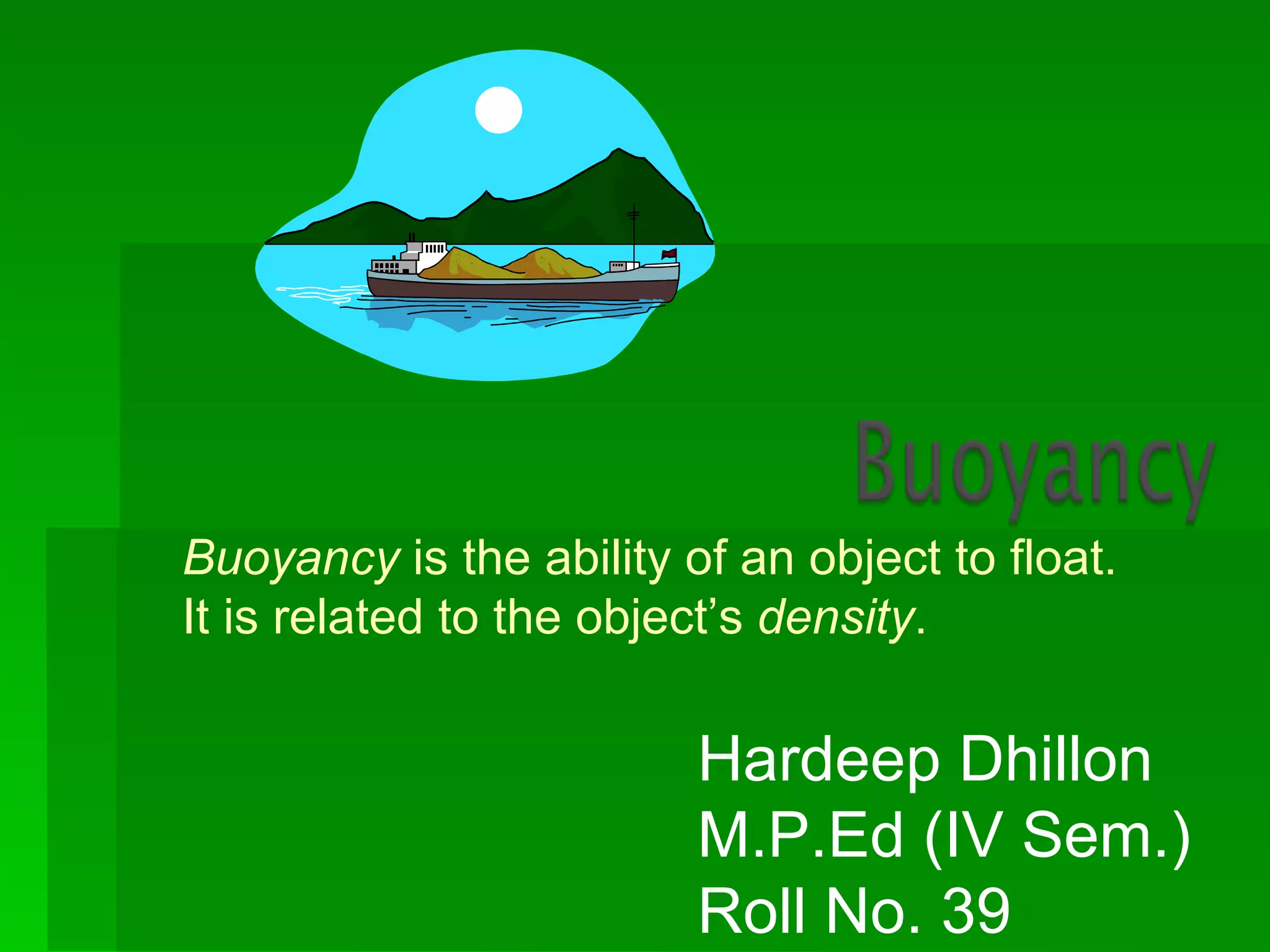
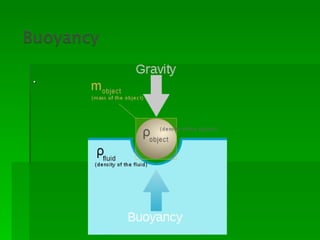
Buoyancy is the ability of an object to float.
It is related to the object’s density.

                         Hardeep Dhillon
                         M.P.Ed (IV Sem.)
                         Roll No. 39
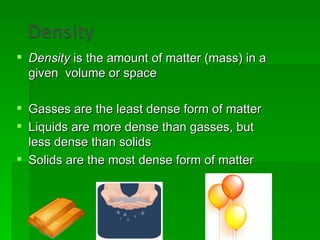
 Density is the amount of matter (mass) in a
  given volume or space

 Gasses are the least dense form of matter
 Liquids are more dense than gasses, but
  less dense than solids
 Solids are the most dense form of matter
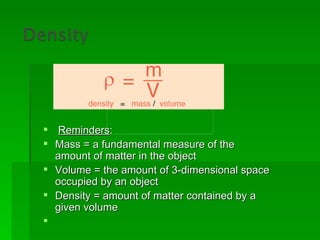
 Reminders:
 Mass = a fundamental measure of the
  amount of matter in the object
 Volume = the amount of 3-dimensional space
  occupied by an object
 Density = amount of matter contained by a
  given volume

 The upward force exerted by the liquid on any
  object.

 An upward acting force caused by fluid
  pressure that keeps object afloat.

 All objects faces the force of buoyancy when
  emerged in water.
.
         
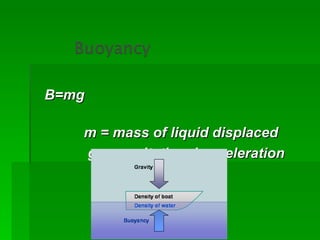
   B=mg  

             m = mass of liquid displaced
              g = gravitational acceleration
                       
Why boats float and
elephants sink
:buoyancy
  How does a boat or ship carrying hundreds of
   pounds worth of stuff float while that same stuff
   would sink to the bottom of the ocean if dumped
   overboard? How come when you're in a pool and
   you stretch your body out flat you float. But, if
   you wrap your arms around your legs and curl up
   into a ball you sink?
  Well, it all has to do with how much water is
   pushing against you and a little scientific
   principle called buoyancy or floatation. When you
   stretch out flat more water pushes against you
   since your body is laid out flatter
Archimedes' Principle
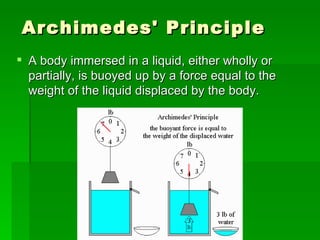
 A body immersed in a liquid, either wholly or
  partially, is buoyed up by a force equal to the
  weight of the liquid displaced by the body.
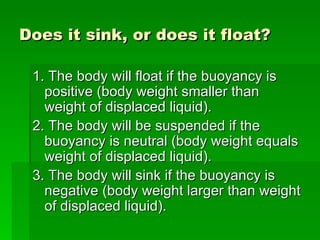
Does it sink, or does it float?

 1. The body will float if the buoyancy is
   positive (body weight smaller than
   weight of displaced liquid).
 2. The body will be suspended if the
   buoyancy is neutral (body weight equals
   weight of displaced liquid).
 3. The body will sink if the buoyancy is
   negative (body weight larger than weight
   of displaced liquid).
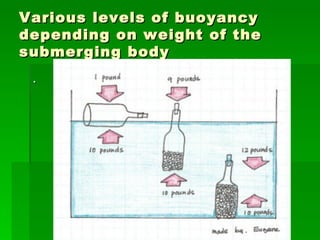
Various levels of buoyancy
depending on weight of the
submerging body
 .
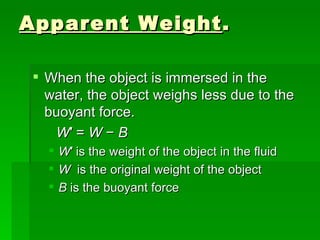
Apparent Weight .

  When the object is immersed in the
   water, the object weighs less due to the
   buoyant force.
    W′ = W − B
      W′ is the weight of the object in the fluid
      W is the original weight of the object
      B is the buoyant force
Thank You


.

Buonac

  • 1.
    Buoyancy is theability of an object to float. It is related to the object’s density. Hardeep Dhillon M.P.Ed (IV Sem.) Roll No. 39
  • 2.
     Density isthe amount of matter (mass) in a given volume or space  Gasses are the least dense form of matter  Liquids are more dense than gasses, but less dense than solids  Solids are the most dense form of matter
  • 3.
     Reminders:  Mass= a fundamental measure of the amount of matter in the object  Volume = the amount of 3-dimensional space occupied by an object  Density = amount of matter contained by a given volume 
  • 4.
     The upwardforce exerted by the liquid on any object.  An upward acting force caused by fluid pressure that keeps object afloat.  All objects faces the force of buoyancy when emerged in water.
  • 5.
  • 6.
              B=mg                m = mass of liquid displaced               g = gravitational acceleration                        
  • 7.
    Why boats floatand elephants sink :buoyancy  How does a boat or ship carrying hundreds of pounds worth of stuff float while that same stuff would sink to the bottom of the ocean if dumped overboard? How come when you're in a pool and you stretch your body out flat you float. But, if you wrap your arms around your legs and curl up into a ball you sink?  Well, it all has to do with how much water is pushing against you and a little scientific principle called buoyancy or floatation. When you stretch out flat more water pushes against you since your body is laid out flatter
  • 8.
    Archimedes' Principle  Abody immersed in a liquid, either wholly or partially, is buoyed up by a force equal to the weight of the liquid displaced by the body.
  • 9.
    Does it sink,or does it float? 1. The body will float if the buoyancy is positive (body weight smaller than weight of displaced liquid). 2. The body will be suspended if the buoyancy is neutral (body weight equals weight of displaced liquid). 3. The body will sink if the buoyancy is negative (body weight larger than weight of displaced liquid).
  • 10.
    Various levels ofbuoyancy depending on weight of the submerging body .
  • 11.
    Apparent Weight .  When the object is immersed in the water, the object weighs less due to the buoyant force. W′ = W − B  W′ is the weight of the object in the fluid  W is the original weight of the object  B is the buoyant force
  • 12.