Starter 10/9-10:
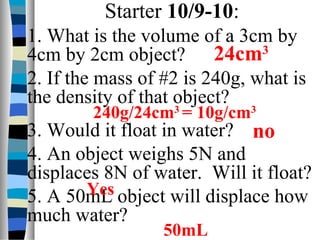
1. What is the volume of a 3cm by
4cm by 2cm object?       24cm3
2. If the mass of #2 is 240g, what is
the density of that object? 3
        240g/24cm = 10g/cm
                    3

3. Would it float in water? no
4. An object weighs 5N and
displaces 8N of water. Will it float?
       Yes object will displace how
5. A 50mL
much water?
                  50mL
What do we know?
Balanced   forces cause no change
 in motion
Gravity pulls items down
Buoyant Force pushes items up
Density is a ratio of mass to
 volume
Test is next week
Will they float?
Coke VS Diet Coke
What do we know about
 them?
Mass: 390.4g & 374.1g
Volume: 380 mL
Which floats?
What  do we need to calculate?
Yes-it is your destiny…
In What though?
Water
 – Density = ?
Salt   Water
 – Density = ?
What is known?
What   is true of both densities?
 – Salt water is denser…1.1g/mL
 – Water is less dense…1.0g/mL
Snorkeling
Easier
      to snorkel in the ocean?
Mono Lake is a favorite
 swimming lake - why?
No it’s Buoyancy
Buoy  = float (latin for)
Archimedes discovered this
 with the golden crown
 – The crown (and our solids)
   displaced an amount of water
Buoyancy
Buoyancy-the  “floating force”
Water is “heavier” then item...
    floats
Low density-more likely to
 float
Buoyancy
Displace   = push water away
 – Water moves up
Archimedes   Principle:
 “a floating object displaces
 water, the water displaced
 weighs the same as the objects
 weight.”
Boyz?
How  did we calculate the
 volume of irregular objects?
Remember Archimedes?
 – Gold crown
Water    is displaced by the
 object
Buoyancy
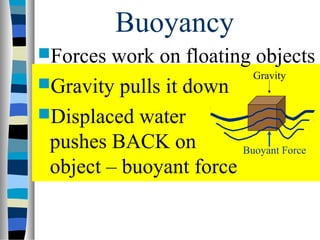
Forces  work on floating objects
                          Gravity
Gravity pulls it down
Displaced water
 pushes BACK on         Buoyant Force
 object – buoyant force
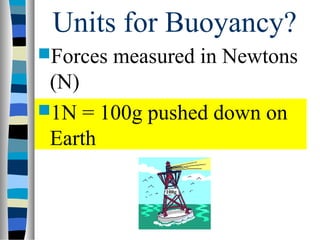
Units for Buoyancy?
Forces   measured in Newtons
 (N)
1N = 100g pushed down on
 Earth

               100g
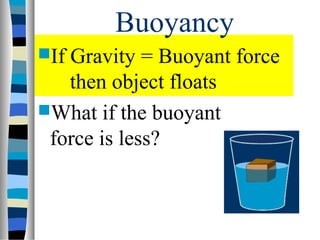
Buoyancy
IfGravity = Buoyant force
   then object floats
What if the buoyant
 force is less?
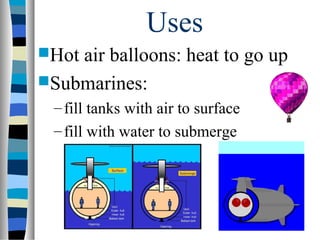
Uses
Hotair balloons: heat to go up
Submarines:
 – fill tanks with air to surface
 – fill with water to submerge
Practice Time!!!
Asmall boat has a mass of
76g and displaced 80 mL of
water. Does it sink or float?
Practice Time!!!
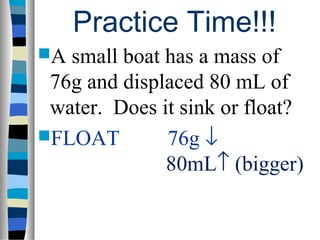
A small boat has a mass of
 76g and displaced 80 mL of
 water. Does it sink or float?
FLOAT        76g ↓
              80mL↑ (bigger)
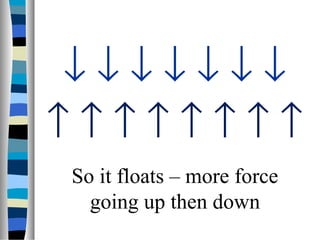
↓↓↓↓↓↓↓
↑↑↑↑↑↑↑↑
So it floats – more force
  going up then down
Practice Time!!!
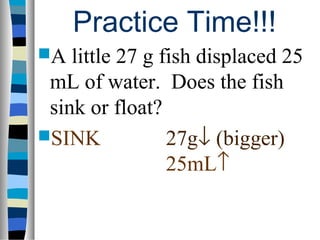
A little 27 g fish displaced 25
mL of water. Does the fish
sink or float?
Practice Time!!!
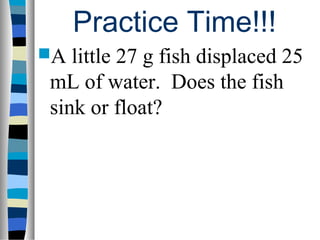
A  little 27 g fish displaced 25
 mL of water. Does the fish
 sink or float?
SINK            27g↓ (bigger)
                 25mL↑
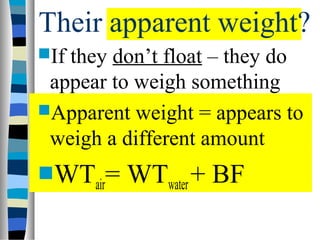
Their apparent weight?
Ifthey don’t float – they do
 appear to weigh something
Apparent weight = appears to
 weigh a different amount
WTair=   WTwater + BF
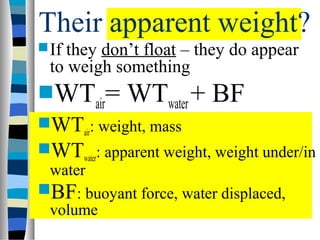
Their apparent weight?
 If they don’t float – they do appear
  to weigh something
WTair= WTwater + BF
WTair: weight, mass
WTwater: apparent weight, weight under/in
 water
BF: buoyant force, water displaced,
 volume
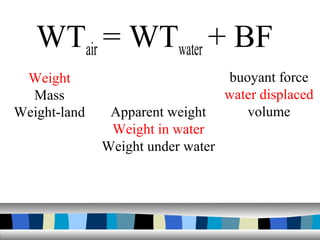
WTair = WTwater + BF
 Weight                            buoyant force
  Mass                             water displaced
Weight-land    Apparent weight        volume
               Weight in water
              Weight under water
Practice Time!
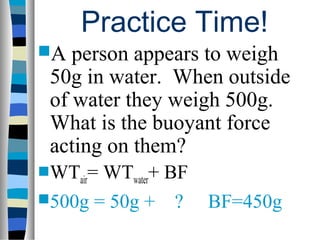
A  person appears to weigh
 50g in water. When outside
 of water they weigh 500g.
 What is the buoyant force
 acting on them?
WTair=WTwater+ BF
500g = 50g + ?      BF=450g
Practice Time!
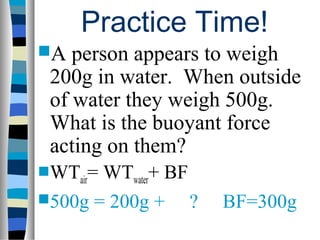
A  person appears to weigh
 200g in water. When outside
 of water they weigh 500g.
 What is the buoyant force
 acting on them?
WTair=WTwater+ BF
500g = 200g +     ?   BF=300g
Practice Time!
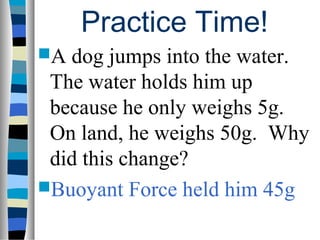
A dog jumps into the water.
 The water holds him up
 because he only weighs 5g.
 On land, he weighs 50g. Why
 did this change?
Buoyant Force held him 45g
Practice Time!
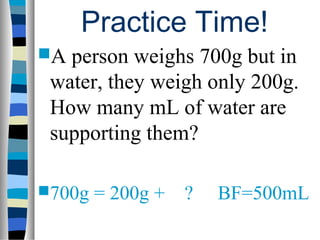
A person weighs 700g but in
 water, they weigh only 200g.
 How many mL of water are
 supporting them?

700g   = 200g +   ?   BF=500mL
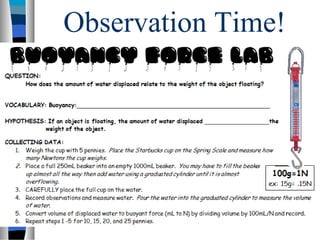
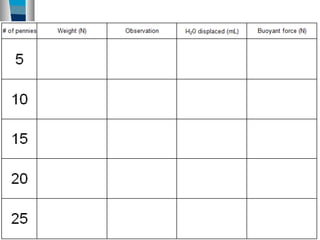
Observation Time!
Bill’s got
 a boat!

L sbuoyancy1112

  • 1.
    Starter 10/9-10: 1. Whatis the volume of a 3cm by 4cm by 2cm object? 24cm3 2. If the mass of #2 is 240g, what is the density of that object? 3 240g/24cm = 10g/cm 3 3. Would it float in water? no 4. An object weighs 5N and displaces 8N of water. Will it float? Yes object will displace how 5. A 50mL much water? 50mL
  • 2.
    What do weknow? Balanced forces cause no change in motion Gravity pulls items down Buoyant Force pushes items up Density is a ratio of mass to volume Test is next week
  • 4.
    Will they float? CokeVS Diet Coke What do we know about them? Mass: 390.4g & 374.1g Volume: 380 mL
  • 5.
    Which floats? What do we need to calculate? Yes-it is your destiny…
  • 6.
    In What though? Water – Density = ? Salt Water – Density = ?
  • 7.
    What is known? What is true of both densities? – Salt water is denser…1.1g/mL – Water is less dense…1.0g/mL
  • 8.
    Snorkeling Easier to snorkel in the ocean? Mono Lake is a favorite swimming lake - why?
  • 9.
    No it’s Buoyancy Buoy = float (latin for) Archimedes discovered this with the golden crown – The crown (and our solids) displaced an amount of water
  • 10.
    Buoyancy Buoyancy-the “floatingforce” Water is “heavier” then item... floats Low density-more likely to float
  • 11.
    Buoyancy Displace = push water away – Water moves up Archimedes Principle: “a floating object displaces water, the water displaced weighs the same as the objects weight.”
  • 12.
    Boyz? How didwe calculate the volume of irregular objects? Remember Archimedes? – Gold crown Water is displaced by the object
  • 13.
    Buoyancy Forces workon floating objects Gravity Gravity pulls it down Displaced water pushes BACK on Buoyant Force object – buoyant force
  • 14.
    Units for Buoyancy? Forces measured in Newtons (N) 1N = 100g pushed down on Earth 100g
  • 15.
    Buoyancy IfGravity = Buoyantforce then object floats What if the buoyant force is less?
  • 16.
    Uses Hotair balloons: heatto go up Submarines: – fill tanks with air to surface – fill with water to submerge
  • 17.
    Practice Time!!! Asmall boathas a mass of 76g and displaced 80 mL of water. Does it sink or float?
  • 18.
    Practice Time!!! A smallboat has a mass of 76g and displaced 80 mL of water. Does it sink or float? FLOAT 76g ↓ 80mL↑ (bigger)
  • 19.
  • 21.
    Practice Time!!! A little27 g fish displaced 25 mL of water. Does the fish sink or float?
  • 22.
    Practice Time!!! A little 27 g fish displaced 25 mL of water. Does the fish sink or float? SINK 27g↓ (bigger) 25mL↑
  • 23.
    Their apparent weight? Iftheydon’t float – they do appear to weigh something Apparent weight = appears to weigh a different amount WTair= WTwater + BF
  • 24.
    Their apparent weight? If they don’t float – they do appear to weigh something WTair= WTwater + BF WTair: weight, mass WTwater: apparent weight, weight under/in water BF: buoyant force, water displaced, volume
  • 25.
    WTair = WTwater+ BF Weight buoyant force Mass water displaced Weight-land Apparent weight volume Weight in water Weight under water
  • 26.
    Practice Time! A person appears to weigh 50g in water. When outside of water they weigh 500g. What is the buoyant force acting on them? WTair=WTwater+ BF 500g = 50g + ? BF=450g
  • 27.
    Practice Time! A person appears to weigh 200g in water. When outside of water they weigh 500g. What is the buoyant force acting on them? WTair=WTwater+ BF 500g = 200g + ? BF=300g
  • 28.
    Practice Time! A dogjumps into the water. The water holds him up because he only weighs 5g. On land, he weighs 50g. Why did this change? Buoyant Force held him 45g
  • 29.
    Practice Time! A personweighs 700g but in water, they weigh only 200g. How many mL of water are supporting them? 700g = 200g + ? BF=500mL
  • 30.
  • 33.