Welcome To Our Presentation
SYSTEMATIC PATHOLOGY
INTEGUMENTARY SYSTEM
RESPIRATORY SYSTEM
DIGESTIVE SYSTEM
EXCRETORY SYSTEM
SYSTEMATIC PATHOLOGY
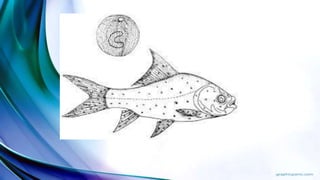
THE INTEGUMENTARY SYSTEM
In the normal environment the fish integument is subtly adapted for
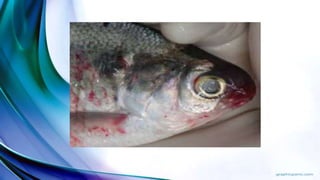
its physiological requirements. Changes in skin are the most readily
observed clinical features of fish by lesions and color change.
INTEGUMENTARY SYSTEM
Cuticular change
Epidermal change
Dermal and hypodermal
change
CUTICULAR CHANGE
Protozoal infection
Mucus secretion from dermal layer
Fail to prevent colonization of the skin surface
Trichodina sp. , Thiecamoeba sp. , Saprolegnia sp.
overcome the basic cuticular defense
(MacMillan,1985,Roberts 1992)
EPIDERMAL CHANGE
Epidermis is avascular
Its changes reflect pathological process in tissue
Degeneration is found
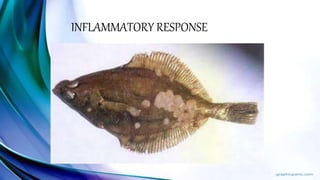
INFLAMMATORY RESPONSE
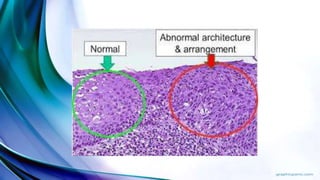
HYPERPLASIA
Increase number of cell in tissue
Phenomenon in fish epidermis accompanied by spongiosis
Include chemical pollutants,hormonal stimuli, Flexibacter sp.
It is frequent at low temperature
Occurred if the fish are retained in salt water over spawning
DERMAL AND HYPODERMAL CHANGE
Dermal inflammatory lesions are associated with the acromonal
disease
Such lesion releases infectious material into water
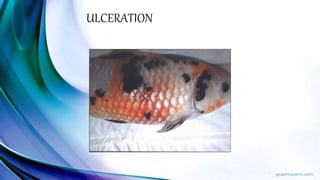
ulceration
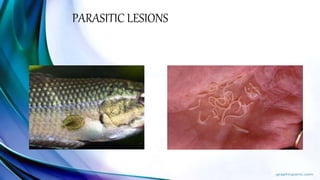
parasitic lesions
ULCERATION
PARASITIC LESIONS
THAT’S ALL ABOUT OUR TOPIC
GROUP-A
Id:
1403004, 1403005,
1403006,1403007,
1403008,1403009,
1403010, 1403011,
1403013, 1403014,
1403015, 1403016,
1403017, 1403018,
1403019,1403020
THANKS TO ALL

Fish pathology