Alaska Fiscal Policy: Where are we headed 
ENERGY MARKETS & REGULATION IN ALASKA 
ANCHORAGE, AK 
DECEMBER 8, 2014 
Brad Keithley 
President, Keithley Consulting 
bgkeithley.com
Problem has been building 
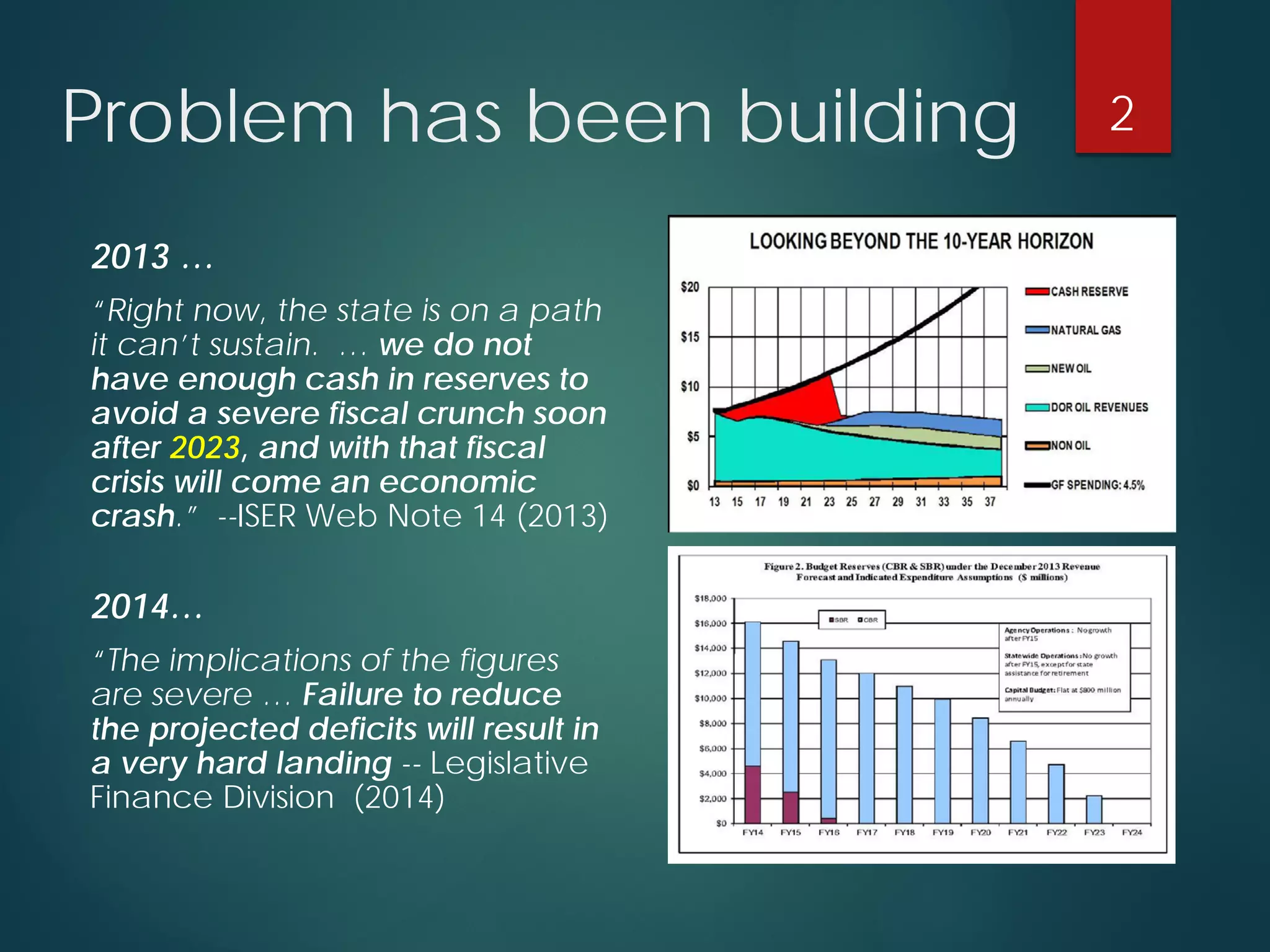
2013 … 
“Right now, the state is on a path it can’t sustain. … we do not have enough cash in reserves to avoid a severe fiscal crunch soon after 2023, and with that fiscal crisis will come an economic crash.” --ISER Web Note 14 (2013) 
2014… 
“The implications of the figures are severe … Failure to reduce the projected deficits will result in a very hard landing--Legislative Finance Division (2014) 
2
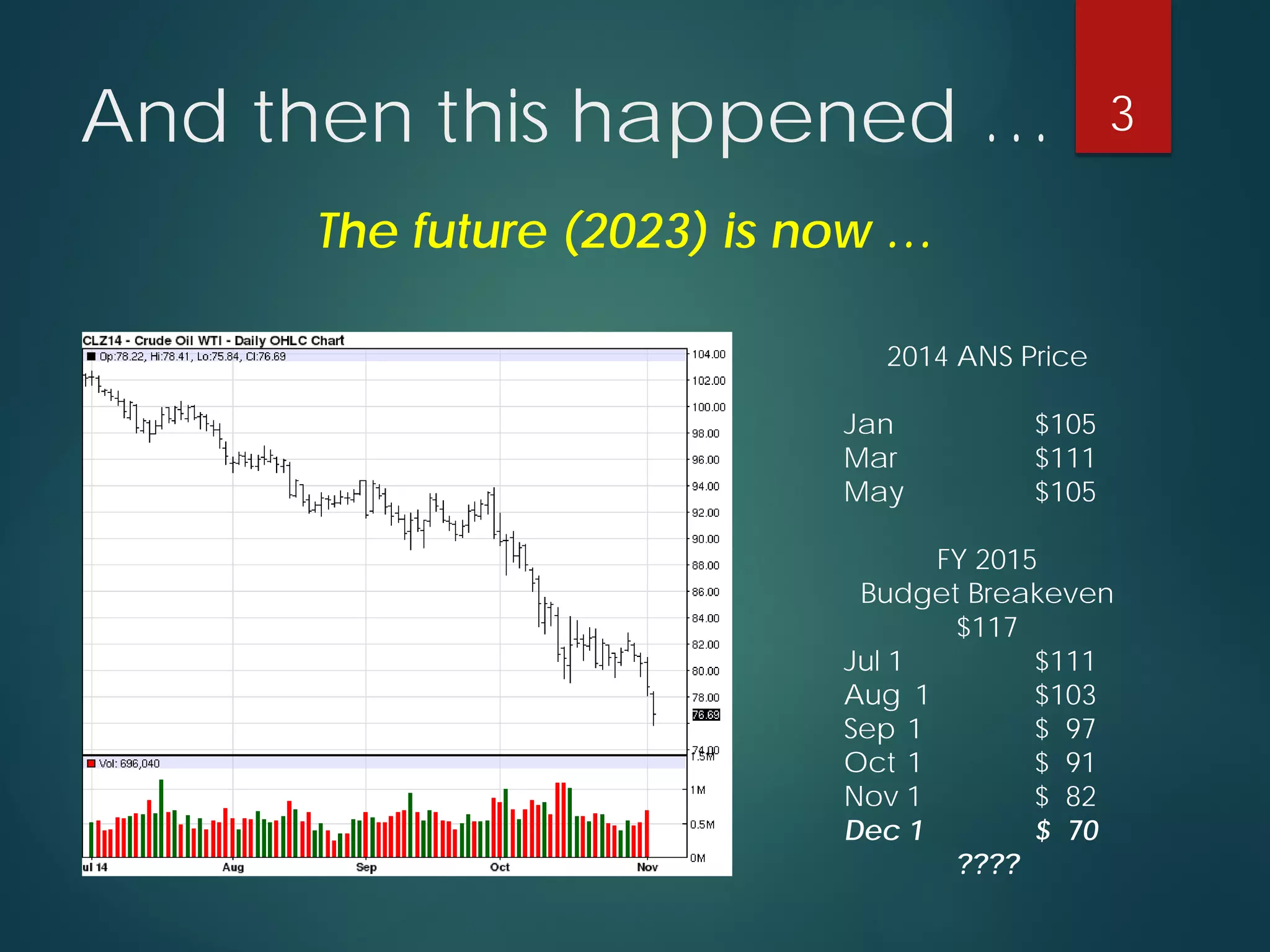
And then this happened … 
2014 ANS Price 
Jan $105 
Mar $111 
May $105 
FY 2015 
Budget Breakeven 
$117 
Jul 1 $111 
Aug 1 $103 
Sep 1 $ 97 
Oct 1 $ 91 
Nov 1 $ 82 
Dec 1 $ 70 
???? 
The future (2023) is now … 
3
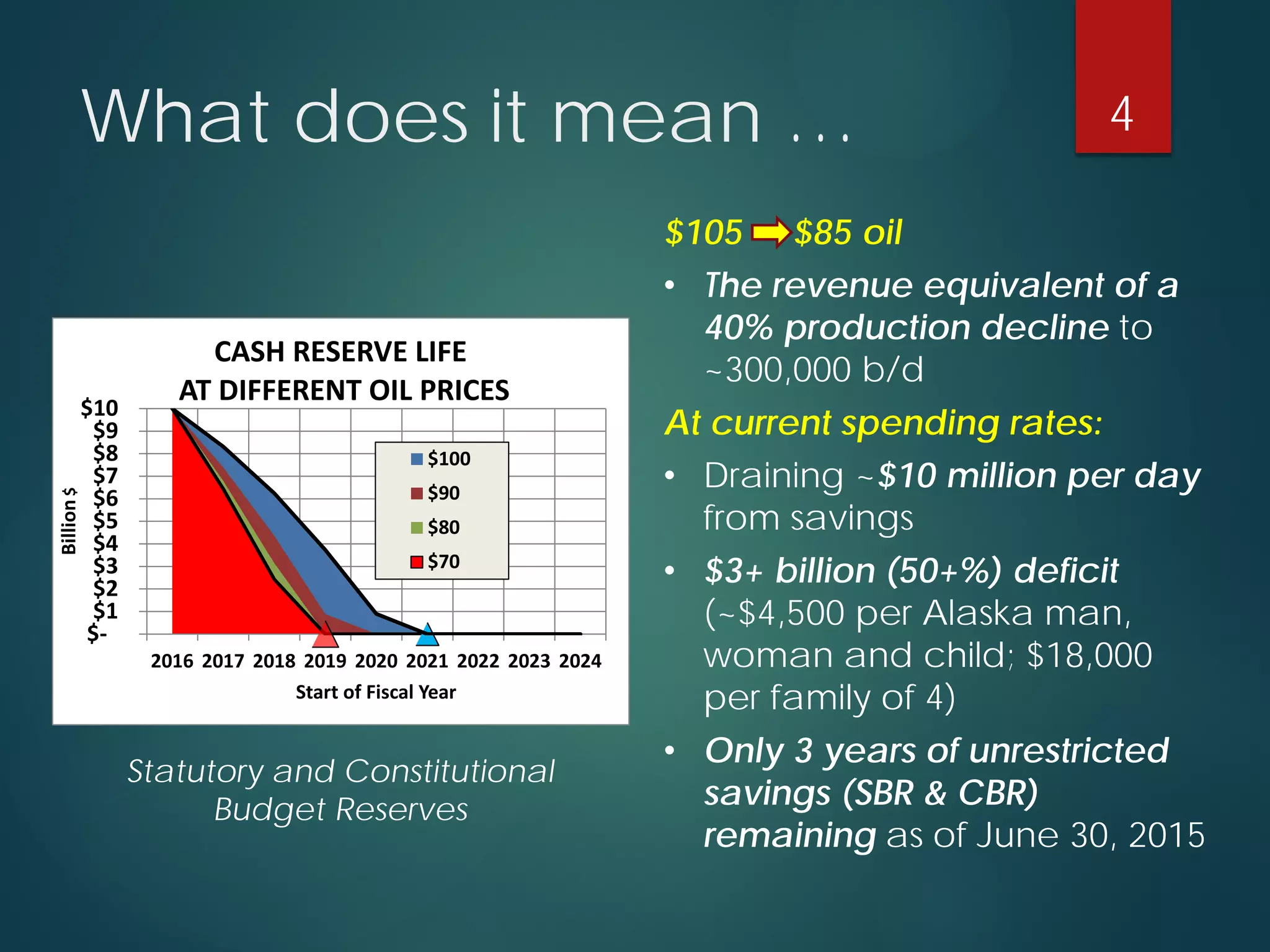
What does it mean … 
$105 $85 oil 
• The revenue equivalent of a 
40% production decline to 
~300,000 b/d 
At current spending rates: 
• Draining ~$10 million per day 
from savings 
• $3+ billion (50+%) deficit 
(~$4,500 per Alaska man, 
woman and child; $18,000 
per family of 4) 
• Only 3 years of unrestricted 
savings (SBR & CBR) 
remaining as of June 30, 2015 
Statutory and Constitutional 
Budget Reserves 
$- $1 $2 $3 $4 $5 $6 $7 $8 $9 $10201620172018201920202021202220232024 Billion$ Start of Fiscal YearCASH RESERVE LIFEAT DIFFERENT OIL PRICES$100$90$80$70 
4
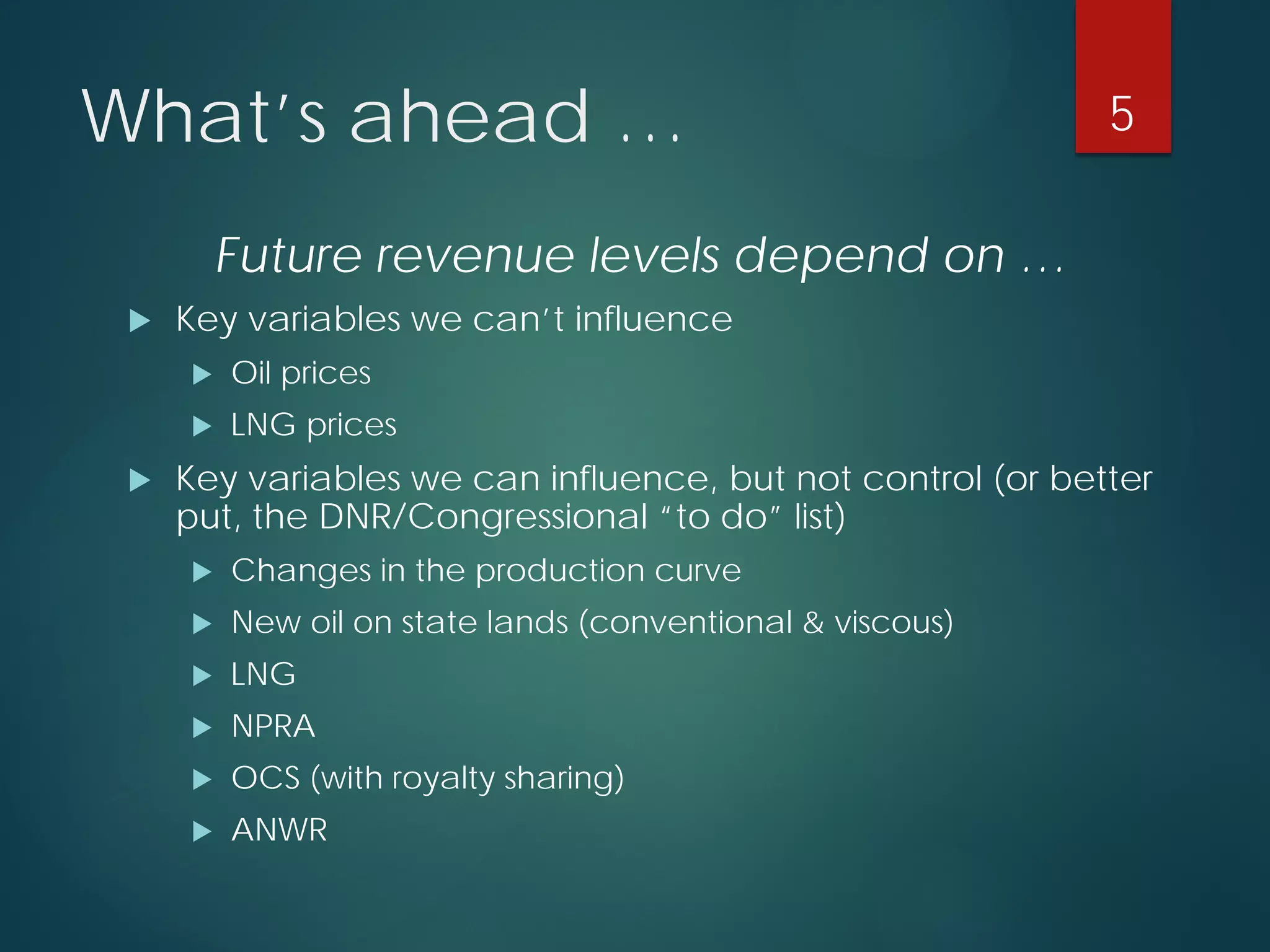
What’s ahead … 
Future revenue levels depend on … 
 
Key variables we can’t influence 
 
Oil prices 
 
LNG prices 
 
Key variables we can influence, but not control (or better put, the DNR/Congressional “to do” list) 
 
Changes in the production curve 
 
New oil on state lands (conventional & viscous) 
 
LNG 
 
NPRA 
 
OCS (with royalty sharing) 
 
ANWR 
5
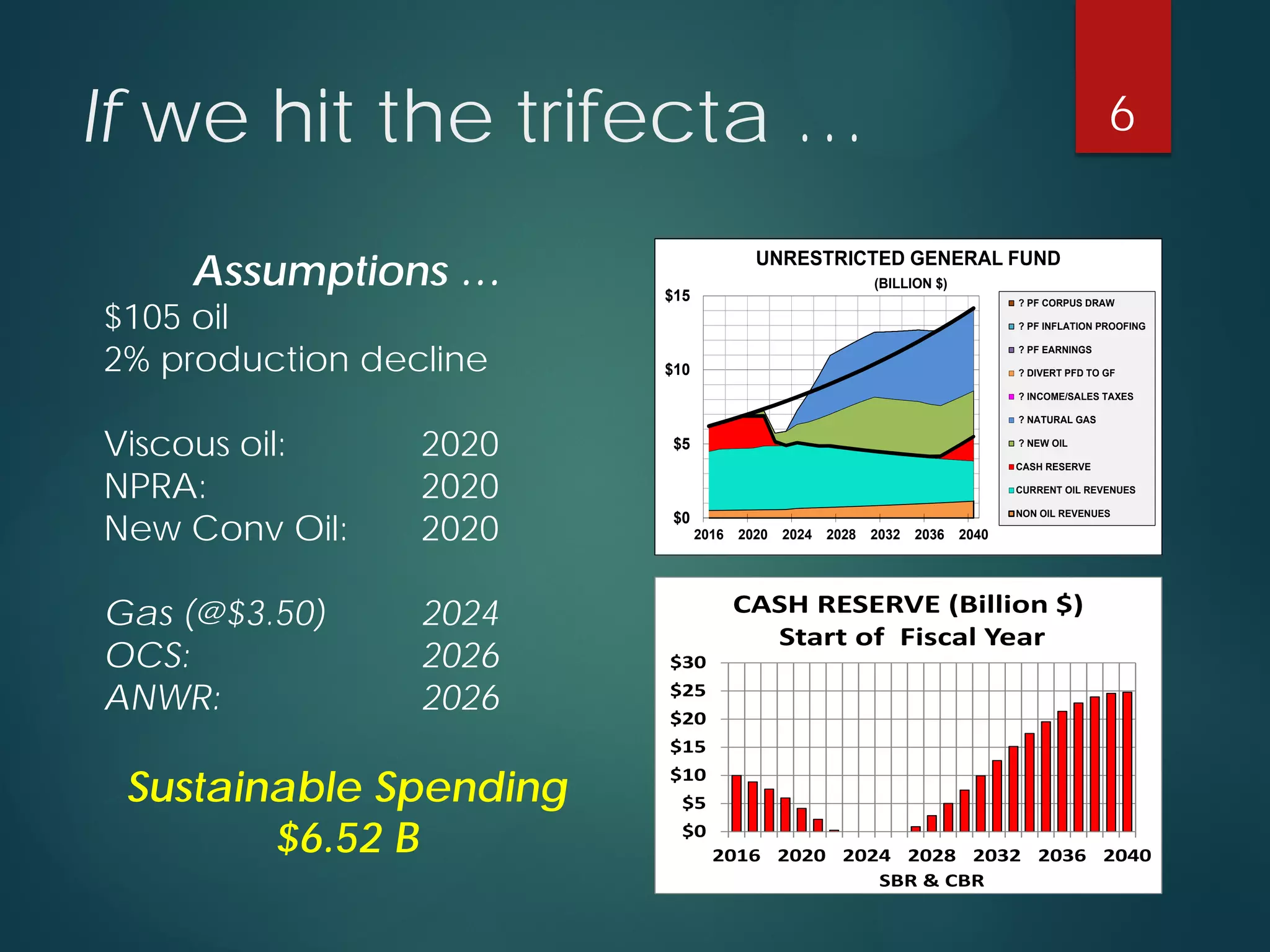
Ifwe hit the trifecta … 
Assumptions … 
$105 oil 
2% production decline 
Viscous oil: 2020 
NPRA: 2020 
New Conv Oil: 2020 
Gas (@$3.50) 2024 
OCS: 2026 
ANWR: 2026 
Sustainable Spending 
$6.52 B 
$0$5$10$152016202020242028203220362040UNRESTRICTED GENERAL FUND(BILLION $) ? PF CORPUS DRAW ? PF INFLATION PROOFING ? PF EARNINGS ? DIVERT PFD TO GF ? INCOME/SALES TAXES ? NATURAL GAS ? NEW OILCASH RESERVECURRENT OIL REVENUESNON OIL REVENUES$0$5$10$15$20$25$302016202020242028203220362040SBR & CBRCASH RESERVE (Billion $) Start of Fiscal Year 
6
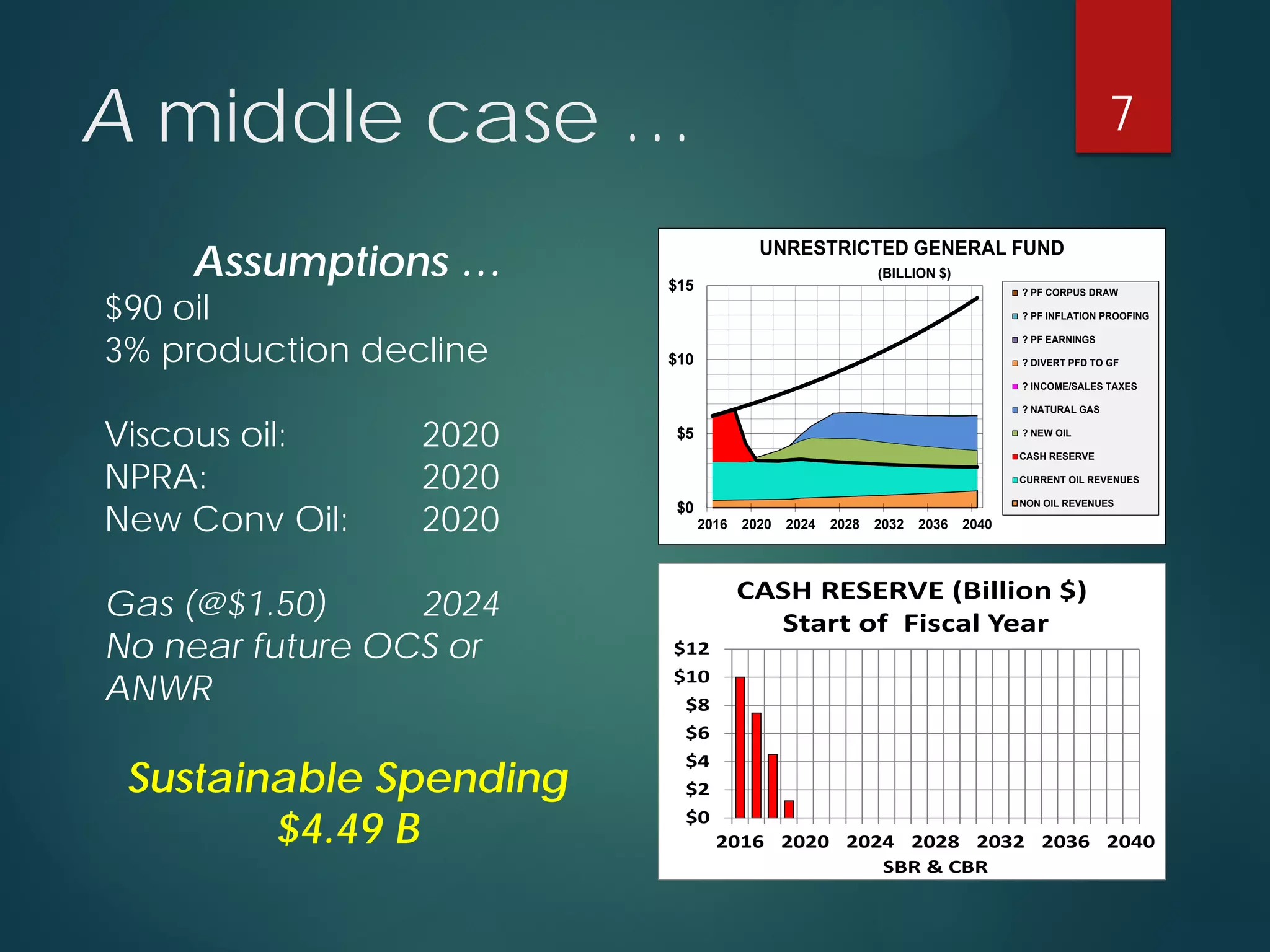
Amiddle case … 
Assumptions … 
$90 oil 
3% production decline 
Viscous oil: 2020 
NPRA: 2020 
New Conv Oil: 2020 
Gas (@$1.50) 2024 
No near future OCS or 
ANWR 
Sustainable Spending 
$4.49 B 
$0$5$10$152016202020242028203220362040UNRESTRICTED GENERAL FUND(BILLION $) ? PF CORPUS DRAW ? PF INFLATION PROOFING ? PF EARNINGS ? DIVERT PFD TO GF ? INCOME/SALES TAXES ? NATURAL GAS ? NEW OILCASH RESERVECURRENT OIL REVENUESNON OIL REVENUES$0$2$4$6$8$10$122016202020242028203220362040SBR & CBRCASH RESERVE (Billion $) Start of Fiscal Year 
7
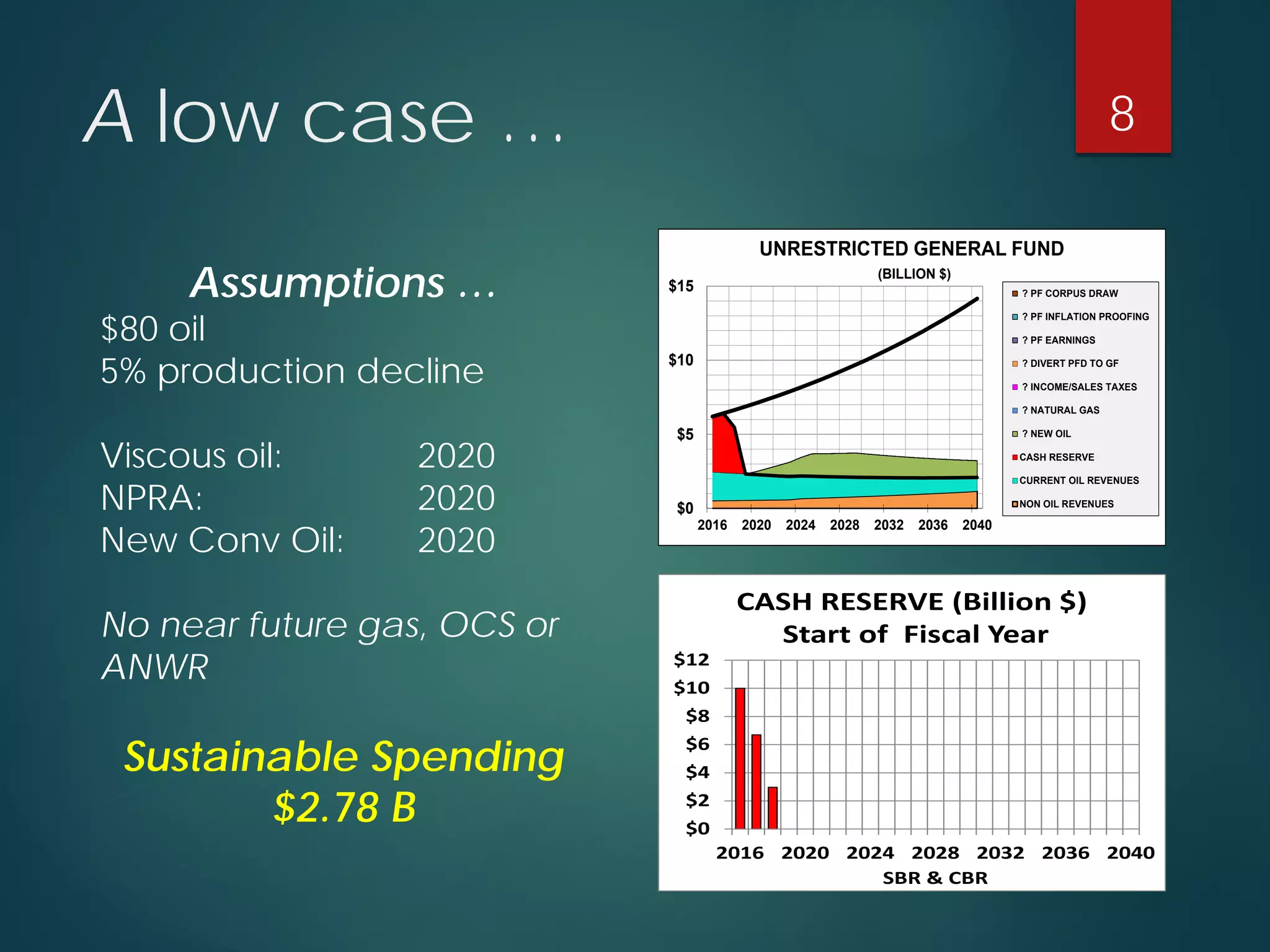
Alow case … 
Assumptions … 
$80 oil 
5% production decline 
Viscous oil: 2020 
NPRA: 2020 
New Conv Oil: 2020 
No near future gas, OCS or 
ANWR 
Sustainable Spending 
$2.78 B 
$0$5$10$152016202020242028203220362040UNRESTRICTED GENERAL FUND(BILLION $) ? PF CORPUS DRAW ? PF INFLATION PROOFING ? PF EARNINGS ? DIVERT PFD TO GF ? INCOME/SALES TAXES ? NATURAL GAS ? NEW OILCASH RESERVECURRENT OIL REVENUESNON OIL REVENUES$0$2$4$6$8$10$122016202020242028203220362040SBR & CBRCASH RESERVE (Billion $) Start of Fiscal Year 
8
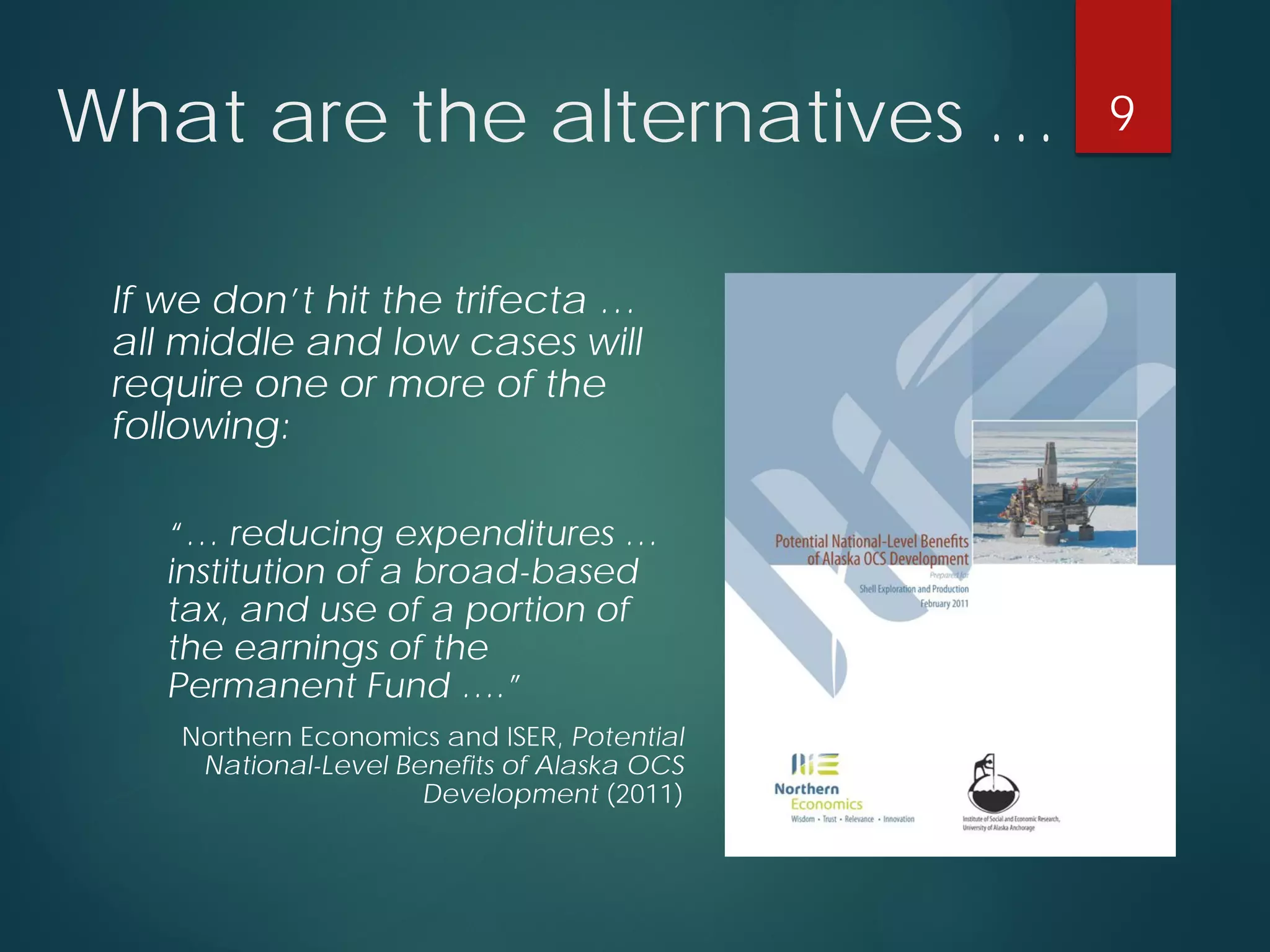
What are the alternatives … 
If we don’t hit the trifecta … all middle and low cases will require one or more of the following: 
“… reducing expenditures… institution of a broad-based tax, and use of a portion of the earnings of the Permanent Fund ….” 
Northern Economics and ISER, Potential National-Level Benefits of Alaska OCS Development (2011) 
9
What is the starting point … 
Parnell “work in progress” FY 2016 budget: 
 
$5.5 billion in spending, but no contribution to PERS/TRS ($5.85 billion with PERS/TRS included) 
 
Limited reductions to operating budget 
 
Balances at $120 oil 
Results 
 
At $67 oil, $2.3 billion in revenues, $3.2 billion deficit 
 
At $85 oil, $2.9 billion in revenues, $2.6 billion deficit 
Unrestricted savings: ~$10 billion at the start of FY 2016 
 
Roughly 3 years at current spending rates, counting PERS/TRS adjustment 
10
What is the goal… 
“I will make the hard choices necessary for a sounder fiscal future, including putting in place a sustainable budget. I will work to make sure the investment climate in Alaska supports those goals, which includes creating a favorable fiscal climate for citizens and companies investing in our economy.” 
–Bill Walker on fiscal responsibility 11
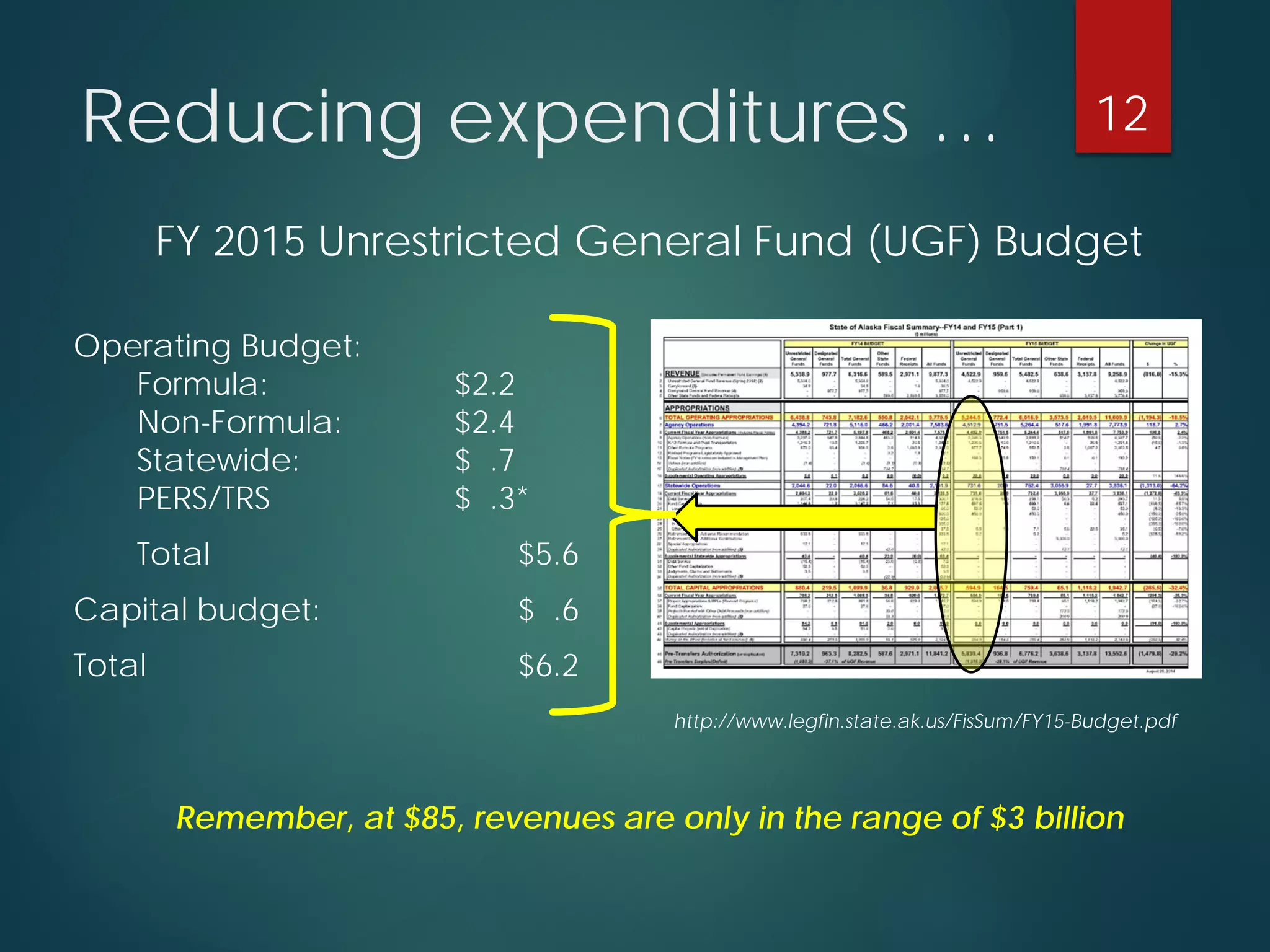
Reducing expenditures … 
Operating Budget: 
Formula:$2.2Non-Formula:$2.4 
Statewide:$ .7 
PERS/TRS$ .3* 
Total$5.6 
Capital budget:$ .6 
Total$6.2 
http://www.legfin.state.ak.us/FisSum/FY15-Budget.pdf 
FY 2015 Unrestricted General Fund (UGF) Budget 
Remember, at $85, revenues are only in the range of $3 billion 
12
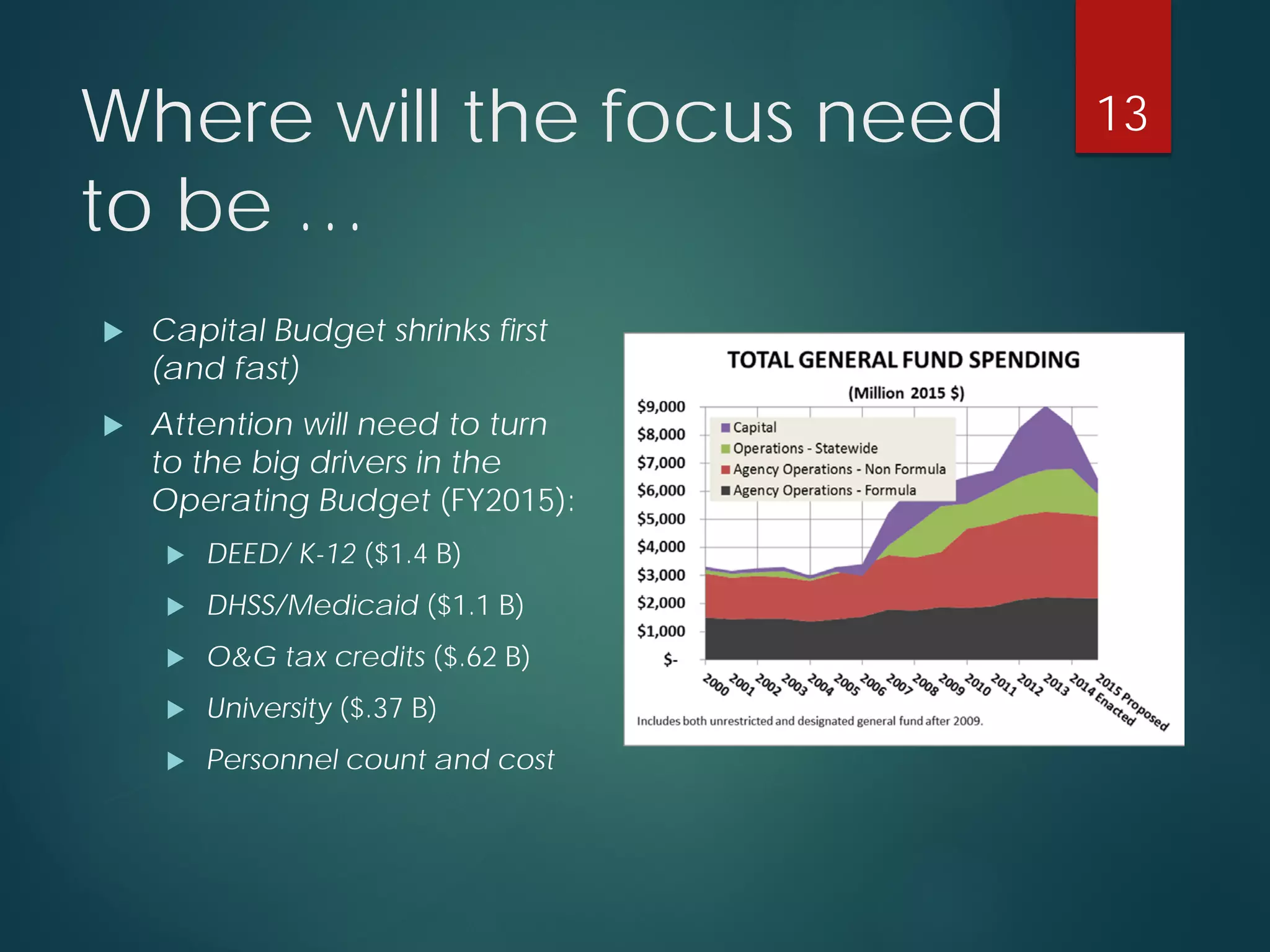
Where will the focus need to be … 
 
Capital Budget shrinks first (and fast) 
 
Attention will need to turn to the big drivers in the Operating Budget (FY2015): 
 
DEED/ K-12 ($1.4 B) 
 
DHSS/Medicaid ($1.1 B) 
 
O&G tax credits ($.62 B) 
 
University ($.37 B) 
 
Personnel count and cost 
13
Additional facts … 
 
Additional cash reserves 
 
Designated reserves: $2.8 billion (accessible through legislative action, but will reduce endowments) 
 
PF earnings reserve:$6.7 billion (est. July 1, 2015, accessible through legislative action, but will reduce PFD) 
 
Potential revenue generating options 
 
Sales/income tax: $1.3 billion (~$1800 per capita) 
 
Diversion of PFD: $1.4 billion (~$1900 per capita) 
 
Permanent Fund corpus 
 
$47 billion (est. July 1, 2015, but accessible only upon vote of the people) 
14
A word about other options 
 
“Increase taxes on other industries” (mining, fish, tourism) 
 
ISER studies repeatedly demonstrate limited revenue impact to state and potential harm to investment 
 
“Invest in economic diversification” 
 
To be helpful in meeting budget shortfalls, investment has to produce revenue to the state (i.e., through taxes) 
 
Other than the LNG line (possibly), no realistic options currently on the table 
 
Limited cash to invest, long history of failures 
 
Change Permanent Fund investment mix to increase potential return 
 
Potentialcomes at increased risk 
15
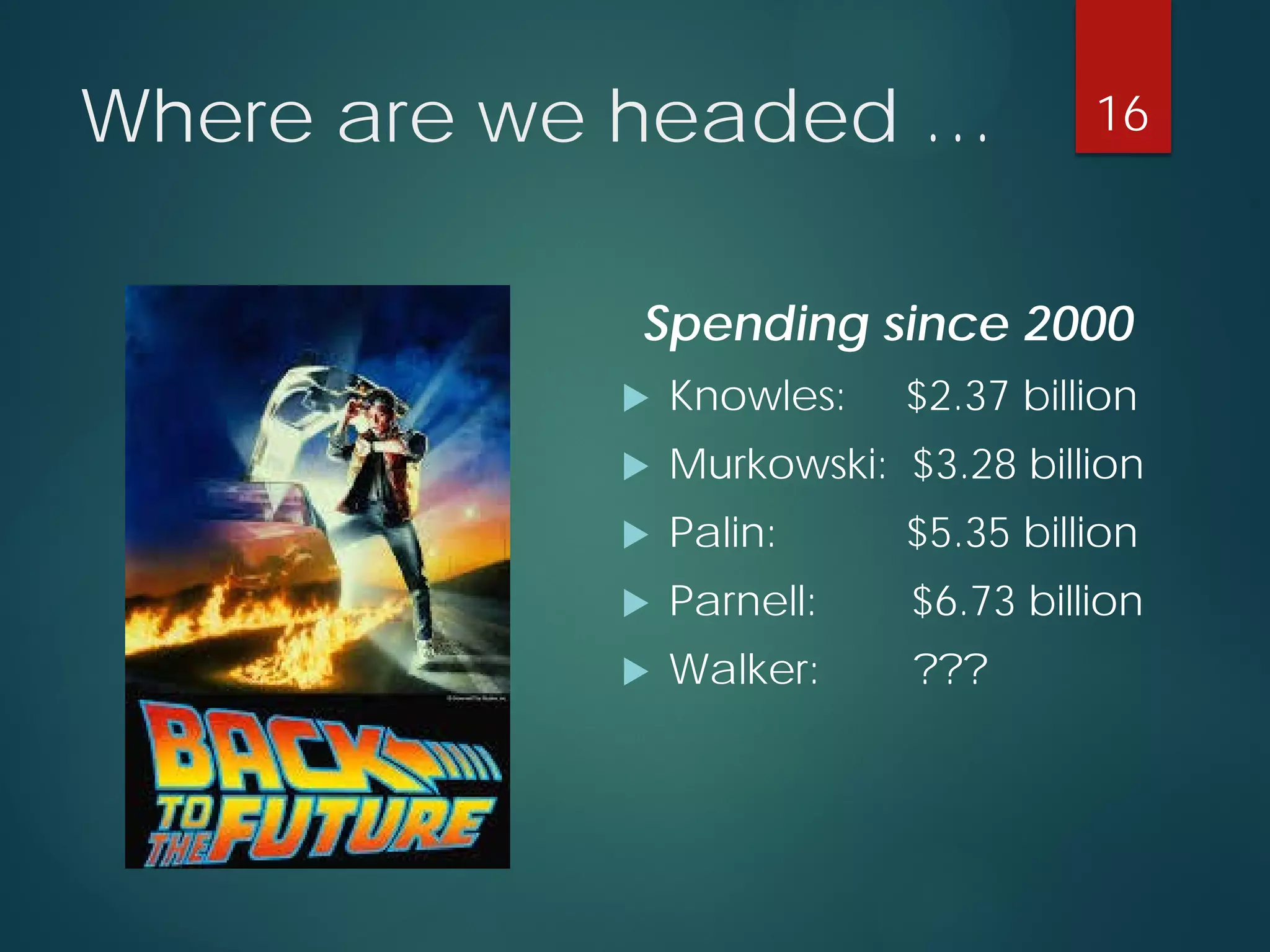
Where are we headed … 
Spending since 2000 
 
Knowles: $2.37 billion 
 
Murkowski: $3.28 billion 
 
Palin: $5.35 billion 
 
Parnell: $6.73 billion 
 
Walker: ??? 
16

Fiscal presentation (12.8.2014final)

  • 1.
    Alaska Fiscal Policy:Where are we headed ENERGY MARKETS & REGULATION IN ALASKA ANCHORAGE, AK DECEMBER 8, 2014 Brad Keithley President, Keithley Consulting bgkeithley.com
  • 2.
    Problem has beenbuilding 2013 … “Right now, the state is on a path it can’t sustain. … we do not have enough cash in reserves to avoid a severe fiscal crunch soon after 2023, and with that fiscal crisis will come an economic crash.” --ISER Web Note 14 (2013) 2014… “The implications of the figures are severe … Failure to reduce the projected deficits will result in a very hard landing--Legislative Finance Division (2014) 2
  • 3.
    And then thishappened … 2014 ANS Price Jan $105 Mar $111 May $105 FY 2015 Budget Breakeven $117 Jul 1 $111 Aug 1 $103 Sep 1 $ 97 Oct 1 $ 91 Nov 1 $ 82 Dec 1 $ 70 ???? The future (2023) is now … 3
  • 4.
    What does itmean … $105 $85 oil • The revenue equivalent of a 40% production decline to ~300,000 b/d At current spending rates: • Draining ~$10 million per day from savings • $3+ billion (50+%) deficit (~$4,500 per Alaska man, woman and child; $18,000 per family of 4) • Only 3 years of unrestricted savings (SBR & CBR) remaining as of June 30, 2015 Statutory and Constitutional Budget Reserves $- $1 $2 $3 $4 $5 $6 $7 $8 $9 $10201620172018201920202021202220232024 Billion$ Start of Fiscal YearCASH RESERVE LIFEAT DIFFERENT OIL PRICES$100$90$80$70 4
  • 5.
    What’s ahead … Future revenue levels depend on …  Key variables we can’t influence  Oil prices  LNG prices  Key variables we can influence, but not control (or better put, the DNR/Congressional “to do” list)  Changes in the production curve  New oil on state lands (conventional & viscous)  LNG  NPRA  OCS (with royalty sharing)  ANWR 5
  • 6.
    Ifwe hit thetrifecta … Assumptions … $105 oil 2% production decline Viscous oil: 2020 NPRA: 2020 New Conv Oil: 2020 Gas (@$3.50) 2024 OCS: 2026 ANWR: 2026 Sustainable Spending $6.52 B $0$5$10$152016202020242028203220362040UNRESTRICTED GENERAL FUND(BILLION $) ? PF CORPUS DRAW ? PF INFLATION PROOFING ? PF EARNINGS ? DIVERT PFD TO GF ? INCOME/SALES TAXES ? NATURAL GAS ? NEW OILCASH RESERVECURRENT OIL REVENUESNON OIL REVENUES$0$5$10$15$20$25$302016202020242028203220362040SBR & CBRCASH RESERVE (Billion $) Start of Fiscal Year 6
  • 7.
    Amiddle case … Assumptions … $90 oil 3% production decline Viscous oil: 2020 NPRA: 2020 New Conv Oil: 2020 Gas (@$1.50) 2024 No near future OCS or ANWR Sustainable Spending $4.49 B $0$5$10$152016202020242028203220362040UNRESTRICTED GENERAL FUND(BILLION $) ? PF CORPUS DRAW ? PF INFLATION PROOFING ? PF EARNINGS ? DIVERT PFD TO GF ? INCOME/SALES TAXES ? NATURAL GAS ? NEW OILCASH RESERVECURRENT OIL REVENUESNON OIL REVENUES$0$2$4$6$8$10$122016202020242028203220362040SBR & CBRCASH RESERVE (Billion $) Start of Fiscal Year 7
  • 8.
    Alow case … Assumptions … $80 oil 5% production decline Viscous oil: 2020 NPRA: 2020 New Conv Oil: 2020 No near future gas, OCS or ANWR Sustainable Spending $2.78 B $0$5$10$152016202020242028203220362040UNRESTRICTED GENERAL FUND(BILLION $) ? PF CORPUS DRAW ? PF INFLATION PROOFING ? PF EARNINGS ? DIVERT PFD TO GF ? INCOME/SALES TAXES ? NATURAL GAS ? NEW OILCASH RESERVECURRENT OIL REVENUESNON OIL REVENUES$0$2$4$6$8$10$122016202020242028203220362040SBR & CBRCASH RESERVE (Billion $) Start of Fiscal Year 8
  • 9.
    What are thealternatives … If we don’t hit the trifecta … all middle and low cases will require one or more of the following: “… reducing expenditures… institution of a broad-based tax, and use of a portion of the earnings of the Permanent Fund ….” Northern Economics and ISER, Potential National-Level Benefits of Alaska OCS Development (2011) 9
  • 10.
    What is thestarting point … Parnell “work in progress” FY 2016 budget:  $5.5 billion in spending, but no contribution to PERS/TRS ($5.85 billion with PERS/TRS included)  Limited reductions to operating budget  Balances at $120 oil Results  At $67 oil, $2.3 billion in revenues, $3.2 billion deficit  At $85 oil, $2.9 billion in revenues, $2.6 billion deficit Unrestricted savings: ~$10 billion at the start of FY 2016  Roughly 3 years at current spending rates, counting PERS/TRS adjustment 10
  • 11.
    What is thegoal… “I will make the hard choices necessary for a sounder fiscal future, including putting in place a sustainable budget. I will work to make sure the investment climate in Alaska supports those goals, which includes creating a favorable fiscal climate for citizens and companies investing in our economy.” –Bill Walker on fiscal responsibility 11
  • 12.
    Reducing expenditures … Operating Budget: Formula:$2.2Non-Formula:$2.4 Statewide:$ .7 PERS/TRS$ .3* Total$5.6 Capital budget:$ .6 Total$6.2 http://www.legfin.state.ak.us/FisSum/FY15-Budget.pdf FY 2015 Unrestricted General Fund (UGF) Budget Remember, at $85, revenues are only in the range of $3 billion 12
  • 13.
    Where will thefocus need to be …  Capital Budget shrinks first (and fast)  Attention will need to turn to the big drivers in the Operating Budget (FY2015):  DEED/ K-12 ($1.4 B)  DHSS/Medicaid ($1.1 B)  O&G tax credits ($.62 B)  University ($.37 B)  Personnel count and cost 13
  • 14.
    Additional facts …  Additional cash reserves  Designated reserves: $2.8 billion (accessible through legislative action, but will reduce endowments)  PF earnings reserve:$6.7 billion (est. July 1, 2015, accessible through legislative action, but will reduce PFD)  Potential revenue generating options  Sales/income tax: $1.3 billion (~$1800 per capita)  Diversion of PFD: $1.4 billion (~$1900 per capita)  Permanent Fund corpus  $47 billion (est. July 1, 2015, but accessible only upon vote of the people) 14
  • 15.
    A word aboutother options  “Increase taxes on other industries” (mining, fish, tourism)  ISER studies repeatedly demonstrate limited revenue impact to state and potential harm to investment  “Invest in economic diversification”  To be helpful in meeting budget shortfalls, investment has to produce revenue to the state (i.e., through taxes)  Other than the LNG line (possibly), no realistic options currently on the table  Limited cash to invest, long history of failures  Change Permanent Fund investment mix to increase potential return  Potentialcomes at increased risk 15
  • 16.
    Where are weheaded … Spending since 2000  Knowles: $2.37 billion  Murkowski: $3.28 billion  Palin: $5.35 billion  Parnell: $6.73 billion  Walker: ??? 16