Consistency of
IT-architecture & business goals
in retail company
Sergey Gumerov
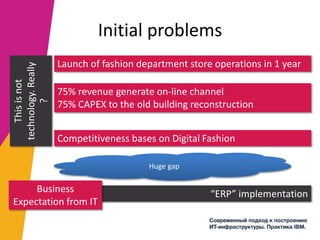
Initial problems
Launch of fashion department store operations in 1 year
75% revenue generate on-line channel
75% CAPEX to the old building reconstruction
Competitiveness bases on Digital Fashion
“ERP” implementation
Thisisnot
technology.Really
?
Business
Expectation from IT
Huge gap
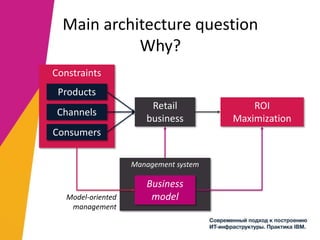
Management system
Constraints
Main architecture question
Why?
Retail
business
ROI
Maximization
Products
Channels
Consumers
Business
modelModel-oriented
management
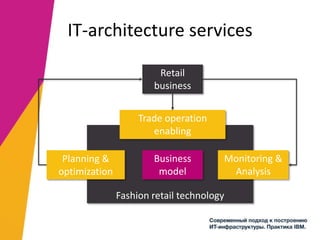
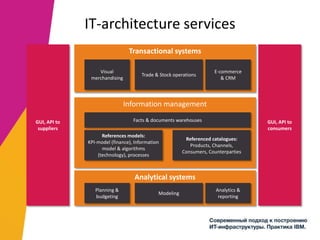
IT-architecture services
Fashion retail technology
Business
model
Retail
business
Monitoring &
Analysis
Planning &
optimization
Trade operation
enabling
Information model
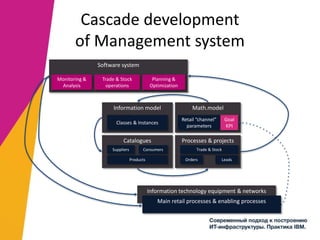
Cascade development
of Management system
Math.model
Retail “channel”
parameters
Goal
KPI
Classes & Instances
Catalogues
Products
Suppliers Consumers
Processes & projects
Software system
Trade & Stock
LeadsOrders
Information technology equipment & networks
Planning &
Optimization
Trade & Stock
operations
Monitoring &
Analysis
Main retail processes & enabling processes
Business model formalization
KPI
model
Function-structure model Procceses
Product
matrix
Supply-Sale
channels
Consumer
segmentation
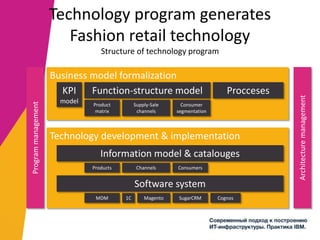
Technology program generates
Fashion retail technology
Structure of technology program
Technology development & implementation
Architecturemanagement
Programmanagement
Information model & catalouges
Software system
Products Channels Consumers
MDM 1C Magento SugarCRM Cognos
Product
characteristic
Consumer
Characteristic
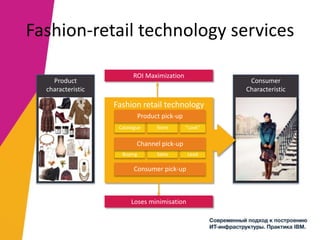
Fashion-retail technology services
ROI Maximization
Fashion retail technology
Consumer pick-up
Catalogue Store “Look”
Product pick-up
Buying Sales Lead
Channel pick-up
Loses minimisation
IT-architecture services
Information management
Referenced catalogues:
Products, Channels,
Consumers, Counterparties
References models:
KPI-model (finance), Information
model & algorithms
(technology), processes
Facts & documents warehouses
Transactional systems
Visual
merchandising
Trade & Stock operations
E-commerce
& CRM
Analytical systems
Planning &
budgeting
Modeling
Analytics &
reporting
GUI, API to
suppliers
GUI, API to
consumers
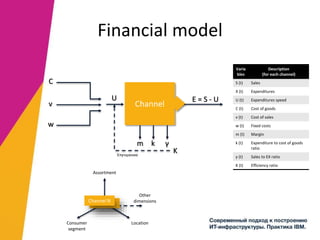
Financial model
Varia
bles
Description
(for each channel)
S (t) Sales
X (t) Expenditures
U (t) Expenditures speed
C (t) Cost of goods
v (t) Cost of sales
w (t) Fixed costs
m (t) Margin
k (t) Expenditure to cost of goods
ratio
γ (t) Sales to EX ratio
K (t) Efficiency ratio
E = S - UU
C
v
w
m k γ
KУлучшение
Канал N
Assortment
Other
dimensions
Consumer
segment
Channel N
Channel
Location
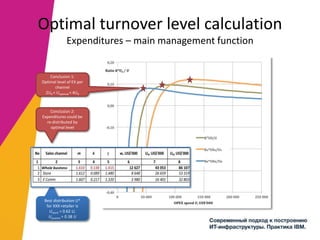
Optimal turnover level calculation
Expenditures – main management function
Best distribution U*
for ХХХ-retailer is
Ustore = 0.62 U,
Uecomm = 0.38 U
Conclusion 1:
Optimal level of EX per
channel
2U0 < Uoptimal < 4U0
Conclusion 2:
Expenditures could be
re-distributed by
optimal level
Whole business
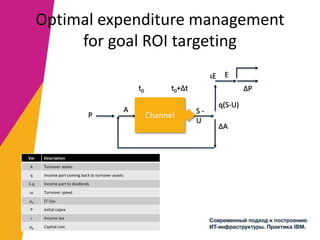
Var Description
A Turnover assets
q Income part coming back to turnover assets
1-q Income part to dividends
ω Turnover speed
μa (ϒ-1)ω
P Initial capex
ι Income tax
μp Capital cost
Optimal expenditure management
for goal ROI targeting
S -
U
A
P
t0 t0+Δt
q(S-U)
E
ΔP
ιE
ΔA
Channel
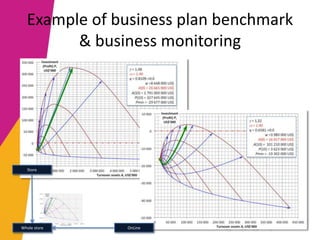
Example of business plan benchmark
& business monitoring
Store
OnLineWhole store
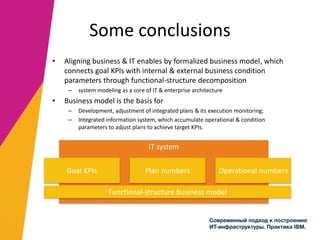
IT system
Operational numbers
Some conclusions
• Aligning business & IT enables by formalized business model, which
connects goal KPIs with internal & external business condition
parameters through functional-structure decomposition
– system modeling as a core of IT & enterprise architecture
• Business model is the basis for
– Development, adjustment of integrated plans & its execution monitoring;
– Integrated information system, which accumulate operational & condition
parameters to adjust plans to achieve target KPIs.
Plan numbersGoal KPIs
Functional-structure business model

First reference for model-oriented (proactive) management system paradigm

  • 1.
    Consistency of IT-architecture &business goals in retail company Sergey Gumerov
  • 2.
    Initial problems Launch offashion department store operations in 1 year 75% revenue generate on-line channel 75% CAPEX to the old building reconstruction Competitiveness bases on Digital Fashion “ERP” implementation Thisisnot technology.Really ? Business Expectation from IT Huge gap
  • 3.
    Management system Constraints Main architecturequestion Why? Retail business ROI Maximization Products Channels Consumers Business modelModel-oriented management
  • 4.
    IT-architecture services Fashion retailtechnology Business model Retail business Monitoring & Analysis Planning & optimization Trade operation enabling
  • 5.
    Information model Cascade development ofManagement system Math.model Retail “channel” parameters Goal KPI Classes & Instances Catalogues Products Suppliers Consumers Processes & projects Software system Trade & Stock LeadsOrders Information technology equipment & networks Planning & Optimization Trade & Stock operations Monitoring & Analysis Main retail processes & enabling processes
  • 6.
    Business model formalization KPI model Function-structuremodel Procceses Product matrix Supply-Sale channels Consumer segmentation Technology program generates Fashion retail technology Structure of technology program Technology development & implementation Architecturemanagement Programmanagement Information model & catalouges Software system Products Channels Consumers MDM 1C Magento SugarCRM Cognos
  • 7.
    Product characteristic Consumer Characteristic Fashion-retail technology services ROIMaximization Fashion retail technology Consumer pick-up Catalogue Store “Look” Product pick-up Buying Sales Lead Channel pick-up Loses minimisation
  • 8.
    IT-architecture services Information management Referencedcatalogues: Products, Channels, Consumers, Counterparties References models: KPI-model (finance), Information model & algorithms (technology), processes Facts & documents warehouses Transactional systems Visual merchandising Trade & Stock operations E-commerce & CRM Analytical systems Planning & budgeting Modeling Analytics & reporting GUI, API to suppliers GUI, API to consumers
  • 9.
    Financial model Varia bles Description (for eachchannel) S (t) Sales X (t) Expenditures U (t) Expenditures speed C (t) Cost of goods v (t) Cost of sales w (t) Fixed costs m (t) Margin k (t) Expenditure to cost of goods ratio γ (t) Sales to EX ratio K (t) Efficiency ratio E = S - UU C v w m k γ KУлучшение Канал N Assortment Other dimensions Consumer segment Channel N Channel Location
  • 10.
    Optimal turnover levelcalculation Expenditures – main management function Best distribution U* for ХХХ-retailer is Ustore = 0.62 U, Uecomm = 0.38 U Conclusion 1: Optimal level of EX per channel 2U0 < Uoptimal < 4U0 Conclusion 2: Expenditures could be re-distributed by optimal level Whole business
  • 11.
    Var Description A Turnoverassets q Income part coming back to turnover assets 1-q Income part to dividends ω Turnover speed μa (ϒ-1)ω P Initial capex ι Income tax μp Capital cost Optimal expenditure management for goal ROI targeting S - U A P t0 t0+Δt q(S-U) E ΔP ιE ΔA Channel
  • 12.
    Example of businessplan benchmark & business monitoring Store OnLineWhole store
  • 13.
    IT system Operational numbers Someconclusions • Aligning business & IT enables by formalized business model, which connects goal KPIs with internal & external business condition parameters through functional-structure decomposition – system modeling as a core of IT & enterprise architecture • Business model is the basis for – Development, adjustment of integrated plans & its execution monitoring; – Integrated information system, which accumulate operational & condition parameters to adjust plans to achieve target KPIs. Plan numbersGoal KPIs Functional-structure business model