Intelligent Process Automation &
Optimization in Retail
Arun Kumar Mishra
Focus Areas
 Demand Pattern Identification
 Facility Location Planning
 Floor Planning (Planogram)
 Sourcing Automation
 Automated Self-Checkout Counters
 Integrated Inventory Control
 Market Basket Analysis
 Inventory Replenishment Automation
 Stock Clearance
 Price Optimization
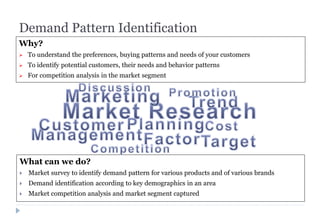
Demand Pattern Identification
What can we do?
 Market survey to identify demand pattern for various products and of various brands
 Demand identification according to key demographics in an area
 Market competition analysis and market segment captured
Why?
 To understand the preferences, buying patterns and needs of your customers
 To identify potential customers, their needs and behavior patterns
 For competition analysis in the market segment
Facility Location Planning
What can we do?
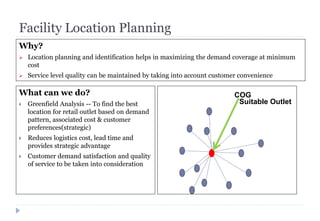
 Greenfield Analysis -- To find the best
location for retail outlet based on demand
pattern, associated cost & customer
preferences(strategic)
 Reduces logistics cost, lead time and
provides strategic advantage
 Customer demand satisfaction and quality
of service to be taken into consideration
Why?
 Location planning and identification helps in maximizing the demand coverage at minimum
cost
 Service level quality can be maintained by taking into account customer convenience
Suitable Outlet
COG
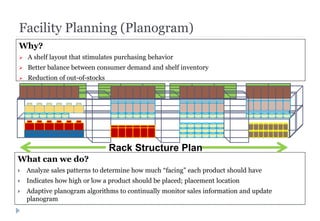
Facility Planning (Planogram)
What can we do?
 Analyze sales patterns to determine how much “facing” each product should have
 Indicates how high or low a product should be placed; placement location
 Adaptive planogram algorithms to continually monitor sales information and update
planogram
Why?
 A shelf layout that stimulates purchasing behavior
 Better balance between consumer demand and shelf inventory
 Reduction of out-of-stocks
Rack Structure Plan
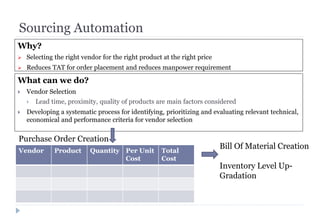
Sourcing Automation
Purchase Order Creation
Vendor Product Quantity Per Unit
Cost
Total
Cost
What can we do?
 Vendor Selection
 Lead time, proximity, quality of products are main factors considered
 Developing a systematic process for identifying, prioritizing and evaluating relevant technical,
economical and performance criteria for vendor selection
Bill Of Material Creation
Inventory Level Up-
Gradation
Why?
 Selecting the right vendor for the right product at the right price
 Reduces TAT for order placement and reduces manpower requirement
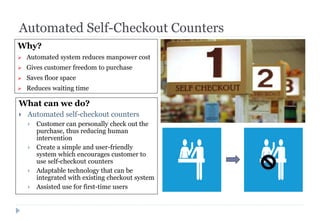
Automated Self-Checkout Counters
What can we do?
 Automated self-checkout counters
 Customer can personally check out the
purchase, thus reducing human
intervention
 Create a simple and user-friendly
system which encourages customer to
use self-checkout counters
 Adaptable technology that can be
integrated with existing checkout system
 Assisted use for first-time users
Why?
 Automated system reduces manpower cost
 Gives customer freedom to purchase
 Saves floor space
 Reduces waiting time
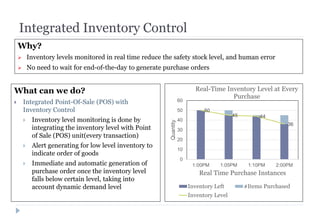
Integrated Inventory Control
50
45 44
36
0
10
20
30
40
50
60
1:00PM 1:05PM 1:10PM 2:00PM
Quantity Real Time Purchase Instances
Real-Time Inventory Level at Every
Purchase
Inventory Left #Items Purchased
Inventory Level
What can we do?
 Integrated Point-Of-Sale (POS) with
Inventory Control
 Inventory level monitoring is done by
integrating the inventory level with Point
of Sale (POS) unit(every transaction)
 Alert generating for low level inventory to
indicate order of goods
 Immediate and automatic generation of
purchase order once the inventory level
falls below certain level, taking into
account dynamic demand level
Why?
 Inventory levels monitored in real time reduce the safety stock level, and human error
 No need to wait for end-of-the-day to generate purchase orders
Market Basket Analysis
What can we do?
 Market basket analysis to identify
“if customers buy certain items of
a group, they are more likely to
buy other items of the group”
 Separates out “planned” purchase
and “impulse” purchase
 “Impulse” purchase products
can then be placed near or far
from “planned” purchase
products
Why?
 Analyze what products customers purchase together
 The products can accordingly be placed together to improve sales, or at two distinct end such
that customer traverse across the floor and scan through other products available
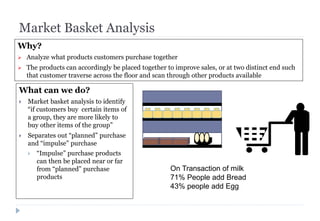
On Transaction of milk
71% People add Bread
43% people add Egg
Inventory Management(Industry 4.0)
Why?
 Minimize operating cost(holding, handling ,transit cost)
 Control whip bull effect which leads to over stocking/wastage of product
 To determine optimal order level-EOQ(economic order quantity)
What can we do?
 Use CPS(cyber physical system). A combination of sensor/IOT, a layer of big data & supply
chain analytics over IT infrastructure to control inventory in real time in order to :-
 Avoid shortage
 Overstocking
 Wastage
 High operational expenses
 Get optimal EOQ
 Maximum service level
 Minimal manual intervention in inventory & stock management and reordering(PO)
Contact:- keshavsinghjitu@gmail.com||+91-7795235692
Inventory Replenishment Automation
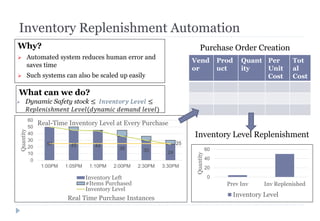
 Dynamic Safety stock ≤ 𝐼𝑛𝑣𝑒𝑛𝑡𝑜𝑟𝑦 𝐿𝑒𝑣𝑒𝑙 ≤
𝑅𝑒𝑝𝑙𝑒𝑛𝑖𝑠ℎ𝑚𝑒𝑛𝑡 𝐿𝑒𝑣𝑒𝑙(𝑑𝑦𝑛𝑎𝑚𝑖𝑐 𝑑𝑒𝑚𝑎𝑛𝑑 𝑙𝑒𝑣𝑒𝑙)
50 45 44
36 30 24
25
0
10
20
30
40
50
60
1:00PM 1:05PM 1:10PM 2:00PM 2:30PM 3:30PM
Quantity
Real Time Purchase Instances
Real-Time Inventory Level at Every Purchase
Inventory Left
#Items Purchased
Inventory Level
Purchase Order Creation
Vend
or
Prod
uct
Quant
ity
Per
Unit
Cost
Tot
al
Cost
0
20
40
60
Prev Inv Inv Replenished
Quantity
Inventory Level
Inventory Level Replenishment
What can we do?
Why?
 Automated system reduces human error and
saves time
 Such systems can also be scaled up easily
Stock Clearance
What can we do?
 Product placement according to shelf life
 Older products placed at front
 Stock clearance
 Product discount offered according to shelf
life remaining
 Lower the shelf life remaining, higher the
discount to be offered
 Stock disposal
 Managing disposal of stocks after shelf life
 Managing reverse logistics for disposal
Why?
 Reduction in inventory levels is necessary as it increases holding cost
 Stock clearance can also lead to increase in sales
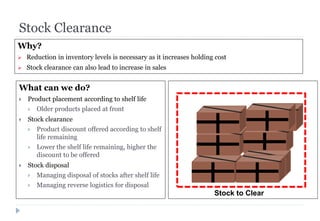
Stock to Clear
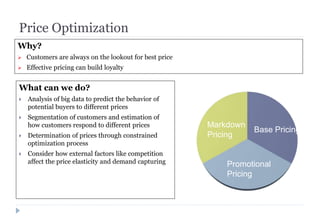
Price Optimization
What can we do?
 Analysis of big data to predict the behavior of
potential buyers to different prices
 Segmentation of customers and estimation of
how customers respond to different prices
 Determination of prices through constrained
optimization process
 Consider how external factors like competition
affect the price elasticity and demand capturing
Base Pricing
Markdown
Pricing
Promotional
Pricing
Why?
 Customers are always on the lookout for best price
 Effective pricing can build loyalty
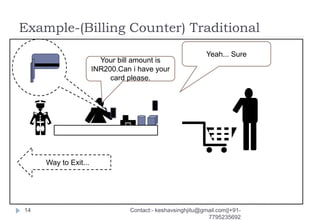
Example-(Billing Counter) Traditional
Contact:- keshavsinghjitu@gmail.com||+91-
7795235692
14
Your bill amount is
INR200.Can i have your
card please.
Yeah... Sure
Way to Exit...
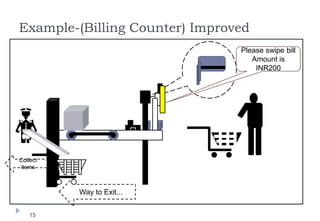
Example-(Billing Counter) Improved
15
Way to Exit...
Collect
items
Please swipe bill
Amount is
INR200
“We need to change the mindset that says , ’We’ve
always done it this way in the past.’
As Tesla has developed self-driving cars , we want
a self-driving supply chain ‘without pilots.’”
--ALESSANDRO DE LUCA

A.intelligent process automation & optimization in retail(with animation) (1)

  • 1.
    Intelligent Process Automation& Optimization in Retail Arun Kumar Mishra
  • 2.
    Focus Areas  DemandPattern Identification  Facility Location Planning  Floor Planning (Planogram)  Sourcing Automation  Automated Self-Checkout Counters  Integrated Inventory Control  Market Basket Analysis  Inventory Replenishment Automation  Stock Clearance  Price Optimization
  • 3.
    Demand Pattern Identification Whatcan we do?  Market survey to identify demand pattern for various products and of various brands  Demand identification according to key demographics in an area  Market competition analysis and market segment captured Why?  To understand the preferences, buying patterns and needs of your customers  To identify potential customers, their needs and behavior patterns  For competition analysis in the market segment
  • 4.
    Facility Location Planning Whatcan we do?  Greenfield Analysis -- To find the best location for retail outlet based on demand pattern, associated cost & customer preferences(strategic)  Reduces logistics cost, lead time and provides strategic advantage  Customer demand satisfaction and quality of service to be taken into consideration Why?  Location planning and identification helps in maximizing the demand coverage at minimum cost  Service level quality can be maintained by taking into account customer convenience Suitable Outlet COG
  • 5.
    Facility Planning (Planogram) Whatcan we do?  Analyze sales patterns to determine how much “facing” each product should have  Indicates how high or low a product should be placed; placement location  Adaptive planogram algorithms to continually monitor sales information and update planogram Why?  A shelf layout that stimulates purchasing behavior  Better balance between consumer demand and shelf inventory  Reduction of out-of-stocks Rack Structure Plan
  • 6.
    Sourcing Automation Purchase OrderCreation Vendor Product Quantity Per Unit Cost Total Cost What can we do?  Vendor Selection  Lead time, proximity, quality of products are main factors considered  Developing a systematic process for identifying, prioritizing and evaluating relevant technical, economical and performance criteria for vendor selection Bill Of Material Creation Inventory Level Up- Gradation Why?  Selecting the right vendor for the right product at the right price  Reduces TAT for order placement and reduces manpower requirement
  • 7.
    Automated Self-Checkout Counters Whatcan we do?  Automated self-checkout counters  Customer can personally check out the purchase, thus reducing human intervention  Create a simple and user-friendly system which encourages customer to use self-checkout counters  Adaptable technology that can be integrated with existing checkout system  Assisted use for first-time users Why?  Automated system reduces manpower cost  Gives customer freedom to purchase  Saves floor space  Reduces waiting time
  • 8.
    Integrated Inventory Control 50 4544 36 0 10 20 30 40 50 60 1:00PM 1:05PM 1:10PM 2:00PM Quantity Real Time Purchase Instances Real-Time Inventory Level at Every Purchase Inventory Left #Items Purchased Inventory Level What can we do?  Integrated Point-Of-Sale (POS) with Inventory Control  Inventory level monitoring is done by integrating the inventory level with Point of Sale (POS) unit(every transaction)  Alert generating for low level inventory to indicate order of goods  Immediate and automatic generation of purchase order once the inventory level falls below certain level, taking into account dynamic demand level Why?  Inventory levels monitored in real time reduce the safety stock level, and human error  No need to wait for end-of-the-day to generate purchase orders
  • 9.
    Market Basket Analysis Whatcan we do?  Market basket analysis to identify “if customers buy certain items of a group, they are more likely to buy other items of the group”  Separates out “planned” purchase and “impulse” purchase  “Impulse” purchase products can then be placed near or far from “planned” purchase products Why?  Analyze what products customers purchase together  The products can accordingly be placed together to improve sales, or at two distinct end such that customer traverse across the floor and scan through other products available On Transaction of milk 71% People add Bread 43% people add Egg
  • 10.
    Inventory Management(Industry 4.0) Why? Minimize operating cost(holding, handling ,transit cost)  Control whip bull effect which leads to over stocking/wastage of product  To determine optimal order level-EOQ(economic order quantity) What can we do?  Use CPS(cyber physical system). A combination of sensor/IOT, a layer of big data & supply chain analytics over IT infrastructure to control inventory in real time in order to :-  Avoid shortage  Overstocking  Wastage  High operational expenses  Get optimal EOQ  Maximum service level  Minimal manual intervention in inventory & stock management and reordering(PO) Contact:- keshavsinghjitu@gmail.com||+91-7795235692
  • 11.
    Inventory Replenishment Automation Dynamic Safety stock ≤ 𝐼𝑛𝑣𝑒𝑛𝑡𝑜𝑟𝑦 𝐿𝑒𝑣𝑒𝑙 ≤ 𝑅𝑒𝑝𝑙𝑒𝑛𝑖𝑠ℎ𝑚𝑒𝑛𝑡 𝐿𝑒𝑣𝑒𝑙(𝑑𝑦𝑛𝑎𝑚𝑖𝑐 𝑑𝑒𝑚𝑎𝑛𝑑 𝑙𝑒𝑣𝑒𝑙) 50 45 44 36 30 24 25 0 10 20 30 40 50 60 1:00PM 1:05PM 1:10PM 2:00PM 2:30PM 3:30PM Quantity Real Time Purchase Instances Real-Time Inventory Level at Every Purchase Inventory Left #Items Purchased Inventory Level Purchase Order Creation Vend or Prod uct Quant ity Per Unit Cost Tot al Cost 0 20 40 60 Prev Inv Inv Replenished Quantity Inventory Level Inventory Level Replenishment What can we do? Why?  Automated system reduces human error and saves time  Such systems can also be scaled up easily
  • 12.
    Stock Clearance What canwe do?  Product placement according to shelf life  Older products placed at front  Stock clearance  Product discount offered according to shelf life remaining  Lower the shelf life remaining, higher the discount to be offered  Stock disposal  Managing disposal of stocks after shelf life  Managing reverse logistics for disposal Why?  Reduction in inventory levels is necessary as it increases holding cost  Stock clearance can also lead to increase in sales Stock to Clear
  • 13.
    Price Optimization What canwe do?  Analysis of big data to predict the behavior of potential buyers to different prices  Segmentation of customers and estimation of how customers respond to different prices  Determination of prices through constrained optimization process  Consider how external factors like competition affect the price elasticity and demand capturing Base Pricing Markdown Pricing Promotional Pricing Why?  Customers are always on the lookout for best price  Effective pricing can build loyalty
  • 14.
    Example-(Billing Counter) Traditional Contact:-keshavsinghjitu@gmail.com||+91- 7795235692 14 Your bill amount is INR200.Can i have your card please. Yeah... Sure Way to Exit...
  • 15.
    Example-(Billing Counter) Improved 15 Wayto Exit... Collect items Please swipe bill Amount is INR200
  • 16.
    “We need tochange the mindset that says , ’We’ve always done it this way in the past.’ As Tesla has developed self-driving cars , we want a self-driving supply chain ‘without pilots.’” --ALESSANDRO DE LUCA