Firewall
Muhammad Ahmed
muhammad.ahmed@superior.edu.pk
+92 – 332- 5500-835
SYSTEM & NETWORK ADMINISTRATION (SNA)
Firewall
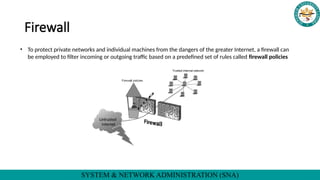
• To protect private networks and individual machines from the dangers of the greater Internet, a firewall can
be employed to filter incoming or outgoing traffic based on a predefined set of rules called firewall policies
SYSTEM & NETWORK ADMINISTRATION (SNA)
Firewall Policies
• Packets flowing through a firewall can have one of three outcomes:
– Accepted: permitted through the firewall
– Dropped: not allowed through with no indication of failure
– Rejected: not allowed through, accompanied by an attempt to inform the source that the
packet was rejected
• Policies used by the firewall to handle packets are based on several properties of the
packets being inspected, including the
• protocol used, such as:
– TCP or UDP
– the source and destination IP addresses
– the source and destination ports
– the application level payload of the packet (e.g., whether it
‐ contains a virus)
SYSTEM & NETWORK ADMINISTRATION (SNA)
Blacklists and White Lists
• There are two fundamental approaches to creating firewall policies (or rule sets) to
effectively minimize vulnerability
• Blacklist approach
– All packets are allowed through except those that fit the rules defined specifically in a
blacklist.
– This type of configuration is more flexible in ensuring that service to the internal network
is not disrupted by the firewall, but is naïve from a security perspective in that it assumes
the network administrator can enumerate all of the properties of malicious traffic.
• Whitelist approach
– A safer approach to defining a firewall rule set is the default deny policy, in which packets
‐
are dropped or rejected unless they are specifically allowed by the firewall.
SYSTEM & NETWORK ADMINISTRATION (SNA)
Firewall Types
• packet filters (stateless)
– If a packet matches the packet filter's set of rules, the packet filter will drop or
accept it
• "stateful" filters
– it maintains records of all connections passing through it
– it determine if a packet is either the start of a new
connection, a part of an existing connection.
• application layer
– Some times it is desirable to filter packets based upon actual content rather than
considering origin and
destination address
SYSTEM & NETWORK ADMINISTRATION (SNA)
Stateless Firewalls
• A stateless firewall doesn’t maintain any remembered context (or “state”) with
respect to the packets it is processing.
• Instead, it treats each packet attempting to travel through it in isolation without
considering packets that it has processed previously.
• packet filtering is based on source and destination address, port and protocols.
– filter examines the header of each packet based on a specific set of rules, and
– on that basis, decides to prevent it from passing (called DROP) or allow it
to pass (called ACCEPT).
SYSTEM & NETWORK ADMINISTRATION (SNA)
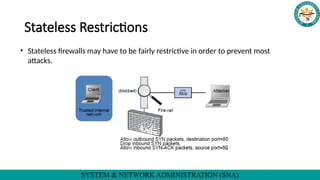
Stateless Restrictions
• Stateless firewalls may have to be fairly restrictive in order to prevent most
attacks.
SYSTEM & NETWORK ADMINISTRATION (SNA)
Statefull Firewalls
• Stateful firewalls can tell when packets are part of legitimate sessions originating
within a trusted network.
• Stateful firewalls maintain tables containing information on each active
connection, including the IP addresses, ports, and sequence numbers of packets.
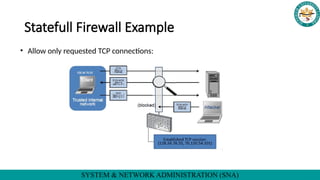
• Using these tables, stateful firewalls can allow only inbound TCP packets that are
in response to a connection initiated from within the internal network.
SYSTEM & NETWORK ADMINISTRATION (SNA)
Statefull Firewall Example
• Allow only requested TCP connections:

Firewall in computer networks and C.pptx

  • 1.
  • 2.
    SYSTEM & NETWORKADMINISTRATION (SNA) Firewall • To protect private networks and individual machines from the dangers of the greater Internet, a firewall can be employed to filter incoming or outgoing traffic based on a predefined set of rules called firewall policies
  • 3.
    SYSTEM & NETWORKADMINISTRATION (SNA) Firewall Policies • Packets flowing through a firewall can have one of three outcomes: – Accepted: permitted through the firewall – Dropped: not allowed through with no indication of failure – Rejected: not allowed through, accompanied by an attempt to inform the source that the packet was rejected • Policies used by the firewall to handle packets are based on several properties of the packets being inspected, including the • protocol used, such as: – TCP or UDP – the source and destination IP addresses – the source and destination ports – the application level payload of the packet (e.g., whether it ‐ contains a virus)
  • 4.
    SYSTEM & NETWORKADMINISTRATION (SNA) Blacklists and White Lists • There are two fundamental approaches to creating firewall policies (or rule sets) to effectively minimize vulnerability • Blacklist approach – All packets are allowed through except those that fit the rules defined specifically in a blacklist. – This type of configuration is more flexible in ensuring that service to the internal network is not disrupted by the firewall, but is naïve from a security perspective in that it assumes the network administrator can enumerate all of the properties of malicious traffic. • Whitelist approach – A safer approach to defining a firewall rule set is the default deny policy, in which packets ‐ are dropped or rejected unless they are specifically allowed by the firewall.
  • 5.
    SYSTEM & NETWORKADMINISTRATION (SNA) Firewall Types • packet filters (stateless) – If a packet matches the packet filter's set of rules, the packet filter will drop or accept it • "stateful" filters – it maintains records of all connections passing through it – it determine if a packet is either the start of a new connection, a part of an existing connection. • application layer – Some times it is desirable to filter packets based upon actual content rather than considering origin and destination address
  • 6.
    SYSTEM & NETWORKADMINISTRATION (SNA) Stateless Firewalls • A stateless firewall doesn’t maintain any remembered context (or “state”) with respect to the packets it is processing. • Instead, it treats each packet attempting to travel through it in isolation without considering packets that it has processed previously. • packet filtering is based on source and destination address, port and protocols. – filter examines the header of each packet based on a specific set of rules, and – on that basis, decides to prevent it from passing (called DROP) or allow it to pass (called ACCEPT).
  • 7.
    SYSTEM & NETWORKADMINISTRATION (SNA) Stateless Restrictions • Stateless firewalls may have to be fairly restrictive in order to prevent most attacks.
  • 8.
    SYSTEM & NETWORKADMINISTRATION (SNA) Statefull Firewalls • Stateful firewalls can tell when packets are part of legitimate sessions originating within a trusted network. • Stateful firewalls maintain tables containing information on each active connection, including the IP addresses, ports, and sequence numbers of packets. • Using these tables, stateful firewalls can allow only inbound TCP packets that are in response to a connection initiated from within the internal network.
  • 9.
    SYSTEM & NETWORKADMINISTRATION (SNA) Statefull Firewall Example • Allow only requested TCP connections: