CTO Design Challenge II 10.15.09
The Challenge "How do we promote intelligent discourse and decision-making on regional and national civic issues, given the deterioration of newspapers and other media and the polarization of politics?  Can technology assist in the promotion of rational discussion?"
The Team Host: Brenda Cooper, CIO, City of Kirkland Sailesh Chutani, Senior Director, Microsoft Tricia Duryee, Principal Correspondent, Moconews Joe Heitzeberg, VP, Whitepages Sajal Sahay, Executive Director, T-Mobile Bill Schrier, CTO, City of Seattle Chetan Sharma, President, Chetan Sharma Consulting
Agenda The Problem State of the Media Potential Solutions Leveraging existing government touch points Introducing a closed-loop framework for civic discourse Incentivizing Civic Participation How will this actually work? Recommendations How can you get involved?
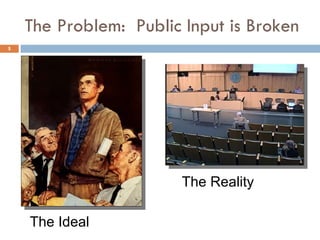
The Problem:  Public Input is Broken The Ideal The Reality
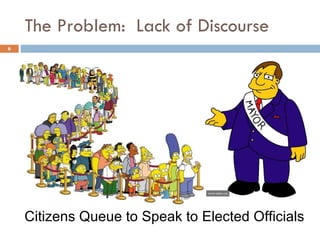
The Problem:  Lack of Discourse Citizens Queue to Speak to Elected Officials
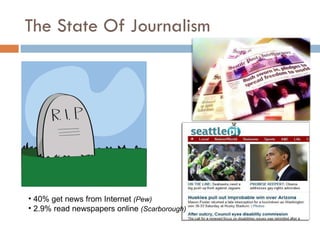
The State Of Journalism 40% get news from Internet  (Pew) 2.9% read newspapers online  (Scarborough)
New Information Sources EveryBlock Neighborlogs SeeClickFix.com
SOLUTIONS
1. Increasing engagement in discourse Goal Dramatically increase input, debate and dialogue between citizens and government at all levels Current Challenges Existing, e.g. town hall has very limited participation Only the dissatisfied engage Social media favors the upper echelon
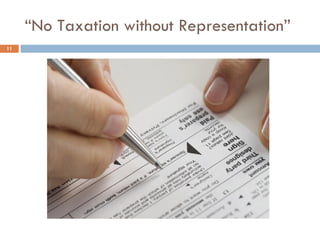
“ No Taxation without Representation”
Leverage existing touch points The “widget” strategy Leverage existing tech Reward participation
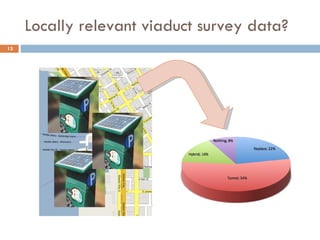
Locally relevant viaduct survey data?
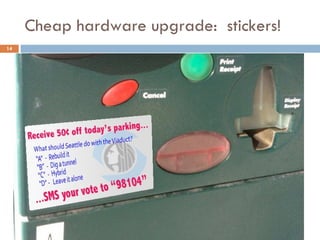
Cheap hardware upgrade:  stickers!
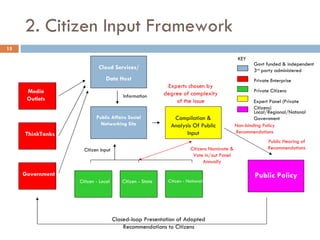
2. Citizen Input Framework Cloud Services/ Data Host Govt funded & independent 3 rd  party administered Public Affairs Social Networking Site Media Outlets ThinkTanks Government Private Enterprise Citizen - Local Private Citizens Citizen - State Citizen - National Compilation & Analysis Of Public Input KEY Expert Panel (Private Citizens) Citizen Input Citizens Nominate & Vote in/out Panel Annually Public Policy Local/Regional/Natonal Government Non-binding Policy Recommendations Closed-loop Presentation of Adopted Recommendations to Citizens Information Experts chosen by degree of complexity of the issue Public Hearing of Recommendations
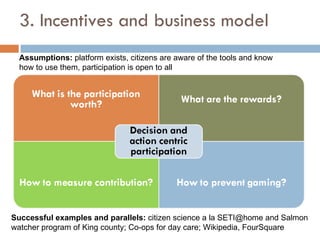
3. Incentives and business model Successful examples and parallels:  citizen science a la SETI@home and Salmon watcher program of King county; Co-ops for day care; Wikipedia, FourSquare Assumptions:  platform exists, citizens are aware of the tools and know how to use them, participation is open to all
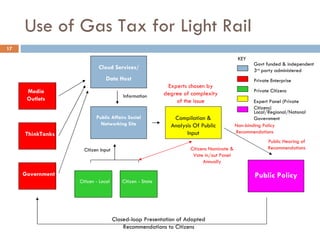
Use of Gas Tax for Light Rail Citizens Nominate & Vote in/out Panel Annually Cloud Services/ Data Host Govt funded & independent 3 rd  party administered Public Affairs Social Networking Site Media Outlets ThinkTanks Government Private Enterprise Citizen - Local Private Citizens Citizen - State Compilation & Analysis Of Public Input KEY Expert Panel (Private Citizens) Citizen Input Public Policy Local/Regional/Natonal Government Non-binding Policy Recommendations Closed-loop Presentation of Adopted Recommendations to Citizens Information Experts chosen by degree of complexity of the issue Public Hearing of Recommendations
Criterion for Success Higher satisfaction with the public policy and the process Increase in civic participation and engagement by a quantifiable metric
Recommendations Save the Journalists (not the print media) and engage them to do analysis, investigative work for think-tanks, policy making Set the public data free and encourage use Leverage existing tools, touch points, and organizations to implement the framework e.g. SMS, Twitter, Facebook Ensure Closed Loop Creative Incentives Invite State and City govt. to prototype the approaches to test their usefulness to address an actual issue
Join the Conversation @ mygov.webpaint.com
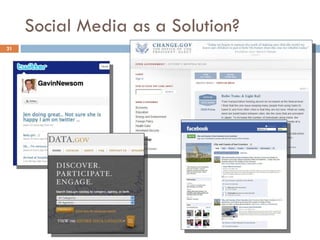
Social Media as a Solution?
Other examples U2 using SMS at concerts  so fans can pledge support for poverty campaigns Why not:  Metro bus tunnel SMS campaign for alternative energy? Ubiquitous:  96% of wireless phones have SMS, 87% of people have wireless Adoption  of blogs, twitter, facebook by  celebrities  and media is rising….but govt? Representatives in government  “Promote policy and respond to needs of citizens”

FiReGlobal CTO Challenge II 2009

  • 1.
  • 2.
    The Challenge "Howdo we promote intelligent discourse and decision-making on regional and national civic issues, given the deterioration of newspapers and other media and the polarization of politics? Can technology assist in the promotion of rational discussion?"
  • 3.
    The Team Host:Brenda Cooper, CIO, City of Kirkland Sailesh Chutani, Senior Director, Microsoft Tricia Duryee, Principal Correspondent, Moconews Joe Heitzeberg, VP, Whitepages Sajal Sahay, Executive Director, T-Mobile Bill Schrier, CTO, City of Seattle Chetan Sharma, President, Chetan Sharma Consulting
  • 4.
    Agenda The ProblemState of the Media Potential Solutions Leveraging existing government touch points Introducing a closed-loop framework for civic discourse Incentivizing Civic Participation How will this actually work? Recommendations How can you get involved?
  • 5.
    The Problem: Public Input is Broken The Ideal The Reality
  • 6.
    The Problem: Lack of Discourse Citizens Queue to Speak to Elected Officials
  • 7.
    The State OfJournalism 40% get news from Internet (Pew) 2.9% read newspapers online (Scarborough)
  • 8.
    New Information SourcesEveryBlock Neighborlogs SeeClickFix.com
  • 9.
  • 10.
    1. Increasing engagementin discourse Goal Dramatically increase input, debate and dialogue between citizens and government at all levels Current Challenges Existing, e.g. town hall has very limited participation Only the dissatisfied engage Social media favors the upper echelon
  • 11.
    “ No Taxationwithout Representation”
  • 12.
    Leverage existing touchpoints The “widget” strategy Leverage existing tech Reward participation
  • 13.
  • 14.
  • 15.
    2. Citizen InputFramework Cloud Services/ Data Host Govt funded & independent 3 rd party administered Public Affairs Social Networking Site Media Outlets ThinkTanks Government Private Enterprise Citizen - Local Private Citizens Citizen - State Citizen - National Compilation & Analysis Of Public Input KEY Expert Panel (Private Citizens) Citizen Input Citizens Nominate & Vote in/out Panel Annually Public Policy Local/Regional/Natonal Government Non-binding Policy Recommendations Closed-loop Presentation of Adopted Recommendations to Citizens Information Experts chosen by degree of complexity of the issue Public Hearing of Recommendations
  • 16.
    3. Incentives andbusiness model Successful examples and parallels: citizen science a la SETI@home and Salmon watcher program of King county; Co-ops for day care; Wikipedia, FourSquare Assumptions: platform exists, citizens are aware of the tools and know how to use them, participation is open to all
  • 17.
    Use of GasTax for Light Rail Citizens Nominate & Vote in/out Panel Annually Cloud Services/ Data Host Govt funded & independent 3 rd party administered Public Affairs Social Networking Site Media Outlets ThinkTanks Government Private Enterprise Citizen - Local Private Citizens Citizen - State Compilation & Analysis Of Public Input KEY Expert Panel (Private Citizens) Citizen Input Public Policy Local/Regional/Natonal Government Non-binding Policy Recommendations Closed-loop Presentation of Adopted Recommendations to Citizens Information Experts chosen by degree of complexity of the issue Public Hearing of Recommendations
  • 18.
    Criterion for SuccessHigher satisfaction with the public policy and the process Increase in civic participation and engagement by a quantifiable metric
  • 19.
    Recommendations Save theJournalists (not the print media) and engage them to do analysis, investigative work for think-tanks, policy making Set the public data free and encourage use Leverage existing tools, touch points, and organizations to implement the framework e.g. SMS, Twitter, Facebook Ensure Closed Loop Creative Incentives Invite State and City govt. to prototype the approaches to test their usefulness to address an actual issue
  • 20.
    Join the Conversation@ mygov.webpaint.com
  • 21.
    Social Media asa Solution?
  • 22.
    Other examples U2using SMS at concerts so fans can pledge support for poverty campaigns Why not: Metro bus tunnel SMS campaign for alternative energy? Ubiquitous: 96% of wireless phones have SMS, 87% of people have wireless Adoption of blogs, twitter, facebook by celebrities and media is rising….but govt? Representatives in government “Promote policy and respond to needs of citizens”

Editor's Notes

  • #6 Our classic notion of public input to the democratic process is the public meeting where each citizen stands up to bravely speak his mind. In reality, however, very few people show up for public meeting, and those few – perhaps as few as 25 in a city the size of Seattle – often monopolize the conversation with elected officials.
  • #7 In public meetings, citizens are always limited to just two or three minutes each. They line up to speak their piece. But there is no discourse or conversation – just a series of one-way, mini-lectures. People don’t build on each others ideas, but just give speeches. And, overwhelmingly, only Caucasian homeowners attend such meetings, to protect their neighborhoods and say NIMBY (not in my backyard).
  • #8 Print media is migrating towards Digital Revenues: What’s worse is that the newspaper industry earned only $3.1 billion from online ads in 2008, a number that is expected to decline this year, according to a Columbia Journalism Review article. Layoffs: Nearly 6,000 journalists lost their jobs in 2008, according to the American Society of Newsroom Editors. At the end of December 2008, there were 46,700 journalists remaining. Content Sources: Clearly, fewer stories are being printed, but also by some rough estimates, newspapers have cut spending on journalism by about $1.6 billion annually over the last several years, according to Poynter. Plunging Revenues: Newspaper revenues are estimated to tumble 17.3% this year to $31.6 billion. When adjusted for inflation, that compares to 1965. Layoffs: American daily newspapers lost 5,900 newsroom jobs last year, a 11.3 percent drop -- comparable to levels in the 1980s. The study found 2,300 journalists worked solely online. Content Sources: U.S. newspapers consumed an estimated 447,000 metric tons of newsprint in February, falling 11.8% from a year earlier. Number of overall news sources may be up.
  • #9 Here are some of the new media sites that are cropping up to fill that $1.6 billion gap. While they all do a good job of either gathering information from the masses, like SeeClickFix, which lets you report non-emergency issues, like potholes, or EveryBlock and Neighborlogs, which do a good job of distributing hyper-local information. None are doing a great job at creating discussion or developing a feedback loop, and are definitely not incentivizing people to participate other than to see their name next to a comment. The Neighborlogs platform , founded by an ex-Microsoft employee, is helping sites out like Central District News.com and Lake City Live.net. Other sites around the country are propping up, too, such as two popular examples the Minnpost and Voice of San Diego. Based on annual budgets of these startups, however, you’d need roughly 1,600 to fill the gap. Whether it’s the same quality of journalism, too, is a big question. EveryBlock: Strings together feeds for your neighborhood, including blogs and newspapers; 911 dispatches; real estate listings; restaurant inspections. Purchased by MSNBC.com, it covers 11 cities. Neighborlogs: Instivate provides a free blogging and ad platform that lets community members start their own site. Advertising revenues are shared back with Instivate. SeeClickFix.com: SeeClickFix lets citizens track non-emergency issues online, like potholes.
  • #12 Taking point (10 seconds): Our country was founded on “no taxation without representation” yet tax collection is a completely one-way offline process. However this is an opportunity here, since it reaches the majority of citizens and has an extremely high conversion rate 
  • #13 1. The “widget” strategy; take the discussion to the citizens Federal : W-9’s, Tax returns, national television State : driver’s licenses, schools, voter registration Local : parking meters, metro station, starbucks lines, ATMs 2. Design solutions that make use of widely available and deployed technology, for example: low end cell phones, SMS, voice calls, facebook/myspace, email 3. Reward participation Citizens : “frequent flyer miles” for civic participation, discounts Businesses : tax breaks to fund infrastructure
  • #16 Platform for citizen engagement at local, state, and national level Various interests and media outlets contribute with content, analysis, view points Citizens can follow any issue, thread, enter their particulars and issues/bills effecting them are outlined in simple English A panel of experts assigned to each major issue at any level synthesizes the discourse and makes non-binding recommendations based on what’s being said Government takes the input and passes laws, Entities analyze and contribute, cycle continues
  • #22 Perhaps social media such as twitter, or facebook, or initiatives such as data.gov and change.gov offer some potential solutions, but again, these are one-way vehicles, with little or no chance for true discourse or discussion, or debate to find solutions.
  • #23 Source: ApolloBraco, CTIA 2009