Raghunath Patil
FIRE FIGHTING
Presentation By
Raghunath Patil
Chief Engineer
Raghunath Patil
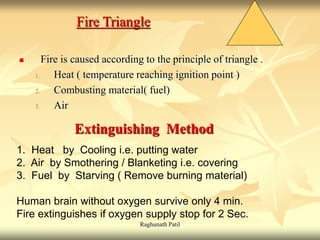
Fire Triangle
 Fire is caused according to the principle of triangle .
1. Heat ( temperature reaching ignition point )
2. Combusting material( fuel)
3. Air
Extinguishing Method
1. Heat by Cooling i.e. putting water
2. Air by Smothering / Blanketing i.e. covering
3. Fuel by Starving ( Remove burning material)
Human brain without oxygen survive only 4 min.
Fire extinguishes if oxygen supply stop for 2 Sec.
Raghunath Patil
The success of fire fighting depends on
 Fire fighting equipments in working condition
 Fire warning system and quantity of extinguishers
 Fire training ( knowledge )
 It is essential for everybody to know type of fire and then
extinguish it with correct extinguisher in quick and effective
manner.
Raghunath Patil
Classification of fire
1. A class(Solid,wood,paper,etc)
2. B class (oil,paint,etc)
3. C class,(Gas,carbonmonoxide)
4. D class ( Metal,zinc,copper,etc)
5. Electrical fire.
Raghunath Patil
Extinguishers:-
1. Water type :- Removes heat i.e. Cooling
only for A class fire.
2. Foam type :-Cutting of Oxygen i.e. Smothering
or Blanketing + cooling)
Only on A,B fire
3. CO2 type :- Displace Oxygen i.e. smothering
Use only on B,C,E fire
4. DCP type:- Cutting of Oxygen i.e. Smothering Use
only B,C,E fire. If ammonium phosphate
is used then it can be used on A class also.
Raghunath Patil
Types of Extinguishers in ROGS
Co2
AFFF
DCP ABC
Store
Pressure
Type
DCP BC
Cartridge
Type
Raghunath Patil
CO2 EXTINGUISHER
 Contains: Liquefied CO2 , 4.5 Kg at 1.125
PSI and at 16 degree .
 Operation :-Hold the extinguisher by
trigger assembly . Remove safety pin
Approach base of fire open the valve fully
& sweep it. By this we are Cutting of Oxygen of
fire called smothering
 Suitable for : B,C and Electrical Fire
 Note:- Do not grip the fiber hose or
cylinder during use or you will get cold
burn.
 It can not be used against A class of fire
because there is no cooling effect CO2
escape in air.
 It can not be used against D class of fire
because reaction takes place.
Raghunath Patil
Co2 Extinguisher
4.5 Kg Co2 Gas
under pressure
Raghunath Patil
AFFF Type  Contains : 550 ML Aqueous Film Forming
foam Compound mixed with fresh water and
one Co2 cartridge of 60-90 gm .
 Operation: Open the safety pin . Hold the
hose towards base of fire. Strike the knob
with left hand . Co2 cartridge will break and
AFFF Foam with a pressure of 3.5 Kg /cm2
will come out. Sweep it on fire. By this we
are Cutting of Oxygen of fire called
smothering
 Suitable for:- A and B class of fire.
Note: Not to use on Electrical and D class fire because of water
reaction
Raghunath Patil
AFFF Type
(Aqueous Film
Forming Foam)
Extinguisher
1. AFFF chemical
2. Co2 cartridge
3. water
Raghunath Patil
DCP ABC STORE PRESSURE TYPE
 Contains :Contains 5 Kg Mono
Ammonium phosphate with nitrogen gas
under pressure. It does not have cartridges
.
 Operation : Remove the safety pin hold the
hose to base of fire, press the handle and
sweep. We can stop at any time in between
by releasing handle. Nitrogen drives to
jetting powder for extinguishing . By this
we are cutting off oxygen of fire called
smothering
 Suitable For: A, B, C and E class of fire
only.
Raghunath Patil
DCP Type (Dry
chemical Powder )
Extinguisher
10 Kg DCP
Contains
1) Mono
Ammonium
phosphate
2) Nitrogen
Raghunath Patil
DCP BC CARTREDGE TYPE
 Note: Can not be used against A class of fire.
 Contains :Contains Sodium bicarbonate powder 5
Kg and Co2 cartridge 120-150 gm
 Operation : Remove the safety pin hold the hose to
base of fire, Strike the knob with hand and sweep
the hose on fire. We can not stop till the
extinguisher finishes.Co2 drives to jetting powder
for extinguishing . By this we are cutting off
oxygen of fire called smothering
 Suitable For: B, C and E class of fire only.
Raghunath Patil
DCP ABC CARTREDGE
TYPE
 5 Kg Sodium
bicarbonate
 Inner container
 Co2 cartridge 120-
150gm
Raghunath Patil
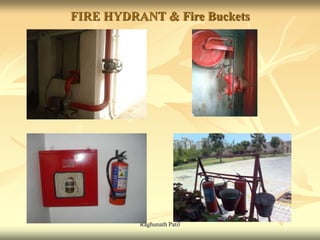
FIRE HYDRANT & Fire Buckets
Raghunath Patil
Fire hydrant hose being
connected to fight with
fire
Raghunath Patil
Fire exit door
on each floor
Raghunath Patil
Raghunath Patil
REFUSE AREA
Raghunath Patil
FIRE HYDRANT AND FIRE BUCKETS
 FIRE HYDRANT:- 30 MTR Mtr hose with nozzle are kept on
guest staircase each floor one. For operating connect it to the
hydrant point ( which is in the duct of each floor) and open the
valve. Jet water will go upto 50 to 60 feet
 30 Mtr hose reel also connected to the hydrant on each floor.
This rubber hose reel of 1 inch width can be unroll and we can
use with pressure nozzle
 There are fire buckets are kept near DG set, Gas bank and HT
Panel room. They should not be removed or use for other
purpose except fire fighting.
Raghunath Patil
Action in case of fire
1. During break out of fire panic , nervousness and confusion
should not be there.
2. Inform Reception and security by dialing 9 by nearest Tel.
3. Give the your name, exact location and size of fire
4. Action should be quick so that small fire can be extinguish
immediately. The delay in action cause fire to grow and may
become difficult to be controlled later
5. Stay on the fire area if safe to do so. Don’t panic .Try to
extinguish the fire with extinguishers/fire hydrant hose.
6. If fire not under control , inform fire brigade and Evacuate
Hotel
7. Follow the route for escape which is pasted on each door in
room
8. Provide help to the guest for evacuation .
9. For guest assembly point is Porch area
10. For staff Lower parking area
Raghunath Patil
YOU MUST KNOW
1. The place where the fire fighting extinguishers are kept .
2. The place where fire hydrant hoses and fire buckets are kept.
3. Fire hydrant points.
4. The telephone numbers of fire brigade , ambulance and
police
5. what is the class of fire and what kind of of fire extinguisher
can be used for this class of fire
6. Application of water on liquid fire and electrical fire causes
fire to spread
7. The route for escape is marked and pasted on each door in
room
Raghunath Patil
DO’s and DONT’s
1. DO NOT allow to use lift. Use only staircase left side.
2. Do not run to fire zone without extinguisher.
3. Close window & door as you leave fire zone
4. Do not shout
5. DO NOT open door & not to switch on Exhaust fan
6. Do not waste time to collect personnel belongings.
7. Use wet towel on your mouth and nose
8. Crawl at lower level while passing through smoke are
9. Do not break sealed window . Do not open window suddenly
10. Do not jump out of window
11. The water buckets and sand buckets should not be removed
unless required for fighting the fire.
Raghunath Patil
EMERGENCY TELEPHONE NUMBERS
 100 -- POLICE
 101 – FIRE BRIGADE
 102 – AMBULANCE
 103 – TRFFIC POLICE
 108 – NATIONAL EMERGENCY
 ALL THESE ARE TOLL FREE NUMBERS
Raghunath Patil
CAUSES OF FIRE:-
 Housekeeping :- Poor house keeping is a poor fire
hazard . Cotton , cloths, papers ,etc are the sources
of ignition. They should be kept away from
combusting material like petrol, oil ,etc.
 Smoking:- Careless smoking in non smoking areas
should be stopped . Smoking shall be permitted in
smoking zone only.
 Welding / gas cutting :- While doing gas welding
or oxy-acetylene cutting produces flying sparks
which falls on inflammable material and fire takes
place.
Raghunath Patil
 Ignorance about fire hazards:- Lack of knowledge about
the safe methods of storage of inflammable liquids,
materials. Correct use of electrical equipments etc.
 Negligent habit :- Our negligent or careless habits are
responsible for fire out break. A lighted match stick,
cigarette end carelessly thrown on any combusting material .
 Kitchen:- Most sensible area to get fire in hotel. Kitchen
staff should take extra care while preparing food. In kitchen
because of carelessness oil fire and gas fire can take place.
 Electrical Panel Room: No material to be stored in electrical
panel room. Small short circuit will be converted into big
fire.
Raghunath Patil
FIRE FIGHTING
 FIRE = Fire Inform Response Evacuate
 Fire is a good servant but bad master. So we must always
keep fire under our control. And not allow fire to be our
master.
 Fire is a serious danger to hotel buildings. Fire occurs
usually because of negligence of any person who carelessly
throws match sticks, cigarettes end or careless storage /
handling of inflammable material.
 Calamities never come with a notice .
 If there has been no fire for long it means that the time for a
fire break –out come near.
 If we prevent fire , the loss we going to suffer on account of
fire that would be our gain.
 Prevention is better than cure . So we should pre-plan our
fire prevention and fire fighting program
Raghunath Patil
Raghunath Patil
Position of holding fire hose
Raghunath Patil
Pressure from fire hydrant hose
Raghunath Patil
Creating Fire
Raghunath Patil
Blanketing ( covering ) the fire cutting off O2
Raghunath Patil
Hose not holded properly and is the result
Raghunath Patil
Raghunath Patil
Raghunath Patil
Extinguishing fire with extingusher
Raghunath Patil
Raghunath Patil
Raghunath Patil
Raghunath Patil
Raghunath Patil
Raghunath Patil
Raghunath Patil
Raghunath Patil
Raghunath Patil

Fire figting 1

  • 1.
    Raghunath Patil FIRE FIGHTING PresentationBy Raghunath Patil Chief Engineer
  • 2.
    Raghunath Patil Fire Triangle Fire is caused according to the principle of triangle . 1. Heat ( temperature reaching ignition point ) 2. Combusting material( fuel) 3. Air Extinguishing Method 1. Heat by Cooling i.e. putting water 2. Air by Smothering / Blanketing i.e. covering 3. Fuel by Starving ( Remove burning material) Human brain without oxygen survive only 4 min. Fire extinguishes if oxygen supply stop for 2 Sec.
  • 3.
    Raghunath Patil The successof fire fighting depends on  Fire fighting equipments in working condition  Fire warning system and quantity of extinguishers  Fire training ( knowledge )  It is essential for everybody to know type of fire and then extinguish it with correct extinguisher in quick and effective manner.
  • 4.
    Raghunath Patil Classification offire 1. A class(Solid,wood,paper,etc) 2. B class (oil,paint,etc) 3. C class,(Gas,carbonmonoxide) 4. D class ( Metal,zinc,copper,etc) 5. Electrical fire.
  • 5.
    Raghunath Patil Extinguishers:- 1. Watertype :- Removes heat i.e. Cooling only for A class fire. 2. Foam type :-Cutting of Oxygen i.e. Smothering or Blanketing + cooling) Only on A,B fire 3. CO2 type :- Displace Oxygen i.e. smothering Use only on B,C,E fire 4. DCP type:- Cutting of Oxygen i.e. Smothering Use only B,C,E fire. If ammonium phosphate is used then it can be used on A class also.
  • 6.
    Raghunath Patil Types ofExtinguishers in ROGS Co2 AFFF DCP ABC Store Pressure Type DCP BC Cartridge Type
  • 7.
    Raghunath Patil CO2 EXTINGUISHER Contains: Liquefied CO2 , 4.5 Kg at 1.125 PSI and at 16 degree .  Operation :-Hold the extinguisher by trigger assembly . Remove safety pin Approach base of fire open the valve fully & sweep it. By this we are Cutting of Oxygen of fire called smothering  Suitable for : B,C and Electrical Fire  Note:- Do not grip the fiber hose or cylinder during use or you will get cold burn.  It can not be used against A class of fire because there is no cooling effect CO2 escape in air.  It can not be used against D class of fire because reaction takes place.
  • 8.
    Raghunath Patil Co2 Extinguisher 4.5Kg Co2 Gas under pressure
  • 9.
    Raghunath Patil AFFF Type Contains : 550 ML Aqueous Film Forming foam Compound mixed with fresh water and one Co2 cartridge of 60-90 gm .  Operation: Open the safety pin . Hold the hose towards base of fire. Strike the knob with left hand . Co2 cartridge will break and AFFF Foam with a pressure of 3.5 Kg /cm2 will come out. Sweep it on fire. By this we are Cutting of Oxygen of fire called smothering  Suitable for:- A and B class of fire. Note: Not to use on Electrical and D class fire because of water reaction
  • 10.
    Raghunath Patil AFFF Type (AqueousFilm Forming Foam) Extinguisher 1. AFFF chemical 2. Co2 cartridge 3. water
  • 11.
    Raghunath Patil DCP ABCSTORE PRESSURE TYPE  Contains :Contains 5 Kg Mono Ammonium phosphate with nitrogen gas under pressure. It does not have cartridges .  Operation : Remove the safety pin hold the hose to base of fire, press the handle and sweep. We can stop at any time in between by releasing handle. Nitrogen drives to jetting powder for extinguishing . By this we are cutting off oxygen of fire called smothering  Suitable For: A, B, C and E class of fire only.
  • 12.
    Raghunath Patil DCP Type(Dry chemical Powder ) Extinguisher 10 Kg DCP Contains 1) Mono Ammonium phosphate 2) Nitrogen
  • 13.
    Raghunath Patil DCP BCCARTREDGE TYPE  Note: Can not be used against A class of fire.  Contains :Contains Sodium bicarbonate powder 5 Kg and Co2 cartridge 120-150 gm  Operation : Remove the safety pin hold the hose to base of fire, Strike the knob with hand and sweep the hose on fire. We can not stop till the extinguisher finishes.Co2 drives to jetting powder for extinguishing . By this we are cutting off oxygen of fire called smothering  Suitable For: B, C and E class of fire only.
  • 14.
    Raghunath Patil DCP ABCCARTREDGE TYPE  5 Kg Sodium bicarbonate  Inner container  Co2 cartridge 120- 150gm
  • 15.
  • 16.
    Raghunath Patil Fire hydranthose being connected to fight with fire
  • 17.
    Raghunath Patil Fire exitdoor on each floor
  • 18.
  • 19.
  • 20.
    Raghunath Patil FIRE HYDRANTAND FIRE BUCKETS  FIRE HYDRANT:- 30 MTR Mtr hose with nozzle are kept on guest staircase each floor one. For operating connect it to the hydrant point ( which is in the duct of each floor) and open the valve. Jet water will go upto 50 to 60 feet  30 Mtr hose reel also connected to the hydrant on each floor. This rubber hose reel of 1 inch width can be unroll and we can use with pressure nozzle  There are fire buckets are kept near DG set, Gas bank and HT Panel room. They should not be removed or use for other purpose except fire fighting.
  • 21.
    Raghunath Patil Action incase of fire 1. During break out of fire panic , nervousness and confusion should not be there. 2. Inform Reception and security by dialing 9 by nearest Tel. 3. Give the your name, exact location and size of fire 4. Action should be quick so that small fire can be extinguish immediately. The delay in action cause fire to grow and may become difficult to be controlled later 5. Stay on the fire area if safe to do so. Don’t panic .Try to extinguish the fire with extinguishers/fire hydrant hose. 6. If fire not under control , inform fire brigade and Evacuate Hotel 7. Follow the route for escape which is pasted on each door in room 8. Provide help to the guest for evacuation . 9. For guest assembly point is Porch area 10. For staff Lower parking area
  • 22.
    Raghunath Patil YOU MUSTKNOW 1. The place where the fire fighting extinguishers are kept . 2. The place where fire hydrant hoses and fire buckets are kept. 3. Fire hydrant points. 4. The telephone numbers of fire brigade , ambulance and police 5. what is the class of fire and what kind of of fire extinguisher can be used for this class of fire 6. Application of water on liquid fire and electrical fire causes fire to spread 7. The route for escape is marked and pasted on each door in room
  • 23.
    Raghunath Patil DO’s andDONT’s 1. DO NOT allow to use lift. Use only staircase left side. 2. Do not run to fire zone without extinguisher. 3. Close window & door as you leave fire zone 4. Do not shout 5. DO NOT open door & not to switch on Exhaust fan 6. Do not waste time to collect personnel belongings. 7. Use wet towel on your mouth and nose 8. Crawl at lower level while passing through smoke are 9. Do not break sealed window . Do not open window suddenly 10. Do not jump out of window 11. The water buckets and sand buckets should not be removed unless required for fighting the fire.
  • 24.
    Raghunath Patil EMERGENCY TELEPHONENUMBERS  100 -- POLICE  101 – FIRE BRIGADE  102 – AMBULANCE  103 – TRFFIC POLICE  108 – NATIONAL EMERGENCY  ALL THESE ARE TOLL FREE NUMBERS
  • 25.
    Raghunath Patil CAUSES OFFIRE:-  Housekeeping :- Poor house keeping is a poor fire hazard . Cotton , cloths, papers ,etc are the sources of ignition. They should be kept away from combusting material like petrol, oil ,etc.  Smoking:- Careless smoking in non smoking areas should be stopped . Smoking shall be permitted in smoking zone only.  Welding / gas cutting :- While doing gas welding or oxy-acetylene cutting produces flying sparks which falls on inflammable material and fire takes place.
  • 26.
    Raghunath Patil  Ignoranceabout fire hazards:- Lack of knowledge about the safe methods of storage of inflammable liquids, materials. Correct use of electrical equipments etc.  Negligent habit :- Our negligent or careless habits are responsible for fire out break. A lighted match stick, cigarette end carelessly thrown on any combusting material .  Kitchen:- Most sensible area to get fire in hotel. Kitchen staff should take extra care while preparing food. In kitchen because of carelessness oil fire and gas fire can take place.  Electrical Panel Room: No material to be stored in electrical panel room. Small short circuit will be converted into big fire.
  • 27.
    Raghunath Patil FIRE FIGHTING FIRE = Fire Inform Response Evacuate  Fire is a good servant but bad master. So we must always keep fire under our control. And not allow fire to be our master.  Fire is a serious danger to hotel buildings. Fire occurs usually because of negligence of any person who carelessly throws match sticks, cigarettes end or careless storage / handling of inflammable material.  Calamities never come with a notice .  If there has been no fire for long it means that the time for a fire break –out come near.  If we prevent fire , the loss we going to suffer on account of fire that would be our gain.  Prevention is better than cure . So we should pre-plan our fire prevention and fire fighting program
  • 28.
  • 29.
    Raghunath Patil Position ofholding fire hose
  • 30.
  • 31.
  • 32.
    Raghunath Patil Blanketing (covering ) the fire cutting off O2
  • 33.
    Raghunath Patil Hose notholded properly and is the result
  • 34.
  • 35.
  • 36.
  • 37.
  • 38.
  • 39.
  • 40.
  • 41.
  • 42.
  • 43.
  • 44.
  • 45.