Hazardous Area
Classification
Systems
• Class/Division System - used predominately in the United States
and Canada.
• Zone System- the rest of the world generally uses the Zone
system.
1. Class/Division System
• Hazardous locations per the Class/Division system are classified
according to the Class, Division, and Group.
• Class: The Class defines the general nature (or properties) of the
hazardous material in the surrounding atmosphere which may or
may not be in sufficient quantities.
• Class I— flammable gases or vapors
• Class II—combustible dusts (either in suspension, intermittently,
or periodically).
• Class III— ignitable fibers.
2. Division
• Division—The Division defines the probability of the hazardous
material being able to produce an explosive or ignitable mixture
based upon its presence.
• Division 1: High probability to produce an explosive or ignitable
mixture. Presence is continuous, intermittent, Periodical or being
present under normal operating condition.
• Division 2: Low probability to produce an explosive or ignitable
mixture. Present only during abnormal condition for a short period
of time.
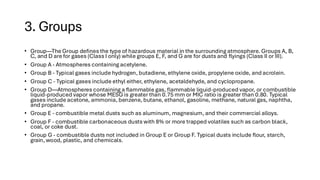
3. Groups
• Group—The Group defines the type of hazardous material in the surrounding atmosphere. Groups A, B,
C, and D are for gases (Class I only) while groups E, F, and G are for dusts and flyings (Class II or III).
• Group A - Atmospheres containing acetylene.
• Group B - Typical gases include hydrogen, butadiene, ethylene oxide, propylene oxide, and acrolein.
• Group C - Typical gases include ethyl either, ethylene, acetaldehyde, and cyclopropane.
• Group D—Atmospheres containing a flammable gas, flammable liquid-produced vapor, or combustible
liquid-produced vapor whose MESG is greater than 0.75 mm or MIC ratio is greater than 0.80. Typical
gases include acetone, ammonia, benzene, butane, ethanol, gasoline, methane, natural gas, naphtha,
and propane.
• Group E - combustible metal dusts such as aluminum, magnesium, and their commercial alloys.
• Group F - combustible carbonaceous dusts with 8% or more trapped volatiles such as carbon black,
coal, or coke dust.
• Group G - combustible dusts not included in Group E or Group F. Typical dusts include flour, starch,
grain, wood, plastic, and chemicals.
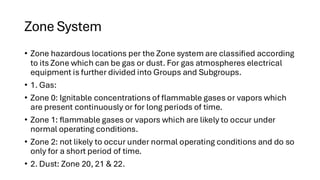
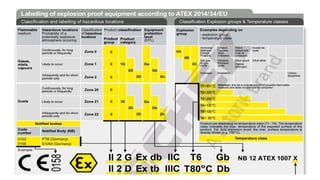
Zone System
• Zone hazardous locations per the Zone system are classified according
to its Zone which can be gas or dust. For gas atmospheres electrical
equipment is further divided into Groups and Subgroups.
• 1. Gas:
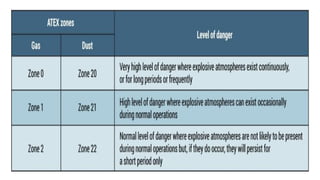
• Zone 0: Ignitable concentrations of flammable gases or vapors which
are present continuously or for long periods of time.
• Zone 1: flammable gases or vapors which are likely to occur under
normal operating conditions.
• Zone 2: not likely to occur under normal operating conditions and do so
only for a short period of time.
• 2. Dust: Zone 20, 21 & 22.
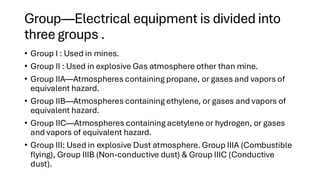
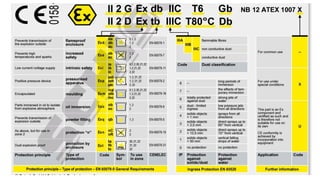
Group—Electrical equipment is divided into
three groups .
• Group I : Used in mines.
• Group II : Used in explosive Gas atmosphere other than mine.
• Group IIA—Atmospheres containing propane, or gases and vapors of
equivalent hazard.
• Group IIB—Atmospheres containing ethylene, or gases and vapors of
equivalent hazard.
• Group IIC—Atmospheres containing acetylene or hydrogen, or gases
and vapors of equivalent hazard.
• Group III: Used in explosive Dust atmosphere. Group IIIA (Combustible
flying), Group IIIB (Non-conductive dust) & Group IIIC (Conductive
dust).
Temperature Class (T1..T6)
• Temperature class (T-class) is one of the characteristics used to
classify an electrical device so it may be safely installed in a
hazardous location.
• In hazardous environments, the installation of an electrical device
whose exterior or interior reaches or exceeds the ignition
temperature of its gaseous environment will result in a catastrophic
outcome – an explosion that can lead to loss of life and/or loss of
property.
• Therefore, the maximum surface temperature of the apparatus
must always be lower than the ignition temperature of the explosive
gas present.
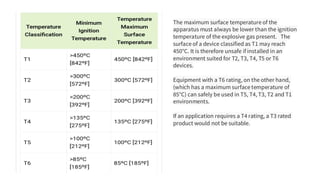
The maximum surface temperature of the
apparatus must always be lower than the ignition
temperature of the explosive gas present. The
surface of a device classified as T1 may reach
450°C. It is therefore unsafe if installed in an
environment suited for T2, T3, T4, T5 or T6
devices.
Equipment with a T6 rating, on the other hand,
(which has a maximum surface temperature of
85°C) can safely be used in T5, T4, T3, T2 and T1
environments.
If an application requires a T4 rating, a T3 rated
product would not be suitable.
The flammable (explosive) range is the range of a gas or vapor concentration that will burn or explode if an
ignition source is introduced. Limiting concentrations are commonly called the lower explosive or flammable
limit (LEL/LFL) and the upper explosive or flammable limit (UEL/UFL).
Below the explosive or flammable limit the mixture is too lean (diluted) to burn. Above the upper explosive or
flammable limit the mixture is too rich (saturated) to burn. The Auto-Ignition Temperature is not the same as
Flash Point - The Flash Point indicates how easy a chemical may burn.

Understanding the Hazardous Area Classification

  • 1.
  • 2.
    Systems • Class/Division System- used predominately in the United States and Canada. • Zone System- the rest of the world generally uses the Zone system.
  • 3.
    1. Class/Division System •Hazardous locations per the Class/Division system are classified according to the Class, Division, and Group. • Class: The Class defines the general nature (or properties) of the hazardous material in the surrounding atmosphere which may or may not be in sufficient quantities. • Class I— flammable gases or vapors • Class II—combustible dusts (either in suspension, intermittently, or periodically). • Class III— ignitable fibers.
  • 5.
    2. Division • Division—TheDivision defines the probability of the hazardous material being able to produce an explosive or ignitable mixture based upon its presence. • Division 1: High probability to produce an explosive or ignitable mixture. Presence is continuous, intermittent, Periodical or being present under normal operating condition. • Division 2: Low probability to produce an explosive or ignitable mixture. Present only during abnormal condition for a short period of time.
  • 6.
    3. Groups • Group—TheGroup defines the type of hazardous material in the surrounding atmosphere. Groups A, B, C, and D are for gases (Class I only) while groups E, F, and G are for dusts and flyings (Class II or III). • Group A - Atmospheres containing acetylene. • Group B - Typical gases include hydrogen, butadiene, ethylene oxide, propylene oxide, and acrolein. • Group C - Typical gases include ethyl either, ethylene, acetaldehyde, and cyclopropane. • Group D—Atmospheres containing a flammable gas, flammable liquid-produced vapor, or combustible liquid-produced vapor whose MESG is greater than 0.75 mm or MIC ratio is greater than 0.80. Typical gases include acetone, ammonia, benzene, butane, ethanol, gasoline, methane, natural gas, naphtha, and propane. • Group E - combustible metal dusts such as aluminum, magnesium, and their commercial alloys. • Group F - combustible carbonaceous dusts with 8% or more trapped volatiles such as carbon black, coal, or coke dust. • Group G - combustible dusts not included in Group E or Group F. Typical dusts include flour, starch, grain, wood, plastic, and chemicals.
  • 7.
    Zone System • Zonehazardous locations per the Zone system are classified according to its Zone which can be gas or dust. For gas atmospheres electrical equipment is further divided into Groups and Subgroups. • 1. Gas: • Zone 0: Ignitable concentrations of flammable gases or vapors which are present continuously or for long periods of time. • Zone 1: flammable gases or vapors which are likely to occur under normal operating conditions. • Zone 2: not likely to occur under normal operating conditions and do so only for a short period of time. • 2. Dust: Zone 20, 21 & 22.
  • 9.
    Group—Electrical equipment isdivided into three groups . • Group I : Used in mines. • Group II : Used in explosive Gas atmosphere other than mine. • Group IIA—Atmospheres containing propane, or gases and vapors of equivalent hazard. • Group IIB—Atmospheres containing ethylene, or gases and vapors of equivalent hazard. • Group IIC—Atmospheres containing acetylene or hydrogen, or gases and vapors of equivalent hazard. • Group III: Used in explosive Dust atmosphere. Group IIIA (Combustible flying), Group IIIB (Non-conductive dust) & Group IIIC (Conductive dust).
  • 12.
    Temperature Class (T1..T6) •Temperature class (T-class) is one of the characteristics used to classify an electrical device so it may be safely installed in a hazardous location. • In hazardous environments, the installation of an electrical device whose exterior or interior reaches or exceeds the ignition temperature of its gaseous environment will result in a catastrophic outcome – an explosion that can lead to loss of life and/or loss of property. • Therefore, the maximum surface temperature of the apparatus must always be lower than the ignition temperature of the explosive gas present.
  • 13.
    The maximum surfacetemperature of the apparatus must always be lower than the ignition temperature of the explosive gas present. The surface of a device classified as T1 may reach 450°C. It is therefore unsafe if installed in an environment suited for T2, T3, T4, T5 or T6 devices. Equipment with a T6 rating, on the other hand, (which has a maximum surface temperature of 85°C) can safely be used in T5, T4, T3, T2 and T1 environments. If an application requires a T4 rating, a T3 rated product would not be suitable.
  • 14.
    The flammable (explosive)range is the range of a gas or vapor concentration that will burn or explode if an ignition source is introduced. Limiting concentrations are commonly called the lower explosive or flammable limit (LEL/LFL) and the upper explosive or flammable limit (UEL/UFL). Below the explosive or flammable limit the mixture is too lean (diluted) to burn. Above the upper explosive or flammable limit the mixture is too rich (saturated) to burn. The Auto-Ignition Temperature is not the same as Flash Point - The Flash Point indicates how easy a chemical may burn.