PERSONAL
IDENTIFICATION
Prepared by: SONNY JOE S. GARINO RCrim
History of Fingerprint
• The development of fingerprint science predates
the Christian era by many centuries. Pre-historic
Indian picture writing of hand with crudely
marked ridge patterns, fingerprints impressions
on clay tablets recording business transactions in
ancient Babylon, and clay seals of ancient
Chinese Origin bearing thumb prints, were found
as evidence of early use of fingerprint as
identification of persons impressing the prints.
History of Fingerprint
• The formal study began as early as 1686 but has finally gained official use in
1858 by Sir William James Herschel, a British chief administrative officer in
Hoogly District of Bengal, India. Herschel used fingerprints in India to prevent
fraudulent collection of army pay accounts and for identity on other
documents
• In 1880 two major developments were achieved that ushered to a more
holistic acceptance of fingerprint use. Dr. Henry Faulds, an English doctor
based in Japan, wrote to publication Nature on the practical use of fingerprints
for the identification of criminals. His argument was supported by his studies
and successful experiments on permanency of one’s fingerprint. After Fauld’s
breakthrough, Sir Francis Galton, a noted British anthropologist and scientist
Charles Darwin’s cousin, devised the first scientific method of classifying
fingerprint patterns.
Method of Identification Before the Science of Fingerprint
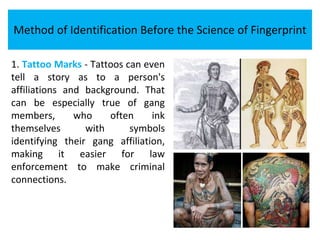
1. Tattoo Marks - Tattoos can even
tell a story as to a person's
affiliations and background. That
can be especially true of gang
members, who often ink
themselves with symbols
identifying their gang affiliation,
making it easier for law
enforcement to make criminal
connections.
Method of Identification Before the Science of Fingerprint
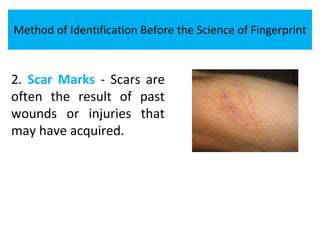
2. Scar Marks - Scars are
often the result of past
wounds or injuries that
may have acquired.
ANTHROPOMETRY
3. Anthropometry – The
first scientific method of
identification done by
measuring various bony
structure of the human
body devised by Alphonse
Bertillion
• Alphonse Bertillion = Father of Personal
Identification. The first to devise a
scientific method of identification called
Anthropometry.
• Around 1870 a French anthropologist
devised a system to measure and
records the dimensions of certain bony
parts of the body. These measurements
were reduced to a formula which,
theoretically, would apply only to one
person and would not change during
his/her adult life. This Bertillion System,
named after its inventor, Alphonse
Bertillion was generally accepted for
thirty years
• In 1888, Bertillion was made Chief of the
newly created Department of Identity in
Paris, Where he used anthropometry as
the main means of identification. He
later introduced fingerprints, but
relegated them to a secondary role in
the category of special marks.
• Bertillion was involved in the first
recorded case of a conviction using
fingerprints in Paris in 1902, but still
maintained that anthropometry was the
superior system.
THE WEST CASE
• In 1903, Bertillion System never recovered, when a man
named Will West was sentenced to the U.S Penintentiary at
Leavenworth, Kansas. There was already a prisoner at the
penitentiary at the time whose bertillion measurements
were nearly exact, and his name was William West.
• Upon investigation, there were indeed two men. They
looked exactly alike, but were allegedly not related. Their
names were Will and William West respectively. Their
Bertillion measurements were close to identify them as the
same person. However, a fingerprint comparison quickly
identified them as two different people. The West men, it
was later discovered were identical twin brothers.
THE WEST CASE
❑ The case of Will West and William West defeats the
Anthropometry System.
WILLIAM WEST (1901)
Primarily Whorl patterns
13/32
WILL WEST (1903)
Primarily Loop patterns
30/23
It was reported by Wilder and Wentworth in 1918 on their accounting or
inventory
AArrested in Kansas for Murder Minor crime
ORIGIN OF FINGERPRINTS
• Chinese - are the ones noted to be the first user of
fingerprint.
• Use fingeprints as symbolism in the early part of
their rituals until they utilize it in the signing of a
contract on the part of the illiterate.
• A Chinese deed of sale, 1839, signed with a finger
print.
• In China fingeperint is called “Hua Chi”
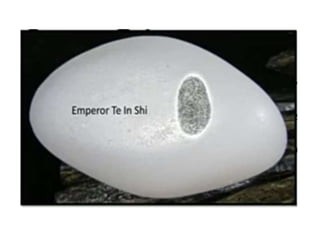
Emperor Te in Shi
• The first Chinese ruler who devised a “seal carved from
white jade”.
• One side is the name of owner & the other side is
impression thumb
• They used the said seal as sealing documents as
authenticity
• But in short the don’t make any system classification
PERSONAL-IDENTIFICATION-CHAPTER-1-1.pptx

PERSONAL-IDENTIFICATION-CHAPTER-1-1.pptx

  • 1.
  • 2.
    History of Fingerprint •The development of fingerprint science predates the Christian era by many centuries. Pre-historic Indian picture writing of hand with crudely marked ridge patterns, fingerprints impressions on clay tablets recording business transactions in ancient Babylon, and clay seals of ancient Chinese Origin bearing thumb prints, were found as evidence of early use of fingerprint as identification of persons impressing the prints.
  • 3.
    History of Fingerprint •The formal study began as early as 1686 but has finally gained official use in 1858 by Sir William James Herschel, a British chief administrative officer in Hoogly District of Bengal, India. Herschel used fingerprints in India to prevent fraudulent collection of army pay accounts and for identity on other documents • In 1880 two major developments were achieved that ushered to a more holistic acceptance of fingerprint use. Dr. Henry Faulds, an English doctor based in Japan, wrote to publication Nature on the practical use of fingerprints for the identification of criminals. His argument was supported by his studies and successful experiments on permanency of one’s fingerprint. After Fauld’s breakthrough, Sir Francis Galton, a noted British anthropologist and scientist Charles Darwin’s cousin, devised the first scientific method of classifying fingerprint patterns.
  • 4.
    Method of IdentificationBefore the Science of Fingerprint 1. Tattoo Marks - Tattoos can even tell a story as to a person's affiliations and background. That can be especially true of gang members, who often ink themselves with symbols identifying their gang affiliation, making it easier for law enforcement to make criminal connections.
  • 5.
    Method of IdentificationBefore the Science of Fingerprint 2. Scar Marks - Scars are often the result of past wounds or injuries that may have acquired.
  • 6.
    ANTHROPOMETRY 3. Anthropometry –The first scientific method of identification done by measuring various bony structure of the human body devised by Alphonse Bertillion
  • 7.
    • Alphonse Bertillion= Father of Personal Identification. The first to devise a scientific method of identification called Anthropometry. • Around 1870 a French anthropologist devised a system to measure and records the dimensions of certain bony parts of the body. These measurements were reduced to a formula which, theoretically, would apply only to one person and would not change during his/her adult life. This Bertillion System, named after its inventor, Alphonse Bertillion was generally accepted for thirty years
  • 8.
    • In 1888,Bertillion was made Chief of the newly created Department of Identity in Paris, Where he used anthropometry as the main means of identification. He later introduced fingerprints, but relegated them to a secondary role in the category of special marks. • Bertillion was involved in the first recorded case of a conviction using fingerprints in Paris in 1902, but still maintained that anthropometry was the superior system.
  • 10.
    THE WEST CASE •In 1903, Bertillion System never recovered, when a man named Will West was sentenced to the U.S Penintentiary at Leavenworth, Kansas. There was already a prisoner at the penitentiary at the time whose bertillion measurements were nearly exact, and his name was William West. • Upon investigation, there were indeed two men. They looked exactly alike, but were allegedly not related. Their names were Will and William West respectively. Their Bertillion measurements were close to identify them as the same person. However, a fingerprint comparison quickly identified them as two different people. The West men, it was later discovered were identical twin brothers.
  • 11.
    THE WEST CASE ❑The case of Will West and William West defeats the Anthropometry System. WILLIAM WEST (1901) Primarily Whorl patterns 13/32 WILL WEST (1903) Primarily Loop patterns 30/23 It was reported by Wilder and Wentworth in 1918 on their accounting or inventory AArrested in Kansas for Murder Minor crime
  • 13.
    ORIGIN OF FINGERPRINTS •Chinese - are the ones noted to be the first user of fingerprint. • Use fingeprints as symbolism in the early part of their rituals until they utilize it in the signing of a contract on the part of the illiterate. • A Chinese deed of sale, 1839, signed with a finger print. • In China fingeperint is called “Hua Chi”
  • 14.
    Emperor Te inShi • The first Chinese ruler who devised a “seal carved from white jade”. • One side is the name of owner & the other side is impression thumb • They used the said seal as sealing documents as authenticity • But in short the don’t make any system classification