T19	
  
Test	
  Management	
  
5/5/16	
  15:00	


Finding	
  Success	
  with	
  Test	
  Process	
  
Improvement	


Presented	
  by:	


Gitte	
  Ottosen	
  
Capgemini-­‐Sogeti	
  Denmark	


Brought	
  to	
  you	
  by:	


350	
  Corporate	
  Way,	
  Suite	
  400,	
  Orange	
  Park,	
  FL	
  32073	
  	
  
888-­‐-­‐-­‐268-­‐-­‐-­‐8770	
  ·∙·∙	
  904-­‐-­‐-­‐278-­‐-­‐-­‐0524	
  -­‐	
  info@techwell.com	
  -­‐	
  http://www.stareast.techwell.com/	


Gitte	
  Ottosen	
  
Capgemini-­‐Sogeti	
  Denmark	


Gitte	
  Ottosen	
  is	
  a	
  managing	
  consultant	
  at	
  Capgemini-­‐Sogeti	
  Denmark,	
  a	
  company	
  
that	
  delivers	
  test	
  consultancy.	
  Â	
  As	
  a	
  career	
  tester,	
  Gitte	
  has	
  twenty	
  years’	
  
experience	
  in	
  test	
  engineering,	
  test	
  management,	
  and	
  process	
  improvement	
  in	
  
both	
  traditional	
  and	
  agile	
  contexts.	
  She	
  has	
  worked	
  in	
  test	
  process	
  improvement,	
  
first	
  as	
  a	
  test	
  architect/manager	
  and	
  more	
  recently	
  as	
  a	
  test	
  coach	
  in	
  shipping,	
  
the	
  public	
  sector,	
  and	
  health	
  care.	
  As	
  as	
  elf-­‐confessed	
  test	
  evangelist	
  who	
  
preaches	
  the	
  need	
  for	
  a	
  structured	
  and	
  committed	
  approach	
  to	
  testing,	
  Gitte	
  is	
  a	
  
strong	
  advocate	
  for	
  a	
  context-­‐driven	
  approach,	
  a	
  role	
  requiring	
  profound	
  
professional	
  insight,	
  passion,	
  and	
  persistence.	


Improving the Test Process
Gitte Ottosen
Gitte.ottosen@capgeminisogeti.dk
godtesen
© CapgeminiSogeti 2
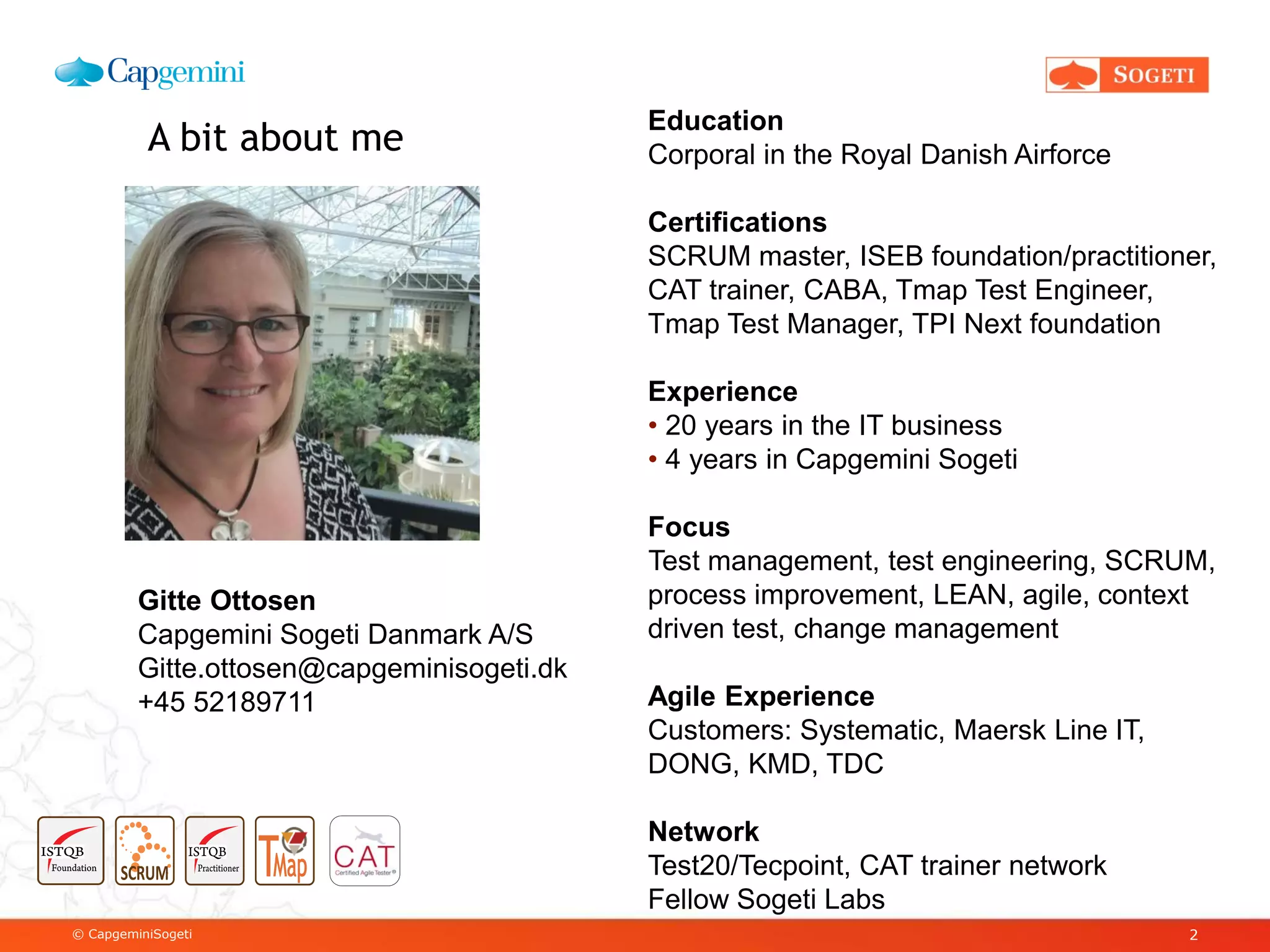
A bit about me
Gitte Ottosen
Capgemini Sogeti Danmark A/S
Gitte.ottosen@capgeminisogeti.dk
+45 52189711
Education
Corporal in the Royal Danish Airforce
Certifications
SCRUM master, ISEB foundation/practitioner,
CAT trainer, CABA, Tmap Test Engineer,
Tmap Test Manager, TPI Next foundation
Experience
• 20 years in the IT business
• 4 years in Capgemini Sogeti
Focus
Test management, test engineering, SCRUM,
process improvement, LEAN, agile, context
driven test, change management
Agile Experience
Customers: Systematic, Maersk Line IT,
DONG, KMD, TDC
Network
Test20/Tecpoint, CAT trainer network
Fellow Sogeti Labs
© CapgeminiSogeti
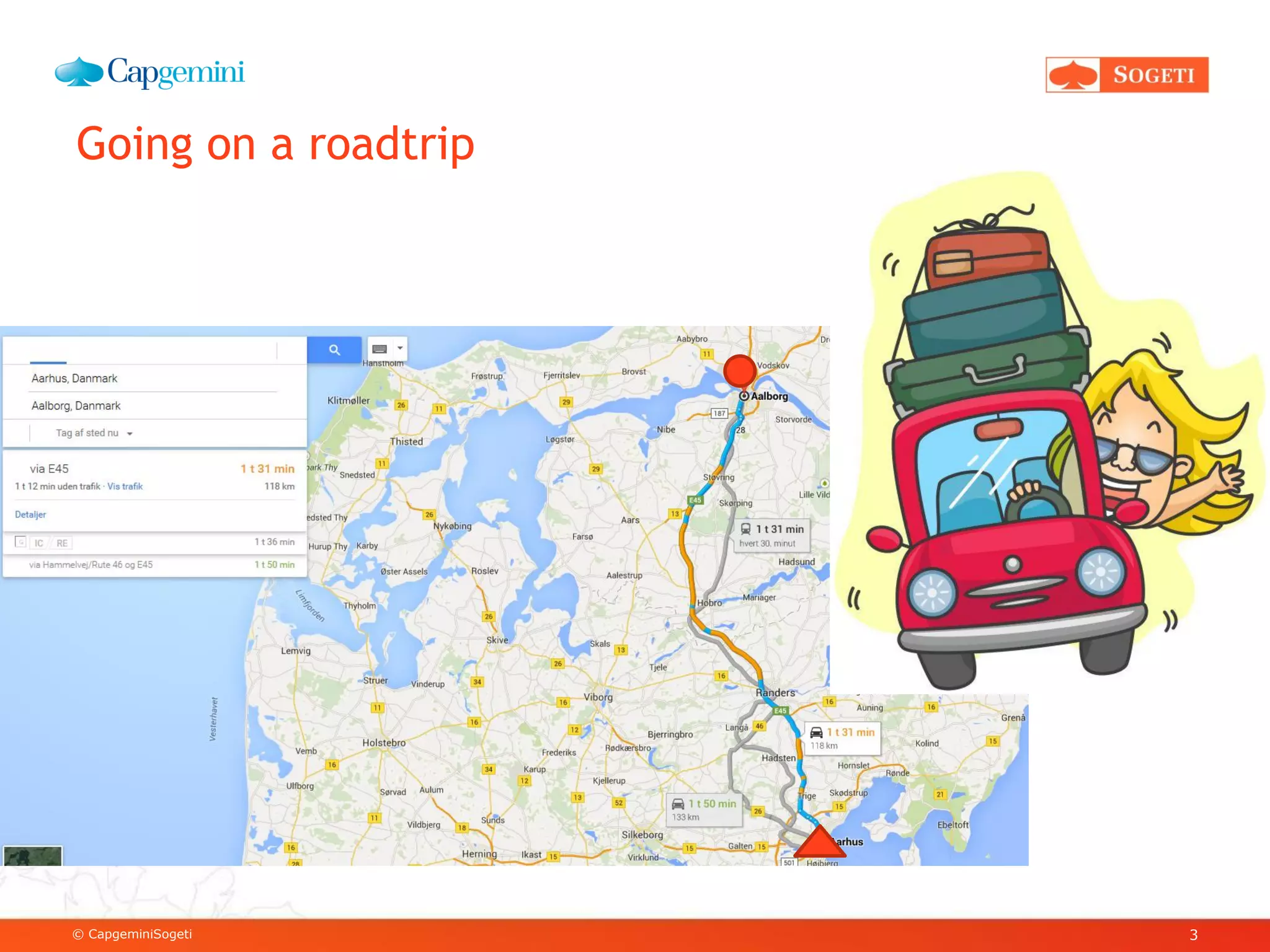
Going on a roadtrip
3
© CapgeminiSogeti
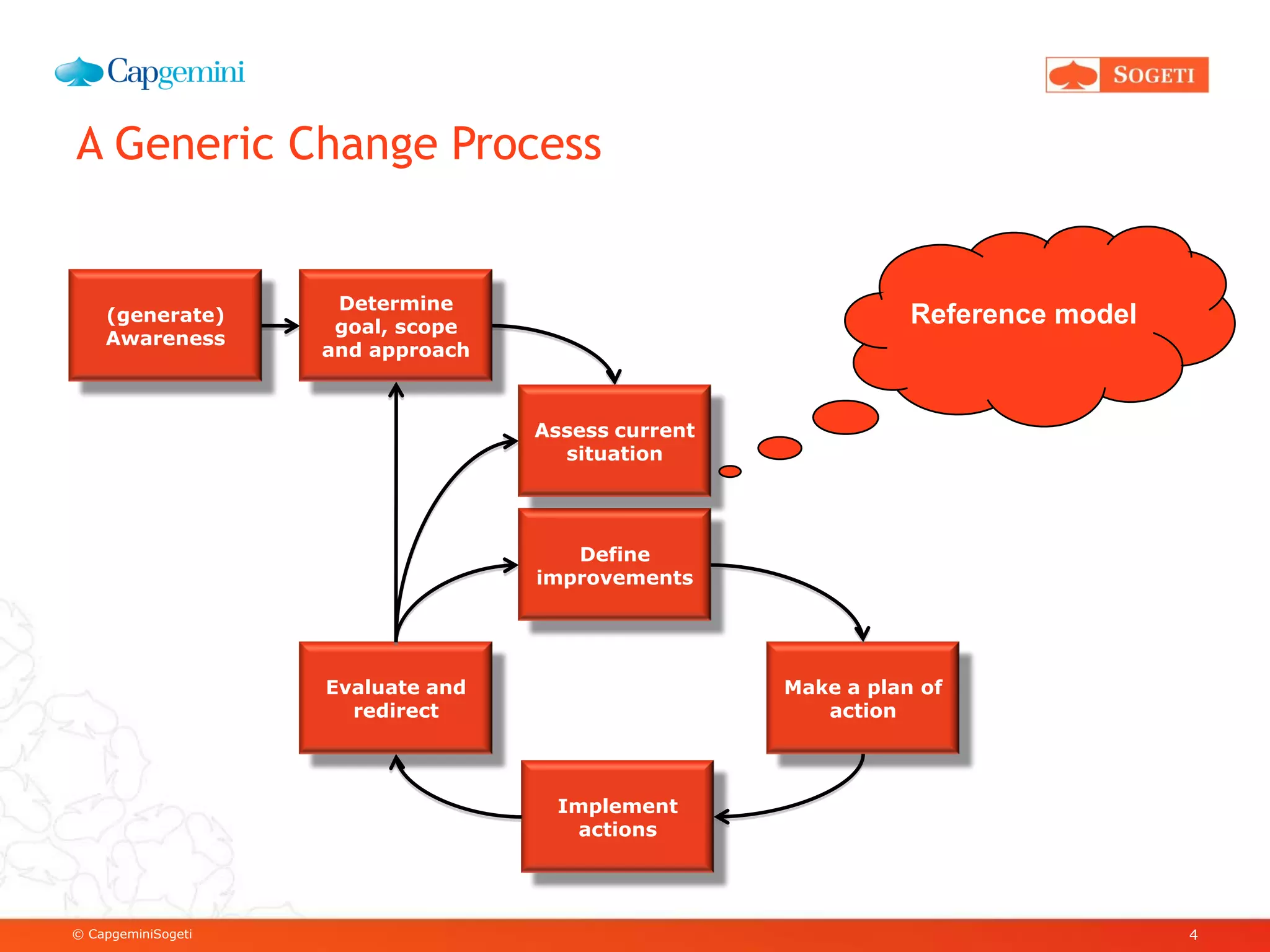
A Generic Change Process
4
Evaluate and
redirect
Implement
actions
Make a plan of
action
Define
improvements
(generate)
Awareness
Determine
goal, scope
and approach
Assess current
situation
Reference model
© CapgeminiSogeti
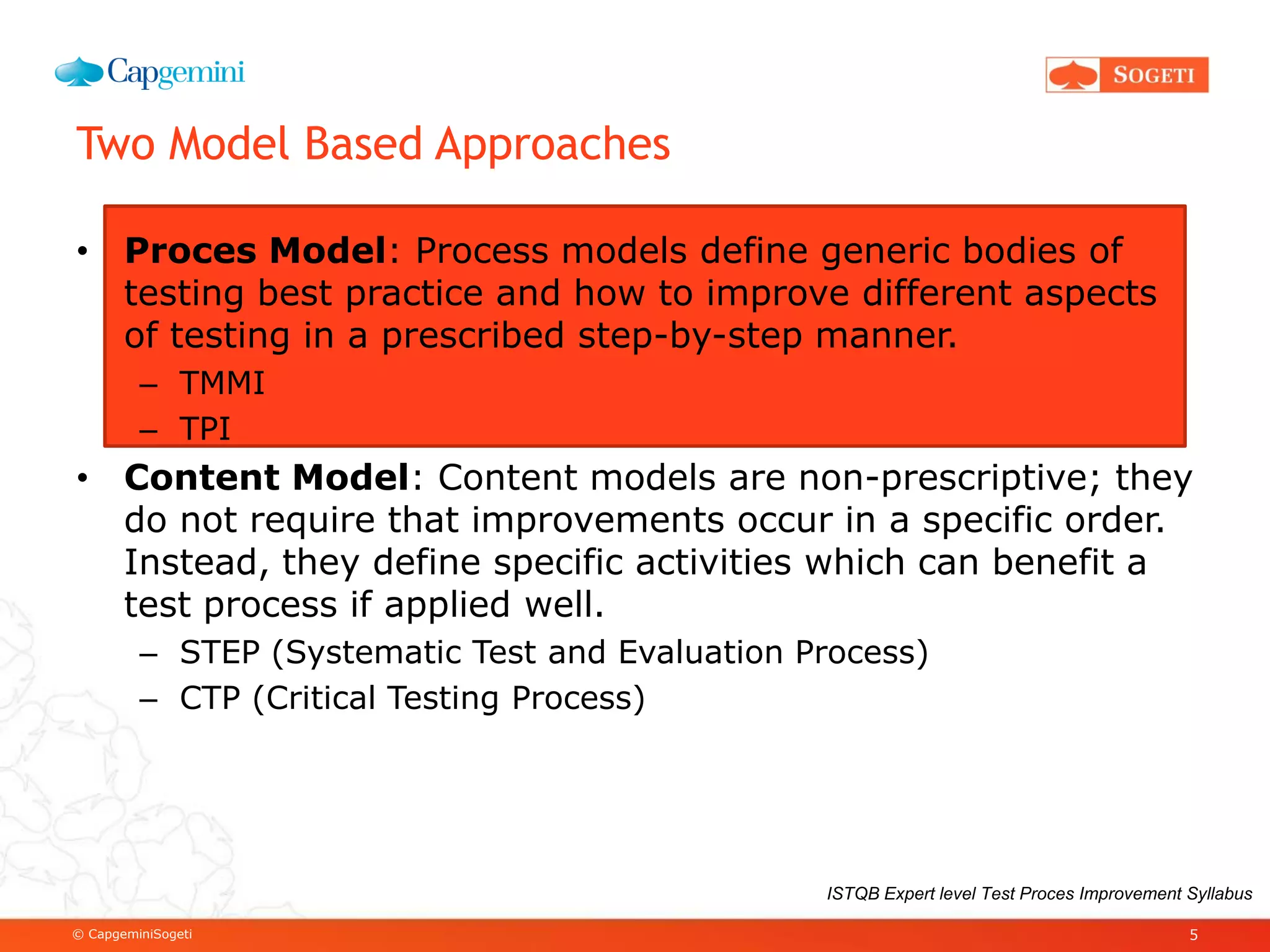
Two Model Based Approaches
• Proces Model: Process models define generic bodies of
testing best practice and how to improve different aspects
of testing in a prescribed step-by-step manner.
– TMMI
– TPI
• Content Model: Content models are non-prescriptive; they
do not require that improvements occur in a specific order.
Instead, they define specific activities which can benefit a
test process if applied well.
– STEP (Systematic Test and Evaluation Process)
– CTP (Critical Testing Process)
5
ISTQB Expert level Test Proces Improvement Syllabus
© CapgeminiSogeti
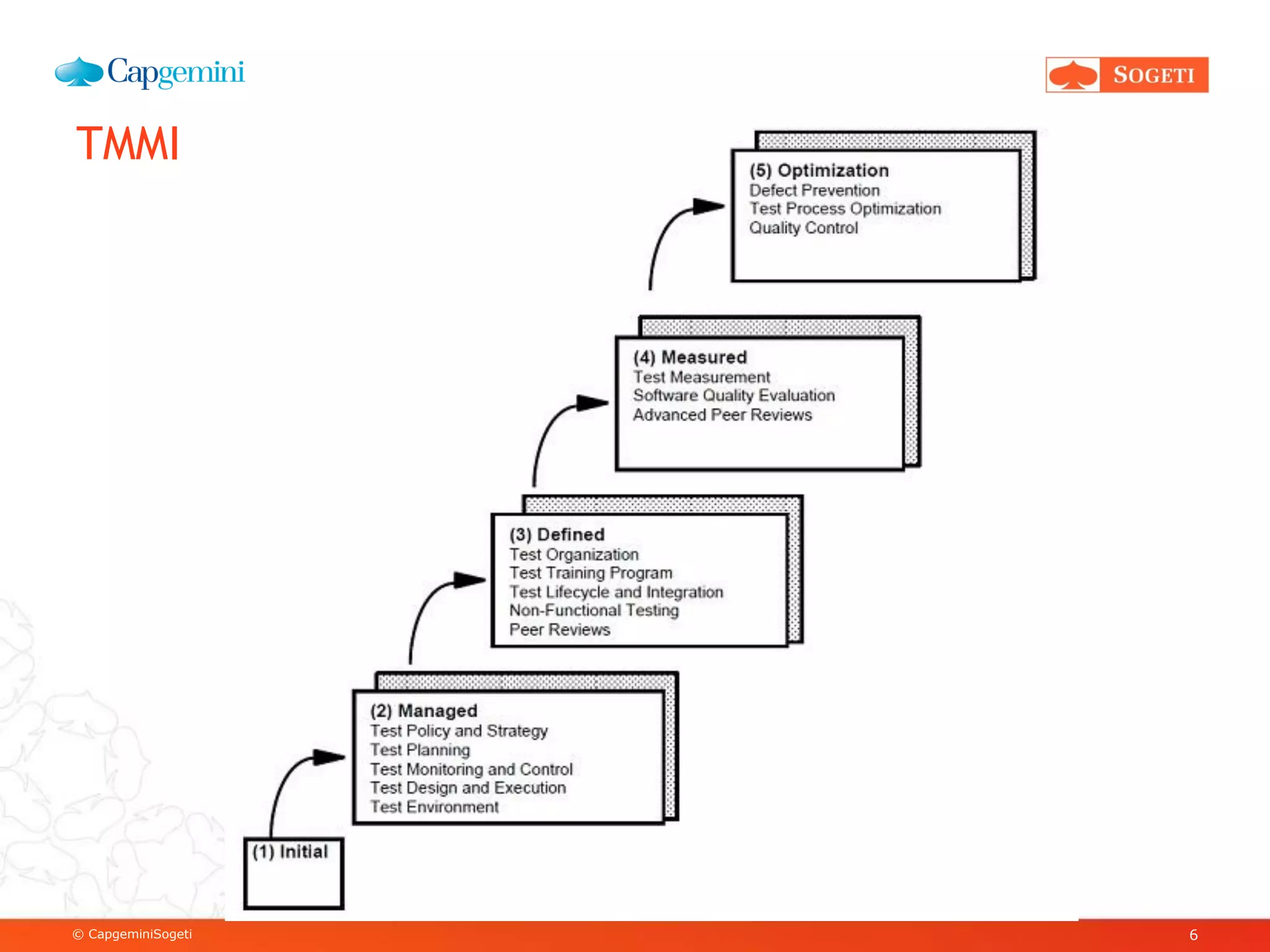
TMMI
6
© CapgeminiSogeti
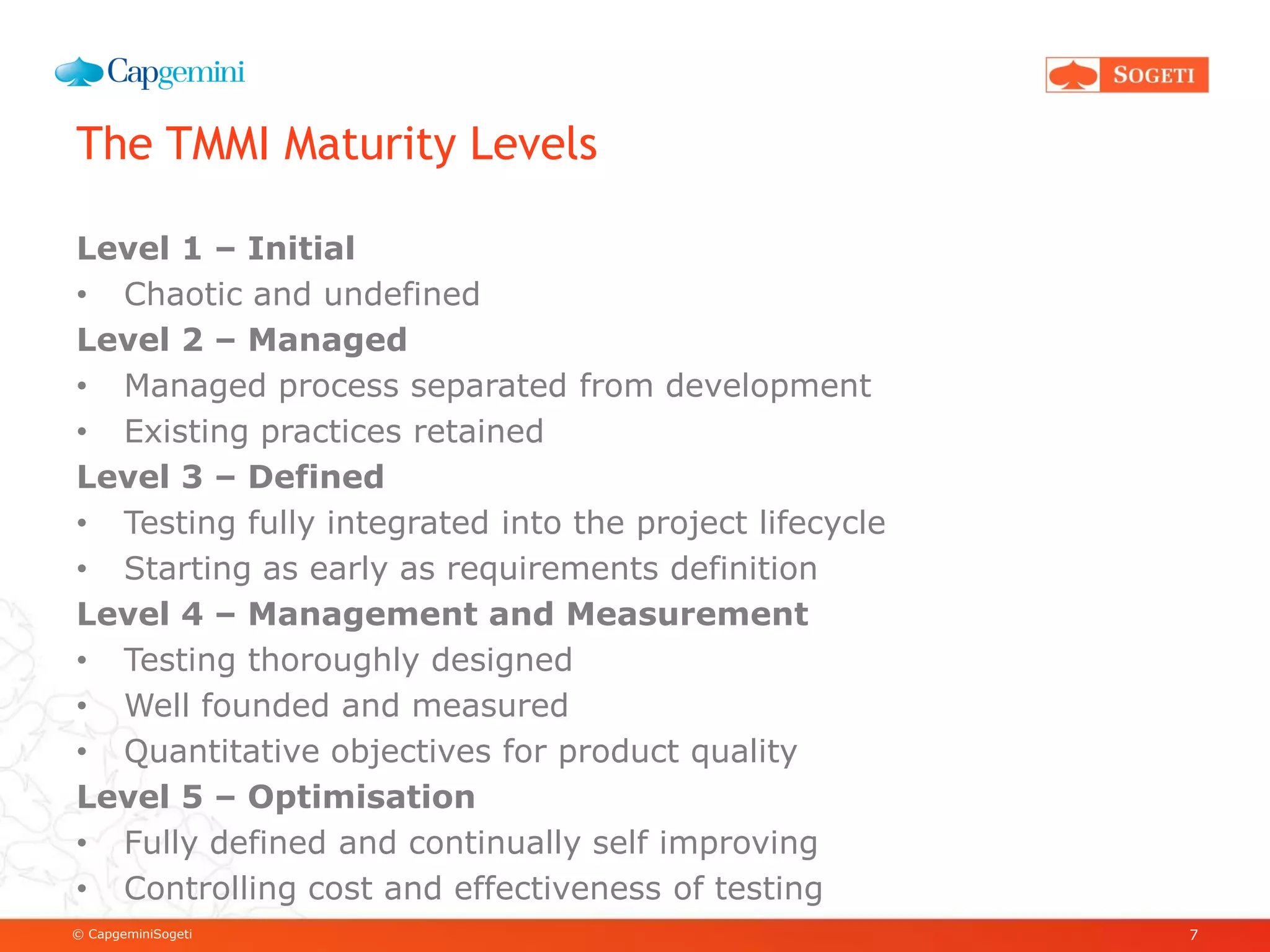
The TMMI Maturity Levels
Level 1 – Initial
• Chaotic and undefined
Level 2 – Managed
• Managed process separated from development
• Existing practices retained
Level 3 – Defined
• Testing fully integrated into the project lifecycle
• Starting as early as requirements definition
Level 4 – Management and Measurement
• Testing thoroughly designed
• Well founded and measured
• Quantitative objectives for product quality
Level 5 – Optimisation
• Fully defined and continually self improving
• Controlling cost and effectiveness of testing
7
© CapgeminiSogeti
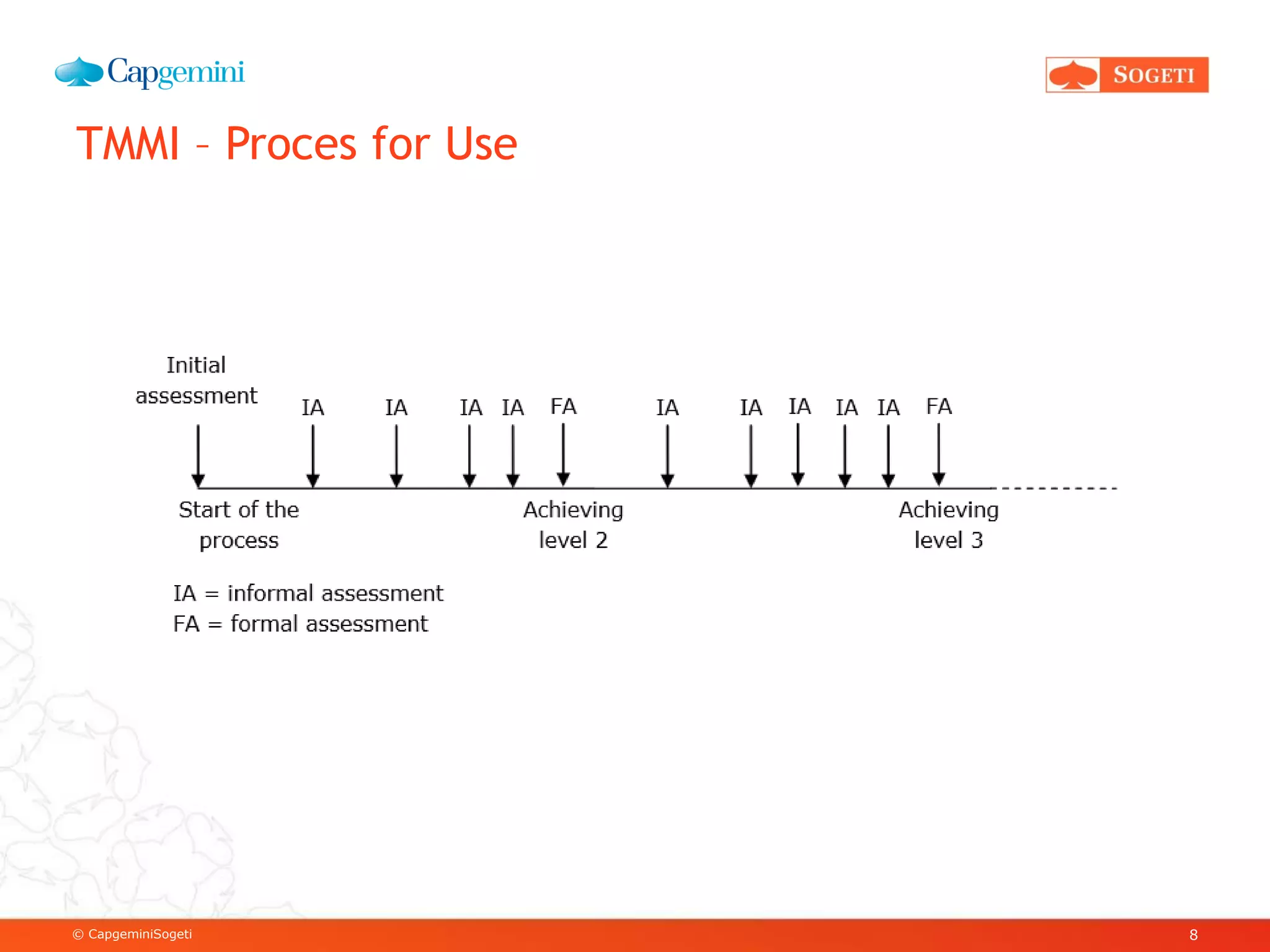
TMMI – Proces for Use
8
© CapgeminiSogeti
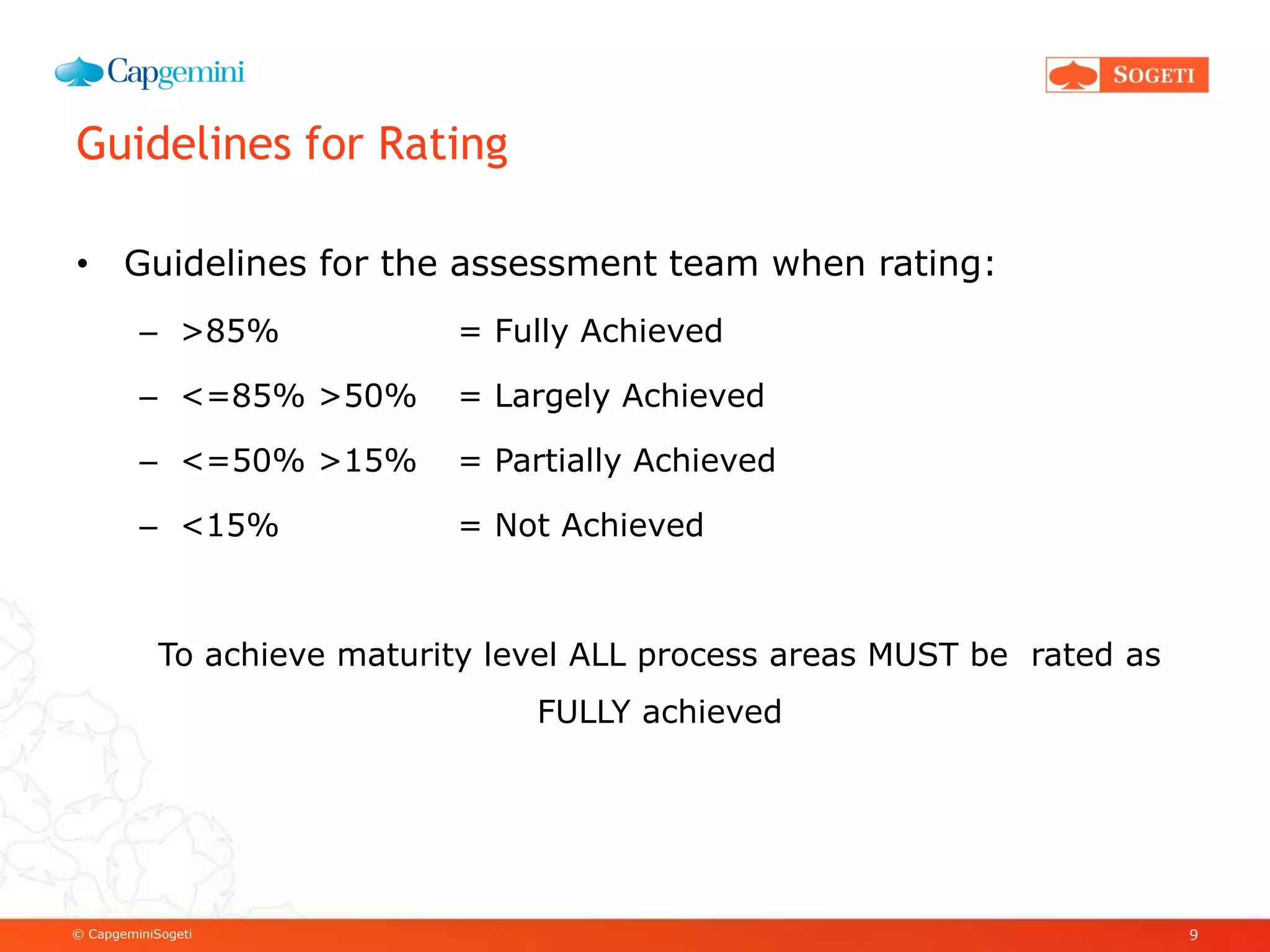
Guidelines for Rating
• Guidelines for the assessment team when rating:
– >85% = Fully Achieved
– <=85% >50% = Largely Achieved
– <=50% >15% = Partially Achieved
– <15% = Not Achieved
To achieve maturity level ALL process areas MUST be rated as
FULLY achieved
9
© CapgeminiSogeti
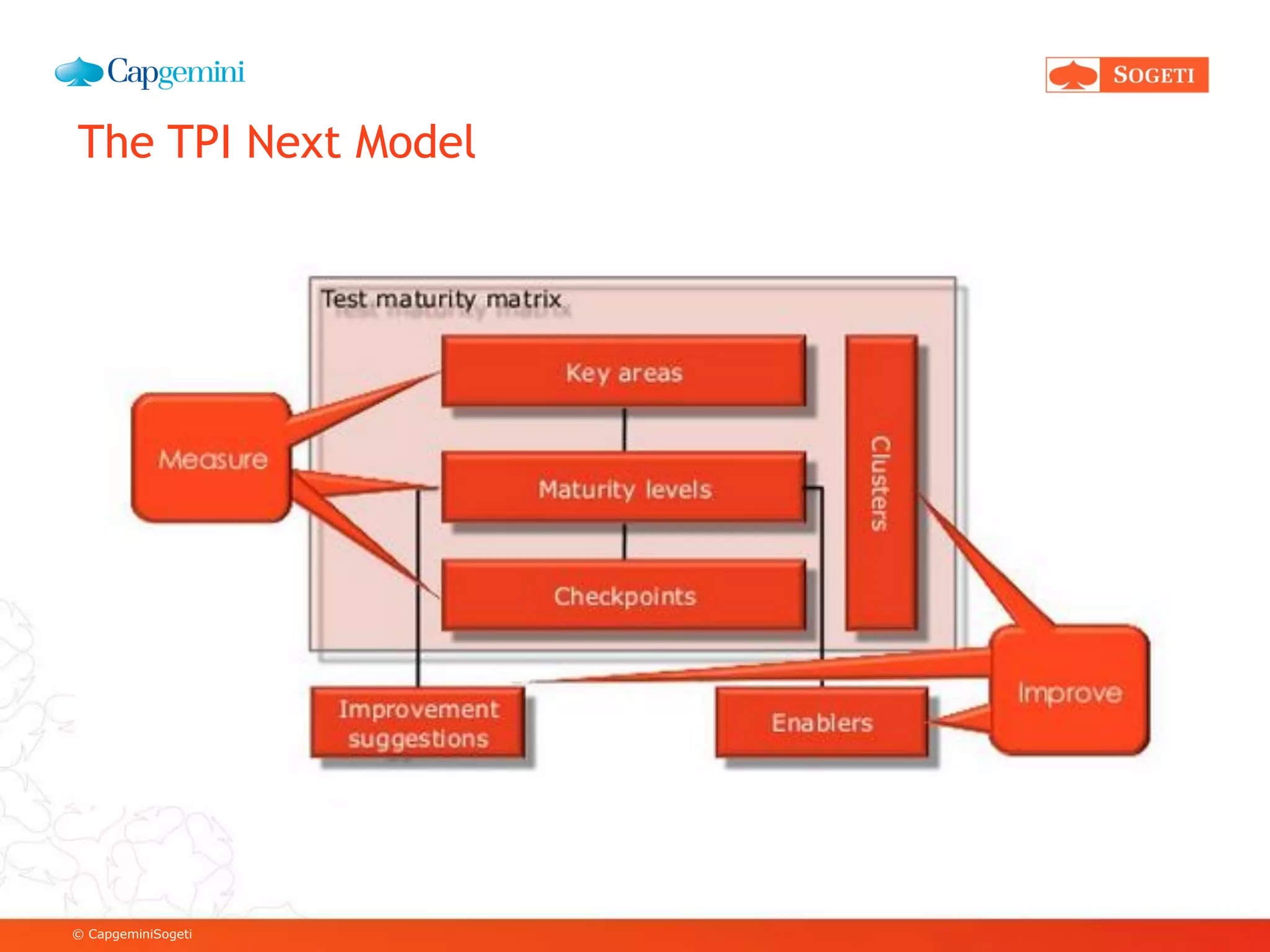
The TPI Next Model
© CapgeminiSogeti
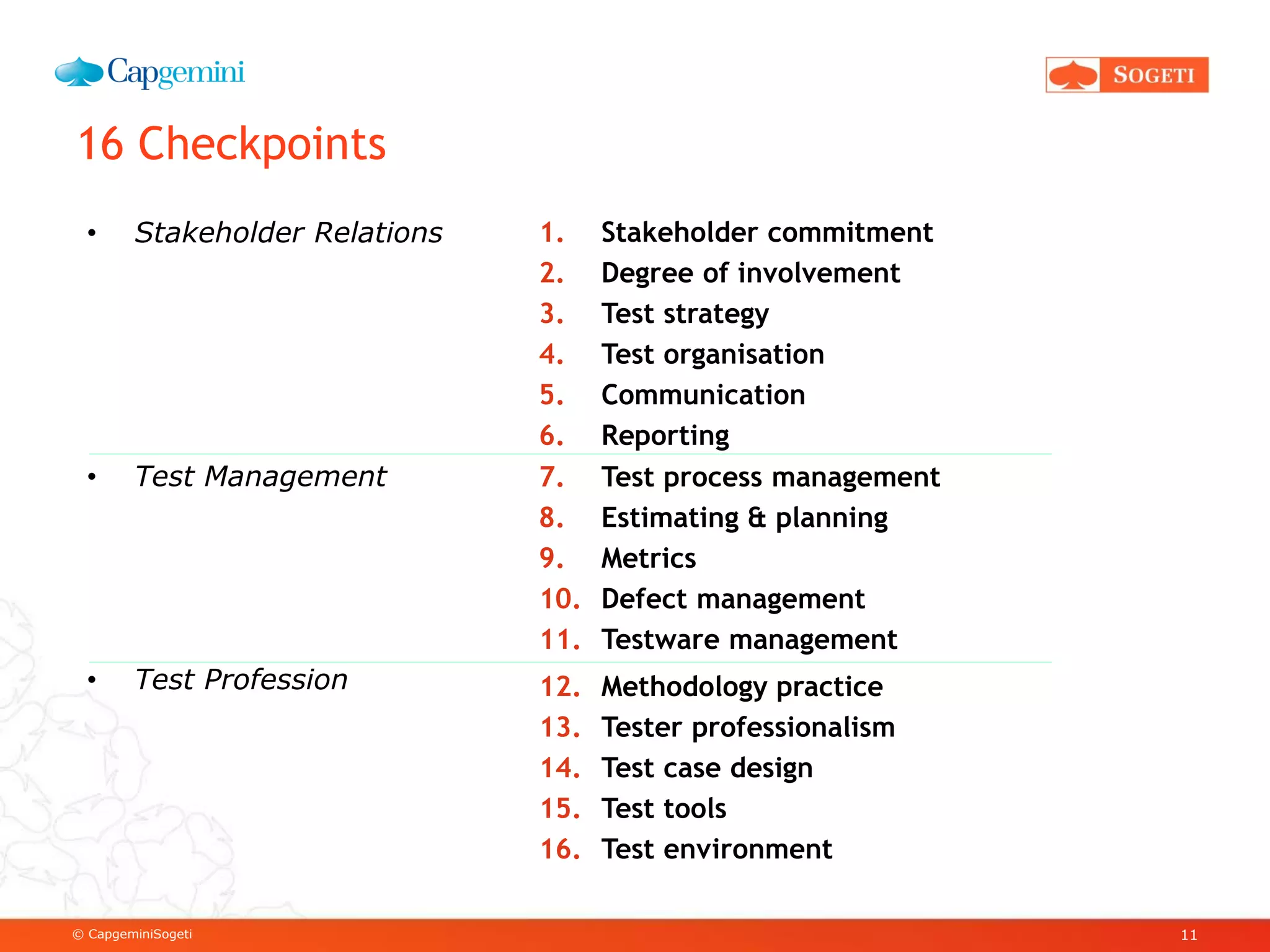
16 Checkpoints
11
• Stakeholder Relations
• Test Management
• Test Profession
1. Stakeholder commitment
2. Degree of involvement
3. Test strategy
4. Test organisation
5. Communication
6. Reporting
12. Methodology practice
13. Tester professionalism
14. Test case design
15. Test tools
16. Test environment
7. Test process management
8. Estimating & planning
9. Metrics
10. Defect management
11. Testware management
© CapgeminiSogeti
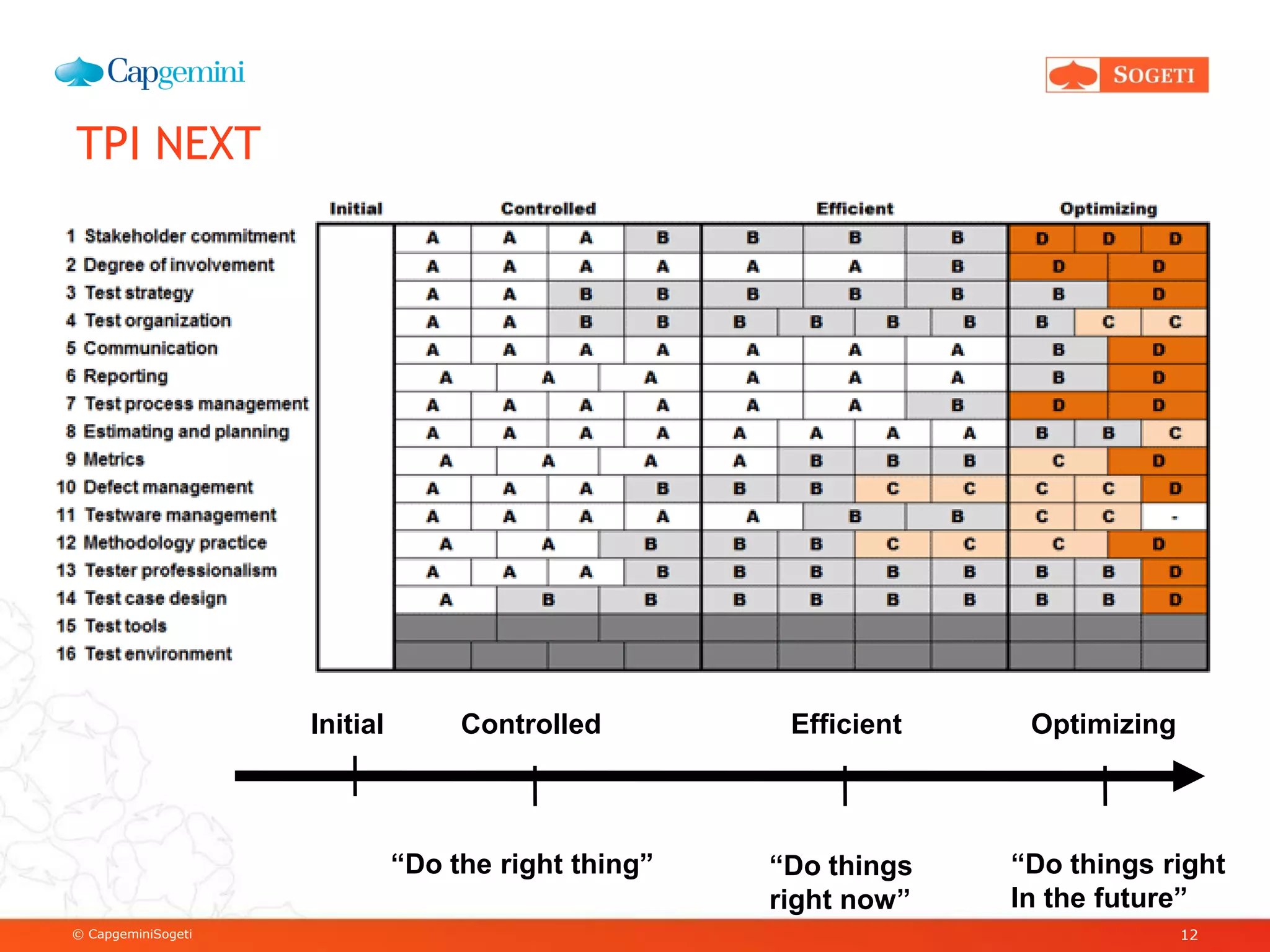
TPI NEXT
12
Initial Controlled Efficient Optimizing
“Do the right thing” “Do things
right now”
“Do things right
In the future”
© CapgeminiSogeti
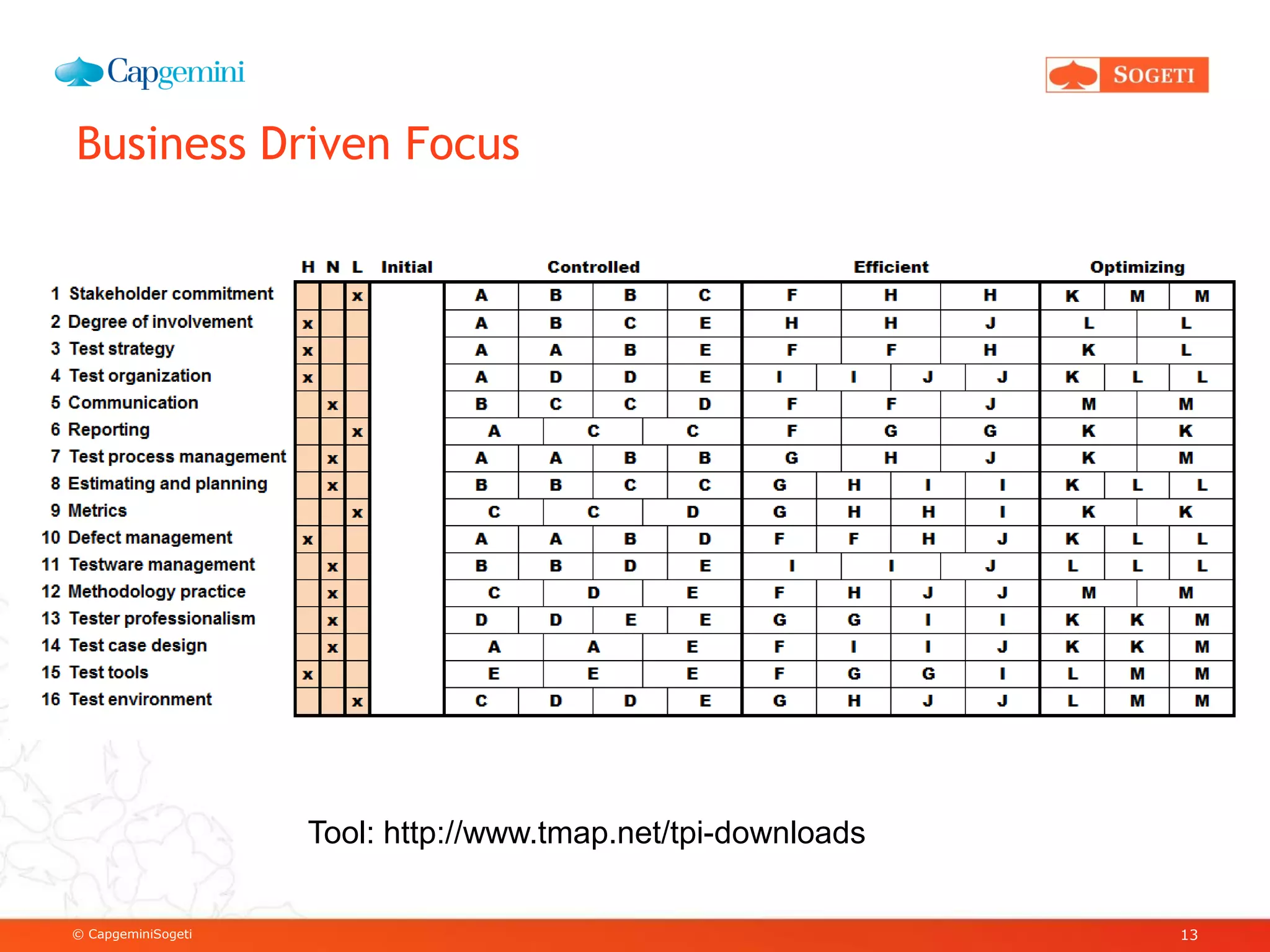
Business Driven Focus
13
Tool: http://www.tmap.net/tpi-downloads
© CapgeminiSogeti
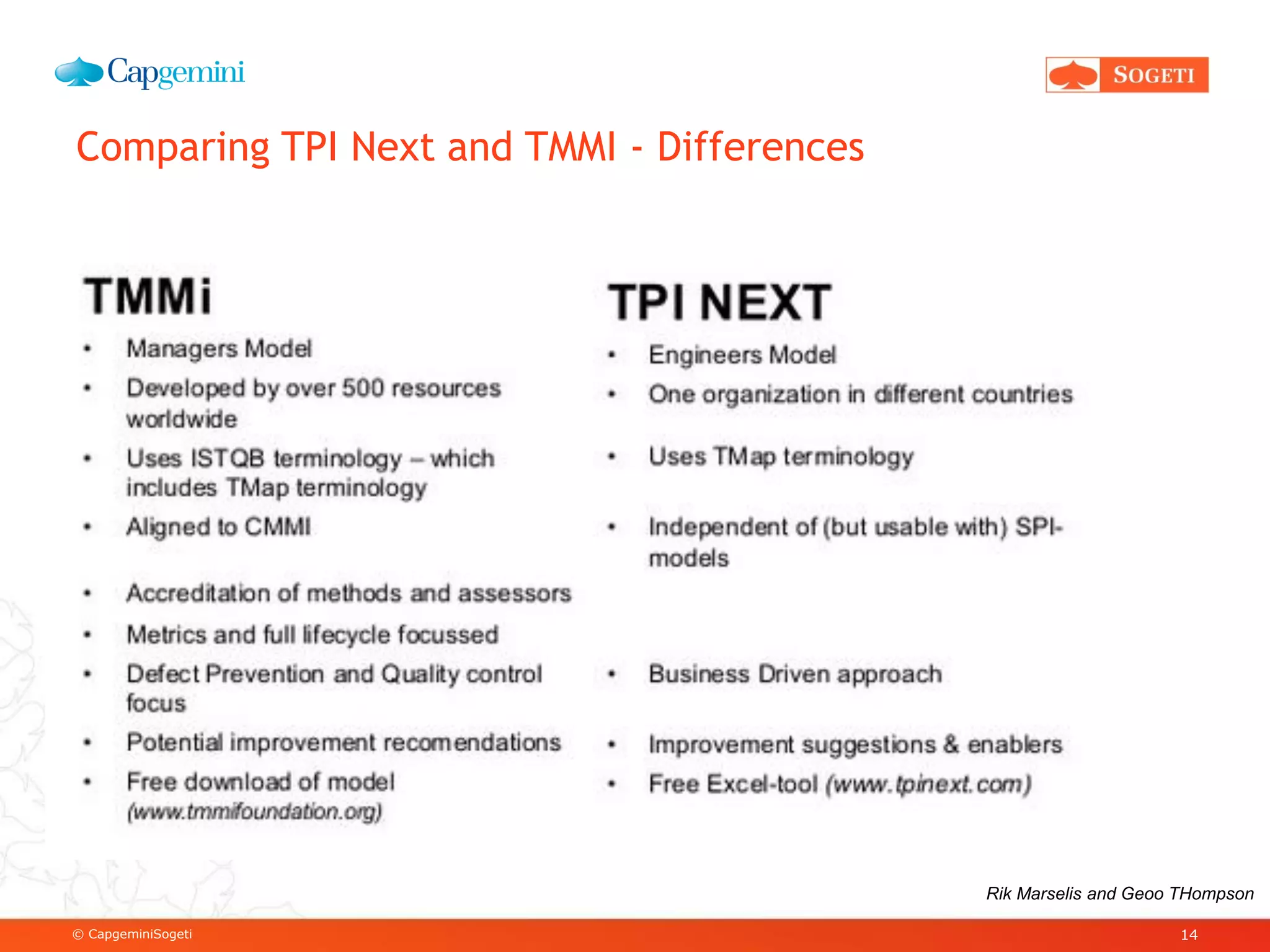
Comparing TPI Next and TMMI - Differences
14
Rik Marselis and Geoo THompson
© CapgeminiSogeti
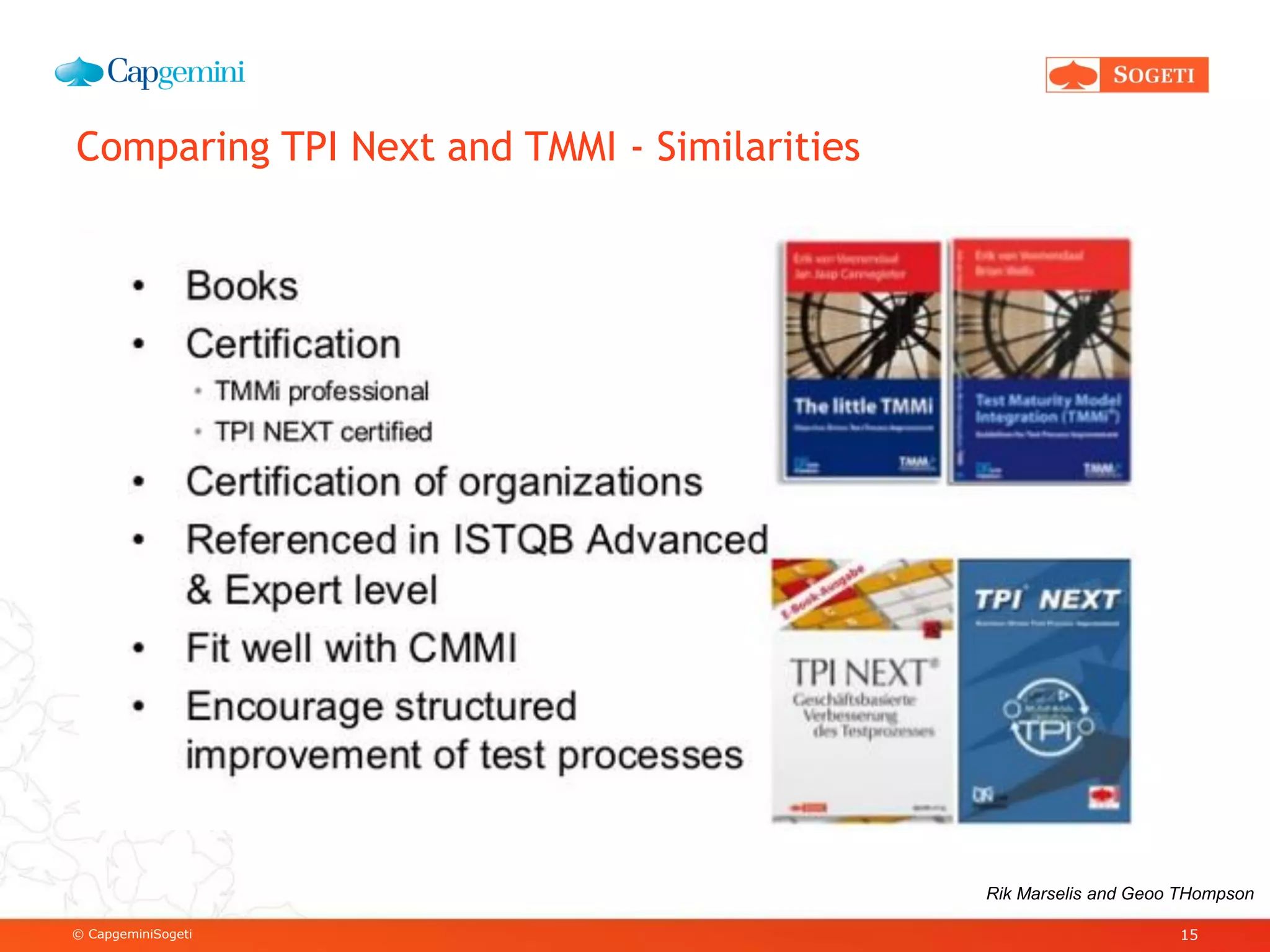
Comparing TPI Next and TMMI - Similarities
15
Rik Marselis and Geoo THompson
© CapgeminiSogeti
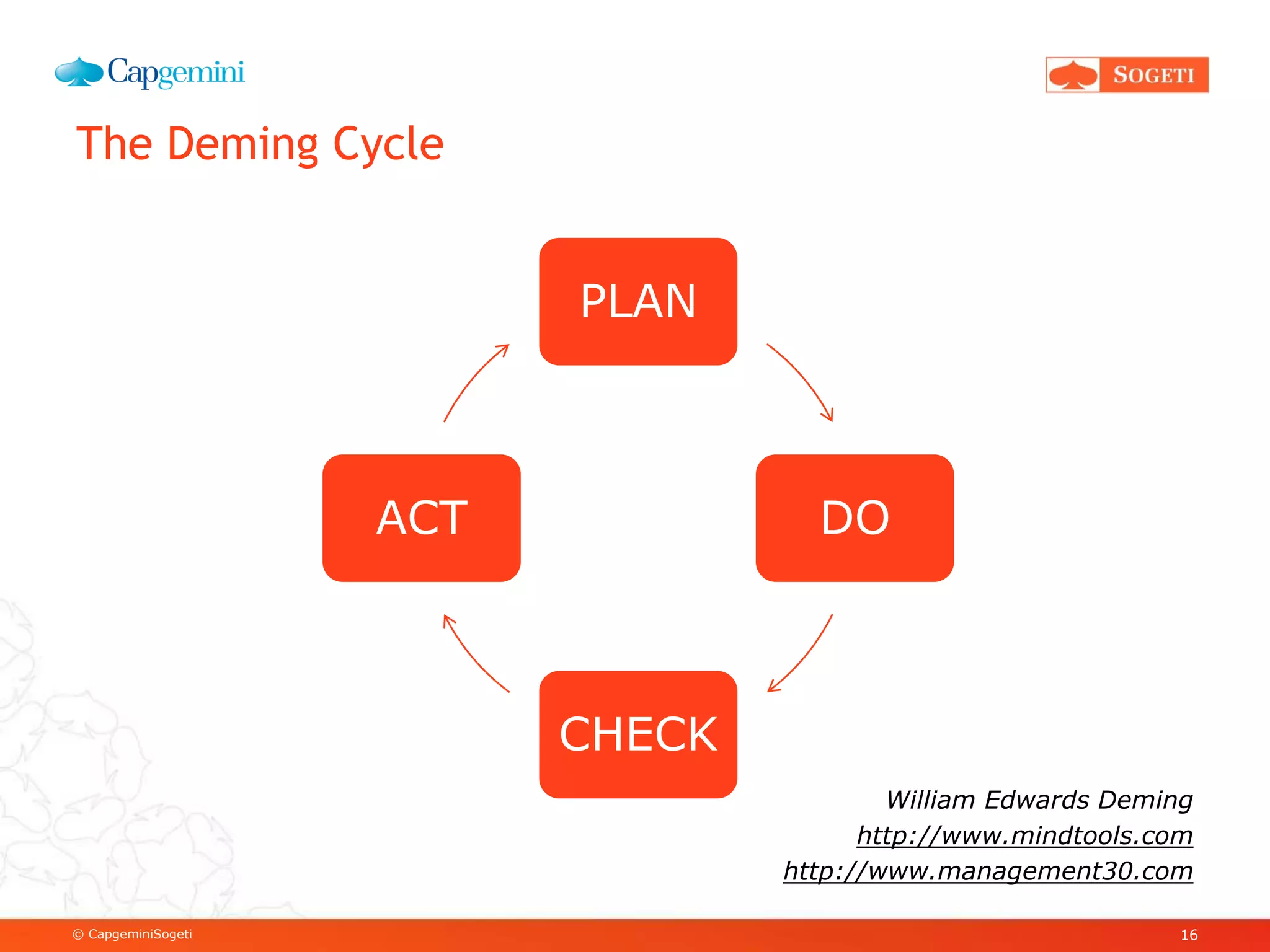
The Deming Cycle
William Edwards Deming
http://www.mindtools.com
http://www.management30.com
16
PLAN
DO
CHECK
ACT
© CapgeminiSogeti
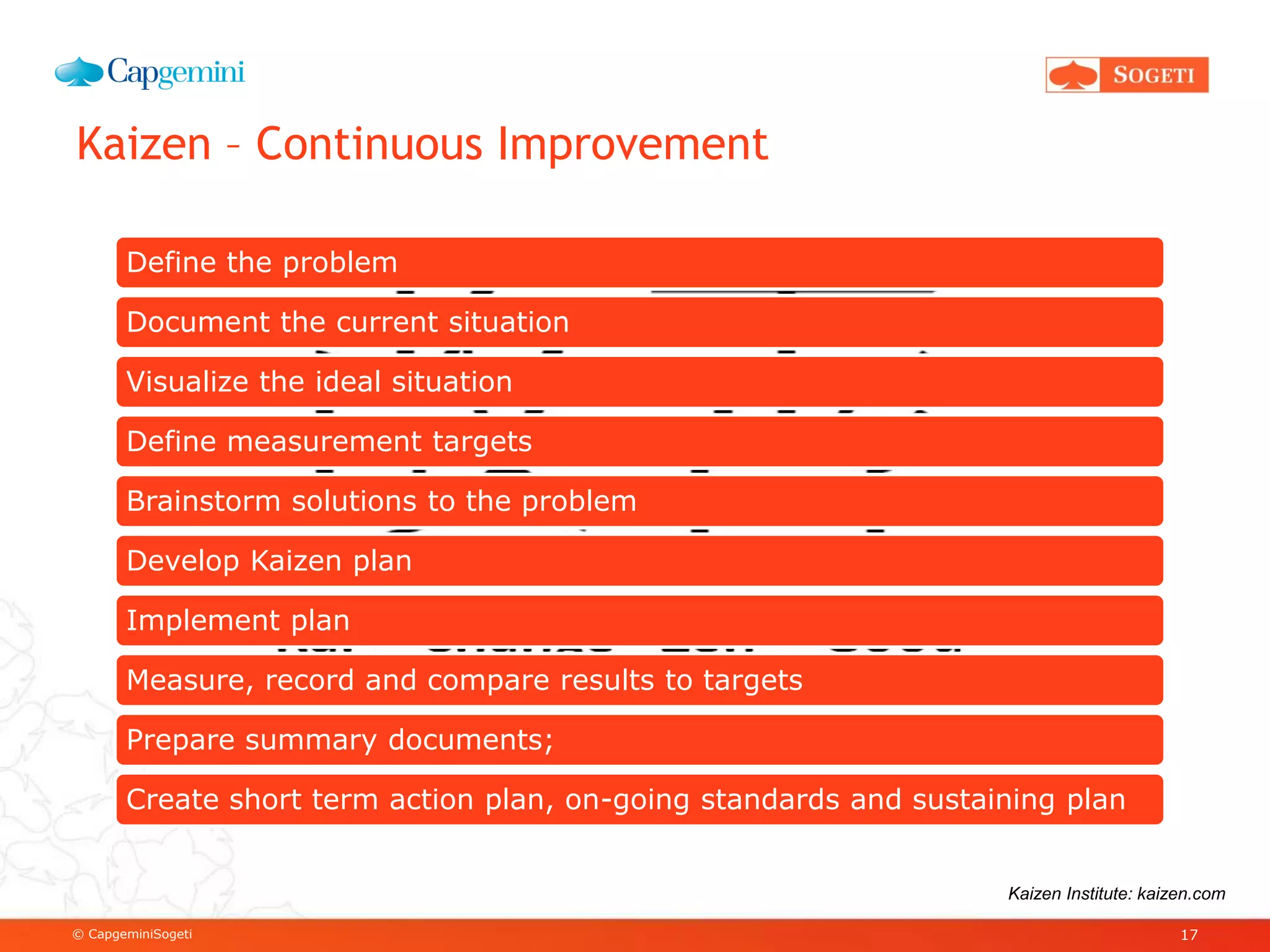
Kaizen – Continuous Improvement
17
Define the problem
Document the current situation
Visualize the ideal situation
Define measurement targets
Brainstorm solutions to the problem
Develop Kaizen plan
Implement plan
Measure, record and compare results to targets
Prepare summary documents;
Create short term action plan, on-going standards and sustaining plan
Kaizen Institute: kaizen.com
© CapgeminiSogeti
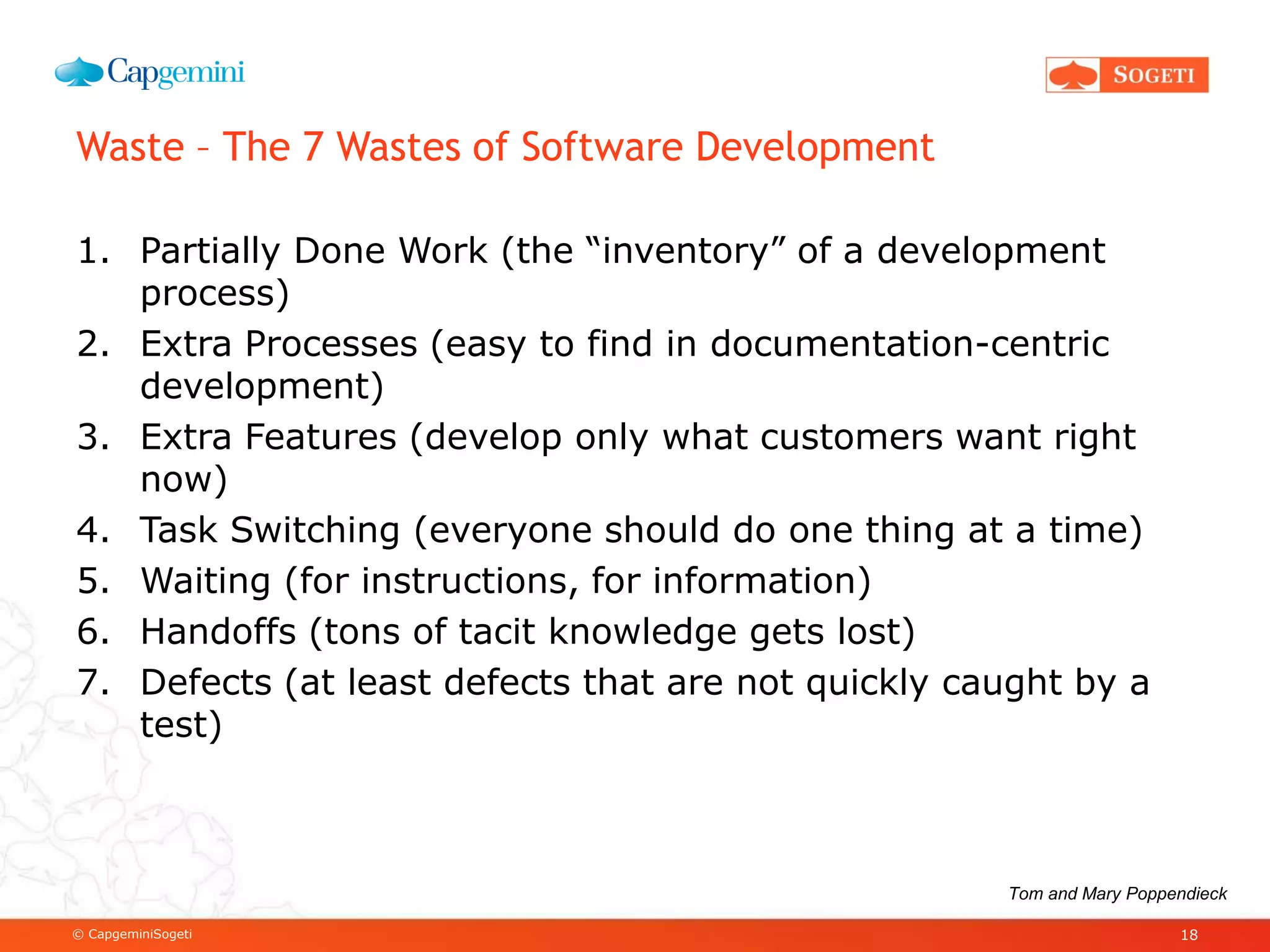
Waste – The 7 Wastes of Software Development
1. Partially Done Work (the “inventory” of a development
process)
2. Extra Processes (easy to find in documentation-centric
development)
3. Extra Features (develop only what customers want right
now)
4. Task Switching (everyone should do one thing at a time)
5. Waiting (for instructions, for information)
6. Handoffs (tons of tacit knowledge gets lost)
7. Defects (at least defects that are not quickly caught by a
test)
18
Tom and Mary Poppendieck
© CapgeminiSogeti
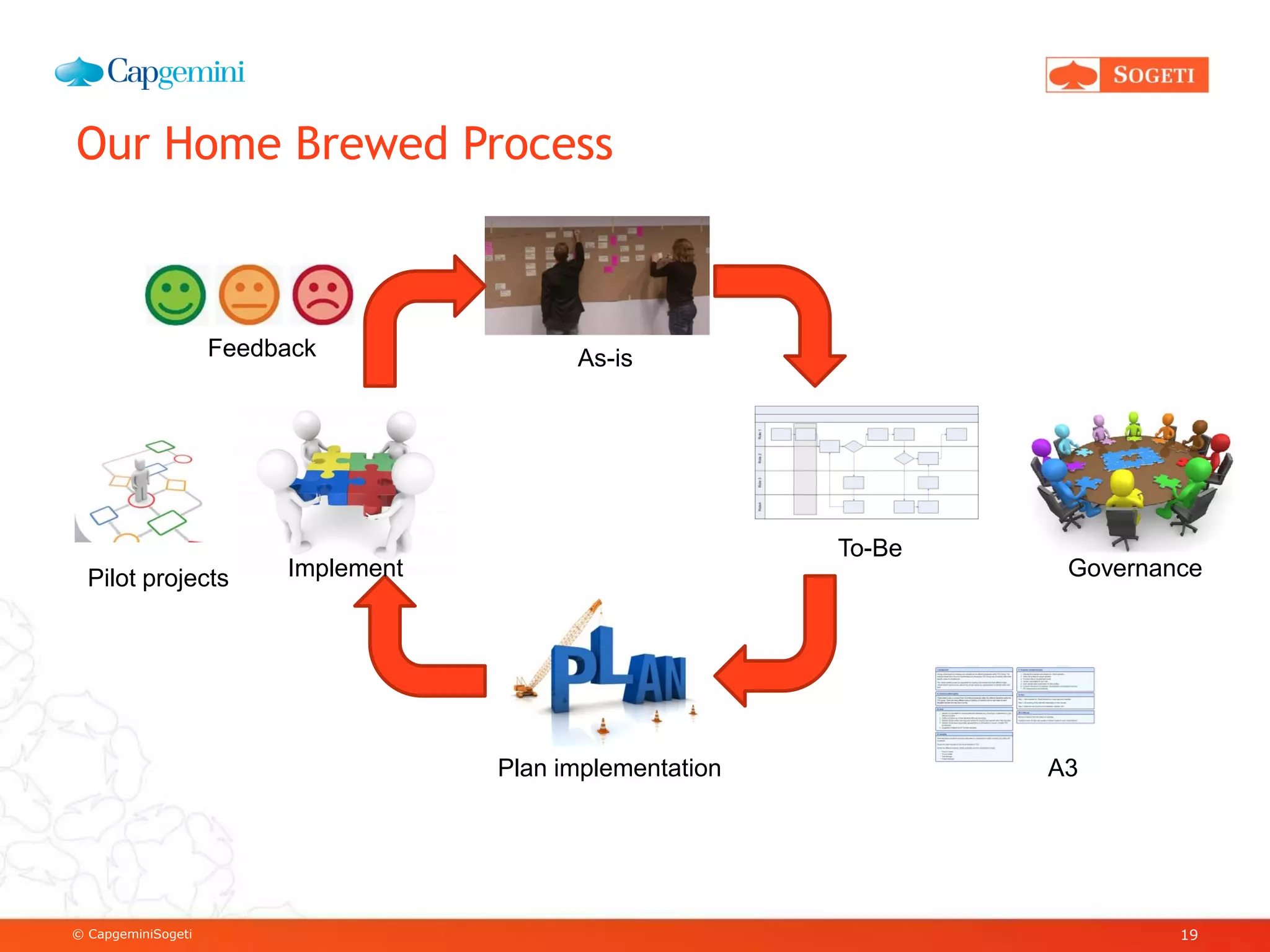
Our Home Brewed Process
19
To-Be
Implement
As-is
Plan implementation A3
GovernancePilot projects
Feedback
© CapgeminiSogeti
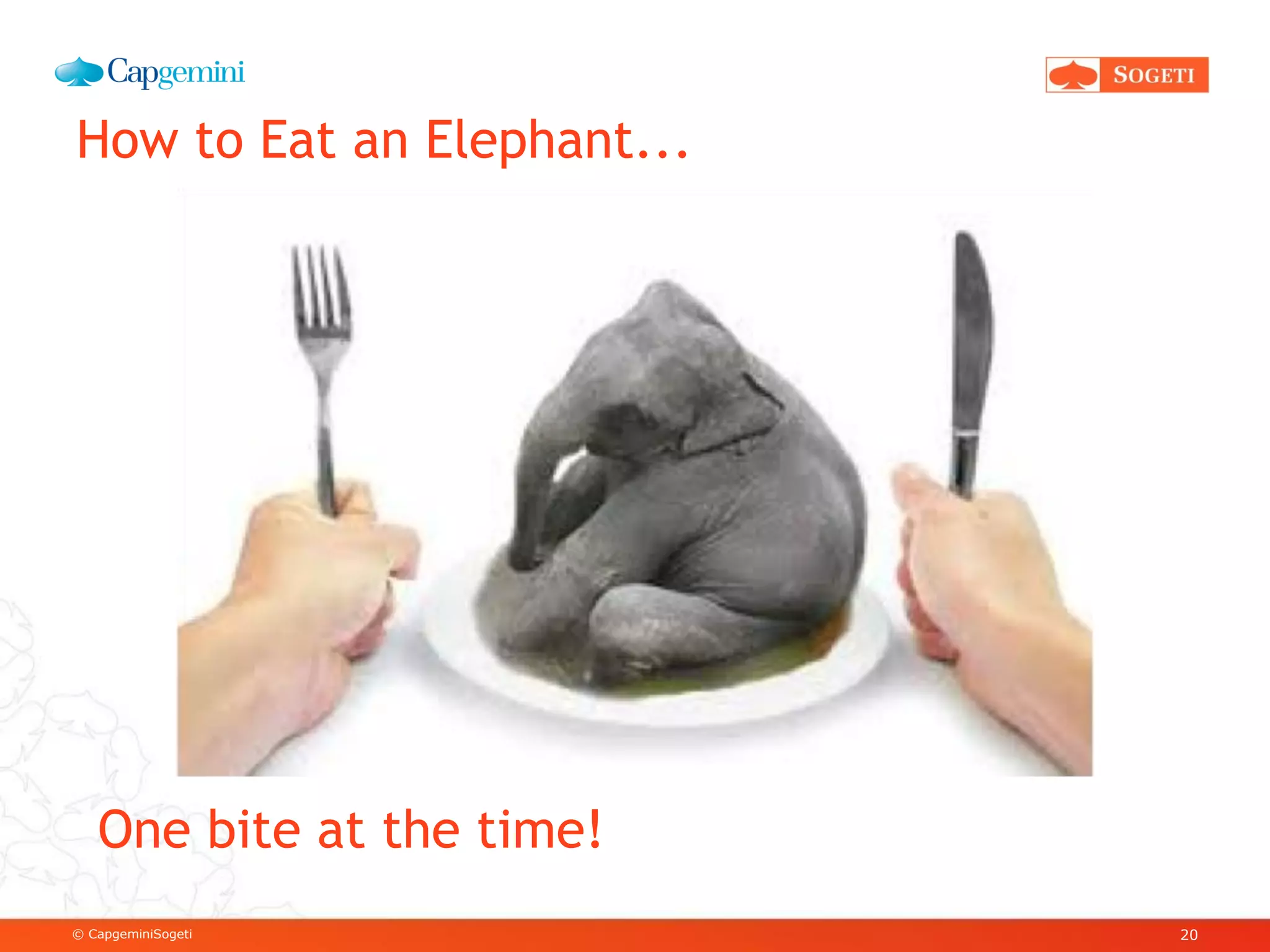
How to Eat an Elephant...
20
One bite at the time!
© CapgeminiSogeti
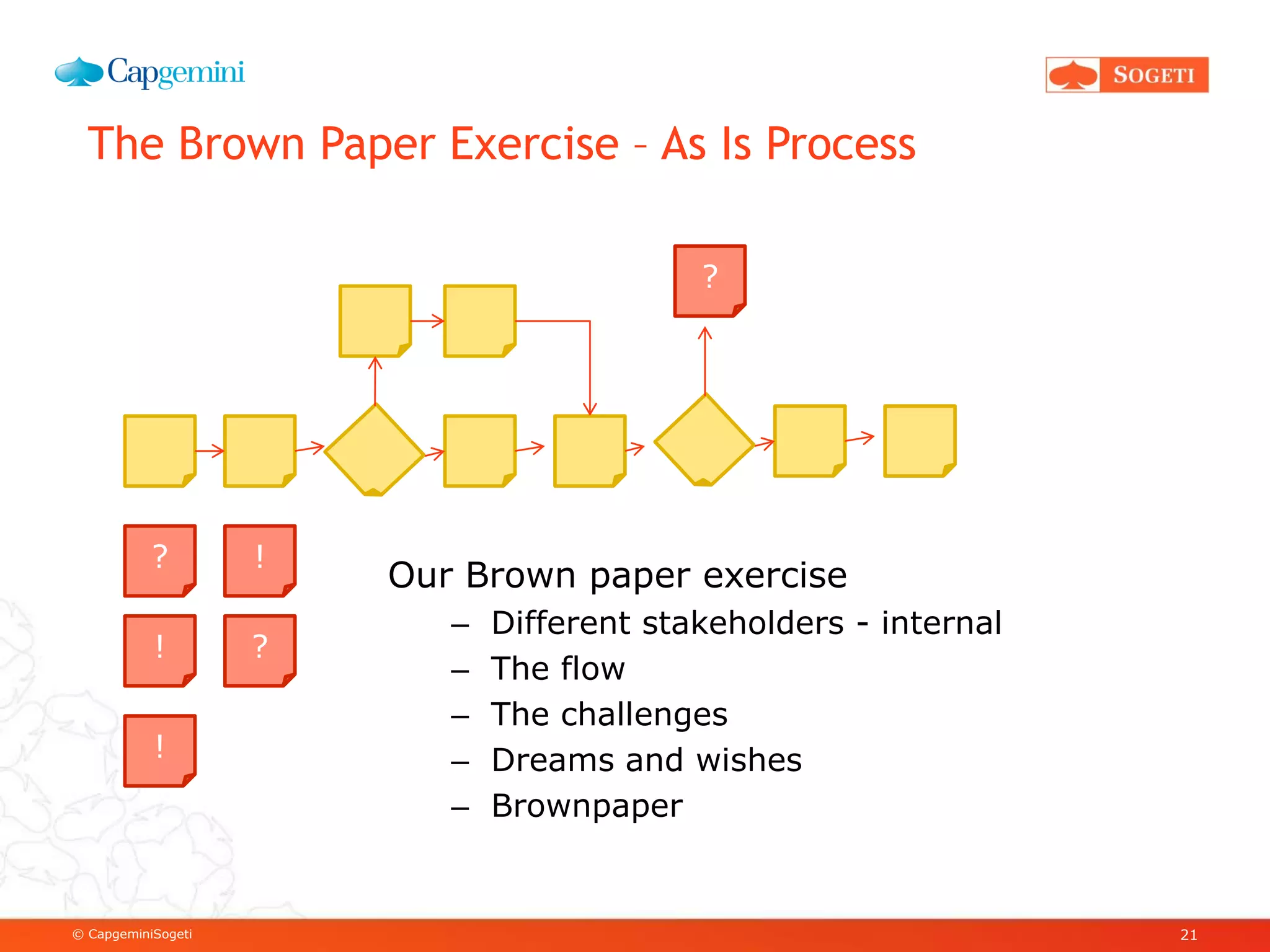
The Brown Paper Exercise – As Is Process
Our Brown paper exercise
– Different stakeholders - internal
– The flow
– The challenges
– Dreams and wishes
– Brownpaper
21
?
!
!
!
?
?
© CapgeminiSogeti
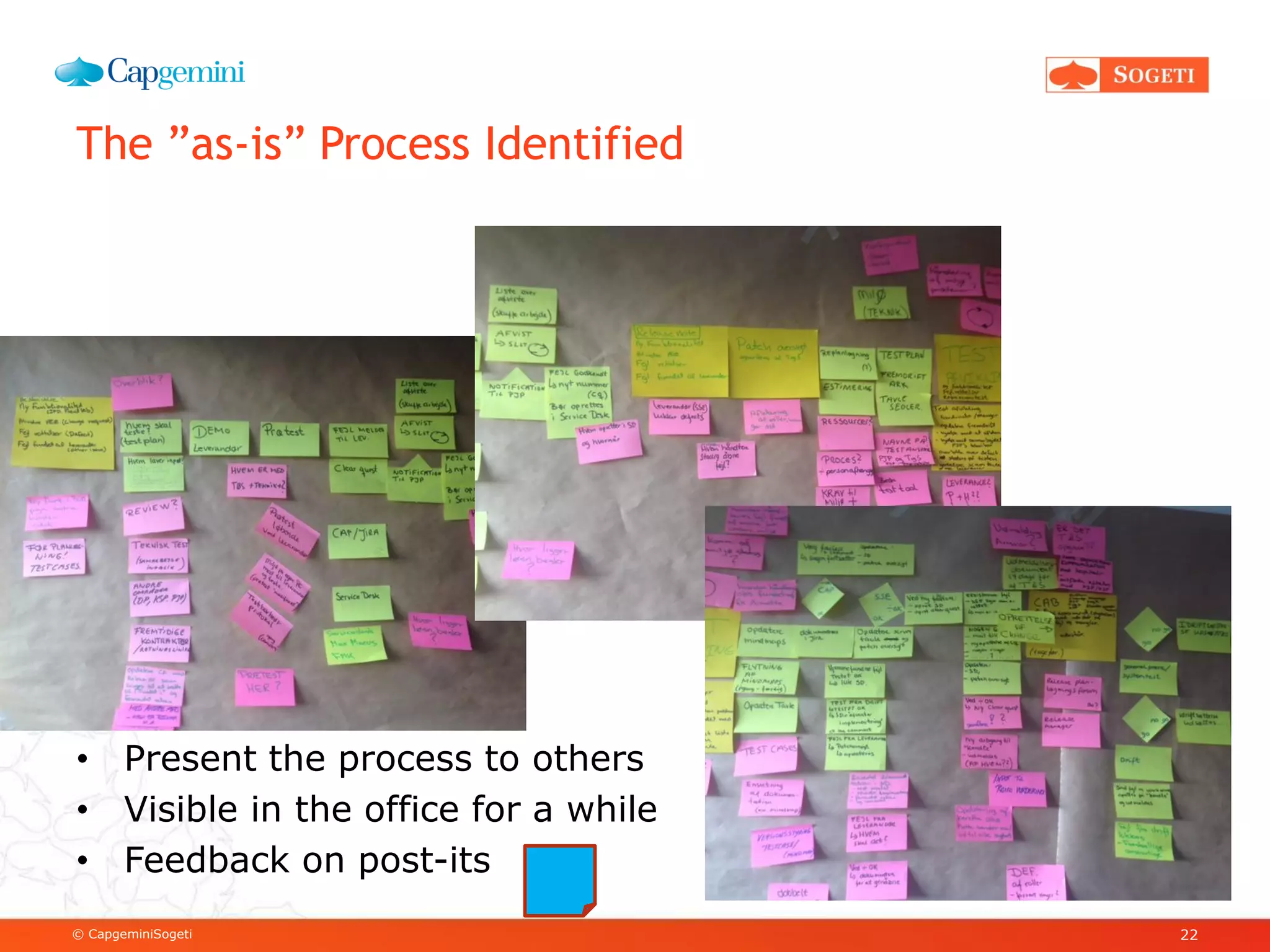
The ”as-is” Process Identified
• Present the process to others
• Visible in the office for a while
• Feedback on post-its
22
© CapgeminiSogeti
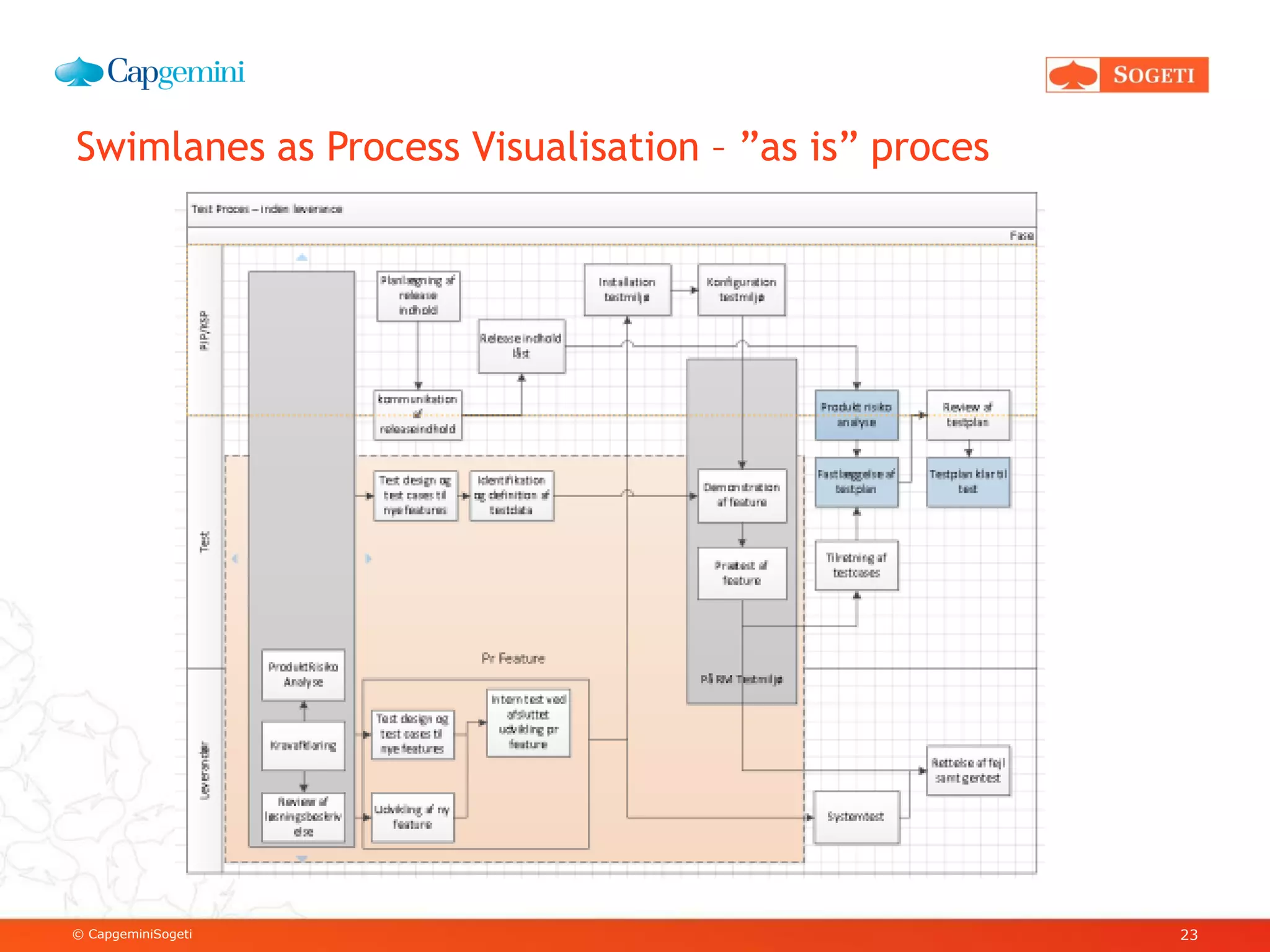
Swimlanes as Process Visualisation – ”as is” proces
23
© CapgeminiSogeti
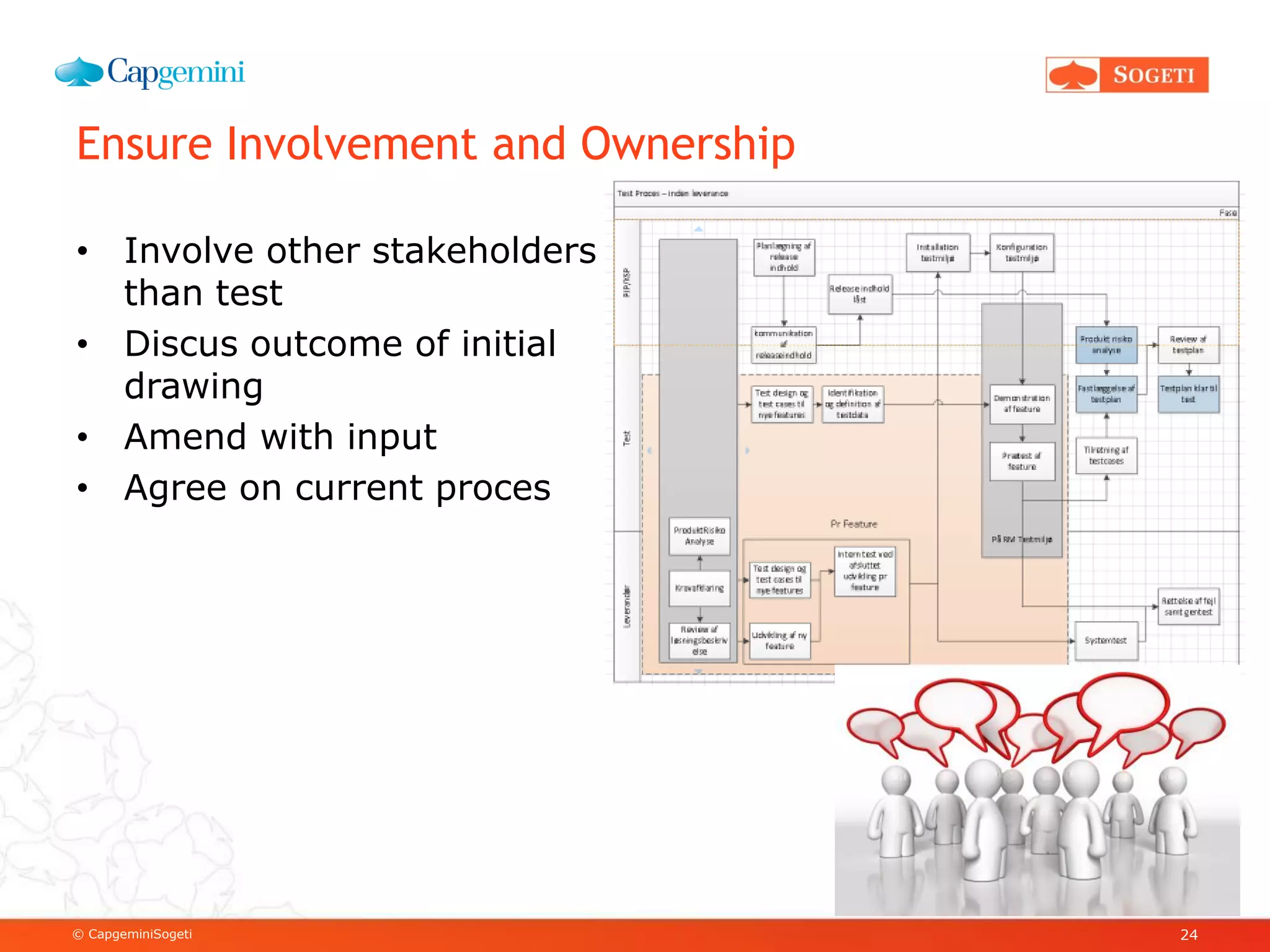
Ensure Involvement and Ownership
• Involve other stakeholders
than test
• Discus outcome of initial
drawing
• Amend with input
• Agree on current proces
24
© CapgeminiSogeti
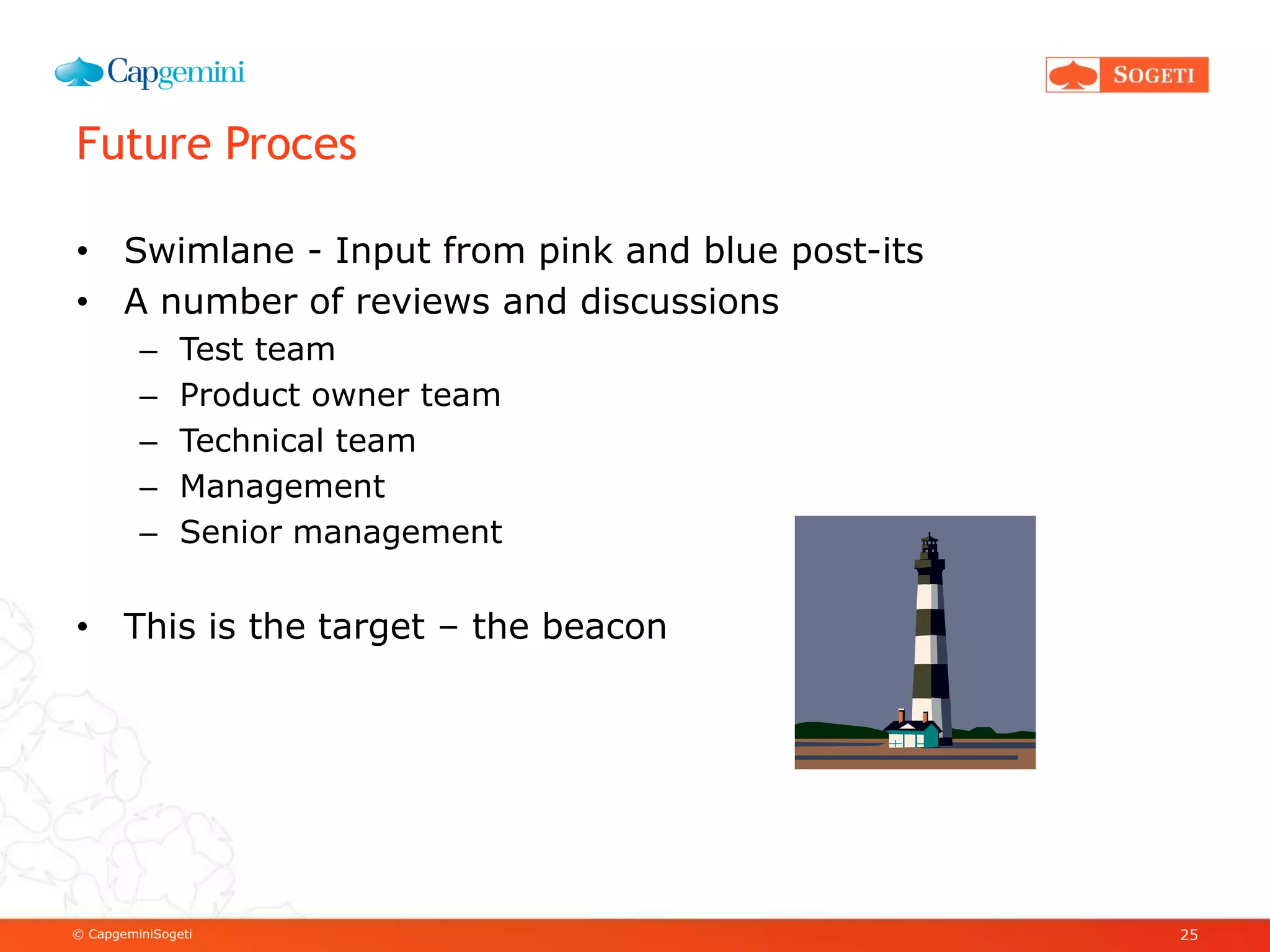
Future Proces
• Swimlane - Input from pink and blue post-its
• A number of reviews and discussions
– Test team
– Product owner team
– Technical team
– Management
– Senior management
• This is the target – the beacon
25
© CapgeminiSogeti
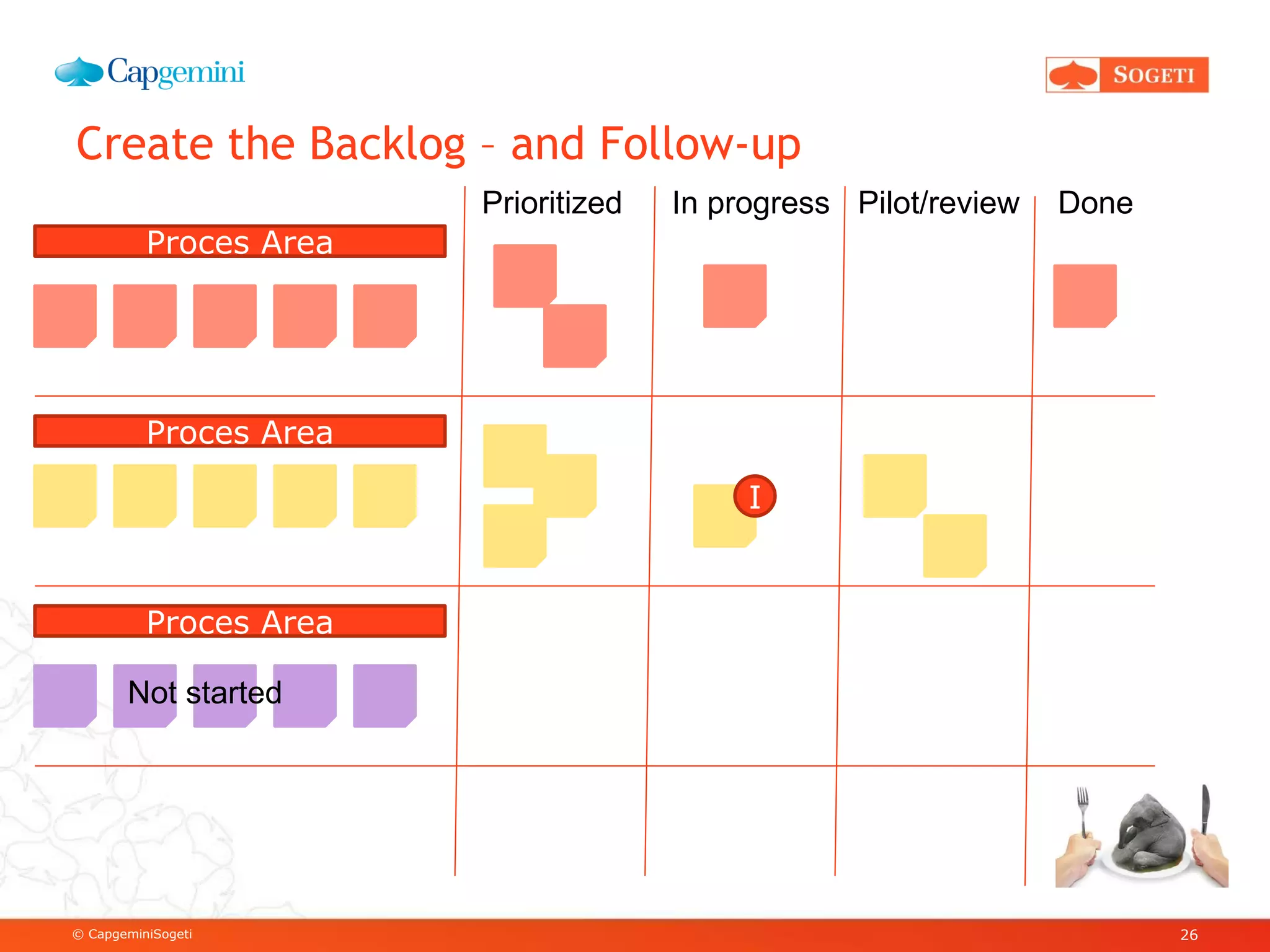
Create the Backlog – and Follow-up
26
Proces Area
Proces Area
Proces Area
Prioritized In progress Pilot/review Done
Not started
I
© CapgeminiSogeti
Remember the Elephant?
27
© CapgeminiSogeti
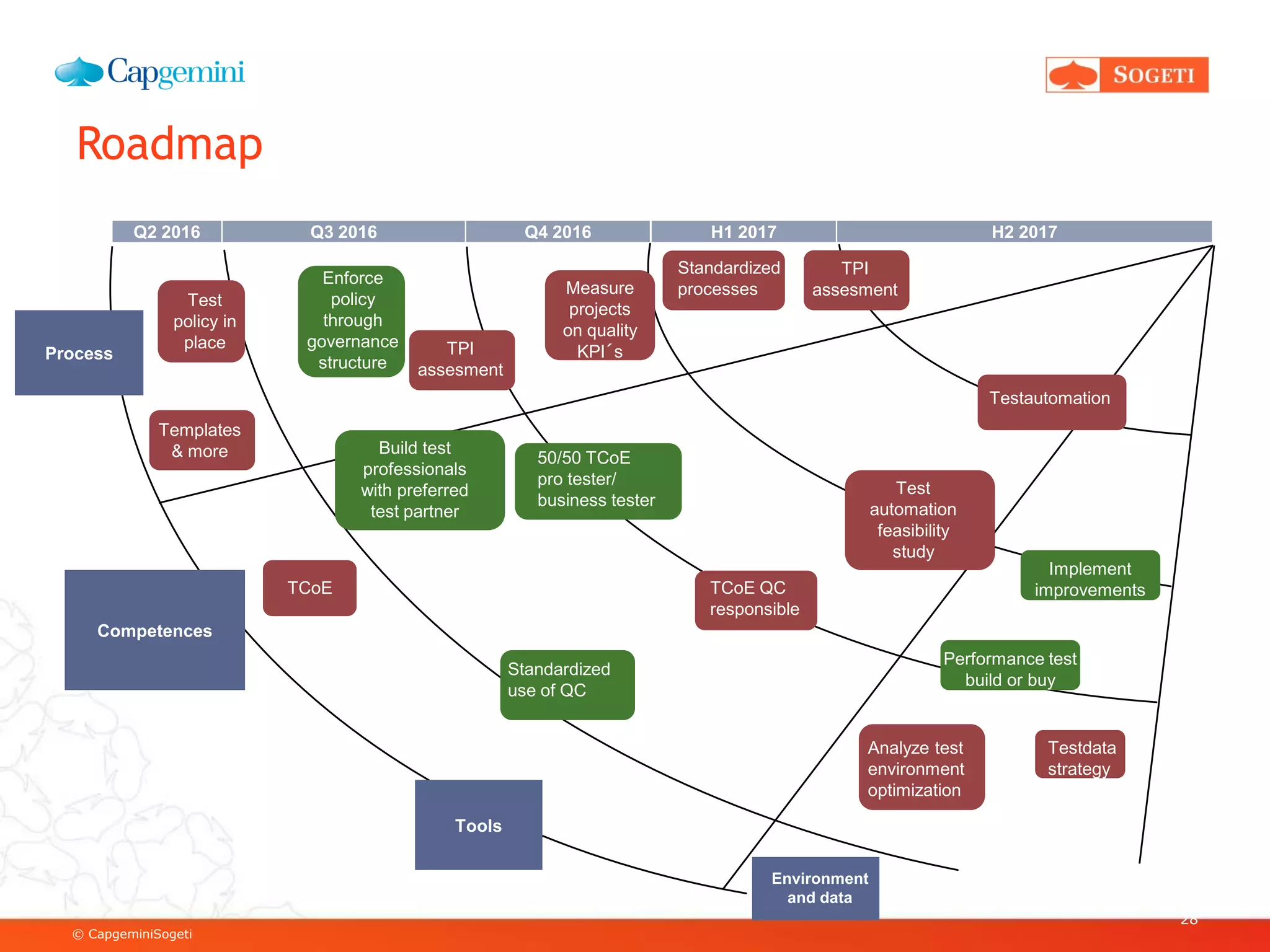
Roadmap
28
Competences
Q4 2016 H1 2017 H2 2017Q3 2016Q2 2016
Tools
Process
TCoE QC
responsible
Test
automation
feasibility
study
50/50 TCoE
pro tester/
business tester
Measure
projects
on quality
KPI´s
Analyze test
environment
optimization
Environment
and data
Enforce
policy
through
governance
structure
Standardized
use of QC
Test
policy in
place
TCoE
Build test
professionals
with preferred
test partner
Templates
& more
Testdata
strategy
Implement
improvements
Performance test
build or buy
Testautomation
Standardized
processes
TPI
assesment
TPI
assesment
© CapgeminiSogeti
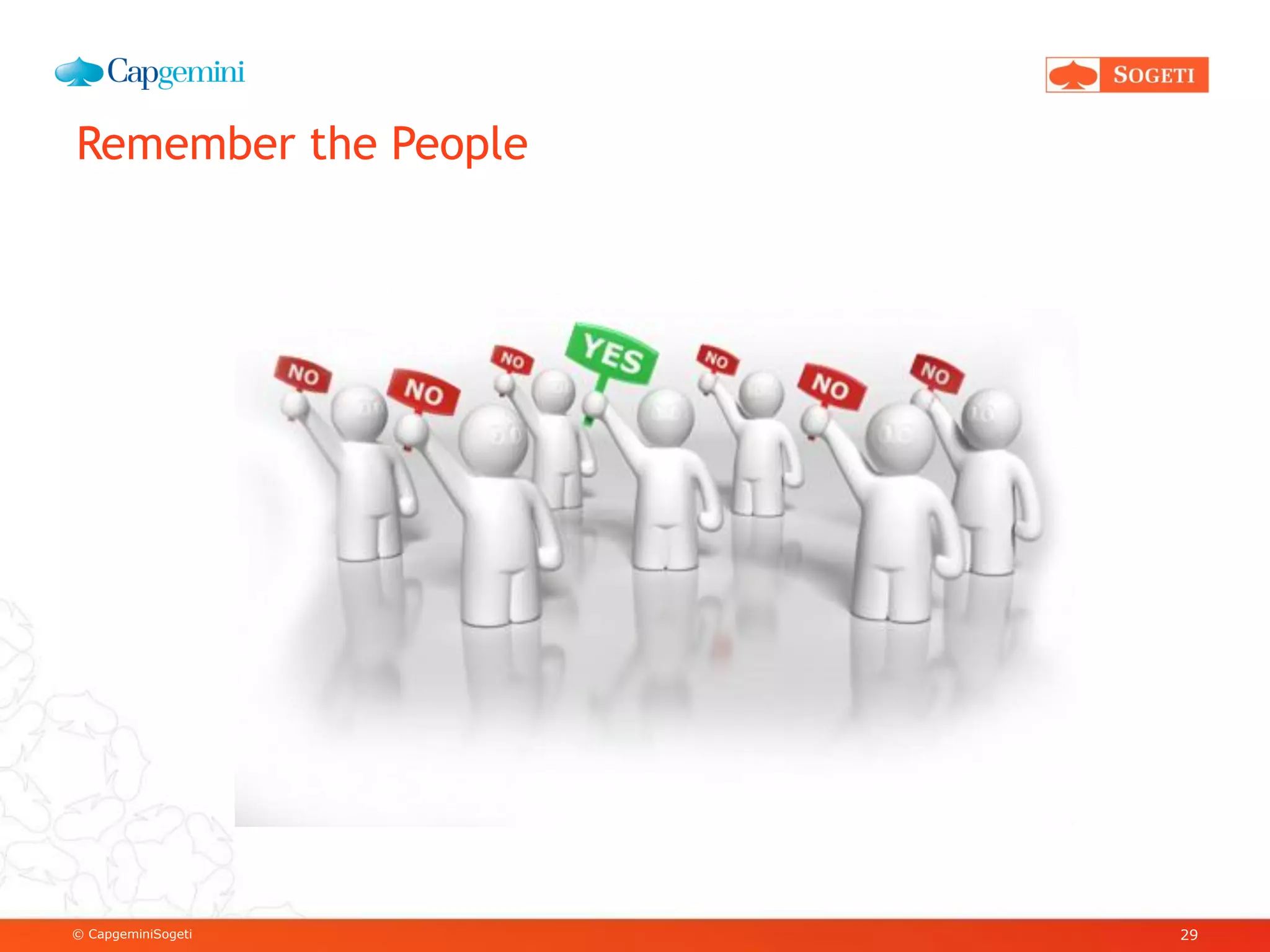
Remember the People
29
© CapgeminiSogeti
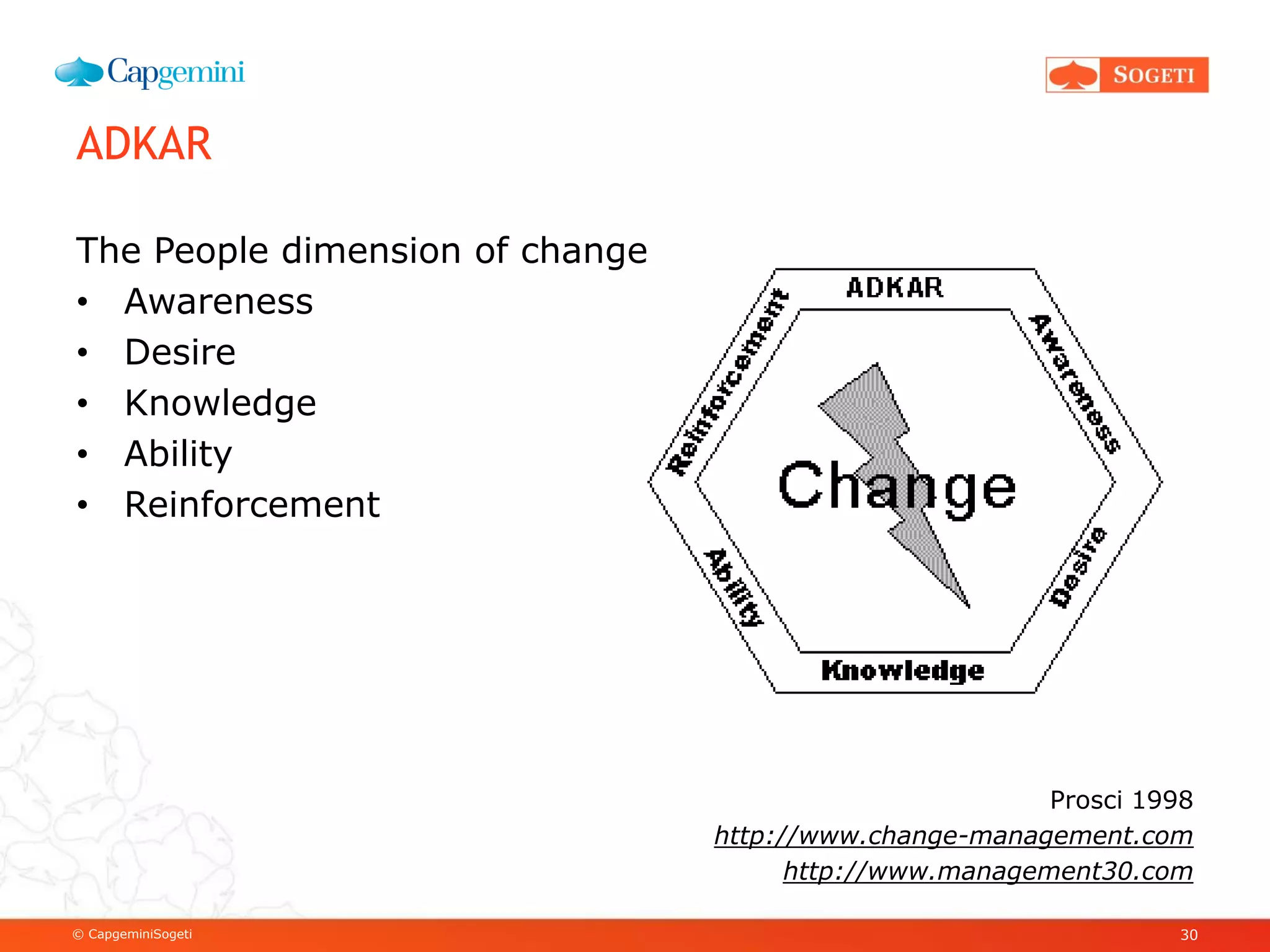
ADKAR
The People dimension of change
• Awareness
• Desire
• Knowledge
• Ability
• Reinforcement
Prosci 1998
http://www.change-management.com
http://www.management30.com
30
© CapgeminiSogeti
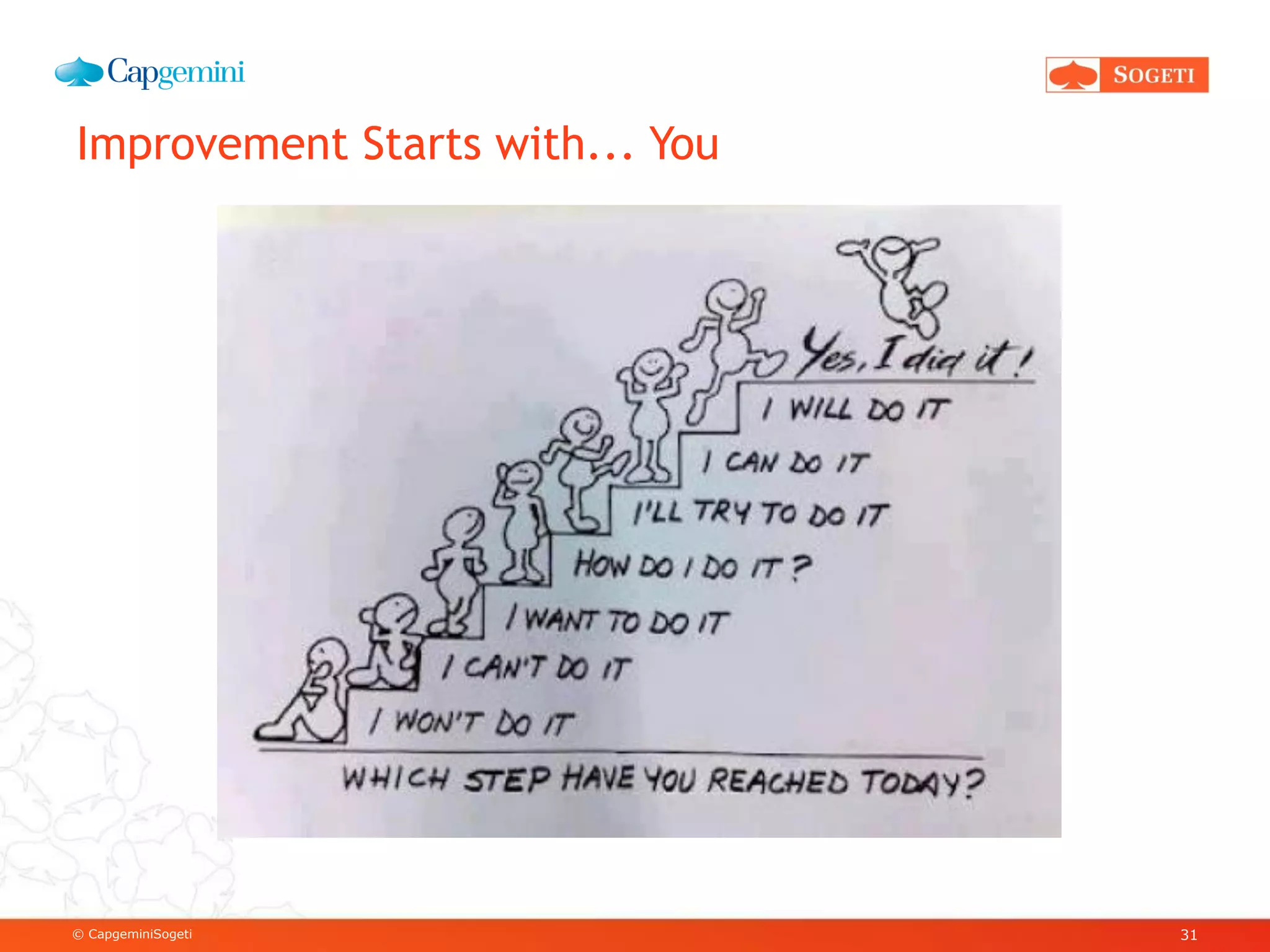
Improvement Starts with... You
31
© CapgeminiSogeti
Sources
• TPI Next – Business Dirven Test Process Improvement : by Rik
Marselis, gerrit de Vries, Ben Vissser, Loek Wilhelmus, Alexander van
Ewijk, Marcel van Oosterwijk, Bent Linker.
• Test Maturity Model Integration TMMi: by Erik van Veenendaal and
Brian Wells
• How to change the world : by Jurgen Appelo
• Lean Software Development, An agile toolkit: By Mary and Tom
Poppendieck
• ISTQB Expert Level Syllabus for Test Proces Improvement:
http://www.istqb.org/downloads/category/12-expert-level-
documents.html
• TPI Presentation: http://www.slideshare.net/RikMarselis/increasing-
business-success-with-tpi-next-and-pointzero/33 by Rik Marselis
• Presentation on process improvement:
http://www.slideshare.net/RikMarselis/why-would-
youwanttoimproveyourtestprocess/17 by Rik Marelis and Geoff Thompson
32
© CapgeminiSogeti
Thank You
33

Finding Success with Test Process Improvement

  • 1.
              T19   Test  Management   5/5/16  15:00               Finding  Success  with  Test  Process   Improvement     Presented  by:     Gitte  Ottosen   Capgemini-­‐Sogeti  Denmark     Brought  to  you  by:                 350  Corporate  Way,  Suite  400,  Orange  Park,  FL  32073     888-­‐-­‐-­‐268-­‐-­‐-­‐8770  ·∙·∙  904-­‐-­‐-­‐278-­‐-­‐-­‐0524  -­‐  info@techwell.com  -­‐  http://www.stareast.techwell.com/        
  • 2.
            Gitte  Ottosen   Capgemini-­‐Sogeti  Denmark     Gitte  Ottosen  is  a  managing  consultant  at  Capgemini-­‐Sogeti  Denmark,  a  company   that  delivers  test  consultancy.  Â  As  a  career  tester,  Gitte  has  twenty  years’   experience  in  test  engineering,  test  management,  and  process  improvement  in   both  traditional  and  agile  contexts.  She  has  worked  in  test  process  improvement,   first  as  a  test  architect/manager  and  more  recently  as  a  test  coach  in  shipping,   the  public  sector,  and  health  care.  As  as  elf-­‐confessed  test  evangelist  who   preaches  the  need  for  a  structured  and  committed  approach  to  testing,  Gitte  is  a   strong  advocate  for  a  context-­‐driven  approach,  a  role  requiring  profound   professional  insight,  passion,  and  persistence.          
  • 3.
    Improving the TestProcess Gitte Ottosen Gitte.ottosen@capgeminisogeti.dk godtesen
  • 4.
    © CapgeminiSogeti 2 Abit about me Gitte Ottosen Capgemini Sogeti Danmark A/S Gitte.ottosen@capgeminisogeti.dk +45 52189711 Education Corporal in the Royal Danish Airforce Certifications SCRUM master, ISEB foundation/practitioner, CAT trainer, CABA, Tmap Test Engineer, Tmap Test Manager, TPI Next foundation Experience • 20 years in the IT business • 4 years in Capgemini Sogeti Focus Test management, test engineering, SCRUM, process improvement, LEAN, agile, context driven test, change management Agile Experience Customers: Systematic, Maersk Line IT, DONG, KMD, TDC Network Test20/Tecpoint, CAT trainer network Fellow Sogeti Labs
  • 5.
  • 6.
    © CapgeminiSogeti A GenericChange Process 4 Evaluate and redirect Implement actions Make a plan of action Define improvements (generate) Awareness Determine goal, scope and approach Assess current situation Reference model
  • 7.
    © CapgeminiSogeti Two ModelBased Approaches • Proces Model: Process models define generic bodies of testing best practice and how to improve different aspects of testing in a prescribed step-by-step manner. – TMMI – TPI • Content Model: Content models are non-prescriptive; they do not require that improvements occur in a specific order. Instead, they define specific activities which can benefit a test process if applied well. – STEP (Systematic Test and Evaluation Process) – CTP (Critical Testing Process) 5 ISTQB Expert level Test Proces Improvement Syllabus
  • 8.
  • 9.
    © CapgeminiSogeti The TMMIMaturity Levels Level 1 – Initial • Chaotic and undefined Level 2 – Managed • Managed process separated from development • Existing practices retained Level 3 – Defined • Testing fully integrated into the project lifecycle • Starting as early as requirements definition Level 4 – Management and Measurement • Testing thoroughly designed • Well founded and measured • Quantitative objectives for product quality Level 5 – Optimisation • Fully defined and continually self improving • Controlling cost and effectiveness of testing 7
  • 10.
  • 11.
    © CapgeminiSogeti Guidelines forRating • Guidelines for the assessment team when rating: – >85% = Fully Achieved – <=85% >50% = Largely Achieved – <=50% >15% = Partially Achieved – <15% = Not Achieved To achieve maturity level ALL process areas MUST be rated as FULLY achieved 9
  • 12.
  • 13.
    © CapgeminiSogeti 16 Checkpoints 11 •Stakeholder Relations • Test Management • Test Profession 1. Stakeholder commitment 2. Degree of involvement 3. Test strategy 4. Test organisation 5. Communication 6. Reporting 12. Methodology practice 13. Tester professionalism 14. Test case design 15. Test tools 16. Test environment 7. Test process management 8. Estimating & planning 9. Metrics 10. Defect management 11. Testware management
  • 14.
    © CapgeminiSogeti TPI NEXT 12 InitialControlled Efficient Optimizing “Do the right thing” “Do things right now” “Do things right In the future”
  • 15.
    © CapgeminiSogeti Business DrivenFocus 13 Tool: http://www.tmap.net/tpi-downloads
  • 16.
    © CapgeminiSogeti Comparing TPINext and TMMI - Differences 14 Rik Marselis and Geoo THompson
  • 17.
    © CapgeminiSogeti Comparing TPINext and TMMI - Similarities 15 Rik Marselis and Geoo THompson
  • 18.
    © CapgeminiSogeti The DemingCycle William Edwards Deming http://www.mindtools.com http://www.management30.com 16 PLAN DO CHECK ACT
  • 19.
    © CapgeminiSogeti Kaizen –Continuous Improvement 17 Define the problem Document the current situation Visualize the ideal situation Define measurement targets Brainstorm solutions to the problem Develop Kaizen plan Implement plan Measure, record and compare results to targets Prepare summary documents; Create short term action plan, on-going standards and sustaining plan Kaizen Institute: kaizen.com
  • 20.
    © CapgeminiSogeti Waste –The 7 Wastes of Software Development 1. Partially Done Work (the “inventory” of a development process) 2. Extra Processes (easy to find in documentation-centric development) 3. Extra Features (develop only what customers want right now) 4. Task Switching (everyone should do one thing at a time) 5. Waiting (for instructions, for information) 6. Handoffs (tons of tacit knowledge gets lost) 7. Defects (at least defects that are not quickly caught by a test) 18 Tom and Mary Poppendieck
  • 21.
    © CapgeminiSogeti Our HomeBrewed Process 19 To-Be Implement As-is Plan implementation A3 GovernancePilot projects Feedback
  • 22.
    © CapgeminiSogeti How toEat an Elephant... 20 One bite at the time!
  • 23.
    © CapgeminiSogeti The BrownPaper Exercise – As Is Process Our Brown paper exercise – Different stakeholders - internal – The flow – The challenges – Dreams and wishes – Brownpaper 21 ? ! ! ! ? ?
  • 24.
    © CapgeminiSogeti The ”as-is”Process Identified • Present the process to others • Visible in the office for a while • Feedback on post-its 22
  • 25.
    © CapgeminiSogeti Swimlanes asProcess Visualisation – ”as is” proces 23
  • 26.
    © CapgeminiSogeti Ensure Involvementand Ownership • Involve other stakeholders than test • Discus outcome of initial drawing • Amend with input • Agree on current proces 24
  • 27.
    © CapgeminiSogeti Future Proces •Swimlane - Input from pink and blue post-its • A number of reviews and discussions – Test team – Product owner team – Technical team – Management – Senior management • This is the target – the beacon 25
  • 28.
    © CapgeminiSogeti Create theBacklog – and Follow-up 26 Proces Area Proces Area Proces Area Prioritized In progress Pilot/review Done Not started I
  • 29.
  • 30.
    © CapgeminiSogeti Roadmap 28 Competences Q4 2016H1 2017 H2 2017Q3 2016Q2 2016 Tools Process TCoE QC responsible Test automation feasibility study 50/50 TCoE pro tester/ business tester Measure projects on quality KPI´s Analyze test environment optimization Environment and data Enforce policy through governance structure Standardized use of QC Test policy in place TCoE Build test professionals with preferred test partner Templates & more Testdata strategy Implement improvements Performance test build or buy Testautomation Standardized processes TPI assesment TPI assesment
  • 31.
  • 32.
    © CapgeminiSogeti ADKAR The Peopledimension of change • Awareness • Desire • Knowledge • Ability • Reinforcement Prosci 1998 http://www.change-management.com http://www.management30.com 30
  • 33.
  • 34.
    © CapgeminiSogeti Sources • TPINext – Business Dirven Test Process Improvement : by Rik Marselis, gerrit de Vries, Ben Vissser, Loek Wilhelmus, Alexander van Ewijk, Marcel van Oosterwijk, Bent Linker. • Test Maturity Model Integration TMMi: by Erik van Veenendaal and Brian Wells • How to change the world : by Jurgen Appelo • Lean Software Development, An agile toolkit: By Mary and Tom Poppendieck • ISTQB Expert Level Syllabus for Test Proces Improvement: http://www.istqb.org/downloads/category/12-expert-level- documents.html • TPI Presentation: http://www.slideshare.net/RikMarselis/increasing- business-success-with-tpi-next-and-pointzero/33 by Rik Marselis • Presentation on process improvement: http://www.slideshare.net/RikMarselis/why-would- youwanttoimproveyourtestprocess/17 by Rik Marelis and Geoff Thompson 32
  • 35.