Introducing Exploratory Testing
To Save The Project
Johan Jonasson
johan.jonasson@houseoftest.se
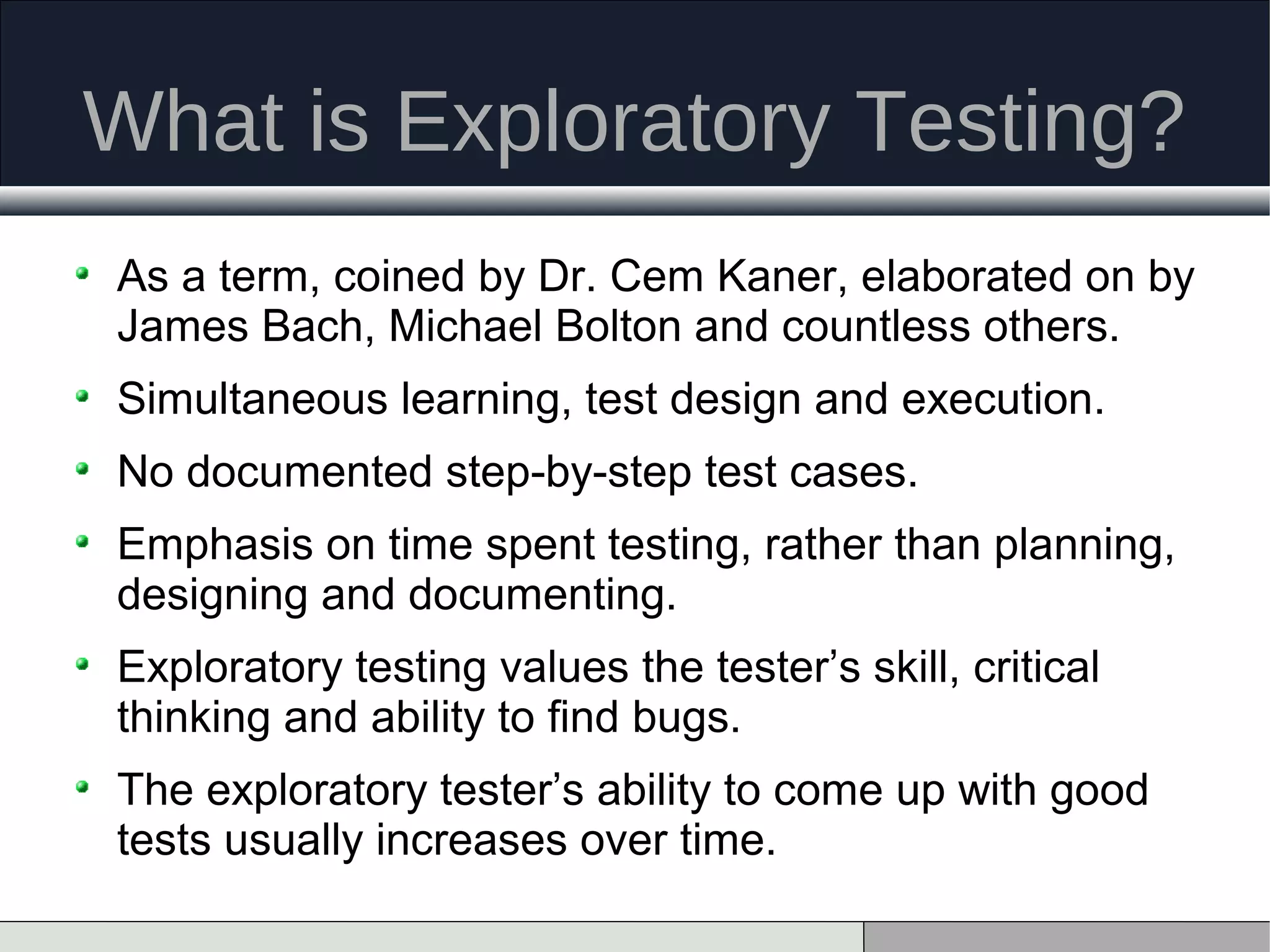
What is Exploratory Testing?
As a term, coined by Dr. Cem Kaner, elaborated on by
James Bach, Michael Bolton and countless others.
Simultaneous learning, test design and execution.
No documented step-by-step test cases.
Emphasis on time spent testing, rather than planning,
designing and documenting.
Exploratory testing values the tester’s skill, critical
thinking and ability to find bugs.
The exploratory tester’s ability to come up with good
tests usually increases over time.
purely
scripted tests
freestyle
explorationchartered
explorationvague
scripts
fragmentary
test cases
role-based
exploration
Levels of Exploration
Session-Based Test Management
Undocumented testing = low accountability?
Session-Based Test Management is laying
accountability groundwork through:
Charter
Time Box
Reviewable Results
Debriefing
Defects
Issues
Coverage
Notes
Charter
Defect
Defects
Issues
Coverage
Defects
Issues
Session-Based Test Management
The Context
Multinational product and service company
Bulky processes and ways of working.
Strong focus on quantitative metrics and testing against
explicit requirements.
Project setup
Inexperienced team
Sketchy requirements
Tight budget
Narrow time plan
Product aimed at consumer market
Original plan
Forming a backup plan
Testing aims to provide quality-related information.
Best effort with available resources.
Focus on basic stability.
Risk analysis input for exploratory test missions.
Moving away from confirmatory testing (checking)
towards testing in the ”putting to the test” sense.
Building the team
Iterative process integration instead of big bang.
Pilot team consisting of the most curious testers rather
than the most experienced.
Get comfortable with way of working.
Do not fall into documentation over testing trap.
Start with high level of free-style exploration based on
high abstraction mission statements.
Develop and share heuristics within the team.
Gradually introduce and encourage increased note
taking and documentation on-the-go.
The Outcome
Confidence in product design.
Lessons learned
Management support
Workshops
Proof of concept
Positive approach side-effects
Checking is boring, exploring is fun!
Challenges testers’ cognitive abilities.
Super-charges test team morale.
Introducing testers to agile development team.
johan.jonasson@houseoftest.se
+46 702 98 97 20
http://www.houseoftest.se
http://www.twitter.com/johanjonasson
Web
Mobile
E-mail
Twitter
Thank you!
Johan Jonasson
House of Test Consulting AB

Johan Jonasson - Introducing Exploratory Testing to Save the Project

  • 1.
    Introducing Exploratory Testing ToSave The Project Johan Jonasson johan.jonasson@houseoftest.se
  • 2.
    What is ExploratoryTesting? As a term, coined by Dr. Cem Kaner, elaborated on by James Bach, Michael Bolton and countless others. Simultaneous learning, test design and execution. No documented step-by-step test cases. Emphasis on time spent testing, rather than planning, designing and documenting. Exploratory testing values the tester’s skill, critical thinking and ability to find bugs. The exploratory tester’s ability to come up with good tests usually increases over time.
  • 3.
  • 4.
    Session-Based Test Management Undocumentedtesting = low accountability? Session-Based Test Management is laying accountability groundwork through: Charter Time Box Reviewable Results Debriefing
  • 5.
  • 6.
    The Context Multinational productand service company Bulky processes and ways of working. Strong focus on quantitative metrics and testing against explicit requirements. Project setup Inexperienced team Sketchy requirements Tight budget Narrow time plan Product aimed at consumer market
  • 7.
  • 8.
    Forming a backupplan Testing aims to provide quality-related information. Best effort with available resources. Focus on basic stability. Risk analysis input for exploratory test missions. Moving away from confirmatory testing (checking) towards testing in the ”putting to the test” sense.
  • 9.
    Building the team Iterativeprocess integration instead of big bang. Pilot team consisting of the most curious testers rather than the most experienced. Get comfortable with way of working. Do not fall into documentation over testing trap. Start with high level of free-style exploration based on high abstraction mission statements. Develop and share heuristics within the team. Gradually introduce and encourage increased note taking and documentation on-the-go.
  • 10.
    The Outcome Confidence inproduct design. Lessons learned Management support Workshops Proof of concept Positive approach side-effects Checking is boring, exploring is fun! Challenges testers’ cognitive abilities. Super-charges test team morale. Introducing testers to agile development team.
  • 11.
    johan.jonasson@houseoftest.se +46 702 9897 20 http://www.houseoftest.se http://www.twitter.com/johanjonasson Web Mobile E-mail Twitter Thank you! Johan Jonasson House of Test Consulting AB