FORMULAES
(TIME VALUE OF MONEY – OPERATING CYCLE
SUBMITTED TO:- SUBMITTED BY:-
DR. SUBODH NALWAYA PRIYAL AGRAWAL
ASSOCIATE PROFESSOR (K16918)
COMMERCE & MANAGEMENT DEPARTMENT BBA (HONORS)
2ND YEAR/4TH SEM
Time Value Of Money
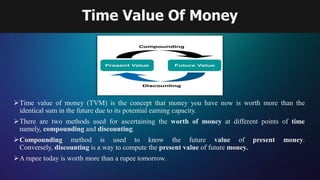
Time value of money (TVM) is the concept that money you have now is worth more than the
identical sum in the future due to its potential earning capacity.
There are two methods used for ascertaining the worth of money at different points of time
namely, compounding and discounting.
Compounding method is used to know the future value of present money.
Conversely, discounting is a way to compute the present value of future money.
A rupee today is worth more than a rupee tomorrow.
Time Value Of Money
Present Value Future Value
Future value of single
present cash flow
FV=PV(1+r)n
Future Value of series
of equal cash flow:
Ordinary Annuity
FVA=A[(1+r)n-1]/r
Future value of series
of equal cash flow:
Annuity Due
FVA= A[(1+r)n-1/r]*
(1+r)
Future Value of series
of unequal cash flow:
Compute it
individually by
compounding each
years annuity
Where;
FV- Future Value
PV- Present Value
A- Annuity
r- Rate of interest
n- time period
Time Value Of Money
Future Value Present Value
Present Value of single
present cash flow:
PV=FV/(1+r)n
Also known as discounting factor
Present Value of series
of equal cash flow:
Ordinary Annuity
Annuity=FVA*r/[(1+r)
n-1]
Present Value of series
of equal cash flow:
Annuity Due
Annuity=
FVA*r/[(1+r)n-1]*(1+r)
Present value of series
of unequal cash flow:
Compute it
individually
considering &
compounding each
year’s interest rate
respectively.
Where;
PV- present
value
A- Annuity
r- Rate of interest
n- time period
Capital Budgeting
Capital budgeting is a method of analyzing and comparing substantial future investments and
expenditures to determine which ones are most worthwhile. In other words, it’s a process that
company management uses to identify what capital projects will create the biggest return compared
with the funds invested in the project. Each project is ranked by its potential future return, so the
company management can choose which one to invest in first.
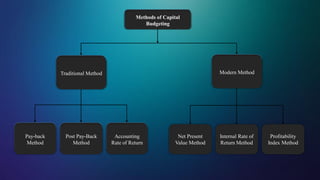
Methods of Capital
Budgeting
Traditional Method
Post Pay-Back
Method
Modern Method
Pay-back
Method
Accounting
Rate of Return
Net Present
Value Method
Internal Rate of
Return Method
Profitability
Index Method
Methods of Capital
Budgeting
Traditional Method
Post Pay-Back
Method
Modern Method
Pay-back
Method
Accounting
Rate of Return
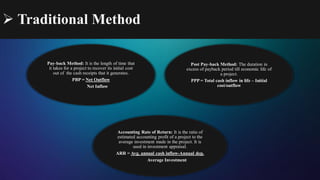
 Traditional Method
Pay-back Method: It is the length of time that
it takes for a project to recover its initial cost
out of the cash receipts that it generates.
PBP = Net Outflow
Net Inflow
Post Pay-back Method: The duration in
excess of payback period till economic life of
a project.
PPP = Total cash inflow in life – Initial
cost/outflow
Accounting Rate of Return: It is the ratio of
estimated accounting profit of a project to the
average investment made in the project. It is
used in investment appraisal.
ARR = Avg. annual cash inflow-Annual dep.
Average Investment
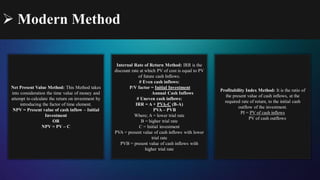
 Modern Method
Profitability Index Method: It is the ratio of
the present value of cash inflows, at the
required rate of return, to the initial cash
outflow of the investment.
PI = PV of cash inflows
PV of cash outflows
Internal Rate of Return Method: IRR is the
discount rate at which PV of cost is equal to PV
of future cash Inflows.
# Even cash inflows:
P/V factor = Initial Investment
Annual Cash Inflows
# Uneven cash inflows:
IRR = A + PVA-C (B-A)
PVA – PVB
Where; A = lower trial rate
B = higher trial rate
C = Initial investment
PVA = present value of cash inflows with lower
trial rate
PVB = present value of cash inflows with
higher trial rate
Net Present Value Method: This Method takes
into consideration the time value of money and
attempt to calculate the return on investment by
introducing the factor of time element.
NPV = Present value of cash inflow – Initial
Investment
OR
NPV = PV – C
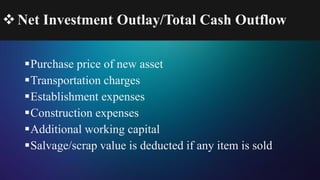
Net Investment Outlay/Total Cash Outflow
Purchase price of new asset
Transportation charges
Establishment expenses
Construction expenses
Additional working capital
Salvage/scrap value is deducted if any item is sold
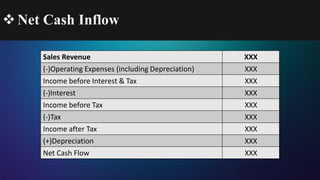
Net Cash Inflow
Sales Revenue XXX
(-)Operating Expenses (including Depreciation) XXX
Income before Interest & Tax XXX
(-)Interest XXX
Income before Tax XXX
(-)Tax XXX
Income after Tax XXX
(+)Depreciation XXX
Net Cash Flow XXX
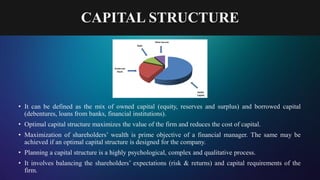
CAPITAL STRUCTURE
• It can be defined as the mix of owned capital (equity, reserves and surplus) and borrowed capital
(debentures, loans from banks, financial institutions).
• Optimal capital structure maximizes the value of the firm and reduces the cost of capital.
• Maximization of shareholders’ wealth is prime objective of a financial manager. The same may be
achieved if an optimal capital structure is designed for the company.
• Planning a capital structure is a highly psychological, complex and qualitative process.
• It involves balancing the shareholders’ expectations (risk & returns) and capital requirements of the
firm.
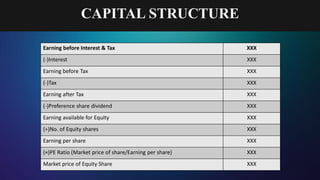
CAPITAL STRUCTURE
Earning before Interest & Tax XXX
(-)Interest XXX
Earning before Tax XXX
(-)Tax XXX
Earning after Tax XXX
(-)Preference share dividend XXX
Earning available for Equity XXX
(÷)No. of Equity shares XXX
Earning per share XXX
(×)PE Ratio (Market price of share/Earning per share) XXX
Market price of Equity Share XXX
CAPITAL STRUCTURE
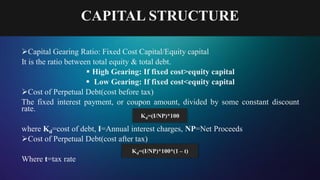
Capital Gearing Ratio: Fixed Cost Capital/Equity capital
It is the ratio between total equity & total debt.
 High Gearing: If fixed cost>equity capital
 Low Gearing: If fixed cost<equity capital
Cost of Perpetual Debt(cost before tax)
The fixed interest payment, or coupon amount, divided by some constant discount
rate.
where Kd=cost of debt, I=Annual interest charges, NP=Net Proceeds
Cost of Perpetual Debt(cost after tax)
Where t=tax rate
Kd=(I/NP)*100
Kd=(I/NP)*100*(1 – t)
CAPITAL STRUCTURE
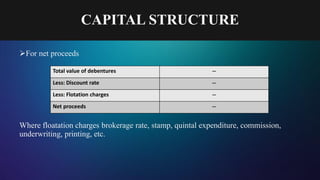
For net proceeds
Where floatation charges brokerage rate, stamp, quintal expenditure, commission,
underwriting, printing, etc.
Total value of debentures --
Less: Discount rate --
Less: Flotation charges --
Net proceeds --
COST OF CAPITAL
Cost of debt capital: It is an integral part of the discounted valuation
analysis which calculates the present value of a firm by discounting future
cash flows by the expected rate of return to its equity and debt holders.
 Cost of Irredeemable debt
Where I=Annual interest charges, NP=Net proceeds, Kd=Cost of debt
 Cost of Redeemable debt
Where RV=Redeemable value of debt at the time of maturity, n=No. of
years to maturity
Kd=(I/NP)*100
Kd=[{I+(RV-NP/n)}/{RV+NP/2}]*100
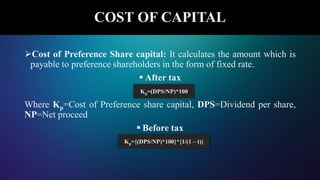
Cost of Preference Share capital: It calculates the amount which is
payable to preference shareholders in the form of fixed rate.
 After tax
Where Kp=Cost of Preference share capital, DPS=Dividend per share,
NP=Net proceed
 Before tax
COST OF CAPITAL
Kp={(DPS/NP)*100}*{1/(1 – t)}
Kp=(DPS/NP)*100
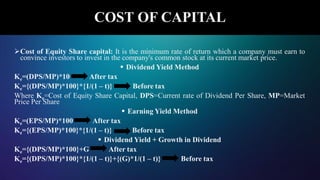
Cost of Equity Share capital: It is the minimum rate of return which a company must earn to
convince investors to invest in the company's common stock at its current market price.
 Dividend Yield Method
Ke=(DPS/MP)*10 After tax
Ke={(DPS/MP)*100}*{1/(1 – t)} Before tax
Where Ke=Cost of Equity Share Capital, DPS=Current rate of Dividend Per Share, MP=Market
Price Per Share
 Earning Yield Method
Ke=(EPS/MP)*100 After tax
Ke={(EPS/MP)*100}*{1/(1 – t)} Before tax
 Dividend Yield + Growth in Dividend
Ke={(DPS/MP)*100}+G After tax
Ke={(DPS/MP)*100}*{1/(1 – t)}+{(G)*1/(1 – t)} Before tax
COST OF CAPITAL
Cost of Retained Earning: The amount of undistributed profits which is
available for investment is called Retained Earning.
Where Kr=Cost of retained earning, D=Dividend which would be
distributed as an alternative of retained earning, Ti=Income tax rate of
individual shareholder, B=Brokerage payable on investment of dividend
received, Tc=Capital gain tax rate applicable to individual shareholder,
MP=Market price per share
# If the shareholder does not have to pay tax on capital profit & income,
then:
COST OF CAPITAL
Kr=[{D(1-B)}/MP]*100
Kr={D*(1-Ti)*(1-B)}/{MP(1-Tc)}*100
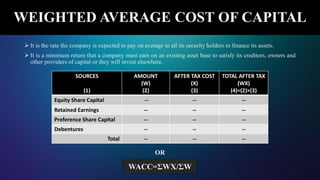
 It is the rate the company is expected to pay on average to all its security holders to finance its assets.
 It is a minimum return that a company must earn on an existing asset base to satisfy its creditors, owners and
other providers of capital or they will invest elsewhere.
OR
WEIGHTED AVERAGE COST OF CAPITAL
SOURCES
(1)
AMOUNT
(W)
(2)
AFTER TAX COST
(X)
(3)
TOTAL AFTER TAX
(WX)
(4)=(2)×(3)
Equity Share Capital -- -- --
Retained Earnings -- -- --
Preference Share Capital -- -- --
Debentures -- -- --
Total -- -- --
WACC=ΣWX/ΣW
LEVERAGE ANALYSIS
 It may be defined as the employment of an asset/source of funds for which the firm has to pay a fixed
cost, or fixed return.
 In financial management leverage analysis means arranging fixed assets in such a way that fixed return
is ensured.
 It means the employment of assets or funds for which the firm pays the fixed cost or fixed return.
 Leverage provides the framework for financing decisions of a firm.
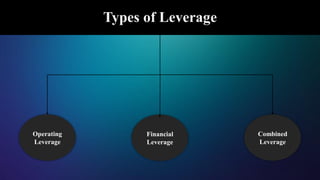
Types of Leverage
Combined
Leverage
Financial
Leverage
Operating
Leverage
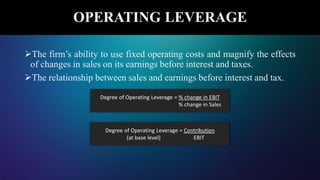
The firm’s ability to use fixed operating costs and magnify the effects
of changes in sales on its earnings before interest and taxes.
The relationship between sales and earnings before interest and tax.
OPERATING LEVERAGE
Degree of Operating Leverage = % change in EBIT
% change in Sales
Degree of Operating Leverage = Contribution
(at base level) EBIT
• It studies the impact of change in EBIT on EPS.
• The degree of financial leverage measures the financial risk associated
with the firm.
• It is also known as trading on equity.
FINANCIAL LEVERAGE
Degree of Financial Leverage = % change in EPS
% change in EBIT
Degree of Financial Leverage = EBIT
(at base level) EBIT - I
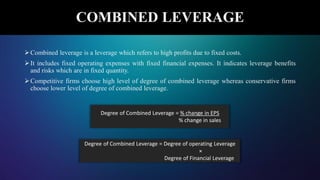
Combined leverage is a leverage which refers to high profits due to fixed costs.
It includes fixed operating expenses with fixed financial expenses. It indicates leverage benefits
and risks which are in fixed quantity.
Competitive firms choose high level of degree of combined leverage whereas conservative firms
choose lower level of degree of combined leverage.
COMBINED LEVERAGE
Degree of Combined Leverage = % change in EPS
% change in sales
Degree of Combined Leverage = Degree of operating Leverage
×
Degree of Financial Leverage
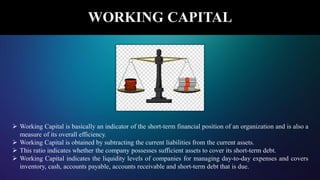
WORKING CAPITAL
 Working Capital is basically an indicator of the short-term financial position of an organization and is also a
measure of its overall efficiency.
 Working Capital is obtained by subtracting the current liabilities from the current assets.
 This ratio indicates whether the company possesses sufficient assets to cover its short-term debt.
 Working Capital indicates the liquidity levels of companies for managing day-to-day expenses and covers
inventory, cash, accounts payable, accounts receivable and short-term debt that is due.
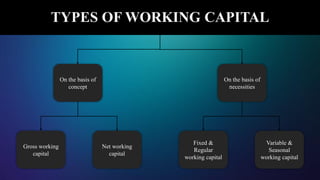
TYPES OF WORKING CAPITAL
On the basis of
concept
On the basis of
necessities
Fixed &
Regular
working capital
Net working
capital
Gross working
capital
Variable &
Seasonal
working capital
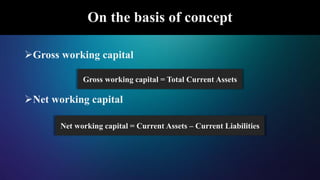
Gross working capital
Net working capital
On the basis of concept
Gross working capital = Total Current Assets
Net working capital = Current Assets – Current Liabilities
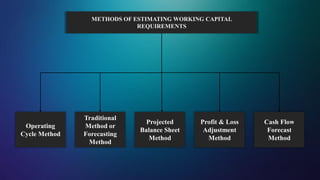
METHODS OF ESTIMATING WORKING CAPITAL
REQUIREMENTS
Operating
Cycle Method
Traditional
Method or
Forecasting
Method
Projected
Balance Sheet
Method
Profit & Loss
Adjustment
Method
Cash Flow
Forecast
Method
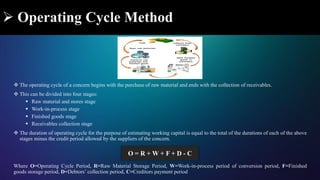
 The operating cycle of a concern begins with the purchase of raw material and ends with the collection of receivables.
 This can be divided into four stages:
 Raw material and stores stage
 Work-in-process stage
 Finished goods stage
 Receivables collection stage
 The duration of operating cycle for the purpose of estimating working capital is equal to the total of the durations of each of the above
stages minus the credit period allowed by the suppliers of the concern.
Where O=Operating Cycle Period, R=Raw Material Storage Period, W=Work-in-process period of conversion period, F=Finished
goods storage period, D=Debtors’ collection period, C=Creditors payment period
 Operating Cycle Method
O = R + W + F + D - C
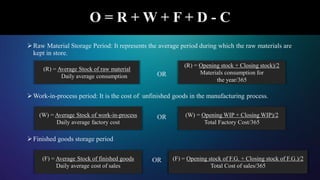
Raw Material Storage Period: It represents the average period during which the raw materials are
kept in store.
OR
Work-in-process period: It is the cost of unfinished goods in the manufacturing process.
OR
Finished goods storage period
OR
O = R + W + F + D - C
(R) = Average Stock of raw material
Daily average consumption
(R) = Opening stock + Closing stock)/2
Materials consumption for
the year/365
(W) = Average Stock of work-in-process
Daily average factory cost
(W) = Opening WIP + Closing WIP)/2
Total Factory Cost/365
(F) = Average Stock of finished goods
Daily average cost of sales
(F) = Opening stock of F.G. + Closing stock of F.G.)/2
Total Cost of sales/365
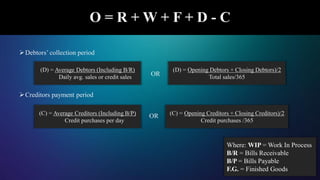
Debtors’ collection period
OR
Creditors payment period
OR
(D) = Average Debtors (Including B/R)
Daily avg. sales or credit sales
(D) = Opening Debtors + Closing Debtors)/2
Total sales/365
O = R + W + F + D - C
(C) = Average Creditors (Including B/P)
Credit purchases per day
(C) = Opening Creditors + Closing Creditors)/2
Credit purchases /365
Where: WIP = Work In Process
B/R = Bills Receivable
B/P = Bills Payable
F.G. = Finished Goods
Financial Management

Financial Management

  • 2.
    FORMULAES (TIME VALUE OFMONEY – OPERATING CYCLE SUBMITTED TO:- SUBMITTED BY:- DR. SUBODH NALWAYA PRIYAL AGRAWAL ASSOCIATE PROFESSOR (K16918) COMMERCE & MANAGEMENT DEPARTMENT BBA (HONORS) 2ND YEAR/4TH SEM
  • 3.
    Time Value OfMoney Time value of money (TVM) is the concept that money you have now is worth more than the identical sum in the future due to its potential earning capacity. There are two methods used for ascertaining the worth of money at different points of time namely, compounding and discounting. Compounding method is used to know the future value of present money. Conversely, discounting is a way to compute the present value of future money. A rupee today is worth more than a rupee tomorrow.
  • 4.
    Time Value OfMoney Present Value Future Value Future value of single present cash flow FV=PV(1+r)n Future Value of series of equal cash flow: Ordinary Annuity FVA=A[(1+r)n-1]/r Future value of series of equal cash flow: Annuity Due FVA= A[(1+r)n-1/r]* (1+r) Future Value of series of unequal cash flow: Compute it individually by compounding each years annuity Where; FV- Future Value PV- Present Value A- Annuity r- Rate of interest n- time period
  • 5.
    Time Value OfMoney Future Value Present Value Present Value of single present cash flow: PV=FV/(1+r)n Also known as discounting factor Present Value of series of equal cash flow: Ordinary Annuity Annuity=FVA*r/[(1+r) n-1] Present Value of series of equal cash flow: Annuity Due Annuity= FVA*r/[(1+r)n-1]*(1+r) Present value of series of unequal cash flow: Compute it individually considering & compounding each year’s interest rate respectively. Where; PV- present value A- Annuity r- Rate of interest n- time period
  • 6.
    Capital Budgeting Capital budgetingis a method of analyzing and comparing substantial future investments and expenditures to determine which ones are most worthwhile. In other words, it’s a process that company management uses to identify what capital projects will create the biggest return compared with the funds invested in the project. Each project is ranked by its potential future return, so the company management can choose which one to invest in first.
  • 7.
    Methods of Capital Budgeting TraditionalMethod Post Pay-Back Method Modern Method Pay-back Method Accounting Rate of Return Net Present Value Method Internal Rate of Return Method Profitability Index Method Methods of Capital Budgeting Traditional Method Post Pay-Back Method Modern Method Pay-back Method Accounting Rate of Return
  • 8.
     Traditional Method Pay-backMethod: It is the length of time that it takes for a project to recover its initial cost out of the cash receipts that it generates. PBP = Net Outflow Net Inflow Post Pay-back Method: The duration in excess of payback period till economic life of a project. PPP = Total cash inflow in life – Initial cost/outflow Accounting Rate of Return: It is the ratio of estimated accounting profit of a project to the average investment made in the project. It is used in investment appraisal. ARR = Avg. annual cash inflow-Annual dep. Average Investment
  • 9.
     Modern Method ProfitabilityIndex Method: It is the ratio of the present value of cash inflows, at the required rate of return, to the initial cash outflow of the investment. PI = PV of cash inflows PV of cash outflows Internal Rate of Return Method: IRR is the discount rate at which PV of cost is equal to PV of future cash Inflows. # Even cash inflows: P/V factor = Initial Investment Annual Cash Inflows # Uneven cash inflows: IRR = A + PVA-C (B-A) PVA – PVB Where; A = lower trial rate B = higher trial rate C = Initial investment PVA = present value of cash inflows with lower trial rate PVB = present value of cash inflows with higher trial rate Net Present Value Method: This Method takes into consideration the time value of money and attempt to calculate the return on investment by introducing the factor of time element. NPV = Present value of cash inflow – Initial Investment OR NPV = PV – C
  • 10.
    Net Investment Outlay/TotalCash Outflow Purchase price of new asset Transportation charges Establishment expenses Construction expenses Additional working capital Salvage/scrap value is deducted if any item is sold
  • 11.
    Net Cash Inflow SalesRevenue XXX (-)Operating Expenses (including Depreciation) XXX Income before Interest & Tax XXX (-)Interest XXX Income before Tax XXX (-)Tax XXX Income after Tax XXX (+)Depreciation XXX Net Cash Flow XXX
  • 12.
    CAPITAL STRUCTURE • Itcan be defined as the mix of owned capital (equity, reserves and surplus) and borrowed capital (debentures, loans from banks, financial institutions). • Optimal capital structure maximizes the value of the firm and reduces the cost of capital. • Maximization of shareholders’ wealth is prime objective of a financial manager. The same may be achieved if an optimal capital structure is designed for the company. • Planning a capital structure is a highly psychological, complex and qualitative process. • It involves balancing the shareholders’ expectations (risk & returns) and capital requirements of the firm.
  • 13.
    CAPITAL STRUCTURE Earning beforeInterest & Tax XXX (-)Interest XXX Earning before Tax XXX (-)Tax XXX Earning after Tax XXX (-)Preference share dividend XXX Earning available for Equity XXX (÷)No. of Equity shares XXX Earning per share XXX (×)PE Ratio (Market price of share/Earning per share) XXX Market price of Equity Share XXX
  • 14.
    CAPITAL STRUCTURE Capital GearingRatio: Fixed Cost Capital/Equity capital It is the ratio between total equity & total debt.  High Gearing: If fixed cost>equity capital  Low Gearing: If fixed cost<equity capital Cost of Perpetual Debt(cost before tax) The fixed interest payment, or coupon amount, divided by some constant discount rate. where Kd=cost of debt, I=Annual interest charges, NP=Net Proceeds Cost of Perpetual Debt(cost after tax) Where t=tax rate Kd=(I/NP)*100 Kd=(I/NP)*100*(1 – t)
  • 15.
    CAPITAL STRUCTURE For netproceeds Where floatation charges brokerage rate, stamp, quintal expenditure, commission, underwriting, printing, etc. Total value of debentures -- Less: Discount rate -- Less: Flotation charges -- Net proceeds --
  • 16.
    COST OF CAPITAL Costof debt capital: It is an integral part of the discounted valuation analysis which calculates the present value of a firm by discounting future cash flows by the expected rate of return to its equity and debt holders.  Cost of Irredeemable debt Where I=Annual interest charges, NP=Net proceeds, Kd=Cost of debt  Cost of Redeemable debt Where RV=Redeemable value of debt at the time of maturity, n=No. of years to maturity Kd=(I/NP)*100 Kd=[{I+(RV-NP/n)}/{RV+NP/2}]*100
  • 17.
    Cost of PreferenceShare capital: It calculates the amount which is payable to preference shareholders in the form of fixed rate.  After tax Where Kp=Cost of Preference share capital, DPS=Dividend per share, NP=Net proceed  Before tax COST OF CAPITAL Kp={(DPS/NP)*100}*{1/(1 – t)} Kp=(DPS/NP)*100
  • 18.
    Cost of EquityShare capital: It is the minimum rate of return which a company must earn to convince investors to invest in the company's common stock at its current market price.  Dividend Yield Method Ke=(DPS/MP)*10 After tax Ke={(DPS/MP)*100}*{1/(1 – t)} Before tax Where Ke=Cost of Equity Share Capital, DPS=Current rate of Dividend Per Share, MP=Market Price Per Share  Earning Yield Method Ke=(EPS/MP)*100 After tax Ke={(EPS/MP)*100}*{1/(1 – t)} Before tax  Dividend Yield + Growth in Dividend Ke={(DPS/MP)*100}+G After tax Ke={(DPS/MP)*100}*{1/(1 – t)}+{(G)*1/(1 – t)} Before tax COST OF CAPITAL
  • 19.
    Cost of RetainedEarning: The amount of undistributed profits which is available for investment is called Retained Earning. Where Kr=Cost of retained earning, D=Dividend which would be distributed as an alternative of retained earning, Ti=Income tax rate of individual shareholder, B=Brokerage payable on investment of dividend received, Tc=Capital gain tax rate applicable to individual shareholder, MP=Market price per share # If the shareholder does not have to pay tax on capital profit & income, then: COST OF CAPITAL Kr=[{D(1-B)}/MP]*100 Kr={D*(1-Ti)*(1-B)}/{MP(1-Tc)}*100
  • 20.
     It isthe rate the company is expected to pay on average to all its security holders to finance its assets.  It is a minimum return that a company must earn on an existing asset base to satisfy its creditors, owners and other providers of capital or they will invest elsewhere. OR WEIGHTED AVERAGE COST OF CAPITAL SOURCES (1) AMOUNT (W) (2) AFTER TAX COST (X) (3) TOTAL AFTER TAX (WX) (4)=(2)×(3) Equity Share Capital -- -- -- Retained Earnings -- -- -- Preference Share Capital -- -- -- Debentures -- -- -- Total -- -- -- WACC=ΣWX/ΣW
  • 21.
    LEVERAGE ANALYSIS  Itmay be defined as the employment of an asset/source of funds for which the firm has to pay a fixed cost, or fixed return.  In financial management leverage analysis means arranging fixed assets in such a way that fixed return is ensured.  It means the employment of assets or funds for which the firm pays the fixed cost or fixed return.  Leverage provides the framework for financing decisions of a firm.
  • 22.
  • 23.
    The firm’s abilityto use fixed operating costs and magnify the effects of changes in sales on its earnings before interest and taxes. The relationship between sales and earnings before interest and tax. OPERATING LEVERAGE Degree of Operating Leverage = % change in EBIT % change in Sales Degree of Operating Leverage = Contribution (at base level) EBIT
  • 24.
    • It studiesthe impact of change in EBIT on EPS. • The degree of financial leverage measures the financial risk associated with the firm. • It is also known as trading on equity. FINANCIAL LEVERAGE Degree of Financial Leverage = % change in EPS % change in EBIT Degree of Financial Leverage = EBIT (at base level) EBIT - I
  • 25.
    Combined leverage isa leverage which refers to high profits due to fixed costs. It includes fixed operating expenses with fixed financial expenses. It indicates leverage benefits and risks which are in fixed quantity. Competitive firms choose high level of degree of combined leverage whereas conservative firms choose lower level of degree of combined leverage. COMBINED LEVERAGE Degree of Combined Leverage = % change in EPS % change in sales Degree of Combined Leverage = Degree of operating Leverage × Degree of Financial Leverage
  • 26.
    WORKING CAPITAL  WorkingCapital is basically an indicator of the short-term financial position of an organization and is also a measure of its overall efficiency.  Working Capital is obtained by subtracting the current liabilities from the current assets.  This ratio indicates whether the company possesses sufficient assets to cover its short-term debt.  Working Capital indicates the liquidity levels of companies for managing day-to-day expenses and covers inventory, cash, accounts payable, accounts receivable and short-term debt that is due.
  • 27.
    TYPES OF WORKINGCAPITAL On the basis of concept On the basis of necessities Fixed & Regular working capital Net working capital Gross working capital Variable & Seasonal working capital
  • 28.
    Gross working capital Networking capital On the basis of concept Gross working capital = Total Current Assets Net working capital = Current Assets – Current Liabilities
  • 29.
    METHODS OF ESTIMATINGWORKING CAPITAL REQUIREMENTS Operating Cycle Method Traditional Method or Forecasting Method Projected Balance Sheet Method Profit & Loss Adjustment Method Cash Flow Forecast Method
  • 30.
     The operatingcycle of a concern begins with the purchase of raw material and ends with the collection of receivables.  This can be divided into four stages:  Raw material and stores stage  Work-in-process stage  Finished goods stage  Receivables collection stage  The duration of operating cycle for the purpose of estimating working capital is equal to the total of the durations of each of the above stages minus the credit period allowed by the suppliers of the concern. Where O=Operating Cycle Period, R=Raw Material Storage Period, W=Work-in-process period of conversion period, F=Finished goods storage period, D=Debtors’ collection period, C=Creditors payment period  Operating Cycle Method O = R + W + F + D - C
  • 31.
    Raw Material StoragePeriod: It represents the average period during which the raw materials are kept in store. OR Work-in-process period: It is the cost of unfinished goods in the manufacturing process. OR Finished goods storage period OR O = R + W + F + D - C (R) = Average Stock of raw material Daily average consumption (R) = Opening stock + Closing stock)/2 Materials consumption for the year/365 (W) = Average Stock of work-in-process Daily average factory cost (W) = Opening WIP + Closing WIP)/2 Total Factory Cost/365 (F) = Average Stock of finished goods Daily average cost of sales (F) = Opening stock of F.G. + Closing stock of F.G.)/2 Total Cost of sales/365
  • 32.
    Debtors’ collection period OR Creditorspayment period OR (D) = Average Debtors (Including B/R) Daily avg. sales or credit sales (D) = Opening Debtors + Closing Debtors)/2 Total sales/365 O = R + W + F + D - C (C) = Average Creditors (Including B/P) Credit purchases per day (C) = Opening Creditors + Closing Creditors)/2 Credit purchases /365 Where: WIP = Work In Process B/R = Bills Receivable B/P = Bills Payable F.G. = Finished Goods