Clrn-shr.com
Financial Literacy 360 Degree
endeavour for Learners
Clrn-shr.com
What is financial literacy?
According to the Cambridge dictionary,
financial literacy is the ability to understand
basic principles of business and finance.
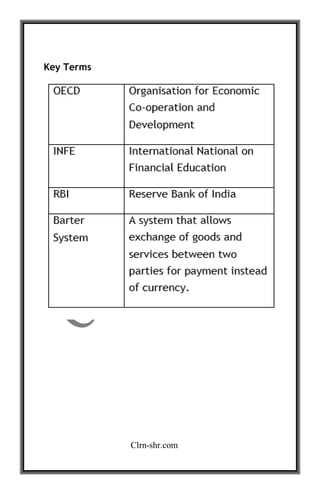
OECD INFE defines financial literacy as a
combination of awareness, knowledge, skill,
attitude and behavior required to make
sound financial decisions to achieve
individual / business financial wellbeing.
However, in layman’s language, financial
literacy is an understanding and a process to
take decisions related to financial outcome.
These decisions may be related to
individuals as well for businesses.
Clrn-shr.com
Why financial literacy?
Knowledge and understanding of finance
plays a vital role in an individual’s life
whether he/she is managing a home or
business. Financially literate person can
take timely decisions about the finances i.e.
budget, risk, return et.al.
Financial literacy helps to make person
disciplined in personal and professional life.
It also helps to develop an understanding of
ethical and social responsibility.
Whether you are working or non working,
basic knowledge of finance is necessary for
all. A financially literate individual can
discuss his/her own perspective and
contribute in the crucial financial decisions.
Clrn-shr.com
Module Description
Financial decision making is a part of
everyone’s life. An understanding of financial
fundamentals helps to take right decision at
various stages of life.
This module is structured in such a way that
learners of all ages can understand and gain
knowledge. Learners can get insight into
financial aspects like time value of money,
risks, fund management etc. They can take
action based on their circumstances.
Module will also help businesses to
understand the ways of financial planning
and management.
Practical scenarios have been included to
increase the potential learning. Module will
also assist in identifying right technology
tools for appropriate solutions.
Learner can assess knowledge by solving the
printable worksheets.
MODULE : 1
Clrn-shr.com
Table of Contents
 What is Money?
 Functions of Money
 Characteristics of Money
 Types of Money
 What is currency?
Clrn-shr.com
What is Money?
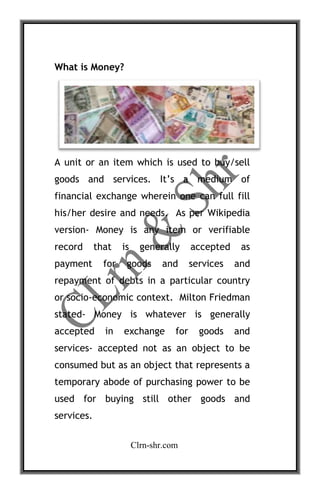
A unit or an item which is used to buy/sell
goods and services. It’s a medium of
financial exchange wherein one can full fill
his/her desire and needs. As per Wikipedia
version- Money is any item or verifiable
record that is generally accepted as
payment for goods and services and
repayment of debts in a particular country
or socio-economic context. Milton Friedman
stated- Money is whatever is generally
accepted in exchange for goods and
services- accepted not as an object to be
consumed but as an object that represents a
temporary abode of purchasing power to be
used for buying still other goods and
services.
Clrn-shr.com
Functions of Money
Clrn-shr.com
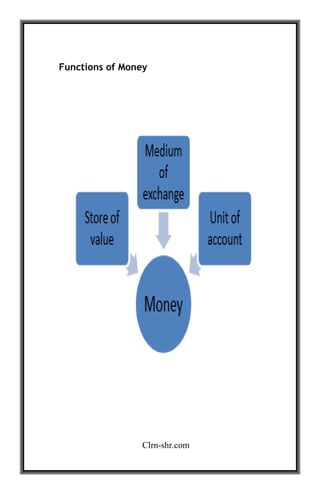
Store of value:
Money to be relevant must hold certain value
over time. It is also defined as an asset that
allows people to transfer power from one
period to another in form of wealth.
Medium of exchange:
Exchange of goods and services is done
through transfer of money, eliminating the
complications of barter system.
Unit of account:
It is defined as a unit of measurement for a
specific item. Money is common measure to
calculate the value of a product or service.
Clrn-shr.com
Characteristics of Money
Clrn-shr.com
Types of Money
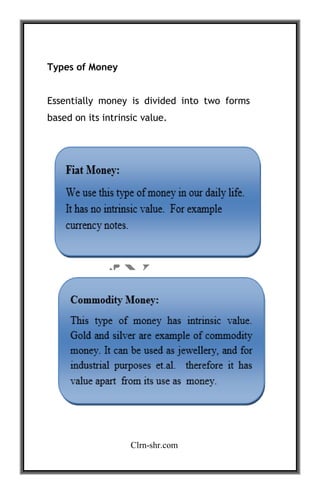
Essentially money is divided into two forms
based on its intrinsic value.
Clrn-shr.com
What is currency?
As per the business dictionary, a token used
as money in a country refers to currency.
Currency includes metal coins, paper notes,
cheque drawn on bank, money orders,
travelers’ cheque etc.
Today in digital World electronic money or
digital cash is also considered as currency.
Virtual currency is also on the way. It is a
form of digital currency but is recognized as
unregulated currency. Bitcoin and Ether are
most commonly known virtual currencies
trading in the digital market.
Clrn-shr.com
Indian Currency
The Indian currency is called the Indian Rupee
(INR) and the coins are called paise. One
rupee consists of 100 paise.
The symbol of the Indian rupee is ₹. Reserve
Bank of India attends to the core statutory
function of notes and coins issue and currency
management in the country. (Source:
Vikaspedia)
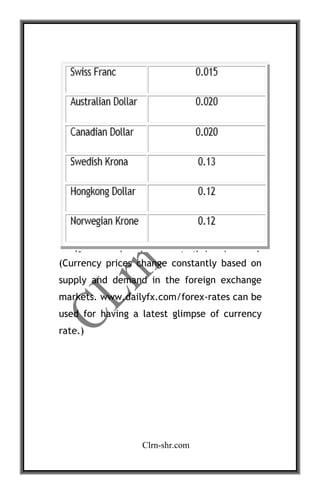
Below is a list of top 10 currencies in the
World used in Forex market trading (Source –
rediff.com/money) -
Clrn-shr.com
(Currency prices change constantly based on
supply and demand in the foreign exchange
markets. www.dailyfx.com/forex-rates can be
used for having a latest glimpse of currency
rate.)
Clrn-shr.com
Key Terms
Clrn-shr.com
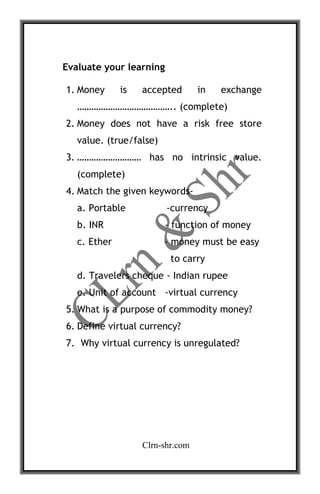
Evaluate your learning
1. Money is accepted in exchange
………………………………….. (complete)
2. Money does not have a risk free store
value. (true/false)
3. ……………………… has no intrinsic value.
(complete)
4. Match the given keywords-
a. Portable -currency
b. INR - function of money
c. Ether - money must be easy
to carry
d. Travelers cheque - Indian rupee
e. Unit of account -virtual currency
5. What is a purpose of commodity money?
6. Define virtual currency?
7. Why virtual currency is unregulated?
Clrn-shr.com
Activity
1. Find out the currency value of the given
countries against the Indian rupee as on
date-
British Pound, US Dollar, Yen, Renminbi,
Euro, Dirham, Ringgit, Rouble, Rial
2. Identify any five virtual currencies.
3. Who designed the Indian rupee symbol?
4. Reserve Bank of India is a regulatory body
which issues and manages currency in
India. Similarly find out the regulatory
bodies of the following countries-
United States of America, Switzerland,
Germany, UAE, China, Singapore, Russia,
Japan
NOTES
Clrn-shr.com

Financial literacy module 1

  • 1.
    Clrn-shr.com Financial Literacy 360Degree endeavour for Learners
  • 2.
    Clrn-shr.com What is financialliteracy? According to the Cambridge dictionary, financial literacy is the ability to understand basic principles of business and finance. OECD INFE defines financial literacy as a combination of awareness, knowledge, skill, attitude and behavior required to make sound financial decisions to achieve individual / business financial wellbeing. However, in layman’s language, financial literacy is an understanding and a process to take decisions related to financial outcome. These decisions may be related to individuals as well for businesses.
  • 3.
    Clrn-shr.com Why financial literacy? Knowledgeand understanding of finance plays a vital role in an individual’s life whether he/she is managing a home or business. Financially literate person can take timely decisions about the finances i.e. budget, risk, return et.al. Financial literacy helps to make person disciplined in personal and professional life. It also helps to develop an understanding of ethical and social responsibility. Whether you are working or non working, basic knowledge of finance is necessary for all. A financially literate individual can discuss his/her own perspective and contribute in the crucial financial decisions.
  • 4.
    Clrn-shr.com Module Description Financial decisionmaking is a part of everyone’s life. An understanding of financial fundamentals helps to take right decision at various stages of life. This module is structured in such a way that learners of all ages can understand and gain knowledge. Learners can get insight into financial aspects like time value of money, risks, fund management etc. They can take action based on their circumstances. Module will also help businesses to understand the ways of financial planning and management. Practical scenarios have been included to increase the potential learning. Module will also assist in identifying right technology tools for appropriate solutions. Learner can assess knowledge by solving the printable worksheets. MODULE : 1
  • 5.
    Clrn-shr.com Table of Contents What is Money?  Functions of Money  Characteristics of Money  Types of Money  What is currency?
  • 6.
    Clrn-shr.com What is Money? Aunit or an item which is used to buy/sell goods and services. It’s a medium of financial exchange wherein one can full fill his/her desire and needs. As per Wikipedia version- Money is any item or verifiable record that is generally accepted as payment for goods and services and repayment of debts in a particular country or socio-economic context. Milton Friedman stated- Money is whatever is generally accepted in exchange for goods and services- accepted not as an object to be consumed but as an object that represents a temporary abode of purchasing power to be used for buying still other goods and services.
  • 7.
  • 8.
    Clrn-shr.com Store of value: Moneyto be relevant must hold certain value over time. It is also defined as an asset that allows people to transfer power from one period to another in form of wealth. Medium of exchange: Exchange of goods and services is done through transfer of money, eliminating the complications of barter system. Unit of account: It is defined as a unit of measurement for a specific item. Money is common measure to calculate the value of a product or service.
  • 9.
  • 10.
    Clrn-shr.com Types of Money Essentiallymoney is divided into two forms based on its intrinsic value.
  • 11.
    Clrn-shr.com What is currency? Asper the business dictionary, a token used as money in a country refers to currency. Currency includes metal coins, paper notes, cheque drawn on bank, money orders, travelers’ cheque etc. Today in digital World electronic money or digital cash is also considered as currency. Virtual currency is also on the way. It is a form of digital currency but is recognized as unregulated currency. Bitcoin and Ether are most commonly known virtual currencies trading in the digital market.
  • 12.
    Clrn-shr.com Indian Currency The Indiancurrency is called the Indian Rupee (INR) and the coins are called paise. One rupee consists of 100 paise. The symbol of the Indian rupee is ₹. Reserve Bank of India attends to the core statutory function of notes and coins issue and currency management in the country. (Source: Vikaspedia) Below is a list of top 10 currencies in the World used in Forex market trading (Source – rediff.com/money) -
  • 13.
    Clrn-shr.com (Currency prices changeconstantly based on supply and demand in the foreign exchange markets. www.dailyfx.com/forex-rates can be used for having a latest glimpse of currency rate.)
  • 14.
  • 15.
    Clrn-shr.com Evaluate your learning 1.Money is accepted in exchange ………………………………….. (complete) 2. Money does not have a risk free store value. (true/false) 3. ……………………… has no intrinsic value. (complete) 4. Match the given keywords- a. Portable -currency b. INR - function of money c. Ether - money must be easy to carry d. Travelers cheque - Indian rupee e. Unit of account -virtual currency 5. What is a purpose of commodity money? 6. Define virtual currency? 7. Why virtual currency is unregulated?
  • 16.
    Clrn-shr.com Activity 1. Find outthe currency value of the given countries against the Indian rupee as on date- British Pound, US Dollar, Yen, Renminbi, Euro, Dirham, Ringgit, Rouble, Rial 2. Identify any five virtual currencies. 3. Who designed the Indian rupee symbol? 4. Reserve Bank of India is a regulatory body which issues and manages currency in India. Similarly find out the regulatory bodies of the following countries- United States of America, Switzerland, Germany, UAE, China, Singapore, Russia, Japan
  • 17.