Introduction of Indian Financial
System
And
Indian Banking System
• The banking system is, by far, the most dominant segment of
the financial sector, accounting for
• over 80 per cent of the funds flowing through the financial sector.
Indian Financial System -
Components
Financial
Institutions
Financial
Markets
Financial
Instruments
Services
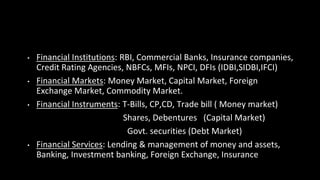
• Financial Institutions: RBI, Commercial Banks, Insurance companies,
Credit Rating Agencies, NBFCs, MFIs, NPCI, DFIs (IDBI,SIDBI,IFCI)
• Financial Markets: Money Market, Capital Market, Foreign
Exchange Market, Commodity Market.
• Financial Instruments: T-Bills, CP,CD, Trade bill ( Money market)
Shares, Debentures (Capital Market)
Govt. securities (Debt Market)
• Financial Services: Lending & management of money and assets,
Banking, Investment banking, Foreign Exchange, Insurance
Major players in Financial sector in
India
• Regulator of
Insurance Sector
• Regulator of
Pension funds
• Regulator of
Capital Market
• Regulator of banking system
• Debt Manager for GOI
• Exchange Rate Management
• Formulating Monetary Policy
• Credit Supply, credit
allocation, cost of credit
• Currency Management
….. and more RBI SEBI
IRDA
PFRDA
REGULATORS
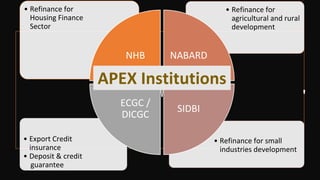
• Refinance for small
industries development
• Export Credit
insurance
• Deposit & credit
guarantee
• Refinance for
agricultural and rural
development
• Refinance for
Housing Finance
Sector
NHB NABARD
SIDBI
ECGC /
DICGC
APEX Institutions
Banking Sector Scheduled Commercial
Banks
Public Sector Banks
Foreign Banks
Cooperative banks
RRBs
Capital Market
participants
Stock Exchanges – NSE,
BSE, regional stock
exchanges
Mutual Fund Companies
Clearing Corporation of
India Ltd. (CCIL)
Others
Public Listed Companies
FIIs
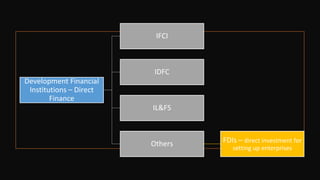
Development Financial
Institutions – Direct
Finance
IFCI
IDFC
IL&FS
Others FDIs – direct investment for
setting up enterprises
Development Financial
Institutions – Indirect
Finance
National
State Financial
Corporations
International
World Bank
Asian Development Bank
Insurance Sector
Life
LIC
Private insurance
companies
General
GIC
Private insurance
companies
Govt. sector
Post-office
Govt. of India & State Govts.
Non-banking Companies
NBFCs
Leasing Companies
Credit Card companies
Investment Banks
Credit Rating Agencies
Exchange Houses
Registrar for Cooperatives
Unorganized sector
Indian Financial Sector
Ministry of Finance is at helm of the policy making body, with
three regulators RBI, SEBI and IRDA consists of three principal
segments:
Financial Institutions Banking Institutions Financial Markets
The Financial System
Financial system, implies a set of complex and closely
connected or inter-linked:
Financial Institutions
Financial Agents
Financial Practices
Financial Markets
Financial Transactions Financial Claims, and Liabilities in the economy
• Financial Agents: Advisors, Brokers (Traders)
• Financial Practices: Cash Management, Capital Budgeting, Financial
Analysis, Forecasting, Portfolio Management, Working Capital
Management.(Set of common methods/Operating procedure)
• Financial Transactions: Cash receipt/payment, Purchases, Loan,
Mortgages, Credit card, Debit Card.
• Financial claims: Claims arising out of Financial Instruments.
• Financial Liabilities: Contractual obligations against Financial
Instruments.
The Financial System
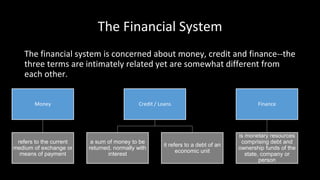
The financial system is concerned about money, credit and finance--the
three terms are intimately related yet are somewhat different from
each other.
Money
refers to the current
medium of exchange or
means of payment
Credit / Loans
a sum of money to be
returned, normally with
interest
it refers to a debt of an
economic unit
Finance
is monetary resources
comprising debt and
ownership funds of the
state, company or
person
Meaning of Banks & its features
In simple words bank is an institution, which deals in money and
credit. The features of a bank may be listed as follows:
• Acceptance of deposits of money from the public.
• Obligation to refund deposits on demand.
• Lending or investing money for promotion and development of
business.
• Profitable employment of funds received as deposits from the
public.
• Money is with-drawable by cheque or draft.
Need for Banking
Savings and capital
formation
Bank plays a vital role in mobilizing the savings of the people and promoting
the capital formation for the economic development of the country
Channelization of
savings
The mobilized savings are allocated by the banks for the development of
various fields such as agriculture, industry, communication, transport etc
Implementation of
Monetary Policy
A well-developed banking system can easily implement the monetary policy
because development of the economy depends upon the control of credit
given by the banks. So, banks are necessary for the effective implementation
of monetary policy
Encouragement of
Industries
Banks provide various types of financial services such as granting cash credit
loans, issuing letter of credit, and bill discounting etc., which encourages the
development of various industries in the country
Regional
development Banks
by transferring surplus money from the developed regions to the less
developed regions reduces regional imbalances
Development of
Agriculture and
other neglected
sectors
Banks are necessary for the farmers. It also encourages the development of
small-scale and cottage industries in rural areas
Types of Banks
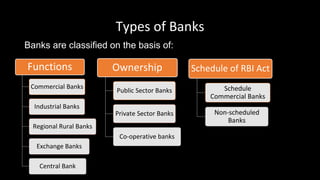
Banks are classified on the basis of:
Functions
Commercial Banks
Industrial Banks
Regional Rural Banks
Exchange Banks
Central Bank
Ownership
Public Sector Banks
Private Sector Banks
Co-operative banks
Schedule of RBI Act
Schedule
Commercial Banks
Non-scheduled
Banks
Types of Banks
Functions
Commercial
Banks
Industrial Banks
Regional Rural
Banks
Exchange Banks
Central Bank
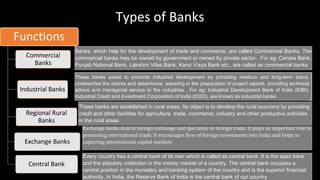
Banks, which help for the development of trade and commerce, are called Commercial Banks. The
commercial banks may be owned by government or owned by private sector. For eg: Canara Bank,
Punjab National Bank, Lakshmi Vilas Bank, Karur Visya Bank etc., are called as commercial banks
These banks assist to promote industrial development by providing medium and long-term loans,
underwrites the shares and debentures, assisting in the preparation of project reports, providing technical
advice and managerial service to the industries. For eg: Industrial Development Bank of India (IDBI),
Industrial Credit and Investment Corporation of India (ICICI), are known as industrial banks
These banks are established in rural areas. Its object is to develop the rural economy by providing
credit and other facilities for agriculture, trade, commerce, industry and other productive activities
in the rural areas
Exchange banks deal in foreign exchange and specialize in foreign trade. It plays an important role in
promoting international trade. It encourages flow of foreign investments into India and helps in
capturing international capital markets
Every country has a central bank of its own which is called as central bank. It is the apex bank
and the statutory institution in the money market of a country. The central bank occupies a
central position in the monetary and banking system of the country and is the superior financial
authority. In India, the Reserve Bank of India is the central bank of our country
Types of Banks
Ownership
Public Sector Banks
Private Sector Banks
Co-operative banks
These types of banks are owned and controlled by the government. The
nationalized banks and regional rural banks come under this category
These Banks are owned by private individuals and corporations
These banks are operated on co- operative principles. It is a voluntary
association of members for self-help and caters to their financial needs on a
mutual basis. These banks are also subject to control and inspection by
Reserve Bank of India.
Types of Banks
Schedule of RBI
Act
Schedule
Commercial Banks
Non-scheduled
Commercial Banks
The banks, which are not covered by the second schedule of
Reserve Bank of India, are called as non-scheduled banks
These types of banks are included in the second schedule of the Reserve bank
of India Act 1934. The banks, which fulfill the following conditions, are
classified into scheduled banks.
✔ Its paid up capital and reserves are at least Rs.5 Lakhs.
✔ Its operations are not detrimental to the interest of the depositors.
✔ It is a corporation or co-operative society and not a partnership or a single
owner firm.
Function of Commercial Banks
Schedule
of
RBI
Act
Primary Functions
Secondary
Functions
- Agency Functions
- Collection of cheques, bills, interest, etc.
- Executing standing instructions
- Purchase and sale of securities and transfer of funds
- Utility Functions or Services
- Safe custody of valuables, Safety Locker Facility
- Accepts bills
- Underwrites Capital issues
- Provides information about customers and trade
- Helps in foreign trade
- Issues Travellers Cheque, Gift cards
- Provides Credit Card and ATM services
- Accepting Deposits
- Making loans and advances
- Loans
- Cash credits / overdrafts
- Purchasing and discounting bills
Functions
of RBI
Execute
the
monetary
Policy Foreign
Exchange
Regulation
Banker to
the Govt.
Banker’s
Bank
Control of
Credit
Control
banking
system
Issue
currency
notes
Publication
of Data
Credit Control Measures by RBI
Quantitative Credit Control Method
Bank Rates
Open Market Operations
Variable Statutory Reserve Ratio
Qualitative Credit Control Method
Fixation of Margins
Regulation of Consumer Credit
Direct Action
Rationing of Credit
Moral Suasion
THANK YOU

1680502482-session_1_introduction.pptx

  • 1.
    Introduction of IndianFinancial System And Indian Banking System
  • 2.
    • The bankingsystem is, by far, the most dominant segment of the financial sector, accounting for • over 80 per cent of the funds flowing through the financial sector. Indian Financial System - Components Financial Institutions Financial Markets Financial Instruments Services
  • 3.
    • Financial Institutions:RBI, Commercial Banks, Insurance companies, Credit Rating Agencies, NBFCs, MFIs, NPCI, DFIs (IDBI,SIDBI,IFCI) • Financial Markets: Money Market, Capital Market, Foreign Exchange Market, Commodity Market. • Financial Instruments: T-Bills, CP,CD, Trade bill ( Money market) Shares, Debentures (Capital Market) Govt. securities (Debt Market) • Financial Services: Lending & management of money and assets, Banking, Investment banking, Foreign Exchange, Insurance
  • 4.
    Major players inFinancial sector in India
  • 5.
    • Regulator of InsuranceSector • Regulator of Pension funds • Regulator of Capital Market • Regulator of banking system • Debt Manager for GOI • Exchange Rate Management • Formulating Monetary Policy • Credit Supply, credit allocation, cost of credit • Currency Management ….. and more RBI SEBI IRDA PFRDA REGULATORS
  • 6.
    • Refinance forsmall industries development • Export Credit insurance • Deposit & credit guarantee • Refinance for agricultural and rural development • Refinance for Housing Finance Sector NHB NABARD SIDBI ECGC / DICGC APEX Institutions
  • 7.
    Banking Sector ScheduledCommercial Banks Public Sector Banks Foreign Banks Cooperative banks RRBs
  • 8.
    Capital Market participants Stock Exchanges– NSE, BSE, regional stock exchanges Mutual Fund Companies Clearing Corporation of India Ltd. (CCIL) Others Public Listed Companies FIIs
  • 9.
    Development Financial Institutions –Direct Finance IFCI IDFC IL&FS Others FDIs – direct investment for setting up enterprises
  • 10.
    Development Financial Institutions –Indirect Finance National State Financial Corporations International World Bank Asian Development Bank
  • 11.
  • 12.
    Govt. sector Post-office Govt. ofIndia & State Govts. Non-banking Companies NBFCs Leasing Companies Credit Card companies Investment Banks Credit Rating Agencies Exchange Houses Registrar for Cooperatives Unorganized sector
  • 13.
    Indian Financial Sector Ministryof Finance is at helm of the policy making body, with three regulators RBI, SEBI and IRDA consists of three principal segments: Financial Institutions Banking Institutions Financial Markets
  • 14.
    The Financial System Financialsystem, implies a set of complex and closely connected or inter-linked: Financial Institutions Financial Agents Financial Practices Financial Markets Financial Transactions Financial Claims, and Liabilities in the economy
  • 15.
    • Financial Agents:Advisors, Brokers (Traders) • Financial Practices: Cash Management, Capital Budgeting, Financial Analysis, Forecasting, Portfolio Management, Working Capital Management.(Set of common methods/Operating procedure) • Financial Transactions: Cash receipt/payment, Purchases, Loan, Mortgages, Credit card, Debit Card. • Financial claims: Claims arising out of Financial Instruments. • Financial Liabilities: Contractual obligations against Financial Instruments.
  • 16.
    The Financial System Thefinancial system is concerned about money, credit and finance--the three terms are intimately related yet are somewhat different from each other. Money refers to the current medium of exchange or means of payment Credit / Loans a sum of money to be returned, normally with interest it refers to a debt of an economic unit Finance is monetary resources comprising debt and ownership funds of the state, company or person
  • 17.
    Meaning of Banks& its features In simple words bank is an institution, which deals in money and credit. The features of a bank may be listed as follows: • Acceptance of deposits of money from the public. • Obligation to refund deposits on demand. • Lending or investing money for promotion and development of business. • Profitable employment of funds received as deposits from the public. • Money is with-drawable by cheque or draft.
  • 18.
    Need for Banking Savingsand capital formation Bank plays a vital role in mobilizing the savings of the people and promoting the capital formation for the economic development of the country Channelization of savings The mobilized savings are allocated by the banks for the development of various fields such as agriculture, industry, communication, transport etc Implementation of Monetary Policy A well-developed banking system can easily implement the monetary policy because development of the economy depends upon the control of credit given by the banks. So, banks are necessary for the effective implementation of monetary policy Encouragement of Industries Banks provide various types of financial services such as granting cash credit loans, issuing letter of credit, and bill discounting etc., which encourages the development of various industries in the country Regional development Banks by transferring surplus money from the developed regions to the less developed regions reduces regional imbalances Development of Agriculture and other neglected sectors Banks are necessary for the farmers. It also encourages the development of small-scale and cottage industries in rural areas
  • 19.
    Types of Banks Banksare classified on the basis of: Functions Commercial Banks Industrial Banks Regional Rural Banks Exchange Banks Central Bank Ownership Public Sector Banks Private Sector Banks Co-operative banks Schedule of RBI Act Schedule Commercial Banks Non-scheduled Banks
  • 20.
    Types of Banks Functions Commercial Banks IndustrialBanks Regional Rural Banks Exchange Banks Central Bank Banks, which help for the development of trade and commerce, are called Commercial Banks. The commercial banks may be owned by government or owned by private sector. For eg: Canara Bank, Punjab National Bank, Lakshmi Vilas Bank, Karur Visya Bank etc., are called as commercial banks These banks assist to promote industrial development by providing medium and long-term loans, underwrites the shares and debentures, assisting in the preparation of project reports, providing technical advice and managerial service to the industries. For eg: Industrial Development Bank of India (IDBI), Industrial Credit and Investment Corporation of India (ICICI), are known as industrial banks These banks are established in rural areas. Its object is to develop the rural economy by providing credit and other facilities for agriculture, trade, commerce, industry and other productive activities in the rural areas Exchange banks deal in foreign exchange and specialize in foreign trade. It plays an important role in promoting international trade. It encourages flow of foreign investments into India and helps in capturing international capital markets Every country has a central bank of its own which is called as central bank. It is the apex bank and the statutory institution in the money market of a country. The central bank occupies a central position in the monetary and banking system of the country and is the superior financial authority. In India, the Reserve Bank of India is the central bank of our country
  • 21.
    Types of Banks Ownership PublicSector Banks Private Sector Banks Co-operative banks These types of banks are owned and controlled by the government. The nationalized banks and regional rural banks come under this category These Banks are owned by private individuals and corporations These banks are operated on co- operative principles. It is a voluntary association of members for self-help and caters to their financial needs on a mutual basis. These banks are also subject to control and inspection by Reserve Bank of India.
  • 22.
    Types of Banks Scheduleof RBI Act Schedule Commercial Banks Non-scheduled Commercial Banks The banks, which are not covered by the second schedule of Reserve Bank of India, are called as non-scheduled banks These types of banks are included in the second schedule of the Reserve bank of India Act 1934. The banks, which fulfill the following conditions, are classified into scheduled banks. ✔ Its paid up capital and reserves are at least Rs.5 Lakhs. ✔ Its operations are not detrimental to the interest of the depositors. ✔ It is a corporation or co-operative society and not a partnership or a single owner firm.
  • 23.
    Function of CommercialBanks Schedule of RBI Act Primary Functions Secondary Functions - Agency Functions - Collection of cheques, bills, interest, etc. - Executing standing instructions - Purchase and sale of securities and transfer of funds - Utility Functions or Services - Safe custody of valuables, Safety Locker Facility - Accepts bills - Underwrites Capital issues - Provides information about customers and trade - Helps in foreign trade - Issues Travellers Cheque, Gift cards - Provides Credit Card and ATM services - Accepting Deposits - Making loans and advances - Loans - Cash credits / overdrafts - Purchasing and discounting bills
  • 24.
    Functions of RBI Execute the monetary Policy Foreign Exchange Regulation Bankerto the Govt. Banker’s Bank Control of Credit Control banking system Issue currency notes Publication of Data
  • 25.
    Credit Control Measuresby RBI Quantitative Credit Control Method Bank Rates Open Market Operations Variable Statutory Reserve Ratio Qualitative Credit Control Method Fixation of Margins Regulation of Consumer Credit Direct Action Rationing of Credit Moral Suasion
  • 26.