Final Report:
Advanced Radio Transmission Experimental MIchigan Satellite
(ARTEMIS)
Aerospace Engineering 483
Winter 2015
Final Report:
Advanced Radio Transmission Experimental MIchigan Satellite
(ARTEMIS)
April 15, 2015
Prepared by:
David Carter (Chief Lead)
Andrew Taylor (Chief Engineer)
Avinash Devalla (Chief Mission Specialist)
Adam Scharich
Ari Porter
Dakota Heidt
Evan Zimny
Jonathan Elias
Jonathon Ekleberry
Mason Ferlic
Mitchell Borchers
Nathaniel Scott
Richard Sutherland
Ritika Mehta
Wesley Moy
Prepared for:
James W. Cutler, Ph.D.
Associate Professor, Aerospace Engineering
University of Michigan
Contents
1 Mission Overview 1
2 Competition Overview 1
3 Mission Requirements 1
4 Project Design Drivers 1
5 ARTEMIS Systems Analysis 1
6 Orbits (ORB) 2
6.1 ORB Performance Dependencies . . . . . . . . . . . . . . . . . . . . . . . . . . . . . . . . . . . . . . . 3
6.1.1 Launch Selection . . . . . . . . . . . . . . . . . . . . . . . . . . . . . . . . . . . . . . . . . . . . 3
6.1.2 Propulsion System . . . . . . . . . . . . . . . . . . . . . . . . . . . . . . . . . . . . . . . . . . . 3
6.2 Simulation Tools & Preliminary Analysis . . . . . . . . . . . . . . . . . . . . . . . . . . . . . . . . . . 3
7 Communication System (COMMS) 8
7.1 COMMS Performance Dependencies . . . . . . . . . . . . . . . . . . . . . . . . . . . . . . . . . . . . . 8
7.1.1 Available Power . . . . . . . . . . . . . . . . . . . . . . . . . . . . . . . . . . . . . . . . . . . . 8
7.1.2 Orbit . . . . . . . . . . . . . . . . . . . . . . . . . . . . . . . . . . . . . . . . . . . . . . . . . . 9
7.1.3 ADCS Pointing Requirements . . . . . . . . . . . . . . . . . . . . . . . . . . . . . . . . . . . . . 9
7.1.4 Computational Power . . . . . . . . . . . . . . . . . . . . . . . . . . . . . . . . . . . . . . . . . 10
7.1.5 Aperture Area and System Mass . . . . . . . . . . . . . . . . . . . . . . . . . . . . . . . . . . . 10
7.1.6 Radiated Thermal Power . . . . . . . . . . . . . . . . . . . . . . . . . . . . . . . . . . . . . . . 10
7.2 Simulation Tools & Preliminary Analysis . . . . . . . . . . . . . . . . . . . . . . . . . . . . . . . . . . 10
7.2.1 Phased Array Overview . . . . . . . . . . . . . . . . . . . . . . . . . . . . . . . . . . . . . . . . 11
7.2.2 Phased Array Link Budget . . . . . . . . . . . . . . . . . . . . . . . . . . . . . . . . . . . . . . 14
7.2.3 Ground Station and Communication Window . . . . . . . . . . . . . . . . . . . . . . . . . . . . 16
7.2.4 Laser Communication . . . . . . . . . . . . . . . . . . . . . . . . . . . . . . . . . . . . . . . . . 19
8 Propulsion System (PROP) 21
8.1 PROP Performance Dependencies . . . . . . . . . . . . . . . . . . . . . . . . . . . . . . . . . . . . . . 21
8.1.1 Thrust Output . . . . . . . . . . . . . . . . . . . . . . . . . . . . . . . . . . . . . . . . . . . . . 21
8.1.2 Stationkeeping and Maneuvering . . . . . . . . . . . . . . . . . . . . . . . . . . . . . . . . . . . 22
8.1.3 Size Constraints . . . . . . . . . . . . . . . . . . . . . . . . . . . . . . . . . . . . . . . . . . . . 22
8.2 Simulation Tools & Preliminary Analysis . . . . . . . . . . . . . . . . . . . . . . . . . . . . . . . . . . 22
8.2.1 CubeSat Ambipolar Thruster . . . . . . . . . . . . . . . . . . . . . . . . . . . . . . . . . . . . . 22
9 Electrical Power System (EPS) 23
9.1 EPS Performance Dependencies . . . . . . . . . . . . . . . . . . . . . . . . . . . . . . . . . . . . . . . . 23
9.1.1 Pointing Accuracy . . . . . . . . . . . . . . . . . . . . . . . . . . . . . . . . . . . . . . . . . . . 24
9.1.2 Operating Temperature . . . . . . . . . . . . . . . . . . . . . . . . . . . . . . . . . . . . . . . . 24
9.1.3 Surface Area . . . . . . . . . . . . . . . . . . . . . . . . . . . . . . . . . . . . . . . . . . . . . . 24
9.1.4 Satellite Volume . . . . . . . . . . . . . . . . . . . . . . . . . . . . . . . . . . . . . . . . . . . . 25
9.1.5 Time in the Sun . . . . . . . . . . . . . . . . . . . . . . . . . . . . . . . . . . . . . . . . . . . . 25
9.2 Simulation Tools & Preliminary Analysis . . . . . . . . . . . . . . . . . . . . . . . . . . . . . . . . . . 25
9.2.1 Solar Cell Placement . . . . . . . . . . . . . . . . . . . . . . . . . . . . . . . . . . . . . . . . . . 25
9.2.2 Solar Array Sizing . . . . . . . . . . . . . . . . . . . . . . . . . . . . . . . . . . . . . . . . . . . 26
9.2.3 Power Storage . . . . . . . . . . . . . . . . . . . . . . . . . . . . . . . . . . . . . . . . . . . . . 27
10 Attitude Determination and Control System (ADCS) 27
10.1 ADCS Performance Dependencies . . . . . . . . . . . . . . . . . . . . . . . . . . . . . . . . . . . . . . . 28
10.1.1 Processing Speed . . . . . . . . . . . . . . . . . . . . . . . . . . . . . . . . . . . . . . . . . . . . 28
10.1.2 Sensor and Actuator Volume . . . . . . . . . . . . . . . . . . . . . . . . . . . . . . . . . . . . . 29
10.1.3 Orbital Parameters . . . . . . . . . . . . . . . . . . . . . . . . . . . . . . . . . . . . . . . . . . . 29
i
10.1.4 Position Knowledge . . . . . . . . . . . . . . . . . . . . . . . . . . . . . . . . . . . . . . . . . . 30
10.1.5 Available Power . . . . . . . . . . . . . . . . . . . . . . . . . . . . . . . . . . . . . . . . . . . . 30
10.2 Simulation Tools & Preliminary Analysis . . . . . . . . . . . . . . . . . . . . . . . . . . . . . . . . . . 30
10.2.1 Attitude Estimation Hardware . . . . . . . . . . . . . . . . . . . . . . . . . . . . . . . . . . . . 31
10.2.2 Dynamics Model . . . . . . . . . . . . . . . . . . . . . . . . . . . . . . . . . . . . . . . . . . . . 31
10.2.3 Attitude Modes . . . . . . . . . . . . . . . . . . . . . . . . . . . . . . . . . . . . . . . . . . . . . 33
10.2.4 Optimal Attitude Determination . . . . . . . . . . . . . . . . . . . . . . . . . . . . . . . . . . . 33
10.2.5 Control Laws . . . . . . . . . . . . . . . . . . . . . . . . . . . . . . . . . . . . . . . . . . . . . . 34
10.2.6 Accuracy Requirements . . . . . . . . . . . . . . . . . . . . . . . . . . . . . . . . . . . . . . . . 34
11 Command and Data Handling System (CDH) 35
11.1 CDH Performance Dependencies . . . . . . . . . . . . . . . . . . . . . . . . . . . . . . . . . . . . . . . 35
11.1.1 Processor Power . . . . . . . . . . . . . . . . . . . . . . . . . . . . . . . . . . . . . . . . . . . . 35
11.1.2 CDH Volume . . . . . . . . . . . . . . . . . . . . . . . . . . . . . . . . . . . . . . . . . . . . . . 36
11.1.3 CDH Thermal Management . . . . . . . . . . . . . . . . . . . . . . . . . . . . . . . . . . . . . . 36
11.2 Simulation Tools & Preliminary Analysis . . . . . . . . . . . . . . . . . . . . . . . . . . . . . . . . . . 36
12 Structures (STR) 37
12.1 STR Performance Dependencies . . . . . . . . . . . . . . . . . . . . . . . . . . . . . . . . . . . . . . . . 38
12.1.1 6U CubeSat Deployer . . . . . . . . . . . . . . . . . . . . . . . . . . . . . . . . . . . . . . . . . 38
12.1.2 Environmental Requirements . . . . . . . . . . . . . . . . . . . . . . . . . . . . . . . . . . . . . 39
12.2 Simulation Tools & Preliminary Analysis . . . . . . . . . . . . . . . . . . . . . . . . . . . . . . . . . . 39
12.2.1 Mechanical Requirements . . . . . . . . . . . . . . . . . . . . . . . . . . . . . . . . . . . . . . . 39
12.2.2 Mass Estimates . . . . . . . . . . . . . . . . . . . . . . . . . . . . . . . . . . . . . . . . . . . . . 40
13 Thermal Control System (TCS) 40
13.1 TCS Performance Dependencies . . . . . . . . . . . . . . . . . . . . . . . . . . . . . . . . . . . . . . . . 41
13.1.1 Available Surface Area & Volume . . . . . . . . . . . . . . . . . . . . . . . . . . . . . . . . . . . 41
13.1.2 Available Power for Active Heating . . . . . . . . . . . . . . . . . . . . . . . . . . . . . . . . . . 42
13.2 Simulation Tools & Preliminary Analysis . . . . . . . . . . . . . . . . . . . . . . . . . . . . . . . . . . 42
13.2.1 TCS Requirements . . . . . . . . . . . . . . . . . . . . . . . . . . . . . . . . . . . . . . . . . . . 42
13.2.2 Thermal Environments . . . . . . . . . . . . . . . . . . . . . . . . . . . . . . . . . . . . . . . . . 43
13.2.3 Thermal Enivronment Phases . . . . . . . . . . . . . . . . . . . . . . . . . . . . . . . . . . . . . 43
13.2.4 Thermal Simulation Techniques . . . . . . . . . . . . . . . . . . . . . . . . . . . . . . . . . . . . 44
13.2.5 Thermal Simulation Preliminary Results . . . . . . . . . . . . . . . . . . . . . . . . . . . . . . . 44
13.2.6 TCS Control Techniques . . . . . . . . . . . . . . . . . . . . . . . . . . . . . . . . . . . . . . . . 48
13.2.7 Surface Emissivities . . . . . . . . . . . . . . . . . . . . . . . . . . . . . . . . . . . . . . . . . . 48
13.2.8 Recommendations . . . . . . . . . . . . . . . . . . . . . . . . . . . . . . . . . . . . . . . . . . . 49
14 Guidance System (GUID) 49
14.1 GUID Performance Dependencies . . . . . . . . . . . . . . . . . . . . . . . . . . . . . . . . . . . . . . . 50
14.1.1 Available Volume and Surface Area . . . . . . . . . . . . . . . . . . . . . . . . . . . . . . . . . 50
14.1.2 Available Power . . . . . . . . . . . . . . . . . . . . . . . . . . . . . . . . . . . . . . . . . . . . 50
14.2 Simulation Tools & Preliminary Analysis . . . . . . . . . . . . . . . . . . . . . . . . . . . . . . . . . . 51
15 Conclusion 51
Appendices 52
A q-Method Attitude Optimization Algorithm 52
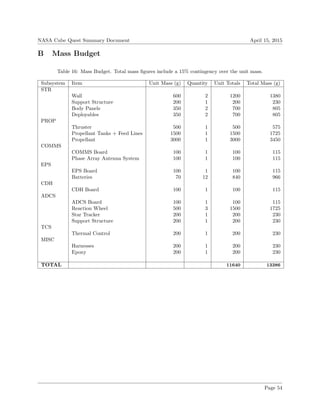
B Mass Budget 54
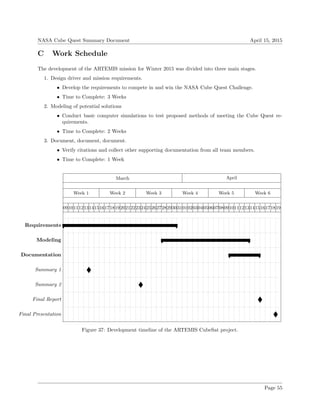
C Work Schedule 55
ii
List of Figures
1 System Performance Dependencies Diagram . . . . . . . . . . . . . . . . . . . . . . . . . . . . 2
2 Position of ARTEMIS (green) with respect to Earth (light blue) and Moon (white), three days
after EM-1 disposal, given no on-board propulsion. . . . . . . . . . . . . . . . . . . . . . . . . 5
3 EM-1 to LLO low thrust transfer example. . . . . . . . . . . . . . . . . . . . . . . . . . . . . . 6
4 EM-1 to LLO single impulse transfer example, depicting coast arc from EM-1 (green), final
orbit (pink), and Lunar motion (white). Grid is spaced at 1000 km with respect to the Moon’s
center. . . . . . . . . . . . . . . . . . . . . . . . . . . . . . . . . . . . . . . . . . . . . . . . . . 7
5 COMMS Design Map . . . . . . . . . . . . . . . . . . . . . . . . . . . . . . . . . . . . . . . . 8
6 Phased Array Layout and Gain Pattern . . . . . . . . . . . . . . . . . . . . . . . . . . . . . . 12
7 Theta Cut . . . . . . . . . . . . . . . . . . . . . . . . . . . . . . . . . . . . . . . . . . . . . . . 12
8 Theta Polar . . . . . . . . . . . . . . . . . . . . . . . . . . . . . . . . . . . . . . . . . . . . . . 13
9 Phased Array Beam Squinted to 30 Degrees . . . . . . . . . . . . . . . . . . . . . . . . . . . . 13
10 Polar Plot of Beam Squinted to 30 Degrees . . . . . . . . . . . . . . . . . . . . . . . . . . . . 14
11 X-Band Frequency Spectrum Allocation . . . . . . . . . . . . . . . . . . . . . . . . . . . . . . 15
12 DSN Coverage . . . . . . . . . . . . . . . . . . . . . . . . . . . . . . . . . . . . . . . . . . . . 17
13 26 m Peach Mountain Dish . . . . . . . . . . . . . . . . . . . . . . . . . . . . . . . . . . . . . 17
14 Simulated DSN Communication Window . . . . . . . . . . . . . . . . . . . . . . . . . . . . . . 18
15 Simulated Peach Mountain Communication Window . . . . . . . . . . . . . . . . . . . . . . . 18
16 Track and Hold ability of MIT’s Exoplanet Using Piezoelectric Stage . . . . . . . . . . . . . . 20
17 PROP Design Map . . . . . . . . . . . . . . . . . . . . . . . . . . . . . . . . . . . . . . . . . . 21
18 EPS Design Map . . . . . . . . . . . . . . . . . . . . . . . . . . . . . . . . . . . . . . . . . . . 24
19 Proposed Position and Orientation of Solar Panels and Phased Array . . . . . . . . . . . . . . 26
20 ADCS Design Map . . . . . . . . . . . . . . . . . . . . . . . . . . . . . . . . . . . . . . . . . . 28
21 ARTEMIS ADCS Schematic . . . . . . . . . . . . . . . . . . . . . . . . . . . . . . . . . . . . . 32
22 CDH Design Map . . . . . . . . . . . . . . . . . . . . . . . . . . . . . . . . . . . . . . . . . . . 35
23 Dimensioned Structure . . . . . . . . . . . . . . . . . . . . . . . . . . . . . . . . . . . . . . . . 38
24 Canisterized Satellite Dispenser Deployment . . . . . . . . . . . . . . . . . . . . . . . . . . . . 38
25 Proposed Deployable Panel System . . . . . . . . . . . . . . . . . . . . . . . . . . . . . . . . . 39
26 Deployed State . . . . . . . . . . . . . . . . . . . . . . . . . . . . . . . . . . . . . . . . . . . . 40
27 TCS Design Map . . . . . . . . . . . . . . . . . . . . . . . . . . . . . . . . . . . . . . . . . . . 41
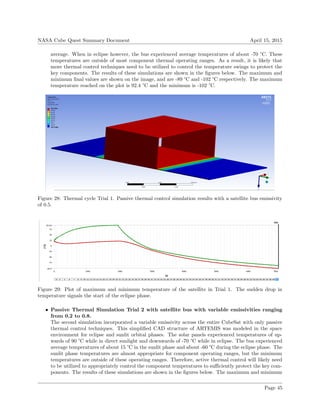
28 Thermal cycle Trial 1. Passive thermal control simulation results with a satellite bus emissivity
of 0.5. . . . . . . . . . . . . . . . . . . . . . . . . . . . . . . . . . . . . . . . . . . . . . . . . . 45
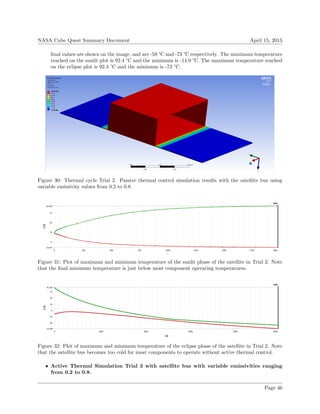
29 Plot of maximum and minimum temperature of the satellite in Trial 1. The sudden drop in
temperature signals the start of the eclipse phase. . . . . . . . . . . . . . . . . . . . . . . . . . 45
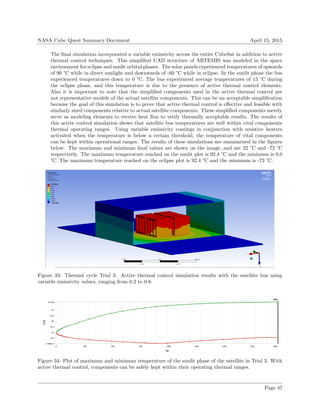
30 Thermal cycle Trial 2. Passive thermal control simulation results with the satellite bus using
variable emissivity values from 0.2 to 0.8. . . . . . . . . . . . . . . . . . . . . . . . . . . . . . 46
31 Plot of maximum and minimum temperature of the sunlit phase of the satellite in Trial 2.
Note that the final minimum temperature is just below most component operating temperatures. 46
32 Plot of maximum and minimum temperature of the eclipse phase of the satellite in Trial 2.
Note that the satellite bus becomes too cold for most components to operate without active
thermal control. . . . . . . . . . . . . . . . . . . . . . . . . . . . . . . . . . . . . . . . . . . . . 46
33 Thermal cycle Trial 3. Active thermal control simulation results with the satellite bus using
variable emissivity values, ranging from 0.2 to 0.8. . . . . . . . . . . . . . . . . . . . . . . . . 47
34 Plot of maximum and minimum temperature of the sunlit phase of the satellite in Trial 3.
With active thermal control, components can be safely kept within their operating thermal
ranges. . . . . . . . . . . . . . . . . . . . . . . . . . . . . . . . . . . . . . . . . . . . . . . . . . 47
35 Plot of maximum and minimum temperature of the eclipse phase of the satellite in Trial 3.
With active thermal control cycling, components can be safely operated even in eclipse. . . . 48
36 GUID Design Map . . . . . . . . . . . . . . . . . . . . . . . . . . . . . . . . . . . . . . . . . . 50
37 Development timeline of the ARTEMIS CubeSat project. . . . . . . . . . . . . . . . . . . . . 55
iii
List of Tables
1 EM-1 Payload Disposal Trajectory. Coordinates are with respect to J2000 inertial reference
frame. . . . . . . . . . . . . . . . . . . . . . . . . . . . . . . . . . . . . . . . . . . . . . . . . . 3
2 ARTEMIS orbit requirements. . . . . . . . . . . . . . . . . . . . . . . . . . . . . . . . . . . . 4
3 Comparison of of low thrust maneuvers from EM-1 disposal to LLO. . . . . . . . . . . . . . . 5
4 Phased Array Specs . . . . . . . . . . . . . . . . . . . . . . . . . . . . . . . . . . . . . . . . . 11
5 Link Budget: DSN Ground Station . . . . . . . . . . . . . . . . . . . . . . . . . . . . . . . . . 15
6 Link Budget: Peach Mountain Ground Station . . . . . . . . . . . . . . . . . . . . . . . . . . 16
7 Communication Windows from Lunar Orbit over a 4 Week Period . . . . . . . . . . . . . . . 18
8 Cost Table for DSN Antenna . . . . . . . . . . . . . . . . . . . . . . . . . . . . . . . . . . . . 19
9 Estimated data rates for laser communication system. . . . . . . . . . . . . . . . . . . . . . . 20
10 CAT Specifications for a 3U, 3 kg CubeSat platform . . . . . . . . . . . . . . . . . . . . . . . 22
11 Potential CubeSat Thrusters . . . . . . . . . . . . . . . . . . . . . . . . . . . . . . . . . . . . 23
12 Power Requirements . . . . . . . . . . . . . . . . . . . . . . . . . . . . . . . . . . . . . . . . . 26
13 Major Types of Single Event Radiation Effects . . . . . . . . . . . . . . . . . . . . . . . . . . 37
14 System Mass Budget . . . . . . . . . . . . . . . . . . . . . . . . . . . . . . . . . . . . . . . . . 40
15 Typical Component Thermal Ranges . . . . . . . . . . . . . . . . . . . . . . . . . . . . . . . . 43
16 Mass Budget. Total mass figures include a 15% contingency over the unit mass. . . . . . . . . 54
iv
NASA Cube Quest Summary Document April 15, 2015
1 Mission Overview
The Advanced Radio Transmission Experimental MIchigan Satellite, ARTEMIS, is a 6U CubeSat that will
either orbit the Moon or enter into deep space and transmit data packets back to Earth following NASA-
provided protocols. It is designed to compete in NASA’s Cube Quest Challenge in 2018.
2 Competition Overview
NASA’s Cube Quest Challenge offers a total of $5 million to teams that meet the challenge objectives
of designing, building, and delivering flight-qualified small satellites capable of advanced communication
operations near and beyond the Moon. Prior to the flight challenges, teams may enter ground competitions
to compete for a secondary payload spot on NASA’s Space Launch System EM-1 vehicle that will be sent
to the Moon in 2018. The in-space prizes are primarily awarded for achieving successful lunar orbit and for
transmitting the largest volume of error-free data. As such, these two areas will be the primary considerations
of the ARTEMIS mission.
3 Mission Requirements
The primary mission requirements are to enter either a lunar orbit or deep space and then to communicate
data back to ground stations on Earth. Specifically, ARTEMIS will attempt to demonstrate the best burst
data rate, defined as the largest cumulative data volume over a 30-minute period, and the largest aggregate
data volume sustained over time, defined as the largest cumulative data volume over a contiguous 28-day
period. These are two of the main in-space prize categories.
4 Project Design Drivers
The key design drivers are the communication and propulsion systems. If we attempt the lunar orbit, the
satellite must be able to decelerate from its lunar flyby trajectory and establish at least one complete lunar
orbit, with minimum periselene altitude of 300 km and maximum aposelene altitude of 10,000 km. If we
instead attempt to enter deep space, then ARTEMIS must travel at least four million kilometers from the
Earth. Following successful lunar capture or reaching deep space, the satellite must then transmit prescribed
1024-bit error-free data blocks according to the burst data rate and aggregate data volume challenge rules.
All other subsystem properties are constrained by the needs of these two primary systems.
5 ARTEMIS Systems Analysis
The Cube Quest Challenge is a competitive mission, and this drives the need for optimization of the spacecraft
to accomplish highly specific goals. The design of a spacecraft is a highly multi-disciplinary process, and
the performance of each individual component relies heavily on the performance of each other component in
the system. Mapping these connections in critical detail is a challenging process, but simplified models can
be constructed that show trends in overall spacecraft performance based on improvements in performance
of individual components. By modeling these connections, we can begin to optimize the spacecraft by
determining how the gains in the performance of an individual system can be utilized towards a final goal.
Page 1
NASA Cube Quest Summary Document April 15, 2015
J(x)
(Processing)
C&DHTHRML
(Heating)
(Cooling)
(Data)
COMMS
ADCS
(Pointing)
PROP
(Orbits)
EPS
(Power)
GUID
(Position)
STR
(Volume)
(Surface Area)
Figure 1: System Performance Dependencies Diagram
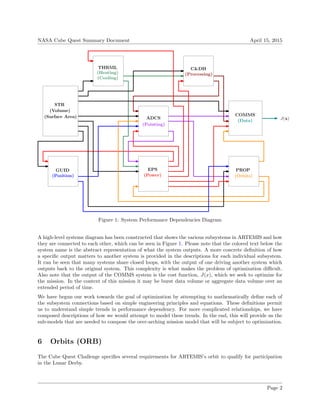
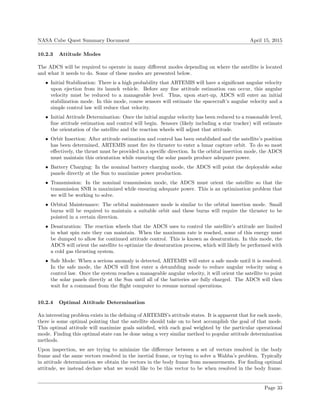
A high-level systems diagram has been constructed that shows the various subsystems in ARTEMIS and how
they are connected to each other, which can be seen in Figure 1. Please note that the colored text below the
system name is the abstract representation of what the system outputs. A more concrete definition of how
a specific output matters to another system is provided in the descriptions for each individual subsystem.
It can be seen that many systems share closed loops, with the output of one driving another system which
outputs back to the original system. This complexity is what makes the problem of optimization difficult.
Also note that the output of the COMMS system is the cost function, J(x), which we seek to optimize for
the mission. In the context of this mission it may be burst data volume or aggregate data volume over an
extended period of time.
We have begun our work towards the goal of optimization by attempting to mathematically define each of
the subsystem connections based on simple engineering principles and equations. These definitions permit
us to understand simple trends in performance dependency. For more complicated relationships, we have
composed descriptions of how we would attempt to model these trends. In the end, this will provide us the
sub-models that are needed to compose the over-arching mission model that will be subject to optimization.
6 Orbits (ORB)
The Cube Quest Challenge specifies several requirements for ARTEMIS’s orbit to qualify for participation
in the Lunar Derby.
Page 2
NASA Cube Quest Summary Document April 15, 2015
6.1 ORB Performance Dependencies
The primary performance dependencies for the ORB subsystem are launch selection and the onboard propul-
sion unit. These constrain the trajectories available to ARTEMIS.
6.1.1 Launch Selection
The Cube Quest Challenge Lunar Derby competition time is defined as the 365 day period which begins
with the launch of the EM-1 mission. NASA has offered the five teams who score the highest in Ground
Tournament 4 the opportunity to be carried aboard the EM-1 mission, currently scheduled for launch in
December 2018. As EM-1 approaches the Moon, it will release secondary payloads (including the selected
Cube Quest competitors) at a specified range in its orbit. NASA provided the expected payload disposal
trajectory for the original launch date [1], specified in Table 1; an updated trajectory remains forthcoming.
Although maneuvering from EM-1 to Low Lunar Orbit (LLO) is likely the quickest option, more frequent,
earlier launches are available to Low Earth Orbit (LEO), a Geosynchronous Transfer Orbit (GTO), and
Geosynchronous Earth Orbit (GEO). These launches may offer simpler trajectories, and therefore simpler
mission planning. Preliminary analysis, covered in Section 6.2, indicates that a low-thrust transfer from
LEO to LLO, while possible, would require upwards of 7 km/s total ∆V and over a year to complete [2].
Therefore, we have chosen to focus on transfers from GEO to LLO or EM-1 to LLO. Spaceflight Services
provides three such launch opportunities for a 6U Cubesat to GTO, one each in 2015, 2016, and 2017 [3].
Table 1: EM-1 Payload Disposal Trajectory. Coordinates are with respect to J2000 inertial reference frame.
State Value Units
Rx -1.5015e+04 km
Ry -2.3569e+04 km
Rz 2.2415e+03 km
Vx -4.8554e−01 km/s
Vy -5.0488e+00 km/s
Vz -8.7999e−01 km/s
Epoch 15 Dec 2017 14:56:42.2 Barycentric Dynamical Time
6.1.2 Propulsion System
Propulsion systems fall into two broad categories: high thrust/low specific-impulse chemical propulsion,
and low thrust/high specific-impulse electric propulsion. Chemical propulsion enables lunar orbit insertion
within a week in most cases, at the cost of higher propellant mass but lower power consumption than an
electric propulsion system. Lunar orbit maneuvers using an electric propulsion systems have flight times
on the order of six to eight months but require far less propellant mass than a chemical thruster, however
they also consume much more power due to the long-duration continuous burns required. Broadly speaking,
choosing an electric propulsion system would also force ARTEMIS to launch at an earlier date to remain
competitive with the winners of Ground Tournament 4.
6.2 Simulation Tools & Preliminary Analysis
The Cube Quest Challenge specifies several requirements for ARTEMIS’s orbit to qualify for participation
in the Lunar Derby [4], outlined in Table 2. Orbit verification is conducted by the Cube Quest judges using
Page 3
NASA Cube Quest Summary Document April 15, 2015
navigation artifacts submitted by each team [5]. These artifacts are based on telemetric data generated by
DSN ground/tracking stations, or by the team’s own ground stations.
Table 2: ARTEMIS orbit requirements.
ID Requirement Source
ORB-01 Competitor CubeSats shall achieve and maintain a verifiable lunar
orbit, during any operation that would count towards the Lunar
Derby Prizes achievements.
CCP-CQ-OPSRUL-001
Rule 24.A
ORB-02 For the purpose of the Lunar Derby, a lunar orbit is defined as at
least one complete orbit of minimum distance always above the
lunar surface of 300 km, and with an aposelene that never exceeds
10,000 km.
CCP-CQ-OPSRUL-001
Rule 24.B
ORB-03 Competitor Teams shall provide evidence demonstrating their
CubeSat has maintained a minimum altitude of at least 300 km
above the lunar surface at all times, before intentional end-of-
mission disposal maneuvers.
CCP-CQ-OPSRUL-001
Rule 24.D
ORB-04 Competitor Teams shall provide evidence, to the Judge’s satisfac-
tion, demonstrating that their CubeSats has maintained a lunar
orbit (as defined in Rule 24.B) during any operations counting
towards competition achievements or prize awards.
CCP-CQ-OPSRUL-001
Rule 24.E
Generally speaking, simulations attempting to place ARTEMIS in an orbit satisfying the Lunar Derby
requirements attempt to solve a two-value boundary value problem. Typically, the initial state will be
known (the secondary payload disposal trajectory for a chosen launch), and the final state can be constrained
(altitude of aposelene and periselene, eccentricity, etc.). The problem can also be posed to minimize a cost
function, which could include some combination of propellant mass, power consumption, and maneuver time,
with constraints imposed by the initial and final trajectories, on-board power generation and storage limits,
and propulsion unit characteristics.
The EM-1 payload disposal trajectory places ARTEMIS on a trailing-edge lunar flyby with a periselene
altitude of 3100 km; if no maneuvers at all are performed after disposal, ARTEMIS will be flung towards
the Sun upon passing the Moon. This was verified by simulations conducted using AGI’s System Toolkit
(STK) 9.0 [6], as depicted in Figure 2.
Page 4
NASA Cube Quest Summary Document April 15, 2015
Figure 2: Position of ARTEMIS (green) with respect to Earth (light blue) and Moon (white), three days
after EM-1 disposal, given no on-board propulsion.
Therefore, ARTEMIS must include some on-board propulsion to successfully compete in the Lunar Derby.
Low-thrust maneuvers to achieve LLO are difficult to simulate, in part due to the complex pattern of flybys
and thrust arcs necessary to insert ARTEMIS into LLO from EM-1. Extensive simulations conducted by
researchers at Goddard Space Flight Center, Purdue University, and Catholic University [7] have, however,
demonstrated the feasibility of low-thrust maneuvering to achieve LLO from the EM-1 payload disposal
trajectory. Their findings are summarized in Table 3.
Table 3: Comparison of of low thrust maneuvers from EM-1 disposal to LLO.
Maneuver Summary System
thrust (mN)
Maneuver
duration
(days)
Aposelene x
Periselene (km)
Inclination (deg)
Trailing-edge Lunar flyby to
trailing-edge Earth flyby
0.5 231 6800 x 100 20
Trailing-edge Lunar flyby to
Earth-Sun L1
2.0 250 9993 x 1545 144
Antivelocity burn to highly
eccentric Earth orbit
3.0 223 6513 x 139 156
Leading-edge Lunar flyby to
apogee at Lunar orbit
2.0 171 350 x 50 165
Leading-edge Lunar flyby to
perigee at Lunar orbit
3.0 214 5571 x 101 32
Assuming sufficient power input, the CubeSat Ambipolar Thruster (CAT) (detailed in Section 8.2.1) can
exceed the thrust level required in several of the simulations [8], implying the total maneuver time could be
decreased. While several of the simulated capture orbits violate Requirements ORB-02 and ORB-03, the
final orbit could be corrected by further maneuvers once ARTEMIS is within the Moon’s sphere of influence,
or by simulating with constraints placed on the final aposelene and periselene.
Page 5
NASA Cube Quest Summary Document April 15, 2015
As a representative example of the simulation complexity, the first maneuver scenario [7] described in Table
3 is depicted in Figure 3 below. The larger image is in a Sun-Earth rotating coordinate frame, with the line
between the Sun and the Earth in yellow. Upon being released from EM-1, the simulated spacecraft would
immediately begin thrusting in an anti-velocity direction (red), increasing periselene altitude to reduce the
∆V imparted by the Lunar flyby. The spacecraft would then swing back towards Earth (contrasting Figure
2), and then shut off its thruster. Coasting along this ballistic trajectory lets the spacecraft flyby Earth,
with its apogee approaching the Sun-Earth L1 distance. At some point it begins to thrust in the velocity
direction (green), and subsequently alternates coast and thrust arcs until it is inserted into its final Lunar
orbit, 231 days after EM-1 disposal.
Figure 3: EM-1 to LLO low thrust transfer example.
Another option is a low-thrust CubeSat maneuver from geosynchronous Earth orbit (GEO) to a 100 km
altitude LLO; assuming a 4kg 3U CubeSat and JPL’s MIXI thruster, providing 1 mN thrust, 3000 s specific
impulse, and 3.5 km/s total ∆V [9], the maneuver time was 365 days with a ∆V requirement of approximately
2.3 km/s. Accordingly, if a GEO to LLO transfer is chosen, ARTEMIS would likely need to launch close to
a year before EM-1 to remain competitive with the winners of Ground Tournament 4.
Low-thrust maneuvers are not the only choice available to the mission, however. As discussed in Section
8, several high-thrust chemical thrusters are available on a CubeSat platform. The low-thrust simulations
cited above required complex initial guesses, algorithms, and software. Therefore, orbit simulations and
analysis focused on minimizing the ∆V necessary for GEO to LLO and EM-1 to LLO transfer using chemical
propulsion options.
Accurate simulation demands accurate representation of the spacecraft’s equations of motion. Lunar orbit
trajectories in particular are highly perturbed and cannot be accurately represented using the standard
two-body problem, as discovered during the run-up to the Apollo missions [10]. The Moon itself is highly
heterogenous, sporting several mass concentrations or “masscons”. Furthermore, due to the Moon’s relatively
Page 6
NASA Cube Quest Summary Document April 15, 2015
low mass, the tug of the Earth and Sun represent significant perturbing forces on any spacecraft in Lunar
orbit. Therefore, the STK ’CisLunar’ gravity model was chosen to simulate the equations of motion when
the spacecraft was within the Moon’s sphere of influence (approx. 61,600 km from its center [11]). This
model accounts for these major perturbing forces, using a spherical harmonics model for both the Earth and
Moon, and a point-mass model for the Sun.
The optimization problem posed for a chemical propulsion maneuver from EM-1 to lunar insertion was to
minimize the ∆V expenditure of the system. A single impulsive maneuver was assumed. The resulting
aposelene and periselene altitudes were constrained to be between 300 km and 9,000 km to satisfy require-
ments ORB-02 and ORB-03, and the eccentricity of the new orbit with respect to the Moon was constrained
to be below 0.8 (elliptical). Secondary simulations demonstrated that Lunar orbits with eccentricity above
approximately 0.8 were quickly perturbed into parabolic or hyperbolic trajectories. The simulation was
propagated for a month after EM-1 disposal, and the result is demonstrated in Figure 4.
Figure 4: EM-1 to LLO single impulse transfer example, depicting coast arc from EM-1 (green), final orbit
(pink), and Lunar motion (white). Grid is spaced at 1000 km with respect to the Moon’s center.
The optimizer arrived at an impulsive ∆V of 0.466 km/s in the antivelocity direction at the periselene of
the EM-1 coast arc to insert ARTEMIS into Lunar orbit, similar to a classic Hohmann transfer. Over the
simulated month, the mean aposelene was 9000 km, and the mean periselene was 1,272 km. Even accounting
for variations in the orbit (depicted as the band of overlapping pink ellipses) due to perturbations, the
orbit remains firmly within Lunar Derby requirements. Propagating the simulation for the duration of the
Page 7
NASA Cube Quest Summary Document April 15, 2015
competition yields similar results. This impulsive ∆V far exceeds the capability of any existing small-sat
propulsion unit, suggesting chemical propulsion may not be feasible to achieve LLO from the EM-1 trajectory.
Reardon, et al [9] inspected high-thrust chemical propulsion maneuvers from GEO to LLO. Assuming a two-
impulse direct transfer, based on a Hohmann transfer, they found a 3U CubeSat (4 kg wet mass) required 1.8
km/s to achieve lunar orbit. A bielliptical transfer required close to double the ∆V of the quasi-Hohmann
transfer. As noted in Table 11, small-sat chemical propulsion units do not currently exist that can provide
that level of impulsive ∆V .
In conclusion, future simulation efforts and system design should focus on low-thrust electric propulsion ma-
neuvers from GEO or EM1 to LLO. While these maneuvers are time-consuming, choosing electric propulsion
increases the mass available to the communications subsystem, and with a sufficiently early launch to GEO,
ARTEMIS can remain competitive with EM1-launched competitors.
7 Communication System (COMMS)
The Communications System (COMMS) is the driving subsystem for the Cube Quest Challenge, and its
requirements are determined by the Challenge’s Operations and Rules document. It must be capable of
providing the greatest possible burst data rate over a 30-minute period as well as the greatest possible
aggregate data volume over a 28-day period. This data must be error-free to count for the competition. The
COMMS must also be capable of downlinking regular system telemetry down to ground stations. Lastly,
position determination may require some form of secondary communication system for tracking.
7.1 COMMS Performance Dependencies
The COMMS system, as the ultimate input to the cost function J(x), has mission priority over the other
subsystems, therefore resource allocation will be designed with the specific needs of COMMS in mind. The
performance of ARTEMIS’ communications system depends on multiple input parameters coming from the
other subsystems. These connections are shown below in Figure 5.
COMMS
ADCS
(Data)
EPS
J(x)
Pointing accuracy
Antenna/array power
Data transmission rate
STR
CDH
PROP
Antenna/array size
Data rate support
Comm windows
Figure 5: COMMS Design Map
7.1.1 Available Power
The amount of available power to the communication system is crucial to data transmission rates. The
quality of the received signal is determined by the link equation (1), which outputs the signal-to-noise ratio
Page 8
NASA Cube Quest Summary Document April 15, 2015
(SNR) or energy-per-bit of the received signal.
Eb
Nb
= SNR =
PLlGtLsLaGr
kTsR
(1)
The link equation computes the SNR for given system values and power inputs.
The CubeSat form factor already places major constraints on the electrical power system (EPS), and total
power produced is significantly lower than in larger communication satellites. The margin of power available
for COMMS is small and places technical challenges on keeping the SNR sufficient. Scheduling schemes
will need to be implemented where maximum power is available to the comm system during transmission
windows. For the burst challenge, larger battery banks will be used to handle the larger power draw.
7.1.2 Orbit
For any choice of communications system, the orbit of the satellite will have a significant effect on com-
munication and data downlink. Orbital analysis provides communication windows for the satellite, those
periods in which it can locate a ground station and transmit data. Within the communication window, we
can estimate our total data downlinked by means of Equation 2.
Data = R · Twindow · ηinitiate (2)
Communication windows are determined by the orbital period and the location of ground stations. If more
than one ground station is available, then the number and duration of communication windows will grow,
which will improve the amount of data that can be downlinked by the COMMS system. Another effect that
the orbit has on the communication system is the free space path loss, modeled by Equation 3.
Ls =
c
4πSf
2
(3)
where S represents the path distance, which influences the SNR of the COMMS system. This influence in
turn affects the amount of data that can be downlinked and the ability of the receiver to accurately acquire
the data.
7.1.3 ADCS Pointing Requirements
Pointing Accuracy has significant effects on the gain of the COMMS system as well as the ability to commu-
nicate with a ground station. The pointing accuracy required will depend on what type of COMMS system
is used. Using a high powered laser will require extremely precise ADCS control in order to maintain beam
contact with the small ground station. If a laser system is used, the accuracy requirement will be the main
design driver for the ADCS subsystem. For an RF antenna communication system, the precision pointing
ability depends on the antenna gain, but is not quite as important due to beam width. As the gain of the
transmitting antenna increase so does the RF pointing requirement. The effect of pointing losses on the
COMMS link equation is captured in Equation 4,
Lθ = −12
e
θ
2
(4)
Page 9
NASA Cube Quest Summary Document April 15, 2015
where e gives the pointing error and θ the half-power beam angle, which is calculated as
θ =
21
fD
(5)
Overall, high accuracy and precision of pointing will allow the COMMS system to achieve the best data
rates with minimum error.
7.1.4 Computational Power
The computational power required for the COMMS system can be significant depending on the data rate
and the forward encoding scheme used. Large sets of data will need to be compressed before transmission,
and the computational power of the processor will need to be accounted for. If achievable transmission rates
approach 100’s of megabits per second, then the advanced turbo codes required to package the data and
transmit it error-free will be non-trivial. Advanced encoding schemes can squeeze more data into limited
bandwidth, and therfore their use will be important to maximize data volume.
7.1.5 Aperture Area and System Mass
Volume and mass are important considerations on any space mission, but especially so on a CubeSat due to
the extremely tight constraints. The aperture area of the RF antenna will depend on the CubeSat structure
and whether deployable panels are used. For a flat phased area, aperture area scales linearly with mass, as
seen in Equation 6.
Area =
m
ρ · t
(6)
7.1.6 Radiated Thermal Power
Communication antennas will radiate energy out of them the amount of energy depends on the efficiency of
the antenna. Different types of communication systems will generate different amounts of waste heat. The
power radiated by an antenna is given below by Equation 7.
Pradiated = εr · Pinput (7)
where r represents the antenna efficiency. For optimal communication rates, waste thermal power needs to
be compensated for to keep the panels cool and functioning at peak performance.
7.2 Simulation Tools & Preliminary Analysis
The focus of COMMS simulation and analysis has been investigating the requirements and capabilities of
both phased array RF systems and laser optical communication systems. We have investigated the systems
on a high level as well as put together link budgets for each system.
Page 10
NASA Cube Quest Summary Document April 15, 2015
7.2.1 Phased Array Overview
A Phased Array consists of multiple antennas linked together to increase the overall aperture area. Phased
arrays offer many advantages. Each antenna transmits the same signal, but at a slightly offset phase from
its neighbor. This phase difference can be used to electronically steer the focus of the main lobe. This can
be done with normal RF antennas but the best results come from using multiple patch antennas arranged in
a close configuration on a flat surface. The size, number of patch antennas, and signal frequency determine
the gain of the phased array. For higher transmission rates; a high gain, high frequency system would
be the most desirable. ARTEMIS has limited physical resources available for a large, deployable, gimballed
antenna. A phased array is perfect for the flat, rectangular CubeSat form factor. Our proposed phased array
is constructed of 243 wafer-thin patch antennas measuring 1.435 x 1.176 cm each. They are constructed using
Teflon, a low dielectric material. The size of each patch was optimized to give the best efficiency at the given
carrier frequency [12]. The overall path efficiency is theoretically calculated to be 80.85%, much better than
the aperture efficiency of most parabolic dishes of the same size. This is marked advantage of phased arrays,
their individual elements can be tuned for optimum efficiency. The small patch antennas are arranged in a
rhombic pattern 6 and cover an area approximately 3U x 6U, the size of the satellite with deployable solar
panels. The greatest advantage in using a phased array is the fact that the beam can be electronically steered.
The directionality of the beam can be squinted ±30° without significant losses. This reduces pointing error,
minimizes ADCS requirements, and allows the solar panels to simultaneously face the Sun. Simulations were
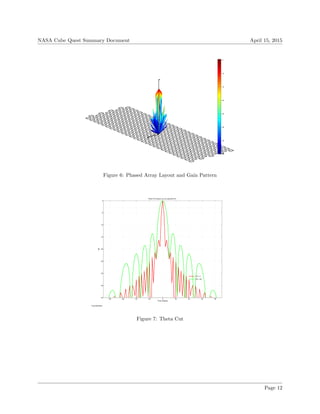
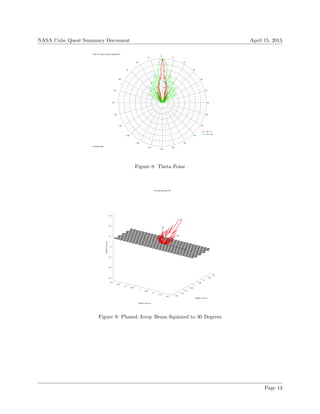
run [13] and gain plots for the phased array can be seen in Figures 6-10.
Table 4: Phased Array Specs
Parameter Value Units Comment
Antenna Size 60 x 30 cm 3U x 6U
Number of Elements 243 Rhombic Pattern
Dielectric Constant 2.03 Teflon (PTFE)
Overall Patch Eff. 80.85 % Excellent
Antenna Gain 30.46 dBi
Beam Width 3 deg. Slice phi=0
Max Squint Angle ±30 deg.
Page 11
NASA Cube Quest Summary Document April 15, 2015
gz
gx
gy
−40
−35
−30
−25
−20
−15
−10
−5
Figure 6: Phased Array Layout and Gain Pattern
−80 −60 −40 −20 0 20 40 60 80
−40
−35
−30
−25
−20
−15
−10
−5
0
Phi = 0
Phi = 90
Theta TOT pattern cuts for specified Phi
Freq 8495 MHz
Theta Degrees
dB
Figure 7: Theta Cut
Page 12
NASA Cube Quest Summary Document April 15, 2015
0
−5
−10
−15
−20
−25
−30
−35
15
30
45
60
75
90
105
120
135
150
165
−180
−165
−150
−135
−120
−105
−90
−75
−60
−45
−30
−15
−0
Phi = 0
Phi = 90
Theta TOT pattern cuts for specified Phi
Freq 8495 MHz
Figure 8: Theta Polar
−0.2
−0.15
−0.1
−0.05
0
0.05
0.1
0.15
0.2 −0.2
−0.15
−0.1
−0.05
0
0.05
0.1
0.15
0.2
−0.3
−0.2
−0.1
0
0.1
0.2
0.3
Global Y−axis (m)
gx
gy
gz
3D Array Geometry Plot
Global X−axis (m)
GlobalZ−axis(m)
Figure 9: Phased Array Beam Squinted to 30 Degrees
Page 13
NASA Cube Quest Summary Document April 15, 2015
0
−5
−10
−15
−20
−25
−30
−35
15
30
45
60
75
90
105
120
135
150
165
−180
−165
−150
−135
−120
−105
−90
−75
−60
−45
−30
−15
−0
Phi = 0
Phi = 90
Theta TOT pattern cuts for specified Phi
Freq 8495 MHz
Figure 10: Polar Plot of Beam Squinted to 30 Degrees
Using a phased array has many engineering advantages. Flat panels are easier to construct than complex
gimballing mechanisms. If the dimensions of the CubeSat need to change, the phased array can morph
respectively and only the elements will need to be re-calibrated. The phased array also offers fault protection.
If one or multiple patches fail it will have little effect on the performance. Likewise, if the main element of
a parabolic dish or laser system fails the mission becomes a bust. Phased arrays have extensive heritage on
the ground and in space [14], because of this we think the technology is ideal if an RF system is to be used
on Artemis.
7.2.2 Phased Array Link Budget
A link budget has been formulated to determine the maximum data rate possible and the signal-to-noise
(SNR) link margin. When transmitting from lunar orbit, the main contributor to signal power degradation
is free-space path loss given by Equation 8.
Ls =
c
4πSf
2
(8)
From the equation we see that path loss decreases as the signal frequency increases. Ideally, ARTEMIS
would transmit in the 8-12 GHz X-band frequency spectrum. The Federal Communications Commission
(FCC) has allocated this frequency band for small sat communication. This band offers low atmospheric
attenuation, higher gain, and higher data rates. There are many commercial transmitters and receivers with
flight heritage designed to operate in the X-band spectrum. Higher frequencies such as Ka band (26.5-40
Ghz) exist, but they suffer from very high rain and atmospheric attenuation that could jeopardize the volume
transmission challenge over a continuous 30-day period. The efficiency of transmitters also decreases as the
signal frequency increases. An X-band solid-state power amplified (SSPA) only has an overall efficiency of
28% [15].
Page 14
NASA Cube Quest Summary Document April 15, 2015
Figure 11: X-Band Frequency Spectrum Allocation
Two link budgets have been created for the phase array, one for each of the potential ground station receivers.
The largest, most advanced X-band capable ground station is NASA’s Deep Space Network (DSN) consisting
of three sites located around the world to provide constant deep space coverage. The receiving dish of interest
is the large 70 m diameter dish as it offers the highest gain and will be useful for comparison purposes. The
alternative ground station is the 26 m radio telescope owned by the University of Michigan located at Peach
Mountain Observatory near Dexter, MI. The Peach Mountain dish has not been operational for decades so
parameter values have been estimated for similar sized parabolic receivers.
Table 5: Link Budget: DSN Ground Station
Parameter Value Unit Comment
Receiver Diameter 70 m DSN Large Dish
Receiver Gain 74.18 dBi [16]
Transmitter Gain 30.46 dBi Calculated
System Noise Temp 21.3 dB-K Estimated
Transmitter Line Loss 0.5 dB From SMAD [17]
Receiver Line loss 0.5 dB Estimate
Required Eb
No
4.4 dB BPSK Plus R-1/2 Viterbi Decoding; From SMAD [18]
BER 10e−5 Bit Error Rate; From SMAD [18]
Transmitter Bus Power 40 W Orbital Average
Power Amplifier Efficiency 30 % From SMAD [18]
Losses 10 dB From SMAD [18]
Free Space Path Loss -222.3 dB At Average Earth Moon Distance
Data Rate 10 Mbps Maximum data rate transmitting to DSN
SNR 19.01 dB Calculated
Link Margin 14.61 dB Very Good
Page 15
NASA Cube Quest Summary Document April 15, 2015
Table 6: Link Budget: Peach Mountain Ground Station
Parameter Value Unit Comment
Receiver Diameter 26 m Peach Mountain Radio Observatory
Receiver Gain 65.73 dBi Calculated
Aperture Efficiency 0.7 Estimated
Transmitter Gain 30.46 dBi Calculated
System Noise Temp 23 dB-K Estimated
Transmitter Line Loss 0.5 dB From SMAD [17]
Receiver Line loss 0.5 dB Estimate
Required Eb
No
1.89 dB Rate 2/3 QPSK Turbo coding; From SMAD [18]
BER 10e−10 Bit Error Rate; From SMAD [18]
Transmitter Bus Power 40 W Orbital Average
Power Amplifier Efficiency 30 % From SMAD [18]
Losses 10 dB From SMAD [18]
Free Space Path Loss -222.3 dB At Average Earth Moon Distance
Data Rate 30 Mbps Target
Spectral Efficiency 1.32
Required Bandwidth 23 Mhz Calculated
SNR 4.1 dB Calculated
Link Margin 2.21 dB
Link analysis of the two different ground stations provides interesting insight into potential communication
architecture. The large 70m dish has very high gain and a low system noise resulting in a very good SNR of
19.01. This gives a link margin of 14.61, which is sufficient highly to account for unexpected losses, pointing
errors, and component inefficiencies. The Peach Mountain Dish (PMD) is a respectably large dish with
sufficient gain for lunar missions. The receivers will not be as advanced as the DSN’s so more system noise
will be present in the signal. This can be mitigated by cooling the receivers, but is unlikely to be necessary.
One of the biggest factors determining downlink data rates is the required SNR and transmission encoding.
Readable bits can be sent at lower signal energies by using advanced forward encoding schemes. Common
encoding methods include BPSK, QPSK, and newer convulsion turbo codes. For example, using QPSK
with a 1/4 code rate the required SNR is only 0.75 dB [19]. However, this comes at the expense of reduced
spectral efficiency of only 0.49 bps/Hz. RF bandwidth is a limited and tightly controlled resource. Therefore,
efficient use of the allocated bandwidth is essential. For the Peach Mountain link budget, we chose a QPSK
rate 2/3 turbo code which makes efficient use of bandwidth at a low SNR. For a bandwidth of only 23 MHz,
ARTEMIS would be able to downlink at a rate of 30 Mbps and a SNR of 4.1 dB. This data rate is exceptional
for a CubeSat and would be fast enough to stream Hi-Def video from lunar orbit. While the link margin is
small, the mission parameters and environment can be tightly controlled to optimize data rates.
One of the biggest inefficiency factors in the link budget is the solid-state power amplifier. It draws 40 W
of bus power, but at 30% efficiency only provides 12 W of RF power to the antenna. Traveling Wave Tube
Amplifiers can exceed 60% efficiency but are bulky and too massive to be flown on a CubeSat. Ideally,
technology maturation will increase component efficiency and help push low-power data rates higher.
7.2.3 Ground Station and Communication Window
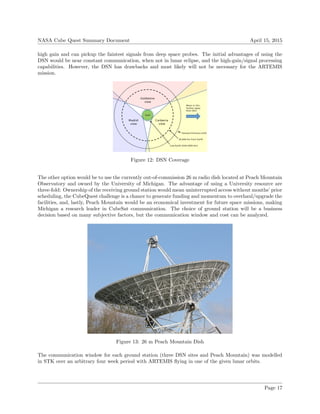
The Deep Space Network (DSN) is a world-wide network of advanced antennas and communication facilities.
There are a total of three sites located in California, Spain, and Australia. Each site is spaced approximately
120° apart to provide uninterrupted contact with deep space missions. The facilities offer exceptional tech-
nology in signal processing, radar telemetry and supporting space missions. The large 70 m dish has very
Page 16
NASA Cube Quest Summary Document April 15, 2015
high gain and can pickup the faintest signals from deep space probes. The initial advantages of using the
DSN would be near constant communication, when not in lunar eclipse, and the high-gain/signal processing
capabilities. However, the DSN has drawbacks and most likely will not be necessary for the ARTEMIS
mission.
Figure 12: DSN Coverage
The other option would be to use the currently out-of-commission 26 m radio dish located at Peach Mountain
Observatory and owned by the University of Michigan. The advantage of using a University resource are
three-fold: Ownership of the receiving ground station would mean uninterrupted access without months’ prior
scheduling, the CubeQuest challenge is a chance to generate funding and momentum to overhaul/upgrade the
facilities, and, lastly, Peach Mountain would be an economical investment for future space missions, making
Michigan a research leader in CubeSat communication. The choice of ground station will be a business
decision based on many subjective factors, but the communication window and cost can be analyzed.
Figure 13: 26 m Peach Mountain Dish
The communication window for each ground station (three DSN sites and Peach Mountain) was modelled
in STK over an arbitrary four week period with ARTEMIS flying in one of the given lunar orbits.
Page 17
NASA Cube Quest Summary Document April 15, 2015
Table 7: Communication Windows from Lunar Orbit over a 4 Week Period
Mean Weekly Contacts Mean Duration [min] Total Contact Time [min]
DSN 58 223.7 12975
Peach Mountain 19 224.9 4272
Ratio (DSN/PM) 3.04
Figure 14: Simulated DSN Communication Window
Figure 15: Simulated Peach Mountain Communication Window
As seen from Table 7, the total contact time for the DSN is three times greater than for Peach mountain.
This makes sense as there are a total of three DSN ground sites vs. one Peach Mountain ground site.
However, this is does not mean that use of the DSN would allow for three times the data to be sent, as
Page 18
NASA Cube Quest Summary Document April 15, 2015
NASA limits the downlink data rate from DSN targets to 10 Mbps [20] to avoid overloading the system
when multiple targets are tracked simultaneously. Normally, 10 Mbps is sufficient for deep space satellites
transmitting telemetry and scientific data. For a capable communication satellite such as ARTEMIS, with
a high-gain transmitting antenna, this is a limiting rate. As it so happens, the link budget using the Peach
Mountain site is sized using a 30 Mbps downlink rate, three times that of the DSN network. This means
that the even though Peach Mountain will not be in constant view of ARTEMIS, we would still be able to
downlink the equivalent volume of data over the 28-day challenge period, and potentially even more data
with improvements. The burst data challenge will be severely hampered by the DSN data limit. The Peach
Mountain site, with capable receivers able to handle the high data rates, would be much more successful at
the challenge. Therefore, it is our recommendation to use a privately owned site to accomplish the burst
challenge.
With total data volume being equal, cost becomes an important factor in determining which ground site
to use. The DSN charges for time based on a costing model that weights the number of contacts and dish
used. The estimate price was calculated using the excel document provided by JPL [16]. Peach Mountain
would be owned by the University of Michigan and access time will be considered free. Unfortunately, this
dish is nonfunctional and significant capital, estimated at $2.5 million, would be needed to bring it online.
However, as mentioned before, the money can be raised through research partners/grants and the dish would
become a vital resource to the University for future missions and scientific research. A cost table 8 can be
seen below.
Table 8: Cost Table for DSN Antenna
Antenna Service Hours per No. Tracks No. Weeks Pre-, Post- Total Total Cost
Size Year Track per Week Required Config. Time Reqd. for period
(meters) (year) (hours) (# tracks) (# weeks) (hours) (hours) Fiscal-Year
70 2018 0.5 1.0 1.0 0.50 1.0 3,134
34BWG 2018 3.75 58.0 4.0 10.00 880.0 4,618,910
From Table 8 we see that the cost to use the DSN for the four week data challenge is exorbitantly high, even
using the smaller 34 m dishes. Concluding the ground station review, we recommend to not use the DSN
as it offers no advantages and is prohibitively expensive. Instead, the University should use funds to restore
the Peach Mountain 26 m RF dish, as this would be the most beneficial use of resources.
7.2.4 Laser Communication
Laser communication could be called the “home run solution” to ARTEMIS’s communications subsystem:
high risk, high reward. In general, laser communications subsystems provide extremely high data rates, but
dramatically increase system complexity. Transmitting the laser to the ground station requires an extremely
precise and stable ADCS system. The TRL for laser communications is low, and even lower for the Cubesat
platform. ARTEMIS could serve as a TRL-raising mission for Cubesat laser communications, but this may
require external expertise, cooperation and funding.
Table 9 estimates the achievable data rates for a 0.5 W output laser communication system aboard ARTEMIS.
If the laser power output is boosted to 2 W, the data rates can be quadrupled.
Potential ground stations include NASA’s 1-m Optical Comm. Telescope Lab at Wrightwood, California;
White Sands, New Mexico; Tenerife, Spain; and, potentially, military or experimental sites. The University
of Michigan could build their own laser ground terminal, which would have the same communication window
as the Peach Mountain dish discussed in the phased array, Section 7.2.3.
Page 19
NASA Cube Quest Summary Document April 15, 2015
Table 9: Estimated data rates for laser communication system.
Parameter Value Units
Assumptions
Range 400,000 km
Flight laser power 0.5 W
Diameter of flight telescope 5 cm
Diameter of ground telescope 100 cm
Link zenith angle 70 °
Flight terminal pointing allocation 15 µrad
Ground detector efficiency 75%
Link margin 3 dB
Slot width 200 ps
Data Rates
Daytime 165 Mb/s
Evening 185 Mb/s
Nighttime 200 Mb/s
To achieve data transmission through a laser, ARTEMIS would have to point the laser towards the ground
station with 120 arcsecond accuracy. The ground station requires a rough 1000-plus pixel CCD camera (17
mrad field of view) to acquire the beacon signal. After acquiring beacon lock, a fine pointing mirror on
ARTEMIS could keep the downlink beam centroid within 2-4 arcsec of the ground station camera centroid.
The Massachusetts Institute of Technology (MIT) Space Systems Laboratory’s Exoplanet Sat is being de-
signed to a 1 arcsec pointing capability using a two-axis piezoelectric translation stage as seen in Figure 16.
If successful, a similar design could be adopted for ARTEMIS. The ARTEMIS ADCS subsystem would also
be used to eliminate sensor noise and jitter by feeding forward estimated disturbances from the reaction
wheels to the optics [21] as seen in Figure 16.
Figure 16: Track and Hold ability of MIT’s Exoplanet Using Piezoelectric Stage
In summary, an accurately size onboard laser communications system is expected to consume approximately
3 kg of mass, 10 W of power, and 1.5U of volume. Besides the technical difficulties, laser is susceptible to
cloud cover and atmospheric distortion. At its current TRL, laser communication has only been flown for
NASA concept testing. The technology space for CubeSat level laser communication systems should continue
to be monitored until the launch date. The technology is developing rapidly and in three years it may end
up being the most desirable option. Michigan can help accelerate the pace of space laser communication
systems by developing ARTEMIS on parallel tracks: one RF and one laser version.
Page 20
NASA Cube Quest Summary Document April 15, 2015
8 Propulsion System (PROP)
The Propulsion System (PROP) has two primary responsibilities. After deployment from EM-1, the PROP
must place the satellite on either a lunar capture or deep space trajectory. Then, over the course of the
mission lifetime, it must perform maneuvers to keep the satellite in its proper orbit or correct for any orbital
perturbations. These tasks may require a significant amount of ∆V . The exact amount will be determined
by simulations of the required orbits. Propulsion System design drivers include:
• Required ∆V determined by orbit.
• Very few, if any, proven CubeSat propulsion systems available.
• Limited fuel volume and mass.
8.1 PROP Performance Dependencies
There are a number of CubeSat subsystems that PROP is dependent upon in order to ensure adequate
performance and capabilities. The Electrical Power (EPS), Guidance (GUID), Attitude Determination and
Control (ADCS), and Structures (STR) subsystems have been determined as these primary dependencies.
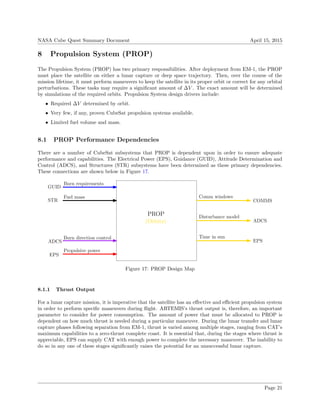
These connections are shown below in Figure 17.
PROP
STR
(Orbits)
ADCS
ADCS
Fuel mass
Burn direction control
Disturbance model
GUID
Burn requirements
Propulsive power
EPS
COMMS
Comm windows
Time in sun
EPS
Figure 17: PROP Design Map
8.1.1 Thrust Output
For a lunar capture mission, it is imperative that the satellite has an effective and efficient propulsion system
in order to perform specific maneuvers during flight. ARTEMIS’s thrust output is, therefore, an important
parameter to consider for power consumption. The amount of power that must be allocated to PROP is
dependent on how much thrust is needed during a particular maneuver. During the lunar transfer and lunar
capture phases following separation from EM-1, thrust is varied among multiple stages, ranging from CAT’s
maximum capabilities to a zero-thrust complete coast. It is essential that, during the stages where thrust is
appreciable, EPS can supply CAT with enough power to complete the necessary maneuver. The inability to
do so in any one of these stages significantly raises the potential for an unsuccessful lunar capture.
Page 21
NASA Cube Quest Summary Document April 15, 2015
8.1.2 Stationkeeping and Maneuvering
In order to perform the lunar capture, or any other stationkeeping operations, the propulsion system must be
properly commanded on specific functions. Knowledge of ARTEMIS’s overall attitude must be continuously
obtained to ensure correct positioning and orientation along its flight path. This can then be analyzed and
interpreted, and PROP can be activated accordingly, giving CAT various commands relating to when, where,
and how long to burn. Specifically, ADCS and GUID will determine when, in the flight path, appreciable
thrust is necessary and, when it is, how much thrust is needed to perform the task at hand. Furthermore,
if the propulsion system is not equipped with multi-axis thrusters or a thrust vectoring system, the precise
orientation for thrusting must also be determined.
8.1.3 Size Constraints
The ability to allocate more volume for the propulsion system not only provides more space for a larger
fuel tank, but allows additional mass to be given to that of the propellant as well. Additionally, CubeSat
launch vehicles are limited to how much payload mass they can carry, depending on the overall size of the
CubeSat (3U, 6U, etc.). Furthermore, the amount of propellant capable of being stored within a CubeSat
often determines a mission’s duration, which can be deduced from the mission’s primary goals. Taking into
account these various factors, the final size of PROP is heavily dependent on the design and manipulation
of STR.
8.2 Simulation Tools & Preliminary Analysis
The focus of PROP’s simulations and analysis has been investigating the various types of thrusters that are
currently available for CubeSats, so that a baseline of capability can be established for the different solutions
regarding ∆V , specific impulse, and thrust.
8.2.1 CubeSat Ambipolar Thruster
The primary propulsion option that we are considering is the CubeSat Ambipolar Thruster (CAT), due to
its large ∆V and Isp capacities, as seen in Table 10, as well as its being under development “in-house” at
the University of Michigan.
Table 10: CAT Specifications for a 3U, 3 kg CubeSat platform
Parameter Value Units
Power Consumption 10 - 50 W
Thrust 0.5 - 4 mN
Isp 400 - 800 s
∆V 1-2 km/s
Thruster Mass 1 kg
Tank Mass 0.3 kg
Prop Mass 0.7 kg
Remaining CubeSat Mass 1 kg
Even after accounting for ARTEMIS’s larger mass compared to the 3U test platform, CAT could still provide
enough thrust and total ∆V for a low-thrust lunar capture maneuver, as detailed in Section 6.2. Although
our predominant choice has rested with the CAT thruster, supplementary research was conducted to find
additional options capable of providing the necessary performance for a lunar capture. Table 11 outlines a
Page 22
NASA Cube Quest Summary Document April 15, 2015
number of these devices, ranging from other low-thrust electric propulsion, to high-thrust chemical propulsion
thrusters.
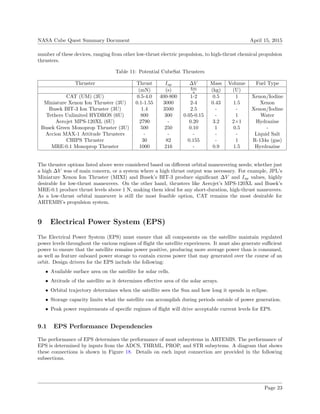
Table 11: Potential CubeSat Thrusters
Thruster Thrust Isp ∆V Mass Volume Fuel Type
(mN) (s) km
s (kg) (U)
CAT (UM) (3U) 0.5-4.0 400-800 1-2 0.5 1 Xenon/Iodine
Miniature Xenon Ion Thruster (3U) 0.1-1.55 3000 2-4 0.43 1.5 Xenon
Busek BIT-3 Ion Thruster (3U) 1.4 3500 2.5 - - Xenon/Iodine
Tethers Unlimited HYDROS (6U) 800 300 0.05-0.15 - 1 Water
Aerojet MPS-120XL (6U) 2790 - 0.20 3.2 2×1 Hydrazine
Busek Green Monoprop Thruster (3U) 500 250 0.10 1 0.5 -
Accion MAX-1 Attitude Thrusters - - - - - Liquid Salt
CHIPS Thruster 30 82 0.155 - 1 R-134a (gas)
MRE-0.1 Monoprop Thruster 1000 216 - 0.9 1.5 Hyrdrazine
The thruster options listed above were considered based on different orbital maneuvering needs; whether just
a high ∆V was of main concern, or a system where a high thrust output was necessary. For example, JPL’s
Miniature Xenon Ion Thruster (MIXI) and Busek’s BIT-3 produce significant ∆V and Isp values, highly
desirable for low-thrust maneuvers. On the other hand, thrusters like Aerojet’s MPS-120XL and Busek’s
MRE-0.1 produce thrust levels above 1 N, making them ideal for any short-duration, high-thrust maneuvers.
As a low-thrust orbital maneuver is still the most feasible option, CAT remains the most desirable for
ARTEMIS’s propulsion system.
9 Electrical Power System (EPS)
The Electrical Power System (EPS) must ensure that all components on the satellite maintain regulated
power levels throughout the various regimes of flight the satellite experiences. It must also generate sufficient
power to ensure that the satellite remains power positive, producing more average power than is consumed,
as well as feature onboard power storage to contain excess power that may generated over the course of an
orbit. Design drivers for the EPS include the following:
• Available surface area on the satellite for solar cells.
• Attitude of the satellite as it determines effective area of the solar arrays.
• Orbital trajectory determines when the satellite sees the Sun and how long it spends in eclipse.
• Storage capacity limits what the satellite can accomplish during periods outside of power generation.
• Peak power requirements of specific regimes of flight will drive acceptable current levels for EPS.
9.1 EPS Performance Dependencies
The performance of EPS determines the performance of most subsystems in ARTEMIS. The performance of
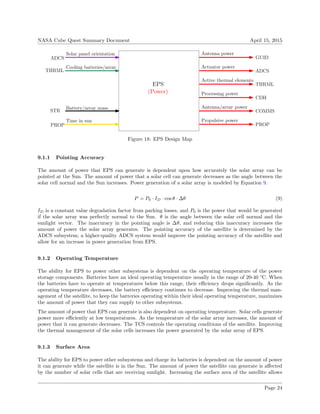
EPS is determined by inputs from the ADCS, THRML, PROP, and STR subsytems. A diagram that shows
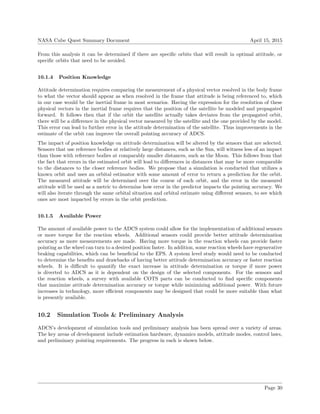
these connections is shown in Figure 18. Details on each input connection are provided in the following
subsections.
Page 23
NASA Cube Quest Summary Document April 15, 2015
EPS
THRML
(Power)
Cooling batteries/array
Battery/array mass
Solar panel orientation
Time in sun
COMMS
ADCS
Actuator power
Antenna/array power
Antenna power
Active thermal elements
Processing power
Propulsive power
GUID
THRML
CDH
PROPPROP
STR
ADCS
Figure 18: EPS Design Map
9.1.1 Pointing Accuracy
The amount of power that EPS can generate is dependent upon how accurately the solar array can be
pointed at the Sun. The amount of power that a solar cell can generate decreases as the angle between the
solar cell normal and the Sun increases. Power generation of a solar array is modeled by Equation 9.
P = P0 · ID · cos θ · ∆θ (9)
ID is a constant value degradation factor from packing losses, and P0 is the power that would be generated
if the solar array was perfectly normal to the Sun. θ is the angle between the solar cell normal and the
sunlight vector. The inaccuracy in the pointing angle is ∆θ, and reducing this inaccuracy increases the
amount of power the solar array generates. The pointing accuracy of the satellite is determined by the
ADCS subsystem; a higher-quality ADCS system would improve the pointing accuracy of the satellite and
allow for an increase in power generation from EPS.
9.1.2 Operating Temperature
The ability for EPS to power other subsystems is dependent on the operating temperature of the power
storage components. Batteries have an ideal operating temperature usually in the range of 20-40 °C. When
the batteries have to operate at temperatures below this range, their efficiency drops significantly. As the
operating temperature decreases, the battery efficiency continues to decrease. Improving the thermal man-
agement of the satellite, to keep the batteries operating within their ideal operating temperature, maximizes
the amount of power that they can supply to other subsystems.
The amount of power that EPS can generate is also dependent on operating temperature. Solar cells generate
power more efficiently at low temperatures. As the temperature of the solar array increases, the amount of
power that it can generate decreases. The TCS controls the operating conditions of the satellite. Improving
the thermal management of the solar cells increases the power generated by the solar array of EPS.
9.1.3 Surface Area
The ability for EPS to power other subsystems and charge its batteries is dependent on the amount of power
it can generate while the satellite is in the Sun. The amount of power the satellite can generate is affected
by the number of solar cells that are receiving sunlight. Increasing the surface area of the satellite allows
Page 24
NASA Cube Quest Summary Document April 15, 2015
EPS to create a larger solar array and increase the amount of power generated by the satellite. Increasing
the power generated allows EPS to recharge batteries faster and supply more power to other subsystems.
9.1.4 Satellite Volume
The ability for EPS to power other subsystems, particularly while the satellite is in a Sun-obscuring eclipse,
is dependent on the amount of power that can be stored in the satellite. The maximum amount of power
that can be stored is determined by the number of batteries that can be housed inside of the satellite. The
structure of the satellite determines the available volume, which limits how many batteries can be stored.
Increasing the volume of the satellite or reducing the amount of volume that other subsystems occupy would
allow for EPS to store more power for eclipse periods. Additional power storage is desirable because it allows
for more flexibility with COMMS and PROP when the satellite is in an eclipse, blocking the solar panels
from the Sun.
9.1.5 Time in the Sun
The amount of power that can be generated by a given solar cell array is dependent upon the amount of
time the satellite spends in sunlight, out of eclipse. The amount of time that the satellite spends in the
sunlight is determined by its orbit, and can be altered by the PROP subsystem. Using the PROP subsystem
to accelerate the satellite out of an eclipse can increase the sunlight experienced by the solar array in an
orbit. Increasing the amount of time the solar array is in the sunlight can generate extra power that can
either be used to add flexibility to the COMMS subsystem or reduce the amount of batteries needed aboard
the satellite.
9.2 Simulation Tools & Preliminary Analysis
EPS’s development of simulation tools and preliminary analysis has been spent on potential solar cell place-
ment, solar array size, and power storage. These are the main contributions to the amount of power EPS
can provide to other subsystems.
9.2.1 Solar Cell Placement
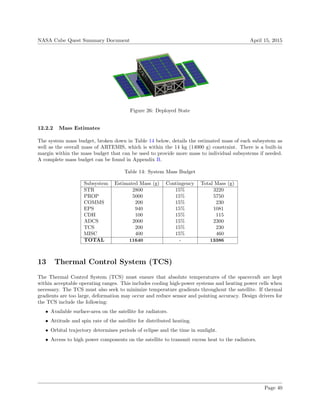
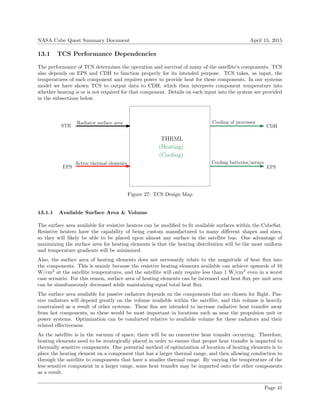
We have determined the overall placement of solar cells and phased array elements based on the influence
of shading from the satellite body. One side of ARTEMIS’s deployable array is subject to shading while
the other is not. Ideally, the side subject to shading will be always facing its target directly, resulting in no
shading for either side of the body. The phased array can alter its pointing angle independent of spacecraft
attitude, however, if it were on the body shading side it would suffer losses whenever it did this. Therefore,
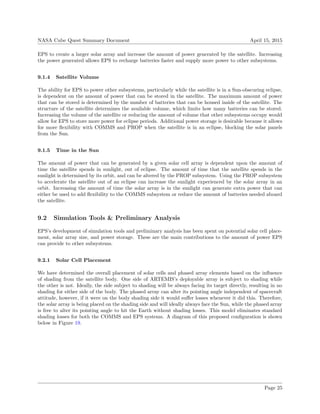
the solar array is being placed on the shading side and will ideally always face the Sun, while the phased array
is free to alter its pointing angle to hit the Earth without shading losses. This model eliminates standard
shading losses for both the COMMS and EPS systems. A diagram of this proposed configuration is shown
below in Figure 19.
Page 25
NASA Cube Quest Summary Document April 15, 2015
Sun Vector
Solar PanelsPhased Array
Solar Panels
Earth Vector
Figure 19: Proposed Position and Orientation of Solar Panels and Phased Array
9.2.2 Solar Array Sizing
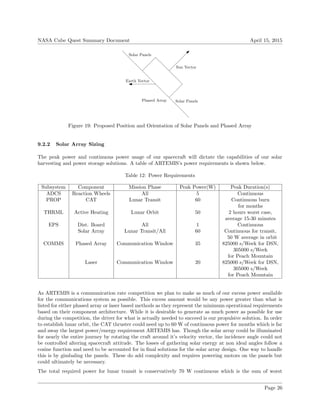
The peak power and continuous power usage of our spacecraft will dictate the capabilities of our solar
harvesting and power storage solutions. A table of ARTEMIS’s power requirements is shown below.
Table 12: Power Requirements
Subsystem Component Mission Phase Peak Power(W) Peak Duration(s)
ADCS Reaction Wheels All 5 Continuous
PROP CAT Lunar Transit 60 Continuous burn
for months
THRML Active Heating Lunar Orbit 50 2 hours worst case,
average 15-30 minutes
EPS Dist. Board All 1 Continuous
Solar Array Lunar Transit/All 60 Continuous for transit,
50 W average in orbit
COMMS Phased Array Communication Window 35 825000 s/Week for DSN,
305000 s/Week
for Peach Mountain
Laser Communication Window 20 825000 s/Week for DSN,
305000 s/Week
for Peach Mountain
As ARTEMIS is a communication rate competition we plan to make as much of our excess power available
for the communications system as possible. This excess amount would be any power greater than what is
listed for either phased array or laser based methods as they represent the minimum operational requirements
based on their component architecture. While it is desirable to generate as much power as possible for use
during the competition, the driver for what is actually needed to succeed is our propulsive solution. In order
to establish lunar orbit, the CAT thruster could need up to 60 W of continuous power for months which is far
and away the largest power/energy requirement ARTEMIS has. Though the solar array could be illuminated
for nearly the entire journey by rotating the craft around it’s velocity vector, the incidence angle could not
be controlled altering spacecraft attitude. The losses of gathering solar energy at non ideal angles follow a
cosine function and need to be accounted for in final solutions for the solar array design. One way to handle
this is by gimbaling the panels. These do add complexity and requires powering motors on the panels but
could ultimately be necessary.
The total required power for lunar transit is conservatively 70 W continuous which is the sum of worst
Page 26
NASA Cube Quest Summary Document April 15, 2015
case power required for the CAT thruster and satellite bus systems. A solution involving panels under
ideal inclination angles for the duration of the trip using 28.3% efficient Spectrolab UTJs will generate 38.3
mW/cm2
at its maximum power point [22]. Each 3U face of the solar array will have seven 32 cm2
solar
cells and therefore generate 8.58 W. Including a standard pre-alpha mission phase margin of 30% means the
8.58 W per 3U panel would need to source 91 W of power. This ultimately requires a deployed solar array
that is slightly larger than 10U x 3U. This is once again a solar panel that is assumed to be perfectly facing
the Sun and operating exactly at its maximum power point.
In summary, the current 6U x 3U array would not be sufficient to power ARTEMIS’s trip to the Moon.
Advances in solar cell technology could make it a possibility, but they would need to be drastic. For instance
to use an 8U x 3U array, the solar cells would have to reach 38% efficiency, while a 6U x 3U array would
need 51% cell efficiency.
9.2.3 Power Storage
ARTEMIS is expected to experience regular eclipse intervals during lunar orbit and some of these eclipses
could be up to 4 hours in length. This dark environment will become quite cold and staying in it for
any duration longer than an hour without active heating would put some of our components beyond their
survivability limits. To prevent this, ARTEMIS will be actively heating its components during eclipse periods
using power stored when the spacecraft was in the Sun. The degree and method of heating chosen requires
a significant amount of power and represents the largest necessary amount of power storage for ARTEMIS.
The thermal subsystem is base-lining a solution that would draw 50 W for over two hours to maintain
component capabilities during a worst case eclipse scenario, as described in Table 12. This means the
storage capacity of ARTEMIS, accounting for the 30% margin, would need to be 130 Wh. However, as
this requirement is based entirely on thermal control, it could be reduced with advances in its capabilities
or by choosing less power intensive method. Additionally, having large amounts of storage capacity could
also be quite advantageous for the competition. ARTEMIS will also require high capacity storage for the
capture maneuver burns, thus afterwards there will be a depleted storage well on the satellite which would be
available for other systems after recharging. The relatively long sunlight times and short eclipse times should
allow us to rapidly charge the batteries, thus providing ample power even for high-demand subsystems. This
power would also allow us to broadcast even when the Sun is eclipsed during a transmission window, and
would provide an emergency reserve during lunar eclipse, when the Sun would be obstructed by the Earth
for an extended period of time.
We are base-lining the use of Lithium Ion batteries to supply the necessary 130 Wh of power to ARTEMIS. It
would require 1.2 kg of Li-Ion batteries to supply this amount of power. We are base-lining Li-Ion batteries
due to the fact that they have the same cycling ability as Nickel Hydrogen and Nickel Cadmium batteries
but can supply twice as much power. They also have a long flight heritage and can be bought at low cost,
which makes them more reliable and cost-effective than Lithium Polymer batteries that are currently being
researched.
10 Attitude Determination and Control System (ADCS)
The Attitude Determination and Control System (ADCS) has two primary and related responsibilities. First,
the ADCS must estimate the satellite’s attitude using a variety of sensors and filters. Then, the ADCS must
be able to control the satellite’s attitude. This is necessary for the successful operation of components such
as the transmitter, solar panels, and propulsion system. Design drivers for the ADCS include the following:
• Orbital trajectory and selection of communication system will drive the required pointing accuracy.
Page 27
NASA Cube Quest Summary Document April 15, 2015
• Both lunar and deep space trajectories limit the types of sensors which can be used for attitude
determination.
• ADCS cannot rely on any magnetic field dependent sensors or actuators.
10.1 ADCS Performance Dependencies
The performance of ADCS determines the performance of several different systems, and relies on even more
to perform. In our systems model we have abstracted ADCS to output pointing, which encompasses both the
attitude to be tracked and the accuracy with which it is tracked. The CDH, STR, PROP, GUID, and EPS
subsystems all have inputs that determine how well ADCS performs. A diagram that shows these connections
is shown in Figure 20. Details on each input connection are provided in the following subsections.
ADCS
STR
(Pointing)
GUID
PROP
Sensor/actuator mass
Pointing requirements
Burn direction control
CDH
Algorithm speed
Actuator power
EPS
COMMS
Pointing accuracy
Solar panel orientation
EPS
PROP
Disturbance model
Figure 20: ADCS Design Map
10.1.1 Processing Speed
The accuracy of the pointing provided by ADCS is highly governed by the estimation algorithm, guidance
algorithm, and control law that are being executed by the flight computer. The more quickly these processes
can be executed the quicker the satellite can adapt to changes in its current attitude and desired attitude.
The speed at which these processes can be executed are mandated by the flight computer features, such as
the number of cores, its clock speed, and other parameters included in the CDH subsystem, as well as the
chosen algorithms in the ADCS process. The correlation between pointing accuracy and processing speed
is not a very well defined relationship based on our research. This makes sense due to the complex and
varying nature of algorithms used to estimate attitude and determine control torques on a spacecraft body.
In addition, accuracy may be defined by several metrics including rise time, overshoot, and settling time, as
well as steady state error.
We propose that the following model and experiment be conducted to determine if a correlation exists between
pointing accuracy and processing speed. First, we must determine two metrics for which a comparison can
be drawn. The first set will be the independent variable, which will be the number of process executions per
second, where a process is defined as an estimation of attitude and the determination of a required control
torque. We will be able to change the processor speed as a variable and thus control this metric. The output
metric will consist of a set of values including rise time, overshoot, settling time, and steady state error. This
will give us an idea of how each of these change with processing speed.
It is important that several different estimation algorithms and control laws be used in different combina-
tions for this experiment to return a trend for accuracy versus computation speed, if it exists. Estimation
Page 28
NASA Cube Quest Summary Document April 15, 2015
algorithms should include simple algorithms such as the TRIAD algorithm and the q-Method [23], as well as
more computationally expensive methods such as the Kalman Filter, Extended Kalman Filter, Multiplica-
tive Extended Kalman Filter [24], and Complementary Filters [25]. ADCS may also incorporate a variety of
feedback methods, such as linearization about a given state or non-linear SO(3)-based control laws, as seen
in Zlotnik [26].
10.1.2 Sensor and Actuator Volume
The ability for ADCS to determine the attitude of the satellite and to achieve and maintain a desired
orientation or attitude rate is dependent on the selection of sensors and actuators which is limited by the
size constraints of the CubeSat. For attitude determination, a Star Tracker alone would be sufficient; however,
it becomes useless if it is blinded by light from the Moon, Sun, or the Earth. As this blinding is expected
to occur regularly, ARTEMIS will require additional attitude sensors for redundancy. Potential redundant
sensors include additional Star Trackers, horizon sensors, gyros, or sun sensors and photodiodes.
In order to determine the optimal number of attitude sensors, we can conduct a simulation with Orbits data
to maximize the ADCS sensor coverage time while minimizing the mass and volume. We can check how
frequently a Star Tracker tracks stellar targets and determine the relationship between adding additional
Star Trackers and increased stellar target tracking time. We can also simulate with different combinations
of attitude sensors and determine if utilizing other sensors with the Star Tracker provides enough time to
track attitude.
Attitude control is conducted by the ADCS actuators, which are traditionally reaction wheels. A reaction
wheel consists of a brushless motor attached to a flywheel which spins and produces a torque on the flywheel
that acts on the CubeSat with an equal magnitude but opposite direction. Having bigger reaction wheels
provides additional torque and faster control for the CubeSat at the cost of using more mass and volume.
The relationship between mass/volume with reaction wheel torque cannot be directly computed because
suppliers design their commercial off-the-shelf reaction wheels to have a similar mass or volume but different
torques and saturation speeds. A preliminary estimate can be made by conducting a survey with currently
available reaction wheels, categorized by different suppliers, to create a trend between mass/volume and
torque and saturation speeds. When the communication system is finalized and pointing accuracy require-
ments are determined, these estimates can be evaluated to find a supplier that designs reaction wheels that
fit our mass and volume constraints.
10.1.3 Orbital Parameters
The ability for ADCS to determine the attitude of the satellite depends on the orbital environment of
the satellite and the reference bodies that it will have available during the course of these orbits. Attitude
determination requires that the physical vectors from the satellite body to various objects, such as the Earth,
Sun, Moon, or other distant body, be measurable by on-board sensors. Thus, if the the line of sight required
for a measurement is blocked, it will disable that measurement from being utilized in attitude determination.
Blockages in line of sight are highly dependent on the orbit that the satellite is in. Orbits with periods of
eclipse will result in the loss of both coarse and fine sun sensors as an attitude measurement device, while
they may result in higher star tracker accuracy due to less saturation. Similarly, lunar horizon sensors may
be impacted by the shape of the orbit around the Moon. These trades are related highly to the particular
accuracy of a sensor as well as the number of environment it can be utilized in.
We propose that orbital simulations are conducted that put the satellite through a variety of orbital envi-
ronments (preferably with lunar-Earth, lunar-Sun, and Earth-Sun eclipses) so that we can determine how
each orbit impacts the utility of each different sensor. By taking the line of sight data provided by these
simulations, we can input this data into our attitude algorithms and analyze the accuracy of our estimator.
Page 29
NASA Cube Quest Summary Document April 15, 2015
From this analysis it can be determined if there are specific orbits that will result in optimal attitude, or
specific orbits that need to be avoided.
10.1.4 Position Knowledge
Attitude determination requires comparing the measurement of a physical vector resolved in the body frame
to what the vector should appear as when resolved in the frame that attitude is being referenced to, which
in our case would be the inertial frame in most scenarios. Having the expression for the resolution of these
physical vectors in the inertial frame requires that the position of the satellite be modeled and propagated
forward. It follows then that if the orbit the satellite actually takes deviates from the propagated orbit,
there will be a difference in the physical vector measured by the satellite and the one provided by the model.
This error can lead to further error in the attitude determination of the satellite. Thus improvements in the
estimate of the orbit can improve the overall pointing accuracy of ADCS.
The impact of position knowledge on attitude determination will be altered by the sensors that are selected.
Sensors that use reference bodies at relatively large distances, such as the Sun, will witness less of an impact
than those with reference bodies at comparably smaller distances, such as the Moon. This follows from that
the fact that errors in the estimated orbit will lead to differences in distances that may be more comparable
to the distances to the closer reference bodies. We propose that a simulation is conducted that utilizes a
known orbit and uses an orbital estimator with some amount of error to return a prediction for the orbit.
The measured attitude will be determined over the course of each orbit, and the error in the measured
attitude will be used as a metric to determine how error in the predictor impacts the pointing accuracy. We
will also iterate through the same orbital situation and orbital estimate using different sensors, to see which
ones are most impacted by errors in the orbit prediction.
10.1.5 Available Power
The amount of available power to the ADCS system could allow for the implementation of additional sensors
or more torque for the reaction wheels. Additional sensors could provide better attitude determination
accuracy as more measurements are made. Having more torque in the reaction wheels can provide faster
pointing as the wheel can turn to a desired position faster. In addition, some reaction wheels have regenerative
braking capabilities, which can be beneficial to the EPS. A system level study would need to be conducted
to determine the benefits and drawbacks of having better attitude determination accuracy or faster reaction
wheels. It is difficult to quantify the exact increase in attitude determination or torque if more power
is diverted to ADCS as it is dependent on the design of the selected components. For the sensors and
the reaction wheels, a survey with available COTS parts can be conducted to find specific components
that maximize attitude determination accuracy or torque while minimizing additional power. With future
increases in technology, more efficient components may be designed that could be more suitable than what
is presently available.
10.2 Simulation Tools & Preliminary Analysis
ADCS’s development of simulation tools and preliminary analysis has been spread over a variety of areas.
The key areas of development include estimation hardware, dynamics models, attitude modes, control laws,
and preliminary pointing requirements. The progress in each is shown below.
Page 30
NASA Cube Quest Summary Document April 15, 2015
10.2.1 Attitude Estimation Hardware
We have spent time investigating the different hardware we could utilize for estimating our attitude. We
began by considering traditional equipment. This includes the following:
• Photodiodes/Sun Sensors
• Magnetometers
• Star Trackers
• Horizon Sensors
• Gyros
Due to the fact that Earth’s magnetic field does not extend out to our position in lunar orbit (more than 9
times further than geostationary orbit, and GEO already faces issues with satellites exiting Earth’s magnetic
field), magnetometers would be useless for attitude determination. This leaves photodiodes/sun sensors, star
trackers, and horizon sensors as the main three options. Photodiodes have been used successfully in previous
lunar missions, but are not sufficient alone for estimating attitude. They will also face problems with eclipse,
which we know we will see periods of in our orbit. Horizon sensors provide an interesting opportunity for this
mission, as there may be the potential to utilize a horizon sensor that has been modified to detect the horizon
of the Moon as well as a horizon sensor that is capable of detecting Earth’s horizon. The optimal attitude
of the satellite may limit the use periods of this sensor at times, but it would provide the complement to
the photodiodes needed to get an estimate of attitude. Star Trackers, while more expensive, provide a direct
parametrization of the attitude given a visible star field. This is a highly potential candidate for our ADCS
given the constraints on the other sensors we can use. The issue is that we have to ensure that the sensor is
able to point at a star field during the variety of operation modes it experiences.
10.2.2 Dynamics Model
We have constructed a model for the satellite that will be useful for simulating the attitude dynamics of
the vehicle. This model does not account for the translational dynamics, which are handled by the orbit
models, but looks at the rotational dynamics using a Newton-Euler approach. This approach was chosen
over a Lagrangian approach because the system does not have constrained bodies, which is what Lagrangian
dynamics excels at. Figure 21 below shows a rough schematic of the system used for our modeling.
The matrix equation that encompasses the rotational dynamics using a Newton-Euler approach, Equation
10, is shown below.
IBC
b ˙ωbi
b + ωbi×
b IBC
b ωbi
b = τBC
b (10)
The components of Equation 10, from left to right, are as follows: IBC
b is the inertia matrix of the body,
relative to the center of mass, resolved in the body frame. ˙ωbi
b is the time derivative of the components of
the angular velocity of the body frame, relative to the inertial frame, resolved in the body frame. ˙ωbi
b is the
angular velocity of the body frame, relative to the inertial frame, resolved in the body frame. Finally, τBC
b
are the moments on the body, about the center of mass, resolved in the body frame. For modeling purposes,
this is rewritten in a form to be used in MATLAB’s ode45 differential equation solver.
˙ωbi
b = IBC−1
b (τBC
b − ωbi×
b IBC
b ωbi
b ) (11)
Page 31
NASA Cube Quest Summary Document April 15, 2015
C
i−→
1
i−→
2
i−→
3
b−→
1
b−→
2
b−→
3
R1R2
R3
P1
Figure 21: ARTEMIS ADCS Schematic
Equation 11 is then combined with Poisson’s Equation (12) to fully describe the system kinematics.
−ωbi×
b Cbi = ˙Cbi (12)
In Equation 12, ωbi
b is the angular velocity of the body frame relative to the inertial frame, Cbi is the direction
cosine matrix that describes the orientation of the body frame relative to the inertial frame, and ˙Cbi is the
time derivative of its elements.
If we vectorize Equation 12, we now have a state model that is quite easy to input into MATLAB. It is also
helpful if we consider our system in question. In particular, we can look at what moments it will experience,
and what major elements will factor into its inertia tensor. The moments on the body will come from the
three reaction wheels, R1, R2, R3, and the propulsion system, P1, depending on an offset in its placement
in the satellite. This looks like Equation 13 below.
τBC
b = τR1C
b + τR2C
b + τR3C
b + rP1C×
b fP1
b =





τR1C
b1
τR2C
b2 − fP1
b1 rP1C
b3
τR3C
b3 + fP1
b1 rP1C
b2





(13)
In considering the inertia matrix, the initial modeling accounts for the structure, thruster, solar arrays, and
fuel tanks. These factors are collected in Equation 14 below.
IBC
b = ISC
b + IPC
b + IAC
b + IT C
b (14)
Page 32
NASA Cube Quest Summary Document April 15, 2015
10.2.3 Attitude Modes
The ADCS will be required to operate in many different modes depending on where the satellite is located
and what it needs to do. Some of these modes are presented below.
• Initial Stabilization: There is a high probability that ARTEMIS will have a significant angular velocity
upon ejection from its launch vehicle. Before any fine attitude estimation can occur, this angular
velocity must be reduced to a manageable level. Thus, upon start-up, ADCS will enter an initial
stabilization mode. In this mode, coarse sensors will estimate the spacecraft’s angular velocity and a
simple control law will reduce that velocity.
• Initial Attitude Determination: Once the initial angular velocity has been reduced to a reasonable level,
fine attitude estimation and control will begin. Sensors (likely including a star tracker) will estimate
the orientation of the satellite and the reaction wheels will adjust that attitude.
• Orbit Insertion: After attitude estimation and control has been established and the satellite’s position
has been determined, ARTEMIS must fire its thruster to enter a lunar capture orbit. To do so most
effectively, the thrust must be provided in a specific direction. In the orbital insertion mode, the ADCS
must maintain this orientation while ensuring the solar panels produce adequate power.
• Battery Charging: In the nominal battery charging mode, the ADCS will point the deployable solar
panels directly at the Sun to maximize power production.
• Transmission: In the nominal transmission mode, the ADCS must orient the satellite so that the
transmission SNR is maximized while ensuring adequate power. This is an optimization problem that
we will be working to solve.
• Orbital Maintenance: The orbital maintenance mode is similar to the orbital insertion mode. Small
burns will be required to maintain a suitable orbit and these burns will require the thruster to be
pointed in a certain direction.
• Desaturation: The reaction wheels that the ADCS uses to control the satellite’s attitude are limited
in what spin rate they can maintain. When the maximum rate is reached, some of this energy must
be dumped to allow for continued attitude control. This is known as desaturation. In this mode, the
ADCS will orient the satellite to optimize the desaturation process, which will likely be performed with
a cold gas thrusting system.
• Safe Mode: When a serious anomaly is detected, ARTEMIS will enter a safe mode until it is resolved.
In the safe mode, the ADCS will first enter a detumbling mode to reduce angular velocity using a
control law. Once the system reaches a manageable angular velocity, it will orient the satellite to point
the solar panels directly at the Sun until all of the batteries are fully charged. The ADCS will then
wait for a command from the flight computer to resume normal operations.
10.2.4 Optimal Attitude Determination
An interesting problem exists in the defining of ARTEMIS’s attitude states. It is apparent that for each mode,
there is some optimal pointing that the satellite should take on to best accomplish the goal of that mode.
This optimal attitude will maximize goals satisfied, with each goal weighted by the particular operational
mode. Finding this optimal state can be done using a very similar method to popular attitude determination
methods.
Upon inspection, we are trying to minimize the difference between a set of vectors resolved in the body
frame and the same vectors resolved in the inertial frame, or trying to solve a Wahba’s problem. Typically
in attitude determination we obtain the vectors in the body frame from measurements. For finding optimal
attitude, we instead declare what we would like to be this vector to be when resolved in the body frame.
Page 33
NASA Cube Quest Summary Document April 15, 2015
For instance, if the normal vector for a solar array appears as 0 0 1
T
in the body frame, we may declare
that the vector to the Sun appears as 0 0 1
T
when resolved in the body frame for the best angle of
incidence. From this we can now compose a set of vectors that we’d like to satisfy (such as solar arrays
towards the Sun, communications systems towards the ground, or ADCS sensors towards their operational
references). Then we may apply a solution method such as the q-Method or QUEST algorithm, which can
be found in de Ruiter, et al [23]. A MATLAB script that finds the optimal attitude using the q-Method can
be found in Appendix A.
10.2.5 Control Laws
Our primary investigative focus thus far has been the application of control by utilizing the direction cosine
matrix directly, following the work of Forbes, et al [26, 27]. A proportional-derivative control law that
provides this is given below.
τBC
b = kpPa(E)v
− kdωbd
b (15)
In this equation, τBC
b is the applied torque resolved in the body frame, kp is the proportional gain, Pa(·)
is the skew-symmetric projection operator such that Pa(U) = 1
2 (U − UT
), E is the rotation error matrix
defined by E = Cbd = CbiCT
di, where Cdi describes the desired attitude, (·)v
is the vectorizing operator such
that (u×
)v
= u, kd is the derivative gain, and ωbd
b is the angular velocity of the body frame, relative to the
desired frame, expressed in the body frame. We’d like to explore the potential for using this control law as
it would allow us to bypass parameterizing the direction cosine matrix.
To utilize this equation above, we will need to find an expression for ωbd
b , the angular velocity of the body
frame, relative to the desired frame, expressed in the body frame. This can be found using the following
equation.
ωbd
b = ωbi
b − ωdi
b (16)
The expression for the first term on the RHS can be produced by gyro measurements on the satellite. The
expression for the second term on the RHS is not easy to find analytically, but may be obtained by taking
the desired attitude at two times separated by a small time step, ∆t. Using the definition of the derivative
and Poisson’s equation, we can produce the following equation, which will give us a more usable expression.
ωdi
d = Pa
Cdi(t + ∆t)CT
di(t) − 1
∆t
v
(17)
It does assume that ∆t is small enough that the angular velocity physical vector is constant over ∆t.
Simulations can show how big ∆t can grow before significant error appears.
10.2.6 Accuracy Requirements
The ADCS accuracy requirement is derived by the antenna pointing requirement as determined by COMMS
in Section 7.1.3. If the laser communication system is selected, it is desired to have an extremely precise
pointing accuracy. In comparison, a phased array system could provide more flexibility in optimal attitude
and required accuracy requirements. A preliminary pointing accuracy for a laser communication system is
on the order of 3−9 mrad [28]. This is considered conservative, as lunar and deep-space spacecraft typically
point RF antennas with precisions to within 3 mrad. Current COTS components can currently provide a
pointing accuracy of ±0.01°, or 0.17 mrad [29].
Page 34
NASA Cube Quest Summary Document April 15, 2015
11 Command and Data Handling System (CDH)
The Command and Data Handling System (CDH) must handle all on-board computing and data management
tasks [30]. These tasks will include monitoring the health of the satellite, preparing data for transmission
to Earth, ADCS algorithms, and any autonomous operations while in orbit. The CDH must handle all of
these reliably while exposed to solar radiation whenever ARTEMIS is not in eclipse. As a result, the effects
of radiation on the flight computer will be a primary consideration. Specific design drivers for the CDH
include:
• Redundancy or protection in case of event upsets due to solar radiation.
• Other satellite subsystems will determine the processing speed and memory requirements.
11.1 CDH Performance Dependencies
The performance of our Command and Data Handling system determines the capabilities of several other
subsystems. The performance of the CDH is related to the power, volume, and thermal control provided
to the system. Abstractly, the CDH outputs processing speed, or the number of computations per second
that other subsystems can utilize. These inputs and outputs are shown below in Figure 22. The inputs to
CDH are discussed in detail in the sections following the figure. The main subsystems which depend on
the processing speed of the CDH are COMMS and ADCS. The CDH must also be able to withstand the
radiation environment in space for the duration of its mission. While not modeled directly as an input,
radiation will be a significant consideration in any models or design decisions.
CDH
STR
(Processing)
EPS
COMMS
ADCS
Redundant computers
Processing power
Data rate support
Algorithm speed
THRML
Cooling of processor
Figure 22: CDH Design Map
11.1.1 Processor Power
The processing speed of the flight computer is related to the amount of power it is provided. In general,
higher power allows for a higher speed computer. However, a specific trend for this relationship is not
known. A second consideration is the performance of the same flight computer when given different amounts
of power.
To determine the first relationship, we advise that as the full satellite design date approaches, power and
processing speed data be gathered for a number of COTS CDHs and flight computers. This will allow for an
approximate trend to be developed for the most advanced technology available. Determining the relationship
between input power and processing speed for a given flight computer will require more experimentation.
Page 35
NASA Cube Quest Summary Document April 15, 2015
We propose that the flight computers under consideration be tested in the following manner. First, a range
of likely input powers are developed. Then, for each of those power levels, the clock speed of the computer
is increased until the data output rate does not match that speed. This will yield the maximum processing
speed for a given input power. Once these relationships are established, a CDH can be selected or designed
to meet the requirements established by the dependent subsystems.
11.1.2 CDH Volume
The volume dedicated to the CDH determines the types and quantities of hardware that can be flown. Most
CubeSat CDHs are approximately the same size and thus, increasing the amount of volume for a single
computer system will likely have little effect. However, the main consideration for volume allotment has to
do with radiation protection. There are two main hardware options to mitigate the risk presented by the
high-radiation environment. The first option is to fly several independent flight computers. Then, if one
computer is damaged, command can be transferred to a backup system and operations can resume. For this
option, an increase in the volume allotted to CDH results in the ability to fly more backup computers. The
second option is to physically enclose the CDH in a case to reduce the amount of radiation that reaches
the flight computer. Similar to the first option, the size of this case is directly related to how much volume
is allotted to CDH. The size of the case is also directly related to how much protection it provides. It is
important to note that both options also significantly increase the mass of the CDH.
11.1.3 CDH Thermal Management
The spacecraft’s thermal management capabilities also influence the performance of the CDH. Specifically,
all flight computers have a range of operating temperatures. As the processing speed increases, the flight
computer will give off more and more heat. If the thermal control system can remove this heat, the flight
computer can operate at a higher speed for longer. To determine this relationship, two things must be
done. First, the maximum operating temperature must be determined for each potential computer. This is
typically done by the manufacturer but could be tested in a lab. Second, and more involved, is testing to
determine how thermal control changes operating speed and duration. The first step to testing this would
be selecting a specific computer model. The computer should then be run without any thermal control until
it fails due to overheating. This will likely require increasing the processing speed. Then, different types
of thermal control should be applied and the processor speed increased until failure. At a certain level of
thermal control, it is likely that the computer will no longer overhead. It is important to note that these
tests could quickly become very expensive if the computers are destroyed each time they overheat.
11.2 Simulation Tools & Preliminary Analysis
Without the protection from radiation offered in Low-Earth Orbit, ARTEMIS will be exposed to a significant
amount of solar radiation. In addition to degrading components such as solar panels over time, high energy
particles can cause sudden damage, known as Single Event Effects (SEE). There are four main types of SEEs
caused by radiation. These are presented below in Table 13.
Page 36
NASA Cube Quest Summary Document April 15, 2015
Table 13: Major Types of Single Event Radiation Effects
Event Type Event Description
Single Event Upset Single bit-flip, information can be lost, temporary
Single Event Latch Up Inadvertent creation of a low resistance path within
MOSFET, requires reset of circuit/computer
Single Event Burn Out [31] High current burns out transistor,
can damage unprotected circuits
Single Event Gate Rupture [32] Large electric field permanently damages MOSFET
The first two types of events are detrimental to a spacecraft’s mission but typically do not cause permanent
damage. The second two types of events, however, can permanently damage a circuit or flight computer to
beyond an operational level. If redundant systems are not present, this can cause a complete mission failure.
There are two primary ways to guard against system failure due to solar radiation. The first way is to
physically shield the flight computer and other sensitive electronics with a barrier. This serves to block some
of the radiation from reaching the electronics. The second method is to build redundancy and error checking
into the hardware, software, or both. One example of a hardware redundancy is to fly two separate flight
computers, with one serving as a backup in case the primary CPU is damaged.
There are several common types of software redundancies, including watchdog timers and storing copies of
the main program code in several independent locations. Watchdog timers look for a periodic OK signal
from the flight computer and reset the computer if it is not received [33]. If multiple copies of the code
are flown, they system can read and vote on the best copy to run. In addition, the system can repeat this
process at set time intervals to ensure proper voting. We must also consider the total radiation dose we
expect over the duration of the mission and ensure that this does not cause a system failure.
In addition to protecting the system from radiation, CDH must also consider the transfer of data around
the satellite and to the ground. Specifically, we must determine how much data will be generated by each
subsystem and how fast it must be transmitted. For example, data from attitude sensors must be transmitted
quickly to perform attitude estimation. We must also determine how much telemetry we will take and how
long we will store that information. Finally, we must consider how we will transfer data and send commands.
Several standard communication protocols exist for this purpose, including I2C, SPI, and UART.
12 Structures (STR)
ARTEMIS will have a custom 6U structure that houses all of the avionics, propulsion, and thermal control
subsystems. The structure will be designed to satisfy all of the individual subsystem mechanical requirements.
In addition, the structure will be designed to the following SLS secondary payload and Cube Quest mechanical
requirements:
• Overall dimensions of 100 mm x 227 mm x 340.5 mm (See Figure 23).
• Total System Mass no greater than 14 kg (See Table 14 or Appendix B for more details).
• Ultimate factors of safety (FOS) of at least 1.4.
• Integrate with the NASA-provided 6U deployer.
• Survive the launch loads prescribed by the launch vehicle provider.
Page 37
NASA Cube Quest Summary Document April 15, 2015
Figure 23: Dimensioned Structure
12.1 STR Performance Dependencies
The ARTEMIS structure will be designed mainly to the 6U deployer mechanical constraints and the expected
launch environment loads. By satisfying these constraints, ARTEMIS will safely integrate to the launch
vehicle and survive the launch into orbit.
12.1.1 6U CubeSat Deployer
According to the Cube Quest Operations and Rules document, NASA will provide, at no cost, a Planetary
Systems Corporation model 6U Canisterized Satellite Dispenser (CSD) [34] to those CubeSats selected for
EM-1. A rendering of ARTEMIS’s deployment from the 6U CSD can be seen in Figure 24. All mechanical
and electrical interfaces will be designed to comply with the 6U CSD requirements. According to the CSD
Payload Specification document [35], “the two tabs and the structure that contacts the CSD ejection plate
on the -Z face are the only required features of the payload. The rest of the payload may be any shape that
fits within the max dynamic envelope.” The mechanical design of ARTEMIS will be completely custom to
accommodate the 6U CSD requirements and other subsystem mechanical requirements.
Figure 24: Canisterized Satellite Dispenser Deployment
Page 38
NASA Cube Quest Summary Document April 15, 2015
12.1.2 Environmental Requirements
The Space Launch System (SLS) Secondary Payload User’s Guide (SPUG) currently does not describe the
predicted launch loads or required environmental testing for the EM-1 CubeSats [36]. However, the 6U CSD
is qualified for a 3,750 N reaction load capability [37]. For a 14 kg CubeSat, that will correlate to a maximum
total RSS payload response of 26 g’s. Since the environmental loads are not provided yet, ARTEMIS will
be currently designed to withstand 26 g’s of maximum acceleration throughout Random Vibration, Shock,
Acceleration, and Sine Burst testing. These levels correlate to 18.6 g’s before taking in to account the FOS
of 1.4.
ARTEMIS will be built with space-rated, low-outgassing materials. All components will have a Total Mass
Loss (TML) of under 1.0%, and a Collected Volatile Condensable Materials (CVCM) of under 0.1%. A
thermal vacuum chamber will be used to bakeout the flight CubeSat to allow the materials to outgas before
delivery and launch.
12.2 Simulation Tools & Preliminary Analysis
The specific mechanical requirements for ARTEMIS are developed to accommodate each subsystem. Due to
the current state of most subsystems, only general requirements are set for the structure. As the fidelity of
each subsystem matures, specific structural requirements will be added to accommodate each subsystem.
12.2.1 Mechanical Requirements
The main mechanical requirements for ARTEMIS are the usable surface area, volume, and mass throughout
the spacecraft. External and internal surface area is required for communication antennas, solar panels,
attitude sensors, thruster nozzles, and radiators. The allowable volume inside the spacecraft will be used
to efficiently pack fuel, batteries, actuators, and processing units, among the other required hardware. The
mass of each subsystem and its components will be carefully maintained to provide additional mass to certain
subsystems if needed.
ARTEMIS will require a deployable panel system for an optimal solar cell surface area and phase array
antenna design. Figure 25 shows a proposed deployable panel system from its stowed configuration to the
fully deployed state. Figure 26 is another view of the proposed deployable panel system, with 49 solar cells
which all face in the same direction. A gimbaling system for the deployable panels may be needed to control
the panels for more optimal power generation and communication operations.
Figure 25: Proposed Deployable Panel System
Page 39
NASA Cube Quest Summary Document April 15, 2015
Figure 26: Deployed State
12.2.2 Mass Estimates
The system mass budget, broken down in Table 14 below, details the estimated mass of each subsystem as
well as the overall mass of ARTEMIS, which is within the 14 kg (14000 g) constraint. There is a built-in
margin within the mass budget that can be used to provide more mass to individual subsystems if needed.
A complete mass budget can be found in Appendix B.
Table 14: System Mass Budget
Subsystem Estimated Mass (g) Contingency Total Mass (g)
STR 2800 15% 3220
PROP 5000 15% 5750
COMMS 200 15% 230
EPS 940 15% 1081
CDH 100 15% 115
ADCS 2000 15% 2300
TCS 200 15% 230
MISC 400 15% 460
TOTAL 11640 - 13386
13 Thermal Control System (TCS)
The Thermal Control System (TCS) must ensure that absolute temperatures of the spacecraft are kept
within acceptable operating ranges. This includes cooling high-power systems and heating power cells when
necessary. The TCS must also seek to minimize temperature gradients throughout the satellite. If thermal
gradients are too large, deformation may occur and reduce sensor and pointing accuracy. Design drivers for
the TCS include the following:
• Available surface-area on the satellite for radiators.
• Attitude and spin rate of the satellite for distributed heating.
• Orbital trajectory determines periods of eclipse and the time in sunlight.
• Access to high power components on the satellite to transmit excess heat to the radiators.
Page 40
NASA Cube Quest Summary Document April 15, 2015
13.1 TCS Performance Dependencies
The performance of TCS determines the operation and survival of many of the satellite’s components. TCS
also depends on EPS and CDH to function properly for its intended purpose. TCS takes, as input, the
temperatures of each component and requires power to provide heat for these components. In our systems
model we have shown TCS to output data to CDH, which then interprets component temperature into
whether heating is or is not required for that component. Details on each input into the system are provided
in the subsections below.
THRML
STR
(Heating)
(Cooling)
EPS
CDH
EPS
Radiator surface area
Active thermal elements
Cooling of processor
Cooling batteries/arrays
Figure 27: TCS Design Map
13.1.1 Available Surface Area & Volume
The surface area available for resistive heaters can be modified to fit available surfaces within the CubeSat.
Resistive heaters have the capability of being custom manufactured to many different shapes and sizes,
so they will likely be able to be placed upon almost any surface in the satellite bus. One advantage of
maximizing the surface area for heating elements is that the heating distribution will be the most uniform
and temperature gradients will be minimized.
Also, the surface area of heating elements does not necessarily relate to the magnitude of heat flux into
the components. This is mainly because the resistive heating elements available can achieve upwards of 10
W/cm2
at the satellite temperatures, and the satellite will only require less than 1 W/cm2
even in a worst
case scenario. For this reason, surface area of heating elements can be increased and heat flux per unit area
can be simultaneously decreased while maintaining equal total heat flux.
The surface area available for passive radiators depends on the components that are chosen for flight. Pas-
sive radiators will depend greatly on the volume available within the satellite, and this volume is heavily
constrained as a result of other systems. These fins are intended to increase radiative heat transfer away
from hot components, so these would be most important in locations such as near the propulsion unit or
power systems. Optimization can be conducted relative to available volume for these radiators and their
related effectiveness.
As the satellite is in the vacuum of space, there will be no convective heat transfer occurring. Therefore,
heating elements need to be strategically placed in order to ensure that proper heat transfer is imparted to
thermally sensitive components. One potential method of optimization of location of heating elements is to
place the heating element on a component that has a larger thermal range, and then allowing conduction to
through the satellite to components that have a smaller thermal range. By varying the temperature of the
less sensitive component in a larger range, some heat transfer may be imparted onto the other components
as a result.
Page 41
NASA Cube Quest Summary Document April 15, 2015
The number of heating elements can be reduced by placing components that need to be in a certain tem-
perature range near each other so heat can be transferred via conduction and less power will be required to
heat. It is important to place the components with similar thermal ranges as close as possible to each other
in order to increase the power efficiency of the active thermal control.
The thermometers will be key in proper active thermal control, because they are the inputs into the command
of the heating elements. For this reason, the thermometer location relative to the heating element and
component are important to consider to ensure proper heating. Multiple thermometers per component
would be desirable to obtain the range of temperatures within the component. By knowing the range of
temperatures with certainty from the thermometers, active thermal control will become more effective at its
goal.
13.1.2 Available Power for Active Heating
The power available for the TCS is directly related to the amount of heat flux that is available to be
transferred to the thermally sensitive components. By increasing the amount of power available for the
TCS, the components will be able to be heated properly in a shorter amount of time. Also, for some values
of power, surface emissivities will become less important because the active thermal control will become
more and more capable of properly controlling component temperatures.
There are obvious drawbacks to pursuing maximum power consumption for the TCS, especially because other
satellite subsystems such as propulsion and communication will inherently require high power capabilities.
For this reason, an optimal condition for the power available for active thermal control will likely not be the
maximum available power. The location and surface area available for active thermal control is much more
probable in influencing the final design of the TCS due to power constraints.
13.2 Simulation Tools & Preliminary Analysis
The TCS subsystem has determined requirements for operation, and analysis has been performed to de-
termine how to fulfill these requirements. ANSYS has been used as a main resource for running thermal
simulations, and this method has been further explained in the subsequent subsections. From these results,
we have been able to make recommendations and conclusions on potential methods of successful thermal
control.
13.2.1 TCS Requirements
The main purpose of the TCS is to ensure the components are kept within their operating temperatures.
Our first requirement is to ensure that the temperature gradient requirements for the satellite are met. If
thermal gradients are too large on the structure, deformation may occur and cause the accuracy of sensing
components to be decreased; therefore, thermal gradients shall be kept to a maximum of approximately 100
°C within the satellite. Another requirement of the TCS is to ensure that all thermally sensitive components
remain within their survivable (and often operational) temperature ranges. This is crucial to ensure that
components do not become damaged by exceeding their specified temperature ranges [38]. In space, due to
extremely low residual pressure, only conductive and radiative heat transfer modes are significant; thus the
TCS system design must focus on using these means to control the thermal gradients.
Page 42
NASA Cube Quest Summary Document April 15, 2015
Table 15: Typical Component Thermal Ranges
Component Operation Temp. (°C) Survival Temp. (°C)
Batteries 0 to 15 -10 to 25
Reaction Wheels -10 to 40 -20 to 50
Gyro/IMU 0 to 40 -10 to 50
Star Trackers 0 to 30 -10 to 40
CDH Box -20 to 60 -40 to 75
Power Box -10 to 50 -20 to 60
Solar Panels -40 to 80 -200 to 130
13.2.2 Thermal Environments
The space environment will determine the parameters that the thermal simulations and calculations must
take into account for the mission. The satellite will pass through periods of sun exposure and eclipse while
orbiting the Moon. The Earth’s magnetosphere does not extend to LLO, so ARTEMIS would be exposed
to deep space conditions during its entire lunar orbit phase. In this orbit, the approximate solar radiation
pressure experienced from the Sun at the Earth-Moon system is 1367 W/m2
. This radiation pressure
magnitude will influence the amount of thermal heat flux imparted onto the satellite from the Sun. It should
also be noted that the Moon is approximately 384,000 km (0.002 AU) away from the Earth; this means that
the minimum and maximum distance that the satellite could be from the Sun would be approximately 1 ±
0.002 AU. Because of this 0.2% difference in distance, the solar radiation pressure present at the Earth is
an acceptable approximation of the solar pressure that the satellite would experience in lunar orbit as well.
The effects of thermal radiation in the form of sunlight reflected from the Moon’s surface has an IR orbit
average of 430 W/m2
and a geometric albedo of 7% [39].
13.2.3 Thermal Enivronment Phases
There are three distinct thermal phases that need to be considered for the spacecraft’s thermal environment.
These phases are standing by on the launchpad prior to launch, transit to the Moon, and orbit around the
Moon.
• Launchpad
The CubeSat will be on the pad and placed into the SLS payload a few days before launch. Launch
will likely be from a moderately warm location, such as Florida’s Kennedy Space Center. The possible
effects of the temperatures and humidity should be taken into account to reduce the risk of damage
while waiting for launch on the pad. Simulations will be required to gain a better understanding of
the effects of the environment while on the launch pad. Based on the Space Shuttle Weather Launch
Commit Criteria and the KSC End of Mission Weather Landing document available on the NASA.gov
website, it can be assumed that the CubeSat could potentially experience temperatures in the range
of -18 to 38 °C during the launch phase [40].
• Transit to the Moon
This phase is defined as the trip from the Earth to the Moon, during which the CubeSat will be
exposed to constant sunlight for a duration of about 2 days. It is likely that the CubeSat will en-
counter Sun-side temperatures potentially exceeding 90 °C. Therefore, proper thermal insulation must
be incorporated to prevent overheating the systems onboard. A maximum of approximately 80 °C was
observed during simulation of the satellite in direct sunlight for 2 hours with an optimal emissivity
properties configuration. These simulation parameters will be explained in the analysis section.
Page 43
NASA Cube Quest Summary Document April 15, 2015
• Orbit
This phase refers to the CubeSat orbit around the Moon. One orbit typically lasts approximately 6
hours and 25 minutes. From STK simulation data, the minimum time in sunlight is 12 minutes and the
maximum time is 5 hours and 30 minutes. While in lunar eclipse, the ambient space temperature may
be around 10 K, so radiative heat transfer will be strong in eclipse periods. To understand the effects
of the radiation from the Sun and deep space-like temperatures, ANSYS will be utilized to model the
thermal cycling on the CubeSat to ensure robustness of thermal control. The orbit phase will be the
thermal environment in which ARTEMIS will execute its primary mission objectives; therefore, it is
crucial that all components can be sustainably maintained within their operational thermal ranges
while in lunar orbit.
13.2.4 Thermal Simulation Techniques
The thermal models for ARTEMIS have been created by utilizing ANSYS and its transient thermal modeling
capabilities. Through this model, the geometry of the assembly is imported and a nodal mesh created from
this geometry. Due to time and hard drive space constraints, thermal models will be simplified to ensure
that results are obtained in an appropriate time frame while maintaining relatively good accuracy. From the
generated mesh, each of the nodes become the locations of thermal analysis calculations.
For this analysis, multiple initial conditions and parameters are inputted, such as the heat transfer modes
present in the simulation, as well as the material properties of the assembly and its components. From these
properties, the heat conductivity can be known and thus offer accurate thermal modeling results. In addition
to material properties, the emissivities of surfaces must be known for thermal simulations that involve
radiative heat transfer. These calculations include, but are not limited to, the time variant temperature of
that location, the heat flux, and the conductive heat transfer.
The thermal model can be improved through various modeling techniques that are possible with more
computational power and time. Increasing the resolution of the thermal CAD file of ARTEMIS would add a
small amount of accuracy to the results. The main simplification, for thermal modeling purposes, has been
the elimination of small rounded features and of hinge mechanisms; this simplification has only minor effects
on the model’s accuracy. Increasing the mesh resolution would lead to a higher fidelity solution, but the
computational time would also increase exponentially. Another possible improvement could be to look into
other, more powerful, modeling applications, such as ESATAN.
13.2.5 Thermal Simulation Preliminary Results
Through using ANSYS Workbench in conjunction with a simplified CAD model of ARTEMIS, we have been
able to simulate the effects of the space environment on the satellite and its components. Multiple cases
and configurations have been outlined and tested, encompassing both eclipse and sunlit conditions as well as
both active and passive heating configurations. Heat transfer from the propulsion unit was not included in
the thermal simulations due to added complexity and uncertainties in specific heat transfer values. This can
be added in future iterations of modeling. A final simulation of the worst-case scenario provides verification
that the proposed system can handle these conditions. Three simulations of increasing effectiveness are be
outlined below.
• Passive Thermal Simulation Trial 1 with satellite bus emissivities equal to 0.5.
The first simulation incorporated an emissivity of 0.5 across the entire CubeSat with no active heating
techniques. This simplified CAD structure of ARTEMIS was modeled in the space environment for
eclipse and sunlit orbital phases. While in direct sunlight ARTEMIS experienced temperatures up to
90 °C in the solar panels. While in eclipse, the solar panels experienced temperatures of down to -100
°C. These temperatures are also the extreme values because the solar panels essentially act as large
radiative heat transfer fins. In the sunlit phase, the bus experienced temperatures of about 40 °C on
Page 44
NASA Cube Quest Summary Document April 15, 2015
average. When in eclipse however, the bus experienced average temperatures of about -70 °C. These
temperatures are outside of most component thermal operating ranges. As a result, it is likely that
more thermal control techniques need to be utilized to control the temperature swings to protect the
key components. The results of these simulations are shown in the figures below. The maximum and
minimum final values are shown on the image, and are -89 °C and -102 °C respectively. The maximum
temperature reached on the plot is 92.4 °C and the minimum is -102 °C.
Figure 28: Thermal cycle Trial 1. Passive thermal control simulation results with a satellite bus emissivity
of 0.5.
Figure 29: Plot of maximum and minimum temperature of the satellite in Trial 1. The sudden drop in
temperature signals the start of the eclipse phase.
• Passive Thermal Simulation Trial 2 with satellite bus with variable emissivities ranging
from 0.2 to 0.8.
The second simulation incorporated a variable emissivity across the entire CubeSat with only passive
thermal control techniques. This simplified CAD structure of ARTEMIS was modeled in the space
environment for eclipse and sunlit orbital phases. The solar panels experienced temperatures of up-
wards of 90 °C while in direct sunlight and downwards of -70 °C while in eclipse. The bus experienced
average temperatures of about 15 °C in the sunlit phase and about -60 °C during the eclipse phase. The
sunlit phase temperatures are almost appropriate for component operating ranges, but the minimum
temperatures are outside of these operating ranges. Therefore, active thermal control will likely need
to be utilized to appropriately control the component temperatures to sufficiently protect the key com-
ponents. The results of these simulations are shown in the figures below. The maximum and minimum
Page 45
NASA Cube Quest Summary Document April 15, 2015
final values are shown on the image, and are -59 °C and -73 °C respectively. The maximum temperature
reached on the sunlit plot is 92.4 °C and the minimum is -14.9 °C. The maximum temperature reached
on the eclipse plot is 92.4 °C and the minimum is -73 °C.
Figure 30: Thermal cycle Trial 2. Passive thermal control simulation results with the satellite bus using
variable emissivity values from 0.2 to 0.8.
Figure 31: Plot of maximum and minimum temperature of the sunlit phase of the satellite in Trial 2. Note
that the final minimum temperature is just below most component operating temperatures.
Figure 32: Plot of maximum and minimum temperature of the eclipse phase of the satellite in Trial 2. Note
that the satellite bus becomes too cold for most components to operate without active thermal control.
• Active Thermal Simulation Trial 3 with satellite bus with variable emissivities ranging
from 0.2 to 0.8.
Page 46
NASA Cube Quest Summary Document April 15, 2015
The final simulation incorporated a variable emissivity across the entire CubeSat in addition to active
thermal control techniques. This simplified CAD structure of ARTEMIS was modeled in the space
environment for eclipse and sunlit orbital phases. The solar panels experienced temperatures of upwards
of 90 °C while in direct sunlight and downwards of -60 °C while in eclipse. In the sunlit phase the bus
experienced temperatures down to 0 °C. The bus experienced average temperatures of 15 °C during
the eclipse phase, and this temperature is due to the presence of active thermal control elements.
Also it is important to note that the simplified components used in the active thermal control are
not representative models of the actual satellite components. This can be an acceptable simplification
because the goal of this simulation is to prove that active thermal control is effective and feasible with
similarly sized components relative to actual satellite components. These simplified components merely
serve as modeling elements to receive heat flux to verify thermally acceptable results. The results of
this active control simulation shows that satellite bus temperatures are well within vital components
thermal operating ranges. Using variable emissivity coatings in conjunction with resistive heaters
activated when the temperature is below a certain threshold, the temperature of vital components
can be kept within operational ranges. The results of these simulations are summarized in the figures
below. The maximum and minimum final values are shown on the image, and are 22 °C and -72 °C
respectively. The maximum temperature reached on the sunlit plot is 92.4 °C and the minimum is 0.0
°C. The maximum temperature reached on the eclipse plot is 92.4 °C and the minimum is -73 °C.
Figure 33: Thermal cycle Trial 3. Active thermal control simulation results with the satellite bus using
variable emissivity values, ranging from 0.2 to 0.8.
Figure 34: Plot of maximum and minimum temperature of the sunlit phase of the satellite in Trial 3. With
active thermal control, components can be safely kept within their operating thermal ranges.
Page 47
NASA Cube Quest Summary Document April 15, 2015
Figure 35: Plot of maximum and minimum temperature of the eclipse phase of the satellite in Trial 3. With
active thermal control cycling, components can be safely operated even in eclipse.
13.2.6 TCS Control Techniques
The TCS will utilize a combination of active and passive thermal control to ensure that all aspects of the
satellite remain within acceptable thermal ranges both while sitting on the pad prior to launch as well as at
all times during operation.
• Active Control
Active heating requires detection and control of component temperatures via the CDH system. The
CDH system will allow the temperatures of components to be interpreted, and then can send a signal
for heating to be activated or ceased depending on the desired versus current component temperature.
Active heating allows for higher resolution control of temperatures of specific components in the Cube-
Sat relative to passive control. Resistive heating, or patch heaters, can be used around more thermally
sensitive components within the satellite. This can be specifically applied to the batteries, as thermal
control is crucial to ensure their proper function.
• Passive Control
The satellite can utilize a passive thermal control system for the sake of simplicity and size constraints.
Passive TCS will also decrease the chance of failure of the TCS as a result of its simplicity. A low spin
rate could also be utilized to more evenly distribute the thermal load on the satellite. One potential
component is Multilayer Insulation (MLI), due to its success in past space missions. MLI is used to
prevent both excessive heat loss from a component as well as excessive heating from environmental
fluxes. Another potential solution is conductive thermal ducting within the satellite. Highly conductive
materials, connected from hot components to cooler components, could be utilized to distribute heat.
These materials could be either metals, such as copper, or composites, such as graphite fibers [41].
Space rated paint can be used to enhance both heat absorption and radiation. White paint could be
applied to the back sides of the solar panels of the CubeSat to ensure that heat generated by the panels
is radiated away from the satellite. Conversely, black paint could be applied to internal faces of the
CubeSat to ensure that, during cold periods, the internal heat is more efficiently preserved.
13.2.7 Surface Emissivities
The emissivity of the surfaces on the CubeSat will play an important role in thermal management due to
its impact on the retention and radiation of heat. The goal in selecting a surface emissivity is to maintain
as uniform and constant of a temperature in the satellite as possible. Simulations can be run with different
emissivities to optimize the distribution of surface emissivity values. One such example is that it may be
beneficial to have a high emissivity on the backs of the solar panels so the heat generated by the panels does
not overheat components.
Page 48
NASA Cube Quest Summary Document April 15, 2015
Another option with these simulations is that they could allow for the investigation of variable emissivity
surfaces, to determine whether this might further optimize heat management. Variable emissivities for space
applications have been researched in the past by NASA [42], and Paragon is developing this technology [43]
for space radiator use. For this reason, variable emissivities may be a feasible technology for use due to their
current research progress as well as low power consumption values for a satellite system.
13.2.8 Recommendations
To keep vital components, such as batteries, reaction wheels, gyros, and star trackers, within their respective
operating temperatures, it is recommended that ARTEMIS employ a combination of passive and active
thermal control methods. A lunar mission will expose the CubeSat to near hot and cold soak conditions
which previous CubeSats have not had to consider. The system will include temperature sensors, peltier
coolers, resistive heaters, MLI, and an algorithm used to operate the active components once the sensors
breach a specified acceptable temperature threshold for the components.
• One thermoelectric heater can be used and strategically placed on the battery. This will allow the
battery to be heated or cooled as needed, particularly necessary when ARTEMIS is in an unusual
environment such as eclipse or waiting on the launch pad.
• Our simulation has shown that four resistive heating devices can be placed on the outside of other
components such as reaction wheels, gyros, and star trackers. As shown in our models, resistive
heaters will keep these core components within their operational temperature ranges. The main driver
for this device is to heat while in a worst case eclipse scenario. In this case, the heaters would operate
50% of the time at 50 W to keep the core components within operational ranges.
• Certain aspects of the structure and outer surfaces (bus panels) are covered with a paint-like variable
emissivity coating. This coating, as described above, can have its emissivity altered by passing a
current through it. The CDH could handle coating emissivity adjustments as ARTEMIS transitions
between sunlight and eclipse; this would allow the structure to hold or release heat depending on the
current state.
• A passive system will also be employed and it will consist of MLI strategically placed to decrease
radiative heat transfer throughout the satellite bus.
This is a feasible configuration for our mission based on the thermal models. From thermal modeling, we
can expect to see conditions that will require both an active heating system as well as passive. With our
prescribed thermal configuration, all components are expected to function continuously and normally.
14 Guidance System (GUID)
The Guidance System (GUID) has one primary responsibility. It must be capable of allowing the satellite’s
position and velocity to be determined to a high precision so that an accurate estimate of the orbital model
can be determined. Due to the nature of the Moon’s uneven mass distribution, any lunar orbit is subject to
significant perturbations, so the GUID system may need to be utilized frequently to provide an update for
the orbit estimate. Design drivers for the GUID system include the following:
• Eclipse periods with the Moon and Earth may disable use of the GUID system, making the accuracy
of the model determined outside of eclipse periods more important.
• Volume and surface must be dedicated to an RF system if it is required to determine the orbit.
• We are outside of the orbit of GPS satellites, making that an infeasible solution to determine our
position and velocity.
Page 49
NASA Cube Quest Summary Document April 15, 2015
14.1 GUID Performance Dependencies
The GUID system is critical to the function of systems such as ADCS and PROP, as well as the optimization of
EPS and COMMS. In our model we have abstracted the GUID system to output position knowledge. ADCS
relies on knowledge of the orbital position to determine the reference physical vectors in the inertial frame,
and PROP uses both position and velocity to determine the required direction, duration, and magnitude of
thrusts. With better knowledge of position, EPS could improve power production and COMMS could yield
higher gain. A diagram that shows these connections is shown in Figure 36.
GUID
STR
(Position)
EPS
PROP
ADCS
Antenna size
Antenna power
Burn requirements
Pointing requirements
Figure 36: GUID Design Map
14.1.1 Available Volume and Surface Area
The GUID system will require the dedication of both volume and surface area for the hardware required. If
an RF system is used, it will require that a transmitter be housed in the system, as well as an omnidirectional
antenna that will take up surface area. Because this antenna will need to be omnidirectional, it follows that
it actually will not have a large physical aperture, as gain and omni-directionality are inversely proportional.
We propose that a simulation be conducted that could be used to determine the trend between the orbital
estimation accuracy and the transmitter size and effective antenna area, using the method described in
Cutler [44]. This simulation will take a known orbit with some given initial conditions and propagate it
forward. A set of RF patterns will be determined along the orbit using a variety of different transmitter
sizes and antenna areas, as well as introducing possible noise and error. We will then compare the orbit that
is predicted from each RF path to that of the actual one. We can see at which transmitter sizes and surface
areas do we began to escape the impact of the error in our system and reach acceptable levels of accuracy.
14.1.2 Available Power
The GUID system will need some amount of power to drive the RF systems required for the above method
[44]. As the power increases the impact of noise will decay and thus the error in the RF pattern will be
smaller. This will tend to increase the accuracy of the orbital determination method and, thus, improve the
performance of the GUID system.
We propose that a simulation be conducted to determine the relationship between the orbital estimation
accuracy and the power utilized by the GUID system. This simulation will take a known orbit with some
given initial conditions and propagate it forward. A set of RF patterns will be determined along the orbit
Page 50
NASA Cube Quest Summary Document April 15, 2015
using a set of power levels, as well as models for system noise. We can then compare the orbit predicted using
our method to the actual one, and we can see at what power levels the impact of noise becomes negligible.
14.2 Simulation Tools & Preliminary Analysis
The initial work for the GUID system has been focused on studying the method for orbital determination,
also described in Cutler [44]. We have determined that as long as we can estimate our initial position and
velocity to some known tolerance, we can estimate the set of possible orbits that the satellite can be in. From
this we can determine what the RF behavior for those orbits should appear as, once we know something
about the communication system. This method of orbital determination has driven the direction of our
performance mapping for the GUID system to investigate using an RF system.
15 Conclusion
In conclusion, the Cube Quest Challenge is a complex mission that requires pushing the boundaries of Cube-
Sat technology. Our investigation has focused primarily on two areas: determination of mission feasibility
and development of models that can be used in optimization of a design. This approach allows us to provide
a baseline based on current technology as well as an idea on where the best development in technology lies
for the mission. We hope that we have provided a useful analysis of the mission and its features that may
be used in the development of a spaceflight vehicle that succeeds in the Cube Quest Challenge.
Page 51
NASA Cube Quest Summary Document April 15, 2015
Appendices
A q-Method Attitude Optimization Algorithm
1 function [q opt,C bi opt] = q Method Optimize(s b,s i,w)
2 %q Method Optimization: This function is designed to find the optimal
3 %attitude of a satellite utilizing Paul Davenport's q-Method soltuion to
4 %Wahba's problem. It differs from the typical Wahba problem in that instead
5 %of utilizing measurements of physical vectors in the body frame, it uses
6 %what the measurement would optimally be in that flight mode. For example,
7 %in an optimzation problem where a satellite has a solar array with a
8 %normal vector given by [0 0 1]' in the body frame and we'd like to point
9 %the array at the Sun, we's use [0 0 1]' as one of our "measurement"
10 %vectors.
11
12 %The inputs of the function are s b (m by 3), s a (m by 3), and w (m by 1),
13 %where m is the number of physical vector that we are trying to optimize in
14 %our rotation. s b contains the desired normalized expression for the
15 %physical vectors in the body frame in a row fashion [x1 b y1 b z1 b], s i
16 %contains the normalized expression of the physical vectors in the inertial
17 %frame in a row fashion [x1 i, y1 i, z1 i], and w contains weightings for
18 %each of the physical vectors that determines their importance in the
19 %optimization.
20
21 %The objective function we are attempting to maximize is as follows:
22 %J(C bi) = Sigmaˆm {k=1} w k*s bk'*C bi*s ik
23
24 %The solving of this problem truly depends on finding the K matrix. To do
25 %this we must find the B matrix, which comes from taking the trace of our
26 %objective function and maniuplating it accordingly.
27
28 %Find the number of vectors we are actually optimizing.
29 m = size(w,1);
30
31 %Setup the transpose of the B matrix for looping.
32 B trans = zeros(3,3);
33
34 %Finding the the tranpose of the B matrix given our expressions of the
35 %physical vectors in the two frames.
36 for i = 1:m
37 B trans = w(i)*s i(i,1:3)'*s b(i,1:3)+B trans;
38 end
39
40 %Declaring B for ease of use later.
41 B = B trans';
42
43 %Declaration of three matrices in the K matrix.
44 k22 = trace(B trans); % 1 by 1
45 K 11 = B+B'-k22*eye(3); % 3 by 3
46 k 12 = [B(2,3)-B(3,2) B(3,1)-B(1,3) B(1,2)-B(2,1)]'; % 3 by 1
47
48 %Assembling the K matrix.
49 K = [K 11 k 12; k 12' k22]; % 4 by 4
50
51 %Take the eigenvalues of K, and select the largest eigenvalue and the
52 %corresponding eigenvector, which is the optimal quaternion.
53
54 [V E] = eig(K);
55
56 [row,col] = find(E == max(E(:)));
Page 52
NASA Cube Quest Summary Document April 15, 2015
57
58 q opt = V(1:4,row);
59 eta = q opt(4,1);
60 eps = q opt(1:3,1);
61 %Finding the optimal attitude
62 C bi opt = (etaˆ2-(eps)'*(eps))*eye(3)+2*(eps)*(eps)'-2*eta*crossmat(eps);
63
64 end
Page 53
NASA Cube Quest Summary Document April 15, 2015
B Mass Budget
Table 16: Mass Budget. Total mass figures include a 15% contingency over the unit mass.
Subsystem Item Unit Mass (g) Quantity Unit Totals Total Mass (g)
STR
Wall 600 2 1200 1380
Support Structure 200 1 200 230
Body Panels 350 2 700 805
Deployables 350 2 700 805
PROP
Thruster 500 1 500 575
Propellant Tanks + Feed Lines 1500 1 1500 1725
Propellant 3000 1 3000 3450
COMMS
COMMS Board 100 1 100 115
Phase Array Antenna System 100 1 100 115
EPS
EPS Board 100 1 100 115
Batteries 70 12 840 966
CDH
CDH Board 100 1 100 115
ADCS
ADCS Board 100 1 100 115
Reaction Wheel 500 3 1500 1725
Star Tracker 200 1 200 230
Support Structure 200 1 200 230
TCS
Thermal Control 200 1 200 230
MISC
Harnesses 200 1 200 230
Epoxy 200 1 200 230
TOTAL 11640 13386
Page 54
NASA Cube Quest Summary Document April 15, 2015
C Work Schedule
The development of the ARTEMIS mission for Winter 2015 was divided into three main stages.
1. Design driver and mission requirements.
• Develop the requirements to compete in and win the NASA Cube Quest Challenge.
• Time to Complete: 3 Weeks
2. Modeling of potential solutions
• Conduct basic computer simulations to test proposed methods of meeting the Cube Quest re-
quirements.
• Time to Complete: 2 Weeks
3. Document, document, document.
• Verify citations and collect other supporting documentation from all team members.
• Time to Complete: 1 Week
March April
Week 1 Week 2 Week 3 Week 4 Week 5 Week 6
091011121314151617181920212223242526272829303101020304050607080910111213141516171819
Requirements
Modeling
Documentation
Summary 1
Summary 2
Final Report
Final Presentation
Figure 37: Development timeline of the ARTEMIS CubeSat project.
Page 55
NASA Cube Quest Summary Document April 15, 2015
References
[1] NASA CubeQuest Challenge Reference Materials. SLS Secondary Payload Trajectory.
www.nasa.gov/cubequest/reference/, January 2015.
[2] A.H.J. de Ruiter, C.J. Damaren, and J.R. Forbes. Spacecraft Dynamics and Control: An Introduction,
pages 183–188. Wiley, West Sussex, United Kingdom, 2013.
[3] Spaceflight Services. Launch Manifest Schedule.
http://spaceflightservices.com/manifest-schedule/, 2015.
[4] NASA CubeQuest Challenge Reference Materials. Cube Quest Challenge Operations and Rules.
www.nasa.gov/cubequest/reference/, January 2015.
[5] NASA CubeQuest Challenge Reference Materials. Required Navigation Artifacts for Authenticating
Claimed Communications Distances, and Verifying Achievement and Maintenance of Lunar Orbit for
Compliance with Cube Quest Challenge Rules. www.nasa.gov/cubequest/reference/, January 2015.
[6] Analytical Graphics Inc. Systems Tool Kit. http://www.agi.com/products/stk/, 2015.
[7] D. Folta et al. LunarCube Transfer Trajectory Options. In 25th
AAS/AIAA Space Flight Mechanics
Meeting, January 2015. http://engineering.purdue.edu/people/kathleen.howell.1/
Publications/Conferences/2015_AAS_FolDicClaHaaHow.pdf.
[8] J.P. Sheehan. Personal Communications, March 2015.
[9] M. Reardon, J. Yu, and C. Brandon. A Comparison of Low Cost Transfer Orbits from GEO to LLO
for a Lunar Cubesat Mission. In New Trends in Astrodynamics, June 2011. www.astrodynamics.eu/
Astrodynamics.eu/AstroconVI_Abstracts_and_Talks_files/Reardon-Talk.pdf.
[10] W.H. Michael and R.H. Tolson. Effect of Eccentricity of the Lunar Orbit, Oblateness of the Earth, and
Solar Gravitational Field on Lunar Trajectories. NASA, 1960.
[11] J Sellers et al. Understanding Space: An Introduction to Astronautics. McGraw Hill, 2004.
[12] T.I. Huque et al. Design and Performance Analysis of Microstrip Array Antennas with Optimum
Parameters for X-band Applications. International Journal of Advanced Computer Science and
Applications, 2(4):81–87, 2011. http://www.thesai.org/downloads/Volume2No4/Paper%
2013-Design%20and%20Performance%20Analysis%20of%20Microstrip%20Array%20Antennas%
20with%20Optimum%20Parameters%20for%20X-band%20Appli.pdf.
[13] N. Tucker. Matlab Phased Array Design Toolbox V2.5.
http://www.activefrance.com/Antennas/page22.html.
[14] D. Bapna, M. Martin, and W. Whittaker. Earth-Moon Communication from a Moving Lunar Rover.
Carnegie Mellon University Robotics Institute, 1996.
https://www.ri.cmu.edu/pub_files/pub1/bapna_deepak_1996_1/bapna_deepak_1996_1.pdf.
[15] J.R. Wertz, D.F. Everett, and J.J. Puschell. Space Mission Engineering: The New SMAD, page 637.
Space Technology Library, 2011.
[16] J. Berner. Deep Space Network Services Catalog. JPL, 820-001 Rev. F edition, February 2015.
https://deepspace.jpl.nasa.gov/files/dsn/820-100-F1.pdf.
[17] J.R. Wertz, D.F. Everett, and J.J. Puschell. Space Mission Engineering: The New SMAD, page 558.
Space Technology Library, 2011.
[18] J.R. Wertz, D.F. Everett, and J.J. Puschell. Space Mission Engineering: The New SMAD, page 562.
Space Technology Library, 2011.
Page 56
NASA Cube Quest Summary Document April 15, 2015
[19] J.R. Wertz, D.F. Everett, and J.J. Puschell. Space Mission Engineering: The New SMAD, page 479.
Space Technology Library, 2011.
[20] C. Cagle. DSN Mission Service Interfaces, Policies, and Practices (MSIPP). JPL, 875-0001 Rev. G
edition, February 2015. https://deepspace.jpl.nasa.gov/files/dsn/875-0001-G1.pdf.
[21] Smith M.W. Pong, C.M. and M.W. Knutson. One-Arcsecond Line-of-Sight Pointing Control on
Exoplanetsat, a Three-Unit CubeSat. American Astronautical Society Guidance and Control
Conference, 2011.
http://ssl.mit.edu/exoplanetsat/wiki/images/8/8e/2011-02-06_AAS_GNC.pdf.
[22] Spectrolab Inc. Datasheet for 28.3% Ultra Triple Junction (UTJ) Solar Cells.
www.spectrolab.com/DataSheets/cells/PV%20UTJ%20Cell%205-20-10.pdf.
[23] A.H.J. de Ruiter, C.J. Damaren, and J.R. Forbes. Spacecraft Dynamics and Control: An Introduction,
pages 467–476. Wiley, West Sussex, United Kingdom, 2013.
[24] J.L. Crassidis and J.L. Junkins. Optimal Estimation of Dynamic Systems. CRC Press, Boca Raton,
FL, 2004.
[25] R. Mahony, T. Hamel, and J. Pflimlin. Nonlinear Complementary Filters on the Special Orthogonal
Group. IEEE Transactions on Automatic Control, 53(5):1203–1218, 2008.
[26] D.E. Zlotnik and J.R. Forbes. Rotation-Matrix-Based Attitude Control Without Angular Velocity
Measurements. In American Control Conference (ACC), 2014, pages 4931–4936, June 2014.
[27] A.H.J. de Ruiter and J.R. Forbes. General Identities for Parameterization of SO(3) with Applications.
ASME Journal of Applied Mechanics, 81:1–16, 2014.
[28] H. Hemmati. Laser-Communications with Lunar Cubesat.
www.lunar-cubes.com/docs/Hamid_Hemmati_13_04_11.pdf, 2013.
[29] Blue Canyon Technologies. XACT High-Performance Attitude Determination for Cubesats.
http://bluecanyontech.com/wp-content/uploads/2015/04/XACT-Data-Sheet.pdf.
[30] J.R. Wertz, D.F. Everett, and J.J. Puschell. Space Mission Engineering: The New SMAD, pages
395–407. Space Technology Library, 2011.
[31] L.E. Selva. Single-Event Gate Rupture and Single-Event Burnout Test Results Performed on Hi-Rel
Fuji Power MOSFETs: 2SK4217, 2SK4152, 2SK4155, and 2SK4158. JPL Publication, page 1, October
2009. https://nepp.nasa.gov/files/20287/09_163_5%20Selva_Scheick%20Single%20Event%
20Gate%20Rupture%20and%20Single%20Event%20Burnout%20Test%20Results%20on%20Hi%20Rel%
20Fuji%20Power%20MOSFETs%2009_26%2010_09%2011_17_09.pdf.
[32] Silva Co. Single Event Gate Rupture (SEGR) Simulations in a Power MOSFET. The Simulation
Standard, pages 10–12, January-March 2013. http://www.silvaco.com/tech_lib_TCAD/
simulationstandard/2013/jan_feb_mar/a2/jan_feb_mar2013_a2.pdf.
[33] G. Manyak. Fault Tolerant and Flexible CubeSat Software Architecture, June 2011.
http://polysat.calpoly.edu/download/Manyak_FSW_architecture.pdf.
[34] Planetary Systems Corporation. Canisterized Satellite Dispenser.
www.planetarysystemscorp.com/?post_type=product&p=448.
[35] Planetary Systems Corporation. Canisterized Satellite Dispenser (CSD) Data Sheet.
www.planetarysys.com/web/wp-content/uploads/2014/08/2002337B-CSD-Data-Sheet.pdf, July
2014. Version 2002337B.
[36] NASA CubeQuest Challenge Reference Materials. SLS Secondary Payload Users Guide (SPUG).
www.nasa.gov/cubequest/reference/, January 2015.
Page 57
NASA Cube Quest Summary Document April 15, 2015
[37] Planetary Systems Corporation. Payload Specification for 3U, 6U, 12U, and 27U. www.planetarysys.
com/web/wp-content/uploads/2014/08/2002367B-Payload-Spec-for-3U-6U-12U-27U.pdf, July
2014. Version 2002367B.
[38] J.R. Wertz, D.F. Everett, and J.J. Puschell. Space Mission Engineering: The New SMAD, page 428.
Space Technology Library, 2011.
[39] J.R. Wertz, D.F. Everett, and J.J. Puschell. Space Mission Engineering: The New SMAD, page 434.
Space Technology Library, 2011.
[40] G. Diller. Space Shuttle Weather Launch Commit Criteria and KSC End of Mission Weather Landing
Criteria. www.nasa.gov/centers/kennedy/news/releases/2003/release-20030128.html, January
2003.
[41] G.R. Sharp and T.A. Loftin. Applications of High Thermal Conductivity Composites to Electronics
and Spacecraft Thermal Design.
http://ntrs.nasa.gov/archive/nasa/casi.ntrs.nasa.gov/19920015106.pdf, March 1990.
[42] D. Butler. NASA Technology Development Group Thermal Engineering Branch - Vary Emittance
Coatings. http://mscweb.gsfc.nasa.gov/545web/Groups/P2/Technology/VaryE.html, April 2012.
[43] Paragon Space Development Corporation. Variable Emissivity Radiator.
www.paragonsdc.com/brochures/VariableEmissivity_lo.pdf, October 2013.
[44] J. Cutler. Robust Orbit Determination: A Machine Learning Approach. In 12th
Annual CubeSat
Developers’ Workshop, April 2015. http://2ww.cubesat.org/index.php/workshops/
upcoming-workshops/132-2015-spring-cubesat-developers-workshop.
Page 58

Cube_Quest_Final_Report

  • 1.
    Final Report: Advanced RadioTransmission Experimental MIchigan Satellite (ARTEMIS) Aerospace Engineering 483 Winter 2015
  • 2.
    Final Report: Advanced RadioTransmission Experimental MIchigan Satellite (ARTEMIS) April 15, 2015 Prepared by: David Carter (Chief Lead) Andrew Taylor (Chief Engineer) Avinash Devalla (Chief Mission Specialist) Adam Scharich Ari Porter Dakota Heidt Evan Zimny Jonathan Elias Jonathon Ekleberry Mason Ferlic Mitchell Borchers Nathaniel Scott Richard Sutherland Ritika Mehta Wesley Moy Prepared for: James W. Cutler, Ph.D. Associate Professor, Aerospace Engineering University of Michigan
  • 3.
    Contents 1 Mission Overview1 2 Competition Overview 1 3 Mission Requirements 1 4 Project Design Drivers 1 5 ARTEMIS Systems Analysis 1 6 Orbits (ORB) 2 6.1 ORB Performance Dependencies . . . . . . . . . . . . . . . . . . . . . . . . . . . . . . . . . . . . . . . 3 6.1.1 Launch Selection . . . . . . . . . . . . . . . . . . . . . . . . . . . . . . . . . . . . . . . . . . . . 3 6.1.2 Propulsion System . . . . . . . . . . . . . . . . . . . . . . . . . . . . . . . . . . . . . . . . . . . 3 6.2 Simulation Tools & Preliminary Analysis . . . . . . . . . . . . . . . . . . . . . . . . . . . . . . . . . . 3 7 Communication System (COMMS) 8 7.1 COMMS Performance Dependencies . . . . . . . . . . . . . . . . . . . . . . . . . . . . . . . . . . . . . 8 7.1.1 Available Power . . . . . . . . . . . . . . . . . . . . . . . . . . . . . . . . . . . . . . . . . . . . 8 7.1.2 Orbit . . . . . . . . . . . . . . . . . . . . . . . . . . . . . . . . . . . . . . . . . . . . . . . . . . 9 7.1.3 ADCS Pointing Requirements . . . . . . . . . . . . . . . . . . . . . . . . . . . . . . . . . . . . . 9 7.1.4 Computational Power . . . . . . . . . . . . . . . . . . . . . . . . . . . . . . . . . . . . . . . . . 10 7.1.5 Aperture Area and System Mass . . . . . . . . . . . . . . . . . . . . . . . . . . . . . . . . . . . 10 7.1.6 Radiated Thermal Power . . . . . . . . . . . . . . . . . . . . . . . . . . . . . . . . . . . . . . . 10 7.2 Simulation Tools & Preliminary Analysis . . . . . . . . . . . . . . . . . . . . . . . . . . . . . . . . . . 10 7.2.1 Phased Array Overview . . . . . . . . . . . . . . . . . . . . . . . . . . . . . . . . . . . . . . . . 11 7.2.2 Phased Array Link Budget . . . . . . . . . . . . . . . . . . . . . . . . . . . . . . . . . . . . . . 14 7.2.3 Ground Station and Communication Window . . . . . . . . . . . . . . . . . . . . . . . . . . . . 16 7.2.4 Laser Communication . . . . . . . . . . . . . . . . . . . . . . . . . . . . . . . . . . . . . . . . . 19 8 Propulsion System (PROP) 21 8.1 PROP Performance Dependencies . . . . . . . . . . . . . . . . . . . . . . . . . . . . . . . . . . . . . . 21 8.1.1 Thrust Output . . . . . . . . . . . . . . . . . . . . . . . . . . . . . . . . . . . . . . . . . . . . . 21 8.1.2 Stationkeeping and Maneuvering . . . . . . . . . . . . . . . . . . . . . . . . . . . . . . . . . . . 22 8.1.3 Size Constraints . . . . . . . . . . . . . . . . . . . . . . . . . . . . . . . . . . . . . . . . . . . . 22 8.2 Simulation Tools & Preliminary Analysis . . . . . . . . . . . . . . . . . . . . . . . . . . . . . . . . . . 22 8.2.1 CubeSat Ambipolar Thruster . . . . . . . . . . . . . . . . . . . . . . . . . . . . . . . . . . . . . 22 9 Electrical Power System (EPS) 23 9.1 EPS Performance Dependencies . . . . . . . . . . . . . . . . . . . . . . . . . . . . . . . . . . . . . . . . 23 9.1.1 Pointing Accuracy . . . . . . . . . . . . . . . . . . . . . . . . . . . . . . . . . . . . . . . . . . . 24 9.1.2 Operating Temperature . . . . . . . . . . . . . . . . . . . . . . . . . . . . . . . . . . . . . . . . 24 9.1.3 Surface Area . . . . . . . . . . . . . . . . . . . . . . . . . . . . . . . . . . . . . . . . . . . . . . 24 9.1.4 Satellite Volume . . . . . . . . . . . . . . . . . . . . . . . . . . . . . . . . . . . . . . . . . . . . 25 9.1.5 Time in the Sun . . . . . . . . . . . . . . . . . . . . . . . . . . . . . . . . . . . . . . . . . . . . 25 9.2 Simulation Tools & Preliminary Analysis . . . . . . . . . . . . . . . . . . . . . . . . . . . . . . . . . . 25 9.2.1 Solar Cell Placement . . . . . . . . . . . . . . . . . . . . . . . . . . . . . . . . . . . . . . . . . . 25 9.2.2 Solar Array Sizing . . . . . . . . . . . . . . . . . . . . . . . . . . . . . . . . . . . . . . . . . . . 26 9.2.3 Power Storage . . . . . . . . . . . . . . . . . . . . . . . . . . . . . . . . . . . . . . . . . . . . . 27 10 Attitude Determination and Control System (ADCS) 27 10.1 ADCS Performance Dependencies . . . . . . . . . . . . . . . . . . . . . . . . . . . . . . . . . . . . . . . 28 10.1.1 Processing Speed . . . . . . . . . . . . . . . . . . . . . . . . . . . . . . . . . . . . . . . . . . . . 28 10.1.2 Sensor and Actuator Volume . . . . . . . . . . . . . . . . . . . . . . . . . . . . . . . . . . . . . 29 10.1.3 Orbital Parameters . . . . . . . . . . . . . . . . . . . . . . . . . . . . . . . . . . . . . . . . . . . 29 i
  • 4.
    10.1.4 Position Knowledge. . . . . . . . . . . . . . . . . . . . . . . . . . . . . . . . . . . . . . . . . . 30 10.1.5 Available Power . . . . . . . . . . . . . . . . . . . . . . . . . . . . . . . . . . . . . . . . . . . . 30 10.2 Simulation Tools & Preliminary Analysis . . . . . . . . . . . . . . . . . . . . . . . . . . . . . . . . . . 30 10.2.1 Attitude Estimation Hardware . . . . . . . . . . . . . . . . . . . . . . . . . . . . . . . . . . . . 31 10.2.2 Dynamics Model . . . . . . . . . . . . . . . . . . . . . . . . . . . . . . . . . . . . . . . . . . . . 31 10.2.3 Attitude Modes . . . . . . . . . . . . . . . . . . . . . . . . . . . . . . . . . . . . . . . . . . . . . 33 10.2.4 Optimal Attitude Determination . . . . . . . . . . . . . . . . . . . . . . . . . . . . . . . . . . . 33 10.2.5 Control Laws . . . . . . . . . . . . . . . . . . . . . . . . . . . . . . . . . . . . . . . . . . . . . . 34 10.2.6 Accuracy Requirements . . . . . . . . . . . . . . . . . . . . . . . . . . . . . . . . . . . . . . . . 34 11 Command and Data Handling System (CDH) 35 11.1 CDH Performance Dependencies . . . . . . . . . . . . . . . . . . . . . . . . . . . . . . . . . . . . . . . 35 11.1.1 Processor Power . . . . . . . . . . . . . . . . . . . . . . . . . . . . . . . . . . . . . . . . . . . . 35 11.1.2 CDH Volume . . . . . . . . . . . . . . . . . . . . . . . . . . . . . . . . . . . . . . . . . . . . . . 36 11.1.3 CDH Thermal Management . . . . . . . . . . . . . . . . . . . . . . . . . . . . . . . . . . . . . . 36 11.2 Simulation Tools & Preliminary Analysis . . . . . . . . . . . . . . . . . . . . . . . . . . . . . . . . . . 36 12 Structures (STR) 37 12.1 STR Performance Dependencies . . . . . . . . . . . . . . . . . . . . . . . . . . . . . . . . . . . . . . . . 38 12.1.1 6U CubeSat Deployer . . . . . . . . . . . . . . . . . . . . . . . . . . . . . . . . . . . . . . . . . 38 12.1.2 Environmental Requirements . . . . . . . . . . . . . . . . . . . . . . . . . . . . . . . . . . . . . 39 12.2 Simulation Tools & Preliminary Analysis . . . . . . . . . . . . . . . . . . . . . . . . . . . . . . . . . . 39 12.2.1 Mechanical Requirements . . . . . . . . . . . . . . . . . . . . . . . . . . . . . . . . . . . . . . . 39 12.2.2 Mass Estimates . . . . . . . . . . . . . . . . . . . . . . . . . . . . . . . . . . . . . . . . . . . . . 40 13 Thermal Control System (TCS) 40 13.1 TCS Performance Dependencies . . . . . . . . . . . . . . . . . . . . . . . . . . . . . . . . . . . . . . . . 41 13.1.1 Available Surface Area & Volume . . . . . . . . . . . . . . . . . . . . . . . . . . . . . . . . . . . 41 13.1.2 Available Power for Active Heating . . . . . . . . . . . . . . . . . . . . . . . . . . . . . . . . . . 42 13.2 Simulation Tools & Preliminary Analysis . . . . . . . . . . . . . . . . . . . . . . . . . . . . . . . . . . 42 13.2.1 TCS Requirements . . . . . . . . . . . . . . . . . . . . . . . . . . . . . . . . . . . . . . . . . . . 42 13.2.2 Thermal Environments . . . . . . . . . . . . . . . . . . . . . . . . . . . . . . . . . . . . . . . . . 43 13.2.3 Thermal Enivronment Phases . . . . . . . . . . . . . . . . . . . . . . . . . . . . . . . . . . . . . 43 13.2.4 Thermal Simulation Techniques . . . . . . . . . . . . . . . . . . . . . . . . . . . . . . . . . . . . 44 13.2.5 Thermal Simulation Preliminary Results . . . . . . . . . . . . . . . . . . . . . . . . . . . . . . . 44 13.2.6 TCS Control Techniques . . . . . . . . . . . . . . . . . . . . . . . . . . . . . . . . . . . . . . . . 48 13.2.7 Surface Emissivities . . . . . . . . . . . . . . . . . . . . . . . . . . . . . . . . . . . . . . . . . . 48 13.2.8 Recommendations . . . . . . . . . . . . . . . . . . . . . . . . . . . . . . . . . . . . . . . . . . . 49 14 Guidance System (GUID) 49 14.1 GUID Performance Dependencies . . . . . . . . . . . . . . . . . . . . . . . . . . . . . . . . . . . . . . . 50 14.1.1 Available Volume and Surface Area . . . . . . . . . . . . . . . . . . . . . . . . . . . . . . . . . 50 14.1.2 Available Power . . . . . . . . . . . . . . . . . . . . . . . . . . . . . . . . . . . . . . . . . . . . 50 14.2 Simulation Tools & Preliminary Analysis . . . . . . . . . . . . . . . . . . . . . . . . . . . . . . . . . . 51 15 Conclusion 51 Appendices 52 A q-Method Attitude Optimization Algorithm 52 B Mass Budget 54 C Work Schedule 55 ii
  • 5.
    List of Figures 1System Performance Dependencies Diagram . . . . . . . . . . . . . . . . . . . . . . . . . . . . 2 2 Position of ARTEMIS (green) with respect to Earth (light blue) and Moon (white), three days after EM-1 disposal, given no on-board propulsion. . . . . . . . . . . . . . . . . . . . . . . . . 5 3 EM-1 to LLO low thrust transfer example. . . . . . . . . . . . . . . . . . . . . . . . . . . . . . 6 4 EM-1 to LLO single impulse transfer example, depicting coast arc from EM-1 (green), final orbit (pink), and Lunar motion (white). Grid is spaced at 1000 km with respect to the Moon’s center. . . . . . . . . . . . . . . . . . . . . . . . . . . . . . . . . . . . . . . . . . . . . . . . . . 7 5 COMMS Design Map . . . . . . . . . . . . . . . . . . . . . . . . . . . . . . . . . . . . . . . . 8 6 Phased Array Layout and Gain Pattern . . . . . . . . . . . . . . . . . . . . . . . . . . . . . . 12 7 Theta Cut . . . . . . . . . . . . . . . . . . . . . . . . . . . . . . . . . . . . . . . . . . . . . . . 12 8 Theta Polar . . . . . . . . . . . . . . . . . . . . . . . . . . . . . . . . . . . . . . . . . . . . . . 13 9 Phased Array Beam Squinted to 30 Degrees . . . . . . . . . . . . . . . . . . . . . . . . . . . . 13 10 Polar Plot of Beam Squinted to 30 Degrees . . . . . . . . . . . . . . . . . . . . . . . . . . . . 14 11 X-Band Frequency Spectrum Allocation . . . . . . . . . . . . . . . . . . . . . . . . . . . . . . 15 12 DSN Coverage . . . . . . . . . . . . . . . . . . . . . . . . . . . . . . . . . . . . . . . . . . . . 17 13 26 m Peach Mountain Dish . . . . . . . . . . . . . . . . . . . . . . . . . . . . . . . . . . . . . 17 14 Simulated DSN Communication Window . . . . . . . . . . . . . . . . . . . . . . . . . . . . . . 18 15 Simulated Peach Mountain Communication Window . . . . . . . . . . . . . . . . . . . . . . . 18 16 Track and Hold ability of MIT’s Exoplanet Using Piezoelectric Stage . . . . . . . . . . . . . . 20 17 PROP Design Map . . . . . . . . . . . . . . . . . . . . . . . . . . . . . . . . . . . . . . . . . . 21 18 EPS Design Map . . . . . . . . . . . . . . . . . . . . . . . . . . . . . . . . . . . . . . . . . . . 24 19 Proposed Position and Orientation of Solar Panels and Phased Array . . . . . . . . . . . . . . 26 20 ADCS Design Map . . . . . . . . . . . . . . . . . . . . . . . . . . . . . . . . . . . . . . . . . . 28 21 ARTEMIS ADCS Schematic . . . . . . . . . . . . . . . . . . . . . . . . . . . . . . . . . . . . . 32 22 CDH Design Map . . . . . . . . . . . . . . . . . . . . . . . . . . . . . . . . . . . . . . . . . . . 35 23 Dimensioned Structure . . . . . . . . . . . . . . . . . . . . . . . . . . . . . . . . . . . . . . . . 38 24 Canisterized Satellite Dispenser Deployment . . . . . . . . . . . . . . . . . . . . . . . . . . . . 38 25 Proposed Deployable Panel System . . . . . . . . . . . . . . . . . . . . . . . . . . . . . . . . . 39 26 Deployed State . . . . . . . . . . . . . . . . . . . . . . . . . . . . . . . . . . . . . . . . . . . . 40 27 TCS Design Map . . . . . . . . . . . . . . . . . . . . . . . . . . . . . . . . . . . . . . . . . . . 41 28 Thermal cycle Trial 1. Passive thermal control simulation results with a satellite bus emissivity of 0.5. . . . . . . . . . . . . . . . . . . . . . . . . . . . . . . . . . . . . . . . . . . . . . . . . . 45 29 Plot of maximum and minimum temperature of the satellite in Trial 1. The sudden drop in temperature signals the start of the eclipse phase. . . . . . . . . . . . . . . . . . . . . . . . . . 45 30 Thermal cycle Trial 2. Passive thermal control simulation results with the satellite bus using variable emissivity values from 0.2 to 0.8. . . . . . . . . . . . . . . . . . . . . . . . . . . . . . 46 31 Plot of maximum and minimum temperature of the sunlit phase of the satellite in Trial 2. Note that the final minimum temperature is just below most component operating temperatures. 46 32 Plot of maximum and minimum temperature of the eclipse phase of the satellite in Trial 2. Note that the satellite bus becomes too cold for most components to operate without active thermal control. . . . . . . . . . . . . . . . . . . . . . . . . . . . . . . . . . . . . . . . . . . . . 46 33 Thermal cycle Trial 3. Active thermal control simulation results with the satellite bus using variable emissivity values, ranging from 0.2 to 0.8. . . . . . . . . . . . . . . . . . . . . . . . . 47 34 Plot of maximum and minimum temperature of the sunlit phase of the satellite in Trial 3. With active thermal control, components can be safely kept within their operating thermal ranges. . . . . . . . . . . . . . . . . . . . . . . . . . . . . . . . . . . . . . . . . . . . . . . . . . 47 35 Plot of maximum and minimum temperature of the eclipse phase of the satellite in Trial 3. With active thermal control cycling, components can be safely operated even in eclipse. . . . 48 36 GUID Design Map . . . . . . . . . . . . . . . . . . . . . . . . . . . . . . . . . . . . . . . . . . 50 37 Development timeline of the ARTEMIS CubeSat project. . . . . . . . . . . . . . . . . . . . . 55 iii
  • 6.
    List of Tables 1EM-1 Payload Disposal Trajectory. Coordinates are with respect to J2000 inertial reference frame. . . . . . . . . . . . . . . . . . . . . . . . . . . . . . . . . . . . . . . . . . . . . . . . . . 3 2 ARTEMIS orbit requirements. . . . . . . . . . . . . . . . . . . . . . . . . . . . . . . . . . . . 4 3 Comparison of of low thrust maneuvers from EM-1 disposal to LLO. . . . . . . . . . . . . . . 5 4 Phased Array Specs . . . . . . . . . . . . . . . . . . . . . . . . . . . . . . . . . . . . . . . . . 11 5 Link Budget: DSN Ground Station . . . . . . . . . . . . . . . . . . . . . . . . . . . . . . . . . 15 6 Link Budget: Peach Mountain Ground Station . . . . . . . . . . . . . . . . . . . . . . . . . . 16 7 Communication Windows from Lunar Orbit over a 4 Week Period . . . . . . . . . . . . . . . 18 8 Cost Table for DSN Antenna . . . . . . . . . . . . . . . . . . . . . . . . . . . . . . . . . . . . 19 9 Estimated data rates for laser communication system. . . . . . . . . . . . . . . . . . . . . . . 20 10 CAT Specifications for a 3U, 3 kg CubeSat platform . . . . . . . . . . . . . . . . . . . . . . . 22 11 Potential CubeSat Thrusters . . . . . . . . . . . . . . . . . . . . . . . . . . . . . . . . . . . . 23 12 Power Requirements . . . . . . . . . . . . . . . . . . . . . . . . . . . . . . . . . . . . . . . . . 26 13 Major Types of Single Event Radiation Effects . . . . . . . . . . . . . . . . . . . . . . . . . . 37 14 System Mass Budget . . . . . . . . . . . . . . . . . . . . . . . . . . . . . . . . . . . . . . . . . 40 15 Typical Component Thermal Ranges . . . . . . . . . . . . . . . . . . . . . . . . . . . . . . . . 43 16 Mass Budget. Total mass figures include a 15% contingency over the unit mass. . . . . . . . . 54 iv
  • 7.
    NASA Cube QuestSummary Document April 15, 2015 1 Mission Overview The Advanced Radio Transmission Experimental MIchigan Satellite, ARTEMIS, is a 6U CubeSat that will either orbit the Moon or enter into deep space and transmit data packets back to Earth following NASA- provided protocols. It is designed to compete in NASA’s Cube Quest Challenge in 2018. 2 Competition Overview NASA’s Cube Quest Challenge offers a total of $5 million to teams that meet the challenge objectives of designing, building, and delivering flight-qualified small satellites capable of advanced communication operations near and beyond the Moon. Prior to the flight challenges, teams may enter ground competitions to compete for a secondary payload spot on NASA’s Space Launch System EM-1 vehicle that will be sent to the Moon in 2018. The in-space prizes are primarily awarded for achieving successful lunar orbit and for transmitting the largest volume of error-free data. As such, these two areas will be the primary considerations of the ARTEMIS mission. 3 Mission Requirements The primary mission requirements are to enter either a lunar orbit or deep space and then to communicate data back to ground stations on Earth. Specifically, ARTEMIS will attempt to demonstrate the best burst data rate, defined as the largest cumulative data volume over a 30-minute period, and the largest aggregate data volume sustained over time, defined as the largest cumulative data volume over a contiguous 28-day period. These are two of the main in-space prize categories. 4 Project Design Drivers The key design drivers are the communication and propulsion systems. If we attempt the lunar orbit, the satellite must be able to decelerate from its lunar flyby trajectory and establish at least one complete lunar orbit, with minimum periselene altitude of 300 km and maximum aposelene altitude of 10,000 km. If we instead attempt to enter deep space, then ARTEMIS must travel at least four million kilometers from the Earth. Following successful lunar capture or reaching deep space, the satellite must then transmit prescribed 1024-bit error-free data blocks according to the burst data rate and aggregate data volume challenge rules. All other subsystem properties are constrained by the needs of these two primary systems. 5 ARTEMIS Systems Analysis The Cube Quest Challenge is a competitive mission, and this drives the need for optimization of the spacecraft to accomplish highly specific goals. The design of a spacecraft is a highly multi-disciplinary process, and the performance of each individual component relies heavily on the performance of each other component in the system. Mapping these connections in critical detail is a challenging process, but simplified models can be constructed that show trends in overall spacecraft performance based on improvements in performance of individual components. By modeling these connections, we can begin to optimize the spacecraft by determining how the gains in the performance of an individual system can be utilized towards a final goal. Page 1
  • 8.
    NASA Cube QuestSummary Document April 15, 2015 J(x) (Processing) C&DHTHRML (Heating) (Cooling) (Data) COMMS ADCS (Pointing) PROP (Orbits) EPS (Power) GUID (Position) STR (Volume) (Surface Area) Figure 1: System Performance Dependencies Diagram A high-level systems diagram has been constructed that shows the various subsystems in ARTEMIS and how they are connected to each other, which can be seen in Figure 1. Please note that the colored text below the system name is the abstract representation of what the system outputs. A more concrete definition of how a specific output matters to another system is provided in the descriptions for each individual subsystem. It can be seen that many systems share closed loops, with the output of one driving another system which outputs back to the original system. This complexity is what makes the problem of optimization difficult. Also note that the output of the COMMS system is the cost function, J(x), which we seek to optimize for the mission. In the context of this mission it may be burst data volume or aggregate data volume over an extended period of time. We have begun our work towards the goal of optimization by attempting to mathematically define each of the subsystem connections based on simple engineering principles and equations. These definitions permit us to understand simple trends in performance dependency. For more complicated relationships, we have composed descriptions of how we would attempt to model these trends. In the end, this will provide us the sub-models that are needed to compose the over-arching mission model that will be subject to optimization. 6 Orbits (ORB) The Cube Quest Challenge specifies several requirements for ARTEMIS’s orbit to qualify for participation in the Lunar Derby. Page 2
  • 9.
    NASA Cube QuestSummary Document April 15, 2015 6.1 ORB Performance Dependencies The primary performance dependencies for the ORB subsystem are launch selection and the onboard propul- sion unit. These constrain the trajectories available to ARTEMIS. 6.1.1 Launch Selection The Cube Quest Challenge Lunar Derby competition time is defined as the 365 day period which begins with the launch of the EM-1 mission. NASA has offered the five teams who score the highest in Ground Tournament 4 the opportunity to be carried aboard the EM-1 mission, currently scheduled for launch in December 2018. As EM-1 approaches the Moon, it will release secondary payloads (including the selected Cube Quest competitors) at a specified range in its orbit. NASA provided the expected payload disposal trajectory for the original launch date [1], specified in Table 1; an updated trajectory remains forthcoming. Although maneuvering from EM-1 to Low Lunar Orbit (LLO) is likely the quickest option, more frequent, earlier launches are available to Low Earth Orbit (LEO), a Geosynchronous Transfer Orbit (GTO), and Geosynchronous Earth Orbit (GEO). These launches may offer simpler trajectories, and therefore simpler mission planning. Preliminary analysis, covered in Section 6.2, indicates that a low-thrust transfer from LEO to LLO, while possible, would require upwards of 7 km/s total ∆V and over a year to complete [2]. Therefore, we have chosen to focus on transfers from GEO to LLO or EM-1 to LLO. Spaceflight Services provides three such launch opportunities for a 6U Cubesat to GTO, one each in 2015, 2016, and 2017 [3]. Table 1: EM-1 Payload Disposal Trajectory. Coordinates are with respect to J2000 inertial reference frame. State Value Units Rx -1.5015e+04 km Ry -2.3569e+04 km Rz 2.2415e+03 km Vx -4.8554e−01 km/s Vy -5.0488e+00 km/s Vz -8.7999e−01 km/s Epoch 15 Dec 2017 14:56:42.2 Barycentric Dynamical Time 6.1.2 Propulsion System Propulsion systems fall into two broad categories: high thrust/low specific-impulse chemical propulsion, and low thrust/high specific-impulse electric propulsion. Chemical propulsion enables lunar orbit insertion within a week in most cases, at the cost of higher propellant mass but lower power consumption than an electric propulsion system. Lunar orbit maneuvers using an electric propulsion systems have flight times on the order of six to eight months but require far less propellant mass than a chemical thruster, however they also consume much more power due to the long-duration continuous burns required. Broadly speaking, choosing an electric propulsion system would also force ARTEMIS to launch at an earlier date to remain competitive with the winners of Ground Tournament 4. 6.2 Simulation Tools & Preliminary Analysis The Cube Quest Challenge specifies several requirements for ARTEMIS’s orbit to qualify for participation in the Lunar Derby [4], outlined in Table 2. Orbit verification is conducted by the Cube Quest judges using Page 3
  • 10.
    NASA Cube QuestSummary Document April 15, 2015 navigation artifacts submitted by each team [5]. These artifacts are based on telemetric data generated by DSN ground/tracking stations, or by the team’s own ground stations. Table 2: ARTEMIS orbit requirements. ID Requirement Source ORB-01 Competitor CubeSats shall achieve and maintain a verifiable lunar orbit, during any operation that would count towards the Lunar Derby Prizes achievements. CCP-CQ-OPSRUL-001 Rule 24.A ORB-02 For the purpose of the Lunar Derby, a lunar orbit is defined as at least one complete orbit of minimum distance always above the lunar surface of 300 km, and with an aposelene that never exceeds 10,000 km. CCP-CQ-OPSRUL-001 Rule 24.B ORB-03 Competitor Teams shall provide evidence demonstrating their CubeSat has maintained a minimum altitude of at least 300 km above the lunar surface at all times, before intentional end-of- mission disposal maneuvers. CCP-CQ-OPSRUL-001 Rule 24.D ORB-04 Competitor Teams shall provide evidence, to the Judge’s satisfac- tion, demonstrating that their CubeSats has maintained a lunar orbit (as defined in Rule 24.B) during any operations counting towards competition achievements or prize awards. CCP-CQ-OPSRUL-001 Rule 24.E Generally speaking, simulations attempting to place ARTEMIS in an orbit satisfying the Lunar Derby requirements attempt to solve a two-value boundary value problem. Typically, the initial state will be known (the secondary payload disposal trajectory for a chosen launch), and the final state can be constrained (altitude of aposelene and periselene, eccentricity, etc.). The problem can also be posed to minimize a cost function, which could include some combination of propellant mass, power consumption, and maneuver time, with constraints imposed by the initial and final trajectories, on-board power generation and storage limits, and propulsion unit characteristics. The EM-1 payload disposal trajectory places ARTEMIS on a trailing-edge lunar flyby with a periselene altitude of 3100 km; if no maneuvers at all are performed after disposal, ARTEMIS will be flung towards the Sun upon passing the Moon. This was verified by simulations conducted using AGI’s System Toolkit (STK) 9.0 [6], as depicted in Figure 2. Page 4
  • 11.
    NASA Cube QuestSummary Document April 15, 2015 Figure 2: Position of ARTEMIS (green) with respect to Earth (light blue) and Moon (white), three days after EM-1 disposal, given no on-board propulsion. Therefore, ARTEMIS must include some on-board propulsion to successfully compete in the Lunar Derby. Low-thrust maneuvers to achieve LLO are difficult to simulate, in part due to the complex pattern of flybys and thrust arcs necessary to insert ARTEMIS into LLO from EM-1. Extensive simulations conducted by researchers at Goddard Space Flight Center, Purdue University, and Catholic University [7] have, however, demonstrated the feasibility of low-thrust maneuvering to achieve LLO from the EM-1 payload disposal trajectory. Their findings are summarized in Table 3. Table 3: Comparison of of low thrust maneuvers from EM-1 disposal to LLO. Maneuver Summary System thrust (mN) Maneuver duration (days) Aposelene x Periselene (km) Inclination (deg) Trailing-edge Lunar flyby to trailing-edge Earth flyby 0.5 231 6800 x 100 20 Trailing-edge Lunar flyby to Earth-Sun L1 2.0 250 9993 x 1545 144 Antivelocity burn to highly eccentric Earth orbit 3.0 223 6513 x 139 156 Leading-edge Lunar flyby to apogee at Lunar orbit 2.0 171 350 x 50 165 Leading-edge Lunar flyby to perigee at Lunar orbit 3.0 214 5571 x 101 32 Assuming sufficient power input, the CubeSat Ambipolar Thruster (CAT) (detailed in Section 8.2.1) can exceed the thrust level required in several of the simulations [8], implying the total maneuver time could be decreased. While several of the simulated capture orbits violate Requirements ORB-02 and ORB-03, the final orbit could be corrected by further maneuvers once ARTEMIS is within the Moon’s sphere of influence, or by simulating with constraints placed on the final aposelene and periselene. Page 5
  • 12.
    NASA Cube QuestSummary Document April 15, 2015 As a representative example of the simulation complexity, the first maneuver scenario [7] described in Table 3 is depicted in Figure 3 below. The larger image is in a Sun-Earth rotating coordinate frame, with the line between the Sun and the Earth in yellow. Upon being released from EM-1, the simulated spacecraft would immediately begin thrusting in an anti-velocity direction (red), increasing periselene altitude to reduce the ∆V imparted by the Lunar flyby. The spacecraft would then swing back towards Earth (contrasting Figure 2), and then shut off its thruster. Coasting along this ballistic trajectory lets the spacecraft flyby Earth, with its apogee approaching the Sun-Earth L1 distance. At some point it begins to thrust in the velocity direction (green), and subsequently alternates coast and thrust arcs until it is inserted into its final Lunar orbit, 231 days after EM-1 disposal. Figure 3: EM-1 to LLO low thrust transfer example. Another option is a low-thrust CubeSat maneuver from geosynchronous Earth orbit (GEO) to a 100 km altitude LLO; assuming a 4kg 3U CubeSat and JPL’s MIXI thruster, providing 1 mN thrust, 3000 s specific impulse, and 3.5 km/s total ∆V [9], the maneuver time was 365 days with a ∆V requirement of approximately 2.3 km/s. Accordingly, if a GEO to LLO transfer is chosen, ARTEMIS would likely need to launch close to a year before EM-1 to remain competitive with the winners of Ground Tournament 4. Low-thrust maneuvers are not the only choice available to the mission, however. As discussed in Section 8, several high-thrust chemical thrusters are available on a CubeSat platform. The low-thrust simulations cited above required complex initial guesses, algorithms, and software. Therefore, orbit simulations and analysis focused on minimizing the ∆V necessary for GEO to LLO and EM-1 to LLO transfer using chemical propulsion options. Accurate simulation demands accurate representation of the spacecraft’s equations of motion. Lunar orbit trajectories in particular are highly perturbed and cannot be accurately represented using the standard two-body problem, as discovered during the run-up to the Apollo missions [10]. The Moon itself is highly heterogenous, sporting several mass concentrations or “masscons”. Furthermore, due to the Moon’s relatively Page 6
  • 13.
    NASA Cube QuestSummary Document April 15, 2015 low mass, the tug of the Earth and Sun represent significant perturbing forces on any spacecraft in Lunar orbit. Therefore, the STK ’CisLunar’ gravity model was chosen to simulate the equations of motion when the spacecraft was within the Moon’s sphere of influence (approx. 61,600 km from its center [11]). This model accounts for these major perturbing forces, using a spherical harmonics model for both the Earth and Moon, and a point-mass model for the Sun. The optimization problem posed for a chemical propulsion maneuver from EM-1 to lunar insertion was to minimize the ∆V expenditure of the system. A single impulsive maneuver was assumed. The resulting aposelene and periselene altitudes were constrained to be between 300 km and 9,000 km to satisfy require- ments ORB-02 and ORB-03, and the eccentricity of the new orbit with respect to the Moon was constrained to be below 0.8 (elliptical). Secondary simulations demonstrated that Lunar orbits with eccentricity above approximately 0.8 were quickly perturbed into parabolic or hyperbolic trajectories. The simulation was propagated for a month after EM-1 disposal, and the result is demonstrated in Figure 4. Figure 4: EM-1 to LLO single impulse transfer example, depicting coast arc from EM-1 (green), final orbit (pink), and Lunar motion (white). Grid is spaced at 1000 km with respect to the Moon’s center. The optimizer arrived at an impulsive ∆V of 0.466 km/s in the antivelocity direction at the periselene of the EM-1 coast arc to insert ARTEMIS into Lunar orbit, similar to a classic Hohmann transfer. Over the simulated month, the mean aposelene was 9000 km, and the mean periselene was 1,272 km. Even accounting for variations in the orbit (depicted as the band of overlapping pink ellipses) due to perturbations, the orbit remains firmly within Lunar Derby requirements. Propagating the simulation for the duration of the Page 7
  • 14.
    NASA Cube QuestSummary Document April 15, 2015 competition yields similar results. This impulsive ∆V far exceeds the capability of any existing small-sat propulsion unit, suggesting chemical propulsion may not be feasible to achieve LLO from the EM-1 trajectory. Reardon, et al [9] inspected high-thrust chemical propulsion maneuvers from GEO to LLO. Assuming a two- impulse direct transfer, based on a Hohmann transfer, they found a 3U CubeSat (4 kg wet mass) required 1.8 km/s to achieve lunar orbit. A bielliptical transfer required close to double the ∆V of the quasi-Hohmann transfer. As noted in Table 11, small-sat chemical propulsion units do not currently exist that can provide that level of impulsive ∆V . In conclusion, future simulation efforts and system design should focus on low-thrust electric propulsion ma- neuvers from GEO or EM1 to LLO. While these maneuvers are time-consuming, choosing electric propulsion increases the mass available to the communications subsystem, and with a sufficiently early launch to GEO, ARTEMIS can remain competitive with EM1-launched competitors. 7 Communication System (COMMS) The Communications System (COMMS) is the driving subsystem for the Cube Quest Challenge, and its requirements are determined by the Challenge’s Operations and Rules document. It must be capable of providing the greatest possible burst data rate over a 30-minute period as well as the greatest possible aggregate data volume over a 28-day period. This data must be error-free to count for the competition. The COMMS must also be capable of downlinking regular system telemetry down to ground stations. Lastly, position determination may require some form of secondary communication system for tracking. 7.1 COMMS Performance Dependencies The COMMS system, as the ultimate input to the cost function J(x), has mission priority over the other subsystems, therefore resource allocation will be designed with the specific needs of COMMS in mind. The performance of ARTEMIS’ communications system depends on multiple input parameters coming from the other subsystems. These connections are shown below in Figure 5. COMMS ADCS (Data) EPS J(x) Pointing accuracy Antenna/array power Data transmission rate STR CDH PROP Antenna/array size Data rate support Comm windows Figure 5: COMMS Design Map 7.1.1 Available Power The amount of available power to the communication system is crucial to data transmission rates. The quality of the received signal is determined by the link equation (1), which outputs the signal-to-noise ratio Page 8
  • 15.
    NASA Cube QuestSummary Document April 15, 2015 (SNR) or energy-per-bit of the received signal. Eb Nb = SNR = PLlGtLsLaGr kTsR (1) The link equation computes the SNR for given system values and power inputs. The CubeSat form factor already places major constraints on the electrical power system (EPS), and total power produced is significantly lower than in larger communication satellites. The margin of power available for COMMS is small and places technical challenges on keeping the SNR sufficient. Scheduling schemes will need to be implemented where maximum power is available to the comm system during transmission windows. For the burst challenge, larger battery banks will be used to handle the larger power draw. 7.1.2 Orbit For any choice of communications system, the orbit of the satellite will have a significant effect on com- munication and data downlink. Orbital analysis provides communication windows for the satellite, those periods in which it can locate a ground station and transmit data. Within the communication window, we can estimate our total data downlinked by means of Equation 2. Data = R · Twindow · ηinitiate (2) Communication windows are determined by the orbital period and the location of ground stations. If more than one ground station is available, then the number and duration of communication windows will grow, which will improve the amount of data that can be downlinked by the COMMS system. Another effect that the orbit has on the communication system is the free space path loss, modeled by Equation 3. Ls = c 4πSf 2 (3) where S represents the path distance, which influences the SNR of the COMMS system. This influence in turn affects the amount of data that can be downlinked and the ability of the receiver to accurately acquire the data. 7.1.3 ADCS Pointing Requirements Pointing Accuracy has significant effects on the gain of the COMMS system as well as the ability to commu- nicate with a ground station. The pointing accuracy required will depend on what type of COMMS system is used. Using a high powered laser will require extremely precise ADCS control in order to maintain beam contact with the small ground station. If a laser system is used, the accuracy requirement will be the main design driver for the ADCS subsystem. For an RF antenna communication system, the precision pointing ability depends on the antenna gain, but is not quite as important due to beam width. As the gain of the transmitting antenna increase so does the RF pointing requirement. The effect of pointing losses on the COMMS link equation is captured in Equation 4, Lθ = −12 e θ 2 (4) Page 9
  • 16.
    NASA Cube QuestSummary Document April 15, 2015 where e gives the pointing error and θ the half-power beam angle, which is calculated as θ = 21 fD (5) Overall, high accuracy and precision of pointing will allow the COMMS system to achieve the best data rates with minimum error. 7.1.4 Computational Power The computational power required for the COMMS system can be significant depending on the data rate and the forward encoding scheme used. Large sets of data will need to be compressed before transmission, and the computational power of the processor will need to be accounted for. If achievable transmission rates approach 100’s of megabits per second, then the advanced turbo codes required to package the data and transmit it error-free will be non-trivial. Advanced encoding schemes can squeeze more data into limited bandwidth, and therfore their use will be important to maximize data volume. 7.1.5 Aperture Area and System Mass Volume and mass are important considerations on any space mission, but especially so on a CubeSat due to the extremely tight constraints. The aperture area of the RF antenna will depend on the CubeSat structure and whether deployable panels are used. For a flat phased area, aperture area scales linearly with mass, as seen in Equation 6. Area = m ρ · t (6) 7.1.6 Radiated Thermal Power Communication antennas will radiate energy out of them the amount of energy depends on the efficiency of the antenna. Different types of communication systems will generate different amounts of waste heat. The power radiated by an antenna is given below by Equation 7. Pradiated = εr · Pinput (7) where r represents the antenna efficiency. For optimal communication rates, waste thermal power needs to be compensated for to keep the panels cool and functioning at peak performance. 7.2 Simulation Tools & Preliminary Analysis The focus of COMMS simulation and analysis has been investigating the requirements and capabilities of both phased array RF systems and laser optical communication systems. We have investigated the systems on a high level as well as put together link budgets for each system. Page 10
  • 17.
    NASA Cube QuestSummary Document April 15, 2015 7.2.1 Phased Array Overview A Phased Array consists of multiple antennas linked together to increase the overall aperture area. Phased arrays offer many advantages. Each antenna transmits the same signal, but at a slightly offset phase from its neighbor. This phase difference can be used to electronically steer the focus of the main lobe. This can be done with normal RF antennas but the best results come from using multiple patch antennas arranged in a close configuration on a flat surface. The size, number of patch antennas, and signal frequency determine the gain of the phased array. For higher transmission rates; a high gain, high frequency system would be the most desirable. ARTEMIS has limited physical resources available for a large, deployable, gimballed antenna. A phased array is perfect for the flat, rectangular CubeSat form factor. Our proposed phased array is constructed of 243 wafer-thin patch antennas measuring 1.435 x 1.176 cm each. They are constructed using Teflon, a low dielectric material. The size of each patch was optimized to give the best efficiency at the given carrier frequency [12]. The overall path efficiency is theoretically calculated to be 80.85%, much better than the aperture efficiency of most parabolic dishes of the same size. This is marked advantage of phased arrays, their individual elements can be tuned for optimum efficiency. The small patch antennas are arranged in a rhombic pattern 6 and cover an area approximately 3U x 6U, the size of the satellite with deployable solar panels. The greatest advantage in using a phased array is the fact that the beam can be electronically steered. The directionality of the beam can be squinted ±30° without significant losses. This reduces pointing error, minimizes ADCS requirements, and allows the solar panels to simultaneously face the Sun. Simulations were run [13] and gain plots for the phased array can be seen in Figures 6-10. Table 4: Phased Array Specs Parameter Value Units Comment Antenna Size 60 x 30 cm 3U x 6U Number of Elements 243 Rhombic Pattern Dielectric Constant 2.03 Teflon (PTFE) Overall Patch Eff. 80.85 % Excellent Antenna Gain 30.46 dBi Beam Width 3 deg. Slice phi=0 Max Squint Angle ±30 deg. Page 11
  • 18.
    NASA Cube QuestSummary Document April 15, 2015 gz gx gy −40 −35 −30 −25 −20 −15 −10 −5 Figure 6: Phased Array Layout and Gain Pattern −80 −60 −40 −20 0 20 40 60 80 −40 −35 −30 −25 −20 −15 −10 −5 0 Phi = 0 Phi = 90 Theta TOT pattern cuts for specified Phi Freq 8495 MHz Theta Degrees dB Figure 7: Theta Cut Page 12
  • 19.
    NASA Cube QuestSummary Document April 15, 2015 0 −5 −10 −15 −20 −25 −30 −35 15 30 45 60 75 90 105 120 135 150 165 −180 −165 −150 −135 −120 −105 −90 −75 −60 −45 −30 −15 −0 Phi = 0 Phi = 90 Theta TOT pattern cuts for specified Phi Freq 8495 MHz Figure 8: Theta Polar −0.2 −0.15 −0.1 −0.05 0 0.05 0.1 0.15 0.2 −0.2 −0.15 −0.1 −0.05 0 0.05 0.1 0.15 0.2 −0.3 −0.2 −0.1 0 0.1 0.2 0.3 Global Y−axis (m) gx gy gz 3D Array Geometry Plot Global X−axis (m) GlobalZ−axis(m) Figure 9: Phased Array Beam Squinted to 30 Degrees Page 13
  • 20.
    NASA Cube QuestSummary Document April 15, 2015 0 −5 −10 −15 −20 −25 −30 −35 15 30 45 60 75 90 105 120 135 150 165 −180 −165 −150 −135 −120 −105 −90 −75 −60 −45 −30 −15 −0 Phi = 0 Phi = 90 Theta TOT pattern cuts for specified Phi Freq 8495 MHz Figure 10: Polar Plot of Beam Squinted to 30 Degrees Using a phased array has many engineering advantages. Flat panels are easier to construct than complex gimballing mechanisms. If the dimensions of the CubeSat need to change, the phased array can morph respectively and only the elements will need to be re-calibrated. The phased array also offers fault protection. If one or multiple patches fail it will have little effect on the performance. Likewise, if the main element of a parabolic dish or laser system fails the mission becomes a bust. Phased arrays have extensive heritage on the ground and in space [14], because of this we think the technology is ideal if an RF system is to be used on Artemis. 7.2.2 Phased Array Link Budget A link budget has been formulated to determine the maximum data rate possible and the signal-to-noise (SNR) link margin. When transmitting from lunar orbit, the main contributor to signal power degradation is free-space path loss given by Equation 8. Ls = c 4πSf 2 (8) From the equation we see that path loss decreases as the signal frequency increases. Ideally, ARTEMIS would transmit in the 8-12 GHz X-band frequency spectrum. The Federal Communications Commission (FCC) has allocated this frequency band for small sat communication. This band offers low atmospheric attenuation, higher gain, and higher data rates. There are many commercial transmitters and receivers with flight heritage designed to operate in the X-band spectrum. Higher frequencies such as Ka band (26.5-40 Ghz) exist, but they suffer from very high rain and atmospheric attenuation that could jeopardize the volume transmission challenge over a continuous 30-day period. The efficiency of transmitters also decreases as the signal frequency increases. An X-band solid-state power amplified (SSPA) only has an overall efficiency of 28% [15]. Page 14
  • 21.
    NASA Cube QuestSummary Document April 15, 2015 Figure 11: X-Band Frequency Spectrum Allocation Two link budgets have been created for the phase array, one for each of the potential ground station receivers. The largest, most advanced X-band capable ground station is NASA’s Deep Space Network (DSN) consisting of three sites located around the world to provide constant deep space coverage. The receiving dish of interest is the large 70 m diameter dish as it offers the highest gain and will be useful for comparison purposes. The alternative ground station is the 26 m radio telescope owned by the University of Michigan located at Peach Mountain Observatory near Dexter, MI. The Peach Mountain dish has not been operational for decades so parameter values have been estimated for similar sized parabolic receivers. Table 5: Link Budget: DSN Ground Station Parameter Value Unit Comment Receiver Diameter 70 m DSN Large Dish Receiver Gain 74.18 dBi [16] Transmitter Gain 30.46 dBi Calculated System Noise Temp 21.3 dB-K Estimated Transmitter Line Loss 0.5 dB From SMAD [17] Receiver Line loss 0.5 dB Estimate Required Eb No 4.4 dB BPSK Plus R-1/2 Viterbi Decoding; From SMAD [18] BER 10e−5 Bit Error Rate; From SMAD [18] Transmitter Bus Power 40 W Orbital Average Power Amplifier Efficiency 30 % From SMAD [18] Losses 10 dB From SMAD [18] Free Space Path Loss -222.3 dB At Average Earth Moon Distance Data Rate 10 Mbps Maximum data rate transmitting to DSN SNR 19.01 dB Calculated Link Margin 14.61 dB Very Good Page 15
  • 22.
    NASA Cube QuestSummary Document April 15, 2015 Table 6: Link Budget: Peach Mountain Ground Station Parameter Value Unit Comment Receiver Diameter 26 m Peach Mountain Radio Observatory Receiver Gain 65.73 dBi Calculated Aperture Efficiency 0.7 Estimated Transmitter Gain 30.46 dBi Calculated System Noise Temp 23 dB-K Estimated Transmitter Line Loss 0.5 dB From SMAD [17] Receiver Line loss 0.5 dB Estimate Required Eb No 1.89 dB Rate 2/3 QPSK Turbo coding; From SMAD [18] BER 10e−10 Bit Error Rate; From SMAD [18] Transmitter Bus Power 40 W Orbital Average Power Amplifier Efficiency 30 % From SMAD [18] Losses 10 dB From SMAD [18] Free Space Path Loss -222.3 dB At Average Earth Moon Distance Data Rate 30 Mbps Target Spectral Efficiency 1.32 Required Bandwidth 23 Mhz Calculated SNR 4.1 dB Calculated Link Margin 2.21 dB Link analysis of the two different ground stations provides interesting insight into potential communication architecture. The large 70m dish has very high gain and a low system noise resulting in a very good SNR of 19.01. This gives a link margin of 14.61, which is sufficient highly to account for unexpected losses, pointing errors, and component inefficiencies. The Peach Mountain Dish (PMD) is a respectably large dish with sufficient gain for lunar missions. The receivers will not be as advanced as the DSN’s so more system noise will be present in the signal. This can be mitigated by cooling the receivers, but is unlikely to be necessary. One of the biggest factors determining downlink data rates is the required SNR and transmission encoding. Readable bits can be sent at lower signal energies by using advanced forward encoding schemes. Common encoding methods include BPSK, QPSK, and newer convulsion turbo codes. For example, using QPSK with a 1/4 code rate the required SNR is only 0.75 dB [19]. However, this comes at the expense of reduced spectral efficiency of only 0.49 bps/Hz. RF bandwidth is a limited and tightly controlled resource. Therefore, efficient use of the allocated bandwidth is essential. For the Peach Mountain link budget, we chose a QPSK rate 2/3 turbo code which makes efficient use of bandwidth at a low SNR. For a bandwidth of only 23 MHz, ARTEMIS would be able to downlink at a rate of 30 Mbps and a SNR of 4.1 dB. This data rate is exceptional for a CubeSat and would be fast enough to stream Hi-Def video from lunar orbit. While the link margin is small, the mission parameters and environment can be tightly controlled to optimize data rates. One of the biggest inefficiency factors in the link budget is the solid-state power amplifier. It draws 40 W of bus power, but at 30% efficiency only provides 12 W of RF power to the antenna. Traveling Wave Tube Amplifiers can exceed 60% efficiency but are bulky and too massive to be flown on a CubeSat. Ideally, technology maturation will increase component efficiency and help push low-power data rates higher. 7.2.3 Ground Station and Communication Window The Deep Space Network (DSN) is a world-wide network of advanced antennas and communication facilities. There are a total of three sites located in California, Spain, and Australia. Each site is spaced approximately 120° apart to provide uninterrupted contact with deep space missions. The facilities offer exceptional tech- nology in signal processing, radar telemetry and supporting space missions. The large 70 m dish has very Page 16
  • 23.
    NASA Cube QuestSummary Document April 15, 2015 high gain and can pickup the faintest signals from deep space probes. The initial advantages of using the DSN would be near constant communication, when not in lunar eclipse, and the high-gain/signal processing capabilities. However, the DSN has drawbacks and most likely will not be necessary for the ARTEMIS mission. Figure 12: DSN Coverage The other option would be to use the currently out-of-commission 26 m radio dish located at Peach Mountain Observatory and owned by the University of Michigan. The advantage of using a University resource are three-fold: Ownership of the receiving ground station would mean uninterrupted access without months’ prior scheduling, the CubeQuest challenge is a chance to generate funding and momentum to overhaul/upgrade the facilities, and, lastly, Peach Mountain would be an economical investment for future space missions, making Michigan a research leader in CubeSat communication. The choice of ground station will be a business decision based on many subjective factors, but the communication window and cost can be analyzed. Figure 13: 26 m Peach Mountain Dish The communication window for each ground station (three DSN sites and Peach Mountain) was modelled in STK over an arbitrary four week period with ARTEMIS flying in one of the given lunar orbits. Page 17
  • 24.
    NASA Cube QuestSummary Document April 15, 2015 Table 7: Communication Windows from Lunar Orbit over a 4 Week Period Mean Weekly Contacts Mean Duration [min] Total Contact Time [min] DSN 58 223.7 12975 Peach Mountain 19 224.9 4272 Ratio (DSN/PM) 3.04 Figure 14: Simulated DSN Communication Window Figure 15: Simulated Peach Mountain Communication Window As seen from Table 7, the total contact time for the DSN is three times greater than for Peach mountain. This makes sense as there are a total of three DSN ground sites vs. one Peach Mountain ground site. However, this is does not mean that use of the DSN would allow for three times the data to be sent, as Page 18
  • 25.
    NASA Cube QuestSummary Document April 15, 2015 NASA limits the downlink data rate from DSN targets to 10 Mbps [20] to avoid overloading the system when multiple targets are tracked simultaneously. Normally, 10 Mbps is sufficient for deep space satellites transmitting telemetry and scientific data. For a capable communication satellite such as ARTEMIS, with a high-gain transmitting antenna, this is a limiting rate. As it so happens, the link budget using the Peach Mountain site is sized using a 30 Mbps downlink rate, three times that of the DSN network. This means that the even though Peach Mountain will not be in constant view of ARTEMIS, we would still be able to downlink the equivalent volume of data over the 28-day challenge period, and potentially even more data with improvements. The burst data challenge will be severely hampered by the DSN data limit. The Peach Mountain site, with capable receivers able to handle the high data rates, would be much more successful at the challenge. Therefore, it is our recommendation to use a privately owned site to accomplish the burst challenge. With total data volume being equal, cost becomes an important factor in determining which ground site to use. The DSN charges for time based on a costing model that weights the number of contacts and dish used. The estimate price was calculated using the excel document provided by JPL [16]. Peach Mountain would be owned by the University of Michigan and access time will be considered free. Unfortunately, this dish is nonfunctional and significant capital, estimated at $2.5 million, would be needed to bring it online. However, as mentioned before, the money can be raised through research partners/grants and the dish would become a vital resource to the University for future missions and scientific research. A cost table 8 can be seen below. Table 8: Cost Table for DSN Antenna Antenna Service Hours per No. Tracks No. Weeks Pre-, Post- Total Total Cost Size Year Track per Week Required Config. Time Reqd. for period (meters) (year) (hours) (# tracks) (# weeks) (hours) (hours) Fiscal-Year 70 2018 0.5 1.0 1.0 0.50 1.0 3,134 34BWG 2018 3.75 58.0 4.0 10.00 880.0 4,618,910 From Table 8 we see that the cost to use the DSN for the four week data challenge is exorbitantly high, even using the smaller 34 m dishes. Concluding the ground station review, we recommend to not use the DSN as it offers no advantages and is prohibitively expensive. Instead, the University should use funds to restore the Peach Mountain 26 m RF dish, as this would be the most beneficial use of resources. 7.2.4 Laser Communication Laser communication could be called the “home run solution” to ARTEMIS’s communications subsystem: high risk, high reward. In general, laser communications subsystems provide extremely high data rates, but dramatically increase system complexity. Transmitting the laser to the ground station requires an extremely precise and stable ADCS system. The TRL for laser communications is low, and even lower for the Cubesat platform. ARTEMIS could serve as a TRL-raising mission for Cubesat laser communications, but this may require external expertise, cooperation and funding. Table 9 estimates the achievable data rates for a 0.5 W output laser communication system aboard ARTEMIS. If the laser power output is boosted to 2 W, the data rates can be quadrupled. Potential ground stations include NASA’s 1-m Optical Comm. Telescope Lab at Wrightwood, California; White Sands, New Mexico; Tenerife, Spain; and, potentially, military or experimental sites. The University of Michigan could build their own laser ground terminal, which would have the same communication window as the Peach Mountain dish discussed in the phased array, Section 7.2.3. Page 19
  • 26.
    NASA Cube QuestSummary Document April 15, 2015 Table 9: Estimated data rates for laser communication system. Parameter Value Units Assumptions Range 400,000 km Flight laser power 0.5 W Diameter of flight telescope 5 cm Diameter of ground telescope 100 cm Link zenith angle 70 ° Flight terminal pointing allocation 15 µrad Ground detector efficiency 75% Link margin 3 dB Slot width 200 ps Data Rates Daytime 165 Mb/s Evening 185 Mb/s Nighttime 200 Mb/s To achieve data transmission through a laser, ARTEMIS would have to point the laser towards the ground station with 120 arcsecond accuracy. The ground station requires a rough 1000-plus pixel CCD camera (17 mrad field of view) to acquire the beacon signal. After acquiring beacon lock, a fine pointing mirror on ARTEMIS could keep the downlink beam centroid within 2-4 arcsec of the ground station camera centroid. The Massachusetts Institute of Technology (MIT) Space Systems Laboratory’s Exoplanet Sat is being de- signed to a 1 arcsec pointing capability using a two-axis piezoelectric translation stage as seen in Figure 16. If successful, a similar design could be adopted for ARTEMIS. The ARTEMIS ADCS subsystem would also be used to eliminate sensor noise and jitter by feeding forward estimated disturbances from the reaction wheels to the optics [21] as seen in Figure 16. Figure 16: Track and Hold ability of MIT’s Exoplanet Using Piezoelectric Stage In summary, an accurately size onboard laser communications system is expected to consume approximately 3 kg of mass, 10 W of power, and 1.5U of volume. Besides the technical difficulties, laser is susceptible to cloud cover and atmospheric distortion. At its current TRL, laser communication has only been flown for NASA concept testing. The technology space for CubeSat level laser communication systems should continue to be monitored until the launch date. The technology is developing rapidly and in three years it may end up being the most desirable option. Michigan can help accelerate the pace of space laser communication systems by developing ARTEMIS on parallel tracks: one RF and one laser version. Page 20
  • 27.
    NASA Cube QuestSummary Document April 15, 2015 8 Propulsion System (PROP) The Propulsion System (PROP) has two primary responsibilities. After deployment from EM-1, the PROP must place the satellite on either a lunar capture or deep space trajectory. Then, over the course of the mission lifetime, it must perform maneuvers to keep the satellite in its proper orbit or correct for any orbital perturbations. These tasks may require a significant amount of ∆V . The exact amount will be determined by simulations of the required orbits. Propulsion System design drivers include: • Required ∆V determined by orbit. • Very few, if any, proven CubeSat propulsion systems available. • Limited fuel volume and mass. 8.1 PROP Performance Dependencies There are a number of CubeSat subsystems that PROP is dependent upon in order to ensure adequate performance and capabilities. The Electrical Power (EPS), Guidance (GUID), Attitude Determination and Control (ADCS), and Structures (STR) subsystems have been determined as these primary dependencies. These connections are shown below in Figure 17. PROP STR (Orbits) ADCS ADCS Fuel mass Burn direction control Disturbance model GUID Burn requirements Propulsive power EPS COMMS Comm windows Time in sun EPS Figure 17: PROP Design Map 8.1.1 Thrust Output For a lunar capture mission, it is imperative that the satellite has an effective and efficient propulsion system in order to perform specific maneuvers during flight. ARTEMIS’s thrust output is, therefore, an important parameter to consider for power consumption. The amount of power that must be allocated to PROP is dependent on how much thrust is needed during a particular maneuver. During the lunar transfer and lunar capture phases following separation from EM-1, thrust is varied among multiple stages, ranging from CAT’s maximum capabilities to a zero-thrust complete coast. It is essential that, during the stages where thrust is appreciable, EPS can supply CAT with enough power to complete the necessary maneuver. The inability to do so in any one of these stages significantly raises the potential for an unsuccessful lunar capture. Page 21
  • 28.
    NASA Cube QuestSummary Document April 15, 2015 8.1.2 Stationkeeping and Maneuvering In order to perform the lunar capture, or any other stationkeeping operations, the propulsion system must be properly commanded on specific functions. Knowledge of ARTEMIS’s overall attitude must be continuously obtained to ensure correct positioning and orientation along its flight path. This can then be analyzed and interpreted, and PROP can be activated accordingly, giving CAT various commands relating to when, where, and how long to burn. Specifically, ADCS and GUID will determine when, in the flight path, appreciable thrust is necessary and, when it is, how much thrust is needed to perform the task at hand. Furthermore, if the propulsion system is not equipped with multi-axis thrusters or a thrust vectoring system, the precise orientation for thrusting must also be determined. 8.1.3 Size Constraints The ability to allocate more volume for the propulsion system not only provides more space for a larger fuel tank, but allows additional mass to be given to that of the propellant as well. Additionally, CubeSat launch vehicles are limited to how much payload mass they can carry, depending on the overall size of the CubeSat (3U, 6U, etc.). Furthermore, the amount of propellant capable of being stored within a CubeSat often determines a mission’s duration, which can be deduced from the mission’s primary goals. Taking into account these various factors, the final size of PROP is heavily dependent on the design and manipulation of STR. 8.2 Simulation Tools & Preliminary Analysis The focus of PROP’s simulations and analysis has been investigating the various types of thrusters that are currently available for CubeSats, so that a baseline of capability can be established for the different solutions regarding ∆V , specific impulse, and thrust. 8.2.1 CubeSat Ambipolar Thruster The primary propulsion option that we are considering is the CubeSat Ambipolar Thruster (CAT), due to its large ∆V and Isp capacities, as seen in Table 10, as well as its being under development “in-house” at the University of Michigan. Table 10: CAT Specifications for a 3U, 3 kg CubeSat platform Parameter Value Units Power Consumption 10 - 50 W Thrust 0.5 - 4 mN Isp 400 - 800 s ∆V 1-2 km/s Thruster Mass 1 kg Tank Mass 0.3 kg Prop Mass 0.7 kg Remaining CubeSat Mass 1 kg Even after accounting for ARTEMIS’s larger mass compared to the 3U test platform, CAT could still provide enough thrust and total ∆V for a low-thrust lunar capture maneuver, as detailed in Section 6.2. Although our predominant choice has rested with the CAT thruster, supplementary research was conducted to find additional options capable of providing the necessary performance for a lunar capture. Table 11 outlines a Page 22
  • 29.
    NASA Cube QuestSummary Document April 15, 2015 number of these devices, ranging from other low-thrust electric propulsion, to high-thrust chemical propulsion thrusters. Table 11: Potential CubeSat Thrusters Thruster Thrust Isp ∆V Mass Volume Fuel Type (mN) (s) km s (kg) (U) CAT (UM) (3U) 0.5-4.0 400-800 1-2 0.5 1 Xenon/Iodine Miniature Xenon Ion Thruster (3U) 0.1-1.55 3000 2-4 0.43 1.5 Xenon Busek BIT-3 Ion Thruster (3U) 1.4 3500 2.5 - - Xenon/Iodine Tethers Unlimited HYDROS (6U) 800 300 0.05-0.15 - 1 Water Aerojet MPS-120XL (6U) 2790 - 0.20 3.2 2×1 Hydrazine Busek Green Monoprop Thruster (3U) 500 250 0.10 1 0.5 - Accion MAX-1 Attitude Thrusters - - - - - Liquid Salt CHIPS Thruster 30 82 0.155 - 1 R-134a (gas) MRE-0.1 Monoprop Thruster 1000 216 - 0.9 1.5 Hyrdrazine The thruster options listed above were considered based on different orbital maneuvering needs; whether just a high ∆V was of main concern, or a system where a high thrust output was necessary. For example, JPL’s Miniature Xenon Ion Thruster (MIXI) and Busek’s BIT-3 produce significant ∆V and Isp values, highly desirable for low-thrust maneuvers. On the other hand, thrusters like Aerojet’s MPS-120XL and Busek’s MRE-0.1 produce thrust levels above 1 N, making them ideal for any short-duration, high-thrust maneuvers. As a low-thrust orbital maneuver is still the most feasible option, CAT remains the most desirable for ARTEMIS’s propulsion system. 9 Electrical Power System (EPS) The Electrical Power System (EPS) must ensure that all components on the satellite maintain regulated power levels throughout the various regimes of flight the satellite experiences. It must also generate sufficient power to ensure that the satellite remains power positive, producing more average power than is consumed, as well as feature onboard power storage to contain excess power that may generated over the course of an orbit. Design drivers for the EPS include the following: • Available surface area on the satellite for solar cells. • Attitude of the satellite as it determines effective area of the solar arrays. • Orbital trajectory determines when the satellite sees the Sun and how long it spends in eclipse. • Storage capacity limits what the satellite can accomplish during periods outside of power generation. • Peak power requirements of specific regimes of flight will drive acceptable current levels for EPS. 9.1 EPS Performance Dependencies The performance of EPS determines the performance of most subsystems in ARTEMIS. The performance of EPS is determined by inputs from the ADCS, THRML, PROP, and STR subsytems. A diagram that shows these connections is shown in Figure 18. Details on each input connection are provided in the following subsections. Page 23
  • 30.
    NASA Cube QuestSummary Document April 15, 2015 EPS THRML (Power) Cooling batteries/array Battery/array mass Solar panel orientation Time in sun COMMS ADCS Actuator power Antenna/array power Antenna power Active thermal elements Processing power Propulsive power GUID THRML CDH PROPPROP STR ADCS Figure 18: EPS Design Map 9.1.1 Pointing Accuracy The amount of power that EPS can generate is dependent upon how accurately the solar array can be pointed at the Sun. The amount of power that a solar cell can generate decreases as the angle between the solar cell normal and the Sun increases. Power generation of a solar array is modeled by Equation 9. P = P0 · ID · cos θ · ∆θ (9) ID is a constant value degradation factor from packing losses, and P0 is the power that would be generated if the solar array was perfectly normal to the Sun. θ is the angle between the solar cell normal and the sunlight vector. The inaccuracy in the pointing angle is ∆θ, and reducing this inaccuracy increases the amount of power the solar array generates. The pointing accuracy of the satellite is determined by the ADCS subsystem; a higher-quality ADCS system would improve the pointing accuracy of the satellite and allow for an increase in power generation from EPS. 9.1.2 Operating Temperature The ability for EPS to power other subsystems is dependent on the operating temperature of the power storage components. Batteries have an ideal operating temperature usually in the range of 20-40 °C. When the batteries have to operate at temperatures below this range, their efficiency drops significantly. As the operating temperature decreases, the battery efficiency continues to decrease. Improving the thermal man- agement of the satellite, to keep the batteries operating within their ideal operating temperature, maximizes the amount of power that they can supply to other subsystems. The amount of power that EPS can generate is also dependent on operating temperature. Solar cells generate power more efficiently at low temperatures. As the temperature of the solar array increases, the amount of power that it can generate decreases. The TCS controls the operating conditions of the satellite. Improving the thermal management of the solar cells increases the power generated by the solar array of EPS. 9.1.3 Surface Area The ability for EPS to power other subsystems and charge its batteries is dependent on the amount of power it can generate while the satellite is in the Sun. The amount of power the satellite can generate is affected by the number of solar cells that are receiving sunlight. Increasing the surface area of the satellite allows Page 24
  • 31.
    NASA Cube QuestSummary Document April 15, 2015 EPS to create a larger solar array and increase the amount of power generated by the satellite. Increasing the power generated allows EPS to recharge batteries faster and supply more power to other subsystems. 9.1.4 Satellite Volume The ability for EPS to power other subsystems, particularly while the satellite is in a Sun-obscuring eclipse, is dependent on the amount of power that can be stored in the satellite. The maximum amount of power that can be stored is determined by the number of batteries that can be housed inside of the satellite. The structure of the satellite determines the available volume, which limits how many batteries can be stored. Increasing the volume of the satellite or reducing the amount of volume that other subsystems occupy would allow for EPS to store more power for eclipse periods. Additional power storage is desirable because it allows for more flexibility with COMMS and PROP when the satellite is in an eclipse, blocking the solar panels from the Sun. 9.1.5 Time in the Sun The amount of power that can be generated by a given solar cell array is dependent upon the amount of time the satellite spends in sunlight, out of eclipse. The amount of time that the satellite spends in the sunlight is determined by its orbit, and can be altered by the PROP subsystem. Using the PROP subsystem to accelerate the satellite out of an eclipse can increase the sunlight experienced by the solar array in an orbit. Increasing the amount of time the solar array is in the sunlight can generate extra power that can either be used to add flexibility to the COMMS subsystem or reduce the amount of batteries needed aboard the satellite. 9.2 Simulation Tools & Preliminary Analysis EPS’s development of simulation tools and preliminary analysis has been spent on potential solar cell place- ment, solar array size, and power storage. These are the main contributions to the amount of power EPS can provide to other subsystems. 9.2.1 Solar Cell Placement We have determined the overall placement of solar cells and phased array elements based on the influence of shading from the satellite body. One side of ARTEMIS’s deployable array is subject to shading while the other is not. Ideally, the side subject to shading will be always facing its target directly, resulting in no shading for either side of the body. The phased array can alter its pointing angle independent of spacecraft attitude, however, if it were on the body shading side it would suffer losses whenever it did this. Therefore, the solar array is being placed on the shading side and will ideally always face the Sun, while the phased array is free to alter its pointing angle to hit the Earth without shading losses. This model eliminates standard shading losses for both the COMMS and EPS systems. A diagram of this proposed configuration is shown below in Figure 19. Page 25
  • 32.
    NASA Cube QuestSummary Document April 15, 2015 Sun Vector Solar PanelsPhased Array Solar Panels Earth Vector Figure 19: Proposed Position and Orientation of Solar Panels and Phased Array 9.2.2 Solar Array Sizing The peak power and continuous power usage of our spacecraft will dictate the capabilities of our solar harvesting and power storage solutions. A table of ARTEMIS’s power requirements is shown below. Table 12: Power Requirements Subsystem Component Mission Phase Peak Power(W) Peak Duration(s) ADCS Reaction Wheels All 5 Continuous PROP CAT Lunar Transit 60 Continuous burn for months THRML Active Heating Lunar Orbit 50 2 hours worst case, average 15-30 minutes EPS Dist. Board All 1 Continuous Solar Array Lunar Transit/All 60 Continuous for transit, 50 W average in orbit COMMS Phased Array Communication Window 35 825000 s/Week for DSN, 305000 s/Week for Peach Mountain Laser Communication Window 20 825000 s/Week for DSN, 305000 s/Week for Peach Mountain As ARTEMIS is a communication rate competition we plan to make as much of our excess power available for the communications system as possible. This excess amount would be any power greater than what is listed for either phased array or laser based methods as they represent the minimum operational requirements based on their component architecture. While it is desirable to generate as much power as possible for use during the competition, the driver for what is actually needed to succeed is our propulsive solution. In order to establish lunar orbit, the CAT thruster could need up to 60 W of continuous power for months which is far and away the largest power/energy requirement ARTEMIS has. Though the solar array could be illuminated for nearly the entire journey by rotating the craft around it’s velocity vector, the incidence angle could not be controlled altering spacecraft attitude. The losses of gathering solar energy at non ideal angles follow a cosine function and need to be accounted for in final solutions for the solar array design. One way to handle this is by gimbaling the panels. These do add complexity and requires powering motors on the panels but could ultimately be necessary. The total required power for lunar transit is conservatively 70 W continuous which is the sum of worst Page 26
  • 33.
    NASA Cube QuestSummary Document April 15, 2015 case power required for the CAT thruster and satellite bus systems. A solution involving panels under ideal inclination angles for the duration of the trip using 28.3% efficient Spectrolab UTJs will generate 38.3 mW/cm2 at its maximum power point [22]. Each 3U face of the solar array will have seven 32 cm2 solar cells and therefore generate 8.58 W. Including a standard pre-alpha mission phase margin of 30% means the 8.58 W per 3U panel would need to source 91 W of power. This ultimately requires a deployed solar array that is slightly larger than 10U x 3U. This is once again a solar panel that is assumed to be perfectly facing the Sun and operating exactly at its maximum power point. In summary, the current 6U x 3U array would not be sufficient to power ARTEMIS’s trip to the Moon. Advances in solar cell technology could make it a possibility, but they would need to be drastic. For instance to use an 8U x 3U array, the solar cells would have to reach 38% efficiency, while a 6U x 3U array would need 51% cell efficiency. 9.2.3 Power Storage ARTEMIS is expected to experience regular eclipse intervals during lunar orbit and some of these eclipses could be up to 4 hours in length. This dark environment will become quite cold and staying in it for any duration longer than an hour without active heating would put some of our components beyond their survivability limits. To prevent this, ARTEMIS will be actively heating its components during eclipse periods using power stored when the spacecraft was in the Sun. The degree and method of heating chosen requires a significant amount of power and represents the largest necessary amount of power storage for ARTEMIS. The thermal subsystem is base-lining a solution that would draw 50 W for over two hours to maintain component capabilities during a worst case eclipse scenario, as described in Table 12. This means the storage capacity of ARTEMIS, accounting for the 30% margin, would need to be 130 Wh. However, as this requirement is based entirely on thermal control, it could be reduced with advances in its capabilities or by choosing less power intensive method. Additionally, having large amounts of storage capacity could also be quite advantageous for the competition. ARTEMIS will also require high capacity storage for the capture maneuver burns, thus afterwards there will be a depleted storage well on the satellite which would be available for other systems after recharging. The relatively long sunlight times and short eclipse times should allow us to rapidly charge the batteries, thus providing ample power even for high-demand subsystems. This power would also allow us to broadcast even when the Sun is eclipsed during a transmission window, and would provide an emergency reserve during lunar eclipse, when the Sun would be obstructed by the Earth for an extended period of time. We are base-lining the use of Lithium Ion batteries to supply the necessary 130 Wh of power to ARTEMIS. It would require 1.2 kg of Li-Ion batteries to supply this amount of power. We are base-lining Li-Ion batteries due to the fact that they have the same cycling ability as Nickel Hydrogen and Nickel Cadmium batteries but can supply twice as much power. They also have a long flight heritage and can be bought at low cost, which makes them more reliable and cost-effective than Lithium Polymer batteries that are currently being researched. 10 Attitude Determination and Control System (ADCS) The Attitude Determination and Control System (ADCS) has two primary and related responsibilities. First, the ADCS must estimate the satellite’s attitude using a variety of sensors and filters. Then, the ADCS must be able to control the satellite’s attitude. This is necessary for the successful operation of components such as the transmitter, solar panels, and propulsion system. Design drivers for the ADCS include the following: • Orbital trajectory and selection of communication system will drive the required pointing accuracy. Page 27
  • 34.
    NASA Cube QuestSummary Document April 15, 2015 • Both lunar and deep space trajectories limit the types of sensors which can be used for attitude determination. • ADCS cannot rely on any magnetic field dependent sensors or actuators. 10.1 ADCS Performance Dependencies The performance of ADCS determines the performance of several different systems, and relies on even more to perform. In our systems model we have abstracted ADCS to output pointing, which encompasses both the attitude to be tracked and the accuracy with which it is tracked. The CDH, STR, PROP, GUID, and EPS subsystems all have inputs that determine how well ADCS performs. A diagram that shows these connections is shown in Figure 20. Details on each input connection are provided in the following subsections. ADCS STR (Pointing) GUID PROP Sensor/actuator mass Pointing requirements Burn direction control CDH Algorithm speed Actuator power EPS COMMS Pointing accuracy Solar panel orientation EPS PROP Disturbance model Figure 20: ADCS Design Map 10.1.1 Processing Speed The accuracy of the pointing provided by ADCS is highly governed by the estimation algorithm, guidance algorithm, and control law that are being executed by the flight computer. The more quickly these processes can be executed the quicker the satellite can adapt to changes in its current attitude and desired attitude. The speed at which these processes can be executed are mandated by the flight computer features, such as the number of cores, its clock speed, and other parameters included in the CDH subsystem, as well as the chosen algorithms in the ADCS process. The correlation between pointing accuracy and processing speed is not a very well defined relationship based on our research. This makes sense due to the complex and varying nature of algorithms used to estimate attitude and determine control torques on a spacecraft body. In addition, accuracy may be defined by several metrics including rise time, overshoot, and settling time, as well as steady state error. We propose that the following model and experiment be conducted to determine if a correlation exists between pointing accuracy and processing speed. First, we must determine two metrics for which a comparison can be drawn. The first set will be the independent variable, which will be the number of process executions per second, where a process is defined as an estimation of attitude and the determination of a required control torque. We will be able to change the processor speed as a variable and thus control this metric. The output metric will consist of a set of values including rise time, overshoot, settling time, and steady state error. This will give us an idea of how each of these change with processing speed. It is important that several different estimation algorithms and control laws be used in different combina- tions for this experiment to return a trend for accuracy versus computation speed, if it exists. Estimation Page 28
  • 35.
    NASA Cube QuestSummary Document April 15, 2015 algorithms should include simple algorithms such as the TRIAD algorithm and the q-Method [23], as well as more computationally expensive methods such as the Kalman Filter, Extended Kalman Filter, Multiplica- tive Extended Kalman Filter [24], and Complementary Filters [25]. ADCS may also incorporate a variety of feedback methods, such as linearization about a given state or non-linear SO(3)-based control laws, as seen in Zlotnik [26]. 10.1.2 Sensor and Actuator Volume The ability for ADCS to determine the attitude of the satellite and to achieve and maintain a desired orientation or attitude rate is dependent on the selection of sensors and actuators which is limited by the size constraints of the CubeSat. For attitude determination, a Star Tracker alone would be sufficient; however, it becomes useless if it is blinded by light from the Moon, Sun, or the Earth. As this blinding is expected to occur regularly, ARTEMIS will require additional attitude sensors for redundancy. Potential redundant sensors include additional Star Trackers, horizon sensors, gyros, or sun sensors and photodiodes. In order to determine the optimal number of attitude sensors, we can conduct a simulation with Orbits data to maximize the ADCS sensor coverage time while minimizing the mass and volume. We can check how frequently a Star Tracker tracks stellar targets and determine the relationship between adding additional Star Trackers and increased stellar target tracking time. We can also simulate with different combinations of attitude sensors and determine if utilizing other sensors with the Star Tracker provides enough time to track attitude. Attitude control is conducted by the ADCS actuators, which are traditionally reaction wheels. A reaction wheel consists of a brushless motor attached to a flywheel which spins and produces a torque on the flywheel that acts on the CubeSat with an equal magnitude but opposite direction. Having bigger reaction wheels provides additional torque and faster control for the CubeSat at the cost of using more mass and volume. The relationship between mass/volume with reaction wheel torque cannot be directly computed because suppliers design their commercial off-the-shelf reaction wheels to have a similar mass or volume but different torques and saturation speeds. A preliminary estimate can be made by conducting a survey with currently available reaction wheels, categorized by different suppliers, to create a trend between mass/volume and torque and saturation speeds. When the communication system is finalized and pointing accuracy require- ments are determined, these estimates can be evaluated to find a supplier that designs reaction wheels that fit our mass and volume constraints. 10.1.3 Orbital Parameters The ability for ADCS to determine the attitude of the satellite depends on the orbital environment of the satellite and the reference bodies that it will have available during the course of these orbits. Attitude determination requires that the physical vectors from the satellite body to various objects, such as the Earth, Sun, Moon, or other distant body, be measurable by on-board sensors. Thus, if the the line of sight required for a measurement is blocked, it will disable that measurement from being utilized in attitude determination. Blockages in line of sight are highly dependent on the orbit that the satellite is in. Orbits with periods of eclipse will result in the loss of both coarse and fine sun sensors as an attitude measurement device, while they may result in higher star tracker accuracy due to less saturation. Similarly, lunar horizon sensors may be impacted by the shape of the orbit around the Moon. These trades are related highly to the particular accuracy of a sensor as well as the number of environment it can be utilized in. We propose that orbital simulations are conducted that put the satellite through a variety of orbital envi- ronments (preferably with lunar-Earth, lunar-Sun, and Earth-Sun eclipses) so that we can determine how each orbit impacts the utility of each different sensor. By taking the line of sight data provided by these simulations, we can input this data into our attitude algorithms and analyze the accuracy of our estimator. Page 29
  • 36.
    NASA Cube QuestSummary Document April 15, 2015 From this analysis it can be determined if there are specific orbits that will result in optimal attitude, or specific orbits that need to be avoided. 10.1.4 Position Knowledge Attitude determination requires comparing the measurement of a physical vector resolved in the body frame to what the vector should appear as when resolved in the frame that attitude is being referenced to, which in our case would be the inertial frame in most scenarios. Having the expression for the resolution of these physical vectors in the inertial frame requires that the position of the satellite be modeled and propagated forward. It follows then that if the orbit the satellite actually takes deviates from the propagated orbit, there will be a difference in the physical vector measured by the satellite and the one provided by the model. This error can lead to further error in the attitude determination of the satellite. Thus improvements in the estimate of the orbit can improve the overall pointing accuracy of ADCS. The impact of position knowledge on attitude determination will be altered by the sensors that are selected. Sensors that use reference bodies at relatively large distances, such as the Sun, will witness less of an impact than those with reference bodies at comparably smaller distances, such as the Moon. This follows from that the fact that errors in the estimated orbit will lead to differences in distances that may be more comparable to the distances to the closer reference bodies. We propose that a simulation is conducted that utilizes a known orbit and uses an orbital estimator with some amount of error to return a prediction for the orbit. The measured attitude will be determined over the course of each orbit, and the error in the measured attitude will be used as a metric to determine how error in the predictor impacts the pointing accuracy. We will also iterate through the same orbital situation and orbital estimate using different sensors, to see which ones are most impacted by errors in the orbit prediction. 10.1.5 Available Power The amount of available power to the ADCS system could allow for the implementation of additional sensors or more torque for the reaction wheels. Additional sensors could provide better attitude determination accuracy as more measurements are made. Having more torque in the reaction wheels can provide faster pointing as the wheel can turn to a desired position faster. In addition, some reaction wheels have regenerative braking capabilities, which can be beneficial to the EPS. A system level study would need to be conducted to determine the benefits and drawbacks of having better attitude determination accuracy or faster reaction wheels. It is difficult to quantify the exact increase in attitude determination or torque if more power is diverted to ADCS as it is dependent on the design of the selected components. For the sensors and the reaction wheels, a survey with available COTS parts can be conducted to find specific components that maximize attitude determination accuracy or torque while minimizing additional power. With future increases in technology, more efficient components may be designed that could be more suitable than what is presently available. 10.2 Simulation Tools & Preliminary Analysis ADCS’s development of simulation tools and preliminary analysis has been spread over a variety of areas. The key areas of development include estimation hardware, dynamics models, attitude modes, control laws, and preliminary pointing requirements. The progress in each is shown below. Page 30
  • 37.
    NASA Cube QuestSummary Document April 15, 2015 10.2.1 Attitude Estimation Hardware We have spent time investigating the different hardware we could utilize for estimating our attitude. We began by considering traditional equipment. This includes the following: • Photodiodes/Sun Sensors • Magnetometers • Star Trackers • Horizon Sensors • Gyros Due to the fact that Earth’s magnetic field does not extend out to our position in lunar orbit (more than 9 times further than geostationary orbit, and GEO already faces issues with satellites exiting Earth’s magnetic field), magnetometers would be useless for attitude determination. This leaves photodiodes/sun sensors, star trackers, and horizon sensors as the main three options. Photodiodes have been used successfully in previous lunar missions, but are not sufficient alone for estimating attitude. They will also face problems with eclipse, which we know we will see periods of in our orbit. Horizon sensors provide an interesting opportunity for this mission, as there may be the potential to utilize a horizon sensor that has been modified to detect the horizon of the Moon as well as a horizon sensor that is capable of detecting Earth’s horizon. The optimal attitude of the satellite may limit the use periods of this sensor at times, but it would provide the complement to the photodiodes needed to get an estimate of attitude. Star Trackers, while more expensive, provide a direct parametrization of the attitude given a visible star field. This is a highly potential candidate for our ADCS given the constraints on the other sensors we can use. The issue is that we have to ensure that the sensor is able to point at a star field during the variety of operation modes it experiences. 10.2.2 Dynamics Model We have constructed a model for the satellite that will be useful for simulating the attitude dynamics of the vehicle. This model does not account for the translational dynamics, which are handled by the orbit models, but looks at the rotational dynamics using a Newton-Euler approach. This approach was chosen over a Lagrangian approach because the system does not have constrained bodies, which is what Lagrangian dynamics excels at. Figure 21 below shows a rough schematic of the system used for our modeling. The matrix equation that encompasses the rotational dynamics using a Newton-Euler approach, Equation 10, is shown below. IBC b ˙ωbi b + ωbi× b IBC b ωbi b = τBC b (10) The components of Equation 10, from left to right, are as follows: IBC b is the inertia matrix of the body, relative to the center of mass, resolved in the body frame. ˙ωbi b is the time derivative of the components of the angular velocity of the body frame, relative to the inertial frame, resolved in the body frame. ˙ωbi b is the angular velocity of the body frame, relative to the inertial frame, resolved in the body frame. Finally, τBC b are the moments on the body, about the center of mass, resolved in the body frame. For modeling purposes, this is rewritten in a form to be used in MATLAB’s ode45 differential equation solver. ˙ωbi b = IBC−1 b (τBC b − ωbi× b IBC b ωbi b ) (11) Page 31
  • 38.
    NASA Cube QuestSummary Document April 15, 2015 C i−→ 1 i−→ 2 i−→ 3 b−→ 1 b−→ 2 b−→ 3 R1R2 R3 P1 Figure 21: ARTEMIS ADCS Schematic Equation 11 is then combined with Poisson’s Equation (12) to fully describe the system kinematics. −ωbi× b Cbi = ˙Cbi (12) In Equation 12, ωbi b is the angular velocity of the body frame relative to the inertial frame, Cbi is the direction cosine matrix that describes the orientation of the body frame relative to the inertial frame, and ˙Cbi is the time derivative of its elements. If we vectorize Equation 12, we now have a state model that is quite easy to input into MATLAB. It is also helpful if we consider our system in question. In particular, we can look at what moments it will experience, and what major elements will factor into its inertia tensor. The moments on the body will come from the three reaction wheels, R1, R2, R3, and the propulsion system, P1, depending on an offset in its placement in the satellite. This looks like Equation 13 below. τBC b = τR1C b + τR2C b + τR3C b + rP1C× b fP1 b =      τR1C b1 τR2C b2 − fP1 b1 rP1C b3 τR3C b3 + fP1 b1 rP1C b2      (13) In considering the inertia matrix, the initial modeling accounts for the structure, thruster, solar arrays, and fuel tanks. These factors are collected in Equation 14 below. IBC b = ISC b + IPC b + IAC b + IT C b (14) Page 32
  • 39.
    NASA Cube QuestSummary Document April 15, 2015 10.2.3 Attitude Modes The ADCS will be required to operate in many different modes depending on where the satellite is located and what it needs to do. Some of these modes are presented below. • Initial Stabilization: There is a high probability that ARTEMIS will have a significant angular velocity upon ejection from its launch vehicle. Before any fine attitude estimation can occur, this angular velocity must be reduced to a manageable level. Thus, upon start-up, ADCS will enter an initial stabilization mode. In this mode, coarse sensors will estimate the spacecraft’s angular velocity and a simple control law will reduce that velocity. • Initial Attitude Determination: Once the initial angular velocity has been reduced to a reasonable level, fine attitude estimation and control will begin. Sensors (likely including a star tracker) will estimate the orientation of the satellite and the reaction wheels will adjust that attitude. • Orbit Insertion: After attitude estimation and control has been established and the satellite’s position has been determined, ARTEMIS must fire its thruster to enter a lunar capture orbit. To do so most effectively, the thrust must be provided in a specific direction. In the orbital insertion mode, the ADCS must maintain this orientation while ensuring the solar panels produce adequate power. • Battery Charging: In the nominal battery charging mode, the ADCS will point the deployable solar panels directly at the Sun to maximize power production. • Transmission: In the nominal transmission mode, the ADCS must orient the satellite so that the transmission SNR is maximized while ensuring adequate power. This is an optimization problem that we will be working to solve. • Orbital Maintenance: The orbital maintenance mode is similar to the orbital insertion mode. Small burns will be required to maintain a suitable orbit and these burns will require the thruster to be pointed in a certain direction. • Desaturation: The reaction wheels that the ADCS uses to control the satellite’s attitude are limited in what spin rate they can maintain. When the maximum rate is reached, some of this energy must be dumped to allow for continued attitude control. This is known as desaturation. In this mode, the ADCS will orient the satellite to optimize the desaturation process, which will likely be performed with a cold gas thrusting system. • Safe Mode: When a serious anomaly is detected, ARTEMIS will enter a safe mode until it is resolved. In the safe mode, the ADCS will first enter a detumbling mode to reduce angular velocity using a control law. Once the system reaches a manageable angular velocity, it will orient the satellite to point the solar panels directly at the Sun until all of the batteries are fully charged. The ADCS will then wait for a command from the flight computer to resume normal operations. 10.2.4 Optimal Attitude Determination An interesting problem exists in the defining of ARTEMIS’s attitude states. It is apparent that for each mode, there is some optimal pointing that the satellite should take on to best accomplish the goal of that mode. This optimal attitude will maximize goals satisfied, with each goal weighted by the particular operational mode. Finding this optimal state can be done using a very similar method to popular attitude determination methods. Upon inspection, we are trying to minimize the difference between a set of vectors resolved in the body frame and the same vectors resolved in the inertial frame, or trying to solve a Wahba’s problem. Typically in attitude determination we obtain the vectors in the body frame from measurements. For finding optimal attitude, we instead declare what we would like to be this vector to be when resolved in the body frame. Page 33
  • 40.
    NASA Cube QuestSummary Document April 15, 2015 For instance, if the normal vector for a solar array appears as 0 0 1 T in the body frame, we may declare that the vector to the Sun appears as 0 0 1 T when resolved in the body frame for the best angle of incidence. From this we can now compose a set of vectors that we’d like to satisfy (such as solar arrays towards the Sun, communications systems towards the ground, or ADCS sensors towards their operational references). Then we may apply a solution method such as the q-Method or QUEST algorithm, which can be found in de Ruiter, et al [23]. A MATLAB script that finds the optimal attitude using the q-Method can be found in Appendix A. 10.2.5 Control Laws Our primary investigative focus thus far has been the application of control by utilizing the direction cosine matrix directly, following the work of Forbes, et al [26, 27]. A proportional-derivative control law that provides this is given below. τBC b = kpPa(E)v − kdωbd b (15) In this equation, τBC b is the applied torque resolved in the body frame, kp is the proportional gain, Pa(·) is the skew-symmetric projection operator such that Pa(U) = 1 2 (U − UT ), E is the rotation error matrix defined by E = Cbd = CbiCT di, where Cdi describes the desired attitude, (·)v is the vectorizing operator such that (u× )v = u, kd is the derivative gain, and ωbd b is the angular velocity of the body frame, relative to the desired frame, expressed in the body frame. We’d like to explore the potential for using this control law as it would allow us to bypass parameterizing the direction cosine matrix. To utilize this equation above, we will need to find an expression for ωbd b , the angular velocity of the body frame, relative to the desired frame, expressed in the body frame. This can be found using the following equation. ωbd b = ωbi b − ωdi b (16) The expression for the first term on the RHS can be produced by gyro measurements on the satellite. The expression for the second term on the RHS is not easy to find analytically, but may be obtained by taking the desired attitude at two times separated by a small time step, ∆t. Using the definition of the derivative and Poisson’s equation, we can produce the following equation, which will give us a more usable expression. ωdi d = Pa Cdi(t + ∆t)CT di(t) − 1 ∆t v (17) It does assume that ∆t is small enough that the angular velocity physical vector is constant over ∆t. Simulations can show how big ∆t can grow before significant error appears. 10.2.6 Accuracy Requirements The ADCS accuracy requirement is derived by the antenna pointing requirement as determined by COMMS in Section 7.1.3. If the laser communication system is selected, it is desired to have an extremely precise pointing accuracy. In comparison, a phased array system could provide more flexibility in optimal attitude and required accuracy requirements. A preliminary pointing accuracy for a laser communication system is on the order of 3−9 mrad [28]. This is considered conservative, as lunar and deep-space spacecraft typically point RF antennas with precisions to within 3 mrad. Current COTS components can currently provide a pointing accuracy of ±0.01°, or 0.17 mrad [29]. Page 34
  • 41.
    NASA Cube QuestSummary Document April 15, 2015 11 Command and Data Handling System (CDH) The Command and Data Handling System (CDH) must handle all on-board computing and data management tasks [30]. These tasks will include monitoring the health of the satellite, preparing data for transmission to Earth, ADCS algorithms, and any autonomous operations while in orbit. The CDH must handle all of these reliably while exposed to solar radiation whenever ARTEMIS is not in eclipse. As a result, the effects of radiation on the flight computer will be a primary consideration. Specific design drivers for the CDH include: • Redundancy or protection in case of event upsets due to solar radiation. • Other satellite subsystems will determine the processing speed and memory requirements. 11.1 CDH Performance Dependencies The performance of our Command and Data Handling system determines the capabilities of several other subsystems. The performance of the CDH is related to the power, volume, and thermal control provided to the system. Abstractly, the CDH outputs processing speed, or the number of computations per second that other subsystems can utilize. These inputs and outputs are shown below in Figure 22. The inputs to CDH are discussed in detail in the sections following the figure. The main subsystems which depend on the processing speed of the CDH are COMMS and ADCS. The CDH must also be able to withstand the radiation environment in space for the duration of its mission. While not modeled directly as an input, radiation will be a significant consideration in any models or design decisions. CDH STR (Processing) EPS COMMS ADCS Redundant computers Processing power Data rate support Algorithm speed THRML Cooling of processor Figure 22: CDH Design Map 11.1.1 Processor Power The processing speed of the flight computer is related to the amount of power it is provided. In general, higher power allows for a higher speed computer. However, a specific trend for this relationship is not known. A second consideration is the performance of the same flight computer when given different amounts of power. To determine the first relationship, we advise that as the full satellite design date approaches, power and processing speed data be gathered for a number of COTS CDHs and flight computers. This will allow for an approximate trend to be developed for the most advanced technology available. Determining the relationship between input power and processing speed for a given flight computer will require more experimentation. Page 35
  • 42.
    NASA Cube QuestSummary Document April 15, 2015 We propose that the flight computers under consideration be tested in the following manner. First, a range of likely input powers are developed. Then, for each of those power levels, the clock speed of the computer is increased until the data output rate does not match that speed. This will yield the maximum processing speed for a given input power. Once these relationships are established, a CDH can be selected or designed to meet the requirements established by the dependent subsystems. 11.1.2 CDH Volume The volume dedicated to the CDH determines the types and quantities of hardware that can be flown. Most CubeSat CDHs are approximately the same size and thus, increasing the amount of volume for a single computer system will likely have little effect. However, the main consideration for volume allotment has to do with radiation protection. There are two main hardware options to mitigate the risk presented by the high-radiation environment. The first option is to fly several independent flight computers. Then, if one computer is damaged, command can be transferred to a backup system and operations can resume. For this option, an increase in the volume allotted to CDH results in the ability to fly more backup computers. The second option is to physically enclose the CDH in a case to reduce the amount of radiation that reaches the flight computer. Similar to the first option, the size of this case is directly related to how much volume is allotted to CDH. The size of the case is also directly related to how much protection it provides. It is important to note that both options also significantly increase the mass of the CDH. 11.1.3 CDH Thermal Management The spacecraft’s thermal management capabilities also influence the performance of the CDH. Specifically, all flight computers have a range of operating temperatures. As the processing speed increases, the flight computer will give off more and more heat. If the thermal control system can remove this heat, the flight computer can operate at a higher speed for longer. To determine this relationship, two things must be done. First, the maximum operating temperature must be determined for each potential computer. This is typically done by the manufacturer but could be tested in a lab. Second, and more involved, is testing to determine how thermal control changes operating speed and duration. The first step to testing this would be selecting a specific computer model. The computer should then be run without any thermal control until it fails due to overheating. This will likely require increasing the processing speed. Then, different types of thermal control should be applied and the processor speed increased until failure. At a certain level of thermal control, it is likely that the computer will no longer overhead. It is important to note that these tests could quickly become very expensive if the computers are destroyed each time they overheat. 11.2 Simulation Tools & Preliminary Analysis Without the protection from radiation offered in Low-Earth Orbit, ARTEMIS will be exposed to a significant amount of solar radiation. In addition to degrading components such as solar panels over time, high energy particles can cause sudden damage, known as Single Event Effects (SEE). There are four main types of SEEs caused by radiation. These are presented below in Table 13. Page 36
  • 43.
    NASA Cube QuestSummary Document April 15, 2015 Table 13: Major Types of Single Event Radiation Effects Event Type Event Description Single Event Upset Single bit-flip, information can be lost, temporary Single Event Latch Up Inadvertent creation of a low resistance path within MOSFET, requires reset of circuit/computer Single Event Burn Out [31] High current burns out transistor, can damage unprotected circuits Single Event Gate Rupture [32] Large electric field permanently damages MOSFET The first two types of events are detrimental to a spacecraft’s mission but typically do not cause permanent damage. The second two types of events, however, can permanently damage a circuit or flight computer to beyond an operational level. If redundant systems are not present, this can cause a complete mission failure. There are two primary ways to guard against system failure due to solar radiation. The first way is to physically shield the flight computer and other sensitive electronics with a barrier. This serves to block some of the radiation from reaching the electronics. The second method is to build redundancy and error checking into the hardware, software, or both. One example of a hardware redundancy is to fly two separate flight computers, with one serving as a backup in case the primary CPU is damaged. There are several common types of software redundancies, including watchdog timers and storing copies of the main program code in several independent locations. Watchdog timers look for a periodic OK signal from the flight computer and reset the computer if it is not received [33]. If multiple copies of the code are flown, they system can read and vote on the best copy to run. In addition, the system can repeat this process at set time intervals to ensure proper voting. We must also consider the total radiation dose we expect over the duration of the mission and ensure that this does not cause a system failure. In addition to protecting the system from radiation, CDH must also consider the transfer of data around the satellite and to the ground. Specifically, we must determine how much data will be generated by each subsystem and how fast it must be transmitted. For example, data from attitude sensors must be transmitted quickly to perform attitude estimation. We must also determine how much telemetry we will take and how long we will store that information. Finally, we must consider how we will transfer data and send commands. Several standard communication protocols exist for this purpose, including I2C, SPI, and UART. 12 Structures (STR) ARTEMIS will have a custom 6U structure that houses all of the avionics, propulsion, and thermal control subsystems. The structure will be designed to satisfy all of the individual subsystem mechanical requirements. In addition, the structure will be designed to the following SLS secondary payload and Cube Quest mechanical requirements: • Overall dimensions of 100 mm x 227 mm x 340.5 mm (See Figure 23). • Total System Mass no greater than 14 kg (See Table 14 or Appendix B for more details). • Ultimate factors of safety (FOS) of at least 1.4. • Integrate with the NASA-provided 6U deployer. • Survive the launch loads prescribed by the launch vehicle provider. Page 37
  • 44.
    NASA Cube QuestSummary Document April 15, 2015 Figure 23: Dimensioned Structure 12.1 STR Performance Dependencies The ARTEMIS structure will be designed mainly to the 6U deployer mechanical constraints and the expected launch environment loads. By satisfying these constraints, ARTEMIS will safely integrate to the launch vehicle and survive the launch into orbit. 12.1.1 6U CubeSat Deployer According to the Cube Quest Operations and Rules document, NASA will provide, at no cost, a Planetary Systems Corporation model 6U Canisterized Satellite Dispenser (CSD) [34] to those CubeSats selected for EM-1. A rendering of ARTEMIS’s deployment from the 6U CSD can be seen in Figure 24. All mechanical and electrical interfaces will be designed to comply with the 6U CSD requirements. According to the CSD Payload Specification document [35], “the two tabs and the structure that contacts the CSD ejection plate on the -Z face are the only required features of the payload. The rest of the payload may be any shape that fits within the max dynamic envelope.” The mechanical design of ARTEMIS will be completely custom to accommodate the 6U CSD requirements and other subsystem mechanical requirements. Figure 24: Canisterized Satellite Dispenser Deployment Page 38
  • 45.
    NASA Cube QuestSummary Document April 15, 2015 12.1.2 Environmental Requirements The Space Launch System (SLS) Secondary Payload User’s Guide (SPUG) currently does not describe the predicted launch loads or required environmental testing for the EM-1 CubeSats [36]. However, the 6U CSD is qualified for a 3,750 N reaction load capability [37]. For a 14 kg CubeSat, that will correlate to a maximum total RSS payload response of 26 g’s. Since the environmental loads are not provided yet, ARTEMIS will be currently designed to withstand 26 g’s of maximum acceleration throughout Random Vibration, Shock, Acceleration, and Sine Burst testing. These levels correlate to 18.6 g’s before taking in to account the FOS of 1.4. ARTEMIS will be built with space-rated, low-outgassing materials. All components will have a Total Mass Loss (TML) of under 1.0%, and a Collected Volatile Condensable Materials (CVCM) of under 0.1%. A thermal vacuum chamber will be used to bakeout the flight CubeSat to allow the materials to outgas before delivery and launch. 12.2 Simulation Tools & Preliminary Analysis The specific mechanical requirements for ARTEMIS are developed to accommodate each subsystem. Due to the current state of most subsystems, only general requirements are set for the structure. As the fidelity of each subsystem matures, specific structural requirements will be added to accommodate each subsystem. 12.2.1 Mechanical Requirements The main mechanical requirements for ARTEMIS are the usable surface area, volume, and mass throughout the spacecraft. External and internal surface area is required for communication antennas, solar panels, attitude sensors, thruster nozzles, and radiators. The allowable volume inside the spacecraft will be used to efficiently pack fuel, batteries, actuators, and processing units, among the other required hardware. The mass of each subsystem and its components will be carefully maintained to provide additional mass to certain subsystems if needed. ARTEMIS will require a deployable panel system for an optimal solar cell surface area and phase array antenna design. Figure 25 shows a proposed deployable panel system from its stowed configuration to the fully deployed state. Figure 26 is another view of the proposed deployable panel system, with 49 solar cells which all face in the same direction. A gimbaling system for the deployable panels may be needed to control the panels for more optimal power generation and communication operations. Figure 25: Proposed Deployable Panel System Page 39
  • 46.
    NASA Cube QuestSummary Document April 15, 2015 Figure 26: Deployed State 12.2.2 Mass Estimates The system mass budget, broken down in Table 14 below, details the estimated mass of each subsystem as well as the overall mass of ARTEMIS, which is within the 14 kg (14000 g) constraint. There is a built-in margin within the mass budget that can be used to provide more mass to individual subsystems if needed. A complete mass budget can be found in Appendix B. Table 14: System Mass Budget Subsystem Estimated Mass (g) Contingency Total Mass (g) STR 2800 15% 3220 PROP 5000 15% 5750 COMMS 200 15% 230 EPS 940 15% 1081 CDH 100 15% 115 ADCS 2000 15% 2300 TCS 200 15% 230 MISC 400 15% 460 TOTAL 11640 - 13386 13 Thermal Control System (TCS) The Thermal Control System (TCS) must ensure that absolute temperatures of the spacecraft are kept within acceptable operating ranges. This includes cooling high-power systems and heating power cells when necessary. The TCS must also seek to minimize temperature gradients throughout the satellite. If thermal gradients are too large, deformation may occur and reduce sensor and pointing accuracy. Design drivers for the TCS include the following: • Available surface-area on the satellite for radiators. • Attitude and spin rate of the satellite for distributed heating. • Orbital trajectory determines periods of eclipse and the time in sunlight. • Access to high power components on the satellite to transmit excess heat to the radiators. Page 40
  • 47.
    NASA Cube QuestSummary Document April 15, 2015 13.1 TCS Performance Dependencies The performance of TCS determines the operation and survival of many of the satellite’s components. TCS also depends on EPS and CDH to function properly for its intended purpose. TCS takes, as input, the temperatures of each component and requires power to provide heat for these components. In our systems model we have shown TCS to output data to CDH, which then interprets component temperature into whether heating is or is not required for that component. Details on each input into the system are provided in the subsections below. THRML STR (Heating) (Cooling) EPS CDH EPS Radiator surface area Active thermal elements Cooling of processor Cooling batteries/arrays Figure 27: TCS Design Map 13.1.1 Available Surface Area & Volume The surface area available for resistive heaters can be modified to fit available surfaces within the CubeSat. Resistive heaters have the capability of being custom manufactured to many different shapes and sizes, so they will likely be able to be placed upon almost any surface in the satellite bus. One advantage of maximizing the surface area for heating elements is that the heating distribution will be the most uniform and temperature gradients will be minimized. Also, the surface area of heating elements does not necessarily relate to the magnitude of heat flux into the components. This is mainly because the resistive heating elements available can achieve upwards of 10 W/cm2 at the satellite temperatures, and the satellite will only require less than 1 W/cm2 even in a worst case scenario. For this reason, surface area of heating elements can be increased and heat flux per unit area can be simultaneously decreased while maintaining equal total heat flux. The surface area available for passive radiators depends on the components that are chosen for flight. Pas- sive radiators will depend greatly on the volume available within the satellite, and this volume is heavily constrained as a result of other systems. These fins are intended to increase radiative heat transfer away from hot components, so these would be most important in locations such as near the propulsion unit or power systems. Optimization can be conducted relative to available volume for these radiators and their related effectiveness. As the satellite is in the vacuum of space, there will be no convective heat transfer occurring. Therefore, heating elements need to be strategically placed in order to ensure that proper heat transfer is imparted to thermally sensitive components. One potential method of optimization of location of heating elements is to place the heating element on a component that has a larger thermal range, and then allowing conduction to through the satellite to components that have a smaller thermal range. By varying the temperature of the less sensitive component in a larger range, some heat transfer may be imparted onto the other components as a result. Page 41
  • 48.
    NASA Cube QuestSummary Document April 15, 2015 The number of heating elements can be reduced by placing components that need to be in a certain tem- perature range near each other so heat can be transferred via conduction and less power will be required to heat. It is important to place the components with similar thermal ranges as close as possible to each other in order to increase the power efficiency of the active thermal control. The thermometers will be key in proper active thermal control, because they are the inputs into the command of the heating elements. For this reason, the thermometer location relative to the heating element and component are important to consider to ensure proper heating. Multiple thermometers per component would be desirable to obtain the range of temperatures within the component. By knowing the range of temperatures with certainty from the thermometers, active thermal control will become more effective at its goal. 13.1.2 Available Power for Active Heating The power available for the TCS is directly related to the amount of heat flux that is available to be transferred to the thermally sensitive components. By increasing the amount of power available for the TCS, the components will be able to be heated properly in a shorter amount of time. Also, for some values of power, surface emissivities will become less important because the active thermal control will become more and more capable of properly controlling component temperatures. There are obvious drawbacks to pursuing maximum power consumption for the TCS, especially because other satellite subsystems such as propulsion and communication will inherently require high power capabilities. For this reason, an optimal condition for the power available for active thermal control will likely not be the maximum available power. The location and surface area available for active thermal control is much more probable in influencing the final design of the TCS due to power constraints. 13.2 Simulation Tools & Preliminary Analysis The TCS subsystem has determined requirements for operation, and analysis has been performed to de- termine how to fulfill these requirements. ANSYS has been used as a main resource for running thermal simulations, and this method has been further explained in the subsequent subsections. From these results, we have been able to make recommendations and conclusions on potential methods of successful thermal control. 13.2.1 TCS Requirements The main purpose of the TCS is to ensure the components are kept within their operating temperatures. Our first requirement is to ensure that the temperature gradient requirements for the satellite are met. If thermal gradients are too large on the structure, deformation may occur and cause the accuracy of sensing components to be decreased; therefore, thermal gradients shall be kept to a maximum of approximately 100 °C within the satellite. Another requirement of the TCS is to ensure that all thermally sensitive components remain within their survivable (and often operational) temperature ranges. This is crucial to ensure that components do not become damaged by exceeding their specified temperature ranges [38]. In space, due to extremely low residual pressure, only conductive and radiative heat transfer modes are significant; thus the TCS system design must focus on using these means to control the thermal gradients. Page 42
  • 49.
    NASA Cube QuestSummary Document April 15, 2015 Table 15: Typical Component Thermal Ranges Component Operation Temp. (°C) Survival Temp. (°C) Batteries 0 to 15 -10 to 25 Reaction Wheels -10 to 40 -20 to 50 Gyro/IMU 0 to 40 -10 to 50 Star Trackers 0 to 30 -10 to 40 CDH Box -20 to 60 -40 to 75 Power Box -10 to 50 -20 to 60 Solar Panels -40 to 80 -200 to 130 13.2.2 Thermal Environments The space environment will determine the parameters that the thermal simulations and calculations must take into account for the mission. The satellite will pass through periods of sun exposure and eclipse while orbiting the Moon. The Earth’s magnetosphere does not extend to LLO, so ARTEMIS would be exposed to deep space conditions during its entire lunar orbit phase. In this orbit, the approximate solar radiation pressure experienced from the Sun at the Earth-Moon system is 1367 W/m2 . This radiation pressure magnitude will influence the amount of thermal heat flux imparted onto the satellite from the Sun. It should also be noted that the Moon is approximately 384,000 km (0.002 AU) away from the Earth; this means that the minimum and maximum distance that the satellite could be from the Sun would be approximately 1 ± 0.002 AU. Because of this 0.2% difference in distance, the solar radiation pressure present at the Earth is an acceptable approximation of the solar pressure that the satellite would experience in lunar orbit as well. The effects of thermal radiation in the form of sunlight reflected from the Moon’s surface has an IR orbit average of 430 W/m2 and a geometric albedo of 7% [39]. 13.2.3 Thermal Enivronment Phases There are three distinct thermal phases that need to be considered for the spacecraft’s thermal environment. These phases are standing by on the launchpad prior to launch, transit to the Moon, and orbit around the Moon. • Launchpad The CubeSat will be on the pad and placed into the SLS payload a few days before launch. Launch will likely be from a moderately warm location, such as Florida’s Kennedy Space Center. The possible effects of the temperatures and humidity should be taken into account to reduce the risk of damage while waiting for launch on the pad. Simulations will be required to gain a better understanding of the effects of the environment while on the launch pad. Based on the Space Shuttle Weather Launch Commit Criteria and the KSC End of Mission Weather Landing document available on the NASA.gov website, it can be assumed that the CubeSat could potentially experience temperatures in the range of -18 to 38 °C during the launch phase [40]. • Transit to the Moon This phase is defined as the trip from the Earth to the Moon, during which the CubeSat will be exposed to constant sunlight for a duration of about 2 days. It is likely that the CubeSat will en- counter Sun-side temperatures potentially exceeding 90 °C. Therefore, proper thermal insulation must be incorporated to prevent overheating the systems onboard. A maximum of approximately 80 °C was observed during simulation of the satellite in direct sunlight for 2 hours with an optimal emissivity properties configuration. These simulation parameters will be explained in the analysis section. Page 43
  • 50.
    NASA Cube QuestSummary Document April 15, 2015 • Orbit This phase refers to the CubeSat orbit around the Moon. One orbit typically lasts approximately 6 hours and 25 minutes. From STK simulation data, the minimum time in sunlight is 12 minutes and the maximum time is 5 hours and 30 minutes. While in lunar eclipse, the ambient space temperature may be around 10 K, so radiative heat transfer will be strong in eclipse periods. To understand the effects of the radiation from the Sun and deep space-like temperatures, ANSYS will be utilized to model the thermal cycling on the CubeSat to ensure robustness of thermal control. The orbit phase will be the thermal environment in which ARTEMIS will execute its primary mission objectives; therefore, it is crucial that all components can be sustainably maintained within their operational thermal ranges while in lunar orbit. 13.2.4 Thermal Simulation Techniques The thermal models for ARTEMIS have been created by utilizing ANSYS and its transient thermal modeling capabilities. Through this model, the geometry of the assembly is imported and a nodal mesh created from this geometry. Due to time and hard drive space constraints, thermal models will be simplified to ensure that results are obtained in an appropriate time frame while maintaining relatively good accuracy. From the generated mesh, each of the nodes become the locations of thermal analysis calculations. For this analysis, multiple initial conditions and parameters are inputted, such as the heat transfer modes present in the simulation, as well as the material properties of the assembly and its components. From these properties, the heat conductivity can be known and thus offer accurate thermal modeling results. In addition to material properties, the emissivities of surfaces must be known for thermal simulations that involve radiative heat transfer. These calculations include, but are not limited to, the time variant temperature of that location, the heat flux, and the conductive heat transfer. The thermal model can be improved through various modeling techniques that are possible with more computational power and time. Increasing the resolution of the thermal CAD file of ARTEMIS would add a small amount of accuracy to the results. The main simplification, for thermal modeling purposes, has been the elimination of small rounded features and of hinge mechanisms; this simplification has only minor effects on the model’s accuracy. Increasing the mesh resolution would lead to a higher fidelity solution, but the computational time would also increase exponentially. Another possible improvement could be to look into other, more powerful, modeling applications, such as ESATAN. 13.2.5 Thermal Simulation Preliminary Results Through using ANSYS Workbench in conjunction with a simplified CAD model of ARTEMIS, we have been able to simulate the effects of the space environment on the satellite and its components. Multiple cases and configurations have been outlined and tested, encompassing both eclipse and sunlit conditions as well as both active and passive heating configurations. Heat transfer from the propulsion unit was not included in the thermal simulations due to added complexity and uncertainties in specific heat transfer values. This can be added in future iterations of modeling. A final simulation of the worst-case scenario provides verification that the proposed system can handle these conditions. Three simulations of increasing effectiveness are be outlined below. • Passive Thermal Simulation Trial 1 with satellite bus emissivities equal to 0.5. The first simulation incorporated an emissivity of 0.5 across the entire CubeSat with no active heating techniques. This simplified CAD structure of ARTEMIS was modeled in the space environment for eclipse and sunlit orbital phases. While in direct sunlight ARTEMIS experienced temperatures up to 90 °C in the solar panels. While in eclipse, the solar panels experienced temperatures of down to -100 °C. These temperatures are also the extreme values because the solar panels essentially act as large radiative heat transfer fins. In the sunlit phase, the bus experienced temperatures of about 40 °C on Page 44
  • 51.
    NASA Cube QuestSummary Document April 15, 2015 average. When in eclipse however, the bus experienced average temperatures of about -70 °C. These temperatures are outside of most component thermal operating ranges. As a result, it is likely that more thermal control techniques need to be utilized to control the temperature swings to protect the key components. The results of these simulations are shown in the figures below. The maximum and minimum final values are shown on the image, and are -89 °C and -102 °C respectively. The maximum temperature reached on the plot is 92.4 °C and the minimum is -102 °C. Figure 28: Thermal cycle Trial 1. Passive thermal control simulation results with a satellite bus emissivity of 0.5. Figure 29: Plot of maximum and minimum temperature of the satellite in Trial 1. The sudden drop in temperature signals the start of the eclipse phase. • Passive Thermal Simulation Trial 2 with satellite bus with variable emissivities ranging from 0.2 to 0.8. The second simulation incorporated a variable emissivity across the entire CubeSat with only passive thermal control techniques. This simplified CAD structure of ARTEMIS was modeled in the space environment for eclipse and sunlit orbital phases. The solar panels experienced temperatures of up- wards of 90 °C while in direct sunlight and downwards of -70 °C while in eclipse. The bus experienced average temperatures of about 15 °C in the sunlit phase and about -60 °C during the eclipse phase. The sunlit phase temperatures are almost appropriate for component operating ranges, but the minimum temperatures are outside of these operating ranges. Therefore, active thermal control will likely need to be utilized to appropriately control the component temperatures to sufficiently protect the key com- ponents. The results of these simulations are shown in the figures below. The maximum and minimum Page 45
  • 52.
    NASA Cube QuestSummary Document April 15, 2015 final values are shown on the image, and are -59 °C and -73 °C respectively. The maximum temperature reached on the sunlit plot is 92.4 °C and the minimum is -14.9 °C. The maximum temperature reached on the eclipse plot is 92.4 °C and the minimum is -73 °C. Figure 30: Thermal cycle Trial 2. Passive thermal control simulation results with the satellite bus using variable emissivity values from 0.2 to 0.8. Figure 31: Plot of maximum and minimum temperature of the sunlit phase of the satellite in Trial 2. Note that the final minimum temperature is just below most component operating temperatures. Figure 32: Plot of maximum and minimum temperature of the eclipse phase of the satellite in Trial 2. Note that the satellite bus becomes too cold for most components to operate without active thermal control. • Active Thermal Simulation Trial 3 with satellite bus with variable emissivities ranging from 0.2 to 0.8. Page 46
  • 53.
    NASA Cube QuestSummary Document April 15, 2015 The final simulation incorporated a variable emissivity across the entire CubeSat in addition to active thermal control techniques. This simplified CAD structure of ARTEMIS was modeled in the space environment for eclipse and sunlit orbital phases. The solar panels experienced temperatures of upwards of 90 °C while in direct sunlight and downwards of -60 °C while in eclipse. In the sunlit phase the bus experienced temperatures down to 0 °C. The bus experienced average temperatures of 15 °C during the eclipse phase, and this temperature is due to the presence of active thermal control elements. Also it is important to note that the simplified components used in the active thermal control are not representative models of the actual satellite components. This can be an acceptable simplification because the goal of this simulation is to prove that active thermal control is effective and feasible with similarly sized components relative to actual satellite components. These simplified components merely serve as modeling elements to receive heat flux to verify thermally acceptable results. The results of this active control simulation shows that satellite bus temperatures are well within vital components thermal operating ranges. Using variable emissivity coatings in conjunction with resistive heaters activated when the temperature is below a certain threshold, the temperature of vital components can be kept within operational ranges. The results of these simulations are summarized in the figures below. The maximum and minimum final values are shown on the image, and are 22 °C and -72 °C respectively. The maximum temperature reached on the sunlit plot is 92.4 °C and the minimum is 0.0 °C. The maximum temperature reached on the eclipse plot is 92.4 °C and the minimum is -73 °C. Figure 33: Thermal cycle Trial 3. Active thermal control simulation results with the satellite bus using variable emissivity values, ranging from 0.2 to 0.8. Figure 34: Plot of maximum and minimum temperature of the sunlit phase of the satellite in Trial 3. With active thermal control, components can be safely kept within their operating thermal ranges. Page 47
  • 54.
    NASA Cube QuestSummary Document April 15, 2015 Figure 35: Plot of maximum and minimum temperature of the eclipse phase of the satellite in Trial 3. With active thermal control cycling, components can be safely operated even in eclipse. 13.2.6 TCS Control Techniques The TCS will utilize a combination of active and passive thermal control to ensure that all aspects of the satellite remain within acceptable thermal ranges both while sitting on the pad prior to launch as well as at all times during operation. • Active Control Active heating requires detection and control of component temperatures via the CDH system. The CDH system will allow the temperatures of components to be interpreted, and then can send a signal for heating to be activated or ceased depending on the desired versus current component temperature. Active heating allows for higher resolution control of temperatures of specific components in the Cube- Sat relative to passive control. Resistive heating, or patch heaters, can be used around more thermally sensitive components within the satellite. This can be specifically applied to the batteries, as thermal control is crucial to ensure their proper function. • Passive Control The satellite can utilize a passive thermal control system for the sake of simplicity and size constraints. Passive TCS will also decrease the chance of failure of the TCS as a result of its simplicity. A low spin rate could also be utilized to more evenly distribute the thermal load on the satellite. One potential component is Multilayer Insulation (MLI), due to its success in past space missions. MLI is used to prevent both excessive heat loss from a component as well as excessive heating from environmental fluxes. Another potential solution is conductive thermal ducting within the satellite. Highly conductive materials, connected from hot components to cooler components, could be utilized to distribute heat. These materials could be either metals, such as copper, or composites, such as graphite fibers [41]. Space rated paint can be used to enhance both heat absorption and radiation. White paint could be applied to the back sides of the solar panels of the CubeSat to ensure that heat generated by the panels is radiated away from the satellite. Conversely, black paint could be applied to internal faces of the CubeSat to ensure that, during cold periods, the internal heat is more efficiently preserved. 13.2.7 Surface Emissivities The emissivity of the surfaces on the CubeSat will play an important role in thermal management due to its impact on the retention and radiation of heat. The goal in selecting a surface emissivity is to maintain as uniform and constant of a temperature in the satellite as possible. Simulations can be run with different emissivities to optimize the distribution of surface emissivity values. One such example is that it may be beneficial to have a high emissivity on the backs of the solar panels so the heat generated by the panels does not overheat components. Page 48
  • 55.
    NASA Cube QuestSummary Document April 15, 2015 Another option with these simulations is that they could allow for the investigation of variable emissivity surfaces, to determine whether this might further optimize heat management. Variable emissivities for space applications have been researched in the past by NASA [42], and Paragon is developing this technology [43] for space radiator use. For this reason, variable emissivities may be a feasible technology for use due to their current research progress as well as low power consumption values for a satellite system. 13.2.8 Recommendations To keep vital components, such as batteries, reaction wheels, gyros, and star trackers, within their respective operating temperatures, it is recommended that ARTEMIS employ a combination of passive and active thermal control methods. A lunar mission will expose the CubeSat to near hot and cold soak conditions which previous CubeSats have not had to consider. The system will include temperature sensors, peltier coolers, resistive heaters, MLI, and an algorithm used to operate the active components once the sensors breach a specified acceptable temperature threshold for the components. • One thermoelectric heater can be used and strategically placed on the battery. This will allow the battery to be heated or cooled as needed, particularly necessary when ARTEMIS is in an unusual environment such as eclipse or waiting on the launch pad. • Our simulation has shown that four resistive heating devices can be placed on the outside of other components such as reaction wheels, gyros, and star trackers. As shown in our models, resistive heaters will keep these core components within their operational temperature ranges. The main driver for this device is to heat while in a worst case eclipse scenario. In this case, the heaters would operate 50% of the time at 50 W to keep the core components within operational ranges. • Certain aspects of the structure and outer surfaces (bus panels) are covered with a paint-like variable emissivity coating. This coating, as described above, can have its emissivity altered by passing a current through it. The CDH could handle coating emissivity adjustments as ARTEMIS transitions between sunlight and eclipse; this would allow the structure to hold or release heat depending on the current state. • A passive system will also be employed and it will consist of MLI strategically placed to decrease radiative heat transfer throughout the satellite bus. This is a feasible configuration for our mission based on the thermal models. From thermal modeling, we can expect to see conditions that will require both an active heating system as well as passive. With our prescribed thermal configuration, all components are expected to function continuously and normally. 14 Guidance System (GUID) The Guidance System (GUID) has one primary responsibility. It must be capable of allowing the satellite’s position and velocity to be determined to a high precision so that an accurate estimate of the orbital model can be determined. Due to the nature of the Moon’s uneven mass distribution, any lunar orbit is subject to significant perturbations, so the GUID system may need to be utilized frequently to provide an update for the orbit estimate. Design drivers for the GUID system include the following: • Eclipse periods with the Moon and Earth may disable use of the GUID system, making the accuracy of the model determined outside of eclipse periods more important. • Volume and surface must be dedicated to an RF system if it is required to determine the orbit. • We are outside of the orbit of GPS satellites, making that an infeasible solution to determine our position and velocity. Page 49
  • 56.
    NASA Cube QuestSummary Document April 15, 2015 14.1 GUID Performance Dependencies The GUID system is critical to the function of systems such as ADCS and PROP, as well as the optimization of EPS and COMMS. In our model we have abstracted the GUID system to output position knowledge. ADCS relies on knowledge of the orbital position to determine the reference physical vectors in the inertial frame, and PROP uses both position and velocity to determine the required direction, duration, and magnitude of thrusts. With better knowledge of position, EPS could improve power production and COMMS could yield higher gain. A diagram that shows these connections is shown in Figure 36. GUID STR (Position) EPS PROP ADCS Antenna size Antenna power Burn requirements Pointing requirements Figure 36: GUID Design Map 14.1.1 Available Volume and Surface Area The GUID system will require the dedication of both volume and surface area for the hardware required. If an RF system is used, it will require that a transmitter be housed in the system, as well as an omnidirectional antenna that will take up surface area. Because this antenna will need to be omnidirectional, it follows that it actually will not have a large physical aperture, as gain and omni-directionality are inversely proportional. We propose that a simulation be conducted that could be used to determine the trend between the orbital estimation accuracy and the transmitter size and effective antenna area, using the method described in Cutler [44]. This simulation will take a known orbit with some given initial conditions and propagate it forward. A set of RF patterns will be determined along the orbit using a variety of different transmitter sizes and antenna areas, as well as introducing possible noise and error. We will then compare the orbit that is predicted from each RF path to that of the actual one. We can see at which transmitter sizes and surface areas do we began to escape the impact of the error in our system and reach acceptable levels of accuracy. 14.1.2 Available Power The GUID system will need some amount of power to drive the RF systems required for the above method [44]. As the power increases the impact of noise will decay and thus the error in the RF pattern will be smaller. This will tend to increase the accuracy of the orbital determination method and, thus, improve the performance of the GUID system. We propose that a simulation be conducted to determine the relationship between the orbital estimation accuracy and the power utilized by the GUID system. This simulation will take a known orbit with some given initial conditions and propagate it forward. A set of RF patterns will be determined along the orbit Page 50
  • 57.
    NASA Cube QuestSummary Document April 15, 2015 using a set of power levels, as well as models for system noise. We can then compare the orbit predicted using our method to the actual one, and we can see at what power levels the impact of noise becomes negligible. 14.2 Simulation Tools & Preliminary Analysis The initial work for the GUID system has been focused on studying the method for orbital determination, also described in Cutler [44]. We have determined that as long as we can estimate our initial position and velocity to some known tolerance, we can estimate the set of possible orbits that the satellite can be in. From this we can determine what the RF behavior for those orbits should appear as, once we know something about the communication system. This method of orbital determination has driven the direction of our performance mapping for the GUID system to investigate using an RF system. 15 Conclusion In conclusion, the Cube Quest Challenge is a complex mission that requires pushing the boundaries of Cube- Sat technology. Our investigation has focused primarily on two areas: determination of mission feasibility and development of models that can be used in optimization of a design. This approach allows us to provide a baseline based on current technology as well as an idea on where the best development in technology lies for the mission. We hope that we have provided a useful analysis of the mission and its features that may be used in the development of a spaceflight vehicle that succeeds in the Cube Quest Challenge. Page 51
  • 58.
    NASA Cube QuestSummary Document April 15, 2015 Appendices A q-Method Attitude Optimization Algorithm 1 function [q opt,C bi opt] = q Method Optimize(s b,s i,w) 2 %q Method Optimization: This function is designed to find the optimal 3 %attitude of a satellite utilizing Paul Davenport's q-Method soltuion to 4 %Wahba's problem. It differs from the typical Wahba problem in that instead 5 %of utilizing measurements of physical vectors in the body frame, it uses 6 %what the measurement would optimally be in that flight mode. For example, 7 %in an optimzation problem where a satellite has a solar array with a 8 %normal vector given by [0 0 1]' in the body frame and we'd like to point 9 %the array at the Sun, we's use [0 0 1]' as one of our "measurement" 10 %vectors. 11 12 %The inputs of the function are s b (m by 3), s a (m by 3), and w (m by 1), 13 %where m is the number of physical vector that we are trying to optimize in 14 %our rotation. s b contains the desired normalized expression for the 15 %physical vectors in the body frame in a row fashion [x1 b y1 b z1 b], s i 16 %contains the normalized expression of the physical vectors in the inertial 17 %frame in a row fashion [x1 i, y1 i, z1 i], and w contains weightings for 18 %each of the physical vectors that determines their importance in the 19 %optimization. 20 21 %The objective function we are attempting to maximize is as follows: 22 %J(C bi) = Sigmaˆm {k=1} w k*s bk'*C bi*s ik 23 24 %The solving of this problem truly depends on finding the K matrix. To do 25 %this we must find the B matrix, which comes from taking the trace of our 26 %objective function and maniuplating it accordingly. 27 28 %Find the number of vectors we are actually optimizing. 29 m = size(w,1); 30 31 %Setup the transpose of the B matrix for looping. 32 B trans = zeros(3,3); 33 34 %Finding the the tranpose of the B matrix given our expressions of the 35 %physical vectors in the two frames. 36 for i = 1:m 37 B trans = w(i)*s i(i,1:3)'*s b(i,1:3)+B trans; 38 end 39 40 %Declaring B for ease of use later. 41 B = B trans'; 42 43 %Declaration of three matrices in the K matrix. 44 k22 = trace(B trans); % 1 by 1 45 K 11 = B+B'-k22*eye(3); % 3 by 3 46 k 12 = [B(2,3)-B(3,2) B(3,1)-B(1,3) B(1,2)-B(2,1)]'; % 3 by 1 47 48 %Assembling the K matrix. 49 K = [K 11 k 12; k 12' k22]; % 4 by 4 50 51 %Take the eigenvalues of K, and select the largest eigenvalue and the 52 %corresponding eigenvector, which is the optimal quaternion. 53 54 [V E] = eig(K); 55 56 [row,col] = find(E == max(E(:))); Page 52
  • 59.
    NASA Cube QuestSummary Document April 15, 2015 57 58 q opt = V(1:4,row); 59 eta = q opt(4,1); 60 eps = q opt(1:3,1); 61 %Finding the optimal attitude 62 C bi opt = (etaˆ2-(eps)'*(eps))*eye(3)+2*(eps)*(eps)'-2*eta*crossmat(eps); 63 64 end Page 53
  • 60.
    NASA Cube QuestSummary Document April 15, 2015 B Mass Budget Table 16: Mass Budget. Total mass figures include a 15% contingency over the unit mass. Subsystem Item Unit Mass (g) Quantity Unit Totals Total Mass (g) STR Wall 600 2 1200 1380 Support Structure 200 1 200 230 Body Panels 350 2 700 805 Deployables 350 2 700 805 PROP Thruster 500 1 500 575 Propellant Tanks + Feed Lines 1500 1 1500 1725 Propellant 3000 1 3000 3450 COMMS COMMS Board 100 1 100 115 Phase Array Antenna System 100 1 100 115 EPS EPS Board 100 1 100 115 Batteries 70 12 840 966 CDH CDH Board 100 1 100 115 ADCS ADCS Board 100 1 100 115 Reaction Wheel 500 3 1500 1725 Star Tracker 200 1 200 230 Support Structure 200 1 200 230 TCS Thermal Control 200 1 200 230 MISC Harnesses 200 1 200 230 Epoxy 200 1 200 230 TOTAL 11640 13386 Page 54
  • 61.
    NASA Cube QuestSummary Document April 15, 2015 C Work Schedule The development of the ARTEMIS mission for Winter 2015 was divided into three main stages. 1. Design driver and mission requirements. • Develop the requirements to compete in and win the NASA Cube Quest Challenge. • Time to Complete: 3 Weeks 2. Modeling of potential solutions • Conduct basic computer simulations to test proposed methods of meeting the Cube Quest re- quirements. • Time to Complete: 2 Weeks 3. Document, document, document. • Verify citations and collect other supporting documentation from all team members. • Time to Complete: 1 Week March April Week 1 Week 2 Week 3 Week 4 Week 5 Week 6 091011121314151617181920212223242526272829303101020304050607080910111213141516171819 Requirements Modeling Documentation Summary 1 Summary 2 Final Report Final Presentation Figure 37: Development timeline of the ARTEMIS CubeSat project. Page 55
  • 62.
    NASA Cube QuestSummary Document April 15, 2015 References [1] NASA CubeQuest Challenge Reference Materials. SLS Secondary Payload Trajectory. www.nasa.gov/cubequest/reference/, January 2015. [2] A.H.J. de Ruiter, C.J. Damaren, and J.R. Forbes. Spacecraft Dynamics and Control: An Introduction, pages 183–188. Wiley, West Sussex, United Kingdom, 2013. [3] Spaceflight Services. Launch Manifest Schedule. http://spaceflightservices.com/manifest-schedule/, 2015. [4] NASA CubeQuest Challenge Reference Materials. Cube Quest Challenge Operations and Rules. www.nasa.gov/cubequest/reference/, January 2015. [5] NASA CubeQuest Challenge Reference Materials. Required Navigation Artifacts for Authenticating Claimed Communications Distances, and Verifying Achievement and Maintenance of Lunar Orbit for Compliance with Cube Quest Challenge Rules. www.nasa.gov/cubequest/reference/, January 2015. [6] Analytical Graphics Inc. Systems Tool Kit. http://www.agi.com/products/stk/, 2015. [7] D. Folta et al. LunarCube Transfer Trajectory Options. In 25th AAS/AIAA Space Flight Mechanics Meeting, January 2015. http://engineering.purdue.edu/people/kathleen.howell.1/ Publications/Conferences/2015_AAS_FolDicClaHaaHow.pdf. [8] J.P. Sheehan. Personal Communications, March 2015. [9] M. Reardon, J. Yu, and C. Brandon. A Comparison of Low Cost Transfer Orbits from GEO to LLO for a Lunar Cubesat Mission. In New Trends in Astrodynamics, June 2011. www.astrodynamics.eu/ Astrodynamics.eu/AstroconVI_Abstracts_and_Talks_files/Reardon-Talk.pdf. [10] W.H. Michael and R.H. Tolson. Effect of Eccentricity of the Lunar Orbit, Oblateness of the Earth, and Solar Gravitational Field on Lunar Trajectories. NASA, 1960. [11] J Sellers et al. Understanding Space: An Introduction to Astronautics. McGraw Hill, 2004. [12] T.I. Huque et al. Design and Performance Analysis of Microstrip Array Antennas with Optimum Parameters for X-band Applications. International Journal of Advanced Computer Science and Applications, 2(4):81–87, 2011. http://www.thesai.org/downloads/Volume2No4/Paper% 2013-Design%20and%20Performance%20Analysis%20of%20Microstrip%20Array%20Antennas% 20with%20Optimum%20Parameters%20for%20X-band%20Appli.pdf. [13] N. Tucker. Matlab Phased Array Design Toolbox V2.5. http://www.activefrance.com/Antennas/page22.html. [14] D. Bapna, M. Martin, and W. Whittaker. Earth-Moon Communication from a Moving Lunar Rover. Carnegie Mellon University Robotics Institute, 1996. https://www.ri.cmu.edu/pub_files/pub1/bapna_deepak_1996_1/bapna_deepak_1996_1.pdf. [15] J.R. Wertz, D.F. Everett, and J.J. Puschell. Space Mission Engineering: The New SMAD, page 637. Space Technology Library, 2011. [16] J. Berner. Deep Space Network Services Catalog. JPL, 820-001 Rev. F edition, February 2015. https://deepspace.jpl.nasa.gov/files/dsn/820-100-F1.pdf. [17] J.R. Wertz, D.F. Everett, and J.J. Puschell. Space Mission Engineering: The New SMAD, page 558. Space Technology Library, 2011. [18] J.R. Wertz, D.F. Everett, and J.J. Puschell. Space Mission Engineering: The New SMAD, page 562. Space Technology Library, 2011. Page 56
  • 63.
    NASA Cube QuestSummary Document April 15, 2015 [19] J.R. Wertz, D.F. Everett, and J.J. Puschell. Space Mission Engineering: The New SMAD, page 479. Space Technology Library, 2011. [20] C. Cagle. DSN Mission Service Interfaces, Policies, and Practices (MSIPP). JPL, 875-0001 Rev. G edition, February 2015. https://deepspace.jpl.nasa.gov/files/dsn/875-0001-G1.pdf. [21] Smith M.W. Pong, C.M. and M.W. Knutson. One-Arcsecond Line-of-Sight Pointing Control on Exoplanetsat, a Three-Unit CubeSat. American Astronautical Society Guidance and Control Conference, 2011. http://ssl.mit.edu/exoplanetsat/wiki/images/8/8e/2011-02-06_AAS_GNC.pdf. [22] Spectrolab Inc. Datasheet for 28.3% Ultra Triple Junction (UTJ) Solar Cells. www.spectrolab.com/DataSheets/cells/PV%20UTJ%20Cell%205-20-10.pdf. [23] A.H.J. de Ruiter, C.J. Damaren, and J.R. Forbes. Spacecraft Dynamics and Control: An Introduction, pages 467–476. Wiley, West Sussex, United Kingdom, 2013. [24] J.L. Crassidis and J.L. Junkins. Optimal Estimation of Dynamic Systems. CRC Press, Boca Raton, FL, 2004. [25] R. Mahony, T. Hamel, and J. Pflimlin. Nonlinear Complementary Filters on the Special Orthogonal Group. IEEE Transactions on Automatic Control, 53(5):1203–1218, 2008. [26] D.E. Zlotnik and J.R. Forbes. Rotation-Matrix-Based Attitude Control Without Angular Velocity Measurements. In American Control Conference (ACC), 2014, pages 4931–4936, June 2014. [27] A.H.J. de Ruiter and J.R. Forbes. General Identities for Parameterization of SO(3) with Applications. ASME Journal of Applied Mechanics, 81:1–16, 2014. [28] H. Hemmati. Laser-Communications with Lunar Cubesat. www.lunar-cubes.com/docs/Hamid_Hemmati_13_04_11.pdf, 2013. [29] Blue Canyon Technologies. XACT High-Performance Attitude Determination for Cubesats. http://bluecanyontech.com/wp-content/uploads/2015/04/XACT-Data-Sheet.pdf. [30] J.R. Wertz, D.F. Everett, and J.J. Puschell. Space Mission Engineering: The New SMAD, pages 395–407. Space Technology Library, 2011. [31] L.E. Selva. Single-Event Gate Rupture and Single-Event Burnout Test Results Performed on Hi-Rel Fuji Power MOSFETs: 2SK4217, 2SK4152, 2SK4155, and 2SK4158. JPL Publication, page 1, October 2009. https://nepp.nasa.gov/files/20287/09_163_5%20Selva_Scheick%20Single%20Event% 20Gate%20Rupture%20and%20Single%20Event%20Burnout%20Test%20Results%20on%20Hi%20Rel% 20Fuji%20Power%20MOSFETs%2009_26%2010_09%2011_17_09.pdf. [32] Silva Co. Single Event Gate Rupture (SEGR) Simulations in a Power MOSFET. The Simulation Standard, pages 10–12, January-March 2013. http://www.silvaco.com/tech_lib_TCAD/ simulationstandard/2013/jan_feb_mar/a2/jan_feb_mar2013_a2.pdf. [33] G. Manyak. Fault Tolerant and Flexible CubeSat Software Architecture, June 2011. http://polysat.calpoly.edu/download/Manyak_FSW_architecture.pdf. [34] Planetary Systems Corporation. Canisterized Satellite Dispenser. www.planetarysystemscorp.com/?post_type=product&p=448. [35] Planetary Systems Corporation. Canisterized Satellite Dispenser (CSD) Data Sheet. www.planetarysys.com/web/wp-content/uploads/2014/08/2002337B-CSD-Data-Sheet.pdf, July 2014. Version 2002337B. [36] NASA CubeQuest Challenge Reference Materials. SLS Secondary Payload Users Guide (SPUG). www.nasa.gov/cubequest/reference/, January 2015. Page 57
  • 64.
    NASA Cube QuestSummary Document April 15, 2015 [37] Planetary Systems Corporation. Payload Specification for 3U, 6U, 12U, and 27U. www.planetarysys. com/web/wp-content/uploads/2014/08/2002367B-Payload-Spec-for-3U-6U-12U-27U.pdf, July 2014. Version 2002367B. [38] J.R. Wertz, D.F. Everett, and J.J. Puschell. Space Mission Engineering: The New SMAD, page 428. Space Technology Library, 2011. [39] J.R. Wertz, D.F. Everett, and J.J. Puschell. Space Mission Engineering: The New SMAD, page 434. Space Technology Library, 2011. [40] G. Diller. Space Shuttle Weather Launch Commit Criteria and KSC End of Mission Weather Landing Criteria. www.nasa.gov/centers/kennedy/news/releases/2003/release-20030128.html, January 2003. [41] G.R. Sharp and T.A. Loftin. Applications of High Thermal Conductivity Composites to Electronics and Spacecraft Thermal Design. http://ntrs.nasa.gov/archive/nasa/casi.ntrs.nasa.gov/19920015106.pdf, March 1990. [42] D. Butler. NASA Technology Development Group Thermal Engineering Branch - Vary Emittance Coatings. http://mscweb.gsfc.nasa.gov/545web/Groups/P2/Technology/VaryE.html, April 2012. [43] Paragon Space Development Corporation. Variable Emissivity Radiator. www.paragonsdc.com/brochures/VariableEmissivity_lo.pdf, October 2013. [44] J. Cutler. Robust Orbit Determination: A Machine Learning Approach. In 12th Annual CubeSat Developers’ Workshop, April 2015. http://2ww.cubesat.org/index.php/workshops/ upcoming-workshops/132-2015-spring-cubesat-developers-workshop. Page 58