Presentation
1.  Sustainable Future Institute
2.  Context - Korea/New Zealand
3.  Three Sights
4.  Creating Intelligent Countries
5.  Government Foresight in New Zealand
6.  Past Initiatives
7.  StrategyNZ: Mapping our Future
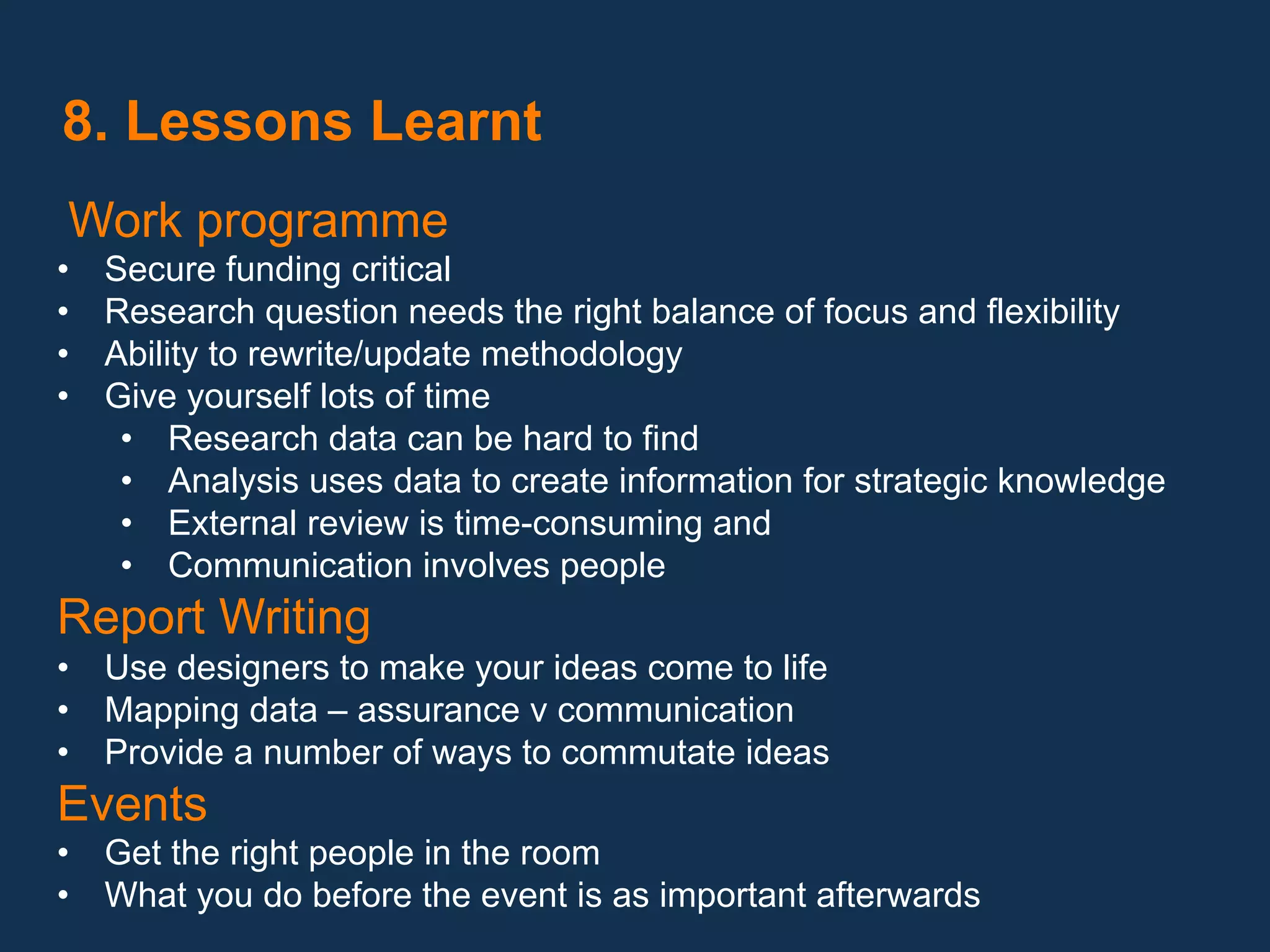
8.  Lessons Learnt
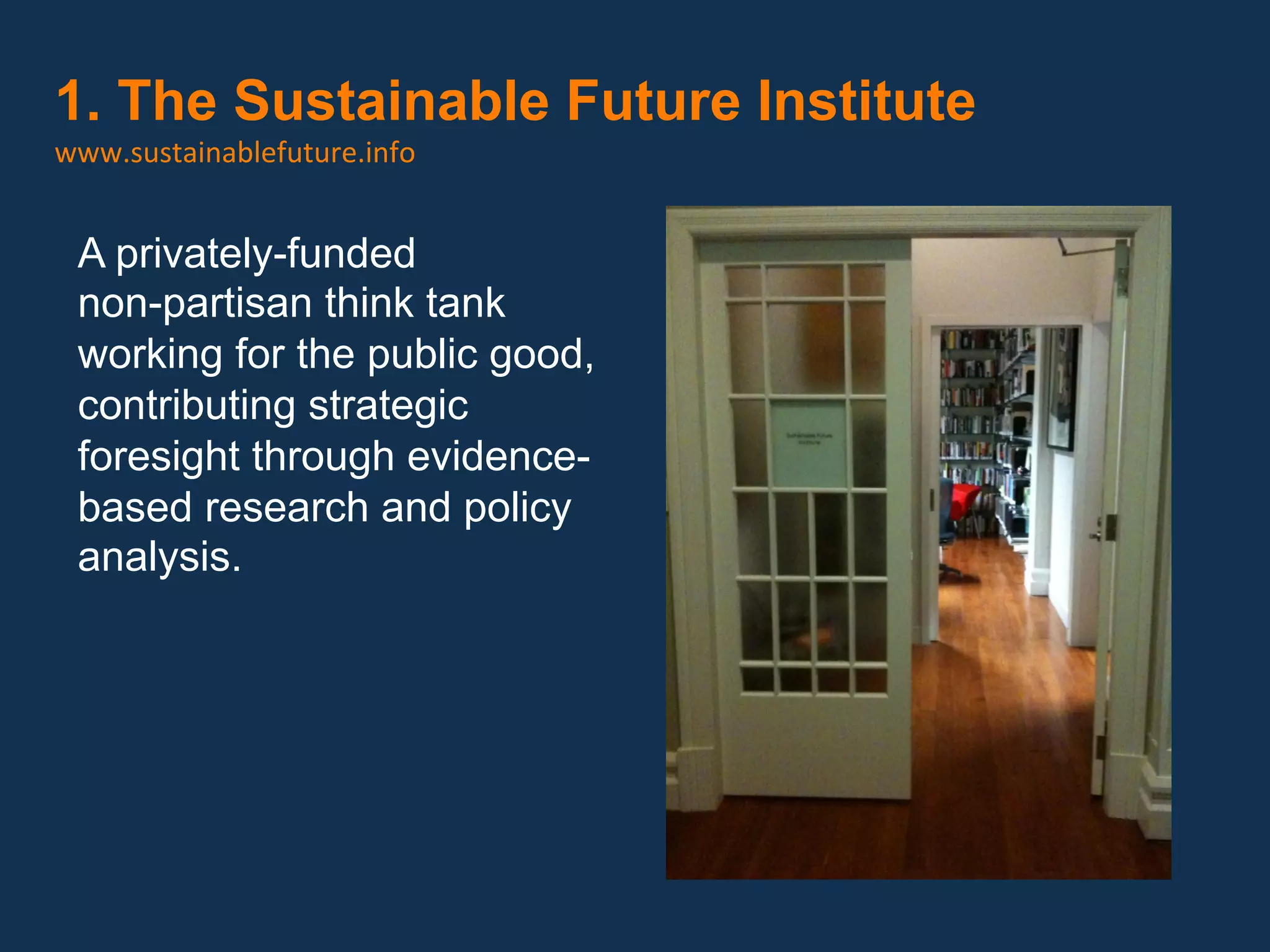
1. The Sustainable Future Institute 
www.sustainablefuture.info    
 
 
    A privately-funded
    non-partisan think tank
    working for the public good,
    contributing strategic
    foresight through evidence-
    based research and policy
    analysis.


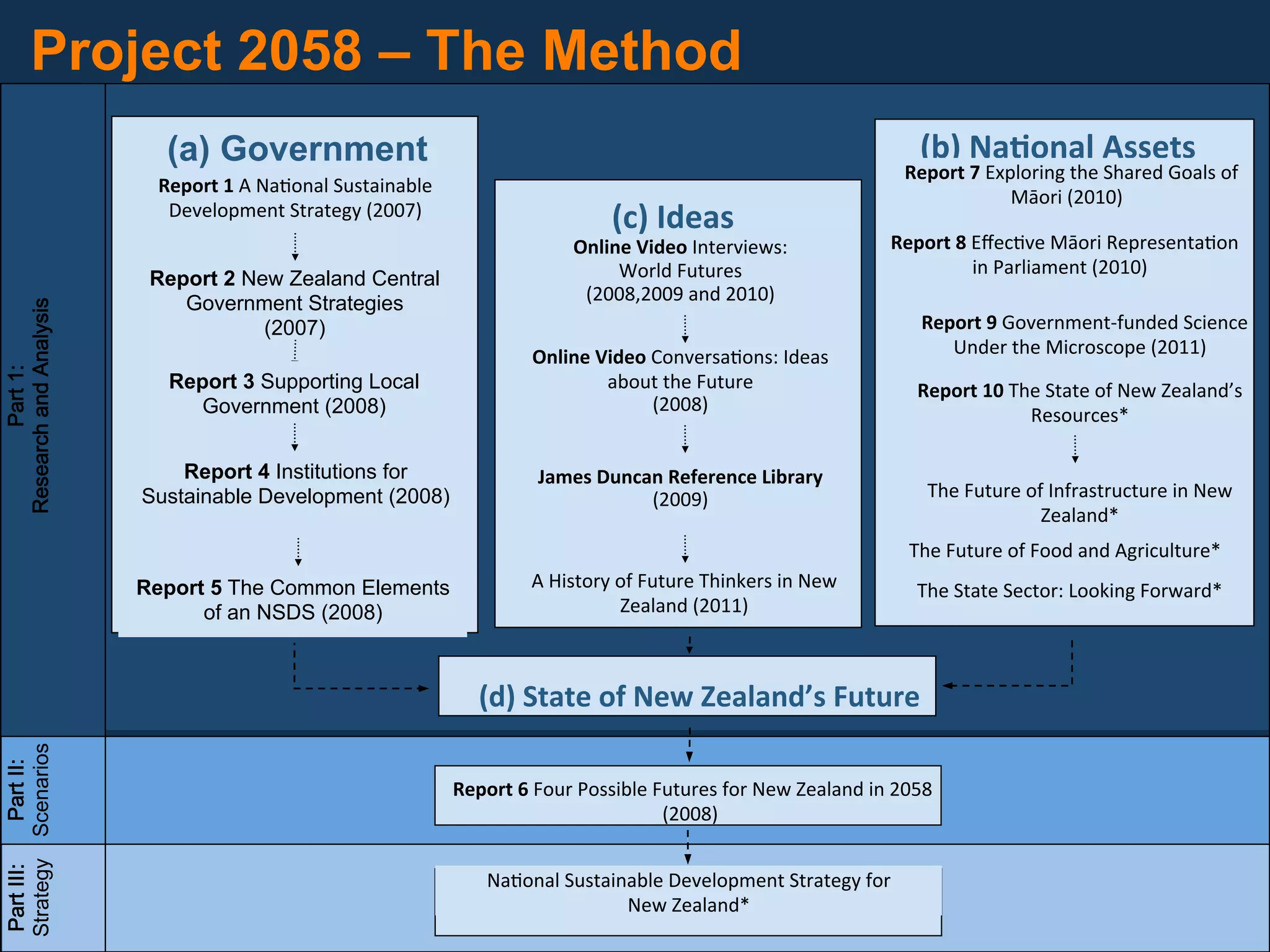
Project 2058 – The Method
                                                                                    (a) Government                                                                         (b) NaGonal Assets 
                                                                                                                                                                           Report 7 Exploring the Shared Goals of 
                                                                                   Report 1 A Na?onal Sustainable 
                                                                                                                                       (c) Future Thinkers                             Māori (2010) 
                                                                                    Development Strategy (2007) 
                                                                                                                                       (c) Ideas 
                                                                                                                                                                                              
                                                                                                                                Online Video Interviews: World 
                                                                                                                                   Online Video Interviews:              Report 8 Effec?ve Māori Representa?on 
                                                                                                                                            Futures 
                                                                                                                                        World Futures                             in Parliament (2010) 
                                                                                   Report 2 New Zealand Central                    (July 2008 and July 2009) 
                                                                                      Government Strategies                         (2008,2009 and 2010) 
Strategy Scenarios 


Research
and
Analysis


                                                                                                                                                                            Report 9 Government‐funded Science 
                                                                                              (2007)
                                                                                                                              Online Video Conversa?ons: Ideas                 Under the Microscope (2011) 
                                                                                                                              Online Video Conversa?ons: Ideas 
                                                                                                                              about the Future            (December 
                                                                 Part
1:


                                                                                    Report 3 Supporting Local                          about the Future 
                                                                                                                                             2008)                         Report 10 The State of New Zealand’s 
                                                                                       Government (2008)                                    (2008) 
                                                                                                                                                                                       Resources* 
                                                                                                                               James Duncan Reference Library 
                                                                                      Report 4 Institutions for                          (October 2009) 
                                                                                                                              James Duncan Reference Library 
                                                                                  Sustainable Development (2008)                                
                                                                                                                                            (2009)                          The Future of Infrastructure in New 
                                                                                                                              A History of Future Thinkers in New                        Zealand* 
                                                                                                                                            Zealand                        The Future of Food and Agriculture* 
                                                                                  Report 5 The Common Elements                A History of Future Thinkers in New          The State Sector: Looking Forward* 
                                                                                        of an NSDS (2008)                               Zealand (2011) 


                                                                                                                        (d) State of New Zealand’s Future 
   

           Part
II:


                                                                                                                      Report 6 Four Possible Futures for New Zealand in 2058 
                                                                                                                                              (2008) 
   

Part
III:


                                                                                                                         Na?onal Sustainable Development Strategy for 
                                                                                                                                        New Zealand* 
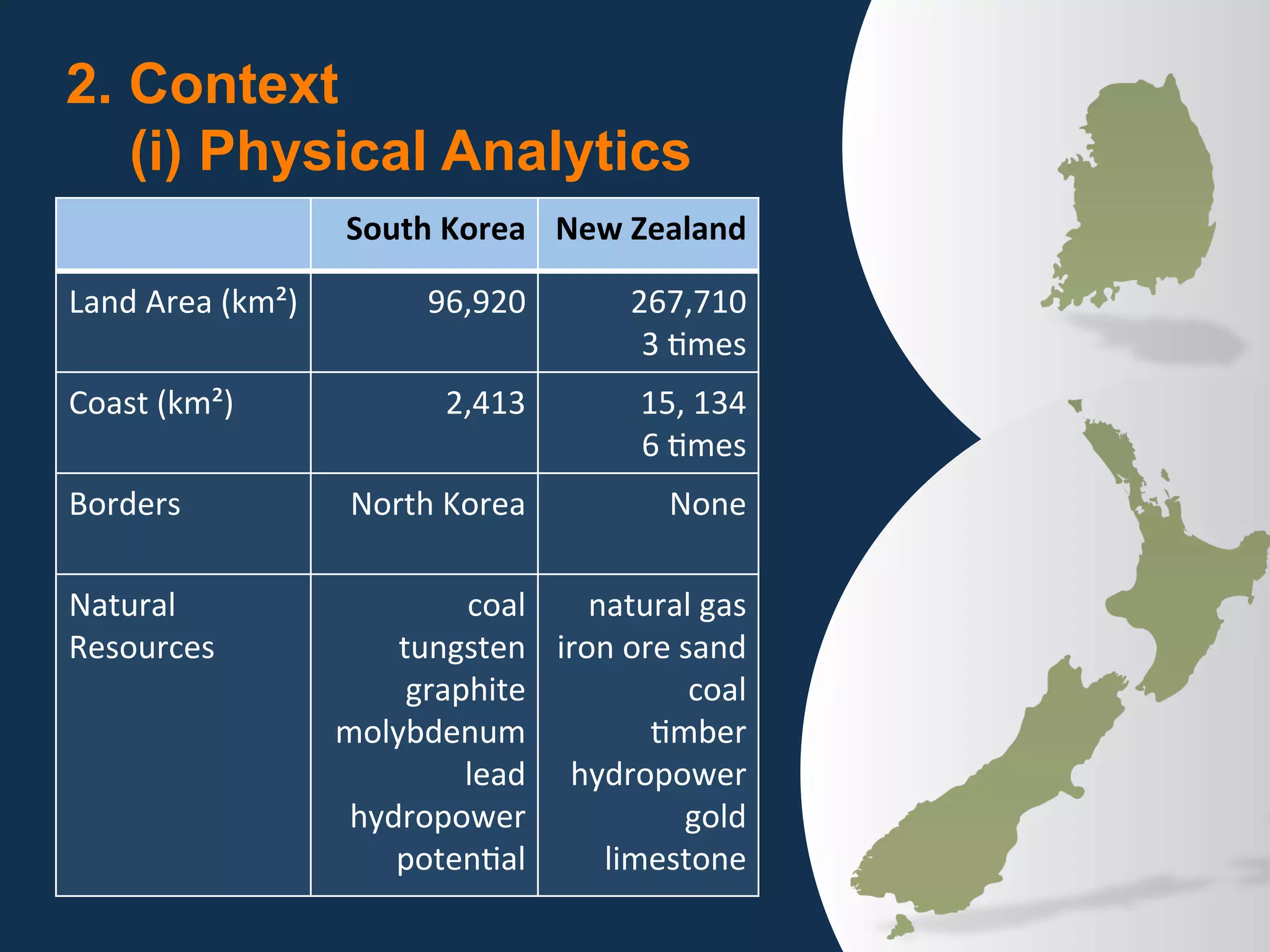
2. Context
   (i) Physical Analytics
                   South Korea  New Zealand 

Land Area (km²)          96,920        267,710 
                                        3 ?mes 
Coast (km²)               2,413         15, 134 
                                        6 ?mes 
Borders             North Korea           None 

Natural                     coal   natural gas 
Resources              tungsten  iron ore sand  
                        graphite           coal  
                   molybdenum           ?mber 
                            lead  hydropower 
                    hydropower            gold 
                       poten?al     limestone 
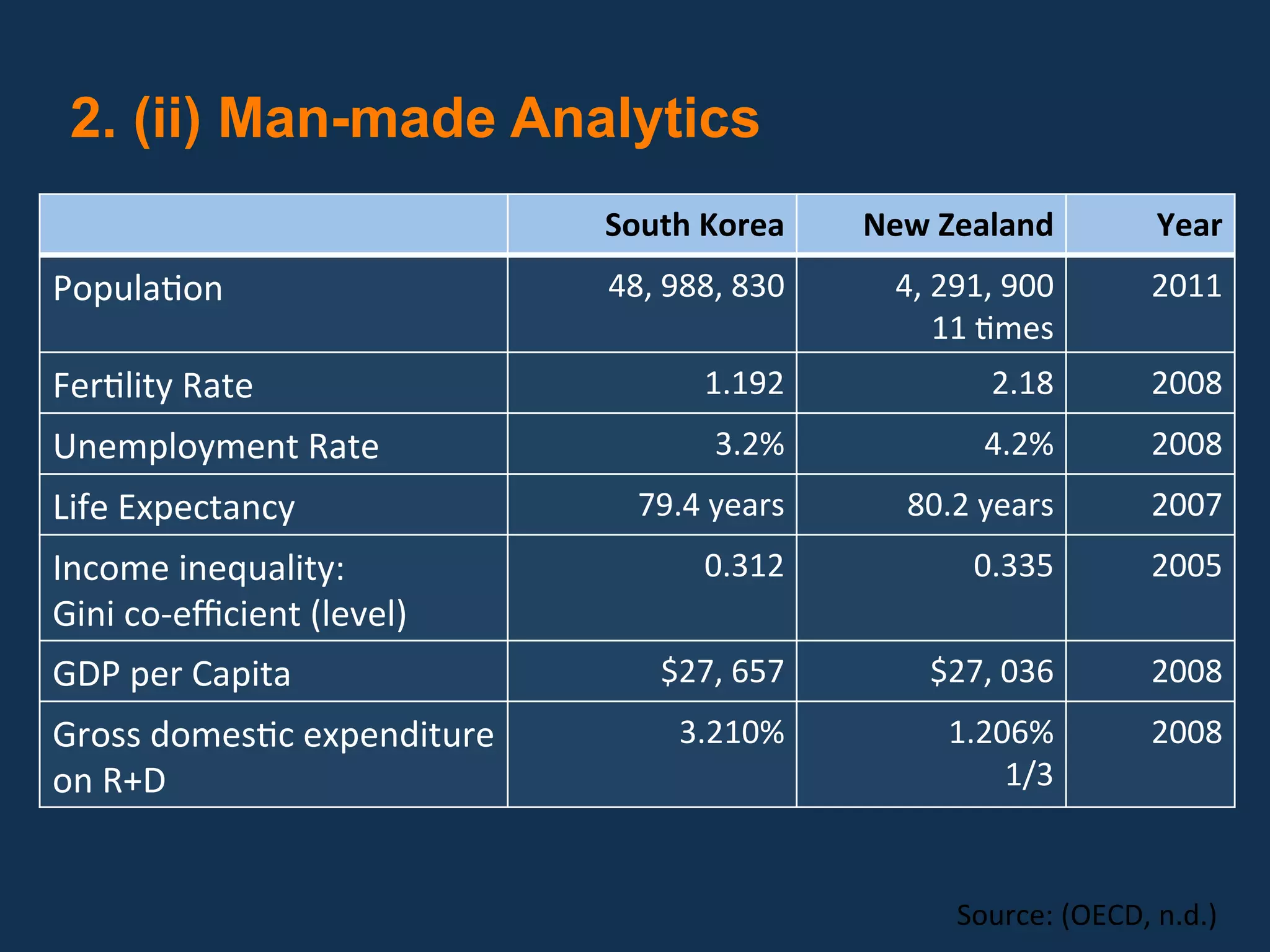
2. (ii) Man-made Analytics
                             South Korea     New Zealand         Year 
Popula?on                    48, 988, 830     4, 291, 900        2011 
                                                 11 ?mes 
Fer?lity Rate                      1.192             2.18        2008 
Unemployment Rate                   3.2%            4.2%         2008 
Life Expectancy                79.4 years      80.2 years        2007 
Income inequality:                 0.312           0.335         2005 
Gini co‐efficient (level) 
GDP per Capita                  $27, 657         $27, 036        2008 
Gross domes?c expenditure        3.210%           1.206%         2008 
on R+D                                                1/3  


                                                  Source: (OECD, n.d.) 
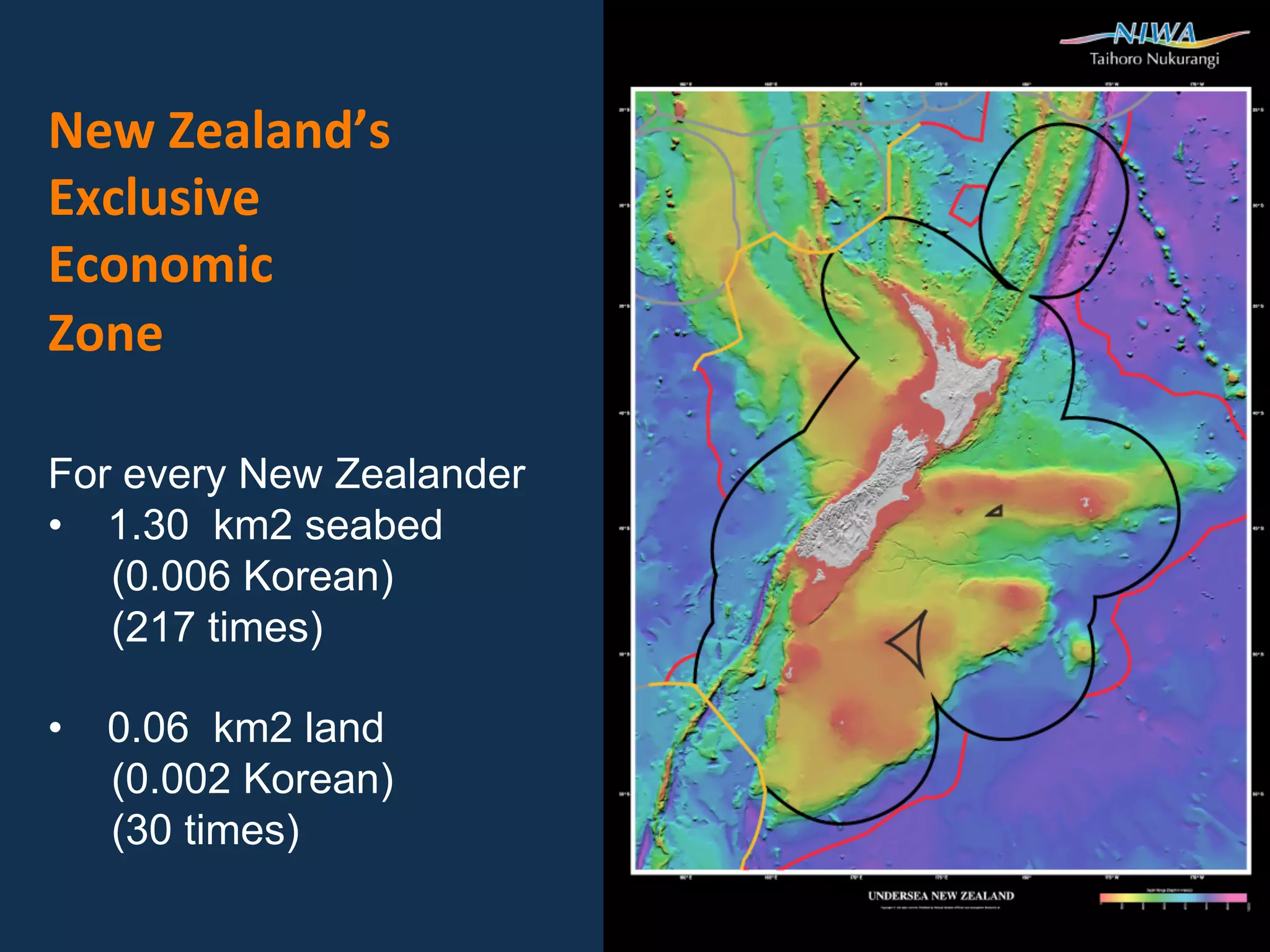
New Zealand’s 
Exclusive 
Economic 
Zone  
 
 
For every New Zealander
•  1.30 km2 seabed
   (0.006 Korean)
   (217 times)

•  0.06 km2 land
   (0.002 Korean)
   (30 times)
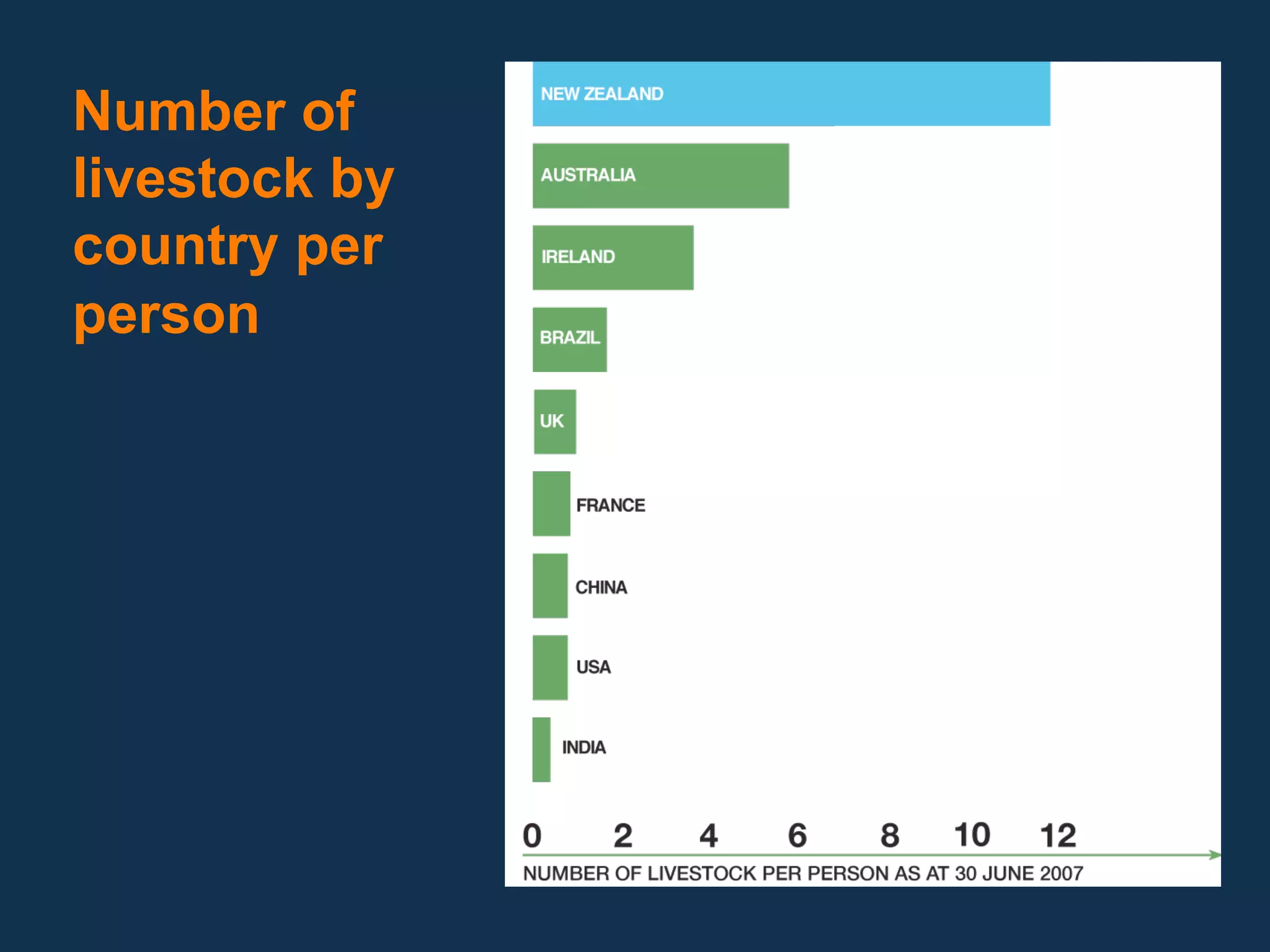
Number of
livestock by
country per
person
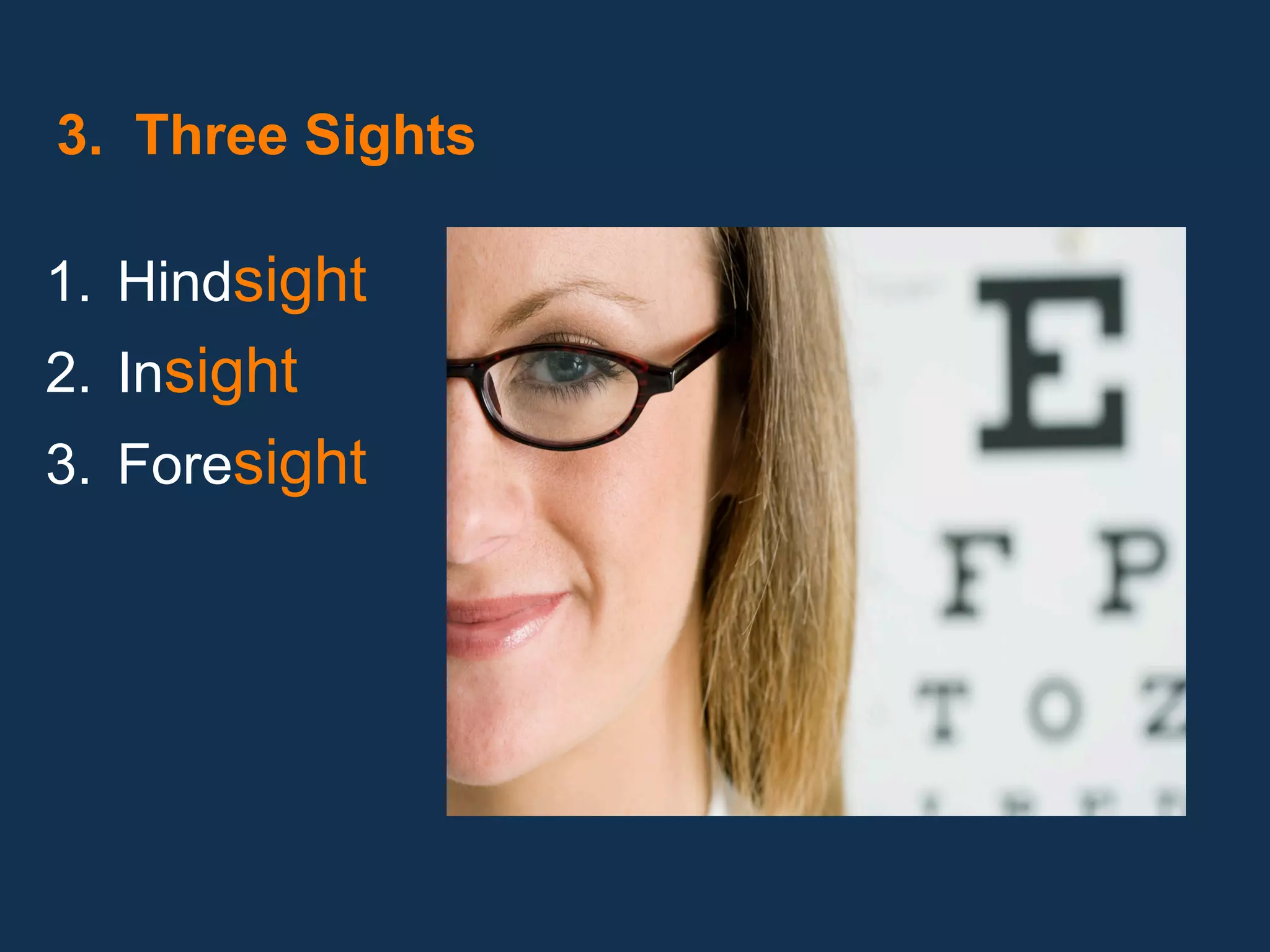
 3.   Three Sights

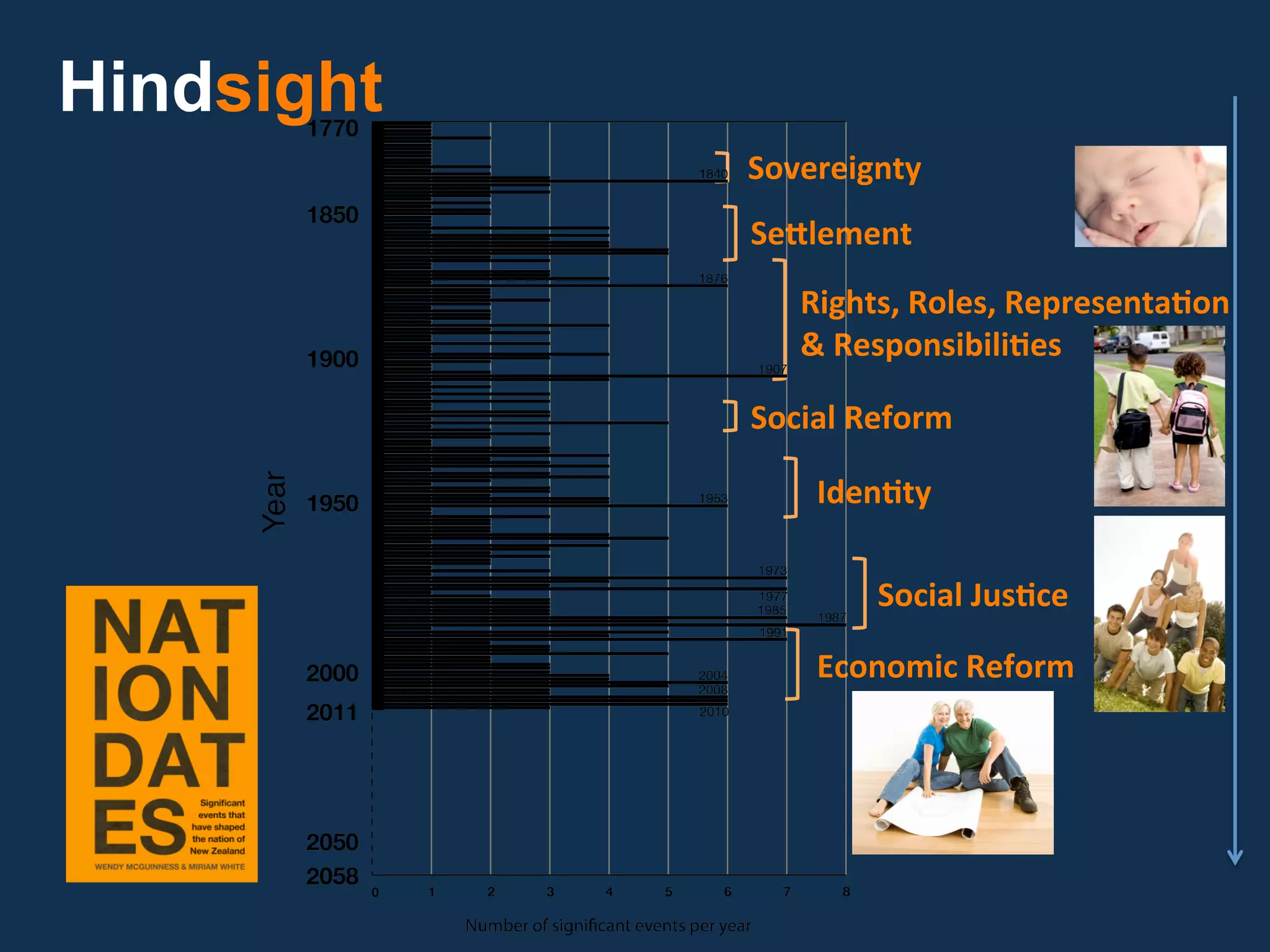
1.  Hindsight
2.  Insight
3.  Foresight
Hindsight
            Sovereignty 
            SeSlement 
               Rights, Roles, RepresentaGon  
               & ResponsibiliGes 

            Social Reform 

                IdenGty 

                    Social JusGce 

                Economic Reform 
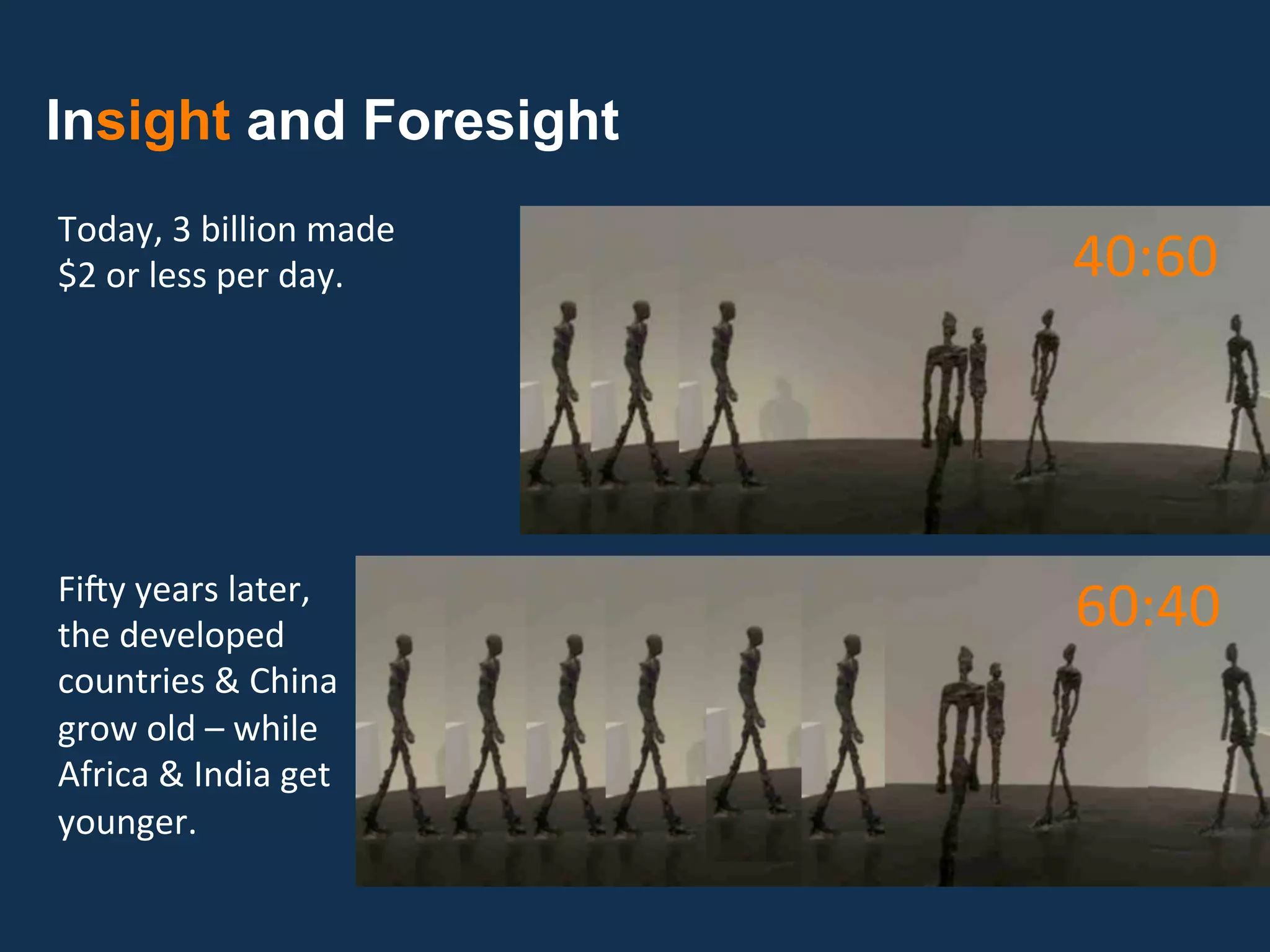
Insight and Foresight
Today, 3 billion made 
$2 or less per day.      40:60 


Fiky years later, 
the developed 
                         60:40 
countries & China 
grow old – while 
Africa & India get 
younger. 
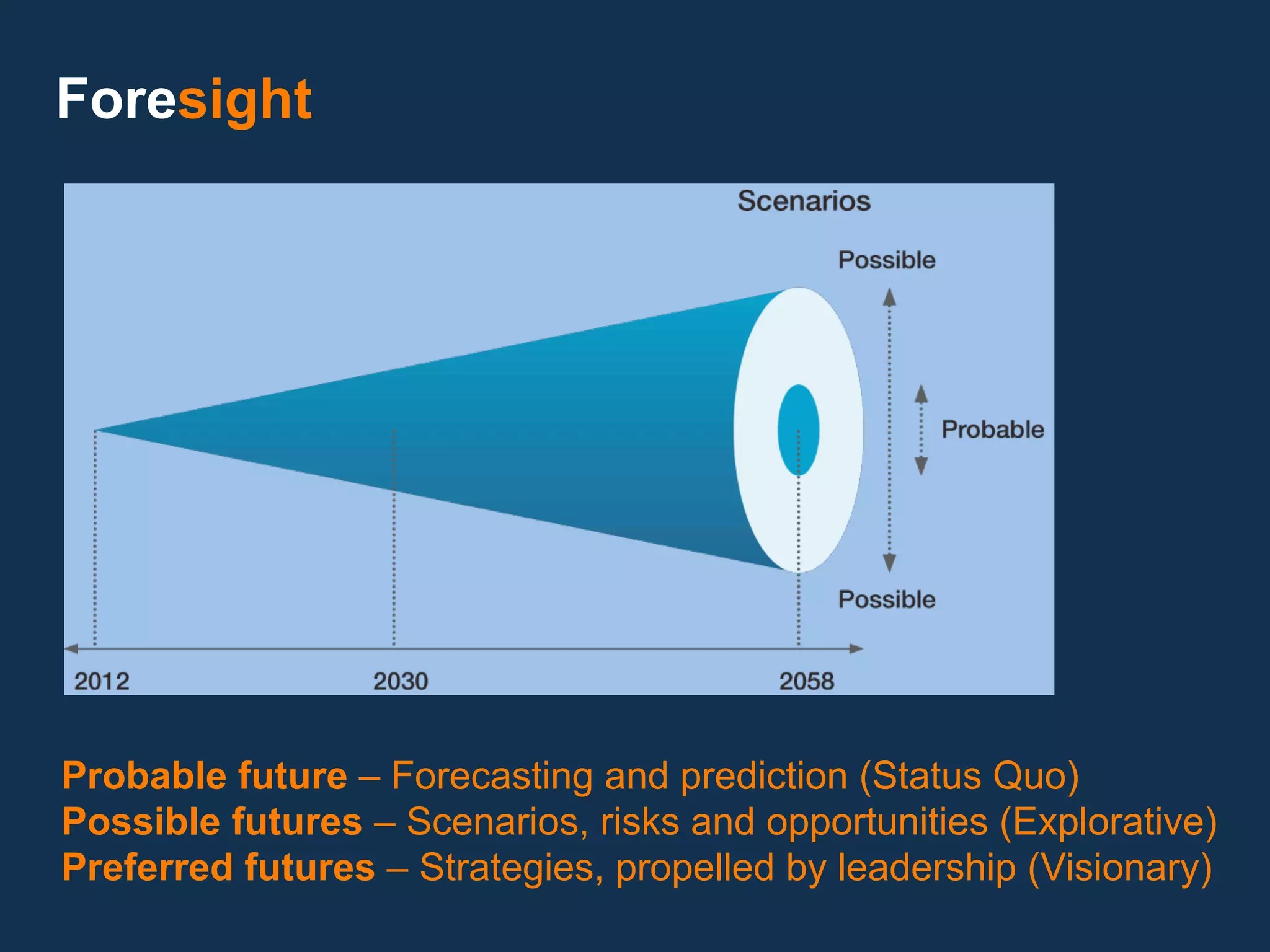
Foresight


Probable future – Forecasting and prediction (Status Quo)
Possible futures – Scenarios, risks and opportunities (Explorative)
Preferred futures – Strategies, propelled by leadership (Visionary)
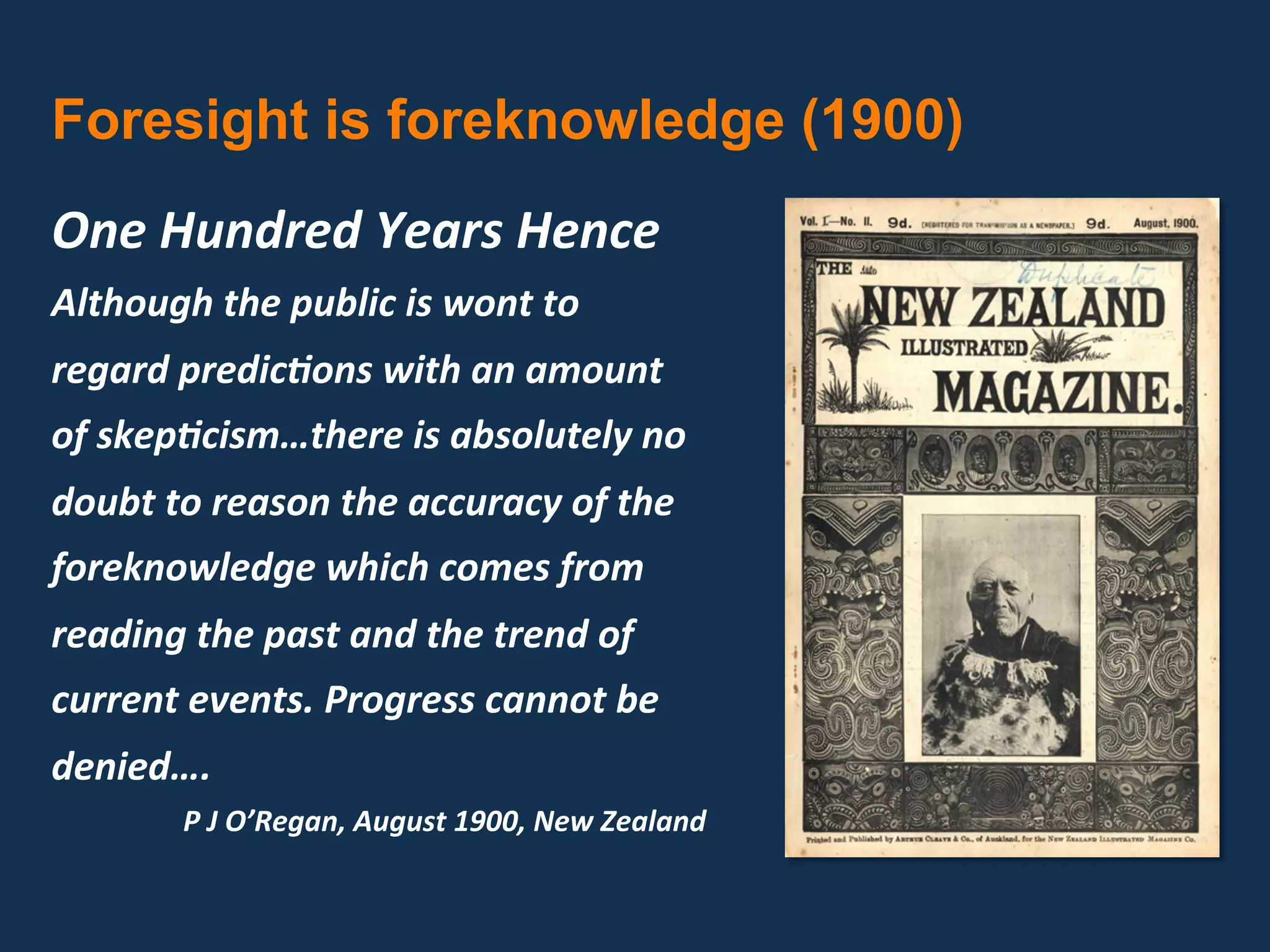
Foresight is foreknowledge (1900)
One Hundred Years Hence 
Although the public is wont to 
regard predic7ons with an amount 
of skep7cism…there is absolutely no 
doubt to reason the accuracy of the 
foreknowledge which comes from 
reading the past and the trend of 
current events. Progress cannot be 
denied….  
       P J O’Regan, August 1900, New Zealand 
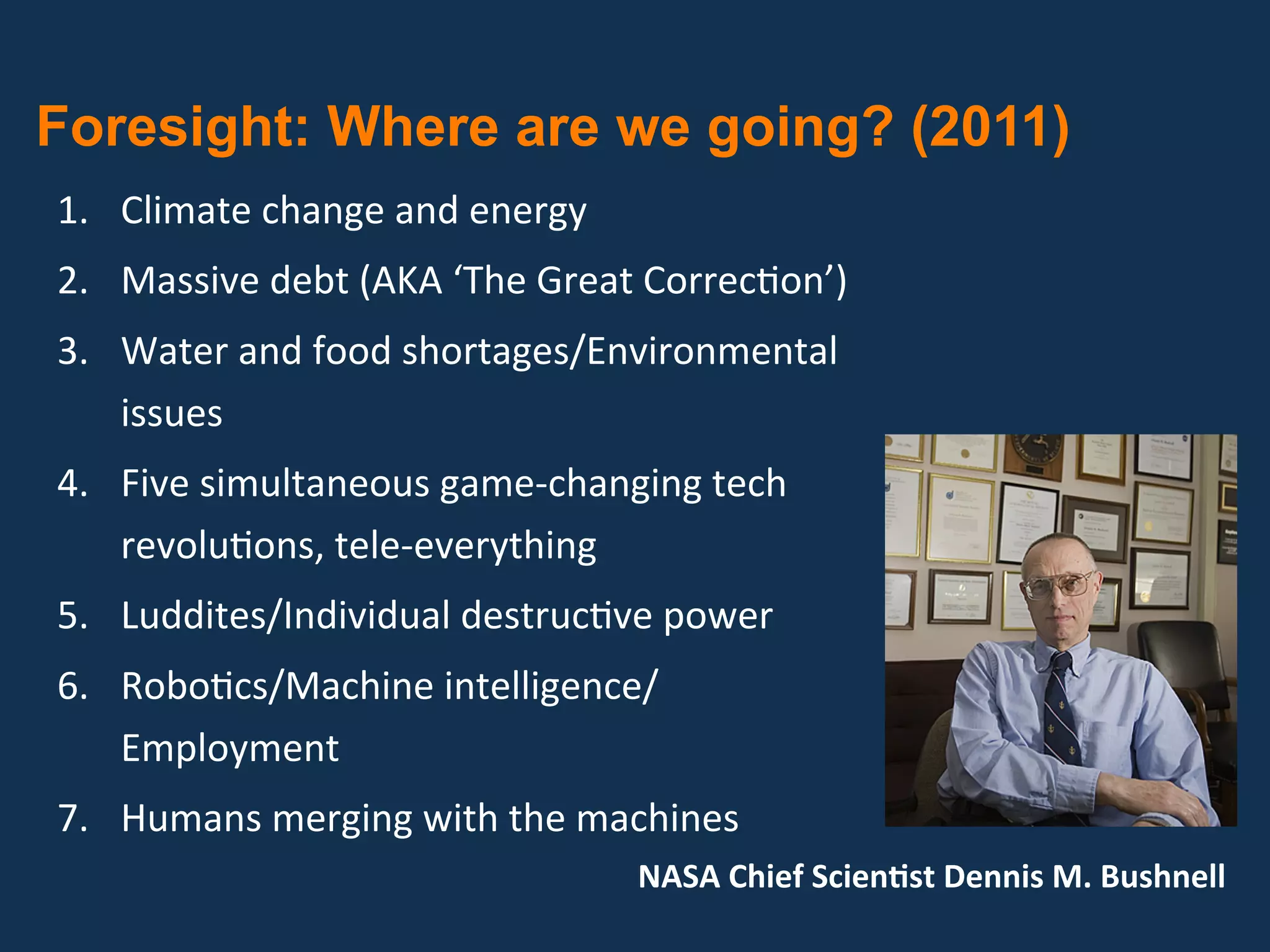
 Foresight: Where are we going? (2011)
 1.  Climate change and energy 
 2.  Massive debt (AKA ‘The Great Correc?on’) 
 3.  Water and food shortages/Environmental 
     issues 
 4.  Five simultaneous game‐changing tech 
     revolu?ons, tele‐everything 
 5.  Luddites/Individual destruc?ve power 
 6.  Robo?cs/Machine intelligence/
     Employment 
 7.  Humans merging with the machines 
                                  NASA Chief ScienGst Dennis M. Bushnell  
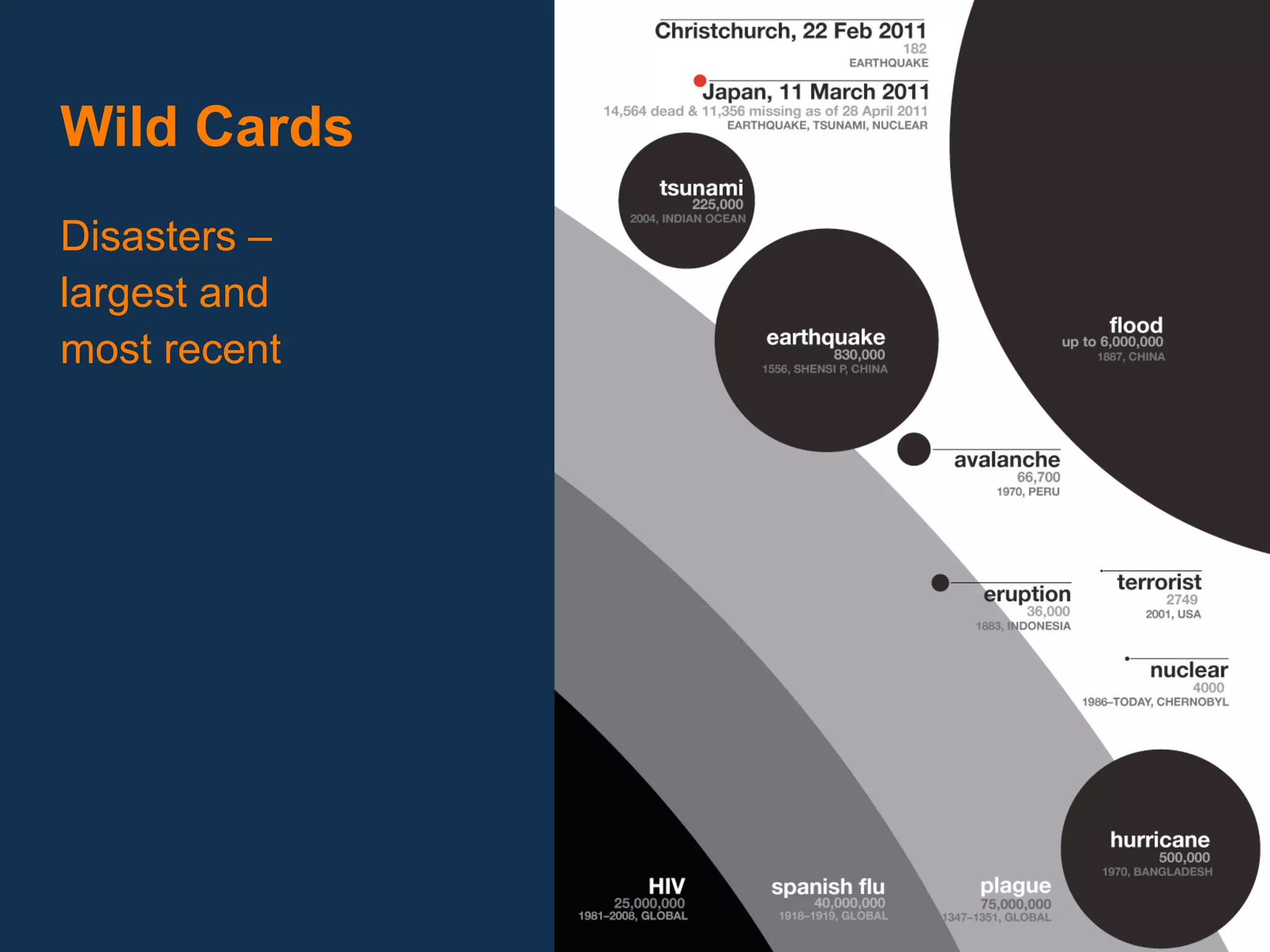
Wild Cards
 
Disasters –
largest and
most recent
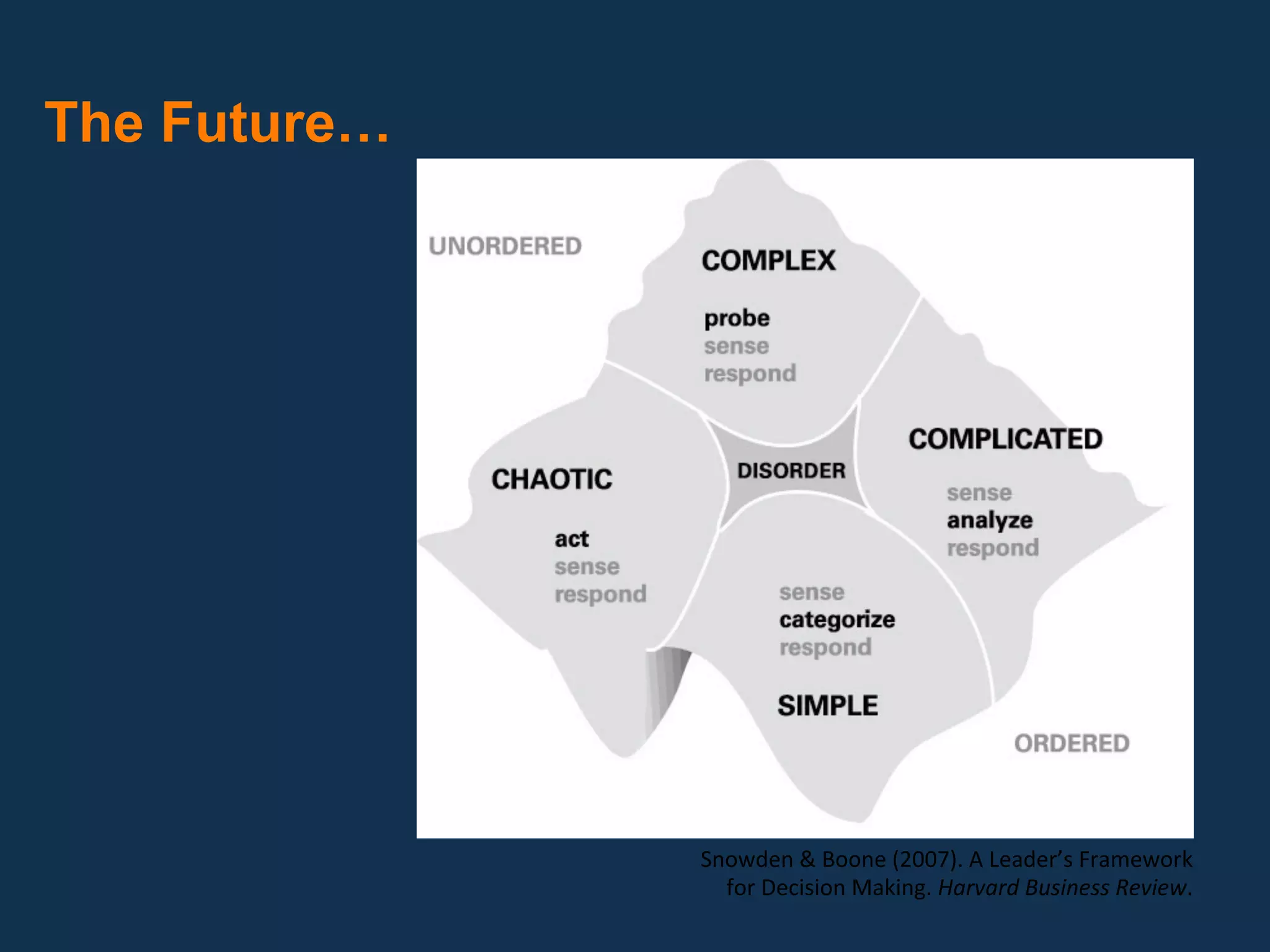
The Future…


              Snowden & Boone (2007). A Leader’s Framework 
                for Decision Making. Harvard Business Review. 
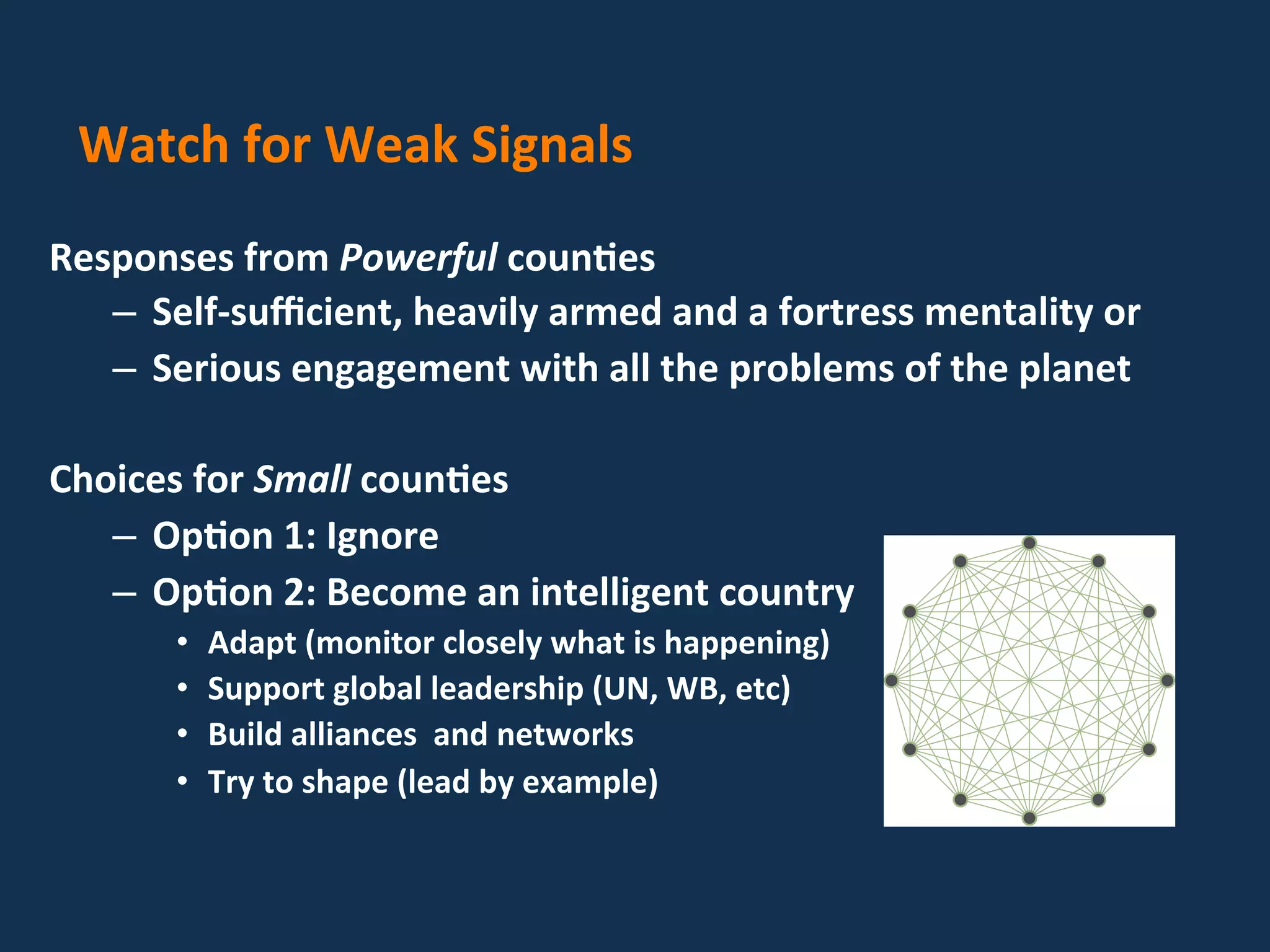
Watch for Weak Signals 
Responses from Powerful counGes 
   –  Self‐sufficient, heavily armed and a fortress mentality or 
   –  Serious engagement with all the problems of the planet 
 
Choices for Small counGes 
   –  OpGon 1: Ignore 
   –  OpGon 2: Become an intelligent country 
       •    Adapt (monitor closely what is happening) 
       •    Support global leadership (UN, WB, etc) 
       •    Build alliances  and networks 
       •    Try to shape (lead by example) 
 
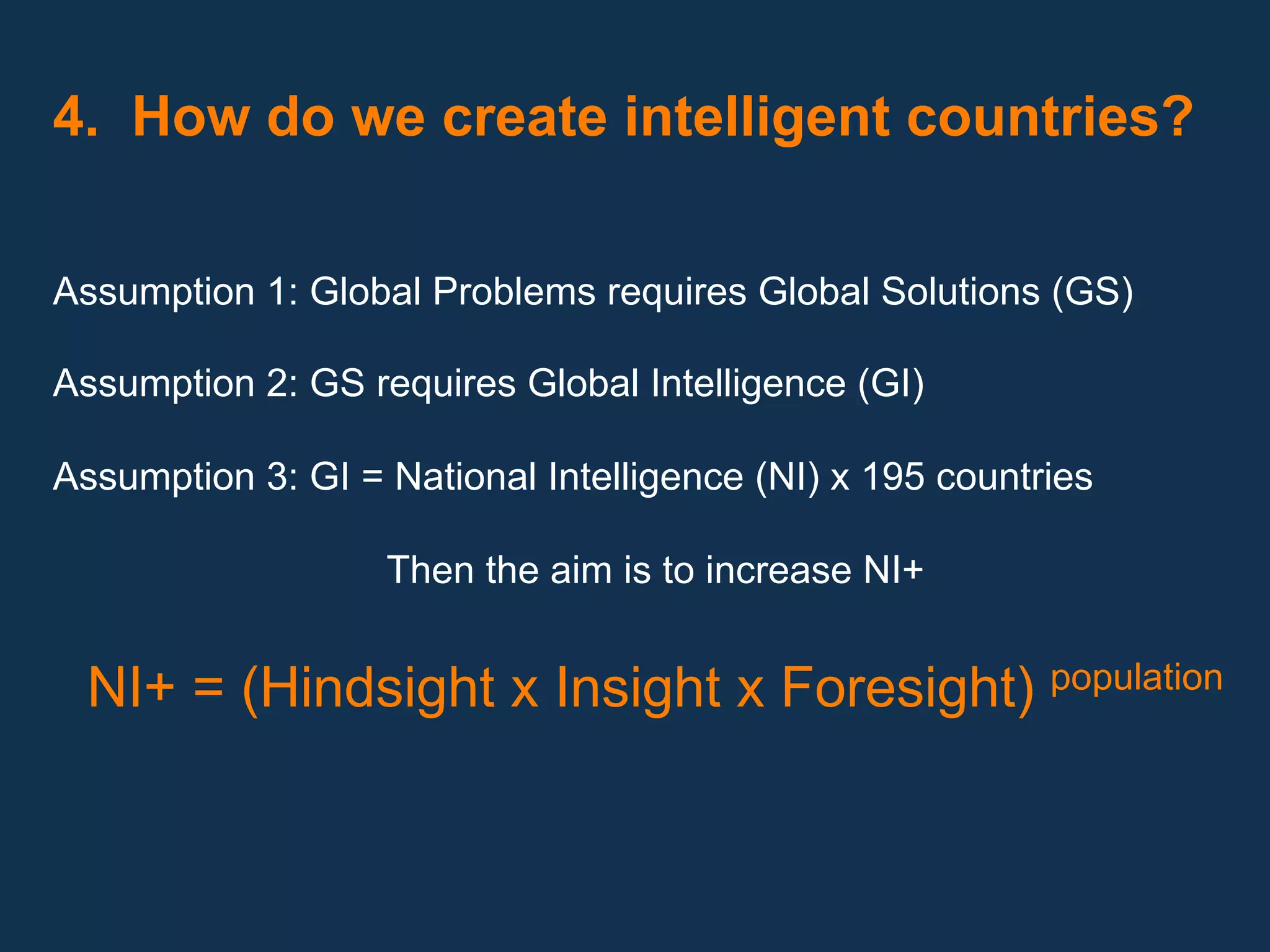
4. How do we create intelligent countries?

   
Assumption 1: Global Problems requires Global Solutions (GS)

Assumption 2: GS requires Global Intelligence (GI)

Assumption 3: GI = National Intelligence (NI) x 195 countries

                   Then the aim is to increase NI+


  NI+ = (Hindsight x Insight x Foresight) population
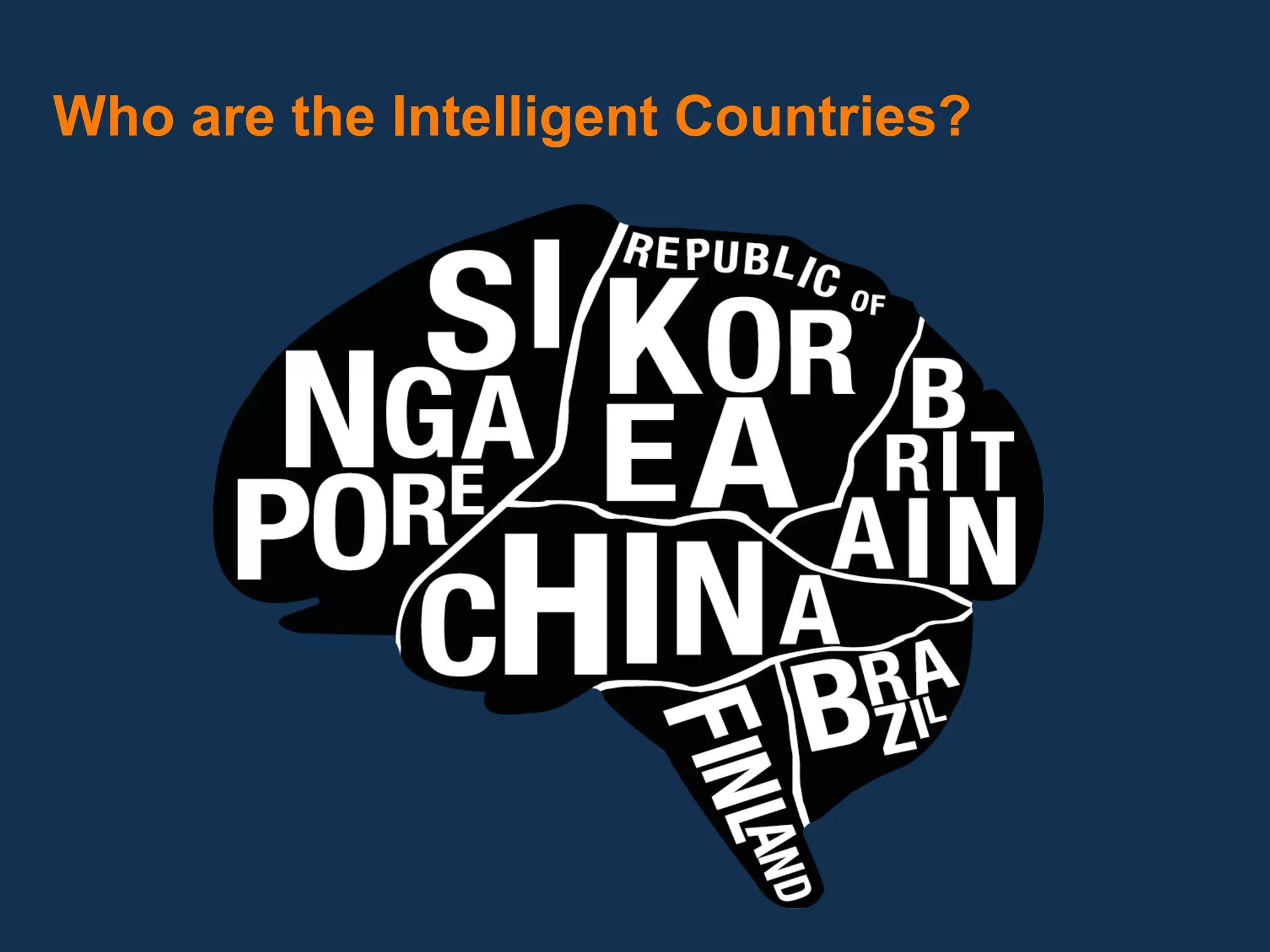
Who are the Intelligent Countries?
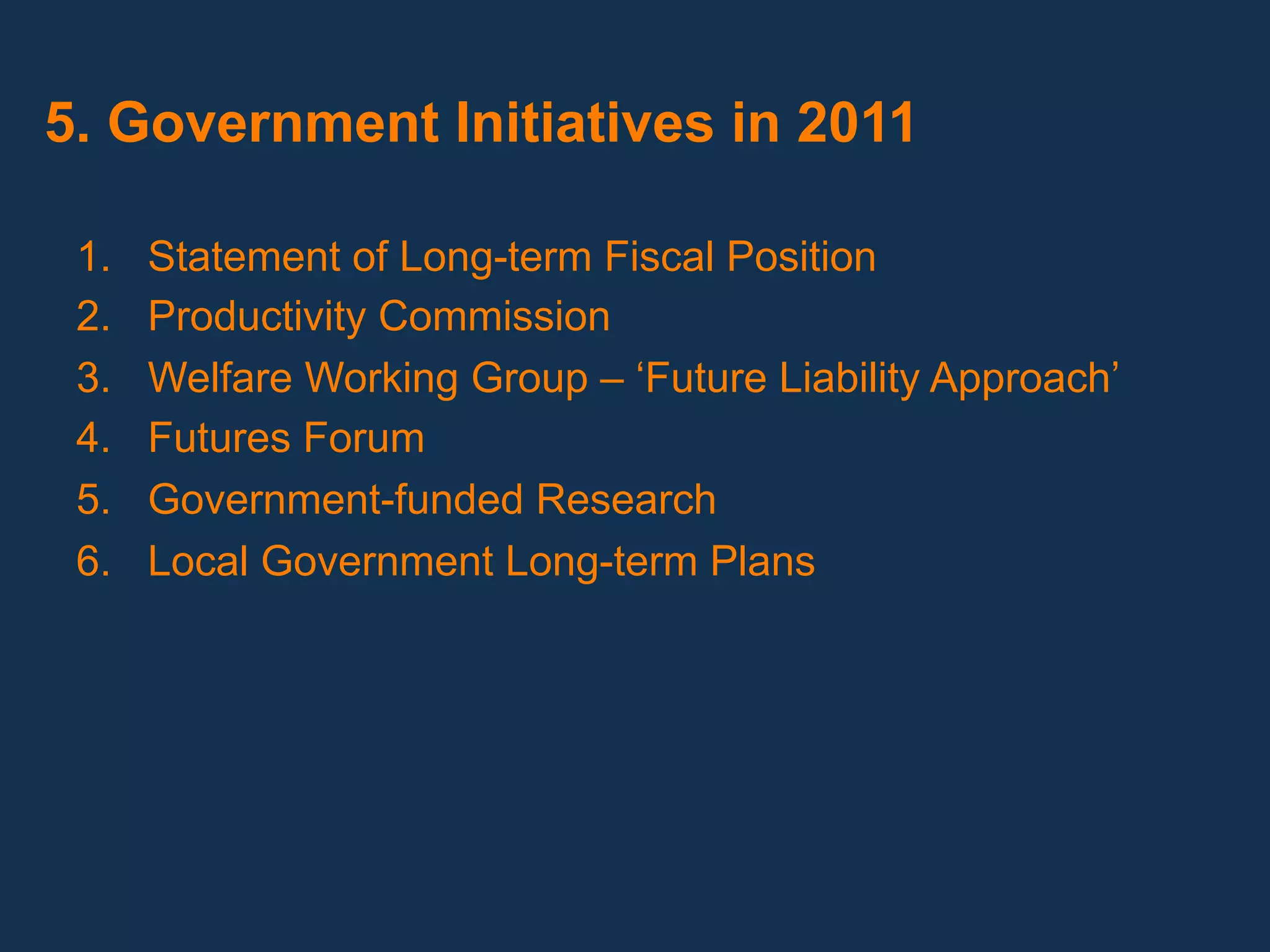
5. Government Initiatives in 2011

 1.    Statement of Long-term Fiscal Position
 2.    Productivity Commission
 3.    Welfare Working Group – ‘Future Liability Approach’
 4.    Futures Forum
 5.    Government-funded Research
 6.    Local Government Long-term Plans
  
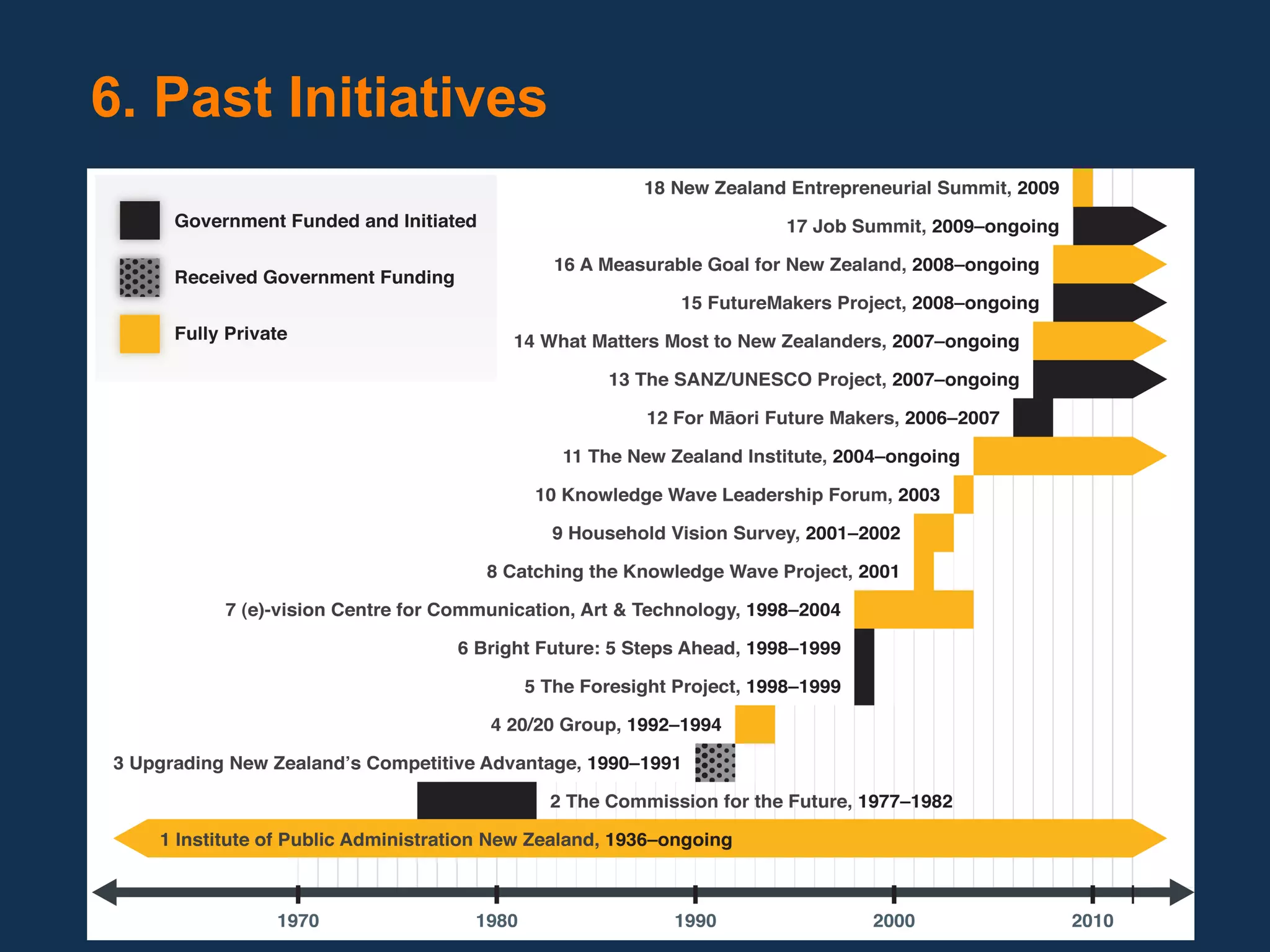
6. Past Initiatives
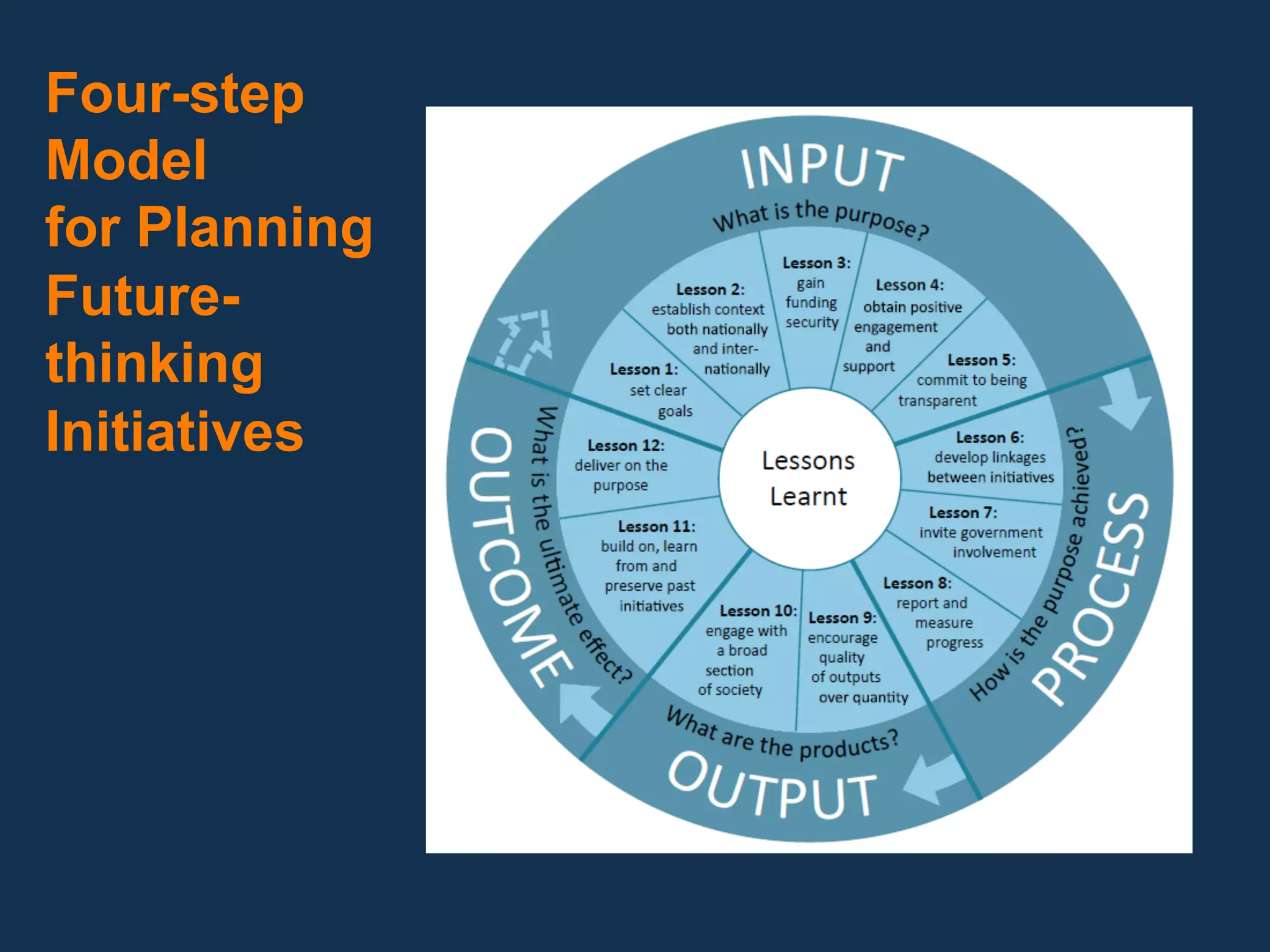
Four-step
Model
for Planning
Future-
thinking
Initiatives
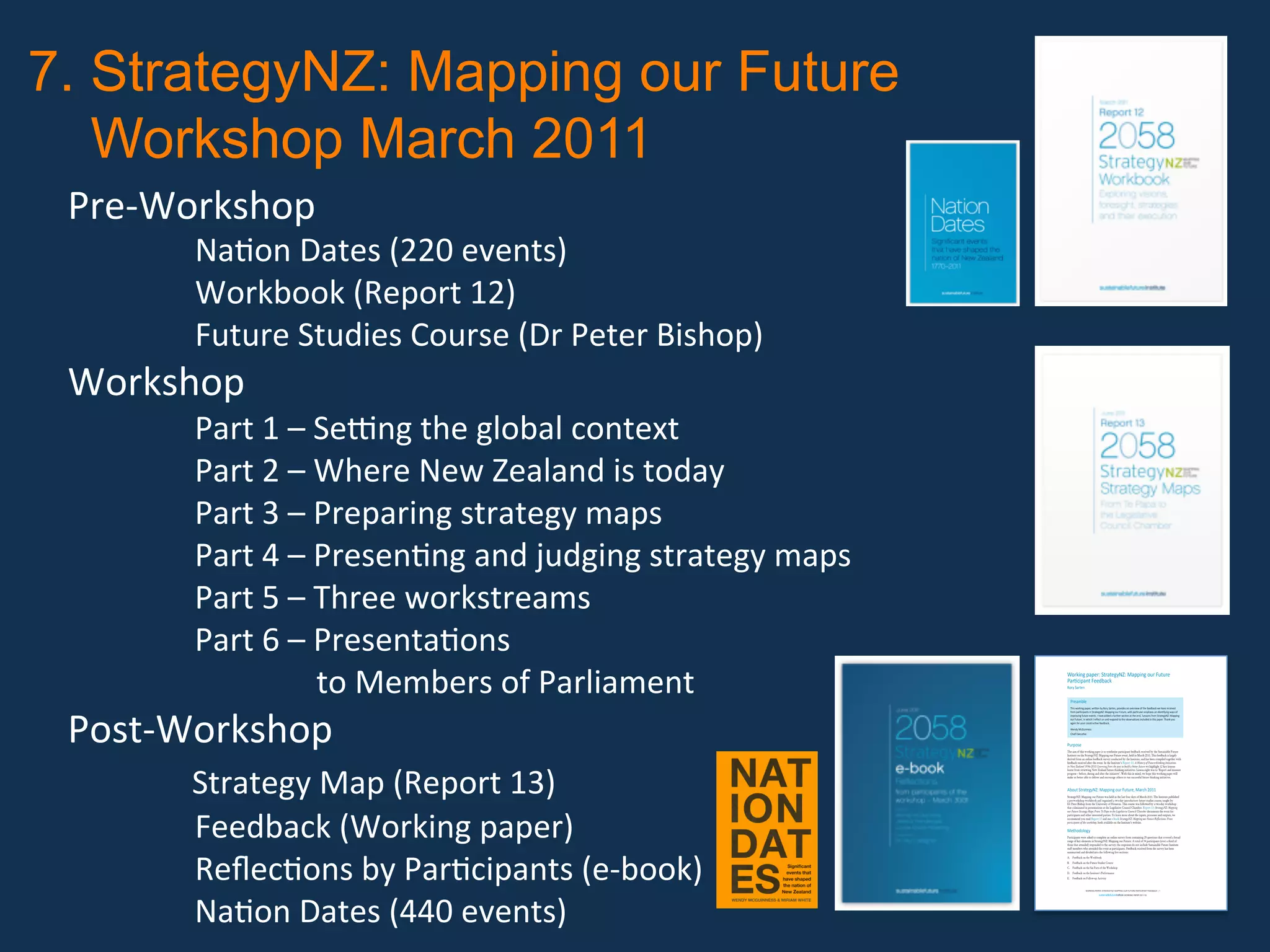
7. StrategyNZ: Mapping our Future
   Workshop March 2011 
  Pre‐Workshop 
              Na?on Dates (220 events) 
              Workbook (Report 12) 
              Future Studies Course (Dr Peter Bishop) 
  Workshop 
           Part 1 – Seong the global context 
           Part 2 – Where New Zealand is today 
           Part 3 – Preparing strategy maps 
           Part 4 – Presen?ng and judging strategy maps 
           Part 5 – Three workstreams 
           Part 6 – Presenta?ons  
                    to Members of Parliament               I'()#*+%,-,.(>%45(-5.+2<=>%?-,,#*+%'@(%A@5@(.%(
                                                           N-(;9#,-*5%A..71-9)(
                                                           3'(2%4-(5.*


                                                             !"#$%&'#


  Post‐Workshop 
                                                             !"#$%&'()#*+%,-,.(/%&(#0.*%12%3'(2%4-(5.*/%,('6#7.$%-*%'6.(6#.&%'8%5".%8..71-9)%&.%"-6.%(.9.#6.7%
                                                             8(':%,-(;9#,-*5$%#*%45(-5.+2<=>%?-,,#*+%'@(%A@5@(./%&#5"%,-(;9@B-(%.:,"-$#$%'*%#7.*;82#*+%&-2$%'8%
                                                             #:,('6#*+%8@5@(.%.6.*5$C%D%"-6.%-77.7%-%8@(5".(%$.9;'*%-5%5".%.*7/%EF.$$'*$%8(':%45(-5.+2<=>%?-,,#*+%
                                                             '@(%A@5@(.G/%#*%&"#9"%D%(.H.95%'*%-*7%(.$,'*7%5'%5".%'1$.(6-;'*$%#*9B@7.7%#*%5"#$%,-,.(C%!"-*)%2'@%
                                                             -+-#*%8'(%2'@(%9'*$5(@9;6.%8..71-9)C

                                                             I.*72%?9J@#**.$$
                                                             K"#.8%LM.9@;6.


                                                           N@(,'$.
                                                           !"#$%&'$()$*"&+$,(-.&/0$1%1#-$&+$*($+2/*"#+&+#$1%-*&3&1%/*$)##45%3.$-#3#&6#4$52$*"#$78+*%&/%59#$:8*8-#$


               Strategy Map (Report 13) 
                                                           ;/+*&*8*#$(/$*"#$7*-%*#02<=>$?%11&/0$(8-$:8*8-#$#6#/*@$"#94$&/$?%-3"$ABCCD$!"&+$)##45%3.$&+$9%-0#92$
                                                           4#-&6#4$)-('$%/$(/9&/#$)##45%3.$+8-6#2$3(/483*#4$52$*"#$;/+*&*8*#@$%/4$"%+$5##/$3('1&9#4$*(0#*"#-$,&*"$
                                                           )##45%3.$-#3#&6#4$%)*#-$*"#$#6#/*D$;/$*"#$;/+*&*8*#E+$F#1(-*$CC>$!"#$%&'()"'*"+,&,(-.&/$01$02"30$&$4&$5-%"
                                                           $0"6-7"8-4940:";<=>?@A;AB"C-4(0$02"*('D"&/-"E4%&"&'"F,$9:"4"F-&&-("*,&,(-$,#$"&0"9&0"*$CA$.#2$9#++(/+$
                                                           9#%-/*$)-('$-#6&#,&/0$<#,$=#%9%/4$)8*8-#$*"&/.&/0$&/&*&%*&6#+D$G#++(/$#&0"*$,%+$*($HF#1(-*$%/4$'#%+8-#$
                                                           1-(0-#++$I$5#)(-#@$48-&/0$%/4$%)*#-$*"#$&/&*&%*&6#ED$J&*"$*"&+$&/$'&/4@$,#$"(1#$*"&+$,(-.&/0$1%1#-$,&99$
                                                           '%.#$8+$5#**#-$%59#$*($4#9&6#-$%/4$#/3(8-%0#$(*"#-+$*($-8/$+833#++)89$)8*8-#$*"&/.&/0$&/&*&%*&6#+D


                                                           O1'@5%45(-5.+2<=>%?-,,#*+%'@(%A@5@(./%?-(9"%PQRR
                                                           7*-%*#02<=>$?%11&/0$(8-$:8*8-#$,%+$"#94$&/$*"#$9%+*$)(8-$4%2+$()$?%-3"$ABCCD$!"#$;/+*&*8*#$1859&+"#4$
                                                           %$1-#K,(-.+"(1$,(-.5((.$%/4$(-0%/&+#4$%$*,(K4%2$&/*-(483*(-2$)8*8-#$+*84&#+$3(8-+#@$*%80"*$52$
                                                           L-$M#*#-$N&+"(1$)-('$*"#$O/&6#-+&*2$()$P(8+*(/D$!"&+$3(8-+#$,%+$)(99(,#4$52$%$*,(K4%2$,(-.+"(1$


              Feedback (Working paper) 
                                                           *"%*$389'&/%*#4$&/$1-#+#/*%*&(/+$%*$*"#$G#0&+9%*&6#$Q(8/3&9$Q"%'5#-D$F#1(-*$CR>$G&(4&-2)68B"H4EE$02"
                                                           ',("+,&,(-"G&(4&-2)"H4E%B"+('D"I-"J4E4"&'"&/-"C-2$%94&$5-"K',0L$9"K/4DF-($4(38'#/*+$*"#$#6#/*$)(-$
                                                           1%-*&3&1%/*+$%/4$(*"#-$&/*#-#+*#4$1%-*&#+D$!($9#%-/$'(-#$%5(8*$*"#$&/18*+@$1-(3#++#+$%/4$(8*18*+@$,#$
                                                           -#3(''#/4$2(8$-#%4$F#1(-*$CR$%/4$(8-$#K5((.$G&(4&-2)68B"H4EE$02"',("+,&,(-"M-*9-L&$'0%B"+('D"
                                                           E4(&$L$E40&%"'*"&/-"7'(1%/'E@$5(*"$%6%&9%59#$(/$*"#$;/+*&*8*#E+$,#5+&*#D$

                                                           ?.5"'7'B'+2
                                                           M%-*&3&1%/*+$,#-#$%+.#4$*($3('19#*#$%/$(/9&/#$+8-6#2$)(-'$3(/*%&/&/0$AS$T8#+*&(/+$*"%*$3(6#-#4$%$5-(%4$
                                                           -%/0#$()$.#2$#9#'#/*+$&/$7*-%*#02<=>$?%11&/0$(8-$:8*8-#D$U$*(*%9$()$RV$1%-*&3&1%/*+$W(6#-$%$*"&-4$()$
                                                           *"(+#$*"%*$%**#/4#4X$-#+1(/4#4$*($*"#$+8-6#2Y$*"#$-#+1(/+#+$4($/(*$&/3984#$78+*%&/%59#$:8*8-#$;/+*&*8*#$


              Reflec?ons by Par?cipants (e‐book) 
                                                           +*%))$'#'5#-+$,"($%**#/4#4$*"#$#6#/*$%+$1%-*&3&1%/*+D$:##45%3.$-#3#&6#4$)-('$*"#$+8-6#2$"%+$5##/$
                                                           +8''%-&+#4$%/4$4&6&4#4$&/*($*"#$)(99(,&/0$)&6#$+#3*&(/+>
                                                           UD$ :##45%3.$(/$*"#$J(-.5((.
                                                           ND$ :##45%3.$(/$*"#$:8*8-#$7*84&#+$Q(8-+#
                                                           QD$ :##45%3.$(/$*"#$7&Z$M%-*+$()$*"#$J(-.+"(1
                                                           LD$ :##45%3.$(/$*"#$;/+*&*8*#E+$M#-)(-'%/3#
                                                           [D$ :##45%3.$(/$:(99(,K81$U3*&6&*2


              Na?on Dates (440 events) 
                                                                            WORKING PAPER: STRATEGYNZ: MAPPING OUR FUTURE PARTICIPANT FEEDBACK | 1
                                                                                                                WORKING PAPER 2011/16
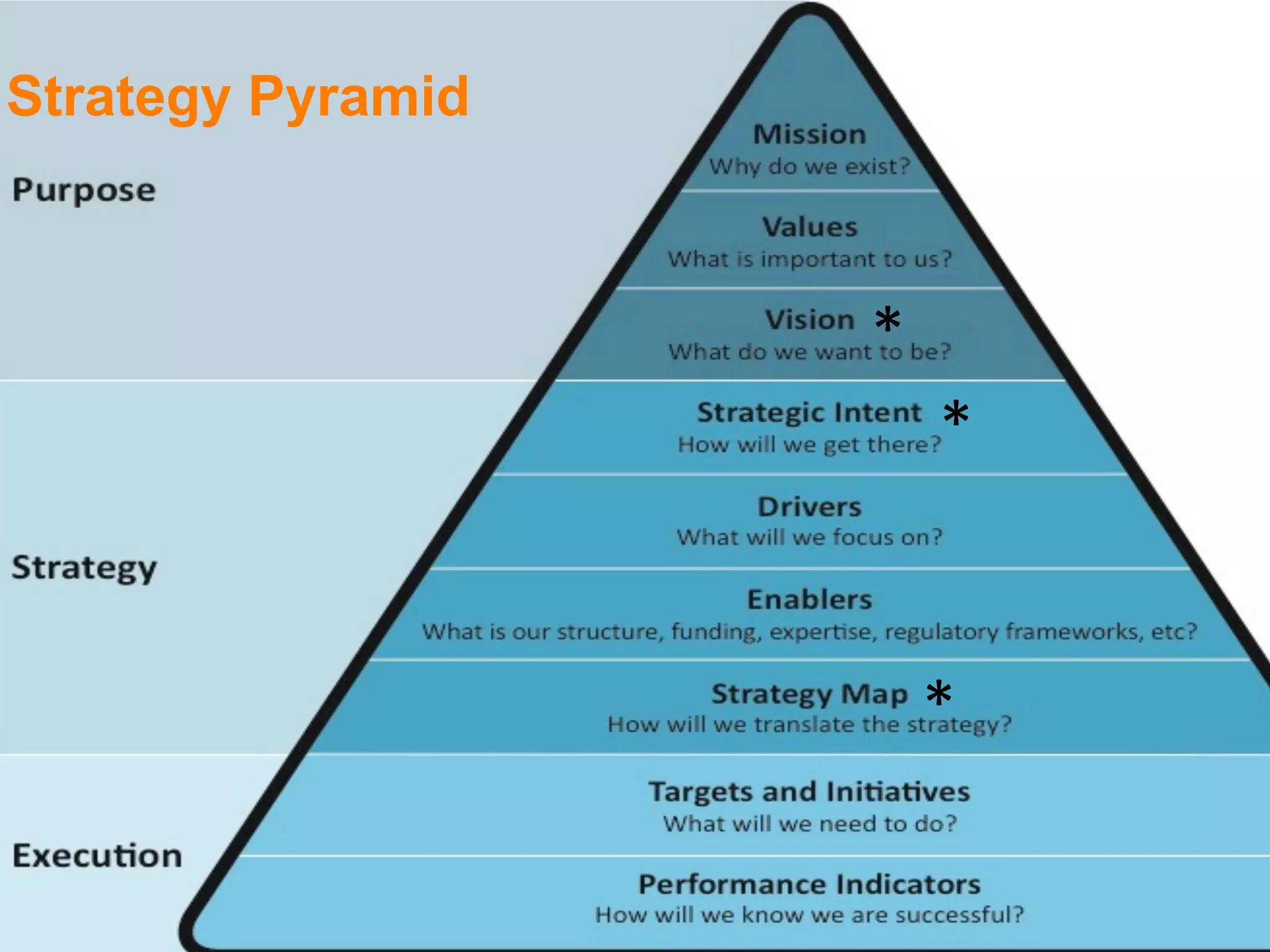
Strategy Pyramid


                   * 
                        * 


                        * 
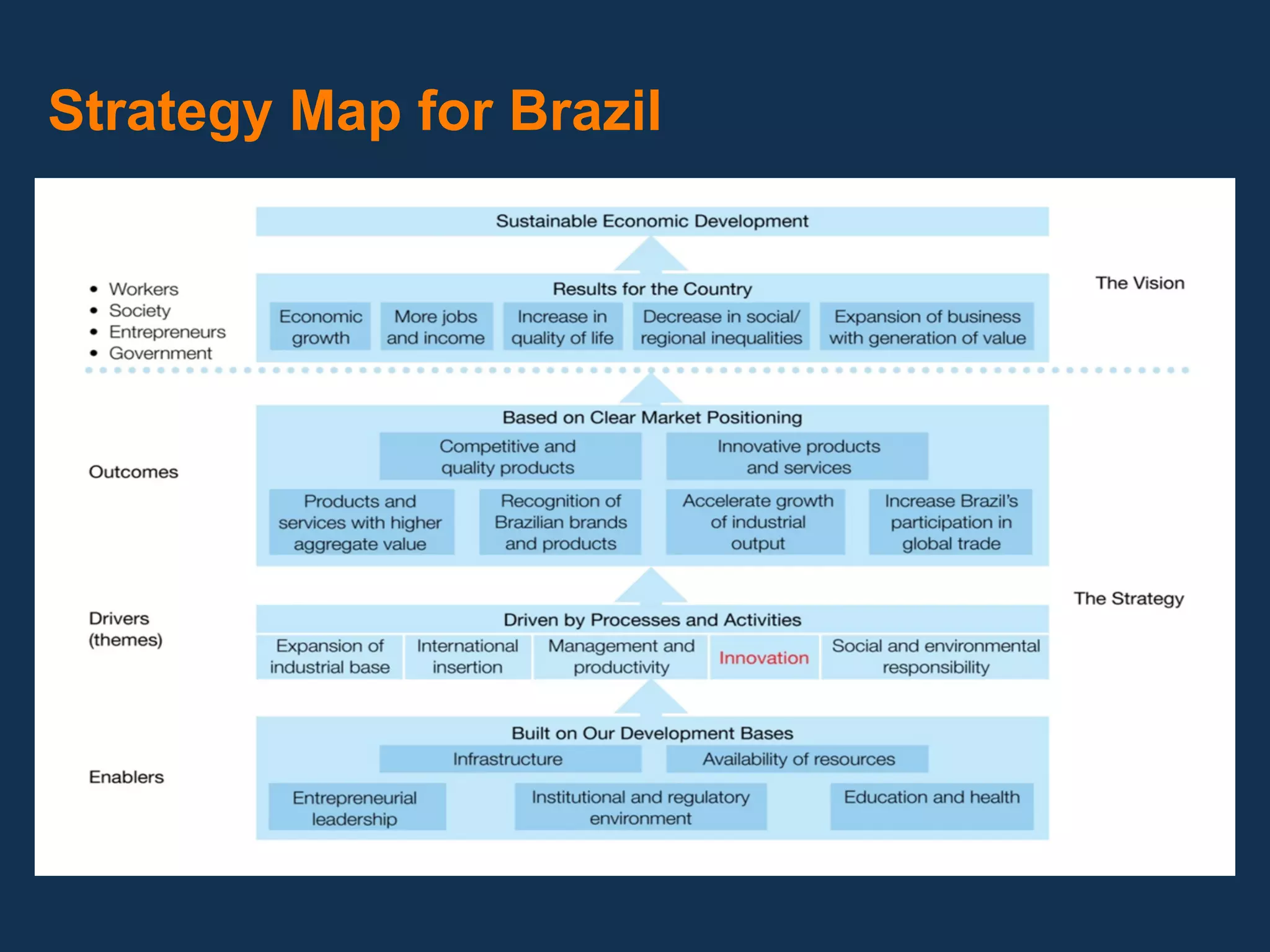
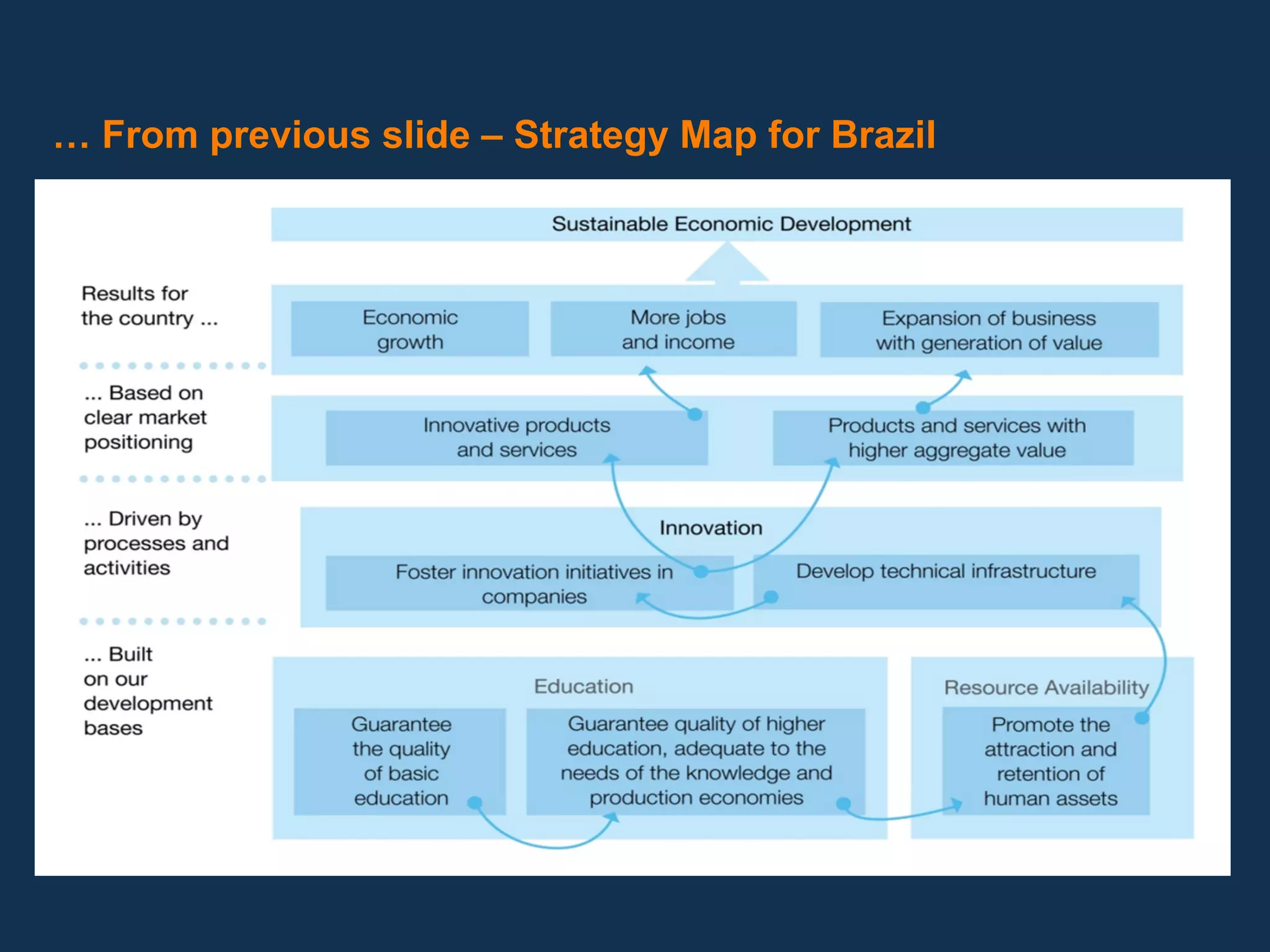
Strategy Map for Brazil
… From previous slide – Strategy Map for Brazil
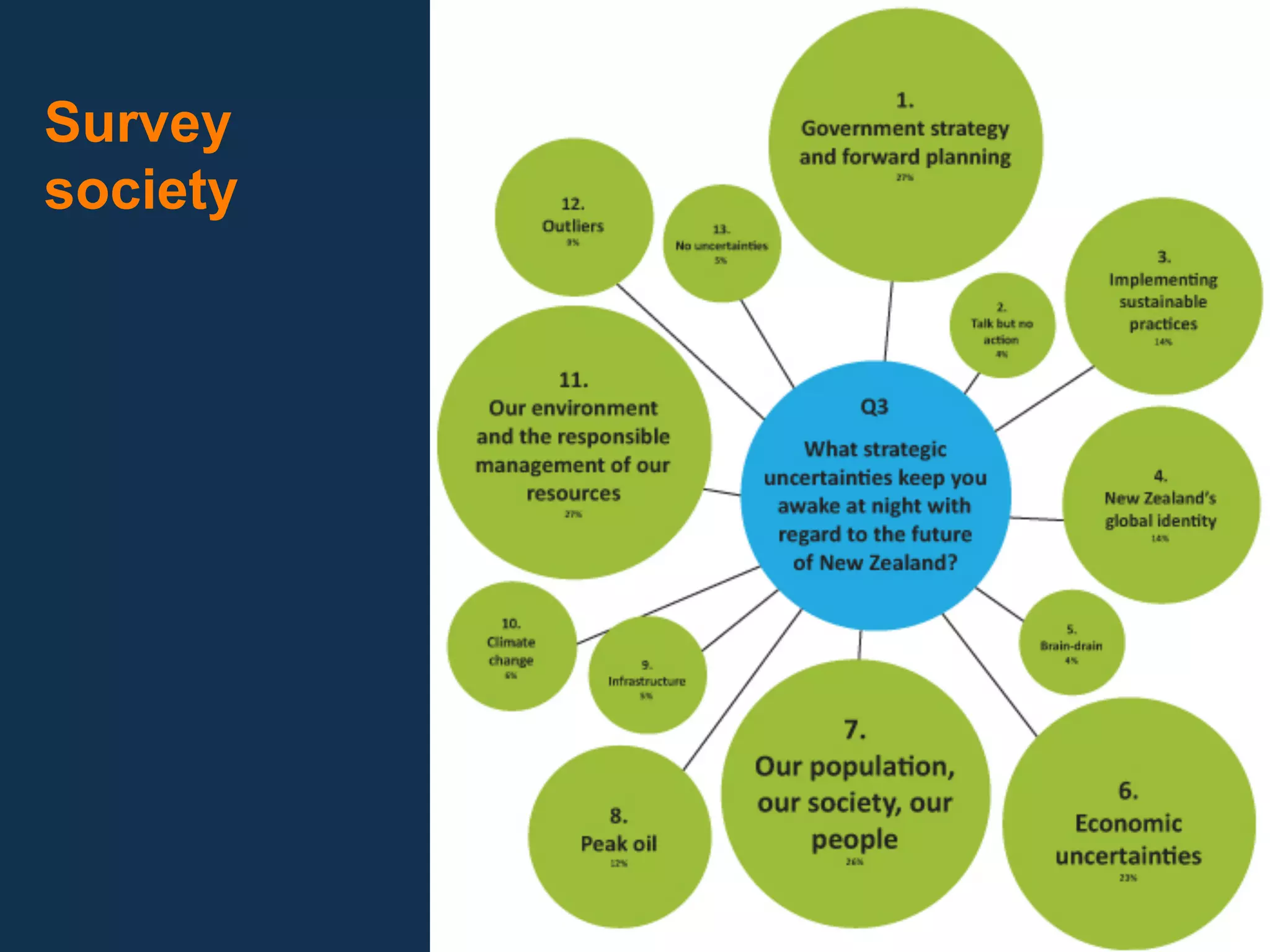
Survey
society
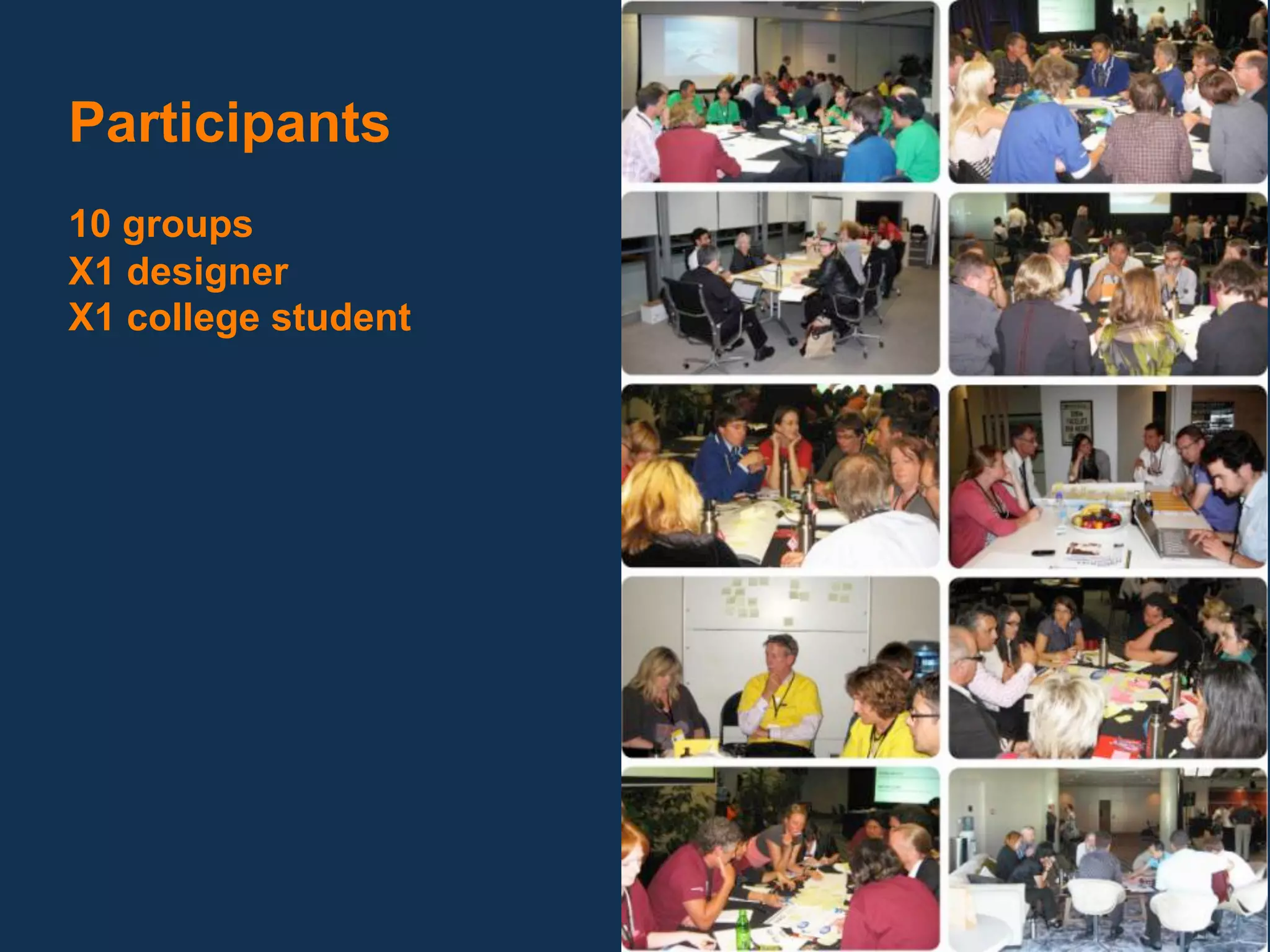
Participants
10 groups
X1 designer
X1 college student
-#*)"/(?".%$(>%)'?",/'%1"%?'()",/'"   '()*+,(-%=8-%8,(%8=%0/(%+-89G)?


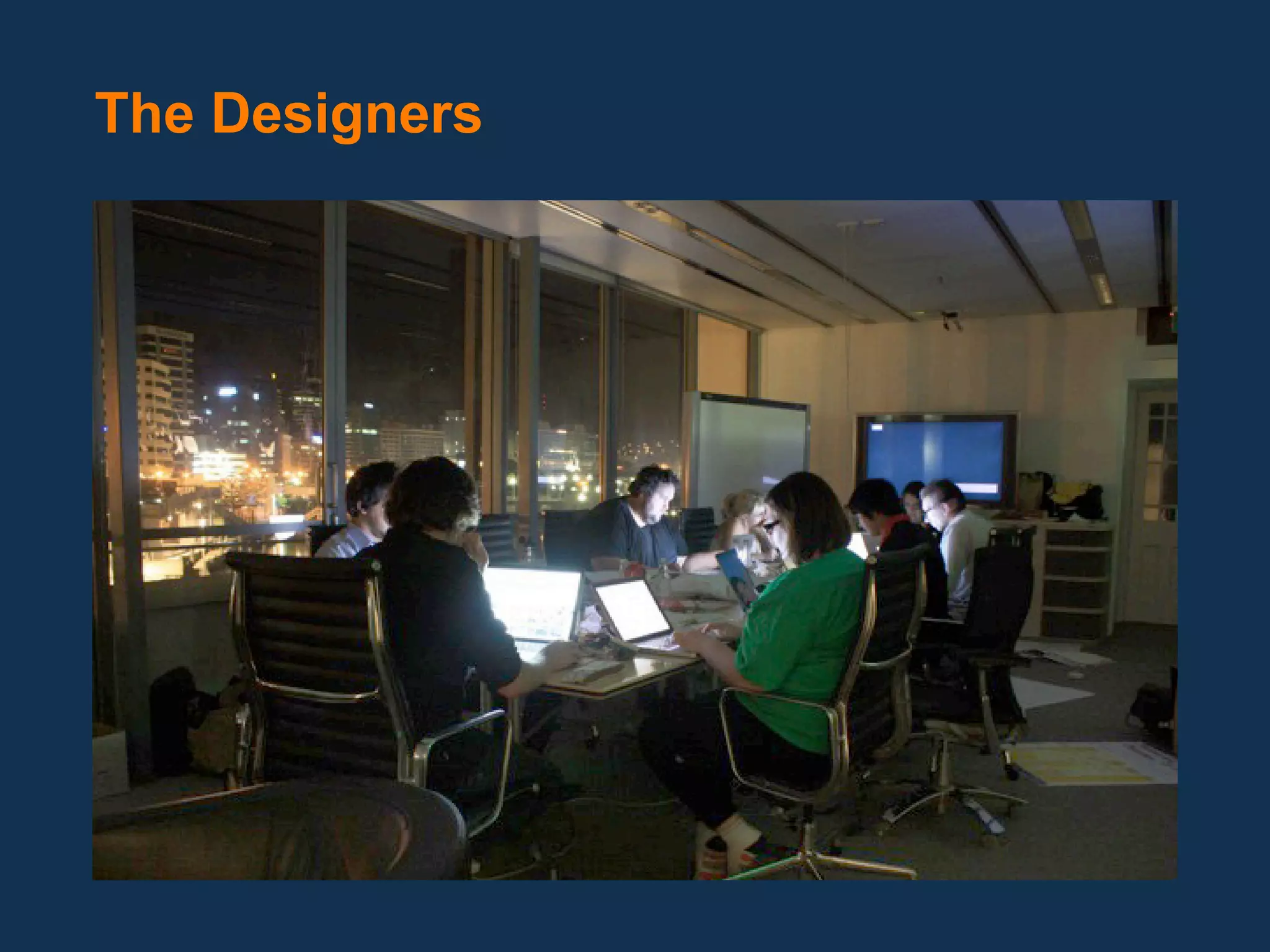
       The Designers
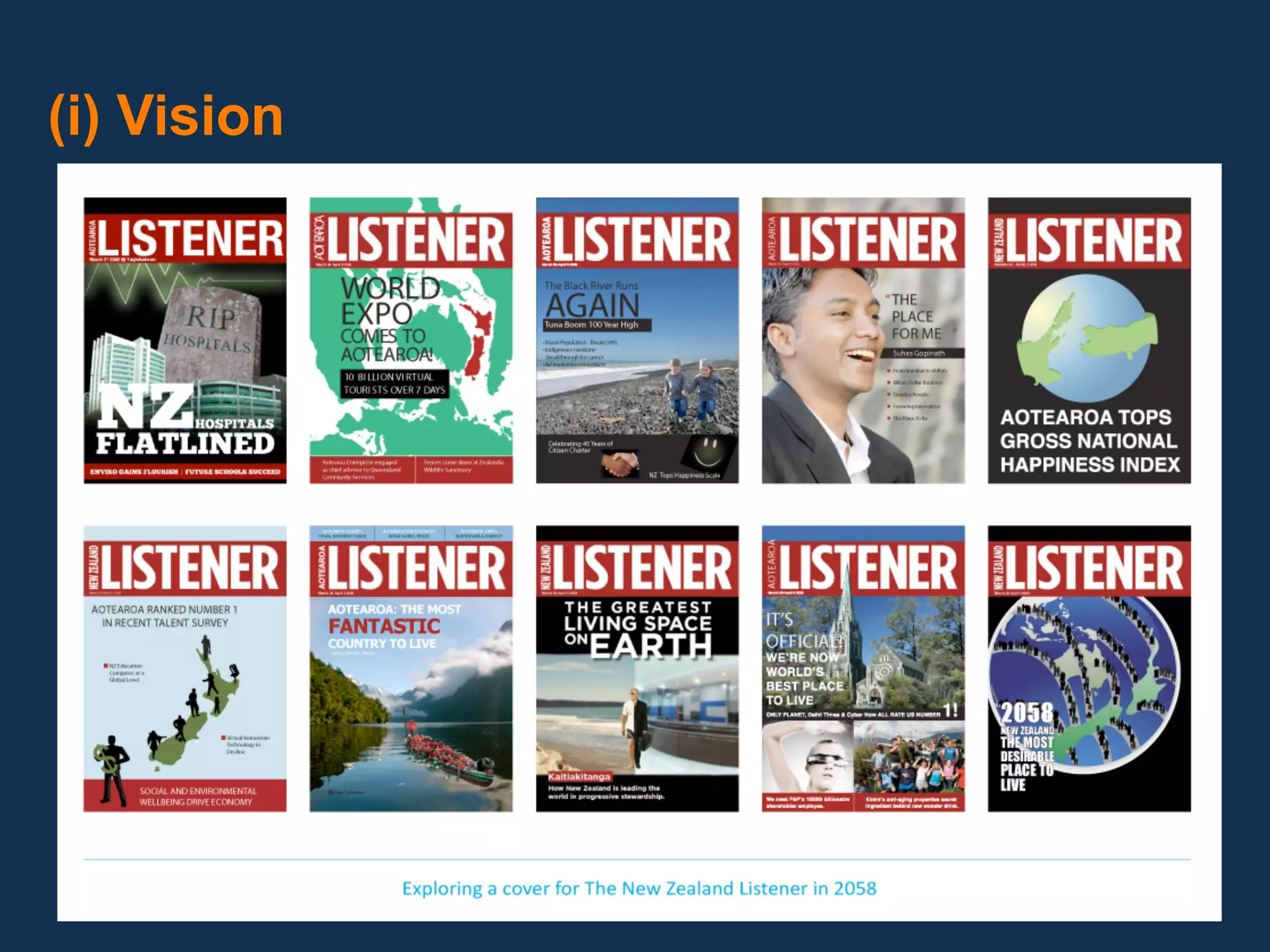
(i) Vision
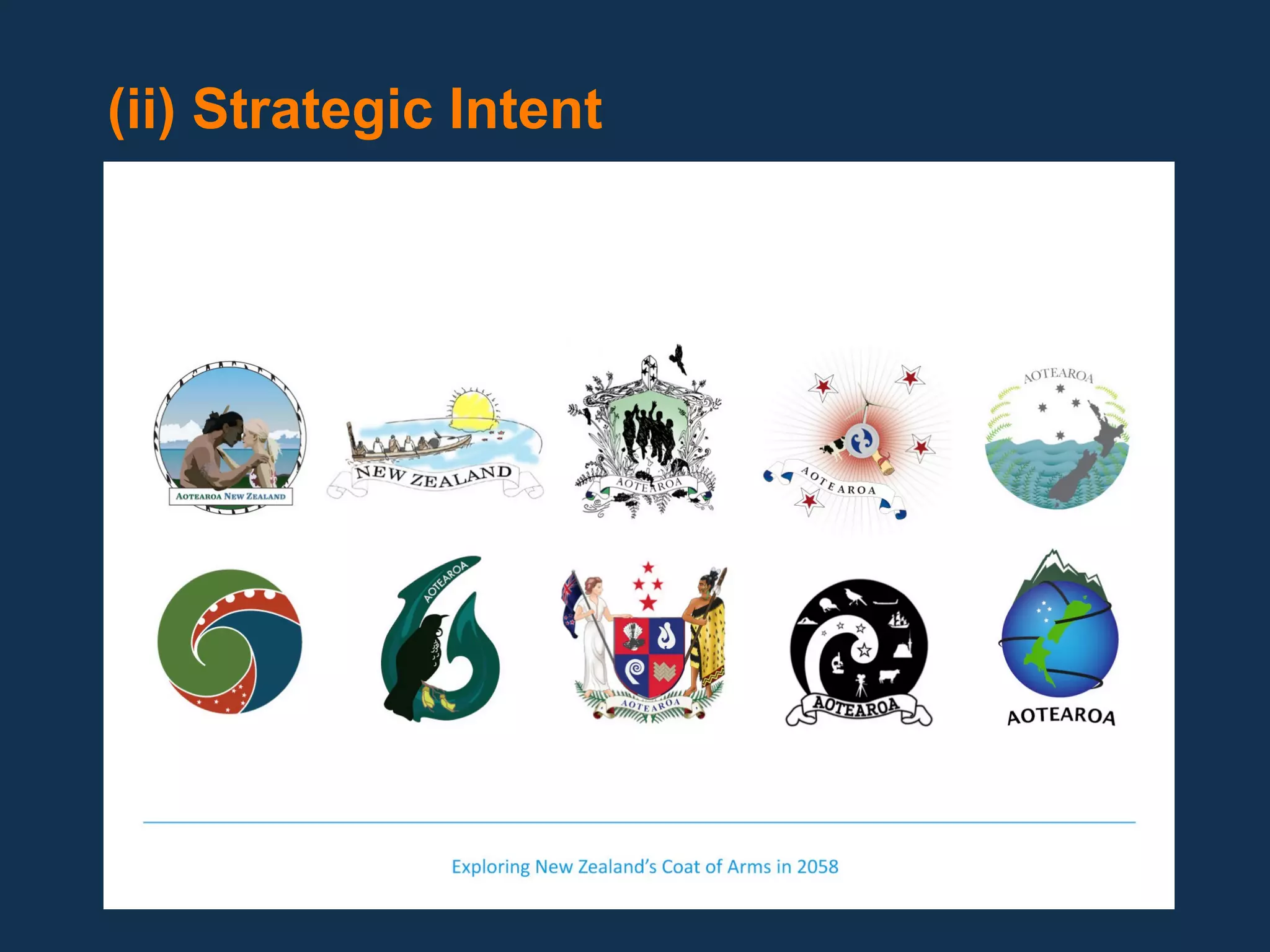
(ii) Strategic Intent
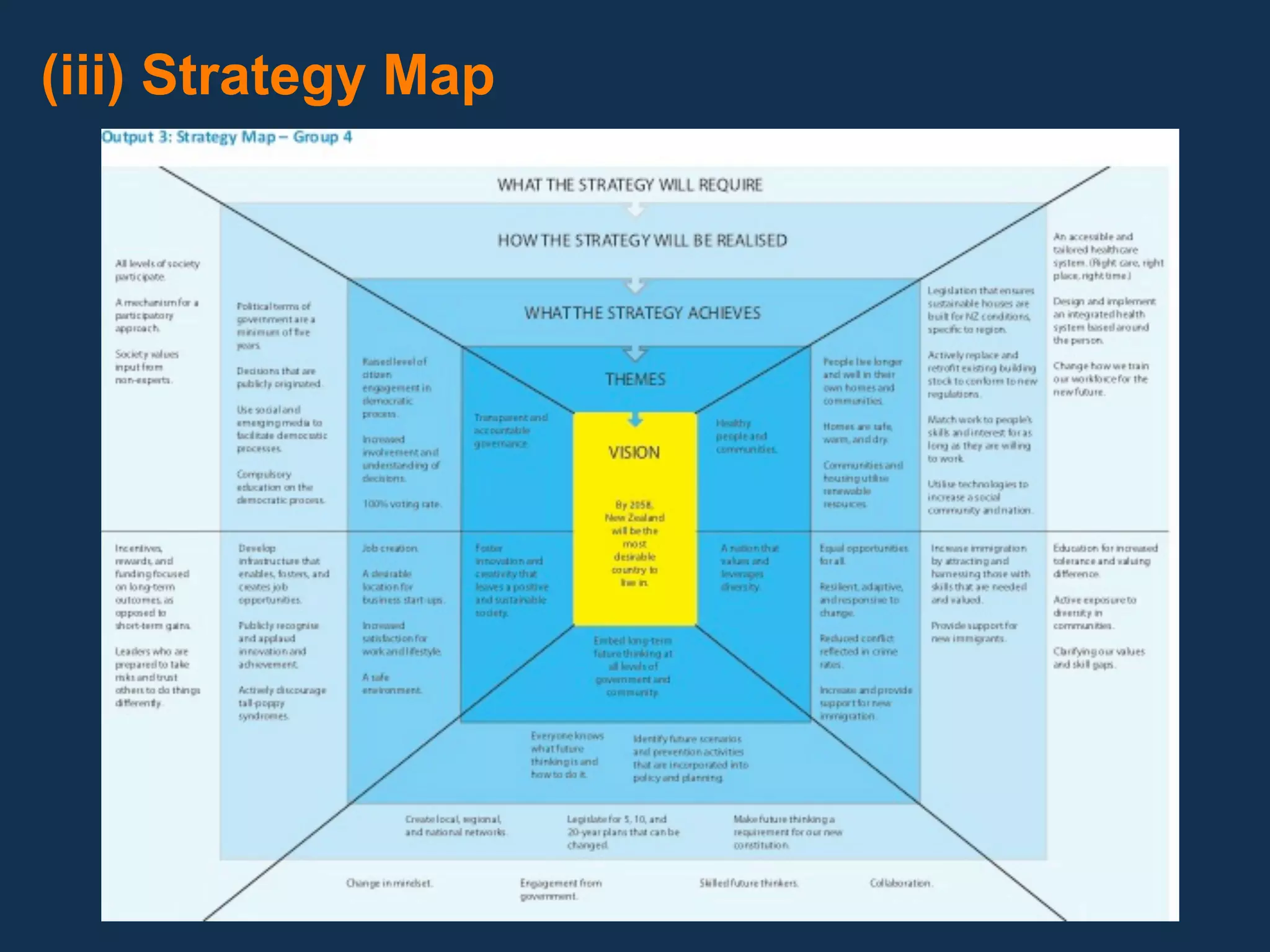
(iii) Strategy Map
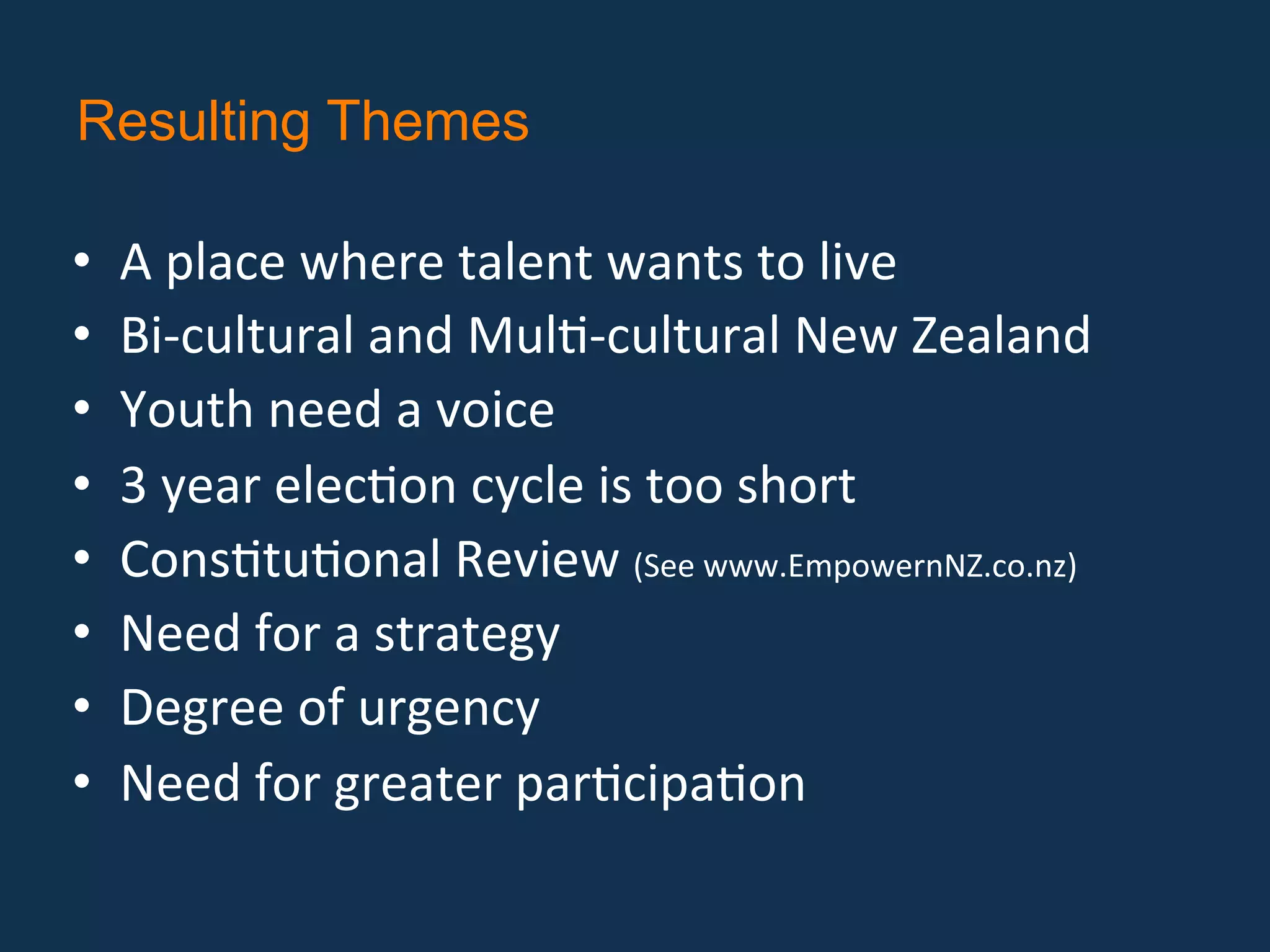
Resulting Themes

•    A place where talent wants to live 
•    Bi‐cultural and Mul?‐cultural New Zealand 
•    Youth need a voice 
•    3 year elec?on cycle is too short 
•    Cons?tu?onal Review (See www.EmpowernNZ.co.nz) 
•    Need for a strategy 
•    Degree of urgency 
•    Need for greater par?cipa?on 
 8. Lessons Learnt
 Work programme
•    Secure funding critical
•    Research question needs the right balance of focus and flexibility
•    Ability to rewrite/update methodology
•    Give yourself lots of time
      •  Research data can be hard to find
      •  Analysis uses data to create information for strategic knowledge
      •  External review is time-consuming and
      •  Communication involves people
Report Writing
•  Use designers to make your ideas come to life
•  Mapping data – assurance v communication
•  Provide a number of ways to commutate ideas
Events
•  Get the right people in the room
•  What you do before the event is as important afterwards
Foresight in New Zealand

Foresight in New Zealand

  • 1.
    Presentation 1.  Sustainable FutureInstitute 2.  Context - Korea/New Zealand 3.  Three Sights 4.  Creating Intelligent Countries 5.  Government Foresight in New Zealand 6.  Past Initiatives 7.  StrategyNZ: Mapping our Future 8.  Lessons Learnt
  • 2.
    1. The SustainableFuture Institute  www.sustainablefuture.info       A privately-funded non-partisan think tank working for the public good, contributing strategic foresight through evidence- based research and policy analysis.  
  • 3.
    Project 2058 –The Method (a) Government (b) NaGonal Assets    Report 7 Exploring the Shared Goals of  Report 1 A Na?onal Sustainable   (c) Future Thinkers  Māori (2010)  Development Strategy (2007)  (c) Ideas      Online Video Interviews: World  Online Video Interviews:    Report 8 Effec?ve Māori Representa?on  Futures  World Futures  in Parliament (2010)  Report 2 New Zealand Central (July 2008 and July 2009)  Government Strategies (2008,2009 and 2010)  Strategy Scenarios 


Research
and
Analysis
     Report 9 Government‐funded Science  (2007) Online Video Conversa?ons: Ideas  Under the Microscope (2011)  Online Video Conversa?ons: Ideas  about the Future            (December  Part
1:

 Report 3 Supporting Local about the Future  2008)  Report 10 The State of New Zealand’s  Government (2008) (2008)    Resources*  James Duncan Reference Library  Report 4 Institutions for (October 2009)  James Duncan Reference Library  Sustainable Development (2008)   (2009)  The Future of Infrastructure in New  A History of Future Thinkers in New  Zealand*  Zealand     The Future of Food and Agriculture*  Report 5 The Common Elements A History of Future Thinkers in New  The State Sector: Looking Forward*  of an NSDS (2008) Zealand (2011)  (d) State of New Zealand’s Future  
 Part
II:
  Report 6 Four Possible Futures for New Zealand in 2058  (2008)  
 Part
III:
 Na?onal Sustainable Development Strategy for  New Zealand* 
  • 4.
    2. Context (i) Physical Analytics South Korea  New Zealand  Land Area (km²)  96,920  267,710  3 ?mes  Coast (km²)  2,413  15, 134  6 ?mes  Borders  North Korea  None  Natural  coal   natural gas  Resources   tungsten  iron ore sand   graphite  coal   molybdenum  ?mber  lead  hydropower  hydropower  gold  poten?al  limestone 
  • 5.
    2. (ii) Man-madeAnalytics South Korea  New Zealand  Year  Popula?on  48, 988, 830  4, 291, 900  2011  11 ?mes  Fer?lity Rate  1.192  2.18  2008  Unemployment Rate  3.2%  4.2%  2008  Life Expectancy  79.4 years  80.2 years  2007  Income inequality:   0.312  0.335  2005  Gini co‐efficient (level)  GDP per Capita  $27, 657  $27, 036  2008  Gross domes?c expenditure  3.210%  1.206%  2008  on R+D  1/3   Source: (OECD, n.d.) 
  • 6.
    New Zealand’s  Exclusive  Economic  Zone       For every NewZealander •  1.30 km2 seabed (0.006 Korean) (217 times) •  0.06 km2 land (0.002 Korean) (30 times)
  • 7.
  • 8.
     3. Three Sights 1.  Hindsight 2.  Insight 3.  Foresight
  • 9.
    Hindsight   Sovereignty  SeSlement  Rights, Roles, RepresentaGon   & ResponsibiliGes  Social Reform  IdenGty  Social JusGce  Economic Reform 
  • 10.
    Insight and Foresight Today, 3 billion made  $2 or less per day.  40:60  Fiky years later,  the developed  60:40  countries & China  grow old – while  Africa & India get  younger. 
  • 11.
    Foresight Probable future –Forecasting and prediction (Status Quo) Possible futures – Scenarios, risks and opportunities (Explorative) Preferred futures – Strategies, propelled by leadership (Visionary)
  • 12.
    Foresight is foreknowledge(1900) One Hundred Years Hence  Although the public is wont to  regard predic7ons with an amount  of skep7cism…there is absolutely no  doubt to reason the accuracy of the  foreknowledge which comes from  reading the past and the trend of  current events. Progress cannot be  denied….   P J O’Regan, August 1900, New Zealand 
  • 13.
     Foresight: Where arewe going? (2011) 1.  Climate change and energy  2.  Massive debt (AKA ‘The Great Correc?on’)  3.  Water and food shortages/Environmental  issues  4.  Five simultaneous game‐changing tech  revolu?ons, tele‐everything  5.  Luddites/Individual destruc?ve power  6.  Robo?cs/Machine intelligence/ Employment  7.  Humans merging with the machines  NASA Chief ScienGst Dennis M. Bushnell  
  • 14.
  • 15.
    The Future… Snowden & Boone (2007). A Leader’s Framework  for Decision Making. Harvard Business Review. 
  • 16.
    Watch for Weak Signals  Responses from Powerful counGes  –  Self‐sufficient, heavily armed and a fortress mentality or  –  Serious engagement with all the problems of the planet    Choices for Small counGes  –  OpGon 1: Ignore  –  OpGon 2: Become an intelligent country  •  Adapt (monitor closely what is happening)  •  Support global leadership (UN, WB, etc)  •  Build alliances  and networks  •  Try to shape (lead by example) 
  • 17.
      4. How dowe create intelligent countries?    Assumption 1: Global Problems requires Global Solutions (GS) Assumption 2: GS requires Global Intelligence (GI) Assumption 3: GI = National Intelligence (NI) x 195 countries Then the aim is to increase NI+ NI+ = (Hindsight x Insight x Foresight) population
  • 18.
    Who are theIntelligent Countries?
  • 19.
    5. Government Initiativesin 2011 1.  Statement of Long-term Fiscal Position 2.  Productivity Commission 3.  Welfare Working Group – ‘Future Liability Approach’ 4.  Futures Forum 5.  Government-funded Research 6.  Local Government Long-term Plans  
  • 20.
  • 21.
  • 22.
    7. StrategyNZ: Mappingour Future Workshop March 2011    Pre‐Workshop          Na?on Dates (220 events)          Workbook (Report 12)          Future Studies Course (Dr Peter Bishop)  Workshop  Part 1 – Seong the global context  Part 2 – Where New Zealand is today  Part 3 – Preparing strategy maps  Part 4 – Presen?ng and judging strategy maps  Part 5 – Three workstreams  Part 6 – Presenta?ons    to Members of Parliament   I'()#*+%,-,.(>%45(-5.+2<=>%?-,,#*+%'@(%A@5@(.%( N-(;9#,-*5%A..71-9)( 3'(2%4-(5.* !"#$%&'# Post‐Workshop  !"#$%&'()#*+%,-,.(/%&(#0.*%12%3'(2%4-(5.*/%,('6#7.$%-*%'6.(6#.&%'8%5".%8..71-9)%&.%"-6.%(.9.#6.7% 8(':%,-(;9#,-*5$%#*%45(-5.+2<=>%?-,,#*+%'@(%A@5@(./%&#5"%,-(;9@B-(%.:,"-$#$%'*%#7.*;82#*+%&-2$%'8% #:,('6#*+%8@5@(.%.6.*5$C%D%"-6.%-77.7%-%8@(5".(%$.9;'*%-5%5".%.*7/%EF.$$'*$%8(':%45(-5.+2<=>%?-,,#*+% '@(%A@5@(.G/%#*%&"#9"%D%(.H.95%'*%-*7%(.$,'*7%5'%5".%'1$.(6-;'*$%#*9B@7.7%#*%5"#$%,-,.(C%!"-*)%2'@% -+-#*%8'(%2'@(%9'*$5(@9;6.%8..71-9)C I.*72%?9J@#**.$$ K"#.8%LM.9@;6. N@(,'$. !"#$%&'$()$*"&+$,(-.&/0$1%1#-$&+$*($+2/*"#+&+#$1%-*&3&1%/*$)##45%3.$-#3#&6#4$52$*"#$78+*%&/%59#$:8*8-#$              Strategy Map (Report 13)  ;/+*&*8*#$(/$*"#$7*-%*#02<=>$?%11&/0$(8-$:8*8-#$#6#/*@$"#94$&/$?%-3"$ABCCD$!"&+$)##45%3.$&+$9%-0#92$ 4#-&6#4$)-('$%/$(/9&/#$)##45%3.$+8-6#2$3(/483*#4$52$*"#$;/+*&*8*#@$%/4$"%+$5##/$3('1&9#4$*(0#*"#-$,&*"$ )##45%3.$-#3#&6#4$%)*#-$*"#$#6#/*D$;/$*"#$;/+*&*8*#E+$F#1(-*$CC>$!"#$%&'()"'*"+,&,(-.&/$01$02"30$&$4&$5-%" $0"6-7"8-4940:";<=>?@A;AB"C-4(0$02"*('D"&/-"E4%&"&'"F,$9:"4"F-&&-("*,&,(-$,#$"&0"9&0"*$CA$.#2$9#++(/+$ 9#%-/*$)-('$-#6&#,&/0$<#,$=#%9%/4$)8*8-#$*"&/.&/0$&/&*&%*&6#+D$G#++(/$#&0"*$,%+$*($HF#1(-*$%/4$'#%+8-#$ 1-(0-#++$I$5#)(-#@$48-&/0$%/4$%)*#-$*"#$&/&*&%*&6#ED$J&*"$*"&+$&/$'&/4@$,#$"(1#$*"&+$,(-.&/0$1%1#-$,&99$ '%.#$8+$5#**#-$%59#$*($4#9&6#-$%/4$#/3(8-%0#$(*"#-+$*($-8/$+833#++)89$)8*8-#$*"&/.&/0$&/&*&%*&6#+D O1'@5%45(-5.+2<=>%?-,,#*+%'@(%A@5@(./%?-(9"%PQRR 7*-%*#02<=>$?%11&/0$(8-$:8*8-#$,%+$"#94$&/$*"#$9%+*$)(8-$4%2+$()$?%-3"$ABCCD$!"#$;/+*&*8*#$1859&+"#4$ %$1-#K,(-.+"(1$,(-.5((.$%/4$(-0%/&+#4$%$*,(K4%2$&/*-(483*(-2$)8*8-#$+*84&#+$3(8-+#@$*%80"*$52$ L-$M#*#-$N&+"(1$)-('$*"#$O/&6#-+&*2$()$P(8+*(/D$!"&+$3(8-+#$,%+$)(99(,#4$52$%$*,(K4%2$,(-.+"(1$         Feedback (Working paper)  *"%*$389'&/%*#4$&/$1-#+#/*%*&(/+$%*$*"#$G#0&+9%*&6#$Q(8/3&9$Q"%'5#-D$F#1(-*$CR>$G&(4&-2)68B"H4EE$02" ',("+,&,(-"G&(4&-2)"H4E%B"+('D"I-"J4E4"&'"&/-"C-2$%94&$5-"K',0L$9"K/4DF-($4(38'#/*+$*"#$#6#/*$)(-$ 1%-*&3&1%/*+$%/4$(*"#-$&/*#-#+*#4$1%-*&#+D$!($9#%-/$'(-#$%5(8*$*"#$&/18*+@$1-(3#++#+$%/4$(8*18*+@$,#$ -#3(''#/4$2(8$-#%4$F#1(-*$CR$%/4$(8-$#K5((.$G&(4&-2)68B"H4EE$02"',("+,&,(-"M-*9-L&$'0%B"+('D" E4(&$L$E40&%"'*"&/-"7'(1%/'E@$5(*"$%6%&9%59#$(/$*"#$;/+*&*8*#E+$,#5+&*#D$ ?.5"'7'B'+2 M%-*&3&1%/*+$,#-#$%+.#4$*($3('19#*#$%/$(/9&/#$+8-6#2$)(-'$3(/*%&/&/0$AS$T8#+*&(/+$*"%*$3(6#-#4$%$5-(%4$ -%/0#$()$.#2$#9#'#/*+$&/$7*-%*#02<=>$?%11&/0$(8-$:8*8-#D$U$*(*%9$()$RV$1%-*&3&1%/*+$W(6#-$%$*"&-4$()$ *"(+#$*"%*$%**#/4#4X$-#+1(/4#4$*($*"#$+8-6#2Y$*"#$-#+1(/+#+$4($/(*$&/3984#$78+*%&/%59#$:8*8-#$;/+*&*8*#$         Reflec?ons by Par?cipants (e‐book)  +*%))$'#'5#-+$,"($%**#/4#4$*"#$#6#/*$%+$1%-*&3&1%/*+D$:##45%3.$-#3#&6#4$)-('$*"#$+8-6#2$"%+$5##/$ +8''%-&+#4$%/4$4&6&4#4$&/*($*"#$)(99(,&/0$)&6#$+#3*&(/+> UD$ :##45%3.$(/$*"#$J(-.5((. ND$ :##45%3.$(/$*"#$:8*8-#$7*84&#+$Q(8-+# QD$ :##45%3.$(/$*"#$7&Z$M%-*+$()$*"#$J(-.+"(1 LD$ :##45%3.$(/$*"#$;/+*&*8*#E+$M#-)(-'%/3# [D$ :##45%3.$(/$:(99(,K81$U3*&6&*2  Na?on Dates (440 events)  WORKING PAPER: STRATEGYNZ: MAPPING OUR FUTURE PARTICIPANT FEEDBACK | 1 WORKING PAPER 2011/16
  • 23.
    Strategy Pyramid *  *  * 
  • 24.
  • 25.
    … From previousslide – Strategy Map for Brazil
  • 26.
  • 27.
  • 28.
    -#*)"/(?".%$(>%)'?",/'%1"%?'()",/'" '()*+,(-%=8-%8,(%8=%0/(%+-89G)? The Designers
  • 29.
  • 30.
  • 31.
  • 32.
    Resulting Themes •  A place where talent wants to live  •  Bi‐cultural and Mul?‐cultural New Zealand  •  Youth need a voice  •  3 year elec?on cycle is too short  •  Cons?tu?onal Review (See www.EmpowernNZ.co.nz)  •  Need for a strategy  •  Degree of urgency  •  Need for greater par?cipa?on 
  • 33.
     8. Lessons Learnt  Workprogramme •  Secure funding critical •  Research question needs the right balance of focus and flexibility •  Ability to rewrite/update methodology •  Give yourself lots of time •  Research data can be hard to find •  Analysis uses data to create information for strategic knowledge •  External review is time-consuming and •  Communication involves people Report Writing •  Use designers to make your ideas come to life •  Mapping data – assurance v communication •  Provide a number of ways to commutate ideas Events •  Get the right people in the room •  What you do before the event is as important afterwards