STRATEGYNZ
IMPROVING STRATEGY STEWARDSHIP IN THE PUBLIC SERVICE
WELLINGTON, NEW ZEALAND (22 OCTOBER 2015)
AS AT FEBRUARY 2015 …NEXT STEPS
2
¡  Report to be published later this year bringing all this work together (late May)
¡  History of ‘goals’ directing the public service (any help greatly appreciated)
¡  More analysis of the data to be completed
¡  Open to suggestions/discussions on way forward
¡  Meeting with Hon. Bill English
¡  Offer to meet with CE of all government departments to discuss index
ASSUMPTIONS
Strategy stewardship matters because without a discussion on strategy the policy landscape
would be riddled with goals, with no clarity around which goals are achievable nor any
collaboration over how to achieve them.   
A public management system that holds strategy stewardship as a core value will result in a
country that is prepared to tackle the policy issues of the future in a cost-effective, integrated
and community-focused manner.
Strategy is the tool we must use to consider and prioritise the vast array of different possible
futures that await us.
3
OUR APPROACH
3 OUTPUTS
4
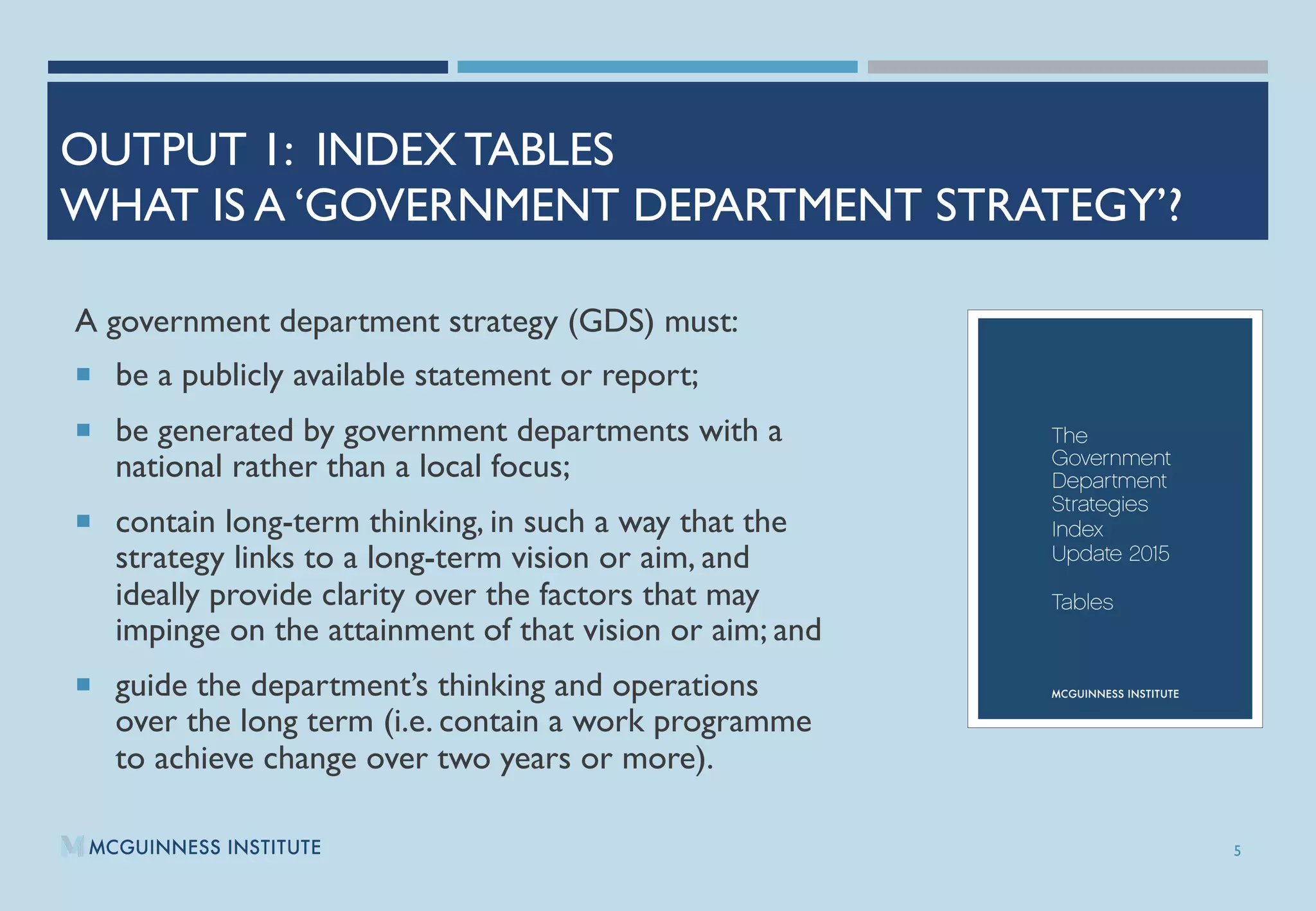
OUTPUT 1: INDEX TABLES
WHAT IS A ‘GOVERNMENT DEPARTMENT STRATEGY’?
A government department strategy (GDS) must: 
¡  be a publicly available statement or report;
¡  be generated by government departments with a
national rather than a local focus; 
¡  contain long-term thinking, in such a way that the
strategy links to a long-term vision or aim, and
ideally provide clarity over the factors that may
impinge on the attainment of that vision or aim; and 
¡  guide the department’s thinking and operations
over the long term (i.e. contain a work programme
to achieve change over two years or more).
5
6
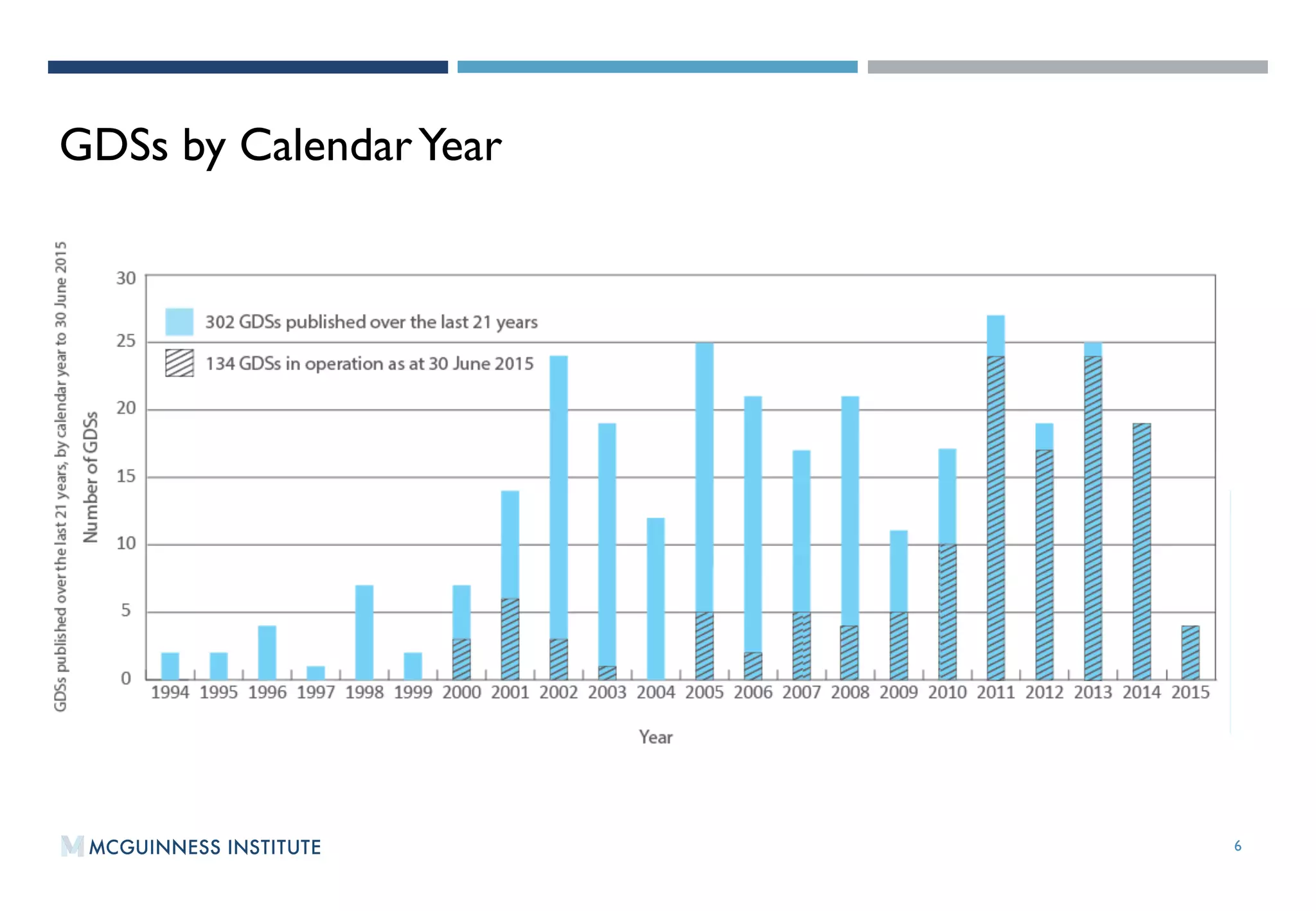
GDSs by CalendarYear
7
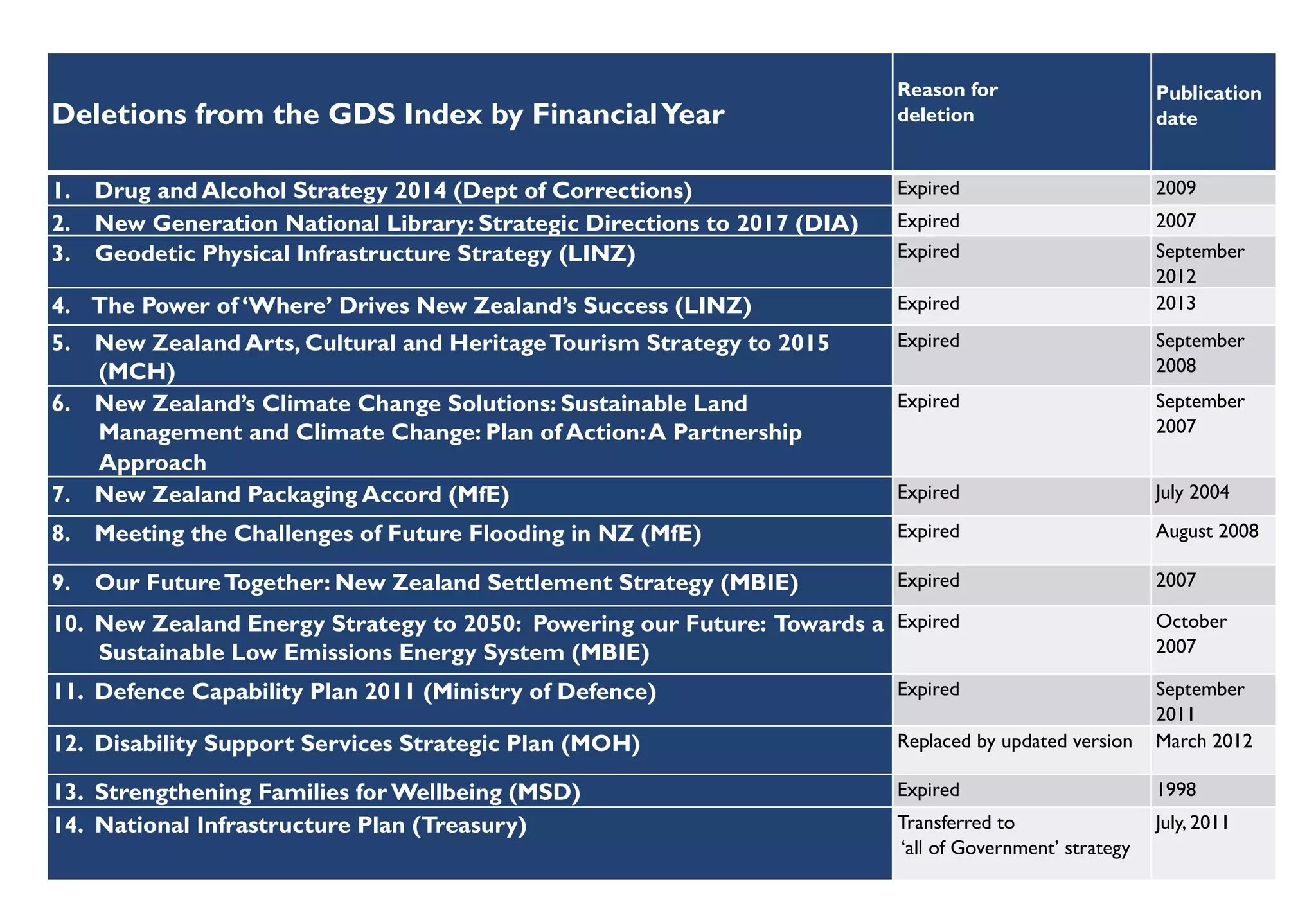
Deletions from the GDS Index by FinancialYear
	
  
Reason for
deletion


Publication
date
	
  
1. Drug and Alcohol Strategy 2014 (Dept of Corrections)	
   Expired 	
   2009	
  
2. New Generation National Library: Strategic Directions to 2017 (DIA)	
   Expired 	
   2007	
  
3. Geodetic Physical Infrastructure Strategy (LINZ)	
   Expired 	
   September
2012	
  
4. The Power of ‘Where’ Drives New Zealand’s Success (LINZ)	
   Expired 	
   2013	
  
5. New Zealand Arts, Cultural and HeritageTourism Strategy to 2015
(MCH)	
  
Expired 	
   September
2008	
  
6. New Zealand’s Climate Change Solutions: Sustainable Land
Management and Climate Change: Plan of Action:A Partnership
Approach	
  
Expired 	
   September
2007	
  
7. New Zealand Packaging Accord (MfE)	
   Expired 	
   July 2004	
  
8. Meeting the Challenges of Future Flooding in NZ (MfE)	
   Expired 	
   August 2008	
  
9. Our FutureTogether: New Zealand Settlement Strategy (MBIE)	
   Expired 	
   2007	
  
10. New Zealand Energy Strategy to 2050: Powering our Future: Towards a
Sustainable Low Emissions Energy System (MBIE)	
  
Expired 	
   October
2007	
  
11. Defence Capability Plan 2011 (Ministry of Defence)	
   Expired	
   September
2011	
  
12. Disability Support Services Strategic Plan (MOH)	
   Replaced by updated version	
   March 2012	
  
13. Strengthening Families for Wellbeing (MSD)	
   Expired	
   1998	
  
14. National Infrastructure Plan (Treasury)	
   Transferred to
‘all of Government’ strategy	
  
July, 2011	
  
8
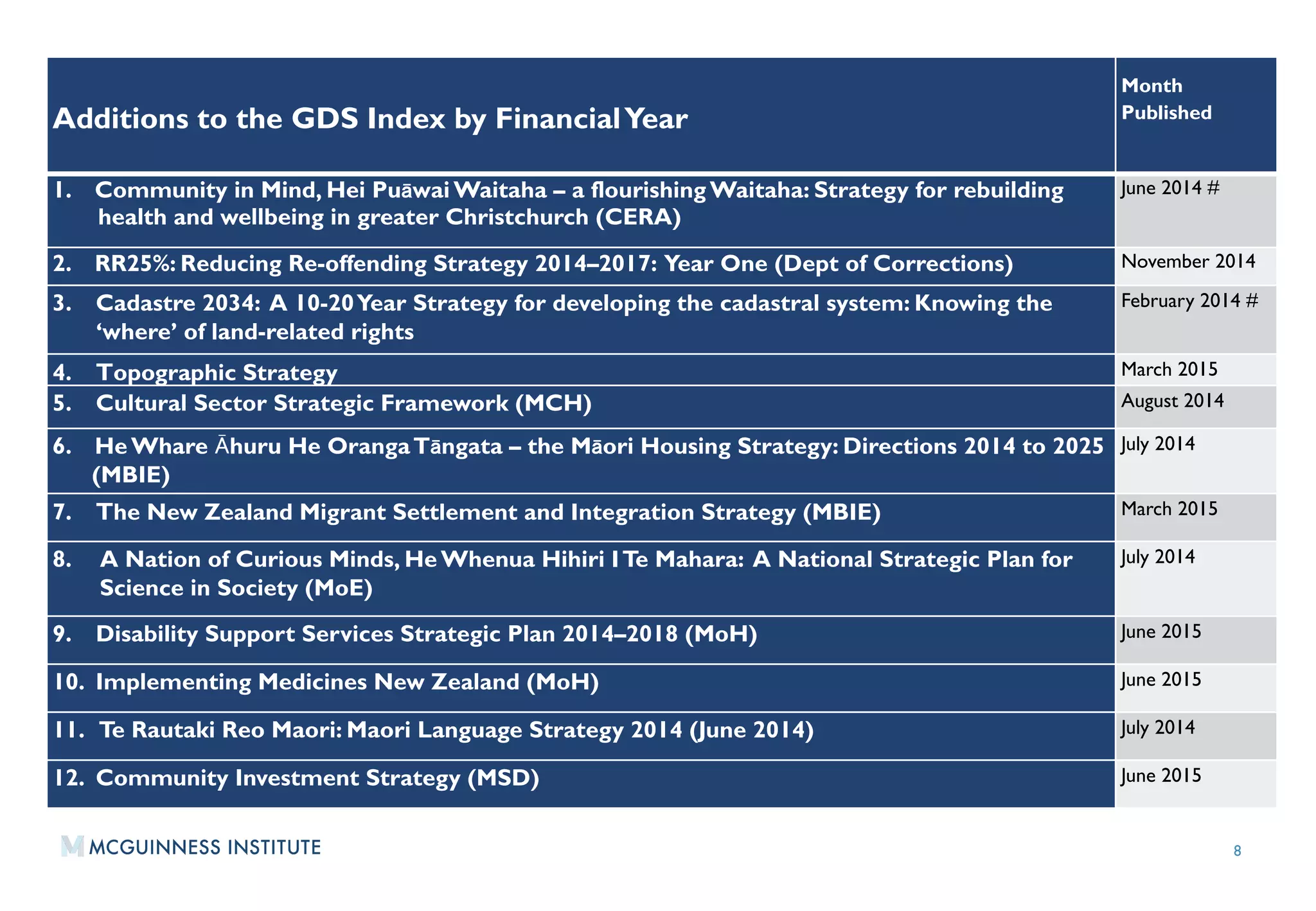
Additions to the GDS Index by FinancialYear


Month
Published	
  
1.  Community in Mind, Hei Puāwai Waitaha – a flourishing Waitaha: Strategy for rebuilding
health and wellbeing in greater Christchurch (CERA)	
  
June 2014 #	
  
2.  RR25%: Reducing Re-offending Strategy 2014–2017: Year One (Dept of Corrections) November 2014	
  
3. Cadastre 2034: A 10-20Year Strategy for developing the cadastral system: Knowing the
‘where’ of land-related rights	
  
February 2014 #	
  
4. Topographic Strategy	
   March 2015	
  
5. Cultural Sector Strategic Framework (MCH) 	
   August 2014	
  
6.  He Whare Āhuru He OrangaTāngata – the Māori Housing Strategy: Directions 2014 to 2025
(MBIE)	
  
July 2014	
  
7. The New Zealand Migrant Settlement and Integration Strategy (MBIE)	
   March 2015	
  
8. A Nation of Curious Minds, He Whenua Hihiri ITe Mahara: A National Strategic Plan for
Science in Society (MoE)	
  
July 2014	
  
9. Disability Support Services Strategic Plan 2014–2018 (MoH)	
   June 2015	
  
10. Implementing Medicines New Zealand (MoH)	
   June 2015	
  
11. Te Rautaki Reo Maori: Maori Language Strategy 2014 (June 2014)	
   July 2014	
  
12. Community Investment Strategy (MSD)	
   June 2015	
  
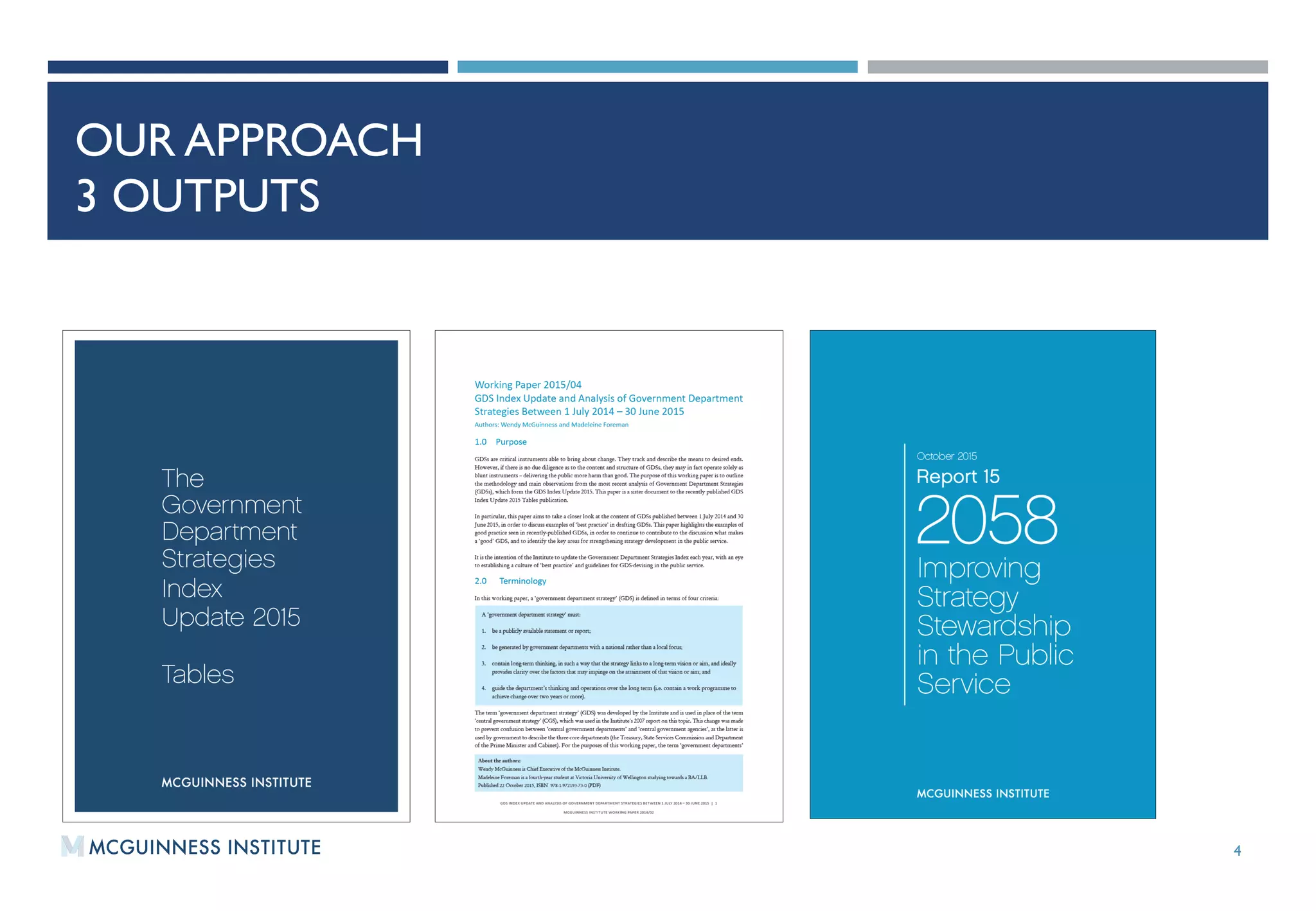
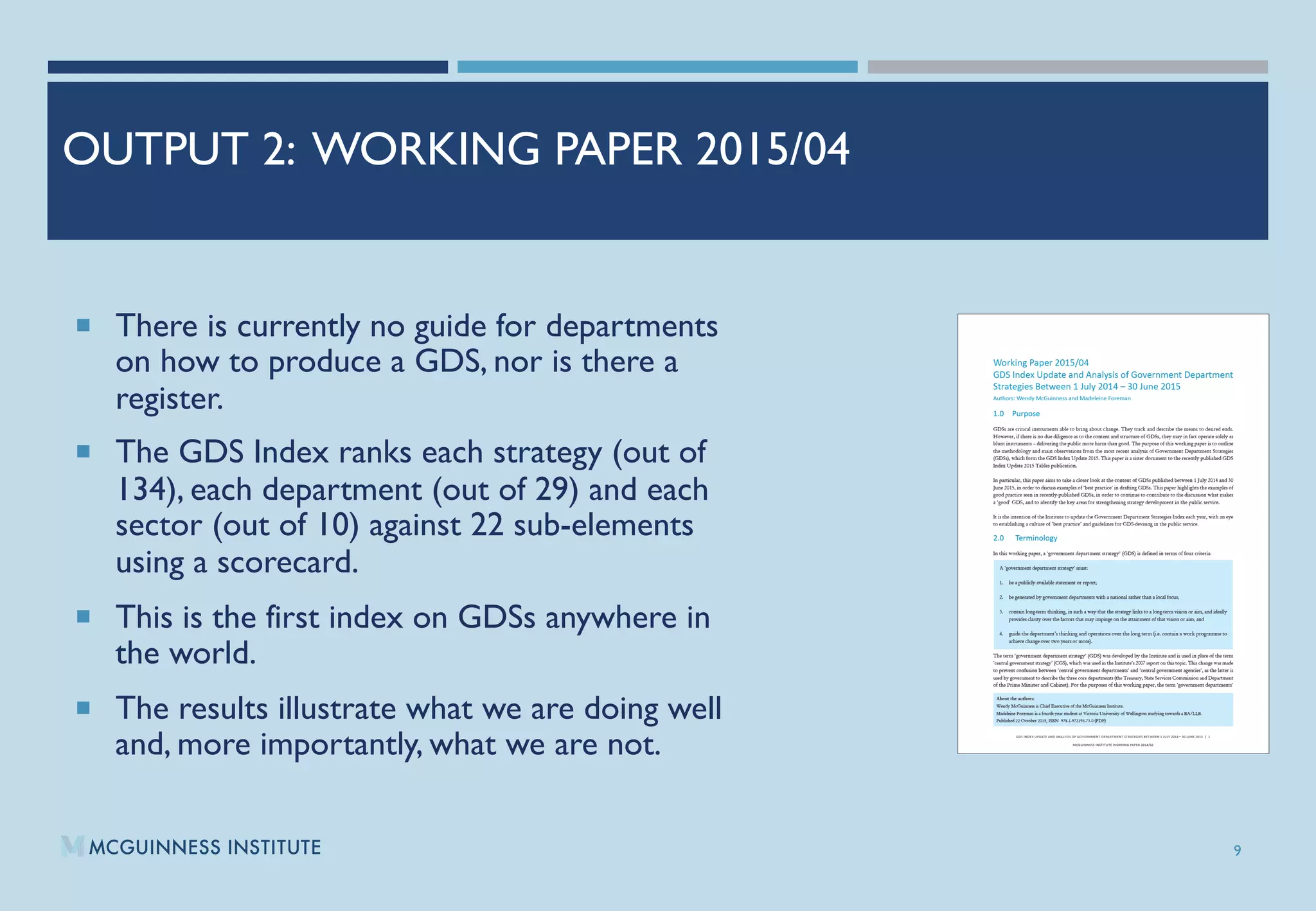
OUTPUT 2: WORKING PAPER 2015/04
¡  There is currently no guide for departments
on how to produce a GDS, nor is there a
register.
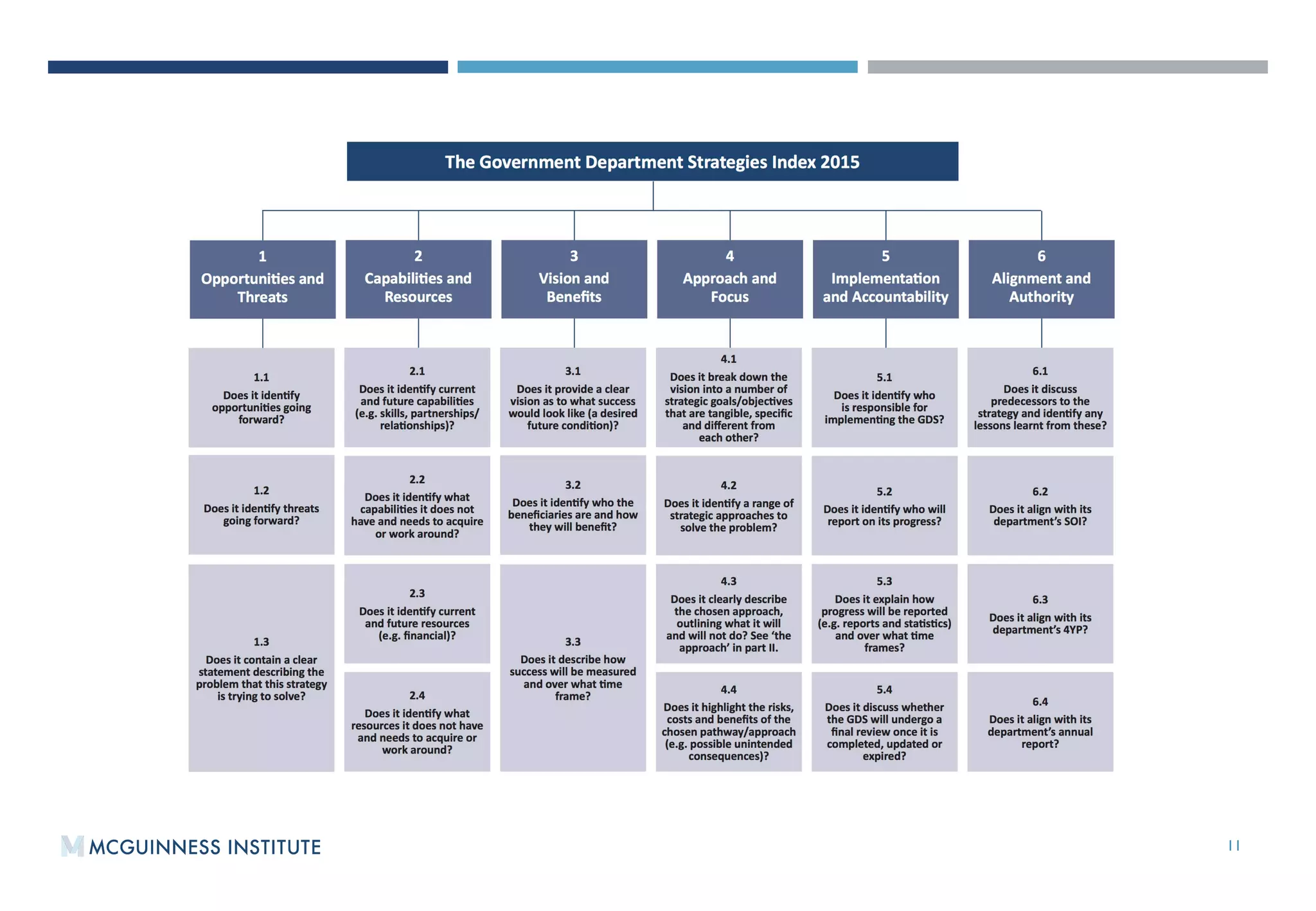
¡  The GDS Index ranks each strategy (out of
134), each department (out of 29) and each
sector (out of 10) against 22 sub-elements
using a scorecard.
¡  This is the first index on GDSs anywhere in
the world.
¡  The results illustrate what we are doing well
and, more importantly, what we are not.
9
10
CHARACTERISTICS OF A GOOD GDS?
0
5
10
15
20
25
30
Purpose [what]:The strategy explains what/who
will benefit from the strategy being implemented,
what choices/priorities are being made and
outlines what success might look like.
Context [why]:The strategy outlines why in
terms of being informed by the past, builds on
the present, and optimises the future (taking into
account risk/reward and the probable, possible
and preferred futures).
Resources [how/when/where]:The strategy sets
out how it will be implemented, over what
duration/timeframes, using what financial
resources, assets and partnerships.
Accountability [who is responsible]:The strategy
sets out who will implement the strategy, who
will report against what indicators and who will
review the strategy.
Alignment [quality of fit]:The strategy aligns both
with internal goals (within the department) and
external goals (within the overall strategy
framework within the public service).
Actual Strategy Average Strategy
Radar Diagram
11
12
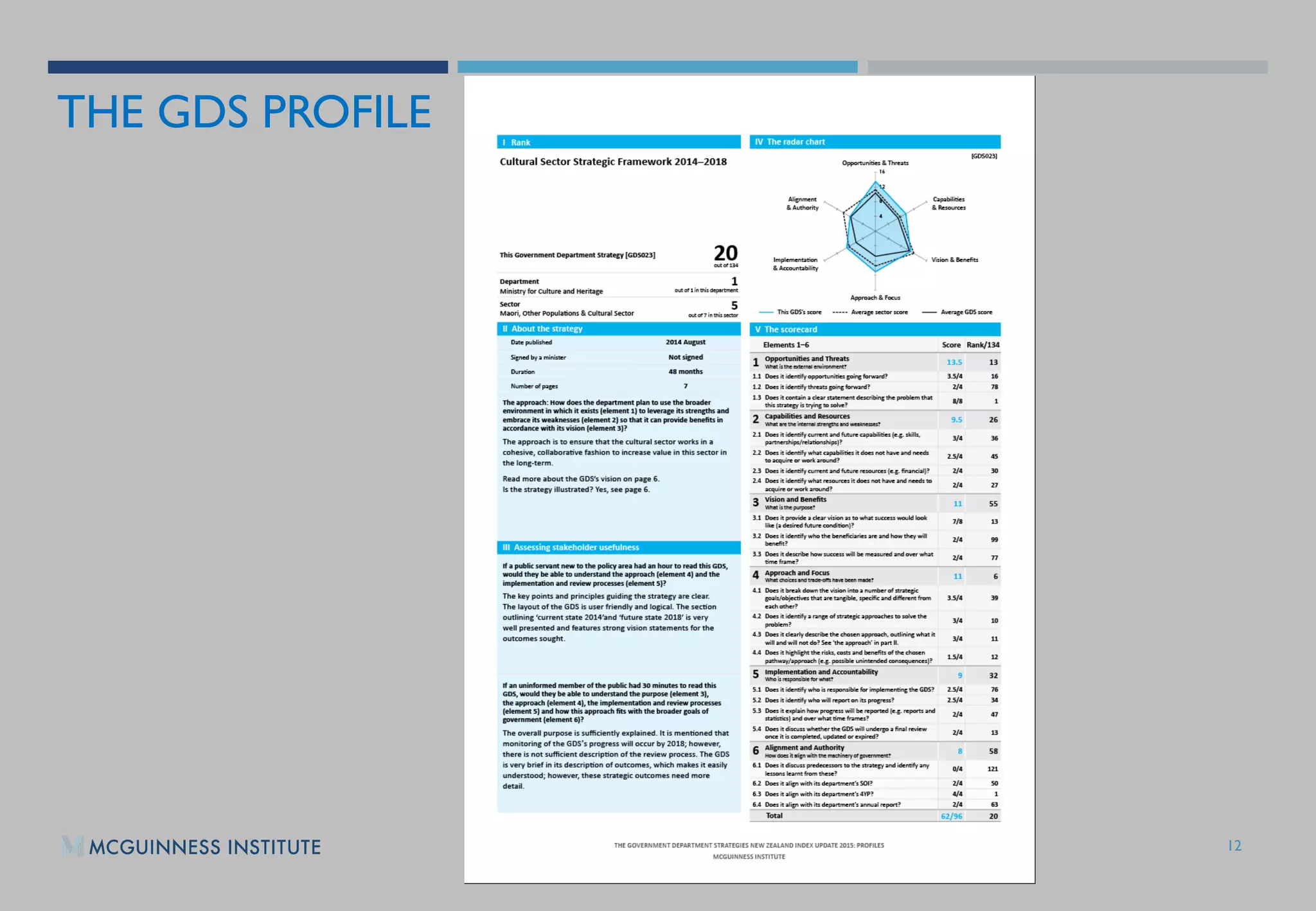
THE GDS PROFILE
13
Additions to the GDS Index this financial year


Publication date	


1.  Community in Mind, Hei Puāwai Waitaha – a flourishing Waitaha: Strategy for rebuilding
health and wellbeing in greater Christchurch (CERA)	
  
June 2014	
  
2. RR25%: Reducing Re-offending Strategy 2014 – 2017:Year One (Dept of Corrections) November 2014	
  
3. Cadastre 2034:A 10-20Year Strategy for developing the
cadastral system: Knowing the ‘where’ of land-related rights	
  
February 2014	
  
4. Topographic Strategy	
   March 2015	
  
5. Cultural Sector Strategic Framework (MCH) 	
   August 2014	
  
6. He Whare Āhuru He OrangaTāngata – the Māori Housing Strategy:
Directions 2014 to 2025 (MBIE)	
  
July 2014	
  
7. The New Zealand Migrant Settlement and Integration Strategy (MBIE)	
   March 2015	
  
8. A Nation of Curious Minds, He Whenua Hihiri ITe Mahara:A National Strategic Plan for
Science in Society (MoE)	
  
July 2014	
  
9. Disability Support Services Strategic Plan 2014 – 2018 (MoH)	
   June 2015	
  
10. Implementing Medicines New Zealand (MoH)	
   June 2015	
  
11. Te Rautaki Reo Maori: Maori Language Strategy 2014 (June 2014)	
   July 2014	
  
12. Community Investment Strategy (MSD)	
   June 2015	
  
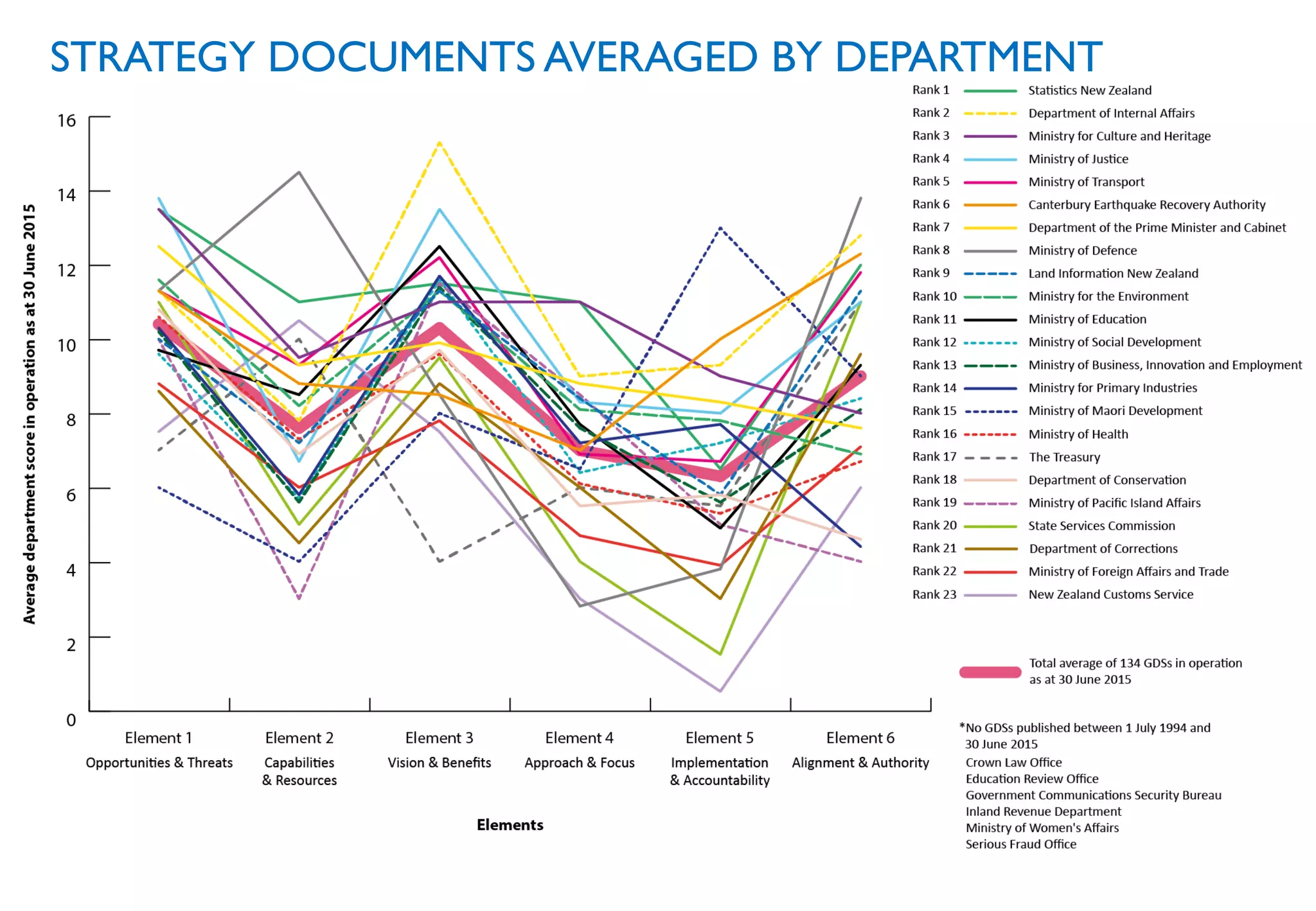
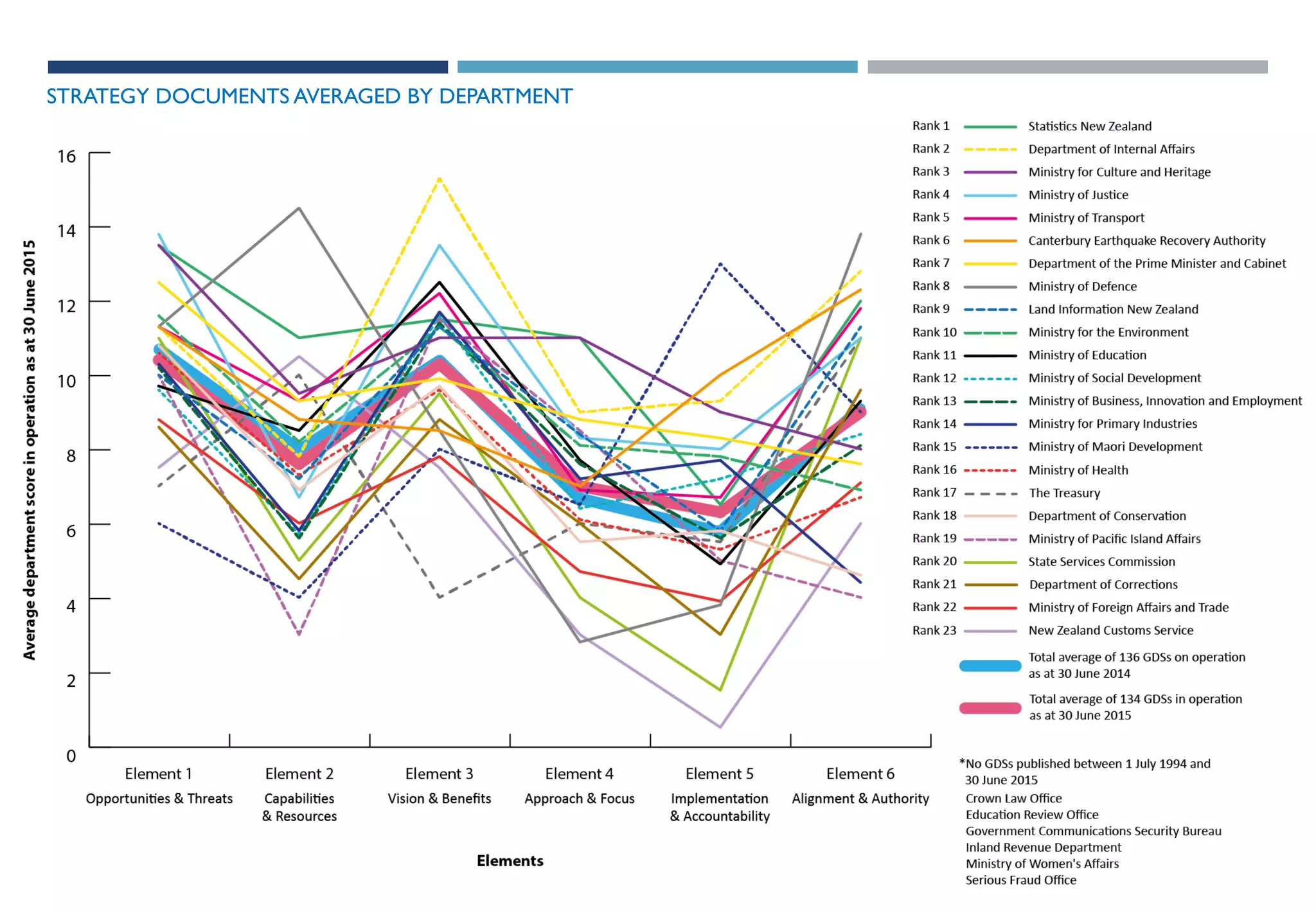
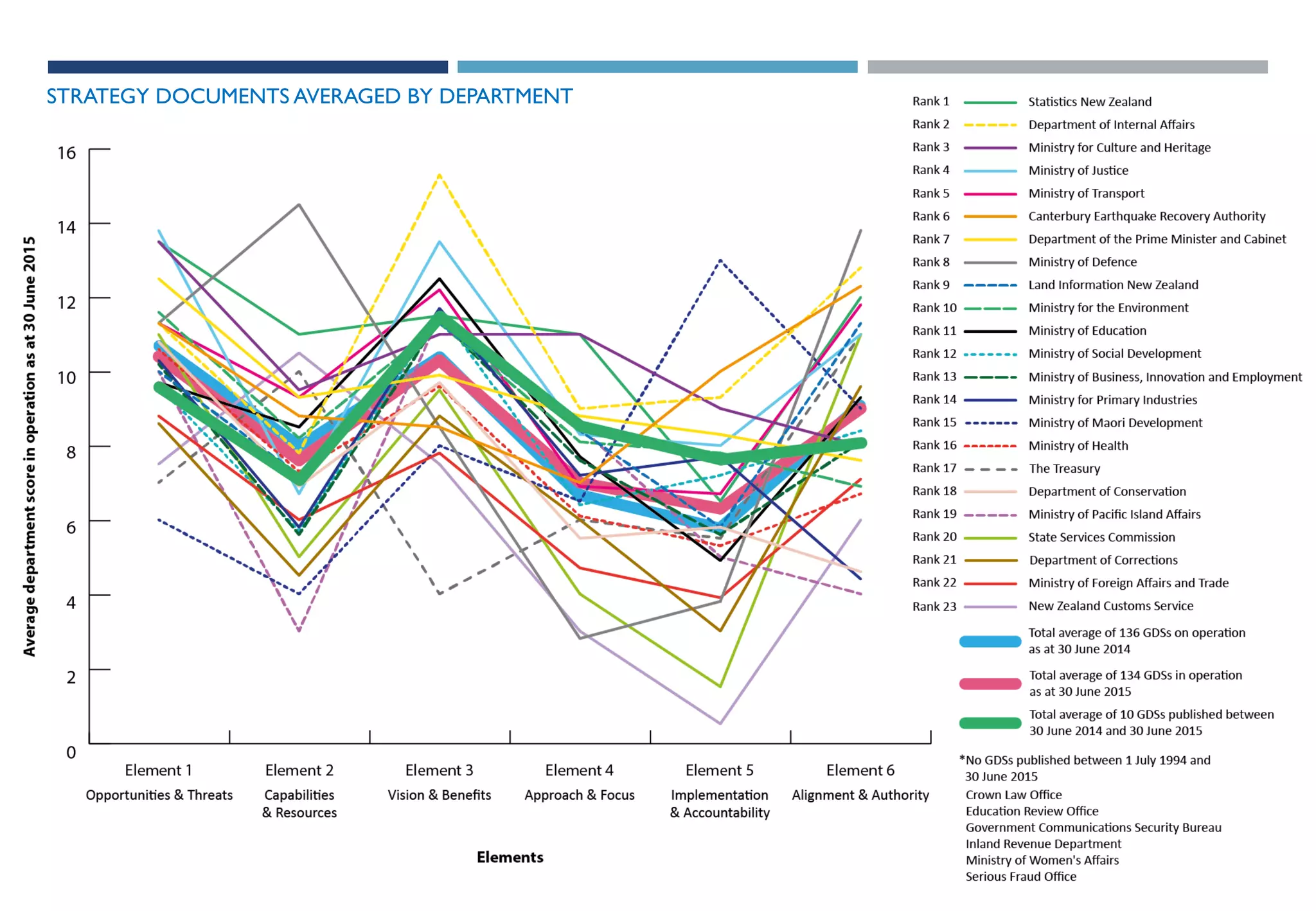
STRATEGY DOCUMENTS AVERAGED BY DEPARTMENT ?
14
STRATEGY DOCUMENTS AVERAGED BY DEPARTMENT ?
15
STRATEGY DOCUMENTS AVERAGED BY DEPARTMENT ?
16
OUTPUT 2:WORKING PAPER 2015/01
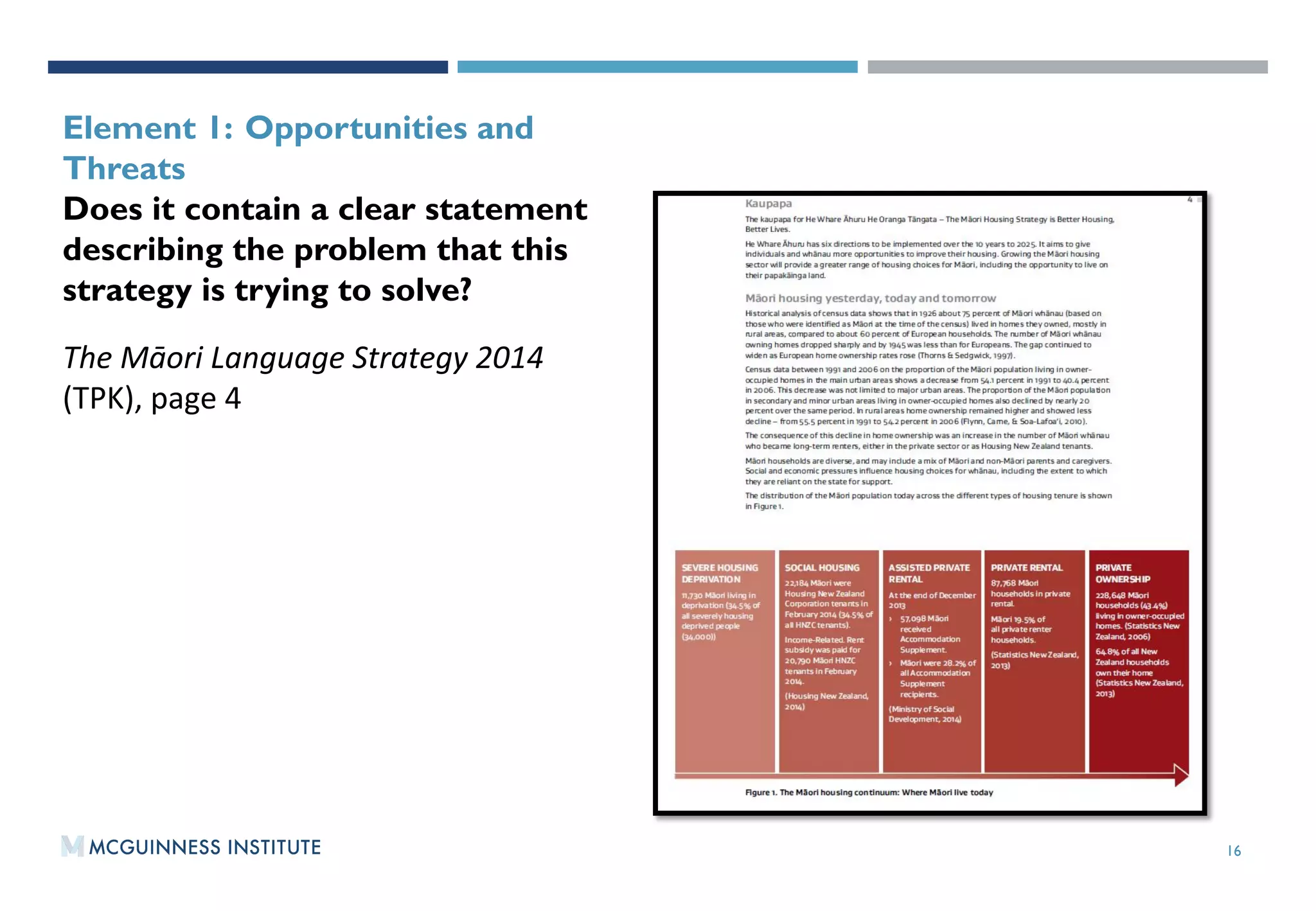
Element 1: Opportunities and
Threats
Does it contain a clear statement
describing the problem that this
strategy is trying to solve?
The	
  Māori	
  Language	
  Strategy	
  2014	
  
(TPK),	
  page	
  4	
  
17
OUTPUT 2:WORKING PAPER 2015/01
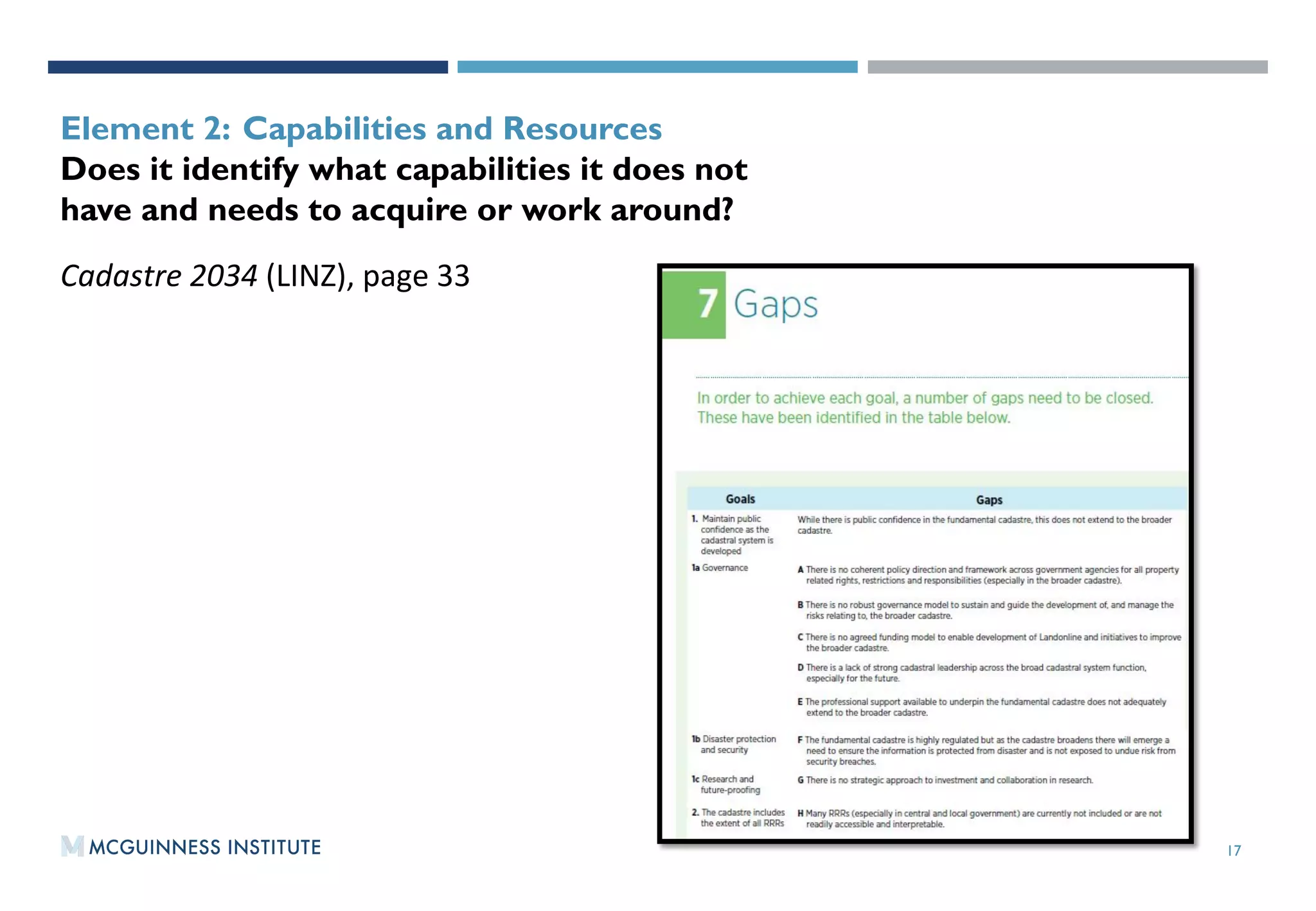
Element 2: Capabilities and Resources
Does it identify what capabilities it does not
have and needs to acquire or work around?
Cadastre	
  2034	
  (LINZ),	
  page	
  33	
  
18
OUTPUT 2:WORKING PAPER 2015/01
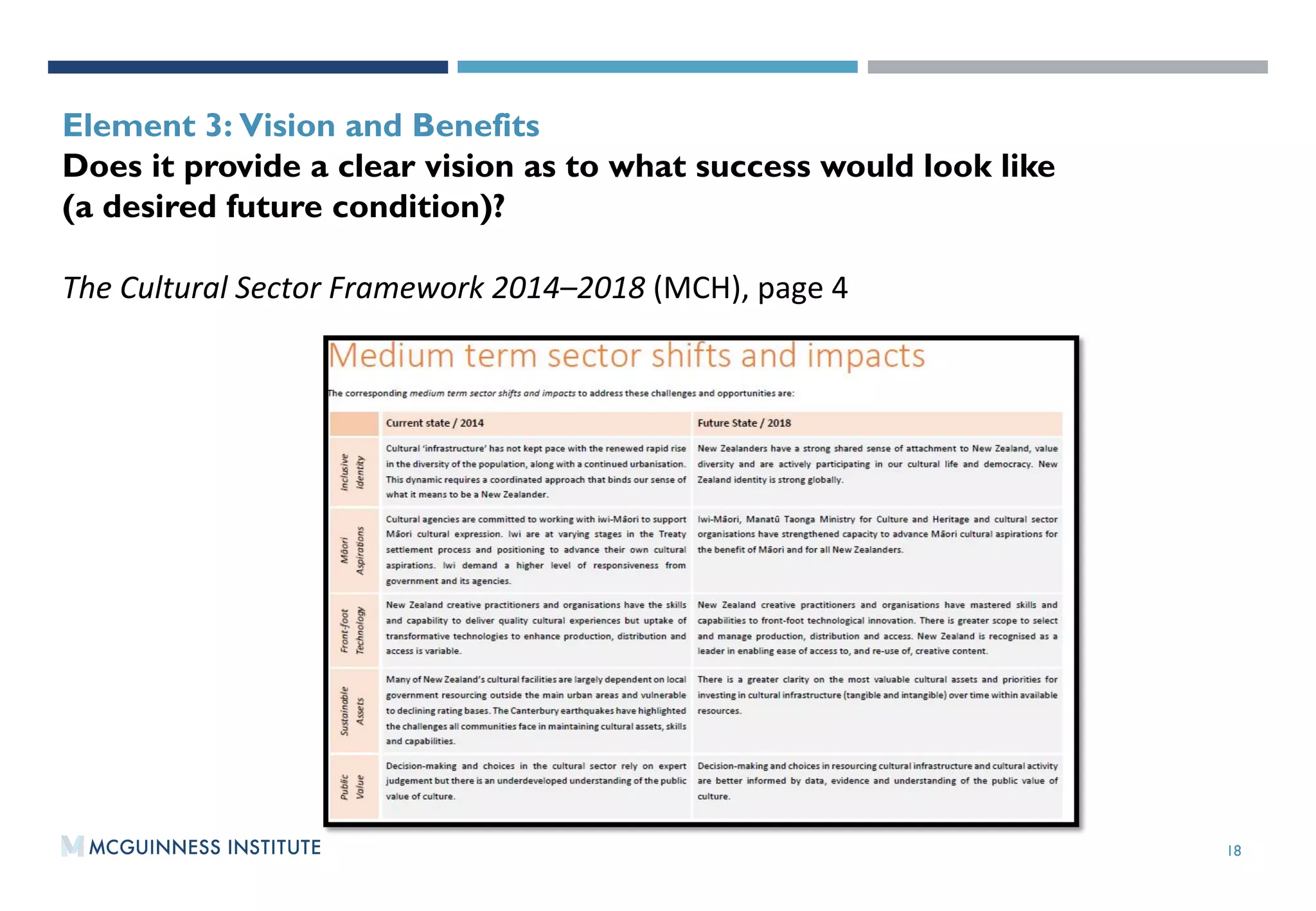
Element 3: Vision and Benefits
Does it provide a clear vision as to what success would look like
(a desired future condition)?
The	
  Cultural	
  Sector	
  Framework	
  2014–2018	
  (MCH),	
  page	
  4	
  
19
OUTPUT 2:WORKING PAPER 2015/01
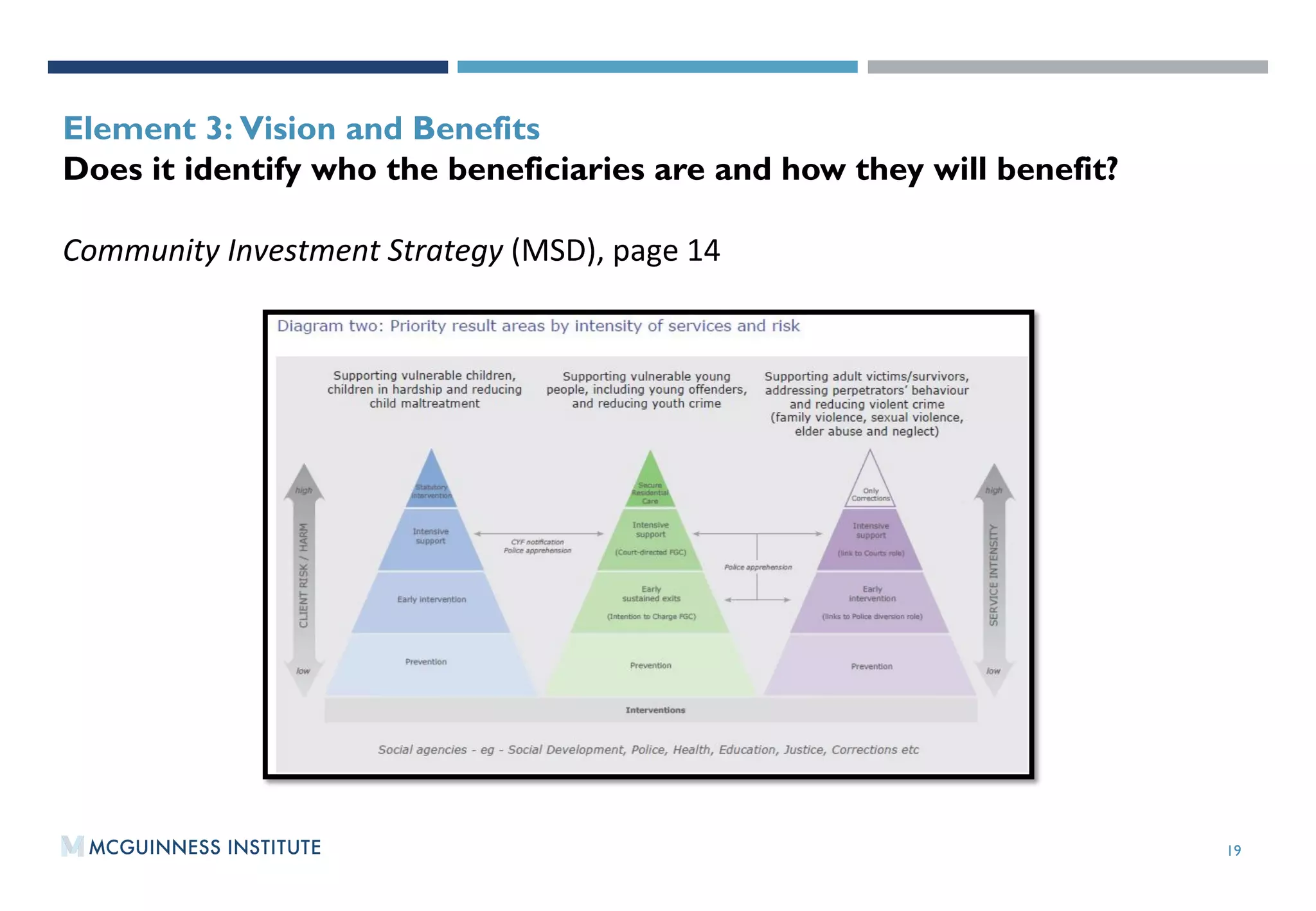
Element 3: Vision and Benefits
Does it identify who the beneficiaries are and how they will benefit?
Community	
  Investment	
  Strategy	
  (MSD),	
  page	
  14	
  
20
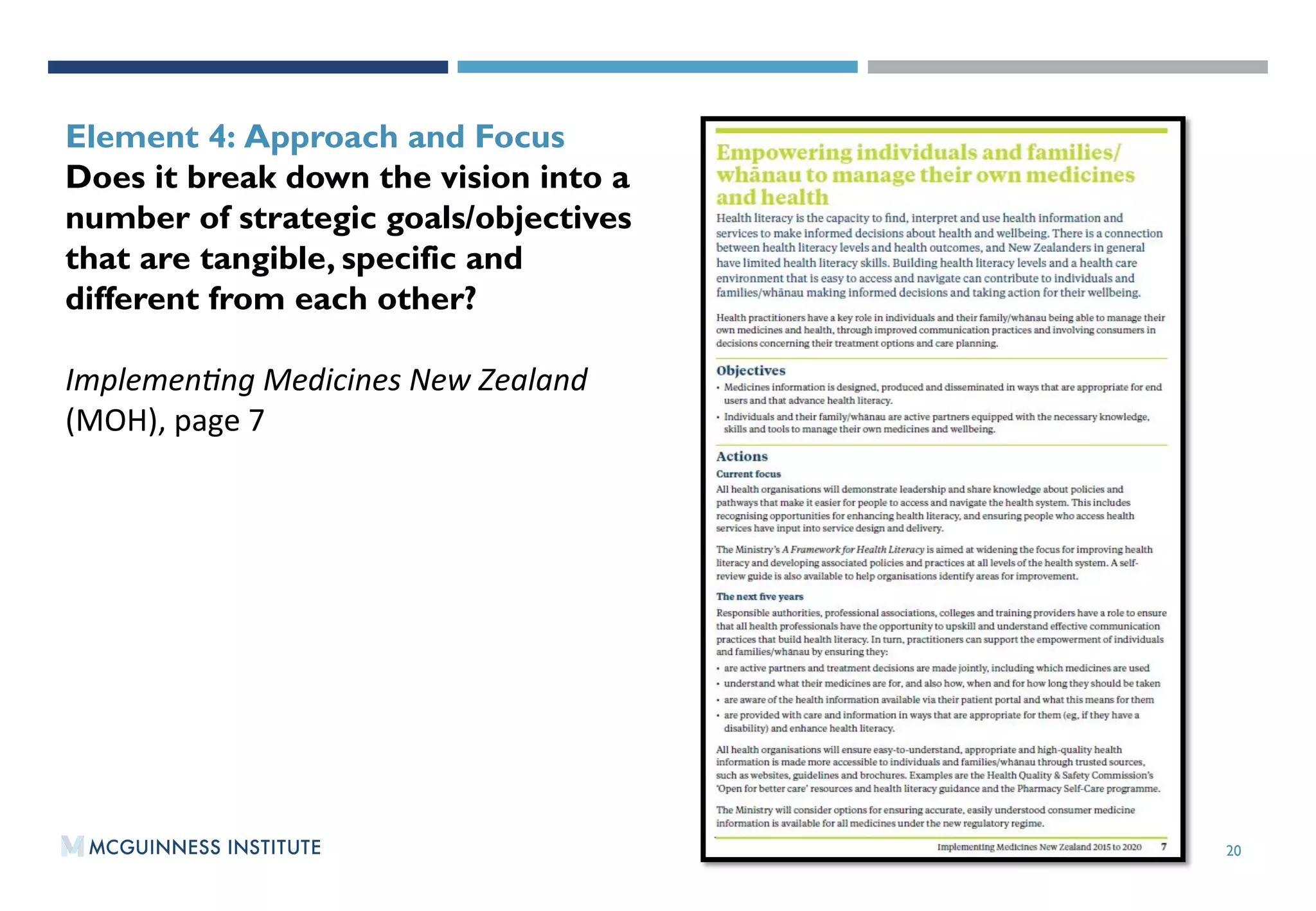
OUTPUT 2:WORKING PAPER 2015/01Element 4: Approach and Focus
Does it break down the vision into a
number of strategic goals/objectives
that are tangible, specific and
different from each other?
ImplemenEng	
  Medicines	
  New	
  Zealand	
  
(MOH),	
  page	
  7	
  
21
OUTPUT 2:WORKING PAPER 2015/01
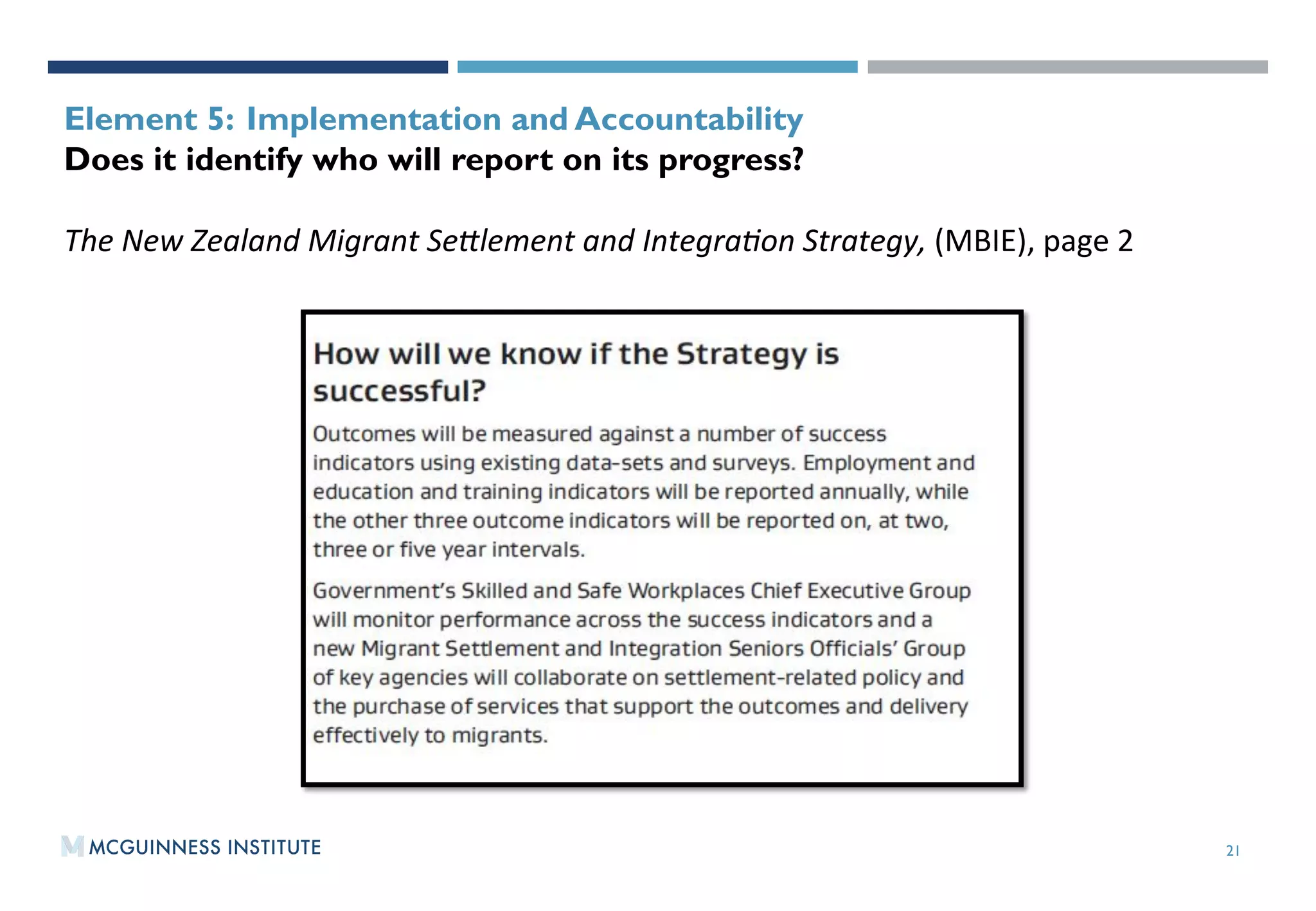
Element 5: Implementation and Accountability
Does it identify who will report on its progress?
The	
  New	
  Zealand	
  Migrant	
  SeHlement	
  and	
  IntegraEon	
  Strategy,	
  (MBIE),	
  page	
  2	
  	
  
22
OUTPUT 2:WORKING PAPER 2015/01
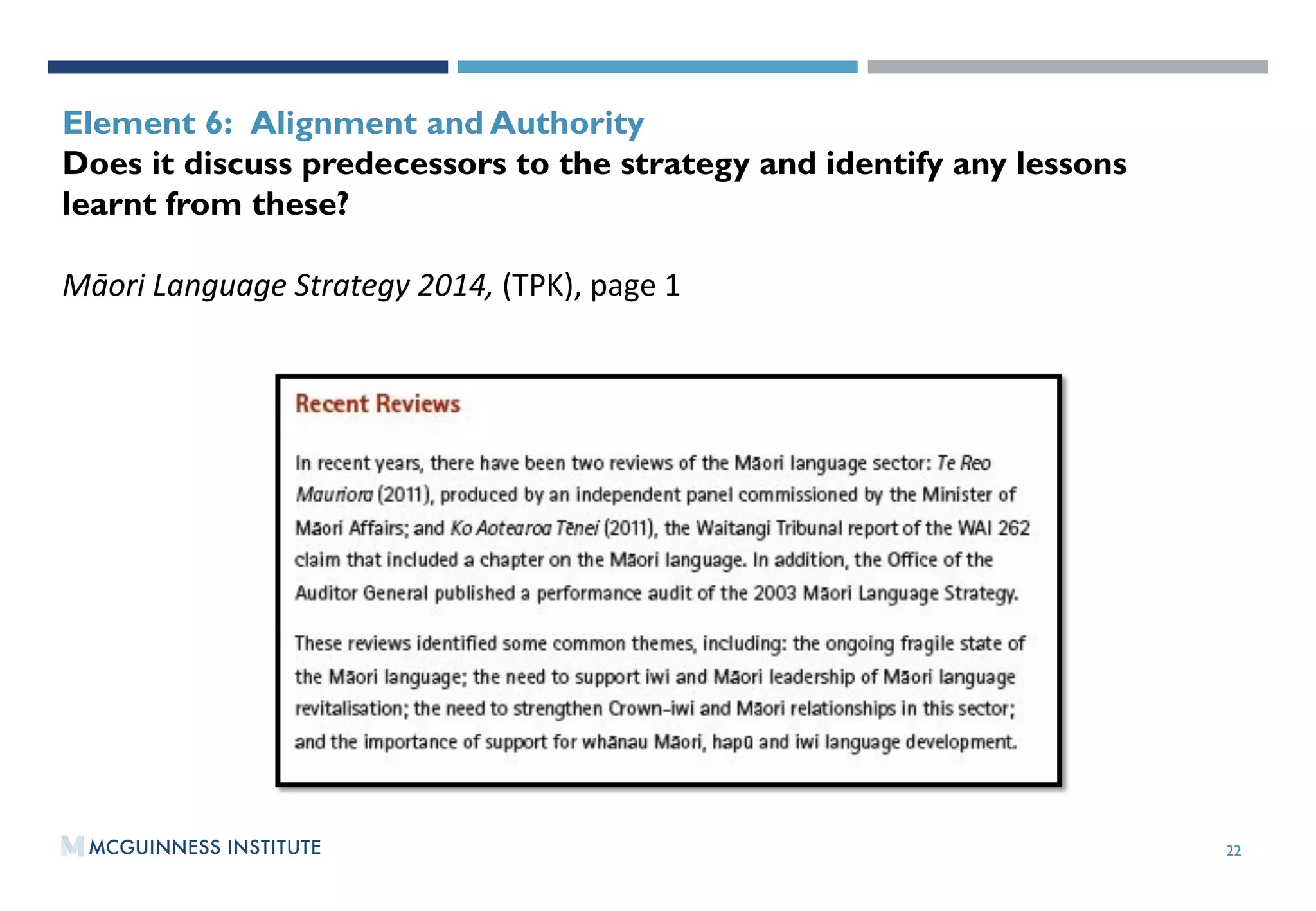
Element 6: Alignment and Authority
Does it discuss predecessors to the strategy and identify any lessons
learnt from these?
Māori	
  Language	
  Strategy	
  2014,	
  (TPK),	
  page	
  1	
  
23
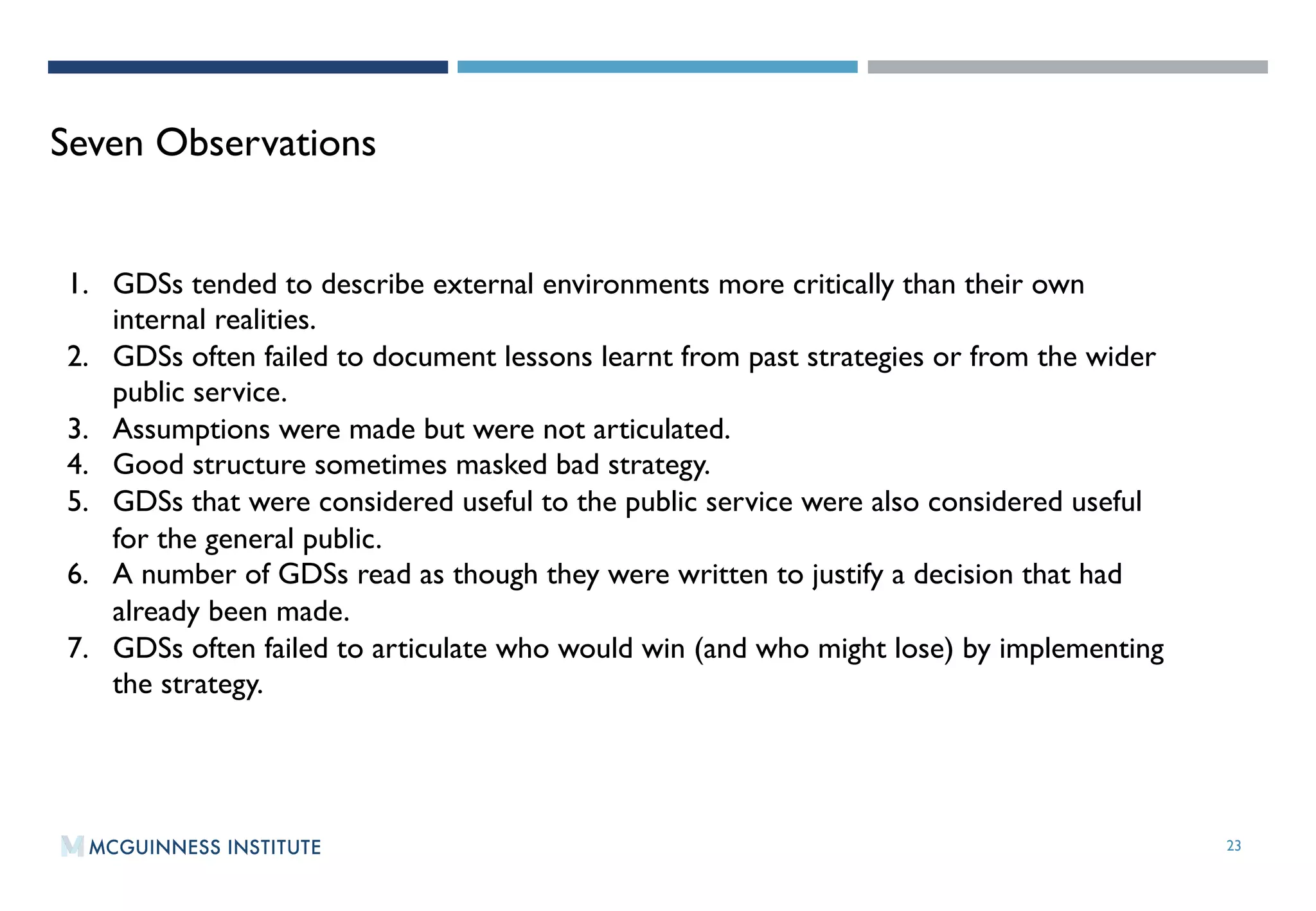
Seven Observations
1.  GDSs tended to describe external environments more critically than their own
internal realities.
2.  GDSs often failed to document lessons learnt from past strategies or from the wider
public service.
3.  Assumptions were made but were not articulated.
4.  Good structure sometimes masked bad strategy.
5.  GDSs that were considered useful to the public service were also considered useful
for the general public.
6.  A number of GDSs read as though they were written to justify a decision that had
already been made.
7.  GDSs often failed to articulate who would win (and who might lose) by implementing
the strategy.
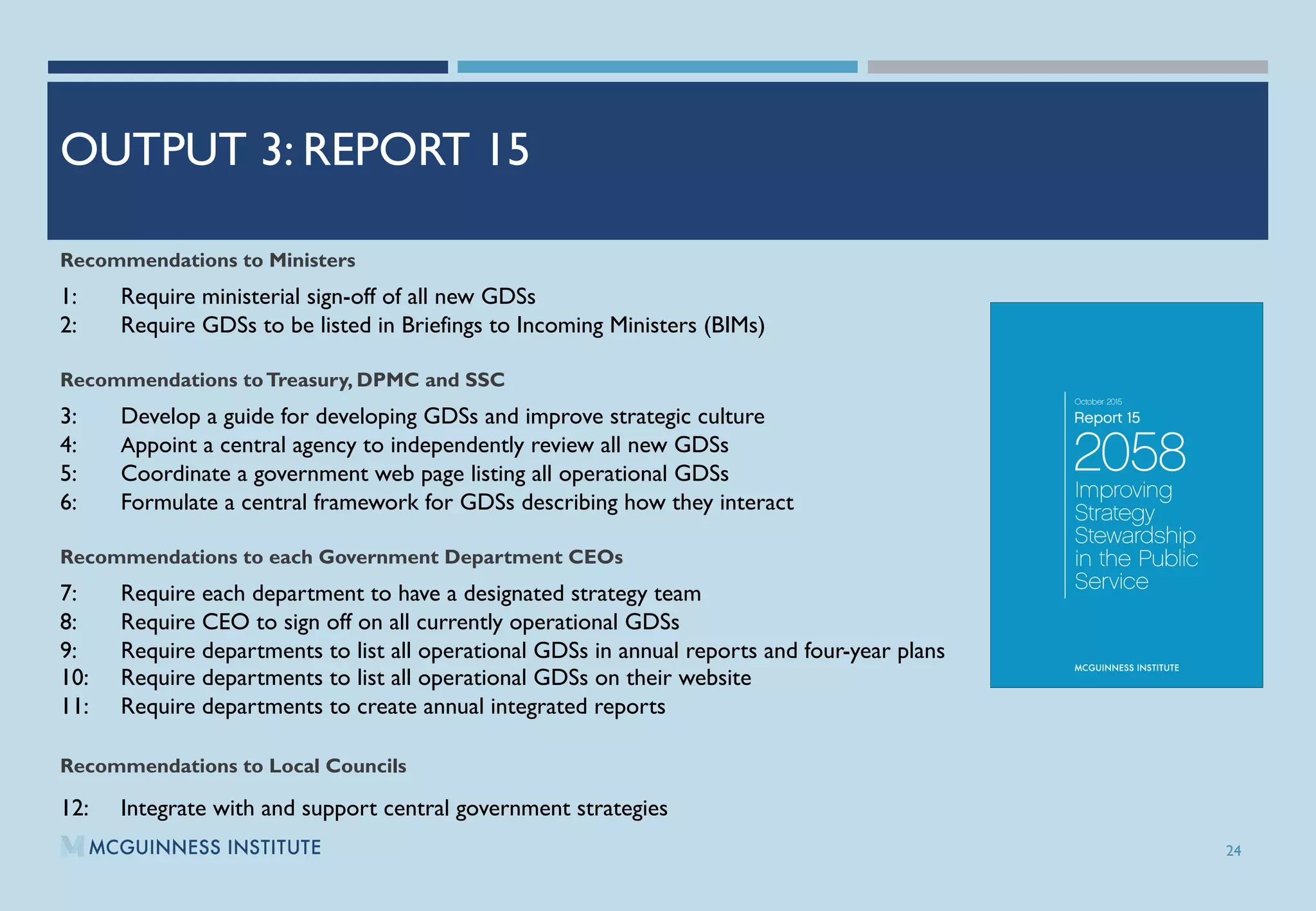
OUTPUT 3: REPORT 15
Recommendations to Ministers
1: Require ministerial sign-off of all new GDSs
2: Require GDSs to be listed in Briefings to Incoming Ministers (BIMs)
Recommendations toTreasury, DPMC and SSC
3: Develop a guide for developing GDSs and improve strategic culture
4: Appoint a central agency to independently review all new GDSs
5: Coordinate a government web page listing all operational GDSs
6: Formulate a central framework for GDSs describing how they interact
Recommendations to each Government Department CEOs
7: Require each department to have a designated strategy team
8: Require CEO to sign off on all currently operational GDSs
9: Require departments to list all operational GDSs in annual reports and four-year plans
10: Require departments to list all operational GDSs on their website
11: Require departments to create annual integrated reports
Recommendations to Local Councils
12: Integrate with and support central government strategies
24
THANKYOU
Level 2, 5 Cable Street
PO Box 24-222
Wellington 6142
(04) 499 8888
www.mcguinnessinstitute.org
 
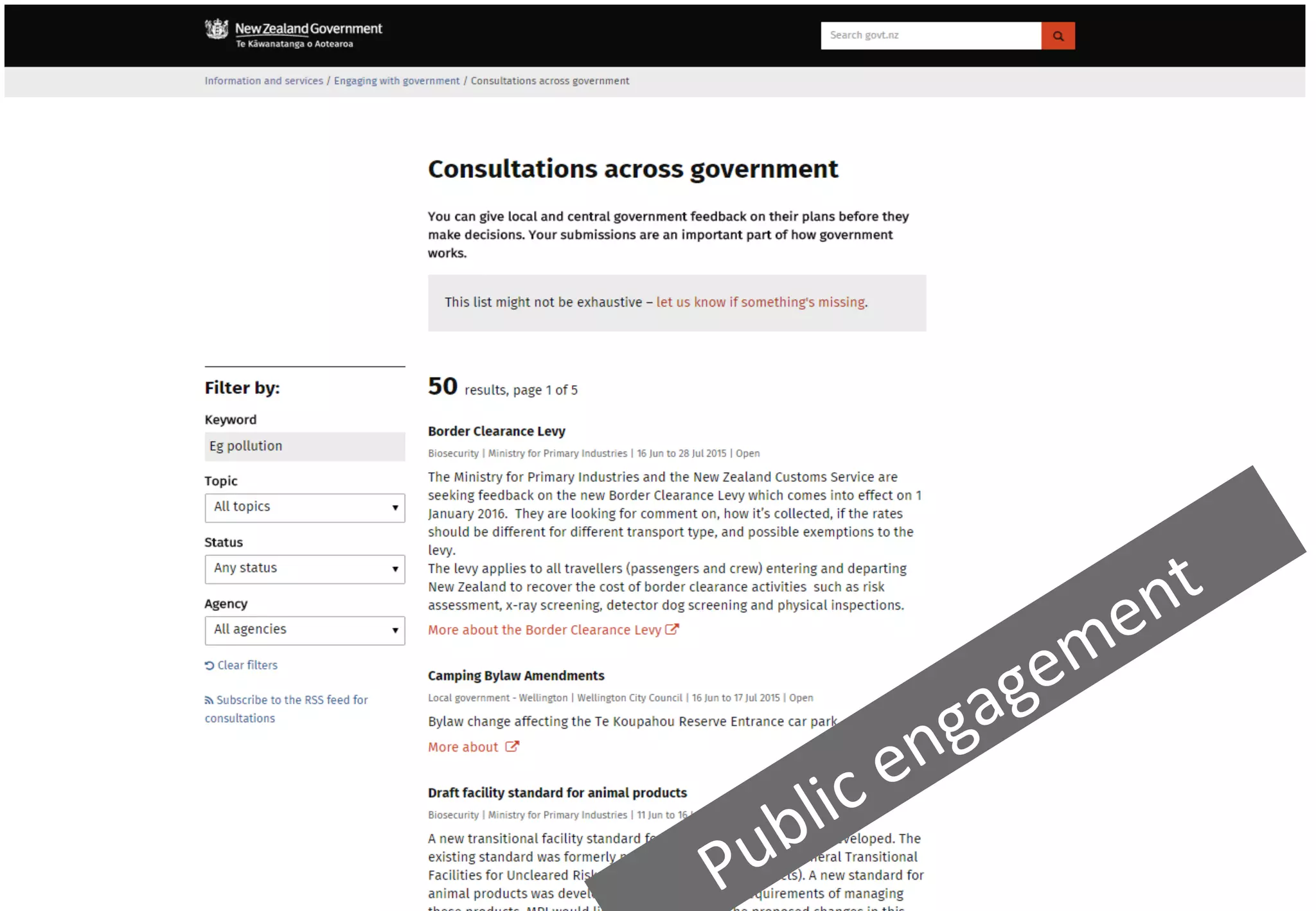
Govt.nz	
  
Easy	
  to	
  find.	
  Easier	
  to	
  use.	
  
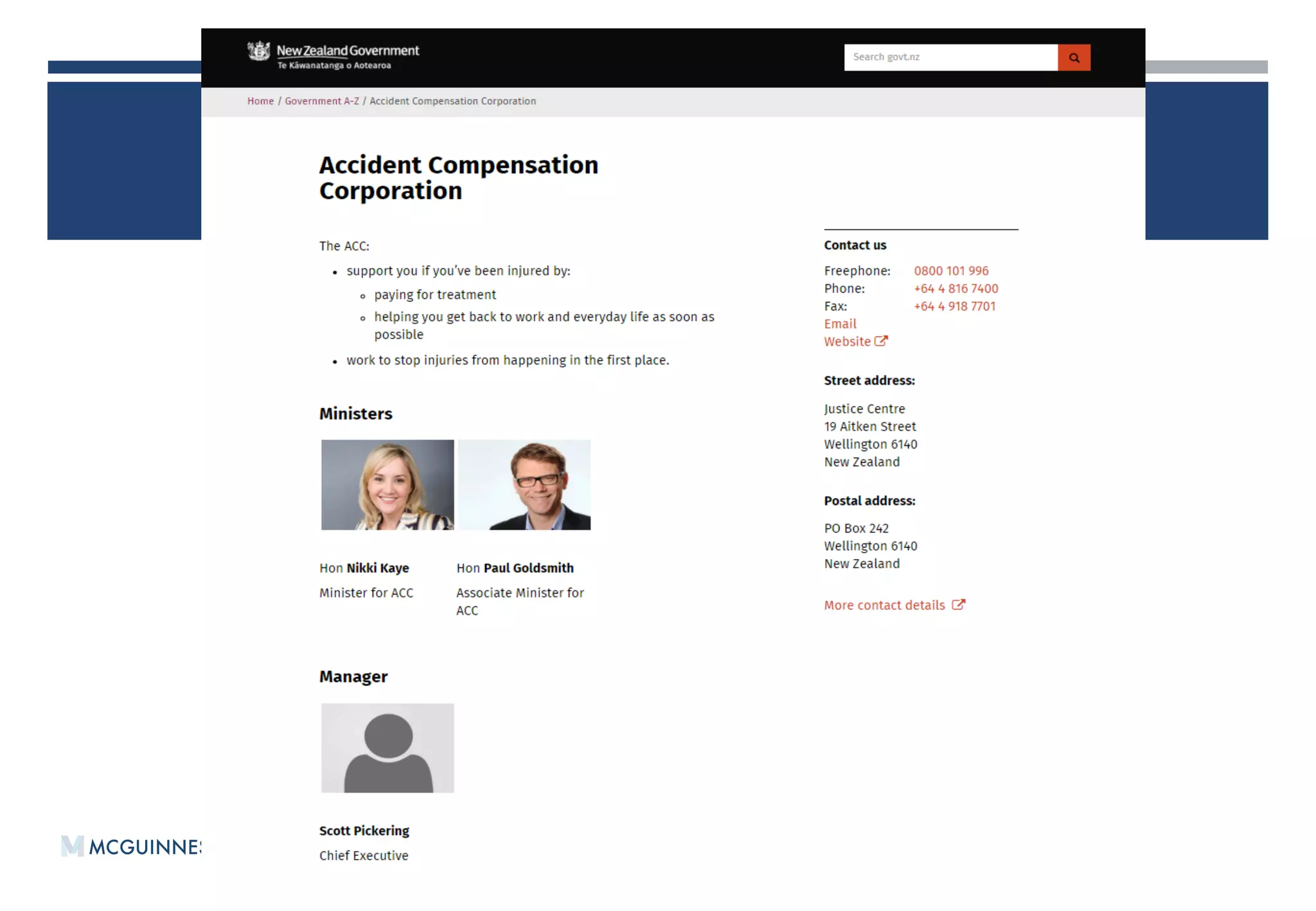
How	
  we	
  connect	
  people	
  with	
  info	
  and	
  
services	
  
Mary	
   Chris	
  
20151023 Strategynz - Launch of Report 15: Improving Strategy Stewardship in the Public Service

20151023 Strategynz - Launch of Report 15: Improving Strategy Stewardship in the Public Service

  • 1.
    STRATEGYNZ IMPROVING STRATEGY STEWARDSHIPIN THE PUBLIC SERVICE WELLINGTON, NEW ZEALAND (22 OCTOBER 2015)
  • 2.
    AS AT FEBRUARY2015 …NEXT STEPS 2 ¡  Report to be published later this year bringing all this work together (late May) ¡  History of ‘goals’ directing the public service (any help greatly appreciated) ¡  More analysis of the data to be completed ¡  Open to suggestions/discussions on way forward ¡  Meeting with Hon. Bill English ¡  Offer to meet with CE of all government departments to discuss index
  • 3.
    ASSUMPTIONS Strategy stewardship mattersbecause without a discussion on strategy the policy landscape would be riddled with goals, with no clarity around which goals are achievable nor any collaboration over how to achieve them.    A public management system that holds strategy stewardship as a core value will result in a country that is prepared to tackle the policy issues of the future in a cost-effective, integrated and community-focused manner. Strategy is the tool we must use to consider and prioritise the vast array of different possible futures that await us. 3
  • 4.
  • 5.
    OUTPUT 1: INDEXTABLES WHAT IS A ‘GOVERNMENT DEPARTMENT STRATEGY’? A government department strategy (GDS) must:  ¡  be a publicly available statement or report; ¡  be generated by government departments with a national rather than a local focus;  ¡  contain long-term thinking, in such a way that the strategy links to a long-term vision or aim, and ideally provide clarity over the factors that may impinge on the attainment of that vision or aim; and  ¡  guide the department’s thinking and operations over the long term (i.e. contain a work programme to achieve change over two years or more). 5
  • 6.
  • 7.
    7 Deletions from theGDS Index by FinancialYear   Reason for deletion     Publication date   1. Drug and Alcohol Strategy 2014 (Dept of Corrections)   Expired   2009   2. New Generation National Library: Strategic Directions to 2017 (DIA)   Expired   2007   3. Geodetic Physical Infrastructure Strategy (LINZ)   Expired   September 2012   4. The Power of ‘Where’ Drives New Zealand’s Success (LINZ)   Expired   2013   5. New Zealand Arts, Cultural and HeritageTourism Strategy to 2015 (MCH)   Expired   September 2008   6. New Zealand’s Climate Change Solutions: Sustainable Land Management and Climate Change: Plan of Action:A Partnership Approach   Expired   September 2007   7. New Zealand Packaging Accord (MfE)   Expired   July 2004   8. Meeting the Challenges of Future Flooding in NZ (MfE)   Expired   August 2008   9. Our FutureTogether: New Zealand Settlement Strategy (MBIE)   Expired   2007   10. New Zealand Energy Strategy to 2050: Powering our Future: Towards a Sustainable Low Emissions Energy System (MBIE)   Expired   October 2007   11. Defence Capability Plan 2011 (Ministry of Defence)   Expired   September 2011   12. Disability Support Services Strategic Plan (MOH)   Replaced by updated version   March 2012   13. Strengthening Families for Wellbeing (MSD)   Expired   1998   14. National Infrastructure Plan (Treasury)   Transferred to ‘all of Government’ strategy   July, 2011  
  • 8.
    8 Additions to theGDS Index by FinancialYear     Month Published   1.  Community in Mind, Hei Puāwai Waitaha – a flourishing Waitaha: Strategy for rebuilding health and wellbeing in greater Christchurch (CERA)   June 2014 #   2.  RR25%: Reducing Re-offending Strategy 2014–2017: Year One (Dept of Corrections) November 2014   3. Cadastre 2034: A 10-20Year Strategy for developing the cadastral system: Knowing the ‘where’ of land-related rights   February 2014 #   4. Topographic Strategy   March 2015   5. Cultural Sector Strategic Framework (MCH)   August 2014   6.  He Whare Āhuru He OrangaTāngata – the Māori Housing Strategy: Directions 2014 to 2025 (MBIE)   July 2014   7. The New Zealand Migrant Settlement and Integration Strategy (MBIE)   March 2015   8. A Nation of Curious Minds, He Whenua Hihiri ITe Mahara: A National Strategic Plan for Science in Society (MoE)   July 2014   9. Disability Support Services Strategic Plan 2014–2018 (MoH)   June 2015   10. Implementing Medicines New Zealand (MoH)   June 2015   11. Te Rautaki Reo Maori: Maori Language Strategy 2014 (June 2014)   July 2014   12. Community Investment Strategy (MSD)   June 2015  
  • 9.
    OUTPUT 2: WORKINGPAPER 2015/04 ¡  There is currently no guide for departments on how to produce a GDS, nor is there a register. ¡  The GDS Index ranks each strategy (out of 134), each department (out of 29) and each sector (out of 10) against 22 sub-elements using a scorecard. ¡  This is the first index on GDSs anywhere in the world. ¡  The results illustrate what we are doing well and, more importantly, what we are not. 9
  • 10.
    10 CHARACTERISTICS OF AGOOD GDS? 0 5 10 15 20 25 30 Purpose [what]:The strategy explains what/who will benefit from the strategy being implemented, what choices/priorities are being made and outlines what success might look like. Context [why]:The strategy outlines why in terms of being informed by the past, builds on the present, and optimises the future (taking into account risk/reward and the probable, possible and preferred futures). Resources [how/when/where]:The strategy sets out how it will be implemented, over what duration/timeframes, using what financial resources, assets and partnerships. Accountability [who is responsible]:The strategy sets out who will implement the strategy, who will report against what indicators and who will review the strategy. Alignment [quality of fit]:The strategy aligns both with internal goals (within the department) and external goals (within the overall strategy framework within the public service). Actual Strategy Average Strategy Radar Diagram
  • 11.
  • 12.
  • 13.
    13 Additions to theGDS Index this financial year     Publication date     1.  Community in Mind, Hei Puāwai Waitaha – a flourishing Waitaha: Strategy for rebuilding health and wellbeing in greater Christchurch (CERA)   June 2014   2. RR25%: Reducing Re-offending Strategy 2014 – 2017:Year One (Dept of Corrections) November 2014   3. Cadastre 2034:A 10-20Year Strategy for developing the cadastral system: Knowing the ‘where’ of land-related rights   February 2014   4. Topographic Strategy   March 2015   5. Cultural Sector Strategic Framework (MCH)   August 2014   6. He Whare Āhuru He OrangaTāngata – the Māori Housing Strategy: Directions 2014 to 2025 (MBIE)   July 2014   7. The New Zealand Migrant Settlement and Integration Strategy (MBIE)   March 2015   8. A Nation of Curious Minds, He Whenua Hihiri ITe Mahara:A National Strategic Plan for Science in Society (MoE)   July 2014   9. Disability Support Services Strategic Plan 2014 – 2018 (MoH)   June 2015   10. Implementing Medicines New Zealand (MoH)   June 2015   11. Te Rautaki Reo Maori: Maori Language Strategy 2014 (June 2014)   July 2014   12. Community Investment Strategy (MSD)   June 2015   STRATEGY DOCUMENTS AVERAGED BY DEPARTMENT ?
  • 14.
  • 15.
  • 16.
    16 OUTPUT 2:WORKING PAPER2015/01 Element 1: Opportunities and Threats Does it contain a clear statement describing the problem that this strategy is trying to solve? The  Māori  Language  Strategy  2014   (TPK),  page  4  
  • 17.
    17 OUTPUT 2:WORKING PAPER2015/01 Element 2: Capabilities and Resources Does it identify what capabilities it does not have and needs to acquire or work around? Cadastre  2034  (LINZ),  page  33  
  • 18.
    18 OUTPUT 2:WORKING PAPER2015/01 Element 3: Vision and Benefits Does it provide a clear vision as to what success would look like (a desired future condition)? The  Cultural  Sector  Framework  2014–2018  (MCH),  page  4  
  • 19.
    19 OUTPUT 2:WORKING PAPER2015/01 Element 3: Vision and Benefits Does it identify who the beneficiaries are and how they will benefit? Community  Investment  Strategy  (MSD),  page  14  
  • 20.
    20 OUTPUT 2:WORKING PAPER2015/01Element 4: Approach and Focus Does it break down the vision into a number of strategic goals/objectives that are tangible, specific and different from each other? ImplemenEng  Medicines  New  Zealand   (MOH),  page  7  
  • 21.
    21 OUTPUT 2:WORKING PAPER2015/01 Element 5: Implementation and Accountability Does it identify who will report on its progress? The  New  Zealand  Migrant  SeHlement  and  IntegraEon  Strategy,  (MBIE),  page  2    
  • 22.
    22 OUTPUT 2:WORKING PAPER2015/01 Element 6: Alignment and Authority Does it discuss predecessors to the strategy and identify any lessons learnt from these? Māori  Language  Strategy  2014,  (TPK),  page  1  
  • 23.
    23 Seven Observations 1.  GDSstended to describe external environments more critically than their own internal realities. 2.  GDSs often failed to document lessons learnt from past strategies or from the wider public service. 3.  Assumptions were made but were not articulated. 4.  Good structure sometimes masked bad strategy. 5.  GDSs that were considered useful to the public service were also considered useful for the general public. 6.  A number of GDSs read as though they were written to justify a decision that had already been made. 7.  GDSs often failed to articulate who would win (and who might lose) by implementing the strategy.
  • 24.
    OUTPUT 3: REPORT15 Recommendations to Ministers 1: Require ministerial sign-off of all new GDSs 2: Require GDSs to be listed in Briefings to Incoming Ministers (BIMs) Recommendations toTreasury, DPMC and SSC 3: Develop a guide for developing GDSs and improve strategic culture 4: Appoint a central agency to independently review all new GDSs 5: Coordinate a government web page listing all operational GDSs 6: Formulate a central framework for GDSs describing how they interact Recommendations to each Government Department CEOs 7: Require each department to have a designated strategy team 8: Require CEO to sign off on all currently operational GDSs 9: Require departments to list all operational GDSs in annual reports and four-year plans 10: Require departments to list all operational GDSs on their website 11: Require departments to create annual integrated reports Recommendations to Local Councils 12: Integrate with and support central government strategies 24
  • 25.
    THANKYOU Level 2, 5Cable Street PO Box 24-222 Wellington 6142 (04) 499 8888 www.mcguinnessinstitute.org
  • 26.
      Govt.nz   Easy  to  find.  Easier  to  use.  
  • 27.
    How  we  connect  people  with  info  and   services   Mary   Chris