
Contents

Background and motivation
Past research work
Proposed solution
ST2FO-MAS to automate personalized Itinerary
(Problem Intro.)
Secure Type-2 Fuzzy Ontology
Secure Type-2 Fuzzy Ontology (A quick review of
terminologies)
Type-1 Fuzzy system
Type-2 Fuzzy system
Secure Type-2 Fuzzy Ontology Development
Crisp ontology development
Type-1 Fuzzy ontology Development
Type-2 Fuzzy ontology development
                                                  2
Multi-Agent System
Related Publications

1. Ahmad C. Bukhari, Yong-Gi Kim, “Integration of Secure Type-2 Fuzzy Ontology with Multi-
agent Platform: A proposal to automate the Personalized Flight Ticket Booking Domain ”
Journal of Information sciences (SCI Index) Impact factor 2.9 For Tracking :
http://dx.doi.org/10.1016/j.ins.2012.02.036

2. Ahmad C. Bukhari ,Yong-Gi Kim, “Ontology-assisted automatic precise information extractor
for visually impaired inhabitant” Journal of Artificial Intelligence Review 2011
http://dx.doi.org/10.1007/s10462-011-9238-6 (SCI index)

 3. Ahmad C. Bukhari , Yong-Gi Kim, "Exploiting the Heavyweight Ontology with Multi -Agent
System Using Vocal Command System: A Case Study on E-Mall", IJACT : International
Journal of Advancements in Computing Technology, Vol. 3, No. 6, pp. 233 ~ 241, 2011
(SCIE, Scopus Index)

4. Ahmad C. Bukhari, Yong-Gi Kim, “Incorporation of Fuzzy Theory with Heavyweight Ontology
and Its Application on Vague Information Retrieval For Decision Making” International
Journal of Fuzzy Logic and Intelligent System, vol.11, no.3, September 2011, pp, 171-17
Http://dx.doi.org/10.5391/IJFIS.2011.11.3.171 (KISTI, ACOMS, SCIE Index)


                                                                                             3
Background and Motivation

As the internet grows rapidly, millions of WebPages are being
added on a daily basis
Personalized information extraction and intelligent decision
making on it behalf are becoming challenging issues
Explosive internet heterogeneity makes the relevant Info.
extraction and intelligent decision making more tricky
Search engines are used commonly to find information
Conventional mechanism of searching: keywords and directory
structure
Most of the data on internet is in imprecise and uncertain format
Optimal searching not possible by using conventional ways
Currently users spend hours and hours to find desired
information from internet
Any solution?

                                                                    4
Past research work


                     5
Proposed solution

Researchers proposed several solution but mostly failed with time, due
to diverse and fatally vague nature of web data
Some solutions found working nevertheless with low precision rate and
their performance decreasing drastically
We present an end-to-end solution to automate the optimal information
extraction and decision making
Underlying technologies of our system are: Type-2 Fuzzy Ontology,
MAS, NLP, Info. Security
Why we use type-2 fuzzy system?
Why we incorporated Type-2 fuzzy system with ontology?
Why the information security is so important?
What is the ontology and how can we exploit it for info. extraction?
What is the relation among MAS, NLP and T2FO to extract the optimal
information and for appropriate and timely decision making?


                                                                     6
ST2FO-MAS to automate personalized Itinerary
      (Ongoing challenges and proposed solutions)


                                                    7
ST2FO-MAS to automate personalized Itinerary (Problem Intro.)


Manual air ticket booking : time consuming and laborious
The domain is rife with uncertainties and with complex linguistic
terminologies
Thousands of solutions available now but mostly work for specific
airlines or for specific routes
Generally, passengers spend hours to find acceptable fare
A complete process (selection, reservation, booking with
transaction) requires full-time use involvement
Travelers are anxiously waiting for automatic solution with
personalized outcomes


                                                                    8
Secure Type-2 Fuzzy Ontology


 A quick review of terminologies
            Ontology:
    An ontology is a branch of
  metaphysics that focuses on the
        study of existence.
    “An ontology is an explicit and
formal specification of a shared
conceptualization of a domain, which
is machine readable and human       9
Secure Type-2 Fuzzy Ontology
Common definitions and(A quick review of terminologies) set and type-2
                       concepts about type-1 Fuzzy
Type-1 Fuzzy system
•  The fuzzy set theory was introduced by Lotfi Zadeh in 1965 to deal with vague
and imprecise concepts.
•   In classical set theory, elements either belong to a particular set or they don’t
belong.
•   However, in fuzzy set theory the association of an element with a particular set
lies between ‘0’ and ‘1’ which is called degree of association or membership
degree. A fuzzy set can be defined as:
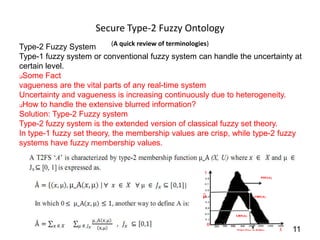
Definition 1: A fuzzy set ‘s’ over universe of discourse ‘X’ can be defined by its
membership function µ_s which maps element ‘x’ to values between [0,1].


                                                                                        10
Secure Type-2 Fuzzy Ontology
                            (A quick review of terminologies)
Type-2 Fuzzy System
Type-1 fuzzy system or conventional fuzzy system can handle the uncertainty at
certain level.
Some Fact

vagueness are the vital parts of any real-time system
Uncertainty and vagueness is increasing continuously due to heterogeneity.
How to handle the extensive blurred information?

Solution: Type-2 Fuzzy system
Type-2 fuzzy system is the extended version of classical fuzzy set theory.
In type-1 fuzzy set theory, the membership values are crisp, while type-2 fuzzy
systems have fuzzy membership values.


                                                                            11
Secure Type-2 Fuzzy Ontology
                               (Ontology Development)
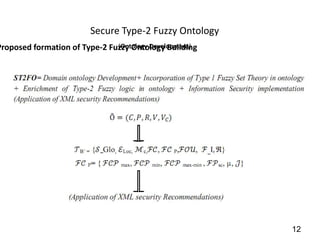
Proposed formation of Type-2 Fuzzy Ontology Building


                                                        12
Development of Secure type-2 fuzzy ontology
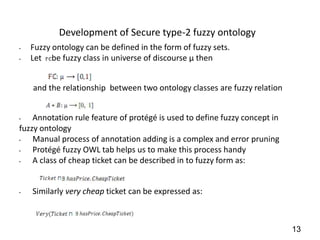
•   Fuzzy ontology can be defined in the form of fuzzy sets.
•   Let be fuzzy class in universe of discourse µ then


    and the relationship between two ontology classes are fuzzy relation


•   Annotation rule feature of protégé is used to define fuzzy concept in
fuzzy ontology
•   Manual process of annotation adding is a complex and error pruning
•   Protégé fuzzy OWL tab helps us to make this process handy
•   A class of cheap ticket can be described in to fuzzy form as:


•   Similarly very cheap ticket can be expressed as:


                                                                            13
Development of Secure type-2 fuzzy ontology
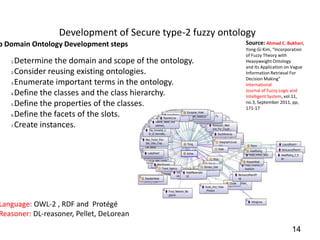
p Domain Ontology Development steps                      Source: Ahmad C. Bukhari,
                                                         Yong-Gi Kim, “Incorporation
                                                         of Fuzzy Theory with
   1.Determine the domain and scope of the ontology.     Heavyweight Ontology
                                                         and Its Application on Vague
   2.Consider reusing existing ontologies.               Information Retrieval For
                                                         Decision Making”
   3.Enumerate important terms in the ontology.          International
                                                         Journal of Fuzzy Logic and
   4.Define the classes and the class hierarchy.
                                                         Intelligent System, vol.11,
   5.Define the properties of the classes.
                                                         no.3, September 2011, pp,
                                                         171-17
   6.Define the facets of the slots.

   7.Create instances.


Language: OWL-2 , RDF and Protégé
Reasoner: DL-reasoner, Pellet, DeLorean
                                                                               14
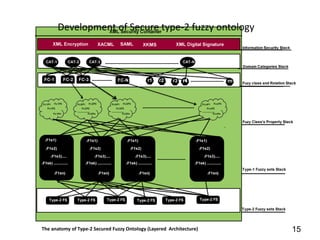
Development of Secure type-2 fuzzy ontology


The anatomy of Type-2 Secured Fuzzy Ontology (Layered Architecture)   15
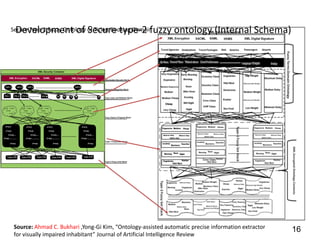
Development of Secure type-2 fuzzy ontology (Internal Schema)
Secure Type-2 Fuzzy Ontology of Ticket Booking Domain


 Source: Ahmad C. Bukhari ,Yong-Gi Kim, “Ontology-assisted automatic precise information extractor   16
 for visually impaired inhabitant” Journal of Artificial Intelligence Review
1
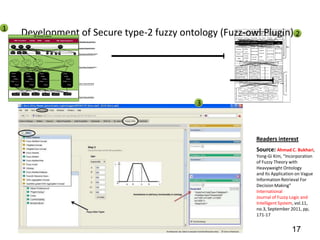
    Development of Secure type-2 fuzzy ontology (Fuzz-owl Plugin) 2


                                           3


                                                         Readers interest
                                                         Source: Ahmad C. Bukhari,
                                                         Yong-Gi Kim, “Incorporation
                                                         of Fuzzy Theory with
                                                         Heavyweight Ontology
                                                         and Its Application on Vague
                                                         Information Retrieval For
                                                         Decision Making”
                                                         International
                                                         Journal of Fuzzy Logic and
                                                         Intelligent System, vol.11,
                                                         no.3, September 2011, pp,
                                                         171-17


                                                                          17
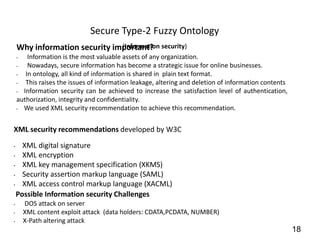
Secure Type-2 Fuzzy Ontology
    Why information security important? security)
                               (Information
    •   Information is the most valuable assets of any organization.
    •   Nowadays, secure information has become a strategic issue for online businesses.
    •  In ontology, all kind of information is shared in plain text format.
    •  This raises the issues of information leakage, altering and deletion of information contents
    • Information security can be achieved to increase the satisfaction level of authentication,
    authorization, integrity and confidentiality.
    • We used XML security recommendation to achieve this recommendation.


XML security recommendations developed by W3C

•   XML digital signature
•   XML encryption
•   XML key management specification (XKMS)
•   Security assertion markup language (SAML)
•   XML access control markup language (XACML)
  Possible Information security Challenges
•       DOS attack on server
•       XML content exploit attack (data holders: CDATA,PCDATA, NUMBER)
•       X-Path altering attack
                                                                                                      18
Secure Type-2 Fuzzy Ontology
                             (Information security: Application scheme)
<? XML version="1.0"?>
<! DOCTYPE Ontology [
<! ENTITY xsd "http://www.w3.org/2001/XMLSchema#" > ]>
<owlx:Ontology owlx:name="http://www.ailab.gnu.ac.kr/t2fo"
xmlns:owlx="http://www.w3.org/2003/05/owl-xml">
 <CustomerInfo xmlns='http://www.ailab.gnu.ac.kr/st2fo-mas/person_ontology'>
   <Name>ahmad chan</Name>
                                                                                  Public Key encryption algorithm
<EncryptedData Type='http://www.w3.org/2001/04/xmlenc#Element'
      xmlns='http://www.w3.org/2001/04/xmlenc#'>
 <EncryptionMethod Algorithm='http://www.w3.org/2001/04/xmlenc#tripledes-cbc'/>
<KeyInfo xmlns='http://www.w3.org/2000/09/xmldsig#'>
   <EncryptedKey xmlns='http://www.w3.org/2001/04/xmlenc#'>
  <EncryptionMethod Algorithm='http://www.w3.org/2001/04/xmlenc#rsa-1_5'/>
<KeyInfo xmlns='http://www.w3.org/2000/09/xmldsig#'>
  <KeyName>white tiger</KeyName>
</KeyInfo>
<CipherData>                                                                           XML Data level encryption
   <CipherValue>vHE@#$&&JUIOFdefghj...</CipherValue>
</CipherData>
</EncryptedKey>
</KeyInfo>
<CipherData>
  <CipherValue>yyFE%!JJNIcflijnvcthsdrtg...</CipherValue>
</CipherData>
</EncryptedData>
</CustomerInfo>
</owlx:Ontology>


       Code view of W3C XML security recommendations                                                         19
Multi-agent system ( Terminology, Role, Integration and usage)
Diversity and complexity factors are increasing day by day in modern
software applications.
The multi-Agent system is considered an efficient technology in the
development of distributed systems.
A multi-Agent system is basically the group of interconnected agents, in
which each agent works autonomously while sharing information.
An agent is a bunch of code which is designed to perform a specific
task on the behalf of its user.
Why we used MAS?
Our domain was diverse

Complex and unstructured

For automatic information extraction

For intelligent decision making


                                                                               20
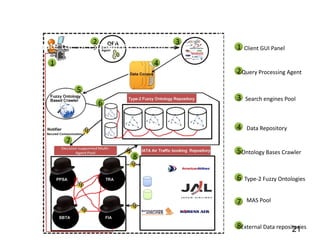
A graphical architecture of STFO-MAS and its Application to
                2                     3
automate the personalized itinerary               1   Client GUI Panel

       1                       4
                                                  2 Query Processing Agent

               5
                                                  3   Search engines Pool
                   6


                                                  4   Data Repository

           7
                                                  5 Ontology Bases Crawler
                          8

                                                  6   Type-2 Fuzzy Ontologies


                                                  7   MAS Pool


                                                  8External Data repositories
                                                                       21
What's inside decision supported multi-agent pool?


                        Multi-agent system schema

                                                     22
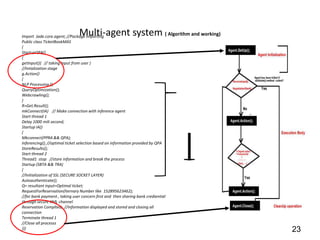
Multi-agent system
Import Jade.core.agent; //Package Importing                                     ( Algorithm and working)
Public class TicketBookMAS
{
StartupQPA()
{
getInput(){ // taking input from user }
//Intialization stage
g.Action()
{
NLP Processing ();
QueryOptimization();
Webcrawling();
}
R=Get.Result();
mkConnect(IA) // Make connection with inference agent
Start thread 1
Delay 1000 mili second;
Startup IA()
{
Mkconnect(PPRA && QPA);
Inferencing(); //optimal ticket selection based on information provided by QPA
StoreResults();
Start thread 2
Thread1 stop //store information and break the process
Startup (SBTA && TRA)
{
//Initialization of SSL (SECURE SOCKET LAYER)
Autoauthenticate();
Q= resultant input=Optimal ticket;
RequestForReservation(Iternary Number like 152895623462);
//for bank payment , taking user concern first and then sharing bank crediential
through secure XML channel
Reservation Complted; //information displayed and stored and closing all
connection
Terminate thread 1
//Close all processs
}}}                                                                                                        23
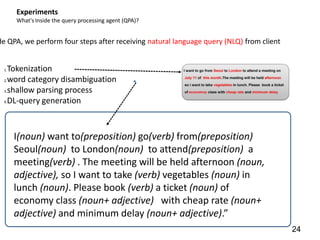
Experiments
       What's Inside the query processing agent (QPA)?


de QPA, we perform four steps after receiving natural language query (NLQ) from client


  1.Tokenization
  2.word category disambiguation

  3.shallow parsing process

  4.DL-query generation


       I(noun) want to(preposition) go(verb) from(preposition)
       Seoul(noun) to London(noun) to attend(preposition) a
       meeting(verb) . The meeting will be held afternoon (noun,
       adjective), so I want to take (verb) vegetables (noun) in
       lunch (noun). Please book (verb) a ticket (noun) of
       economy class (noun+ adjective) with cheap rate (noun+
       adjective) and minimum delay (noun+ adjective).”
                                                                                         24
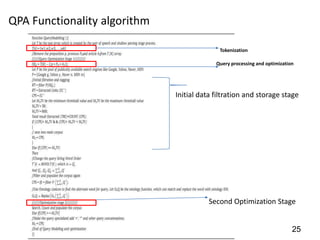
QPA Functionality algorithm

                                            Tokenization

                                           Query processing and optimization


                              Initial data filtration and storage stage


                                         Second Optimization Stage


                                                                           25
Experiments and results
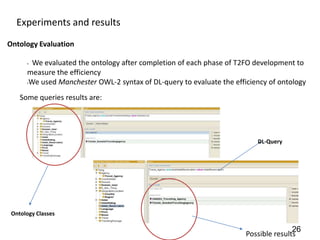
Ontology Evaluation

      • We evaluated the ontology after completion of each phase of T2FO development to
      measure the efficiency
      •We used Manchester OWL-2 syntax of DL-query to evaluate the efficiency of ontology


    Some queries results are:


                                                                          DL-Query


 Ontology Classes

                                                                                      26
                                                                       Possible results
Experiments and results
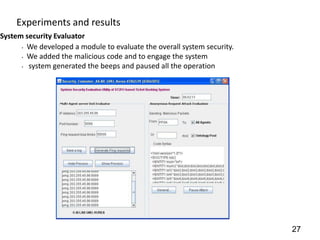
System security Evaluator
      • We developed a module to evaluate the overall system security.

      • We added the malicious code and to engage the system

      • system generated the beeps and paused all the operation


                                                                         27
Experiments and results
 Overall system evaluation
    •   Information system can be categorized on the basis of its effectiveness.
    •  There are some known ways to define the efficiency of an information
    system, such as the precision (PR), recall(RC) and time
    •  To exact judge the performance, we requested five volunteers to
        help us in experiments.
    •  The volunteers enquired from the system by using crisp ontology, type-1
    fuzzy and Type-2 fuzzy ontology.
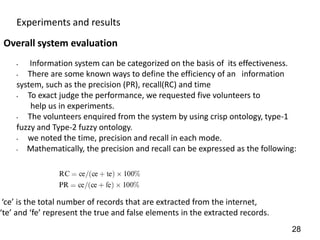
    •  we noted the time, precision and recall in each mode.
    •  Mathematically, the precision and recall can be expressed as the following:


 ‘ce’ is the total number of records that are extracted from the internet,
‘te’ and ‘fe’ represent the true and false elements in the extracted records.
                                                                                28
Results (Extracted results)

  Overall system performance results recoded in the case of the secured type-1 fuzzy ontology.


 Overall system performance results recoded in the case of the secured type-1 fuzzy
 ontology.


                                                                                                 29
Results

 Overall system performance results recoded in the case of the secured type-2
 fuzzy ontology.


                                                                                30
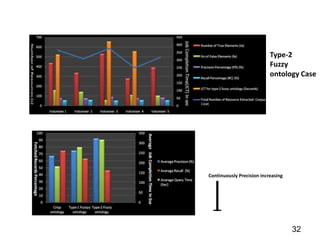
Results (Efficiency Comparison)

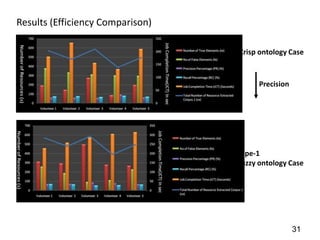
                                  Crisp ontology Case


                                        Precision


                                  Type-1
                                  Fuzzy ontology Case


                                                    31
Type-2
                           Fuzzy
                           ontology Case


Continuously Precision increasing


                                    32
References
1.A. Segev, J. Kantola, Patent Search Decision Support Service, In: Proceedings of Seventh International Conference on Information Technology, 2010, pp.
568-573.
2.A. Vorobiev, J. Han, Security Attack Ontology for Web Services, Semantics, In: Proceedings of Second International Conference on Knowledge and Grid, 2006,

pp. 42-49.
3.A.C. Bukhari, Y.G Kim, Exploiting the Heavyweight Ontology with Multi-Agent System Using Vocal Command System: A Case Study on E-Mall, International

Journal of Advancements in Computing Technology 3(2011) 233-241.
4.A.C. Bukhari, Y.G Kim, Ontology-assisted automatic precise information extractor for visually impaired inhabitants, Artificial Intelligence Review (2005) Issn:

0269-2821.
5.C. Lee, M. Wang, H. Hagras, A Type-2 Fuzzy Ontology and Its Application to Personal Diabetic-Diet Recommendation, IEEE Transactions on Fuzzy Systems 18

(2010), pp. 374-395
6.C. Lee, M. Wang, M. Wu, C. Hsu; Y. Lin, S. Yen , A type-2 fuzzy personal ontology for meeting scheduling system, In: Proceeding of International Conference

on Fuzzy Systems, 2010 , pp. 1-8
7.C.J Su, C.Y Wu, JADE implemented mobile multi-agent based, distributed information platform for pervasive health care monitoring , Applied Soft Computing

Journal 11 (2011), 315-325.
8.C.I. Nyulas, M.J. O'Connor, S.W. Tu, D.L. Buckeridge, A. Okhmatovskaia, M.A. Musen, An Ontology-Driven Framework for Deploying JADE Agent

Systems, IEEE/WIC/ACM International Conference on Web Intelligence and Intelligent Agent Technology, 2008, pp. 573-577.
9.C. Lee, C. Jiang, T. Hsieh, A genetic fuzzy agent using ontology model for meeting scheduling system, Information Sciences 176 (2006) 1131-1155

10.C. Lee, M. Wang, G. Acampora, C. Hsu, and H. Hagras, Diet assessment based on type-2 fuzzy ontology and fuzzy markup language, Int. J. Intell. Syst., 25

(2010) 1187-1216.
11.C. S. Lee, M. H. Wang. Z. R. Yang, Y. J. Chen, H. Doghmen, and O. Teytaud, FML-based type-2 fuzzy ontology for computer Go knowledge representation, In:

Proceeding of International Conference on System Science and Engineering (ICSSE 2010), 2010, pp. 63-68.
12.C.D. Maio,G. Fenza, V. Loia, S. Senatore , Towards an automatic fuzzy ontology generation," In: Proceedings of IEEE International Conference on fuzzy

system,2009, pp.1044-1049.
13.C.D. Maio,G. Fenza, V. Loia, S. Senatore, Hierarchical web resources retrieval by exploiting Fuzzy Formal Concept Analysis, Information Processing &

Management Available online 26 May 2011, ISSN 0306-4573.
14.D.H. Fudholi, N. Maneerat, R. Varakulsiripunth, Y. Kato, Application of Protégé, SWRL and SQWRL in fuzzy ontology-based menu recommendation,

International Symposium on Intelligent Signal Processing and Communication Systems, 2009, pp. 631-634.
15.D.Wu, J.M. Mendel, Uncertainty measures for interval type-2 fuzzy sets, Information Sciences, 177 (2007) 5378-5393.

16.E. Gatial, Z. Balogh, M. Ciglan, L. Hluchy, Focused web crawling mechanism based on page relevance, In: Proceedings of (ITAT 2005) information

technologies applications and theory, 2005, pp. 41–45
17.F. Abdoli, M. Kahani, Ontology-based distributed intrusion detection system,In: Proceedings of 14th International Computer Conference, 2009, pp. 65-70.


                                                                                                                                                          33
References


1.F. Bobillo, U. Straccia, Fuzzy
Ontology Representation using
OWL 2, International Journal of
Approximate Reasoning (2011) 1-
36.
2.F. Bobillo, M. Delgado, J. Gomez-

Romero, DeLorean: a reasoner for
fuzzy OWL 1.1, In: Proceedings of
4th International Workshop on         34
Many Thanks for your Kind attention!


                                       35

Type-2 Fuzzy Ontology

  • 2.
    Contents Background and motivation Pastresearch work Proposed solution ST2FO-MAS to automate personalized Itinerary (Problem Intro.) Secure Type-2 Fuzzy Ontology Secure Type-2 Fuzzy Ontology (A quick review of terminologies) Type-1 Fuzzy system Type-2 Fuzzy system Secure Type-2 Fuzzy Ontology Development Crisp ontology development Type-1 Fuzzy ontology Development Type-2 Fuzzy ontology development 2 Multi-Agent System
  • 3.
    Related Publications 1. AhmadC. Bukhari, Yong-Gi Kim, “Integration of Secure Type-2 Fuzzy Ontology with Multi- agent Platform: A proposal to automate the Personalized Flight Ticket Booking Domain ” Journal of Information sciences (SCI Index) Impact factor 2.9 For Tracking : http://dx.doi.org/10.1016/j.ins.2012.02.036 2. Ahmad C. Bukhari ,Yong-Gi Kim, “Ontology-assisted automatic precise information extractor for visually impaired inhabitant” Journal of Artificial Intelligence Review 2011 http://dx.doi.org/10.1007/s10462-011-9238-6 (SCI index) 3. Ahmad C. Bukhari , Yong-Gi Kim, "Exploiting the Heavyweight Ontology with Multi -Agent System Using Vocal Command System: A Case Study on E-Mall", IJACT : International Journal of Advancements in Computing Technology, Vol. 3, No. 6, pp. 233 ~ 241, 2011 (SCIE, Scopus Index) 4. Ahmad C. Bukhari, Yong-Gi Kim, “Incorporation of Fuzzy Theory with Heavyweight Ontology and Its Application on Vague Information Retrieval For Decision Making” International Journal of Fuzzy Logic and Intelligent System, vol.11, no.3, September 2011, pp, 171-17 Http://dx.doi.org/10.5391/IJFIS.2011.11.3.171 (KISTI, ACOMS, SCIE Index) 3
  • 4.
    Background and Motivation Asthe internet grows rapidly, millions of WebPages are being added on a daily basis Personalized information extraction and intelligent decision making on it behalf are becoming challenging issues Explosive internet heterogeneity makes the relevant Info. extraction and intelligent decision making more tricky Search engines are used commonly to find information Conventional mechanism of searching: keywords and directory structure Most of the data on internet is in imprecise and uncertain format Optimal searching not possible by using conventional ways Currently users spend hours and hours to find desired information from internet Any solution? 4
  • 5.
  • 6.
    Proposed solution Researchers proposedseveral solution but mostly failed with time, due to diverse and fatally vague nature of web data Some solutions found working nevertheless with low precision rate and their performance decreasing drastically We present an end-to-end solution to automate the optimal information extraction and decision making Underlying technologies of our system are: Type-2 Fuzzy Ontology, MAS, NLP, Info. Security Why we use type-2 fuzzy system? Why we incorporated Type-2 fuzzy system with ontology? Why the information security is so important? What is the ontology and how can we exploit it for info. extraction? What is the relation among MAS, NLP and T2FO to extract the optimal information and for appropriate and timely decision making? 6
  • 7.
    ST2FO-MAS to automatepersonalized Itinerary (Ongoing challenges and proposed solutions) 7
  • 8.
    ST2FO-MAS to automatepersonalized Itinerary (Problem Intro.) Manual air ticket booking : time consuming and laborious The domain is rife with uncertainties and with complex linguistic terminologies Thousands of solutions available now but mostly work for specific airlines or for specific routes Generally, passengers spend hours to find acceptable fare A complete process (selection, reservation, booking with transaction) requires full-time use involvement Travelers are anxiously waiting for automatic solution with personalized outcomes 8
  • 9.
    Secure Type-2 FuzzyOntology A quick review of terminologies Ontology: An ontology is a branch of metaphysics that focuses on the study of existence. “An ontology is an explicit and formal specification of a shared conceptualization of a domain, which is machine readable and human 9
  • 10.
    Secure Type-2 FuzzyOntology Common definitions and(A quick review of terminologies) set and type-2 concepts about type-1 Fuzzy Type-1 Fuzzy system • The fuzzy set theory was introduced by Lotfi Zadeh in 1965 to deal with vague and imprecise concepts. • In classical set theory, elements either belong to a particular set or they don’t belong. • However, in fuzzy set theory the association of an element with a particular set lies between ‘0’ and ‘1’ which is called degree of association or membership degree. A fuzzy set can be defined as: Definition 1: A fuzzy set ‘s’ over universe of discourse ‘X’ can be defined by its membership function µ_s which maps element ‘x’ to values between [0,1]. 10
  • 11.
    Secure Type-2 FuzzyOntology (A quick review of terminologies) Type-2 Fuzzy System Type-1 fuzzy system or conventional fuzzy system can handle the uncertainty at certain level. Some Fact vagueness are the vital parts of any real-time system Uncertainty and vagueness is increasing continuously due to heterogeneity. How to handle the extensive blurred information? Solution: Type-2 Fuzzy system Type-2 fuzzy system is the extended version of classical fuzzy set theory. In type-1 fuzzy set theory, the membership values are crisp, while type-2 fuzzy systems have fuzzy membership values. 11
  • 12.
    Secure Type-2 FuzzyOntology (Ontology Development) Proposed formation of Type-2 Fuzzy Ontology Building 12
  • 13.
    Development of Securetype-2 fuzzy ontology • Fuzzy ontology can be defined in the form of fuzzy sets. • Let be fuzzy class in universe of discourse µ then and the relationship between two ontology classes are fuzzy relation • Annotation rule feature of protégé is used to define fuzzy concept in fuzzy ontology • Manual process of annotation adding is a complex and error pruning • Protégé fuzzy OWL tab helps us to make this process handy • A class of cheap ticket can be described in to fuzzy form as: • Similarly very cheap ticket can be expressed as: 13
  • 14.
    Development of Securetype-2 fuzzy ontology p Domain Ontology Development steps Source: Ahmad C. Bukhari, Yong-Gi Kim, “Incorporation of Fuzzy Theory with 1.Determine the domain and scope of the ontology. Heavyweight Ontology and Its Application on Vague 2.Consider reusing existing ontologies. Information Retrieval For Decision Making” 3.Enumerate important terms in the ontology. International Journal of Fuzzy Logic and 4.Define the classes and the class hierarchy. Intelligent System, vol.11, 5.Define the properties of the classes. no.3, September 2011, pp, 171-17 6.Define the facets of the slots. 7.Create instances. Language: OWL-2 , RDF and Protégé Reasoner: DL-reasoner, Pellet, DeLorean 14
  • 15.
    Development of Securetype-2 fuzzy ontology The anatomy of Type-2 Secured Fuzzy Ontology (Layered Architecture) 15
  • 16.
    Development of Securetype-2 fuzzy ontology (Internal Schema) Secure Type-2 Fuzzy Ontology of Ticket Booking Domain Source: Ahmad C. Bukhari ,Yong-Gi Kim, “Ontology-assisted automatic precise information extractor 16 for visually impaired inhabitant” Journal of Artificial Intelligence Review
  • 17.
    1 Development of Secure type-2 fuzzy ontology (Fuzz-owl Plugin) 2 3 Readers interest Source: Ahmad C. Bukhari, Yong-Gi Kim, “Incorporation of Fuzzy Theory with Heavyweight Ontology and Its Application on Vague Information Retrieval For Decision Making” International Journal of Fuzzy Logic and Intelligent System, vol.11, no.3, September 2011, pp, 171-17 17
  • 18.
    Secure Type-2 FuzzyOntology Why information security important? security) (Information • Information is the most valuable assets of any organization. • Nowadays, secure information has become a strategic issue for online businesses. • In ontology, all kind of information is shared in plain text format. • This raises the issues of information leakage, altering and deletion of information contents • Information security can be achieved to increase the satisfaction level of authentication, authorization, integrity and confidentiality. • We used XML security recommendation to achieve this recommendation. XML security recommendations developed by W3C • XML digital signature • XML encryption • XML key management specification (XKMS) • Security assertion markup language (SAML) • XML access control markup language (XACML) Possible Information security Challenges • DOS attack on server • XML content exploit attack (data holders: CDATA,PCDATA, NUMBER) • X-Path altering attack 18
  • 19.
    Secure Type-2 FuzzyOntology (Information security: Application scheme) <? XML version="1.0"?> <! DOCTYPE Ontology [ <! ENTITY xsd "http://www.w3.org/2001/XMLSchema#" > ]> <owlx:Ontology owlx:name="http://www.ailab.gnu.ac.kr/t2fo" xmlns:owlx="http://www.w3.org/2003/05/owl-xml"> <CustomerInfo xmlns='http://www.ailab.gnu.ac.kr/st2fo-mas/person_ontology'> <Name>ahmad chan</Name> Public Key encryption algorithm <EncryptedData Type='http://www.w3.org/2001/04/xmlenc#Element' xmlns='http://www.w3.org/2001/04/xmlenc#'> <EncryptionMethod Algorithm='http://www.w3.org/2001/04/xmlenc#tripledes-cbc'/> <KeyInfo xmlns='http://www.w3.org/2000/09/xmldsig#'> <EncryptedKey xmlns='http://www.w3.org/2001/04/xmlenc#'> <EncryptionMethod Algorithm='http://www.w3.org/2001/04/xmlenc#rsa-1_5'/> <KeyInfo xmlns='http://www.w3.org/2000/09/xmldsig#'> <KeyName>white tiger</KeyName> </KeyInfo> <CipherData> XML Data level encryption <CipherValue>vHE@#$&&JUIOFdefghj...</CipherValue> </CipherData> </EncryptedKey> </KeyInfo> <CipherData> <CipherValue>yyFE%!JJNIcflijnvcthsdrtg...</CipherValue> </CipherData> </EncryptedData> </CustomerInfo> </owlx:Ontology> Code view of W3C XML security recommendations 19
  • 20.
    Multi-agent system (Terminology, Role, Integration and usage) Diversity and complexity factors are increasing day by day in modern software applications. The multi-Agent system is considered an efficient technology in the development of distributed systems. A multi-Agent system is basically the group of interconnected agents, in which each agent works autonomously while sharing information. An agent is a bunch of code which is designed to perform a specific task on the behalf of its user. Why we used MAS? Our domain was diverse Complex and unstructured For automatic information extraction For intelligent decision making 20
  • 21.
    A graphical architectureof STFO-MAS and its Application to 2 3 automate the personalized itinerary 1 Client GUI Panel 1 4 2 Query Processing Agent 5 3 Search engines Pool 6 4 Data Repository 7 5 Ontology Bases Crawler 8 6 Type-2 Fuzzy Ontologies 7 MAS Pool 8External Data repositories 21
  • 22.
    What's inside decisionsupported multi-agent pool? Multi-agent system schema 22
  • 23.
    Multi-agent system Import Jade.core.agent;//Package Importing ( Algorithm and working) Public class TicketBookMAS { StartupQPA() { getInput(){ // taking input from user } //Intialization stage g.Action() { NLP Processing (); QueryOptimization(); Webcrawling(); } R=Get.Result(); mkConnect(IA) // Make connection with inference agent Start thread 1 Delay 1000 mili second; Startup IA() { Mkconnect(PPRA && QPA); Inferencing(); //optimal ticket selection based on information provided by QPA StoreResults(); Start thread 2 Thread1 stop //store information and break the process Startup (SBTA && TRA) { //Initialization of SSL (SECURE SOCKET LAYER) Autoauthenticate(); Q= resultant input=Optimal ticket; RequestForReservation(Iternary Number like 152895623462); //for bank payment , taking user concern first and then sharing bank crediential through secure XML channel Reservation Complted; //information displayed and stored and closing all connection Terminate thread 1 //Close all processs }}} 23
  • 24.
    Experiments What's Inside the query processing agent (QPA)? de QPA, we perform four steps after receiving natural language query (NLQ) from client 1.Tokenization 2.word category disambiguation 3.shallow parsing process 4.DL-query generation I(noun) want to(preposition) go(verb) from(preposition) Seoul(noun) to London(noun) to attend(preposition) a meeting(verb) . The meeting will be held afternoon (noun, adjective), so I want to take (verb) vegetables (noun) in lunch (noun). Please book (verb) a ticket (noun) of economy class (noun+ adjective) with cheap rate (noun+ adjective) and minimum delay (noun+ adjective).” 24
  • 25.
    QPA Functionality algorithm Tokenization Query processing and optimization Initial data filtration and storage stage Second Optimization Stage 25
  • 26.
    Experiments and results OntologyEvaluation • We evaluated the ontology after completion of each phase of T2FO development to measure the efficiency •We used Manchester OWL-2 syntax of DL-query to evaluate the efficiency of ontology Some queries results are: DL-Query Ontology Classes 26 Possible results
  • 27.
    Experiments and results Systemsecurity Evaluator • We developed a module to evaluate the overall system security. • We added the malicious code and to engage the system • system generated the beeps and paused all the operation 27
  • 28.
    Experiments and results Overall system evaluation • Information system can be categorized on the basis of its effectiveness. • There are some known ways to define the efficiency of an information system, such as the precision (PR), recall(RC) and time • To exact judge the performance, we requested five volunteers to help us in experiments. • The volunteers enquired from the system by using crisp ontology, type-1 fuzzy and Type-2 fuzzy ontology. • we noted the time, precision and recall in each mode. • Mathematically, the precision and recall can be expressed as the following: ‘ce’ is the total number of records that are extracted from the internet, ‘te’ and ‘fe’ represent the true and false elements in the extracted records. 28
  • 29.
    Results (Extracted results) Overall system performance results recoded in the case of the secured type-1 fuzzy ontology. Overall system performance results recoded in the case of the secured type-1 fuzzy ontology. 29
  • 30.
    Results Overall systemperformance results recoded in the case of the secured type-2 fuzzy ontology. 30
  • 31.
    Results (Efficiency Comparison) Crisp ontology Case Precision Type-1 Fuzzy ontology Case 31
  • 32.
    Type-2 Fuzzy ontology Case Continuously Precision increasing 32
  • 33.
    References 1.A. Segev, J.Kantola, Patent Search Decision Support Service, In: Proceedings of Seventh International Conference on Information Technology, 2010, pp. 568-573. 2.A. Vorobiev, J. Han, Security Attack Ontology for Web Services, Semantics, In: Proceedings of Second International Conference on Knowledge and Grid, 2006, pp. 42-49. 3.A.C. Bukhari, Y.G Kim, Exploiting the Heavyweight Ontology with Multi-Agent System Using Vocal Command System: A Case Study on E-Mall, International Journal of Advancements in Computing Technology 3(2011) 233-241. 4.A.C. Bukhari, Y.G Kim, Ontology-assisted automatic precise information extractor for visually impaired inhabitants, Artificial Intelligence Review (2005) Issn: 0269-2821. 5.C. Lee, M. Wang, H. Hagras, A Type-2 Fuzzy Ontology and Its Application to Personal Diabetic-Diet Recommendation, IEEE Transactions on Fuzzy Systems 18 (2010), pp. 374-395 6.C. Lee, M. Wang, M. Wu, C. Hsu; Y. Lin, S. Yen , A type-2 fuzzy personal ontology for meeting scheduling system, In: Proceeding of International Conference on Fuzzy Systems, 2010 , pp. 1-8 7.C.J Su, C.Y Wu, JADE implemented mobile multi-agent based, distributed information platform for pervasive health care monitoring , Applied Soft Computing Journal 11 (2011), 315-325. 8.C.I. Nyulas, M.J. O'Connor, S.W. Tu, D.L. Buckeridge, A. Okhmatovskaia, M.A. Musen, An Ontology-Driven Framework for Deploying JADE Agent Systems, IEEE/WIC/ACM International Conference on Web Intelligence and Intelligent Agent Technology, 2008, pp. 573-577. 9.C. Lee, C. Jiang, T. Hsieh, A genetic fuzzy agent using ontology model for meeting scheduling system, Information Sciences 176 (2006) 1131-1155 10.C. Lee, M. Wang, G. Acampora, C. Hsu, and H. Hagras, Diet assessment based on type-2 fuzzy ontology and fuzzy markup language, Int. J. Intell. Syst., 25 (2010) 1187-1216. 11.C. S. Lee, M. H. Wang. Z. R. Yang, Y. J. Chen, H. Doghmen, and O. Teytaud, FML-based type-2 fuzzy ontology for computer Go knowledge representation, In: Proceeding of International Conference on System Science and Engineering (ICSSE 2010), 2010, pp. 63-68. 12.C.D. Maio,G. Fenza, V. Loia, S. Senatore , Towards an automatic fuzzy ontology generation," In: Proceedings of IEEE International Conference on fuzzy system,2009, pp.1044-1049. 13.C.D. Maio,G. Fenza, V. Loia, S. Senatore, Hierarchical web resources retrieval by exploiting Fuzzy Formal Concept Analysis, Information Processing & Management Available online 26 May 2011, ISSN 0306-4573. 14.D.H. Fudholi, N. Maneerat, R. Varakulsiripunth, Y. Kato, Application of Protégé, SWRL and SQWRL in fuzzy ontology-based menu recommendation, International Symposium on Intelligent Signal Processing and Communication Systems, 2009, pp. 631-634. 15.D.Wu, J.M. Mendel, Uncertainty measures for interval type-2 fuzzy sets, Information Sciences, 177 (2007) 5378-5393. 16.E. Gatial, Z. Balogh, M. Ciglan, L. Hluchy, Focused web crawling mechanism based on page relevance, In: Proceedings of (ITAT 2005) information technologies applications and theory, 2005, pp. 41–45 17.F. Abdoli, M. Kahani, Ontology-based distributed intrusion detection system,In: Proceedings of 14th International Computer Conference, 2009, pp. 65-70. 33
  • 34.
    References 1.F. Bobillo, U.Straccia, Fuzzy Ontology Representation using OWL 2, International Journal of Approximate Reasoning (2011) 1- 36. 2.F. Bobillo, M. Delgado, J. Gomez- Romero, DeLorean: a reasoner for fuzzy OWL 1.1, In: Proceedings of 4th International Workshop on 34
  • 35.
    Many Thanks foryour Kind attention! 35