11/2016
VALIDATE and PUBLISH
CEDAR: Easing Authoring of Metadata to Make Biomedical Data Sets More Findable and Reusable
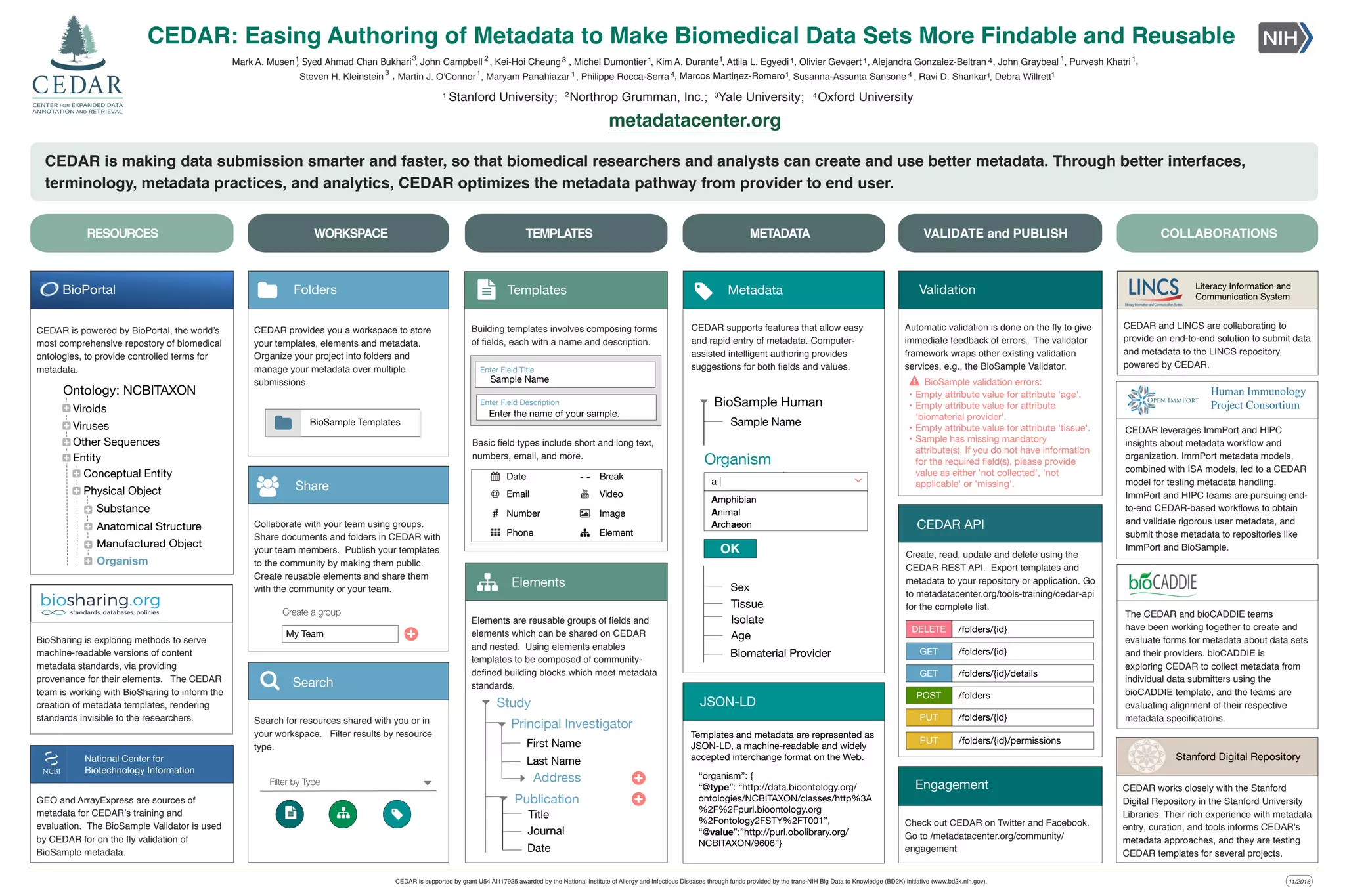
CEDAR is making data submission smarter and faster, so that biomedical researchers and analysts can create and use better metadata. Through better interfaces,
terminology, metadata practices, and analytics, CEDAR optimizes the metadata pathway from provider to end user.
CEDAR
CENTER FOR EXPANDED DATA
ANNOTATION AND RETRIEVAL
CEDAR
R FOR EXPANDED DATA
ATION AND RETRIEVAL
TEMPLATES METADATARESOURCES COLLABORATIONSWORKSPACE
CEDAR works closely with the Stanford
Digital Repository in the Stanford University
Libraries. Their rich experience with metadata
entry, curation, and tools informs CEDAR's
metadata approaches, and they are testing
CEDAR templates for several projects.
Stanford Digital Repository
CEDAR and LINCS are collaborating to
provide an end-to-end solution to submit data
and metadata to the LINCS repository,
powered by CEDAR.
Literacy Information and
Communication System
Building templates involves composing forms
of fields, each with a name and description.
Templates
GEO and ArrayExpress are sources of
metadata for CEDAR’s training and
evaluation. The BioSample Validator is used
by CEDAR for on the fly validation of
BioSample metadata.
CEDAR provides you a workspace to store
your templates, elements and metadata.
Organize your project into folders and
manage your metadata over multiple
submissions.
Folders
BioSample Templates
CEDAR is powered by BioPortal, the world’s
most comprehensive repostory of biomedical
ontologies, to provide controlled terms for
metadata.
Ontology: NCBITAXON
Viroids
Viruses
Other Sequences
Entity
Conceptual Entity
Physical Object
Substance
Anatomical Structure
Manufactured Object
Organism
JSON-LD
Create, read, update and delete using the
CEDAR REST API. Export templates and
metadata to your repository or application. Go
to metadatacenter.org/tools-training/cedar-api
for the complete list.
CEDAR API
DELETE /folders/{id}
GET /folders/{id}
GET /folders/{id}/details
POST /folders
PUT /folders/{id}
PUT /folders/{id}/permissions
Collaborate with your team using groups.
Share documents and folders in CEDAR with
your team members. Publish your templates
to the community by making them public.
Create reusable elements and share them
with the community or your team.
Share
My Team
Create a group
+
Automatic validation is done on the fly to give
immediate feedback of errors. The validator
framework wraps other existing validation
services, e.g., the BioSample Validator.
Validation
BioSample validation errors:
• Empty attribute value for attribute 'age'.
• Empty attribute value for attribute
'biomaterial provider'.
• Empty attribute value for attribute 'tissue'.
• Sample has missing mandatory
attribute(s). If you do not have information
for the required field(s), please provide
value as either 'not collected', 'not
applicable' or 'missing'.
BioSharing is exploring methods to serve
machine-readable versions of content
metadata standards, via providing
provenance for their elements. The CEDAR
team is working with BioSharing to inform the
creation of metadata templates, rendering
standards invisible to the researchers.
Check out CEDAR on Twitter and Facebook.
Go to /metadatacenter.org/community/
engagement
Engagement
, John Campbell 2
, Kei-Hoi Cheung3 , Michel Dumontier1, Kim A. Durante1, Attila L. Egyedi1 , Alejandra Gonzalez-Beltran 4, John Graybeal 1
, Purvesh Khatri1
, Maryam Panahiazar 1, Philippe Rocca-Serra4 , Susanna-Assunta Sansone 4 , Ravi D. Shankar1
2
Northrop Grumman, Inc.; 3Yale University; 4Oxford University
metadatacenter.org
Steven H. Kleinstein
3
Martin J. O'Connor1, , Debra Willrett1
, Olivier Gevaert 1 ,
“organism”: {
“@type”: “http://data.bioontology.org/
ontologies/NCBITAXON/classes/http%3A
%2F%2Fpurl.bioontology.org
%2Fontology2FSTY%2FT001”,
“@value”:”http://purl.obolibrary.org/
NCBITAXON/9606”}
Templates and metadata are represented as
JSON-LD, a machine-readable and widely
accepted interchange format on the Web.
Basic field types include short and long text,
numbers, email, and more.
Sample Name
Enter Field Title
Enter the name of your sample.
Enter Field Description
Date
Ǜ Email
# Number
Phone
- - Break
Video
Image
Element
Elements are reusable groups of fields and
elements which can be shared on CEDAR
and nested. Using elements enables
templates to be composed of community-
defined building blocks which meet metadata
standards.
Elements
Study
Journal
Date
Title
Principal Investigator
First Name
Last Name
Address
Publication +
+
, Marcos Martinez-Romero1 1
1
Mark A. Musen
CEDAR leverages ImmPort and HIPC
insights about metadata workflow and
organization. ImmPort metadata models,
combined with ISA models, led to a CEDAR
model for testing metadata handling.
ImmPort and HIPC teams are pursuing end-
to-end CEDAR-based workflows to obtain
and validate rigorous user metadata, and
submit those metadata to repositories like
ImmPort and BioSample.
Human Immunology
Project Consortium
, Syed Ahmad Chan Bukhari3
Stanford University;1
The CEDAR and bioCADDIE teams
have been working together to create and
evaluate forms for metadata about data sets
and their providers. bioCADDIE is
exploring CEDAR to collect metadata from
individual data submitters using the
bioCADDIE template, and the teams are
evaluating alignment of their respective
metadata specifications.
CEDAR is supported by grant U54 AI117925 awarded by the National Institute of Allergy and Infectious Diseases through funds provided by the trans-NIH Big Data to Knowledge (BD2K) initiative (www.bd2k.nih.gov).
Search for resources shared with you or in
your workspace. Filter results by resource
type.
Search
Filter by Type
BioPortal
National Center for
Biotechnology Information
CEDAR supports features that allow easy
and rapid entry of metadata. Computer-
assisted intelligent authoring provides
suggestions for both fields and values.
Metadata
Organism
Amphibian
OK
BioSample Human
Sample Name
∠
Animal
Archaeon
a |
Isolate
Age
Biomaterial Provider
Tissue
Sex

CEDAR: Easing Authoring of Metadata to Make Biomedical Data Sets More Findable and Reusable

  • 1.
    11/2016 VALIDATE and PUBLISH CEDAR:Easing Authoring of Metadata to Make Biomedical Data Sets More Findable and Reusable CEDAR is making data submission smarter and faster, so that biomedical researchers and analysts can create and use better metadata. Through better interfaces, terminology, metadata practices, and analytics, CEDAR optimizes the metadata pathway from provider to end user. CEDAR CENTER FOR EXPANDED DATA ANNOTATION AND RETRIEVAL CEDAR R FOR EXPANDED DATA ATION AND RETRIEVAL TEMPLATES METADATARESOURCES COLLABORATIONSWORKSPACE CEDAR works closely with the Stanford Digital Repository in the Stanford University Libraries. Their rich experience with metadata entry, curation, and tools informs CEDAR's metadata approaches, and they are testing CEDAR templates for several projects. Stanford Digital Repository CEDAR and LINCS are collaborating to provide an end-to-end solution to submit data and metadata to the LINCS repository, powered by CEDAR. Literacy Information and Communication System Building templates involves composing forms of fields, each with a name and description. Templates GEO and ArrayExpress are sources of metadata for CEDAR’s training and evaluation. The BioSample Validator is used by CEDAR for on the fly validation of BioSample metadata. CEDAR provides you a workspace to store your templates, elements and metadata. Organize your project into folders and manage your metadata over multiple submissions. Folders BioSample Templates CEDAR is powered by BioPortal, the world’s most comprehensive repostory of biomedical ontologies, to provide controlled terms for metadata. Ontology: NCBITAXON Viroids Viruses Other Sequences Entity Conceptual Entity Physical Object Substance Anatomical Structure Manufactured Object Organism JSON-LD Create, read, update and delete using the CEDAR REST API. Export templates and metadata to your repository or application. Go to metadatacenter.org/tools-training/cedar-api for the complete list. CEDAR API DELETE /folders/{id} GET /folders/{id} GET /folders/{id}/details POST /folders PUT /folders/{id} PUT /folders/{id}/permissions Collaborate with your team using groups. Share documents and folders in CEDAR with your team members. Publish your templates to the community by making them public. Create reusable elements and share them with the community or your team. Share My Team Create a group + Automatic validation is done on the fly to give immediate feedback of errors. The validator framework wraps other existing validation services, e.g., the BioSample Validator. Validation BioSample validation errors: • Empty attribute value for attribute 'age'. • Empty attribute value for attribute 'biomaterial provider'. • Empty attribute value for attribute 'tissue'. • Sample has missing mandatory attribute(s). If you do not have information for the required field(s), please provide value as either 'not collected', 'not applicable' or 'missing'. BioSharing is exploring methods to serve machine-readable versions of content metadata standards, via providing provenance for their elements. The CEDAR team is working with BioSharing to inform the creation of metadata templates, rendering standards invisible to the researchers. Check out CEDAR on Twitter and Facebook. Go to /metadatacenter.org/community/ engagement Engagement , John Campbell 2 , Kei-Hoi Cheung3 , Michel Dumontier1, Kim A. Durante1, Attila L. Egyedi1 , Alejandra Gonzalez-Beltran 4, John Graybeal 1 , Purvesh Khatri1 , Maryam Panahiazar 1, Philippe Rocca-Serra4 , Susanna-Assunta Sansone 4 , Ravi D. Shankar1 2 Northrop Grumman, Inc.; 3Yale University; 4Oxford University metadatacenter.org Steven H. Kleinstein 3 Martin J. O'Connor1, , Debra Willrett1 , Olivier Gevaert 1 , “organism”: { “@type”: “http://data.bioontology.org/ ontologies/NCBITAXON/classes/http%3A %2F%2Fpurl.bioontology.org %2Fontology2FSTY%2FT001”, “@value”:”http://purl.obolibrary.org/ NCBITAXON/9606”} Templates and metadata are represented as JSON-LD, a machine-readable and widely accepted interchange format on the Web. Basic field types include short and long text, numbers, email, and more. Sample Name Enter Field Title Enter the name of your sample. Enter Field Description Date Ǜ Email # Number Phone - - Break Video Image Element Elements are reusable groups of fields and elements which can be shared on CEDAR and nested. Using elements enables templates to be composed of community- defined building blocks which meet metadata standards. Elements Study Journal Date Title Principal Investigator First Name Last Name Address Publication + + , Marcos Martinez-Romero1 1 1 Mark A. Musen CEDAR leverages ImmPort and HIPC insights about metadata workflow and organization. ImmPort metadata models, combined with ISA models, led to a CEDAR model for testing metadata handling. ImmPort and HIPC teams are pursuing end- to-end CEDAR-based workflows to obtain and validate rigorous user metadata, and submit those metadata to repositories like ImmPort and BioSample. Human Immunology Project Consortium , Syed Ahmad Chan Bukhari3 Stanford University;1 The CEDAR and bioCADDIE teams have been working together to create and evaluate forms for metadata about data sets and their providers. bioCADDIE is exploring CEDAR to collect metadata from individual data submitters using the bioCADDIE template, and the teams are evaluating alignment of their respective metadata specifications. CEDAR is supported by grant U54 AI117925 awarded by the National Institute of Allergy and Infectious Diseases through funds provided by the trans-NIH Big Data to Knowledge (BD2K) initiative (www.bd2k.nih.gov). Search for resources shared with you or in your workspace. Filter results by resource type. Search Filter by Type BioPortal National Center for Biotechnology Information CEDAR supports features that allow easy and rapid entry of metadata. Computer- assisted intelligent authoring provides suggestions for both fields and values. Metadata Organism Amphibian OK BioSample Human Sample Name ∠ Animal Archaeon a | Isolate Age Biomaterial Provider Tissue Sex