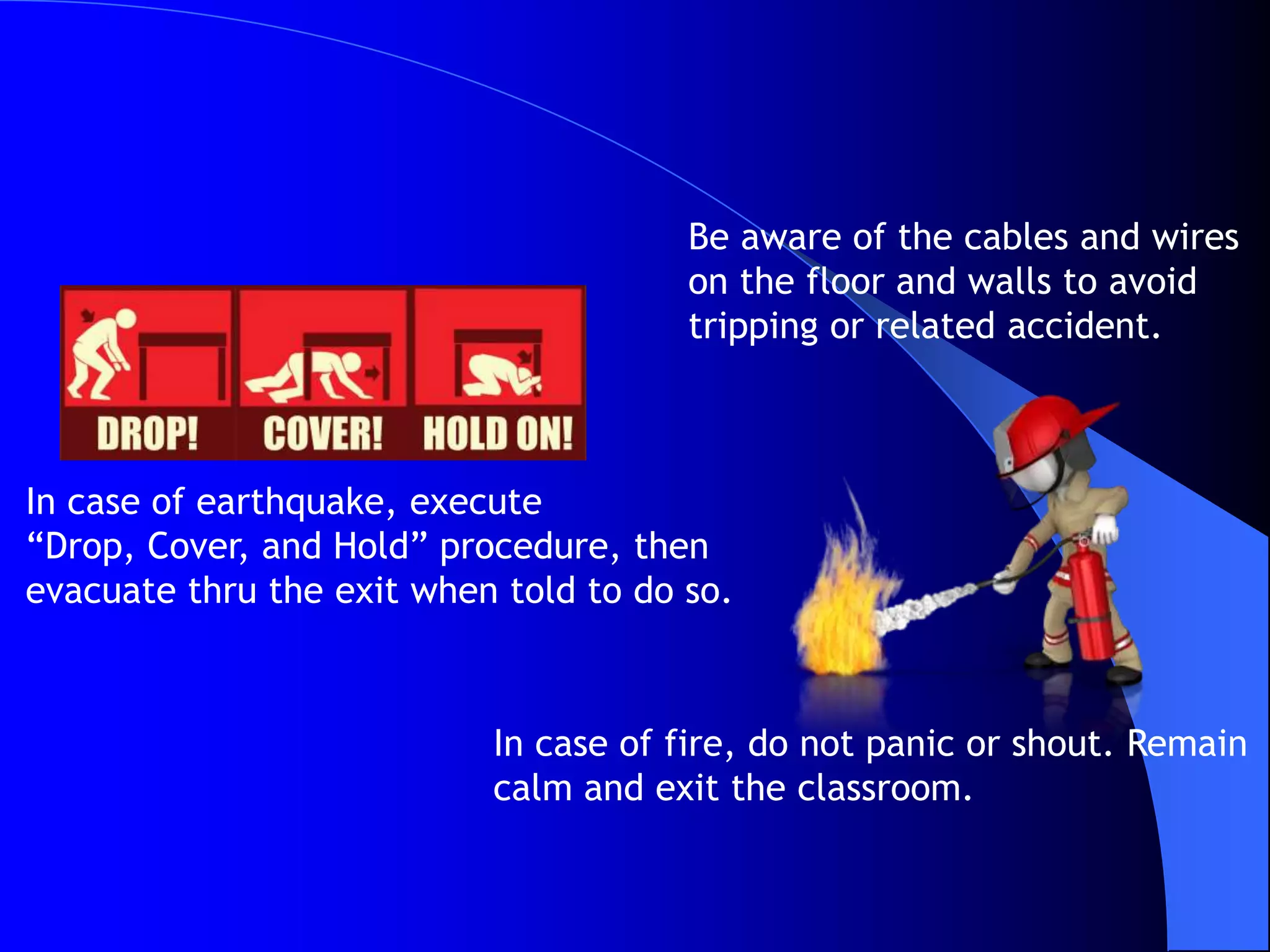
In case of earthquake, execute
“Drop, Cover, and Hold” procedure, then
evacuate thru the exit when told to do so.
In case of fire, do not panic or shout. Remain
calm and exit the classroom.
Be aware of the cables and wires
on the floor and walls to avoid
tripping or related accident.
I. BACKGROUND
II . DEFINITION OF TERMS
III. OBJECTIVES OF THE ROTC
PROGRAM
IV. ROTC PROGRAM OF
INSTRUCTION
V. OPPORTUNITIES IN THE ROTC
PROGRAM
VI. TRAINING
 Commonwealth Act Nr.1 – Otherwise known as the National
Defense Act of 1935 requiring the compulsary military training
for all college students.
 Executive Order Nr. 207 – the implementing arm of this Act issued
by Pres Manuel L Quezon to prepare the youth for the defense of
the state.
 PD 1706 – (amended the Commonwealth Nr.1 in 1990) known as the
National Service Law which offered three(3) components National
Service Program namely:
 Military Science (DND)
 Civil Welfare Service (CHED)
 Law Enforcement Service (DILG)
 However, concerned agencies were not prepared to implement
the CWS and LES components, thus MS program was the only
program pursued in colleges and universities.
 RA 7077 – (enacted in 1991) otherwise known as the AFP
Reservist Act which enforced and prescribing for a two (2) year
ROTC program as a requirement for graduation to all tertiary
level students.
 Expanded ROTC program (1994) – a tripartite committee was
formed among DND, CHED & DILG representatives modifying
the traditional two (2) year ROTC program which provide for a
mandatory Military Training for the first curriculum year and
optional to pursue MS, CWS and LES on the second year.
 RA 9163 (SY 2000-2001, RA 7077 and PD 1706 were
amended) known as the National Training Program
Act of 2001 was formally signed by PGMA on 23 Jan
2003 and promulgated on 23 March 2003.Composed of:
ROTC (made ROTC optional and voluntary)
LTS
CWTS
 Effective SY 2002-2003, all freshmen male and female
students in the tertiary level are mandated to finish one
(1) year of any one of the NSTP components as a
prerequisite for graduation from any baccalaureate
degree course or from any two (2) year
technical/vocational course. Meaning, one (1) of NSTP
components will be taken for a period of one (1) year or
two (2) semesters.
 National Service Training Program (NSTP) - is a
program aimed at enhancing civic consciousness and
defense preparedness in the youth by developing the
ethic of service and patriotism while undergoing
training in any of its three (3) program components.
 Reserve officer Training Corps (ROTC) – is a
program institutionalized under Section 38 and 39 of
RA 7077 designed to provide military training to
tertiary level students In order to motivate, train,
organized and mobilize them for national defense
preparedness.
 Literacy Training Service (LTS) – is a program
designed to train students to become teachers of
literacy and numeracy skills to school children, out of
school youth, and other segments of society in need of
their service.
 Civic Welfare Training Service (CWTS) – refers to
program of activities contributory to the general
welfare and the betterment of life for the members of
the community or the enhancement of its facilities,
especially those devoted to improving health,
education, environment, entrepreneurship, safety,
recreation and morals of the citizen.
 Program Component – shall refer to the service
components of the NSTP as enumerated in Section 4 of
RA 9163.
 Clustering – refers to the grouping of students
enrolled in different schools and taking up the same
NSTP component into one (1) group under the
management and supervision of a designated school.
 Cross enrollment – refers to a system of enrollment
where a student who is officially enrolled in an
academic program of a school is allowed to enroll in
the NSTP component od another school.
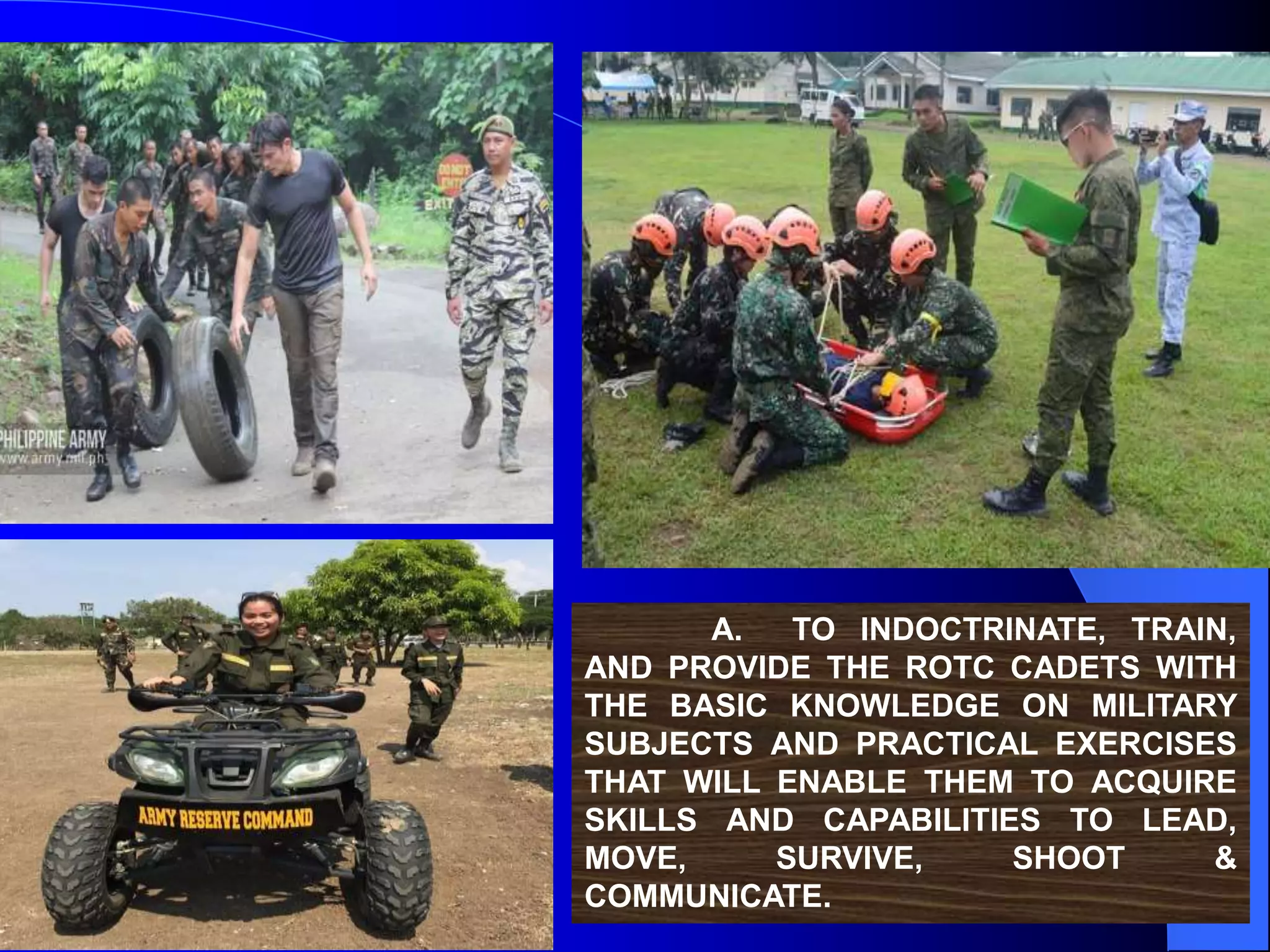
A. TO INDOCTRINATE, TRAIN,
AND PROVIDE THE ROTC CADETS WITH
THE BASIC KNOWLEDGE ON MILITARY
SUBJECTS AND PRACTICAL EXERCISES
THAT WILL ENABLE THEM TO ACQUIRE
SKILLS AND CAPABILITIES TO LEAD,
MOVE, SURVIVE, SHOOT &
COMMUNICATE.
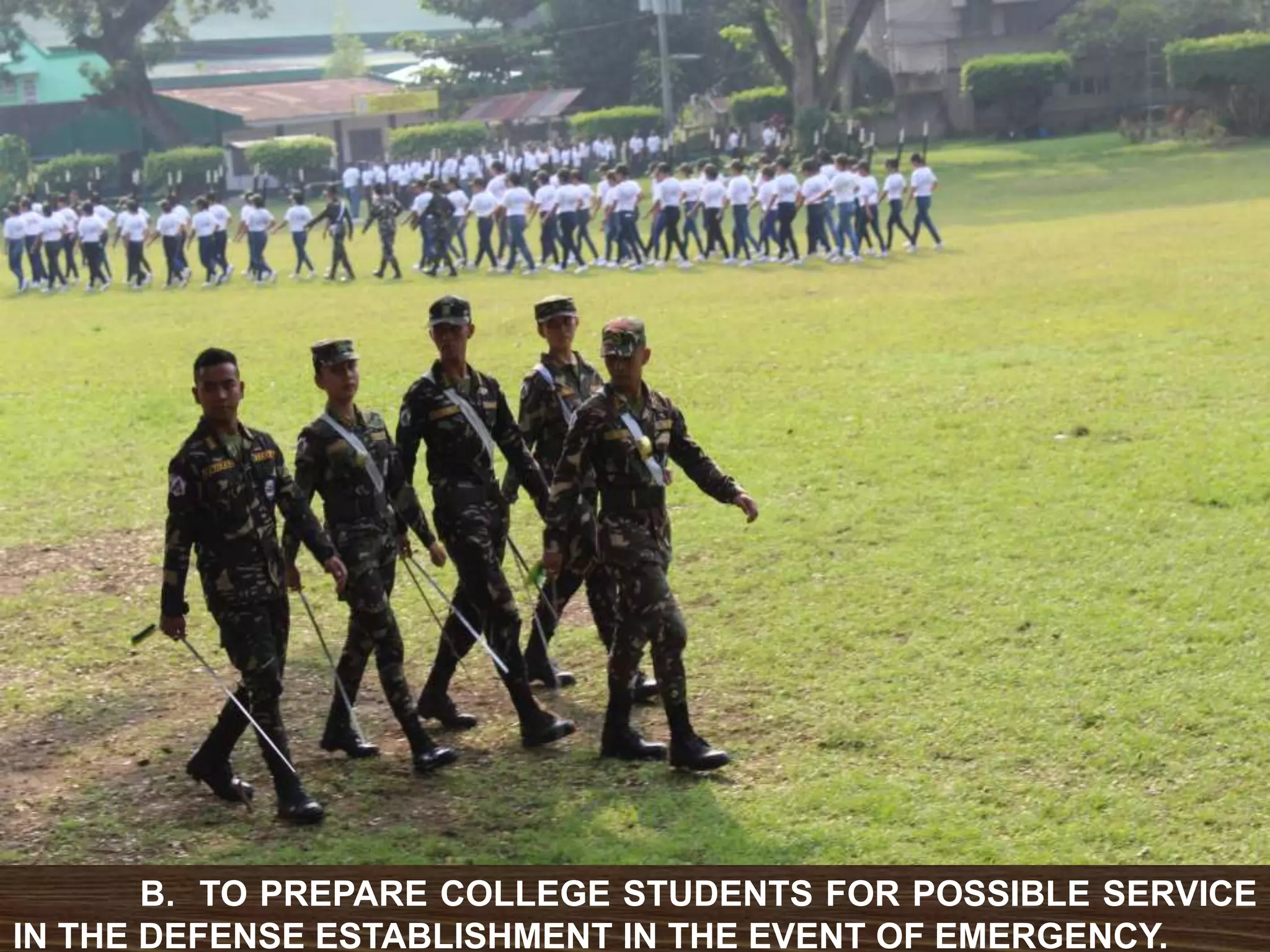
B. TO PREPARE COLLEGE STUDENTS FOR POSSIBLE SERVICE
IN THE DEFENSE ESTABLISHMENT IN THE EVENT OF EMERGENCY.
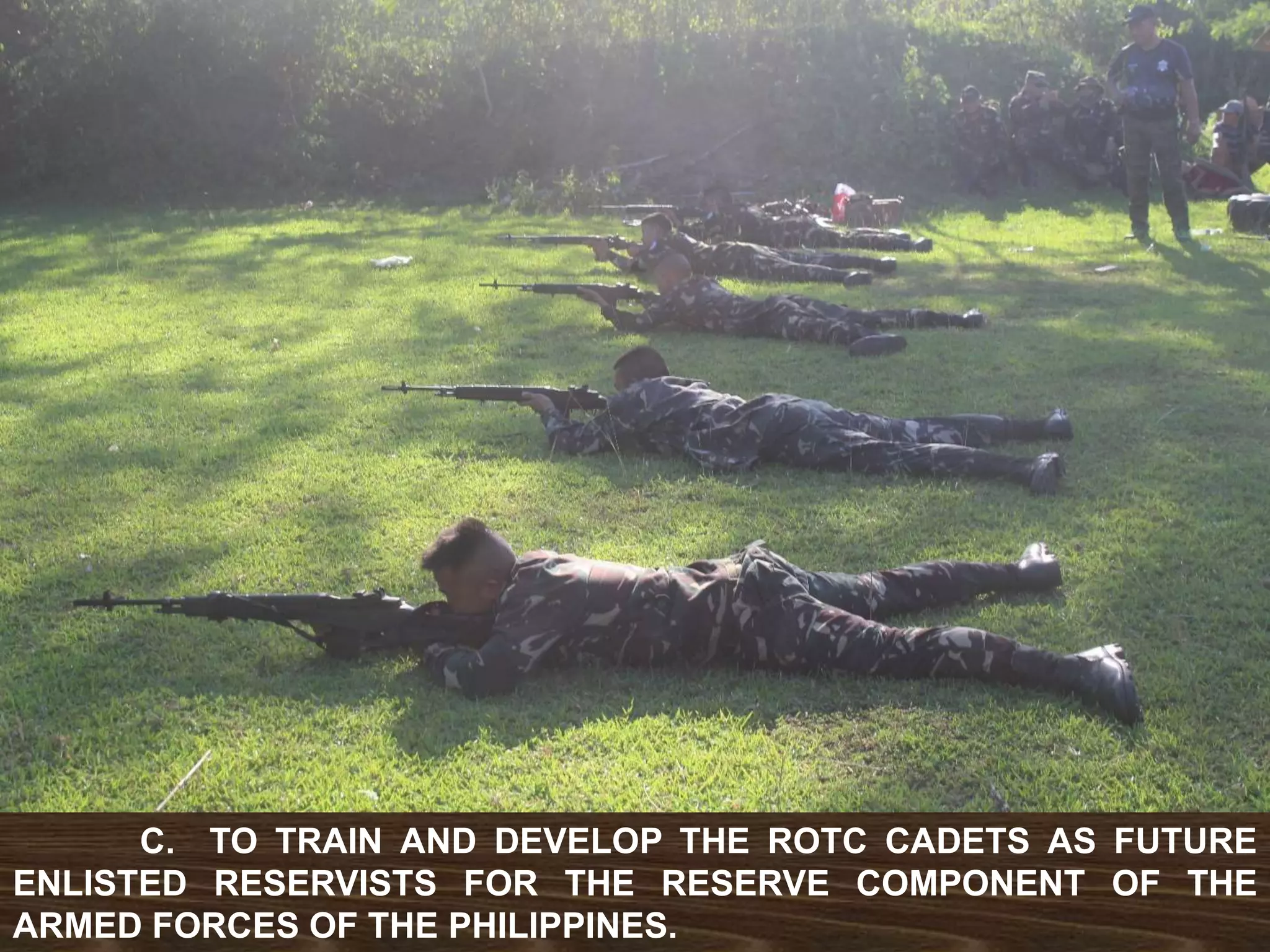
C. TO TRAIN AND DEVELOP THE ROTC CADETS AS FUTURE
ENLISTED RESERVISTS FOR THE RESERVE COMPONENT OF THE
ARMED FORCES OF THE PHILIPPINES.
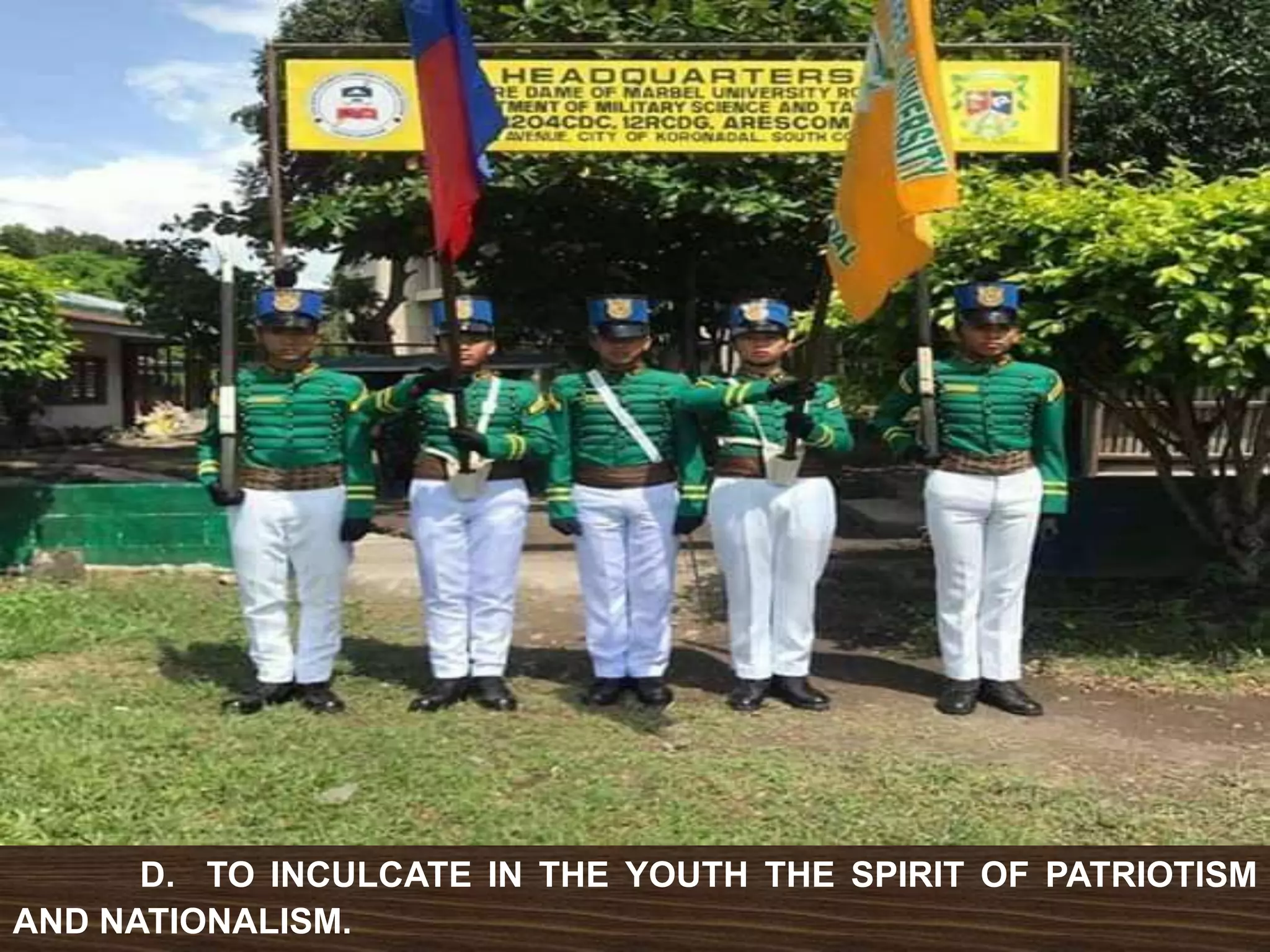
D. TO INCULCATE IN THE YOUTH THE SPIRIT OF PATRIOTISM
AND NATIONALISM.
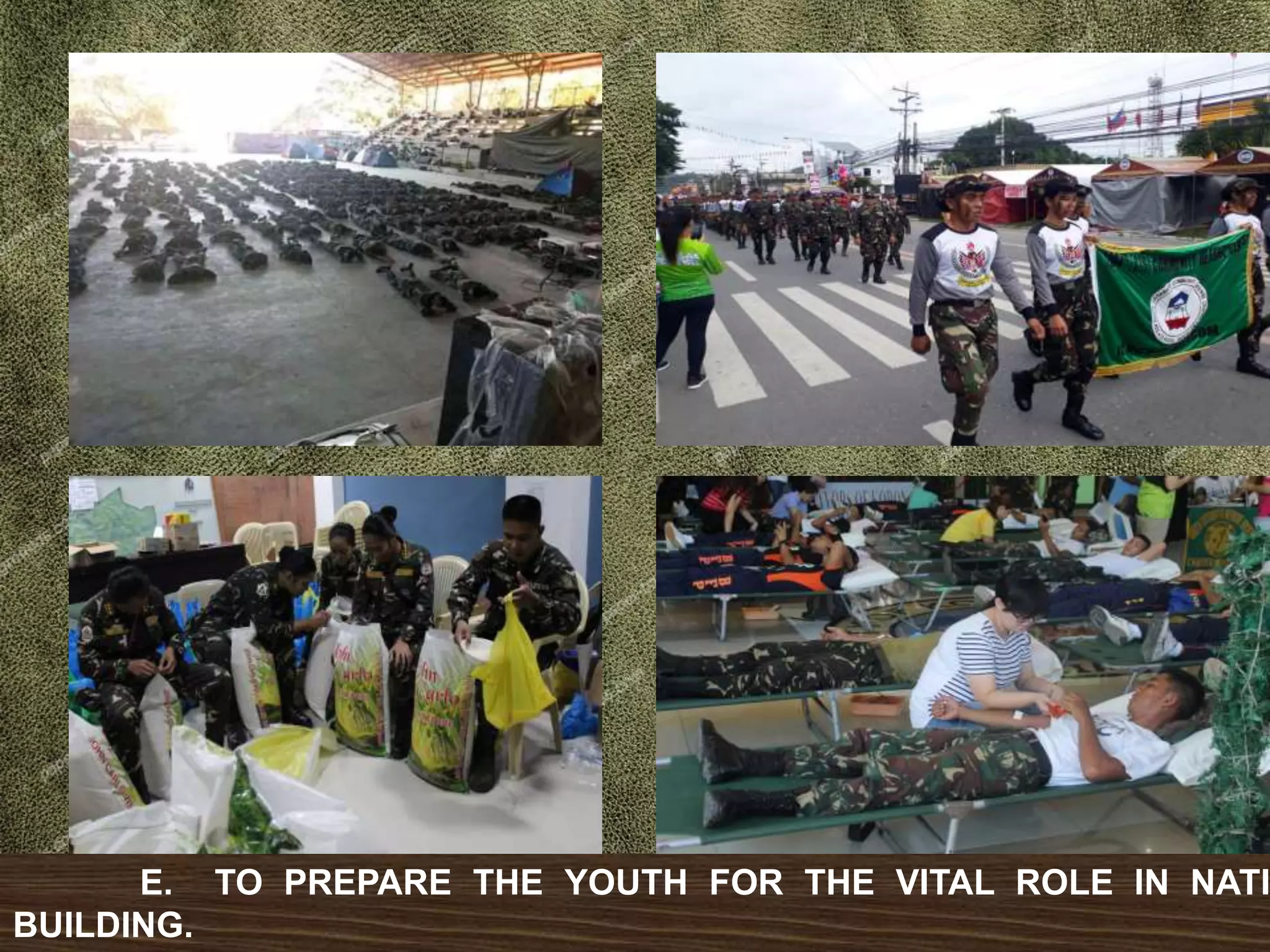
E. TO PREPARE THE YOUTH FOR THE VITAL ROLE IN NATIO
BUILDING.
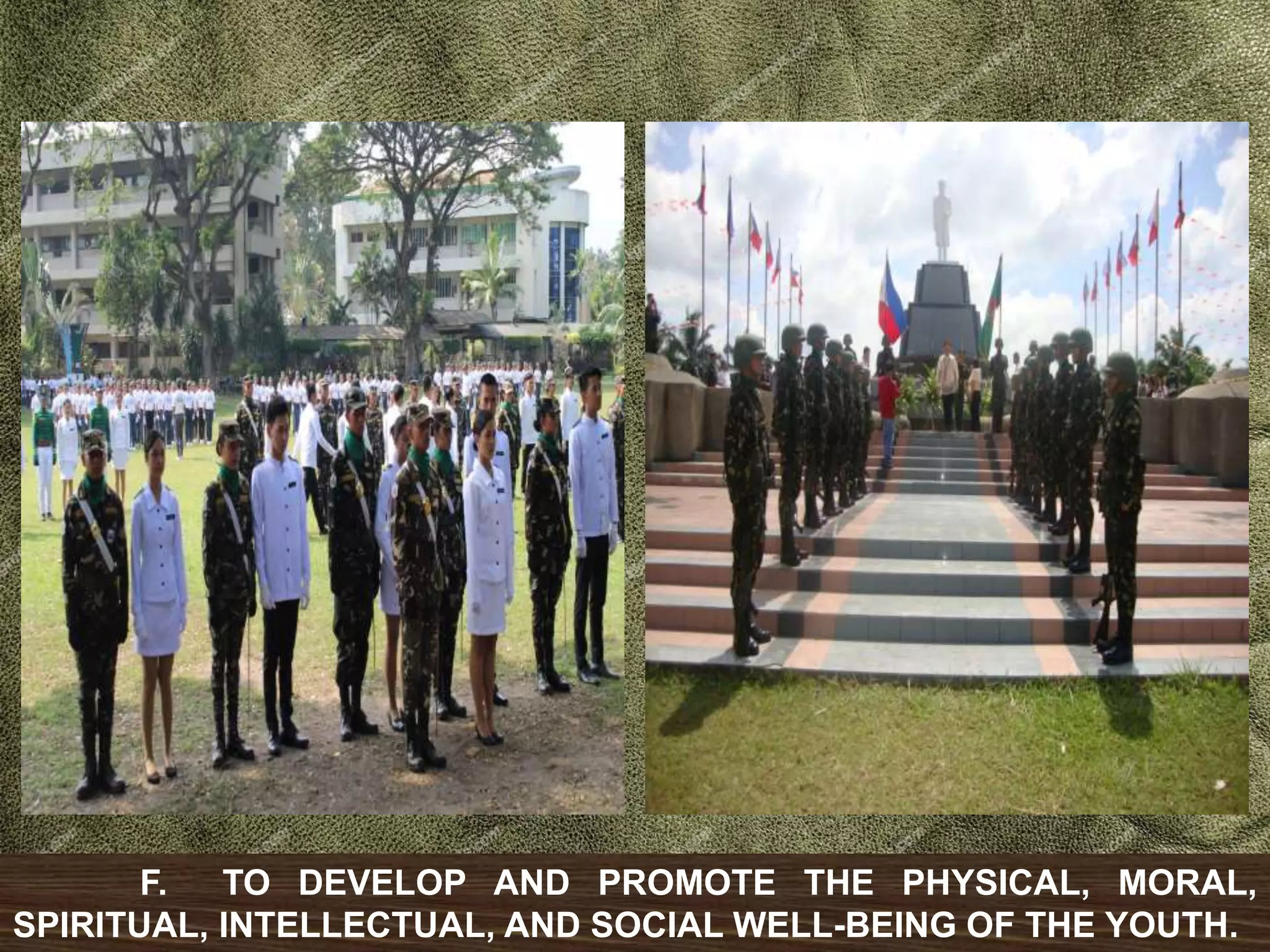
F. TO DEVELOP AND PROMOTE THE PHYSICAL, MORAL,
SPIRITUAL, INTELLECTUAL, AND SOCIAL WELL-BEING OF THE YOUTH.
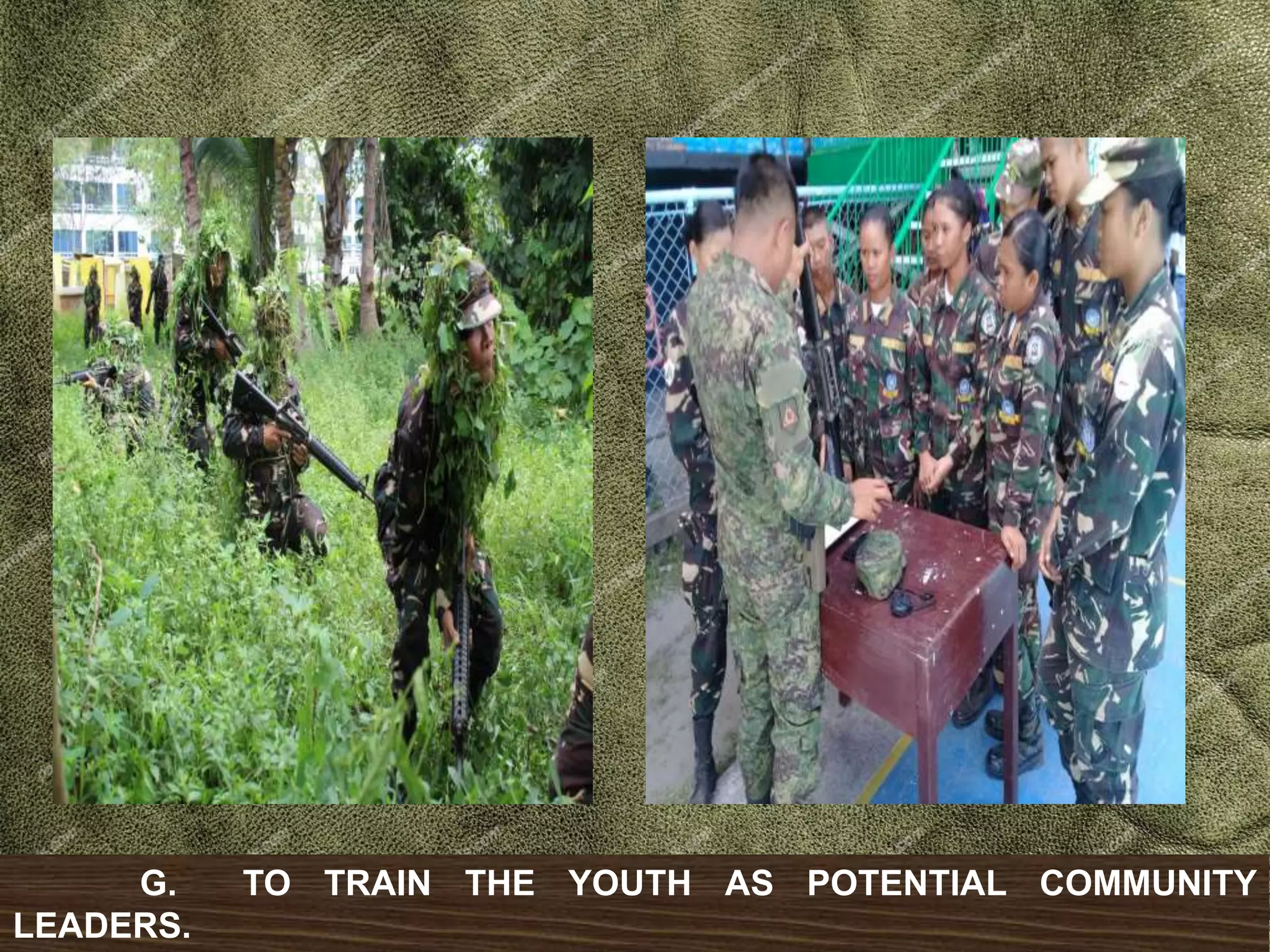
G. TO TRAIN THE YOUTH AS POTENTIAL COMMUNITY
LEADERS.
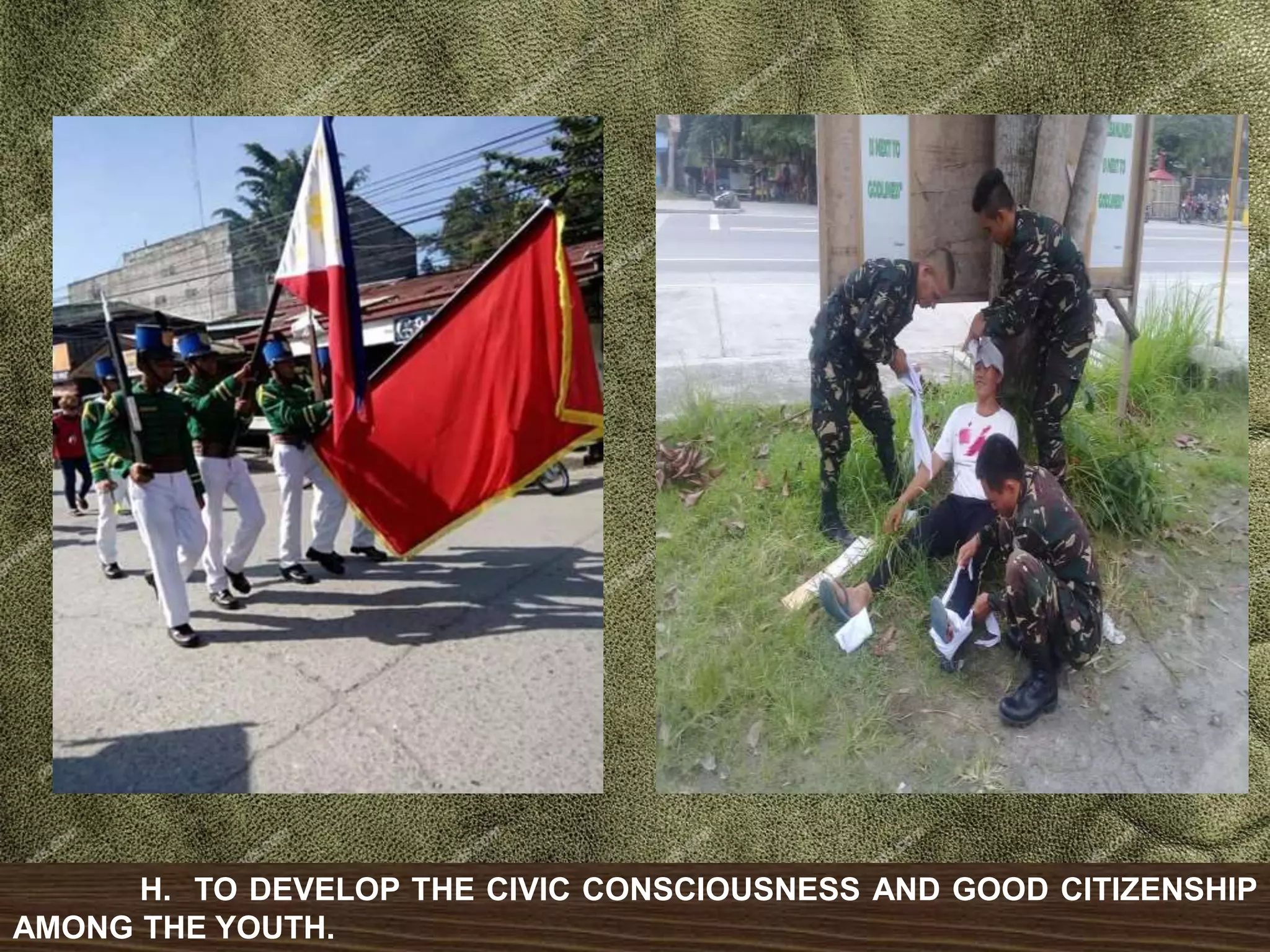
H. TO DEVELOP THE CIVIC CONSCIOUSNESS AND GOOD CITIZENSHIP
AMONG THE YOUTH.
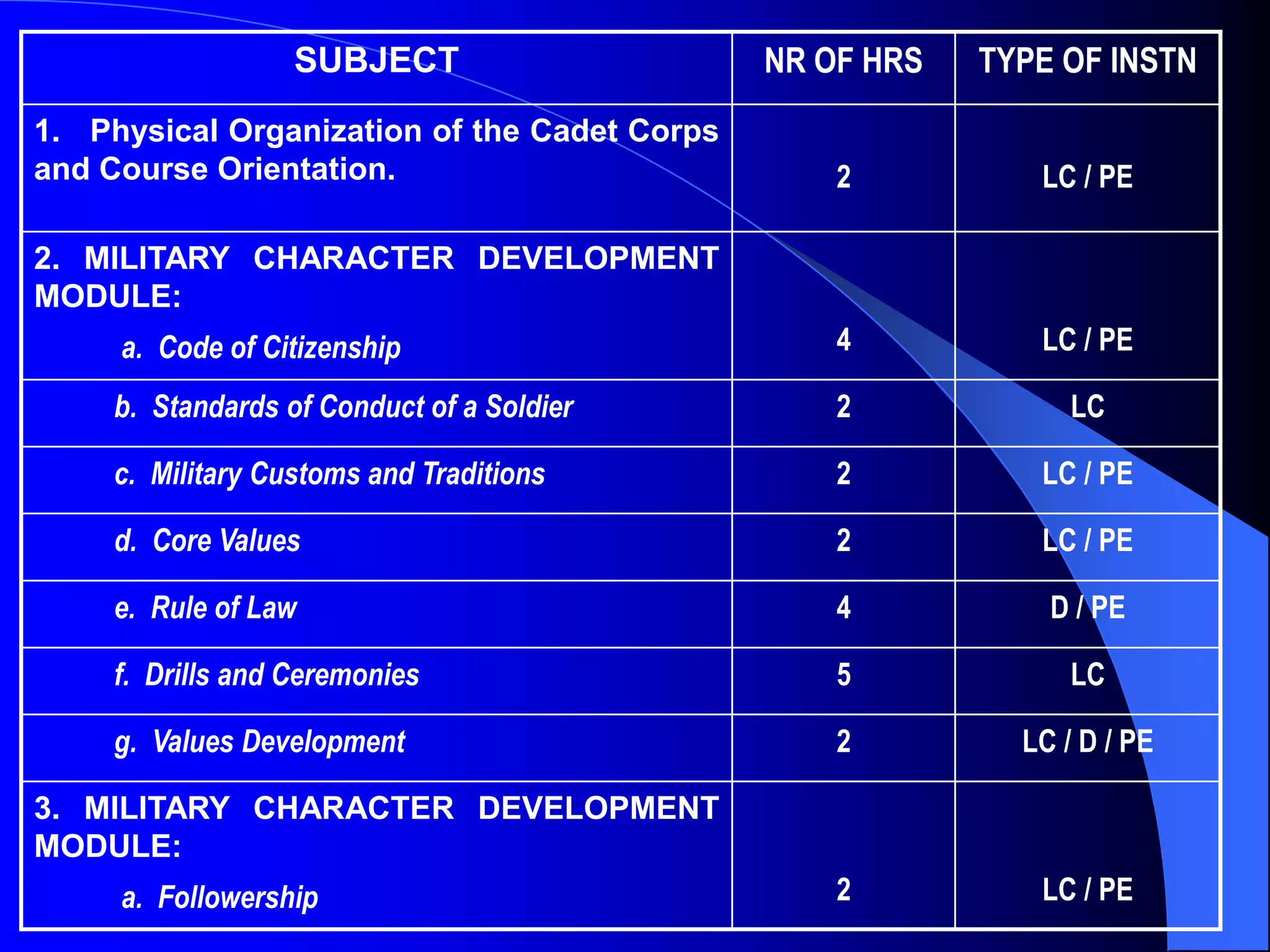
SUBJECT NR OF HRS TYPE OF INSTN
1. Physical Organization of the Cadet Corps
and Course Orientation. 2 LC / PE
2. MILITARY CHARACTER DEVELOPMENT
MODULE:
a. Code of Citizenship 4 LC / PE
b. Standards of Conduct of a Soldier 2 LC
c. Military Customs and Traditions 2 LC / PE
d. Core Values 2 LC / PE
e. Rule of Law 4 D / PE

f. Drills and Ceremonies 5 LC
g. Values Development 2 LC / D / PE
3. MILITARY CHARACTER DEVELOPMENT
MODULE:
a. Followership 2 LC / PE
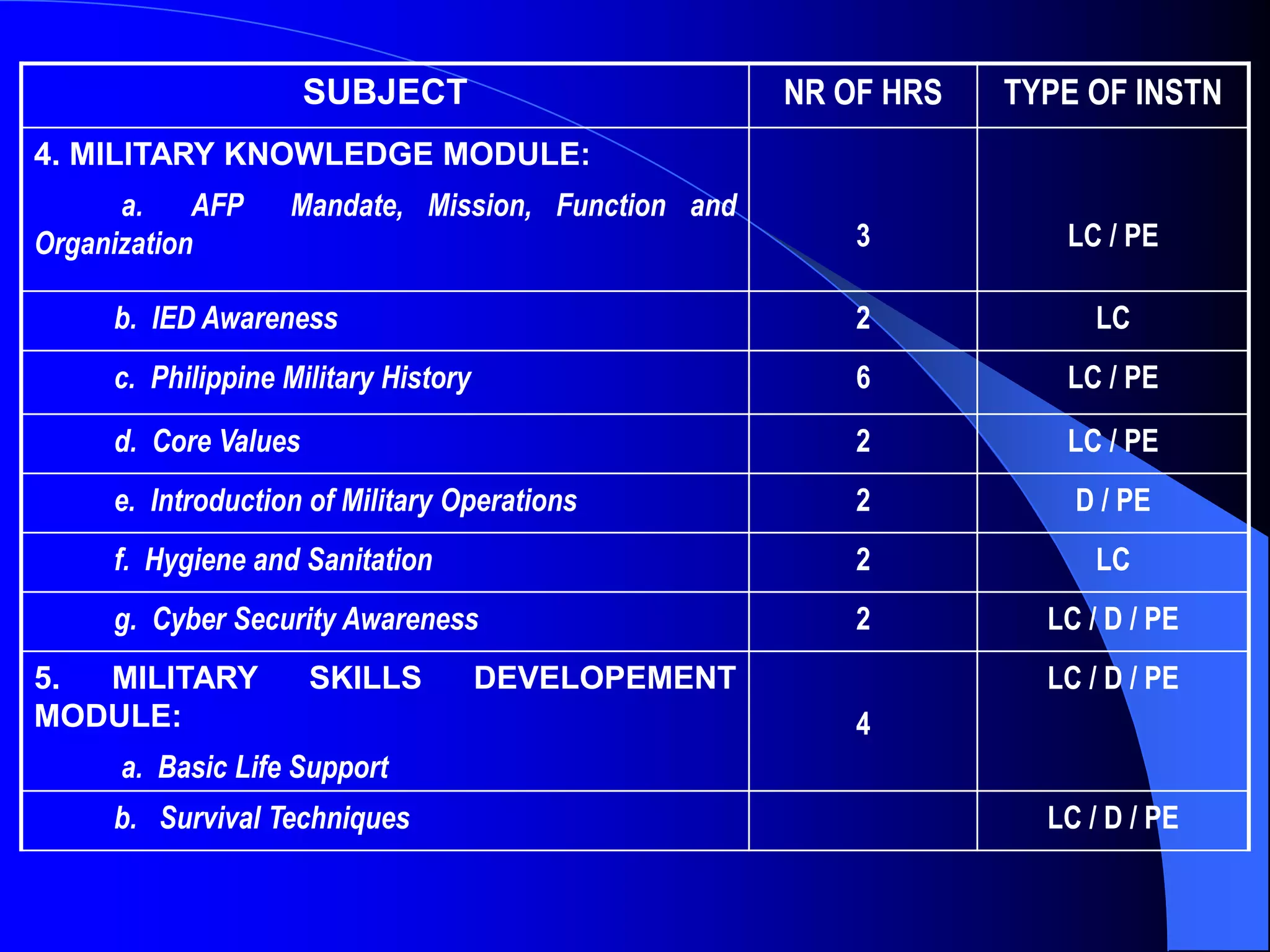
SUBJECT NR OF HRS TYPE OF INSTN
4. MILITARY KNOWLEDGE MODULE:
a. AFP Mandate, Mission, Function and
Organization 3 LC / PE
b. IED Awareness 2 LC
c. Philippine Military History 6 LC / PE
d. Core Values 2 LC / PE
e. Introduction of Military Operations 2 D / PE
f. Hygiene and Sanitation 2 LC
g. Cyber Security Awareness 2 LC / D / PE
5. MILITARY SKILLS DEVELOPEMENT
MODULE:
a. Basic Life Support
4
LC / D / PE
b. Survival Techniques LC / D / PE
SUBJECT NR OF HRS TYPE OF INSTN
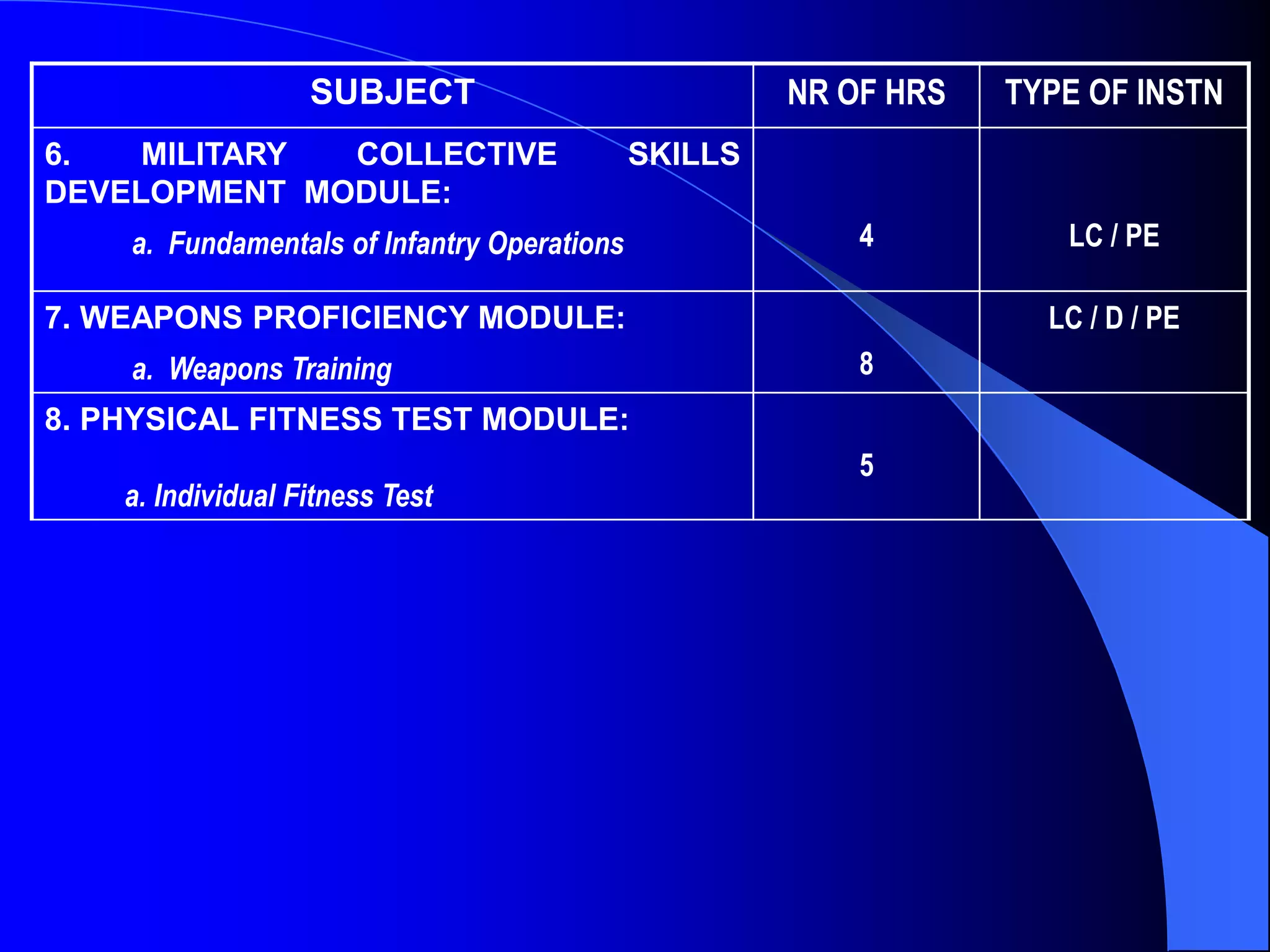
6. MILITARY COLLECTIVE SKILLS
DEVELOPMENT MODULE:
a. Fundamentals of Infantry Operations 4 LC / PE
7. WEAPONS PROFICIENCY MODULE:
a. Weapons Training 8
LC / D / PE
8. PHYSICAL FITNESS TEST MODULE:
a. Individual Fitness Test
5
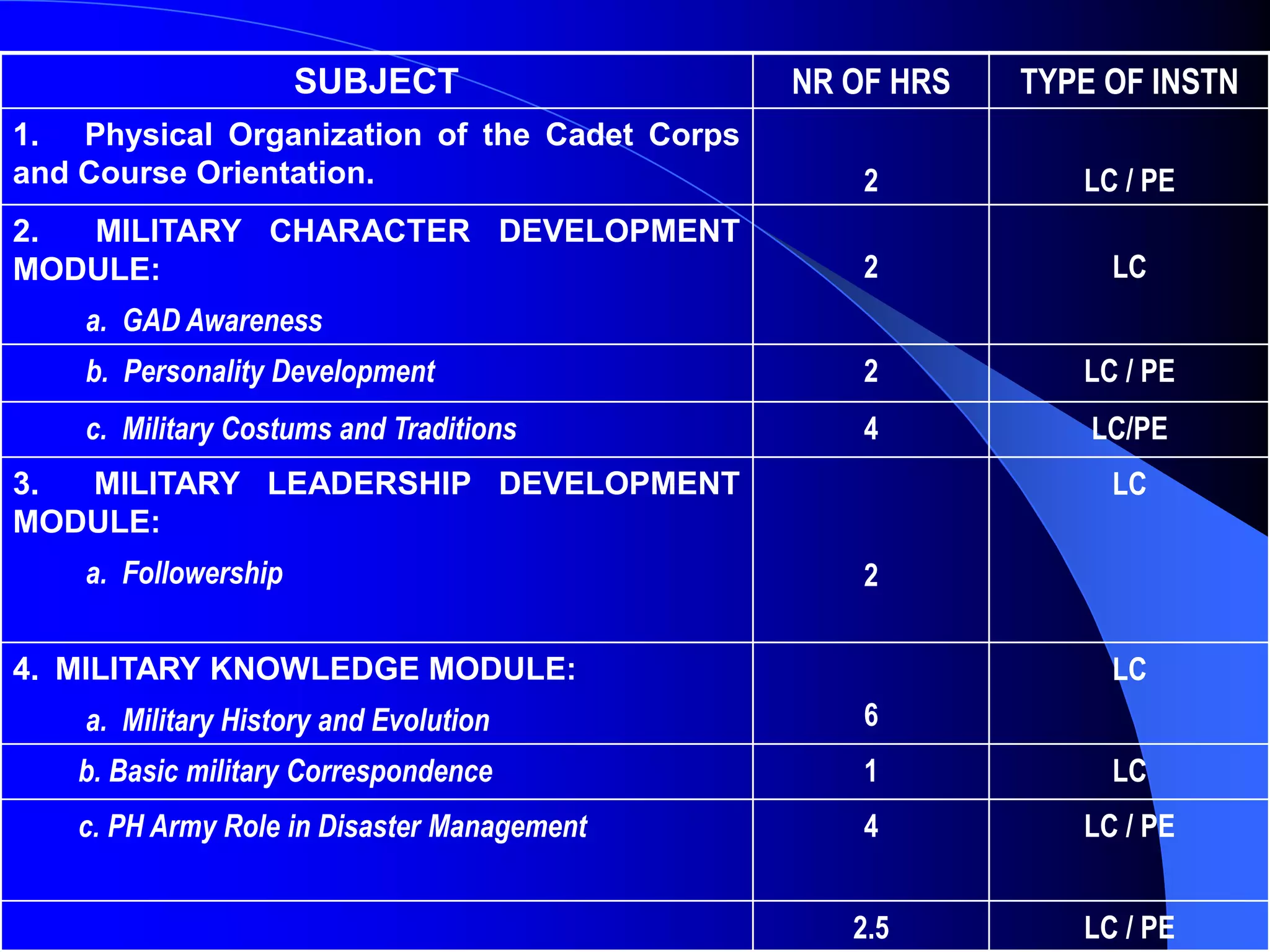
SUBJECT NR OF HRS TYPE OF INSTN
1. Physical Organization of the Cadet Corps
and Course Orientation. 2 LC / PE
2. MILITARY CHARACTER DEVELOPMENT
MODULE:
a. GAD Awareness
2 LC
b. Personality Development 2 LC / PE
c. Military Costums and Traditions 4 LC/PE
3. MILITARY LEADERSHIP DEVELOPMENT
MODULE:
a. Followership 2
LC
4. MILITARY KNOWLEDGE MODULE:
a. Military History and Evolution 6
LC
b. Basic military Correspondence 1 LC
c. PH Army Role in Disaster Management 4 LC / PE
2.5 LC / PE
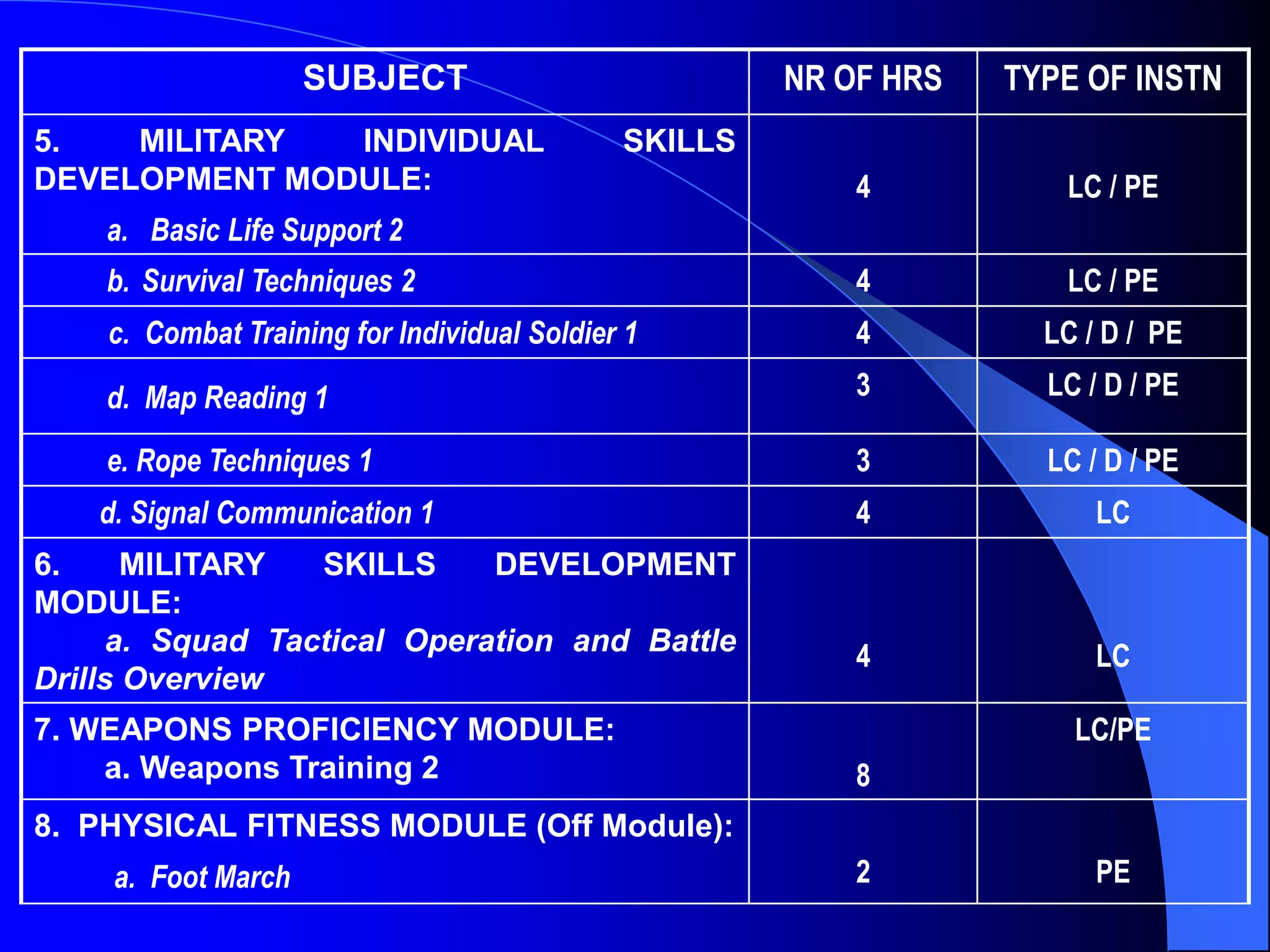
SUBJECT NR OF HRS TYPE OF INSTN
5. MILITARY INDIVIDUAL SKILLS
DEVELOPMENT MODULE:
a. Basic Life Support 2
4 LC / PE
b. Survival Techniques 2 4 LC / PE
c. Combat Training for Individual Soldier 1 4 LC / D / PE
d. Map Reading 1 3 LC / D / PE
e. Rope Techniques 1 3 LC / D / PE
d. Signal Communication 1 4 LC
6. MILITARY SKILLS DEVELOPMENT
MODULE:
a. Squad Tactical Operation and Battle
Drills Overview
4 LC
7. WEAPONS PROFICIENCY MODULE:
a. Weapons Training 2 8
LC/PE
8. PHYSICAL FITNESS MODULE (Off Module):
a. Foot March 2 PE
SCHOLARSHIP OF CADET OFFICERS AND A CHANCE TO
BECOME A MILITARY OFFICER THROUGH THE ADVANCE ROTC
PROGRAM.
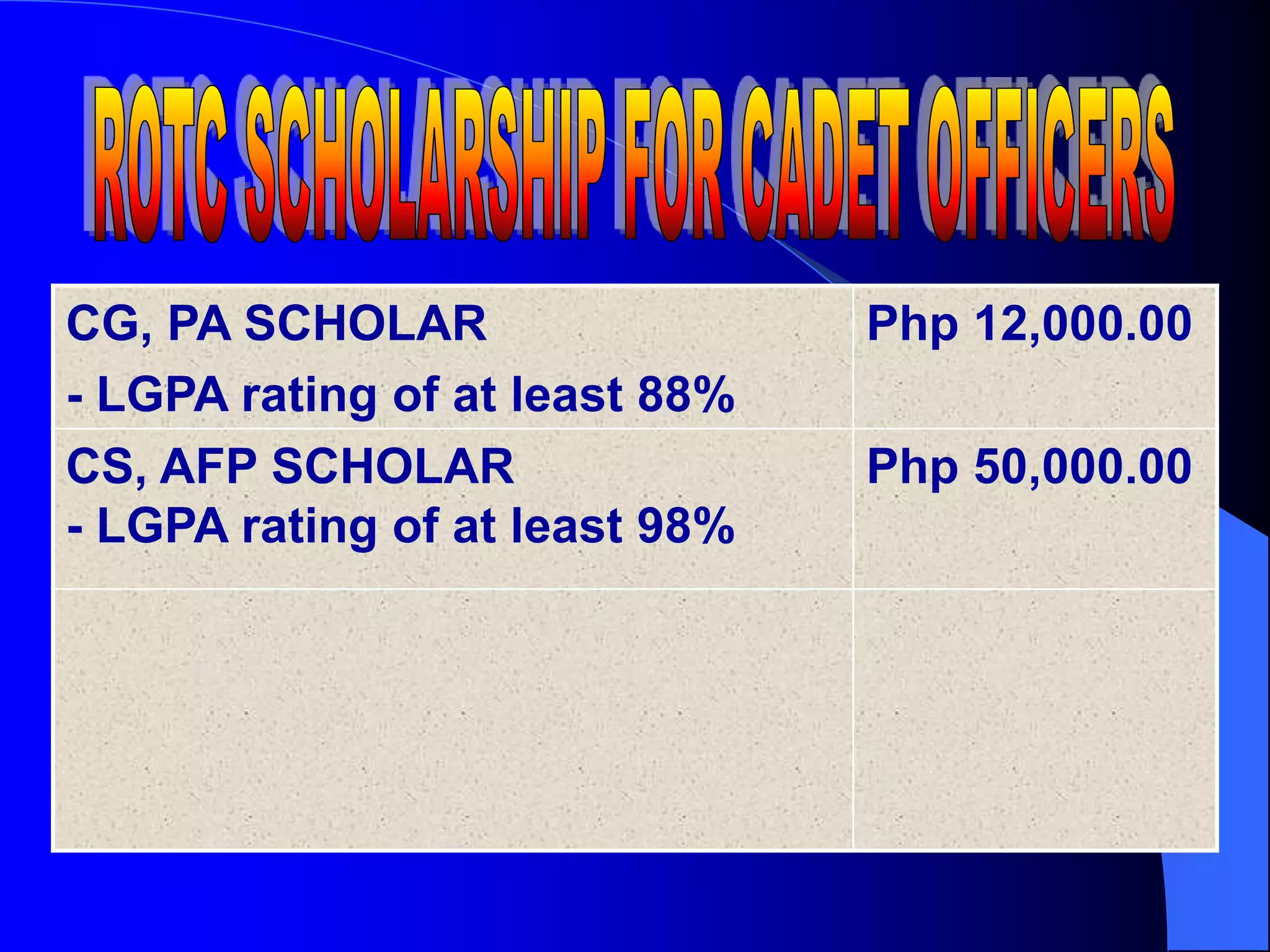
CG, PA SCHOLAR
- LGPA rating of at least 88%
Php 12,000.00
CS, AFP SCHOLAR
- LGPA rating of at least 98%
Php 50,000.00
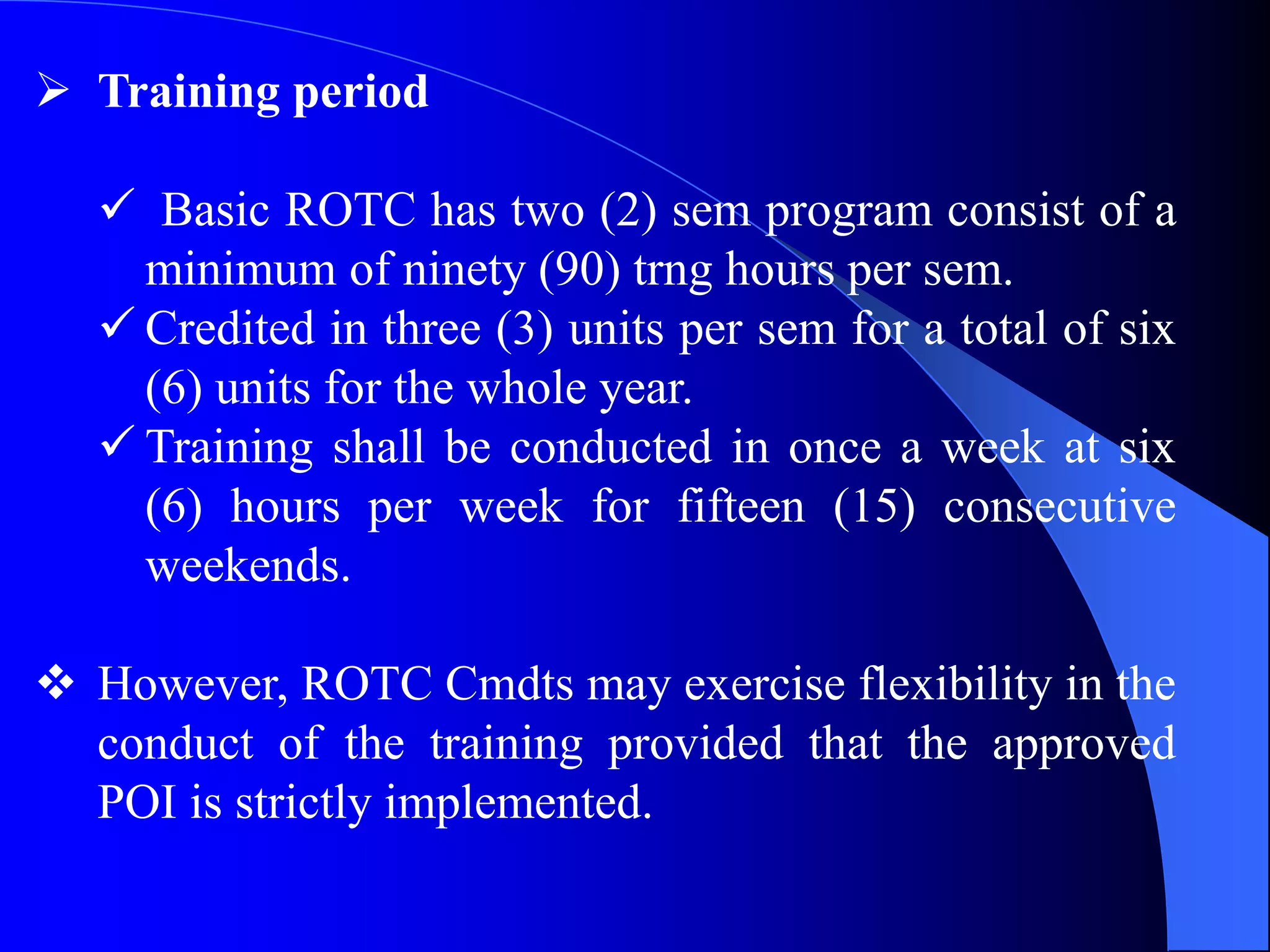
 Training period
 Basic ROTC has two (2) sem program consist of a
minimum of ninety (90) trng hours per sem.
 Credited in three (3) units per sem for a total of six
(6) units for the whole year.
 Training shall be conducted in once a week at six
(6) hours per week for fifteen (15) consecutive
weekends.
 However, ROTC Cmdts may exercise flexibility in the
conduct of the training provided that the approved
POI is strictly implemented.
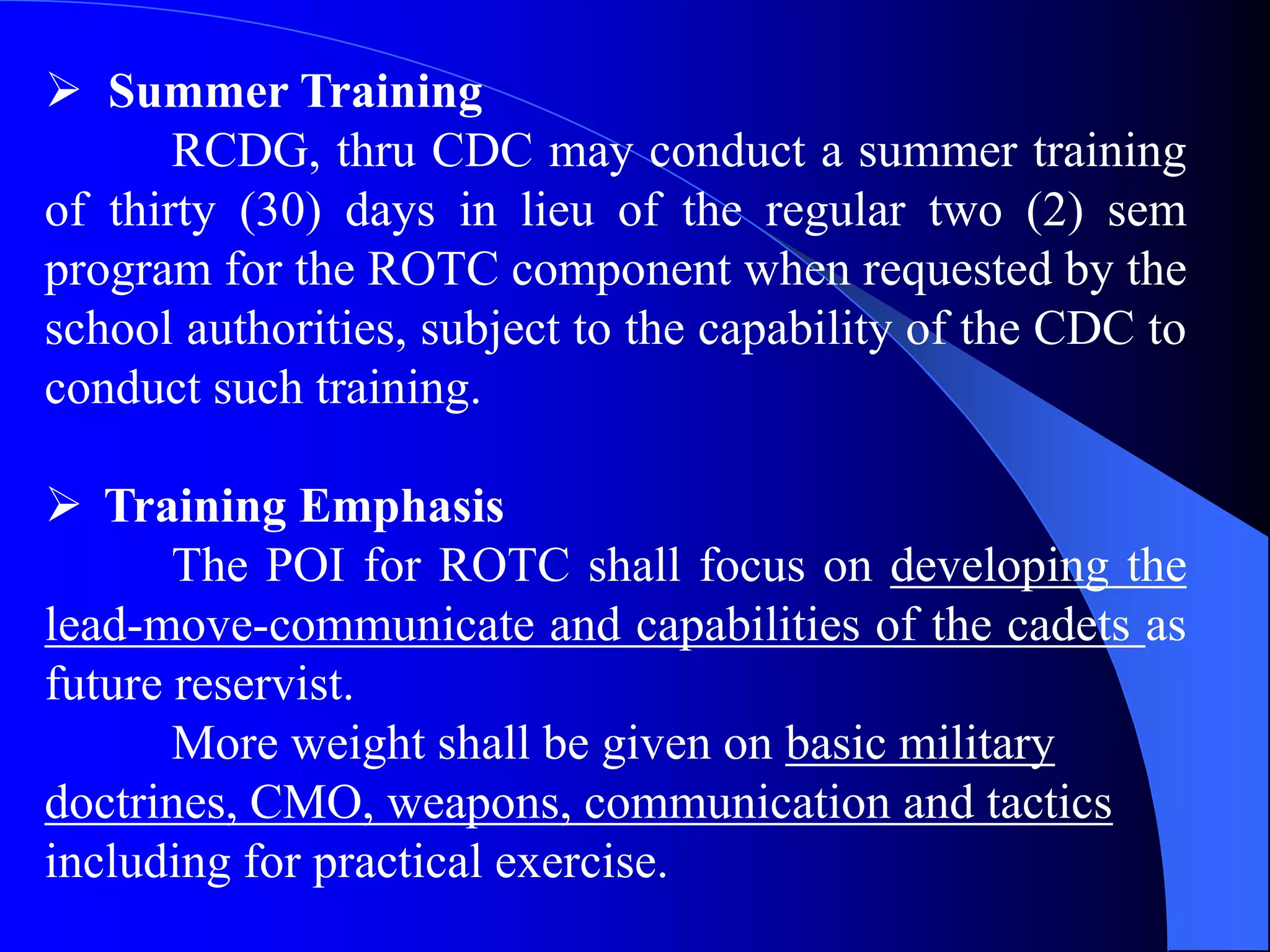
 Summer Training
RCDG, thru CDC may conduct a summer training
of thirty (30) days in lieu of the regular two (2) sem
program for the ROTC component when requested by the
school authorities, subject to the capability of the CDC to
conduct such training.
 Training Emphasis
The POI for ROTC shall focus on developing the
lead-move-communicate and capabilities of the cadets as
future reservist.
More weight shall be given on basic military
doctrines, CMO, weapons, communication and tactics
including for practical exercise.
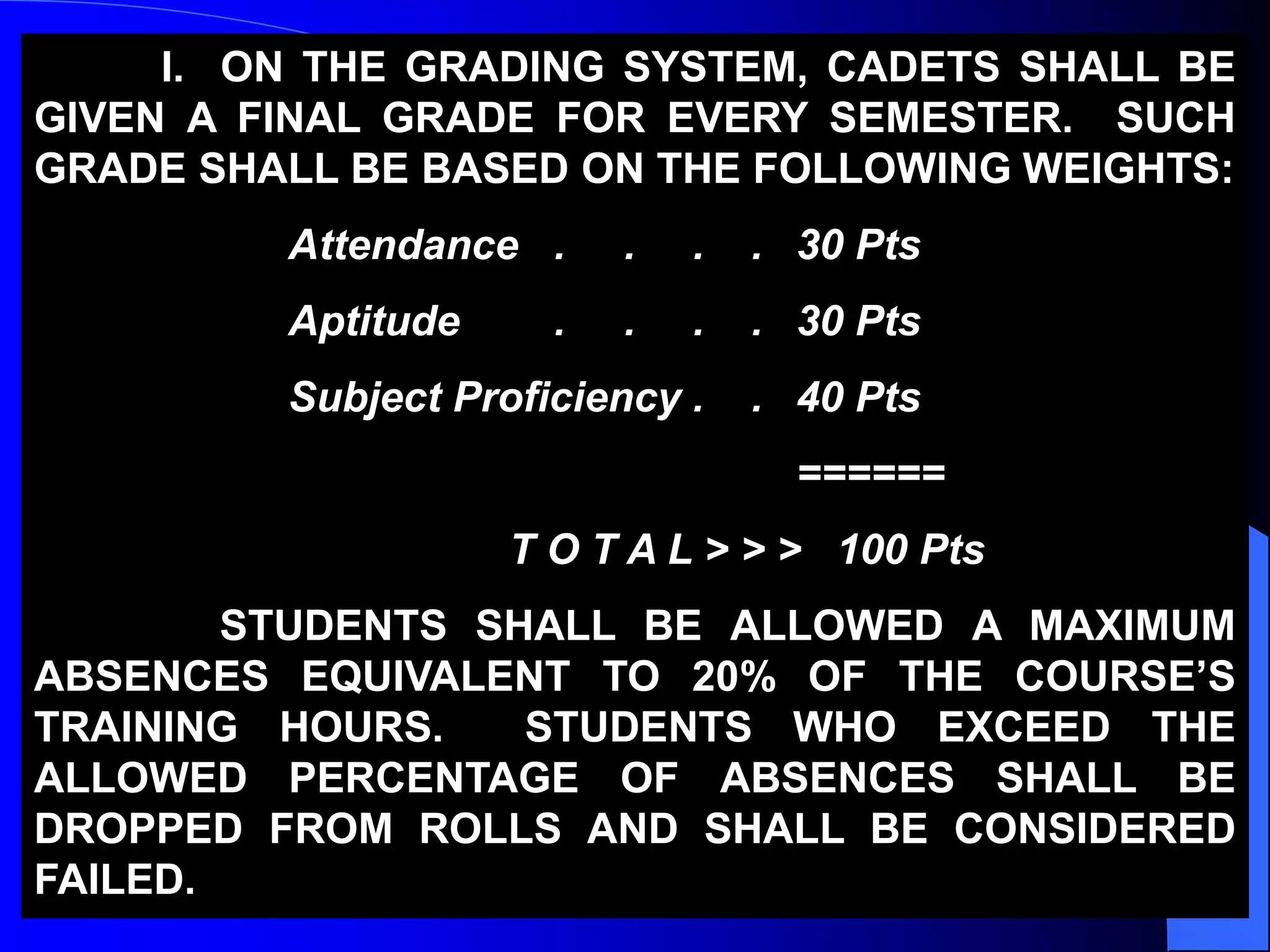
I. ON THE GRADING SYSTEM, CADETS SHALL BE
GIVEN A FINAL GRADE FOR EVERY SEMESTER. SUCH
GRADE SHALL BE BASED ON THE FOLLOWING WEIGHTS:
Attendance . . . . 30 Pts
Aptitude . . . . 30 Pts
Subject Proficiency . . 40 Pts
======
T O T A L > > > 100 Pts
STUDENTS SHALL BE ALLOWED A MAXIMUM
ABSENCES EQUIVALENT TO 20% OF THE COURSE’S
TRAINING HOURS. STUDENTS WHO EXCEED THE
ALLOWED PERCENTAGE OF ABSENCES SHALL BE
DROPPED FROM ROLLS AND SHALL BE CONSIDERED
FAILED.
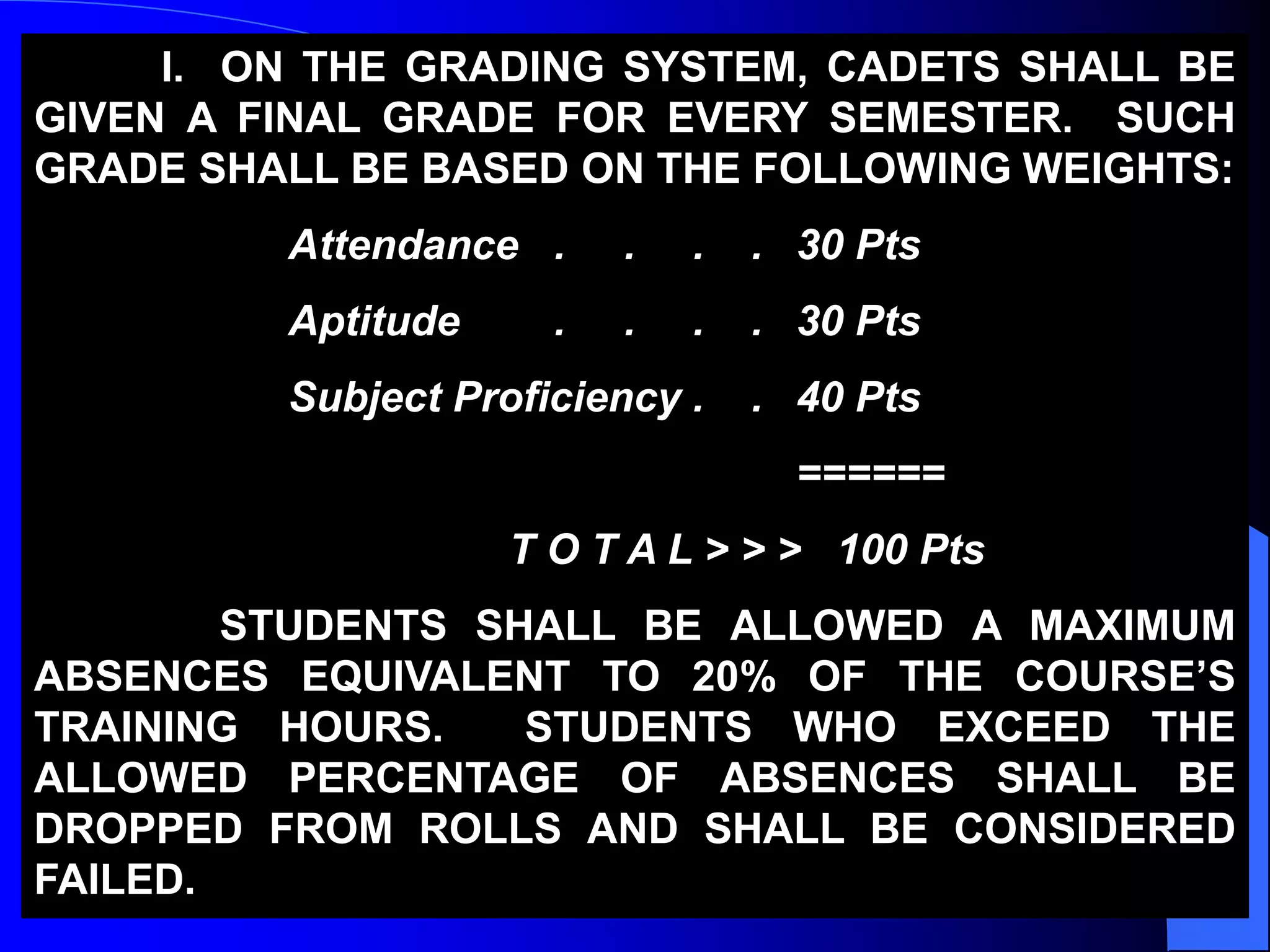
I. ON THE GRADING SYSTEM, CADETS SHALL BE
GIVEN A FINAL GRADE FOR EVERY SEMESTER. SUCH
GRADE SHALL BE BASED ON THE FOLLOWING WEIGHTS:
Attendance . . . . 30 Pts
Aptitude . . . . 30 Pts
Subject Proficiency . . 40 Pts
======
T O T A L > > > 100 Pts
STUDENTS SHALL BE ALLOWED A MAXIMUM
ABSENCES EQUIVALENT TO 20% OF THE COURSE’S
TRAINING HOURS. STUDENTS WHO EXCEED THE
ALLOWED PERCENTAGE OF ABSENCES SHALL BE
DROPPED FROM ROLLS AND SHALL BE CONSIDERED
FAILED.
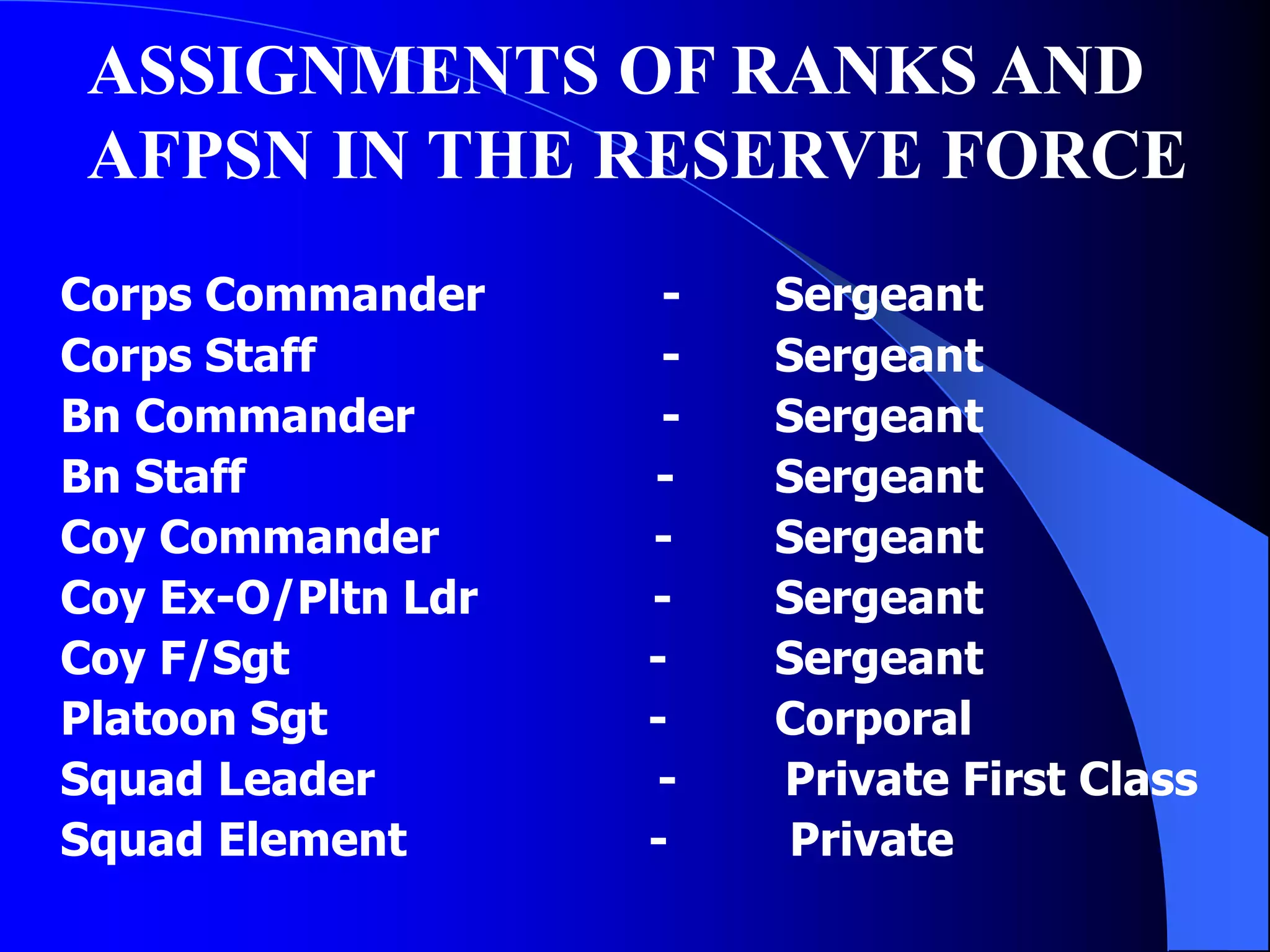
ASSIGNMENTS OF RANKS AND
AFPSN IN THE RESERVE FORCE
Corps Commander - Sergeant
Corps Staff - Sergeant
Bn Commander - Sergeant
Bn Staff - Sergeant
Coy Commander - Sergeant
Coy Ex-O/Pltn Ldr - Sergeant
Coy F/Sgt - Sergeant
Platoon Sgt - Corporal
Squad Leader - Private First Class
Squad Element - Private
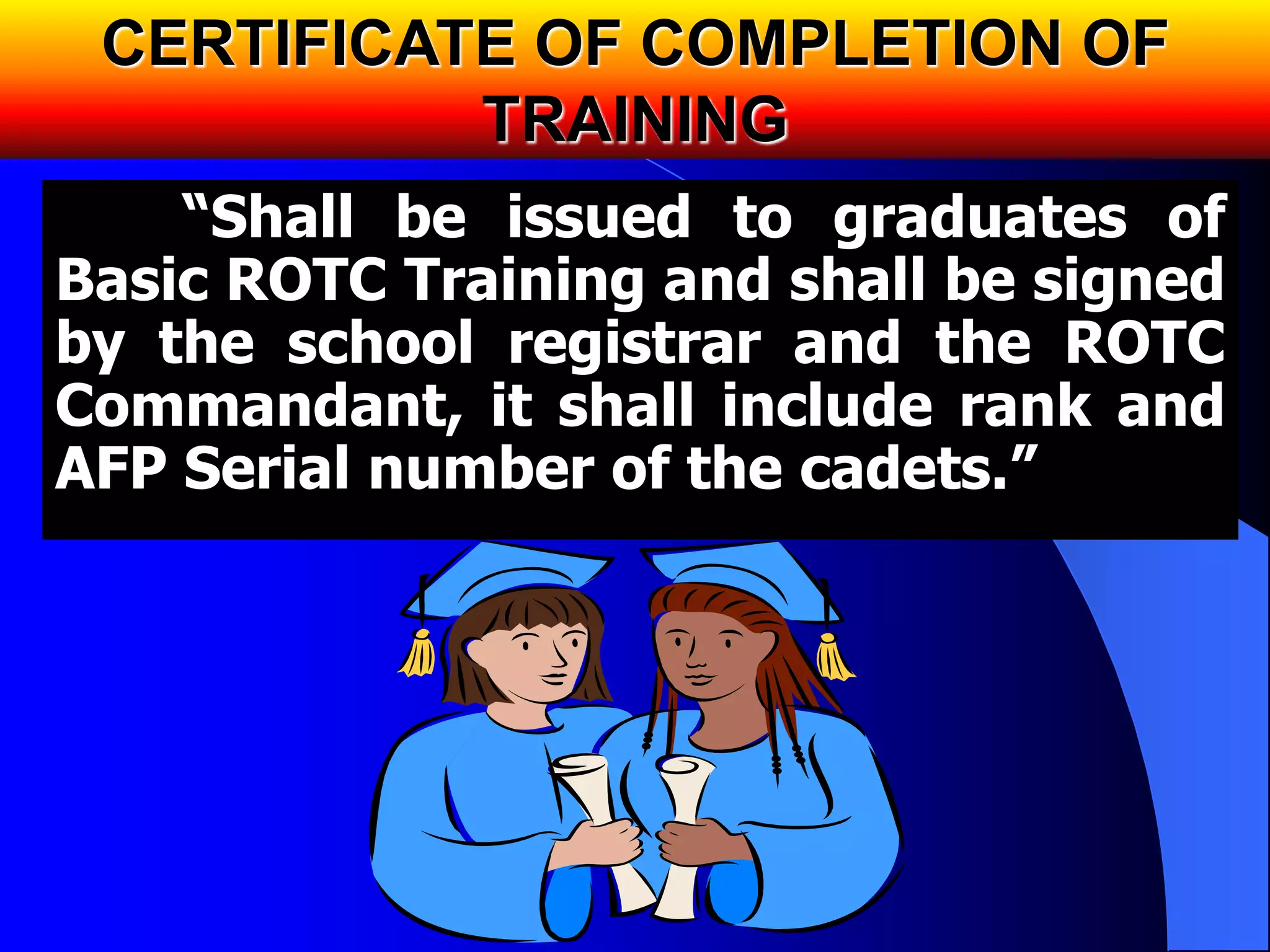
CERTIFICATE OF COMPLETION OF
TRAINING
“Shall be issued to graduates of
Basic ROTC Training and shall be signed
by the school registrar and the ROTC
Commandant, it shall include rank and
AFP Serial number of the cadets.”
FINAL ROTC ORIENTATION 1204 CDC.pptx

FINAL ROTC ORIENTATION 1204 CDC.pptx

  • 2.
    In case ofearthquake, execute “Drop, Cover, and Hold” procedure, then evacuate thru the exit when told to do so. In case of fire, do not panic or shout. Remain calm and exit the classroom. Be aware of the cables and wires on the floor and walls to avoid tripping or related accident.
  • 3.
    I. BACKGROUND II .DEFINITION OF TERMS III. OBJECTIVES OF THE ROTC PROGRAM IV. ROTC PROGRAM OF INSTRUCTION V. OPPORTUNITIES IN THE ROTC PROGRAM VI. TRAINING
  • 5.
     Commonwealth ActNr.1 – Otherwise known as the National Defense Act of 1935 requiring the compulsary military training for all college students.  Executive Order Nr. 207 – the implementing arm of this Act issued by Pres Manuel L Quezon to prepare the youth for the defense of the state.  PD 1706 – (amended the Commonwealth Nr.1 in 1990) known as the National Service Law which offered three(3) components National Service Program namely:  Military Science (DND)  Civil Welfare Service (CHED)  Law Enforcement Service (DILG)
  • 6.
     However, concernedagencies were not prepared to implement the CWS and LES components, thus MS program was the only program pursued in colleges and universities.  RA 7077 – (enacted in 1991) otherwise known as the AFP Reservist Act which enforced and prescribing for a two (2) year ROTC program as a requirement for graduation to all tertiary level students.  Expanded ROTC program (1994) – a tripartite committee was formed among DND, CHED & DILG representatives modifying the traditional two (2) year ROTC program which provide for a mandatory Military Training for the first curriculum year and optional to pursue MS, CWS and LES on the second year.
  • 7.
     RA 9163(SY 2000-2001, RA 7077 and PD 1706 were amended) known as the National Training Program Act of 2001 was formally signed by PGMA on 23 Jan 2003 and promulgated on 23 March 2003.Composed of: ROTC (made ROTC optional and voluntary) LTS CWTS  Effective SY 2002-2003, all freshmen male and female students in the tertiary level are mandated to finish one (1) year of any one of the NSTP components as a prerequisite for graduation from any baccalaureate degree course or from any two (2) year technical/vocational course. Meaning, one (1) of NSTP components will be taken for a period of one (1) year or two (2) semesters.
  • 9.
     National ServiceTraining Program (NSTP) - is a program aimed at enhancing civic consciousness and defense preparedness in the youth by developing the ethic of service and patriotism while undergoing training in any of its three (3) program components.  Reserve officer Training Corps (ROTC) – is a program institutionalized under Section 38 and 39 of RA 7077 designed to provide military training to tertiary level students In order to motivate, train, organized and mobilize them for national defense preparedness.
  • 10.
     Literacy TrainingService (LTS) – is a program designed to train students to become teachers of literacy and numeracy skills to school children, out of school youth, and other segments of society in need of their service.  Civic Welfare Training Service (CWTS) – refers to program of activities contributory to the general welfare and the betterment of life for the members of the community or the enhancement of its facilities, especially those devoted to improving health, education, environment, entrepreneurship, safety, recreation and morals of the citizen.
  • 11.
     Program Component– shall refer to the service components of the NSTP as enumerated in Section 4 of RA 9163.  Clustering – refers to the grouping of students enrolled in different schools and taking up the same NSTP component into one (1) group under the management and supervision of a designated school.  Cross enrollment – refers to a system of enrollment where a student who is officially enrolled in an academic program of a school is allowed to enroll in the NSTP component od another school.
  • 13.
    A. TO INDOCTRINATE,TRAIN, AND PROVIDE THE ROTC CADETS WITH THE BASIC KNOWLEDGE ON MILITARY SUBJECTS AND PRACTICAL EXERCISES THAT WILL ENABLE THEM TO ACQUIRE SKILLS AND CAPABILITIES TO LEAD, MOVE, SURVIVE, SHOOT & COMMUNICATE.
  • 14.
    B. TO PREPARECOLLEGE STUDENTS FOR POSSIBLE SERVICE IN THE DEFENSE ESTABLISHMENT IN THE EVENT OF EMERGENCY.
  • 15.
    C. TO TRAINAND DEVELOP THE ROTC CADETS AS FUTURE ENLISTED RESERVISTS FOR THE RESERVE COMPONENT OF THE ARMED FORCES OF THE PHILIPPINES.
  • 16.
    D. TO INCULCATEIN THE YOUTH THE SPIRIT OF PATRIOTISM AND NATIONALISM.
  • 17.
    E. TO PREPARETHE YOUTH FOR THE VITAL ROLE IN NATIO BUILDING.
  • 18.
    F. TO DEVELOPAND PROMOTE THE PHYSICAL, MORAL, SPIRITUAL, INTELLECTUAL, AND SOCIAL WELL-BEING OF THE YOUTH.
  • 19.
    G. TO TRAINTHE YOUTH AS POTENTIAL COMMUNITY LEADERS.
  • 20.
    H. TO DEVELOPTHE CIVIC CONSCIOUSNESS AND GOOD CITIZENSHIP AMONG THE YOUTH.
  • 22.
    SUBJECT NR OFHRS TYPE OF INSTN 1. Physical Organization of the Cadet Corps and Course Orientation. 2 LC / PE 2. MILITARY CHARACTER DEVELOPMENT MODULE: a. Code of Citizenship 4 LC / PE b. Standards of Conduct of a Soldier 2 LC c. Military Customs and Traditions 2 LC / PE d. Core Values 2 LC / PE e. Rule of Law 4 D / PE f. Drills and Ceremonies 5 LC g. Values Development 2 LC / D / PE 3. MILITARY CHARACTER DEVELOPMENT MODULE: a. Followership 2 LC / PE
  • 23.
    SUBJECT NR OFHRS TYPE OF INSTN 4. MILITARY KNOWLEDGE MODULE: a. AFP Mandate, Mission, Function and Organization 3 LC / PE b. IED Awareness 2 LC c. Philippine Military History 6 LC / PE d. Core Values 2 LC / PE e. Introduction of Military Operations 2 D / PE f. Hygiene and Sanitation 2 LC g. Cyber Security Awareness 2 LC / D / PE 5. MILITARY SKILLS DEVELOPEMENT MODULE: a. Basic Life Support 4 LC / D / PE b. Survival Techniques LC / D / PE
  • 24.
    SUBJECT NR OFHRS TYPE OF INSTN 6. MILITARY COLLECTIVE SKILLS DEVELOPMENT MODULE: a. Fundamentals of Infantry Operations 4 LC / PE 7. WEAPONS PROFICIENCY MODULE: a. Weapons Training 8 LC / D / PE 8. PHYSICAL FITNESS TEST MODULE: a. Individual Fitness Test 5
  • 26.
    SUBJECT NR OFHRS TYPE OF INSTN 1. Physical Organization of the Cadet Corps and Course Orientation. 2 LC / PE 2. MILITARY CHARACTER DEVELOPMENT MODULE: a. GAD Awareness 2 LC b. Personality Development 2 LC / PE c. Military Costums and Traditions 4 LC/PE 3. MILITARY LEADERSHIP DEVELOPMENT MODULE: a. Followership 2 LC 4. MILITARY KNOWLEDGE MODULE: a. Military History and Evolution 6 LC b. Basic military Correspondence 1 LC c. PH Army Role in Disaster Management 4 LC / PE 2.5 LC / PE
  • 27.
    SUBJECT NR OFHRS TYPE OF INSTN 5. MILITARY INDIVIDUAL SKILLS DEVELOPMENT MODULE: a. Basic Life Support 2 4 LC / PE b. Survival Techniques 2 4 LC / PE c. Combat Training for Individual Soldier 1 4 LC / D / PE d. Map Reading 1 3 LC / D / PE e. Rope Techniques 1 3 LC / D / PE d. Signal Communication 1 4 LC 6. MILITARY SKILLS DEVELOPMENT MODULE: a. Squad Tactical Operation and Battle Drills Overview 4 LC 7. WEAPONS PROFICIENCY MODULE: a. Weapons Training 2 8 LC/PE 8. PHYSICAL FITNESS MODULE (Off Module): a. Foot March 2 PE
  • 29.
    SCHOLARSHIP OF CADETOFFICERS AND A CHANCE TO BECOME A MILITARY OFFICER THROUGH THE ADVANCE ROTC PROGRAM.
  • 30.
    CG, PA SCHOLAR -LGPA rating of at least 88% Php 12,000.00 CS, AFP SCHOLAR - LGPA rating of at least 98% Php 50,000.00
  • 32.
     Training period Basic ROTC has two (2) sem program consist of a minimum of ninety (90) trng hours per sem.  Credited in three (3) units per sem for a total of six (6) units for the whole year.  Training shall be conducted in once a week at six (6) hours per week for fifteen (15) consecutive weekends.  However, ROTC Cmdts may exercise flexibility in the conduct of the training provided that the approved POI is strictly implemented.
  • 33.
     Summer Training RCDG,thru CDC may conduct a summer training of thirty (30) days in lieu of the regular two (2) sem program for the ROTC component when requested by the school authorities, subject to the capability of the CDC to conduct such training.  Training Emphasis The POI for ROTC shall focus on developing the lead-move-communicate and capabilities of the cadets as future reservist. More weight shall be given on basic military doctrines, CMO, weapons, communication and tactics including for practical exercise.
  • 34.
    I. ON THEGRADING SYSTEM, CADETS SHALL BE GIVEN A FINAL GRADE FOR EVERY SEMESTER. SUCH GRADE SHALL BE BASED ON THE FOLLOWING WEIGHTS: Attendance . . . . 30 Pts Aptitude . . . . 30 Pts Subject Proficiency . . 40 Pts ====== T O T A L > > > 100 Pts STUDENTS SHALL BE ALLOWED A MAXIMUM ABSENCES EQUIVALENT TO 20% OF THE COURSE’S TRAINING HOURS. STUDENTS WHO EXCEED THE ALLOWED PERCENTAGE OF ABSENCES SHALL BE DROPPED FROM ROLLS AND SHALL BE CONSIDERED FAILED.
  • 35.
    I. ON THEGRADING SYSTEM, CADETS SHALL BE GIVEN A FINAL GRADE FOR EVERY SEMESTER. SUCH GRADE SHALL BE BASED ON THE FOLLOWING WEIGHTS: Attendance . . . . 30 Pts Aptitude . . . . 30 Pts Subject Proficiency . . 40 Pts ====== T O T A L > > > 100 Pts STUDENTS SHALL BE ALLOWED A MAXIMUM ABSENCES EQUIVALENT TO 20% OF THE COURSE’S TRAINING HOURS. STUDENTS WHO EXCEED THE ALLOWED PERCENTAGE OF ABSENCES SHALL BE DROPPED FROM ROLLS AND SHALL BE CONSIDERED FAILED.
  • 36.
    ASSIGNMENTS OF RANKSAND AFPSN IN THE RESERVE FORCE Corps Commander - Sergeant Corps Staff - Sergeant Bn Commander - Sergeant Bn Staff - Sergeant Coy Commander - Sergeant Coy Ex-O/Pltn Ldr - Sergeant Coy F/Sgt - Sergeant Platoon Sgt - Corporal Squad Leader - Private First Class Squad Element - Private
  • 37.
    CERTIFICATE OF COMPLETIONOF TRAINING “Shall be issued to graduates of Basic ROTC Training and shall be signed by the school registrar and the ROTC Commandant, it shall include rank and AFP Serial number of the cadets.”