Republic of the Philippines
CEBU TECHNOLOGICAL UNIVERSITY
Moalboal Campus
Poblacion West, Moalboal, Cebu
Tel Nos. (032) 4474-8196; 474-8104; 474-8383
Fax Nos. 474-8196; 474-8104; 474-8383
http://www.ctu.edu.ph Email: ctumoalboalcampus@gmail.com
MALABUYOC EXTENSION
COURSE SYLLABUS
in
THC 124
MICRO PERSPECTIVE OF TOURISM AND HOSPITALITY
Second Semester, A.Y.2019-2020
INS Form 1
December 7, 2019
Revision: 2
Page 1 of 14 Pages
Department : Technology
Curriculum : Bachelor of Science in Hospitality Management
Curricular Year : Third Year
No. of Hours/ Sem. : 54 hours
Credit Unit(s) : 3 units
Prerequisite(s) : None
Vision of the University : A premier, multidisciplinary - technological university
Mission of the University: The University shall primarily provide advanced professional and technical instruction for special purposes, advanced studies in
industrial trade, agriculture, fishery, forestry, aeronautics, and land-based programs, arts and sciences, health sciences,
information technology and other relevant fields of study. It shall also undertake research and extension services and provide
progressive leadership in its areas of specialization (Sec. 2 of RA 9744).
Goal of the College : 1. Outcomes-based and quality technological instruction is delivered to its clientele;
2. Fully-equipped professionals that can meet both local and international market demands;
3. Holistic development of its graduates that are agent of change; and
4. Research-oriented and problem-solver graduates that are at valuable to the market.
Page 2 of 14 Pages
Program Outcomes:
The BSHM program aims to develop and mold students who can (CMO 62 Series of 2017).
A. COMMON TO ALL PROGRAMS
1. Articulate and discuss the latest developments in the specific field of practice;
2. Effectively communicate orally and in writing using English, Filipino, mother tongue language, and an appropriate Foreign Language required by theindustry;
3. Work effectively and independently in the multi-disciplinary and multi-cultural teams;
4. Act in recognition of professional, social and ethical responsibility;
5. Preserve and promote “Filipino historical and cultural heritage” (based on R.A. No. 7722);
B. COMMON TO TOURISM AND HOSPITALITY DISCIPLINE
1. Demonstrate knowledge of tourism industry, local tourism products and services;
2. Interpret and apply relevant laws related to tourism industry;
3. Observe and perform risk mitigation activities;
4. Utilize information technology applications for tourism and hospitality;
5. Manage and market service-oriented business organization;
6. Demonstrate administrative and managerial skills in a service-oriented business organization;
7. Prepare and monitor industry capital development functions of a tourism-oriented organization;
8. Perform human capital development functions of a tourism-oriented organization;
9. Utilize various communication channels proficiently in dealing with guests and colleagues;
C. SPECIFIC TO THE BS IN HOSPITALITY MANAGEMENT
1. Produce food products and services complying with enterprise standards;
2. Apply management skills in F&B service and operations;
3. Perform and provide full guest cycle services for front office;
4. Perform and maintain various housekeeping services for guest and facility operations; and
5. Plan and implement a risk management program to provide a safe and secure workplace;
6. Provide food & beverage service and manage the operation seamlessly based on industry standards;
Page 3 of 14 Pages
Course Description:
This course will cover the working operations and the integrative activities of major stakeholders in the Tourism and Hospitality Industry. The student will
also gain knowledge of managing and marketing a service-oriented business organization. Apart from the scope and structure of travel organizations, it provides
an in-depth study of the nature and distinctive characteristics of each sector of the entire tourism industry, focusing in the management, organization and planning
of specific business strategies for the various entities in the local setting. This will also involve the analysis of the possible impacts of the external factors and
trends on the different tourism industry sectors and specific types of businesses. It will also look into client profiling such as travel motivations and influences as it
relates to aligning strategic and tactical solutions to the business. The course also identifies the employment opportunities available in each sector and the
corresponding qualifications for the jobs. (CMO 62 Series 2017)
Course Learning Outcomes:
At the end of the course, the students can:
KNOWLEDGE
1. Determine the economic effects of tourism, social impacts of tourism, explain the impacts of tourism on culture and environment
2. Define the meaning of tourism distribution channel
3. Enumerate the importance of promotion planning and budgeting
4. Discuss the major issues of promotion
5. Explain the relation of distribution to marketing
SKILLS
6. Discuss the steps in the tourism project evaluation and analysis system
7. Trace the evolution of transportation and travel
8. Discuss the management methods in the lodging industry
9. Analyze the need for professional leadership in the recreation field
VALUES
10. Explain the importance of marketing orientation, market segmentation and product life cycle to tourism marketing
11. Identify the relationship between tourism planning and tourism development
12. Trace the history of the food and beverage industry
13. Explain the factors which promote the growth of recreation
14. Describe the aviation system
Page 4 of 14 Pages
Course Content: 54 hours (3 hours Lecture per week)
INTENDED
LEARNING
OUTCOME
ASSESSMENT
TASK(S)
TEACHING
LEARNING
ACTIVITIES
CONTENTS LEARNING
RESOURCES
REFERENCES TIME
ALLOCATION
REMARKS
Set the expectations
of the course.
Understand the
content of the
syllabus, course
requirements and
grading system.
Know the classroom
rules and policies.
Graded Oral
Recitation
Quiz
Lecture /
Discussion
Orientation
a. Introduction
b. CTU Vision-
Mission
c. Course
Description
d. Course
Requirements
e. Alternative
Activities
f. Grading System
House Rules
Posters of CTU
VMGO
CTU Manual
CTU Manual
Student
Handbook
1
Revisit the Vision,
Mission, Goals and
Objectives of CTU.
Identify the policies
and regulations of the
University Vision,
Mission and Goals.
Graded Oral
Recitation
Quiz
Open Forum Objective of the
course Mission,
Vision, Goals and
Objectives.
Posters of CTU
VMGO
CTU Manual
CTU Manual
Student
Handbook
1
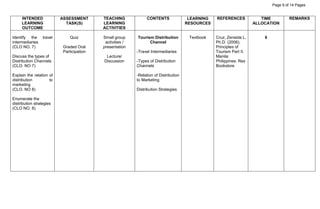
Page 5 of 14 Pages
INTENDED
LEARNING
OUTCOME
ASSESSMENT
TASK(S)
TEACHING
LEARNING
ACTIVITIES
CONTENTS LEARNING
RESOURCES
REFERENCES TIME
ALLOCATION
REMARKS
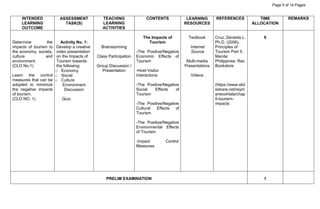
Determine the
impacts of tourism to
the economy, society,
culture and
environment.
(CLO No.1)
Learn the control
measures that can be
adopted to minimize
the negative impacts
of tourism.
(CLO NO. 1)
Activity No. 1:
Develop a creative
video presentation
on the Impacts of
Tourism towards
the following:
o Economy
o Social
o Culture
Environment
Discussion
Quiz
Brainstorming
Class Participation
Group Discussion /
Presentation
The Impacts of
Tourism
-The Positive/Negative
Economic Effects of
Tourism
-Host-Visitor
Interactions
-The Positive/Negative
Social Effects of
Tourism
-The Positive/Negative
Cultural Effects of
Tourism
-The Positive/Negative
Environmental Effects
of Tourism
-Impact Control
Measures
Textbook
Internet
Source
Multi-media
Presentations
Videos
Cruz, Zenaida L.
Ph.D. (2006),
Principles of
Tourism Part II,
Manila:
Philippines: Rex
Bookstore
(https://www.slid
eshare.net/reym
arieoohlala/chap
5-tourism-
impacts
6
PRELIM EXAMINATION 1
Page 6 of 14 Pages
INTENDED
LEARNING
OUTCOME
ASSESSMENT
TASK(S)
TEACHING
LEARNING
ACTIVITIES
CONTENTS LEARNING
RESOURCES
REFERENCES TIME
ALLOCATION
REMARKS
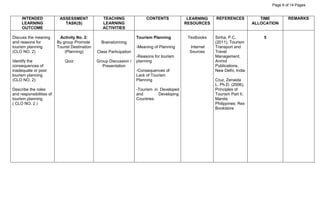
Discuss the meaning
and reasons for
tourism planning
(CLO NO. 2)
Identify the
consequences of
inadequate or poor
tourism planning
(CLO NO. 2)
Describe the roles
and responsibilities of
tourism planning
( CLO NO. 2 )
Activity No. 2:
By group Promote
Tourist Destination
(Planning)
Quiz
Brainstorming
Class Participation
Group Discussion /
Presentation
Tourism Planning
-Meaning of Planning
-Reasons for tourism
planning
-Consequences of
Lack of Tourism
Planning
-Tourism in Developed
and Developing
Countries
Textbooks
Internet
Sources
Sinha, P.C.
(2011), Tourism
Transport and
Travel
Management,
Anmol
Publications,
New Delhi, India
Cruz, Zenaida
L. Ph.D. (2006),
Principles of
Tourism Part II,
Manila:
Philippines: Rex
Bookstore
5
Page 7 of 14 Pages
INTENDED
LEARNING
OUTCOME
ASSESSMENT
TASK(S)
TEACHING
LEARNING
ACTIVITIES
CONTENTS LEARNING
RESOURCES
REFERENCES TIME
ALLOCATION
REMARKS
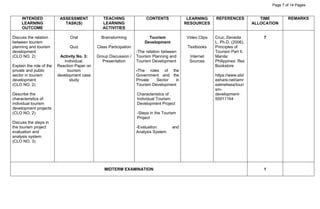
Discuss the relation
between tourism
planning and tourism
development
(CLO NO. 2)
Explain the role of the
private and public
sector in tourism
development
(CLO NO. 2)
Describe the
characteristics of
individual tourism
development projects
(CLO NO. 2)
Discuss the steps in
the tourism project
evaluation and
analysis system
(CLO NO. 3)
Oral
Quiz
Activity No. 3:
Individual,
Reaction Paper on
tourism
development case
study
Brainstorming
Class Participation
Group Discussion /
Presentation
Tourism
Development
-The relation between
Tourism Planning and
Tourism Development
-The roles of the
Government and the
Private Sector in
Tourism Development
Characteristics of
Individual Tourism
Development Project
-Steps in the Tourism
Project
-Evaluation and
Analysis System
Video Clips
Textbooks
Internet
Sources
Cruz, Zenaida
L. Ph.D. (2006),
Principles of
Tourism Part II,
Manila:
Philippines: Rex
Bookstore
https://www.slid
eshare.net/iamr
ealmelissa/touri
sm-
development-
50011164
7
MIDTERM EXAMINATION 1
Page 8 of 14 Pages
INTENDED
LEARNING
OUTCOME
ASSESSMENT
TASK(S)
TEACHING
LEARNING
ACTIVITIES
CONTENTS LEARNING
RESOURCES
REFERENCES TIME
ALLOCATION
REMARKS
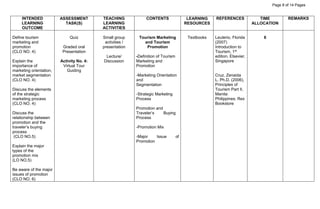
Define tourism
marketing and
promotion
(CLO NO. 4)
Explain the
importance of
marketing orientation,
market segmentation
(CLO NO. 4)
Discuss the elements
of the strategic
marketing process
(CLO NO. 4)
Discuss the
relationship between
promotion and the
traveler’s buying
process
(CLO NO.5)
Explain the major
types of the
promotion mix
(LO NO.5)
Be aware of the major
issues of promotion
(CLO NO. 6)
Quiz
Graded oral
Presentation
Activity No. 4:
Virtual Tour
Guiding
Small group
activities /
presentation
Lecture/
Discussion
Tourism Marketing
and Tourism
Promotion
-Definition of Tourism
Marketing and
Promotion
-Marketing Orientation
and
Segmentation
-Strategic Marketing
Process
Promotion and
Traveler’s Buying
Process
-Promotion Mix
-Major Issue of
Promotion
Textbooks Leuterio, Florida
(2007)
Introduction to
Tourism, 1st
edition. Elsevier,
Singapore
Cruz, Zenaida
L. Ph.D. (2006),
Principles of
Tourism Part II,
Manila:
Philippines: Rex
Bookstore
6
Page 9 of 14 Pages
INTENDED
LEARNING
OUTCOME
ASSESSMENT
TASK(S)
TEACHING
LEARNING
ACTIVITIES
CONTENTS LEARNING
RESOURCES
REFERENCES TIME
ALLOCATION
REMARKS
Identify the travel
intermediaries
(CLO NO. 7)
Discuss the types of
Distribution Channels
(CLO. NO 7)
Explain the relation of
distribution to
marketing
(CLO. NO 8)
Enumerate the
distribution strategies
(CLO NO. 8)
Quiz
Graded Oral
Participation
Small group
activities /
presentation
Lecture/
Discussion
Tourism Distribution
Channel
-Travel Intermediaries
-Types of Distribution
Channels
-Relation of Distribution
to Marketing
Distribution Strategies
Textbook Cruz, Zenaida L.
Ph.D. (2006),
Principles of
Tourism Part II,
Manila:
Philippines: Rex
Bookstore
6
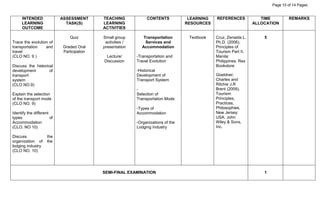
Page 10 of 14 Pages
INTENDED
LEARNING
OUTCOME
ASSESSMENT
TASK(S)
TEACHING
LEARNING
ACTIVITIES
CONTENTS LEARNING
RESOURCES
REFERENCES TIME
ALLOCATION
REMARKS
Trace the evolution of
transportation and
travel
(CLO NO. 9 )
Quiz
Graded Oral
Participation
Small group
activities /
presentation
Lecture/
Discussion
Transportation
Services and
Accommodation
-Transportation and
Travel Evolution
Textbook Cruz, Zenaida L.
Ph.D. (2006),
Principles of
Tourism Part II,
Manila:
Philippines: Rex
Bookstore
Goeldner,
Charles and
Ritchie J.R
Brent (2009),
Tourism:
Principles,
Practices,
Philosophies,
New Jersey:
USA: John
Wiley & Sons,
Inc.
5
Discuss the historical
development of
transport
system
(CLO NO.9)
-Historical
Development of
Transport System
Explain the selection
of the transport mode
(CLO NO. 9)
-
Selection of
Transportation Mode
Identify the different
types of
Accommodation
(CLO. NO 10)
-Types of
Accommodation
-Organizations of the
Lodging Industry
Discuss the
organization of the
lodging industry
(CLO NO. 10)
SEMI-FINAL EXAMINATION 1
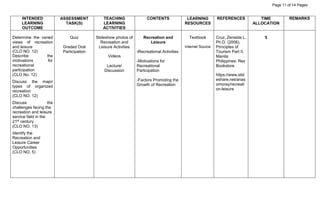
Page 11 of 14 Pages
INTENDED
LEARNING
OUTCOME
ASSESSMENT
TASK(S)
TEACHING
LEARNING
ACTIVITIES
CONTENTS LEARNING
RESOURCES
REFERENCES TIME
ALLOCATION
REMARKS
Determine the varied
views of recreation
and leisure
(CLO NO. 12)
Describe the
motivations for
recreational
participation
(CLO No. 12)
Discuss the major
types of organized
recreation
(CLO NO. 12)
Discuss the
challenges facing the
recreation and leisure
service field in the
21st century
(CLO NO. 13)
Identify the
Recreation and
Leisure Career
Opportunities
(CLO NO. 5)
Quiz
Graded Oral
Participation
Slideshow photos of
Recreation and
Leisure Activities
Recreation and
Leisure
-Recreational Activities
-Motivations for
Recreational
Participation
-Factors Promoting the
Growth of Recreation
Textbook
Internet Source
Cruz, Zenaida L.
Ph.D. (2006),
Principles of
Tourism Part II,
Manila:
Philippines: Rex
Bookstore
https://www.slid
eshare.net/anas
omoray/recreati
on-leisure
5
Videos
Lecture/
Discussion
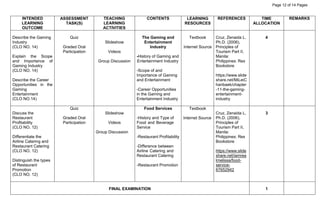
Page 12 of 14 Pages
INTENDED
LEARNING
OUTCOME
ASSESSMENT
TASK(S)
TEACHING
LEARNING
ACTIVITIES
CONTENTS LEARNING
RESOURCES
REFERENCES TIME
ALLOCATION
REMARKS
Describe the Gaming
Industry
(CLO NO. 14)
Explain the Scope
and Importance of
Gaming Industry
(CLO NO. 14)
Describe the Career
Opportunities in the
Gaming
Entertainment
(CLO NO.14)
Quiz
Graded Oral
Participation
Slideshow
Videos
Group Discussion
The Gaming and
Entertainment
Industry
-History of Gaming and
Entertainment Industry
-Scope of and
Importance of Gaming
and Entertainment
-Career Opportunities
in the Gaming and
Entertainment Industry
Textbook
Internet Source
Cruz, Zenaida L.
Ph.D. (2006),
Principles of
Tourism Part II,
Manila:
Philippines: Rex
Bookstore
https://www.slide
share.net/MiLeiC
hanbaek/chapter
-11-the-gaming-
entertainment-
industry
4
Discuss the
Restaurant
Profitability
(CLO NO. 12)
Differentiate the
Airline Catering and
Restaurant Catering
(CLO NO. 12)
Distinguish the types
of Restaurant
Promotion
(CLO NO. 12)
Quiz
Graded Oral
Participation
Slideshow
Videos
Group Discussion
Food Services
-History and Type of
Food and Beverage
Service
-Restaurant Profitability
-Difference between
Airline Catering and
Restaurant Catering
-Restaurant Promotion
Textbook
Internet Source
Cruz, Zenaida L.
Ph.D. (2006),
Principles of
Tourism Part II,
Manila:
Philippines: Rex
Bookstore
https://www.slide
share.net/iamrea
lmelissa/food-
service-
67652942
3
FINAL EXAMINATION 1
Page 13 of 14 Pages
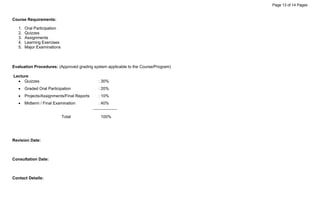
Course Requirements:
1. Oral Participation
2. Quizzes
3. Assignments
4. Learning Exercises
5. Major Examinations
Evaluation Procedures: (Approved grading system applicable to the Course/Program)
Lecture
 Quizzes : 30%
 Graded Oral Participation : 20%
 Projects/Assignments/Final Reports : 10%
 Midterm / Final Examination : 40%
Total 100%
Revision Date:
Consultation Date:
Contact Details:
Page 14 of 14 Pages
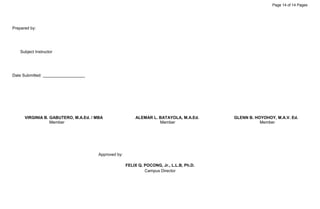
Prepared by:
Subject Instructor
Date Submitted:
VIRGINIA B. GABUTERO, M.A.Ed. / MBA ALEMAR L. BATAYOLA, M.A.Ed. GLENN B. HOYOHOY, M.A.V. Ed.
Member Member Member
Approved by:
FELIX Q. POCONG, Jr., L.L.B, Ph.D.
Campus Director
Page 15 of 14 Pages
Page 16 of 14 Pages

micro-perspective-of-tourism-and-hospitality.docx

  • 1.
    Republic of thePhilippines CEBU TECHNOLOGICAL UNIVERSITY Moalboal Campus Poblacion West, Moalboal, Cebu Tel Nos. (032) 4474-8196; 474-8104; 474-8383 Fax Nos. 474-8196; 474-8104; 474-8383 http://www.ctu.edu.ph Email: ctumoalboalcampus@gmail.com MALABUYOC EXTENSION COURSE SYLLABUS in THC 124 MICRO PERSPECTIVE OF TOURISM AND HOSPITALITY Second Semester, A.Y.2019-2020 INS Form 1 December 7, 2019 Revision: 2 Page 1 of 14 Pages Department : Technology Curriculum : Bachelor of Science in Hospitality Management Curricular Year : Third Year No. of Hours/ Sem. : 54 hours Credit Unit(s) : 3 units Prerequisite(s) : None Vision of the University : A premier, multidisciplinary - technological university Mission of the University: The University shall primarily provide advanced professional and technical instruction for special purposes, advanced studies in industrial trade, agriculture, fishery, forestry, aeronautics, and land-based programs, arts and sciences, health sciences, information technology and other relevant fields of study. It shall also undertake research and extension services and provide progressive leadership in its areas of specialization (Sec. 2 of RA 9744). Goal of the College : 1. Outcomes-based and quality technological instruction is delivered to its clientele; 2. Fully-equipped professionals that can meet both local and international market demands; 3. Holistic development of its graduates that are agent of change; and 4. Research-oriented and problem-solver graduates that are at valuable to the market.
  • 2.
    Page 2 of14 Pages Program Outcomes: The BSHM program aims to develop and mold students who can (CMO 62 Series of 2017). A. COMMON TO ALL PROGRAMS 1. Articulate and discuss the latest developments in the specific field of practice; 2. Effectively communicate orally and in writing using English, Filipino, mother tongue language, and an appropriate Foreign Language required by theindustry; 3. Work effectively and independently in the multi-disciplinary and multi-cultural teams; 4. Act in recognition of professional, social and ethical responsibility; 5. Preserve and promote “Filipino historical and cultural heritage” (based on R.A. No. 7722); B. COMMON TO TOURISM AND HOSPITALITY DISCIPLINE 1. Demonstrate knowledge of tourism industry, local tourism products and services; 2. Interpret and apply relevant laws related to tourism industry; 3. Observe and perform risk mitigation activities; 4. Utilize information technology applications for tourism and hospitality; 5. Manage and market service-oriented business organization; 6. Demonstrate administrative and managerial skills in a service-oriented business organization; 7. Prepare and monitor industry capital development functions of a tourism-oriented organization; 8. Perform human capital development functions of a tourism-oriented organization; 9. Utilize various communication channels proficiently in dealing with guests and colleagues; C. SPECIFIC TO THE BS IN HOSPITALITY MANAGEMENT 1. Produce food products and services complying with enterprise standards; 2. Apply management skills in F&B service and operations; 3. Perform and provide full guest cycle services for front office; 4. Perform and maintain various housekeeping services for guest and facility operations; and 5. Plan and implement a risk management program to provide a safe and secure workplace; 6. Provide food & beverage service and manage the operation seamlessly based on industry standards;
  • 3.
    Page 3 of14 Pages Course Description: This course will cover the working operations and the integrative activities of major stakeholders in the Tourism and Hospitality Industry. The student will also gain knowledge of managing and marketing a service-oriented business organization. Apart from the scope and structure of travel organizations, it provides an in-depth study of the nature and distinctive characteristics of each sector of the entire tourism industry, focusing in the management, organization and planning of specific business strategies for the various entities in the local setting. This will also involve the analysis of the possible impacts of the external factors and trends on the different tourism industry sectors and specific types of businesses. It will also look into client profiling such as travel motivations and influences as it relates to aligning strategic and tactical solutions to the business. The course also identifies the employment opportunities available in each sector and the corresponding qualifications for the jobs. (CMO 62 Series 2017) Course Learning Outcomes: At the end of the course, the students can: KNOWLEDGE 1. Determine the economic effects of tourism, social impacts of tourism, explain the impacts of tourism on culture and environment 2. Define the meaning of tourism distribution channel 3. Enumerate the importance of promotion planning and budgeting 4. Discuss the major issues of promotion 5. Explain the relation of distribution to marketing SKILLS 6. Discuss the steps in the tourism project evaluation and analysis system 7. Trace the evolution of transportation and travel 8. Discuss the management methods in the lodging industry 9. Analyze the need for professional leadership in the recreation field VALUES 10. Explain the importance of marketing orientation, market segmentation and product life cycle to tourism marketing 11. Identify the relationship between tourism planning and tourism development 12. Trace the history of the food and beverage industry 13. Explain the factors which promote the growth of recreation 14. Describe the aviation system
  • 4.
    Page 4 of14 Pages Course Content: 54 hours (3 hours Lecture per week) INTENDED LEARNING OUTCOME ASSESSMENT TASK(S) TEACHING LEARNING ACTIVITIES CONTENTS LEARNING RESOURCES REFERENCES TIME ALLOCATION REMARKS Set the expectations of the course. Understand the content of the syllabus, course requirements and grading system. Know the classroom rules and policies. Graded Oral Recitation Quiz Lecture / Discussion Orientation a. Introduction b. CTU Vision- Mission c. Course Description d. Course Requirements e. Alternative Activities f. Grading System House Rules Posters of CTU VMGO CTU Manual CTU Manual Student Handbook 1 Revisit the Vision, Mission, Goals and Objectives of CTU. Identify the policies and regulations of the University Vision, Mission and Goals. Graded Oral Recitation Quiz Open Forum Objective of the course Mission, Vision, Goals and Objectives. Posters of CTU VMGO CTU Manual CTU Manual Student Handbook 1
  • 5.
    Page 5 of14 Pages INTENDED LEARNING OUTCOME ASSESSMENT TASK(S) TEACHING LEARNING ACTIVITIES CONTENTS LEARNING RESOURCES REFERENCES TIME ALLOCATION REMARKS Determine the impacts of tourism to the economy, society, culture and environment. (CLO No.1) Learn the control measures that can be adopted to minimize the negative impacts of tourism. (CLO NO. 1) Activity No. 1: Develop a creative video presentation on the Impacts of Tourism towards the following: o Economy o Social o Culture Environment Discussion Quiz Brainstorming Class Participation Group Discussion / Presentation The Impacts of Tourism -The Positive/Negative Economic Effects of Tourism -Host-Visitor Interactions -The Positive/Negative Social Effects of Tourism -The Positive/Negative Cultural Effects of Tourism -The Positive/Negative Environmental Effects of Tourism -Impact Control Measures Textbook Internet Source Multi-media Presentations Videos Cruz, Zenaida L. Ph.D. (2006), Principles of Tourism Part II, Manila: Philippines: Rex Bookstore (https://www.slid eshare.net/reym arieoohlala/chap 5-tourism- impacts 6 PRELIM EXAMINATION 1
  • 6.
    Page 6 of14 Pages INTENDED LEARNING OUTCOME ASSESSMENT TASK(S) TEACHING LEARNING ACTIVITIES CONTENTS LEARNING RESOURCES REFERENCES TIME ALLOCATION REMARKS Discuss the meaning and reasons for tourism planning (CLO NO. 2) Identify the consequences of inadequate or poor tourism planning (CLO NO. 2) Describe the roles and responsibilities of tourism planning ( CLO NO. 2 ) Activity No. 2: By group Promote Tourist Destination (Planning) Quiz Brainstorming Class Participation Group Discussion / Presentation Tourism Planning -Meaning of Planning -Reasons for tourism planning -Consequences of Lack of Tourism Planning -Tourism in Developed and Developing Countries Textbooks Internet Sources Sinha, P.C. (2011), Tourism Transport and Travel Management, Anmol Publications, New Delhi, India Cruz, Zenaida L. Ph.D. (2006), Principles of Tourism Part II, Manila: Philippines: Rex Bookstore 5
  • 7.
    Page 7 of14 Pages INTENDED LEARNING OUTCOME ASSESSMENT TASK(S) TEACHING LEARNING ACTIVITIES CONTENTS LEARNING RESOURCES REFERENCES TIME ALLOCATION REMARKS Discuss the relation between tourism planning and tourism development (CLO NO. 2) Explain the role of the private and public sector in tourism development (CLO NO. 2) Describe the characteristics of individual tourism development projects (CLO NO. 2) Discuss the steps in the tourism project evaluation and analysis system (CLO NO. 3) Oral Quiz Activity No. 3: Individual, Reaction Paper on tourism development case study Brainstorming Class Participation Group Discussion / Presentation Tourism Development -The relation between Tourism Planning and Tourism Development -The roles of the Government and the Private Sector in Tourism Development Characteristics of Individual Tourism Development Project -Steps in the Tourism Project -Evaluation and Analysis System Video Clips Textbooks Internet Sources Cruz, Zenaida L. Ph.D. (2006), Principles of Tourism Part II, Manila: Philippines: Rex Bookstore https://www.slid eshare.net/iamr ealmelissa/touri sm- development- 50011164 7 MIDTERM EXAMINATION 1
  • 8.
    Page 8 of14 Pages INTENDED LEARNING OUTCOME ASSESSMENT TASK(S) TEACHING LEARNING ACTIVITIES CONTENTS LEARNING RESOURCES REFERENCES TIME ALLOCATION REMARKS Define tourism marketing and promotion (CLO NO. 4) Explain the importance of marketing orientation, market segmentation (CLO NO. 4) Discuss the elements of the strategic marketing process (CLO NO. 4) Discuss the relationship between promotion and the traveler’s buying process (CLO NO.5) Explain the major types of the promotion mix (LO NO.5) Be aware of the major issues of promotion (CLO NO. 6) Quiz Graded oral Presentation Activity No. 4: Virtual Tour Guiding Small group activities / presentation Lecture/ Discussion Tourism Marketing and Tourism Promotion -Definition of Tourism Marketing and Promotion -Marketing Orientation and Segmentation -Strategic Marketing Process Promotion and Traveler’s Buying Process -Promotion Mix -Major Issue of Promotion Textbooks Leuterio, Florida (2007) Introduction to Tourism, 1st edition. Elsevier, Singapore Cruz, Zenaida L. Ph.D. (2006), Principles of Tourism Part II, Manila: Philippines: Rex Bookstore 6
  • 9.
    Page 9 of14 Pages INTENDED LEARNING OUTCOME ASSESSMENT TASK(S) TEACHING LEARNING ACTIVITIES CONTENTS LEARNING RESOURCES REFERENCES TIME ALLOCATION REMARKS Identify the travel intermediaries (CLO NO. 7) Discuss the types of Distribution Channels (CLO. NO 7) Explain the relation of distribution to marketing (CLO. NO 8) Enumerate the distribution strategies (CLO NO. 8) Quiz Graded Oral Participation Small group activities / presentation Lecture/ Discussion Tourism Distribution Channel -Travel Intermediaries -Types of Distribution Channels -Relation of Distribution to Marketing Distribution Strategies Textbook Cruz, Zenaida L. Ph.D. (2006), Principles of Tourism Part II, Manila: Philippines: Rex Bookstore 6
  • 10.
    Page 10 of14 Pages INTENDED LEARNING OUTCOME ASSESSMENT TASK(S) TEACHING LEARNING ACTIVITIES CONTENTS LEARNING RESOURCES REFERENCES TIME ALLOCATION REMARKS Trace the evolution of transportation and travel (CLO NO. 9 ) Quiz Graded Oral Participation Small group activities / presentation Lecture/ Discussion Transportation Services and Accommodation -Transportation and Travel Evolution Textbook Cruz, Zenaida L. Ph.D. (2006), Principles of Tourism Part II, Manila: Philippines: Rex Bookstore Goeldner, Charles and Ritchie J.R Brent (2009), Tourism: Principles, Practices, Philosophies, New Jersey: USA: John Wiley & Sons, Inc. 5 Discuss the historical development of transport system (CLO NO.9) -Historical Development of Transport System Explain the selection of the transport mode (CLO NO. 9) - Selection of Transportation Mode Identify the different types of Accommodation (CLO. NO 10) -Types of Accommodation -Organizations of the Lodging Industry Discuss the organization of the lodging industry (CLO NO. 10) SEMI-FINAL EXAMINATION 1
  • 11.
    Page 11 of14 Pages INTENDED LEARNING OUTCOME ASSESSMENT TASK(S) TEACHING LEARNING ACTIVITIES CONTENTS LEARNING RESOURCES REFERENCES TIME ALLOCATION REMARKS Determine the varied views of recreation and leisure (CLO NO. 12) Describe the motivations for recreational participation (CLO No. 12) Discuss the major types of organized recreation (CLO NO. 12) Discuss the challenges facing the recreation and leisure service field in the 21st century (CLO NO. 13) Identify the Recreation and Leisure Career Opportunities (CLO NO. 5) Quiz Graded Oral Participation Slideshow photos of Recreation and Leisure Activities Recreation and Leisure -Recreational Activities -Motivations for Recreational Participation -Factors Promoting the Growth of Recreation Textbook Internet Source Cruz, Zenaida L. Ph.D. (2006), Principles of Tourism Part II, Manila: Philippines: Rex Bookstore https://www.slid eshare.net/anas omoray/recreati on-leisure 5 Videos Lecture/ Discussion
  • 12.
    Page 12 of14 Pages INTENDED LEARNING OUTCOME ASSESSMENT TASK(S) TEACHING LEARNING ACTIVITIES CONTENTS LEARNING RESOURCES REFERENCES TIME ALLOCATION REMARKS Describe the Gaming Industry (CLO NO. 14) Explain the Scope and Importance of Gaming Industry (CLO NO. 14) Describe the Career Opportunities in the Gaming Entertainment (CLO NO.14) Quiz Graded Oral Participation Slideshow Videos Group Discussion The Gaming and Entertainment Industry -History of Gaming and Entertainment Industry -Scope of and Importance of Gaming and Entertainment -Career Opportunities in the Gaming and Entertainment Industry Textbook Internet Source Cruz, Zenaida L. Ph.D. (2006), Principles of Tourism Part II, Manila: Philippines: Rex Bookstore https://www.slide share.net/MiLeiC hanbaek/chapter -11-the-gaming- entertainment- industry 4 Discuss the Restaurant Profitability (CLO NO. 12) Differentiate the Airline Catering and Restaurant Catering (CLO NO. 12) Distinguish the types of Restaurant Promotion (CLO NO. 12) Quiz Graded Oral Participation Slideshow Videos Group Discussion Food Services -History and Type of Food and Beverage Service -Restaurant Profitability -Difference between Airline Catering and Restaurant Catering -Restaurant Promotion Textbook Internet Source Cruz, Zenaida L. Ph.D. (2006), Principles of Tourism Part II, Manila: Philippines: Rex Bookstore https://www.slide share.net/iamrea lmelissa/food- service- 67652942 3 FINAL EXAMINATION 1
  • 13.
    Page 13 of14 Pages Course Requirements: 1. Oral Participation 2. Quizzes 3. Assignments 4. Learning Exercises 5. Major Examinations Evaluation Procedures: (Approved grading system applicable to the Course/Program) Lecture  Quizzes : 30%  Graded Oral Participation : 20%  Projects/Assignments/Final Reports : 10%  Midterm / Final Examination : 40% Total 100% Revision Date: Consultation Date: Contact Details:
  • 14.
    Page 14 of14 Pages Prepared by: Subject Instructor Date Submitted: VIRGINIA B. GABUTERO, M.A.Ed. / MBA ALEMAR L. BATAYOLA, M.A.Ed. GLENN B. HOYOHOY, M.A.V. Ed. Member Member Member Approved by: FELIX Q. POCONG, Jr., L.L.B, Ph.D. Campus Director
  • 15.
    Page 15 of14 Pages
  • 16.
    Page 16 of14 Pages