Welcome to class. We will
begin shortly
Final Review
Important Dates
▶ Assignment 2/13/2024
▶ Midterm 2/15/2024
▶ Assignment 2/22/2024
▶ Final 2/27/2024
This Photo by Unknown Author is licensed under CC BY-SA-NC
Shipping Industries
▶ The shipping industry plays a crucial role in
global trade and commerce, facilitating the
transportation of goods and commodities across
the world's oceans. Here are some key aspects of
the shipping industry:
• Types of Vessels: The shipping industry
encompasses various types of vessels,
including container ships, bulk carriers,
tankers, LNG (liquefied natural gas) carriers,
Ro-Ro (roll-on/roll-off) ships, and more. Each
type of vessel serves different purposes and
carries different types of cargo.
• Global Trade: Shipping is fundamental to
global trade, with approximately 90% of the
world's trade being carried by sea. It enables
the transportation of raw materials,
manufactured goods, energy resources, and
agricultural products between countries and
continents.
• Ports and Terminals: Ports and terminals
serve as crucial hubs in the shipping
industry, where vessels load and unload
cargo. These facilities handle various
operations, including cargo handling,
storage, customs clearance, and logistics
services.
Shipping Industries
• Logistics and Supply Chain Management:
The shipping industry is closely intertwined
with logistics and supply chain
management. Efficient coordination
between shipping companies, freight
forwarders, ports, and other stakeholders
is essential to ensure smooth cargo
movement and timely delivery.
• Regulations and Compliance: The
shipping industry is subject to a wide
range of regulations and compliance
standards, including safety regulations,
environmental regulations (such as
MARPOL), and security measures (like the
International Ship and Port Facility
Security Code - ISPS Code).
• Technological Advancements: The
shipping industry has seen significant
technological advancements in recent
years, including the development of larger
and more efficient vessels, automation in
port operations, digitalization of
documentation and processes, and the
exploration of alternative fuels to reduce
emissions.
Shipping Industries
• Environmental Concerns: Environmental
sustainability is a growing concern in the
shipping industry. Efforts are being made
to reduce emissions of greenhouse
gases and air pollutants, improve energy
efficiency, and develop cleaner
propulsion technologies.
• Market Dynamics: The shipping industry
is influenced by various market
dynamics, including fluctuations in
global demand for commodities,
changes in fuel prices, geopolitical
events, and regulatory developments.
Overall, the shipping industry plays a critical
role in driving global economic activity and
connecting markets around the world. It
continues to evolve in response to changing
market conditions, technological
advancements, and environmental
considerations. A shipping industry is a
company or a functional unit of a company
that organizes the transportation of goods in
the following business contexts.
Supplier Base
▶ The supplier base in the shipping industry
refers to the network of companies and
entities that provide goods and services to
support the operations of shipping companies,
ports, terminals, and related businesses. This
supplier base is diverse and encompasses
various types of suppliers offering different
products and services. Here are some key
components of the supplier base in the
shipping industry:
• Shipbuilding and Equipment Suppliers:
Companies that manufacture and supply
ships, as well as the equipment and
components used in ship construction and
maintenance, such as ship engines,
propulsion systems, navigation equipment,
and communication systems.
• Marine Fuel Suppliers: Suppliers of marine
fuels, including traditional fuels like heavy
fuel oil (HFO) and marine diesel oil (MDO),
as well as alternative fuels such as
liquefied natural gas (LNG) and low-sulfur
fuels compliant with environmental
regulations like IMO 2020.
Supplier Base
• Port Equipment and Technology
Providers: Suppliers of equipment,
technology, and software solutions for
port operations, including cranes,
container handling equipment,
automated guided vehicles (AGVs),
terminal operating systems (TOS), and
other logistics and cargo handling
systems.
• Maritime Services Providers: Companies
offering a range of maritime services,
including ship management, crewing
services, maritime security, vessel
inspection and surveying, classification
societies, marine insurance, and
maritime legal and consulting services.
• Ship Chandlers and Suppliers: Suppliers
of provisions, consumables, spare parts,
and other goods needed for ship
operations and crew welfare, including
food and beverage supplies, medical
supplies, safety equipment, and
maintenance supplies.
Supplier Base
• Logistics and Transportation Providers:
Companies providing logistics and
transportation services, such as freight
forwarding, warehousing, customs
brokerage, and inland transportation
services to support the movement of
goods to and from ports and terminals.
• Technology and Software Providers:
Suppliers of technology solutions and
software platforms tailored for the shipping
industry, including fleet management
software, supply chain management
systems, maritime communication and
satellite services, and digitalization
solutions for vessel and cargo operations.
• Environmental and Sustainability Solutions
Providers: Companies offering products
and services focused on environmental
sustainability and compliance with
regulations related to emissions reduction,
ballast water management, waste
management, and other environmental
concerns in the shipping industry.
Supplier Base
▶ The supplier base in the
shipping industry is dynamic
and continuously evolving,
driven by technological
advancements, regulatory
changes, market demands, and
the ongoing efforts of industry
stakeholders to improve
efficiency, safety, and
sustainability in maritime
operations.
A high-quality and competitive
supplier base makes a given
location suitable. The proximity
of important suppliers’ plants
also supports lean production
methods.
Transportation Method
▶ The transportation method refers to the mode
or means by which goods, people, or
commodities are moved from one place to
another. There are several transportation
methods, each with its own advantages,
limitations, and suitability for different types of
cargo, distances, and logistical requirements.
Here are some common transportation methods:
• Road Transportation: This involves the
movement of goods and passengers by road
using vehicles such as cars, trucks, buses,
and motorcycles. Road transportation is
versatile, providing door-to-door delivery
options and flexibility in accessing remote
locations. However, it may be limited by traffic
congestion, road conditions, and distance
constraints.
• Rail Transportation: Rail transportation
utilizes trains to carry freight and passengers
along railway tracks. It is efficient for long-
distance cargo transportation, particularly for
bulky goods and commodities. Rail
transportation is known for its reliability,
capacity, and lower carbon emissions
compared to road transportation.
Transportation Method
• Maritime Transportation: Maritime
transportation involves the movement of goods
and passengers by sea using ships and
vessels. It is crucial for international trade,
facilitating the transportation of large volumes
of cargo across oceans and waterways.
Maritime transportation is cost-effective for
transporting bulky or heavy goods over long
distances, but it can be slower than other
modes.
• Air Transportation: Air transportation relies on
airplanes to transport passengers and cargo
through the air. It is the fastest mode of
transportation, making it ideal for time-sensitive
shipments and perishable goods. Air
transportation offers global connectivity and is
often used for high-value or urgent shipments,
although it can be more expensive than other
modes.
• Pipeline Transportation: Pipeline transportation
involves the movement of liquids, gases, and
solids through pipelines. It is commonly used
for transporting oil, natural gas, water, and
other fluids over long distances. Pipeline
transportation is efficient, reliable, and cost-
effective for continuous flow operations,
particularly for commodities with high volumes
and stable demand.
Transportation Method
• Multimodal Transportation: Multimodal
transportation combines two or more modes of
transportation (e.g., road, rail, sea, air) within a
single journey to optimize efficiency, cost, and
service levels. It provides greater flexibility and
coverage, allowing shippers to leverage the
strengths of different modes while mitigating their
respective weaknesses.
• Intermodal Transportation: Intermodal
transportation involves the use of standardized
containers that can be transferred between
different modes of transportation, such as ships,
trains, and trucks, without the need to unload and
reload cargo. Intermodal transportation enhances
efficiency, reduces handling costs, and improves
cargo security and tracking.
Each transportation method has its own set of
advantages and considerations, and the choice of
transportation mode depends on factors such as the
nature of the cargo, distance, time constraints, cost
considerations, environmental impact, and logistical
requirements. In practice, many supply chains utilize a
combination of transportation methods to optimize
their operations and meet customer demands
effectively. A transportation method is a special linear
programming method that is useful for solving
problems involving transporting products from several
sources to several destinations.
Centroid method
▶ The centroid method, also known as the
center-of-gravity method, is a mathematical
technique used in logistics and supply chain
management for determining the optimal
location for a facility, such as a warehouse,
distribution center, or production facility. The
goal of the centroid method is to minimize
transportation costs or travel time by
strategically locating the facility relative to the
demand or supply points it serves.
The centroid method provides a simple yet
effective approach for making facility location
decisions, especially when transportation costs
or travel time are critical factors. However, it's
important to note that the centroid method is a
heuristic technique and may not always result in
the most optimal solution, particularly in
complex supply chain networks with numerous
constraints and considerations. Therefore, it is
often used in combination with other analytical
methods and tools for more comprehensive
decision-making. It is a technique for locating
single facilities that considers the existing
facilities, the distances between them, and the
volumes of goods to be shipped.

Centroid method
▶ Here's how the centroid method typically
works:
1. Identifying Demand or Supply Points:
The first step involves identifying the
locations of demand points (such as
customer locations) or supply points
(such as suppliers or production sites)
that the facility will serve. These points
are typically represented
geographically with coordinates
(latitude and longitude) or in terms of
distance from a reference point.
2. Assigning Weights: Each demand or
supply point is assigned a weight
representing its importance or volume
of demand/supply. The weight could
be based on factors such as the
quantity of goods transported, the
frequency of transactions, or the
revenue generated from each point.
Centroid method
▶ Here's how the centroid method typically
works:
3. Calculating Centroid Coordinates: The
centroid coordinates are calculated using a
weighted average of the coordinates (or
distances) of the demand or supply points,
where the weights correspond to the
assigned weights in step 2. This calculation
results in a single point representing the
"center of gravity" of the demand or supply
distribution.
4. Selecting Facility Location: The calculated
centroid coordinates serve as a starting point
for selecting the optimal location of the
facility. Factors such as land availability,
cost, infrastructure, regulations, and
proximity to transportation networks may
influence the final facility location decision.
5. Sensitivity Analysis: Sensitivity analysis may
be conducted to assess how changes in the
weights of demand or supply points affect
the optimal facility location. This analysis
helps decision-makers understand the
robustness of their location decision under
different scenarios.
Factor-rating systems
▶ A factor-rating system, also known as the
weighted factor evaluation method or the
point rating method, is a technique used in
decision-making processes, particularly in
areas such as project selection, supplier
evaluation, site selection, and product
development. This method helps decision-
makers evaluate and compare different
options or alternatives based on multiple
criteria or factors.
Factor-rating systems provide a structured
and systematic approach to decision-
making, allowing decision-makers to
consider multiple criteria and weigh their
relative importance. By incorporating both
qualitative and quantitative assessments,
factor-rating systems help improve
transparency, consistency, and objectivity in
decision-making processes. However, it's
essential to ensure that the chosen criteria
and weights accurately reflect the decision
context and objectives to derive meaningful
and reliable results. It is an approach for
selecting a facility location by combining a
diverse set of factors.
Airway bill
▶ An air waybill (AWB) is a crucial document used in
airfreight logistics. It serves as a contract of carriage
between the shipper (sender of goods) and the carrier
(airline), detailing the terms and conditions of
transportation for the cargo being shipped. Here are the

key aspects of an air waybill:
• Contractual Agreement: The air waybill serves as a
contract between the shipper and the carrier, outlining
the terms and conditions of transportation, including
the agreed-upon freight charges, the type and
quantity of goods being transported, and any special
instructions or requirements.

• Identification and Tracking: The air waybill contains
unique identification numbers, including the air waybill
number, which allows for tracking and tracing of the
shipment throughout its journey. This facilitates
transparency and visibility in the supply chain.
• Information on Parties: The air waybill includes details
about the shipper (consignor), the consignee
(recipient), and any other parties involved in the
shipment, such as freight forwarders or agents. This
information ensures that the cargo is delivered to the
correct recipient and allows for communication
between relevant parties.
• Description of Goods: The air waybill provides a
description of the goods being transported, including
their nature, quantity, weight, dimensions, and any
special handling instructions. This information helps
ensure proper handling and documentation of the
cargo.
Airway bill
• Description of Goods: The air waybill provides a
description of the goods being transported,
including their nature, quantity, weight,
dimensions, and any special handling
instructions. This information helps ensure
proper handling and documentation of the cargo.
• Conditions of Carriage: The air waybill may
contain terms and conditions of carriage,
including limitations of liability, insurance
coverage, and responsibilities of the shipper and
carrier. These conditions govern the rights and
obligations of both parties during transportation.
• Customs Documentation: The air waybill serves
as a key document for customs clearance
procedures, providing information about the
shipment's contents, value, and origin. It may
also include any necessary customs declarations
or certifications required for international
shipments.
• Freight Charges: The air waybill indicates the
freight charges associated with the transportation
of the goods, including any applicable taxes,
fees, or surcharges. This allows for accurate
invoicing and payment processing between the
shipper and the carrier.
Airway bill
• Signature and Date: The air waybill is
typically signed and dated by the
shipper or their authorized
representative, acknowledging the
terms and conditions of carriage and
confirming the shipment's readiness
for transportation.
Overall, the air waybill plays a crucial
role in facilitating air cargo
transportation by providing a
standardized and legally binding
document that governs the movement of
goods from the point of origin to the final
destination. It ensures transparency,
compliance, and accountability
throughout the shipping process. AWB
stands for: Airway bill.
Bill of lading
▶ A bill of lading (B/L) is a legal
document issued by a carrier or its
agent to acknowledge the receipt of
cargo for shipment. It serves as
evidence of the contract of carriage
between the shipper (sender of
goods) and the carrier (shipping
company), detailing the terms and
conditions of transportation. The bill
of lading also serves as a receipt for
the goods, a document of title, and
a negotiable instrument in
international trade.
Overall, the bill of lading is a critical
document in international shipping
and trade, providing a legal
framework for the movement of
goods and facilitating transactions
between buyers and sellers across
borders BOL stands for: Bill of
lading.
Bulk Cargo
▶ Bulk cargo refers to unpackaged goods
or commodities that are transported in
large quantities, typically loaded directly
into the cargo holds of ships, without the
need for packaging such as containers or
pallets. Bulk cargo is commonly
transported in its natural state, loose or in
bulk form, and is often homogeneous in
nature. This type of cargo is prevalent in
various industries, including mining,
agriculture, energy, and manufacturing.
Bulk cargo is typically loaded and
unloaded using specialized equipment
such as conveyor belts, cranes, grabs, and
suction hoses. It is transported in bulk
carriers, bulk tankers, or specialized
vessels designed to handle specific types
of bulk cargo. The transportation of bulk
cargo plays a vital role in global trade,
supplying essential raw materials and
commodities to industries and markets
around the world. Bulk cargo usually
contains materials requiring special
handling, such as dangerous goods, but
complies to general shipping rules.
Collaborative approach
▶ A collaborative approach to the supply
chain involves integrating and aligning the
efforts of multiple stakeholders, including
suppliers, manufacturers, distributors, and
customers, to optimize the overall
performance of the supply chain network.
This approach emphasizes cooperation,
communication, and shared goals among all
participants, with the aim of improving
efficiency, responsiveness, and customer
satisfaction.
Overall, a collaborative approach to the
supply chain fosters closer integration,
cooperation, and alignment among
stakeholders, leading to enhanced
efficiency, flexibility, and responsiveness
throughout the supply chain network. By
working together toward common goals and
sharing benefits and risks, organizations can
create value and competitive advantage in
today's dynamic and interconnected
business environment. Collaborative
approach focuses on developing contracts
with carriers for a tailored set of
transportation services at rates that fairly
compensate the carrier
Supply Chain
▶ Supply chain management (SCM) is the
process of managing the flow of goods,
services, information, and finances as they
move from the supplier to the
manufacturer, wholesaler, retailer, and
ultimately to the end customer. It involves
the coordination and integration of various
activities, including procurement,
production, inventory management,
logistics, distribution, and customer
service, to optimize the efficiency and
effectiveness of the overall supply chain
network.
Overall, effective supply chain
management is essential for organizations
to achieve competitive advantage, improve
customer satisfaction, reduce costs, and
drive growth and profitability in today's
dynamic and interconnected global
marketplace. The supply chain defines the
entire value chain from the first vendor
over a sequence of manufacturers or
distributors to the final receiver.
Dynamic analysis
▶ Dynamic analysis in supply chain
management refers to the process of
examining and modeling the behavior of
a supply chain system over time to
understand how it responds to various
changes, disruptions, and uncertainties.
Unlike static analysis, which focuses on
a snapshot of the supply chain at a
specific point in time, dynamic analysis
considers the evolving nature of the
supply chain and its interactions with
internal and external factors.
Overall, dynamic analysis plays a crucial
role in improving the agility,
responsiveness, and resilience of supply
chain operations by providing insights
into the behavior of the supply chain
system over time and supporting
informed decision-making in a
constantly changing business
landscape. Dynamic analysis does not
concentrate on a specific point in time or
level of production output
Comparative Advantage
▶ Comparative advantage is an
economic principle that explains how
specialization and trade can benefit all
parties involved, even if one party is
more efficient at producing all goods
than another. It refers to the ability of a
country, region, or individual to produce
a particular good or service at a lower
opportunity cost relative to other goods
or services, compared to another
country, region, or individual.
The concept of comparative advantage
was first introduced by the economist
David Ricardo in the early 19th century
as an extension of the theory of
absolute advantage proposed by Adam
Smith. While absolute advantage
focuses on the productivity of a country
in producing all goods compared to
other countries, comparative advantage
emphasizes the relative efficiency in
producing specific goods.
Comparative Advantage
▶ Overall, the concept of
comparative advantage provides
a theoretical foundation for
understanding the benefits of
international trade and
specialization, highlighting the
importance of leveraging
differences in productivity and
resource endowments to achieve
higher levels of economic growth
and prosperity.
Economic integration and
reduction of trade barriers leads
to increased global flows of goods
and services (comparative
advantage), which leads to global
interdependence.
Full container load
▶ A Full Container Load (FCL)
refers to a shipment that occupies
an entire shipping container and is
exclusively dedicated to one
shipper (or consignor) and one
consignee. In other words, the
entire contents of the container
belong to a single party, whether it's
a business or an individual.’
Overall, Full Container Load (FCL)
shipments offer a cost-effective and
efficient transportation solution for
shippers with large volumes of
cargo that require dedicated
container space. By utilizing FCL
services, shippers can benefit from
greater security, control, and
reliability in transporting their goods
to international destinations. FCL
stands for: Full container load
Hubs
▶ In supply chain management, a hub
refers to a centralized location or facility
that serves as a point of consolidation,
distribution, or transfer for goods,
materials, information, or services within
a network. Hubs play a crucial role in
facilitating the efficient movement and
coordination of resources and activities
across various stages of the supply
chain.
Overall, hubs serve as critical nodes in
supply chain networks, facilitating the
flow of goods, services, information, and
resources between different stages and
participants. By strategically locating
and managing hubs, organizations can
enhance efficiency, reduce costs,
improve service levels, and gain
competitive advantages in today's global
and interconnected supply chains. Hubs
are located in strategic locations near
the geographic center of the region they
are to serve to minimize the distance a
good must travel
Intermodal
▶ Intermodal transportation refers to the
movement of goods using multiple modes
of transportation within a single journey,
typically involving the seamless transfer
of cargo between different modes, such
as trucks, trains, ships, and airplanes.
Intermodal transportation offers several
advantages, including cost savings,
efficiency improvements, environmental
benefits, and enhanced connectivity.
Overall, intermodal transportation offers a
flexible, efficient, and environmentally
sustainable approach to freight transport,
leveraging the strengths of multiple
modes of transportation to meet the
diverse needs of global supply chains. By
embracing intermodal solutions,
businesses can achieve cost savings,
improve supply chain resilience, and
contribute to sustainable transportation
practices. If cargo in containers is moved
from a road-based chassis to a rail-based
stack car, the term intermodal is used.
International transportation
▶ International transportation of cargo
refers to the movement of goods across
national borders, typically involving the
use of various modes of transportation
such as ships, airplanes, trucks, and
trains. International transportation is a
critical component of global trade,
enabling the exchange of goods
between countries and facilitating
economic activity on a global scale.
Overall, international transportation of
cargo is a complex and dynamic
process that plays a vital role in
supporting global trade and economic
development. Effective international
transportation systems are essential for
connecting markets, facilitating
commerce, and driving growth in the
global economy. In international
transportation cargo is moved across
borders and may be relevant for trade
compliance processes.
Integrated carriers
▶ Integrated carriers, also known
as integrated logistics providers or
integrated transportation
companies, are companies that
offer a comprehensive range of
logistics and transportation
services, often combining multiple
modes of transportation and value-
added services to meet the end-to-
end supply chain needs of their
customers. Integrated carriers
differentiate themselves by
providing seamless, coordinated,
and integrated solutions for moving
goods from origin to destination,
encompassing various stages of the
logistics and transportation process.
Integrated carriers
▶ Overall, integrated carriers play a
critical role in the global logistics
and transportation industry, offering
comprehensive, seamless, and
value-added solutions to meet the
evolving needs of their customers in
an increasingly complex and
interconnected world. By combining
transportation expertise, global
networks, technology innovation,
and customer-centric approach,
integrated carriers help optimize
supply chain performance, drive
business growth, and deliver
competitive advantage for their
customers. Integrated carriers
provides door-to-door service,
scheduled pickup and delivery
windows, and expedited service
through their hub-and-spoke
networks
Product flow
▶ Product flow refers to the movement of
goods or products through the various
stages of a supply chain, from the initial
production or procurement of raw materials
to the final delivery to the end customer. It
encompasses all the activities and
processes involved in transporting,
handling, storing, processing, and
transforming goods as they move along the
supply chain network.
Overall, product flow is a fundamental
aspect of supply chain management,
encompassing the physical movement and
transformation of goods from suppliers to
customers. Effective management of
product flow is essential for optimizing
supply chain performance, reducing costs,
improving customer service, and driving
business success in today's competitive
marketplace. Product flow is directly
dependent on effective transportation for
timely, reliable, and damage-free product
delivery to customers.
Mode of transportation
▶ The most widely used mode of
transportation is trucking. Trucks
play a dominant role in the
transportation of goods across the
country, accounting for the majority
of freight shipments by volume and
value.
Overall, trucking is the backbone of
the US transportation system,
playing a vital role in supporting
economic activity, trade, and
commerce by providing efficient,
reliable, and flexible transportation
services for a wide range of
industries and supply chains.
Supply Chain Management
▶ Supply chain management (SCM) is the
process of overseeing the flow of goods,
services, information, and finances as they
move from the supplier to the manufacturer,
wholesaler, retailer, and ultimately to the
end customer. SCM involves the planning,
coordination, execution, and monitoring of
activities across the entire supply chain
network to optimize efficiency, minimize
costs, and meet customer demand.
By effectively managing these components,
supply chain management aims to create
value for customers, reduce costs, improve
efficiency, and enhance competitiveness in
today's global marketplace. Continuous
improvement and innovation are essential
for adapting to changing market conditions,
emerging technologies, and evolving
customer demands in the dynamic field of
supply chain management.
SCM is the art and science of integrating the
flows of products, information, and financials
through the entire supply pipeline from the
supplier’s supplier to the customer’s
customer.
Special consolidation
warehouses
▶ Special consolidation warehouses, also
known as cross-docking facilities or
consolidation centers, are strategically
located facilities within the supply chain
network designed to streamline the
process of consolidating and
deconsolidating shipments. These
warehouses play a crucial role in
optimizing transportation efficiency,
reducing inventory holding costs, and
improving overall supply chain agility.
Overall, special consolidation warehouses
play a vital role in optimizing supply chain
operations, improving transportation
efficiency, and enhancing overall supply
chain performance. By consolidating and
deconsolidating shipments, these facilities
help reduce costs, increase flexibility, and
enhance customer service levels in today's
competitive business environment. Special
consolidation is when warehouses used to
ship from various sources are pulled
together and combined into larger
shipments with a common destination
Dynamic analysis
▶ A Master Bill of Lading (MB/L) is a
crucial document used in international
shipping that serves as a contract of
carriage between the shipper, the carrier
(often the ocean carrier), and the
consignee. It outlines the terms and
conditions of the transportation
agreement and provides details about the
cargo being transported.
Overall, the Master Bill of Lading is a
critical document in international shipping
that serves as a contract of carriage, a
receipt for the cargo, and a key
instrument for documentation, tracking,
and legal purposes. It provides
transparency, accountability, and
protection for all parties involved in the
transportation of goods by sea. The
Master bill of lading (MBL) document is
usually issued by carriers or forwarders to
define the consolidation of multiple
shipments into a unit (e.g., container),
which is then physically handled.
Master bill of lading
(MBL)
▶ Ensuring that the educational and
skill levels of the labor pool match
the company's needs is essential for
maintaining a competitive workforce
and driving business success.
By aligning the educational and skill
levels of the labor pool with the
company's needs, organizations can
enhance their ability to recruit and
retain top talent, improve workforce
productivity and performance, and
position themselves for long-term
success in today's dynamic business
environment. The educational and
skill levels of the labor pool must
match the company’s needs. Even
more important are their willingness
and ability to learn.
Geopolitical scenes
▶ Geopolitical events and dynamics can
have significant effects on transportation
systems and logistics operations,
influencing trade routes, supply chain
resilience, transportation costs, and the
overall efficiency of global supply
chains.
Overall, geopolitical scenes can have
far-reaching implications for
transportation systems and supply chain
operations, impacting trade flows,
transportation costs, infrastructure
investments, and risk management
strategies. Companies must closely
monitor geopolitical developments and
adapt their transportation and logistics
strategies to mitigate risks and maintain
supply chain resilience in an uncertain
geopolitical environment. The fast-
changing geopolitical scenes in
numerous nations present exciting and
challenging opportunities.
The long-run Analysis
▶ In economics, a long-run analysis
refers to the examination of economic
phenomena and outcomes over an
extended period, typically spanning
several years or decades. Unlike short-
run analysis, which focuses on
immediate or temporary changes in
economic variables, long-run analysis
considers the underlying trends,
structural changes, and equilibrium
conditions that characterize the
economy over the long term.
Overall, long-run analysis provides
valuable insights into the underlying
drivers, trends, and dynamics of the
economy over extended time horizons,
helping policymakers, businesses, and
researchers understand the factors
shaping long-term economic outcomes
and formulate informed decisions and
strategies for sustainable development
and prosperity. It is NOT known as
Special Analysis.
Beneficial cargo owner
▶ A Beneficial Cargo Owner (BCO) is a
term used in the shipping and logistics
industry to refer to the entity or
individual that owns the goods being
transported. The BCO is typically the
importer or consignee of the goods and
holds a beneficial interest in the cargo
throughout the transportation process.
Overall, Beneficial Cargo Owners play a
critical role in international trade and
transportation by owning and overseeing
the movement of goods across borders.
By assuming responsibility for the
transportation process, BCOs ensure
the efficient and timely delivery of goods
to their intended destinations,
contributing to the success of global
supply chains. Beneficial Cargo Owner
is the party that holds ownership for the
cargo to be transported. This is
especially valid if neither shipper not
consignee owns the goods.
Payment party
▶ In the context of international trade and
shipping, a "payment party" typically refers
to the entity responsible for making or
receiving payments related to the
transportation of goods or services.
Depending on the terms of the trade
agreement, there are various parties
involved in payment transactions.
Overall, the payment parties involved in
international trade transactions work
together to ensure the smooth flow of
goods and services across borders,
comply with legal and regulatory
requirements, and facilitate secure and
timely payment settlements between the
parties involved in the transaction.
Effective communication, documentation,
and coordination among the payment
parties are essential for successful
international trade operations and financial
transactions. The party who pays the
invoice for a shipment, which can be the
ordering party, the invoicing party, or
another clearing company is the payment
party.
Consignee or recipient
▶ In the context of shipping and
logistics, the terms "consignee" and
"recipient" refer to the party to
whom a shipment of goods is being
delivered.
In summary, while the consignee is
the designated recipient of the
goods named in the shipping
documents, the recipient is the
actual party who physically receives
the goods upon delivery. In many
cases, especially in commercial
transactions, the consignee and the
recipient are the same entity, but
there are situations where they may
differ, particularly in complex supply
chain arrangements. The party who
receives the cargo. In many cases,
the consignee or recipient is also
the buyer of the goods.
Logistic Service
Provider
▶ A Logistics Service Provider (LSP) is a
company or organization that offers a range
of logistical services to support the
transportation, storage, and distribution of
goods throughout the supply chain. LSPs
play a critical role in facilitating the
movement of goods from suppliers to
customers efficiently and effectively.
Overall, Logistics Service Providers play a
crucial role in managing and optimizing the
flow of goods throughout the supply chain,
providing a wide range of logistical services
to support the transportation, storage, and
distribution of goods from suppliers to
customers. By outsourcing logistics
functions to LSPs, companies can focus on
their core business activities while benefiting
from the expertise, infrastructure, and
resources of experienced logistics
professionals. The term Logistic Service
Provider encompasses all companies that
provide management and execution
capabilities to shippers and other LSPs.
Environmental
Regulation
▶ Environmental regulation refers to the rules,
laws, policies, and standards implemented by
governments to protect the environment,
conserve natural resources, and mitigate
pollution and environmental degradation.
These regulations aim to safeguard air, water,
soil, and ecosystems, as well as human health
and well-being, by controlling the activities of
individuals, businesses, industries, and other
entities that may impact the environment.
Overall, environmental regulation plays a
crucial role in protecting the environment,
promoting sustainable development, and
ensuring the health and well-being of present
and future generations. By implementing
effective environmental regulations,
governments can mitigate environmental risks,
foster environmental stewardship, and
promote a transition to a more sustainable and
resilient economy. The environmental
regulations that impact a certain industry in a
given location should be included in the
location decision as they influence the
relationship with the local community.
Transportation
Management System
▶ A Transportation Management System
(TMS) is a software solution that helps
businesses efficiently manage and optimize
their transportation operations. TMS
software automates and streamlines various
tasks related to transportation planning,
execution, and optimization, enabling
organizations to reduce costs, improve
service levels, and enhance overall supply
chain efficiency
Overall, a Transportation Management
System plays a critical role in helping
businesses optimize their transportation
operations, reduce costs, improve service
levels, and enhance overall supply chain
efficiency. By automating and streamlining
transportation processes, TMS software
enables organizations to effectively manage
their logistics operations and meet customer
demand in today's dynamic and competitive
business environment. TMS and related
tools are widely used to support effective
planning, execution, and analysis of
transportation processes.
Transloading
▶ Transloading freight refers to the process of
transferring goods or cargo from one mode of
transportation to another at an intermediate
location, typically a transloading facility or
terminal. This intermediate location serves as a
transfer point where freight can be shifted
between different modes of transportation, such
as from rail to truck, truck to rail, rail to ship, or
ship to rail. Transloading facilitates the
movement of goods between different
transportation networks and enables more
efficient and cost-effective transportation
solutions.
Overall, transloading freight is an essential
component of modern logistics and
transportation systems, enabling the seamless
movement of goods between different
transportation modes and facilitating the
efficient and cost-effective delivery of goods to
their final destination. By leveraging
transloading facilities and intermodal
transportation solutions, shippers can optimize
their supply chain operations, improve
transportation efficiency, and enhance customer
satisfaction in today's global marketplace.
Transload freight involves goods that are
handled and transferred between transportation
equipment and mode multiple times
Transportation
▶ Transportation plays a critical role
in supply chain efficiency, as it is
responsible for the movement of
goods from suppliers to
manufacturers, distributors, retailers,
and ultimately to customers.
Improving transportation efficiency
can have significant benefits for
supply chain performance, including
reduced costs, improved customer
service, and enhanced
competitiveness.
By implementing these strategies and
adopting a holistic approach to
transportation management,
organizations can enhance
transportation supply chain efficiency,
reduce costs, improve service levels,
and gain a competitive advantage in
today's dynamic and complex
business environment.
Transportation
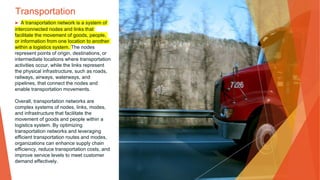
▶ A transportation network is a system of
interconnected nodes and links that
facilitate the movement of goods, people,
or information from one location to another
within a logistics system. The nodes
represent points of origin, destinations, or
intermediate locations where transportation
activities occur, while the links represent
the physical infrastructure, such as roads,
railways, airways, waterways, and
pipelines, that connect the nodes and
enable transportation movements.
Overall, transportation networks are
complex systems of nodes, links, modes,
and infrastructure that facilitate the
movement of goods and people within a
logistics system. By optimizing
transportation networks and leveraging
efficient transportation routes and modes,
organizations can enhance supply chain
efficiency, reduce transportation costs, and
improve service levels to meet customer
demand effectively.
Transportation
▶ Transportation plays a critical role
in supply chain efficiency, as it is
responsible for the movement of
goods from suppliers to
manufacturers, distributors, retailers,
and ultimately to customers.
Improving transportation efficiency
can have significant benefits for
supply chain performance, including
reduced costs, improved customer
service, and enhanced
competitiveness.
By implementing these strategies and
adopting a holistic approach to
transportation management,
organizations can enhance
transportation supply chain efficiency,
reduce costs, improve service levels,
and gain a competitive advantage in
today's dynamic and complex
business environment.
Logistics
▶ Logistics refers to the process of planning,
implementing, and controlling the flow of
goods, services, and information from the
point of origin to the point of consumption to
meet customer requirements efficiently and
effectively. It involves the coordination and
integration of various activities, including
transportation, inventory management,
warehousing, material handling, packaging,
and distribution, to ensure the smooth and
timely movement of goods through the supply
chain.
Overall, logistics plays a crucial role in supply
chain management by optimizing the
movement and flow of goods, services, and
information to meet customer demand,
minimize costs, and maximize efficiency and
competitiveness in today's global marketplace.
By effectively managing logistics operations,
organizations can improve customer
satisfaction, reduce lead times, enhance
inventory control, and gain a competitive
advantage in the marketplace. Logistics
defines the operations process of receiving,
storing, moving, and shipping of goods from
the viewpoint of a supply chain participant.
Cross-docking
▶ Cross-docking is a logistics strategy and
process that involves transferring goods
directly from inbound transportation vehicles,
such as trucks or railcars, to outbound
transportation vehicles with minimal or no
storage in between. In other words, it's a
method of distribution where products are
unloaded from an incoming vehicle and
immediately loaded onto outbound vehicles for
onward shipment to their final destination.
Cross-docking is commonly used in industries
with high-volume, time-sensitive goods, such
as retail, grocery, and automotive sectors,
where rapid order fulfillment and delivery are
essential. It's also beneficial for handling
perishable goods, seasonal merchandise, and
products with short shelf lives. However,
cross-docking requires careful coordination,
synchronization, and collaboration among
suppliers, carriers, and logistics providers to
ensure smooth and efficient operations.
Cross-docking is an approach used in these
consolidation warehouses, where rather than
making larger shipments, large shipments are
broken down into small shipments for local
delivery in an area.
Competitive
Advantage
▶ Competitive advantage refers to the unique
strengths or attributes that enable a business
to outperform its competitors in the
marketplace and achieve superior
performance and profitability. It is the edge
that a company has over its rivals, allowing it
to attract customers, generate higher
revenues, and gain market share. Competitive
advantage can be derived from various
sources, including product differentiation, cost
leadership, technological innovation,
operational excellence, and customer service.
Overall, competitive advantage is essential for
sustaining long-term success and profitability
in today's competitive business environment.
Companies that identify and leverage their
unique strengths, capabilities, and resources
to differentiate themselves and create value
for customers are better positioned to thrive
and succeed in the marketplace. Competitive
advantage is created at a home base where
strategy is set, the core product and process
technology are created, and a critical mass of
production takes place.
Free Trade Zones
▶ Free Trade Zones (FTZs), also known
as Foreign Trade Zones, are designated
areas within a country's borders where
goods can be imported, stored, processed,
and re-exported without being subject to
customs duties, tariffs, or other import
taxes or regulations. FTZs are established
by governments to promote international
trade, attract foreign investment, and
stimulate economic development by
providing businesses with various benefits
and incentives.
Overall, Free Trade Zones play a vital role
in facilitating international trade, promoting
investment, and driving economic
development by providing businesses with
a range of incentives, benefits, and
opportunities to engage in global
commerce more efficiently and
competitively. Free Trade Zones is typically
a closed facility (under the supervision of
the customs department) into which foreign
goods can be brought without being
subject to the normal customs
requirements.
Out-of-gauge cargo
▶ Out-of-gauge (OOG) cargo refers
to shipments that exceed the
standard dimensions or weight limits
for transportation on conventional
modes of transportation, such as
trucks, railcars, or containers. These
shipments are often oversized, over-
dimensional, or overweight, requiring
special handling, equipment, and
transportation arrangements to
accommodate their size, shape, or
weight. Out-of-gauge cargo may
include individual items, machinery,
equipment, vehicles, or entire project
cargoes that cannot be easily
accommodated within standard
transportation parameters.
Out-of-gauge cargo refers to any kind
of large, shipped items that don’t fit
into standardized sizes of
containments or compartments.
Piece Cargo
▶ Piece cargo refers to individual
items or units of cargo that are
packaged, handled, and transported
separately rather than being
consolidated into larger shipments or
containers. Piece cargo can include a
wide range of goods, merchandise, or
commodities that are shipped as
individual units, packages, boxes,
crates, or palletized loads. Unlike bulk
cargo, which is transported in large
quantities or volumes, piece cargo
consists of discrete, identifiable items
that are typically handled and
processed individually throughout the
transportation and logistics chain.
Piece cargo refers to cargo made of
individual pieces or packages of small
size as handled by postal or express
services.
Barge Transportation
▶ Barge transportation is a mode of
freight transportation that involves the
movement of goods, commodities,
materials, and other cargo by barge
along rivers, canals, inland
waterways, and coastal routes.
Barges are flat-bottomed vessels
designed to navigate inland water
bodies, such as rivers, lakes, and
canals, and are typically towed or
pushed by tugboats or towboats.
Barge transportation offers several
advantages, including cost-
effectiveness, fuel efficiency,
environmental sustainability, and
capacity for bulk cargo.
Barge transportation is usually done on
river barges and often carried out
either as domestic moves.
Bulk Cargo
▶ Bulk cargo refers to large quantities
of homogeneous commodities or raw
materials that are transported
unpackaged or in large quantities,
typically without individual packaging
or containers. Bulk cargo is
characterized by its volume, weight,
and uniformity, and it is commonly
transported in bulk carriers, bulk
cargo ships, barges, or bulk
containers. Bulk cargo can include a
wide range of dry or liquid
commodities, such as ores, coal,
grains, petroleum, chemicals, ores,
minerals, cement, fertilizers, and
aggregates.
Bulk Cargo refers to any kind of solid
materials or goods that are shipped in
a loose form.
Unimodal
Transportation
▶ Unimodal transportation refers to
the movement of goods or
passengers using a single mode of
transportation throughout the entire
journey, without any intermodal
transfers or changes in transportation
mode. In unimodal transportation,
goods or passengers are transported
from the point of origin to the final
destination using only one mode of
transportation, such as road, rail, air,
or sea. Each mode of transportation
has its own advantages,
characteristics, and infrastructure,
and unimodal transportation allows for
the optimization of the chosen mode's
capabilities for a given journey.
Unimodal transportation means that
cargo is moved on a single mode of
transport.
Hub-and-spoke
systems
▶ A hub-and-spoke system is a
transportation or distribution network
design commonly used in logistics
and supply chain management to
optimize the flow of goods,
passengers, or information between
multiple locations. In a hub-and-spoke
system, a central hub serves as a
focal point or central point of
consolidation, where goods,
passengers, or information are
collected, sorted, and distributed to
various spoke locations. The spokes
are the secondary locations
connected to the hub, which receive
or send goods, passengers, or
information to and from the central
hub.
Hub-and-spoke system combine the
idea of consolidation and that of cross-
docking.
Oil & Gas industries
▶ The transportation of oil and gas products
involves a complex network of infrastructure,
modes of transportation, and logistical
considerations due to the nature of these
commodities and their importance to various
industries worldwide. Here's an overview of a
transportation method commonly used in the
oil and gas industry:
• Pipelines: Pipelines are the primary mode
of transportation for crude oil, natural gas,
and refined petroleum products over long
distances. Pipelines are efficient, cost-
effective, and environmentally friendly,
providing a safe and reliable means of
transporting large volumes of oil and gas
across continents and regions. Pipelines
are often used for both onshore and
offshore transportation, with extensive
networks connecting production fields to
refineries, terminals, distribution centers,
and end markets.
Oil & Gas industries extract fossil energy
sources, transport the material to refineries
(upstream), and produce finished fuels to be
distributed to storage tanks or gas stations
(downstream)
House bill of lading
(HBL)
▶ A House Bill of Lading (HBL) is a
transport document issued by a freight
forwarder or a Non-Vessel Operating
Common Carrier (NVOCC) to a shipper
or exporter for the transportation of
goods. It serves as a contract of
carriage and a receipt for the goods,
outlining the terms and conditions of the
transportation agreement between the
shipper and the carrier.
Overall, the House Bill of Lading plays a
crucial role in facilitating international
trade by documenting the transportation
agreement between the shipper and the
carrier, providing proof of receipt for the
goods, and ensuring compliance with
legal and regulatory requirements for
the shipment of goods.
House bill of lading (HBL) is the legal
proof and shipment definition between a
shipper and the commissioned LSP.
Free on board (FOB)
▶ Free on Board (FOB) is a
common international trade term
used in sales contracts to
indicate the point at which the
seller fulfills their obligation and
transfers the responsibility and
risk of the goods to the buyer.
FOB defines who will be
responsible for the
transportation costs, insurance,
and risk of loss or damage to
the goods during transit
Free on Board (FOB) means
that the shipper includes the
freight up to a location in the
sales price and is responsible to
hand it over on board a vessel.
Multimodal
▶ Multimodal transportation, also
known as intermodal transportation,
refers to the movement of goods or
passengers using multiple modes of
transportation within a single
journey. It involves the seamless
transfer of cargo or passengers
between different modes of
transportation, such as road, rail,
air, sea, or inland waterways, to
optimize the efficiency, reliability,
and cost-effectiveness of
transportation operations.
Multimodal means the decision to
move cargo involves more than one
mode of transportation, for
example, an initial truck move, a rail
move, and a subsequent truck
move.
Drayage
▶ Drayage refers to the short-distance
transportation of goods, typically over land,
between transportation hubs, such as
ports, rail yards, or warehouses, and their
final destination. Drayage services involve
the movement of cargo containers,
palletized goods, or bulk commodities over
relatively short distances, often within the
same metropolitan area or region.
In summary, drayage is a critical
component of the intermodal transportation
system, facilitating the efficient movement
of goods between ports, rail terminals,
warehouses, and customer locations.
Drayage services play a vital role in
supporting global trade, supply chain
logistics, and the delivery of goods to end
consumers by providing seamless
connectivity between different modes of
transportation and enabling last-mile
delivery solutions. Drayage refers to the
move of consolidated or containerized
cargo from the consolidation facility of a
forwarder (CFS/GHF) to a port
terminal/airline facility or vice versa.
A company or a functional unit of a
company that organizes the transportation
of goods in the following business
contexts.
Shipping Industries
A high-quality and competitive supplier
base makes a given location suitable. The
proximity of important suppliers’ plants
also supports lean production methods.
True
A special linear programming method that
is useful for solving problems involving
transporting products from several sources
to several destinations.
Transportation method
A technique for locating single facilities
that considers the existing facilities, the
distances between them, and the volumes
of goods to be shipped.
Centroid method
An approach for selecting a facility
location by combining a diverse set of
factors.
Factor-rating systems
AWB stands for: Airway bill
True
BOL stands for: Bill of lading
True
Bulk cargo usually contains materials
requiring special handling, such as
dangerous goods, but complies to general
shipping rules.
True
Collaborative approach focuses on
developing contracts with carriers for a
tailored set of transportation services at
rates that fairly compensate the carrier
True
Defines the entire value chain from the
first vendor over a sequence of
manufacturers or distributors to the final
receiver.
Supply Chain
Dynamic analysis concentrates on a
specific point in time or level of
production output
False
Economic integration and reduction of
trade barriers leads to increased global
flows of goods and services (comparative
advantage), which leads to global
interdependence.
True
FCL stands for: Full container load
True
Hubs are located in strategic locations near
the geographic center of the region they
are to serve to minimize the distance a
good must travel
True
If cargo in containers is moved from a
road-based chassis to a rail-based stack
car, the term __________ is used.
Intermodal
In _____________ transportation cargo is
moved across borders and may be relevant
for trade compliance processes.
International
Integrated carriers provides door-to-door
service, scheduled pickup and delivery
windows, and expedited service through
their hub-and-spoke networks
True
Product flow is directly dependent on
effective transportation for timely, reliable,
and damage-free product delivery to
customers.
True
Railroad is the most widely used mode
of transportation in the US domestic
supply chain.
False
SCM is the art and science of integrating
the flows of products, information, and
financials through the entire supply
pipeline from the supplier’s supplier to the
customer’s customer
True
Special consolidation warehouses are not
used when shipments from various
sources are pulled together and combined
into larger shipments with a common
destination
False
The --------------- document is usually issued
by carriers or forwarders to define the
consolidation of multiple shipments into a
unit (e.g., container), which is then
physically handled.
Master bill of lading (MBL)
The educational and skill levels of the
labor pool must match the company’s
needs. Even more important are their
willingness and ability to learn.
True
The fast-changing geopolitical scenes
in numerous nations present exciting
and challenging opportunities
True
The long-run Analysis which examines a
logistics system over a long time period or
range of output is also known as Special
Analysis
False
The party that holds ownership for the
cargo to be transported. This is especially
valid if neither shipper not consignee owns
the goods.
Beneficial cargo owner
The party who pays the invoice for a
shipment, which can be the ordering party,
the invoicing party, or another clearing
company.
Payment party
The party who receives the cargo. In
many cases, the ____________ is also
the buyer of the goods.
Consignee or recipient
The term ____________ encompasses all
companies that provide management and
execution capabilities to shippers and
other LSPs.
Logistic Service Provider
The ___________ regulations that impact
a certain industry in a given location
should be included in the location decision
as they influence the relationship with the
local community.
Environmental
TMS and related tools are widely used to
support effective planning, execution, and
analysis of transportation processes.
True
Transload freight doesn’t involves goods
that are handled and transferred between
transportation equipment and mode
multiple times
False
Transportation doesn’t plays an important
role in supply chain efficiency (including
level of inventory) and effectiveness.
False
Transportation network that connects
the nodes in the logistics system are
known as stations
False
Transportation service quality
contributes to improved customer
service and faster cash flow
True
___________ defines the operations
process of receiving, storing, moving, and
shipping of goods from the viewpoint of a
supply chain participant.
Logistics
___________ is an approach used in these
consolidation warehouses, where, rather
than making larger shipments, large
shipments are broken down into small
shipments for local delivery in an area.
Cross-docking
___________ is created at a home base
where strategy is set, the core product and
process technology are created, and a
critical mass of production takes place.
Competitive Advantage
___________ is typically a closed facility
(under the supervision of the customs
department) into which foreign goods can
be brought without being subject to the
normal customs requirements.
Free Trade Zones
___________ refers to any kind of large,
shipped items that don’t fit into
standardized sizes of containments or
compartments.
Out-of-gauge cargo
___________ refers to cargo made of
individual pieces or packages of small size
as handled by postal or express services.
Piece Cargo
___________ transportation is usually
done on river barges and often carried
out either as domestic moves.
Barge
____________ refers to any kind of
solid materials or goods that are
shipped in a loose form.
Bulk Cargo
____________ transportation means
that cargo is moved on a single mode
of transport.
Unimodal
_____________ combine the idea of
consolidation and that of cross-
docking.
Hub-and-spoke systems
_____________ extract fossil energy
sources, transport the material to
refineries (upstream), and produce
finished fuels to be distributed to storage
tanks or gas stations (downstream)
Oil & Gas industries
_____________ is the legal proof and
shipment definition between a shipper
and the commissioned LSP.
House bill of lading (HBL)
_____________ means that the shipper
includes the freight up to a location in the
sales price and is responsible to hand it
over on board a vessel.
Free on board (FOB)
______________means the decision to
move cargo involves more than one mode
of transportation, for example, an initial
truck move, a rail move, and a subsequent
truck move.
Multimodal
_______________________ refers to the
move of consolidated or containerized
cargo from the consolidation facility of a
forwarder (CFS/GHF) to a port
terminal/airline facility or vice versa.
Drayage

Final Review Logistics and Transportation.pptx

  • 1.
    Welcome to class.We will begin shortly
  • 2.
  • 3.
    Important Dates ▶ Assignment2/13/2024 ▶ Midterm 2/15/2024 ▶ Assignment 2/22/2024 ▶ Final 2/27/2024 This Photo by Unknown Author is licensed under CC BY-SA-NC
  • 4.
    Shipping Industries ▶ Theshipping industry plays a crucial role in global trade and commerce, facilitating the transportation of goods and commodities across the world's oceans. Here are some key aspects of the shipping industry: • Types of Vessels: The shipping industry encompasses various types of vessels, including container ships, bulk carriers, tankers, LNG (liquefied natural gas) carriers, Ro-Ro (roll-on/roll-off) ships, and more. Each type of vessel serves different purposes and carries different types of cargo. • Global Trade: Shipping is fundamental to global trade, with approximately 90% of the world's trade being carried by sea. It enables the transportation of raw materials, manufactured goods, energy resources, and agricultural products between countries and continents. • Ports and Terminals: Ports and terminals serve as crucial hubs in the shipping industry, where vessels load and unload cargo. These facilities handle various operations, including cargo handling, storage, customs clearance, and logistics services.
  • 5.
    Shipping Industries • Logisticsand Supply Chain Management: The shipping industry is closely intertwined with logistics and supply chain management. Efficient coordination between shipping companies, freight forwarders, ports, and other stakeholders is essential to ensure smooth cargo movement and timely delivery. • Regulations and Compliance: The shipping industry is subject to a wide range of regulations and compliance standards, including safety regulations, environmental regulations (such as MARPOL), and security measures (like the International Ship and Port Facility Security Code - ISPS Code). • Technological Advancements: The shipping industry has seen significant technological advancements in recent years, including the development of larger and more efficient vessels, automation in port operations, digitalization of documentation and processes, and the exploration of alternative fuels to reduce emissions.
  • 6.
    Shipping Industries • EnvironmentalConcerns: Environmental sustainability is a growing concern in the shipping industry. Efforts are being made to reduce emissions of greenhouse gases and air pollutants, improve energy efficiency, and develop cleaner propulsion technologies. • Market Dynamics: The shipping industry is influenced by various market dynamics, including fluctuations in global demand for commodities, changes in fuel prices, geopolitical events, and regulatory developments. Overall, the shipping industry plays a critical role in driving global economic activity and connecting markets around the world. It continues to evolve in response to changing market conditions, technological advancements, and environmental considerations. A shipping industry is a company or a functional unit of a company that organizes the transportation of goods in the following business contexts.
  • 7.
    Supplier Base ▶ Thesupplier base in the shipping industry refers to the network of companies and entities that provide goods and services to support the operations of shipping companies, ports, terminals, and related businesses. This supplier base is diverse and encompasses various types of suppliers offering different products and services. Here are some key components of the supplier base in the shipping industry: • Shipbuilding and Equipment Suppliers: Companies that manufacture and supply ships, as well as the equipment and components used in ship construction and maintenance, such as ship engines, propulsion systems, navigation equipment, and communication systems. • Marine Fuel Suppliers: Suppliers of marine fuels, including traditional fuels like heavy fuel oil (HFO) and marine diesel oil (MDO), as well as alternative fuels such as liquefied natural gas (LNG) and low-sulfur fuels compliant with environmental regulations like IMO 2020.
  • 8.
    Supplier Base • PortEquipment and Technology Providers: Suppliers of equipment, technology, and software solutions for port operations, including cranes, container handling equipment, automated guided vehicles (AGVs), terminal operating systems (TOS), and other logistics and cargo handling systems. • Maritime Services Providers: Companies offering a range of maritime services, including ship management, crewing services, maritime security, vessel inspection and surveying, classification societies, marine insurance, and maritime legal and consulting services. • Ship Chandlers and Suppliers: Suppliers of provisions, consumables, spare parts, and other goods needed for ship operations and crew welfare, including food and beverage supplies, medical supplies, safety equipment, and maintenance supplies.
  • 9.
    Supplier Base • Logisticsand Transportation Providers: Companies providing logistics and transportation services, such as freight forwarding, warehousing, customs brokerage, and inland transportation services to support the movement of goods to and from ports and terminals. • Technology and Software Providers: Suppliers of technology solutions and software platforms tailored for the shipping industry, including fleet management software, supply chain management systems, maritime communication and satellite services, and digitalization solutions for vessel and cargo operations. • Environmental and Sustainability Solutions Providers: Companies offering products and services focused on environmental sustainability and compliance with regulations related to emissions reduction, ballast water management, waste management, and other environmental concerns in the shipping industry.
  • 10.
    Supplier Base ▶ Thesupplier base in the shipping industry is dynamic and continuously evolving, driven by technological advancements, regulatory changes, market demands, and the ongoing efforts of industry stakeholders to improve efficiency, safety, and sustainability in maritime operations. A high-quality and competitive supplier base makes a given location suitable. The proximity of important suppliers’ plants also supports lean production methods.
  • 11.
    Transportation Method ▶ Thetransportation method refers to the mode or means by which goods, people, or commodities are moved from one place to another. There are several transportation methods, each with its own advantages, limitations, and suitability for different types of cargo, distances, and logistical requirements. Here are some common transportation methods: • Road Transportation: This involves the movement of goods and passengers by road using vehicles such as cars, trucks, buses, and motorcycles. Road transportation is versatile, providing door-to-door delivery options and flexibility in accessing remote locations. However, it may be limited by traffic congestion, road conditions, and distance constraints. • Rail Transportation: Rail transportation utilizes trains to carry freight and passengers along railway tracks. It is efficient for long- distance cargo transportation, particularly for bulky goods and commodities. Rail transportation is known for its reliability, capacity, and lower carbon emissions compared to road transportation.
  • 12.
    Transportation Method • MaritimeTransportation: Maritime transportation involves the movement of goods and passengers by sea using ships and vessels. It is crucial for international trade, facilitating the transportation of large volumes of cargo across oceans and waterways. Maritime transportation is cost-effective for transporting bulky or heavy goods over long distances, but it can be slower than other modes. • Air Transportation: Air transportation relies on airplanes to transport passengers and cargo through the air. It is the fastest mode of transportation, making it ideal for time-sensitive shipments and perishable goods. Air transportation offers global connectivity and is often used for high-value or urgent shipments, although it can be more expensive than other modes. • Pipeline Transportation: Pipeline transportation involves the movement of liquids, gases, and solids through pipelines. It is commonly used for transporting oil, natural gas, water, and other fluids over long distances. Pipeline transportation is efficient, reliable, and cost- effective for continuous flow operations, particularly for commodities with high volumes and stable demand.
  • 13.
    Transportation Method • MultimodalTransportation: Multimodal transportation combines two or more modes of transportation (e.g., road, rail, sea, air) within a single journey to optimize efficiency, cost, and service levels. It provides greater flexibility and coverage, allowing shippers to leverage the strengths of different modes while mitigating their respective weaknesses. • Intermodal Transportation: Intermodal transportation involves the use of standardized containers that can be transferred between different modes of transportation, such as ships, trains, and trucks, without the need to unload and reload cargo. Intermodal transportation enhances efficiency, reduces handling costs, and improves cargo security and tracking. Each transportation method has its own set of advantages and considerations, and the choice of transportation mode depends on factors such as the nature of the cargo, distance, time constraints, cost considerations, environmental impact, and logistical requirements. In practice, many supply chains utilize a combination of transportation methods to optimize their operations and meet customer demands effectively. A transportation method is a special linear programming method that is useful for solving problems involving transporting products from several sources to several destinations.
  • 14.
    Centroid method ▶ Thecentroid method, also known as the center-of-gravity method, is a mathematical technique used in logistics and supply chain management for determining the optimal location for a facility, such as a warehouse, distribution center, or production facility. The goal of the centroid method is to minimize transportation costs or travel time by strategically locating the facility relative to the demand or supply points it serves. The centroid method provides a simple yet effective approach for making facility location decisions, especially when transportation costs or travel time are critical factors. However, it's important to note that the centroid method is a heuristic technique and may not always result in the most optimal solution, particularly in complex supply chain networks with numerous constraints and considerations. Therefore, it is often used in combination with other analytical methods and tools for more comprehensive decision-making. It is a technique for locating single facilities that considers the existing facilities, the distances between them, and the volumes of goods to be shipped.
  • 15.
    Centroid method ▶ Here'show the centroid method typically works: 1. Identifying Demand or Supply Points: The first step involves identifying the locations of demand points (such as customer locations) or supply points (such as suppliers or production sites) that the facility will serve. These points are typically represented geographically with coordinates (latitude and longitude) or in terms of distance from a reference point. 2. Assigning Weights: Each demand or supply point is assigned a weight representing its importance or volume of demand/supply. The weight could be based on factors such as the quantity of goods transported, the frequency of transactions, or the revenue generated from each point.
  • 16.
    Centroid method ▶ Here'show the centroid method typically works: 3. Calculating Centroid Coordinates: The centroid coordinates are calculated using a weighted average of the coordinates (or distances) of the demand or supply points, where the weights correspond to the assigned weights in step 2. This calculation results in a single point representing the "center of gravity" of the demand or supply distribution. 4. Selecting Facility Location: The calculated centroid coordinates serve as a starting point for selecting the optimal location of the facility. Factors such as land availability, cost, infrastructure, regulations, and proximity to transportation networks may influence the final facility location decision. 5. Sensitivity Analysis: Sensitivity analysis may be conducted to assess how changes in the weights of demand or supply points affect the optimal facility location. This analysis helps decision-makers understand the robustness of their location decision under different scenarios.
  • 17.
    Factor-rating systems ▶ Afactor-rating system, also known as the weighted factor evaluation method or the point rating method, is a technique used in decision-making processes, particularly in areas such as project selection, supplier evaluation, site selection, and product development. This method helps decision- makers evaluate and compare different options or alternatives based on multiple criteria or factors. Factor-rating systems provide a structured and systematic approach to decision- making, allowing decision-makers to consider multiple criteria and weigh their relative importance. By incorporating both qualitative and quantitative assessments, factor-rating systems help improve transparency, consistency, and objectivity in decision-making processes. However, it's essential to ensure that the chosen criteria and weights accurately reflect the decision context and objectives to derive meaningful and reliable results. It is an approach for selecting a facility location by combining a diverse set of factors.
  • 18.
    Airway bill ▶ Anair waybill (AWB) is a crucial document used in airfreight logistics. It serves as a contract of carriage between the shipper (sender of goods) and the carrier (airline), detailing the terms and conditions of transportation for the cargo being shipped. Here are the key aspects of an air waybill: • Contractual Agreement: The air waybill serves as a contract between the shipper and the carrier, outlining the terms and conditions of transportation, including the agreed-upon freight charges, the type and quantity of goods being transported, and any special instructions or requirements. • Identification and Tracking: The air waybill contains unique identification numbers, including the air waybill number, which allows for tracking and tracing of the shipment throughout its journey. This facilitates transparency and visibility in the supply chain. • Information on Parties: The air waybill includes details about the shipper (consignor), the consignee (recipient), and any other parties involved in the shipment, such as freight forwarders or agents. This information ensures that the cargo is delivered to the correct recipient and allows for communication between relevant parties. • Description of Goods: The air waybill provides a description of the goods being transported, including their nature, quantity, weight, dimensions, and any special handling instructions. This information helps ensure proper handling and documentation of the cargo.
  • 19.
    Airway bill • Descriptionof Goods: The air waybill provides a description of the goods being transported, including their nature, quantity, weight, dimensions, and any special handling instructions. This information helps ensure proper handling and documentation of the cargo. • Conditions of Carriage: The air waybill may contain terms and conditions of carriage, including limitations of liability, insurance coverage, and responsibilities of the shipper and carrier. These conditions govern the rights and obligations of both parties during transportation. • Customs Documentation: The air waybill serves as a key document for customs clearance procedures, providing information about the shipment's contents, value, and origin. It may also include any necessary customs declarations or certifications required for international shipments. • Freight Charges: The air waybill indicates the freight charges associated with the transportation of the goods, including any applicable taxes, fees, or surcharges. This allows for accurate invoicing and payment processing between the shipper and the carrier.
  • 20.
    Airway bill • Signatureand Date: The air waybill is typically signed and dated by the shipper or their authorized representative, acknowledging the terms and conditions of carriage and confirming the shipment's readiness for transportation. Overall, the air waybill plays a crucial role in facilitating air cargo transportation by providing a standardized and legally binding document that governs the movement of goods from the point of origin to the final destination. It ensures transparency, compliance, and accountability throughout the shipping process. AWB stands for: Airway bill.
  • 21.
    Bill of lading ▶A bill of lading (B/L) is a legal document issued by a carrier or its agent to acknowledge the receipt of cargo for shipment. It serves as evidence of the contract of carriage between the shipper (sender of goods) and the carrier (shipping company), detailing the terms and conditions of transportation. The bill of lading also serves as a receipt for the goods, a document of title, and a negotiable instrument in international trade. Overall, the bill of lading is a critical document in international shipping and trade, providing a legal framework for the movement of goods and facilitating transactions between buyers and sellers across borders BOL stands for: Bill of lading.
  • 22.
    Bulk Cargo ▶ Bulkcargo refers to unpackaged goods or commodities that are transported in large quantities, typically loaded directly into the cargo holds of ships, without the need for packaging such as containers or pallets. Bulk cargo is commonly transported in its natural state, loose or in bulk form, and is often homogeneous in nature. This type of cargo is prevalent in various industries, including mining, agriculture, energy, and manufacturing. Bulk cargo is typically loaded and unloaded using specialized equipment such as conveyor belts, cranes, grabs, and suction hoses. It is transported in bulk carriers, bulk tankers, or specialized vessels designed to handle specific types of bulk cargo. The transportation of bulk cargo plays a vital role in global trade, supplying essential raw materials and commodities to industries and markets around the world. Bulk cargo usually contains materials requiring special handling, such as dangerous goods, but complies to general shipping rules.
  • 23.
    Collaborative approach ▶ Acollaborative approach to the supply chain involves integrating and aligning the efforts of multiple stakeholders, including suppliers, manufacturers, distributors, and customers, to optimize the overall performance of the supply chain network. This approach emphasizes cooperation, communication, and shared goals among all participants, with the aim of improving efficiency, responsiveness, and customer satisfaction. Overall, a collaborative approach to the supply chain fosters closer integration, cooperation, and alignment among stakeholders, leading to enhanced efficiency, flexibility, and responsiveness throughout the supply chain network. By working together toward common goals and sharing benefits and risks, organizations can create value and competitive advantage in today's dynamic and interconnected business environment. Collaborative approach focuses on developing contracts with carriers for a tailored set of transportation services at rates that fairly compensate the carrier
  • 24.
    Supply Chain ▶ Supplychain management (SCM) is the process of managing the flow of goods, services, information, and finances as they move from the supplier to the manufacturer, wholesaler, retailer, and ultimately to the end customer. It involves the coordination and integration of various activities, including procurement, production, inventory management, logistics, distribution, and customer service, to optimize the efficiency and effectiveness of the overall supply chain network. Overall, effective supply chain management is essential for organizations to achieve competitive advantage, improve customer satisfaction, reduce costs, and drive growth and profitability in today's dynamic and interconnected global marketplace. The supply chain defines the entire value chain from the first vendor over a sequence of manufacturers or distributors to the final receiver.
  • 25.
    Dynamic analysis ▶ Dynamicanalysis in supply chain management refers to the process of examining and modeling the behavior of a supply chain system over time to understand how it responds to various changes, disruptions, and uncertainties. Unlike static analysis, which focuses on a snapshot of the supply chain at a specific point in time, dynamic analysis considers the evolving nature of the supply chain and its interactions with internal and external factors. Overall, dynamic analysis plays a crucial role in improving the agility, responsiveness, and resilience of supply chain operations by providing insights into the behavior of the supply chain system over time and supporting informed decision-making in a constantly changing business landscape. Dynamic analysis does not concentrate on a specific point in time or level of production output
  • 26.
    Comparative Advantage ▶ Comparativeadvantage is an economic principle that explains how specialization and trade can benefit all parties involved, even if one party is more efficient at producing all goods than another. It refers to the ability of a country, region, or individual to produce a particular good or service at a lower opportunity cost relative to other goods or services, compared to another country, region, or individual. The concept of comparative advantage was first introduced by the economist David Ricardo in the early 19th century as an extension of the theory of absolute advantage proposed by Adam Smith. While absolute advantage focuses on the productivity of a country in producing all goods compared to other countries, comparative advantage emphasizes the relative efficiency in producing specific goods.
  • 27.
    Comparative Advantage ▶ Overall,the concept of comparative advantage provides a theoretical foundation for understanding the benefits of international trade and specialization, highlighting the importance of leveraging differences in productivity and resource endowments to achieve higher levels of economic growth and prosperity. Economic integration and reduction of trade barriers leads to increased global flows of goods and services (comparative advantage), which leads to global interdependence.
  • 28.
    Full container load ▶A Full Container Load (FCL) refers to a shipment that occupies an entire shipping container and is exclusively dedicated to one shipper (or consignor) and one consignee. In other words, the entire contents of the container belong to a single party, whether it's a business or an individual.’ Overall, Full Container Load (FCL) shipments offer a cost-effective and efficient transportation solution for shippers with large volumes of cargo that require dedicated container space. By utilizing FCL services, shippers can benefit from greater security, control, and reliability in transporting their goods to international destinations. FCL stands for: Full container load
  • 29.
    Hubs ▶ In supplychain management, a hub refers to a centralized location or facility that serves as a point of consolidation, distribution, or transfer for goods, materials, information, or services within a network. Hubs play a crucial role in facilitating the efficient movement and coordination of resources and activities across various stages of the supply chain. Overall, hubs serve as critical nodes in supply chain networks, facilitating the flow of goods, services, information, and resources between different stages and participants. By strategically locating and managing hubs, organizations can enhance efficiency, reduce costs, improve service levels, and gain competitive advantages in today's global and interconnected supply chains. Hubs are located in strategic locations near the geographic center of the region they are to serve to minimize the distance a good must travel
  • 30.
    Intermodal ▶ Intermodal transportationrefers to the movement of goods using multiple modes of transportation within a single journey, typically involving the seamless transfer of cargo between different modes, such as trucks, trains, ships, and airplanes. Intermodal transportation offers several advantages, including cost savings, efficiency improvements, environmental benefits, and enhanced connectivity. Overall, intermodal transportation offers a flexible, efficient, and environmentally sustainable approach to freight transport, leveraging the strengths of multiple modes of transportation to meet the diverse needs of global supply chains. By embracing intermodal solutions, businesses can achieve cost savings, improve supply chain resilience, and contribute to sustainable transportation practices. If cargo in containers is moved from a road-based chassis to a rail-based stack car, the term intermodal is used.
  • 31.
    International transportation ▶ Internationaltransportation of cargo refers to the movement of goods across national borders, typically involving the use of various modes of transportation such as ships, airplanes, trucks, and trains. International transportation is a critical component of global trade, enabling the exchange of goods between countries and facilitating economic activity on a global scale. Overall, international transportation of cargo is a complex and dynamic process that plays a vital role in supporting global trade and economic development. Effective international transportation systems are essential for connecting markets, facilitating commerce, and driving growth in the global economy. In international transportation cargo is moved across borders and may be relevant for trade compliance processes.
  • 32.
    Integrated carriers ▶ Integratedcarriers, also known as integrated logistics providers or integrated transportation companies, are companies that offer a comprehensive range of logistics and transportation services, often combining multiple modes of transportation and value- added services to meet the end-to- end supply chain needs of their customers. Integrated carriers differentiate themselves by providing seamless, coordinated, and integrated solutions for moving goods from origin to destination, encompassing various stages of the logistics and transportation process.
  • 33.
    Integrated carriers ▶ Overall,integrated carriers play a critical role in the global logistics and transportation industry, offering comprehensive, seamless, and value-added solutions to meet the evolving needs of their customers in an increasingly complex and interconnected world. By combining transportation expertise, global networks, technology innovation, and customer-centric approach, integrated carriers help optimize supply chain performance, drive business growth, and deliver competitive advantage for their customers. Integrated carriers provides door-to-door service, scheduled pickup and delivery windows, and expedited service through their hub-and-spoke networks
  • 34.
    Product flow ▶ Productflow refers to the movement of goods or products through the various stages of a supply chain, from the initial production or procurement of raw materials to the final delivery to the end customer. It encompasses all the activities and processes involved in transporting, handling, storing, processing, and transforming goods as they move along the supply chain network. Overall, product flow is a fundamental aspect of supply chain management, encompassing the physical movement and transformation of goods from suppliers to customers. Effective management of product flow is essential for optimizing supply chain performance, reducing costs, improving customer service, and driving business success in today's competitive marketplace. Product flow is directly dependent on effective transportation for timely, reliable, and damage-free product delivery to customers.
  • 35.
    Mode of transportation ▶The most widely used mode of transportation is trucking. Trucks play a dominant role in the transportation of goods across the country, accounting for the majority of freight shipments by volume and value. Overall, trucking is the backbone of the US transportation system, playing a vital role in supporting economic activity, trade, and commerce by providing efficient, reliable, and flexible transportation services for a wide range of industries and supply chains.
  • 36.
    Supply Chain Management ▶Supply chain management (SCM) is the process of overseeing the flow of goods, services, information, and finances as they move from the supplier to the manufacturer, wholesaler, retailer, and ultimately to the end customer. SCM involves the planning, coordination, execution, and monitoring of activities across the entire supply chain network to optimize efficiency, minimize costs, and meet customer demand. By effectively managing these components, supply chain management aims to create value for customers, reduce costs, improve efficiency, and enhance competitiveness in today's global marketplace. Continuous improvement and innovation are essential for adapting to changing market conditions, emerging technologies, and evolving customer demands in the dynamic field of supply chain management. SCM is the art and science of integrating the flows of products, information, and financials through the entire supply pipeline from the supplier’s supplier to the customer’s customer.
  • 37.
    Special consolidation warehouses ▶ Specialconsolidation warehouses, also known as cross-docking facilities or consolidation centers, are strategically located facilities within the supply chain network designed to streamline the process of consolidating and deconsolidating shipments. These warehouses play a crucial role in optimizing transportation efficiency, reducing inventory holding costs, and improving overall supply chain agility. Overall, special consolidation warehouses play a vital role in optimizing supply chain operations, improving transportation efficiency, and enhancing overall supply chain performance. By consolidating and deconsolidating shipments, these facilities help reduce costs, increase flexibility, and enhance customer service levels in today's competitive business environment. Special consolidation is when warehouses used to ship from various sources are pulled together and combined into larger shipments with a common destination
  • 38.
    Dynamic analysis ▶ AMaster Bill of Lading (MB/L) is a crucial document used in international shipping that serves as a contract of carriage between the shipper, the carrier (often the ocean carrier), and the consignee. It outlines the terms and conditions of the transportation agreement and provides details about the cargo being transported. Overall, the Master Bill of Lading is a critical document in international shipping that serves as a contract of carriage, a receipt for the cargo, and a key instrument for documentation, tracking, and legal purposes. It provides transparency, accountability, and protection for all parties involved in the transportation of goods by sea. The Master bill of lading (MBL) document is usually issued by carriers or forwarders to define the consolidation of multiple shipments into a unit (e.g., container), which is then physically handled.
  • 39.
    Master bill oflading (MBL) ▶ Ensuring that the educational and skill levels of the labor pool match the company's needs is essential for maintaining a competitive workforce and driving business success. By aligning the educational and skill levels of the labor pool with the company's needs, organizations can enhance their ability to recruit and retain top talent, improve workforce productivity and performance, and position themselves for long-term success in today's dynamic business environment. The educational and skill levels of the labor pool must match the company’s needs. Even more important are their willingness and ability to learn.
  • 40.
    Geopolitical scenes ▶ Geopoliticalevents and dynamics can have significant effects on transportation systems and logistics operations, influencing trade routes, supply chain resilience, transportation costs, and the overall efficiency of global supply chains. Overall, geopolitical scenes can have far-reaching implications for transportation systems and supply chain operations, impacting trade flows, transportation costs, infrastructure investments, and risk management strategies. Companies must closely monitor geopolitical developments and adapt their transportation and logistics strategies to mitigate risks and maintain supply chain resilience in an uncertain geopolitical environment. The fast- changing geopolitical scenes in numerous nations present exciting and challenging opportunities.
  • 41.
    The long-run Analysis ▶In economics, a long-run analysis refers to the examination of economic phenomena and outcomes over an extended period, typically spanning several years or decades. Unlike short- run analysis, which focuses on immediate or temporary changes in economic variables, long-run analysis considers the underlying trends, structural changes, and equilibrium conditions that characterize the economy over the long term. Overall, long-run analysis provides valuable insights into the underlying drivers, trends, and dynamics of the economy over extended time horizons, helping policymakers, businesses, and researchers understand the factors shaping long-term economic outcomes and formulate informed decisions and strategies for sustainable development and prosperity. It is NOT known as Special Analysis.
  • 42.
    Beneficial cargo owner ▶A Beneficial Cargo Owner (BCO) is a term used in the shipping and logistics industry to refer to the entity or individual that owns the goods being transported. The BCO is typically the importer or consignee of the goods and holds a beneficial interest in the cargo throughout the transportation process. Overall, Beneficial Cargo Owners play a critical role in international trade and transportation by owning and overseeing the movement of goods across borders. By assuming responsibility for the transportation process, BCOs ensure the efficient and timely delivery of goods to their intended destinations, contributing to the success of global supply chains. Beneficial Cargo Owner is the party that holds ownership for the cargo to be transported. This is especially valid if neither shipper not consignee owns the goods.
  • 43.
    Payment party ▶ Inthe context of international trade and shipping, a "payment party" typically refers to the entity responsible for making or receiving payments related to the transportation of goods or services. Depending on the terms of the trade agreement, there are various parties involved in payment transactions. Overall, the payment parties involved in international trade transactions work together to ensure the smooth flow of goods and services across borders, comply with legal and regulatory requirements, and facilitate secure and timely payment settlements between the parties involved in the transaction. Effective communication, documentation, and coordination among the payment parties are essential for successful international trade operations and financial transactions. The party who pays the invoice for a shipment, which can be the ordering party, the invoicing party, or another clearing company is the payment party.
  • 44.
    Consignee or recipient ▶In the context of shipping and logistics, the terms "consignee" and "recipient" refer to the party to whom a shipment of goods is being delivered. In summary, while the consignee is the designated recipient of the goods named in the shipping documents, the recipient is the actual party who physically receives the goods upon delivery. In many cases, especially in commercial transactions, the consignee and the recipient are the same entity, but there are situations where they may differ, particularly in complex supply chain arrangements. The party who receives the cargo. In many cases, the consignee or recipient is also the buyer of the goods.
  • 45.
    Logistic Service Provider ▶ ALogistics Service Provider (LSP) is a company or organization that offers a range of logistical services to support the transportation, storage, and distribution of goods throughout the supply chain. LSPs play a critical role in facilitating the movement of goods from suppliers to customers efficiently and effectively. Overall, Logistics Service Providers play a crucial role in managing and optimizing the flow of goods throughout the supply chain, providing a wide range of logistical services to support the transportation, storage, and distribution of goods from suppliers to customers. By outsourcing logistics functions to LSPs, companies can focus on their core business activities while benefiting from the expertise, infrastructure, and resources of experienced logistics professionals. The term Logistic Service Provider encompasses all companies that provide management and execution capabilities to shippers and other LSPs.
  • 46.
    Environmental Regulation ▶ Environmental regulationrefers to the rules, laws, policies, and standards implemented by governments to protect the environment, conserve natural resources, and mitigate pollution and environmental degradation. These regulations aim to safeguard air, water, soil, and ecosystems, as well as human health and well-being, by controlling the activities of individuals, businesses, industries, and other entities that may impact the environment. Overall, environmental regulation plays a crucial role in protecting the environment, promoting sustainable development, and ensuring the health and well-being of present and future generations. By implementing effective environmental regulations, governments can mitigate environmental risks, foster environmental stewardship, and promote a transition to a more sustainable and resilient economy. The environmental regulations that impact a certain industry in a given location should be included in the location decision as they influence the relationship with the local community.
  • 47.
    Transportation Management System ▶ ATransportation Management System (TMS) is a software solution that helps businesses efficiently manage and optimize their transportation operations. TMS software automates and streamlines various tasks related to transportation planning, execution, and optimization, enabling organizations to reduce costs, improve service levels, and enhance overall supply chain efficiency Overall, a Transportation Management System plays a critical role in helping businesses optimize their transportation operations, reduce costs, improve service levels, and enhance overall supply chain efficiency. By automating and streamlining transportation processes, TMS software enables organizations to effectively manage their logistics operations and meet customer demand in today's dynamic and competitive business environment. TMS and related tools are widely used to support effective planning, execution, and analysis of transportation processes.
  • 48.
    Transloading ▶ Transloading freightrefers to the process of transferring goods or cargo from one mode of transportation to another at an intermediate location, typically a transloading facility or terminal. This intermediate location serves as a transfer point where freight can be shifted between different modes of transportation, such as from rail to truck, truck to rail, rail to ship, or ship to rail. Transloading facilitates the movement of goods between different transportation networks and enables more efficient and cost-effective transportation solutions. Overall, transloading freight is an essential component of modern logistics and transportation systems, enabling the seamless movement of goods between different transportation modes and facilitating the efficient and cost-effective delivery of goods to their final destination. By leveraging transloading facilities and intermodal transportation solutions, shippers can optimize their supply chain operations, improve transportation efficiency, and enhance customer satisfaction in today's global marketplace. Transload freight involves goods that are handled and transferred between transportation equipment and mode multiple times
  • 49.
    Transportation ▶ Transportation playsa critical role in supply chain efficiency, as it is responsible for the movement of goods from suppliers to manufacturers, distributors, retailers, and ultimately to customers. Improving transportation efficiency can have significant benefits for supply chain performance, including reduced costs, improved customer service, and enhanced competitiveness. By implementing these strategies and adopting a holistic approach to transportation management, organizations can enhance transportation supply chain efficiency, reduce costs, improve service levels, and gain a competitive advantage in today's dynamic and complex business environment.
  • 50.
    Transportation ▶ A transportationnetwork is a system of interconnected nodes and links that facilitate the movement of goods, people, or information from one location to another within a logistics system. The nodes represent points of origin, destinations, or intermediate locations where transportation activities occur, while the links represent the physical infrastructure, such as roads, railways, airways, waterways, and pipelines, that connect the nodes and enable transportation movements. Overall, transportation networks are complex systems of nodes, links, modes, and infrastructure that facilitate the movement of goods and people within a logistics system. By optimizing transportation networks and leveraging efficient transportation routes and modes, organizations can enhance supply chain efficiency, reduce transportation costs, and improve service levels to meet customer demand effectively.
  • 51.
    Transportation ▶ Transportation playsa critical role in supply chain efficiency, as it is responsible for the movement of goods from suppliers to manufacturers, distributors, retailers, and ultimately to customers. Improving transportation efficiency can have significant benefits for supply chain performance, including reduced costs, improved customer service, and enhanced competitiveness. By implementing these strategies and adopting a holistic approach to transportation management, organizations can enhance transportation supply chain efficiency, reduce costs, improve service levels, and gain a competitive advantage in today's dynamic and complex business environment.
  • 52.
    Logistics ▶ Logistics refersto the process of planning, implementing, and controlling the flow of goods, services, and information from the point of origin to the point of consumption to meet customer requirements efficiently and effectively. It involves the coordination and integration of various activities, including transportation, inventory management, warehousing, material handling, packaging, and distribution, to ensure the smooth and timely movement of goods through the supply chain. Overall, logistics plays a crucial role in supply chain management by optimizing the movement and flow of goods, services, and information to meet customer demand, minimize costs, and maximize efficiency and competitiveness in today's global marketplace. By effectively managing logistics operations, organizations can improve customer satisfaction, reduce lead times, enhance inventory control, and gain a competitive advantage in the marketplace. Logistics defines the operations process of receiving, storing, moving, and shipping of goods from the viewpoint of a supply chain participant.
  • 53.
    Cross-docking ▶ Cross-docking isa logistics strategy and process that involves transferring goods directly from inbound transportation vehicles, such as trucks or railcars, to outbound transportation vehicles with minimal or no storage in between. In other words, it's a method of distribution where products are unloaded from an incoming vehicle and immediately loaded onto outbound vehicles for onward shipment to their final destination. Cross-docking is commonly used in industries with high-volume, time-sensitive goods, such as retail, grocery, and automotive sectors, where rapid order fulfillment and delivery are essential. It's also beneficial for handling perishable goods, seasonal merchandise, and products with short shelf lives. However, cross-docking requires careful coordination, synchronization, and collaboration among suppliers, carriers, and logistics providers to ensure smooth and efficient operations. Cross-docking is an approach used in these consolidation warehouses, where rather than making larger shipments, large shipments are broken down into small shipments for local delivery in an area.
  • 54.
    Competitive Advantage ▶ Competitive advantagerefers to the unique strengths or attributes that enable a business to outperform its competitors in the marketplace and achieve superior performance and profitability. It is the edge that a company has over its rivals, allowing it to attract customers, generate higher revenues, and gain market share. Competitive advantage can be derived from various sources, including product differentiation, cost leadership, technological innovation, operational excellence, and customer service. Overall, competitive advantage is essential for sustaining long-term success and profitability in today's competitive business environment. Companies that identify and leverage their unique strengths, capabilities, and resources to differentiate themselves and create value for customers are better positioned to thrive and succeed in the marketplace. Competitive advantage is created at a home base where strategy is set, the core product and process technology are created, and a critical mass of production takes place.
  • 55.
    Free Trade Zones ▶Free Trade Zones (FTZs), also known as Foreign Trade Zones, are designated areas within a country's borders where goods can be imported, stored, processed, and re-exported without being subject to customs duties, tariffs, or other import taxes or regulations. FTZs are established by governments to promote international trade, attract foreign investment, and stimulate economic development by providing businesses with various benefits and incentives. Overall, Free Trade Zones play a vital role in facilitating international trade, promoting investment, and driving economic development by providing businesses with a range of incentives, benefits, and opportunities to engage in global commerce more efficiently and competitively. Free Trade Zones is typically a closed facility (under the supervision of the customs department) into which foreign goods can be brought without being subject to the normal customs requirements.
  • 56.
    Out-of-gauge cargo ▶ Out-of-gauge(OOG) cargo refers to shipments that exceed the standard dimensions or weight limits for transportation on conventional modes of transportation, such as trucks, railcars, or containers. These shipments are often oversized, over- dimensional, or overweight, requiring special handling, equipment, and transportation arrangements to accommodate their size, shape, or weight. Out-of-gauge cargo may include individual items, machinery, equipment, vehicles, or entire project cargoes that cannot be easily accommodated within standard transportation parameters. Out-of-gauge cargo refers to any kind of large, shipped items that don’t fit into standardized sizes of containments or compartments.
  • 57.
    Piece Cargo ▶ Piececargo refers to individual items or units of cargo that are packaged, handled, and transported separately rather than being consolidated into larger shipments or containers. Piece cargo can include a wide range of goods, merchandise, or commodities that are shipped as individual units, packages, boxes, crates, or palletized loads. Unlike bulk cargo, which is transported in large quantities or volumes, piece cargo consists of discrete, identifiable items that are typically handled and processed individually throughout the transportation and logistics chain. Piece cargo refers to cargo made of individual pieces or packages of small size as handled by postal or express services.
  • 58.
    Barge Transportation ▶ Bargetransportation is a mode of freight transportation that involves the movement of goods, commodities, materials, and other cargo by barge along rivers, canals, inland waterways, and coastal routes. Barges are flat-bottomed vessels designed to navigate inland water bodies, such as rivers, lakes, and canals, and are typically towed or pushed by tugboats or towboats. Barge transportation offers several advantages, including cost- effectiveness, fuel efficiency, environmental sustainability, and capacity for bulk cargo. Barge transportation is usually done on river barges and often carried out either as domestic moves.
  • 59.
    Bulk Cargo ▶ Bulkcargo refers to large quantities of homogeneous commodities or raw materials that are transported unpackaged or in large quantities, typically without individual packaging or containers. Bulk cargo is characterized by its volume, weight, and uniformity, and it is commonly transported in bulk carriers, bulk cargo ships, barges, or bulk containers. Bulk cargo can include a wide range of dry or liquid commodities, such as ores, coal, grains, petroleum, chemicals, ores, minerals, cement, fertilizers, and aggregates. Bulk Cargo refers to any kind of solid materials or goods that are shipped in a loose form.
  • 60.
    Unimodal Transportation ▶ Unimodal transportationrefers to the movement of goods or passengers using a single mode of transportation throughout the entire journey, without any intermodal transfers or changes in transportation mode. In unimodal transportation, goods or passengers are transported from the point of origin to the final destination using only one mode of transportation, such as road, rail, air, or sea. Each mode of transportation has its own advantages, characteristics, and infrastructure, and unimodal transportation allows for the optimization of the chosen mode's capabilities for a given journey. Unimodal transportation means that cargo is moved on a single mode of transport.
  • 61.
    Hub-and-spoke systems ▶ A hub-and-spokesystem is a transportation or distribution network design commonly used in logistics and supply chain management to optimize the flow of goods, passengers, or information between multiple locations. In a hub-and-spoke system, a central hub serves as a focal point or central point of consolidation, where goods, passengers, or information are collected, sorted, and distributed to various spoke locations. The spokes are the secondary locations connected to the hub, which receive or send goods, passengers, or information to and from the central hub. Hub-and-spoke system combine the idea of consolidation and that of cross- docking.
  • 62.
    Oil & Gasindustries ▶ The transportation of oil and gas products involves a complex network of infrastructure, modes of transportation, and logistical considerations due to the nature of these commodities and their importance to various industries worldwide. Here's an overview of a transportation method commonly used in the oil and gas industry: • Pipelines: Pipelines are the primary mode of transportation for crude oil, natural gas, and refined petroleum products over long distances. Pipelines are efficient, cost- effective, and environmentally friendly, providing a safe and reliable means of transporting large volumes of oil and gas across continents and regions. Pipelines are often used for both onshore and offshore transportation, with extensive networks connecting production fields to refineries, terminals, distribution centers, and end markets. Oil & Gas industries extract fossil energy sources, transport the material to refineries (upstream), and produce finished fuels to be distributed to storage tanks or gas stations (downstream)
  • 63.
    House bill oflading (HBL) ▶ A House Bill of Lading (HBL) is a transport document issued by a freight forwarder or a Non-Vessel Operating Common Carrier (NVOCC) to a shipper or exporter for the transportation of goods. It serves as a contract of carriage and a receipt for the goods, outlining the terms and conditions of the transportation agreement between the shipper and the carrier. Overall, the House Bill of Lading plays a crucial role in facilitating international trade by documenting the transportation agreement between the shipper and the carrier, providing proof of receipt for the goods, and ensuring compliance with legal and regulatory requirements for the shipment of goods. House bill of lading (HBL) is the legal proof and shipment definition between a shipper and the commissioned LSP.
  • 64.
    Free on board(FOB) ▶ Free on Board (FOB) is a common international trade term used in sales contracts to indicate the point at which the seller fulfills their obligation and transfers the responsibility and risk of the goods to the buyer. FOB defines who will be responsible for the transportation costs, insurance, and risk of loss or damage to the goods during transit Free on Board (FOB) means that the shipper includes the freight up to a location in the sales price and is responsible to hand it over on board a vessel.
  • 65.
    Multimodal ▶ Multimodal transportation,also known as intermodal transportation, refers to the movement of goods or passengers using multiple modes of transportation within a single journey. It involves the seamless transfer of cargo or passengers between different modes of transportation, such as road, rail, air, sea, or inland waterways, to optimize the efficiency, reliability, and cost-effectiveness of transportation operations. Multimodal means the decision to move cargo involves more than one mode of transportation, for example, an initial truck move, a rail move, and a subsequent truck move.
  • 66.
    Drayage ▶ Drayage refersto the short-distance transportation of goods, typically over land, between transportation hubs, such as ports, rail yards, or warehouses, and their final destination. Drayage services involve the movement of cargo containers, palletized goods, or bulk commodities over relatively short distances, often within the same metropolitan area or region. In summary, drayage is a critical component of the intermodal transportation system, facilitating the efficient movement of goods between ports, rail terminals, warehouses, and customer locations. Drayage services play a vital role in supporting global trade, supply chain logistics, and the delivery of goods to end consumers by providing seamless connectivity between different modes of transportation and enabling last-mile delivery solutions. Drayage refers to the move of consolidated or containerized cargo from the consolidation facility of a forwarder (CFS/GHF) to a port terminal/airline facility or vice versa.
  • 68.
    A company ora functional unit of a company that organizes the transportation of goods in the following business contexts. Shipping Industries
  • 69.
    A high-quality andcompetitive supplier base makes a given location suitable. The proximity of important suppliers’ plants also supports lean production methods. True
  • 70.
    A special linearprogramming method that is useful for solving problems involving transporting products from several sources to several destinations. Transportation method
  • 71.
    A technique forlocating single facilities that considers the existing facilities, the distances between them, and the volumes of goods to be shipped. Centroid method
  • 72.
    An approach forselecting a facility location by combining a diverse set of factors. Factor-rating systems
  • 73.
    AWB stands for:Airway bill True
  • 74.
    BOL stands for:Bill of lading True
  • 75.
    Bulk cargo usuallycontains materials requiring special handling, such as dangerous goods, but complies to general shipping rules. True
  • 76.
    Collaborative approach focuseson developing contracts with carriers for a tailored set of transportation services at rates that fairly compensate the carrier True
  • 77.
    Defines the entirevalue chain from the first vendor over a sequence of manufacturers or distributors to the final receiver. Supply Chain
  • 78.
    Dynamic analysis concentrateson a specific point in time or level of production output False
  • 79.
    Economic integration andreduction of trade barriers leads to increased global flows of goods and services (comparative advantage), which leads to global interdependence. True
  • 80.
    FCL stands for:Full container load True
  • 81.
    Hubs are locatedin strategic locations near the geographic center of the region they are to serve to minimize the distance a good must travel True
  • 82.
    If cargo incontainers is moved from a road-based chassis to a rail-based stack car, the term __________ is used. Intermodal
  • 83.
    In _____________ transportationcargo is moved across borders and may be relevant for trade compliance processes. International
  • 84.
    Integrated carriers providesdoor-to-door service, scheduled pickup and delivery windows, and expedited service through their hub-and-spoke networks True
  • 85.
    Product flow isdirectly dependent on effective transportation for timely, reliable, and damage-free product delivery to customers. True
  • 86.
    Railroad is themost widely used mode of transportation in the US domestic supply chain. False
  • 87.
    SCM is theart and science of integrating the flows of products, information, and financials through the entire supply pipeline from the supplier’s supplier to the customer’s customer True
  • 88.
    Special consolidation warehousesare not used when shipments from various sources are pulled together and combined into larger shipments with a common destination False
  • 89.
    The --------------- documentis usually issued by carriers or forwarders to define the consolidation of multiple shipments into a unit (e.g., container), which is then physically handled. Master bill of lading (MBL)
  • 90.
    The educational andskill levels of the labor pool must match the company’s needs. Even more important are their willingness and ability to learn. True
  • 91.
    The fast-changing geopoliticalscenes in numerous nations present exciting and challenging opportunities True
  • 92.
    The long-run Analysiswhich examines a logistics system over a long time period or range of output is also known as Special Analysis False
  • 93.
    The party thatholds ownership for the cargo to be transported. This is especially valid if neither shipper not consignee owns the goods. Beneficial cargo owner
  • 94.
    The party whopays the invoice for a shipment, which can be the ordering party, the invoicing party, or another clearing company. Payment party
  • 95.
    The party whoreceives the cargo. In many cases, the ____________ is also the buyer of the goods. Consignee or recipient
  • 96.
    The term ____________encompasses all companies that provide management and execution capabilities to shippers and other LSPs. Logistic Service Provider
  • 97.
    The ___________ regulationsthat impact a certain industry in a given location should be included in the location decision as they influence the relationship with the local community. Environmental
  • 98.
    TMS and relatedtools are widely used to support effective planning, execution, and analysis of transportation processes. True
  • 99.
    Transload freight doesn’tinvolves goods that are handled and transferred between transportation equipment and mode multiple times False
  • 100.
    Transportation doesn’t playsan important role in supply chain efficiency (including level of inventory) and effectiveness. False
  • 101.
    Transportation network thatconnects the nodes in the logistics system are known as stations False
  • 102.
    Transportation service quality contributesto improved customer service and faster cash flow True
  • 103.
    ___________ defines theoperations process of receiving, storing, moving, and shipping of goods from the viewpoint of a supply chain participant. Logistics
  • 104.
    ___________ is anapproach used in these consolidation warehouses, where, rather than making larger shipments, large shipments are broken down into small shipments for local delivery in an area. Cross-docking
  • 105.
    ___________ is createdat a home base where strategy is set, the core product and process technology are created, and a critical mass of production takes place. Competitive Advantage
  • 106.
    ___________ is typicallya closed facility (under the supervision of the customs department) into which foreign goods can be brought without being subject to the normal customs requirements. Free Trade Zones
  • 107.
    ___________ refers toany kind of large, shipped items that don’t fit into standardized sizes of containments or compartments. Out-of-gauge cargo
  • 108.
    ___________ refers tocargo made of individual pieces or packages of small size as handled by postal or express services. Piece Cargo
  • 109.
    ___________ transportation isusually done on river barges and often carried out either as domestic moves. Barge
  • 110.
    ____________ refers toany kind of solid materials or goods that are shipped in a loose form. Bulk Cargo
  • 111.
    ____________ transportation means thatcargo is moved on a single mode of transport. Unimodal
  • 112.
    _____________ combine theidea of consolidation and that of cross- docking. Hub-and-spoke systems
  • 113.
    _____________ extract fossilenergy sources, transport the material to refineries (upstream), and produce finished fuels to be distributed to storage tanks or gas stations (downstream) Oil & Gas industries
  • 114.
    _____________ is thelegal proof and shipment definition between a shipper and the commissioned LSP. House bill of lading (HBL)
  • 115.
    _____________ means thatthe shipper includes the freight up to a location in the sales price and is responsible to hand it over on board a vessel. Free on board (FOB)
  • 116.
    ______________means the decisionto move cargo involves more than one mode of transportation, for example, an initial truck move, a rail move, and a subsequent truck move. Multimodal
  • 117.
    _______________________ refers tothe move of consolidated or containerized cargo from the consolidation facility of a forwarder (CFS/GHF) to a port terminal/airline facility or vice versa. Drayage