Final Reflections/Representation
Gabrielle Nkansa-Yeboah
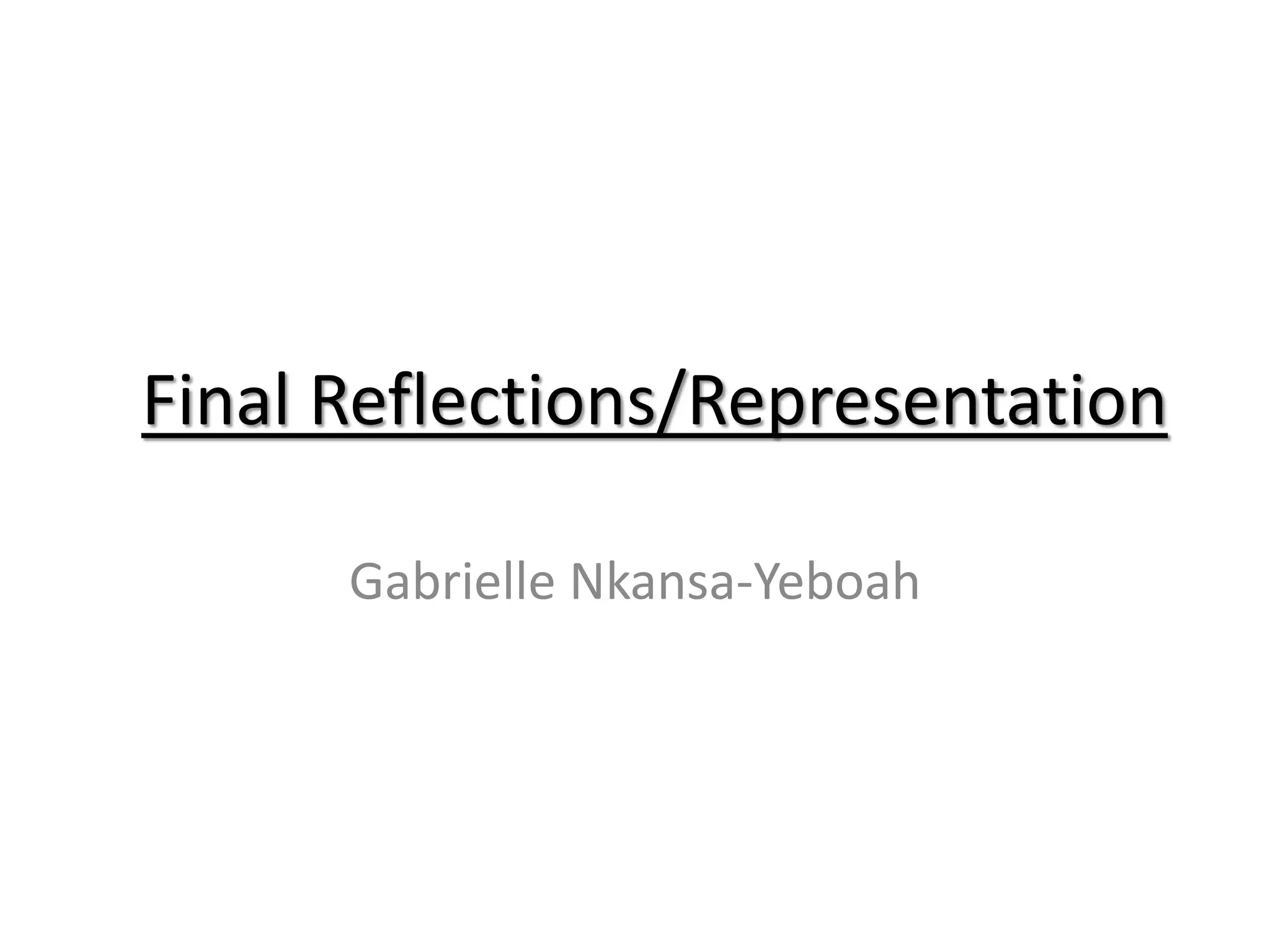
The protagonists challenges the conventions of
homeless people. For example the character is
a teenage orphan which is rarely depicted in
films along with his ethnicity. In which the
stereotypes of teenagers is also challenged. For
example the character is shown as hard
working and eager to be successful, whereas
teenagers are usually depicted as troublesome.
However stereotypes are still used to portray
the character as being homeless. For example
through the costume and props used as well
the location.
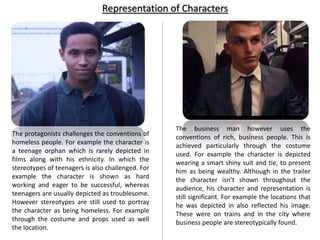
The business man however uses the
conventions of rich, business people. This is
achieved particularly through the costume
used. For example the character is depicted
wearing a smart shiny suit and tie, to present
him as being wealthy. Although in the trailer
the character isn’t shown throughout the
audience, his character and representation is
still significant. For example the locations that
he was depicted in also reflected his image.
These were on trains and in the city where
business people are stereotypically found.
Representation of Characters
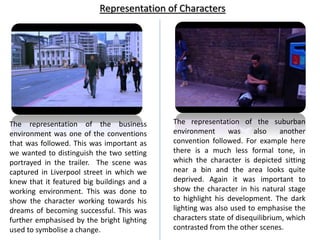
The representation of the business
environment was one of the conventions
that was followed. This was important as
we wanted to distinguish the two setting
portrayed in the trailer. The scene was
captured in Liverpool street in which we
knew that it featured big buildings and a
working environment. This was done to
show the character working towards his
dreams of becoming successful. This was
further emphasised by the bright lighting
used to symbolise a change.
The representation of the suburban
environment was also another
convention followed. For example here
there is a much less formal tone, in
which the character is depicted sitting
near a bin and the area looks quite
deprived. Again it was important to
show the character in his natural stage
to highlight his development. The dark
lighting was also used to emphasise the
characters state of disequilibrium, which
contrasted from the other scenes.
Representation of Characters
Representation of Target Audience
Our target audience was teenagers
between the age of 16-24. As a result we
wanted the audience to be able to relate to
the story given by making the protagonist a
teenager. We first began by relating our
ideas to our genre “drama” In which it
conventionally deal with real life issues. As
a result we focused on the main issues
dealt with by teenagers, however we didn’t
want to focus on conventional issues
portrayed in films such as gangs, crime,
drugs etc. Thus we decided to focus on the
aspirations and success of young people
and the issues surrounding that.
Furthermore the protagonists being
homeless and an orphan. symbolically
represents the struggles and set backs
stopping teenagers from reaching their
dream .
Improvements/ Pleased with:
Pleased with : I am thoroughly pleased with the outcome of the products and how well it
suited our genre. For example most of the feedback gained from our audience was very
positive in which many said that they would want to watch the whole film. I am also
pleased with the quality of our media products in which it resembled real media
products, thus making it very effective. The research and planning is also something that I
am pleased with as a lot of the development was as a result of this. In which we looked
at other real products and applied some of the influences to our products.
Improvements: I think the way our product could have been improved particularly in our
trailer is by adding scenes where the character is talking and interacting with another
character, as I feel that it lacked versatility and that this may have engaged the audience a
bit more. Another way our trailer could have been improved was by applying a range of
different scenes as I felt that they were too similar. This could have been improved by
showing a better contrast between the suburban and inner city environment as I felt that
this wasn’t shown enough. Thus limiting its effectiveness.

Final reflections - Evaluation

  • 1.
  • 2.
    The protagonists challengesthe conventions of homeless people. For example the character is a teenage orphan which is rarely depicted in films along with his ethnicity. In which the stereotypes of teenagers is also challenged. For example the character is shown as hard working and eager to be successful, whereas teenagers are usually depicted as troublesome. However stereotypes are still used to portray the character as being homeless. For example through the costume and props used as well the location. The business man however uses the conventions of rich, business people. This is achieved particularly through the costume used. For example the character is depicted wearing a smart shiny suit and tie, to present him as being wealthy. Although in the trailer the character isn’t shown throughout the audience, his character and representation is still significant. For example the locations that he was depicted in also reflected his image. These were on trains and in the city where business people are stereotypically found. Representation of Characters
  • 3.
    The representation ofthe business environment was one of the conventions that was followed. This was important as we wanted to distinguish the two setting portrayed in the trailer. The scene was captured in Liverpool street in which we knew that it featured big buildings and a working environment. This was done to show the character working towards his dreams of becoming successful. This was further emphasised by the bright lighting used to symbolise a change. The representation of the suburban environment was also another convention followed. For example here there is a much less formal tone, in which the character is depicted sitting near a bin and the area looks quite deprived. Again it was important to show the character in his natural stage to highlight his development. The dark lighting was also used to emphasise the characters state of disequilibrium, which contrasted from the other scenes. Representation of Characters
  • 4.
    Representation of TargetAudience Our target audience was teenagers between the age of 16-24. As a result we wanted the audience to be able to relate to the story given by making the protagonist a teenager. We first began by relating our ideas to our genre “drama” In which it conventionally deal with real life issues. As a result we focused on the main issues dealt with by teenagers, however we didn’t want to focus on conventional issues portrayed in films such as gangs, crime, drugs etc. Thus we decided to focus on the aspirations and success of young people and the issues surrounding that. Furthermore the protagonists being homeless and an orphan. symbolically represents the struggles and set backs stopping teenagers from reaching their dream .
  • 5.
    Improvements/ Pleased with: Pleasedwith : I am thoroughly pleased with the outcome of the products and how well it suited our genre. For example most of the feedback gained from our audience was very positive in which many said that they would want to watch the whole film. I am also pleased with the quality of our media products in which it resembled real media products, thus making it very effective. The research and planning is also something that I am pleased with as a lot of the development was as a result of this. In which we looked at other real products and applied some of the influences to our products. Improvements: I think the way our product could have been improved particularly in our trailer is by adding scenes where the character is talking and interacting with another character, as I feel that it lacked versatility and that this may have engaged the audience a bit more. Another way our trailer could have been improved was by applying a range of different scenes as I felt that they were too similar. This could have been improved by showing a better contrast between the suburban and inner city environment as I felt that this wasn’t shown enough. Thus limiting its effectiveness.