Royal University of Phnom Penh Master of Education Program
ED2004: Quantitative Research in Education Page 1 of 11
The Students’ Achievement of Sixth Graders between Rural
and Urban Areas
Case Study in Battambang Province
1. Introduction
Improving the quality of basic education is taken into account by the Ministry of Education
Youth and Sports (MoEYS) to reach education strategic plan 2014-2018, education 2030,
education declaration towards inclusive and equitable quality education, and lifelong learning for
all. The grade 6 is a transition stage of children to be ready at lower secondary schools. However,
the 6th graders’ capacity and knowledge in urban and rural areas still have a wider gap. According
to the national assessment of grade 3 in 2006 and 2009 and grade 7 in 2007 revealed that grade 6
students performed less than their younger counterparts. Currently, MoEYS released the report on
student assessment through Cambodia piloted EGRA test. The assessment was given to 2,400
children in Grades 1 to 6 in 40 schools in 18 provinces. The assessment indicated that majority of
grade 1, 2, and 3 students tested could read numbers, but did not have strong conceptual
understandings. Grade 6 students were good at procedural skills, but lacked conceptual
understandings. The majority of grade three students were not learning basic Khmer and
mathematics skills in earlier grades (MoEYS, 2015). Based on the exam result as well, Cambodian
piloted EGRA test clearly presented the learning outcome of students at grade 1, 2 & 3 was low
and underachievement that has not met the goal of CFS and education policy of MoEYS. However,
MoEYS only pointed out the general achievement of students. It did not indicate about the
education performance in rural area.
According to the presentation by the Minister of Education Youth and Sports, H.E. Hang
Choun Naron (2014), there has been some greater improvement in education development of
Cambodia, especially primary and secondary education. Over the last decade (2008-2012), all most
members of Association of Southeast Asian Nations (ASEAN) have successfully achieved net
primary enrolment rate. For example, Vietnam reached 98.10% which was higher than Thailand,
95.60%. The Royal government of Cambodia has offered free universal primary education to all
children to pushed net primary enrolment rate up to 98.40% which was higher than other member
states of ASEAN. However, there have been still many problems with early grade reading and
mathematics. 12% of students at Grade 2 had great difficulty in reading (66.5% master the skills
required); 53% attained appropriate math level, with 36% at the intermediate level. High dropout
Royal University of Phnom Penh Master of Education Program
ED2004: Quantitative Research in Education Page 2 of 11
rate was 20% at lower secondary education, although gross enrolment rate for lower secondary
level was 53%.
Therefore, in order to compare the students’ achievement in rural and urban areas, this study
is a good reflection on the grade 6 students’ performance in urban and rural area, and gender based
performance in learning skills of Khmer and Math.
2. Research purpose
This research is determined to fulfill the following purposes:
- To find out the achievement gap between rural and urban students in Khmer and Math
subjects
- To find out the achievement gap between male and female students on each subject, Khmer
and Math.
3. Research questions
In order the above purposes of this research, the following research questions are to be answered:
- What is different mean score of Khmer and Math subjects between grade 6 students in Rural
and Urban areas?
- What is different mean score of Khmersubject between male and female students?
- What is different mean score of math subject between male and female students?
4. Research methodology
4.1. Sample selection and instrument
BTB primary school project has been implemented at 16 primary schools in BTB and
Sangke districts for 3 years (2013-2016), and 6 primary schools in Rukakiri district which just
started in 2016. The project conducted the outstanding student contest at 22 target schools in order
to assess the knowledge and effective capacity in Khmer or math which are the fundamental
subjects among three subjects taught in primary school. The committee was formed to coordinate
the outstanding student contest comprised of POE, DOE, NGO staff and school directors as
members to develop tests and correct them. All children from grade 4, 5 & 6 were given an equal
opportunity to select only one of two subjects—either Mathematics or Khmer for the exam. The
first phase, all student registered for the exam at the school level which was conducted on 29 June
2016. There were 1340 students (828 female) of grade 4, 5 & 6 from 22 targeted primary schools
joined the exam. Those students got the exam at the same day and same amount of time (1h30mn),
and the tests were designed based on the grades. As the result, the project selected only top 3
Royal University of Phnom Penh Master of Education Program
ED2004: Quantitative Research in Education Page 3 of 11
students, who got the highest score among their peer at their schools, from each subject of each
grade to join the exam at school cluster level. Therefore, 408 students of grade 4, 5 & 6 joined the
exam at school cluster level on 25 July 2016. The tests were corrected thoroughly by POE, DOE,
and the directors of targeted school. The passed students received rewards and appreciation letters
from the project. Since there were many students from three different grades, the researchers chose
only the students from grade 6 who passed the second phase of the exam for both Khmer and Math
subjects as the samples for their research in order to find out and compare the achievement level
between the rural and urban students. Table 1 below shows the numbers of students who registered
for the exam and the selected samples.
Table 1: Numbers of students at selected primary schools and register to join the exam
No. School Name
2015-2016
# of
register # of the
passGrade 6 Volunteer # in subject
Khmer Math from school
Total Female T F % T F T F Total
1 BuoKhna 41 23 20 13 48.78 10 8 10 5 6
2 AnlongLvea 24 16 16 12 66.67 10 9 6 3 6
3 Kampong Chhlorng 20 16 12 11 60.00 6 6 6 5 6
4 AusralaoKert 63 32 21 20 33.33 11 10 10 10 6
5 AukacheayTbong 25 12 21 10 84.00 10 4 11 6 6
6 Wat Cheng 61 29 37 19 60.66 20 12 17 7 6
7 BosPor 82 48 32 15 39.02 15 8 17 7 6
8 Audambong I 41 27 20 12 48.78 11 7 9 5 6
9 AukacheayCherng 28 19 22 17 78.57 6 6 16 11 6
10 Anlongvil 204 107 26 16 12.75 13 10 13 6 12
11 Wat Leap 61 34 23 16 37.70 12 6 11 10 12
12 Rumchek III 32 15 26 11 81.25 14 7 12 4 6
13 Sophy 42 14 18 8 42.86 9 5 9 3 6
14 Chhouk 10 6 6 4 60.00 3 2 3 2 6
15 ChraingKpors 60 27 10 8 16.67 4 3 6 5 6
16 Chakrey 23 10 10 8 43.48 5 5 5 3 6
Total 817 435 320 200 39.17 159 108 161 92 108
4.2. Data Collection for the research study
The data used in his study was collected from the results of the outstanding student’s exams
of the 108 sixth graders at 16 selected primary schools of 7 school clusters. The 16 target schools
are located in 3 different districts—BTB, Sangke and Rukakiri in BTB province. Among the 16
primary schools, 6 primary schools are located in urban while the other 10 are located in rural area.
Royal University of Phnom Penh Master of Education Program
ED2004: Quantitative Research in Education Page 4 of 11
This study focuses on students’ achievement of grade 6 in Khmer and Math subjects in rural
and urban areas in Battambang province. It analyzes the learning outcome of students between
rural and urban areas based on the test score coming from the exam of school cluster level.
Moreover, it would be assessed the knowledge and affective capacity of the 6th graders from urban
and rural areas because the grade 6 is the last grade in primary school before transferring to lower
secondary school.
Table2: Gender tendency in passing the tests with high score in exam
Gender Total
Female Male
Subjects Khmer Subject 40 14 54
Math Subject 32 22 54
Total 72 36 108
Table 2 shows the differences between male and female students from 16 schools who
passed the tests with high scores. Among 108 passed students with high scores for both subjects,
female students passed Khmer test more than male students, 40 females and 14 males. Likewise,
there were 32 female students passed math test while there were 22 male students passed the same
test.
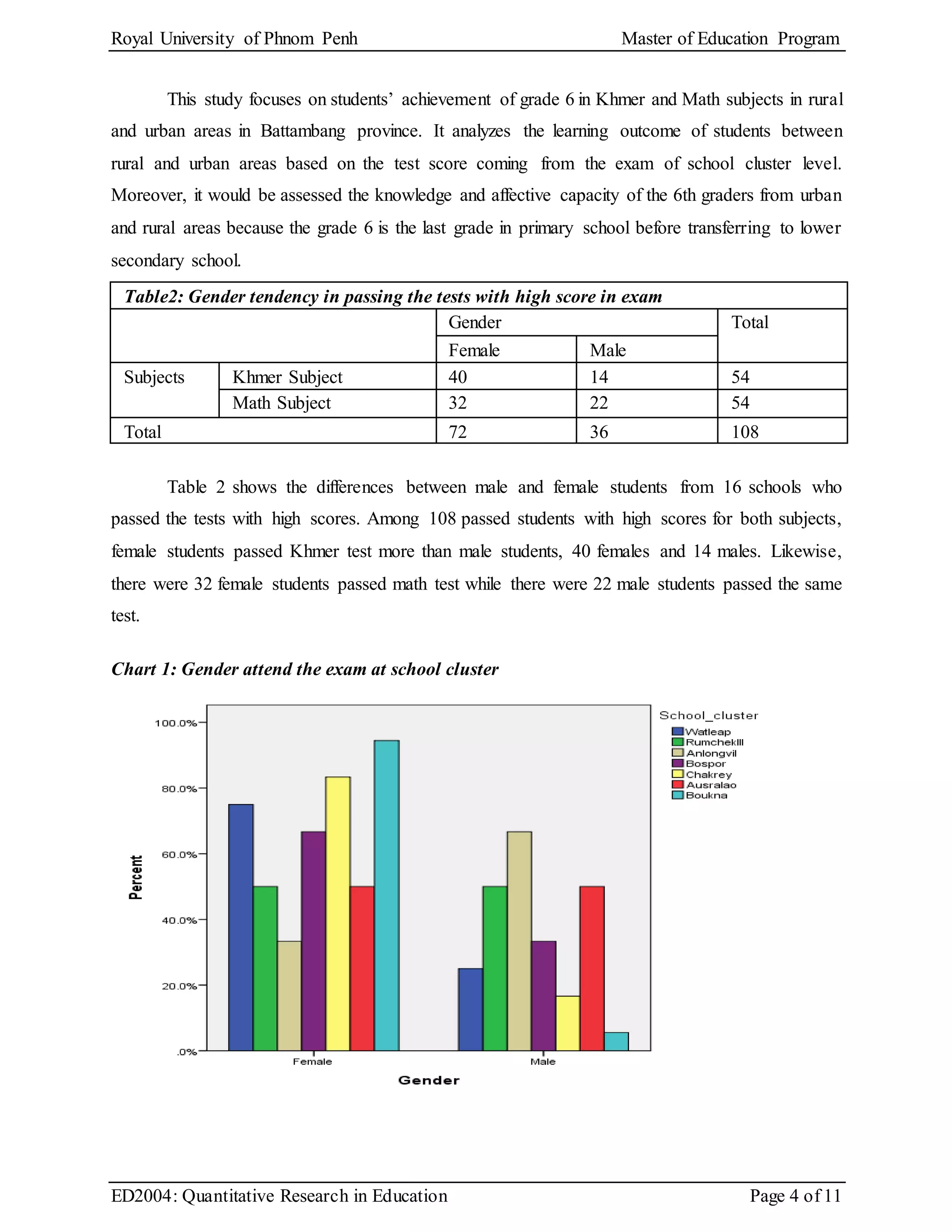
Chart 1: Gender attend the exam at school cluster
Royal University of Phnom Penh Master of Education Program
ED2004: Quantitative Research in Education Page 5 of 11
Chart 1 above shows the comparison between male students and female students who have
registered in seven primary school clusters: Watleap, Rumchek III, Anlongvil, Bospor, Chakrey,
Ausralao, and Boukna. In Watleap, the female students are higher than male students around 50
percent. The total female students are approximately 78%. Surprisingly, the male and female
students registering in Rumchek III school cluster are the same, 50%. In Anlongvil primary school,
the female students are two times less than the male students, 35% and 66% comparatively. In
contrast, the female students in Bospor primary school is almost double compared to male students.
The female students are around 66% while the male students are about 35%. Remarkably, the
female students in Chakrey school cluster and Boukna school cluster are too far different from the
male students. In Chakrey, the female students are approximately 82%, but the male students are
around 19%. For Ausralao school cluster, the female students equal the male students.
4.3. Data Analysis
The purpose of this analysis or study was determined to see the different mean score of
Khmer and math tests of sixth graders between rural and urban areas, and mean score of Khmer
and math tests between male and female students; and to determine the factors that affect the
students’ achievement at primary school. That’s why, this study used T-test and ANOVA analysis
to find out the different mean scores of Khmer and math subjects between urban and rural areas,
and between male and female students.
5. Research Finding
Shown below are the results for each of the proposed research questions above.
5.1. What is different mean score of Khmer and Math subjects between grade 6th students in
Rural and Urban areas?
Table 3: Khmer score and math score at urban and rural schools
N Mean Std. Deviation Std. Error
KH_Score Urban 24 6.8242 1.86672 .38104
Rural 30 5.7503 1.48609 .27132
Total 54 6.2276 1.73513 .23612
MA_Score Urban 24 6.5208 2.05484 .41944
Rural 30 4.1383 1.37870 .25171
Total 54 5.1972 2.07374 .28220
Based on the descriptive statistic on mean scores of Khmer subject and math subject
between rural and urban areas in table 3 shows that mean score of Khmer subject in urban is 6.8242
Royal University of Phnom Penh Master of Education Program
ED2004: Quantitative Research in Education Page 6 of 11
while mean score of Khmer subject in rural is 5.7503. Consequently, it can be assumed that the
mean scores between these two areas are slightly different and above average of total score (5.00
≤10.00). It indicated that the sixth graders in urban and rural areas have quite similar knowledge
and capacity level in Khmer subject due to Khmer is their mother tongue, and the family members
can help their children at home. MoEYS report (2015) presented that more than 500 students from
grade 6 or 11% could not write, whereas only 0.5% of students write perfectly. 57% of students
could not write a letter. 58.3% of students could not interpret poems and transform poems into
normal phrases, and only 6.7% can do it perfectly.
In contrast, the mean score of Math subject in Urban area is 6. 5208, but the mean score of
Math subject in rural area is 4.1383. Comparatively, the students who did the test on Math subject
in urban area got higher scores than students who did the same test in the rural area. It pointed out
that mean score of Math in rural area is below the average of total score. The study could not find
out the root causes why rural students have low performance in Math.
To sum up, the students who did the test on Khmer subject in Urban area got slightly higher
scores than the students in rural area (1.0739). However, for Math subject, urban students
gothigherscores than the rural students (2.3825). As a result, the students in urban area performed
better than students in rural area although the numbers of urban students who did the test were
lower than the rural students.
Table 4: The Output of ANOVA analysis
Sum of
Squares df
Mean
Square F Sig.
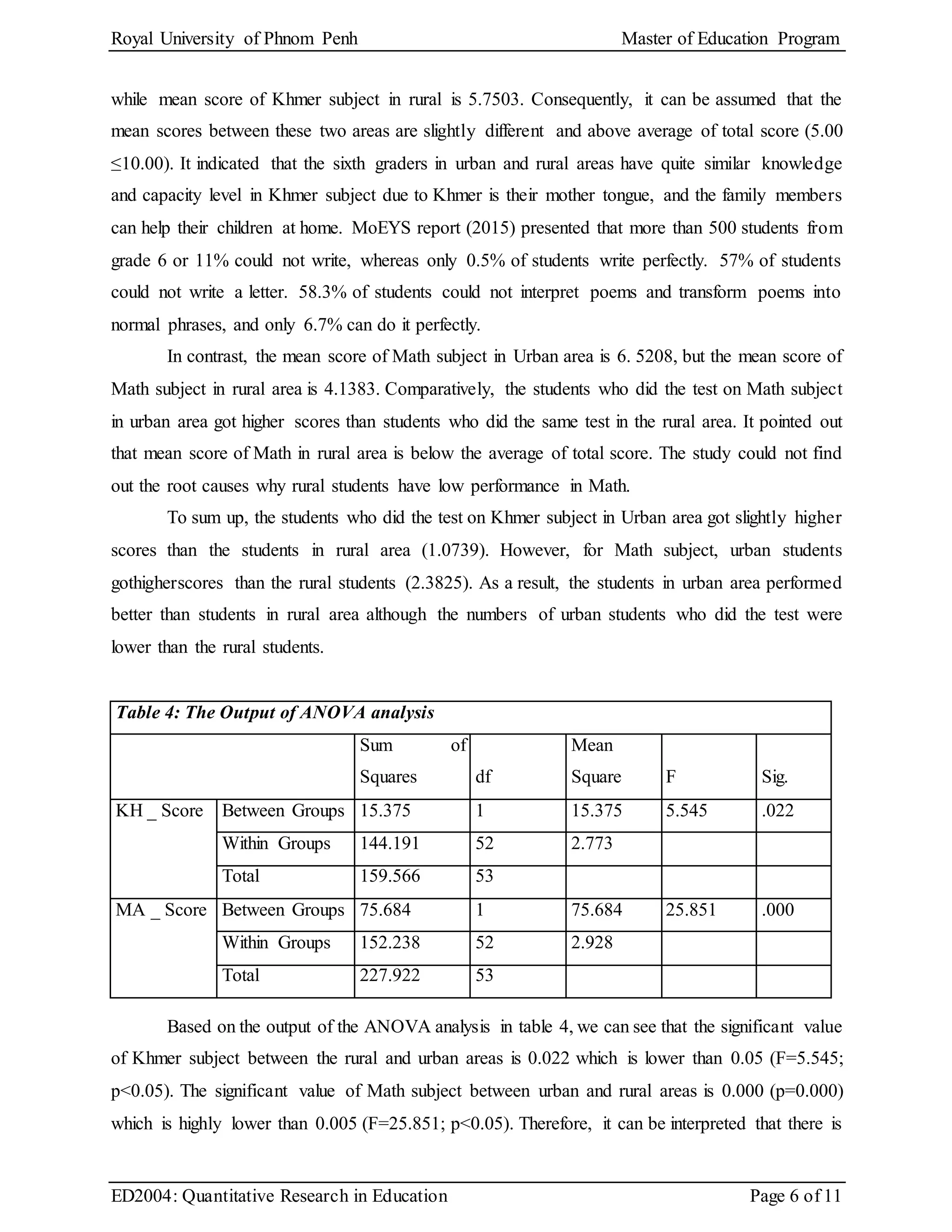
KH _ Score Between Groups 15.375 1 15.375 5.545 .022
Within Groups 144.191 52 2.773
Total 159.566 53
MA _ Score Between Groups 75.684 1 75.684 25.851 .000
Within Groups 152.238 52 2.928
Total 227.922 53
Based on the output of the ANOVA analysis in table 4, we can see that the significant value
of Khmer subject between the rural and urban areas is 0.022 which is lower than 0.05 (F=5.545;
p<0.05). The significant value of Math subject between urban and rural areas is 0.000 (p=0.000)
which is highly lower than 0.005 (F=25.851; p<0.05). Therefore, it can be interpreted that there is
Royal University of Phnom Penh Master of Education Program
ED2004: Quantitative Research in Education Page 7 of 11
a slightly significant difference between the mean score of Khmer subject between urban and rural
areas. However, there is a highly significant difference between the mean score of Math subject
between the urban and rural areas.
5.2. What is different mean score of Khmer subject between male and female students?
Table 5: Different mean score of Khmer subject between male and female students
Gender N Mean Std. Deviation Std. Error Mean
KH _ Score Female 40 5.9753 1.83897 .29077
Male 14 6.9486 1.17183 .31318
Based on the descriptive statistic in the table 5 above, it is clearly seen that the mean scoreof
male students is higher than the mean score of female students in Khmer subject even though the
numbers of female students are almost three times higher than the numbers of male students
(female=40; male=14). The mean score of female students is 5.9753, but the mean score of male
students is 6.9486. This shows that male students performed better than female students in terms
of test scores.
Table 6: Independent Samples Test
Levene's Testfor
Equality of
Variances t-test for Equality of Means
F Sig. t df
Sig. (2-
tailed)
Mean
Differenc
e
Std. Error
Differenc
e
95% Confidence
Interval of the
Difference
Lower Upper
KH_Score Equal
variances
assumed
3.061 .086 -1.847 52 .070 -.97332 .52695 -2.03073 .08409
Equal
variances
not assumed
-2.278 36.123 .029 -.97332 .42735 -1.83993 -.10671
According to t-test analysis as shown in the table 6 above, it shows that the significant value
of Khmer subject between male and female students is 0.086 which is greater than 0.05. Therefore,
there is no significant difference for the mean score of Khmer subject between male and female
Royal University of Phnom Penh Master of Education Program
ED2004: Quantitative Research in Education Page 8 of 11
students (F=3.061;p> 0.05). This means that the mean scores between male and female students
are not different from each other even though they were from different areas.
5.3. What is different mean score of math subject between male and female students?
Table 7: Different mean score of Math subject between male and female students
Gender N Mean Std. Deviation Std. Error Mean
MA _ Score Female 32 5.0813 2.01453 .35612
Male 22 5.3659 2.19368 .46769
Based on the table 7 above, the numbers of female students (32 students) who passed the
math test are higher than the numbers of male students (22 students); however, their mean scores
are almost the same (female=5.0813; male=5.3659). This shows that male students performed
slightly better during the test.
Table 8: Independent Samples Test
Levene's
Test for
Equality of
Variances t-test for Equality of Means
F Sig. t df
Sig.
(2-
tailed)
Mean
Differenc
e
Std. Error
Differenc
e
95% Confidence
Interval of the
Difference
Lower Upper
MA_Score Equal variances
assumed
.532 .469 -.492 52 .625 -.28466 .57849 -1.44548 .87616
Equal variances
not assumed
-.484 42.689 .631 -.28466 .58784 -1.47041 .90109
According to t-test analysis as shown in the table 8 above, the significant value of Math
subject between male and female students is 0.469 which is greater than 0.05. So it can be
interpreted that there is no significant difference for mean score of Math subject between male and
female students (F=532; p> 0.05). This means that the mean scores between male and female
students from both areas are not much different from each other.
6. Discussion
The result of this study indicated that the achievement of grade 6 students in the urban area
did perform better than students in the rural area. Based on the mean scores of students in urban
Royal University of Phnom Penh Master of Education Program
ED2004: Quantitative Research in Education Page 9 of 11
area and students in rural area, we could see clearly that the mean scores of urban students are
higher than rural students in both subjects, Khmer and Math. More importantly, the mean scores
of urban students and rural students who chose Khmer subject test, are slightly different. In
contrast, the mean score of Math subject in urban area is 6.5208, but the mean score of Math subject
in rural area is 4.1383. Comparatively, the students who did the Math subject in urban area got
higher scores than students in rural area. According to data analysis, it could be assumed that urban
students really performed with a high achievement in Math subject.
According to table 5, data has illustrated that the mean scores of male students, who chose
Khmer subject for test, are higher than female students. At the same time the data from table 7 has
also shown that the mean scores of male students who selected Math subject for test are higher than
female students. On the other hand, the number of male participants are much fewer than female
participants in both Khmer and Math subjects. It was such the main challenges and limited result
for our quantitative research. There were some main reasons to explain why there were fewer male
participants in the study. Compare to female students in taking the tests, male students would not
sit for the test if they lack of confidence. Thus, we could also see in data analysis that male
participants really performed better than female participants in both Khmer and Math subjects.
Even though this study wasn’t determined to discover the factors which have really
influenced the achievement of the students from both areas, we could assume that there may be
similar factors discovered in the previous study by Soeung, No, Ang, & Hirakawa (n.d.). They
studied on factors influencing student achievement in rural Cambodian primary schools with 1150
fourth-grade students (618 females) in BanteayMeanchey, Battambang and Kampong Cham. They
indicated in their study that individual, family and community factors had significant influence on
the achievement of the students. They claimed that the student-self-esteem was positively
correlated with math and Khmer test scores. Based on the above data analysisin this, most rural
students may lack of self-esteem while urban students may have higher self-esteem including the
involvement from family and community. Thus, urban students tend to have high achievement than
rural students in both subjects.
Unfortunately, there are not many research papers on the specific grade 6 in urban and rural
areas. That’s why the main reasons or factors contributing to the wider gap of quality of education
between the urban and rural areas haven’t clearly and exactly identified or discovered yet. In
general, CDRI (2015) reported that learning outcome of students is declined, especially in rural
areas or remote areas. Most grade 2 students cannot learn well because new version of textbooks
is too burden for them and students cannot catch up the lessons in the curriculum. Children are not
Royal University of Phnom Penh Master of Education Program
ED2004: Quantitative Research in Education Page 10 of 11
learning well in classroom because of lacking of teaching and learning materials, textbooks, and
classroom management and leadership skill of teachers, especially school directors as well as
classroom teachers rarely have discussion or engagement with parents of students. It means both
expertise, teachers and parents never meet each other to discuss about learning performance of
children to find out what kind of support their children need and how to help their children in
studying. MoEYS report (2015) presented that more than 500 students from grade 6 or 11% could
not write, whereas only 0.5% of students write perfectly. 57% of students could not write a letter.
58.3% of students could not interpret poems and transform poems into normal phrases, and only
6.7% can do it perfectly. In addition, NEP (2015) found out that too many schools have lost
instruction hours through unofficial holiday, teacher absence, and official school holiday. Average
teacher absence rate in rural area (12%) was higher than urban area (8%), as well as average
reduction of lesson duration in rural areas obtained 14% while urban area was only 7% (NEP,
2015).
7. Conclusion and Recommendation
Overall, the urban sixth graders have significantly achieved higher result and performance
than the rural sixth graders. Although the numbers of male participants were lower in the study due
to some reasons, male participants tend to provide greater positive achievement than female
participants on both subjects. Therefore, government, NGOs, and other educational development
partners have significant roles in implementing programs to boost the student-self-esteem, the
involvement from family and community, and teacher performance in teaching and working in
school for enhancing students learning and achievement in the rural areas.
Royal University of Phnom Penh Master of Education Program
ED2004: Quantitative Research in Education Page 11 of 11
References
Ang, S., Anderson. C., & Chhum, S. (July 2015). Teaching hours in School in Cambodia. Phnom
Penh: NGO Education Partnership (NEP).
Hang, C., N. (2014). Reforming Institutions to ImproveEducation Service Delivery and Strengthen
Cambodia’s Competitiveness: Keynote address at the Cambodia Economic Association
Annual Meeting. Phnom Penh.
Khieng, S., Srinivasa, M., & Chhem, R. (Mar, 2015). Education 2015 Employment and
Empowerment. Phnom Penh: Cambodia Development Resource Institute.
MoEYS (2015). Education congress on the education, Youth and Sport Performance in the
academic Year 2014-2016 and Goals For The Academic Year 2015-2016. Phnom Penh.
MoEYS (2015). Results of Grade Six Student Achievement from the National Assessment in 2013.
Phnom Penh: Education Quality Assurance Department, EQAD.
MoEYS (2014). National Education For All Committee: The National Education For All 2015
Review Report. Phnom Penh: Royal Government of Cambodia.
Soeung, S., No, F., Ang, B., & Hirakawa, Y. (n.d.). Factors Influencing Student Achievement in
Rural Cambodian Primary Schools. Japan: Hiroshima University.

Final quantitative research paper

  • 1.
    Royal University ofPhnom Penh Master of Education Program ED2004: Quantitative Research in Education Page 1 of 11 The Students’ Achievement of Sixth Graders between Rural and Urban Areas Case Study in Battambang Province 1. Introduction Improving the quality of basic education is taken into account by the Ministry of Education Youth and Sports (MoEYS) to reach education strategic plan 2014-2018, education 2030, education declaration towards inclusive and equitable quality education, and lifelong learning for all. The grade 6 is a transition stage of children to be ready at lower secondary schools. However, the 6th graders’ capacity and knowledge in urban and rural areas still have a wider gap. According to the national assessment of grade 3 in 2006 and 2009 and grade 7 in 2007 revealed that grade 6 students performed less than their younger counterparts. Currently, MoEYS released the report on student assessment through Cambodia piloted EGRA test. The assessment was given to 2,400 children in Grades 1 to 6 in 40 schools in 18 provinces. The assessment indicated that majority of grade 1, 2, and 3 students tested could read numbers, but did not have strong conceptual understandings. Grade 6 students were good at procedural skills, but lacked conceptual understandings. The majority of grade three students were not learning basic Khmer and mathematics skills in earlier grades (MoEYS, 2015). Based on the exam result as well, Cambodian piloted EGRA test clearly presented the learning outcome of students at grade 1, 2 & 3 was low and underachievement that has not met the goal of CFS and education policy of MoEYS. However, MoEYS only pointed out the general achievement of students. It did not indicate about the education performance in rural area. According to the presentation by the Minister of Education Youth and Sports, H.E. Hang Choun Naron (2014), there has been some greater improvement in education development of Cambodia, especially primary and secondary education. Over the last decade (2008-2012), all most members of Association of Southeast Asian Nations (ASEAN) have successfully achieved net primary enrolment rate. For example, Vietnam reached 98.10% which was higher than Thailand, 95.60%. The Royal government of Cambodia has offered free universal primary education to all children to pushed net primary enrolment rate up to 98.40% which was higher than other member states of ASEAN. However, there have been still many problems with early grade reading and mathematics. 12% of students at Grade 2 had great difficulty in reading (66.5% master the skills required); 53% attained appropriate math level, with 36% at the intermediate level. High dropout
  • 2.
    Royal University ofPhnom Penh Master of Education Program ED2004: Quantitative Research in Education Page 2 of 11 rate was 20% at lower secondary education, although gross enrolment rate for lower secondary level was 53%. Therefore, in order to compare the students’ achievement in rural and urban areas, this study is a good reflection on the grade 6 students’ performance in urban and rural area, and gender based performance in learning skills of Khmer and Math. 2. Research purpose This research is determined to fulfill the following purposes: - To find out the achievement gap between rural and urban students in Khmer and Math subjects - To find out the achievement gap between male and female students on each subject, Khmer and Math. 3. Research questions In order the above purposes of this research, the following research questions are to be answered: - What is different mean score of Khmer and Math subjects between grade 6 students in Rural and Urban areas? - What is different mean score of Khmersubject between male and female students? - What is different mean score of math subject between male and female students? 4. Research methodology 4.1. Sample selection and instrument BTB primary school project has been implemented at 16 primary schools in BTB and Sangke districts for 3 years (2013-2016), and 6 primary schools in Rukakiri district which just started in 2016. The project conducted the outstanding student contest at 22 target schools in order to assess the knowledge and effective capacity in Khmer or math which are the fundamental subjects among three subjects taught in primary school. The committee was formed to coordinate the outstanding student contest comprised of POE, DOE, NGO staff and school directors as members to develop tests and correct them. All children from grade 4, 5 & 6 were given an equal opportunity to select only one of two subjects—either Mathematics or Khmer for the exam. The first phase, all student registered for the exam at the school level which was conducted on 29 June 2016. There were 1340 students (828 female) of grade 4, 5 & 6 from 22 targeted primary schools joined the exam. Those students got the exam at the same day and same amount of time (1h30mn), and the tests were designed based on the grades. As the result, the project selected only top 3
  • 3.
    Royal University ofPhnom Penh Master of Education Program ED2004: Quantitative Research in Education Page 3 of 11 students, who got the highest score among their peer at their schools, from each subject of each grade to join the exam at school cluster level. Therefore, 408 students of grade 4, 5 & 6 joined the exam at school cluster level on 25 July 2016. The tests were corrected thoroughly by POE, DOE, and the directors of targeted school. The passed students received rewards and appreciation letters from the project. Since there were many students from three different grades, the researchers chose only the students from grade 6 who passed the second phase of the exam for both Khmer and Math subjects as the samples for their research in order to find out and compare the achievement level between the rural and urban students. Table 1 below shows the numbers of students who registered for the exam and the selected samples. Table 1: Numbers of students at selected primary schools and register to join the exam No. School Name 2015-2016 # of register # of the passGrade 6 Volunteer # in subject Khmer Math from school Total Female T F % T F T F Total 1 BuoKhna 41 23 20 13 48.78 10 8 10 5 6 2 AnlongLvea 24 16 16 12 66.67 10 9 6 3 6 3 Kampong Chhlorng 20 16 12 11 60.00 6 6 6 5 6 4 AusralaoKert 63 32 21 20 33.33 11 10 10 10 6 5 AukacheayTbong 25 12 21 10 84.00 10 4 11 6 6 6 Wat Cheng 61 29 37 19 60.66 20 12 17 7 6 7 BosPor 82 48 32 15 39.02 15 8 17 7 6 8 Audambong I 41 27 20 12 48.78 11 7 9 5 6 9 AukacheayCherng 28 19 22 17 78.57 6 6 16 11 6 10 Anlongvil 204 107 26 16 12.75 13 10 13 6 12 11 Wat Leap 61 34 23 16 37.70 12 6 11 10 12 12 Rumchek III 32 15 26 11 81.25 14 7 12 4 6 13 Sophy 42 14 18 8 42.86 9 5 9 3 6 14 Chhouk 10 6 6 4 60.00 3 2 3 2 6 15 ChraingKpors 60 27 10 8 16.67 4 3 6 5 6 16 Chakrey 23 10 10 8 43.48 5 5 5 3 6 Total 817 435 320 200 39.17 159 108 161 92 108 4.2. Data Collection for the research study The data used in his study was collected from the results of the outstanding student’s exams of the 108 sixth graders at 16 selected primary schools of 7 school clusters. The 16 target schools are located in 3 different districts—BTB, Sangke and Rukakiri in BTB province. Among the 16 primary schools, 6 primary schools are located in urban while the other 10 are located in rural area.
  • 4.
    Royal University ofPhnom Penh Master of Education Program ED2004: Quantitative Research in Education Page 4 of 11 This study focuses on students’ achievement of grade 6 in Khmer and Math subjects in rural and urban areas in Battambang province. It analyzes the learning outcome of students between rural and urban areas based on the test score coming from the exam of school cluster level. Moreover, it would be assessed the knowledge and affective capacity of the 6th graders from urban and rural areas because the grade 6 is the last grade in primary school before transferring to lower secondary school. Table2: Gender tendency in passing the tests with high score in exam Gender Total Female Male Subjects Khmer Subject 40 14 54 Math Subject 32 22 54 Total 72 36 108 Table 2 shows the differences between male and female students from 16 schools who passed the tests with high scores. Among 108 passed students with high scores for both subjects, female students passed Khmer test more than male students, 40 females and 14 males. Likewise, there were 32 female students passed math test while there were 22 male students passed the same test. Chart 1: Gender attend the exam at school cluster
  • 5.
    Royal University ofPhnom Penh Master of Education Program ED2004: Quantitative Research in Education Page 5 of 11 Chart 1 above shows the comparison between male students and female students who have registered in seven primary school clusters: Watleap, Rumchek III, Anlongvil, Bospor, Chakrey, Ausralao, and Boukna. In Watleap, the female students are higher than male students around 50 percent. The total female students are approximately 78%. Surprisingly, the male and female students registering in Rumchek III school cluster are the same, 50%. In Anlongvil primary school, the female students are two times less than the male students, 35% and 66% comparatively. In contrast, the female students in Bospor primary school is almost double compared to male students. The female students are around 66% while the male students are about 35%. Remarkably, the female students in Chakrey school cluster and Boukna school cluster are too far different from the male students. In Chakrey, the female students are approximately 82%, but the male students are around 19%. For Ausralao school cluster, the female students equal the male students. 4.3. Data Analysis The purpose of this analysis or study was determined to see the different mean score of Khmer and math tests of sixth graders between rural and urban areas, and mean score of Khmer and math tests between male and female students; and to determine the factors that affect the students’ achievement at primary school. That’s why, this study used T-test and ANOVA analysis to find out the different mean scores of Khmer and math subjects between urban and rural areas, and between male and female students. 5. Research Finding Shown below are the results for each of the proposed research questions above. 5.1. What is different mean score of Khmer and Math subjects between grade 6th students in Rural and Urban areas? Table 3: Khmer score and math score at urban and rural schools N Mean Std. Deviation Std. Error KH_Score Urban 24 6.8242 1.86672 .38104 Rural 30 5.7503 1.48609 .27132 Total 54 6.2276 1.73513 .23612 MA_Score Urban 24 6.5208 2.05484 .41944 Rural 30 4.1383 1.37870 .25171 Total 54 5.1972 2.07374 .28220 Based on the descriptive statistic on mean scores of Khmer subject and math subject between rural and urban areas in table 3 shows that mean score of Khmer subject in urban is 6.8242
  • 6.
    Royal University ofPhnom Penh Master of Education Program ED2004: Quantitative Research in Education Page 6 of 11 while mean score of Khmer subject in rural is 5.7503. Consequently, it can be assumed that the mean scores between these two areas are slightly different and above average of total score (5.00 ≤10.00). It indicated that the sixth graders in urban and rural areas have quite similar knowledge and capacity level in Khmer subject due to Khmer is their mother tongue, and the family members can help their children at home. MoEYS report (2015) presented that more than 500 students from grade 6 or 11% could not write, whereas only 0.5% of students write perfectly. 57% of students could not write a letter. 58.3% of students could not interpret poems and transform poems into normal phrases, and only 6.7% can do it perfectly. In contrast, the mean score of Math subject in Urban area is 6. 5208, but the mean score of Math subject in rural area is 4.1383. Comparatively, the students who did the test on Math subject in urban area got higher scores than students who did the same test in the rural area. It pointed out that mean score of Math in rural area is below the average of total score. The study could not find out the root causes why rural students have low performance in Math. To sum up, the students who did the test on Khmer subject in Urban area got slightly higher scores than the students in rural area (1.0739). However, for Math subject, urban students gothigherscores than the rural students (2.3825). As a result, the students in urban area performed better than students in rural area although the numbers of urban students who did the test were lower than the rural students. Table 4: The Output of ANOVA analysis Sum of Squares df Mean Square F Sig. KH _ Score Between Groups 15.375 1 15.375 5.545 .022 Within Groups 144.191 52 2.773 Total 159.566 53 MA _ Score Between Groups 75.684 1 75.684 25.851 .000 Within Groups 152.238 52 2.928 Total 227.922 53 Based on the output of the ANOVA analysis in table 4, we can see that the significant value of Khmer subject between the rural and urban areas is 0.022 which is lower than 0.05 (F=5.545; p<0.05). The significant value of Math subject between urban and rural areas is 0.000 (p=0.000) which is highly lower than 0.005 (F=25.851; p<0.05). Therefore, it can be interpreted that there is
  • 7.
    Royal University ofPhnom Penh Master of Education Program ED2004: Quantitative Research in Education Page 7 of 11 a slightly significant difference between the mean score of Khmer subject between urban and rural areas. However, there is a highly significant difference between the mean score of Math subject between the urban and rural areas. 5.2. What is different mean score of Khmer subject between male and female students? Table 5: Different mean score of Khmer subject between male and female students Gender N Mean Std. Deviation Std. Error Mean KH _ Score Female 40 5.9753 1.83897 .29077 Male 14 6.9486 1.17183 .31318 Based on the descriptive statistic in the table 5 above, it is clearly seen that the mean scoreof male students is higher than the mean score of female students in Khmer subject even though the numbers of female students are almost three times higher than the numbers of male students (female=40; male=14). The mean score of female students is 5.9753, but the mean score of male students is 6.9486. This shows that male students performed better than female students in terms of test scores. Table 6: Independent Samples Test Levene's Testfor Equality of Variances t-test for Equality of Means F Sig. t df Sig. (2- tailed) Mean Differenc e Std. Error Differenc e 95% Confidence Interval of the Difference Lower Upper KH_Score Equal variances assumed 3.061 .086 -1.847 52 .070 -.97332 .52695 -2.03073 .08409 Equal variances not assumed -2.278 36.123 .029 -.97332 .42735 -1.83993 -.10671 According to t-test analysis as shown in the table 6 above, it shows that the significant value of Khmer subject between male and female students is 0.086 which is greater than 0.05. Therefore, there is no significant difference for the mean score of Khmer subject between male and female
  • 8.
    Royal University ofPhnom Penh Master of Education Program ED2004: Quantitative Research in Education Page 8 of 11 students (F=3.061;p> 0.05). This means that the mean scores between male and female students are not different from each other even though they were from different areas. 5.3. What is different mean score of math subject between male and female students? Table 7: Different mean score of Math subject between male and female students Gender N Mean Std. Deviation Std. Error Mean MA _ Score Female 32 5.0813 2.01453 .35612 Male 22 5.3659 2.19368 .46769 Based on the table 7 above, the numbers of female students (32 students) who passed the math test are higher than the numbers of male students (22 students); however, their mean scores are almost the same (female=5.0813; male=5.3659). This shows that male students performed slightly better during the test. Table 8: Independent Samples Test Levene's Test for Equality of Variances t-test for Equality of Means F Sig. t df Sig. (2- tailed) Mean Differenc e Std. Error Differenc e 95% Confidence Interval of the Difference Lower Upper MA_Score Equal variances assumed .532 .469 -.492 52 .625 -.28466 .57849 -1.44548 .87616 Equal variances not assumed -.484 42.689 .631 -.28466 .58784 -1.47041 .90109 According to t-test analysis as shown in the table 8 above, the significant value of Math subject between male and female students is 0.469 which is greater than 0.05. So it can be interpreted that there is no significant difference for mean score of Math subject between male and female students (F=532; p> 0.05). This means that the mean scores between male and female students from both areas are not much different from each other. 6. Discussion The result of this study indicated that the achievement of grade 6 students in the urban area did perform better than students in the rural area. Based on the mean scores of students in urban
  • 9.
    Royal University ofPhnom Penh Master of Education Program ED2004: Quantitative Research in Education Page 9 of 11 area and students in rural area, we could see clearly that the mean scores of urban students are higher than rural students in both subjects, Khmer and Math. More importantly, the mean scores of urban students and rural students who chose Khmer subject test, are slightly different. In contrast, the mean score of Math subject in urban area is 6.5208, but the mean score of Math subject in rural area is 4.1383. Comparatively, the students who did the Math subject in urban area got higher scores than students in rural area. According to data analysis, it could be assumed that urban students really performed with a high achievement in Math subject. According to table 5, data has illustrated that the mean scores of male students, who chose Khmer subject for test, are higher than female students. At the same time the data from table 7 has also shown that the mean scores of male students who selected Math subject for test are higher than female students. On the other hand, the number of male participants are much fewer than female participants in both Khmer and Math subjects. It was such the main challenges and limited result for our quantitative research. There were some main reasons to explain why there were fewer male participants in the study. Compare to female students in taking the tests, male students would not sit for the test if they lack of confidence. Thus, we could also see in data analysis that male participants really performed better than female participants in both Khmer and Math subjects. Even though this study wasn’t determined to discover the factors which have really influenced the achievement of the students from both areas, we could assume that there may be similar factors discovered in the previous study by Soeung, No, Ang, & Hirakawa (n.d.). They studied on factors influencing student achievement in rural Cambodian primary schools with 1150 fourth-grade students (618 females) in BanteayMeanchey, Battambang and Kampong Cham. They indicated in their study that individual, family and community factors had significant influence on the achievement of the students. They claimed that the student-self-esteem was positively correlated with math and Khmer test scores. Based on the above data analysisin this, most rural students may lack of self-esteem while urban students may have higher self-esteem including the involvement from family and community. Thus, urban students tend to have high achievement than rural students in both subjects. Unfortunately, there are not many research papers on the specific grade 6 in urban and rural areas. That’s why the main reasons or factors contributing to the wider gap of quality of education between the urban and rural areas haven’t clearly and exactly identified or discovered yet. In general, CDRI (2015) reported that learning outcome of students is declined, especially in rural areas or remote areas. Most grade 2 students cannot learn well because new version of textbooks is too burden for them and students cannot catch up the lessons in the curriculum. Children are not
  • 10.
    Royal University ofPhnom Penh Master of Education Program ED2004: Quantitative Research in Education Page 10 of 11 learning well in classroom because of lacking of teaching and learning materials, textbooks, and classroom management and leadership skill of teachers, especially school directors as well as classroom teachers rarely have discussion or engagement with parents of students. It means both expertise, teachers and parents never meet each other to discuss about learning performance of children to find out what kind of support their children need and how to help their children in studying. MoEYS report (2015) presented that more than 500 students from grade 6 or 11% could not write, whereas only 0.5% of students write perfectly. 57% of students could not write a letter. 58.3% of students could not interpret poems and transform poems into normal phrases, and only 6.7% can do it perfectly. In addition, NEP (2015) found out that too many schools have lost instruction hours through unofficial holiday, teacher absence, and official school holiday. Average teacher absence rate in rural area (12%) was higher than urban area (8%), as well as average reduction of lesson duration in rural areas obtained 14% while urban area was only 7% (NEP, 2015). 7. Conclusion and Recommendation Overall, the urban sixth graders have significantly achieved higher result and performance than the rural sixth graders. Although the numbers of male participants were lower in the study due to some reasons, male participants tend to provide greater positive achievement than female participants on both subjects. Therefore, government, NGOs, and other educational development partners have significant roles in implementing programs to boost the student-self-esteem, the involvement from family and community, and teacher performance in teaching and working in school for enhancing students learning and achievement in the rural areas.
  • 11.
    Royal University ofPhnom Penh Master of Education Program ED2004: Quantitative Research in Education Page 11 of 11 References Ang, S., Anderson. C., & Chhum, S. (July 2015). Teaching hours in School in Cambodia. Phnom Penh: NGO Education Partnership (NEP). Hang, C., N. (2014). Reforming Institutions to ImproveEducation Service Delivery and Strengthen Cambodia’s Competitiveness: Keynote address at the Cambodia Economic Association Annual Meeting. Phnom Penh. Khieng, S., Srinivasa, M., & Chhem, R. (Mar, 2015). Education 2015 Employment and Empowerment. Phnom Penh: Cambodia Development Resource Institute. MoEYS (2015). Education congress on the education, Youth and Sport Performance in the academic Year 2014-2016 and Goals For The Academic Year 2015-2016. Phnom Penh. MoEYS (2015). Results of Grade Six Student Achievement from the National Assessment in 2013. Phnom Penh: Education Quality Assurance Department, EQAD. MoEYS (2014). National Education For All Committee: The National Education For All 2015 Review Report. Phnom Penh: Royal Government of Cambodia. Soeung, S., No, F., Ang, B., & Hirakawa, Y. (n.d.). Factors Influencing Student Achievement in Rural Cambodian Primary Schools. Japan: Hiroshima University.