Group ID : 24
Project under the guidance of Prof. Ashwini Dalvi
Project By: Aniket Patil, Nishigandha Dandekar
[BE- IT (A)]
PROBLEM DEFINITION
To project a 2D image as a 3D holographic image (also known as
holograms) inside a glass pyramid and to interact with them using a
gesture recognition system so as to control the holograms.
 Convergence of Augmented reality, 3D holographic Projection and Sensors.
Augmented reality is a technology that augments the components of the immediate real
world surrounding with computer generated digital information. 3D Holographic
Projection is on of the ways of achieving Augmented reality as it enables the projection of a
static or dynamic object, on a holographic display or mid-air, such that it appears to be
three dimensional to the naked eye. It can be implemented by using lasers or three
dimensional computer graphics [1]. It provides an enticing view of the object, in space, to
the user. This experience can further be heightened by the use of sensors. Sensors are used
to detect the facial expressions and body movements of the user. These body movements
are taken as inputs and can be used for controlling a variety of devices like TV [2].They can
also be used to incorporate touch less hand gesture UI in devices like mobile phones
[3].Sensors also enable us to control PC using hand gestures [4]. Sixth sense technology is
an excellent example of amalgamation of augmented reality and sensors [5]. In this project,
we move a step further by merging Augmented Reality, sensors and 3D holographic
projection into a single system for providing a more enticing view of the object to the user.
LITERATURE SURVEY
1) Establish a connection between the Unity 3D software and the
software of the gesture
control device.
2) Obtain four projections of the object and project them on the
pyramid.
3) Ensure that the size of the base of the pyramid must be same as
that of the LCD
monitor screen.
PRE REQUISITES
Software Requirements Specification
SOFTWARE REQUIREMENTS SPECIFICATION
1)Orientation of images forms a hologram inside the pyramid shaped
prism.
2) Movement of hologram, as per the hand gestures of the user
FUNCTIONAL REQUIREMENTS
 Reliability
Reliability of the product is dependent on the reliability of the hand
gesture device. Thus, the product works accurately under moderate
lighting conditions.
 Availability
The product can be made available by assembling the three
hardware components of the product, supported by the unity 3D
software. The hardware components are LCD Screen, pyramid and
the hand gesture device
NON FUNCTIONAL REQUIREMENTS
 Security
Security of the product is directly dependent on the security of the
Unity 3D software. This software security can be regulated by the
means of any anti-virus software like Norton ,Avast etc. Physical
security of the hardware components is also necessary.
 Maintainability
Product is easy to maintain .
NON FUNCTIONAL REQUIREMENTS
 Portability
Product is highly portable as long as the hardware and software
components required by the product are readily available. These
components must be then assembled together for the functioning of
the product.
 Performance
This device is designed to be controlled by one user at a time. The
product delivers optimal performance under moderate lighting
conditions. The performance of the product deteriorates when the
hand gesture device is exposed to the sunlight.
NON FUNCTIONAL REQUIREMENTS
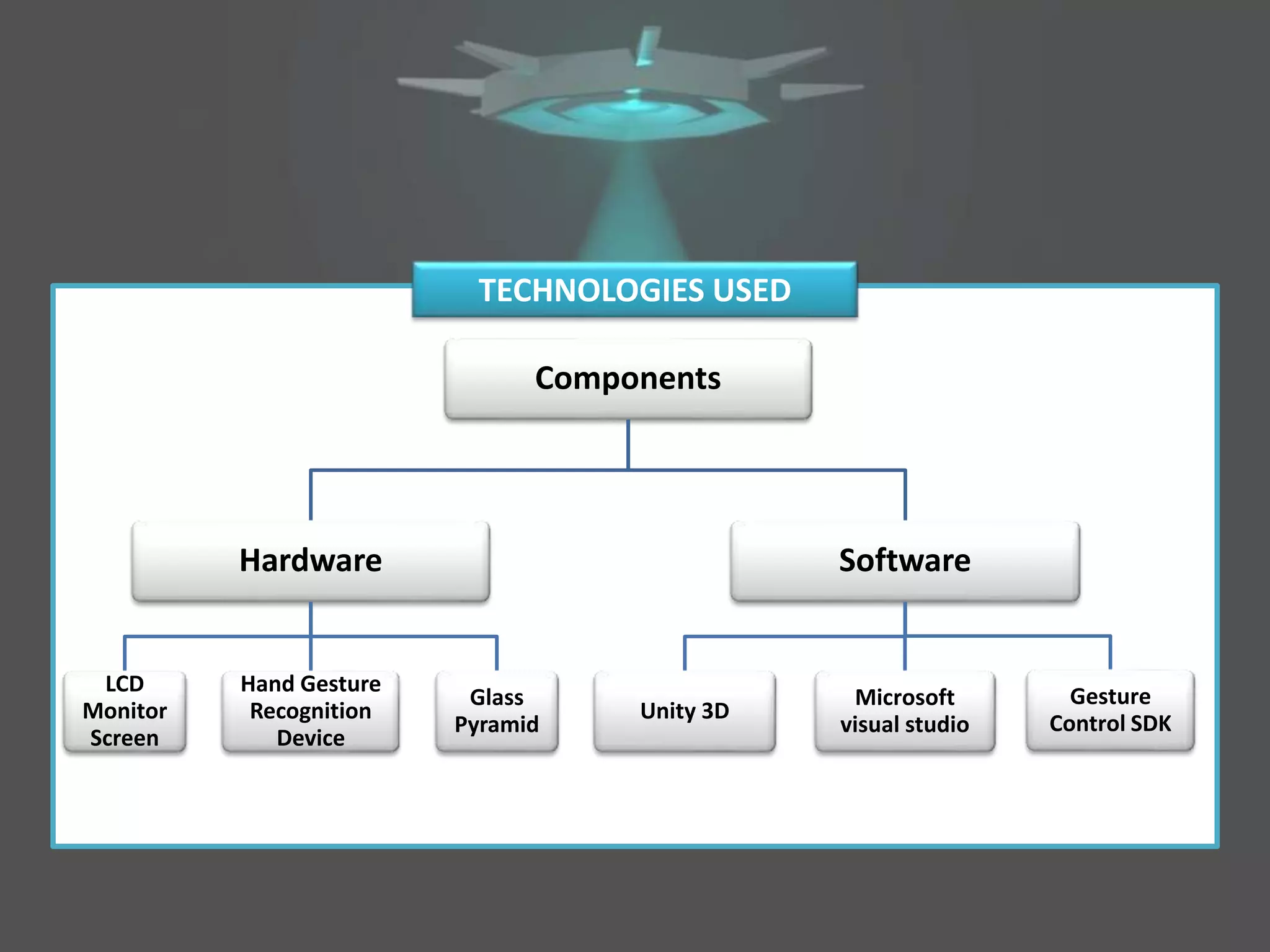
TECHNOLOGIES USED
Components
Hardware
LCD
Monitor
Screen
Hand Gesture
Recognition
Device
Glass
Pyramid
Software
Unity 3D
Microsoft
visual studio
Gesture
Control SDK
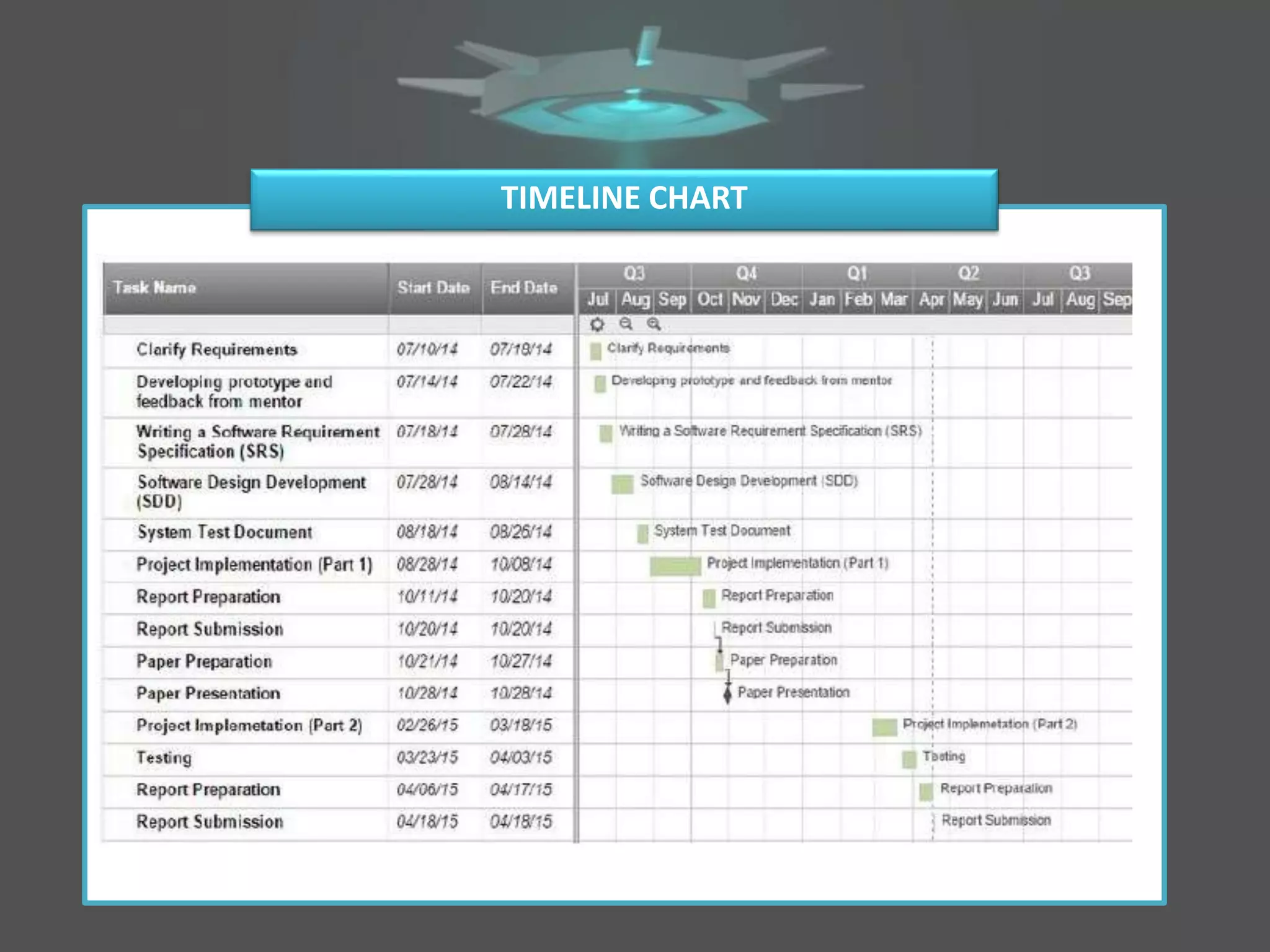
TIMELINE CHART
RESPONSIBILITIES
 Background Search
 Requirement Gathering and analysis
 Developing Software Requirement
 Specification (SRS)
 Coding
 Implementation
 Testing
 Project Presentation
 Paper Preparation
 Requirement gathering and analysis
 Developing Software Project
 Management Plan (SPMP)
 Developing the Software Design
Document
 Coding
 Implementation
 Testing
 Project Presentation
SOFTWARE DESIGN DOCUMENT
 A software design document (SDD) is a written description of a software
product, that a software designer writes in order to give a software
development team overall guidance to the architecture of the software
project.
 The following diagrams have been incorporated in the SDD:
1) Component Diagram
2) Deployment Diagram
 Software Design Document
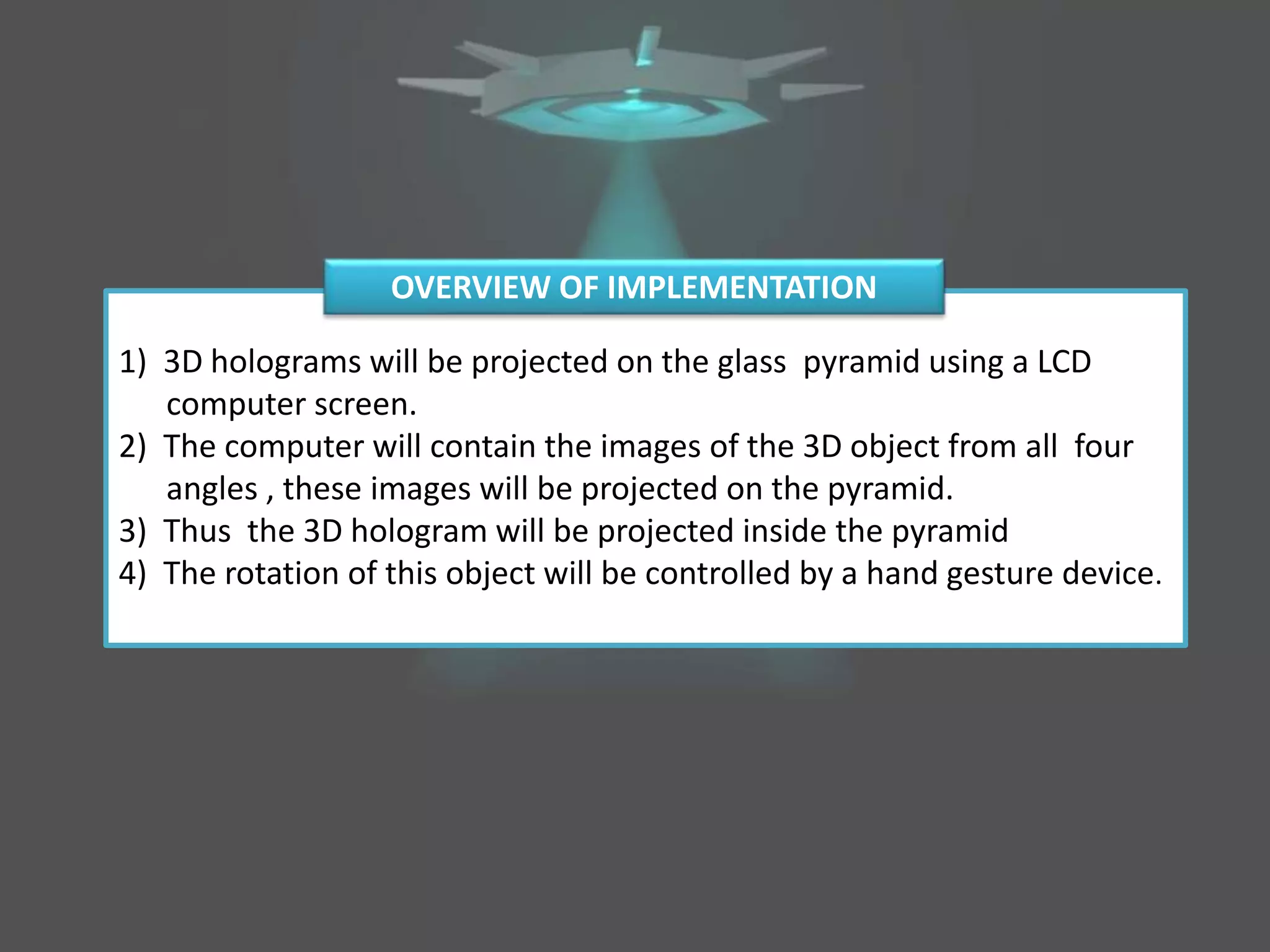
1) 3D holograms will be projected on the glass pyramid using a LCD
computer screen.
2) The computer will contain the images of the 3D object from all four
angles , these images will be projected on the pyramid.
3) Thus the 3D hologram will be projected inside the pyramid
4) The rotation of this object will be controlled by a hand gesture device.
OVERVIEW OF IMPLEMENTATION
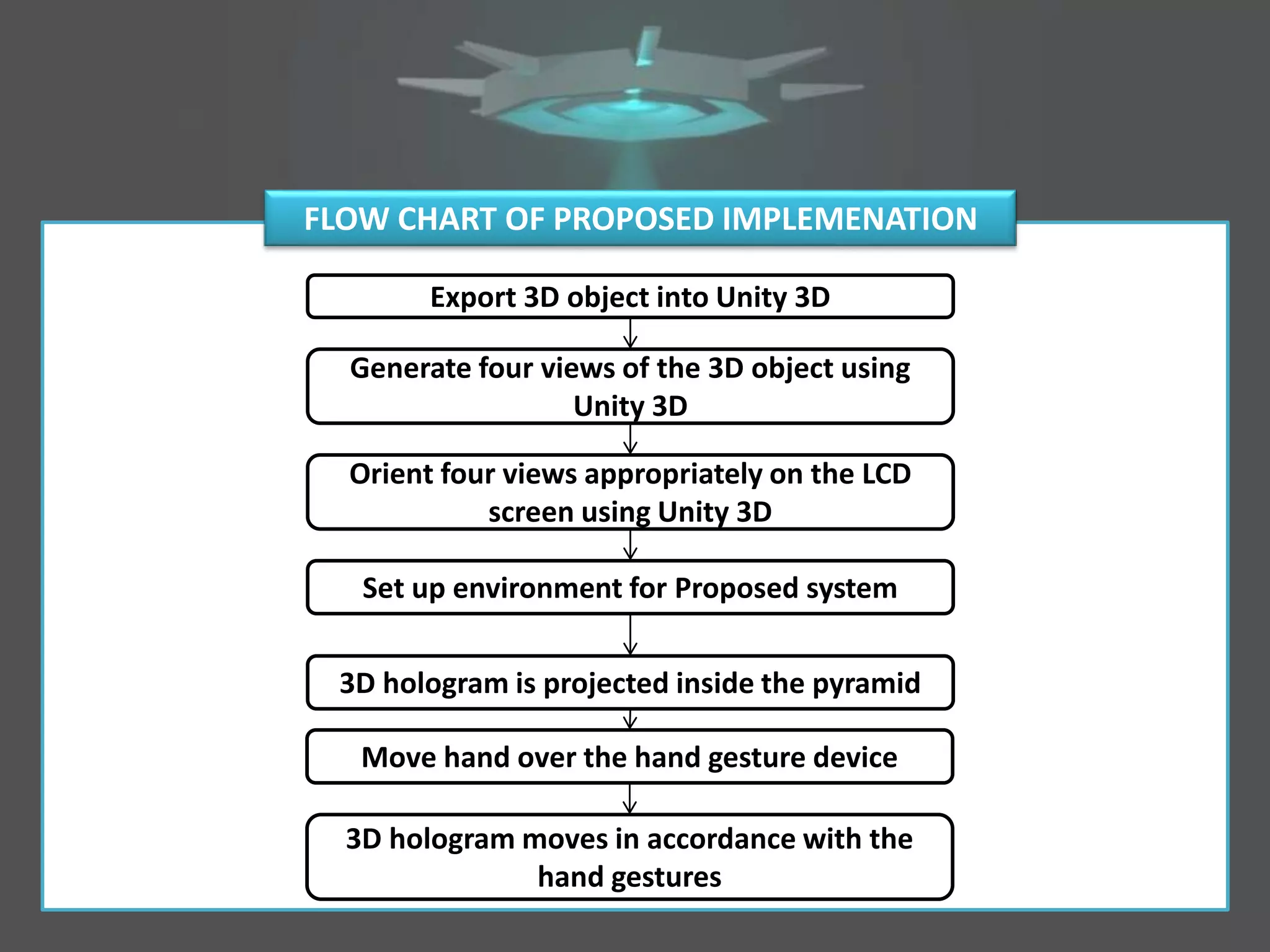
FLOW CHART OF PROPOSED IMPLEMENATION
Export 3D object into Unity 3D
Generate four views of the 3D object using
Unity 3D
Orient four views appropriately on the LCD
screen using Unity 3D
Set up environment for Proposed system
3D hologram is projected inside the pyramid
Move hand over the hand gesture device
3D hologram moves in accordance with the
hand gestures
BLACK BOX TESTING
 The main aim of the project is to project a 3D object inside the
pyramid and control it through hand gestures. The emphasis is on
obtaining the appropriate output for the specific input .
 During testing the tester will have access to the .exe files. He/She will
not be able to access the code of the project. So Black Box testing has
been used.
 Black-box testing is a method of software testing that examines the
functionality of an application without peering into its internal
structures or workings
TESTING
 UNIT TESTING (TEST CASES):
Unit testing is a software testing method by which individual units
of source code, sets of one or more computer program modules
together with associated control data, usage procedures, and
operating procedures are tested to determine if they are fit for
use.
 INTEGRATION TESTING
Integration testing tests integration or interfaces between
components, interactions to different parts of the system such as an
operating system, file system and hardware or interfaces between
systems.
 Software Test Document
TYPE OF TESTING
[2] Rin-ichiro Taniguchi, "Hand Gesture based TV Control SystemTowards Both
User- & Machine-friendly Gesture Applications, " The 19th Korea-Japan Joint
Workshop on Frontiers of Computer Vision ,2013 IEEE.
[3] Jun Haeng Lee1, Paul K. J. Park1, Chang-Woo Shin1, Hyunsurk Ryu1, Byung
Chang Kang1, and Tobi Delbruck2, "Touchless Hand Gesture UI with
Instantaneous Responses," 2012 IEEE1957 ICIP 2012
[4] Kaoru Yamagishi, Lei Jing*, Zixue Cheng*, “A System for Controlling Personal
Computers by Hand Gestures using a Wireless Sensor Device," 978-1-4799-
44767/14 ©2014 IEEE
[5] S.Pradeep Kumar and O.Pandithurai," Sixth Sense Technology,” Information
Communication and Embedded Systems (ICICES), 2013
REFERENCES
[1] Kaoru Yamagishi, Lei Jing*, Zixue Cheng*, “A System for Controlling Personal
Computers by Hand Gestures using a Wireless Sensor Device," 978-1-4799-
44767/14 ©2014 IEEE.

final project presentation

  • 1.
    Group ID :24 Project under the guidance of Prof. Ashwini Dalvi Project By: Aniket Patil, Nishigandha Dandekar [BE- IT (A)]
  • 2.
    PROBLEM DEFINITION To projecta 2D image as a 3D holographic image (also known as holograms) inside a glass pyramid and to interact with them using a gesture recognition system so as to control the holograms.
  • 3.
     Convergence ofAugmented reality, 3D holographic Projection and Sensors. Augmented reality is a technology that augments the components of the immediate real world surrounding with computer generated digital information. 3D Holographic Projection is on of the ways of achieving Augmented reality as it enables the projection of a static or dynamic object, on a holographic display or mid-air, such that it appears to be three dimensional to the naked eye. It can be implemented by using lasers or three dimensional computer graphics [1]. It provides an enticing view of the object, in space, to the user. This experience can further be heightened by the use of sensors. Sensors are used to detect the facial expressions and body movements of the user. These body movements are taken as inputs and can be used for controlling a variety of devices like TV [2].They can also be used to incorporate touch less hand gesture UI in devices like mobile phones [3].Sensors also enable us to control PC using hand gestures [4]. Sixth sense technology is an excellent example of amalgamation of augmented reality and sensors [5]. In this project, we move a step further by merging Augmented Reality, sensors and 3D holographic projection into a single system for providing a more enticing view of the object to the user. LITERATURE SURVEY
  • 4.
    1) Establish aconnection between the Unity 3D software and the software of the gesture control device. 2) Obtain four projections of the object and project them on the pyramid. 3) Ensure that the size of the base of the pyramid must be same as that of the LCD monitor screen. PRE REQUISITES Software Requirements Specification SOFTWARE REQUIREMENTS SPECIFICATION
  • 5.
    1)Orientation of imagesforms a hologram inside the pyramid shaped prism. 2) Movement of hologram, as per the hand gestures of the user FUNCTIONAL REQUIREMENTS
  • 6.
     Reliability Reliability ofthe product is dependent on the reliability of the hand gesture device. Thus, the product works accurately under moderate lighting conditions.  Availability The product can be made available by assembling the three hardware components of the product, supported by the unity 3D software. The hardware components are LCD Screen, pyramid and the hand gesture device NON FUNCTIONAL REQUIREMENTS
  • 7.
     Security Security ofthe product is directly dependent on the security of the Unity 3D software. This software security can be regulated by the means of any anti-virus software like Norton ,Avast etc. Physical security of the hardware components is also necessary.  Maintainability Product is easy to maintain . NON FUNCTIONAL REQUIREMENTS
  • 8.
     Portability Product ishighly portable as long as the hardware and software components required by the product are readily available. These components must be then assembled together for the functioning of the product.  Performance This device is designed to be controlled by one user at a time. The product delivers optimal performance under moderate lighting conditions. The performance of the product deteriorates when the hand gesture device is exposed to the sunlight. NON FUNCTIONAL REQUIREMENTS
  • 9.
  • 10.
  • 11.
    RESPONSIBILITIES  Background Search Requirement Gathering and analysis  Developing Software Requirement  Specification (SRS)  Coding  Implementation  Testing  Project Presentation  Paper Preparation  Requirement gathering and analysis  Developing Software Project  Management Plan (SPMP)  Developing the Software Design Document  Coding  Implementation  Testing  Project Presentation
  • 12.
    SOFTWARE DESIGN DOCUMENT A software design document (SDD) is a written description of a software product, that a software designer writes in order to give a software development team overall guidance to the architecture of the software project.  The following diagrams have been incorporated in the SDD: 1) Component Diagram 2) Deployment Diagram  Software Design Document
  • 13.
    1) 3D hologramswill be projected on the glass pyramid using a LCD computer screen. 2) The computer will contain the images of the 3D object from all four angles , these images will be projected on the pyramid. 3) Thus the 3D hologram will be projected inside the pyramid 4) The rotation of this object will be controlled by a hand gesture device. OVERVIEW OF IMPLEMENTATION
  • 14.
    FLOW CHART OFPROPOSED IMPLEMENATION Export 3D object into Unity 3D Generate four views of the 3D object using Unity 3D Orient four views appropriately on the LCD screen using Unity 3D Set up environment for Proposed system 3D hologram is projected inside the pyramid Move hand over the hand gesture device 3D hologram moves in accordance with the hand gestures
  • 15.
    BLACK BOX TESTING The main aim of the project is to project a 3D object inside the pyramid and control it through hand gestures. The emphasis is on obtaining the appropriate output for the specific input .  During testing the tester will have access to the .exe files. He/She will not be able to access the code of the project. So Black Box testing has been used.  Black-box testing is a method of software testing that examines the functionality of an application without peering into its internal structures or workings TESTING
  • 16.
     UNIT TESTING(TEST CASES): Unit testing is a software testing method by which individual units of source code, sets of one or more computer program modules together with associated control data, usage procedures, and operating procedures are tested to determine if they are fit for use.  INTEGRATION TESTING Integration testing tests integration or interfaces between components, interactions to different parts of the system such as an operating system, file system and hardware or interfaces between systems.  Software Test Document TYPE OF TESTING
  • 17.
    [2] Rin-ichiro Taniguchi,"Hand Gesture based TV Control SystemTowards Both User- & Machine-friendly Gesture Applications, " The 19th Korea-Japan Joint Workshop on Frontiers of Computer Vision ,2013 IEEE. [3] Jun Haeng Lee1, Paul K. J. Park1, Chang-Woo Shin1, Hyunsurk Ryu1, Byung Chang Kang1, and Tobi Delbruck2, "Touchless Hand Gesture UI with Instantaneous Responses," 2012 IEEE1957 ICIP 2012 [4] Kaoru Yamagishi, Lei Jing*, Zixue Cheng*, “A System for Controlling Personal Computers by Hand Gestures using a Wireless Sensor Device," 978-1-4799- 44767/14 ©2014 IEEE [5] S.Pradeep Kumar and O.Pandithurai," Sixth Sense Technology,” Information Communication and Embedded Systems (ICICES), 2013 REFERENCES [1] Kaoru Yamagishi, Lei Jing*, Zixue Cheng*, “A System for Controlling Personal Computers by Hand Gestures using a Wireless Sensor Device," 978-1-4799- 44767/14 ©2014 IEEE.