


OBJECTIVES
Why we are here?
What are the challenges?
What can we do about them?
How do we do it?
Let’s take a look at one
young man who was
impacted by an early
childhood development
program.
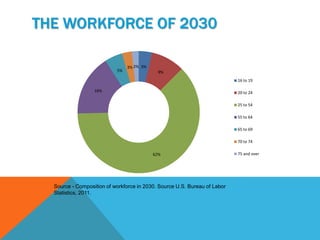
THE WORKFORCE OF 2030

                                3% 2% 3%
                           5%                9%
                                                                           16 to 19

                  16%                                                      20 to 24

                                                                           25 to 54

                                                                           55 to 64

                                                                           65 to 69

                                                                           70 to 74

                                           62%                             75 and over


  Source - Composition of workforce in 2030. Source U.S. Bureau of Labor
  Statistics, 2011.
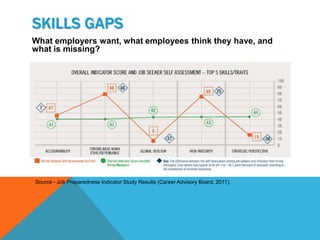
SKILLS GAPS
What employers want, what employees think they have, and
what is missing?


Source - Job Preparedness Indicator Study Results (Career Advisory Board, 2011).
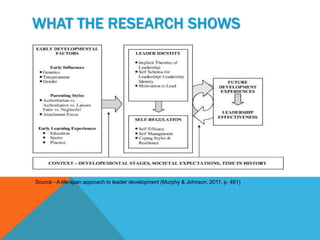
WHAT THE RESEARCH SHOWS


Source - A life-span approach to leader development (Murphy & Johnson, 2011, p. 461)
HOW DO WE ADDRESS THE GAPS?
Through education and development
  programs:
• Junior Achievement
• Headstart
• Village Academies
• Urban Youth Impact
• Character Counts
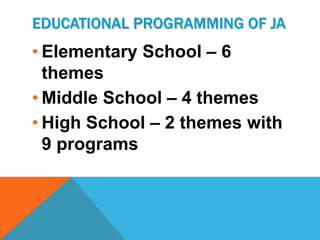
EDUCATIONAL PROGRAMMING OF JA
• Elementary School – 6
  themes
• Middle School – 4 themes
• High School – 2 themes with
  9 programs
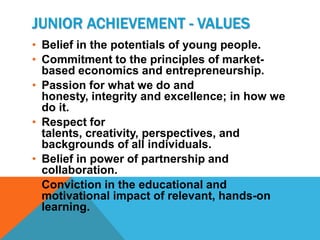
JUNIOR ACHIEVEMENT - VALUES
• Belief in the potentials of young people.
• Commitment to the principles of market-
  based economics and entrepreneurship.
• Passion for what we do and
  honesty, integrity and excellence; in how we
  do it.
• Respect for
  talents, creativity, perspectives, and
  backgrounds of all individuals.
• Belief in power of partnership and
  collaboration.
• Conviction in the educational and
  motivational impact of relevant, hands-on
  learning.
TESTIMONIALS
• Alumni, Mark Richards-founder of The
  Richards Group, LLC stated, “when you
  start opening doors, more and more
  doors begin to open for you”.
• “JA gives students a unique and valuable
  opportunity to discover and develop their
  own talents for working in today’s
  exciting business world”. –Alumna:
  Christina Gillen.
EVALUATION OF EFFECT
• 95% of teachers report JA students
  have a better understanding of how
  the real world operates.
• For middle school students, 71%
  reported JA helped them recognize
  importance of education and
  motivated them to work harder
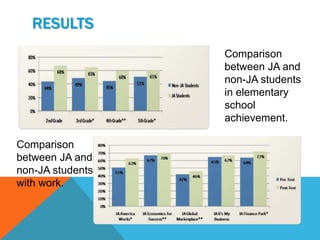
RESULTS
                  Comparison
                  between JA and
                  non-JA students
                  in elementary
                  school
                  achievement.

Comparison
between JA and
non-JA students
with work.
HEADSTART
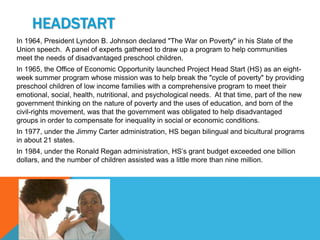
In 1964, President Lyndon B. Johnson declared "The War on Poverty" in his State of the
Union speech. A panel of experts gathered to draw up a program to help communities
meet the needs of disadvantaged preschool children.
In 1965, the Office of Economic Opportunity launched Project Head Start (HS) as an eight-
week summer program whose mission was to help break the "cycle of poverty" by providing
preschool children of low income families with a comprehensive program to meet their
emotional, social, health, nutritional, and psychological needs. At that time, part of the new
government thinking on the nature of poverty and the uses of education, and born of the
civil-rights movement, was that the government was obligated to help disadvantaged
groups in order to compensate for inequality in social or economic conditions.
In 1977, under the Jimmy Carter administration, HS began bilingual and bicultural programs
in about 21 states.
In 1984, under the Ronald Regan administration, HS’s grant budget exceeded one billion
dollars, and the number of children assisted was a little more than nine million.
HEADSTART
In 1995, under the Bill Clinton administration, the first Early Head Start (EHS) grants were
given serving families of children ages birth to three.
In October of 1998, HS and EHS were reauthorized to expand from the eight-week
demonstration project to a full day/full year program.
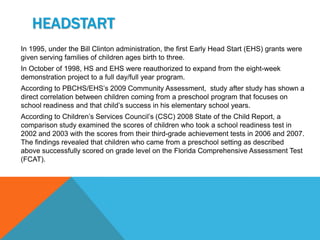
According to PBCHS/EHS’s 2009 Community Assessment, study after study has shown a
direct correlation between children coming from a preschool program that focuses on
school readiness and that child’s success in his elementary school years.
According to Children’s Services Council’s (CSC) 2008 State of the Child Report, a
comparison study examined the scores of children who took a school readiness test in
2002 and 2003 with the scores from their third-grade achievement tests in 2006 and 2007.
The findings revealed that children who came from a preschool setting as described
above successfully scored on grade level on the Florida Comprehensive Assessment Test
(FCAT).
HEADSTART
                              Vision
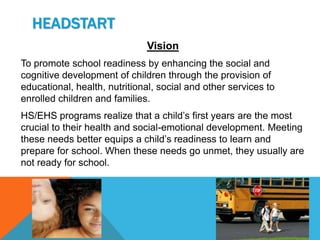
To promote school readiness by enhancing the social and
cognitive development of children through the provision of
educational, health, nutritional, social and other services to
enrolled children and families.
HS/EHS programs realize that a child’s first years are the most
crucial to their health and social-emotional development. Meeting
these needs better equips a child’s readiness to learn and
prepare for school. When these needs go unmet, they usually are
not ready for school.
SCHOOL READINESS & VPK

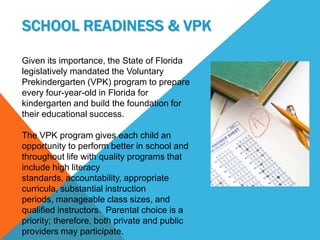
Given its importance, the State of Florida
legislatively mandated the Voluntary
Prekindergarten (VPK) program to prepare
every four-year-old in Florida for
kindergarten and build the foundation for
their educational success.

The VPK program gives each child an
opportunity to perform better in school and
throughout life with quality programs that
include high literacy
standards, accountability, appropriate
curricula, substantial instruction
periods, manageable class sizes, and
qualified instructors. Parental choice is a
priority; therefore, both private and public
providers may participate.
SCHOOL READINESS & VPK

Florida State Board of Education set the minimum VPK Provider Kindergarten
Readiness Rate for 2007-08 at 214.

Of the 19 PBCHS/EHS Centers approved to deliver the VPK education
curriculum, only 7 or 37% were identified as meeting performance standards.

There are many factors that impose upon PBC’s ability to meet and/or exceed
expectations:
• One-third of Florida's welfare recipients have low literacy levels
• 71% of mothers receiving AFDC or TANF have not completed high school
• 20% of Florida's children live in poverty and are likely to have parents who have
  not finished high school.
• One-half of these children begin school two years behind their peers in
  development
• 1.5 million Florida Residents speak little or no English and have difficulties with
  everyday survival skills; therefore, we are educating two generations at the same
  time.
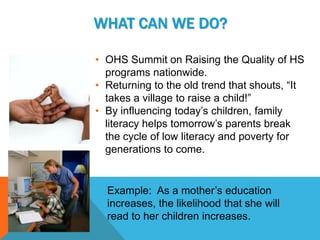
WHAT CAN WE DO?

• OHS Summit on Raising the Quality of HS
  programs nationwide.
• Returning to the old trend that shouts, “It
  takes a village to raise a child!”
• By influencing today’s children, family
  literacy helps tomorrow’s parents break
  the cycle of low literacy and poverty for
  generations to come.


  Example: As a mother’s education
  increases, the likelihood that she will
  read to her children increases.
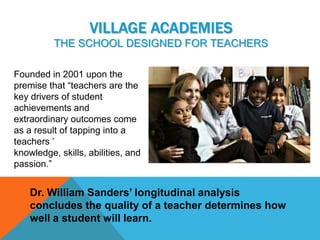
VILLAGE ACADEMIES
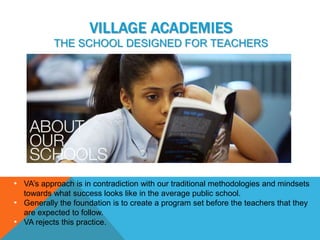
          THE SCHOOL DESIGNED FOR TEACHERS

Founded in 2001 upon the
premise that “teachers are the
key drivers of student
achievements and
extraordinary outcomes come
as a result of tapping into a
teachers ’
knowledge, skills, abilities, and
passion.”


    Dr. William Sanders’ longitudinal analysis
    concludes the quality of a teacher determines how
    well a student will learn.
VILLAGE ACADEMIES
           THE SCHOOL DESIGNED FOR TEACHERS


• VA’s approach is in contradiction with our traditional methodologies and mindsets
  towards what success looks like in the average public school.
• Generally the foundation is to create a program set before the teachers that they
  are expected to follow.
• VA rejects this practice.
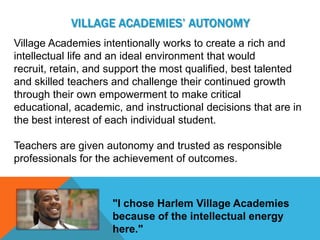
VILLAGE ACADEMIES’ AUTONOMY
Village Academies intentionally works to create a rich and
intellectual life and an ideal environment that would
recruit, retain, and support the most qualified, best talented
and skilled teachers and challenge their continued growth
through their own empowerment to make critical
educational, academic, and instructional decisions that are in
the best interest of each individual student.

Teachers are given autonomy and trusted as responsible
professionals for the achievement of outcomes.


                     "I chose Harlem Village Academies
                     because of the intellectual energy
                     here."
A HIGHER LEVEL FOR PASSIONATE LEARNING
                         VA’s students
•   Think critically
•   Argue passionately
•   Take ownership of their learning
•   Are fiercely independent and sophisticated thinkers
•   Coherent writers
•   Confident speakers
•   Avid readers

We seek to inspire in our students a passion for inquiry, and a
genuine love of learning. We believe it is also important for
students to attain proficiency in basic knowledge and
skills, so we have designed a core set of skills all students
must master, exams they must pass, and content they must
learn.
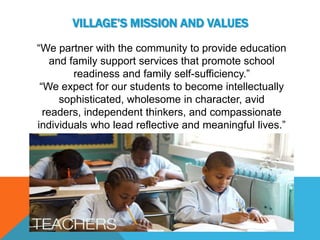
VILLAGE’S MISSION AND VALUES
“We partner with the community to provide education
    and family support services that promote school
         readiness and family self-sufficiency.”
 “We expect for our students to become intellectually
      sophisticated, wholesome in character, avid
  readers, independent thinkers, and compassionate
individuals who lead reflective and meaningful lives.”
FOUNDER’S MESSAGE
    (FOUNDER AND CEO, DR. DEBORAH KENNY


“Quality public education is an essential human right - it
  is the ultimate civil right…we are passionate about
  creating a new model, setting a gold standard, and
    changing public education in this country…The
            revolution is happening here…”
OUTCOMES & SUSTAINED SUCCESSES
• 100% of Village’s students are minority
• Approximately 74% qualify for free or reduced price lunch
• 12% are special education
• Test scores amongst young African-American and Latino students who
  historically had 75% failure rates in New York’s Harlem have risen
  dramatically and are at an all-time high.
• The first fifth grade class that entered the Academy ranked in the
  nation’s bottom 20th percentile, lacking basic skills and study habits.
  Three years later, they ranked number 1 in mathematics of all non-
  selective public schools in New York State.
• Today, these students are analyzing Shakespeare, studying
  physics, and competing in a college-level debate team. For the first
  time in the history of Harlem, 100% of Village Academies' eighth
  grade students passed the state math test!!!
THE RITZ-CARLTON MODEL
• Parent satisfaction is strong at Harlem Village Academies.
• Approximately 95% of parents grade the academies an A or
  B.
• Parents are customers and are paid as much attention and
  respect as Ritz-Carlton workers are trained to treat their
  guests.
• Parents are very much involved in the educational process
  of their children.
• Teachers are required to keep parents informed. Whether
  there is a literacy or academic concern or a mere hallway
  infraction.
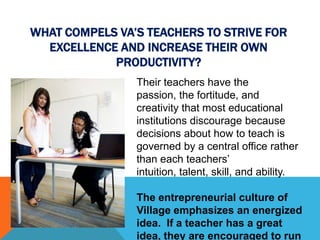
WHAT COMPELS VA’S TEACHERS TO STRIVE FOR
  EXCELLENCE AND INCREASE THEIR OWN
            PRODUCTIVITY?
                Their teachers have the
                passion, the fortitude, and
                creativity that most educational
                institutions discourage because
                decisions about how to teach is
                governed by a central office rather
                than each teachers’
                intuition, talent, skill, and ability.

                The entrepreneurial culture of
                Village emphasizes an energized
                idea. If a teacher has a great
                idea, they are encouraged to run
MISSION, VISION, AND VALUES
Mission
    • Urban Youth Impact exists to love, equip and
      empower inner-city youth and their parents to fulfil
      their God-given purpose.
Vision
    • To be the model, faith-based, inner-city outreach in
      Palm Beach County.
Values
    • We submit to God’s authority, we are passionate and
      purpose driven, we are servant leaders.
URBAN YOUTH IMPACT PROGRAMS


• Summer Work Program
• The Leadership Academy
CHARACTER COUNTS
 Let’s take a look at the last portion
 of video of Deonte Bridges who
 “moved the audience with his
 Valedictorian speech before fellow
 graduates, faculty, staff and
 parents” at Booker T. Washington
 High School.
 (www.youtube.com/watch?v=Q0Wcr82UOsw)
CONCLUSION
There is significant support for the delivery
of the skills necessary for individuals to
become effective leaders early in the
development cycle.
Skills that increase
flexibility, teambuilding, self-
awareness, and social skills will help the
youth of today become better prepared to
meet the needs of the workplace of 2030.
Preparing Youth of Today for the Workforce of 2030

Preparing Youth of Today for the Workforce of 2030

  • 2.
    OBJECTIVES Why we arehere? What are the challenges? What can we do about them? How do we do it?
  • 4.
    Let’s take alook at one young man who was impacted by an early childhood development program.
  • 7.
    THE WORKFORCE OF2030 3% 2% 3% 5% 9% 16 to 19 16% 20 to 24 25 to 54 55 to 64 65 to 69 70 to 74 62% 75 and over Source - Composition of workforce in 2030. Source U.S. Bureau of Labor Statistics, 2011.
  • 8.
    SKILLS GAPS What employerswant, what employees think they have, and what is missing? Source - Job Preparedness Indicator Study Results (Career Advisory Board, 2011).
  • 10.
    WHAT THE RESEARCHSHOWS Source - A life-span approach to leader development (Murphy & Johnson, 2011, p. 461)
  • 11.
    HOW DO WEADDRESS THE GAPS? Through education and development programs: • Junior Achievement • Headstart • Village Academies • Urban Youth Impact • Character Counts
  • 13.
    EDUCATIONAL PROGRAMMING OFJA • Elementary School – 6 themes • Middle School – 4 themes • High School – 2 themes with 9 programs
  • 14.
    JUNIOR ACHIEVEMENT -VALUES • Belief in the potentials of young people. • Commitment to the principles of market- based economics and entrepreneurship. • Passion for what we do and honesty, integrity and excellence; in how we do it. • Respect for talents, creativity, perspectives, and backgrounds of all individuals. • Belief in power of partnership and collaboration. • Conviction in the educational and motivational impact of relevant, hands-on learning.
  • 15.
    TESTIMONIALS • Alumni, MarkRichards-founder of The Richards Group, LLC stated, “when you start opening doors, more and more doors begin to open for you”. • “JA gives students a unique and valuable opportunity to discover and develop their own talents for working in today’s exciting business world”. –Alumna: Christina Gillen.
  • 16.
    EVALUATION OF EFFECT •95% of teachers report JA students have a better understanding of how the real world operates. • For middle school students, 71% reported JA helped them recognize importance of education and motivated them to work harder
  • 17.
    RESULTS Comparison between JA and non-JA students in elementary school achievement. Comparison between JA and non-JA students with work.
  • 19.
    HEADSTART In 1964, PresidentLyndon B. Johnson declared "The War on Poverty" in his State of the Union speech. A panel of experts gathered to draw up a program to help communities meet the needs of disadvantaged preschool children. In 1965, the Office of Economic Opportunity launched Project Head Start (HS) as an eight- week summer program whose mission was to help break the "cycle of poverty" by providing preschool children of low income families with a comprehensive program to meet their emotional, social, health, nutritional, and psychological needs. At that time, part of the new government thinking on the nature of poverty and the uses of education, and born of the civil-rights movement, was that the government was obligated to help disadvantaged groups in order to compensate for inequality in social or economic conditions. In 1977, under the Jimmy Carter administration, HS began bilingual and bicultural programs in about 21 states. In 1984, under the Ronald Regan administration, HS’s grant budget exceeded one billion dollars, and the number of children assisted was a little more than nine million.
  • 20.
    HEADSTART In 1995, underthe Bill Clinton administration, the first Early Head Start (EHS) grants were given serving families of children ages birth to three. In October of 1998, HS and EHS were reauthorized to expand from the eight-week demonstration project to a full day/full year program. According to PBCHS/EHS’s 2009 Community Assessment, study after study has shown a direct correlation between children coming from a preschool program that focuses on school readiness and that child’s success in his elementary school years. According to Children’s Services Council’s (CSC) 2008 State of the Child Report, a comparison study examined the scores of children who took a school readiness test in 2002 and 2003 with the scores from their third-grade achievement tests in 2006 and 2007. The findings revealed that children who came from a preschool setting as described above successfully scored on grade level on the Florida Comprehensive Assessment Test (FCAT).
  • 21.
    HEADSTART Vision To promote school readiness by enhancing the social and cognitive development of children through the provision of educational, health, nutritional, social and other services to enrolled children and families. HS/EHS programs realize that a child’s first years are the most crucial to their health and social-emotional development. Meeting these needs better equips a child’s readiness to learn and prepare for school. When these needs go unmet, they usually are not ready for school.
  • 22.
    SCHOOL READINESS &VPK Given its importance, the State of Florida legislatively mandated the Voluntary Prekindergarten (VPK) program to prepare every four-year-old in Florida for kindergarten and build the foundation for their educational success. The VPK program gives each child an opportunity to perform better in school and throughout life with quality programs that include high literacy standards, accountability, appropriate curricula, substantial instruction periods, manageable class sizes, and qualified instructors. Parental choice is a priority; therefore, both private and public providers may participate.
  • 23.
    SCHOOL READINESS &VPK Florida State Board of Education set the minimum VPK Provider Kindergarten Readiness Rate for 2007-08 at 214. Of the 19 PBCHS/EHS Centers approved to deliver the VPK education curriculum, only 7 or 37% were identified as meeting performance standards. There are many factors that impose upon PBC’s ability to meet and/or exceed expectations: • One-third of Florida's welfare recipients have low literacy levels • 71% of mothers receiving AFDC or TANF have not completed high school • 20% of Florida's children live in poverty and are likely to have parents who have not finished high school. • One-half of these children begin school two years behind their peers in development • 1.5 million Florida Residents speak little or no English and have difficulties with everyday survival skills; therefore, we are educating two generations at the same time.
  • 24.
    WHAT CAN WEDO? • OHS Summit on Raising the Quality of HS programs nationwide. • Returning to the old trend that shouts, “It takes a village to raise a child!” • By influencing today’s children, family literacy helps tomorrow’s parents break the cycle of low literacy and poverty for generations to come. Example: As a mother’s education increases, the likelihood that she will read to her children increases.
  • 26.
    VILLAGE ACADEMIES THE SCHOOL DESIGNED FOR TEACHERS Founded in 2001 upon the premise that “teachers are the key drivers of student achievements and extraordinary outcomes come as a result of tapping into a teachers ’ knowledge, skills, abilities, and passion.” Dr. William Sanders’ longitudinal analysis concludes the quality of a teacher determines how well a student will learn.
  • 27.
    VILLAGE ACADEMIES THE SCHOOL DESIGNED FOR TEACHERS • VA’s approach is in contradiction with our traditional methodologies and mindsets towards what success looks like in the average public school. • Generally the foundation is to create a program set before the teachers that they are expected to follow. • VA rejects this practice.
  • 28.
    VILLAGE ACADEMIES’ AUTONOMY VillageAcademies intentionally works to create a rich and intellectual life and an ideal environment that would recruit, retain, and support the most qualified, best talented and skilled teachers and challenge their continued growth through their own empowerment to make critical educational, academic, and instructional decisions that are in the best interest of each individual student. Teachers are given autonomy and trusted as responsible professionals for the achievement of outcomes. "I chose Harlem Village Academies because of the intellectual energy here."
  • 29.
    A HIGHER LEVELFOR PASSIONATE LEARNING VA’s students • Think critically • Argue passionately • Take ownership of their learning • Are fiercely independent and sophisticated thinkers • Coherent writers • Confident speakers • Avid readers We seek to inspire in our students a passion for inquiry, and a genuine love of learning. We believe it is also important for students to attain proficiency in basic knowledge and skills, so we have designed a core set of skills all students must master, exams they must pass, and content they must learn.
  • 30.
    VILLAGE’S MISSION ANDVALUES “We partner with the community to provide education and family support services that promote school readiness and family self-sufficiency.” “We expect for our students to become intellectually sophisticated, wholesome in character, avid readers, independent thinkers, and compassionate individuals who lead reflective and meaningful lives.”
  • 31.
    FOUNDER’S MESSAGE (FOUNDER AND CEO, DR. DEBORAH KENNY “Quality public education is an essential human right - it is the ultimate civil right…we are passionate about creating a new model, setting a gold standard, and changing public education in this country…The revolution is happening here…”
  • 32.
    OUTCOMES & SUSTAINEDSUCCESSES • 100% of Village’s students are minority • Approximately 74% qualify for free or reduced price lunch • 12% are special education • Test scores amongst young African-American and Latino students who historically had 75% failure rates in New York’s Harlem have risen dramatically and are at an all-time high. • The first fifth grade class that entered the Academy ranked in the nation’s bottom 20th percentile, lacking basic skills and study habits. Three years later, they ranked number 1 in mathematics of all non- selective public schools in New York State. • Today, these students are analyzing Shakespeare, studying physics, and competing in a college-level debate team. For the first time in the history of Harlem, 100% of Village Academies' eighth grade students passed the state math test!!!
  • 33.
    THE RITZ-CARLTON MODEL •Parent satisfaction is strong at Harlem Village Academies. • Approximately 95% of parents grade the academies an A or B. • Parents are customers and are paid as much attention and respect as Ritz-Carlton workers are trained to treat their guests. • Parents are very much involved in the educational process of their children. • Teachers are required to keep parents informed. Whether there is a literacy or academic concern or a mere hallway infraction.
  • 34.
    WHAT COMPELS VA’STEACHERS TO STRIVE FOR EXCELLENCE AND INCREASE THEIR OWN PRODUCTIVITY? Their teachers have the passion, the fortitude, and creativity that most educational institutions discourage because decisions about how to teach is governed by a central office rather than each teachers’ intuition, talent, skill, and ability. The entrepreneurial culture of Village emphasizes an energized idea. If a teacher has a great idea, they are encouraged to run
  • 36.
    MISSION, VISION, ANDVALUES Mission • Urban Youth Impact exists to love, equip and empower inner-city youth and their parents to fulfil their God-given purpose. Vision • To be the model, faith-based, inner-city outreach in Palm Beach County. Values • We submit to God’s authority, we are passionate and purpose driven, we are servant leaders.
  • 37.
    URBAN YOUTH IMPACTPROGRAMS • Summer Work Program • The Leadership Academy
  • 39.
    CHARACTER COUNTS Let’stake a look at the last portion of video of Deonte Bridges who “moved the audience with his Valedictorian speech before fellow graduates, faculty, staff and parents” at Booker T. Washington High School. (www.youtube.com/watch?v=Q0Wcr82UOsw)
  • 40.
    CONCLUSION There is significantsupport for the delivery of the skills necessary for individuals to become effective leaders early in the development cycle. Skills that increase flexibility, teambuilding, self- awareness, and social skills will help the youth of today become better prepared to meet the needs of the workplace of 2030.