CHINESE L1 ENGLISH
LEARNERS
A CROSSLINGUISTIC STUDY
C H R I S T Y G A N C H E R O
T S L 6 0 9 F I N A L P R E S E N T A T I O N
OVERVIEW
• Introduction
• Phonology Research
• Morphology and Syntax Research
• Pragmatic and Social Research
• Discussion and Future Research
• Conclusion
2
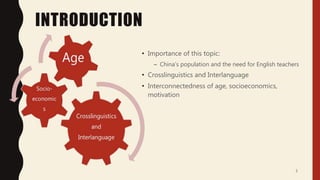
INTRODUCTION
• Importance of this topic:
– China’s population and the need for English teachers
• Crosslinguistics and Interlanguage
• Interconnectedness of age, socioeconomics,
motivation
3
PHONOLOGY RESEARCH
• Eckman, F. R. (2004). From phonemic differences to constraint rankings: Research on
second language phonology.
• Dixon, L. Quentin, Chuang, Hui-Kai, and Quiroz, Blanca (2012). English phonological
awareness in bilinguals: A cross-linguistic study of Tamil, Malay and Chinese English-
language learners. Journal of Research in Reading, 35(4), 372–392.
• Leong, Che Kan, Cheng, Pui Wan, and Tan, Li Hai (2005). “The role of sensitivity to
rhymes, phonemes and tones in reading English and Chinese pseudowords. Reading and
Writing: An Interdisciplinary Journal, 18(1), 1-26.
• McDowell, Heather J., & Lorch, Marjorie Perlman (2008). Awareness in Chinese L1 readers
of English: Not simply and effect of orthography. TESOL Quarterly, 42(3), 495-513.
• Rau, D. Victoria, Chang, Hui-Huan Ann, and Tarone, Elaine E. (2009). Think or sink:
Chinese learners’ acquisition of the English voiceless interdental fricative. Language
Learning, 59(3), 581-621.
4
MORPHOLOGY AND SYNTAX RESEARCH
• Pierce, Lara J., Genesee, Fred and Paradis, Johanne (2013). Acquisition of English
grammatical morphology by internationally adopted children from China. Journal of
Child Language, 40 (5), 1076-1090.
• Lu, Xiaofei (2011). A corpus-based evaluation of syntactic complexity measures as
indices of college-level ESL writers' language development. TESOL Quarterly, 45 (1), 36-
62.
5
RESEARCH ON PRAGMATIC AND SOCIAL
DIMENSIONS
• Chang, Yuh-fang (2011). Refusing in a foreign language: An investigation of problems
encountered by Chinese learners of English. Multilingua, 30(1), 71-98.
• He, An E (2011). Possibility of crosslingual transfer: A comparative study of Chinese (L1)
and English (L2) lessons. The Modern Language Journal, 95 (supplementary issue), 64-
80.
• Yu, M.-C (2004). Interlinguistic variation and similarity in second language speech act
behavior. The Modern Language Journal, 88(1), 102-119.
6
DISCUSSION
• How important is pronunciation?
– World Englishes
• Syntax/Morphology research and “Big Data”
– Future of corpus research
7
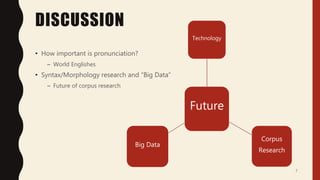
Future
Technology
Corpus
Research
Big Data
CONCLUSION
• Phonology Research
• Morphology and Syntax Research
• Pragmatic and Social Research
• Discussion and Future Research
8
ANY QUESTIONS?
9
THANK YOU!
C H R I S T Y G A N C H E R O
T S L 6 0 9 F I N A L P R E S E N T A T I O N

Final Presentation

  • 1.
    CHINESE L1 ENGLISH LEARNERS ACROSSLINGUISTIC STUDY C H R I S T Y G A N C H E R O T S L 6 0 9 F I N A L P R E S E N T A T I O N
  • 2.
    OVERVIEW • Introduction • PhonologyResearch • Morphology and Syntax Research • Pragmatic and Social Research • Discussion and Future Research • Conclusion 2
  • 3.
    INTRODUCTION • Importance ofthis topic: – China’s population and the need for English teachers • Crosslinguistics and Interlanguage • Interconnectedness of age, socioeconomics, motivation 3
  • 4.
    PHONOLOGY RESEARCH • Eckman,F. R. (2004). From phonemic differences to constraint rankings: Research on second language phonology. • Dixon, L. Quentin, Chuang, Hui-Kai, and Quiroz, Blanca (2012). English phonological awareness in bilinguals: A cross-linguistic study of Tamil, Malay and Chinese English- language learners. Journal of Research in Reading, 35(4), 372–392. • Leong, Che Kan, Cheng, Pui Wan, and Tan, Li Hai (2005). “The role of sensitivity to rhymes, phonemes and tones in reading English and Chinese pseudowords. Reading and Writing: An Interdisciplinary Journal, 18(1), 1-26. • McDowell, Heather J., & Lorch, Marjorie Perlman (2008). Awareness in Chinese L1 readers of English: Not simply and effect of orthography. TESOL Quarterly, 42(3), 495-513. • Rau, D. Victoria, Chang, Hui-Huan Ann, and Tarone, Elaine E. (2009). Think or sink: Chinese learners’ acquisition of the English voiceless interdental fricative. Language Learning, 59(3), 581-621. 4
  • 5.
    MORPHOLOGY AND SYNTAXRESEARCH • Pierce, Lara J., Genesee, Fred and Paradis, Johanne (2013). Acquisition of English grammatical morphology by internationally adopted children from China. Journal of Child Language, 40 (5), 1076-1090. • Lu, Xiaofei (2011). A corpus-based evaluation of syntactic complexity measures as indices of college-level ESL writers' language development. TESOL Quarterly, 45 (1), 36- 62. 5
  • 6.
    RESEARCH ON PRAGMATICAND SOCIAL DIMENSIONS • Chang, Yuh-fang (2011). Refusing in a foreign language: An investigation of problems encountered by Chinese learners of English. Multilingua, 30(1), 71-98. • He, An E (2011). Possibility of crosslingual transfer: A comparative study of Chinese (L1) and English (L2) lessons. The Modern Language Journal, 95 (supplementary issue), 64- 80. • Yu, M.-C (2004). Interlinguistic variation and similarity in second language speech act behavior. The Modern Language Journal, 88(1), 102-119. 6
  • 7.
    DISCUSSION • How importantis pronunciation? – World Englishes • Syntax/Morphology research and “Big Data” – Future of corpus research 7 Future Technology Corpus Research Big Data
  • 8.
    CONCLUSION • Phonology Research •Morphology and Syntax Research • Pragmatic and Social Research • Discussion and Future Research 8
  • 9.
  • 10.
    THANK YOU! C HR I S T Y G A N C H E R O T S L 6 0 9 F I N A L P R E S E N T A T I O N