Previous exams' questions
Physiology
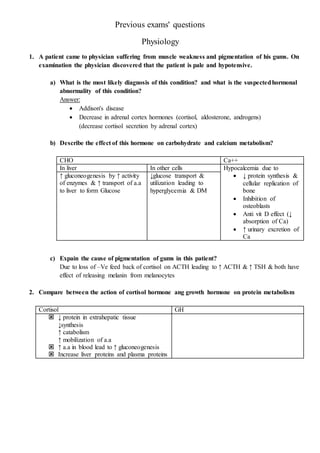
1. A patient came to physician suffering from muscle weakness and pigmentation of his gums. On
examination the physician discovered that the patient is pale and hypotensive.
a) What is the most likely diagnosis of this condition? and what is the suspectedhormonal
abnormality of this condition?
Answer:
 Addison's disease
 Decrease in adrenal cortex hormones (cortisol, aldosterone, androgens)
(decrease cortisol secretion by adrenal cortex)
b) Describe the effect of this hormone on carbohydrate and calcium metabolism?
CHO Ca++
In liver In other cells Hypocalcemia due to
 ↓ protein synthesis &
cellular replication of
bone
 Inhibition of
osteoblasts
 Anti vit D effect (↓
absorption of Ca)
 ↑ urinary excretion of
Ca
↑ gluconeogenesis by ↑ activity
of enzymes & ↑ transport of a.a
to liver to form Glucose
↓glucose transport &
utilization leading to
hyperglycemia & DM
c) Expain the cause of pigmentation of gums in this patient?
Due to loss of –Ve feed back of cortisol on ACTH leading to ↑ ACTH & ↑ TSH & both have
effect of releasing melanin from melanocytes
2. Compare between the action of cortisol hormone ang growth hormone on protein metabolism
Cortisol GH
 ↓ protein in extrahepatic tissue
↓synthesis
↑ catabolism
↑ mobilization of a.a
 ↑ a.a in blood lead to ↑ gluconeogenesis
 Increase liver proteins and plasma proteins
3. Compare between insulin & cortisol as regard their effect on
 Carbohydrate metabolism
 Protein metabolism
Insulin Cortisol
CHO
metabolism
 Facilitate Glucose entry inside the
cells through action on cell
membrane
 Resting muscle impermeable
to glucose in absence of
insulin unlike exercising
muscles which is permeable
 Brain is permeable to glucose
in absence of insulin except
satiety center
 Increase glycogenesis through
activating glycogen synthase
 Inhibit gluconeogenesis through
inhibiting its enzymes
In liver Anti insulin effect
in extrahepatic
↑ gluconeogenesis by ↑
activity of enzymes & ↑
transport of a.a to liver
to form Glucose
↓glucose transport
& utilization
leading to
hyperglycemia &
DM
Protein
metabolism
 Increase a.a uptake by cells &
increase protein synthesis
 On ribosomes:increase translation of
mRNA
 Decrease protein catabolism
 Inhibit gluconeogenesis: conserve
a.a
 ↓ protein in extrahepatic tissue
↓synthesis
↑ catabolism
↑ mobilization of a.a
 ↑ a.a in blood lead to ↑
gluconeogenesis
 Increase liver proteins and plasma
proteins
4. Enumerate three hormones antagonizing the action of insulin, and the role of each of them on
carbohydrate metabolism
Hormone Effect on carbohydrate metabolism
Glucagon  ↑ gluconeogenesis :activation of its enzymes
 ↑ glycogenolysis: ↑ activity of glycogen phosphorylase &↓ glycogen synthase
Cortisol In liver Anti insulin effect in extrahepatic
↑ gluconeogenesis by ↑ activity of
enzymes & ↑ transport of a.a to liver to
form Glucose
↓glucose transport & utilization leading to
hyperglycemia & DM
GH
Throid
hormones
5. Explain the effect of thyroxine hormone on CVS (4 marks)
6. Explain the effect of thyroid hormones on CVS (2 marks)
7. Discuss the effect of GH on growth
8. Mention 2 hormones affecting calcium metabolism (list, effect, and mechanism)

Final physio

  • 1.
    Previous exams' questions Physiology 1.A patient came to physician suffering from muscle weakness and pigmentation of his gums. On examination the physician discovered that the patient is pale and hypotensive. a) What is the most likely diagnosis of this condition? and what is the suspectedhormonal abnormality of this condition? Answer:  Addison's disease  Decrease in adrenal cortex hormones (cortisol, aldosterone, androgens) (decrease cortisol secretion by adrenal cortex) b) Describe the effect of this hormone on carbohydrate and calcium metabolism? CHO Ca++ In liver In other cells Hypocalcemia due to  ↓ protein synthesis & cellular replication of bone  Inhibition of osteoblasts  Anti vit D effect (↓ absorption of Ca)  ↑ urinary excretion of Ca ↑ gluconeogenesis by ↑ activity of enzymes & ↑ transport of a.a to liver to form Glucose ↓glucose transport & utilization leading to hyperglycemia & DM c) Expain the cause of pigmentation of gums in this patient? Due to loss of –Ve feed back of cortisol on ACTH leading to ↑ ACTH & ↑ TSH & both have effect of releasing melanin from melanocytes 2. Compare between the action of cortisol hormone ang growth hormone on protein metabolism Cortisol GH  ↓ protein in extrahepatic tissue ↓synthesis ↑ catabolism ↑ mobilization of a.a  ↑ a.a in blood lead to ↑ gluconeogenesis  Increase liver proteins and plasma proteins
  • 2.
    3. Compare betweeninsulin & cortisol as regard their effect on  Carbohydrate metabolism  Protein metabolism Insulin Cortisol CHO metabolism  Facilitate Glucose entry inside the cells through action on cell membrane  Resting muscle impermeable to glucose in absence of insulin unlike exercising muscles which is permeable  Brain is permeable to glucose in absence of insulin except satiety center  Increase glycogenesis through activating glycogen synthase  Inhibit gluconeogenesis through inhibiting its enzymes In liver Anti insulin effect in extrahepatic ↑ gluconeogenesis by ↑ activity of enzymes & ↑ transport of a.a to liver to form Glucose ↓glucose transport & utilization leading to hyperglycemia & DM Protein metabolism  Increase a.a uptake by cells & increase protein synthesis  On ribosomes:increase translation of mRNA  Decrease protein catabolism  Inhibit gluconeogenesis: conserve a.a  ↓ protein in extrahepatic tissue ↓synthesis ↑ catabolism ↑ mobilization of a.a  ↑ a.a in blood lead to ↑ gluconeogenesis  Increase liver proteins and plasma proteins 4. Enumerate three hormones antagonizing the action of insulin, and the role of each of them on carbohydrate metabolism Hormone Effect on carbohydrate metabolism Glucagon  ↑ gluconeogenesis :activation of its enzymes  ↑ glycogenolysis: ↑ activity of glycogen phosphorylase &↓ glycogen synthase Cortisol In liver Anti insulin effect in extrahepatic ↑ gluconeogenesis by ↑ activity of enzymes & ↑ transport of a.a to liver to form Glucose ↓glucose transport & utilization leading to hyperglycemia & DM GH Throid hormones 5. Explain the effect of thyroxine hormone on CVS (4 marks) 6. Explain the effect of thyroid hormones on CVS (2 marks) 7. Discuss the effect of GH on growth 8. Mention 2 hormones affecting calcium metabolism (list, effect, and mechanism)