Shree Aniruddha Upasana Foundation
The journey towards Ramrajya begins from the station of the Graamrajya and the Graamrajya is Graamvikas. The Ramrajya means the reign, the kingdom and the general circumstances (the ‘Rajya’) that Shreeram gave to Ayodhya. Moulding the people on the lines of the subjects of Ayodhya; to make of them, what the citizens of Ayodhya were; creating a society and social order like Ayodhya had, grooming every single individual from this point of view leading to a corresponding response from the human community in its entirety. Aim
Concept and Principles   Gram Vikas does not mean ‘The development of village as a whole’ but the development of  labour  and  neglected classes. The class may be different in different villages respectively. While doing this work we would not be interfering within  anybody’s religion or caste.  We are not going to make these people rich, but well-to-do and contended.  Well-to-do means ones who are satisfied with supply of all the daily necessities.
Concept and Principles Making everybody independent  by making optimum use of their available resources. Increasing of production is off course important, but lowering the cost of production and  offsetting individual and household expenses (without any cost)  is the most important .  Those who want to volunteer for this work should have love for villages and its labour classes.
Concept and Principles Our work would start where we have our Upasana Centers. After Pune, Sangli, Satara, Kolhapur, Thane the Gramvikas work would proceed in Dhule, Jalgaon and Nandurbar. There would not be a ‘chief’ per see in any district, village or Upasana Centre at ‘ Aniruddhas Institute of Gram Vikas’ . Everyone would be a ‘volunteer’.   But they  would function with the assistance from local ‘ Pramukh   Sevaks’ .
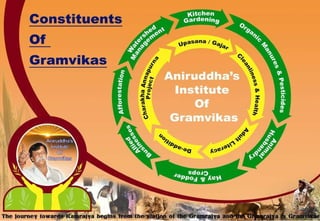
Components of Gramin Vikas
Diploma Courses Organic Farming   8 Days Animal Husbandry   4 Days Social Forestry  4 Days Watershed Management 6 Days Allied Businesses   4 Days
Organic Farming Training in making of various types of manures viz., compost manure, vermi-compost, manure from sheep droppings, the farmyard manure. Training in making of cow-dung slurry, C.P.P. (Cow Pat Pit) and liquid & reviver manures such as  Beejamrut ,  Panchagavya ,  Amrutpani , etc. Training in making of different pesticides by using cow urine,  Dashparni Ark ,  Lameen  and Vermi-wash.
Kitchen Gardening Kitchen Garden  ( Parasbaug)  means cultivating leafy vegetables, vegetables, bulbs & roots and other greens required for daily meals at a farm or in the spare vacant space around the house in a planned way. Kitchen Garden , would ensure that no one would go starved even in abject poverty and famine.  Baskets, old mango boxes, trays, tyres, covers, etc are utilized for this planting.
Kitchen Gardening Utilization of waste water from kitchen and washroom.  Cultivating vegetables, leafy vegetables, green pods which can be cropped in a few days and for 3-4 times.  Planning cultivation of vegetables in such a way that everyday at least one vegetable will be available for food.
Animal Husbandry   Training in domestication, management, yield management and sale of cows, buffalos, goats, hens, quail, hare, etc.  Cleaning, maintenance and care of animal sheds. Classification of animal feed, understanding its importance and measurements. Ingredients necessary for milk production and well-being of animals.
Animal Husbandry Animal feed, importance  of green and dry fodder. Necessity of water and its measurement. Animal cleanliness, health and nurturing. Household first-aid techniques for animal diseases and illnesses.
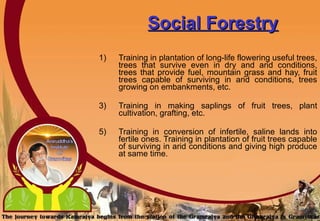
Social Forestry Training in plantation of long-life flowering useful trees, trees that survive even in dry and arid conditions, trees that provide fuel, mountain grass and hay, fruit trees capable of surviving in arid conditions, trees growing on embankments, etc.  Training in making saplings of fruit trees, plant cultivation, grafting, etc. Training in conversion of infertile, saline lands into fertile ones. Training in plantation of fruit trees capable of surviving in arid conditions and giving high produce at same time.
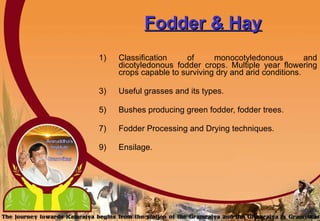
Fodder & Hay Classification of monocotyledonous and dicotyledonous fodder crops. Multiple year flowering crops capable to surviving dry and arid conditions.  Useful grasses and its types. Bushes producing green fodder, fodder trees. Fodder Processing and Drying techniques.  Ensilage.
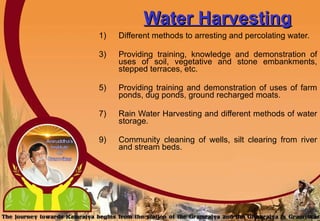
Water Harvesting Different methods to arresting and percolating water. Providing training, knowledge and demonstration of uses of soil, vegetative and stone embankments, stepped terraces, etc.  Providing training and demonstration of uses of farm ponds, dug ponds, ground recharged moats.  Rain Water Harvesting and different methods of water storage. Community cleaning of wells, silt clearing from river and stream beds.
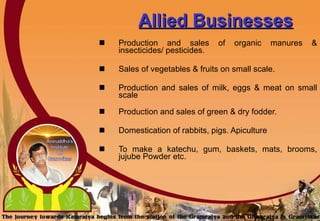
Allied Businesses Production and sales of organic manures & insecticides/ pesticides. Sales of vegetables & fruits on small scale. Production and sales of milk, eggs & meat on small scale Production and sales of green & dry fodder. Domestication of rabbits, pigs. Apiculture To make a katechu, gum, baskets, mats, brooms, jujube Powder etc.
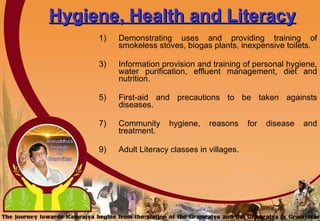
Hygiene, Health and Literacy Demonstrating uses and providing training of smokeless stoves, biogas plants, inexpensive toilets. Information provision and training of personal hygiene, water purification, effluent management, diet and nutrition. First-aid and precautions to be taken againsts diseases. Community hygiene, reasons for disease and treatment. Adult Literacy classes in villages.
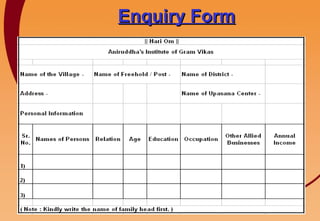
Enquiry Form
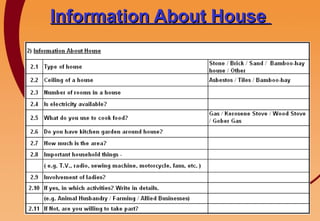
Information About House
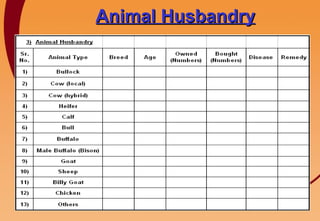
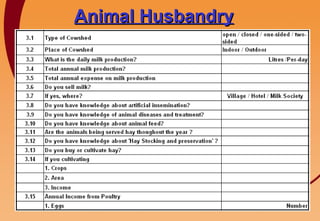
Animal Husbandry
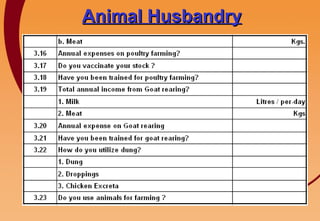
Animal Husbandry
Animal Husbandry
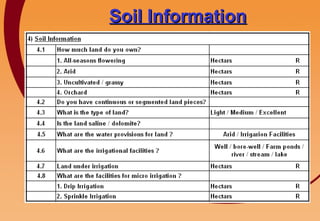
Soil Information
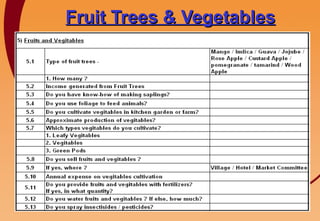
Fruit Trees & Vegetables
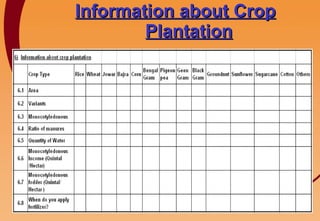
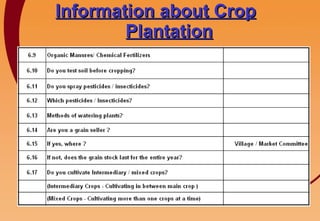
Information about Crop Plantation
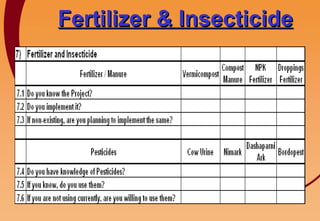
Fertilizer & Insecticide
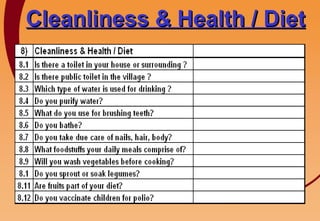
Cleanliness & Health / Diet
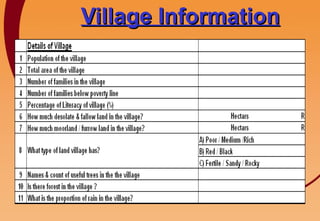
Village Information
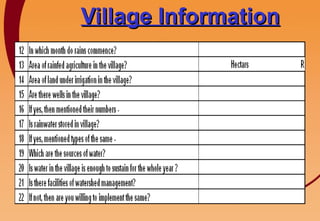
Village Information
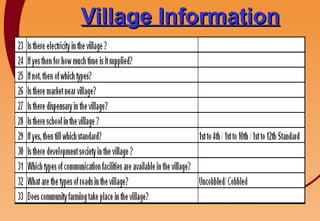
Village Information

Final gram vikas ppt (eng)

  • 1.
  • 2.
    The journey towardsRamrajya begins from the station of the Graamrajya and the Graamrajya is Graamvikas. The Ramrajya means the reign, the kingdom and the general circumstances (the ‘Rajya’) that Shreeram gave to Ayodhya. Moulding the people on the lines of the subjects of Ayodhya; to make of them, what the citizens of Ayodhya were; creating a society and social order like Ayodhya had, grooming every single individual from this point of view leading to a corresponding response from the human community in its entirety. Aim
  • 3.
    Concept and Principles Gram Vikas does not mean ‘The development of village as a whole’ but the development of labour and neglected classes. The class may be different in different villages respectively. While doing this work we would not be interfering within anybody’s religion or caste. We are not going to make these people rich, but well-to-do and contended. Well-to-do means ones who are satisfied with supply of all the daily necessities.
  • 4.
    Concept and PrinciplesMaking everybody independent by making optimum use of their available resources. Increasing of production is off course important, but lowering the cost of production and offsetting individual and household expenses (without any cost) is the most important . Those who want to volunteer for this work should have love for villages and its labour classes.
  • 5.
    Concept and PrinciplesOur work would start where we have our Upasana Centers. After Pune, Sangli, Satara, Kolhapur, Thane the Gramvikas work would proceed in Dhule, Jalgaon and Nandurbar. There would not be a ‘chief’ per see in any district, village or Upasana Centre at ‘ Aniruddhas Institute of Gram Vikas’ . Everyone would be a ‘volunteer’. But they would function with the assistance from local ‘ Pramukh Sevaks’ .
  • 6.
  • 7.
    Diploma Courses OrganicFarming 8 Days Animal Husbandry 4 Days Social Forestry 4 Days Watershed Management 6 Days Allied Businesses 4 Days
  • 8.
    Organic Farming Trainingin making of various types of manures viz., compost manure, vermi-compost, manure from sheep droppings, the farmyard manure. Training in making of cow-dung slurry, C.P.P. (Cow Pat Pit) and liquid & reviver manures such as Beejamrut , Panchagavya , Amrutpani , etc. Training in making of different pesticides by using cow urine, Dashparni Ark , Lameen and Vermi-wash.
  • 9.
    Kitchen Gardening KitchenGarden ( Parasbaug) means cultivating leafy vegetables, vegetables, bulbs & roots and other greens required for daily meals at a farm or in the spare vacant space around the house in a planned way. Kitchen Garden , would ensure that no one would go starved even in abject poverty and famine. Baskets, old mango boxes, trays, tyres, covers, etc are utilized for this planting.
  • 10.
    Kitchen Gardening Utilizationof waste water from kitchen and washroom. Cultivating vegetables, leafy vegetables, green pods which can be cropped in a few days and for 3-4 times. Planning cultivation of vegetables in such a way that everyday at least one vegetable will be available for food.
  • 11.
    Animal Husbandry Training in domestication, management, yield management and sale of cows, buffalos, goats, hens, quail, hare, etc. Cleaning, maintenance and care of animal sheds. Classification of animal feed, understanding its importance and measurements. Ingredients necessary for milk production and well-being of animals.
  • 12.
    Animal Husbandry Animalfeed, importance of green and dry fodder. Necessity of water and its measurement. Animal cleanliness, health and nurturing. Household first-aid techniques for animal diseases and illnesses.
  • 13.
    Social Forestry Trainingin plantation of long-life flowering useful trees, trees that survive even in dry and arid conditions, trees that provide fuel, mountain grass and hay, fruit trees capable of surviving in arid conditions, trees growing on embankments, etc. Training in making saplings of fruit trees, plant cultivation, grafting, etc. Training in conversion of infertile, saline lands into fertile ones. Training in plantation of fruit trees capable of surviving in arid conditions and giving high produce at same time.
  • 14.
    Fodder & HayClassification of monocotyledonous and dicotyledonous fodder crops. Multiple year flowering crops capable to surviving dry and arid conditions. Useful grasses and its types. Bushes producing green fodder, fodder trees. Fodder Processing and Drying techniques. Ensilage.
  • 15.
    Water Harvesting Differentmethods to arresting and percolating water. Providing training, knowledge and demonstration of uses of soil, vegetative and stone embankments, stepped terraces, etc. Providing training and demonstration of uses of farm ponds, dug ponds, ground recharged moats. Rain Water Harvesting and different methods of water storage. Community cleaning of wells, silt clearing from river and stream beds.
  • 16.
    Allied Businesses Productionand sales of organic manures & insecticides/ pesticides. Sales of vegetables & fruits on small scale. Production and sales of milk, eggs & meat on small scale Production and sales of green & dry fodder. Domestication of rabbits, pigs. Apiculture To make a katechu, gum, baskets, mats, brooms, jujube Powder etc.
  • 17.
    Hygiene, Health andLiteracy Demonstrating uses and providing training of smokeless stoves, biogas plants, inexpensive toilets. Information provision and training of personal hygiene, water purification, effluent management, diet and nutrition. First-aid and precautions to be taken againsts diseases. Community hygiene, reasons for disease and treatment. Adult Literacy classes in villages.
  • 18.
  • 19.
  • 20.
  • 21.
  • 22.
  • 23.
  • 24.
    Fruit Trees &Vegetables
  • 25.
  • 26.
  • 27.
  • 28.
  • 29.
  • 30.
  • 31.