November 23rd, 2011
                         Final Exam Review

This is the review for the final exam. It by no means intends to depict
the exam’s format, and it is NOT everything you need to know for the
final exam. This review is intended to help you have more chemistry
practice. Below I have written the topics we have covered this
semester (I may have missed some, but you SHOULD have all of
them in your notes!The old reviews should help you study as well.

Make sure you go over your notes and homework. Do not wait until
the day before the exam to study, begin now!

70 percent of the exam will be based on the material covered after
third partial.
10 percent will come from first partial.
10 percent will come from second partial.
10 percent will come from third partial.
For a total of 100 percent

  1.  Introduction to chemistry: definition of chemistry
  2.  Matter
  3.  Substance
  4.  Mass vs. Weight
  5.  Conversions (SI Units and English Units)
  6.  Properties and changes of matter (physical and chemical…
      include states of matter)
   7. Elements name and symbol of common elements
   8. Methods of separating mixtures
   9. Types of mixtures
  10. The atom and the atomic model
  11. Atomic structure (composition, atomic mass, atomic number,
     average atomic mass)
  12. Ions
  13. Isotopes
  14. Atomic models
  15. Ground vs. Excited State
  16. Quantum numbers
  17. Electron configurations
  18. Periodic Table and periodic trends
  19. Types of bonds
  20. Types of inorganic compounds
November 23rd, 2011
                              Final Exam Review
  21. Types of reactions
  22. Nomenclature
  23. Oxidation Numbers
  24. Balancing (This will include Redox)
  25. Stoichiometry
  26. Ideal Gas Law
  27. Solutions
  28. Concentrations
  29. pH


Solve the following problems:


1. Draw the orbital diagram, the electron configuration, electron dot notation, and
the noble notation of the following elements. Then find the four quantum numbers
for the given electron.

             a.   Re (hint this element goes through the f-orbitals): 30th electron
             b.   Cd: 14th electron
             c.   Ra: 83rd electron
             d.   In: 36th electron

2. Differentiate between chemical and physical property and change, give
examples of each.

3.Give the names of the following compounds and find the oxidation numbers.

             a.   Ca(C2H3O2)2
             b.   NO2
             c.   SiF4
             d.   VCl5

4. Complete the following reactions, state the type of reaction and balance where
necessary, identify the type of inorganic compound:

             a.   K(s) + Cl2(g)
             b.   H2CO3
             c.   MCO3
             d.   Fe(s) + CuSO4(aq) 
             e.   AgNO3(aq) + KCl(aq)
             f.   HCl (aq) + NaOH (aq) 
             g.   HBr (aq) + Ba(OH)2 (aq)
November 23rd, 2011
                             Final Exam Review

5. Stoichiometry

              a. Ethanol, also known as grain, can be made from the
fermentation of sugar (C6H12O6). The unbalanced chemical equation for the
reaction is shown below.

                           C6H12O6      C2H5OH + CO2

Balance the chemical equation and determine the mass of C2H5OH produced
from 750 g of C6H12O6.


              b. Hydrofluoric acid solutions cannot be stored in glass containers
because HF reacts readily with silica dioxide in glass to produce hexafluorosilicic
acid (H2SiF6). 40.0g SiO2 and 40.0g HF react to yield 45.8 g H2SiF6.

                   SiO2 (s) + 6HF (aq)  H2SiF6 (aq) + 2H2O (l)

I. What is the limiting reactant?
II. What is the mass of the excess reactant?
III. What is the theoretical yield of H2SiF6?
IV. What is the percent yield?


             c. This problem is a challenge problem, harder than the ones we
have done before… but not so hard as to where you cannot answer it. Read the
problem carefully!

Phosphorus (P4) is commercially prepared by heating a mixture of calcium
phosphate (Ca3(PO4)2), sand (SiO2), and coke (C) in an electric furnace. The
process involves two reactions.

                2Ca3(PO4)2 (s) + 6SiO2 (s) 6CaSiO3 (l) + P4O10 (g)

                        P4O10 (g) + 10C (s)  P4 + 10CO (g)

The P4O10 produced in the first reaction reacts with an excess of coke (C) in the
second reaction. Determine the theoretical yield P4if 250.0 g of Ca3(PO4)2and
400.0 g of SiO2are heated. If the actual yield of P4 is 45.0g, determine the
percent yield of P4.
November 23rd, 2011
                              Final Exam Review

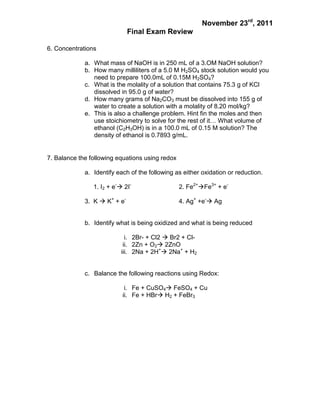
6. Concentrations

             a. What mass of NaOH is in 250 mL of a 3.OM NaOH solution?
             b. How many milliliters of a 5.0 M H2SO4 stock solution would you
                need to prepare 100.0mL of 0.15M H2SO4?
             c. What is the molality of a solution that contains 75.3 g of KCl
                dissolved in 95.0 g of water?
             d. How many grams of Na2CO3 must be dissolved into 155 g of
                water to create a solution with a molality of 8.20 mol/kg?
             e. This is also a challenge problem. Hint fin the moles and then
                use stoichiometry to solve for the rest of it… What volume of
                ethanol (C2H3OH) is in a 100.0 mL of 0.15 M solution? The
                density of ethanol is 0.7893 g/mL.


7. Balance the following equations using redox

             a. Identify each of the following as either oxidation or reduction.

                1. I2 + e- 2I-                  2. Fe2+Fe3+ + e-

             3. K  K+ + e-                      4. Ag+ +e- Ag


             b. Identify what is being oxidized and what is being reduced

                             i. 2Br- + Cl2  Br2 + Cl-
                            ii. 2Zn + O2 2ZnO
                           iii. 2Na + 2H+ 2Na+ + H2


             c. Balance the following reactions using Redox:

                            i. Fe + CuSO4 FeSO4 + Cu
                           ii. Fe + HBr H2 + FeBr3

Final exam review

  • 1.
    November 23rd, 2011 Final Exam Review This is the review for the final exam. It by no means intends to depict the exam’s format, and it is NOT everything you need to know for the final exam. This review is intended to help you have more chemistry practice. Below I have written the topics we have covered this semester (I may have missed some, but you SHOULD have all of them in your notes!The old reviews should help you study as well. Make sure you go over your notes and homework. Do not wait until the day before the exam to study, begin now! 70 percent of the exam will be based on the material covered after third partial. 10 percent will come from first partial. 10 percent will come from second partial. 10 percent will come from third partial. For a total of 100 percent 1. Introduction to chemistry: definition of chemistry 2. Matter 3. Substance 4. Mass vs. Weight 5. Conversions (SI Units and English Units) 6. Properties and changes of matter (physical and chemical… include states of matter) 7. Elements name and symbol of common elements 8. Methods of separating mixtures 9. Types of mixtures 10. The atom and the atomic model 11. Atomic structure (composition, atomic mass, atomic number, average atomic mass) 12. Ions 13. Isotopes 14. Atomic models 15. Ground vs. Excited State 16. Quantum numbers 17. Electron configurations 18. Periodic Table and periodic trends 19. Types of bonds 20. Types of inorganic compounds
  • 2.
    November 23rd, 2011 Final Exam Review 21. Types of reactions 22. Nomenclature 23. Oxidation Numbers 24. Balancing (This will include Redox) 25. Stoichiometry 26. Ideal Gas Law 27. Solutions 28. Concentrations 29. pH Solve the following problems: 1. Draw the orbital diagram, the electron configuration, electron dot notation, and the noble notation of the following elements. Then find the four quantum numbers for the given electron. a. Re (hint this element goes through the f-orbitals): 30th electron b. Cd: 14th electron c. Ra: 83rd electron d. In: 36th electron 2. Differentiate between chemical and physical property and change, give examples of each. 3.Give the names of the following compounds and find the oxidation numbers. a. Ca(C2H3O2)2 b. NO2 c. SiF4 d. VCl5 4. Complete the following reactions, state the type of reaction and balance where necessary, identify the type of inorganic compound: a. K(s) + Cl2(g) b. H2CO3 c. MCO3 d. Fe(s) + CuSO4(aq)  e. AgNO3(aq) + KCl(aq) f. HCl (aq) + NaOH (aq)  g. HBr (aq) + Ba(OH)2 (aq)
  • 3.
    November 23rd, 2011 Final Exam Review 5. Stoichiometry a. Ethanol, also known as grain, can be made from the fermentation of sugar (C6H12O6). The unbalanced chemical equation for the reaction is shown below. C6H12O6 C2H5OH + CO2 Balance the chemical equation and determine the mass of C2H5OH produced from 750 g of C6H12O6. b. Hydrofluoric acid solutions cannot be stored in glass containers because HF reacts readily with silica dioxide in glass to produce hexafluorosilicic acid (H2SiF6). 40.0g SiO2 and 40.0g HF react to yield 45.8 g H2SiF6. SiO2 (s) + 6HF (aq)  H2SiF6 (aq) + 2H2O (l) I. What is the limiting reactant? II. What is the mass of the excess reactant? III. What is the theoretical yield of H2SiF6? IV. What is the percent yield? c. This problem is a challenge problem, harder than the ones we have done before… but not so hard as to where you cannot answer it. Read the problem carefully! Phosphorus (P4) is commercially prepared by heating a mixture of calcium phosphate (Ca3(PO4)2), sand (SiO2), and coke (C) in an electric furnace. The process involves two reactions. 2Ca3(PO4)2 (s) + 6SiO2 (s) 6CaSiO3 (l) + P4O10 (g) P4O10 (g) + 10C (s)  P4 + 10CO (g) The P4O10 produced in the first reaction reacts with an excess of coke (C) in the second reaction. Determine the theoretical yield P4if 250.0 g of Ca3(PO4)2and 400.0 g of SiO2are heated. If the actual yield of P4 is 45.0g, determine the percent yield of P4.
  • 4.
    November 23rd, 2011 Final Exam Review 6. Concentrations a. What mass of NaOH is in 250 mL of a 3.OM NaOH solution? b. How many milliliters of a 5.0 M H2SO4 stock solution would you need to prepare 100.0mL of 0.15M H2SO4? c. What is the molality of a solution that contains 75.3 g of KCl dissolved in 95.0 g of water? d. How many grams of Na2CO3 must be dissolved into 155 g of water to create a solution with a molality of 8.20 mol/kg? e. This is also a challenge problem. Hint fin the moles and then use stoichiometry to solve for the rest of it… What volume of ethanol (C2H3OH) is in a 100.0 mL of 0.15 M solution? The density of ethanol is 0.7893 g/mL. 7. Balance the following equations using redox a. Identify each of the following as either oxidation or reduction. 1. I2 + e- 2I- 2. Fe2+Fe3+ + e- 3. K  K+ + e- 4. Ag+ +e- Ag b. Identify what is being oxidized and what is being reduced i. 2Br- + Cl2  Br2 + Cl- ii. 2Zn + O2 2ZnO iii. 2Na + 2H+ 2Na+ + H2 c. Balance the following reactions using Redox: i. Fe + CuSO4 FeSO4 + Cu ii. Fe + HBr H2 + FeBr3