Race Equality-Past, Present & Future


       Dr Vivienne Lyfar-Cissé
          Transitional Lead
         NHS BME Network
Sir William Macpherson defined institutional racism as:-


“the collective failure of an organisation to provide an appropriate and
professional service to people because of their colour, culture or ethnic
origin. It can be detected in processes, attitudes or behaviour which
amount to discrimination through unwitting prejudice, ignorance,
thoughtlessness and racist stereotyping which disadvantages minority
ethnic people.”
The Race Relations (Amendment) Act (RRAA) 2000


General Duties

 eliminate unlawful discrimination

 promote equality of opportunity and

 promote good relations between people of different racial groups
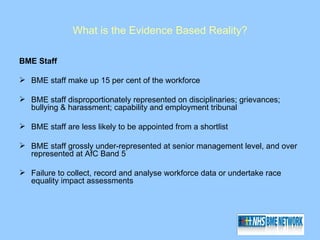
What is the Evidence Based Reality?

BME Staff

 BME staff make up 15 per cent of the workforce

 BME staff disproportionately represented on disciplinaries; grievances;
  bullying & harassment; capability and employment tribunal

 BME staff are less likely to be appointed from a shortlist

 BME staff grossly under-represented at senior management level, and over
  represented at AfC Band 5

 Failure to collect, record and analyse workforce data or undertake race
  equality impact assessments
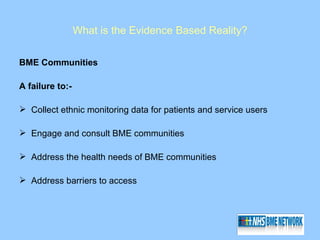
What is the Evidence Based Reality?

BME Communities

A failure to:-

 Collect ethnic monitoring data for patients and service users

 Engage and consult BME communities

 Address the health needs of BME communities

 Address barriers to access
The Vision
            NHS BME Network

“an independent and effective voice for BME
staff, BME patients and BME service users
to ensure the NHS delivers on its statutory
duties regarding race equality”


              Hope, Change and Bottom Up
Naaz Coker Racism in Medicine (2001)

describes racism as:
“one of the most difficult and painful words in the
English language. It is a word that inspires fear,
anger and revulsion in equal measures from all
manner of people. It both describes and creates
barriers between people. It is a work associated
with conflict, with power and ideology. Not
surprisingly then it is a word that gets a great deal
of use but which is rarely discussed openly,
dispassionately and with neither malice or
dismissiveness”.
                  Hope, Change and Bottom Up
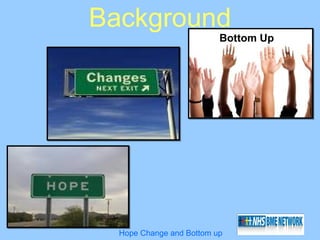
Background
                          Bottom Up


  Hope Change and Bottom up
NHS BME NETWORK


Operational Framework 2010/11
NHS BME NETWORK
•   An independent and effective voice for BME staff, BME patients and
    BME service users
•   Active Partner in the elimination of racism in the NHS
•   Bottom up approach-empowering of BME staff
•   Making NHS organisations accountable
•   Delivery of quality service to BME people

-   Memorandum of Understanding with the Care Quality Commission
-   Memorandum of Understanding with the Department of Health??

•   Developing Talent and Inspiring BME Leaders
Changes Required

 Elimination of discrimination in the workplace

 Delivery of quality services to BME people

 NHS organisation to be held accountable


                 Hope, Change and Bottom Up
Criteria for Change

 Leadership

 Commitment from senior managers

 BME people (staff, patients & service
  users are equal partners)

 Adequate resources

               Hope, Change and Bottom Up
Hope


“Hope that is not backed by action is likely to
remain an unfulfilled dream”


               Hope, Change and Bottom Up

Final dr lyfar cisse-100710

  • 1.
    Race Equality-Past, Present& Future Dr Vivienne Lyfar-Cissé Transitional Lead NHS BME Network
  • 2.
    Sir William Macphersondefined institutional racism as:- “the collective failure of an organisation to provide an appropriate and professional service to people because of their colour, culture or ethnic origin. It can be detected in processes, attitudes or behaviour which amount to discrimination through unwitting prejudice, ignorance, thoughtlessness and racist stereotyping which disadvantages minority ethnic people.”
  • 3.
    The Race Relations(Amendment) Act (RRAA) 2000 General Duties  eliminate unlawful discrimination  promote equality of opportunity and  promote good relations between people of different racial groups
  • 6.
    What is theEvidence Based Reality? BME Staff  BME staff make up 15 per cent of the workforce  BME staff disproportionately represented on disciplinaries; grievances; bullying & harassment; capability and employment tribunal  BME staff are less likely to be appointed from a shortlist  BME staff grossly under-represented at senior management level, and over represented at AfC Band 5  Failure to collect, record and analyse workforce data or undertake race equality impact assessments
  • 7.
    What is theEvidence Based Reality? BME Communities A failure to:-  Collect ethnic monitoring data for patients and service users  Engage and consult BME communities  Address the health needs of BME communities  Address barriers to access
  • 8.
    The Vision NHS BME Network “an independent and effective voice for BME staff, BME patients and BME service users to ensure the NHS delivers on its statutory duties regarding race equality” Hope, Change and Bottom Up
  • 9.
    Naaz Coker Racismin Medicine (2001) describes racism as: “one of the most difficult and painful words in the English language. It is a word that inspires fear, anger and revulsion in equal measures from all manner of people. It both describes and creates barriers between people. It is a work associated with conflict, with power and ideology. Not surprisingly then it is a word that gets a great deal of use but which is rarely discussed openly, dispassionately and with neither malice or dismissiveness”. Hope, Change and Bottom Up
  • 10.
    Background Bottom Up Hope Change and Bottom up
  • 11.
    NHS BME NETWORK OperationalFramework 2010/11
  • 12.
    NHS BME NETWORK • An independent and effective voice for BME staff, BME patients and BME service users • Active Partner in the elimination of racism in the NHS • Bottom up approach-empowering of BME staff • Making NHS organisations accountable • Delivery of quality service to BME people - Memorandum of Understanding with the Care Quality Commission - Memorandum of Understanding with the Department of Health?? • Developing Talent and Inspiring BME Leaders
  • 13.
    Changes Required  Eliminationof discrimination in the workplace  Delivery of quality services to BME people  NHS organisation to be held accountable Hope, Change and Bottom Up
  • 14.
    Criteria for Change Leadership  Commitment from senior managers  BME people (staff, patients & service users are equal partners)  Adequate resources Hope, Change and Bottom Up
  • 15.
    Hope “Hope that isnot backed by action is likely to remain an unfulfilled dream” Hope, Change and Bottom Up