Update on equality and diversity
Jo Jacomelli, National Data Manager,AAAScreening
Programme, Public Health England
Lisa Summers, National Programme Manager,
AAAScreening Programme, Public Health England
Our responsibilities - PHE
Public Health England (PHE) exists to protect and improve the
public’s health and wellbeing and reduce health inequalities. We do
this through world-class science, advocacy, partnership, knowledge
and intelligence, and the delivery of specialist public health services.
There are commitments to tackle inequalities in:
• the PHE remit letter 2018 – 2019
• PHE’s Strategic Plan for the next four years – better outcomes
by 2020
• a framework for PHE action on health inequalities, 2015 – 2020
• we also have published equality objectives
Equality and diversity2 PHE Screening Division’s Inequalities Strategy
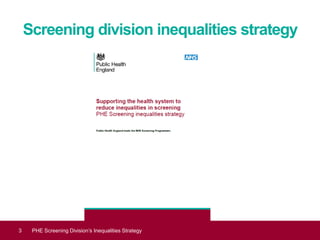
Screening division inequalities strategy
Equality and diversity3 PHE Screening Division’s Inequalities Strategy
Screening division inequalities strategy
The strategy builds on :
• past and current programme specific work
• stakeholder workshop on screening inequalities
• inequalities network
• stakeholder engagement and consultation
• PHE annual conference in September 2017
Implement through programme specific and generic actions
Equality and diversity4 PHE Screening Division’s Inequalities Strategy
Screening division inequalities strategy
The strategy seeks to address the unwarranted, and unfair barriers that may
mean people don’t participate in screening when, after due consideration,
they would wish to.
It also recognises that an informed decision to accept or opt out of screening
is one for the individual involved to make. It should ideally be congruent with
their values and unique circumstances and free from pressure.
Equality and diversity5 PHE Screening Division’s Inequalities Strategy
Vision, aims and objectives
Our vision is that all screening services can be accessed fairly by all
communities and that everyone, regardless of their social and personal
circumstance, has an opportunity to make an informed personalised choice
about screening
Our aim is to maximise the health outcomes of national screening
programmes and reduce the overall burden of health inequalities.
Our objectives are to:
• provide leadership and strategic direction, to tackle inequalities in
screening
• provide those responsible for the delivery and commissioning of screening
with the evidence and tools to identify and tackle screening inequalities
within local communities and eligible screening groups they support the
reduction of screening inequalities
Equality and diversity6 PHE Screening Division’s Inequalities Strategy
What PHE Screening can do
What PHE Screening can do:
• provide leadership and strategic direction, to tackle inequalities in
screening
• provide those responsible for the delivery and commissioning of screening
with the evidence and tools to identify and tackle screening inequalities
within local communities and eligible screening groups they support the
reduction of screening inequalities
Equality and diversity7 PHE Screening Division’s Inequalities Strategy
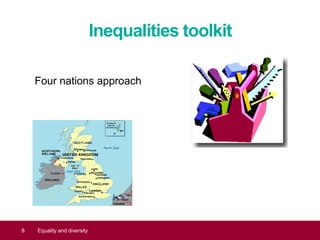
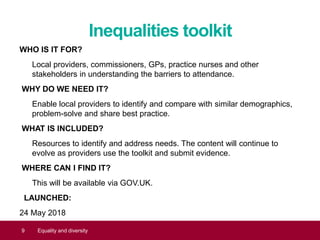
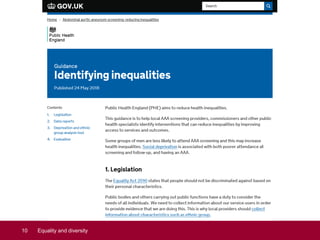
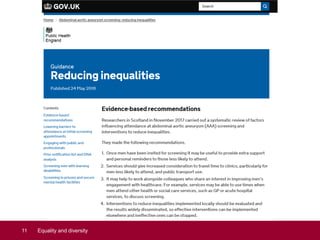
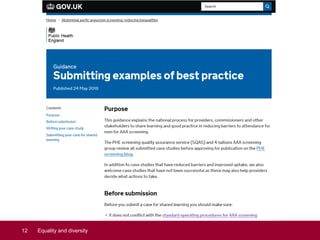
Inequalities toolkit
Four nations approach
8 Equality and diversity
Inequalities toolkit
WHO IS IT FOR?
Local providers, commissioners, GPs, practice nurses and other
stakeholders in understanding the barriers to attendance.
WHY DO WE NEED IT?
Enable local providers to identify and compare with similar demographics,
problem-solve and share best practice.
WHAT IS INCLUDED?
Resources to identify and address needs. The content will continue to
evolve as providers use the toolkit and submit evidence.
WHERE CAN I FIND IT?
This will be available via GOV.UK.
LAUNCHED:
24 May 2018
2018 – delay due to Purdah (pre-election period)9 Equality and diversity
10 Equality and diversity
11 Equality and diversity
12 Equality and diversity
What next?
• Four nations ownership
• Toolkit evolution
• Submission process
• How will new inequalities initiatives be announced?
• Audit and service evaluation
13 Equality and diversity
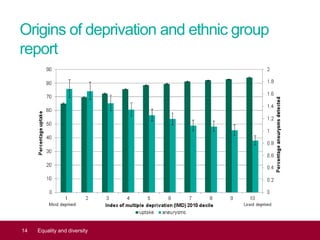
Origins of deprivation and ethnic group
report
14 Equality and diversity
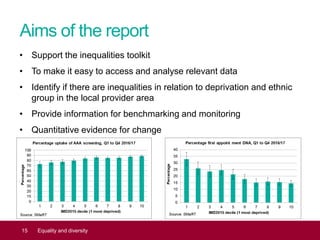
Aims of the report
• Support the inequalities toolkit
• To make it easy to access and analyse relevant data
• Identify if there are inequalities in relation to deprivation and ethnic
group in the local provider area
• Provide information for benchmarking and monitoring
• Quantitative evidence for change
15 Equality and diversity
Rationale for change
• Deprivation and ethnic group are not the only drivers of
inequalities
• Changing availability of data
• Duty to make best use of available data
16 Equality and diversity
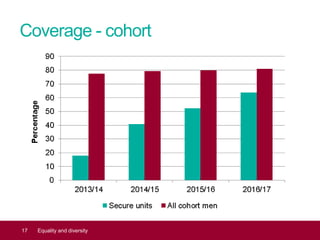
Coverage - cohort
17 Equality and diversity
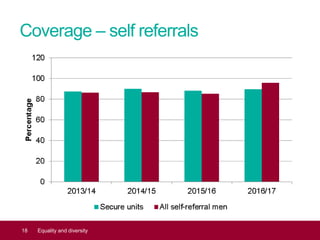
Coverage – self referrals
18 Equality and diversity
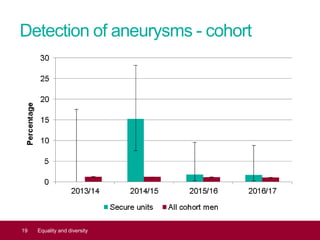
Detection of aneurysms - cohort
19 Equality and diversity
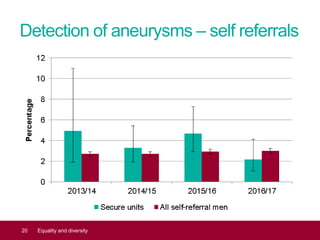
Detection of aneurysms – self referrals
20 Equality and diversity
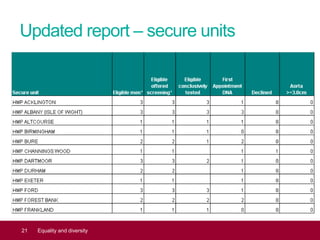
Updated report – secure units
21 Equality and diversity
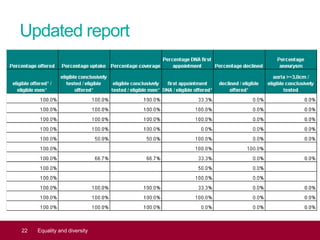
Updated report
22 Equality and diversity
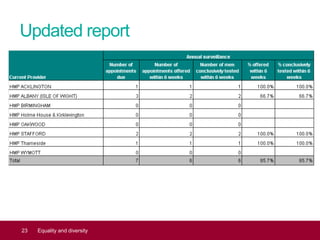
Updated report
23 Equality and diversity
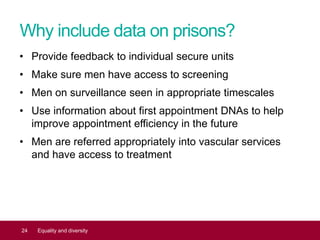
Why include data on prisons?
• Provide feedback to individual secure units
• Make sure men have access to screening
• Men on surveillance seen in appropriate timescales
• Use information about first appointment DNAs to help
improve appointment efficiency in the future
• Men are referred appropriately into vascular services
and have access to treatment
24 Equality and diversity
Next steps and timeframes
• Pilot with providers
• Aim to introduce in Q2 (October 2018)
25 Equality and diversity

4) lisa summers and jo jacomelli

  • 1.
    Update on equalityand diversity Jo Jacomelli, National Data Manager,AAAScreening Programme, Public Health England Lisa Summers, National Programme Manager, AAAScreening Programme, Public Health England
  • 2.
    Our responsibilities -PHE Public Health England (PHE) exists to protect and improve the public’s health and wellbeing and reduce health inequalities. We do this through world-class science, advocacy, partnership, knowledge and intelligence, and the delivery of specialist public health services. There are commitments to tackle inequalities in: • the PHE remit letter 2018 – 2019 • PHE’s Strategic Plan for the next four years – better outcomes by 2020 • a framework for PHE action on health inequalities, 2015 – 2020 • we also have published equality objectives Equality and diversity2 PHE Screening Division’s Inequalities Strategy
  • 3.
    Screening division inequalitiesstrategy Equality and diversity3 PHE Screening Division’s Inequalities Strategy
  • 4.
    Screening division inequalitiesstrategy The strategy builds on : • past and current programme specific work • stakeholder workshop on screening inequalities • inequalities network • stakeholder engagement and consultation • PHE annual conference in September 2017 Implement through programme specific and generic actions Equality and diversity4 PHE Screening Division’s Inequalities Strategy
  • 5.
    Screening division inequalitiesstrategy The strategy seeks to address the unwarranted, and unfair barriers that may mean people don’t participate in screening when, after due consideration, they would wish to. It also recognises that an informed decision to accept or opt out of screening is one for the individual involved to make. It should ideally be congruent with their values and unique circumstances and free from pressure. Equality and diversity5 PHE Screening Division’s Inequalities Strategy
  • 6.
    Vision, aims andobjectives Our vision is that all screening services can be accessed fairly by all communities and that everyone, regardless of their social and personal circumstance, has an opportunity to make an informed personalised choice about screening Our aim is to maximise the health outcomes of national screening programmes and reduce the overall burden of health inequalities. Our objectives are to: • provide leadership and strategic direction, to tackle inequalities in screening • provide those responsible for the delivery and commissioning of screening with the evidence and tools to identify and tackle screening inequalities within local communities and eligible screening groups they support the reduction of screening inequalities Equality and diversity6 PHE Screening Division’s Inequalities Strategy
  • 7.
    What PHE Screeningcan do What PHE Screening can do: • provide leadership and strategic direction, to tackle inequalities in screening • provide those responsible for the delivery and commissioning of screening with the evidence and tools to identify and tackle screening inequalities within local communities and eligible screening groups they support the reduction of screening inequalities Equality and diversity7 PHE Screening Division’s Inequalities Strategy
  • 8.
    Inequalities toolkit Four nationsapproach 8 Equality and diversity
  • 9.
    Inequalities toolkit WHO ISIT FOR? Local providers, commissioners, GPs, practice nurses and other stakeholders in understanding the barriers to attendance. WHY DO WE NEED IT? Enable local providers to identify and compare with similar demographics, problem-solve and share best practice. WHAT IS INCLUDED? Resources to identify and address needs. The content will continue to evolve as providers use the toolkit and submit evidence. WHERE CAN I FIND IT? This will be available via GOV.UK. LAUNCHED: 24 May 2018 2018 – delay due to Purdah (pre-election period)9 Equality and diversity
  • 10.
    10 Equality anddiversity
  • 11.
    11 Equality anddiversity
  • 12.
    12 Equality anddiversity
  • 13.
    What next? • Fournations ownership • Toolkit evolution • Submission process • How will new inequalities initiatives be announced? • Audit and service evaluation 13 Equality and diversity
  • 14.
    Origins of deprivationand ethnic group report 14 Equality and diversity
  • 15.
    Aims of thereport • Support the inequalities toolkit • To make it easy to access and analyse relevant data • Identify if there are inequalities in relation to deprivation and ethnic group in the local provider area • Provide information for benchmarking and monitoring • Quantitative evidence for change 15 Equality and diversity
  • 16.
    Rationale for change •Deprivation and ethnic group are not the only drivers of inequalities • Changing availability of data • Duty to make best use of available data 16 Equality and diversity
  • 17.
    Coverage - cohort 17Equality and diversity
  • 18.
    Coverage – selfreferrals 18 Equality and diversity
  • 19.
    Detection of aneurysms- cohort 19 Equality and diversity
  • 20.
    Detection of aneurysms– self referrals 20 Equality and diversity
  • 21.
    Updated report –secure units 21 Equality and diversity
  • 22.
  • 23.
  • 24.
    Why include dataon prisons? • Provide feedback to individual secure units • Make sure men have access to screening • Men on surveillance seen in appropriate timescales • Use information about first appointment DNAs to help improve appointment efficiency in the future • Men are referred appropriately into vascular services and have access to treatment 24 Equality and diversity
  • 25.
    Next steps andtimeframes • Pilot with providers • Aim to introduce in Q2 (October 2018) 25 Equality and diversity